
CHSE Odisha Class 12 Political Science Unit 1 Democracy in India Long Answer Questions

Odisha State Board CHSE Odisha Class 12 Political Science Solutions Unit 1 Democracy in India Long Answer Questions.

CHSE Odisha 12th Class Political Science Unit 1 Democracy in India Long Answer Questions

Long Questions With Answers

Question 1.
Write Meaning of Democracy with giving different definitions of democracy.
Answer:
Long back, former President of the United States of America, Abraham Lincoln said, “Democracy is a government of the people, for the people, and by the people.” The term ‘democracy’ comes from the Greek word demokratia which means “rule of the people”. It was coined from two words: demos that means “people” and Kratos which refers to “power”. That is, in a democracy the power rests with the people. This meaning is based on the experiences of the governments that existed in some of the Greek city-states, notably Athens.

And, today also, democracy is defined as a form of government in which the supreme power is vested in the people and exercised by them directly or indirectly through a system of representation usually involving periodic free elections. When you examinethe definitions of democracy, as suggested above, you will find that most of those definitions define democracy as a form of government which is run by the elected representatives.

Democracy has been defined in many ways. Bryce believes that “Democracy really means nothing more or less than the rule of the whole people, expressing their Sovereign will by their votes”. Maclver observes, “Democracy is not a way of governing, whether by majority or otherwise, but primarily a way of determining, who shall govern, and broadly to what ends”.

It means more than a mere form of government. In its comprehensive form, democracy means, or ought to mean,

  • a form of government,
  • a type of state,
  • a pattern of social system,
  • a design of economic order, and
  • a way of life and culture. Therefore, when we say that India is a democracy, we mean not only that its political institutions and processes are democratic but also that the Indian society and every Indian citizen is democratic, reflecting basic democratic values of equality, liberty, fraternity, secularism and justice in the social environment and individual behaviour.

Quention 2.
What are the Essential Conditions For Democracy?
Answer:
A system can be termed as a genuine and comprehensive democracy only when it fulfills both political and socio-economic aspects of people’s participation and satisfaction. Let us identify those. There may be two major categories:
(1) political conditions and
(2) social and economic conditions
The fulfillment of the first leads to political democracy and the second as social democracy. Obviously, the first and the foremost, are political conditions of democracy. It is essential that for a system to be democratic, we must adopt a Constitution and laws that vest supreme power in the people.

The human rights and fundamental rights, such as equality, liberty of thought and expression, belief, movement, communication and association must be protected by the Constitution. The democratic system has to have universal adult franchise as the basis of electing representatives at various levels of the government. Moreover, opportunities for political participation of all the citizens not only in elections at regular interval, but also in other aspects of the political process have to be made available.

There has to be a responsible government in which the executive is answerable to the legislature, the legislature to the people and the Judiciaiy to remain independent. Political institutions like political parties and interest and pressure groups (associations, various non-governmental organizations) must be functional for expressing popular needs, demands and grievances. A democratic system is strengthened if it maintains an enlightened public opinion in its various forms through free press and other communication processes. Political democracy is thus one which incorporates all the above political traits.

Question 3.
What is the social and economic conditions of democracy?
Answer:
A democratic system has to ensure that the social development is in tune with democratic values and norms reflecting equality of social status and opportunities for development, social security and social welfare. Citizens must avail opportunities of universal and compulsory education. They must also be enabled to utilize means of economic development. The fruits of economic development must reach all and especially to the poor and the deprived sections of the society. Socio-economic development of the people strengths social democracy.

Question 4.
What are the challenges to democracy?
Answer:
Since independence India has been functioning as a responsible democracy. The same has been appreciated by international community. It has successfully adapted to the challenging situations. There have been free and fair periodic elections for all political offices from the panchayats to the President. There has been smooth transfer of political power from one political party or set of political parties to others, both at national and state levels on many occasions.

You will find many examples in our neighbouring countries like Pakistan, Myanmar and even Bangladesh where transfer of power has been done through military coups. The legislative, executive and judicial organs have been functioning properly.The Parliament and the State Legislatures control the Executives effectively through the means like question hours, etc.

More importantly, some significant enactments like the Right to Information (RTI) Act 2005, Right to Education 2009 and other welfare means have empowered the people. The mass media, including print and electronic, have full autonomy and play a key role in formulating and influencing public opinion. Significant social change has taken place in almost all walks of life and the nation is moving ahead on course of socio-economic development.

India is a very large country full of diversities – linguistically, culturally, religiously. At the time of independence it was economically underdeveloped. There were enormous regional disparities, widespread poverty, illiteracy, unemployment, and shortage of almost all public welfare means. Citizens had enormous expectations from independence.

As mentioned above, India has changed a lot. Yet, there are various challenges that the country faces in terms of fulfillment of expectations of various sections of society. The challenges come both from prevailing domestic and international conditions as well as lack of adequate prerequisites for a smooth functioning of democracy. These are discussed below.

Question 5.
How Illiteracy is a factor challenging democracy?
Answer:
Illiteracy among people was a matter of grave concern for the successful functioning of democracy in India on the eve of independence and it still continues to be a major challenge. The level of education of citizens is a key to both the successful functioning of democracy and socio-economic development of the country. And perhaps, more importantly, it is an essential condition for human dignity. But the state of formal literacy was almost dismal when India achieved independence.

The literacy rate in 1951 was mere 18.33 per cent and female literacy was negligible with 8.9 percent. It was, therefore, feared by many that the citizens would not be able to play their roles effectively and exercise their right to vote meaningfully which is an individual’s expression of the power of the people, this apprehension, however, has been proved wrong by the Indian electorate over the years.

In spite of a substantial number of them being illiterates, they have demonstrated maturity in the exercise of their right to vote on more than one occasion thus resulting peaceful transfer of political power since independence. The Indian National Congress under the leadership of Ms. Indira Gandhi was very popular and powerful during the early part of 1970s.

But in 1977’s general election, the people of India rejected her primarily because of the misuse of power during emergency in 1975-1977 and provided an opportunity to the. first nomCongress government at the Centre in form of the Janata Party. After that there have been changes in the governments both at the Centre and in the States almost regularly. Literacy is necessary not simply for enabling citizens to participate in elections and exercise their right to vote effectively, it has other important implications as well. Literacy enables citizens to be aware of various issues, problems, demands, and interests in the country.

It also makes them conscious of the principles of liberty and equality of all and ensures that the representatives elected by them truly represent all the interests in the society.Universal literacy is therefore a must for the successful functioning of Indian democracy. Although according to 2011 Census, the literacy rate has risen to 74.04 per cent, the female literacy rate is still lagging at 65.46 per cent.

This means that over one-fourth of the country’s population is still illiterate while among women nearly one out of three is not literate. If the children have access to basic education, the problem of illiteracy can be checked. Recently, the Right to Education is provided as a fundamental right. We hope that this will help the cause of educating the children universally.

CHSE Odisha Class 12 Political Science Unit 1 Democracy in India Long Answer Questions

Question 6.
How Poverty is affecting democracy?
Answer:
It is generally said that for a hungry person right to vote does not have any meaning. For him/her the first requirement is food. Therefore, poverty is considered as the greatest bane of democracy. It is, in fact, the root cause of all kinds of deprivations and inequalities. It is the state of denial of opportunities to people to lead a healthy and fulfilling life. Of course, India inherited poverty from the long exploitative British colonial rule, but it continues to be one of the gravest problems today.

Even now a considerable proportion of Indian population lives below poverty line, called ‘BPL’. The poverty line means an income level below which human beings cannot provide for their basic necessities of food, much less for clothes and shelter. The governmental definition of poverty line during the 1960s sought to measure ihe extent of poverty on the amount of income requiredto purchase a barest minimum desirable food having nutritional standards of caloric intake by a person.

According to it, in Indian conditions, a person in rural areas needs an average of 2400 calories per day and in urban areas an average of 2100 calories per day in order to keep himself above the poverty line.

During the 1990s non-food items’like clothes, employment, shelter, education, etc. got included in the definition of poverty. Poverty in the contemporary phase is linked with systemic deprivation of rights. It is also associated with the notion of Human Development Index (HDI) as championed by Mabud-ul-Haq and Amartya Sen. Viewed from the HDI perspective, the definition of poverty also includes socio-economic-political and human rights issues under its ambit.

The persisting phenomenon of poverty is attributed to any factors, one of which is mass unemployment and under-employmenf. A large number of people in rural areas do not have regular and adequate work. In urban areas also the number of educated unemployed is very high. The growing population is regarded as a reason for poverty, though population is considered as,rthe greatest resource in the country. In fact, the process of economic development has not been able to ensure social justice and gap between rich and poor has not been bridged. Because of all this, poverty continues to remain a great challenge to Indian democracy.

Question 7.
How Gender Discrimination is affecting democracy?
Answer:
Discrimination against girls and women exists in every walk of life. You must have had such experiences of prevailing gender inequality in our society and polity. But we know that gender equality is one of the basic principles of democracy. The Constitution of India enjoins upon the State to ensure that men and women are treated as equals and there is no discrimination against women.

Fundamental Rights and Fundamental Duties as well as the Directive Principles of State Policy make these intensions very clear. But the discrimination against females continues to be a fact of life. It is clearly reflected in the sex ratio, child sex ratio and maternal mortality rate. The number of females in comparison to males has been declining ever since 1901. In 1901, the sex ratio was 972 females per 1000 males. It came down to 927 females per 1000 males in 1991.

According to 2011 Census it is 940 females per 1000 males which is still very unfavourable to females. In some of the States, the 2011 Census reported a very low sex ratio of 877 females per 1000 males (Haryana), the lowest being 618 in Daman & Diu and 866 in the NCT of Delhi. The child sex ratio is a matter of greater concern. According to 2011 Census, the child sex ratio (0-6 years) in India is only 914 female children per 1000 male children. This is lower than the 2001 Census which reported child sex ratio of927 female children per 1000 male children.

It has been declining because of several factors, like the prevailing preference for male child, discriminatory treatment against the girl child right after birth, and the increasing incidence of female infanticides and female foeticides. By using technology, people are forcing mothers td get the fetus of a female child aborted. The infant mortality rate among girl children is high, as compared to that among boy children. The maternal mortality ratio as per the Sample Registration System 2004-06 is 254 per lakh live births, which is considered very high.

Question 8.
How Casteism, Communalism, Religious Fundamentalism is challenge for democracy?
Answer:
The Indian democracy faces serious challenges also from casteism, communalism and religious fundamentalism. They weaken the functioning and stability of democratic system.
(a) Casteism: The caste system which presumably originated in the division of labour in the ancient society has become a more or less rigid group classification, based on birth. Have you ever experienced the role of caste in your life and society? You will agree that the most detrimental and inhuman aspect of the caste system is the practice of untouchability which is continuing in spite of the constitutional ban imposed on it.

This has led to segregation of so called low castes or ‘Dalits’, depriving them of education and other social benefits.The Dalits have been typically performing menial labour and some of the hardest physical work in society. Casteism has played a negative role even in the democratic political processes, in fact, casteism has become notorious as a strategy of exploitation of caste consciousness for narrow political gains. The caste system acts against the roots of democracy.

The democratic facilities – like fundamental rights relating to equality, freedom of speech, expression and association, participation in the electoral process, free media and press, and even legislative forums – are misused for maintaining casteist identity.Casteism has also been contributing towards continuation of socio-economic inequalities. It is true that India has been an unequal society from times immemorial. The Scheduled Castes (SCs), the Scheduled Tribes (STs) and the backward classes have suffered down the ages from socio-economic deprivations.

There are enormous inequalities in our society which are posing serious challenge to Indian democracy. What is more alarming is the mixing of caste and politics resulting into‘politicization of caste’ and ‘casteization of politics’ in contemporary Indian polity which has become a grave challenge to our democracy. Despite the era of liberalization and globalization caste consciousness has not been eroded in our society and castes are being increasingly used as vote bank politics.

(b) Communalism: Communalism and religious fundamentalism have acquired a very dangerous form and alarming proportion in India. They disrupt the pattern of co-existence in our multi-religious society. Communalism is-an affront to India’s nationalist identity and a tragic setback to its evolving secular culture. It is subversive of our democratic political stability and destroyer of our glorious heritage of humanism and composite culture. Quite often, communalism is wrongly used as a synonym for religion or conservatism. Adherence to a religion or attachment to a religious community is not communalism.

Religious Fundamentalism
Religious fundamentalism also reinforces communalists in exploiting both religion and politics. In fact, fundamentalism acts as an ideology which advocates a return to orthodoxy and a strict compliance to the fundamental tenets of religion. Religious fundamentalists vehemently oppose progressive reforms in order to establish their exclusive control on their respective communities.

Regionalism
Indian democracy has also been struggling with regionalism which is primarily an outcome of regional disparities and imbalances in development. We all know that India is a plural country with diversities of religions, languages, communities, tribes and cultures. A number of cultural and linguistic groups are concentrated in certain territorial segments. Although development process in the country aims at growth and development of all regions, the regional disparities and imbalances in terms of differences in per capita income, literacy rates, state of health and educational infrastructure and services, population situation and levels of industrial and agricultural development continue to exist.

Existence and continuation of regional inequalities both among States and within a State create a feeling of neglect, deprivation and discrimination. This situation has led to regionalism manifested in demands for creation of new States, autonomy or more powers to States or even secession from the country. It is true that regionalism and sub-regionalism are unavoidable in a vast and plural country like India. It is not always correct to consider every attempt to support or defend regional or sub-regional interests as divisive, fissiparous and unpatriotic.

The problem begins when these interests are politicized and regional movements are promoted for ulterior political motives. Such unhealthy regional or sub-regional patriotism is cancerous and disruptive. The continuing regional imbalances have given rise to militant movements in certain parts of our country. Separatist demands in Jammu and Kashmir or by ULFA (United Liberation Front of Assam) in Assam or by different groups in the North-Eastern region are matters of grave concern for Indian polity.

Corruption
Corruption in public life has been a major concern in India. In 2011, India was ranked 95th of 183 countries defined as corrupt in Transparency International’s Corruption Perceptions Index (CPI). In fact, corruption is rampant in all walks of life, be it land and property, health, education, commerce and industry, agriculture, transport, police, armed forces, even religious institutions or so called places of spiritual pursuits.

Corruption continues to exist in covert and overt ways at all three levels – political, bureaucratic and corporate sector. One can see the nexus between the politicians, the bureaucrats and the industrialists which has resulted into corruption and corrupt practices. The tentacles of corruption have affected all organs of government, including the judiciary.

Criminalization of Politics
In recent years, criminalization of politics in India has become a debatable issue. There have been allegations that there are some elements in politics who do not have faith in democratic values and practices. They indulge in violence and take refuge in otjter unhealthy, undemocratic methods to win elections. Undoubtedly, this is not a healthy trend in politics and there is an urgent need to apply serious check on such tendencies.

Criminalization of politics is tke very negation of democratic values and has no place in a ‘ democratic set up. Democracy can be strengthened by adopting and promoting democratic values and shunning criminal activities. Recently, the judiciary, while taking a serious , note of criminal tendencies in politics, has showed signs of adopting remedial measures to apply a serious check on such elements.

The Central government and many State governments have been taking steps to address this issue effectively. This is a matter of great satisfaction and a healthy sign for the successful functioning of democracy in our country. We, as awakened citizens and as voters of the largest democracy in the world, can also contribute by discouraging such persons who have a criminal background, from contesting elections.

Question 8.
How to tackle the challenges of Democracy?
Answer:
It is thus clear that democracy in India faces certain serious challenges. These are causes of serious concern to all. In fact, the leadership.of the freedom movement and especially the framers of the Indian Constitution themselves were very much aware of these issues, they made a number of constitutional provisions to address the same. Since independence governments have taken various measures to respond to many of these challenges.

There have been significant improvements in some of these. However, lots still have to be done. For that, efforts have been going on. These is need for collaboration among governmental agencies, political parties, civil society and citizens in general. Certain . significant corrective measures that have been adopted and can be initiated are as follows:

Universal Literacy ‘Education for All’
The significance and necessity of education for efficient functioning of democracy , was appreciated by the framers of the Indian Constitution. Which is why, free and compulsory education to all children up to the fourteen years of age continued to remain constitutional commitment in IndiaA arious governments at national and state levels have i been making efforts to attain this goal.

As a follow up of the National Policy on Education1986, a National Literacy Mission was set up in 1988 to plan and implement programmes for the removal of illiteracy under the platform, Sarva Shiksha Abhiy an. But the goal of universal literacy is yet to be attained.

Currently a nation-wide programme known as Saakshar Bharat is being implemented. It aims at developing functional literacy and numeracy to non-literate and non-numerate adults in the age group of fifteen and above, to enable them to continue their learning beyond basic literacy and acquire equivalence to formal educational system. The Sarva Shiksha Abhiyan is a flagship programme for universalization of elementary education for children between 6-14 years of age. Further, the Parliament of India in 2009 passed the Right to Education Act through which education has become a fundamental right for all children of age group’6-14 years.

Poverty Alleviation
From the 1970s, a number of programmes have been implemented for alleviation of poverty in India. These programmes fall into two broad categories:
(1) There are programmes to lift beneficiaries above poverty line by providing them with productive assets or skills or both, so that they can employ themselves usefully and earn greater income,
(2) Programmes are also being implemented to provide temporary wage employment for the poor and the landless.

Elimination of Gender Discrimination
It is now being recognized that the goals of democracy “of the people, for the people and by the people” can not be fully realized if the female population are not included in all ways in the processes of socio-economic and political development. That is why, besides constitutional provisions, several laws have been enacted, policies have been made and implemented and institutional reforms have been carried out for the development of women.

The 73rd and 74th Amendments of Indian Constitution in 1993 are the milestones in the process of political empowerment of women. These Amendments have reserved one-third of the seats in the Panchayati Raj Institutions, Municipalities and Municipal Corporations. Another significant development has been the adoption of the National Policy for Empowerment of Women in 2001, the overarching goal of which is to “bring about the advancement, development and empowerment cf women.” But a lot needs to be done to attain this goal.

Removal of Regional Imbalance
Redressing regional imbalances has indeed been a vital objective of the planning process in India. Efforts are on to reduce regional disparities. Besides, the Statespecific efforts for reducing intra-State regional disparities, a number of Centrally Sponsored Programmes have been in operation for the last two to three decades for taking care of specific aspects of backwardness of such regions.

Administrative and Judicial Reforms
The success of all the above stated corrective measures primarily depends on the efficient functioning of administration and independence and righteousness of the judicial system. But on both counts, a lot needs to be done. The performance of public administration in India has come under close scrutiny in the last few years. Rampant corruption, inefficiencies, wastages and irresponsiveness to the needs of citizens are some of the , commonly acknowledged problems afflicting the administration.

No doubt, the Indian judiciary lias remained independent and neutral; there are serious problems of
(1) slow disposal of cases leading to delays as well as accumulation of backlog, and
(2) very low rate of prosecution in criminal cases.

Administrative reforms have continuously been on the agenda of the government ever since independence. A number of Commissions and Committees have been set up in this regard. But bureaucratic reluctance to change has prevented the reforms to take place in full measure; The recommendations of various Commissions and Committees focus around the need
(1) to make administration accountable and citizen friendly,
(2) to build its capacity for quality governance,
(3) to orient administration for promoting peoples’ participation, decentralization and devolution of powers,
(4) to make administrative decision-making process transparent,
(5) to improve the performance and integrity of the public services,
(6) to reinforce ethics in administration.
(7) to inculcate readiness for e-govemance. Judicial reform also has been a critical concern since long. Various recommendations have been made on many occasions. The major issues that need consideration in this regard are:

  • Simplification of Rules and Procedures,
  • Repealing Out-dated Laws,
  • Increase in the Judge Population Ratio,
  • Time-bound filling of Vacant Posts in Judiciary,
  • Transparency in Appointment, Promotion and Transfer of Judges,
  • Judicial Accountability; and
  • Transparency of Court Proceedings.

Sustainable Development (Economic, Social, Environmental)
Indian democracy can adequately respond to all the challenges when it moves forward on the path of sustainable development. A model of development without taking into account the basic needs of millions, today as well as in the future, can not be conducive for the survival of democracy. Development has to be human-centred and directed towards improvement of quality of life of all the people. It has to be focused on removal of poverty, ignorance, discrimination, disease and unemployment. The development process has to aim at sustained economic, social and environmental development.

CHSE Odisha Class 12 Political Science Unit 1 Democracy in India Long Answer Questions

Question 9.
what is SGSY?
Answer:
In 1999, Swarnajayanti Gram Swarozgar Yojana (SGSY) was conceived as a holistic programme of micro enterprise development in rural areas with emphasis on organizing the rural poor into self-help groups (SHGs), capacity building, planning of activity clusters, infrastructure support, technology, credit and marketing linkages. This programme has impacted many rural poor, for example, in Mathur, a village of the Dharmapuri district of Tamil Nadu, 100 women from eight self-help groups were trained in fruit processing by a non-government organization (NGO).

They availed assistance under SGSY to run a fruit processing unit registered under the name of Sathyamurthi Mahalir Mandram in May 2000, The unit produces fruit squash, jam, readyto- serve beverages, pickle, etc. Apart from raising the economic status of the group members, this venture has made the members more aware and they are actively involved in the government schemes, camps and campaigns. They have made significant representations for ensuring provision of basic facilities in their village and by bringing overall development of the area.

Question 10.
Write the meaning and role of political parties.
Answer:
Human beings have always organised themselves in groups and larger formations. Political parties have emerged as one of these human organisations. In modern age the ideal form of government is run through one or the other method of representative institutions. All representative governments and representative institutions require the existence of political parties.

A political party is an organised body of people who share certain common principles and goals regarding the political system of a country. The main purpose of political parties is to acquire and retain political power. Political parties which run the government are called the ruling party. In a coalition government, there may be more than one ruling party. Those who sit in the opposition and criticise and analyse the performance of-the ruling party/ parties generally or on specific issues are called opposition parties. Apolitical party as such should have the following essential features:

  • it must be an organised body of people with a formal membership;
  • it must have clearly spelt out policies and programmes;
  • its members should agree with its ideology, policies and programmes;
  • it must aim at getting power through the democratic process;
  • it must have a clear and acceptable leadership; and
  • it must focus on broad issues and major areas of government policies.

Question 11.
Write about the types of party system.
Answer:
India has a multi-party system- Indian politics is dominated by several national and regional parties. There are countries where there is one-party system or two-party system. Erstwhile Soviet Union and Yugoslavia had single party systems. Similarly, China has one-party system. Earlier in Germany there existed only one-party – the Nazi Party; so was the case in Italy where the only party was known as the Fascist Party. In a two party or bi-party system there are two main political parties.

The United Kingdom (UK), the United States of America (USA), Australia and New Zealand have bi-party systems. There may exist other parties but their role is generally insignificant. For example in UK, there are two main parties, the Conservative Party and the Labour Party. In the USA the two main parties are the Republican Party and the Democratic Party. Japan, France, Germany and Switzerland have multi-party systems.

Question 12.
Write about the evlution of party system in India.
Answer:
The evolution of Indian party system can be traced to the formation of the Congress, as a political platform in 1885. Other parties and groups originated later. The Indian National Congress was formed as a response to the colonial rule and to achieve independence from the British rule. After independence and with the adoption of a democratic Constitution, a new party system emerged in the wake of the first general elections based on universal adult franchise in 1952.

In preceding lesson you have learnt about the universal adult franchise in detail. During the post-independence period, the party system passed through various phases.The first phase is known as the phase of one-party dominance because with the exception of Kerala during 1956-59, the ruling party both at the Centre and in the states was the Congress. The second phase (1967-1975) saw the emergence of a multi-party system in India. In the Assembly elections in 1967, Congress was defeated in eight States.

For the first time non-Congress parties formed governments in these states. These parties formed coalition governments. Then came the split in Congress into Congress (O) and Congress (N). However, the Congress again became a dominant force at the Centre after winning 1971 mid-term poll. Then came the emergency period (1975-77) which is known as the authoritarian period of Indian democracy.

With the lifting of emergency, the dominance of Congress ended. In the general elections of 1977 Congress was defeated by the Janata Party. Janata Party came into existence as a result of the merger of many opposition parties. But again in 1980 general elections Congress came back to power and remained in power till 1989. Janata Party emerged out of the merger of Congress (O) led by Moraiji Desai, Bharatiya Lok Dal led by Ch. Charan Singh, Congress for Democracy (CFD) led by Jagjivan Ram and H.N. Bahuguna, the socialists led by George Fernandes and Jana Sangh led by L.K. Advani.

In 1989 elections, the National Front joined government with the support of BJP and the Left Front.But this formation could not last its tenure and elections for the tenth Lok Sabha were held in May- June, 1991. Congress again formed government at the Centre. In 1.996 general elections BJP emerged as the single largest party and was asked to form government at the Centre. Since it could not prove its majority within the given time it had to resign. The United Front which was a combination of thirteen parties, formed the government at the Centre with the external support of the Congress and the CPI(M).

But this government also could not last its full term. Although the coalition government formed under the leadership of BJP after 1998 elections was defeated in Lok Sabha, the 1999 elections again provided them the opportunity to form government which lasted its full term under a multi-party coalition, known as National Democratic Alliance (NDA). In the 14th general elections held in 2004, Congress emerged as the single largest party.

It formed alliance with like minded parties and formed government at the Centre. The phase of Indian party system which began in 1989 and is still continuing has been aptly called a phase of coalition politics. No single party has been able to form government on its own at the Centre.

Question 13.
Write about two types of major parties in India.
Answer:
India has two types of political parties – national parties and regional parties. National parties are those which generally have influence all over the country. It is not necessary that a national party will have equal strength in all the states; it varies from State to State. A party is recognised as a national party by the Election Commission on the basis of a formula. The political party which has secured not less than four percent of the total valid votes in the previous general elections at least in four states, is given the status of a national party.

The number of national parties has been changing. In the year 2006, Indian National Congress, Bharatiya Janata Party, Communist Party of India (Marxist) [CPI(M)], Communist Party of India (CPI), Bahujan Samaj Party, and the Nationalist Congress Party were national parties. However, there are other parties in India, which do not enjoy national influence. Their activities and influence are restricted to particular states or regions. Sometimes these parties are formed to voice demands of a specific region.

These parties are neither weak nor short-lived. Sometimes they prove to be very powerful in their respective regions. These are known as regional parties. Major regional parties are AIADMK and DMK in Tamil Nadu, Telugu Desam in Andhra Pradesh, Akali Dal in Punjab, National Conference in Jammu dnd Kashmir, Jharkhand Mukti Morcha in Jharkhand, Asam Gana Parishad in Assam and Nationalist Congress Party and Shiv Sena in Maharashtra.

Question 14.
Write about Indian National Congress.
Answer:
As you have already read, Indian National Congress was formed in the year 1885 in Bombay. W.C. Banarjee was the first President of the Indian National Congress. To begin with, Congress was an organisation of middle class intellectuals who were primarily concerned with political reforms in the British colonial rule. In the twenties under the leadership of Mahatma Gandhi, the Congress became a mass based organisation. The party started enjoying the support of the common people and played a very significant role in the freedom struggle.

After independence Jawahar Lai Nehru became the Prime Minsiter and led the Congress till his death in 1°64. As already mentioned in an earlier paragraph, this was known as the ‘Nehru era’. The Congress party won first five general elections in 1952, 1957, 1962,1967 and 1971. In 1975 national emergency was declared which went on till 1977. In the elections of 1977, the Congress was defeated.

However, in 1980 general elections, the Congress Party led by Indira Gandhi came back to power. Indira Gandhi was assassinated in 1984 and during 1985 general elections, Rajiv Gandhi was the leader of the party. Congress won the 1985 general elections with a larger majority. In 1989 though Congress could not get absolute majority, it was the single largest party. In the tenth general
elections in 1991.

Congress again emerged as the single largest party and formed the government at the Centre. In the 1996, general elections Congress could not form government at the Centre. In the 12th general elections in 1998, Congress could get only 140.Lok Sabha seats. In the 1999 general elections Congress’s strength was further reduced to 112. But in the 14th general elections Congress entered into alliance with other secular parties and secured the number of seats that provided it an opportunity to form a coalition government.

Question 15.
Write about The Bharatiya Janata Party (BJP).
Answer:
The Bharatiya Janata Party (BJP) was formed in 1980. Since then it has extended its influence in the Hindi belt, Gujarat and Maharashtra. Since 1989, it has been trying to extend its base in South India also. Since its formation in 1980, the BJP has been increasing its number of seats in the Lok Sabha gradually. In 1984, general elections it secured only two seats. In 1989 the number of seats increased to 88. In 1991 general elections BJP’s strength in the Lok Sabha increased to 122 which rose to 161 in the 1996 elections.

In 1998 it won 180 seats and in 1999 its number in Lok Sabha increased to 182. In the 1999 general elections, BJP contested as an alliance partner in the National Democratic Alliance (NDA). In the recent 2004 general elections BJP as an alliance of NDA could not get the required majority. It is playing the role of the opposition party. The BJP has emerged as a significant national party but its support base as yet is limited to certain areas, rather than spread all over India.

Question 16.
Write short notes on the Communist Parties.
Answer:
The two Communist Parties are the Communist Party of India (CPI) and the Communist Party of India (Marxist) [CPI(M)]. Next to the Congress, the Communist Party is the oldest in India. The communist movement began in the early twenties, and the Communist Party was founded in 1925. The communists participated in the national movement, though often they had serious differences with the Congress. The communists assert that the people should be economically equal and the society should not be divided into classes of rich and poor.

The workers and peasants and other toiling people who do most of the productive work for the society, should be given due recognition and power.The communists were the main opposition in the Lok Sabha throughout the Nehru Era. In the firstLok Sabha they had 26 members, in the second and the third Lok Sabha, they had 27 and 29 members respectively. In 1957, the CPI won absolute majority in the Kerala Assembly and formed the first Communist government in India. In the early sixties specially after the Chinese aggression of 1962 there were serious differences among the members of the Communist Party. As a result, the party split into two.

Those who broke away from CPI formed CPI(M) in 1964. The CPI(M)’s main support base has been concentrated in West Bengal, Kerala and Tripura, though it has registered its presence in Andhra Pradesh, Assam, Bihar, Maharashtra, Odisha, and Punjab. The CPI has its pockets of influence in states like Andhra Pradesh, Assam, Bihar, Manipur, Odisha, Pondicherry, Punjab, etc. Moreover, CPI has been a part of the left-front coalition in Kerala and West Bengal. In the Lok Sabha elections of 2004, both the CPI and the CPI (M) were alliance partners of the Congress. They are supporting the United Progressive Alliance (UPA) government at the Centre from outside.

Question 17.
Write short notes on Bahujan Samaj Party (BSP).
Answer:
The BSP acquired the status of a national party in 1996. The BSP champions the cause of those sections which belong to low castes, deprived groups, and minorities. In fact, these sections of Indian society (the Bahujan Samaj) form the majority of the Indian population. The BSP believes that this ‘ Samaj ’ should be freed from the exploitation of the upper castes and by forming their own government. BSP’s influence lies in states like Madhya Pradesh, Uttar Pradesh and Punjab. In 1995 and 1997 BSP was a partner in the coalition governments in Uttar Pradesh.

CHSE Odisha Class 12 Political Science Unit 1 Democracy in India Long Answer Questions

Question 18.
Describe the one-party dominance in early phases.
Answer:
The results of the first general election did n<?t surprise anyone. The Indian National Congress was expected to win this election. The Congress party, as it was popularly known, had inherited the legacy of the national movement. It was the only party then to have an organization spread all over the country. And finally, in Jawaharlal Nehru, the party had the most popular and charismatic leader in Indian politics.

He led the Congress campaign and toured the country. When the final results were declared, the extent of the victory of the Congress did surprise many. The party won 364 of the 489 seats in the first Lok Sabha and finished way ahead of any other challenger. The Communist Party of India came next in terms of seats winning only 16 seats. The state elections were held with the Lok Sabha elections. Congress scored a big victory in those elections as well.

It won a majority of seats in all the states except Travancore-Cochin (part of today’s Kerala), Madras, and Odisha. Finally even in these states Congress’formed the government. So the party ruled all over the country at the national and the state level. As expected, Jawaharlal Nehru became the Prime Minister after the first general election. In the second and the third general elections, held in 1957 and 1962 respectively, the Congress maintained the same position in the Lok Sabha by winning three-fourths of the seats. None of the opposition parties could win even one-tenth of the number of seats won by the Congress. In the state assembly elections, Congress did not get a majority in a few cases.

The most significant of these cases was in Kerala in 1957 when a coalition led by the CPI formed the government. Apart from exceptions like this, Congress controlled the national and all the state governments. The extent of the victory of the Congress was artificially boosted by our electoral system. The Congress won three out of every four seats but it did not get even half of the votes. In 1952, for example, Congress obtained 45 percent of the total votes. But it managed to win 74 percent of the seats.

The Socialist Party, the second-largest party in terms of votes, secured more than 10 percent of the votes all over the country. But it could not even win three percent of the seats. How did this happen? For this, you need to recall the discussion about the first-past-the-post method in your textbook ‘Constitution at Work last year. In this system of election, adopted in our country, the party that gets more votes than others tends to get much more than its proportional share.

That is exactly what worked in favour of Congress. If we add up the votes of all the non-Congress candidates it was more than the votes of the Congress. But the non-Congress votes were divided between different rival parties and candidates. So the Congress was still way ahead of the opposition and managed to win.
CHSE Odisha Class 12 Foundations of Education Unit 3 Current Issues in Education Short Answer Questions

Odisha State Board CHSE Odisha Class 12 Foundations of Education Solutions Unit 3 Current Issues in Education Short Answer Questions.

CHSE Odisha 12th Class Foundations of Education Unit 3 Current Issues in Education Short Answer Questions

Short Type Questions With Answers

Question 1.
What is wastage?
Answer:
Wastage means the immature or premature withdrawal of students from any class before the completion of primary course. This is due to social, economic and geographical causes.

Question 2.
What is stagnation?
Answer:
According to Hartog Committee 1929, the retention of the children in primary classes for more than one year in a class, not promoted to next class is stagnation. It is due to educational defects.

Question 3.
Give three educational causes of wastage and stagnation?
Answer:
Three educational causes of wastage and stagnation are:

  • Heavy and uninteresting curriculum.
  • Defective method of teaching.
  • Irregularities of attendance.

Question 4.
Give two activities which develop national integration in Elementary schools?
Answer:

  •  By observing national days in the school.
  • Co-curricular activities like games, sports, debates should be organised.

Question 5.
Give the function of DPEP?
Answer:

  • Stress on child-centred education,
  • Emphasis on minimum levels of learning.
  • Emphasis on qualitative and quantiative education.
  • Joyful learning and work education to be emphasized.

Question 6.
Give three steps for universalization?
Answer:

  • Necessary teaching aids which are attractive.
  • Midtime meals provision and supply of play materials,
  • Stock of maximum play materials in school.

Question 7.
Give three causes of dropouts?
Answer:

  • Poor economic condition of parents.
  • Rapid population growth and lack of schools.
  • Indifferent attitude towards women education.
  • Geographical causes.

Question 8.
Give the elements of Operation Black-board?
Answer:

  • Two classrooms with a big verandah.
  • Supply of necessary play materials.
  • Black-board, maps, and chart, globes and aids.

Question 9.
Give three educational functions of National Integration?
Answer:

  • Evoke democratic thoughts among the children by discussion and seminars.
  • All should participate in play, games, sports, visting etc. without feeling of caste, creed and religion.
  • All should participate in the observation of National Days.

Question 10.
Give two measures to inculcate a spirit of N.I.?
Answer:
The measures to insulate the spirit of national Unity are:

  • Celebrate various National days.
  • The lives and works of great freedom fighters to be included in the curriculum
  • Teachings of great religious leaders should be included in the curriculum.
  • Organise inter matches.

CHSE Odisha Class 12 Foundations of Education Unit 3 Current Issues in Education Short Answer Questions

Question 11.
Give three remedial measures to check wastage and stagnation?
Answer:

  • School hours to be fixed to the geographical situation of the child.
  • Enrolment system to be modified to the universal enrolment system.
  • Necessary equipments and teaching aids to be provided to schools.

Question 12.
Give three causes that hampers universalization?
Answer:

  • Universal provision.
  • Apathy to the female education.
  • Lack of proper facilities in the school.
  • Poor condition of parents.

Question 13.
Give three obstacles of N.I?
Answer:

  • Provincialism.
  • Multilingualism.
  • Unsuitable curriculum
  • Lackofnatkaialsystonofeducatioa

Question 14.
Give two activities which develop national integration in Elementary Schools?
Answer:

  • By observing national days in the school.
  • Co-curricular activities like games and sports, debates should be encouraged.

Question 15.
Give two needs of national integration?
Answer:

  • To safeguard the country from foreign aggression and terrorism.
  • To safeguard our democracy.
  • To develop the spirit of oneness without communal disparities.

Question 16.
Give two measures to inculcate the spirit of NI?
Answer:

  • Celebrating various national days.
  • The lives and works of great freedom fighters to be included in the curriculum
  • Teachings of great religious leaders should be included in the curriculum

Question 17.
Explain three co-curricular activities to promote NI?
Answer:

  • Observe national festivals.
  • Holding picnics, NCC camps, NSS camps, etc.
  • Holding picnics and excursions, debates and seminars, etc.

Question 18.
Give three Educational functions of NI?
Answer:

  • Evoke democratic thoughts among the children by discussion and seminars.
  • All should participate in play, games, and sports, visiting, etc. Without the feelings of caste, creed, and religion.
  • All should participate in the national days celebration.

Question 19.
Explain three elements of values?
Answer:
In national curriculum such intrinsic elements are kept to develop value education such as:

  • History of India’s freedom struggle.
  • Constitutional rights and duties.
  • Equality without men and women before law and other aspects.
  • Develop scientific attitude.

Question 20.
What is Eternal values?
Answer:
Eternal values builds man with Saty-Siva-Sundar. Joy is the last aims of man. Such joy is eternal value. Idealists believe in eternal value because those values are spiritual, eternal and everlasting. It remains and remains forever in future. It is permanent and unchangeable.

CHSE Odisha Class 12 Foundations of Education Unit 3 Current Issues in Education Short Answer Questions

Question 21.
Explain the main causes of wastage and stagnation?
Answer:
In 1929, Hartog Committee explored the causes and stagnation in Education. To him, the main impediment on the way of universal primary education is wastage and stagnation.
For wastage and stagnation, there are a number of causes, like social, economic, geographical, and educational They are as follows:

  • Single-teacher school.
  • Lack of trained teachers and women teachers.
  • Lack of proper educational equipment and aids.
  • Lack of suitable timetable.
  • Lack of adequate teaching methods.
  • Unsuitable curriculum.
  • Lack of a national system of education.
  • Poverty of parents.

Question 22.
What are the measures taken in the school to inculcate the spirit of National Integration?
Answer:
Education plays a major role in inspecting the national integration and the following measures are taken in promoting National Integration.

  • Observance of various national days and foil participation of the teachers and students. .
  • The lives of great men, their contributions and sacrifices of great freedom fighters and national leaders should be included in the curriculum.
  • The curriculum should be designed according to national ideals and pay respect to the constitution the fundamental rights and duties.

Question 23.
Explain the major co-curricular activities which can promote national unity or national integration?
Answer:
The following are some of the major co-curricular activities which can promote national unity, are as follows :

  • Observance of national festivals like Independence Day, Republic Day and Birth Anniversaries of National heroes should be celebrated in the school.
  • Talks and seminars on national ideals.
  • Co-curricular activities like sports and games, drama and debate.
  • Stamp collection pen-friendship.
  • In schools the students should be taken on tours, travels, excursions etc.

Question 24.
Discuss the factors of intrinsic values?
Answer:
In national education curriculum, the following intrinsic values are included. Such as:

  • The history of India’s freedom struggle.
  • Constitutional rights and duties. ‘
  • Ancient heritage and cultural traditions.
  • Equality despite ofmen and women.
  • Eradication of social evils.
  • Decision of snail family.
  • Creation of scientific attitude.
  • Common harmony, democracy and secularism.

Question 25.
Aims and objectives of value education?
Answer:
The aims and objectives of value education are as follows:

  • To develop the moral, spiritual, aesthetic and cultural values among the children.
  • To acquaint pupils with democracy, socialism, secularism, law and justice, scientific attitude, etc.
  • To develop the character and morality of children.
  • Purpose utilization of leisure.
  • To develop cultural values among the children.
  • To create the awareness of social service attitude and social efficiency with the school children.
  • To make our children to be dutiful and an ideal citizen.

Question 26.
What are the problems on the way of value education?
Answer:
The main problems on the way of value education are as follows:

  • Value education is a continuous process and so it is not possible to achieve values in one day or so.
  • For change in value education there is need of patience.
  • A child’s nearest environment is polluted choosing values because which is beautiful attractive, essential for one, it is ugly, unuseful to other.

Question 27.
What is Indian Values, Explain?
Answer:
From time immemorial for ages together India has influenced the world with the fight pf education and civilization. In the exploration of knowledge with world the role of India’s education, civilization and culture contributes greatly.

Dedication, tapasya (worship), and tapovan are the important characteristics of Indian culture. The whole world is a family in such feelings were created in Ancient education. Dharma, Artha, Kama and Mokshya were the four elements which helps in the salvation of man.

Indians are influenced by non-violence, simplicity, cooperation, peace, sanctity and love. Buddha, Shankaracharya, Kabir and Sura Das were the creator of such values.Under the leadership of Gandhi, India got its independence by non-violence and truth.

The fundamental principle of one national system of education are socialism, freedom, equality, brotherhood, nationality and international attitude. After independence Indian bears the values like modernisation, productivity, balance of environment, small family and national integration.

Question 28.
Explain, the ways and means of making universalization of primary education of our State successful?
Answer:
A few measures are suggested below for making universalization of primary education a success in our State.
(1) Workout universal provision – According to Article – 45 of the Indian Constitution 6 to 14 age groups of all children to be given free and compulsory education. Now every village having a school. To support this D.P.E.P. is working in the district level.

(2)Free education -Primary education has become free of tuition fee, provision of mid time meals for children, free medical service, supply of dress, scholarships and maintenance allowance for parents.

(3)Equal education facilities – Privileges equal educational opportunities is given, abolition of tuition fee from primary stage, supply of textbooks and development of an elaborate programme of scholarships, supply of bicycles, etc.

(4)Harnessing wastage and stagnation – Adequate steps taken to minimize of incidence of wastage.

Question 29.
Write down the advantages and disadvantages of I.T. in Education?
Answer:
Advantages –
Although CAI is developed on the principle of programmed learning it also utilises the concept of audio-visual education communication theory, system analysis, data processing and learning theory.

CAI provides learning experiences effectively and efficiently. A good amount of information stored in the computer is made available the learner more rapidly than any other media.
The interaction between a student and instrumental programme is made more dynamic and more individualised. A careful programming is essential for this.

Disadvantages –
CAI is extremely expensive which is not possible in a poor country like India. It is also mostly mechanical and deprived of human touch. So innovation will dehumanize the education system and the teaching-learning process will lifeless and mechanical

Question 30.
Discuss the role of CAI in the field of education?
Answer:
CAI can deal the problem of quality in education more effectively and more flexibly for a student. A learner can make progress at one’s pace receive immediate feedback on the basis of his personal needs and choose material level of instruction freely.

Since each learner’s performance is recorded and evaluated and education can be provided easily. Any lesson in any subject can be programmed for CAI if the objectives be clearly defined and learning materials be represented in words, visuals, and experiments. So CAI is beneficial to a student.

CHSE Odisha Class 12 Foundations of Education Unit 3 Current Issues in Education Short Answer Questions

Question 31.
Explain the function of computer in Education?
Answer:
Now computer is considered as a super teaching machine. Its use in education is innovative. In developed countries, its teaching efficiency has proved. The computer has been helping the teacher in the following ways.

  • Evaluation of students’ performance and classification of children according to abilities.
  • Preparation of timetable and schedules.
  • Allocation of fearing materials according to individual needs and interests.
  • Maintenance of progress cards efficiently.
  • Providing information/data for guidance and reference.
  • Provision of direct interaction between pupils and subjects in tutorial work.
  • Providing immediate feedback to students for better interaction and motivation.

Question 32.
What is Internet?
Answer:
The Internet is a vast computer network of information and technology in which large number of small network is connected. It is called the super highway of information. The importance of the internet is W (world wave) which is connected with persons, and institutions of the world. By online sendee telecommunication and e-mail, service is possible.

In this short time, information, letters, and pictures are sent from one computer to another computer. Now e-library facilities are there and qualitative information are collected.

For international qualitative education at the international level as well as an e-journal, e-leaming and e-governance is possible.

Question 33.
What is input devices? Give its kinds?
Answer:
An input device is a machine that feeds data into a computer. The input unit is actually a device that provides man-to-machine communication with the computer.

Data and instructions data. Input data may be characters, symbols, audio, visual, or audio-visual The following functions are performed by input devices,

  • It accepts the list of instructions and data from the outside world,
  • It converts these instructions and data into binary form for acceptance by the computer.
  • It supplies converted instructions and data to a computer system for further processing.

The number of input devices inputting information into a computer such as – keyboard, mouse, joystick, lightpen, optical character, recognition bar code scanner, speed recognition, and graphic scanner, etc.

Question 34.
What is an output device? Give kinds of it.
Answer:
The device through which we get information from the computer is known as an output device.

The output coming from the CPU is in the form of electronic binary signals which needs conversion in the same form which can be easily understood by human beings, i.e. graphical
The output can be given:

  • On the screen by the visual display unit.
  • In printed form by printers.
  • In graphic form by plotters.
  • In audible sound form by speech.

The output devices may adopt, hard copy devices, and soft copy devices and hard copy devices produce a permanent record on media such as paper sheets.

CHSE Odisha Class 12 Psychology Unit 2 Long Answer Questions Part-1

Odisha State Board CHSE Odisha Class 12 Psychology Solutions Unit 2 Long Answer Questions Part-1.

CHSE Odisha 12th Class Psychology Unit 2 Long Answer Questions Part-1

Long Questions With Answers

Question 1:
Explain the concept of stress. Give examples from daily life.
Answer:
Stress is derived from Latin word ‘strictus’ which means tight or narrow. Stress can be described as the pattern of responses an organism makes t6 stimulus event that disturbs the equilibrium and exceeds a person’s ability to cope. All the challenges, problems, and difficult circumstances put us to stress. It gives energy, increases human arousal and affects performance.

High stress too can produce unpleasant effects and cause our performance to deteriorate. Conversely, too little stress may cause one to feel somewhat listless and low on motivation which may lead us to perform slowly and less efficiently. It is important to remember that not all stress is inherently bad or destructive.

Examples from daily life:

  • Attending parties may be stressful for a person who likes to spend quiet evenings at home.
  • If a person gets low marks than his/her expectations, then it may be stressful and a sign of frustration for them.
  • When someone is forced to choose a job due to family pressure then it may stressful for him afterwards.

Question 2:
State the symptoms and sources of stress.
Answer:
Symptoms of stress :
Some of us know our pattern of stress response and can gauge the depth of the problem by the nature and severity of our own symptoms or changes in behaviour. These symptoms of stress can be physical, emotional and behavioural. Any of the symptoms can indicate a degree of stress which, if left unresolved, might have serious implications.

Sources of stress:
A wide range of events and conditions can generate stress. Among the most important of these are major stressful life events, such as the death of a loved one or personal injury, the annoying frequent hassles of everyday life and traumatic events that affect our lives.

Question 3:
Describe the GAS model and illustrate the relevance of this model with the help of an example.
Answer:
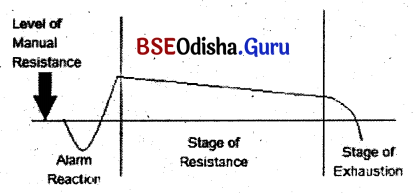
Selye studied the body when stress is prolonged by subjecting animals to a variety of stressors such as high temperature, X-rays and insulin injections, in the laboratory over a long period of time. He also observed patients with various injuries and illnesses in hospitals. Selye noticed a similar pattern of bodily response in all of them. He called this pattern the General Adaptation Syndrome (GAS). According to him, GAS involves three stages: alarm reaction, resistance, and exhaustion.

C:\Users\Shaheena\Desktop\CHSE Odisha Class 12 Psychology Unit 2 Long Answer Questions.png

  • Alarm reaction stage:
    The presence of a noxious stimulus or stressor leads to the activation of the adrenal-pituitary-cortex system. This triggers the release of
    hormones producing the stress response. Now the individual is ready for fight or flight.
  • Resistance stage:
    If stress is prolonged, the resistance stage begins. The para-sympathetic nervous system calls for more cautious use of the body’s resources. The organism makes efforts to cope with the threat, as through confrontation.
  • Exhaustion stage:
    Continued exposure to the same stressor or additional stressors drains the body of its resources and leads to the third stage of exhaustion. The physiological systems involved in alarm reaction and resistance become ineffective and susceptibility to stress-related diseases such as high blood pressure becomes more likely. Selye’s model has been criticised for assigning a very limited role to psychological factors in stress.
    Researchers have reported that the psychological appraisal of events is important for the determination of stress. How people respond to stress is substantially influenced by their perceptions, personalities and biological constitutions.

Question 4:
Enumerate the different ways of coping with stress.
Answer:
To manage stress we often need to reassess the way we think and learn coping strategies. Different ways of coping with stress are:

  • Task-oriented Strategy:
    This involves obtaining information about the stressful situation and about alternative courses of action and their probable outcome. lt also involves deciding priorities and acting so as to deal directly with the stressful situation. For example, schedule my time better, or think about how I have solved similar problems.
  • Emotion-oriented Strategy:
    This can involve efforts to maintain hope and to control one’s emotions. It can also involve venting feelings of anger and frustration or deciding that nothing can be done to change things. For example, tell myself that it is not really happening to me, or worry about what I am going to do.
  • Avoidance-oriented Strategy:
    This involves denying or minimising the seriousness of the situation. It also involves the conscious suppression of stressful thoughts and their replacement by self-protective thoughts. Examples of this are watching TV, phone up a friend, or try to be with other people.

Question 5:
Explain the effect of stress on psychological functioning.
Answer:
The effect of stress on psychological functioning:

Emotional Effects:
Those who suffer from stress are far more likely to experience mood swings and show erratic behaviour that may alienate them from family and friends. In some cases this can start a vicious cycle of decreasing confidence, leading to more serious emotional problems. Some examples are feelings of anxiety and depression, increased physical tension, increased psychological tension and mood swings.

Physiological Effects:
When the human body is placed under physical Or psychological stress, it increases the production of certain hormones such as adrenaline and cortisol. These hormones produce marked changes in heart rate, blood pressure levels, metabolism and physical activity. Although this physical reaction will help us to function more effectively when we are under pressure for short periods of time, it can be extremely damaging to the body in the long-term effects. Examples of physiological effects are the release of epinephrine and nor-epinephrine, slowing down of the digestive system, expansion of air passages in the lungs, increased heart rate and constriction of blood vessels.

Cognitive Effects:
If pressures due to stress continue, one may suffer from mental overload. This suffering from high levels of stress can rapidly cause individuals to lose their ability to make sound decisions. Faulty decisions made at home, in career, or at the workplace may lead to arguments, failure, financial loss or even loss of job. The cognitive effects of stress are poor concentration and reduced short-term memory capacity.

Behavioural Effects:
Stress affects our behaviour in the form of eating less nutritional food, increasing intake of stimulants such as caffeine, excessive consumption of cigarettes, alcohol and other drugs such as tranquillisers etc. Tranquillisers can be addictive and have side effects such as loss of concentration, poor coordination, and dizziness. Some of the typical behavioural effects of stress seen are disrupted sleep patterns, increased absenteeism, and reduced work performance.

Question 6:
Describe how life skills can help meet life’s challenges.
Answer:
Life skills are abilities for adaptive and positive behaviour that enable individuals to deal effectively with the demands and challenges of everyday life. Our ability to cope depends on how well we are prepared to deal with and counterbalance everyday demands and keep equilibrium in our lives. These life skills can be learned and even improved, upon. Assertiveness, time management, rational thinking, improving relationships, self-care and overcoming unhelpful habits such as perfectionism, and procrastination, etc. are some life skills that will help to meet the challenges of life.

Question 7:
Discuss the factors that lead to positive health and well-being.
Answer:
Various factors have been identified which facilitate the development of positive health. Health is a state of complete physical, mental, social and spiritual well-being and not merely the absence of disease or infirmity. Positive health comprises the following constructs: “a healthy body, high quality of. personal relationships, a sense of purpose in life self-regard, mastery of life’s tasks and resilience to stress, trauma and change”. Specifically, factors that act as stress buffers and facilitate positive health are diet, exercise, positive attitude, positive thinking and social support.

Question 8:
How does stress affect the immune system?
Answer:
Stress can cause illness by impairing the workings of the immune system. The immune system guards the body against attackers, both from within and outside. Psychoneuroimmunology focuses on the links between the mind, the brain and the immune system. It studies the effects of stress on the immune system. How does the immune system work? The white blood, cells (leucocytes) within the immune system identify and destroy foreign bodies (antigens) such as viruses. It also leads to the production of antibodies.

There are several kinds of white blood cells or leucocytes within the immune system, including T cells, B cells and natural killer cells. T cells destroy invaders and T-helper cells increase immunological activity. It is these T-helper cells that are attacked by the Human Immuno Deficiency Virus (HTV), the virus causing Acquired Immuno Deficiency Syndrome (AIDS). B cells produce antibodies. Natural killer cells are involved in the fight against both viruses and tumours.

Stress can affect natural killer cell cytotoxicity, which is of major importance in the defence against various infections and cancer. Reduced levels of natural killer cell cytotoxicity have been found in people who are highly stressed, including students facing important examinations, bereaved persons and those who are severely depressed. Studies reveal that immune functioning is better in individuals receiving social support. Also, changes in the immune system will have more effect on health among those whose immune systems are already weakened.

Question 9:
Give an example of a life event which is likely to be stressful. Suggest reasons why it is likely to cause different degrees of stress to the person experiencing it.
Answer:
Changes, both big and small, sudden and gradual affect our life from the moment we are born. We learn to cope with small, everyday changes but major life events can be stressful because they disturb our routine and cause upheaval. If several of these life events that are planned (e.g. moving into a new house) or unpredicted (e.g. break-up of a long-term relationship) occur within a short period of time, we find it difficult to cope with them and will be more prone to the symptoms of stress.

Unexpected accidents or trauma or the death of close family members are examples of life events which are very stressful for the members, relatives of the family and friends. The impact of most life events varies from person to person. Factors such as the age at which the event was first experienced, frequency of occurrence, duration of the stressful event and social support are the reasons which is likely to cause different degrees of stress to the person experiencing it.

Question 10:
Given what you know about coping strategies, what suggestions would you give to your friends to avoid stress in their everyday lives.
Answer:
Coping is a dynamic situation-specific reaction to stress. It is a set of concrete responses to stressful situations or events that are intended to resolve the problem and reduce stress. I would suggest my friends to adopt problem-focused strategies and emotion-focused strategies. Both are coping strategies which can be used to handle stressful situations.

Problem-focused strategies attack the problem itself, with behaviours designed to gain information, to alter the event and to alter beliefs and commitments. They increase the person’s awareness, level of knowledge and range of behavioural and cognitive coping options. They can act to reduce the threat value of the event. For example “I made a plan of action and followed it”.

Emotion-focused strategies call for psychological changes designed primarily to limit the degree of emotional disruption caused by an event, with minimal effort to alter the event itself. For example “I did some things to let it out of my system”. While both problem-focused and emotion-focused coping are necessary when facing stressful situations, research suggests that people generally tend to use the former more often than the latter.

Question 11:
Reflect on the environmental factors that have (a) a positive impact on the being, and (b) a negative effect.
Answer:

  •  Environmental factors that have a positive impact on the being are social and public campaigns, fair governmental policies, plantation of green plants, medical policies etc.
  • Environmental factors that have a negative impact on the being are unavoidable such as air pollution, crowding, noise, heat of the summer, winter cold, etc. Another group are catastrophic events, or disasters such as fire, earthquake, floods, etc.

Question 12:
We know that certain lifestyle factors can cause stress and may lead to diseases like cancer and coronary heart disease, yet we are unable to change our behaviour. Explain why?
Answer:
Stress can lead to an unhealthy lifestyle or health-damaging behaviour. Lifestyle is the overall pattern of decisions and behaviours that determine a person’s health and quality of life. Stressed individuals may be more likely to expose themselves to pathogens which are agents causing physical illness. People who are stressed have poor nutritional habits, sleep less and are likely to engage in other health risk behaviours like smoking and alcohol abuse.

Such health-impairing behaviours develop gradually and are accompanied by pleasant experiences temporarily. However, we tend to ignore their long-term damaging effects and underestimate the risk they pose to our lives. Studies have revealed that health-promoting behaviour like a balanced diet, regular exercise, family support, etc. play an important role in good health.

Adhering to a lifestyle that includes a balanced low-fat diet, regular exercise and continued activity along with positive thinking enhance health and longevity. The modem lifestyle of excesses in eating, drinking and the so-called fast-paced good life has led to the violation of basic principles of health in some of us, as to what we eat think or do with our lives.

Question 13:
What is ‘Eustress’?
Answer:
It is the term used to describe the level of stress that is good for you and is one of a person’s best assets for achieving peak performance and managing a minor crisis. Eustress, however, has the potential of turning into ‘distress’. It is this latter manifestation of stress that causes our body’s wear and tear. Thus, stress can be described as the pattern of responses an organism makes to stimulus event that disturbs the equilibrium and exceeds a person’s ability to cope.

Question 14:
Describe the Nature of Stress.
Answer:
The word stress has its origin in the Latin words ‘strictus’, meaning tight or narrow and ‘stringere’, the verb meaning to tighten. These root words reflect the internal feelings of tightness and constriction of the muscles and breathing reported by many people under stress. Stress is often explained in terms of characteristics of the environment that are disruptive to the individual. Stressors are events that cause our body to give a stress response.

Such events include noise, crowding, a bad relationship, or the daily commuting to school or the office. The reaction to external stressors is called ‘strain’. Stress has come to be associated with both causes as well as effects. However, this view of stress can cause confusion. Hans Selye,-the father of modem stress research, defined stress as “the nonspecific response of the body to any demand” that is, regardless of the cause of the threat, the individual will respond with the same physiological pattern of reactions.

Many researchers do not agree with this definition as they feel that the stress response is not nearly as general and nonspecific as Selye suggests. Different stressors may produce somewhat different patterns of stress reaction and different individuals may have different characteristic modes of response. You may recall the case of an opening batsman mentioned earlier.

Each one of us will see the situation through our own eyes and it is our perception of the demands, and our ability to meet them, which will determine whether we are feeling ‘stressed’ or not. Stress is not a factor that resides in the individual or the environment, instead, it is embedded in an ongoing process that involves individuals transacting with their social and cultural environments, making appraisals of those encounters and attempting to cope with the issues that arise.

Stress is a dynamic mental/cognitive state. It is a disruption in homeostasis or an imbalance that gives rise to a requirement for the resolution of that imbalance or restoration of homeostasis. The perception of stress is dependent upon the individual’s cognitive appraisal of events and the resources available to deal with them.

Question 15:
Explain the stress process of Lazarus.
Answer:
The stress process is based on the cognitive theory of stress propounded by Lazarus and his colleagues. An individual’s response to a stressful situation largely depends upon the perceived events and how they are interpreted or appraised. Lazarus has distinguished between two types of appraisal, i.e. primary and secondary.
Primary appraisal refers to the perception of a new or changing environment as positive, neutral or negative in its consequences. Negative events are appraised for their possible harm, threat or challenge.

Harm is the assessment of the damage that has already been done by an event. The threat is the assessment of possible future damage that may be brought about by the event. Challenge appraisals are associated with more confident expectations of the ability to cope with the stressful event, the potential to overcome and even profit from the event. When we perceive an event as stressful, we are likely to make a secondary appraisal, which is the assessment of one’s coping abilities and resources and whether they will be sufficient to meet the harm, threat or challenge of the event.

These resources may be mental, physical, personal or social. If one thinks one has a positive attitude, health, skills and social support to deal with the crises she/he will feel less stressed. This two-level appraisal process determines not only our cognitive and behavioural responses but also our emotional and physiological responses to external events. These appraisals are very subjective and will depend on many factors. One factor is. the past experience of dealing with such a stressful condition. If one has handled similar, situations very successfully in the past, they would be less threatening for her/him.

Another factor is whether the stressful event is perceived as controllable, i.e. whether one has mastery or control over a situation. A person who believes that s/he can control the onset of a negative situation, or its adverse consequences, will experience less amount of stress than those who have no such sense of personal control. For example, a sense of self-confidence or efficacy can determine whether the person is likely to appraise the situation as a threat or a challenge. Thus, the experience and outcome of a stressor may vary from individual to individual.

Stress includes all those environmental and personal events, which challenge or threaten the well-being of a person. These stressors can be external, such as environmental (noise, air pollution), social (break-up with a friend, loneliness) or psychological (conflict, frustration) within the individual. Very often, these stressors result in a variety of stress reactions, which may be physiological, behavioural, emotional and cognitive. At the physiological level, arousal plays a key role in stress-related behaviours. The hypothalamus initiates action along two pathways.

The first pathway involves the autonomic nervous system. The adrenal gland releases a large amount of catecholamines (epinephrine and norepinephrine) into the bloodstream. This leads to physiological changes seen in the fight-or-flight response. The second pathway involves the pituitary gland, which secretes the corticosteroid (cortisol) which provides energy. The emotional reactions to the experience of stress include negative emotions such as fear, anxiety, embarrassment, anger, depression or even denial.

The behavioural responses are virtually limitless, depending on the nature of the stressful event. Confrontative action against the stressor (fight) or withdrawal from the threatening event (flight) are two general categories of behavioural responses. Cognitive responses include beliefs about the harm or threat an event poses and beliefs about its causes or controllability. These include responses such as the inability to concentrate and intrusive, repetitive or morbid thoughts.

As indicated in Figure 3.2, the stresses which people experience also vary in terms of intensity (low intensity vs. high intensity), duration (short-term vs. long-term), complexity ( less complex vs. more complex) and predictability (unexpected vs. predictable). The outcome of stress depends on the position of a particularly stressful experience along these dimensions. Usually, more intense, prolonged or chronic, complex and unanticipated stresses have more negative consequences than have less intense, short-term, less complex and expected stresses.

An individual’s experiences of stress depend on the physiological strength of that person. Thus, individuals with poor physical health and weak constitution would be more vulnerable than would be those who enjoy good health and a strong constitution. Psychological characteristics like mental health, temperament and self-concept are relevant to the experience of stress.

The cultural context in which we live determines the meaning of any event and defines the nature of the response that is expected under various conditions.  Finally, the stress experience will be determined by the resources of the person, such as money, social skills, coping style, support networks, etc; All these factors determine the appraisal of a given stressful situation.

CHSE Odisha Class 12 Sociology Unit 2 Indian Social Structure Long Answer Questions Part-2

Odisha State Board CHSE Odisha Class 12 Sociology Solutions Unit 2 Indian Social Structure Long Answer Questions Part-2.

CHSE Odisha 12th Class Sociology Unit 2 Indian Social Structure Long Answer Questions Part-2

Long Questions With Answers

Question 1.
Discuss various factors affecting the caste system.
(Or)
What are the causes responsible for the disintegration of the caste- system?
Answer:
The caste system, under the impact of certain powerful factors, is undergoing drastic changes in modem India. Under the impact of all these powerful forces, wide cracks have already appeared in the walls of the citadel of caste in India. The major factors which are responsible for such changes in the system are

  • Modem education
  • Industrialization
  • Urbanization
  • Modem means of transportation
  • Increase in importance of wealth
  • New social movements
  • Political changes
  • The new legal system and
  • The Indian constitution.

Modern education:
Modem education has played a major role in undermining the importance of caste in Indian social life. Modem education is secular in nature. So it is on one hand based on such democratic values like equality, liberty and fraternity, on the other hand, it is based on such scientific values like reason and observation. Modem education is also very much indifferent to religion.

With the spread of modem education beliefs like the divine origin of caste. Karma and Karma fala are growing weaker and weaker in the minds of people with the influence of democratic values like equality, Modem man finds it difficult to accept the principle of inherited inequality on which the entire structure of the caste system is based.

In modem educational institutions children of different castes sit side by side in the same classroom, as a result, the feeling of untouchability do not find scope to develop in the minds of children. Modem co-educational institutions also encourage inter-caste marriages based on love, among educated young men and women. Thus, Modem education acts as a very powerful force against caste in India.

Industrialization :
The effects of industrialization is very much disastrous on the caste- system. Occupational castes cannot survive in the face of large-scale industrialization. For example, the members of the weaving castes are finding it extremely difficult to follow their traditional caste occupations. Because it is not possible for them to compete with the textile mills in the open markets.

The caste system is based on the rural economy. The tradition of the following caste- occupation gradually crumbled down. The members of all castes are interested and getting employment in modem factories. In a factory people of different castes work together. A Brahmin who works by the side of an un-touchable cannot avoid his touch. So the idea of pollution by touch is losing its ground gradually in an industrial setting.

Urbanisation:
Urbanisation, which invariably follows industrialization, has also made it impossible to practice caste- restrictions. Under urban conditions of life, the idea of pollution by the touch of a shadow cannot be translated into action. Because it is impossible on one’s part to restrict himself in a dining place, in a hotel, in a shopping centre etc.

Modern means of transportation:
Geographical isolation was a favourable condition for the creation and continuation of the caste- system in India. But modem means of transportation have increased spatial mobility of the people and thereby put an end to geographical isolation. Again while travelling in a bus, train or tram, it is impossible to observe caste rules regarding food, drink and social intercourse.

Increase in importance of wealth:
In the present age, wealth is replacing birth as the basis of social prestige. Hence, caste, which is based on birth, is no longer the basis of social status. In modem society, a rich Shudra is getting more prestige than a poor Brahmin. Hence people while choosing their occupations, give more consideration to income than to occupation.

New social movements:
A number of movements were launched in the past against the caste system. The social movements started by Raja Rammohan Roy, and Dayananda Saraswati could influence the intelligence of the country against the caste- system and other evils of Hindu society.

Political Changes:
One of the main aims of the Indian national freedom movement was to abolish all discrimination particularly the caste- a system in Indian society. This movement created a strong public opinion against the caste- system in India. Hence, when India got independence, a democratic form of society abolished all discriminatory practices based on caste, creed, sex, etc. Secondly, ideologies like communism, which is based on the principle of a classless society, have also become popular in India. New groups based on class interests rather than caste interests have emerged in the country.

New legal system:
The new legal system has also played a vital role against the caste- system, as a result, the age-old legal discrimination against the lower castes has been removed. Under the new system, the principle of equality before law has firmly been instituted in legal proceedings. Again with the establishment of judicial courts, the caste, panchayats have lost their power to punish the culprits and enforce the caste rules. Besides a number of acts like. The untouchability Offences Act of 1995 and the Hindu Marriage Act of 1955 have been passed, which prove too disastrous to the caste system.

The Indian Constitution:
Our constitution is taking strong steps against the very existence of caste in India Para 15(2) of the constitution which declares all citizens as equal, directly attacks the Hindu social order based on the caste system. It is clear from the above discussion that due to the influence of the above factors the caste- system has been changing in India. But it would be a gross mistake to think that the caste- system has completely disappeared from the Indian scene.

CHSE Odisha Class 12 Sociology Unit 2 Indian Social Structure Long Answer Questions Part-2

Question 2.
Discuss recent changes in the institution of caste.
(Or)
Discuss the changing aspects of the caste system in Indian Society.
(Or)
“Caste has never maintained its traditional forms” – justify the system.
Answer:
As a consequence of the impact of a number of factors like industrialization, urbanization, modem education, development in modem means of transportation, new social movements, the new legal system, an increase in the importance of wealth, political changes and the constitutional provisions, there have been a number of changes in the caste system. As a result, caste has never maintained its traditional forms.
The changes in the caste systems are –

  • The decline in the supremacy of the Brahmin.
  • Changes in status structure.
  • Development in the socio-economic conditions of the Harijans.
  • Changes in the functions of caste.
  • Changes in rules regarding marriage.
  • Change in restrictions on food, drink and social intercourse.
  • Changes in restrictions regarding the choice of occupations.
  • Changes in the ideas regarding the doctrine of karma.

The decline in the supremacy of the Brahmin:
Under the caste system, the Brahmin occupied the highest position. The whole system revolved around the prestige of the Brahmin. But today he does not enjoy the same high and dominant social position. For example, in the past, the Brahmin is only allowed to read Vedas, Epics etc. But now other lower caste people are enjoying the position of Brahmin.

Changes in the status structure:
Traditionally caste society was a closed and rigid society. Each caste had its own traditional status in the hierarchy of castes, which was more or less permanently fixed. Besides, every caste had its own style of life, followed exclusively by its members.

It was these differences in the styles of life that made the people of different castes appear distinct from one another. But at present people of lower castes are adopting the lifestyles of higher castes and claiming and actually achieving higher status in society. This process which Srinivas refers as Sanskritization.

Development in the socio-economic conditions of the Harijans:
Thirdly, as a result of the governmental policy of protective discrimination, the socio-economic condition of the Harijans has been considerably improved. As a result, the downtrodden people of the society namely the Harijans have been able to get higher status.

Changes in the functions of caste:
In the fourth place, there are changes in the functions of castes. For example, in a caste system, people get status according to their caste. So the caste system was the determinant of one’s status. But under the changed conditions of modem society, birth is no longer regarded as the basis of social prestige. Today wealth and achievement have replaced birth as the basis of social status. Asa result caste has lost its traditional function of determining the status of an individual in society.

Changes in the rules regarding marriage :
The other important change in the caste- system is marriage. Under the caste system, there were strict rules regulating the choice of mates. Every caste and sub-caste was an endogamous group, each caste was not allowed to marry outside one’s own caste. But nowadays inter-caste marriages are more prevalent in society. The Special Marriage Act and Hindu Marriage Act have removed all the restrictions and declared inter-caste marriage as legally valid.

Changes in restrictions on food, drink and social intercourse:
Sixthly, there are changes in the ideas of pollution and other restrictions on food, drink etc. The higher caste people i.e. Brahmin do not take food and drink from lower caste people. Similarly, if a lower caste people touch a higher caste then the higher caste people got polluted. So there were very many restrictions. But. today these rules have lost their significance in Hindu society.

Changes in restriction regarding the choice of occupation:
In the caste system choice of occupation was not free. Each caste had its own traditional occupation, which its members had invariably to follow. But now- a -days people follow occupations which are not their own caste’s occupation. Nowadays those occupations which arc profitable are followed by people irrespective of their caste. Now a Brahmin works in a leather factory whereas a Shudra is accompanied By a teaching profession, which in traditional society could not be imagined.

Changes in the ideas regarding the doctrine of Karma:
The family caste system has lost its grip on the minds of the people. People have begun to doubt the validity of the caste system. Now, they do not believe in the theory of Karma, or the doctrine of Karma, Karmafala etc. So also they do not believe that the caste system is a divinely ordained institution.

BSE Odisha

Question 3.
Do you think that the caste system is disappearing from India? Give reasons in support of your opinion.
(Or)
Discuss the present trends and future of the caste system.
Answer:
In India, we find a unique system of social stratification based on birth, the like of which is not found elsewhere in the whole world. This system is known as the ‘caste- system’ and divides Indian society into several groups. This caste system transforms into casteism in the evil hand. It has contributed a number of functions to its credit and is also not devoid of dysfunctions.

The caste system serves as a device of the division of labour in society. It integrates society and also brings stability to society. In a traditional way, it determines the status of the individual and it also guides the individual behaviour. The age-old system, i.e. caste system, under the impact of certain powerful factors is undergoing drastic changes in modem India.

At the same time it is right to say that due to modem education, industrialization, urbanization, development in the means of transportation, increase in the importance of wealth, political changes and the new legal system some changes have taken place in the caste- system. As a result, wide cracks have already appeared in the walls of the citadel of caste in India.

Encouraged by the visible changes in the system, some students of the institution have come to believe that the caste system is soon going to dis- integrate in India. But scholars like Prof. Ghurye and Prof. Srinivas do not agree with this view. They on the contrary assert that caste in modem India is becoming stronger and will continue to exist for some time to come.

Dr Ghurye, says that caste will continue to exist in India for some time due to certain factors that are active today in the country. He says that while democracy weakens caste, the method of elections at present strengthens the caste system. As the governmental machinery in a democracy is run by the elected representatives of the people, elections in India have become imperative.

But unfortunately, in this country elections are fought and won on the basis of caste. Candidates contesting elections seek support from their caste fellows by drumming the cause of casteism. These leaders maintain casteism even after the elections by showing special treatment to their caste members. Even political parties are not free from ‘caste politics’.

Political parties in India sponsor candidates having a social base, which is nothing but the numerical strength of the caste of a candidate in the constituency. Thus elections have actually encouraged casteism in India. So caste has assumed political functions and has become stronger today. Dr Ghuiye also says another factor encouraging caste in India, is the special constitutional protection accorded to the scheduled and other backward castes.

The Indian constitution makes special provisions for the protection of these castes in the form of reservations in the central and state legislative government services. In addition, it directs the government to provide many other facilities to them. These constitutional provisions have created casteism among the people of these castes.

Prof. M.N. Srinivas holds that the establishment of a national government for the whole country, the political boundaries of the small independent states, that hitherto acted as barriers and prevented the members of a caste, spread over a large- part of the country, from uniting have disappeared. As a consequence castes especially the larger ones have found it easier to organize themselves on an unprecedented scale.

Hence castes in modem India have become more organized and stronger.  Secondly, modem developments in the means of transportation and communication are regarded by him as another potent factor in strengthening caste in India. He is of the opinion that modem means of transportation and communication such as the railways, buses, printing press, postal services, newspapers etc. have enabled the members of castes, scattered all over the country, to come together and discuss problems concerning the interests of their own castes and organize more effectively into large caste associations.

As such, in modem India, castes have actually become more effective and stronger. Besides, no accurate predictions can be made about the future of the caste system in India. Therefore many thinkers would like to be non-committal about its future. But there are scholars like Prof, Srinivas, who believe, that caste is so an organic part of Hindu society and Hindu social organization that it is difficult to conceive of Hindu society without it.

There are other scholars like Prof. Ghurye, who think that caste has outlived its usefulness and therefore it should go. They also believe that Hindu society will sooner or later, be got rid of caste. In modem day, there are already some important changes in the salient features of the system like marriage, occupation, styles of life etc. brought about by forces discussed before.

But at the same time, there are equality powerful factors like the method of elections, protection of the scheduled and other backward castes etc. which encouraged casteism. From the above analysis, it may be said that some more changes will certainly take place in the system. But it is wrong to believe that the system. But it is wrong to believe that the system will altogether be eliminated from Indian social science. It may assume new forms and perform new functions in the changed conditions of modem society.

Question 4.
What do you mean by class? Write an essay regarding the emergence of the class- system in Indian society.
Answer:
If the caste system is found to be unique to India, the class- system is universal in nature. ‘ Social class’ is a principal type of social stratification found especially in the modem civilized countries. Sometimes the word ‘class’ is used to represent groups of professors, artists, engineers, doctors, students etc. The word ‘class’ is also used to refer to the quality of things whether good, better, best and so on.

But the concept of ‘social class’ is more used in sociology representing a kind of social stratification than anything else.  P. Gisbert says “A social class is a category or a permanently determines their relation to other groups.” Ogburn and Nimkoff say that “A Social class is the aggregate of persons having essentially the same social status in a given society.

Maclver and Page define “A social is any portion of the community marked off from the rest by social status”. A social class is understood mainly in two different ways. Firstly, there is the Marxian conception of class. The Marxists define a class in terms of its relation to the means of production. According to them, a class is determined by its possession of such objective, usually economic criteria like wealth, occupation and income.

Secondly, there are thinkers like Maclver, who view class as a status group. But there are also other sociologists like Max Weber who tried to reconcile these two divergent approaches to class in their studies of modem social organization.

Characteristics of social class:

  • A social class is essentially a status group.
  • Status in the case of the class system is achieved and not ascribed. Birth is not the criterion of status. The achievement of an individual mostly decides his status.
  • Class is almost a universal phenomenon which appears in all the modem complex societies of the world.
  • A social class is not transitory nor unstable like a crowd or a mob. It is relatively a stable group.
  • There is a feeling of equality in relation to members of one’s own class. Individuals belonging to the same social class are expected to maintain a similar standard of life.
  • There is a feeling of inferiority and superiority in the social hierarchy.
  • The class system is associated with class consciousness, Class consciousness is the sentiment that characterises the relations of men towards the members of their own and other classes.

The emergence of class, as we understand them today, is the direct result of British rule in India. The British in India established a new social economy and a new administrative system. It also introduced modem education and industrialization. These forces give rise to new social classes in Indian society. The British introduced drastic changes in the economy through legislation.

Firstly, private property in the form of Zamindari and Ryotwari systems was recognized and as a result of two classes, namely the zamindars and the peasants came into being. Secondly right to lease, the land created the tenants and sub-tenants. Finally, the right to purchase and sell the land and the right to hire and employ labour on land created conditions for the emergence of such classes as absentee landlords and the agricultural proletariat.

Under the agrarian economic system there developed new classes of intermediaries like money lenders, absentee landlords and merchants. However, it is not to say that merchants and money lenders did not exist in pre-British India They did exist but their position and function in the old economy were fundamentally different. After Independence, the agrarian class structure has undergone radical changes due to the abolition of the zamindari system, ceilings on land holdings, tenancy reforms etc.

As a consequence, the agrarian class structure, at present, consists of two principal classes namely land owners and agricultural labourers.
Under British rule production in India became more and more for the market. The internal market expanded and got linked up with the world market Thus, the class of commercial bourgeoisie came into being.

A large class of merchants grew who were primarily engaged in the import and export of goods from and into India. The new commercial class purchased the agricultural and industrial goods produced in India and sold them in both Indian and world markets. The profits and savings made by the trading class zamindars and wealthy members of professional classes served as the capital for the growth of Indian-owned industries like textile, mining etc.

With the growth of industries, the bourgeoisie and proletariat came into existence. There also grew professional classes comprising lawyers, doctors, teachers, managers, engineers, technologists, and journalists in response to the needs of the new society. In addition to the above-mentioned classes, another class of petty traders and shopkeepers also developed in every town and city.

Along with these new classes, some old classes like the village artisans and urban handicraftsmen also survived and existed side by side in India. C.H. Cooley opines that three principal conditions favour the growth of social classes. They are:-

Marked differences in the constituent parts of the population:
When the population is composed of different races, this racial heterogeneity facilitates the growth of social classes. Little communication and enlightenment: Lack of inter-communication among the people also favours the growth of social distances increase.

A slow rate of social change:
Perhaps the slow rate of society is the principal factor favouring the growth of social classes. When society does not change and condition remains much the same from generation, social classes develop. The Indian society remained static for about three thousand years with the result that untouchables were not permitted to use public wells or enter temples.

CHSE Odisha Class 12 Sociology Unit 2 Indian Social Structure Long Answer Questions Part-2

Question 5.
Distinguish between ‘Caste and Class’.
(Or)
Both ‘Caste’ and “Class’ co-exist in Indian society – Justify the statement.
Answer:
There are a number of points which have so far remained unclarified in regard to the nature of caste and class in India. Caste and class are polar opposites. Caste is being replaced by class; caste is a rural phenomenon whereas clan is found in urban industrial settings. Caste is an ascriptive system and class is based on the achievement principle.

Caste is a closed system and does not allow mobility for its members, whereas class is an open system and allows mobility for its members, India has/had a caste system, hence a ‘caste model’ for studying Indian society and the west has/had classes. Hence a ‘class model’ for studying western societies – is some of the familiar misconceived notions about caste and class in India.

However, these notions are rooted in the historicity of Indian society and its culture including British and post-independence academic colonialism. Battelle does not offer a ‘class analysis’ of Indian society as an alternative to the ‘caste – model’, In fact, he suggests a sort of modification of the caste model by putting an emphasis on the study of economic and political activities of inter-caste relations.

However, he points out that it could be wrong to consider India as a ‘caste society and the united states as a ‘class society and Europe as a ‘caste society. Bettie takes a clue from Leach, Bailey and Dumont who have offered a ‘caste- model’ of Indian society. The essence of the views of Leach, Bailey and Dumont is that caste is a non-competitive system, the castes are non-antagonistic strata.

Competition refers to class and cooperation refers to caste. This is really a very erroneous view about both class and caste and more so about the understanding of caste, in India. Bailey refers to caste groups which cooperate and do not compete. But western scholars including Leach look at the caste system from the viewpoint of class in western societies.

Leach finds competition within the ‘dominant caste’ and not between the dominant caste and other castes. Ketkar mentions hereditary membership and endogamy as the most striking features of the caste, system in India. Funeral, Hutton and Sherring observe that the caste system is ‘functional’ for Indian society. Ghurye refers to six features of the caste system and upholds the endogamy of its essence.

Other students of Indian society have also provided a view that either refers to the uniqueness of the caste system or they have viewed it from the viewpoint of their own society. Marx related to Asiatic mode of production to the stability of the caste system in India. H.J.S. Maine referred to caste as an example of a non-contractual4 status society’ Senate.

Hocart and Dumont have emphasized ritual Criteria and pollution Purity as the basis of Hindu society. Weber considered caste as a system of status groups based on the other world by doctrines of Hinduism.  At the same time scholars of the west glorified the class system with a view to establishing the superiority of western society and culture, Class was considered an open system, the individual was given freedom of movement under the system and achievement was the essence of the system.

In contrast to caste system was a closed system, the individual could not move up the hierarchy and it was a system based on aspiration. Caste and class were polar opposites. Caste was considered a feature of an archaic society like India and class was considered a characteristic feature of the industrially advanced achievement based on western society.

This clearly shows that western scholars mainly the American and the British tried to establish their hegemony by academic propaganda. Maclver and Page do not define class strictly in the economic sense. They refer to status’ as the basis of what they call the social class”. T.H. Marshall. T. Parsons, K. Davis and W. Moore. T.B. Bottomore and Richard centres decline class either in terms of status or in psychological terms.

The perfect example of the definitions of caste cis-a-vis class is found in India and class is a feature of the western world. Berreman recently published essay which has been written over a period of two decades emphasises that ‘caste-based’ inequalities in India are not different from race-based inequalities in the United States of America. Gough has been highlighting the class basis of the caste system in India.

N.K. Byse refers to the class genesis of the caste structure in Bengal. Changes from caste to class are noted by Mishra, Beteille, Miller and Kolenda. A class analysis of Indian society in general and the caste system and village community, in particular, is found in A.R. Desai’s edited work on rural sociology. D. Souza decisively concludes that class is replacing caste and the individual is replacing the group.

Beteille realized that caste alone is not the totality of social stratification and that caste is not being replaced by class. Class in India is generally seen as a consequence of a change in the caste system and not as a concomitant and co-existent system separate from caste. Dube and Singh both realize that the concepts of caste and class have been basically Western and therefore ignore the historicity of Indian society in their formulations.

Caste has been taken as synonymous with the social formation of Indian society and therefore class is treated as an alternative system to caste. However the fact is that neither does caste refer to the totality of social formations nor is class the polar opposite of caste, caste and class; caste, class and power, caste, religion and power and caste, class and politics do not provide a corrective to the caste alone approach.

These studies are rooted in the falsity of the western dichotomy of tradition and modernity and the trilogy of class, status and party. They do not incorporate the existence of Indian society into the concepts of caste, class and power etc. Hence they are inadequate in rescuing us from these aline concepts and theories. Class in India has existed along with caste and power.

Caste incorporates class and class incorporates caste in the Indian context. ‘Neither the ‘caste alone’ view nor the class alone’ perspective will help in a proper and fuller understanding of Indian society. Castes have been functioning as classes for all practical considerations. The Varna and the Jajmani system can be explained in terms of class relations.

The main classes today in India are – the agrarian classes, the industrial classes, the business and the mercantile classes and the professional classes. Industrial, business and professional classes characterize urban India and land owners, tenants, and agricultural labourers are found in the countryside.

CHSE Odisha Class 12 Sociology Unit 2 Indian Social Structure Long Answer Questions Part-2

Question 6.
What is a joint family? Discuss its characteristics.
Answer:
An Indian family is based upon the sanctity of domestic life and value commitments which make it intimate, personal and durable Family for an Indian is a sacred institution in which the interrelationship between husband and wife, father and son. brother and sister is booked by religious and spiritualists consideration notify more annexations of consanguinity. Thus, the family bond, the sense of duties and obligations toward each other continues even for generations together.

As such, an Indian family, more particularly a Hindu family becomes large, extended and of the type described as joint. Thus, now it is very much clear that a joint family is a large group of the members of two or more generations having a common ancestry, common – property, common culture, and common household, playing, different roles of father, mother, son, daughter, brother and sister and contributing towards the betterment of family as a whole.

Characteristics of a joint family:

Large size:
The members of two or more generations constitute a joint family. As Jolly puts it, not only do parents and children brothers and step-brothers live on the common property but it may sometimes, include ascendants, descendants and collaterally up to many generations. Hence, it is quite natural that the size of a joint family becomes large in comparison to a nuclear family in which a man lives his immediate family consisting of only his wife and children.

Joint property:
Another feature of a joint family is that all the members hold the property in common. Everyone works according to his capacity and brings the earnings to home. Mostly the economy of a family is based on agriculture. The adult members cultivate their inherited property. Whatever property is bought or sold, is added or subtracted from the common property of the family. The head of the family, generally known as ‘Karta’ manages the entire socio-economic affairs like a trustee.

Common Residence and Joint Kitchen:
All the members of a joint family generally live under one roof. The entire house is divided into many small rooms for the use of different brothers. Sometimes separate rooms are also constructed for grown-up children depending on the resources and condition of the family. All these members take their food cooked in one kitchen. Mostly there is a common arrangement for joint living and common dining.

Common rituals and ceremonies:
Every joint family has its own rites and rituals in accordance with caste norms and religious obligations. All the members participate in such common rites and rituals. Each family has its own ‘kula devata’ (family deity) which is worshipped by all the members.

Socialist system:
Functionally, the joint family is a sort of cooperative enterprise based on secularistic norms. Everyone works for the benefit of the family as a whole. The rights and privileges are distributed equally among all the members. Each member contributes according to his capacity and gets according to his necessity. The responsibility of children old am unable members are shared by all.

Mutual obligations:
In a joint family all the members, due to their common ancestry feel mutually obliged to each other. No one works against the interest of the other. Everyone is interested in the welfare of all the members of his family. A mutual understanding, co-operative spirit, and give-and-take informal relationship bind all the members together.

The ‘Karta’ as the authority:
The Karta or the head of the family acts as the formal authority in all the affairs of the family. Generally, the ‘Karta’ is the eldest male member. All the earning members keep their earnings with him and the entire property is kept under his control. All the family celebrations like marriage, birth and death anniversary are held under his direction and guidance. The disputes and dissatisfaction among the members are settled by him. All the members remain obliged to him and his decision stands final in all matters.

Question 7.
Define joint family and discuss its functions.
Answer:
A joint family is a large social group in which the father, mother, their children, uncle, aunt, grandfather and grandmother live together. According to Dr Iravati Karve, “A joint family is a group of people who generally live under one roof who eat food cooked at one hearth, who hold property in common and who participate in common worship and are related to each other as some particular type of kindred.” According to D.G Mandelbaum, ‘Joint family consists of typically’ of a set of men related to each other as father and sons are brothers and live together with their wives and children.

Functions of joint family:
Following are the functions of the joint family

Social control:
Social control is the function of a joint family. In a joint family, the relations between the members are direct, intimate and personal. The social relationship of a joint family acts as an important means of social control of the parents and other elder members 6f the family. In a joint family the leaders have direct control of the activities of the members.

Socialisation:
A joint family plays a very important role in the socialisation process of the child. If fosters good qualities among its members. In a joint family, children learn social adjustment and other social virtues, like obedience, self-discipline, love, cooperation, self-sacrifice, self-confidence and patience. The youngsters always have a sense of respect for the elders in a joint family.

Development of personality:
It is one of the important functions of a joint family which work in close collaboration with each other. All the members sacrifice themselves for the sake of the family. In a joint family, the children can be brought up and regarded properly by the family members. All these lead to the development of the personality of the members.

Economic functions:
A joint family also performs some economic functions. It acts as both productions as well as consumption unit. A joint family fulfils all the economic needs on the principle of joint ownership of land. It saves land from being fragmented into small and economic holdings. All earnings in a joint family are pooled into a common fund, and every member gets an almost equal share irrespective of his income. In a joint family cooking and household, purchases are done jointly resulting in considerable savings.

Educational function:
A joint family imparts education to the members. It is from the family that children learn the first letter under the affectionate guidance of either parent and other members. A joint family provides vocational education of its members. All the social virtues of children are developed by members of the family regarded as the first school of children.

Division of labour:
A joint family system creates a division of labour among the members. Every member in a joint family is as signed with work according to his ability and none is overburdened.

CHSE Odisha Class 12 Sociology Unit 2 Indian Social Structure Long Answer Questions Part-2

Question 8.
Discuss the merits and demerits of a joint family.
Answer:
A joint family is a group of people who generally live under one roof, eat food cooked at one hearth, hold property in common, participate in common worship and are related as some particular type of kindred.

Merits of joint family:

Economic merits:
From an economic point of view, joint family system has many advantages. It creates obstacles for subdivision and fragmentation of landed property. That means it prevents family property from being divided due to indivisibility and non-fragmentation of family property. Economic production increases considerably. In a joint family, all the members work together in the family property.

Division of labour:
The joint family system is based on the principle of division of labour. Every member of the family is provided work in accordance with his ability and capacity. For example, in joint families, women look after domestic affairs and care of children whereas men work in the fields. Similarly, in farming season all the members collectively work according to their abilities.

Protection of members:
Our late Prime Minister Pundit Jawaharlal Nehru had said that the joint family system is insurance for the family members which provides a guarantee of protection to those who are physically and mentally weak. It provides social security to those members who are sick, old, invalid, destitute, infirm and instance.

Cradle of social virtues:
A joint family is a storehouse of social virtues or good qualities like love, cooperation, affection, sympathy, sacrifice, tolerance, honesty, obedience, discipline, a broad spirit of selfless service generality, self-control, and mindlessness, for one among its members. These qualities are very essential for every individual in society. Joint family has checked the undesirable and anti-social tendencies of these youth through the care of elders. Thus, a joint family is a cradle of social virtues.

Means of Recreation:
A joint family is one of the best means of recreation. It creates friendly and stimulating taking of the children, mother’s love, love between brothers and sister and the like for the entertainment of the members. Joint family has formed many recreation and cultural institutions. At the time of the fifth, marriage and death, the joint family arranges many cultural functions. The joint family actually takes over the role of a club by providing recreation to all the members.

Sense of unity :
A joint family creates a sense of oneness and unity among its members. It is a strong ‘we feeling’ or belongingness among the members of a joint family. All the family members face a crisis collectively. It gives them a sense of security which is necessary for the development of personality.

Economy:
The joint family system is very economic in nature because there is a common residence and a common kitchen. It secures the economy of expenditure. The things consumed in large qualities are purchased at a wholesale rate and are secured as economically secure.

Socialism on wealth:
According to Sir Henry Maine, a joint family is like a cooperating trust where the father acts as its trustee. Every member in a joint family Works according to this necessity. Thus, the joint family achieves the socialistic form according to his needs. The fundamental of a joint family is to provide minimum needs such as food, clothing and shelter to every member.

Demerits of joint family:
In spite of the above merits, the joint family system has certain demerits also. The following are the main demerits of a joint family.

Hindrance to the development of personality:
The main demerit of a joint family is the hindrance to the development of the personality of its members. In the joint family, the head is the absolute ruler.He directly controls the behaviour of all the members. He regards them as children though they have turned adulthood. The head is the sole authority to take any decision in the family affairs. The members are not permitted to express their views independently or against the supreme administration of the head nor they can disobey the rules and regulations of the family when framed by the head.

Miserable conditions of women:
The miserable condition of women is yet another disadvantage of the joint family system. In a joint family, women are generally known as neglected and backward persons because they do not get any opportunity to develop their personalities. They are confirmed within the four walls of the house and deserve the entire family like slaves.

The women can neither talk nor express their views independently particularly. In a joint family, the condition of the daughter-in-law is very miserable. They are often ill-treated by their mother-in-law and sister-in-law. Some of them even commit suicide due to intolerable and unendurable oppression and suffering hence the condition of women is very pitiable in the joint family.

Increase of Idleness:
The point family system encourages idleness. All the members of a joint family are sure of economic security. lt is because whether a member works or not, a joint family provides minimum economic needs such as food, clothing and shelter to all members. Therefore, some members do not work for the progress of the family due to this facility. As a result of this laziness of the member’s increases. It hinders the economic prosperity of the family. Thus, a joint family acts as a centre of idleness.

Centre of quarrels:
A joint family is generally known as a centre of the conflict. It is a hotbed of quarrels and bickering, especially among female members. Due to their selfishness and jealous nature the mother-in-law, the sister-in-law and the daughter-in-law create conflict with each other frequently. The activities of children create tension in the family daily disputes and conflict make the family a bed for its members.

Lack of privacy:
In a joint family, there is a lack of sufficient accommodation for its members Newly married couples face great difficulty in a joint family. They do not discuss the- problems in the presence of their elders. The wife cannot meet her husband in a daytime. It imposes certain restrictions upon husband and wife by which they cannot enjoy their marital life fully. Due to these restrictions, they do not have the opportunity to develop their personality.

Uncontrolled reproduction:
A joint family is the centre of uncontrolled reproduction. The responsibility to bring up children and educate them is shared in a joint family. Therefore, no members brothers about the number of children he should produce. In a joint family, the individual does not feel the responsibility of individual members. Thus, uncontrolled reproduction is a serious demerit of disadvantaged or a joint families and it leads to poverty.

Hindrance to social change :
Joint family acts as a great obstacle to social change. The members are more conservative and they do not accept any change of society easily. They strictly follow the old traditional custom, folkways and modes in that way it hinders social change. The members of the joint family do not avoid old culture and values as a result of which new scientific inventions and discoveries are retarded.

Hindrances to economic progress:
A joint family hinders the economic progress of society because those who work hard are not properly rewarded. There is always satisfaction among the earning members. The wives of the earning members instigate their husbands not to manage the family and work in proportion to what they get from the family. It checks and hinders the economic progress of the family.

Social problems:
Lastly, a joint family disorganises society by creating social problems. Actually, the joint family is a solid place for social problems. Firstly, uncontrolled reproduction it increases the population of a country. Secondly, the joint family does not take proper care of the children. As a result of which children become juvenile delinquents in joint families. Thirdly, it increases the unemployment problem due to a lack of education and proper training.

Fourthly, on the basis of the dowry system, it leads to survival and bride-burning among young women. Fifthly, due to family quarrels, joint family increases divorce among the members. Lastly, it does not control its members directly. As a consequence, they indulge in various antisocial works. Owing to these reasons, the joint family system violates the peaceful atmosphere of society.

CHSE Odisha Class 12 Sociology Unit 2 Indian Social Structure Long Answer Questions Part-2

Question 9.
Describe the recent changes in a joint family.
Answer:
Changes in social conditions led to changes in social institutions. A joint family which was once upon a time created in response to certain needs of man is now undergoing a large number of changes. These changes in the institution of the joint family were due to the influence of a large number of factors like the influence of western culture, legislation, enlightenment of women, modem education, economic freedom, industrialisation, overpopulation etc.

Thus, as a result of the impact of the above-mentioned some changes in the joint family structure; features and have become inevitable. These changes are as follows. The first change in the institution related to the common residence. Nowadays members of a joint family are no more living in a common residence but still, but live in a joint family.

In spite of living under one roof, they also remain as a member of a joint family. The second kind of change is related to a common kitchen. Because of industrialisation and urbanisation members of joint families are living in far-off places as they are working in different places. Hence, in spite of their separate kitchens they still also remain in a joint family.

Thirdly, there is also a change in the concept of common worship. Members of joint family are no more gathering in everyday morning and evening, for worship. They are only coming together at the time of common festivals. Fourthly, change is also occurring in the large size of joint families. Joint family has ceased to be very large in size. It does not have more generation depth, than before.

Fifthly, a great deal of change is also being noted in the authority of the head or in the rule of the Karta. The eldest male member of the joint family is no more enjoying his previous power. He is no more exercising such absolute power over the members of the joint family. Sixthly, there is a change in the functions of the joint family. The joint family instead of developing good.

Questionuestionuestionuestionualities among its members create jealousy, self- centredness etc.  Now- a – days joint family ceases its role of providing healthy recreation in its members. Even in many places, joint families failed to provide all sorts of social security to their members. Thus, these are the changes found in the institution of a joint family.