
Students can include Class 7 Curiosity Extra Questions and Class 7 Science Chapter 3 Electricity: Circuits and Their Components Extra Question Answer in their daily self-study routine.
Class 7 Science Chapter 3 Electricity: Circuits and Their Components Extra Questions
Class 7 Science Chapter 3 Extra Questions on Electricity: Circuits and Their Components
Electricity: Circuits and Their Components Class 7 Very Short Question Answer
Question 1.
In a torch, two cells are connected but the bulb does not glow. A friend suggests reversing the direction of the cells. Explain how reversing one cell can help the bulb to glow?
Answer:
If one cell is placed wrongly, like terminals may touch each other, so the two cells do not form a proper battery and current does not flow. Reversing one cell makes the positive terminal of one touch the negative terminal of the other, forming a battery, so current flows and the bulb glows.

Question 2.
What is the function of a switch in an electric circuit? Can a switch be made entirely of plastic?
Answer:
A switch is used to complete (close) or break (open) an electric circuit, thereby controlling the flow of current. A switch cannot be made entirely of plastic because the part that completes the circuit must be a conductor (usually metal); plastic can be used only as the insulating cover.
Question 3.
List the components required to light a bulb in an electric circuit and to turn it ON and OFF.
Answer:
To light a bulb in a circuit and to turn it ON and OFF, we need an electric cell (or battery), a bulb, connecting wires, and a switch.
Question 4.
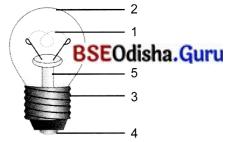
Figure given below shows a bulb with its different parts marked as 1, 2, 3, 4 and 5. Which of them label the terminals of the bulb?
Answer:
Labels 3 and 4 mark the terminals of the bulb.
Question 5.
Mehul opens an old torch bulb and observes a very thin wire stretched at the centre of the glass bulb.
(i) What is this thin wire called?
(ii) Is this component present in an LED?
Answer:
(i) The very thin wire inside the torch bulb is called the filament.
(ii) No. This component is not present in an LED.
Question 6.
What is a circuit diagram? Why do we use circuit diagrams instead of real pictures of components?
Answer:
A circuit diagram is a drawing of an electric circuit using standard symbols for its components. We use circuit diagrams because they are simple, clear, and easy to draw and understand, and they show connections more neatly than real pictures.
Question 7.
Paheli wanted to light a torch bulb using a cell. She did not have connecting wires, so she used two strips of aluminium foil instead. Will the bulb glow? Explain how.
Answer:
Yes, the bulb will Aluminium foil is a good conductor of electricity, so the two foil strips can act like connecting wires. One strip should connect one terminal of the cell to one terminal of the bulb, and the other strip should connect the other terminal of the cell to the other terminal of the bulb.
Electricity: Circuits and Their Components Class 7 Short Question Answer
Question 1.
In the science lab, students were given two cells and asked to light a bulb. What can be the possible ways of connecting the two cells, and in which of those cases will the bulb glow?
Answer:
Two cells can be connected end-to-end in two ways. Correct connection: The positive terminal of one cell is connected to the negative terminal of the other cell. The two free terminals are then connected to the bulb. In this case, the cells act together as a battery, current flows in the closed circuit, and the bulb glows.
Wrong connection: If the cells are placed so that positive terminal of one cell is connected to the positive terminal of the other cell or negative to negative, the cells do not add up to form a useful battery for the circuit, and the bulb does not glow.
Question 2.
(i) Explain how the two terminals of a lamp are formed at its base.
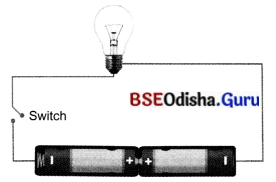
(ii) Riya makes the circuit shown in the figure. The bulb does not glow. What two changes must be made in the circuit to make the bulb light up?
Answer:
(i) One thick support wire from the filament is connected to the metal case at the base, and the other support wire is connected to the metal tip at the centre of the base. These two metal parts act as the two terminals of the lamp.
(ii) To make the bulb light up, Riya must do the following two things:
- Arrange the two cells correctly to form a battery, i.e., the positive terminal of one cell should touch the negative terminal of the other.
- Close the switch so that the circuit becomes complete (closed circuit).
Question 3.
Figures A and B, show a bulb connected to a cell in two different ways.
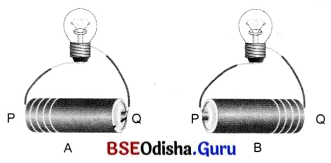
(i) What will be the direction of the current through the bulb in both the cases? (Q to P or P to Q)
(ii) Will the bulb glow in both the cases?
(iii) Does the brightness of the glowing bulb depend on the direction of current through it?
Answer:
(i) The direction of the current through the bulb in Fig. (A) is from Q to P, and in Fig. (B) is from P to Q.
(ii) Yes, because the circuit is complete and current flows in both cases.
(iii) No, the brightness of the glowing bulb does not depend on the direction of current flow.
Question 4.
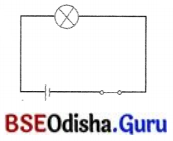
Examine the given circuit carefully and answer the questions that follow.
(i) Give a reason why the given circuit doesn’t result in the bulb glowing.
(ii) What component is missing from the given circuit?
(iii) Draw a corrected circuit diagram along with the missing component.

Answer:
(i) The bulb is not glowing because the circuit is incomplete, i.e., there is a gap in the wire connection from the negative terminal of the cell to the terminal of the bulb.
(ii) A switch is missing from the circuit.
(iii)
Question 5.
Aanchal is making a working model of a room light. She uses a cardboard sheet, two cells, a bulb, a switch, and connecting wires to make a simple circuit. When the switch is turned ‘ON’, the bulb does not glow.
(i) Explain how she should test whether the cells are responsible for the bulb not glowing.
(ii) If the cells are found to be in proper working condition, what else might be wrong, and how would she fix it?
Answer:
(i) To test the cells, Aanchal can connect them in a simple test circuit using a known working bulb and two wires. If the bulb glows, the cells are working. She should test each cell separately in the same way to find whether any cell is weak or discharged.
(ii) If the cells are in good condition, then the bulb may be fused, a wire connection may be loose or wrongly joined, the wire ends may still have insulation, or the switch may not be making proper contact. She should tighten all connections, remove insulation from the wire ends, ensure the bulb is fitted properly, check the switch contacts, and replace the bulb if its filament is broken. Once the circuit is complete, the bulb will glow when the switch is turned ON.
Question 6.
Answer the following questions:
(i) Draw an electric circuit diagram using symbols that satisfy the following conditions:
- The battery contains two electric cells.
- The switch is in the OFF position.
- Two electric bulbs are connected next to each other in the same path.
(ii) Will the bulbs glow in the circuit you have drawn? Give a reason for your answer.
(iii) Imagine that the switch is turned ON, but one of the bulbs in the series gets fused. Will the other bulb glow? Explain your answer.
Answer:
(i)
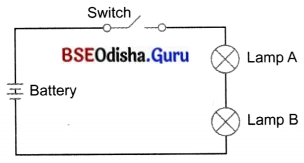
(ii) No, the bulbs will not glow. Because the switch is OFF, the circuit is open, so there is no complete path for current from one terminal of the battery to the other.
(iii) No, the other bulb will not glow. In the given circuit, all components are in a single path. When one bulb is fused, its filament breaks and the circuit becomes open. Since no current can flow through the circuit, the remaining bulb also cannot glow.
Question 7.
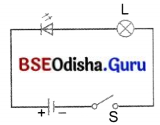
In the circuit diagram shown alongside, [Problem Solving Skill]
(i) will the lamp ‘L’ glow, if the switch ‘S’ is turned on? Why?
(ii) will the lamp glow if LED is removed from the circuit?
(iii) can switch S be placed between LED and lamp L? Will the lamp glow after changing the place of the switch and turning it ON?
Answer:
(i) No, lamp L will not glow because the LED is wrongly connected.
(ii) Yes, the lamp will glow.
If the LED is removed and the circuit is completed properly, current can flow directly through the lamp when the switch is ON. Therefore, the lamp will light up.
(iii) Yes, the switch can be placed between the LED and the lamp but the lamp will still not glow due to the wrong connection of the LED.
Question 8.
Answer the following questions:
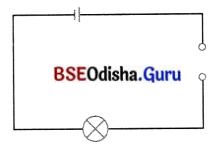
(i) Describe the simple tester circuit you can build to find out whether daily-use objects are conductors or insulators. Draw a neat and labelled circuit diagram to support your answer.
(ii) Using this tester circuit, what observations would you expect when you test the following items: a steel spoon, a rubber band, a pen, a plastic scale, an eraser and a coin?
Answer:
(i) A simple tester can be made by connecting a cell, a small bulb and two wires in series, leaving two free wire ends as test points. When an object is placed between these two free ends, it becomes part of the circuit. If the bulb glows, the object is a conductor; if it does not, the object is an insulator.
(ii) Steel spoon: bulb glows ⇒ conductor
Rubber band: bulb does not glow ⇒ insulator
Pen: bulb does not glow ⇒ insulator
Plastic scale: bulb does not glow ⇒ insulator
Eraser: bulb does not glow ⇒ insulator
Coin: bulb glows ⇒ conductor
Electricity: Circuits and Their Components Class 7 Long Question Answer
Question 1.
Neha’s torch would not glow even with a new cell during her camping trip. She observed that the torch needed more than one cell.
(i) Why do you think a torchlight uses multiple cells instead of one?
(ii) What would be the result if she put multiple cells in an incorrect arrangement?
(iii) Even though the placement of cells is important in a torchlight, the direction of the current does not affect the working of the bulbs. Why?
Answer:
(i) A torchlight uses a battery of multiple cells, because it provides more energy and lasts longer than a single cell. Using multiple cells ensures that the torchlight glows brighter and works for a longer period of time, during activities like camping or emergencies.
(ii) If the cells are placed incorrectly, the current will not flow as intended, and the torch may not work.
(iii) The filament inside the bulb operates regardless of whether the current flows in one direction or the other, the filament simply heats up and glows when current flows through it.
Question 2.
In a simple circuit, an LED does not glow. The teacher says, “Don’t change anything except the way the LED is connected.” When the student reverses its terminals, it glows.
(i) What does this tell us about LEDs?
(ii) How is the above behaviour of LED different from that of an incandescent bulb?
(iii) Draw a simple circuit diagram using a cell, a switch, an LED and a bulb connected in series.
Answer:
(i) This shows that an LED allows current to pass only in one particular direction. If its terminals are connected in the wrong way, current does not flow through it and it does not glow. When the terminals are reversed, current flows through the circuit and the LED glows.
(ii) An incandescent bulb glows whenever current passes through its filament, no matter which way it is connected to the cell. Its working does not depend on the direction of current, unlike an LED, which glows only when connected in the correct direction.
(iii)

Question 3.
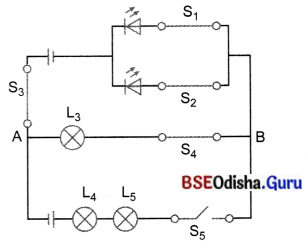
In the circuit shown below there are five identical lamps and five switches.
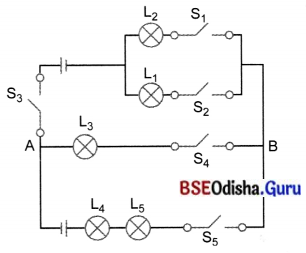
(i) If S2, S3, and S4 are turned ON, but all the other switches are OFF. Which lamp(s) will glow?
(ii) If S1, S2, and S3 are turned ON, but S4 and S5 are OFF. Which lamp(s) will glow? Explain your answer.
(iii) Which switches must be in the ON position to make L1, L2, and L3 glow simultaneously?
(iv) Redraw this circuit, replacing the lamps L1 and L2 with LEDs so that these LEDs glow when all switches are ON except S5.
Answer:
(i) If S3, S2 and S4 are turned ON while all others are OFF, lamps L1 and L3 will glow.
(ii) When S1, S2 and S3 are ON and S4, S5 are OFF, none of the lamps will glow. This is because there is no closed path for current when S4 and S5 are OFF.
(iii) To make L1, L2 and L3 glow simultaneously, switches S1, S2, S3, and S4 must be turned ON.
(iv)
Electricity: Circuits and Their Components Class 7 Case Based Questions
Read the following passages and answer the questions that follow:
Question 1.
Aman wants to light a bulb using a battery of two cells. He tries two different methods to make the battery:
Method 1: He connects the positive terminal of one cell to the negative terminal of the other.
Method 2: He connects both positive terminals together.
(i) What must be kept in mind while connecting cells together in a circuit?
Answer:
The positive terminal of one cell should be connected to the negative terminal of the next cell.
(ii) Draw a circuit diagram for the method in which the bulb glows.
Answer:
The bulb glows in method 1. The circuit diagram is as follows (assuming a switch is also used in the circuit)
(iii) In which method, the bulb does not glow? Why?
Answer:
The bulb does not glow in method 2, when both positive terminals of the cells are connected together. The cells cancel out their electrical energy. Since no energy is supplied to move the current, the bulb does not glow.
OR
(iii) What is the effect on the bulb when two electric cells are connected in a circuit in place of a single cell?
Answer:
When two cells are connected correctly in place of one, the current in the circuit increases and the bulb glows brighter.
Question 2.
During a science workshop, three students, Kabir, Arun and Aryan, were provided with identical electrical components: two cells, one lamp, one LED, one switch, and connecting wires. They were instructed to assemble a working electrical circuit using these materials. However, they arranged the components in different ways.
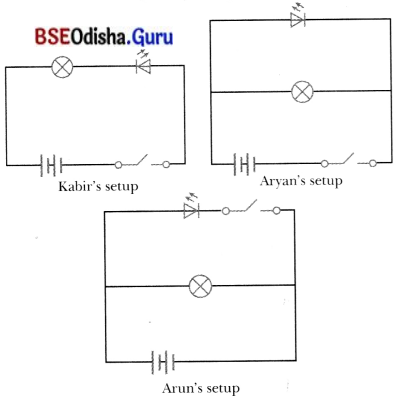
(i) In which of the setups, when the switch is turned ON, will the bulb continue to glow irrespective of the manner in which the LED is connected?
(a) Kabir’s and Aryan’s setup
(b) Arun’s and Aryan’s setup
(c) Arun’s setup only
(d) Aryan’s setup only
Answer:
(b) In these setups, the bulb is not in series with the LED. Therefore, when the switch is turned ON, the bulb receives current directly from the cells and continues to glow irrespective of the way the LED is connected.
(ii) In which case will the bulb glow irrespective of whether the switch is turned ON or OFF?
(a) Kabir’s and Aryan’s setup
(b) Arun’s and Aryan’s setup
(c) Arun’s setup only
(d) Kabir’s setup only
Answer:
(c) In Arun’s setup, the switch is not connected in the bulb’s circuit. Hence, the bulb remains connected to the cells and glows whether the switch is in the ON or OFF position.
(iii) Will the LED glow in Kabir’s experimental setup? State Yes or No and give a reason if it glows, or suggest a corrective measure if it does not glow.
Answer:
No. In Kabir’s circuit, the LED is connected in reverse. An LED allows current to flow only in one direction. Therefore, the LED does not glow and the flow of current in the circuit stops.
Correction: The LED connection should be reversed so that its longer leg is connected to the positive terminal of the cell.
OR
(iii) Identify and define the component whose position has been changed between Aryan’s setup and Arun’s setup.
Answer:
The the component whose position has been changed between Aryan’s setup and Arun’s setup is switch. A switch is a simple device used to open or close an electric
Question 3.
Neeraj designed an electric circuit as shown below.
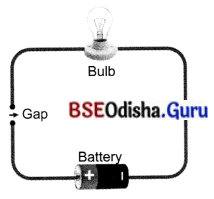
He filled the gap in the circuit with four different objects, one at a time. The table shows Neeraj’s findings.
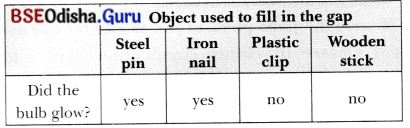
(i) Which question can be answered through Neeraj’s activity? Circle ‘Yes ‘ or ‘No’ for the correct response.
| Can this question be answered? | Yes or No |
| (a) Are metals good conductors of electricity? | Yes/No |
| (b) Are non-metals bad conductors of electricity? | Yes/No |
| (c) Do all electric circuits contain an electric bulb? | Yes/No |
Answer:
(a) Yes
(b) Yes
(c) No
(ii) Which safety measure must Neeraj follow during the activity?
(a) Wear an apron
(b) Wear a face mask
(c) Wear a pair of goggles
(d) Wear a pair of rubber gloves
Answer:
(d) Wear a pair of rubber gloves
(iii) Neeraj repeated the activity using the same four objects. This time the bulb did not glow for any of the four objects. What could be the most likely reason for this?
Answer:
The bulb may not glow for any of the objects if:
- The battery (cell) is exhausted and cannot supply current.
- The bulb is fused, so it will not glow even if the circuit is complete.
Electricity: Circuits and Their Components Class 7 Picture Based Questions
Observe the given pictures and answer the questions that follow:
Question 1.
Observe the electric circuit given below.
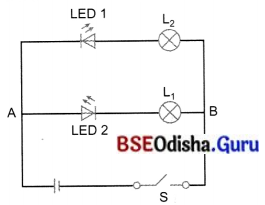
(i) When the switch S is moved to the ON position, which of the components in the circuit will glow?
(a) L1 and LED 2 Only
(b) L2 and LED 1 Only
(c) All four components
(d) None of them
Answer:
(ii) When the switch S is turned ON, trace the path of current starting from the positive terminal of the cell.
Answer:
When the switch S is turned ON, the current starts from the positive terminal of the cell, goes to point A, then flows through LED 2, then through lamp L1 to point B, then passes through the switch S, and returns to the negative terminal of the cell. No current flows through the upper branch because LED 1 blocks it.
(iii) To make lamp L2 glow without changing the position of the cell or the switch or L2 itself, what change should be made in the circuit?
Answer:
To make lamp L2 glow without changing the position of the cell or the switch or L2 itself, reverse LED 1 so that it is connected in the correct direction. Then current will pass through the upper branch and L2 will glow.
OR
(iii) Suppose the cell is taken out and inserted again with its positive and negative terminals interchanged, while everything else is kept the same. When switch S is ON in this new situation, which of the four components (LED 1, LED 2, L1, and L2) will glow?
Answer:
If the cell is inserted again with its terminals interchanged, the direction of current reverses. In this case, LED 1 becomes correctly connected, so current flows through the upper branch and LED 1 and L2 glow. LED 2 becomes reverse connected, so LED 2 and L1 will not glow.
Question 2.
Four circuit arrangements are shown below.
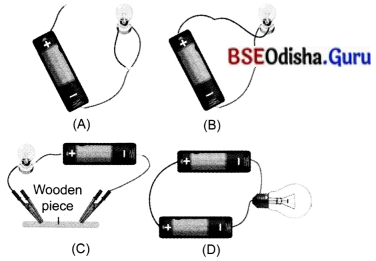
(i) In which of the given arrangements will the lamp glow?
Answer:
The lamp will glow only in arrangement (B).
(ii) In arrangement (C), what should be placed instead of a wooden piece to make the lamp glow?
Answer:
To make the lamp glow, an object which is a conductor of electricity should be placed in place of the wooden piece. For example, a steel spoon or a metal key.
(iii) If in arrangement (B), the lamp is replaced by an LED, will the circuit work and the LED glow? Explain.
Answer:
Yes, the circuit will work provided that the LED is connected in the correct direction, with its longer leg (positive terminal) connected to the positive terminal of the cell. If connected in reverse, it will not glow.
OR
(iii) In arrangement (D), what change should be made in the connections so that the lamp glows?
Answer:
In arrangement (D), connect the two cells correctly to make a proper battery by joining the positive terminal of one cell to the negative terminal of the other. Then connect the bulb to the two free terminals of the battery (one free + and one free –).
Electricity: Circuits and Their Components Class 7 Activity Based Questions
Read the following activity and answer the questions that follow:
Question 1.
Objective: To observe how the arrangement of cells affect the working of a bulb in an electric circuit.
Materials required: One small bulb with a holder, two cells, connecting wires with bare ends, a cardboard base, and a switch (optional).
Procedure:
- Fix the bulb holder on a cardboard base.
- Now arrange two cells by connecting the positive terminal of the first cell to the negative terminal of the second cell.
- Connect the free positive terminal of this battery to one terminal of the bulb holder and the free negative terminal to the other terminal of the bulb holder using connecting wires.
Observe whether the bulb glows.
- Now disconnect the circuit.
- Finally, arrange the two cells by connecting the positive terminal of the first cell to the positive terminal of the second cell.
- Connect the free negative terminals of both cells to the terminals of the bulb holder using connecting wires.
Observe whether the bulb glows.
(i) What conclusion can be drawn from this activity?
Answer:
A bulb glows only when two cells are connected in the correct order to form a battery. If the cells are connected incorrectly, electric current does not flow through the circuit and the bulb does not glow.
(ii) If someone connects the two terminals of a single cell directly by a wire without any bulb or device in between, is it considered harmful for the cell? Explain briefly.
Answer:
Connecting the two terminals of a single cell directly by a wire without any bulb or device in between makes a huge current flow directly through the wire, which heats the wire and quickly discharges or damages the cell, and may even melt the wire’s insulation.
OR
(ii) What will happen if a battery of three cells is used instead of two?
Answer:
If three cells are connected properly in series instead of two, more current flows through the bulb, so the bulb will glow brighter (If too many cells are used, the bulb may get damaged or fuse.)
(iii) Draw the circuit diagram for the case where the bulb is connected to two cells and glows.
Answer:
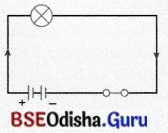
Electricity: Circuits and Their Components Extra Questions for Practice
Question 1.
Which of the following options correctly describes the direction of conventional electric current in a simple circuit containing a battery and a bulb?
(a) From the negative terminal of the battery, through the bulb, back to the positive terminal of the battery.
(b) From the bulb to the battery and then back to the bulb.
(c) From the positive terminal of the bulb, through the battery, back to the negative terminal of the bulb.
(d) From the positive terminal of the battery, through the bulb, back to the negative terminal of the battery.
Answer:
(d) Conventional electric current flows from the positive terminal of the battery, through the bulb, and back to the negative terminal of the battery.
Question 2.
A technician has to make a safe plug and connecting wire using the materials given: copper, aluminium, plastic, rubber, and ceramic. Which combination is most appropriate?
(a) Pins/connectors: plastic; outer cover: copper
(b) Pins/connectors: copper; outer cover: plastic
(c) Pins/connectors: rubber; outer cover: aluminium
(d) Pins/connectors: ceramic; outer cover: copper
Answer:
(b) Pins/connectors should be made of copper because it is a good conductor of electricity, and the outer cover should be made of plastic because it is an insulator and provides safety.
Question 3.
Which of the following statements are correct?
(i) An electric cell has two terminals, positive and negative.
(ii) A battery is a source of electrical energy, but a single cell is not.
(iii) In a battery, the positive terminal of one cell is connected to the negative terminal of the next cell.
(iv) In an electric circuit with a cell and bulb, current originates from the bulb.
(a) (i), (ii) and (iii) only
(b) (i) and (iii) only
(c) (i) and (ii) only
(d) (i), (ii), (iii) and (iv)
Answer:
(b) A single cell is also a source of electrical energy; a battery is simply a combination of two or more cells. In an electric circuit with a cell and a bulb, the current originates from the source of electrical energy, i.e., the cell.
Question 4.
A student connects a bulb to a battery of two cells using wires, but the bulb does not glow. Which of the following could be the possible reasons?
(i) The connections are loose.
(ii) The filament of the bulb is broken.
(iii) The cells are new.
(iv) The cells are connected incorrectly while forming the battery.
(a) (i) only
(b) (i), (ii) and (iii) only
(c) (i), (ii) and (iv) only
(d) (i) and (iii) only
Answer:
(c) (i), (ii) and (iv) only
Questions 5 and 6 consist of two statements – Assertion (A) and Reason (R). Answer these questions by selecting the correct option:
(a) Both A and R are true and R is the correct explanation of A.
(b) Both A and R are true but R is not the correct explanation of A.
(c) A is true but R is false.
(d) A is false but R is true.
Question 5.
Assertion (A): A bulb glows only when the circuit is complete.
Reason (R): The bulb glows because air inside it conducts electricity and produces light.
Answer:
(c) A is true but R is false.
Question 6.
Assertion (A): Copper wire is used to connect different components in an electric circuit.
Reason (R): Copper is a conductor and allows electric current to pass through it easily.
Answer:
(a) Both A and R are true and R is the correct explanation of.
Question 7.
Why does a torch lamp glow only in one position of its switch?
Answer:
A torch lamp glows only in one position of its switch because, in the ON position, the circuit is complete and electric current can flow through the lamp, while in the OFF position, the circuit is open and current cannot flow.
Question 8.
Why should electrical switches not be touched with wet hands?
Answer:
Electrical switches should not be touched with wet hands because if water from wet hands comes in contact with the conductive parts of the appliance or switch, it can allow electric current to pass through the body, as tap water conducts electricity. This may result in an electric shock and can be dangerous. Therefore, electrical switches should always be handled with dry hands.
Question 9.
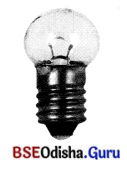
Observe the picture of the bulb given alongside and answer the following questions.
(i) Mark the filament and terminals of the bulb in the picture.
(ii) How does an incandescent bulb glow when electric current passes through it?
(iii) Does it matter which terminal of an incandescent lamp is connected to the positive or negative terminal of a cell?
Answer:
Observe the picture of the bulb given alongside and answer the following questions.
(i) Mark the filament and terminals of the bulb in the picture.
(ii) How does an incandescent bulb glow when electric current passes through it?
(iii) Does it matter which terminal of an incandescent lamp is connected to the positive or negative terminal of a cell?
Question 10.
(i) What is a circuit diagram?
(ii) Draw the circuit symbol of a battery having 3 cells.
Answer:
(i) What is a circuit diagram?
(ii) Draw the circuit symbol of a battery having 3 cells.
Question 11.
Ravi is preparing a night-lamp model for a school exhibition using a cell, a switch, connecting wires, a torch bulb and an LED. He makes a circuit using the cell, switch and the LED, but the LED does not glow even when the switch is ON. He then replaces the LED with an incandescent bulb and the bulb glows. Ravi reconnects the LED by interchanging its two terminals, and this time the LED glows.
Later, Ravi decides to use two cells to make the night-lamp brighter, but after adding the second cell, the torch bulb does not glow.
(i) What would happen if one of the connecting wires becomes disconnected?
(ii) Why did the incandescent bulb glow even when the LED did not glow in the initial setup?
(iii) After adding the second cell, the bulb did not glow. What possible mistake in connecting the two cells could have caused this?
Answer:
Ravi is preparing a night-lamp model for a school exhibition using a cell, a switch, connecting wires, a torch bulb and an LED. He makes a circuit using the cell, switch and the LED, but the LED does not glow even when the switch is ON. He then replaces the LED with an incandescent bulb and the bulb glows. Ravi reconnects the LED by interchanging its two terminals, and this time the LED glows.
Later, Ravi decides to use two cells to make the night-lamp brighter, but after adding the second cell, the torch bulb does not glow.
(i) What would happen if one of the connecting wires becomes disconnected?
(ii) Why did the incandescent bulb glow even when the LED did not glow in the initial setup?
(iii) After adding the second cell, the bulb did not glow. What possible mistake in connecting the two cells could have caused this?
OR
(iii) What does the LED glowing only after interchanging its terminals indicate about the nature of an LED? Write one difference between an LED and an incandescent bulb.
Answer:
What does the LED glowing only after interchanging its terminals indicate about the nature of an LED? Write one difference between an LED and an incandescent bulb.
Question 12.
(i) Describe how to make a simple electric switch using easily available materials.
(ii) Name any four materials-two conductors and two insulators-commonly found around you.
Answer:
(i) Describe how to make a simple electric switch using easily available materials.
(ii) Name any four materials-two conductors and two insulators-commonly found around you.