
Go through BSE Odisha Class 8 Science Solutions Chapter 12 How Nature Works in Harmony Question Answer to understand textbook questions more clearly.
Class 8 Science Curiosity Chapter 12 Question Answer
Class 8 Science Ch 12 How Nature Works in Harmony Question Answer
Class 8 Science Chapter 12 How Nature Works in Harmony Question Answer
Probe and Ponder Questions
Question 1.
How might the loss of forest cover and changes in rainfall patterns lead to elephants entering human farms and villages?
Answer:
Loss of forest cover reduces vegetation and habitat space, while changes in rainfall patterns can dry up waterholes, making food and water scarce in elephants’ natural habitats. As a result, elephants wander into nearby farms and villages in search of crops like bananas and sugarcane, leading to crop damage and potential harm to humans and animals.

Question 2.
Imagine you are a tree in a dense forest. What kind of relationships would you have with water, sunlight, other animals and other components of the forest?
Answer:
As a tree, I would:
- Water: Abrorb water from the soil for photosynthesis and growth.
- Sunlight: Use sunlight to produce food via photosynthesis.
- Other Animals: Provide shelter, food (fruits, leaves) and oxygen for animals; animals like birds and insects aid in pollution and seed dispersal.
- Other Components: Intract with soil for nutrients and stability, contribute to air quality by releasing oxygen and help retain soil moisture to prevent erosion.
Question 3.
Do you think the Earth can thrive without humans? Can humans survive without the Earth?
Answer:
Earth without humans: Yes, Earth can thrive without humans Ecosystems, such as forests and aquatic systems, function through natural interactions (e.g., food chains, nutrient cycling) without human intervention. Protected areas like national parks show ecosystems can self-sustain. Humans without Earth: No, humans cannot survive without Earth, as they depend on ecosystem for air, water, food and resources essential for survival.
Question 4.
If two kinds of birds compete for the same fruit, how might their way of living change over time?
Answer:
Competition may lead to niche differentiation, where one bird species adapts to feed at different times or on different parts of the fruit tree to reduce competition. Over time, they may evolve distinct beak shapes or feeding behaviours, or one species may dominate, forcing the other to find alternative food sources or habitats.
Question 5.
Can human actions cause natural disasters?
Answer:
Human actions can exacerbate or trigger events that resemble natural disasters. For example, deforestation and pollution can worsen floods or storms by destabilizing soil and altering weather patterns. Overuse of pesticides can disrupt ecosystems, indirectly contributing to environmental imbalances.
Question 6.
Share your questions
Answer:
Here are some fun questions from the chapter:
- How do decomposers help recycle waste?
- Why are mangroves important for coastal areas?
- What happen if predators disappear from a forest?
- How can we make farming more ecofriendly?
InText Questions
Question 1.
Why do some organisms live on land and others in water? (Page 192)
Answer:
Every organism needs certain conditions to survive, such as food, water, oxygen, shelter and space. Example: Fish live in ponds because they get food, oxygen, and shelter there. Pond water provides both biotic needs (food from plants/ animals) and abiotic needs (oxygen from water). Many other creatures (frogs, turtles, snakes, insects, birds, plants) share the pond. Each interacts with others and with the nonliving parts of the habitat.
Question 2.
Who all live together in Nature? (Page 192)
Answer:
A population is a group of the same species in a habitat. A community includes multiple populations interacting. Ecosystems encompass communities and their abiotic interactions.
Question 3.
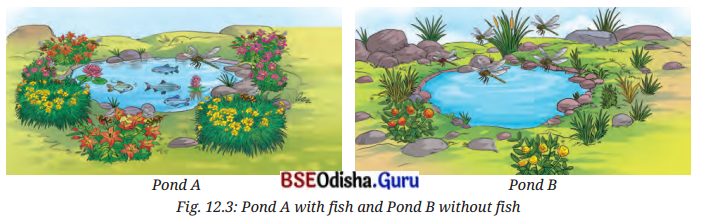
We observed that in Pond A (with fish) the number of dragonflies were less as compared to Pond B (without fish). Why? (Page 195)
Answer:
This is because fish eat dragonflies larvae in the pond.
Question 4.
How does the population of fish in a pond affect the seed production in nearby plants? (Page 195)
Answer:
Dragonflies are predators of bees, butterflies and other insects that help pollinate flowers. Fever dragonflies in pond A (with fish) means more bees and butterflies can survive and pollinate the flowers. So, more pollination will occur which leads to more flowers producing seeds and more plants.
Question 5.
Draw any two food chain a grassland ecosystem.
Answer:
(a) Grass → Grasshopper → Frog → Snake → Eagle.
(b) Grass → Hare → Fox.
Question 6.
In nature, nothing is wasted; everything is reused. Does nature really waste anything? (Page 201)
Answer:
Nothing truly goes to waste in nature every thing is reused in one form or another.
Question 7.
What happens when we intervene in nature? (Page 202)
Answer:
Human intervention leads to:
- Ecological damage
- Extinction of some species and biodiversity loss.
- Resources depletion like overuse of forest, fish stocks etc. and damages to ecosystems and disrupts the balance of nature.
How Nature Works in Harmony Class 8 Questions and Answers
Keep the Curiosity Alive (Pages 207-208)
Question 1.
Refer to the given diagram (Fig.) and select the wrong statement.
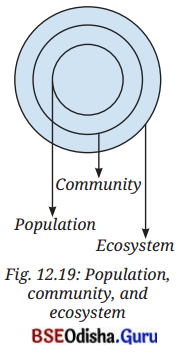
(i) A community is larger than a population.
(ii) A community is smaller than an ecosystem.
(iii) An ecosystem is part of a community.
Answer:
(iii) An ecosystem is part of a community.
Explanation: Actually, a community (groups of populations) is part of an ecosystem, which includes both living things and non-living parts like soil and water. The other statements are correct: communities are larger than populations and smaller than ecosystems.
Question 2.
A population is part of a community. If all decomposers suddenly disappear from a forest ecosystem, what changes do you think would occur? Explain why decomposers are essential.
Answer:
Changes: Dead plants and animals would accumulate, nutrients would not return to the soil, and plant growth would decline. This could lead to a reduction in herbivore and carnivore populations due to food scarcity. Decomposers are essential, (e.g., fungi, bacteria) break down dead matter into simpler substances, recycling nutrients like nitrogen and carbon back into the soil for plants. Without them, the nutrient cycle would stop, disrupting the food web.
Question 3.
Selvam from Cuddalore district, Tamil Nadu, shared that his milage was less affected by the 2004 Tsunami compared to nearby milages due to the presence of mangrove forests. This surprised Sarita, Shabnam, and Shijo. They wondered if mangroves were protecting the village. Can you help them understand this?
Answer:
Yes, mangroves protected the village. Mangrove forests act as natural barriers, slowing down strong winds and waves during storms and tsunamis. Their roots stabilize soil, reducing erosion, and they absorb water impact, protecting coastal areas. The Sundarbans’ mangroves, a World Heritage Site, demonstrate this protective role.
Question 4.
Look at this food chain :
Grass→Grasshopper- Frog → Snake
If frogs disappear from this ecosystem, what will happen to the population of grasshoppers and snakes? Why?
Answer:
- Grasshoppers: The population would likely increase because frogs, their main predators, are gone, reducing predation pressure.
- Snakes: The population would decrease because frogs are their primary food source, leading to food scarcity.
- Why: In a food chain, the removal of a middle trophic level (frogs) disrupts the balance. Fewer predators allow prey (grasshoppers) to multiply, while the loss of prey affects higher predators (snakes).
Question 5.
In a school garden, students noticed fewer butterflies the previous season. What could be the possible reasons? What steps can students take to have more butterflies on campus?
Answer:
- Possible reasons: Possible causes include pesticide use killing larvae, loss of nectar plants, or increased predators (e.g., birds). Monoculture or pollution might also reduce habitat quality.
- The steps we can take: Plant diverse nectar-rich flowers (e.g., marigolds), avoid pesticides, create sheltered areas, and install butterfly feeders or water sources to attract and support butterflies.
Question 6.
Why is it not possible to have an ecosystem with only producers and no consumers or decomposers?
Answer:
An ecosystem needs consumers to regulate producer populations (e.g., herbivores eat plants) and decomposers to recycle dead matter into nutrients for producers. Without consumers, producers would overgrow and die from competition; without decomposers, nutrients would not cycle, collapsing the system.
Question 7.
Observe two different places near your home or school (e.g., a park and a roadside). List the living and non-living components you see. How are the two ecosystems different?
Answer:
We can see some common things near our home and school, such as
- Park: Living (trees, birds, squirrels, grass); Non-living (soil, water, benches, sunlight).
- Roadside: Living (weeds, insects); Non-living (asphalt, dust, car exhaust).
- Differences: The park is a designed ecosystem with diverse plants and animals, supported by soil and water, while the roadside is a disturbed, human-altered area with fewer species and more pollution.
Question 8.
‘Human-made ecosystems like agricultural fields are necessary, but they must be made sustainable.’ Comment on the statement.
Answer:
Agree. Agricultural fields provide food but often use unsustainable practices (e.g., synthetic fertilisers, monoculture) that degrade soil and harm biodiversity. Sustainable methods (e.g., organic farming, crop rotation) ensure long-term productivity and environmental health.
Question 9.
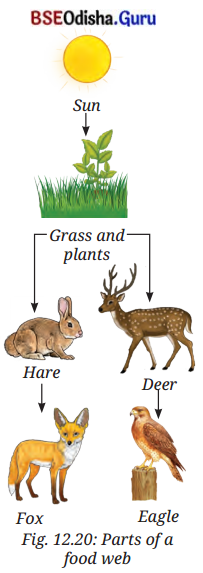
If the Indian hare population (Fig.) drops because of a disease, how would it affect the number of other organisms?
Answer:
- Predators: The numbers of foxes and eagles would decrease due to reduced prey (hares), leading to food scarcity.
- Plants: Grass and plant populations might increase initially without hare grazing, but overgrowth could alter the habitat.
- Deer: Since deer aren’t preyed on by foxes or eagles, their role in this particular chain isn’t disturbed directly.
- Why: A decline in a key herbivore like the hare disrupts the food web, affecting both higher (predators) and lower (plants) trophic levels.
Class 8 Science Chapter 12 Question Answer
Activity 1.
Let us explore
Aim: To understand the meaning of a habitat and its components.
Procedure:
- Let us select any two habitats in your surroundings.
- You may visit any two of the following like a pond, a forest, an agricultural farm, or even a large tree like banyan, mango, or pilkhan (white fig) tree.
- Make a list of the living beings and non-living things that you observe in these habitats.
- Note down your observations in table.
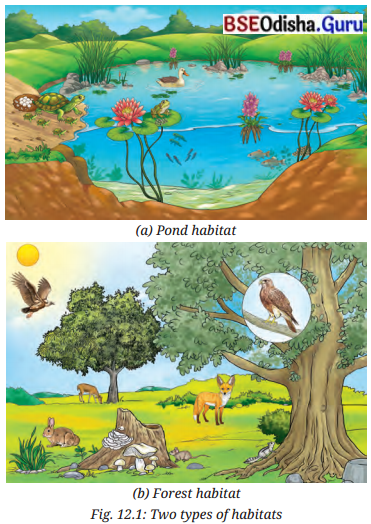
Observations:
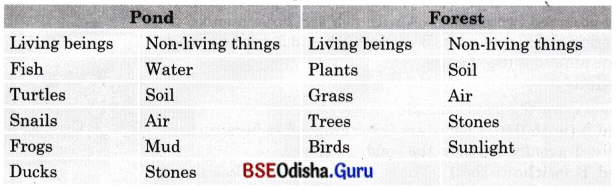
Common similarities: Both habitats have biotic and abiotic components.
Question.
What are biotic and abiotic components ?
Answer:
The living beings you have recorded in above table are termed as the biotic components and non-living things as the abiotic components of a habitat.
Inferences:
- Habitat is a place that provides the right conditions for an organism to live and grow.
- There are two components in a habitat biotic and abiotic.
- Both biotic components (plants, animal, microbes) and abiotic components (air, water, soil, temperature) interact with each other.
Activity 2.
Let us record
Aim: To find the population of a certain plant or animal.
Procedure:
- Divide your class into four to five groups of students.
- Each group have to identify any two living organisms, plant(s) or animal(s).
- Mark a fixed area (for example, 1m × 1m in your school garden).
- Count the number of each type of organism (plants or animals) present in that area.
- Record this information as the population for that type of organism at a particular area at that time. Population means the number of individuals of a particular kind (species) living in a defined area at a certain time.
- Complete the data from all groups and record in the table given below.
Observation:
| Name of organism | Population (Number of individual organisms) |
| Plant 1: ………… Cactus | 20 |
| Plant 2: ………… Rose | 05 |
| Animal 1: ………… Frogs | 10 |
| Animal 2: ………… Snake | 2 |
Activity 3.
Let us read
Aim: How does every organism in a community matter?
Procedure:
To understand this, researchers have conducted a study to see how fish in ponds affect seed production in the plants nearby. They observed two ponds: A with fish and large number of flowering plants around it; B without fish and fewer flowering plants around it (See figure).
Observations:
Explanation using the pond example:
- Pond A (with fish): There are fewer dragonflies because fish eat the dragonfly larvae in the pond.
- Pond B (without fish): There are more dragonflies since nothing eats their larvae.
What happens next ?
- Dragonflies are predators of bees, butterflies and other insects that help pollinate flowers.
- Fewer dragonflies in Pond A means more bees and butterflies can survive and pollinate the flowers.
- More pollinators = more pollination, which leads to more flowers producing seeds and more plants.
Inferences:
1. Scientific studies confirm this: researchers found better pollinated than those around ponds without
2. This show that:
- Organisms are interconnected: The presence or absence of one type (like fish) can affect many others (like pollinators and plants).
- Every member of a community has a role (niche): Fish control dragonfly populations, dragonflies affect pollinators, pollinators are essential for plant reproduction and plants provide food and shelter for all.
- This is known as a food web or ecological balance, where changes in one group lead to effects (sometimes called a “cascade”) throughout the community.
3. Impact of overfishing by humans
- Overfishing removes too many fish from ponds or oceans.
If too many fish are taken away, then the numbers of dragonfly definitely rise because their predators have gone. - This could lower the number of pollinators, resulting in less pollination for nearby plants.
- Removing key species like fish upsets the delicate balance of the community, affecting not just other animals but also plants and even the non-living (abiotic) environment.
Activity 4.
Let us relate and identify:
Aim: To identify the interactions between biotic and abiotic components based on given criteria.
Procedure :
- For Criterion 1: Interactions between abiotic and biotic components. These may influence life processes like nutrition, respiration, and reproduction in biotic components.
- For Criterion 2: Interaction between two abiotic components these may influence the physical characteristics of a habitat.
- For Criterion 3: Interaction among the biotic components. These may influence the availability of resources needed for life processes like nutrition, respiration, and reproduction.
- Now, try relate your knowledge and learning with your observations.
Observations:
- Note down your observations in table at the appropriate places. You may fill the table with other examples also.
Table: Interaction of biotic and abiotic components in a habitat
| Criterion 1: Interactions between biotic and abiotic components | Criterion 2: Interaction between two abiotic components | Criterion 3: Interaction among the biotic components |
| Earthworms live in moist soil. | The day temperature is high due to the bright sunlight. | A frog eats insects food chain. |
| Soil provides nutrients for plant. | Water is evaporating fast due to the sunlight. | A water snake eats fish. |
| Many microbes are present in the pond. | Air current is blowing slowly on the water surface creating gentle waves. | Frogs and fish may compete for small insects larvae. |
| A fish lays eggs in water (abiotic). | The soil near the pond is moist. | A fish lays eggs in water near vegetation to protect them from other fish or frogs. |
| Plant need sunlight (abiotic) for photo synthesis, water and soil for growth and air for resperition. | Many microbes (tiny living beings) interact in the pond, breaking down dead material. |
Inferences:
- We can conclude that (the biotic components (plants, animals, and microorganisms) and the abiotic components (air, water, soil, sunlight, and temperature) in a habitat interact with each other to form an ecosystem.
- Organisms in an ecosystem interact with abiotic components for food, shelter, and protection in an ecosystem.
Activity 5.
Let us classify
Aim: To classify the organisms in a ecosystem.
Procedure:
- Let us observe the figure activity -1 (b), which is an example of ecosystem.
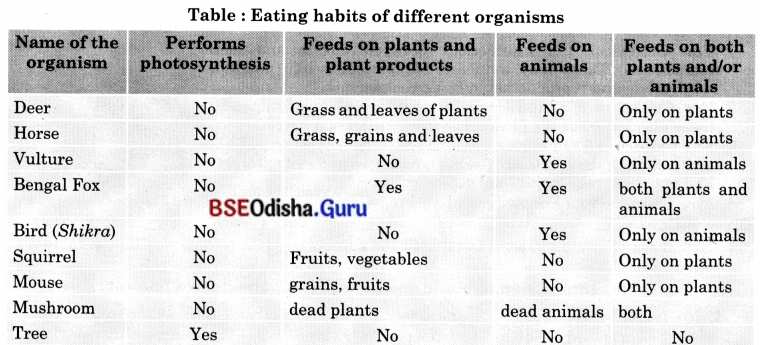
- Now, study the picture carefully and spot the organisms listed in table.
- With the help of the internet or your school library, find out the type of food they eat.
- Note down your observations in below table by identifying whether each organism feeds only on plants and plant products, only on animals, or on both.
Observations:
Inferences:
- Producers (Autotrophs): Make their own food (usually plants via photosynthesis). i.e., Autotrophs (auto = self + troph = food)
- Consumers (Heterotrophs): Depend on others for food. (hetro = other + troph = food)
- Herbivores: Eat only plants (deer, horse).
- Carnivores: Eat only animals (vulture, shikra).
- Omnivores: Eat both plants and animals (fox, mouse).
- Decomposers: Organisms like mushrooms and bacteria that feed on dead plants and animals, recycling nutrients back into the ecosystem.
Activity 6.
Let us link (relate)
Aim: To understand the meaning of a food chain.
Procedure:
- To understand the meaning of a food chain, let us take an example of a grassland ecosystem.
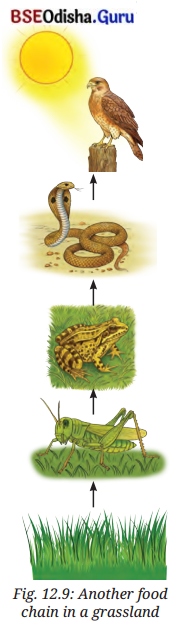
- Suppose the following organisms are present in a grassland ecosystem: grass, frog, hare, fox, grasshopper, snake, and eagle.
- Here we are representing a relationship of who eats whom among the organisms.
- We will draw the feeding relationships for the remaining organisms by adding arrows, same as shown in figure.
Observations:
- Grass is eaten by the hare and the hare is eaten by the fox. Grass → Hare → Fox
- Grass → Grasshopper → Frog → Snake → Eagle.
- Grass → Hare → Tiger.
Inference: A food chain is a simple sequence showing ‘who eats whom’ in an ecosystem.
Activity 7.
Let us draw
Aim: To understand the meaning of tropic level.
Procedure:
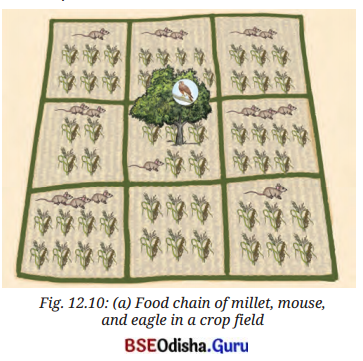
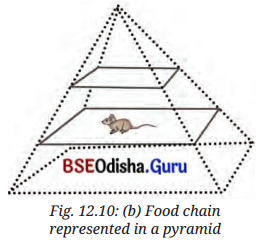
- Figure (a) represents a crop field with millets, mouse, and eagle.
- Now, we will count the number of each type of organism given in figure (a).
- Make a table and set a number in the table against each of the organisms.
- Then, arrange the numbers in the ascending order, you have to place the highest number at the base and the lowest at the top.
- Place the mouse, millet, and eagle appropriately in figure (b). According to appropriate position.
- What figure do you get? It looks like a pyramid. Complete the pyramid in figure (b).
Observations:
Ecological Pyramid
- When you count the number of organisms at each level (e.g., many grasses, fewer mice, only one eagle), and arrange these numbers with the highest at the base and lowest at the top, you get a pyramid shape.
- Producers are always the base and top predators are at the top, indicating energy loss at each step.
Inferences:
Trophic Levels
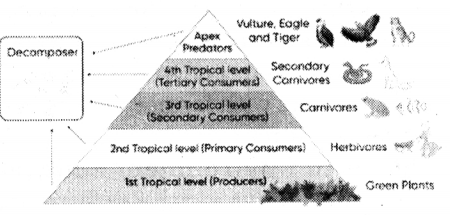
Each organism in a food chain occupies a specific position, called a trophic level:
- First trophic level: Producers (plants, e.g., grass, millet)
- Second trophic level: Herbivores (organisms that eat plants, e.g., hare, mouse)
- Third trophic level: Small carnivores (those that eat herbivores, e.g., frogs)
- Fourth trophic level (and above): Large carnivores or top predators (e.g., eagle, hawk, fox)
Activity 8.
Let us trace and link
Aim: To understand the concept of food web.
Procedure:
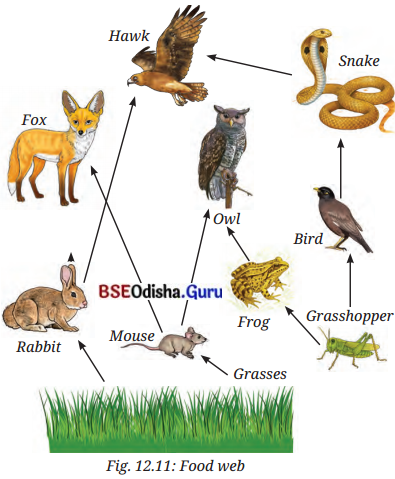
1. In reality, feeding relationships are not simple chains – they are much more complex, forming a food web.
2.
- The grass can be eaten by rabbit or mouse.
- Grasshoppers can be eaten by the bird or frog.
- Owls can eat mice or frog.
Observations: Since each organism may be eaten by two or more types of organisms, so the food chains are interlinked.
Inference: Thus, in an ecosystem, the food chains are interlinked with each other to form a network, called a food web.
Activity 9.
Let us read
Aim: Effects of Human Intervention: The Frog Leg Export Story.
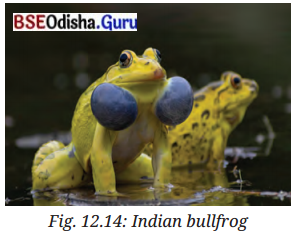
- In the 1980s, India exported a huge number of Indian bullfrogs. (Hoplobatrachus tigerinus)
- This reduced frog populations.
- Fewer frogs meant more insects, including pests in farms.
- Farmers then used more pesticides, harming the environment, water, soil and health of living beings.
- The Government banned frog-leg exports to help restore balance.
Observations and Inferences:
Ecosystem Balance
- Interactions between organisms and their environment keep populations and resources stable-this is called ecological balance.
- This balance is always changing (dynamic), but large disruptions by natural or human-made changes (such as overuse, pollution, loss of species) can harm it.
Activity 10.
Let us survey
Aim: To prepare a report that how synthetic fertilisers and pesticides can affect the environment and soil health after long-term use.
Procedure:
1. Go to a farm or a nearby village with your parents or teacher and interact with farmers in that community to find out about the farming practices they adopt.
2. Now, prepare a list of questions for farmers to find out the pesticides and other farm inputs they use, and whether they reuse or recycle materials to improve their crops. Here are some sample questions:
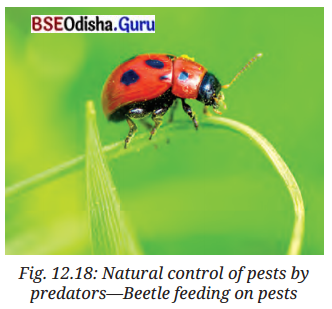
- How have your farming practices changed over time? And why?
- What effects do you notice when using synthetic fertilisers and pesticides?
- Have you seen any changes in soil health after using these synthetic fertilisers and pesticides?
3. Interact with farmers on the basis of these questions. Based on your observations, prepare a report.
Observations:
Harms to Environment and Health:
- Now a days synthetic fertilisers and pesticides are used to improve crop production and food velocity.
- Using pesticides and monoculture lead to soil degradation (loss of quality).
- Reduces soil fertility by decreasing friendly microorganisms and organic matter (humus), which binds soil particles.
- Without humus, soil erodes easily.
- Reduces natural predators which ultimately increasing pest populations.
- Heavy irrigation and repeated ploughing disturb soil organisms like earthworms and snails, important for ecological balance.
- Pests may develop resistance to pesticides, making control harder.
- Monoculture reduces crop diversity and affects pollinators (e.g., bees), crucial for food production.
- Understanding ecosystems helps adopt sustainable farming.
- Some farmers explore organic and natural methods to reduce synthetic fertilizers and minimize interference in natural ecosystems.
Inferences:
- Synthetic fertilisers and pesticides have played a vital role in improving crop production and helped countries like India become food secure. However, their long-term use can affect the environment and soil health.
- To make farming more sustainable, some farmers are exploring organic and natural farming methods.
How Nature Works in Harmony Class 8 Extra Questions and Answers
Short Answer Type Questions
Question 1.
Explain the difference between a community and an ecosystem.
Answer:
A community is all the populations of different species living and interacting in a habital, while an ecosystem includes the community plus abiotic community includes fish and plants, but an ecosystem adds water and sunlight.
Question 2.
How do fish indirectly affect seed production in plants near a pond ?
Answer:
Fish eat dragonfly larvae, reducing adult dragonflies. Fewer dragonflies meanless predation on pollinators (bees, butterflies), increasing pollination and seed production.
Question 3.
What are the effects of the overuse of synthetic fertilizers on soil ?
Answer:
Overuse hardens soil, reduces earthworm populations decreases organic matter and increase irrigation needs, leading to long-term fertility loss.
Question 4.
Why did the Government of India ban frog leg exports?
Answer:
The ban was imposed to protect frog population because frogs eat insects, their reduced numbers resulted in a rise in agricultural pests. This forced farmers to use more synthetic pesticides, which harmed the environment, soil and water quality, and affected the overall environmental and human health. The Government of India banned the export of frog legs to prevent further ecological damage.
Question 5.
What is an ecological pyramid, what does it show ?
Answer:
An ecological pyramid is a graphical representation of the number, biomass or energy at each trophic level. It shows that producers are most abundant at the base, while top carnivores are fewest at the top, reflecting energy loss.
Question 6.
Define “protected area for conservation”. Write its benefits.
Answer:
Definition: Protected areas are parts of land or water set aside to conserve wildlife and their habitats. India has many protected areas like national parks, wildlife sanctuaries, biosphere reserves, and community conserved areas.
Benefits: These places help protect entire habitats including endangered animals, birds, and many rare plants.
Question 7.
Explain the role of decomposers in the environment.
Answer:
Decomposers break down the dead and decaying organic matter and return the nutrients to the soil. Thus, they play a very important role in the nutrient re-cycling in the environment.
Question 8.
Write any three methods to achieve reforestation.
Answer:
Reforestation can be achieved by the following method:
- Restoring the destroyed forest by planting new trees mostly of the same species.
- If trees have to cut, then double the number of trees need to be planted.
- Sometimes a destroyed forest can grow into a new forest over a period of time if left undisturbed.
Long Answer Type Questions
Question 1.
Explain the structure and importance of a food web in an ecosystem with examples.
Answer:
A food web is a network of interconnected food chains showing multiple feeding relationships. It includes producers (e.g., grass), herbivores (e.g., grasshoppers, hares) carnivores (e.g., frogs, snakes) and top carnivores (e.g., eagles), with decomposers (e.g., mushrooms) recycling nutrients. For example, grass → grasshopper → frog → snake → eagle overlaps with grass → hare → fox, where snakes might eat hares. Its importance lies in providing resilience; if one species declines (e.g., frogs), others (e.g., snakes) can adapt by finding alternative prey, maintaining energy flow and ecosystem stability.
Question 2.
Discuss the ecological consequences of the Green Revolution in India and suggest sustainable alternatives.
Answer:
The Green Revolution introduced synthetic fertilisers and pesticides, boosting food production but causing soil degradation, pest resistance and reduced biodiversity. Oversuse of hardened soil killed beneficial organisms (e.g., earthworms) and increased irrigation needs. Sustainable alternatives include organic farming with compost or Kunapajala, crop rotation and diversity to reduce pests naturally, promoting long-term soil health and ecosystem balance.
Question 3.
Describe how human activities can disrupt ecosystem balance, using the example of frog harvesting in the 1980s.
Answer:
Human activities like over-harvesting disrupt ecosystems by removing key species. In the 1980s, exporting frog legs reduced frog populations, natural pest controllers. This led to more agricultural pests, increased pesticide use, soil and water pollution and health risks. The imabalance shows how removing a middle trophic level affects prey (pests increase) and predators (e.g., snakes decline), necessitating the export ban to restore balance.
Case-Study Based Questions
1. Read the following passage carefully and answer the questions that follow:
A great variety of plants and animals exist on earth. They are essential for the well-being and survival of mankind. Today, a major threat to survival of these organisms is deforestation. Deforestation means clearing of forests and using that land for other purposes. Some natural causes of deforestation are forest fires and severe droughts. Deforestation disturbs the balance in nature. If cutting of trees continues, rainfall and the fertility of the soil will decrease.
Moreover, there will be increased chances of natural calamities such as floods and droughts. This will lead to global warming as carbon dioxide traps the heat rays reflected by the earth. Deforestation is a major cause which leads to the change in soil properties. Physical properties of the soil get affected by plantation and vegetation. Trees prevent soil erosion. This soil has less humus and is less fertile. Gradually the fertile land gets converted into deserts. It is called desertification. Deforestation also leads to a decrease in the water holding capacity of the soil. The movement of water from the soil surface into the ground (infiltration rate) is reduced. So, there are floods.
(i) The clearing of forests is referred to as:
(a) reforestation
(b) desertification
(c) deforestation
(d) sanitation
Answer:
(c) deforestation
(ii) Deforestation leads to:
(a) an increase in the temperature of the earth
(b) imbalance of O2 and CO2
(c) increase in rainfall
(d) both (a) and (b)
Answer:
(d) both (a) and (b)
(iii) Desertification leads to :
(a) soil erosion
(b) soil being less fertile
(c) fertile land turning into deserts
(d) all of the above
Answer:
(d) all of the above
(iv) An increase in the amount of carbon dioxide results in :
(a) winter season
(b) global warming
(c) rainfall
(d) all of these
Answer:
(b) global warming
Picture Based Questions
II. Look at the picture and answer the following questions that follows:
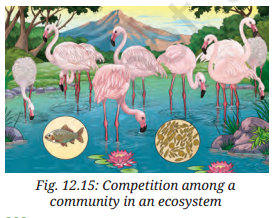
(i) What does this picture shows?
(ii) Do you think competetion among them are good for balancing the ecosystem ?
Answer:
(i) The picture shows that there is a competition among a community in an ecosystem. They compete for common resources like food, water, physical space or sunlight.
(ii) Yes, this competition helps control population size and keeps the ecosystem balanced. Without it, one species could multiply too much causing an imbalance in the ecosystem.
How Nature Works in Harmony Class 8 MCQ
Multiple Choice Questions (Mcqs)
Question 1.
What do wildlife corridors help with?
(a) Building roads
(b) Animal movement between forests
(c) Reducing pollution
(d) Connecting rivers
Answer:
(b) Animal movement between forests
Question 2.
What leads elephants to enter human settlements?
(a) Increase in rainfall
(b) Abundant crops
(c) Deforestation and water scarcity
(d) Forest expansion
Answer:
(c) Deforestation and water scarcity
Question 3.
What is the term for livings in a habitat?
(a) Biotic components
(b) Landscapes
(c) Ecosystems
(d) Abiotic components
Answer:
(a) Biotic components
Question 4.
What is a habitat ?
(a) The food chain
(b) A type of forest
(c) The place an organism lives
(d) An animal group
Answer:
(c) The place an organism lives
Question 5.
What is a group of same species in a habitat called ?
(a) Community
(b) Population
(c) Ecosystem
(d) Biome
Answer:
(b) Population
Assertion and Reasoning
These questions consist of two statements, each printed as Assertion (A) and Reason (R). While answering these questions, you are required to choose any one of the following four responses.
(a) Assertion and reason both are correct and reason is correct explanation for assertion.
(b) Assertion and reason both are correct and reason is not correct explanation for assertion.
(c) Assertion is correct but the reason is wrong.
(d) Assertion is wrong but the reason is correct.
1. Assertion: The removal of frogs from a food chain can increase the grasshopper population.
Reason: Frogs are natural predators of grass-hoppers.
Answer:
(a) Assertion and reason both are correct and reason is correct explanation for assertion.
2. Assertion: Synthetic fertilizers improve soil health in the long term.
Reason: They reduce the population of beneficial microorganisms in the soil.
Answer:
(d) Assertion is wrong but the reason is correct.
Fill in the blanks
1. The process by which plants make their own food using sunlight is called ………….
Answer:
photosynthesis
2. A group of the same type of organisms living together in a habitat is known as a ………….
Answer:
population
3. The relationship where one organism benefits and the other is harmed is called ………….
Answer:
parasitism
4. ………… forests in the sundarbans protect coastal areas from storms and floods.
Answer:
Mangrove
5. The Green Revolution introduced ………… to increase food production in India.
Answer:
synthetic fertilisers and pesticides
True or False
1. All ecosystem can function without decomposers.
Answer:
False
2. Mangroves can help reduce the impact of tsunamis on coastal villages.
Answer:
True
3. Herbivores occupy the top trophic level in a food chain.
Answer:
False
4. A food web is a single linear sequence of who eats whom.
Answer:
False
5. Overuse of pesticides can lead to the development of pest resistance.
Answer:
True