
Combining textbook study with BSE Odisha Class 6 Science Notes and Class 6 Science Curiosity Chapter 8 A Journey through States of Water Notes can make exam preparation more effective.
A Journey through States of Water Notes Class 6
Class 6 Science Curiosity Chapter 8 Notes
Water is one of the most important substances on Earth. It is a clear, colourless liquid that forms rain and makes up rivers, lakes and oceans. It is used by humans every day for drinking, cooking, cleaning, bathing, farming, and many other purposes.
States of Water
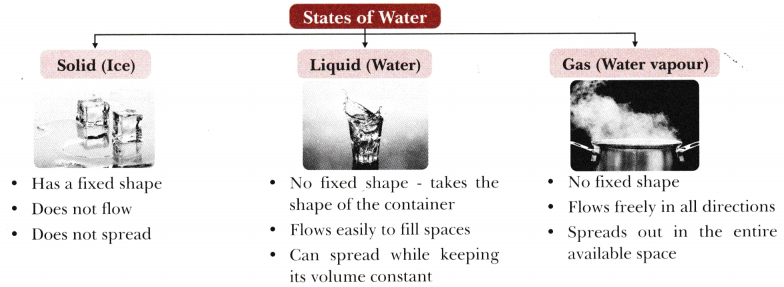
Water exists mainly in three different states as shown in the following flowchart:

Interconversion Between States
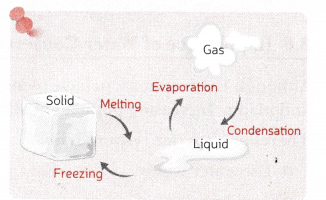
There are primarily four different processes that involve the interconversion between different states of water.

These processes are discussed as follows:
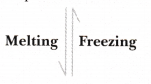
Melting
The process by which a substance changes its state from solid to liquid is called melting, the conversion of solid ice to liquid water occurs by this process. Heat needs to be supplied for the melting of ice into water. Melting becomes faster with an increase in temperature.
Freezing
The process by which a substance changes its state from liquid to solid is called freezing.
- The conversion of liquid water to solid ice occurs by this process.
- The process of freezing occurs due to cooling or a decrease in temperature.
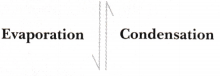
Evaporation
The process by which a liquid converts into its vapour form is called evaporation.
- The conversion of liquid water to water vapour occurs by this process.
- Evaporation can occur at all temperatures, even at room temperature.
- Some common real-life examples of evaporation are:
- Water sprinkled on a hot pan turns into steam
- Drying of wet clothes
- Drying of freshly mopped floor
- Drying of sweat from the body
- Disappearance of water puddles from the ground
- NOTE: Water vapour is actually invisible but the presence of tiny water droplets in the steam makes it visible.
Condensation
The process by which a vapour (gas) converts into its liquid form is called condensation, a The conversion of water vapour to liquid water occurs by this process, a Some common real-life examples of condensation are:
- Appearance of water droplets on the outer surface of a glass tumbler containing ice-cold water
- Formation of dew drops on plants, grass, and leaves in the early morning
- Appearance of water droplets on inner side of a lid used to close a container containing hot water
- Appearance of mist on a cool mirror surface after a hot water bath
Factors Affecting Evaporation
Evaporation does not take place at the same rate in all conditions. The rate of evaporation is dependent on the factors that are discussed as follows:
Exposed Surface Area
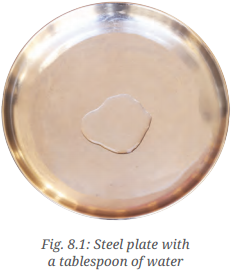
- The larger the exposed surface area, the greater the rate of evaporation.
- More water can escape into the air as vapour when water to be evaporated has a comparatively larger exposed surface area.
- For example, water spread on a plate evaporates faster than water in a bottle cap.
Temperature
- The higher the temperature, the greater the rate of evaporation.
- For example, the same amount of water kept in sunlight evaporates faster than water kept in a shaded region.
Wind Speed
- An increase in the wind speed or the movement of air causes an increase in the rate of evaporation.
- Moving air carries away water vapour from the surface, which speeds up the evaporation.
- For example, wet clothes dry faster on a windy day compared to a non-windy day.
Humidity
- Humidity is the amount of water vapour present in the air.
- The rate of evaporation decreases with an increase in the humidity.
- When the air already has a lot of water vapour, there is less space for extra water vapour to enter the air, hence evaporation slows down.
- For example, wet clothes dry very slowly on a cloudy day dtte to high humidity in the air.
Cooling Effect of Evaporation
Evaporation causes a cooling effect. During evaporation, water absorbs heat from its surroundings, which causes cooling effect.
Examples of Cooling Effect:
- Earthen Pot (Matka): Earthen pots have tiny pores. Water seeps through these pores and evaporates from the surface, resulting in a cooling effect. Consequently, the water stored in earthen pots (matka or surahi) feels cool.
- Sweating: Evaporation of sweat from the body produces a cooling sensation.
- Rubbing sanitiser on hands: The hands feel cool as the sanitiser evaporates quickly, taking heat from the hands.
- Cooling rooftops during summers: Sprinkling water on rooftops during summer helps cool them due to evaporation.
- Pot-in-Pot Cooler: Water evaporates from wet sand that is present in between two pots, creating a cooling effect inside.
Formation of Clouds and Rain — Water Cycle
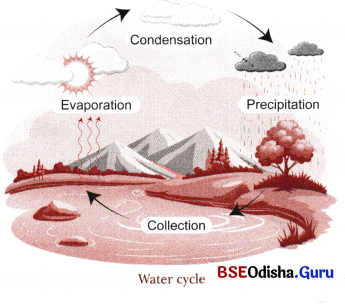
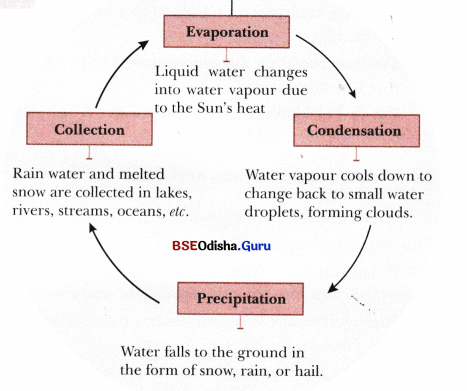
The water cycle is the continuous circulation of water between Earth’s surface and the atmosphere.
The steps involved in the water cycle are as follows:
- Evaporation: Water from oceans, rivers, and lakes evaporates into the atmosphere as water vapour.
- Rising of Water Vapour: Water vapour is lighter than air, so it rises up in the atmosphere.
- Cooling and Condensation: As air rises higher, it becomes cooler. Water vapour condenses around dust particles to form tiny water droplets.
- Cloud Formation: Many tiny water droplets floating together join to form clouds.
- Precipitation: Droplets join together to form bigger drops. When they become heavy enough, they fall to the ground as rain. Under special conditions, water may fall as snow or hail.
- Return to Earth: Water returns to oceans, rivers, lakes, and groundwater, and the cycle continues.
Importance of Water Conservation :
Although Earth appears to have plenty of water, only a small amount of it is fit for use by humans, animals, and plants. Increasing population and pollution are causing water shortages in many areas.
Therefore, it is our responsibility to:
- Use water wisely
- Avoid wastage of water
- Keep water sources clean and free from pollution
- Water is essential for life, and protecting it is essential for our future.
Different States of Water
Ice (Solid)
Fixed shape and fixed volume
Does not spread or flow like liquid
Water (Liquid)
Fixed volume but no fixed shape
Flows freely, keeping a constant volume
Water Vapour (Gas)
‘— No fixed shape or fixed ‘oliime
Moves rapidly
Water Cycle
Inter-Conversion of States of Water
- Evaporation: Conversion of water into water vapour
- Condensation: Conversion of water vapour into liquid water on cooling
- Melting: Conversion of solid (ice) into liquid (water)
- Freezing: Conversion of liquid (water) into solid (ice) on cooling
Factors Affecting Rate of Evaporation :
- Exposed Surface Area: Increase in the exposed surface area caused an increase in the rate of evaporation.
- Temperature: Increase in the temperature causes an increase in the rate of evaporation.
- Wind Speed: Increase in the wind speed causes an increase in the rate of evaporation.
- Humidity: Increase in the humidity causes a decrease in the rate of evaporation.