
Combining textbook study with BSE Odisha Class 6 Science Notes and Class 6 Science Curiosity Chapter 4 Exploring Magnets Notes can make exam preparation more effective.
Exploring Magnets Notes Class 6
Class 6 Science Curiosity Chapter 4 Notes
Magnets
A magnet is a substance that has the property of attracting certain materials (like iron, nickel, cobalt, etc.) around itself.
There are two types of magnets, natural magnets and artificial magnets.
- Natural magnets are brittle and have irregular shapes. They have weak magnetic power or magnetism. Lodestone or magnetite is an example of natural magnet.
- Artificial magnets or man-made magnets are available in various shapes and sizes and possess strong magnetism.
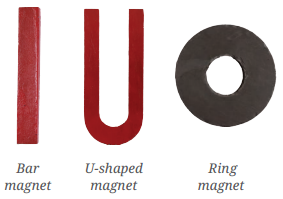

Magnetic and Non-magnetic Materials
- The materials that are attracted towards a magnet and stick to it are called magnetic materials. Iron, nickel, and cobalt are examples of magnetic materials, and certain materials containing these metals (like steel) are also attracted by magnets.
- The materials which are not attracted towards a magnet are called non-magnetic materials. Objects made of plastic, wood, rubber, aluminium, and glass do not stick to magnets and are therefore non-magnetic.
Poles of a Magnet
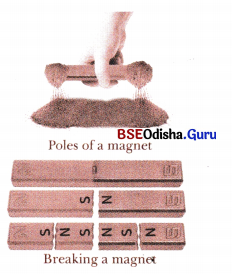
- When a bar magnet is placed on iron filings, maximum iron filings collect near its two ends and very few near the middle.
- These regions at the ends of a magnet, where attraction is maximum, are called the poles of the magnet.
- Magnetic poles always occur in pairs. Every magnet has both a North pole and a South pole. It is not possible to obtain a magnet with only one pole.
- If a magnet is broken into smaller pieces, each piece behaves like a magnet and has both a north pole and a south pole.
Magnetisation
Magnetisation is the process of converting a magnetic material such as iron or steel into a magnet.
- In this process, the material acquires magnetic properties and begins to attract magnetic substances like iron pins or paper clips.
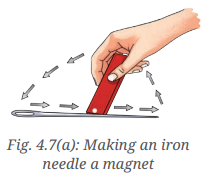
- Single-touch method: A simple method of magnetisation in which one pole of a bar magnet is stroked repeatedly in the same direction along an iron object to make it magnetic.
Directive Property of Magnet
A freely suspended bar magnet always comes to rest along the north-south direction because the Earth itself behaves like a giant magnet.
The end of a freely suspended magnet that points towards the north direction is called its north-seeking pole or north pole, and the end that points towards the south direction is called its south-seeking pole
or south pole.
An ordinary iron bar does not always come to rest in the north-south direction, so this behaviour can be used as a simple test to check whether a piece of metal is a magnet.
The property of a freely suspended magnet to rest along the north-south direction is used for finding directions on the Earth.
Magnetic Compass
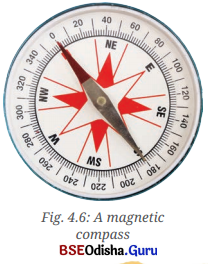
- A magnetic compass is a small device developed long ago for finding directions, and it contains a magnet in the shape of a needle that can rotate freely.
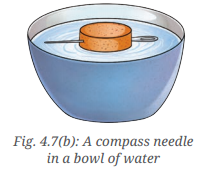
- To make a magnetic compass at home, an iron sewing needle can be magnetised by single-touch method.
- When this magnetised needle is passed through a cork and floated on water, it turns and comes to rest in a fixed direction each time, acting like a simple compass needle.
Attraction and Repulsion between Magnets
- When two magnets are brought close to each other, they either attract or repel, depending on which poles face each other.
- The north pole of one magnet and the south pole of another magnet attract each other; such poles are called unlike poles.
- When two north poles are brought close together, they push each other away. In the same way, two south poles also repel each other.
- Such poles are known as like poles, a If one magnet is replaced by an iron bar, both ends of the iron bar are attracted by both poles of the magnet.
- Repulsion is observed only between two magnets, never between a magnet and an ordinary iron piece. Therefore, the property of repulsion is the surest test of magnetism.
Applications of Magnets
- In factories to lift heavy iron objects such as scrap iron.
- By surgeons in hospitals to remove iron/steel splinters from the wounds.
- In the construction of telephones, electric bells, etc.
- To separate iron and steel from non-magnetic materials.
Effect of Bar Magnet on Magnetic Compass
- When the north pole of a bar magnet is brought near the north pole of the compass needle, the needle moves away, showing repulsion between like poles.
- When the south pole of the bar magnet is brought near the north pole of the compass needle, the needle moves towards the magnet, showing attraction between unlike poles.
- When sheets of wood, cardboard, plastic or glass are placed between a bar magnet and a magnetic compass, the compass needle moves towards and away in the same way as it does without the sheets.
- The magnetic effect can act through non-magnetic materials such as wood, cardboard, plastic, etc.
Proper Handling and Storage of Magnets
Magnets should be handled with care and should not be heated, dropped or hammered, and they should not be kept near devices like mobile phones or remote controls.
To store bar magnets safely, they should be kept in pairs with unlike poles on the same side, with a wooden piece between them and two pieces of soft iron placed across their ends as keepers. To store a horseshoe magnet safely, a keeper should be placed across its poles.
Characteristics of Magnets
Poles of Magnet
- The regions at the end of a magnet where the magnetic strength is maximum are called poles of a magnet.
- All magnets have two poles whatever their shape may be.
- The North Pole: The end of the magnet that points towards the north.
- The South Pole: The end of the magnet that points towards the south.
- The poles of a magnet always exist in pairs. A single north pole or a single south pole does not exist.
A magnet is a material having the property of attracting magnetic materials (like iron).
Materials that occur naturally and possess magnetic properties. Example: Lodestone.
- Man-made magnets.
- These magnets are made in different shapes and sizes as per requirements.
- Example: Bar magnet, U-shaped magnet, ring magnet, etc.
Attraction and Repulsion
- The like poles (N-N or S-S) of two magnets repel each other while unlike poles (N-S) attract each other.
- A magnet can be identified by its property of repulsion.
Alignment in North-South Direction
- A freely suspended magnet comes to rest along the north-south direction.
- This alignment happens because of the influence of the Earth, which itself acts like a giant bar magnet.
Magnets
A magnet is a material having the property of attracting magnetic materials (like iron).
Natural Magents: Materials that occur naturally and possess magnetic properties.
Example: Lodestone.
Artificial Magnets
- Man-made magnets.
- These magnets are made in different shapes and sizes as per requirements.
- Example: Bar magnet, U-shaped magnet, ring magnet, etc.
Types of Materials
- Magnetic Materials: The materials which are attracted towards a magnet.
Example: Plastic, paper, wood, etc. - Non-magnetic Materials: The materials which are not attracted towards a magnet.
Example: Plastic, paper, wood, etc.
Note: The magnetic effect can act through non-magnetic materials.
Applications of Magnets
- The property of a freely suspended magnet to always rest along the north-south direction is used to find directions.
- An instrument with a magnet, that is used to find directions is called a magnetic compass.
- Magnets are used
- in factories to lift heavy iron objects such as scrap iron.
- by surgeons in hospitals to remove steel splinters from the wounds.
- in the construction of telephones, electric bells, etc.
- to separate iron and steel from non-magnetic materials.
Proper Handling and Storage of Magnets
- Magnets lose their magnetic properties if they are heated, hammered or dropped from some height. Improper storage can also cause loss of magnetic properties.
- Bar magnets should be kept in pairs with their unlike poles on the same side.
- Bar magnets must be separated by a piece of wood while magnet keepers (pieces of soft iron) should be placed across their ends.
- For storing U-shaped/horseshoe magnet, one should keep a magnet keeper across the poles.