
For better exam readiness, students can include Class 7 Science MCQ and Curiosity Chapter 12 Earth, Moon, and the Sun MCQ in their daily study routine.
Class 7 Science Chapter 12 Earth, Moon, and the Sun MCQ
Earth, Moon, and the Sun MCQ Class 7
MCQ On Earth, Moon, and the Sun Class 7
Question 1.
Which motion leads to the cycle of day and night on the Earth?
(a) Revolution of the Earth around the Sun
(b) Rotation of the Earth on its axis
(c) Tilt of the Earth’s axis
(d) Rotation of the Sun
Answer:
(b) Rotation of the Earth on its axis
Question 2.
Which option correctly describes Earth’s rotation (observed from above the North Pole) and the apparent motion of the Sun?
(a) The Earth spins clockwise; the Sun appears to rise in the west.
(b) The Earth spins anticlockwise; the Sun appears to move from east to west.
(c) The Earth spins clockwise; the Sun appears fixed at one location.
(d) The Earth does not spin; day and night occur due to revolution.
Answer:
(b) The Earth spins anticlockwise; the Sun appears to move from east to west.

Question 3.
If the Earth rotated faster, then…………..
(a) days and nights would be shorter.
(b) days and nights would be longer.
(c) there would be no seasons.
(d) eclipses would not occur.
Answer:
(a) Faster rotation reduces the time taken for one day-night cycle.
Question 4.
Which motion of the Earth mainly causes the occurrence of different seasons?
(a) Rotation on its axis
(b) Rotation around the Sun
(c) Revolution around the Sun
(d) Revolution on its axis
Answer:
(c) Revolution around the Sun
Question 5.
Why do we see different stars at different times of the year?
(a) Stars change position
(b) The Earth rotates on its axis
(c) The Earth revolves around the Sun
(d) Stars disappear suddenly
Answer:
(c) As the Earth revolves around the Sun, we face different directions in space at different times of the year, so different stars become visible in the night sky.
Question 6.
If Earth’s axis were not tilted, which of the following would be true?
(a) Day and night would not occur
(b) Seasons would not occur
(c) Solar eclipses would not occur
(d) Lunar eclipses would not occur
Answer:
(b) Without tilt, sunlight would be evenly distributed throughout the year.
Question 7.
During which month does the Northern Hemisphere experience the longest day?
(a) December
(b) March
(c) June
(d) September
Answer:
(c) June
Question 8.
At which region of the earth are the lengths of day and night almost equal throughout the year?
(a) North Pole
(b) South Pole
(c) Tropic of Cancer
(d) Equator
Answer:
(d) Equator
Question 9.
At the North Pole, the Sun rises on 21 March and sets on 22 September. What happens at the South Pole during this time?
(a) Continuous daylight
(b) Continuous night
(c) Equal day and night
(d) The Sun rises and sets daily
Answer:
(b) Continuous night
Question 10.
Which option correctly identifies the equinoxes and solstices in the Northern Hemisphere?
(a) 21 March – spring equinox; 23 September – autumn equinox;
21 June – summer solstice; 22 December – winter solstice
(b) 21 March – autumn equinox; 23 September – spring equinox;
21 June – winter solstice; 22 December – summer solstice
(c) 21 March – summer solstice; 23 September – winter solstice;
21 June – spring equinox; 22 December – autumn equinox
(d) 21 March & 23 September – solstices (longest and shortest days);
21 June & 22 December – equinoxes (equal day and night)
Answer:
(a) 21 March – spring equinox; 23 September – autumn equinox;
21 June – summer solstice; 22 December – winter solstice
Question 11.
Three cities P, Q and R record their approximate daylight hours on four key dates:
| City | 21 March | 21 June | 23 September | 22 December |
| P | 12h | 16h | 12h | 8h |
| Q | 12h | 8h | 12h | 16h |
| R | 12h | 12h | 12h | 12h |
Which option correctly identifies the locations of the three cities?
(a) P – near equator, Q – Northern Hemisphere, R – Southern Hemisphere
(b) P – Southern Hemisphere, Q – Northern Hemisphere, R – near equator
(c) P – Northern Hemisphere, Q – Southern Hemisphere, R – near Equator
(d) P – Northern Hemisphere, Q – near equator, R – Southern Hemisphere
Answer:
(c) P – Northern Hemisphere, Q – Southern Hemisphere, R – near Equator
Question 12.
A solar eclipse occurs when
(a) the Earth comes between the Sun and the Moon.
(b) the Moon comes between the Sun and the Earth.
(c) the Sun comes between the Earth and the Moon.
(d) the Moon blocks stars.
Answer:
(b) the Moon comes between the Sun and the Earth.
Question 13.
A lunar eclipse occurs when……………..
(a) the Moon comes between the Sun and the Earth.
(b) the Earth comes between the Sun and the Moon.
(c) the Sun comes between the Earth and the Moon.
(d) the Moon blocks sunlight reaching Earth.
Answer:
(b) the Earth comes between the Sun and the Moon.
Question 14.
Which eclipse is safe to watch with the naked eye?
(a) Total solar eclipse
(b) Partial solar eclipse
(c) Lunar eclipse
(d) None of the above
Answer:
(c) Lunar eclipse
Question 15.
Which statement best compares the visibility of solar and lunar eclipses?
(a) Both can be seen only from polar regions.
(b) Solar eclipses are visible from the whole Earth.
(c) Lunar eclipses can be seen from the entire night side of Earth.
(d) Solar eclipses last longer than lunar eclipses.
Answer:
(c) Lunar eclipses can be seen from the entire night side of Earth.
Question 16.
Which of the following statements are true about lunar and solar eclipses?
(i) A lunar eclipse is safe to watch with the naked eye.
(ii) A solar eclipse is safe to watch without protection.
(iii) During a total solar eclipse, the Moon completely covers the Sun.
(iv) During a total lunar eclipse, the Moon completely disappears.
(a) (i) only
(b) (iii) only
(c) (i) and (iii) only
(d) (ii), (iii), and (iv)
Answer:
(c) Watching a solar eclipse without proper protection can damage the eyes. During a total lunar eclipse, the moon appears dark red in colour.
Question 17.
Consider the following phenomena:
(i) Sunrise happens earlier in eastern India than in western India on the same date.
(ii) Different constellations are visible in different months.
(iii) Day and night occur on Earth.
(iv) There are about 365 days in a year.
Which pair correctly matches each phenomenon with the correct motion of the Earth responsible for it?
(a) (i) – rotation, (ii) – revolution, (iii) – revolution, (iv) – rotation
(b) (i) – revolution, (ii) – rotation, (iii) – rotation, (iv) – revolution
(c) (i) – revolution, (ii) – revolution, (iii) – rotation, (iv) – rotation
(d) (i) – rotation, (ii) – revolution, (iii) – rotation, (iv) – revolution
Answer:
(d) (i) – rotation, (ii) – revolution, (iii) – rotation, (iv) – revolution
Question 18.
Look at the picture below carefully.
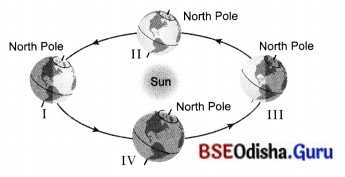
In which position would the Earth be if the Northern Hemisphere were to experience winter?
(a) I only
(b) II only
(c) III only
(d) II and IV
Answer:
(c) III only
Question 19.
Which of the following statements about eclipses is/are correct?
(i) A solar eclipse takes place when the Moon comes between the Earth and the Sun.
(ii) A lunar eclipse occurs when the Earth comes between the Sun and the Moon.
(iii) A ‘diamond ring’ is seen just after a total solar eclipse, when the Moon starts to move away.
(a) (i) only
(b) (ii) only
(c) (iii) only
(d) (i), (ii), and (iii)
Answer:
(d) (i), (ii), and (iii)
Earth, Moon, and the Sun Class 7 Assertion and Reason Questions
The following questions consist of two statements – Assertion (A) and Reason (R). Answer these questions by selecting the correct option:
(a) Both A and R are true and R is the correct explanation of A.
(b) Both A and R are true but R is not the correct explanation of A.
(c) A is true but R is false.
(d) A is false but R is true.
1. (A): The Sun appears to rise in the east and set in the west.
(R): The Earth rotates from west to east.
Answer:
(a) Both A and R are true and R is the correct explanation of A.
2. (A): Seasons occur because the Earth is sometimes closer to the Sun and sometimes farther.
(R): Earth’s orbit is nearly circular.
Answer:
(d) Seasons do not occur due to the varying distance between the Earth and the Sun. They arise because of the tilt of the Earth’s axis and its spherical shape.
3. (A): Different constellations are visible in the night sky at different times of the year.
(R): The Earth revolves around the Sun, changing the view of the night sky.
Answer:
(a) Both A and R are true and R is the correct explanation of A.
4. (A): When the northern hemisphere is tilted towards the Sun, it is summer there.
(R): The seasons are caused by the tilt of the Earth’s axis and the spherical shape of the Earth.
Answer:
(a) Both A and R are true and R is the correct explanation of A.
5. (A): During June, the Southern Hemisphere experiences winter.
(R): At this time, the Southern Hemisphere tilts away from the Sun.
Answer:
(a) Both A and R are true and R is the correct explanation of A.
6. (A): Solar eclipses are visible only from a small region on the Earth.
(R): The Moon is much smaller than Earth, so its shadow formed on Earth covers only a small region.
Answer:
(a) Both A and R are true and R is the correct explanation of A.
7. (A): When it is daytime in India, it can be nighttime in the USA at the same moment.
(R): This happens because the Earth does not rotate but only revolves around the Sun.
Answer:
(a) Both A and R are true and R is the correct explanation of A.
8. (A): During some months, the Sun never sets at the poles, while during others, it never rises.
(R): At the poles, the tilt of Earth’s axis keeps one pole continuously facing the Sun for about six months, and the other in darkness.
Answer:
(a) Both A and R are true and R is the correct explanation of A.
Earth, Moon, and the Sun Class 7 Fill in the Blanks
1. The Earth’s rotation on its axis causes ………… cycle.
Answer: day-night
2. The imaginary line about which the Earth spins is called the ………… of ………….
Answer: axis, rotation
3. When viewed from above the North Pole, the Earth rotates in a/an ………… direction.
Answer: anti-clockwise
4. The fixed curved path in which the Earth moves around the Sun is called its ………….
Answer: orbit
5. The longest day in the Northern Hemisphere occurs around ………….
Answer: 21 June
6. The Moon can appear to cover the Sun because it is much ………… to Earth than the Sun.
Answer: closer
Earth, Moon, and the Sun Class 7 True or False
1. At any moment, all places on Earth have either day or night because the Earth is spherical.
Answer:
False: At any moment, some places on the Earth have day and others have night because the Earth is spherical.
2. The Pole Star appears almost fixed in the sky because it lies above the equator.
Answer:
False: The Pole Star appears almost fixed in the sky because it lies nearly along the Earth’s axis of rotation above the North Pole.
3. If Earth rotated from east to west, the Sun would still appear to rise in the east.
Answer:
False: If Earth rotated from east to west, the Sun would appear to rise in the west.
4. At the equator, the length of day and night is almost equal throughout the year.
Answer:
True
5. When the Northern Hemisphere tilts towards the Sun, Earth is closer to the Sun in its orbit.
Answer:
False: When the Northern Hemisphere tilts towards the Sun, Earth is not closer to the Sun in its orbit.
6. When it is summer in the Northern Hemisphere, then it is spring in the Southern Hemisphere.
Answer:
False: When it is summer in the Northern Hemisphere, it is winter in the Southern Hemisphere.
7. At the North Pole, the Sun rises only once and sets only once in a year.
Answer:
True
Earth, Moon, and the Sun Class 7 Match the Following
Question 1.
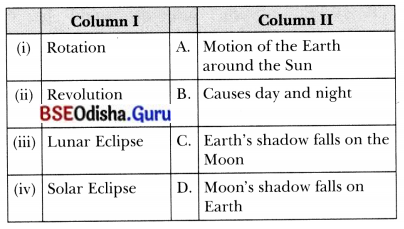
Answer:
| Column I | Column II | ||
| (i) | Rotation | B. | Causes day and night |
| (ii) | Revolution | A. | Motion of the Earth around the Sun |
| (iii) | Lunar Eclipse | C. | Earth’s shadow falls on the Moon |
| (iv) | Solar Eclipse | D. | Moon’s shadow falls on Earth |
Question 2.
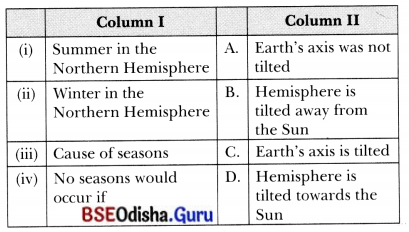
Answer:
| Column I | Column II | ||
| (i) | Summer in the Northern Hemisphere | D. | Hemisphere is tilted towards the Sun |
| (ii) | Winter in the Northern Hemisphere | B. | Hemisphere is tilted away from the Sun |
| (iii) | Cause of seasons | C. | Earth’s axis is tilted |
| (iv) | No seasons would occur if | A. | Earth’s axis was not tilted |