
Students can include Class 7 Curiosity Extra Questions and Class 7 Science Chapter 4 The World of Metals and Non-metals Extra Question Answer in their daily self-study routine.
Class 7 Science Chapter 4 The World of Metals and Non-metals Extra Questions
Class 7 Science Chapter 4 Extra Questions on The World of Metals and Non-metals
The World of Metals and Non-metals Class 7 Very Short Question Answer
Question 1.
A non-sonorous material breaks into pieces when struck with a hammer. Can it be a metal? Give a reason for your answer.
Answer:
No. Metals are generally sonorous, malleable and therefore, do not break on hammering. The given material can be a non-metal like coal, sulphur, etc. or a material like glass.

Question 2.
Radhika’s mother uses an aluminium foil to pack her food for lunch. Which physical property of metals is utilised in making foils? Can her mother use sulphur or wooden sheets for wrapping food?
Answer:
Malleability is the property of metals that is utilised in making foils. This is the property of metals by virtue of which they can be beaten into thin sheets. No, sulphur or wooden sheets cannot be used for wrapping food. This is because they are nonmalleable and brittle. They cannot be converted into foils (thin sheets) on beating, as they will break into pieces.
Question 3.
Harish found a block in his garage. He wanted to figure out if it was made up of a metal. Suggest at least one physical test that he can perform to determine if the block is made up of metal. What can he conclude about the nature of the block based on this test?
Answer:
Harish can perform a hammering test on the block to assess its properties. If the block flattens or bends without breaking, it indicates malleability, a key characteristic of metals.
This test allows him to make informed conclusions: if the block demonstrates malleable behaviour, it is likely to be made of metal. On the other hand, if it breaks or cracks during the test, it suggests that it is probably a non-metal or some other material.
Question 4.
One day, while cooking, Priyanka’s mother accidentally hurt her hand by touching the handle of a hot pan. Between plastic and aluminium, what is the handle likely to be made of and why?
Answer:
The handle of the pan is likely to be made of aluminium as aluminium, being a metal, is a good conductor of heat. Whereas plastic is a poor conductor of heat.
Question 5.
Name any two metals that have wide usage in household electrical appliances. Also, explain the reason.
Answer:
Aluminium and copper are two metals that are widely used in household electrical appliances. This is because aluminium and copper are ductile and good conductors of electricity.
Question 6.
After heavy rains over a few days, Akhilesh saw the deposition of reddish-brown flakes on the iron gate in his house. He wanted to protect it from further damage. If you were Akhilesh’s friend, what methods would you suggest to him to prevent the gate from rusting?
Answer:
Rusting of iron can be prevented by painting, oiling, greasing, or applying a protective layer of zinc metal on the iron.
Question 7.
Why do statues made of copper turn green after many years? Name the process responsible for this change.
Answer:
Copper statues turn green due to the formation of a green layer when copper reacts slowly with air, moisture, and other substances present in the air. This process is called corrosion.
Question 8.
(i) Why is sodium stored in kerosene?
(ii) Name the non-metal that is commonly used as an antiseptic substance.
Answer:
(i) Sodium reacts vigorously with oxygen and water, generating a lot of heat. Therefore, it is stored in kerosene to prevent its exposure to moisture and air.
(ii) Iodine
Question 9.
X is a non-metal that is stored under water, while Y is a metal that gets rusted when exposed to air and water. Identify X and Y. Give reasons for these observations.
Answer:
X is phosphorus, and it is stored under water as it readily reacts with atmospheric air and catches fire. Y is iron, as it reacts with air and water and acquires a brown deposit called rust.
The World of Metals and Non-metals Class 7 Short Question Answer
Question 1.
Complete the table by writing the materials in the column corresponding to the property they show.
Iron, silver, aluminium, wood, a piece of coal, a lump of sulphur, a glass, copper, gold, rubber
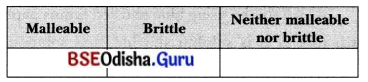
Answer:
| Malleable | Brittle | Neither malleable nor brittle |
| Iron, silver, aluminium, copper, gold | A piece of coal, a lump of sulphur, a glass | Wood, rubber |
Question 2.
A student is asked to identify an unknown solid substance using only physical properties. The substance is dull, non-sonorous and breaks on hammering.
(i) Is the substance more likely to be a metal or a non-metal?
(ii) Give two reasons to support your answer.
Answer:
(i) The substance is likely to be a non-metal.
(ii) Non-metals are generally dull in appearance and brittle; they break when hammered and do not produce a ringing sound (non-sonorous).
Question 3.
Consider the three materials, viz., copper, iodine and plastic.
(i) Which of the given materials can be used to make electrical wires and why?
(ii) Which of the given materials can be used for making the outer covering of the wire to provide safety, and why?
(iii)Which of the given materials is/are nonmetal(s)?
Answer:
(i) Copper can be used to make electrical wires as copper is a good conductor of electricity and is also ductile.
(ii) Plastic should be used for making the outer covering of the wire because it is a poor conductor of electricity.
iii) Among the given materials, only iodine is a non-metal.
Question 4.
A metal X, in the presence of air and water, undergoes corrosion and forms a brown flaky substance, Y. However, oil or paint can be applied on the surface of metal X to prevent corrosion.
(i) Identify metal X and substance Y.
(ii) Explain how oiling or painting the surface of metal X helps to prevent corrosion.
Answer:
(i) Metal X: Iron; Substance Y: Rust
(ii) Corrosion of iron (rusting) takes place in the presence of air and water to form rust (brown flaky substance). When oil or paint is applied to the surface of iron, it forms a protective layer that prevents air and water from coming into contact with the surface of iron. Hence, rusting is prevented.
Question 5.
An element P, on burning in air, produces a gas Q. When gas Q is dissolved in water, it forms sulphurous acid.
(i) Identify element P and gas Q.
(ii) Explain the nature of the oxide of element P.
Answer:
(i) Element P: Sulphur; Gas Q: Sulphur dioxide
(ii) The oxide of sulphur, i.e., sulphur dioxide, is acidic in nature. This can be confirmed via a litmus test. Sulphur dioxide gas, when dissolved in water, forms sulphurous acid that turns blue litmus red, confirming the acidic nature of sulphur dioxide.
Question 6.
Name any three non-metals with their uses in everyday life.
Answer:
Three non-metals with their uses in everyday life are as follows:
- Carbon: It is the building block of all life forms. It is a key component of proteins, fats, and carbohydrates, which are necessary for growth and energy.
- Nitrogen: It is used in the manufacturing of fertilisers and other chemicals. It is an essential nutrient for the growth of plants.
- Oxygen: It is essential for respiration in humans and animals.
Question 7.
(i) How are metal oxides different from non-metal oxides? How can you test the chemical nature of both these oxides?
(ii) Why does an iron nail placed inside a glass bottle filled with silica gel not acquire rust?
Answer:
(i) Metal oxides are basic in nature, while nonmetal oxides are acidic in nature. The chemical nature of these oxides can be tested with the help of a litmus test. Metallic oxides turn red litmus blue, while non-metallic oxides turn blue litmus red.
(ii) The presence of silica gel inside the glass bottle makes the air dry and therefore rusting cannot take place in the absence of water/moisture. The presence of both air and water is required for rusting.
The World of Metals and Non-metals Class 7 Long Question Answer
Question 1.
Metals and non-metals show different physical and chemical properties.
(i) Differentiate between metals and non-metals on the basis of malleability, electrical conductivity and sonority.
(ii) State one difference between metals and nonmetals based on the nature of their oxides.
Answer:
(i)
| Property | Metals | Non-metals |
| Malleability Electrical Conductivity Sonority |
Malleable Good conductors Sonorous |
Not malleable (Brittle) Poor conductors Non-sonorous |
(ii) Metals form basic oxides, while non-metals form acidic oxides.
Question 2.
A student wants to classify substances as metals or non-metals based only on their physical properties.
(i) State any two physical tests that the student can perform.
(ii) What observations would indicate that a substance is a metal?
(iii) Why is it not advisable to depend on only one property for classification?
Answer:
(i) Hammering (malleability) test, electrical conductivity test, sonority test, heat conductivity test, etc.
(ii) If the substance is malleable, sonorous, conducts heat or electricity, it is likely to be a metal.
(ii) Some substances show exceptions; therefore, more than one property must be considered. For example, generally metals are solid at room temperature, but mercury is a metal that is liquid at room temperature.
Question 3.
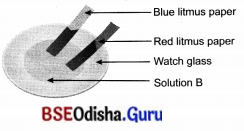
In a science experiment, sulphur powder is burned in air to produce gas A. The gas produced is collected in a gas jar to which some water is added, and solution B is formed. The resulting solution $B$ is then tested using red and blue litmus papers, as shown in the given picture:
(i) Identify gas A and solution B.
(ii) Give the word equations for the reactions taking place.
(iii) Is gas A acidic or basic in nature? How can you tell this by using blue and red litmus papers?
Answer:
(i) Gas A is sulphur dioxide, and solution B is sulphurous acid.
(ii)
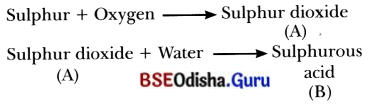
(iii) Gas A is acidic in nature. This can be confirmed by the following test:
When the aqueous solution of A, i.e., solution B is tested with blue litmus paper, it turns red. Whereas, when tested with red litmus paper, the colour of the litmus paper does not change.
Question 4.
Answer the following questions.
(i) Why is iron heated before being beaten with a hammer?
(ii) Which other metals can be beaten in the same way as iron? Define the property responsible for this phenomenon.
(iii) Does wood behave like iron when beaten with a hammer? Explain.
Answer:
(i) Iron is heated before being beaten with a hammer to reduce its hardness. This makes it easier to mould it into desired forms through hammering.
(ii) Metals such as gold, silver, copper, and aluminium can also be beaten in the same way as iron due to their high malleability. Malleability is defined as the property of metals by which they can be beaten into thin sheets without breaking.
(iii) No, wood does not behave like iron when beaten with a hammer because it is not malleable like metals. When wood is beaten, it breaks or cracks instead of getting flattened.
The World of Metals and Non-metals Class 7 Case Based Questions
Read the following passages and answer the questions that follow:
Question 1.
While visiting a jewellery shop with her mother, Roshni admired the brilliant shine and intricate designs of gold and silver ornaments, along with the copper sculptures on display. She began to wonder why gold and silver are commonly used to make ornaments. She also recalled an interesting fact her teacher had shared in class – just one gram of gold can be drawn into a thin wire nearly 2 kilometres long.
(i) Which properties of metals are highlighted in the given passage?
Answer:
Lustre, malleability and ductility.
(ii) Which of the following statements is/are incorrect about gold and silver?
1. Gold and silver are the most malleable metals.
2. Silver foil is used for decorating some sweets.
3. Gold and silver are poor conductors of heat.
4. A piece of gold, when hammered, gets broken down into pieces, thus it is brittle in nature.
(a) Statement 3 only
(b) Statements 3 and 4
(c) Statements 1 and 2
(d) Statement 4 only
Answer:
Lustre, malleability and ductility.
(iii) Mention any two properties of gold and silver that make them suitable for making jewellery.
Answer:
Gold and silver are good conductors of heat. Gold is malleable, not brittle.
OR
(iii) Define corrosion. How does it affect an object made up of copper?
Answer:
Malleability
- Lustre
- Ductility
- Resistance to corrosion
Question 2.
In a scientific experiment performed to determine the nature of metallic and non-metallic oxides, Amit burned some substances to obtain their respective oxides and mixed the oxides with water to determine their nature using litmus papers. While doing the experiment, he observed that some substances were stored separately, immersed in different types of liquids. Such observations sparked curiosity in his mind.
(i) Give one example of a metal that is stored in kerosene and one example of a non-metal that is stored in water.
Answer:
Sodium is a highly reactive metal that is stored in kerosene oil because it reacts violently with air and water. Phosphorus (non-metal) is stored in water because it catches fire on exposure to air.
(ii) What happens when iron is kept exposed to moist air for a long period of time?
Answer:
Iron undergoes rusting when exposed to moist air for a long period of time. A layer of a brown, flaky substance gets formed on its surface, also known as rust.
(iii) What is the nature of the oxide formed when magnesium is burned in air? How will you confirm its nature?
Answer:
Magnesium burns in air to form magnesium oxide, which is basic in nature. This can be confirmed by testing the aqueous solution of the magnesium oxide (magnesium hydroxide) with red litmus paper. The red litmus paper turns blue, indicating the basic nature of the oxide.
OR
(iii) What happens when blue litmus paper is dipped in a solution of sulphur dioxide gas dissolved in water? Give a reason for your answer.
Answer:
When sulphur dioxide is dissolved in water, it forms sulphurous acid, which is acidic in nature. Therefore, blue litmus paper will turn red when dipped in this solution.
Question 3.
During the summer holidays, Charit went to Mumbai with his family. While riding in the car, they crossed a sea link suspension bridge. Charit was amazed by its massive structure. He asked his father about the science behind the bridge. Charit’s father explained the types of materials used in the formation of and their properties.
(i) The ropes used in suspension bridges are made up of steel wires. What other material(s) is/are mixed with iron to make steel wires? Also, explain the reason behind it.
Answer:
Steel is a mixture of metal (iron) and nonmetal (carbon). This is done to increase the strength of suspension bridges so that they can lift heavy objects.
(ii) If the bridge were made up of only iron, would it have acquired rust after some time?
Answer:
Yes, if the bridge were made up of only iron, it would have acquired rust after some time unless some preventive measures (like oiling, painting or galvanisation) are used.
(iii) State the conditions essential for rusting.
Answer:
The two essential conditions required for rusting are air and water.
OR
(iii) Can only a non-metal be used to make cables to support the heavy loads of a bridge? Give a reason for your answer.
Answer:
No, only a non-metal cannot be used to make cables to support heavy loads of a bridge because most non-metals are not strong and flexible enough to support heavy.
The World of Metals and Non-metals Class 7 Picture Based Questions
Observe the given pictures and answer the questions that follow:
1. The following pictures show different properties of metals:
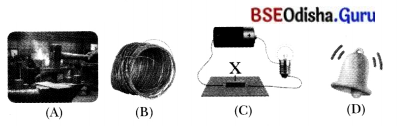
(i) Identify and define the properties shown in pictures A and D.
Answer:
The property of metals shown in picture A is malleability. The property of metals by which they can be beaten into thin sheets is known as malleability.
The property of metals shown in picture D is sonority. The property of metals by which they produce a ringing sound when struck against a hard surface is called sonority.
(ii) Which of the following statements is incorrect based on the above properties and uses of metals?
(a) Copper wires are used in electrical appliances due to the properties shown in pictures B and C.
(b) Picture D shows the sonorous nature of the metals.
(c) Picture A shows the properties of metals, due to which they can be used to make sheets and foils.
(d) Pictures A and B, respectively, show the ductility and malleability of metals.
Answer:
(d) Picture A shows malleability, while picture B shows ductility.
(iii) Can X be a lump of sulphur as shown in picture C? Explain your answer.
Answer:
No, X cannot be a lump of sulphur. This is because sulphur is a non-metal and a poor conductor of electricity.
OR
(iii) Gold and silver are used in making ornaments due to their highly lustrous appearance. Apart from this, which other two properties shown in the pictures make them suitable for making ornaments?
Answer:
Properties shown in pictures A and B i.e., malleability and ductility, respectively.
Question 2.
Consider the following objects/materials and complete the table given below:
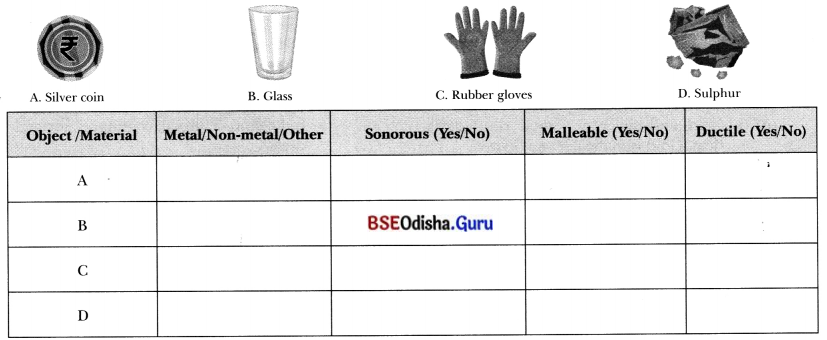
Answer:
| Object /Material | Metal/Non-metal/Other | Sonorous (Yes/No) | Malleable (Yes/No) | Ductile (Yes/No) |
| A. Silver coin B. Glass C. Rubber gloves D. Sulphur |
Metal Other Other Non-metal |
Yes No No No |
Yes No No No |
Yes No No No |
The World of Metals and Non-metalsClass 7 Activity Based Questions
Read the following activity and answer the questions that follow:
Question 1.
Objective: To determine the necessary conditions for the rusting of iron.
Materials required: Iron nails, silica gel, boiled water, oil, glass bottles, tap water, sandpaper etc.
Procedure:
- Take a few shiny new iron nails. If you have old iron nails, ensure you rub them properly with sandpaper.
- Place an iron nail in bottle A containing silica gel and cap the bottle tightly.
- Place the second iron nail in a bottle B containing cooled boiled water, followed by a layer of oil and cap the bottle tightly.
- Place the third iron nail in bottle C containing tap water and leave it open.
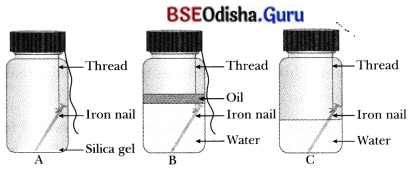
(i) Why were old iron nails rubbed with sandpaper?
Answer:
Before performing the experiment, the old iron nails were rubbed using sandpaper to make sure that there were no brown deposits of rust on them.
(ii) The bottles were kept undisturbed for 10 days. In which bottle(s) would rusting have taken place, and why?
Answer:
The rust formation is only possible in bottle C, as in this case, the iron nail is exposed to both air and water. The air inside the bottle A becomes dry due to the presence of silica gel; thus, rusting will not occur. Similarly, in bottle B, the oil acts as a barrier between the air and water, preventing the iron nail from rusting.
OR
(ii) During the process of rusting, what kind of deposit is formed on iron objects?
Answer:
During the process of rusting, a brown flaky deposit, called rust, is formed on the iron objects.
(iii) How can rusting of iron be prevented?
Answer:
Rusting of iron can be prevented by painting, oiling, greasing, or applying a protective layer of zinc metal (galvanisation).
The World of Metals and Non-metals Extra Questions for Practice
Question 1.
Why does a metal spoon produce a ringing sound when it falls on the floor, whereas a plastic spoon does not?
(a) A metal spoon is always larger in size than a plastic spoon.
(b) Metals are malleable, while plastics are not.
(c) Metals are sonorous, while plastics are not.
(d) Since the plastic spoon is not made up of metal, it is sonorous.
Answer:
(c) Metals are sonorous i.e., they produce a ringing sound when struck against a hard surface. Other materials like plastics are not sonorous, and hence, are unable to produce such ringing sound.
Question 2.
In a science experiment, two identical iron nails are taken and kept under different conditions for 10 days:
Nail A is kept in water with a layer of oil on the top. – Nail B is kept in dry air.
In which nail, A or B, does rusting occur?
(a) Nail A only
(b) Nail B only
(c) Both A and B
(d) Neither A nor B
Answer:
(d) The presence of both air and water is essential for rusting to occur on iron articles.
Question 3.
A student is given three substances – X, Y, and Z with the following properties:
X- Reacts vigorously with oxygen and water; thus, it is kept under kerosene.
Y- Malleable and used in making foils to wrap food items.
Z- Reacts with air to form a black coating on its surface.
Which of the following options correctly identifies X, Y, and Z?
(a) X – Sodium, Y – Silver, Z – Copper
(b) X – Silver, Y – Aluminium, Z – Iron
(c) X – Potassium, Y – Iron, Z – Gold
(d) X – Sodium, Y – Aluminium, Z – Silver
Answer:
(d) X – Sodium, Y – Aluminium, Z – Silver
Question 4.
Which of the following statements is incorrect?
(a) Sulphur is malleable and a good conductor of electricity.
(b) Most of the metal oxides are basic in nature.
(c) A metal spoon conducts heat, while a plastic spoon does not.
(d) Rusting of iron can be prevented by painting the iron surface.
Answer:
(a) Sulphur is a non-metal. It is neither malleable nor a good conductor of electricity.
Questions 5 and 6 consist of two statements – Assertion (A) and Reason (R). Answer these questions by selecting the correct option:
(a) Both A and R are true and R is the correct explanation of A.
(b) Both A and R are true but R is not the correct explanation of A.
(c) A is true but R is false.
(d) A is false but R is true.
Question 5.
Assertion (A): Copper and aluminium can be used to make cooking utensils.
Reason (R): Metals are generally good conductors of electricity.
Answer:
(b) Copper and aluminium can be used to make cooking utensils because metals are generally good conductors of heat.
Question 6.
Assertion (A): A piece of coal or a lump of sulphur is considered brittle in nature.
Reason (R): They break into pieces when hammered.
Answer:
(a) Both A and R are true and R is the correct explanation of A.
Question 7.
During a lab experiment, Vamik observed that a silver spoon became hot quickly in hot water, but a wooden spoon remained cool. What is the possible reason for this Which one of these spoons will produce a ringing sound when struck against a hard surface?
Answer:
The silver spoon became hot quickly as silver is a good conductor of heat, while the wooden spoon did not, as wood is a poor conductor of heat. A silver spoon will produce a ringing sound when struck against a hard surface, as it is sonorous in nature.
Question 8.
(i) You are given a few objects – a piece of aluminium foil, an iron nail, a piece of coal, and a piece of dry wood. Which of these objects will cause the bulb of the tester circuit to glow when connected in the gap of the circuit? Give a reason for your answer.
Answer:
A piece of aluminium foil and an iron nail can make the bulb of the tester circuit glow, whereas a piece of coal, and a piece of dry wood cannot make the bulb of the tester glow in an electric circuit. This is because aluminium and iron are good conductors of electricity, while coal (carbon) and wood are poor conductors of electricity.
(ii) In the jewellery-making process, a goldsmith draws gold into thin wires for making a twisted design. Which physical property of metals is utilised in this case?
Answer:
Ductility.
Question 9.
(i) A teacher asked students to identify a material suitable for making electric wires. The material must: – conduct electricity well – be drawn into thin wires
Among rubber, copper and sulphur, which material best satisfies both of these conditions? Justify your choice.
Answer:
Among the given materials, copper best satisfies the given conditions. Copper is ductile (can be drawn into thin wires) and a very good conductor of electricity. Sulphur is not ductile and is a poor conductor of electricity. Similarly, rubber is neither ductile nor a good conductor of electricity.
(ii) Do the oxides of magnesium and sulphur have the same nature? Give a reason for your answer.
Answer:
No, the oxides of magneisum and sulphur do not have the same nature as the former is basic in nature, while the latter is acidic in nature.
Question 10.
(i) Anita wants to make a handle for a cooking vessel. She is given two materials, wood and iron. Which material should she use to make the handle, and why?
Answer:
Anita should use the wood to make the handle of the cooking vessel.
This is because wood is a poor conductor of heat and will not heat up while cooking in the vessel. This will prevent her hands from burning while holding the vessel. On the other hand, iron, being a metal, is a good conductor of heat. Hence, it will become very hot and will be unsase to touch while cooking.
(ii) Give examples of any two materials that are malleable as well as good conductors of heat
Answer:
Silver and aluminium.
Question 11.
A science teacher conducted a few experiments to explain the physical properties of metals and non-metals. To do so, she selected three materials: P, Q, and R. She then tested their physical properties, including conductivity, malleability, ductility, lustre, and sonority.
The following observations were made based on these experiments: – Material P was lustrous, highly ductile, malleable and did not corrode in moist air.
- Material Q was a good conductor of heat, hard, and could be easily corroded. It acquired a reddish-brown flaky layer on its surface on prolonged exposure to air and water.
- Material R was non-sonorous, dull in appearance, and a poor conductor of heat.
(i) Which of the given materials is most suitable for making ornaments, and why?
Answer:
Material P is most suitable for making ornaments as it is lustrous, malleable. ductile and does not corrode when exposed to moist air.
(ii) Among copper, rubber, aluminium and gold, which could be material R and why?
Answer:
Rubber is non-sonorous, dull in appearance, and a poor conductor of heat, as it is not a metal.
(iii) What could be material Q ? What are the different methods of preventing its corrosion? Explain any one method.
Answer:
Material Q could be iron. The corrosion of iron is known as rusting. It can be prevented by painting, greasing, galvanisation, etc.
In galvanisation, a thin layer of zinc is coated on iron to prevent its exposure to air and water.
OR
(iii) What type of oxide is formed when material Q is burned in the presence of oxygen? How can it be tested using litmus papers?
Answer:
Since material Q is a metal (iron), it forms a basic oxide when burned in the presence of air (oxygen). The aqueous solution of basic oxide turns red limus paper blue, and does not change the colour of a blue limus paper.
Question 12.
A student claims that a single physical property alone is enough to classify substances as metals or non-metals.
(i) Do you agree with this statement? Give a reason.
Answer:
No, a single physical property is not sufficient because some substances show exceptions. For example, a substance can be soft and/or liquid at room temperature, but it can still be a metal.
(ii) Mention one chemical property that helps distinguish metals from non-metals.
Answer:
The nature of oxides can be used as a basis for distinguishing metals from non-metals. Metals generally form basic oxides, while non-metals generally form acidic oxides.
(iii) Give two examples each of a metal and a non-metal with their uses.
Answer:
Examples of metals: Copper and aluminium
Uses:
- Copper is used to make electrical wires.
- Aluminium is used to make foil to wrap food items.
Examples of non-metals: Nitrogen and chlorine
Uses:
- Nitrogen is used in making fertilisers.
- Chlorime is used in water purification.