
Easy-to-read Ganita Prakash Class 6 Notes and Chapter 6 Perimeter and Area Class 6 Notes save valuable study time during exam season.
Class 6 Maths Chapter 6 Perimeter and Area Notes
Class 6 Perimeter and Area Notes
The perimeter of a closed figure is the length of the boundary of the figure.
If a closed figure is made up entirely of line segments then its perimeter is the sum of the lengths of all the sides.
Perimeter of Rectangle and Square
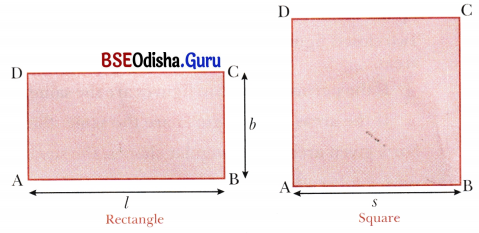
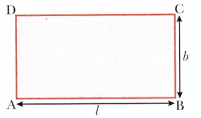
Generally, the longer side of a rectangle is called length while the shorter side is called the breadth.
Perimeter of a rectangle = 2 (Length + Breadth) = 2(l + b)
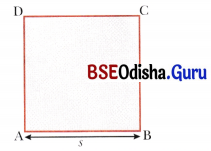
A square is a special rectangle where all the four sides are equal.
Perimeter of a square = 4 × Side length = 4s
Perimeter of Triangle
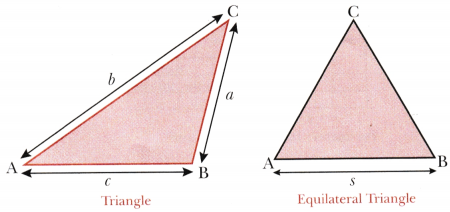
Perimeter of a triangle = Sum of lengths of its three sides.
Perimeter of triangle ABC = a + b + c
A triangle having all three sides equal, is called an equilateral trians
Perimeter of an equilateral trian = 3 × Side length = 3s
Perimeter of Regular Polygon: If all the sides and all the interior angles of a polygon are equal, then it is called a regular polygon.
|
No. of Sides |
Regular Polygon |
Length of Side |
Perimeter |
| 3 | Equilateral Triangle | a | 3a |
| 4 | Square | a | 4a |
| 5 | Regular Pentagon | a | 5a |
| 6 | Regular Hexagon | a | 6a |
| 7
. . . |
Regular Heptagon
. . . |
a
. . . |
7a
. . . |
| n | n-sided Regular Polygon | a | n × a |

Area is the measure or amount of flat surface enclosed by a closed figure. It is measured in square units such as square centimetres (cm2), square metres (m2), square feet (ft2), etc.
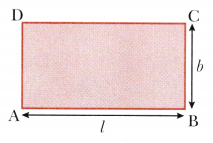
| Area of a rectangle
= (Length × Breadth) = (l × b) |
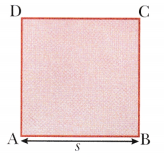
Area of a Square
= Side × Side = s × s = s2 |
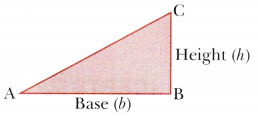
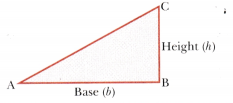
Area of a triangle ABC
= \(\frac{1}{2}\) × Base × Height = \(\frac{1}{2}\) × AB × BC = \(\frac{1}{2}\) × b × h
|
The perimeter is a length, so its unit is not in square units (those are used for area). We measure it in simple length units like metres (m), centimetres (cm), or kilometres (km).
Area = length × breadth, so the units also get multiplied. Thus, we measure area in units like square centimetres (cm2), square metres (m2), or square kilometres (km2).
Two closed figures can have same area with different perimeters, or same perimeter with different areas.
- If the perimeters of two figures are the same, then equate the perimeters to find the unknown.
- If the areas of two figures are the same, then equate the areas to find the unknown.
For a given area of rectangular shapes, the square has the smallest perimeter.
With a fixed perimeter of rectangular shapes, the square encloses the largest area.
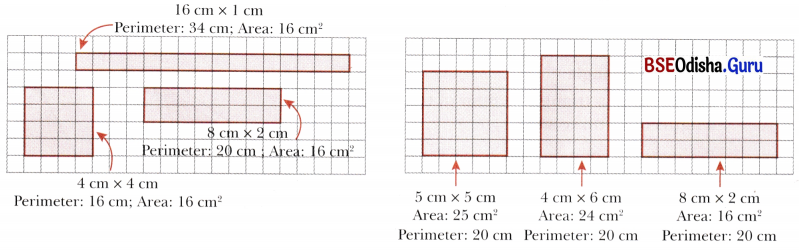
We can find the area of a shape by breaking it into smaller units like squares or into simple shapes like rectangles and triangles whose areas we already know.
For example, to find the area of below figure, we will break it into shapes with known areas, such as rectangles or squares.

A house plan is a drawing that shows the layout of rooms and spaces in a home. It uses measurements to represent the size and shape of each room, helping us understand how space is used. House plans are useful for designing, building, and calculating areas of different parts.
Perimeter
The perimeter of a closed figure is the length of the boundary of the figure. The word perimeter is derived from the Greek words peri (around) and metron (measure).
If a closed figure is made up entirely of line segments then its perimeter is the sum of the lengths of all the sides.
Perimeter of Rectangle & Square
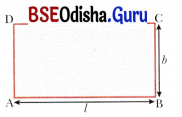
Perimeter of a rectangle = 2(Length + Breadth)
= 2(l + b)
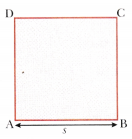
Perimeter of a square
= 4 × Side length = 4s
Perimeter of Triangle
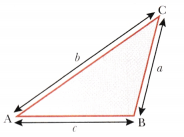
Perimeter of triangle ABC = a + b + c
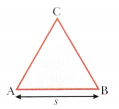
Perimeter of an equilateral triangle = 3 × Side length
= 3s
Area
The amount of surface of the plane covered by a closed figure is called its area.
Area of Rectangle
Area of a rectangle
= (Length × Breadth)
= (l × b)
Area of Square
Area of a square
= Side × Side
= s × s = s2
Area of Triangle
Area of a triangle
= \(\frac{1}{2}\) × Base × Height
= \(\frac{1}{2}\) × AB × BC
= \(\frac{1}{2}\) × b × h
The perimeter is a length, so its unit is not in square units (those are used for area). We measure it in simple length units like metres (m), centimetres (cm), or kilometres (km).
Area = length × breadth, so the units also get multiplied. Thus, we measure area in units like square centimetres (cm2), square metres (m2), or square kilometres (km2).