
Combining textbook study with BSE Odisha Class 6 Science Notes and Class 6 Science Curiosity Chapter 2 Diversity in the Living World Notes can make exam preparation more effective.
Diversity in the Living World Notes Class 6
Class 6 Science Curiosity Chapter 2 Notes
Biodiversity
Biodiversity is the variety of all living organisms in a particular area, including plants, animals, and microscopic life forms. It is shaped by a region’s environment, geography, and climate.
- Organisms are dependent on one another for their growth and survival for e.g., plants provide food and shelter to birds and animals, while animals disperse (spread) seeds after eating fruits to help new plants grow, and so on.
- Grouping organisms makes it easier to understand and stud) the similarities and differences between them.

Grouping Plants
(i) Based on Stem Thickness and Height
- Herbs: Small, non-woody plants with soft, green, delicate stems, minimal branching, and a short lifespan, e.g., tomato, mint, etc.
- Shrubs: Medium-sized woody plants with multiple branches, a hard but not very thick stem, and a bushy appearance with branches growing close to the ground, e.g., Hibiscus, rose, etc.
- Trees: Tall plants with thick, brown, and woody stems; their branches start higher up on the stem away from the ground, e.g., mango, banyan, etc.
- Other types of plants:
- Creepers: Plants with soft stems that spread along the ground, e.g., pumpkin, watermelon, etc.
- Climbers: Plants with soft stems that grow upward using a support, e.g., bottle gourd (lauki), money plant, etc.

(ii) Based on Venation
Thin lines that run across the surface of the leaves (lamina or leaf blade) are called veins. Venation refers to the arrangement of veins in a leaf,
a Reticulate Venation: Veins form a net-like pattern on either side of the main vein (midrib), e.g., Hibiscus, periwinkle (sadabahar), etc.
a Parallel Venation: Veins run parallel throughout the leaf, e.g., bamboo, banana, etc.
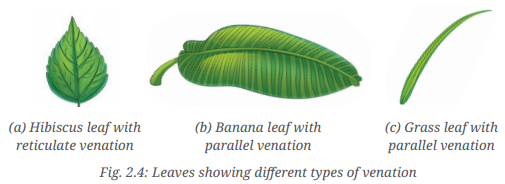
(iii) Based on Types of Roots
- Tap Root: A thick, central main root grows downward with smaller roots branching off, e.g., mustard, rose, etc.
- Fibrous Root: Many roots of similar size spread out in different directions from the stem base, e.g., common grass, rice, etc.
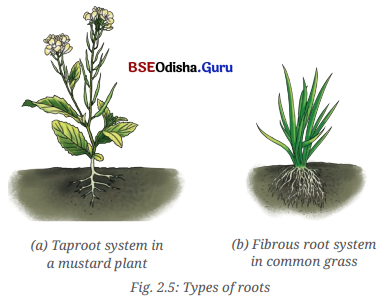
(iv) Based on Types of Seeds
- Monocotyledons (Monocots): Seeds with one cotyledon, e.g., maize, rice, etc.
- Dicotyledons (Dicots): Seeds with two cotyledons, e.g., chickpea (chana), mustard, etc.
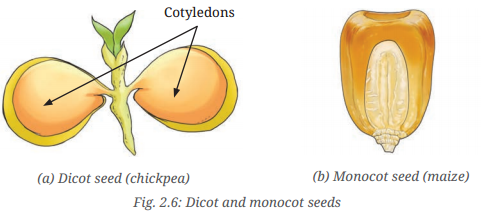
Note: Plants with parallel venation and fibrous roots have monocot seeds, while plants with reticulate venation and tap roots have dicot seeds.
Grouping Animals
Animals can be grouped based on their common features, such as:
- Types of movement (flying, running, crawling, etc.)
- Shape
- Body parts used for movement (wings, legs, etc.)
- Size
- Structure
Habitat
A habitat is a place where plants and animals live together while interacting with all other components (like sun, air, water, and soil) of the environment.
Based on where an organism lives, habitat can be categorised into two types:
- Aquatic Habitats: Found in water bodies like ponds, lakes, rivers, and oceans.
- Terrestrial Habitats: Found on land such as deserts, forests, grasslands, and mountains.
Habitat Destruction and Conservation
Destruction of habitat is one of the major causes of decline in biodiversity. Some notable conservation projects initiated in our country to overcome loss of biodiversity are discussed below:
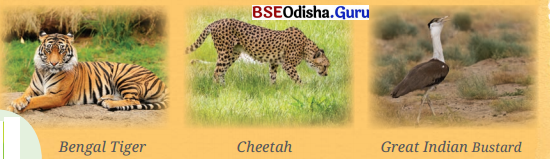
- Cheetah Reintroduction Project (2022): Aimed to restore the population of cheetahs in India.
- Bengal Tiger Conservation: Project Tiger was initiated in 1973 in India to protect Bengal Tigers and their habitats through dedicated conservation measures.
- Protection of Great Indian Bustard: Certain areas in Gujarat, Rajasthan, and Maharashtra were declared as protected areas to support the survival of this endangered (in danger of disappearing) bird.
Save Silent Valley Movement: Silent Valley is an evergreen forest in Palakkad, Kerala, famous for its rich biodiversity. The movement that persisted for 10 years opposed the proposal of a hydroelectric dam on the Kunthipuzha river that flows through the forest. People used letters, newspaper articles, petitions, and court appeals to’raise awareness, and all these efforts successfully protected the Silent Valley from destruction.
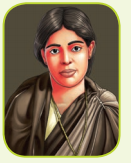
Janaki Ammal (1897-1984) was an Indian botanist who worked to protect India’s rich plant biodiversity. She led the ‘Save Silent Valley Movement’ and headed the Botanical Survey of India, documenting and conserving plant diversity.
Sacred Groves are the forest areas that are traditionally protected by local communities for religious or cultural reasons. They can range from small patches to entire forests, where cutting trees or harming animals is prohibited, making them a community-protected biodiversity treasure.
Adaptations
Adaptations are unique features that help an organism to survive and live better in a specific environment. Some common examples of adaptations in organisms include:
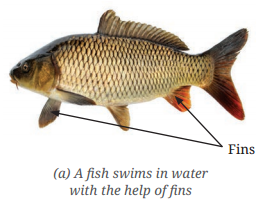
- Aquatic Adaptations Fish: Streamlined bodies with fins allow them to swim easily in water.
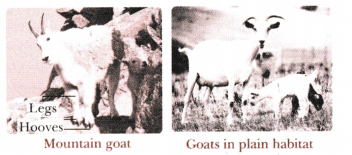
- Terrestrial Adaptations in Goats
- Goats in Mountains: Live at high altitudes with cold temperatures; have thick fur and sharp, well-divided hooves to maintain grip on mountain slopes.
- Goats in Plains: Live in flat, grassy areas; have thin fur and smooth hooves for walking on plains.
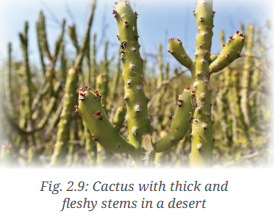
Desert Adaptations in Cactus: Thick and fleshy stems to store water and minimise water loss.
Desert Adaptations in Camels
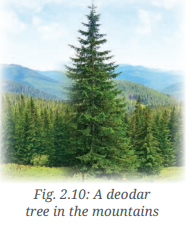
- Camels of Hot Deserts (Rajasthan): One hump for food storage, long legs, and wide hooves for walking on hot sandy deserts without sinking.
- Camels of Cold Deserts (Ladakh): Two humps for food storage, short legs, and long hair to withstand cold.
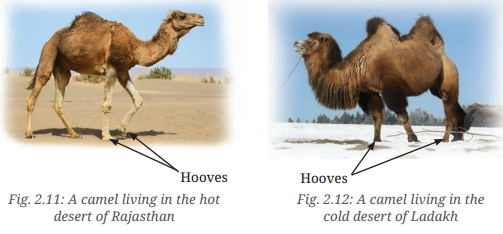
Mountainous Adaptations in Deodar Trees: Commonly seen in Himachal Pradesh; conical shape with flexible, sloping branches that let snow slide off easily.
Mountainous Adaptations in Rhododendrons
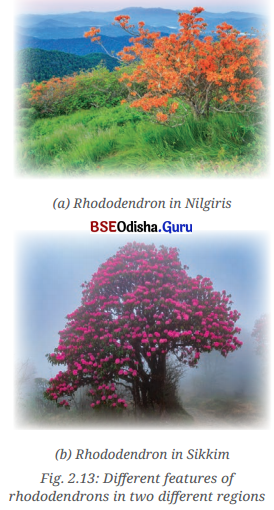
- Rhododendrons of Shola forests of Nilgiris: They have beautiful and bright flowers with short height and small leaves to survive heavy winds in the mountain regions.
- Rhododendrons of Sikkim: They are comparatively taller with broader leaves.
Salim Ali (1896-1987) is known as the ‘Birdman of India’. He studied and documented India’s birds, their habitats, and migration. He helped conserve regions of Keoladeo National Park, Bharatpur, Rajasthan, and Ranganathittu Bird Sanctuary, Mandya, Karnataka, and authored a landmark series of 10 books on Indian birds. He was awarded Padma Vibhushan in 1976.

Plants
Stems
- Trees : Possess hard and thick stems with branches on the top. Example: Mango
- Shrubs : Possess brown and woody stems (not as hard as trees) with branching close to the ground. Example: Rose
- Herbs : Possess soft and green stems. Example: Tomato
- Climbers : Possess very weak stems and require support to climb. Example: Money plant
- Creepers : Possess weak stems similar to climbers, and generally creep along the ground. Example: Watermelon
Seeds
- Monocot : Seeds with only one cotyledon (seed leaf that provides food to the embryo) Example: Maize
- Dicot : Seeds with two cotyledons Example: Gram
Leaves
- Reticulate Venation : Veins arranged in a net-like pattern; present in dicots Example: Hibiscus
- Parallel Venation : Veins arranged parallel to each other; present in monocots Example: Grass
Roots
- Tap root : Primary root arises from the base of the stem. Present in dicots. Example: Mustard
- Fibrous root : Similar sized thin roots arise from the base of the stem. Present in monocots. Example: Maize
Animals
Classified based on:
- Types of movements
- Body parts used for motion
- Shape
- Size
- Structure
- Colour
Adaptations
Features that help an organism to survive and live better in an environment.
- Thick and fleshy stems in cactus
- Streamlined bodies and fins in fishes
- Thick fur and well-divided hooves in mountain goats
- Thin fur with plain and smooth hooves in goats of plain habitats
- Sloping branches with a cone-shape in deodar trees
- Long legs, wide hooves, and single hump in camels of hot deserts
- Short legs and two humps in camels of cold deserts
- Short height and small leaves in rhododendrons of Nilgiris
- Tall height with broader leaves in rhododendrons of Sikkim
Habitats
An area where an organism lives by interacting with its surroundings.
Types of Habitats
- Aquatic : Includes all the water bodies like ponds, lakes, rivers, oceans, etc.
- Terrestrial : Includes areas like forests, grasslands, mountains, etc.
Importance of Habitats
- Provides us with food, water, shelter, and other resources
- Supports the growth and development of living beings
- Its damage results in the loss of biodiversity
Conservation of Habitat
Notable preventive measures to conserve biodiversity and habitat include:
- Cheetah Reintroduction Project: Aimed to restore declining cheetah population in India, initiated in 2022.
- Bengal Tiger Conservation: Project Tiger was initiated in 1973 to protect Bengal Tigers and their habitats.
- Protection of Great Indian Bustard: Certain areas of Gujarat, Rajasthan and Maharashtra were declared protected to support survival of this endangered bird.
Some organisms can live on both land and water and are termed amphibians (e.g., frogs).