Combining textbook study with BSE Odisha Class 6 Science Notes and Class 6 Science Curiosity Chapter 1 The Wonderful World of Science Notes can make exam preparation more effective.
The Wonderful World of Science Notes Class 6
Class 6 Science Curiosity Chapter 1 Notes
The famous writer, William Arthur Ward, once said, “Curiosity is the wick in the candle of learning.” This means that when we are curious, we light up our paths to discovery. Thus, it can be said that curiosity leads to the discovery of science.
What is Science?
- Science is a special tool that helps us understand the world around us. It is a way of thinking, asking questions, experimenting, and observing to find answers.
- By asking “how,” “why,” “what,” and “when,” we can uncover the mysteries of the world.

The Values of Science
- In science, learning happens through curiosity, critical thinking, patience, creativity, teamwork, and respect for nature.
- Curiosity encourages asking questions and exploring the unknown.
- Critical thinking helps us analyse evidence carefully and think of unique ideas logically.
- Patience helps us repeat experiments carefully to obtain reliable results, and to keep trying and work through challenges.
- Teamwork teaches us to work with others to share and improve ideas.
- Respect for nature reminds us to use science responsibly while protecting the environment and the life around us.
Science is Everywhere
The best part about science is that it is not just about reading books; it is something that happens everywhere, all around us!
Whether it is studying tiny grains of sand or massive mountains, a blade of grass or a vast forest, there is always something new and exciting to discover.
Earth is the only planet that sustains life. So, it is our responsibility to protect the environment that surrounds us. It provides fresh air for breathing and water for drinking, cooking, cleaning, and other important life processes.
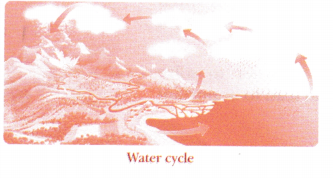
Water changes its form as it moves in a cycle from oceans and rivers, forming clouds, and returning as rain, hail, or snow. This is called the water cycle, and it is important for sustaining life on Earth.
The objects around us, like paper, rubber, and clothes etc., are all made of different materials.

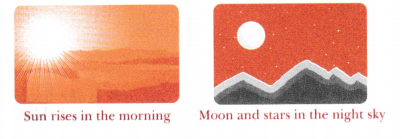
The Sun rises in the morning, while the Moon and the stars become visible in the night sky. All such natural phenomena can be explained by science.
Scientific Methods
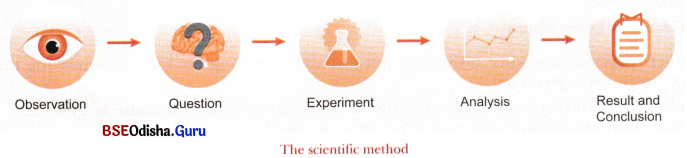
- The step-by-step method of figuring out a problem is called the scientific method.
- It involves making observations, asking questions, forming guesses, testing them, and then drawing conclusions.
- The scientific method helps us find answers in a clear and organised manner. n It is the key to science that helps us approach problems with curiosity, logic, and an open mind.
Generally, the given steps are followed in a scientific method:
- First, try to observe something which you find interesting or do not understand. This step will make you wonder and perhaps let you think of a question about it.
- After thinking of a question, try to guess a possible answer to it.
- Now test your guess through repeated experiments.
- Analyse the results of your experiments to see if you actually answered your question or not.
Finally, draw a conclusion to arrive at a complete understanding of the problem.
People who use the scientific method to solve problems and discover new things are called scientists.
Science is rarely done alone. Scientists often work in teams, which helps combine different ideas and skills together.
Working as a team makes it easier to solve challenging problems and can lead to important discoveries