
Easy-to-read Ganita Prakash Class 6 Notes and Chapter 2 Lines and Angles Class 6 Notes save valuable study time during exam season.
Class 6 Maths Chapter 2 Lines and Angles Notes
Class 6 Lines and Angles Notes
A point has no length, no width, and no height.
Three or more points that lie on the same straight line are known as collinear points.
Line Segment, Ray and Line
| Line segment | Ray | Line |
| A line segment has two endpoints. | A ray has only one endpoint. | A line has no endpoint. |
| A line segment has definite length. | A ray has indefinite length. | A line has indefinite length. |
A line segment can be drawn on a sheet of paper.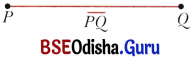 |
A ray cannot be drawn on a sheet of paper as it has indefinite length, but it can be represented by a diagram.
|
A line cannot be drawn on a sheet of paper as it has indefinite length, but it can be represented by a diagram.
|
| Line segment PQ and line segment QP are the same. | Ray PQ and ray QP are different rays. | Line PQ and line QP are the same. |


Special Lines
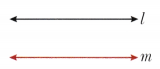
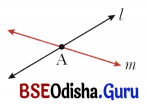
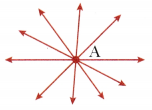
| Parallel lines | Intersecting lines | Concurrent lines |
| Lines lying on the same plane that do not intersect, no matter how far they are extended.
|
Lines that meet or cross each other at a single point.
The point where they meet is called the point of intersection.
|
Three or more lines that pass through one common point.
This common point is called the point of concurrency.
|
A plane is a smooth, flat surface that extends endlessly in all directions.
An angle is formed when two rays start from the same initial point called the vertex.

To represent an angle, write the letter of one arm, followed by the letter of the vertex (always in the middle), and then the letter of the other arm.
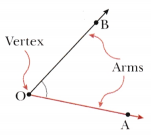
For example, in the adjacent figure, the angle is written as ∠AOB or ∠BOA.
Interior of an angle: The space between the arms (when extended indefinitely).
Exterior of an angle: The space outside the arms.
The size of an angle depends on the amount of rotation, not on the length of its arms.
Angles are measured in degrees (°).
To find out whether two angles are equal, greater or smaller, we compare them using the following methods:
- By observation (without superimposition)
- By tracing/superimposition
Types of Angles
| Name | Definition | Diagram | |
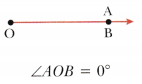
| Zero Angle | The initial and final positions of a rotating ray coincide without making any turn.
The measure of such an angle is 0° |
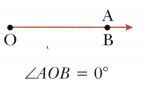 |
|
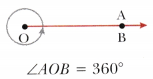
| Complete Angle | The initial and final positions of a rotating ray coincide after making a full turn.
The measure of such an angle is the angle made in a full turn, i.e. 360°. |
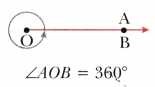 |
|
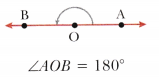
| Straight Angle | The initial and final positions of a rotating ray are opposite to each other (on the same line) after making half of a full turn.
The measure of such an angle is equal to half of a complete angle, i.e. \(\frac{1}{2}\) × 360° = i80°. |
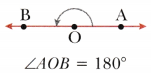 |
|
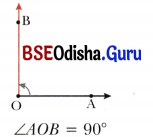
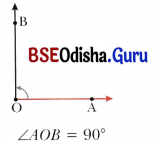
| Right Angle | The initial and final positions of a rotating ray are perpendicular to each other after making one-fourth of a full turn.
The measure of such an angle is equal to one-fourth of a complete angle, i.e. \(\frac{1}{4}\) × 360° = 90°. |
 |
|
| Acute Angle | The final position of a rotating ray lies between the initial position and one-fourth of a full turn (i.e less than 90°). | 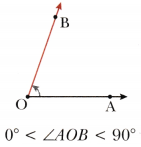 |
|
| Obtuse Angle | The final position of a rotating ray lies between a right angle and a straight angle (i.e. more than 90° but less than 180°). | 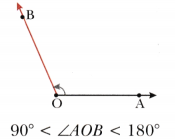 |
|
| Reflex Angle | The final position of a rotating ray lies between a straight angle and a complete angle (i.e. more than 180° but less than 360°). | 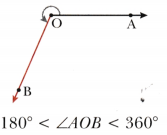 |
|
A protractor is a semi-circular tool used to measure angles from 0° to 180°.
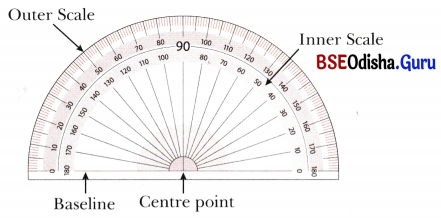
It has two scales:
- Inner scale: It starts at 0° on the right and increases to 180° as you move anti-clockwise.
- Outer scale: It starts at 0° on the left and increases to 180° as you move clockwise.
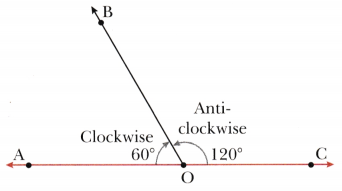
To measure an angle, place the centre point of the base line on the vertex, aligning one arm with the base line.
Use the outer scale if the angle opens clockwise and the inner scale if the angle opens anti-clockwise.
Angles Formed by a Clock
- A clock is shaped like a circle, so one full turn around it is 360 degrees.
- As the clock is divided into 12 hours, the angle between any two adjacent hour marks = \(\frac{360^{\circ}}{12}\) = 30°
Line segment, Ray and Line
| Line segment | Ray | Line | |
| Number of endpoints | 2 | 1 | 0 |
| Length | Definite | Indefinite | Indefinite |
| Representation | 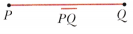 |
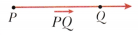 |
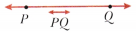 |
Note: Rays \(\overrightarrow{P Q} \text { and } \overrightarrow{Q P}\) are different because they start from different points and extend in opposite directions.
Comparison of Angles
By observation:
- Angles can be compared visually when the difference in their openings is clearly noticeable.
- This method is suitable only when the difference in size is significant.
By tracing/superimposition:
- Any two angles can be compared by placing them one over the other, i.e. by superimposition.
- While superimposing, the vertices and one arm of the angles must overlap.
Types of Angles
|
Angles with fixed values |
||||
| Zero Angle: The measure of such an angle is 0°. | Right Angle: The measure of such an angle is equal to 90°. | Straight Angle: The measure of such an angle is equal to 180°. | Complete Angle: The measure of such an angle is equal to 360°. | |
 |
 |
 |
 |
|
|
Angles with multiple values |
|||
| Acute Angle: Between 0° and 90° | Obtuse Angle: Between 90° and 180° | Reflex Angle: Between 180° and 360° | |
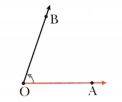
0° < ∠AOB < 90° |
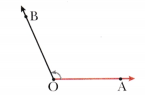
90° < ∠AOB < 180° |
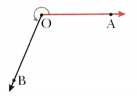
180° < ∠AOB < 360° |
|