
Combining textbook study with BSE Odisha Class 6 Science Notes and Class 6 Science Curiosity Chapter 5 Measurement of Length and Motion Notes can make exam preparation more effective.
Measurement of Length and Motion Notes Class 6
Class 6 Science Curiosity Chapter 5 Notes
Measurement
Measurement is defined as the process of comparing an unknown quantity with a known or standard quantity of the same kind. This known fixed quantity is called a unit,
- Earlier, people measured length using body parts. Common examples include:
- Handspan (balisht) – distance between the tips of the thumb and little finger of an outstretched hand.
- Cubit – distance from the elbow to the tip of the middle finger
- Footspan – length of a person’s foot.
- Footstep / stride – distance covered in one step while walking.
When an object’s length is measured the length is expressed as a number and a unit. For example, length of a table is measured as 13 handspans’ where 13 is the number and handspan is the unit. It means length of table is 13 times the length of the handspan.
Different people have different-sized handspans, feet or fists. Therefore, the same object gives different numerical values when measured with different persons’ body parts. This variation shows that body-based units are not reliable for accurate measurements.

Standard Units
Standard unit is a unit which has a fixed magnitude, amount or size which does not change from person to person, place to place or time to time.
Some standard units of length are metre, foot, yard etc.
- Different regions of the world developed different systems of units, which made comparison of measurements difficult. To avoid confusion, most countries have adopted the International System of Units (SI units) as a common set of standard units.
- The SI unit of length is metre, written with the symbol m.
- Some other units of length are defined in relation to the metre:
- 1 metre = 100 centimetres (cm)
- 1 centimetre =10 millimetres (mm) .
- 1 kilometre = 1000 metre (m)
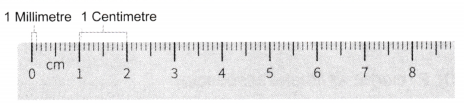
- Very large distances, such as those between cities, are measured in kilometres (km), while everyday lengths are measured in metres (m), centimetres (cm) or millimetres (mm).
Correct Way of Measuring Length
- We must select a suitable measuring device for the length to be measured, such as a short scale for a pencil, a metre scale for the height of a room, or a flexible tape for the girth of a tree or the chest size of a person.
- While measuring length, the scale should be placed in contact with the object along its length, without any gap or tilt.
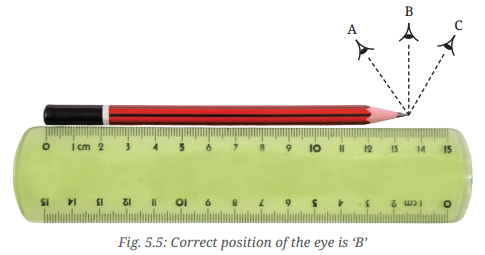
- The eye should be placed directly above die mark being read. Viewing the scale from an angle can give a wrong reading.
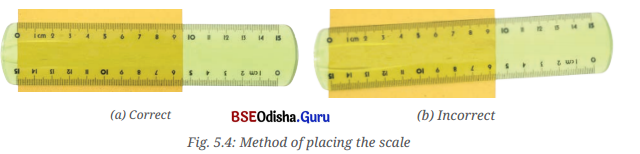
Parallax error: It is the error in measurement that occurs when we read a scale from an angle instead of keeping the eye vertically above the mark. Because of the slanted view, the object’s end and the scale division do not appear to line up correctly, so the reading becomes incorrect.
If the zero mark at the end of a scale is broken or unclear, another full mark such as 1.0-cm can be used as the starting point, and this starting reading is subtracted from the reading at the other end to get the correct length.
Example: If one end of the object is at 1.0 cm and the other end is at 10.4 cm on the scale, then the length of the object is 10.4 cm – 1.0 cm = 9.4 cm.
- Visually impaired learners can measure length using scales with raised markings that can be felt by touch.
- When writing a measured length, we must always write the number and the unit, leaving a space between the number and the unit.
- The names of units such as kilometre, metre, centimetre and millimetre begin with lowercase letters, and their symbols km, m, cm and mm are also written in lowercase, without a plural ‘s’. A full stop is not written after a unit symbol, except at the end of a sentence.
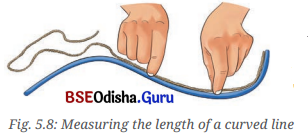
Measuring the Length of a Curved Line
- Curved lengths such as the edge of an arch or the circular base of a tumbler cannot be measured directly with a rigid, straight scale.
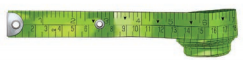
- Curved lengths can be measured using a flexible measuring tape that bends and fits exactly along the curve.
- A curved length can also be measured by carefully laying a thread along the curved object, then straightening the thread and measuring it with a metre scale.
Describing Position
o People may disagree about which place is nearer or farther away if they compare distances from their own houses or from different starting points. If all distances are measured from the same fixed point, everyone will agree on which place is closer or farther from that point.
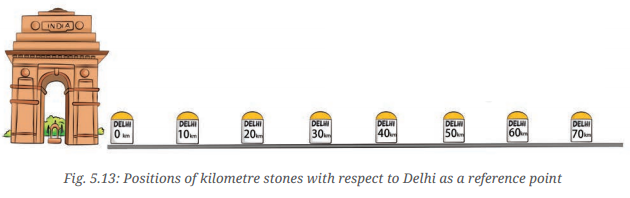
- Reference point: A fixed object or position with respect to which the distance (or position) of an object is described is called a reference point.
- Kilometre stones along a highway show the distance of that point from a fixed city (for example, ‘Jaipur 100 km”). The city acts as the reference point for all those distances.
- As a vehicle moves and the numbers on kilometre stones decrease, this shows that the position of the vehicle with respect to the reference city is changing with time.
Motion
An object is said to be in motion if its position changes with respect to a reference point as time passes. An object is said to be at rest if its position does not change with respect to a reference point with time.
Whether an object is at rest or in motion depends on the chosen reference point; the same object can be at rest with respect to one reference point and in motion with respect to another. For example, passengers sitting in a moving bus are at rest relative to the bus but in motion relative to trees and buildings outside.
Types of Motion
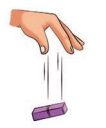
Linear motion: When an object moves along a straight line, its motion is called linear motion. Example: a ball dropped from a height or people marching in a straight line.
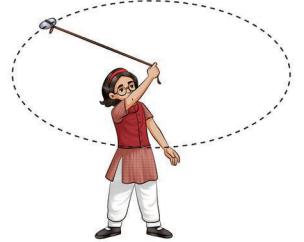
Circular motion: When an object moves along a circular path around a fixed point or axis, its motion is called circular motion. Example: a seat on a merry-go-round or a stone tied to a string and whirled in a circle.
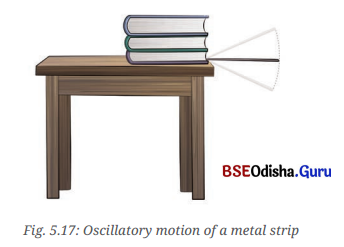
Oscillatory motion: When a oscillatory motion object moves to and fro about a fixed position, its motion is called Oscillatory motion. Example: a swing moving back and forth or a simple pendulum.
Periodic motion
- When an object repeats its motion after equal intervals of time, its motion is called periodic motion. Example: the to-and-fro motion of a pendulum or the circular motion of a rotating wheel.
- Circular motion and oscillatory motion are type of periodic motions, because they repeat themselves in a regular pattern after a fixed time.
- The same object can show different types of motion along different parts of its path, such as a ball moving on a roller-coaster track with straight and curved sections.
Measurement
- It is the comparison of an unknown quantity with some known fixed quantity.
- The known fixed quantity is the unit of measurement.
- Measurement of any quantity consists of two parts — a number and a unit.
Old Methods of Measurements
- Ancient methods of measurement have only been approximate measurements and they differ from person to person, place to place and time to time.
- Cubit: The length between the tip of the middle linger and elbow.
- Handspan: The length between the tip of the thumb and the tip of the little finger when the hand is fully extended.
Standard Units of Measurements
- A standard unit is a fixed value which does not change from person to person, place to place and time to time.
- The international system of units (SI units) has been adopted by countries as standard units of measurements.
- The SI unit of length is metre (m).
- For measuring smaller lengths, we use smaller units such as centimetre (cm) or millimetre (mm).
- For measuring larger lengths, we use larger units such as kilometre (km).
- Conversion of Units:
- 1 km = 1000 m
- 1 m = 100 cm
- 1 cm = 10 mm
Motion
- The reference point is a fixed point from which the position or distance of an object is measured.
- Distance tells us how far an object is from the reference point.
Rest and Motion
- An object is said to be in motion if its position changes with respect to the reference point with time.
- If an object is not changing its position with respect to the reference point with time, it is said to be at rest.
Types of Motion
- Linear Motion: When an object moves along a straight line.
Examples:
A box moving in a straight line.
A train moving on a straight railway track. - Oscillatory Motion: When an object moves to and fro about a fixed position.
Examples:
The motion of a ruler fixed at one end when the other end is flicked.
Pendulum of a clock. - Circular Motion: When an object moves along a circular path.
Examples:
The whirling of an eraser tied to a thread.
Children riding on a rotating merry-go-round. - Periodic Motion: When an object repeats its path after a fixed interval of time.
Examples:
The motion of the hands of a clock.
Both circular and oscillatory motions are periodic in nature.