
Students can include Class 7 Curiosity Extra Questions and Class 7 Science Chapter 5 Changes Around Us: Physical and Chemical Extra Question Answer in their daily self-study routine.
Class 7 Science Chapter 5 Changes Around Us: Physical and Chemical Extra Questions
Class 7 Science Chapter 5 Extra Questions on Changes Around Us: Physical and Chemical
Changes Around Us: Physical and Chemical Class 7 Very Short Question Answer
Question 1.
Classify the following processes into physical or chemical changes:
(i) Beating of aluminium metal to make aluminium foil
(ii) Digestion of food
(iii) Cutting of a log of wood into pieces
(iv) Burning of crackers
Answer:
(i) and (iii) are physical changes, while (ii) and (iv) are chemical changes.
Question 2.
Give one example for each of the following:
(i) A chemical change in which heat and light are produced
(ii) A chemical change in which gas is evolved
(iii) An irreversible physical change involving a change in the size and shape of the original substance
Answer:
(i) Burning of magnesium ribbon
(ii)Reaction of vinegar with baking soda
Cutting of vegetables

Question 3.
Paper does not burn when kept in the air for a long time, but it burns quickly when a burning matchstick is brought near it. What condition is being fulfilled by the burning matchstick? Can the burning of paper be reversed?
Answer:
The flame of the matchstick provides heat to raise the temperature of the paper to reach its ignition temperature, which is necessary for combustion to take place. No, the burning of paper cannot be reversed.
Question 4.
Two students of class 7 were making paper toys during their lunch break. Student (I) made an aeroplane by folding a piece of paper, while student (II) made a paper boat by cutting a sheet of paper into the shape of a boat. In which case can the student get the original paper back and why?
Answer:
Student (I) will get the original paper back as he had only folded the piece of paper. The folded paper can be unfolded again to obtain the original paper. Since the student (II) has cut the paper, it is not possible to get back the original paper. The pieces cut in different sizes cannot be joined back together to obtain the original paper.
Question 5.
Explain whether the ripening of fruit is desirable or undesirable.
Answer:
Ripening of fruit is considered desirable as it improves the taste, colour, and edibility of a fruit. For instance, as bananas ripen, they become sweeter. But if the ripening continues for a longer time, the fruit becomes overripe and starts to rot / decay which is undesirable.
Question 6.
A calcium-containing colourless solution is such that it turns milky when carbon dioxide gas is passed through it. Name the colourless solution and also state if any chemical change occurs during this process.
Answer:
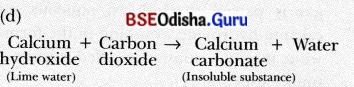
The calcium-containing colourless solution that turns milky on passing carbon dioxide gas through it is lime water a solution of (calcium hydroxide). Yes, a chemical change occurs when carbon dioxide gas is passed through an aqueous solution of calcium hydroxide, resulting in the formation of a white insoluble substance called calcium carbonate Tinilky appearance).
Question 7.
Justify the type of change taking place in each of the given cases:
(i) Melting of ice
(ii) Weathering of rocks
Answer:
(i) When ice melts, there is only a change in the physical state of water, i.e., from solid to liquid. Since no new substance is formed, it is a physical change.
(ii) During weathering, the breakdown of large rocks into smaller pieces represents a physical change, while change in chemical composition of the rock by reacting with water or other substances involves a chemical change.
Question 8.
Preeti, a science teacher, performed two experiments to make her students understand how a chemical change takes place. Complete the following word equations for the chemical reactions involved in her experiments:
(i) Vinegar + …………→ ………… + Other substances
(ii) Magnesium + ………… → Magnesium + Heat + Light oxide
Answer:
(i) Vinegar + soda Baking → Carbondioxide + Other substances
(ii) Magnesium + Oxygen → Magnesium oxide + Heat + Light
Question 9.
Riya accidentally dropped a slice of bread on the kitchen floor and forgot to throw it out. After two days, she saw green patches on it. It was also giving out a bad smell. Is this a physical or a chemical change? Give a reason for your answer.
Answer:
It is a chemical change. A new substance (fungus) is formed on the bread, and the change cannot be reversed.
Question 10.
Write word equations for two chemical reactions using the substances given in the box.
Calcium hydroxide, iron, water, carbon dioxide, iron oxide, air, calcium carbonate
Answer:
(i) Calcium hydroxide + Carbon dioxide → Calcium Carbonate + Water
(ii) Iron + Air + Water → Iron oxide
Changes Around Us: Physical and Chemical Class 7 Short Question Answer
Question 1.
Give two examples for each of the following cases:
(i) Physical changes which are reversible
Answer:
(a) Folding of paper
(b) Melting of ice
(ii) Physical changes which are not reversible
Answer:
(a) Tearing of paper
(b) Breaking of glass
(iii) Chemical changes
Answer:
(a) Reaction between vinegar and baking soda
(b) Burning of a matchstick
Question 2.
(i) The following table lists the changes that take place when a candle is burned. Classify these as chemical or physical changes.
(ii) What are the three requirements for a combustion process to occur?
Answer:
(i) (a) Physical, (b) Physical, (c) Chemical
(ii) The three requirements for a combustion process to occur are as follows:
- A combustible substance, also called ‘fuel’
- Air (oxygen)
- Heat that allows the fuel to reach its ignition temperature.
Question 3.
(i) Curdling of milk is considered to be a chemical change. Justify this statement. Can the original milk be obtained again? Explain.
(ii) Lakshika lit a candle in a Petri dish and covered it with a glass tumbler. After some time, she noticed the flame of the candle had been extinguished. What could be the possible reason for this?
Answer:
(i) Curdling of milk is a chemical change as it results in the formation of a new substance called curd. The properties and chemical composition of the milk change when it is curdled. No, the original milk cannot be obtained once curd is formed as its chemical composition has changed and this is an irreversible change.
(ii) The flame of the candle got extinguished after some time because the continuous supply of air (oxygen) was cut off by covering the candle with a glass tumbler.
Question 4.
Mention any three points of difference between physical and chemical changes.
Answer:
| Physical change | Chemical change |
| (i) Can be reversible or irreversible | Generally irreversible |
| (ii) Involves a change in physical properties like shape, size, state, etc. | Involves a change in chemical properties |
| (iii) No new substance is formed | New substance(s) is/ are formed |
| (iv) Examples include folding a paper, melting ice, stretching a rubber, etc. | Examples include cooking of food, rusting of iron, burning of wood, etc. |
Question 5.
During a science experiment, Naman mixed baking soda with vinegar and observed the formation of bubbles. His friend Rachita said, “It’s just like when we dissolve salt in water. A similar type of change happens in that case as well.” Do you agree with Rachita? Give two points to support your answer.
Answer:
Rachita’s statement is incorrect. This is because:
- Mixing baking soda with vinegar produces gas bubbles (carbon dioxide), indicating a new substance is formed. Thus, this is a chemical change.
- Dissolving salt in water is a physical change where no new substance is formed, and salt can be recovered from the resultant solution by evaporating the water. No gas or bubbles are produced when salt is dissolved in water.
Question 6.
(i) One day, Garvit noticed that his bicycle had developed brown flaky patches after being left outside in the rain for almost a month. Her mother explained that it is rust. Based on this situation, explain why rusting is a chemical change.
(ii) What type of change is tearing of paper and why?
Answer:
(i) Rusting is a chemical change because, in rusting, a new substance, rust (iron oxide), is formed through a chemical reaction. Iron reacts with oxygen and water to form rust, which has properties different from those of iron.
(ii) Tearing of paper is an irreversible physical change, as in this change no new substance is produced and the material, i.e., paper, still remains the same. However, the original sheet of paper cannot be brought back from the torn pieces of paper.
Question 7.
Magnesium ribbon burns in air to produce a white-coloured ash. Name the white-coloured ash formed in this process. What kind of chemical reaction occurs in this process? Mention any one essential condition required for such a reaction to take place.
Answer:
The white coloured ash formed in this process is that of magnesium oxide. The given reaction is a combustion reaction. The three essential conditions required for combustion to take place are as follows:
- A combustible substance, also known as ‘fuel’
- Air (oxygen)
- Heat that allows the fuel to reach its ignition temperature.
Question 8.
Answer the following questions.
(i) What is the term used for the minimum temperature at which a substance catches fire?
(ii) Which gas is released when lemon juice is added to a baking soda solution?
(iii) What is the white insoluble substance formed after the reaction of calcium hydroxide with carbon dioxide?
Answer:
(i) Ignition temperature
(ii) Carbon dioxide
(iii) Calcium carbonate
Changes Around Us: Physical and Chemical Class 7 Long Question Answer
Question 1.
If you leave a piece of iron in the open for a few days, it acquires a film of brownish substance, called rust.
(i) Do you think rust is different from iron?
(ii) Can you change rust back into iron by some simple method?
(iii) Do you think formation of rust from iron is a chemical change?
(iv) Give two other examples of a similar type of change.
Answer:
(i) Yes, rust is chemically different from iron.
(ii) No, rusting is an irreversible process.
(iii) Yes, it is a chemical change because a new substance (iron oxide) is formed.
(iv)
- Setting of curd from milk.
- Burning of magnesium ribbon to form magnesium oxide.
Answer:
(i) Erosion is defined as the process in which rock pebbles, soil, and sediments are broken down and moved from one location to another by natural forces like wind and flowing water. For example, fine sand gets collected on the riverbeds due to the flow of water.
Weathering on the other hand is defined as the physical and chemical changes that are responsible for breaking large rocks into smaller pieces. For example, temperature changes, growing roots of trees, and even freezing of water within cracks in the rocks can cause them to break into smaller pieces. Thus, weathering of rocks involves both physical and chemical changes, while erosion is an example of a physical change.
Question 2.
(i) Define the term erosion. How is it different from weathering? Explain with the help of examples.
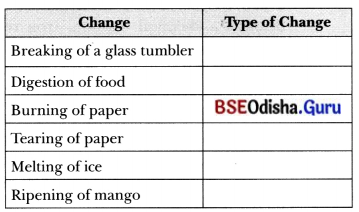
(ii) Read the following table carefully and select the physical and chemical changes by writing P and C against the respective change.
Answer:
| Change | Type of Change |
| Breaking of a glass tumbler | P |
| Digestion of food | C |
| Burning of paper | C |
| Tearing of paper | P |
| Melting of ice | P |
| Ripening of mango | C |
Question 3.
A student performed the following three experiments in the science laboratory: Experiment A: Heated a piece of ice in a beaker until it turned into water and then into steam.
Experiment B: Burned a small piece of magnesium ribbon using a burner until it turned into a white powder.
Experiment C: Dissolved salt in water and heated the resultant mixture to evaporate the water to recover the salt.
(i) Identify the type of change (physical or chemical) in each experiment.
(ii) Justify your answer in part (i).
(iii)The student claims that “all changes involving heat are chemical changes.” Do you agree? Use evidence from the experiments above to support your answer.
Answer:
(i) Experiment A: Physical change Experiment B: Chemical change Experiment C: Physical change
(ii) Experiment A: There is only a change in the physical property of water (state change), and no new substance is formed.
Experiment B: Since a white powder of magnesium oxide, which has entirely different properties from those of magnesium, is formed, it is a chemical change. Heat and light are also released while burning a magnesium ribbon.
Experiment C: Salt can be recovered from the salt solution by a simple physical method of evaporation. No new substance is formed, as salt and water are only physically mixed together.
(iii) No, not all changes involving heat are chemical changes. This is evident from Experiment A, where heat causes a physical change in the state of water, and Experiment C , where heating is used to evaporate the water to recover the salt. Only Experiment B involves a chemical change because a new substance, i.e., magnesium oxide is formed on burning the magnesium ribbon. Hence, heat can cause both physical changes (like melting, boiling, evaporation, etc.) and chemical changes (like burning, cooking, etc.). The type of change depends on whether any new substance is formed or not.
Question 4.
(i) One Sunday afternoon, Ravi went out on a picnic with his family. During the picnic, he performed activities like cutting a log of wood, chopping fruits, melting of ice, folding clothes, making a paper boat, burning wood etc. Which of the activities performed by him were reversible and why?
(ii) Elaborate with the help of an activity that both physical and chemical changes can simultaneously occur in a process.
Answer:
(i) The following activities performed by him were reversible:
- Melting of ice: It results in the formation of water that can be frozen again to obtain ice.
- Folding clothes: Clothes can be unfolded again.
- Making a paper boat: A paper boat is generally formed by folding the paper in a specific manner such that it can easily float on water. The folded paper can therefore be unfolded again to obtain the original sheet of paper.
(ii) Take a candle and light it with the help of a matchstick. The candle burns and the following changes take place:
- Physical changes: The wax near the wick of the candle melts, flows down and solidifies on cooling. Evaporation of wax due to heat takes place. All these are physical changes, as no new substance is formed in any of these cases.
- Chemical changes: The burning of wax vapour in the presence of oxygen results in the formation of new substances such as carbon dioxide and water vapour.
Changes Around Us: Physical and Chemical Class 7 Case Based Questions
Read the following passages and answer the questions that follow:
Question 1.
Shruti was preparing a solution of lemon juice and baking soda in the science laboratory. She observed that the reaction between lemon juice and baking soda produces a gas. On passing the gas through lime water, it turns milky. Her teacher explained that this is due to the formation of calcium carbonate.
(i) Name the gas released in the given experiment.
Answer:
Carbon dioxide
(ii) Does the gas released in this experiment support combustion? Explain your answer.
Answer:
No, carbon dioxide gas is not a supporter of combustion. Oxygen gas is a supporter of combustion.
(iii) What type of change takes place in this experiment? Explain your answer briefly.
Answer:
A chemical change takes place in the given experiment, resulting in the evolution of carbon dioxide gas along with the formation of other new substances. Calcium carbonate is formed when carbon dioxide gas is passed through lime water.
OR
(iii) Give any two characteristics of the type of change that has taken place in the given experiment.
Answer:
The two characteristics of chemical change are as follows:
- A chemical change results in the formation of one or more new substances.
- A chemical change takes place through a chemical reaction.
Question 2.
Raghav prepares a chapati using the following steps:
P: Wheat grains are ground to make flour.
Q : Flour is mixed with water to make a soft dough.
R: Small balls of dough are flattened using a rolling pin.
S: The flat, round dough is cooked on a pan.
T: The cooked chapati is coated with a layer of butter.
(i) In which of the given step(s) does a physical change take place?
Answer:
(i) Physical changes: Steps P, Q, R and T
(ii) Chemical change: Step S
(ii) In which of the given step(s) does a chemical change take place?
Answer:
(a) Burning of a candle- On gentle heating, the wax melts (physical change), but on burning, it forms carbon dioxide and water vapour (chemical change).
(b) Weathering of rocks- Rocks undergo physical changes when they are broken down into smaller pieces due to certain environmental factors, such as action of wind, pressure, temperature etc. However these rocks can also undergo chemical changes when the materials present in them react with water or other substances.
(iii) Give two examples in which both physical and chemical changes take place. Also, provide explanation for your answer.
OR
(iii) Based on the concept of reversible and irreversible changes, can you distinguish between steps P and S? Justify your answer.
Answer:
Steps P and S cannot be distinguished based on the concept of reversible and irreversible changes as both these are irreversible changes. Step P represents a physical, irreversible change, as when wheat grains are ground to make flour, there occurs only a change in the shape and size of the grain and no new substance is formed. Whereas step S represents a chemical, irreversible change as chapati formed upon cooking the flat, round dough has entirely different properties from those of the original dough.
Changes Around Us: Physical and Chemical Class 7 Picture Based Questions
Observe the given pictures and answer the questions that follow:
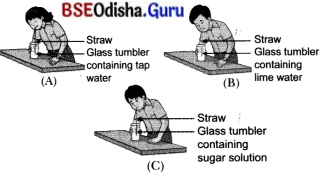
Question 1.
Three students performed an activity to show the presence of carbon dioxide in the air as shown below:
(i) In which of the given case(s), the presence of carbon dioxide cannot be confirmed?
(a) A only
(b) A and B
(c) C only
(d) A and C
Answer:
(d) A and C
(ii) Write down the word equation for the chemical reaction occurring in the case(s) identified in part (i).
Answer:
(iii) Give a reaction in which carbon dioxide is released, which can be confirmed with the lime water test.
Answer:
When baking soda reacts with an acidic substance like vinegar, carbon dioxide is released, which can be confirmed by the lime water test.
Baking Soda + Vinegar → Carbon dioxide + Other substances
OR
(iii) Is any gas released when vinegar is mixed with tap water? Is this a physical or a chemical change?
Answer:
No. This is a physical change as no new substance is formed in this process.
Changes Around Us: Physical and Chemical Class 7 Activity Based Questions
Read the following activity and answer the questions that follow:
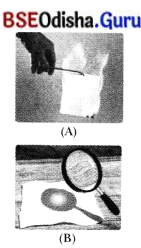
1. Objective: To determine if combustion can take place without fire.
Materials required: A sheet of paper, a magnifying glass, a pair of tongs, and a matchbox.
Procedure:
- Hold a piece of paper with the help of a pair of tongs and bring a lighted matchstick to it.
- The paper quickly catches fire as shown in Figure (A).
- Now, take another sheet of paper. Focus the sunrays on the paper using a magnifying glass such that a small and bright spot is formed on the paper (Figure B).
- Hold the magnifying glass in the same position for some time.
[Caution: Perform this activity under the supervision of your teacher or an adult]
(i) What do you observe when the sunlight is focused by the magnifying glass on the paper for a long time?
Answer:
Smoke starts to emerge at the bright spot, and gradually the paper catches fire.
(ii) Which of the following is essential for combustion to occur in both cases of the activity?
(a) Flame
(b) Oxygen
(c) Magnifying glass
(d) Matchstick
Answer:
(b) Oxygen
(iii) Why does the paper start burning when sunlight is focused on it using a magnifying glass?
Answer:
The magnifying glass focuses the Sun’s rays at a small spot, increasing the temperature of the paper at that spot, leading it to reach its ignition temperature, consequently causing it to burn.
OR
(iii) Figure B shows that paper can burn in the absence of fire. Does this mean fire is not necessary for combustion to begin? Justify your answer.
Answer:
Yes, fire is not necessary for combustion to begin. It requires a combustible substance, sufficient heat to reach the ignition temperature of that substance, and the presence of oxygen. In Figure B, sunlight provides the required heat.
Changes Around Us: Physical and Chemical Extra Questions for Practice
Question 1.
Sumit, a student of class listed a few changes and their type in the table shown below:
| Change | Type of Change | |
| (i) | Burning of paper | Physical |
| (ii) | Rusting of iron | Chemical |
| (iii) | Cutting a piece of paper | Physical |
| (iv) | Melting of ice | Chemical |
| (v) | Erosion | Chemical |
Select the option in which the change(s) classified is/are incorrect.
(a) (i) only (b)
(ii) and (iii) only
(c) (ii), (iii) and (iv)
(d) (i), (iv) and (v)
Answer:
(d) (i) Burning of paper- Chemical change
(iv) Melting of ice- Physical change
(v) Frosion- Physical change
Question 2.
Adarsh, a science teacher of class 7, burnt a magnesium ribbon as shown in the picture alongside.
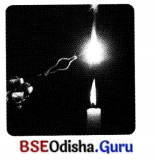
(a) A black-coloured ash is produced at the end of the experiment, and it is a reversible change.
(b) A red-coloured ash is produced at the end of the experiment and it is a reversible change.
(c) A white-coloured ash is produced at the end of the experiment and it is an irreversible change.
(d) A blue-coloured ash is produced at the end of the experiment and it is an irreversible change.
Answer:
(c) Burning of magnesium ribbon results in the formation of a white-coloured ash known as magnesium oxide. This is an irreversible chemical change as a new substance (magnesium oxide) with entirely different properties from those of magnesium and oxygen, is formed in this process. The magnesium oxide so formed cannot be turned back to the magnesium ribbon.
Question 3.
Select the process(es) that will result in a physical change.
(i) Cutting a cloth to make a shirt
(ii) Burning of wood
(iii) Stretching of a rubber band
(iv) Heating ice cubes in a pan on a Bunsen burner
(a) (i) only
(b) (i), (iii), and (iv)
(c) (ii) and (iii) only
(d) (i) and (iv) only
Answer:
(b) Burning of wood is a chemical change, rest. all are physical changes.
Question 4.
Study the following Venn diagram carefully and select the correct statement.
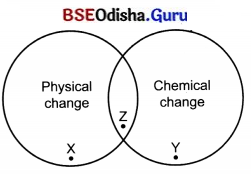
(a) Point X represents the weathering of rocks, while point Z represents the burning of a candle.
(b) Point Y represents the grinding of wheat grains, while point X represents the melting of ice.
(c) Point Z represents the folding of clothes, while point X represents the digestion of food.
(d) Point X represents the boiling of water, while point Y represents the burning of magnesium ribbon.
Answer:
(d) Boiling of water is a physical change, while the burning of magnesium ribbon is a chemical change.
Questions 5 and 6 consist of two statements – Assertion (A) and Reason (R). Answer these questions by selecting the correct option:
(a) Both A and R are true and R is the correct explanation of A.
(b) Both A and R are true but R is not the correct explanation of A.
(c) A is true but R is false.
(d) A is false but R is true.
Question 5.
Assertion (A): Weathering of rocks is caused only due to physical changes.
Reason (R): This phenomenon results in the formation of soil from rocks.
Answer:
(d) Weathering of rocks is caused by both physical and chemical changes.
Question 6.
Assertion (A): Melting of wax is a reversible physical change.
Reason (R): The chemical composition of wax changes during melting.
Answer:
(c) Only the physical state of wax changes during melting.
Question 7.
Explain what will be observed if
(i) Baking soda is added to a test tube containing vinegar
Answer:
Bubbles are produced when baking soda is added to a test tube containing vinegar. This is due to the evolution of carbon dioxide gas.
(ii) Carbon dioxide gas is passed through lime water.
Answer:
When carbon dioxide is passed through lime water, a milky appearance is observed. This is due to the formation of a white insoluble substancc, i.e., calcium carbonate.
Question 8.
You might have noticed brown patches on iron objects. What is the reason for the formation of these brown patches? Identify the type of change that occurred.
Answer:
The brown patches on iron objects are formed as a result of the rusting of iron, wherein iron gets converted to iron oxide. This is a chemical change, as a new substance, called iron oxide, is formed.
Question 9.
Identify and justify the type of change taking place in each of the following cases:
(i) Breaking of glass
Answer:
Breaking of glass represents a physical change, as it involves only a change in the size of the glass, and no new substance is formed.
(ii) Rusting of iron
Answer:
Rusting of iron represents a chemical change, as it involves the formation of a new substance, rust (iron oxide), on the surface of an iron object.
(iii) Burning of a candle
Answer:
Burning of a candle involves both physical and chemical changes. The wax of the candle melts, is carried up the wick, and evaporates due to the heat of the flame. The vapour of wax burns to produce a flame. The melting of wax, its solidification, and evaporation.
Question 10.
During a science activity, a student heats a piece of iron strongly and then allows it to cool. He notices that the iron becomes red hot on heating but returns to its original appearance after cooling.
(i) Name the type of change involved and explain it briefly.
Answer:
It is a physical change, because only the physical properties like colour and temperature of iron change, while the substancc itself remains the same.
(ii) Mention one example involving iron, of a change that is different from this type. Give reason for your answer.
Answer:
Rusting of iron is a chemical change because a new substance (rust) is formed and the change is irreversible.
Question 11.
One afternoon, Ritika and her mother were preparing food for lunch. During preparation, her mother heated milk and added a few drops of lemon juice into it. Ritika was surprised to see thick, white lumps (paneer) forming in the milk and separating from the liquid. Then she boiled water in a closed pan to use it later to wash vegetables. Based on the above situation, answer the following questions:
(i) State whether adding lemon juice to hot milk results in a physical or a chemical change? Give a reason for your answer.
Answer:
Adding lemon juice to hot milk results in a chemical change due to the formation of paneer, which is an entirely new substance and has different properties than those of milk.
(ii) Which of the above-mentioned changes is reversible? Explain.
Answer:
Boiling of water in a closed pan is a reversible change as the water vapour formed is converting back to liquid water in the closed pan.
(iii) Are the changes taking place in the above situation desirable? Justify your answer with suitable explanation.
Answer:
Yes, both changes taking place in the given situation are desirable. ‘This is because Ritaka’s mother has intentiomally added lemon juice to milk to obtain paneer and she intentionally boiled the water to use it later to wash vegetables.
OR
(iii) What would happen if baking soda is added to lemon juice? Is this a chemical or a physical change? Explain.
Answer:
If baking soda is added to lemon juice, carbon dioxide gas is evolved along with the formation of other new substances. This is a chemical change as new substances with entirely different properties are formed in this process.
Question 12.
Observe the following pictures and answer the following questions:
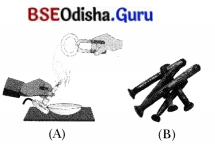
(i) Does picture (A) represent a chemical change? If yes, name the type of reaction involved, and give the chemical equation for the reaction taking place (if any). If no, then justify your answer.
Answer:
Yes, burning of magnesium ribbon represents a chemical change. The reaction involved in this process is a combustion reaction. The chemical equation for the burning of magnesium ribbon is as follows:

(ii) What does picture (B) represent?
Answer:
Picture (B) represents rusted iron nails.
(iii) What new product is formed in the chemical change taking place in picture (B)?
Answer:
Rusting of iron nails results in the formation of iron oxide (rust), a brown-coloured substance that covers the surface of iron nails.