Finding the Unknown Class 7 MCQ Maths Part 2 Chapter 7

Regular revision with Class 7 Maths MCQ with Answers and Ganita Prakash Class 7 Maths Part 2 Chapter 7 Finding the Unknown MCQ improves accuracy in objective exams.

MCQ on Finding the Unknown Class 7

Finding the Unknown MCQ Class 7

Class 7 Maths Finding the Unknown MCQ

Question 1.
A weighing scale is balanced when two identical boxes and a 4-unit weight are placed on one pan, and one identical box with a 12-unit weight is placed on the other pan. What is the weight of one box?
(a) 6
(b) 4
(c) 8
(d) 12
Solution:
(c) 8
Let the weight of one box be x units. Then,
Total weight on one pan = (2x + 4) units
Total weight on other pan = (x + 12) units
As weighing scale is balanced, weights on boththe pans are equal.
∴ 2x + 4 = x + 12
⇒ 2x – x = 12 – 4 ⇒ x = 8
Hence, the weight of one box is 8 units.

Question 2.
A sequence of arrangements uses 4 sticks in the first step and increases by 3 sticks in every next step. Which expression gives the number of sticks in step n?
(a) 3n
(b) 3n + 1
(c) 3n + 2
(d) 3n – 1
Solution:
(b) 3n + 1
Number of sticks in:
1st step = 4
2nd step = 4 + 3 × 1
3rd step = 4 + 3 × 2
4th step = 4 + 3 × 3
.
.
.
.
.
nth step = 4 + 3 × (n – 1) = 4 + 3n – 3
= 3n + 1
Hence, the number of sticks in step n is 3n + 1.

Question 3.
The value of m so that 0.6 m – (-0.8 m + 0.4) = 0.2 – 0.5 m, is:
(a) \(\frac{7}{19}\)
(b) \(\frac{6}{19}\)
(c) \(\frac{9}{19}\)
(d) \(\frac{8}{19}\)
Solution:
(b) \(\frac{6}{19}\)
Given, 0.6m – (- 0.8 m + 0.4) = 0.2 – 0.5m
⇒ 0.6m + 0.8m – 0.4 = 0.2 – 0.5m
⇒ 1.4m – 0.4 = 0.2 – 0.5m
⇒ 1.4m + 0.5m = 0.2 + 0.4
⇒ 1.9m = 0.6
⇒ m = \(\frac{0.6}{1.9}\) ⇒ m = \(\frac{6}{19}\)

Finding the Unknown Class 7 MCQ Maths Part 2 Chapter 7

Question 4.
Which of the following is correct about x = x?
(a) The equation has no solution.
(b) The equation has exactly one solution.
(c) The equation has infinitely many solutions.
(d) The equation is incorrect.
Solution:
(c) The equation has infinitely many solutions.
We have, x = x
It means it is true (LHS = RHS) for all values of the variable. Hence, it has infinitely many solutions.

Question 5.
It is given that \(\frac{45}{56} \times \frac{14}{9} \times \frac{7}{3} \times 5=\frac{22050}{1512}\), then the value of \(\frac{45}{56} \times \frac{14}{9} \times 5\) is:
(a) \(\frac{3150}{504}\)
(b) \(\frac{2850}{564}\)
(c) \(\frac{3150}{564}\)
(d) \(\frac{2850}{504}\)
Solution:
(a) \(\frac{3150}{504}\)
Given, \(\frac{45}{56} \times \frac{14}{9} \times \frac{7}{3} \times 5=\frac{22050}{1512}\)
⇒ \(\frac{45}{56} \times \frac{14}{9} \times 5=\frac{22050}{1512} \times \frac{3}{7}=\frac{3150}{504}\)

Finding the Unknown Class 7 MCQ Maths Part 2 Chapter 7

Question 6.
If 3x – \(\frac{4}{5}=\frac{5 x}{3}+\frac{16}{5}\), then the value of x which satisfies the given equation is:
(a) Natural number greater than 7
(b) Natural number between 5 and 7
(c) Natural number less than 2
(d) Natural number between 2 and 4
Solution:
(d) Natural number between 2 and 4
Given, \(3 x-\frac{4}{5}=\frac{5 x}{3}+\frac{16}{5}\)
⇒ \(3 x-\frac{5 x}{3}=\frac{16}{5}+\frac{4}{5}\) ⇒ \(\frac{9 x-5 x}{3}=\frac{16+4}{5}\)
⇒ \(\frac{4 x}{3}=\frac{20}{5}\) ⇒ \(\frac{4 x}{3}=4\)
⇒ x = \(\frac{4 \times 3}{4}\) ⇒ x = 3

Question 7.
The sum of two consecutive even numbers is 70. The greater one is:
(a) 32
(b) 34
(c) 36
(d) 38
Solution:
(c) 36
Let x and x + 2 be two consecutive even numbers.
According to question, we have
x + (x + 2) = 70
⇒ 2x + 2 = 70 ⇒ 2x = 70 – 2
⇒ 2x = 68 ⇒ x = \(\frac{68}{2}\) = 34
So, smaller even number = 34 and greater even number = 34 + 2 = 36

Question 8.
Rajini has three balls, A, B and C. A is twice as heavy as B, B weighs one third of C. The heaviest ball is:
(a) A
(b) B
(c) C
(d) A and C
Solution:
(c) C
Let the weight of ball C be x units. Then,
Weights of ball B and ball A are \(\frac{x}{3}\) units and \(\frac{2x}{3}\) units respectively. Clearly, x > \(\frac{2x}{3}\) > \(\frac{x}{3}\)
[As weight cannot be negative, x > 0]
Thus, the heaviest ball is C.

Finding the Unknown Class 7 MCQ Maths Part 2 Chapter 7

Question 9.
Which of the following equations represents the statement “twice of a number is 25 more than one-third of the number”?
(a) \(2 x=\frac{x}{3}+25\)
(b) \(2 x+25=\frac{x}{3}\)
(c) \(2 x=\frac{25+x}{3}\)
(d) \(3 x=25+\frac{x}{2}\)
Solution:
(a) \(2 x=\frac{x}{3}+25\)
Let the number be x. Then,
Twice of the number = 2x and one-third of the number = \(\frac{x}{3}\)
According to question, we have 2x = \(\frac{x}{3}\) + 25

Question 10.
Adding 7 to the thrice of a whole number gives 34. The whole number is:
(a) 13
(b) 9
(c) 14
(d) 11
Solution:
(b) 9
Let the whole number be x. Then, thrice of the whole number = 3x
According to question, we have
3x + 7 = 34 ⇒ 3x = 34 – 7
⇒ 3x = 27 ⇒ x = \(\frac{27}{3}\) = 9

Question 11.
Which of the following equations have t = – 3 as a solution?
(i) 2t + 7 = 1
(ii) 4(t + 5) = 8
(iii) 2t + \(2\left(t+\frac{1}{4}\right)=\frac{-5}{2}\) + t
(iv) -2 = \(\frac{3}{5}\) – 7t
Choose the correct option from the following:
(a) (i) and (ii)
(b) (ii) and (iii)
(c) (iii) and (iv)
(d) (i) and (iv)
Solution:
(a) (i) and (ii)
(i) LHS = 2t + 7 = 2 × (-3) + 7 = -6 + 7
= 1 = RHS
∴ t = – 3 is the solution of equation 2t + 7 = 1.

(ii) LHS = 4(t + 5) = 4(-3 + 5) = 4 × 2 = 8 = RHS
∴ t = – 3 is the solution of equation
4 (t + 5) = 8.

(iii) LHS = 2t + 2\(\left(t+\frac{1}{4}\right)\)
= 2 x (-3) + 2 \(\left(-3+\frac{1}{4}\right)\)
= -6 + \(2\left(\frac{-11}{4}\right)\) = -6 – \(\frac{11}{2}\)
= \(-\frac{23}{2}\)
RHS = \(\frac{3}{5}-7 t=\frac{3}{5}-7 \times(-3)\)
= \(\frac{3}{5}+21=\frac{3+105}{5}=\frac{108}{5}\) ≠ -2 = LHS

Finding the Unknown Class 7 MCQ Maths Part 2 Chapter 7

Question 12.
“48 is divided into 2 parts such that three times the greater part is 10 less than four times the smaller part”.
Identify the correct statements about the given situation.
(i) The smaller part is 16.
(ii) The smaller part is 22.
(iii) The greater part is 26.
(iv) The greater part is 32.
Choose the correct option from the following:
(a) (i) and (iii)
(b) (i) and (iv)
(c) (ii) and (iii)
(d) (ii) and (iv)
Solution:
(c) (ii) and (iii)
Let the greater part be x. Then, the smaller part = 48 – x
According to given situation, we have
3x = 4(48 – x) – 10 ⇒ 3x = 4 × 48 – 4x – 10
⇒ 3x = 192 – 4x – 10 ⇒ 3x + 4x = 192 – 10
⇒ 7x = 182 ⇒ x = \(\frac{182}{7}\) = 26
So, the greater part is 26 and the smaller part is 48 – 26 = 22.
Thus, statements (ii) and (iii) are correct.

Question 13.
The sum of three consecutive odd numbers is 63.
Identify the correct statements about the given situation.
(i) Smallest odd number is 17.
(ii) Largest odd number is 23.
(iii) Smallest odd number is 19.
(iv) Largest odd number is 21.
Choose the correct option from the following:
(a) (i) and (ii)
(b) (ii) and (iii)
(c) (iii) and (iv)
(d) (i) and (iv)
Solution:
(b) (ii) and (iii)
We know, difference between two consecutive odd numbers is 2.
Let x, x + 2 and x + 4 be the three consecutive odd numbers.
∴ x + (x + 2) + (x + 4) = 63
[Given, sum of three consecutive odd numbers is 63.]
⇒ 3x + 6 = 63 ⇒ 3x = 63 – 6
⇒ 3x = 57 ⇒ x = \(\frac{57}{3}\) = 19
So, the three consecutive odd numbers are 19, 21 and 23.
Thus, the smallest odd number is 19 and the largest odd number is 23.

Finding the Unknown Class 7 MCQ Maths Part 2 Chapter 7

Finding the Unknown Class 7 Assertion and Reason Questions

The following questions are Assertion and Reason based questions. Two statements are given, one labelled as Assertion (A) and the other is labelled as Reason (R). Select the correct answer to these questions from the codes (a), (b), (c) and (d) as given below.
(a) Both A and R are true and R is the correct explanation of A.
(b) Both A and R are true but R is not the correct explanation of A.
(c) A is true but R is false.
(d) A is false but R is true.

Question 1
(A): Only addition can be done on both sides of an equation, not subtraction.
(R): An equation remains balanced when we perform the same operation on both sides.
Solution:
(d) A is false but R is true.
An equation remains balanced when we perform the same operation (addition, subtraction, multiplication, division) on both sides.
∴ Assertion (A) is false, but Reason (R) is true.

Question 2.
(A): Two complementary angles differ by 8° can be represented by equation x – (90° – x) = 8°.
(R): Sum of complementary angles is 180°.
Solution:
(c) A is true but R is false.
We know, sum of complementary angles is 90°.
Given, two complementary angles differ by 8°.
Let x be one of the two complementary angles. Then, the other angle = 90° – x
∴ x – (90° – x) = 8° is the required equation.
Thus, Assertion (A) is true, but Reason (R) is false.

Finding the Unknown Class 7 MCQ Maths Part 2 Chapter 7

Question 3.
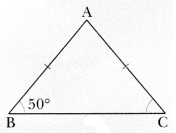
(A): For the given triangle, y + 2 (y + 15°) = 180°.
(R): In an isosceles triangle, angles opposite to equal sides are equal.
Finding the Unknown Class 7 MCQ Maths Part 2 Chapter 7-1
Solution:
(a) Both A and R are true and R is the correct explanation of A.
The given triangle is isosceles.
We know, angles opposite to equal sides of an isosceles triangle are equal.
∴ First angle = y, second angle = third angle
= y + 15°
Now, y + (y + 15°) + (y + 15°) = 180°
[The sum of all the angles of a triangle is 180°.]
⇒ y + 2(y + 15°) = 180°
∴ Both Assertion (A) and Reason (R) are true and Reason (R) is the correct explanation of Assertion (A).

Finding the Unknown Class 7 Fill in the Blanks

Question 1.
If the solution is known, the number of equations that can be built are ________ .
Solution: infinite
If the solution is known, the number of equations that can be built are infinite.

Finding the Unknown Class 7 MCQ Maths Part 2 Chapter 7

Question 2.
Fill in the blanks with integers:
(i) 11 (11 + ____ ) – 98 = 100
(ii) – 3 × (-9 + _____) = 42
Solution: 7, -5
(i) Let y be the required value to fill the blank.
∴ 11(11 + y) – 98 = 100
⇒ 11(11 + y) = 100 + 98
[Adding 98 to both sides]
⇒ 11(11 + y) = 198
⇒ (11 + y) = 198 ÷ 11
[Dividing both sides by 11]
⇒ 11 + y= 18
⇒ y = 18 – 11 = 7
So, 11(11 + 7) – 98 = 100

(ii) Let y be the required value to fill the blank.
∴ -3 × (- 9 + y) = 42
⇒ (- 9 + y) = 42 ÷ (-3)
[Dividing both sides by – 3]
⇒ – 9 + y = -14
⇒ y = – 14 + 9 [Adding 9 to both sides]
⇒ y = – 5
So, – 3 × (- 9 + (- 5)) = 42

Question 3.
In an equation, there is always an ________ sign.
Solution: equals
In an equation, there is always an equals sign.

Question 4.
The value of the variable which satisfies a equation is called a ________ to the equation.
Solution: solution
The value of the variable which satisfies an equation is called a solution to the equation.

Finding the Unknown Class 7 MCQ Maths Part 2 Chapter 7

Question 5.
The equation representing “one-fifth of a number is 3 more than one-sixth of the same number” is \(\frac{x}{5}\) = ______ .
Solution: \(\frac{x}{6}\) + 3
Let x be the number. Then,
One-fifth of the number = \(\frac{x}{5}\) and one-sixth of the number = \(\frac{x}{6}\)
\(\frac{x}{5}=\frac{x}{6}\) + 3
The equation representing “one-fifth of a number is 3 more than one-sixth of the same number” is \(\frac{x}{5}=\frac{x}{6}\) + 3.

Question 6.
If \(\frac{x}{7}\) of a number is 60. the number is _______ .
Solution: 105
Let the number be x.
∴ \(\frac{4}{7}\) × x = 60
⇒ x = 60 × \(\frac{7}{4}\) = 15 × 7 = 105
If \(\frac{4}{7}\) of a number is 60, the number is 105.

Class 7 Maths Chapter 1 Question Answer Odia Medium ଆମ ଚାରିପଟେ ଥିବା ବଡ଼ ସଂଖ୍ୟା

Students can use Class 7 Math Solution Odia Medium and Class 7 Maths Chapter 1 Question Answer Odia Medium ଆମ ଚାରିପଟେ ଥିବା ବଡ଼ ସଂଖ୍ୟା to check their answers after solving exercises.

7th Class Maths Chapter 1 Question Answer Odia Medium

Class 7 Maths Chapter 1 Odia Medium

1.1 ଏକ ଲକ୍ଷ ପ୍ରକାରର ବିହନ:

Page No. (2 to 5)

Question 1.
ସଂରଚନାକୁ ଲକ୍ଷ୍ୟକରି ତଳେ ଦିଆଯାଇଥିବା କୋଠରିଗୁଡ଼ିକୁ ପୂରଣ କର । (ପ୍ରଶ୍ନ ସହିତ ଉତ୍ତର)
Class 7 Maths Chapter 1 Question Answer Odia Medium ଆମ ଚାରିପଟେ ଥିବା ବଡ଼ ସଂଖ୍ୟା 1
Solution:
Class 7 Maths Chapter 1 Question Answer Odia Medium ଆମ ଚାରିପଟେ ଥିବା ବଡ଼ ସଂଖ୍ୟା 2
1,00,000 କୁ ‘ଏକ ଲକ୍ଷ’ କୁହାଯାଏ ।

Question 2.
ଖାଲିସ୍ଥାନ ପୂରଣ କରି ଲେଖ । (ପ୍ରଶ୍ନ ସହିତ ଉତ୍ତର)
Class 7 Maths Chapter 1 Question Answer Odia Medium ଆମ ଚାରିପଟେ ଥିବା ବଡ଼ ସଂଖ୍ୟା 3
Solution:
Class 7 Maths Chapter 1 Question Answer Odia Medium ଆମ ଚାରିପଟେ ଥିବା ବଡ଼ ସଂଖ୍ୟା 4

Question 3.
ଯଦି ଦିନକୁ ଗୋଟିଏ ପ୍ରକାର ଚାଉଳ ଖାଆନ୍ତି, ତେବେ 100 ବର୍ଷରେ ଏକ ଲକ୍ଷ ପ୍ରକାର ଚାଉଳ ଖାଇପାରିବେ ନାହିଁ । ଯଦି ଆମେ ଦିନକୁ 2 ପ୍ରକାର ଚାଉଳ ଖାଇବା, ତେବେ କ’ଣ 100 ବର୍ଷରେ ଏକ ଲକ୍ଷ ପ୍ରକାରର ଚାଉଳ ଖାଇପାରିବା ?
Solution:
ଦତ୍ତ ଅଛି, ଯେ ଦିନକୁ ସେ 2 ପ୍ରକାର ଚାଉଳ ଖାଆନ୍ତି ।
1 ବର୍ଷ = 12 ମାସ = 365 ଦିନ ।
ଆମେ ଗୋଟିଏ ଦିନରେ ଖାଉ 2 ପ୍ରକାର ଚାଉଳ ।
ଗୋଟିଏ ବର୍ଷରେ ଖାଇବୁ = 2 × 365 = 730 ପ୍ରକାର ଚାଉଳ ।
100 ବର୍ଷରେ ଖାଇବୁ = 730 × 100 = 73,000 ପ୍ରକାର ଚାଉଳ ।
∴ ଆମେ 100 ବର୍ଷରେ 73,000 ପ୍ରକାର ଚାଉଳ ଖାଇବା, ଯାହା ଏକ ଲକ୍ଷ ନୁହେଁ ।

Class 7 Maths Chapter 1 Question Answer Odia Medium ଆମ ଚାରିପଟେ ଥିବା ବଡ଼ ସଂଖ୍ୟା

Question 4.
ଯଦି ଜଣେ ଦିନକୁ 3 ପ୍ରକାର ଚାଉଳ ଖାଏ, ତେବେ ସେ 100 ବର୍ଷ ଜୀବନ କାଳରେ ଏକ ଲକ୍ଷ ପ୍ରକାରର ଚାଉଳ ଖାଇପାରିବା କି ? ଆସ ନିର୍ଣ୍ଣୟ କରିବା ।
Solution:
ଦତ୍ତ ଅଛି ଯେ ଦିନକୁ ସେ 3 ପ୍ରକାର ଚାଉଳ ଖାଏ ।
1 ବର୍ଷ = 12 ମାସ = 365 ଦିନ ।
ଜଣେ ଗୋଟିଏ ଦିନରେ ଖାଏ 3 ପ୍ରକାର ଚାଉଳ ।
ଗୋଟିଏ ବର୍ଷରେ ଖାଏ = 3 × 365 = 1095 ପ୍ରକାର ଚାଉଳ ।
100 ବର୍ଷରେ ଖାଏ = 1095 × 100 = 1,09,5,00 ପ୍ରକାର ଚାଉଳ ।
∴ ସେ 100 ବର୍ଷରେ 1 ଲକ୍ଷ ପ୍ରକାରର ଚାଉଳ ଖାଇପାରିବ ।
> ରମେଶ କହିଲା, ‘‘ଆମେ ଜାଣିଲୁ ଯେ ଏକ ବର୍ଷରେ 365 ଦିନ ଅଛି (ଅଧ୍ବବର୍ଷକୁ ବାଦେଇ) । ଯଦି ଆମେ y ବର୍ଷ ବଞ୍ଚିବା, ଜୀବନ କାଳର ମୋଟ ଦିନ ସଂଖ୍ୟା ହେବ 365 × y ।

Question 5.
ତୁମେ y ପାଇଁ ଏକ ସଂଖ୍ୟା ନିଅ । ଏହି y ବର୍ଷର ଦିନଗୁଡ଼ିକର ସଂଖ୍ୟା ଏକ ଲକ୍ଷ ସହିତ କେତେ ନିକଟତର ଅଛି, ତୁମେ ବାଛିଥୁବା y ର ମାନ ପାଇଁ ନିର୍ଣ୍ଣୟ କର।
Solution:
ମନେକର ଆମେ 95 ବର୍ଷ ବଞ୍ଚିବୁ ଅର୍ଥାତ୍ y = 95 ।
ଆମ ଜୀବନସାରା ଦିନସଂଖ୍ୟା = 365 × 95 = 34,675 ଦିନ ।
1,00,000 ଓ 34,675ର ପାର୍ଥକ୍ୟ = 1,00,000 – 34,675 = 65,325

ନିଜେ କରି ଦେଖ :

Question 1.
2011 ଜନଗଣନା ଅନୁଯାୟୀ, ବରଗଡ଼ ସହରର ଜନସଂଖ୍ୟା ପ୍ରାୟ 83,651 ଥିଲା । ଏହା ଏକ ଲକ୍ଷରୁ କେତେ କମ୍ ?
Solution:
2011 ଜନଗଣନା ଅନୁଯାୟୀ ବରଗଡ଼ ସହରର ଜନସଂଖ୍ୟା = 83, 651
ଏହା 1 ଲକ୍ଷରୁ କମ୍ = 1,00,000 – 83,651 = 16,349
∴ ଏହା ଏକ ଲକ୍ଷରୁ 16,349 କମ୍ ।

Question 2.
2024 ମସିହାରେ ବରଗଡ଼ ସହରର ଆନୁମାନିକ ଜନସଂଖ୍ୟା 1,04,000 । ଏହା ଏକ ଲକ୍ଷଠାରୁ କେତେ ଅଧ୍ବକ ?
Solution:
2024 ଜନଗଣନା ଅନୁଯାୟୀ ବରଗଡ଼ ସହରର ଜନସଂଖ୍ୟା = 1,04,000
1 ଲକ୍ଷରୁ ଅଧିକ, 1,04,000 – 1,00,000 = 4,000
∴ ଏହା ଏକ ଲକ୍ଷରୁ 4,000) ବେଶୀ ।

Question 3.
2011 ରୁ 2024 ପର୍ଯ୍ୟନ୍ତ ବରଗଡ଼ ସହରର ଜନସଂଖ୍ୟା କେତେ ବୃଦ୍ଧି ପାଇଲା ?
Solution:
2011 ମସିହାରେ ଜନସଂଖ୍ୟା = 83,651
2024 ମସିହାରେ ଜନସଂଖ୍ୟା = 1,04,000
ଜନସଂଖ୍ୟା ବୃଦ୍ଧି ପାଇଲା = 1,04,000 – 83,651 = 20,349
∴ 2011 ରୁ 2024 ପର୍ଯ୍ୟନ୍ତ ବରଗଡ଼ ସହରର ଜନସଂଖ୍ୟା 20,349 ବୃଦ୍ଧି ପାଇଲା ।

ବଡ଼ସଂଖ୍ୟାକୁ ବୁଝିବା :

Question 1.
ଉଦାହରଣ : ସୋମୁର ଗୋଟିଏ ଦଶ (10) ମହଲା ବିଶିଷ୍ଟ ଘର ଅଛି । ସୋମୁର ଉଚ୍ଚତା 1 ମିଟର । ଯଦି ଏହି ଘରର ପ୍ରତ୍ୟେକ ମହଲା ସୋମୁ ଉଚ୍ଚତାର ପ୍ରାୟ 4 ଗୁଣ, ତେବେ ଘରର ଆନୁମାନିକ ଉଚ୍ଚତା କେତେ ?
Class 7 Maths Chapter 1 Question Answer Odia Medium ଆମ ଚାରିପଟେ ଥିବା ବଡ଼ ସଂଖ୍ୟା 5
Solution:
ସୋମୁର ଉଚ୍ଚତା 1 ମିଟର । ଘରର ପ୍ରତ୍ୟେକ ମହଲା ସୋମୁ ଉଚ୍ଚତାର ପ୍ରାୟ 4 ଗୁଣ ।
∴ ଘରର ପ୍ରତ୍ୟେକ ମହଲାର ଉଚ୍ଚତା = 4 × 1 = 4 ମିଟର ।
ସୋମୁ ଘରଟି 10 ମହଲା ବିଶିଷ୍ଟ । ସୋମୁ ଘରର ସମୁଦାୟ ଉଚ୍ଚତା = 10 × 4 = 40 ମିଟର ।
∴ ଘରର ଉଚ୍ଚତା 40 ମିଟର ।

Question 2.
ଷ୍ଟାଚ୍ୟୁ ଅଫ୍ ୟୁନିଟ୍ କିମ୍ବା ସୋମୁର ଏହି ଦଶମହଲା ବିଶିଷ୍ଟ ଘରର ଉଚ୍ଚତା ମଧ୍ୟରୁ କେଉଁଟିର ଉଚ୍ଚତା ଅଧିକ ? କେତେ ମିଟର ଅଧୁକ ? ଆମେ ଜାଣିପାରିବା ଯେ, ଷ୍ଟାଚ୍ୟୁ ଅଫ୍ ୟୁନିଟ୍‌ର ଉଚ୍ଚତା, ସେହି ଘରର ଉଚ୍ଚତାର 4 ଗୁଣ ପାଖାପାଖୁ ।
Class 7 Maths Chapter 1 Question Answer Odia Medium ଆମ ଚାରିପଟେ ଥିବା ବଡ଼ ସଂଖ୍ୟା 6
Solution:
ଷ୍ଟାଚ୍ୟୁ ଅଫ୍ ୟୁନିଟ୍‌ର ଉଚ୍ଚତା = 180 ମିଟର ।
ସୋମୁର ଦଶମହଲା ବିଶିଷ୍ଟ ଘରର ଉଚ୍ଚତା = 40 ମିଟର ।
ଅଧ୍ବକ = 180 – 40 = 140 ମିଟର ।
∴ ଷ୍ଟାଚ୍ୟୁ ଅଫ୍ ୟୁନିଟ୍‌ର ଉଚ୍ଚତା 140 ମିଟର ଅଧୂକ ।

Question 3.
ଖଣ୍ଡାଧାର ଜଳପ୍ରପାତ ସୋମୁର ଘରର ଉଚ୍ଚତା ଠାରୁ କେତେ ଅଧିକ ଉଚ୍ଚ ? …………… ମିଟର ।
Solution:
ଖଣ୍ଡାଧାର ଜଳପପ୍ରାତର ଉଚ୍ଚତା = 244 ମିଟର । ସୋମୁର ଘରର ଉଚ୍ଚତା = 40 ମିଟର ।
ଅଧିକ = 244 – 40 = 204 ମିଟର ।
∴ ଖଣ୍ଡାଧାର ଜଳପ୍ରପାତ ସୋମୁର ଘରର ଉଚ୍ଚତା ଠାରୁ 204 ମିଟର ଅଧୂକ ଉଚ୍ଚ ।

Question 4.
ସୋମୁର ଘର କେତେ ମହଲା ହେଲେ ଖଣ୍ଡାଧାର ଜଳପ୍ରପାତର ଉଚ୍ଚତାର ନିକଟତର ହେବ ?
Solution:
ଖଣ୍ଡାଧାର ଜଳପପ୍ରାତର ଉଚ୍ଚତା = 244 ମିଟର । ସୋମୁର ଗୋଟିଏ ମହଲାର ଉଚ୍ଚତା = 4 ମିଟର ।
244 ÷ 4 = 61 ମହଲା ।
∴ ସୋମୁର ଘର 61 ମହଲା ହେଲେ ଖଣ୍ଡାଧାର ଜଳପ୍ରପାତର ଉଚ୍ଚତାର ନିକଟତର ହେବ ।

Class 7 Maths Chapter 1 Question Answer Odia Medium ଆମ ଚାରିପଟେ ଥିବା ବଡ଼ ସଂଖ୍ୟା

ଏକ ଲକ୍ଷ ଗୋଟିଏ ବଡ଼ ସଂଖ୍ୟା କି ? :
Question 1.
ଏକ ଲକ୍ଷ ସଂଖ୍ୟାଟି ବଡ଼ କି ସାନ ? ଚିନ୍ତା କର ।
Solution:
ଏକ ଲକ୍ଷ ସଂଖ୍ୟାଟି ବଡ଼ କି ସାନ, ତାହା ତା’ର ପ୍ରସଙ୍ଗ ଉପରେ ନିର୍ଭର କରିଥାଏ । ଏକ ଲକ୍ଷ ଆନୁସଙ୍ଗିକ ଭାବରେ ଏକ ବଡ଼ ସଂଖ୍ୟା । ଯାହା ୧୦୦୦୦୦ ।
ମନେକର ଏକ ସହରର ଲୋକସଂଖ୍ୟା 1 ଲକ୍ଷ ।
ଏଠାରେ 1 ଲକ୍ଷ କହିଲେ ଏହା ଏକ ଛୋଟ ସହରକୁ ବୁଝାଏ ।
ମନେକର ଜଣେ ଲୋକ ମାସକୁ ୧ ଲକ୍ଷ ଟଙ୍କା ଦରମା ପାଉଛି । ଏହା ଏକ ବଡ଼ଭାବରେ ଗଣନା କରାଯିବ ।

Question 2.
ନିମ୍ନରେ ଦିଆଯାଇଥିବା ପ୍ରତ୍ୟେକ ସଂଖ୍ୟାକୁ ଅକ୍ଷରରେ ଲେଖ ।
(a) 3,00,600
(b) 5,04,085
(c) 27,30,000
(d) 70,53,138
Solution:
(a) 3,00,600 – ତିନି ଲକ୍ଷ ଛଅଶହ ।
(b) 5,04,085 – ପାଞ୍ଚ ଲକ୍ଷ ଚାରି ହଜାର ପଞ୍ଚାଅଶୀ ।
(c) 27,30,000 – ସତେଇଶି ଲକ୍ଷ ତିରିଶି ହଜାର ।
(d) 70,53,138 – ସତୁରୀ ଲକ୍ଷ ତେପନ ହଜାର ଶହେ ଅଡ଼ତିରିଶି ।

Question 3.
ନିମ୍ନରେ କେତେକ ସଂଖ୍ୟାକୁ ଅକ୍ଷରରେ ଲେଖାଯାଇଛି । ପ୍ରତ୍ୟେକକୁ ଭାରତୀୟ ସ୍ଥାନୀୟମାନ ଲିଖନ ପ୍ରଣାଳୀରେ ଅଙ୍କରେ ଲେଖ ।
(a) ଏକ ଲକ୍ଷ ତେଇଶି ହଜାର ଚାରିଶହ ଛପନ
(b) ଚାରି ଲକ୍ଷ ସାତ ହଜାର ସାତଶହ ଚାରି
(c) ପଚାଶ ଲକ୍ଷ ପାଞ୍ଚ ହଜାର ପଚାଶ
(d) ଦଶ ଲକ୍ଷ ଦୁଇଶହ ପଞ୍ଚତିରିଶି
Solution:
(a) ଏକ ଲକ୍ଷ ତେଇଶି ହଜାର ଚାରିଶହ ଛପନ – 1, 23, 456
(b) ଚାରି ଲକ୍ଷ ସାତ ହଜାର ସାତଶହ ଚାରି – 4, 07, 704
(c) ପଚାଶ ଲକ୍ଷ ପାଞ୍ଚ ହଜାର ପଚାଶ – 50 05, 050
(d) ଦଶ ଲକ୍ଷ ଦୁଇଶହ ପଞ୍ଚତିରିଶି – 10, 00, 235

1.2 ଏକ ଦଶକର ରାଜ୍ୟ :

Page No. (5 to 8)

ଦଶକର ରାଜ୍ୟରେ ସ୍ଵତନ୍ତ୍ର ବଟନ୍ ଥିବା ସ୍ଵତନ୍ତ୍ର କାଲ୍‌କୁଲେଟର ଅଛି ।
Question 1.
‘ଚିନ୍ତାଶୀଳ ହଜାର’ କାଲ୍‌କୁଲେଟରରେ କେବଳ ‘ + 1000’ ବଟନ୍‌ ଅଛି । ଏହାକୁ କେତେଥର ଦବାଇଲେ, ନିମ୍ନରେ ଦିଆଯାଇଥ‌ିବା ସଂଖ୍ୟା ଦେଖାଇବ :
Class 7 Maths Chapter 1 Question Answer Odia Medium ଆମ ଚାରିପଟେ ଥିବା ବଡ଼ ସଂଖ୍ୟା 7
ଯେପରି
(a) ତିନି ହଜାର – 3 ଥର ।
(b) 10,000 – ………….. ଥର
(c) ତେପନ ହଜାର – …… ଥର
(d) 90,000 – ……………….. ଥର
(e) ଏକ ଲକ୍ଷ – …………….. ଥର
(f) …………… – 153 ଥର
(g) ଏକ ଲକ୍ଷ ହେବାକୁ କେତେ ହଜାର ଆବଶ୍ୟକ ?
Solution:
(a) ତିନି ହଜାର = \(\frac{3,000}{1000}\) = 3 ଥର ।
(b) 10,000 = \(\frac{10,000}{1000}\) = 10 ଥର ।
(c) ତେପନ ହଜାର = \(\frac{53,000}{1000}\) = 53 ଥର ।
(d) 90,000 = \(\frac{90,000}{1000}\) = 90 ଥର ।
(e) ଏକ ଲକ୍ଷ = \(\frac{1,00,000}{1000}\) = 100 ଥର ।
(f) 153 ଥର = 153 × 1000 = 1,53,000 ।
(g) 1,00,000 ÷ 1000 = 100 ଏକ ଲକ୍ଷ ହେବାକୁ 100) ହଜାର ଆବଶ୍ୟକ ।

Question 2.
‘କ୍ରାନ୍ତିକାରୀ ଦଶକ’ କାଲକୁଲେଟରରେ କେବଳ ‘+10’ ବଟନ୍‌ ଅଛି । ଏହାକୁ କେତେଥର ଦବାଇଲେ, ନିମ୍ନରେ ଦିଆଯାଇଥିବା ସଂଖ୍ୟା ଦର୍ଶାଇବ ?
Class 7 Maths Chapter 1 Question Answer Odia Medium ଆମ ଚାରିପଟେ ଥିବା ବଡ଼ ସଂଖ୍ୟା 8
ଯେପରି
(a) ପାଞ୍ଚ ଶହ ? 5 ଥର
(b) 780 ? ……… ଥର
(c) 1000 ? …….. ଥର
(d) 3700 ? ……… ଥର
(e) 10,000 ? ……. ଥର
(f) ଏକ ଲକ୍ଷ ? ……….. ଥର
(g) ……… ? 453 ଥର
Solution:
(a) ପାଞ୍ଚ ଶହ = \(\frac{500}{10}\) = 50 ଥର
(b) 780 = \(\frac{780}{10}\) = 78 ଥର
(c) 1000 = \(\frac{1000}{10}\) = 100 ଥର
(d) 3700 = \(\frac{3700}{10}\) = 370 ଥର
(e) 10,000 = \(\frac{10,000}{10}\) = 1000 ଥର
(f) ଏକ ଲକ୍ଷ = \(\frac{1,00,000}{10}\) = 10000 ଥର
(g) 453 × 10 = 4530 = 453 ଥର

Question 3.
‘ଉପଯୋଗୀ ଶତକ’ କାଲକୁଲେଟରରେ କେବଳ ‘+100’ ବଟନ୍‌ ଅଛି । ଏହାକୁ କେତେଥର ଦବାଇଲେ, ନିମ୍ନରେ ଦିଆଯାଇଥ‌ିବା ସଂଖ୍ୟା ଦର୍ଶାଇବ ?
Class 7 Maths Chapter 1 Question Answer Odia Medium ଆମ ଚାରିପଟେ ଥିବା ବଡ଼ ସଂଖ୍ୟା 9
(a) ଚାରି ଶହ ? 4 ଥର
(b) 3,700 ? ………… ଥର
(c) 10,000 ? ………… ଥର
(d) ତେପନ ହଜାର ? …………… ଥର
(e) 90,0000 ? ………… ଥର
(f) 97,000 ? ………… ଥର
(g) 1,00,000 ? ………… ଥର
(h) ………… ? 582 ଥର
(i) ଦଶ ହଜାର ହେବାକୁ କେତେ ଶହ ଦରକାର ?
(j) ଏକ ଲକ୍ଷ ହେବାକୁ କେତେ ଶହ ଦରକାର ?
(k) ‘ ଉପଯୋଗୀ ଶତକ’ କାଲ୍‌କୁଲେଟର୍ କହୁଛି ‘‘ଏଠାରେ କିଛି ସଂଖ୍ୟା ଅଛି ଯାହା ‘କ୍ରାନ୍ତିକର ଦଶକ’ ଏବଂ ‘ଚିନ୍ତାଶୀଳ ହଜାର’ ଦେଖାଇ ପାରିବେ ନାହିଁ କିନ୍ତୁ ମୁଁ ପାରିବି ।’’ ଏହି ଭକ୍ତି ସତ୍ୟ କି ? ଚିନ୍ତା କର ଏବଂ ଅନୁସନ୍ଧାନ କର ।
Solution:
(a) ଚାରି ଶହ = \(\frac{400}{100}\) = 4 ଥର
(b) 3,700 = \(\frac{3700}{100}\) = 37 ଥର
(c) 10,000 = \(\frac{10,000}{100}\) = 100 ଥର
(d) ତେପନ ହଜାର = \(\frac{53,000}{100}\) = 530 ଥର
(e) 90,000 = \(\frac{90,000}{100}\) = 900 ଥର
(f) 97,000 = \(\frac{97,000}{100}\) = 970 ଥର
(g) 1,00,000 = \(\frac{1,00,000}{100}\) = 1000 ଥର
(h) \(\frac{58,200}{100}\) = 582 ଥର
(i) \(\frac{10,000}{100}\) = 100 ଥର ।
∴ ଦଶ ହଜାର ହେବାକୁ 100 ଶହ ଦରକାର ।
(j) \(\frac{1,00,000}{100}\) = = 1000 ଥର ।
∴ ଏକ ଲକ୍ଷ ହେବାକୁ 1000) ଶହ ଦରକାର ।
(k) ‘ଉପଯୋଗୀ ଶତକ’ କାଲ୍‌କୁଲେଟର୍ କହୁଛି ‘‘ଏଠାରେ କିଛି ସଂଖ୍ୟା ଅଛି ଯାହା ‘କ୍ରାନ୍ତିକର ଦଶକ’ ଏବଂ ‘ଚିନ୍ତାଶୀଳ ହଜାର’ ଦେଖାଇ ପାରିବେ ନାହିଁ କିନ୍ତୁ ମୁଁ ପାରିବି ।’’ ଏହି ଉକ୍ତି ସତ୍ୟ ।

Question 4.
‘କ୍ରିଏଟିଭ୍ ଚିଟ୍ଟି’ ଏକ ଭିନ୍ନ ପ୍ରକାରର କାଲକୁଲେଟର । ଏଥରେ ନିମ୍ନଲିଖ୍ତ ବଟନ୍‌ଗୁଡ଼ିକ ଅଛି : +1, +10, +100, +1000, +10000, +100000 ଏବଂ +1000000 । ଏହା ସବୁବେଳେ ଅନେକ ଉପାୟରେ କାମ କରିଥାଏ । ସଂଖ୍ୟା 321 ପାଇବାକୁ ହେଲେ, ଏହା +10କୁ 32 ଥର ଏବଂ +1 କୁ ଥରେ ଦବାଏ । ଏହା 321 ପାଇପାରିବ କି ? ବିକଳ୍ପ ଭାବରେ, ଏହା +100 କୁ ଦୁଇଥର ଏବଂ +10କୁ 12 ଥର ଏବଂ +1 କୁ ଥରେ ଦବାଇ ପାଇପାରିବ ।
321 କୁ ପାଇବା ପାଇଁ ଅତିବେଶିରେ + 100) ବଟନ୍‌କୁ କେତେଥର ଦବାଯାଇପାରିବ ?
Class 7 Maths Chapter 1 Question Answer Odia Medium ଆମ ଚାରିପଟେ ଥିବା ବଡ଼ ସଂଖ୍ୟା 10
Solution:
+10 ବଟନକୁ 32 ଥର ଦବାଇଲେ = 32 × 10 = 320
+1 ବଟନକୁ 1 ଥର ଦବାଇଲେ = 1
ବର୍ତ୍ତମାନ ଯୋଗ କଲେ, 320 + 1 = 321
∴ ହଁ 321 ପହଞ୍ଚିବ ।
ବିକଳ୍ପ ଭାବରେ, +100 ବଟନକୁ 2 ଥର ଚିପିଲେ = 2 × 100 = 200
+10 ବଟନକୁ 12 ଥର ଚିପିଲେ = 12 × 10 = 120
+1 ବଟନକୁ 1 ଥର ଟିପିଲେ = 1 × 1 = 1
ବର୍ତ୍ତମାନ ଯୋଗକଲେ, 200 + 120 + 1 = 321
ଆଉଥରେ ଏହା 321ରେ ପହଞ୍ଚିବ ।
+100 ବଟନକୁ 3 ଥର ଟିପିଲେ = 3 × 100 = 300
+10 ବଟନକୁ 2 ଥର ଟିପିଲେ = 2 × 10 = 20
+1 ବଟନକୁ 1 ଥର ଟିପିଲେ = 1 × 1 = 1
ବର୍ତ୍ତମାନ ଯୋଗକଲେ = 300 + 20 + 1 = 321
∴ 321 କୁ ପାଇବା ପାଇଁ ଅତିବେଶିରେ +100 ବଟନକୁ 3 ଥର ଦବାଯାଇପାରିବ ।

Question 5.
5072 ପାଇବା ପାଇଁ ଅନେକ ଉପାୟ ମଧ୍ୟରୁ ଦୁଇଟି ଉପାୟ ନିମ୍ନରେ ଦର୍ଶାଯାଇଛି ; ଏହି ଦୁଇଟି ଉପାୟକୁ ଏହିପରି ପରିପ୍ରକାଶ କରାଯାଇପାରିବ :
(a) 50 × 100) + (7 × 10) + (2 × 1) = 5072
(b) (3 × 1000) + (20 × 100) + (72 × 1) = 5072
• 5072 ପାଇବା ପାଇଁ ଏକ ଭିନ୍ନ ଉପାୟ ଖୋଜ ଏବଂ ଏହା ପାଇଁ ଏକ ପରିପ୍ରକାଶ ଲେଖ ।
Solution:
ଏଠାରେ 5 × 1000 + 0 × 100 + 7 × 10 + 2 × 1
= 5000 + 0 + 70 + 2
= 5072

Class 7 Maths Chapter 1 Question Answer Odia Medium ଆମ ଚାରିପଟେ ଥିବା ବଡ଼ ସଂଖ୍ୟା

ନିଜେ କରି ଦେଖ :

Question 1.
ନିଜେ କରି ଦେଖ । ତଳେ ଦିଆଯାଇଥିବା ପ୍ରତ୍ୟେକ ସଂଖ୍ଯାପାଇଁ, ବଟନ୍ ଦବାଇବା-ମାଧ୍ୟମରେ ସଂଖ୍ୟା ପରିପ୍ରକାଶ କରିବା ପାଇଁ ଅତି କମ୍‌ରେ ଦୁଇଟି ଭିନ୍ନ ଉପାୟ ଲେଖ । ‘କ୍ରିଏଟିଭ୍ ଚିଟ୍ଟି? ପରି ଚିନ୍ତାକର ଏବଂ ସୃଜନଶୀଳ ହୁଅ ।
(a) 8300
(b) 40629
(c) 56354
(d) 66666
(e) 367813
Solution:
(a) 8300
(i) (8 × 1000) + (3 × 100)
(ii) (83 × 1000)

(b) 40629
(i) (4 × 10,000) + (6 × 100) + (2 × 10) + (9 × 1)
(ii) (406 × 100) + (2 × 10) + (9 × 1)

(c) 56354
(i) (56 × 1000) + (35 × 10) + (4 × 1)
(ii) (5635 × 10) + (4 × 1)

(d) 66666
(i) (6 × 10000 + (66 × 100) + (66 × 1)
(ii) (66 × 1000) + (666 × 1)

(e) 367813
(i) (367 × 1000 + (813 × 1)
(ii) (3 × 100000 + (67 × 1000) + (8 × 100) + (13 × 1)

Question 2.
ତୁମପାଇଁ କ୍ରିଏଟିଭ୍ ଚିଟ୍ଟି କାଲକୁଲେଟରର କିଛି ପ୍ରଶ୍ନ :
Class 7 Maths Chapter 1 Question Answer Odia Medium ଆମ ଚାରିପଟେ ଥିବା ବଡ଼ ସଂଖ୍ୟା 11
(a) ତୁମକୁ ଠିକ୍ 30 ଥର ବଟନ୍ ଦବାଇବାକୁ ପଡ଼ିବ । ତୁମେ କେଉଁ ତିନିଅଙ୍କ ବିଶିଷ୍ଟ ବୃହତ୍ତମ ସଂଖ୍ୟା ତିଆରି କରିପାରିବ ? ତୁମେ କେଉଁ ତିନି ଅଙ୍କ ବିଶିଷ୍ଟ କ୍ଷୁଦ୍ରତମ ସଂଖ୍ୟାଟି ତିଆରି କରିପାରିବ ?
Solution:
ଏଠାରେ (9 × 100) + (8 × 10) + (13 × 1) = 993
ସମୁଦାୟ ବଟନ ଦବାଇବାକୁ ହେବ = 9 + 8 + 13 = 30 ଥର ।
∴ ଆମେ 30 ଥର ବଟନ୍ ଦବାଇଲାପରେ ତିନିଅଙ୍କ ବିଶିଷ୍ଟ ବୃହତ୍ତମ ସଂଖ୍ୟା ୨93 ତିଆରି କରିପାରିବା ।
ଏଠାରେ (8 × 10) + (22 × 1) = 80 + 22 = 102
ସମୁଦାୟ ବଟନ ଦବାଇବାକୁ ହେବ = 8 + 22 = 30
∴ ଆମେ 30 ଥର ବଟନ୍ ଦବାଇଲାପରେ ତିନିଅଙ୍କ ବିଶିଷ୍ଟ କ୍ଷୁଦ୍ରତମ ସଂଖ୍ୟା 102 ତିଆରି କରିପାରିବା ।

(b) 25 ଥର ବଟନ୍ ଦବାଇ 997 ସଂଖ୍ୟାଟି ପାଇପାରିବା । ତୁମେ ଭିନ୍ନ ଭିନ୍ନ ଥର ବଟନ୍ ଦବାଇବା ମାଧ୍ୟମରେ
997 ସଂଖ୍ୟାଟି ତିଆରି କରିପାରିବ କି ?
Solution:
ଏଠାରେ (8 × 100) + (19 × 10) + (7 × 1) = 800 + 190 + 7 = 997
ସମୁଦାୟ ବଟନ୍ ଦବାଇବାକୁ ହେବ = 8 + 19 + 7 = 34
∴ ଆମେ 34 ଥର ବଟନ୍ ଦବାଇବା ମାଧ୍ୟମରେ ୨97 ସଂଖ୍ୟାଟି ତିଆରି କରିପାରିବା ।

Question 3.
ସିଷ୍ଟେମେଟିକ୍ ସିୱି ଏକ ଭିନ୍ନ ପ୍ରକାରର କାଲ୍‌କୁଲେଟର୍ । ଏଥରେ ନିମ୍ନଲିଖ୍ ବଟନ୍‌ଗୁଡ଼ିକ ଅଛି – +1, +10, +100, +1000, +10000, +100000 । ଏହାର ବଟନ୍‌କୁ ଯଥାସମ୍ଭବ କମ୍ ଥର ଦବାଇ ବିଭିନ୍ନ ସଂଖ୍ୟା ଗଠନ କର । ଆମେ କିପରି ଯଥାସମ୍ଭବ କମ୍ ଥର ବଟନ୍ ଦବାଇ ସଂଖ୍ୟାଗୁଡ଼ିକ ପାଇପାରିବା ?
Class 7 Maths Chapter 1 Question Answer Odia Medium ଆମ ଚାରିପଟେ ଥିବା ବଡ଼ ସଂଖ୍ୟା 12
(a) 5072
(b) 8300
Solution:
(a) ଏଠାରେ 5072 = (5 × 1000) + (7 × 10) + (2 × 1)
ସମୁଦାୟ ଥର ବଟନ୍ ଦବାଇବା ସଂଖ୍ୟା = 5 + 7 + 2 = 14
∴ 14 ଥର ବଟନ୍ ଦବାଇ ଆମେ 5072 ସଂଖ୍ୟାଟି ପାଇପାରିବା ।

(b) ଏଠାରେ 8300 = (8 × 1000) + (3 × 00) ସମୁଦା
ୟ ଥର ବଟନ୍ ଦବାଇବା ସଂଖ୍ୟା = 8 + 3 = 11
∴ 11 ଥର ବଟନ୍ ଦବାଇ ଆମେ 8300 ସଂଖ୍ୟାଟି ପାଇପାରିବା ।

• 23 ଥର ଠାରୁ କମ୍ ଥର ବଟନ୍ ଦବାଇ 5072 ପାଇବାର ଅନ୍ୟ କୌଣସି ଉପାୟ ଅଛି କି ? ସେଥ‌ିପାଇଁ ପରିପ୍ରକାଶଟି ଲେଖ ।
Solution:
ଏଠାରେ (5 × 1000) + (7 × 10) + (2 × 1)
ସମୁଦାୟ ଥର ବଟନ୍ ଦବାଇବା = 5 + 7 + 2 = 14
∴ 5072 ସଂଖ୍ୟାଟି ପାଇବା ପାଇଁ ଅତିକମ୍‌ରେ 14 ଥର ବଟନ୍ ଦବାଇବାକୁ ପଡ଼ିବ ।

ନିଜେ କରି ଦେଖ :

Question 1.
ପୂର୍ବ ଅଭ୍ୟାସରେ ଥିବା ସଂଖ୍ୟାଗୁଡ଼ିକ ପାଇଁ ସର୍ବନିମ୍ନ ସଂଖ୍ୟକ ବଟନ୍ ଦବାଇ କିପରି ପ୍ରତ୍ୟେକ ସଂଖ୍ୟା ପାଇବ, ତାହା ଖୋଜ ଏବଂ ସେଗୁଡ଼ିକର ପରିପ୍ରକାଶ ଲେଖ ।
(a) 8300
(b) 40629
(c) 56354
(d) 66666
(e) 367813
Solution:
(a) 8300 = (8 × 1000) + (3 × 100)
∴ 8300 ସଂଖ୍ୟାଟି ପାଇପାରିବା = 8 + 3 = 11 ଥର ବଟନ୍ ଦବାଇବା ପରେ ।

(b) 40629 = (4 × 10,000 + (6 × 100) + (2 × 10) + (9 × 1)
∴ 40629 ସଂଖ୍ୟାଟି ପାଇପାରିବା = 4 + 6 + 2 + 9 = 21 ଥର ବଟନ୍ ଦବାଇବା ପରେ ।

(c) 56354 = (5 × 10,000) + (6 × 1000) + (3 × 100) + (5 × 10) + (4 × 1)
∴ 56354 ସଂଖ୍ୟାଟି ପାଇପାରିବା = 5 + 6 + 3 + 5 + 4 = 23 ଥର ବଟନ୍ ଦବାଇବା ପରେ ।

(d) 66666 = (6 × 10,000) + (6 × 1000) + (6 × 100) + (6 × 10) + (6 × 1)
∴ 66666 ସଂଖ୍ୟାଟି ପାଇପାରିବା = 6 + 6 + 6 + 6 + 6 = 30 ଥର ବଟନ୍ ଦବାଇବା ପରେ ।

(e) 367813 = (3 × 1,00,000) + (6 × 10,000) + (7 × 1000) + (8 × 100) + (1 × 10) + (3 × 1)
∴ 367813 ସଂଖ୍ୟାଟି ପାଇପାରିବା = 3 + 6 + 7 + 8 + 1 + 3 = 28 ଥର ବଟନ୍ ଦବାଇବା ପରେ ।

Question 2.
ପ୍ରତ୍ୟେକ ସଂଖ୍ୟା ଏବଂ ଅନୁରୂପ ସର୍ବନିମ୍ନ ସଂଖ୍ୟକ ବଟନ୍ ଦବାଇବା ମଧ୍ଯରେ କୌଣସି ସମ୍ପର୍କ ଥୁବାର ତୁମେ ଦେଖିପାରୁଛ କି ?
Solution:
ସର୍ବନିମ୍ନ ସଂଖ୍ୟକ ବଟନ୍ ଦବାଇବା = ସଂଖ୍ୟାରେ ଥିବା ଅଙ୍କମାନଙ୍କର ସମଷ୍ଟି ।

Question 3.
ତୁମେ ଲକ୍ଷ୍ୟ କର ଯେ, ସର୍ବନିମ୍ନ ବଟନ୍ ଦବାଇବା ପରିପ୍ରକାଶଗୁଡ଼ିକ, ସଂଖ୍ୟାଗୁଡ଼ିକର ଭାରତୀୟ ସ୍ଥାନୀୟମାନ ଲିଖନ ପ୍ରଣାଳୀ ମଧ୍ୟ ଦେଇଥାଏ । ଏହାର କାରଣ ବିଷୟରେ ତୁମେ ଚିନ୍ତାକର ।
Solution:
ଭାରତୀୟ ସ୍ଥାନୀୟମାନ ଲିଖନ ପ୍ରଣାଳୀଦ୍ଵାରା ଆମେ ହଜାର, ଲକ୍ଷ ଓ କୋଟି ସ୍ଥାନୀୟମାନଙ୍କୁ ସହଜରେ ଦଳ କରି ଜାଣିଥାଉ ।

1.3 କୋଟି ବା କୋଟିରୁ ଅଧ୍ବକ :

(Page No. 9)

Question 1.
ଏକ ହଜାର ଲକ୍ଷରେ କେତୋଟି ଶୂନ ଅଛି ? ………………….
Solution:
ଏକ ହଜାର ଲକ୍ଷ = 10,00,00,000 ରେ 5 ଟି ଶୂନ ଅଛି ।

Question 2.
ଏକ ଶହ ହଜାରରେ କେତୋଟି ଶୂନ ଅଛି ?
Solution:
ଏକ ଶହ ହଜାର = 1,00,000 ରେ 5 ଟି ଶୂନ ଅଛି ।

9876501234 ସଂଖ୍ୟାଟିକୁ ପ୍ରଥମେ କମା ଦେଇ ସହଜରେ ପଢ଼ିହେବ ।
(a) 9,87,65,01,234 = ୨ ଅରବ 87 କୋଟି 65 ଲକ୍ଷ 1 ହଜାର 234 କିମ୍ବା 987 କୋଟି 65 ଲକ୍ଷ 1 ହଜାର 234 (ଭାରତୀୟ ଲିଖନ ପ୍ରଣାଳୀରେ)
(b) 9,87,65,01,234 = 9 ବିଲିୟନ୍ 876 ମିଲିୟନ୍ 501 ହଜାର 234 (ଆମେରିକୀୟ ଲିଖନ ପ୍ରଣାଳୀରେ)

ନିଜେ କରି ଦେଖ :

Question 1.
ନିମ୍ନରେ ଦିଆଯାଇଥିବା ସଂଖ୍ୟାଗୁଡ଼ିକୁ ଭାରତୀୟ ସ୍ଥାନୀୟମାନ ଅନୁସାରେ ପଢ଼ ଏବଂ ସେଗୁଡ଼ିକର ସଂଖ୍ୟା ନାମ ଉଭୟ ଭାରତୀୟ ଓ ଆମେରିକୀୟ ପ୍ରଣାଳୀରେ ଲେଖ ।
(a) 4050678
(b) 48121620
(c) 20022002
(d) 246813579
(e) 34500543
(f) 1020304050
Solution:
(a) ଭାରତୀୟ ପ୍ରଣାଳୀ : 40,50,678 = ଚାଳିଶି ଲକ୍ଷ ପଚାଶ ହଜାର ଛଅ ଶହ ଅଠସ୍ତରୀ ।
ଆମେରିକୀୟ ପ୍ରଣାଳୀ : 4,050,678 = ଚାରି ମିଲିୟନ୍ ପଚାଶ ହଜାର ଛଅ ଶହ ଅଠସ୍ତରୀ ।

(b) ଭାରତୀୟ ପ୍ରଣାଳୀ : 4,81,21,620 = ଚାରି କୋଟି ଏକାଅଶୀ ଲକ୍ଷ ଏକୋଇଶି ହଜାର ଛଅ ଶହ କୋଡ଼ିଏ ।
ଆମେରିକୀୟ ପ୍ରଣାଳୀ : 48,121,620 = ଅଡ଼ଚାଳିଶ ମିଲିୟନ୍ ଶହେ ଏକୋଇଶି ହଜାର ଛଅ ସହ କୋଡ଼ିଏ ।

(c) ଭାରତୀୟ ପ୍ରଣାଳୀ : 2,00,22,002 = ଦୁଇ କୋଟି ବାଇଶି ହଜାର ଦୁଇ ।
ଆମେରିକୀୟ ପ୍ରଣାଳୀ : 20, 022, 002 = କୋଡ଼ିଏ ମିଲିୟନ୍ ବାଇଶି ହଜାର ଦୁଇ ।

(d) ଭାରତୀୟ ପ୍ରଣାଳୀ : 24,68,13,579 = ଚବିଶି କୋଟି ଅଡ଼ଷଠୀ ଲକ୍ଷ ତେର ହଜାର ପାଞ୍ଚଶହ ଅଣାଅଶୀ ।
ଆମେରିକୀୟ ପ୍ରଣାଳୀ : 246,813,579 = ଦୁଇଶହ ଛୟାଳିଶି ମିଲିୟନ୍ ଆଠ ଶହ ତେର ହଜାର ପାଞ୍ଚଶହ ଅଣାଅଶୀ ।

(e) ଭାରତୀୟ ପ୍ରଣାଳୀ : 34,50,00,543 = ଚଉତିରିଶି କୋଟି ପଚାଶ ହଜାର ପାଞ୍ଚଶହ ତେୟାଳିଶି ।
ଆମେରିକୀୟ ପ୍ରଣାଳୀ : 345,000,543 = ତିନିଶହ ପଇଁଚାଳିଶି ମିଲିୟନ୍ ପାଞ୍ଚଶହ ତେୟାଳିଶି ।

(f) ଭାରତୀୟ ପ୍ରଣାଳୀ : 1,02,03,04,050 = ଏକ ଅରବ ଦୁଇ କୋଟି ତିନି ଲକ୍ଷ ଚାରି ହଜାର ପଚାଶ ।
ଆମେରିକୀୟ ପ୍ରଣାଳୀ : 1,020,304,050 = ଏକ ବିଲିୟନ୍ କୋଡ଼ିଏ ମିଲିୟନ୍ ତିନିଶହ ଚାରି ହଜାର ପଚାଶ ।

Question 2.
ନିମ୍ନରେ ଦିଆଯାଇଥିବା ସଂଖ୍ୟାଗୁଡ଼ିକୁ ଭାରତୀୟ ସ୍ଥାନୀୟମାନ ପଦ୍ଧତି ଅନୁସାରେ ଲେଖ ।
(a) ଏକ କୋଟି ଏକ ଲକ୍ଷ ଏକ ହଜାର ଦଶ
(b) ଏକ ବିଲିୟନ୍ ଏକ ମିଲିୟନ ଏକ ହଜାର ଏକ
(c) ଦଶ କୋଟି କୋଡ଼ିଏ ଲକ୍ଷ ତିରିଶ ହଜାର ଚାଳିଶ
(d) ନଅ ବିଲିୟନ୍ ଅଶୀ ମିଲିୟନ ସାତ ଶହ ହଜାର ଛଅ ଶହ
Solution:
(a) ଏକ କୋଟି ଏକ ଲକ୍ଷ ଏକ ହଜାର ଦଶ = 1,01,01,010
(b) ଏକ ବିଲିୟନ୍ ଏକ ମିଲିୟନ ଏକ ହଜାର ଏକ = 1,00,10,01,001
(c) ଦଶ କୋଟି କୋଡ଼ିଏ ଲକ୍ଷ ତିରିଶ ହଜାର ଚାଳିଶ = 10,20,30,040
(d) ନଅ ବିଲିୟନ୍ ଅଶୀ ମିଲିୟନ ସାତ ଶହ ହଜାର ଛଅ ଶହ = 9,080,700,600

Question 3.
ତୁଳନା କର ଏବଂ ‘<‘, ‘>’ କିମ୍ବା ‘=’ ଲେଖ ।
(a) 30 ହଜାର ……………… 3 ଲକ୍ଷ
(b) 500 ଲକ୍ଷ ……….. 5 ମିଲିୟନ୍
(c) 800 ହଜାର ………….. 8 ମିଲିୟନ୍
(d) 640 ହଜାର ………….. 30 ବିଲିୟନ୍
Solution:
(a) 30 ହଜାର ( < ) 3 ଲକ୍ଷ ∴ 30,000 < 3,00,000
(b) 500 ଲକ୍ଷ (> ) 5 ମିଲିୟନ୍ ∴ 5,00,00,000 > 5,000,000
(c) 800 ହଜାର ( < ) 8 ମିଲିୟନ୍ ∴ 8,00,000 < 8,000,000
(d) 640 କୋଟି ( < ) 60 ବିଲିୟନ୍ ∴ 6,40,00,00,000 < 60,000,000,00

Class 7 Maths Chapter 1 Question Answer Odia Medium ଆମ ଚାରିପଟେ ଥିବା ବଡ଼ ସଂଖ୍ୟା

1.4 ଠିକ୍ ଏବଂ ଆନୁମାନିକ ମାନ :

Page No. (10 to 12)

Question 1.
ସେହି ପରିସ୍ଥିତିଗୁଡ଼ିକୁ ଦଳଭିତରେ ବିଚାର କର ଏବଂ ଆଲୋଚନା କର ଯେଉଁଠାରେ (କ) ଆସନ୍ନମାନଟି ପ୍ରକୃତ ମାନଠାରୁ ଅଧିକ ହେବ । (ଖ) ଆସନ୍ନମାନଟି ପ୍ରକୃତମାନଠାରୁ କମ୍ ହେବ (ଗ) ଆସନ୍ନମାନଟି ପ୍ରକୃତ ମାନଠାରୁ ଅଧିକ ବା କମ୍ ହେବ, (ଘ) ଠିକ୍ ସଂଖ୍ୟା ଆବଶ୍ୟକ ହେବ ।
Solution:
(କ) ନିକଟତମ ଦଶକ ଆସନ୍ନମାନ ନିର୍ଣ୍ଣୟ :
1 ରୁ 4 ପର୍ଯ୍ୟନ୍ତ ସଂଖ୍ୟାଗୁଡ଼ିକ 10 ଅପେକ୍ଷା ‘0’ ର ନିକଟତମ ।
ତେଣୁ 1, 2, 3, 4 ଆସନ୍ନମାନ ‘0’ ଅଟେ ।
6 ରୁ 9 ପର୍ଯ୍ୟନ୍ତ ସଂଖ୍ୟାଗୁଡ଼ିକ ‘0’ ଅପେକ୍ଷା ’10’ ର ନିକଟତମ ।
ତେଣୁ 6, 7, 8, 9 ଆସନ୍ନମାନ 10 ଅଟେ ।
5 ସଂଖ୍ୟାଟି 0 ଓ 10 ଠାରୁ ସମଦୂରବର୍ତ୍ତୀ ।
ତେଣୁ 5, ସଂଖ୍ୟାଟିର ଆସନ୍ନମାନ 10 ଅଟେ ।
ତେଣୁ 12, 25 ଓ 17 ସଂଖ୍ୟାଗୁଡ଼ିକର ଆସନ୍ନମାନ ଯଥାକ୍ରମେ 10, 30 ଓ 20 ।

(ଖ) ନିକଟତମ ଶତକ ଆସନ୍ନମାନ ନିର୍ଣ୍ଣୟ :
1 ରୁ 49 ପର୍ଯ୍ୟନ୍ତ ସଂଖ୍ୟାଗୁଡ଼ିକ 100 ଅପେକ୍ଷା ‘0’ ନିକଟତମ ।
ତେଣୁ ଏହାର ଆସନ୍ନମାନ = 0
ସେହିପରି 51 ରୁ 99 ପର୍ଯ୍ୟନ୍ତ ସଂଖ୍ୟାଗୁଡ଼ିକର ଆସନ୍ନମାନ = 100 ।
ସେହିପରି 212, 375 ଓ 495 ର ନିକଟତମ ଆସନ୍ନମାନ ଯଥାକ୍ରମେ 200, 400 ଓ 500 ।

(ଗ) ନିକଟତମ ହଜାରର ଆସନ୍ନମାନ ନିର୍ଣ୍ଣୟ :
1 ରୁ 499 ସଂଖ୍ୟାଗୁଡ଼ିକ 1000 ଅପେକ୍ଷା ‘0’ ର ନିକଟତମ ।
ତେଣୁ ଏହାର ଆସନ୍ନମାନ = 0
କିନ୍ତୁ 501 ଠାରୁ 999 ପର୍ଯ୍ୟନ୍ତ ସଂଖ୍ୟାଗୁଡ଼ିକର ଆସନ୍ନମାନ = 1000

ମନେରଖ :
– ନିକଟତମ ଦଶକର ଆସନ୍ନମାନ ଏକ ଅଙ୍କ ବିଶିଷ୍ଟ । ଯଦି ଏକକ ଘରର ଅଙ୍କ 5 ଠାରୁ କମ୍ ହେବ, ତେବେ ଏହି ସଂଖ୍ୟାମାନଙ୍କର ଆସନ୍ନମାନରେ ଏକକ ସ୍ଥାନୀୟ ଅଙ୍କଟି 0 ହେବ ।
– ନିକଟତମ ଶତକର ଆସନ୍ନମାନରେ ଯଦି ଦଶକ ଘରର ଅଙ୍କଟି 5 କିମ୍ବା ତାଠାରୁ ବଡ଼ ତେବେ ଏହାର ଆସନ୍ନମାନ ଏକକ ଓ ଦଶକ ଅଙ୍କ ପ୍ରତ୍ୟେକ ) ଓ ଶତକ ଅଙ୍କ । ଅଧିକ ହେବ । ଉଦାହରଣ 153 → 200

ନିକଟତମ ପଡ଼ୋଶୀ :
Question 2.
ବଡ଼ ସଂଖ୍ୟାଗୁଡ଼ିକ ସହିତ ନିକଟତମ ହଜାର, ଲକ୍ଷ କିମ୍ବା କୋଟି ଜାଣିବା ଉପଯୋଗୀ ଅଟେ । (ଆସନ୍ତମାନ) ଲେଖ ।
ଉଦାହରଣ : ସଂଖ୍ୟା 6,72,85,183 ର ନିକଟତମ ସଂଖ୍ୟା
Solution:

ନିକଟତମ ହଜାର 6,7,2,85,000 ନିକଟତମ 10 ହଜାର 6,72,90,000
ନିକଟତମ ଲକ୍ଷ 6,73,00,000 ନିକଟତମ 10 ଲକ୍ଷ 6,70,00,000
ନିକଟତମ କୋଟି 7,00,00,000

Question 3.
ନିମ୍ନ ସଂଖ୍ୟାଗୁଡ଼ିକର ପାଞ୍ଚୋଟି ନିକଟତମ ସଂଖ୍ୟା (ଆସନମାନ) ଲେଖ ।
(a) 3,87,69,957
(b) 29,05,32,481
Solution:
(a) 3,87,69,957
ଏଠାରେ ନିକଟତମ ହଜାର 3,87,70,000
ନିକଟତମ 10 ହଜାର 3,87,70,000
ନିକଟତମ ଲକ୍ଷ 3,88,00,000
ନିକଟତମ 10 ଲକ୍ଷ 3,90,00,000
ନିକଟତମ କୋଟି 4,00,00,000

(b) 29,05,32,481
ନିକଟତମ ହଜାର 29,05,32,000
ନିକଟତମ 10 ହଜାର 29,05,30,000
ନିକଟତମ ଲକ୍ଷ 29,05,00,000
ନିକଟତମ 10 ଲକ୍ଷ 29,10,00,000
ନିକଟତମ କୋଟି 29,00,00,000

Question 4.
ତୁମ ପାଖରେ ଏକ ସଂଖ୍ୟା ଅଛି ଯାହାର ନିକଟବର୍ତୀ ଏହିପରି ପାଞ୍ଚୋଟି ସଂଖ୍ୟା 5,00,00,000 ଅଟେ । ସଂଖ୍ୟାଟି କେତେ ? ଏହିପରି କେତୋଟି ସଂଖ୍ୟା ଅଛି ?
Solution:
4,99,99,500 ଓ 5,00,00,000 (ପ୍ରଥମ ଓ ଶେଷ ସଂଖ୍ୟାକୁ ବାଦ୍ ଦେଇ) ମଧ୍ୟବର୍ତ୍ତୀ ଏକ ସଂଖ୍ୟା, ଯାହାର ନିକଟବର୍ତ୍ତୀ ଏହିପରି ପାଞ୍ଚଟି ସଂଖ୍ୟାର ଆସନ୍ନମାନ 5,00,00,000 । ଏହିପରି 1000)ଟି ସଂଖ୍ୟା ଅଛି ।

1. 4,63,128 + 4,19,682
ନମିତା : ‘‘ଯୋଗଫଳ ପ୍ରାୟ 8,00,000 ଏବଂ 8,00,000 ରୁ ଅଧିକ ’’
ରମେଶ : ‘‘ଯୋଗଫଳ ପ୍ରାୟ 9,00,000 ଏବଂ 9,00,000 ରୁ କମ୍ ।”
ନମିତା ଏବଂ ରମେଶ ସରଳ ପରିପ୍ରକାଶର ମାନ ଆକଳନ କରିଛନ୍ତି ।

(a) ଏହି ଆକଳନଗୁଡ଼ିକ ଠିକ୍ ଅଛି କି ? କାହାର ଆକଳନ ଯୋଗଫଳର ନିକଟତର ?
Solution:
ଏହି ଆକଳନଗୁଡ଼ିକ ଠିକ୍ ଅଛି । ରମେଶର ଆକଳନ ଯୋଗଫଳର ନିକଟତର ।

(b) ଯୋଗଫଳ 8,50,000 ରୁ ଅଧିକ ହେବ କିମ୍ବା 8,50,000 ରୁ କମ୍ ହେବ ? ତୁମେ ଏହା କାହିଁକି ଭାବୁଛ ?
Solution:
ହଁ, ଏହାର ଯୋଗଫଳ 8,50,000 ଠାରୁ ବଡ଼ ହୋଇପାରେ । କାରଣ ଯଦି ଆମେ ଏହାର ବାମରୁ 2ଟି ଅଙ୍କ ଯୋଗ କରିବା ଯୋଗଫଳ 87 ହେବ, ଯାହା 85 ଠାରୁ ବଡ଼ ।

(c) ଯୋଗଫଳ 8,83,128 ରୁ ଅଧିକ ହେବ କିମ୍ବା 8,83,128 ରୁ କମ୍ ହେବ ? ତୁମେ ଏପରି କାହିଁକି ଭାବୁଛ ?\
Solution:
ଯୋଗଫଳ 8,83,128ରୁ କମ୍ ହେବ ।

(d) 4,63,128 + 4,19,682ର ଠିକ୍ ମୂଲ୍ୟ କେତେ ହେବ ?
Solution:
4,63,128 + 4,19,682 = 8,82,810 ହେବ ।

2. 14,63,128 – 4,90,020
ନମିତା : ‘‘ପାର୍ଥକ୍ୟ ପାଖାପାଖୁ 10 ଲକ୍ଷ ଏବଂ 10 ଲକ୍ଷରୁ କମ୍ ।”
ରମେଶ : ‘‘ପାର୍ଥକ୍ୟ ପାଖାପାଖୁ 9 ଲକ୍ଷ ଏବଂ 9 ଲକ୍ଷରୁ ବେଶୀ ।’’

(a) ଏହି ଆକଳନଗୁଡ଼ିକ ଠିକ୍ ଅଛି କି ? କାହାର ଆକଳନ ପାର୍ଥକ୍ୟର ନିକଟତର ?
Solution:
ଏହାର ପ୍ରକୃତ ପାର୍ଥକ୍ୟ = 14,63,128 – 4,90,020 = 9,73,108
ପାଖାପାଖୁ ପାର୍ଥକ୍ୟ = 15,00,000 – 5,00,000 = 10,00,000
∴ ନମିତାର ଆକଳନ ପ୍ରକୃତ ପାର୍ଥକ୍ୟର ନିକଟତମ ।

(b) ପାର୍ଥକ୍ୟ 9,50,000 ରୁ ଅଧିକ ହେବ କିମ୍ବା 9,50,000 ରୁ କମ୍ ହେବ । ତୁମେ ଏପରି କାହିଁକି ଭାବୁଛ ?
Solution:
ପ୍ରକୃତ ପାର୍ଥକ୍ୟ = 9,73,108 । ଏହା 9,50,000 ଠାରୁ ବଡ଼ ।
ବର୍ତ୍ତମାନ 14,63,128 ଓ 4,90,020ର ଆକଳନ ଆସନ୍ନ ନିକଟତମ 10 ହଜାର ଘର ।
ଆମେ ପାଇବା 14,60,000 ଓ 4,90,000
∴ ପାର୍ଥକ୍ୟ = 14,60,000 – 4,90,000 = 9,70,000
ଏହା 9,50,000 ଠାରୁ ବଡ଼ ।

(c) ପାର୍ଥକ୍ୟ 9,63,128 ରୁ ଅଧିକ ହେବ କିମ୍ବା 9,63,128 ରୁ କମ୍ ହେବ କି ? ତୁମେ ଏପରି କାହିଁକି ଭାବୁଛ ?
Solution:
ପ୍ରକୃତ ପାର୍ଥକ୍ୟ = 9,73,108 । ଏହା 9,63,128 ଠାରୁ ବଡ଼ ।
∴ ପାର୍ଥକ୍ୟ = 9,,73,108 – 9,63,128 = 9,98୦
ଏହା ପ୍ରକୃତ ପାର୍ଥକ୍ୟଠାରୁ ଦୂର ।

(d) 14,63,128 – 4,90,020 ର ଠିକ୍ ମୂଲ୍ୟ ଆଳକନ କର ।
Solution:
ପ୍ରକୃତ ମୂଲ୍ୟ = 14,63,128 – 4,90,000 = 9,73,108

ସହରମାନଙ୍କର ଜନସଂଖ୍ୟା

Class 7 Maths Chapter 1 Question Answer Odia Medium ଆମ ଚାରିପଟେ ଥିବା ବଡ଼ ସଂଖ୍ୟା 13
Class 7 Maths Chapter 1 Question Answer Odia Medium ଆମ ଚାରିପଟେ ଥିବା ବଡ଼ ସଂଖ୍ୟା 14
ଉପରେ ଦିଆଯାଇଥବା ସାରଣୀର ତଥ୍ୟ ଅନୁଯାୟୀ ନିମ୍ନଲିଖତ ପ୍ରଶ୍ନଗୁଡ଼ିକର ଉତ୍ତର ଦିଅ ।
Question 1.
ଉପରୋକ୍ତ ତଥ୍ୟ ବିଷୟରେ ତୁମ ଶ୍ରେଣୀରେ ଆଲୋଚନା କର ।
Solution:
ଅଧିକାଂଶ ସହରର ଲୋକସଂଖ୍ୟା ଉଲ୍ଲେଖନୀୟ ଭାବରେ ବୃଦ୍ଧି ପାଉଥିବାର ଦେଖାଯାଉଛି । ବେଙ୍ଗାଲୁରୁ, ହାଇଦ୍ରାବାଦ, ସୁରତ ଇତ୍ୟାଦି ସହରର ଲୋକସଂଖ୍ୟା ଦୁଇଗୁଣ ଲେଖାଏଁ ବୃଦ୍ଧି ପାଇଛି । କୋଲକାତା ପରି ଅଳ୍ପ କେତେକ ସହରର ଲୋକସଂଖ୍ୟା ଅଳ୍ପ ପରିମାଣରରେ ବୃଦ୍ଧି ଘଟିଛି ।

Question 2.
ଉପରୋକ୍ତ ସାରଣୀ ପାଇଁ ଏକ ଉପଯୁକ୍ତ ଶୀର୍ଷକ କ’ଣ ହେବ ?
Solution:
2001 ଓ 2011ରେ ପ୍ରମୁଖ ଭାରତୀୟ ସହରର ଜନସଂଖ୍ୟା ।

Question 3.
2011 ମସିହାରେ ଭୁବନେଶ୍ଵର ସହରର ଜନସଂଖ୍ୟା କେତେ ? ଆନୁମାନିକ ଭାବରେ, 2001 ତୁଳନାରେ ଏହା କେତେ ବୃଦ୍ଧି ପାଇଛି ?
Solution:
2011 ରେ ଭୁବନେଶ୍ଵରର ଜନସଂଖ୍ୟା = 8,85,363
2001 ରେ ଭୁବନେଶ୍ଵରର ଜନସଂଖ୍ୟା ଥିଲା = 6,58,220
ଜନସଂଖ୍ୟାର ବୃଦ୍ଧି = 8,85,363 – 6,58,220 = 2,27,143
∴ ଆନୁମାନିକ ଭାବରେ 2001 ତୁଳନାରେ ଏହା 2.2 ଲକ୍ଷ ବୃଦ୍ଧି ପାଉଛି

Question 4.
2001 ଏବଂ 2011 ମଧ୍ୟରେ କେଉଁ ସହରର ଜନସଂଖ୍ୟା ସର୍ବାଧକ ବୃଦ୍ଧି ପାଇଛି ?
Solution:
କେତେକ ସହରର ଜନସଂଖ୍ୟା ବୃଦ୍ଧି ପାଇଛି ।
ହାଇଦ୍ରାବାଦ = 68,09,970 – 36,37,483 = 31,72,487
ନୂଆଦିଲ୍ଲୀ = 1,10,07,835 – 98,79,172 = 11,28,663
ବେଙ୍ଗାଲୁରୁ = 84,25,970 – 43,01,326 = 41,24,644
ଅହମ୍ମଦାବାଦ = 55,70,585 – 35,20,085 = 20,25,500

Question 5.
କେଉଁ କେଉଁ ସହରର ଜନସଂଖ୍ୟା 2001 ତୁଳନାରେ ପ୍ରାୟ ଦୁଇଗୁଣ ହୋଇଛି ?
Solution:
ହାଇଦ୍ରାବାଦର ଜନସଂଖ୍ୟା 2001 ତୁଳନାରେ ପ୍ରାୟ ଦୁଇଗୁଣ ହୋଇଛି ।

Question 6.
ଭୁବନେଶ୍ଵରର ଜନସଂଖ୍ୟାକୁ କେଉଁ ସଂଖ୍ୟାଦ୍ଵାରା ଗୁଣନକଲେ ମୁମ୍ବାଇ ଜନସଂଖ୍ୟାର ପାଖାପାଖୁ ହେବ ?
Solution:
ଭୁବନେଶ୍ୱରର ଜନସଂଖ୍ୟା (2001) = 6,58,220
ମୁମ୍ବାଇର ଜନସଂଖ୍ୟା (2001) = 1,19,78,450
ଗୁଣ୍ଯ = 1,19,78,450 ÷ 6,58,220 = 18.2
∴ ଭୁବନେଶ୍ଵରର ଜନସଂଖ୍ୟାକୁ 18 ଦ୍ଵାରା ଗୁଣନ କଲେ ମୁମ୍ବାଇ ସହରର ଜନସଂଖ୍ୟା ପାଖାପାଖୁ ହେବ ।

Class 7 Maths Chapter 1 Question Answer Odia Medium ଆମ ଚାରିପଟେ ଥିବା ବଡ଼ ସଂଖ୍ୟା

1.5 ଗୁଣନରେ ସଂରଚନା :

Page No. (13 to 15)

• ଏକ ଗୁଣନ ସମ୍ବନ୍ଧୀୟ ଖେଳରେ ଦୁଇଜଣ ପିଲା ଗୋଟିଏ ସଂଖ୍ୟାକୁ 10,100, 1000, ….ଇତ୍ୟାଦି ଦ୍ଵାରା ଗୁଣିବା ପାଇଁ ଏକ ଆକର୍ଷଣୀୟ କୌଶଳ ପାଇପାରିଛନ୍ତି ।

ସଂକ୍ଷିପ୍ତ ପ୍ରଣାଳୀରେ ଗୁଣନ
Question 1.
ଗୋଟିଏ ପିଲା 116 × 5 ର ଗୁଣଫଳକୁ ନିମ୍ନ ପ୍ରକ୍ରିୟାରେ ନିଶ୍ଚୟ କଲା ।
Solution:
116 × 5 = Class 7 Maths Chapter 1 Question Answer Odia Medium ଆମ ଚାରିପଟେ ଥିବା ବଡ଼ ସଂଖ୍ୟା 15 = 58 × 10 = 580

Question 2.
ଅନ୍ୟ ଜଣକ ନିମ୍ନ ପ୍ରକ୍ରିୟାରେ 824 × 25 ର ଗୁଣଫଳ ନିଶ୍ଚୟ କଲା ।
Solution:
824 × 25 = Class 7 Maths Chapter 1 Question Answer Odia Medium ଆମ ଚାରିପଟେ ଥିବା ବଡ଼ ସଂଖ୍ୟା 16 = 20,600

Question 3.
ଗୁଣନ ଓ ଭାଗକ୍ରିୟାଦ୍ଵାରା ଗୋଟିଏ ସଂଖ୍ୟାକୁ 5 ଦ୍ଵାରା ଗୁଣିବା ଅର୍ଥ, ସେହି ସଂଖ୍ୟାକୁ 2 ଦ୍ଵାରା ଭାଗକରି 10 ଦ୍ଵାରା ଗୁଣିବା ସହ ସମାନ କି ?
Solution:
ହଁ, ସମାନ ହେବ । କାରଣ \(\frac{1}{2}\) = \(\frac{10 \div 2}{2 \div 2}\) = 5

ନିଜେ କରି ଦେଖ ।

Question 1.
ନିମ୍ନଲିଖତ ଗୁଣନଗୁଡ଼ିକର ଗୁଣଫଳ ଶୀଘ୍ର ନିଷ୍କ୍ରିୟ କରିବାର ଉପାୟ ଲେଖ ।
(a) 2 × 1768 × 50
(b) 72 × 125 (ସୂଚନା : 125 = \(\frac{1000}{8}\) )
(c) 125 × 40 × 8 × 25
Solution:
(a) 2 × 1768 × 50 = 2 × 50 × 1768 = 100 × 1768 = 176800

(b) 72 × 125 = 72 × \(\frac{1000}{8}\) = 9 × 1000 = 9000

(c) 125 × 40 × 8 × 25 = 125 × 8 × 40 × 25 = 1000 × 1000 = 1000000

Question 2.
କମ୍ ସମୟରେ ଗୁଣଫଳ ନିର୍ଣ୍ଣୟ କର ।
(a) 25 × 12 =
(b) 25 × 240 =
(c) 250 × 120 =
(d) 2500 × 12 =
(e) ……………. × ………………. = 120000000
Solution:
(a) 25 × 12 = \(\frac{100}{4}\) × 12 = 100 × 3 = 300
(b) 25 × 240 = \(\frac{100}{4}\) × 240 = 100 × 60 = 6000
(c) 250 × 120 = \(\frac{1000}{4}\) × 120 = 1000 × 30 = 30000
(d) 2500 × 12 = \(\frac{10,000}{4}\) × 12 = 10,000 × 3 = 30,000
(e) 25000 × 4800 = \(\frac{1,00,000}{4}\) × 4800 = 1,00,000 × 1200 = 120000000

ଗୁଣଫଳ କେତେ ବଡ଼ ?

Question 1.
ତଳେ ଦିଆଯାଇଥ‌ିବା କୋଠରିଗୁଡ଼ିକରେ ଗୁଣନଗୁଡ଼ିକ ମଜାଦାର ସଂରଚନା ସୃଷ୍ଟି କରୁଛନ୍ତି । ସେହି ସଂରଚନାକୁ ଖୋଜିବା ପାଇଁ ଗୁଣଫଳ ନିର୍ଣ୍ଣୟ କର । ଲକ୍ଷ୍ୟ କରିଥିବା ସଂରଚନାକୁ ଆଧାର କରି ଗୁଣନଗୁଡ଼ିକୁ ଆଗକୁ ବଢ଼ାଅ ।
Class 7 Maths Chapter 1 Question Answer Odia Medium ଆମ ଚାରିପଟେ ଥିବା ବଡ଼ ସଂଖ୍ୟା 17
Solution:
Class 7 Maths Chapter 1 Question Answer Odia Medium ଆମ ଚାରିପଟେ ଥିବା ବଡ଼ ସଂଖ୍ୟା 18

Question 2.
ପ୍ରତ୍ୟେକ ସ୍ଥଳରେ ଗୁଣନ କରାଯାଇଥିବା ଦୁଇଟି ସଂଖ୍ୟା ଓ ସେମାନଙ୍କ ଗୁଣଫଳର ଅଙ୍କଗୁଡ଼ିକର ସଂଖ୍ୟାକୁ ଲକ୍ଷ୍ୟ କର । ଗୁଣନ କରାଯାଉଥିବା ସଂଖ୍ୟା ଓ ସେମାନଙ୍କର ଗୁଣଫଳର ଅଙ୍କମାନଙ୍କ ସଂଖ୍ୟା ମଧ୍ୟରେ କିଛି ସମ୍ପର୍କ ରହିଛି କି ?
Solution:
ହଁ, ସମ୍ପର୍କ ରହିଛି । ଆମେ ଯେତେବେଳେ ନିମ୍ନ ଅଙ୍କ ସଂଖ୍ୟାର ଗୁଣନ କରୁ,
1- ଅଙ୍କ ସଂଖ୍ୟା × 1-ଅଙ୍କ ସଂଖ୍ୟା = 1 ଓ 2 ଅଙ୍କ ।
2- ଅଙ୍କ ସଂଖ୍ୟା × 2-ଅଙ୍କ ସଂଖ୍ୟା = 3 ଓ 4 ଅଙ୍କ ।
3- ଅଙ୍କ ସଂଖ୍ୟା × 3-ଅଙ୍କ ସଂଖ୍ୟା = 5 ଓ 6 ଅଙ୍କ ।
4- ଅଙ୍କ ସଂଖ୍ୟା × 4-ଅଙ୍କ ସଂଖ୍ୟା = 7 ଓ 8 ଅଙ୍କ ।

Question 3.
• ଦୁଇଟି 2-ଅଙ୍କ ବିଶିଷ୍ଟ ସଂଖ୍ୟାର ଗୁଣପଳ କେବଳ 3-ଅଙ୍କ କିମ୍ବା 4-ଅଙ୍କ ବିଶିଷ୍ଟ ସଂଖ୍ୟା ହୋଇପାରିବ । ଏହା କ’ଣ ଠିକ୍ ?
Solution:
ଏହା ଠିକ୍ ।
କାରଣ, ଦୁଇ ଅଙ୍କ ବିଶିଷ୍ଟ ସାନ ସଂଖ୍ୟାର ଗୁଣଫଳ = 10 × 10 = 100 (3 ଅଙ୍କ ବିଶିଷ୍ଟ ସଂଖ୍ୟା)
ଦୁଇଟି ଦୁଇ ଅଙ୍କ ବିଶିଷ୍ଟ ବୃହତ୍ତମ ସଂଖ୍ୟାର ଗୁଣଫଳ = 99 × 99 = 9801 (4 ଅଙ୍କ ବିଶିଷ୍ଟ ସଂଖ୍ୟା)

Question 4.
ଏହି ଉକ୍ତିଟି ଠିକ୍ ନା ନୁହେଁ ଜାଣିବାପାଇଁ ଆମେ 2 ଅଙ୍କ ବିଶିଷ୍ଟ ସଂଖ୍ୟା ସହିତ ସମସ୍ତ ସମ୍ଭାବ୍ୟ ଗୁଣନ ଚେଷ୍ଟା କରିବା ଉଚିତ୍ କି ? କିମ୍ବା ଏହାକୁ ପ୍ରମାଣିତ କରିବା ପାଇଁ ଅନ୍ୟ କିଛି ଭଲ ଉପାୟ ଅଛି କି ?
Class 7 Maths Chapter 1 Question Answer Odia Medium ଆମ ଚାରିପଟେ ଥିବା ବଡ଼ ସଂଖ୍ୟା 19
‘‘ଆମେ ଦୁଇଟି 2-ଅଙ୍କ ବିଶିଷ୍ଟ ସଂଖ୍ୟାର ଗୁଣଫଳର ଅଙ୍କଗୁଡ଼ିକର ସଂଖ୍ୟା ବିଷୟରେ ଜାଣିବାକୁ ଚାହୁଁଛି । ସେହିପରି ସବୁଠାରୁ ଛୋଟ ଗୁଣଫଳ ଜାଣିବା ପାଇଁ ମୁଁ 10 × 10 ନେଲି । ତେଣୁ ଅନ୍ୟ ସମସ୍ତ ଗୁଣଫଳ 100 ରୁ ଅଧ‌ିକ ହେବ । ସେହିପରି ବୃହତ୍ତମ ଗୁଣଫଳ ଜାଣିବା ପାଇଁ ମୁଁ 3-ଅଙ୍କ ବିଶିଷ୍ଟ କ୍ଷୁଦ୍ରତମ ସଂଖ୍ୟା (100) × 100) କୁ ଗୁଣନ କରି ଗୁଣଫଳ 10,000 ପାଇଲି । ତେଣୁ ସମସ୍ତ ଦୁଇଟି 2- ଅଙ୍କ ବିଶିଷ୍ଟ ସଂଖ୍ୟାମାନଙ୍କର ଗୁଣଫଳ 10,000ରୁ କମ୍ ହେବ ।’’
Solution:
ନା, ସମସ୍ତ ସମ୍ଭାବ୍ୟ ଗୁଣଫଳର ଆବଶ୍ୟକତା ନାହିଁ ।
10 × 10 ଓ 99 × 99 ରେ କମ୍ ଓ ଅଧିକ ଅଙ୍କର ସମ୍ଭାବନା ଥାଏ ।

Question 5.
ଗୋଟିଏ ତିନିଅଙ୍କ ବିଶିଷ୍ଟ ସଂଖ୍ୟା ସହ ଅନ୍ୟ ଏକ 3- ଅଙ୍କ ବିଶିଷ୍ଟ ସଂଖ୍ୟା ଗୁଣନ କଲେ ଗୁଣଫଳ ଚାରିଅଙ୍କ ବିଶିଷ୍ଟ ସଂଖ୍ୟା ହେବ କି ?
Solution:
ନା, ଦୁଇଟି ତିନି ଅଙ୍କ ବିଶିଷ୍ଟ ସାନ ସଂଖ୍ୟାର ଗୁଣଫଳ = 100 × 100 = 10,000 (5 ଅଙ୍କ ବିଶିଷ୍ଟ ସଂଖ୍ୟା) ଦୁଇଟି ତିନି ଅଙ୍କ ବିଶିଷ୍ଟ ବଡ଼ ସଂଖ୍ୟାର ଗୁଣଫଳ = 999 × 999 = 9,98,001 (6 ଅଙ୍କ ବିଶିଷ୍ଟ ସଂଖ୍ୟା) ତେଣୁ ଦୁଇଟି 3 ଅଙ୍କ ବିଶିଷ୍ଟ ସଂଖ୍ୟାକୁ ଗୁଣନ କଲେ ଗୁଣଫଳ 4 ଅଙ୍କ ବିଶିଷ୍ଟ ସଂଖ୍ୟା ହୋଇପାରିବ ନାହିଁ ।

Class 7 Maths Chapter 1 Question Answer Odia Medium ଆମ ଚାରିପଟେ ଥିବା ବଡ଼ ସଂଖ୍ୟା

Question 6.
ଗୋଟିଏ ଚାରି 4- ଅଙ୍କ ବିଶିଷ୍ଟ ସଂଖ୍ୟା ସହ ଅନ୍ୟ ଏକ 2-ଅଙ୍କ ବିଶିଷ୍ଟ ସଂଖ୍ୟା ଗୁଣନ କଲେ ଗୁଣଫଳ 5-ଅଙ୍କ ବିଶିଷ୍ଟ ସଂଖ୍ୟା ହେବ କି ?
Solution:
ଏହା ସମ୍ଭବ ।
4 ଅଙ୍କ ବିଶିଷ୍ଟ ସଂଖ୍ୟା ସହ 2 ଅଙ୍କ ବିଶିଷ୍ଟ ସାନ ସଂଖ୍ୟାର ଗୁଣଫଳ
= 1000 × 10 = 10,000 (5-ଅଙ୍କ ବିଶିଷ୍ଟ ସଂଖ୍ୟା)
ଗୋଟିଏ 4 ଅଙ୍କ ବିଶିଷ୍ଟ ବଡ଼ ସଂଖ୍ୟା ସହ 2 ଅଙ୍କ ବିଶିଷ୍ଟ ବଡ଼ ସଂଖ୍ୟାର ଗୁଣଫଳ
= 9999 × 99 = 9,89,901 (6 ଅଙ୍କ ବିଶିଷ୍ଟ ସଂଖ୍ୟା) ।

Question 7.
ନିମ୍ନରେ ଦିଆଯାଇଥିବା ବିଭିନ୍ନ ଅଙ୍କବିଶିଷ୍ଟ ସଂଖ୍ୟାର ଗୁଣନ ପ୍ରକ୍ରିୟାକୁ ଲକ୍ଷ୍ୟ କର । ତୁମେ କିଛି ସଂରଚନାଥୁବାର ଲକ୍ଷ୍ୟ କରୁଛ କି ? ଉକ୍ତ ସଂରଚନା ଅନ୍ୟ ସଂଖ୍ୟାଗୁଡ଼ିକ ପାଇଁ ମଧ୍ୟ ପ୍ରଯୁଜ୍ୟ କି, ଚେଷ୍ଟା କରି ଦେଖ । (ପ୍ରଶ୍ନ ସହିତ ଉତ୍ତର)
Class 7 Maths Chapter 1 Question Answer Odia Medium ଆମ ଚାରିପଟେ ଥିବା ବଡ଼ ସଂଖ୍ୟା 20
Solution:
Class 7 Maths Chapter 1 Question Answer Odia Medium ଆମ ଚାରିପଟେ ଥିବା ବଡ଼ ସଂଖ୍ୟା 21
Class 7 Maths Chapter 1 Question Answer Odia Medium ଆମ ଚାରିପଟେ ଥିବା ବଡ଼ ସଂଖ୍ୟା 22

ବଡ଼ସଂଖ୍ୟା ସମ୍ପର୍କରେ ମଜାଦାର ତଥ୍ୟ :
ବଡ଼ ସଂଖ୍ୟାଗୁଡ଼ିକର ଗୁଣନ ଓ ହରଣ କରିବା ସମୟରେ କିଛି ରୋଚକ ତଥ୍ୟ ଉପଲବ୍‌ଧୁ ହୋଇଥାଏ । ଏହାର ଲିଖନ ପ୍ରଣାଳୀରେ ଲେଖାଯାଇଥାଏ । ଗୁଣଫଳ ଓ ଭାଗଫଳକୁ ଆମେରିକୀୟ ସଂଖ୍ୟା
ଗୁଣଫଳ ନିଷ୍କ୍ରିୟ : ଗୁଣଫଳ ବିଷୟରେ ରୋଚକ ତଥ୍ୟ ପାଇବା ପାଇଁ ଗୁଣନ କରିବା :

Question 1.
କିମ୍ବଦନ୍ତୀ ଅନୁସାରେ 1250 × 380 ହେଉଛି ପୁରନ୍ଦରଦାସଙ୍କ ରଚିତ କୀର୍ତ୍ତନ ସଂଖ୍ୟା । ଏହାର ଗୁଣଫଳ କେତେ?
Solution:
କୀର୍ତ୍ତନ ସଂଖ୍ୟା = 1250 × 380 = (125 × 10) × (38 × 10)
= 125 × 38 × 10 × 10 = 4750 × 100 = 475000 = 4,75,000

Question 2.
2100 × 70,000 ହେଉଛି, ପୃଥ‌ିବୀ ଓ ସୂର୍ଯ୍ୟ ମଧ୍ୟରେ ଥ‌ିବା ଦୂରତା କିଲୋମିଟରରେ ଆନୁମାନିକ ମୂଲ୍ୟ ।
Solution:
ପୃଥ‌ିବୀ ଓ ସୂର୍ଯ୍ୟ ମଧ୍ୟରେ ଦୂରତା = 2100 × 70,000 = (21 × 1,00) × (7 × 10,000)
= 21 × 7 × 1,00 × 10,000 = 147 × 10,00,000 = 147000000.
= 14,70,00,000 କିଲୋମିଟର ।

Question 3.
6400 × 62,500 ହେଉଛି ଆମାଜନ୍ ନଦୀ ପ୍ରତି ସେକେଣ୍ଡରେ ଆଟଲାଣ୍ଟିକ୍ ମହାସାଗରକୁ ଛାଡ଼ୁଥୁବା ପାଣିର ପରିମାଣ (ଲିଟରରେ) ।
ପାଣିର ପରିମାଣ = 6400 × 62,500 = (64 × 100) × (625 × 100)
= 64 × 625 × 100 × 100 = 40,000 × 10,000
= 40,00,00,000 ଲିଟର ।

Question 4.
ଭାଗଫଳ ନିଶ୍ଚୟ : ହରଣ ବିଷୟରେ ରୋଚକ ତଥ୍ୟ ଜାଣିବା ପାଇଁ ଦିଆଯାଇଥିବା ସଂଖ୍ୟାଗୁଡ଼ିକୁ ଭାଗ କରିବା । 13,95,000 ÷ 150 ହେଉଛି, ପୃଥିବୀର ଦୀର୍ଘତମ ଏକକ ଟ୍ରେନ୍ ଯାତ୍ରାର ଦୂରତା( କି.ମି.ରେ) ।
Solution:
ଯାତ୍ରାର ଦୂରତା = \(\frac{13,95,000}{150}\) = \(\frac{1395}{15}\) × \(\frac{1000}{10}\) = 93 × 100 = 9300 କି.ମି. ।

Question 5.
ନୀଳତିମିର ଓଜନ 10,50,00,000 ÷ 700 କିଲୋଗ୍ରାମର ଅଧିକ ହୋଇପାରେ ।
Solution:
ନୀଳତିମିର ଓଜନ = \(\frac{10,50,00,000}{700}\) = \(\frac{105}{7}\) × \(\frac{10,00,000}{100}\) = 15 × 10000 = 1,50,000 କିଲୋଗ୍ରାମ୍ ।

Question 6.
52,00,00,00,000 ÷ 130 ଟନ୍ ହେଉଛି 2021 ମସିହାରେ ବିଶ୍ଵରେ ନିର୍ଗତ ହୋଇଥିବା ପ୍ଲାଷ୍ଟିକ୍ ବର୍ଜ୍ୟବସ୍ତୁର ଓଜନ ।
Solution:
ବର୍ଜ୍ୟବସ୍ତୁର ଓଜନ = \(\frac{52,00,00,00,000}{130}\) = 40,00,00,000 କିଲୋଗ୍ରାମ୍ ।

1.6 ତୁମେ କେବେ ଭାବିଛ କି ?

Page No. (19 to 21)

Question 1.
ଟାଇଟାନିକ୍ ଜାହାଜରେ 2500 ଜଣ ଯାତ୍ରୀ ବସିପାରନ୍ତି । ତେବେ ଭୁବନେଶ୍ଵର ସହରର ସମସ୍ତ ଲୋକ ସେହିପରି 400ଟି ଜାହାଜରେ ବସିପାରିବେ କି ?
Class 7 Maths Chapter 1 Question Answer Odia Medium ଆମ ଚାରିପଟେ ଥିବା ବଡ଼ ସଂଖ୍ୟା 23
Solution:
ଗୋଟିଏ ଟାଇଟାନିକ୍ ଜାହାଜରେ ବସିପାରନ୍ତି = 2500 ଜଣ ଯାତ୍ରୀ ।
400 ଟି ଜାହାଜରେ ବସିପାରିବେ = 2500 × 400 = 10,00,000 ଜଣ ଯାତ୍ରୀ ।
ଭୁବନେଶ୍ୱର ସହରର ଜନସଂଖ୍ୟା = ୫ ଲକ୍ଷ 85 ହଜାରରୁ ଅଧିକ (2011 ଜନଗଣନା ଅନୁଯାୟୀ) = 8,85,000
∴ ଭୁବନେଶ୍ଵର ସହରର ସମସ୍ତ ଲୋକ ଜାହାଜରେ ବସିପାରିବେ ।

Question 2.
ନମିତା ପଚାରିଲା, ‘ଯଦି ସେ ପ୍ରତିଦିନ 100 କି.ମି. ଯାତ୍ରା କରିବ, ତେବେ ସେ 10 ବର୍ଷରେ ଚନ୍ଦ୍ରରେ ପହଞ୍ଚିପାରିବ କି ? (ପୃଥ‌ିବୀ ଓ ଚନ୍ଦ୍ର ମଧ୍ୟରେ ଦୂରତା 3,84,400 କି.ମି.)
• ସେ ଏକ ବର୍ଷରେ କେତେ ଦୂରତା ଅତିକ୍ରମ କରିଥାନ୍ତା ?
• ସେ 10 ବର୍ଷରେ କେତେ ଦୂରତା ଯାଇପାରିଥାନ୍ତା ?
Solution:
ପୃଥ‌ିବୀ ଓ ଚନ୍ଦ୍ର ମଧ୍ୟରେ ଦୂରତା = 3,84,400 କି.ମି. ।
1 ଦିନରେ ଯାତ୍ରା କରେ = 100 କି.ମି. ।
1 ବର୍ଷ = 365 ଦିନ ।
। ବର୍ଷରେ ଯାତ୍ରା କରିବ = 100 × 365 = 36,500 କି.ମି. ।
ଚନ୍ଦ୍ରରେ ପହଞ୍ଚିବାକୁ ସମୟ ଲାଗିବ = 3,84,400 ÷ 36500 = 10.5 ବର୍ଷ ।
∴ ସେ 10.5 ବର୍ଷରେ ଚନ୍ଦ୍ରରେ ପହଞ୍ଚିପାରିବ ।
1 ବର୍ଷରେ ସେ ଯାତ୍ରା କରେ = 36,500 କି.ମି. ।
10 ବର୍ଷରେ ସେ ଯାତ୍ରା କରିବ = 36,500 × 10 = 3,65,000 କି.ମି. ।
∴ ସେ 10 ବର୍ଷରେ 3,65,000 କି.ମି. ଯାତ୍ରା କରିବ ।

Question 3.
ଯଦି ତୁମେ ଦିନକୁ 1000 କି.ମି. ଯାତ୍ରା କର, ତେବେ ତୁମେ ଜୀବନକାଳ ମଧ୍ୟରେ ସୂର୍ଯ୍ୟ ପାଖରେ ପହଞ୍ଚି ପାରିବ କି ? ଚିନ୍ତାକରି ଉତ୍ତର ଦିଅ । (ପୂର୍ବ ଅଭ୍ୟାସରେ ପୃଥ‌ିବୀ ଓ ସୂର୍ଯ୍ୟ ମଧ୍ୟରେ ଦୂରତା ଦିଆଯାଇଛି)
Solution:
ଛାତ୍ରଛାତ୍ରୀମାନେ ଅଭ୍ୟାସ କରନ୍ତୁ ।

Class 7 Maths Chapter 1 Question Answer Odia Medium ଆମ ଚାରିପଟେ ଥିବା ବଡ଼ ସଂଖ୍ୟା

Question 4.
ଉପଯୁକ୍ତ କଳ୍ପନା କରି ନିମ୍ନ ପ୍ରଶ୍ନଗୁଡ଼ିକର ଉତ୍ତର ଦିଅ ।
(a) ଯଦି ଗୋଟିଏ କାଗଜ ଫର୍ଦ୍ଦର ଓଜନ 5 ଗ୍ରାମ୍ ହୁଏ, ତେବେ ଏକାଥରକେ ଏକ ଲକ୍ଷ କାଗଜ ଫର୍ଦ୍ଦକୁ ତୁମେ ଉଠାଇ ପାରିବ କି ?
Solution:
ଗୋଟିଏ କାଗଜ ଫର୍ଦ୍ଦର ଓଜନ = 5 ଗ୍ରାମ୍ ।
1 ଲକ୍ଷ କାଗଜ ଫର୍ଦର ଓଜନ = 1,00,000 × 5 = 5,00,000 ଗ୍ରାମ୍ ।
1 କି.ଗ୍ରା. = 1000 ଗ୍ରାମ୍ । 5,00,000 ଗ୍ରାମ୍ = 5,00,000 ÷ 1000 = 500 କି.ଗ୍ରା. ।
∴ ଜଣେ ସାଧାରଣ ଲୋକ 500 କି.ଗ୍ରା. ଏକାଥରକେ ଉଠାଇ ପାରିବ ନାହିଁ ।

(b) ଯଦି ସାରା ବିଶ୍ଵରେ ପ୍ରତି ମିନିଟ୍‌ରେ 250 ଟି ଶିଶୁ ଜନ୍ମ ହୁଅନ୍ତି, ତେବେ ଗୋଟିଏ ଦିନରେ ଏକ ମିଲିୟନ୍ ଶିଶୁ ଜନ୍ମ ହୋଇପାରିବେ କି ?
Solution:
1 ଘଣ୍ଟା = 60 ମିନିଟ୍, 1 ଦିନ = 24 ଘଣ୍ଟା ।
1 ମିନିଟ୍‌ରେ ଜନ୍ମ ନିଅନ୍ତି = 250 ଶିଶୁ ।
1 ଘଣ୍ଟାରେ ଜନ୍ମ ନିଅନ୍ତି = 250 × 60 = 15,000 ଶିଶୁ ।
1 ଦିନରେ ଜନ୍ମ ନିଅନ୍ତି = 15,000 × 24 = 3,60,000 ଶିଶୁ ।
1 ମିଲିୟନ୍ = 10 ଲକ୍ଷ ।
3,60,000 ସଂଖ୍ୟାଟି 1 ମିଲିୟନ୍ (10) ଲକ୍ଷ)ରୁ ସାନ ।
∴ ଗୋଟିଏ ଦିନରେ ଏକ ମିଲିୟନ୍ ଶିଶୁ ଜନ୍ମ ହୋଇପାରିବେ ନାହିଁ ।

(c) ତୁମେ 1 ମିଲିୟନ୍ ମୁଦ୍ରା, ଗୋଟିଏ ଦିନରେ ଗଣିପାରିବ କି ? (ମନେକର, ତୁମେ 1 ସେକେଣ୍ଡରେ 1ଟି ମୁଦ୍ରା ଗଣିପାରୁଛ)
Solution:
1 ଘଣ୍ଟା = 60 ମିନିଟ୍, 1 ମିନିଟ୍ = 60 ସେକେଣ୍ଡ, 1 ଦିନ = 24 ଘଣ୍ଟା ।
1 ସେକେଣ୍ଡରେ ଗଣେ = 1 ମୁଦ୍ରା
1 ମିନିଟ୍‌ରେ ଗଣିବ = 1 × 60 = 60 ମୁଦ୍ରା |
1 ଘଣ୍ଟାରେ ଗଣିବ = 60 × 60 = 3600 ମୁଦ୍ରା ।
1 ଦିନରେ ଗଣିବ = 3600 × 24 = 86,400 ମୁଦ୍ରା ।
1 ମିଲିୟନ୍ = 10 ଲକ୍ଷ ।
86,400 ସଂଖ୍ୟାଟି । ମିଲିୟନ୍ (10 ଲକ୍ଷ)ରୁ ସାନ ।
∴ ଗୋଟିଏ ଦିନରେ ସେ ଏକ ମିଲିୟନ୍ ମୁଦ୍ରା ଗଣିପାରିବ ନାହିଁ ।

ନିଜେ କରି ଦେଖ :

Question 1.
0 ରୁ 9 ପର୍ଯ୍ୟନ୍ତ ଅଙ୍କଗୁଡ଼ିକ କେବଳ ଥରେ ମାତ୍ର ବ୍ୟବହାର କରି (ପ୍ରଥମ ଅଙ୍କ ‘0’ ହୋଇପାରିବ ନାହିଁ) ଗୋଟିଏ 10 ଅଙ୍କ ବିଶିଷ୍ଟ ସଂଖ୍ୟା ଗଠନ କର ଓ ଲେଖ, ଯାହା–
(a) 5ର ବୃହତ୍ତମ ଗୁଣିତକ
(b) କ୍ଷୁଦ୍ରତମ ଯୁଗ୍ମ ସଂଖ୍ୟା
Solution:
(a) 0 ରୁ 9 ପର୍ଯ୍ୟନ୍ତ ଅଙ୍କଗୁଡ଼ିକୁ ଥରେ ମାତ୍ର ବ୍ୟବହାର କରି ବଡ଼ ସଂଖ୍ୟା = 9876543210
ସଂଖ୍ୟାର ଡାହାଣପଟେ 0 କିମ୍ବା 5 ଥିଲେ ସଂଖ୍ୟାଟି 5 ଦ୍ଵାରା ବିଭାଜ୍ୟ ହେବ ।
ଏଣୁ 9876543210 ସଂଖ୍ୟାଟି 5 ଦ୍ଵାରା ବିଭାଜ୍ୟ ।
∴ 5 ର ବୃହତ୍ତମ ଗୁଣିତକ ସଂଖ୍ୟାଟି ହେଲା 98765432

(b) ସାନରୁ ବଡ଼ କ୍ରମରେ ଲେଖୁଲେ ସଂଖ୍ୟାଟି ହେବ = 0123456789
ଆମେ ଜାଣିଛେ ସଂଖ୍ୟାଟି 0 ରୁ ଆରମ୍ଭ ହୋଇପାରିବ ନାହିଁ,
ତେଣୁ କ୍ଷୁଦ୍ରତମ ସଂଖ୍ୟାଟି ହେବ = 10223456789
କିନ୍ତୁ ସଂଖ୍ୟାଟି ଯୁଗ୍ମ ସଂଖ୍ୟା ନୁହେଁ ।
ସଂଖ୍ୟାଟିର ଡାହାଣପଟ ସଂଖ୍ୟାଦୁଇଟିକୁ ଅଦଳ ବଦଳ କଲେ ସଂଖ୍ୟାଟି ଯୁଗ୍ମ ସଂଖ୍ୟା ହେବ ।
∴ କ୍ଷୁଦ୍ରତମ ଯୁଗ୍ମ ସଂଖ୍ୟାଟି = 1023456798

Question 2.
10,30,285 ସଂଖ୍ୟାକୁ ଅକ୍ଷରରେ ‘‘ଦଶ ଲକ୍ଷ ତିରିଶ ହଜାର ଦୁଇ ଶହ ପଞ୍ଚାଅଶୀ’’ ଲେଖାଯାଏ, ଯେଉଁଥରେ 18 ଟି ଅକ୍ଷର ଅଛି । ସର୍ବାଧ‌ିକ ସଂଖ୍ୟକ ଅକ୍ଷର ଥିବା ଗୋଟିଏ 7 ଅଙ୍କ ବିଶିଷ୍ଟ ସଂଖ୍ୟା ଲେଖ ।
Solution:
10,30,285 = ଦଶ ଲକ୍ଷ ତିରିଶ ହଜାର ଦୁଇ ଶହ ପଞ୍ଚାଅଶୀ (ଅକ୍ଷର ସଂଖ୍ୟା = 18)
ଗୋଟିଏ ସାତ ଅଙ୍କ ବିଶିଷ୍ଟ ସଂଖ୍ୟା ହେଉଛି 77,77,777
77,77,777 = ସତସ୍ତରୀ ଲକ୍ଷ ସତସ୍ତରୀ ହଜାର ସାତ ଶହ ସତସ୍ତରୀ (ଅକ୍ଷର ସଂଖ୍ୟା = 21)

Question 3.
ଏକ 9 ଅଙ୍କ ବିଶିଷ୍ଟ ସଂଖ୍ୟା ଲେଖ ଯେଉଁଠାରେ ଯେକୌଣସି ଦୁଇଟି ଅଙ୍କର ସ୍ଥାନ ପରିବର୍ତ୍ତନ କଲେ ଏକ ବଡ଼ ସଂଖ୍ୟା ମିଳିବ । ଏହିପରି କେତୋଟି ସଂଖ୍ୟା ଅଛି ?
Solution:
ମନେକର ଏକ 9 ଅଙ୍କ ବିଶିଷ୍ଟ ସଂଖ୍ୟା = 123456789
ଯେକୌଣସି ଦୁଇଟି ଅଙ୍କର ସ୍ଥାନ ପରିବର୍ତ୍ତନ କଲେ ମିଳୁଥିବା ବଡ଼ ସଂଖ୍ୟାଟି = 213456789

Question 4.
12345123451234512345 ସଂଖ୍ୟାରୁ 10ଟି ଅଙ୍କ କାଟିଦିଅ, ଯାହାଦ୍ଵାରା ଅବଶିଷ୍ଟ ସଂଖ୍ୟାଟି ଯଥାସମ୍ଭବ ବଡ଼ ସଂଖ୍ୟା ହେବ ?
Solution:
1. ଆମର 20 ଅଙ୍କ ଅଛି ଏବଂ ଆମକୁ 10 ଅଙ୍କ କରିବାକୁ ପଡ଼ିବ, ଯାହାଫଳରେ ଆମ ପାଖରେ 10 ଅଙ୍କ ରହିବ । ପରିମାଣ ସ୍ଵରୂପ ସଂଖ୍ୟାକୁ ସର୍ବାଧ‌ିକ କରିବା ପାଇଁ, ଆମେ ବାମ ଅଙ୍କକୁ ବଡ଼ କରିବାକୁ ଚାହୁଁଛୁ । ମୂଳସଂଖ୍ୟା = 12 । ପ୍ରଥମ କିଛି ଅଙ୍କ ଛୋଟ । ପ୍ରଥମ ସ୍ଥାନରେ ଏକ ବଡ଼ ଅଙ୍କ ପାଇବା ପାଇଁ ଆମେ ପ୍ରାରମ୍ଭିକ 12345 କୁ କାଟି ପାରିବା ।

2. ପରବର୍ତୀ ଉପରକୁ ଅଙ୍କଗୁଡ଼ିକୁ ପ୍ରଥମ ପାଞ୍ଚଟି ଅଙ୍କ କାଟିବା ପରେ ଅଛି । 1234512345 ଏବେ ପ୍ରଥମ ଅଙ୍କ 1 । ଯଦି ଆମେ ପ୍ରଥମ ଚାରୋଟି ଅଙ୍କ କାଟିବା, ତେବେ ଅବଶିଷ୍ଟ ସଂଖ୍ୟା 5 ସହିତ ଆରମ୍ଭ ହେବ । ଏହା 1 ଅପେକ୍ଷା ଭଲ ।

3. ଏବେ ଆମର ଆରମ୍ଭ ସଂଖ୍ୟା = 5। ଆମେ ଏ ପର୍ଯ୍ୟନ୍ତ 4 ଅଙ୍କ କାଟି ସାରିଛେ । 5 ଅଙ୍କ କାଟିବାକୁ ପଡ଼ିବ । ବାକିସଂଖ୍ୟା ହେଉଛି 5123451234512345 । ଆମେ ଚାହୁଁଛୁ ଯେ ପରବର୍ତ୍ତୀ ଅଙ୍କ ଯଥାସମ୍ଭବ ବଡ଼ ହେଉ । ଆମେ 5 ପରେ 1234 କୁ କାଟିବା, ଯାହା ଫଳରେ ଆମ ପାଖରେ 551234512345 ରହିବ । ଆମେ ଏବେ 4 + 4 = 8 ଅଙ୍କ କାଟି ସାରିଛୁ ।

4. ଆମକୁ ଆଉ 2ଟି ଅଙ୍କ କାଟିବାକୁ ପଡ଼ିବ । ସଂଖ୍ୟାକୁ ଯଥାସମ୍ଭବ ବଳ୍କ କରିବା ପାଇଁ ଆମକୁ 1 କିମ୍ବା 2 କାଟିବା ଉଚିତ । ତେଣୁ 1234 ତା’ପରେ 1234 ଏବଂ 1 ଓ 2 କାଟିବା ପରେ ଅବଶିଷ୍ଟ ସଂଖ୍ୟା ହେଉଛି 5534512345

Question 5.
‘Zero’ ଓ ‘One’ ଉଭୟ ଶବ୍ଦରେ ‘e’ ଏବଂ ‘o’ ଅକ୍ଷର ଅଛି । ‘One’ ଏବଂ ‘Two’ ଉଭୟ ଶବ୍ଦରେ ‘o’ ଅକ୍ଷର ଅଛି ଏବଂ ‘two’ ଏବଂ ‘three’ ଉଭୟ ଶବ୍ଦରେ ‘t’ ଅକ୍ଷର ଅଛି । କୌଣସି ଇଂରାଜୀ ଅକ୍ଷର ସମାନ ନଥାଇ ଦୁଇଟି କ୍ରମିକ ସଂଖ୍ୟା (ଇଂରାଜୀ ବନାନ) ନିର୍ଣ୍ଣୟ କରିବା ପାଇଁ ତୁମକୁ କେତେ ପର୍ଯ୍ୟନ୍ତ ଗଣିବାକୁ ପଡ଼ିବ ?
Solution:
ଏଠାରେ ଶବ୍ଦ ‘one’ ଏବଂ ‘two’ରେ ‘o’ ଅକ୍ଷର ଅଛି । two ଏବଂ three ଉଭୟ ଶବ୍ଦରେ ‘t’ ଅକ୍ଷର ଅଛି ।
three ଏବଂ four ଉଭୟ ଶବ୍ଦରେ ‘r’ ଅକ୍ଷର ଅଛି । four ଏବଂ five ଉଭୟ ଶବ୍ଦରେ ‘f’ ଅକ୍ଷର ଅଛି ।
five ଏବଂ six ଉଭୟ ଶବ୍ଦରେ ‘i’ ଅକ୍ଷର ଅଛି । six ଏବଂ seven ଉଭୟ ଶବ୍ଦରେ ‘s’ ଅକ୍ଷର ଅଛି ।
seven ଏବଂ eight ଉଭୟ ଶବ୍ଦରେ ‘e’ ଅକ୍ଷର ଅଛି ।
eight ଏବଂ nine ଉଭୟ ଶବ୍ଦରେ ‘e’,’n’ ଅକ୍ଷର ଅଛି ।
nine ଏବଂ ten ଉଭୟ ଶବ୍ଦରେ ‘n’, ‘e’ ଅକ୍ଷର ଅଛି ।
ଏହା ଦର୍ଶାଉଛି ଯେ, ସମସ୍ତ କ୍ରମାଗତ ସଂଖ୍ୟାରେ ଅତିକମ୍‌ରେ ଗୋଟିଏ ସାଧାରଣ ସଂଖ୍ୟା ଅଛି ।

Question 6.
ମନେକର ତୁମେ ସମସ୍ତ ସଂଖ୍ୟା 1, 2, 3, 4, 5 ……9, 10, 11 ………………. ଲେଖୁଛି । ତୁମେ ଲେଖୁଥ‌ିବା ଦଶମ ଅଙ୍କଟି ହେଉଛି ‘1’ ଏବଂ ଏକାଦଶ ଅଙ୍କଟି ହେଉଛି ‘0’, ଯାହା ସଂଖ୍ୟା 10 ର ଏକ ଅଂଶ ।
(a) ସେହିପରି ଲେଖୁ ଚାଲିଲେ, 1000 ତମ ଅଙ୍କଟି କ’ଣ ହେବ ? ଏହି ଅକଟି କେଉଁ ସଂଖ୍ୟାରେ ଥବ ?
(b) କେଉଁ ସଂଖ୍ୟାରେ ନିୟୁତତମ ଅଙ୍କ ରହିଥ‌ିବ ?
(c) ତୁମେ କେତେବେଳେ ଅଙ୍କ ‘+10,000’ ଏବଂ ‘+100’ ବଟନ୍ ଅଛି ।
Solution:
(a) ଏଠାରେ 1 ରୁ 9 ପର୍ଯ୍ୟନ୍ତ ଅଙ୍କ ହେଉଛି 9ଟି ଅଙ୍କ ।
10 ରୁ 99 ପର୍ଯ୍ୟନ୍ତ ଅଙ୍କ = 90 × 2 = 180 ଟି ଅଙ୍କ ।
1 ରୁ 99 ପର୍ଯ୍ୟନ୍ତ ମୋଟ ଅଙ୍କ = 180 + 9 = 189 ଟି ଅଙ୍କ ।
1000 ତମ ଅଙ୍କ ପାଇବାକୁ ବାକିଥିବା ଅଙ୍କ = 1000 – 189 = 811
ତିନି ଅଙ୍କ ବିଶିଷ୍ଟ ସଂଖ୍ୟା = \(\frac{811}{3}\) = 270 ପଡ଼ି 1 ବଳିଲା ।
ପ୍ରଥମ 3 ଅଙ୍କ ବିଶିଷ୍ଟ ସଂଖ୍ୟା ହେଉଛି 100 ।
270 ତମ 3 ଅଙ୍କ ବିଶିଷ୍ଟ ସଂଖ୍ୟାଟି = 100 + 270 – 1 = 369 ।
ପରବର୍ତୀ ସଂଖ୍ୟାଟି ହେଉଛି 370 ।
ତେଣୁ 370 ର ପ୍ରଥମ ଅଙ୍କଟି 3 ଯାହା 1000 ତମ ଅଙ୍କଟି ହେବ ।

(b)

  • ଏକ ଅଙ୍କ ବିଶିଷ୍ଟ (1 – 9) ସଂଖ୍ୟା = 9 ଟି ଅଙ୍କ ।
  • ଦୁଇ ଅଙ୍କ ବିଶିଷ୍ଟ ( 10 – 99) ସଂଖ୍ୟା = 90 × 2 = 180ଟି ଅଙ୍କ ।
    ମୋଟ ଅଙ୍କ = 9 + 180 = 189 ଟି ଅଙ୍କ ।
  • ତିନି ଅଙ୍କ ବିଶିଷ୍ଟ (100 – 999) ସଂଖ୍ୟା = 900 × 3 = 2700ଟି ଅଙ୍କ ।
    ମୋଟ ଅଙ୍କ = 189 + 27000 = 2889 ଟି ଅଙ୍କ ।
  • ଚାରି ଅଙ୍କ ବିଶିଷ୍ଟ (1000 – 9999) ସଂଖ୍ୟା = 9000 × 4 = 36000ଟି ଅଙ୍କ ।
    ମୋଟ ଅଙ୍କ = 2889 + 36000 = 38,889 ଟି ଅଳ୍ପ ।
  • ପାଞ୍ଚ ଅଙ୍କ ବିଶିଷ୍ଟ (1000 – 99999) ସଂଖ୍ୟା = 90000 × 5 = 4,50,000ଟି ଅଙ୍କ ।
    ମୋଟ ଅଙ୍କ = 4,50,000 + 38,889 = 4,88,889 ଟି ଅଙ୍କ ।
  • ଏବେ, ଆମକୁ 6 ଅଙ୍କ ବିଶିଷ୍ଟ ସଂଖ୍ୟା ଆବଶ୍ୟକ ।
    1,000,000 – 4,88,889 = 5,11,111 ଟି ଅଳ୍ପ ବାକି ।
    ପ୍ରତ୍ୟେକ 6 ଅଙ୍କ ବିଶିଷ୍ଟ ସଂଖ୍ୟାରେ ଅଙ୍କ ସଂଖ୍ୟା = 6
    511111 ÷ 6 = 85,185 ପଡ଼ି 1 ବଳିଲା ।
    ତେଣୁ ନିୟୁତତମ ଅଙ୍କଟି ହେଉଛି 85,185, 6 ଅଙ୍କ ବିଶିଷ୍ଟ ସଂଖ୍ୟାର ପ୍ରଥମ ଅଙ୍କ ।
    ତେଣୁ ପ୍ରଥମ 6 ଅଙ୍କ ବିଶିଷ୍ଟ ସଂଖ୍ୟା = 1,00,000 + 85,185 – 1 = 1,85,185
  • ନିୟୁତ ତମ ସଂଖ୍ୟା ଏହି ସଂଖ୍ୟା 1,85,185ରେ ଅବସ୍ଥିତ ।

(c)

  • ଏକ ଅଙ୍କ ବିଶିଷ୍ଟ ସଂଖ୍ୟା (1 – 9) କେବଳ ଥରେ ଲେଖାଏଁ
    ‘5’ ଆସୁଥିବା ମୋଟ ସଂଖ୍ୟା = 1 ଥର ।
  • ଦୁଇ ଅଙ୍କ ବିଶିଷ୍ଟ (10 – 99) ସଂଖ୍ୟା ମଧ୍ୟରେ ‘5’ ଆସୁଥିବା ସଂଖ୍ୟା = 19 ଥର ।
    ମୋଟ ସଂଖ୍ୟା = 1 + 19 = 20 ଥର ।
  • ତିନି ଅଙ୍କ ବିଶିଷ୍ଟ (100 – 999) ସଂଖ୍ୟା ମଧ୍ୟରେ ‘5’ ଆସୁଥିବା ସଂଖ୍ୟା = 280 ଥର ।
    ମୋଟ ସଂଖ୍ୟା = 280 + 20 = 300
  • ଚାରି ଅଙ୍କ ବିଶିଷ୍ଟ (1000 – 9999) ସଂଖ୍ୟା ମଧ୍ୟରେ ‘5’ ଆସୁଥ‌ିବା ସଂଖ୍ୟା = 3700 ଥର ।
    ମୋଟ ସଂଖ୍ୟା = 300 + 3700 = 4000
  • ସଂଖ୍ୟା 1000 ରୁ ଆରମ୍ଭ କରି 5000 ତମ ପାଇଁ ଆମକୁ ଆବଶ୍ୟକ 5000 – 4000 = 1000ଟି ‘5’ ଯାହା 10,001 – 10,999 ମଦ୍ୟରେ ଆସିବ ।
  • (10,000 – 10,999) ମଧ୍ୟରେ ଏକ ଅଙ୍କରେ ‘5’ ଆସୁଥିବା ସଂଖ୍ୟା 100 (ଉଦାହରଣ – 10,005, 10,015, ……..)
    ଦଶକ ଅଙ୍କରେ ‘5’ ଆସୁଥିବା ସଂଖ୍ୟା = 100
    (10,500 – 10,599) ଶତକ ଅଙ୍କରେ ‘5’ ଆସୁଥିବା ସଂଖ୍ୟା = 100
    ଏବେ ମୋଟ ସଂଖ୍ୟା (ଯଥା – 10,500 – 10,599) 4000 + 300 = 4300
    (11,000 – 11,999) ମଧ୍ୟରେ
    ଏକକ ଅଙ୍କରେ ‘5’ ଆସୁଥିବା ସଂଖ୍ୟା = 100
    ଦଶକ ଅଙ୍କରେ ‘5’ ଆସୁଥିବା ସଂଖ୍ୟା = 100
    ଶତକ ଅଙ୍କରେ ‘5’ ଆସୁଥିବା ସଂଖ୍ୟା = 100
    ମୋଟ ସଂଖ୍ୟା = 4300 + 300 = 4600
    (12,000 – 12,999) ସଂଖ୍ୟା ମଧ୍ୟରେ ‘5’ ଆସୁଥ‌ିବା ସଂଖ୍ୟା = 4600 + 300 = 4900
    (13,000 – 13,99) ସଂଖ୍ୟା ମଧ୍ୟରେ = 20 ଥର ମୋଟ = 4920
    13,100 – 13, 199 ସଂଖ୍ୟା ମଧ୍ୟରେ = 20 ଥର ମୋଟ = 4940
    13,200 – 13, 299 ସଂଖ୍ୟା ମଧ୍ୟରେ = 20 ଥର ମୋଟ = 4960
    13,300 – 13, 399 ସଂଖ୍ୟା ମଧ୍ୟରେ = 20 ଥର ମୋଟ = 4980
    13,400 – 13, 495 ସଂଖ୍ୟା ମଧ୍ଯରେ = 20 ଥର ମୋଟ = 5000

Question 7.
ଗୋଟିଏ କାଲକୁଲେଟର୍‌ର କେବଳ ‘+10,000’ ଏବଂ ‘+100’ ବଟନ୍ ଅଛି । ନିମ୍ନଲିଖତ ସଂଖ୍ୟାଗୁଡ଼ିକ ପାଇଁ କେତେଥର କେଉଁ ବଟନ୍ ଦବାଉଛ, ତା’ର ଏକ ପରିପ୍ରକାଶ ଲେଖ ।
(a) 20,800
(b) 92,100
(c) 1,20,500
(d) 65,30,000
(e) 70,25,700
Solution:
(a) 20,800 (2 × 10,000) + (8 × 100) ବଟନ ଦବାଇବା = 2 + 8 = 10 ଥର ।
(b) 92,100 = (9 × 10,000) + (21 × 100) ବଟନ ଦବାଇବା = 9 + 21 = 30 ଥର ।
(c) 1,20,500 (12 × 10,000) + (5 × 100) ବଟନ ଦବାଇବା = 12 + 5 = 17 ଥର ।
(d) 65,30,000 (653 × 10,000) ବଟନ ଦବାଇବା = 653 ଥର ।
(e) 70,25,700 = (702 × 10,000) + (57 × 100) ବଟନ ଦବାଇବା = 702 + 57 = 759 ଥର ।

Question 8.
କେତେ ଲକ୍ଷରେ ଏକ ବିଲିୟନ୍ ହୁଏ ?
Solution:
ଆମେ ଜାଣିଛେ 1 ଲକ୍ଷ = 1,00,000
1 ବିଲିୟନ୍ = 1,000,000,000
1,000,000,000 ÷ 1,00,000 = 10,000
∴ 10,000 ଲକ୍ଷରେ ଏକ ବିଲିୟନ୍ ହୁଏ ।

Question 9.
1 ରୁ 9 ଥିବା ଦୁଇ ସେଟ୍ ସଂଖ୍ୟା କାର୍ଡ଼ ତୁମକୁ ଦିଆଯାଇଛି । ତଳେ ଦିଆଯାଇଥିବା ପ୍ରତ୍ୟେକ କୋଠରୀରେ ସେଥୁରୁ ଏପରି ଗୋଟିଏ ଲେଖାଏଁ କାର୍ଡ଼ ରଖ ଯେପରି –
(a) ସୃଷ୍ଟି ହୋଇଥବା ଦୁଇଟି ସଂଖ୍ୟାର ଯୋଗଫଳ ସର୍ବାଧ‌ିକ ହେବ ।
(b) ଗଠିତ ସଂଖ୍ୟାଦ୍ଵୟର ସମ୍ଭାବ୍ୟ ସର୍ବନିମ୍ନ ବିୟୋଗଫଳ ହେବ ।
Class 7 Maths Chapter 1 Question Answer Odia Medium ଆମ ଚାରିପଟେ ଥିବା ବଡ଼ ସଂଖ୍ୟା 24
Solution:
(a) ଦୁଇଟି ସଂଖ୍ୟାର ଯୋଗଫଳ ସର୍ବାଧ‌ିକ ହେବ,
ଅର୍ଥାତ୍ 7 ଅଙ୍କ ବିଶିଷ୍ଟ ଓ 5 ଅଙ୍କ ବିଶିଷ୍ଟ ସଂଖ୍ୟା ବୃହତ୍ତମ ହେବ ।
7 ଅଙ୍କ ବିଶିଷ୍ଟ ବୃହତ୍ତମ ସଂଖ୍ୟା = 98,76,543
5 ଅଙ୍କ ବିଶିଷ୍ଟ ବୃହତ୍ତମ ସଂଖ୍ୟା = 98.765
ଯୋଗକଲେ = 98,76,543 + 98,765 = 99,75,308

(b) ଗଠିତ ସଂଖ୍ୟାଦ୍ଵୟର ସମ୍ଭାବ୍ୟ ବିୟୋଗଫଳ ସର୍ବନିମ୍ନ ହେବ; ଅର୍ଥାତ୍ 7 ଅଙ୍କ ବିଶିଷ୍ଟ ଗଠିତ ସଂଖ୍ୟା କ୍ଷୁଦ୍ରତମ ହେବ ଓ ପାଞ୍ଚ ଅଙ୍କ ବିଶିଷ୍ଟ ଗଠିତ ସଂଖ୍ୟା ବୃହତ୍ତମ ହେବ ।
7 ଅଙ୍କ ବିଶିଷ୍ଟ କ୍ଷୁଦ୍ରତମ ସଂଖ୍ୟା =12, 34, 567
5 ଅଙ୍କ ବିଶିଷ୍ଟ ବୃହତ୍ତମ ସଂଖ୍ୟା = 98,765
ବିୟୋଗ କଲେ = 12,34,567 – 98,765 = 11,35,802

Class 7 Maths Chapter 1 Question Answer Odia Medium ଆମ ଚାରିପଟେ ଥିବା ବଡ଼ ସଂଖ୍ୟା

Question 10.
ତୁମକୁ କିଛି ସଂଖ୍ୟା କାର୍ଡ଼ ଦିଆଯାଇଛି । 4000, 13000, 300, 70000, 150000, 20, 5 । କାର୍ଡ଼ଗୁଡ଼ିକୁ ବ୍ୟବହାର କରି ତୁମେ ଚାହୁଁଥୁବା ଗାଣିତିକ ପ୍ରକ୍ରିୟା ଅନୁସାରେ ନିମ୍ନରେ ଦିଆଯାଇଥିବା ସଂଖ୍ୟାଗୁଡ଼ିକର ନିକଟତର ହୁଅ । (ଏକ ନିର୍ଦ୍ଦିଷ୍ଟ ସଂଖ୍ୟା ତିଆରି କରିବା ପାଇଁ ପ୍ରତ୍ୟେକ କାର୍ଡ଼କୁ କେବଳ ଥରେ ବ୍ୟବହୃତ କରିପାରିବା ।)
Class 7 Maths Chapter 1 Question Answer Odia Medium ଆମ ଚାରିପଟେ ଥିବା ବଡ଼ ସଂଖ୍ୟା 25
ଯେପରି –
(a) 1,10,000 4000 × (20 + 5) + 13000 = 1,13,000
(b) 2,00,000
(c) 5,80,000
(d) 12,45,000
(e) 20,90,800
Solution:
(a) 1,10,000 = 70,000 + (4,000 × 5) + 13,000
= 70,000 + 20,000 + 13,000 = 1,03,000

(b) 2,00,000 = 1,50,000 + 70,000 – 4,000 × 5
= 1,50,000 + 70,000 – 20,000 = 2,00,000

(c) 5,80,000 = 70,000 × 5 + 1,50,000 + 4,000 × 20
= 3,50,000 + 1,50,000 + 80,000 = 5,80,000

(d) 12,45,000 = 70,000 × 20 – 1,50,000 – 4,000 – 300 × 3
= 14,00,000 – 1,50,000 – 4,000 – 1,500 = 12,44,500

(e) 20,90,800 = 13,000 × 300 – 70,000 (20 + 5) – 1,50,000 + 4,000
= 39,00,000 – 17,50,000 – 1,50,00 + 4,000 = 20,04,000

Question 11.
‘ଷ୍ଟାଚ୍ୟୁ ଅଫ୍ ୟୁନିଟ୍’ ଉଚ୍ଚତା ବିଶିଷ୍ଟ ଏକ ମୁଦ୍ରା ସ୍ତମ୍ଭ ସୃଷ୍ଟି କରିବା ପାଇଁ କେତୋଟି ମୁଦ୍ରା ଆବଶ୍ୟକ ହେବ ? ମନେକର ପ୍ରତ୍ୟେକ ମୁଦ୍ରାର ମୋଟେଇ 1 ମି.ମି. ।
Solution:
ଗୋଟିଏ ମୁଦ୍ରାର ମୋଟେଇ = 1 ମି.ମି. ।
1 ମିଟର = 1000 ମି.ମି. ।
ଷ୍ଟାଚ୍ୟୁ ଅଫ୍ ୟୁନିଟ୍‌ର ଉଚ୍ଚତା = 180 ମିଟର = 180 × 1000 = 1,80,000 ମି.ମି. ।
1 ମି.ମି. = 1ଟି ମୁଦ୍ରା ।
1,80,000 ମି.ମି. = 1,80,000 ÷ 1 1,80,000ଟି ମୁଦ୍ରା ।
∴ ‘ଷ୍ଟାଚ୍ୟୁ ଅଫ୍ ୟୁନିଟ୍’ ଉଚ୍ଚତା ବିଶିଷ୍ଟ ଏକ ମୁଦ୍ରା ସ୍ତମ୍ଭ ସୃଷ୍ଟି କରିବା ପାଇଁ 1,80,000ଟି ମୁଦ୍ରା ଆବଶ୍ୟକ ହେବ ।

Question 12.
ଧୂସର ମୁଣ୍ଡଥିବା ଏକ ପ୍ରକାର ସାମୁଦ୍ରିକ ପକ୍ଷୀ ‘ଆଲ୍‌ବାଟ୍ରୋସ୍’ ଗୁଡ଼ିକର ପ୍ରାୟ 7 ଫୁଟ ଓସାରର ଡେଣା ଥାଏ । ସେମାନେ ସମୁଦ୍ରରେ ଏକ ସ୍ଥାନରୁ ଅନ୍ୟ ସ୍ଥାନକୁ ସ୍ଥାନାନ୍ତର କରିବାରେ ଜଣାଶୁଣା । ଆଲ୍‌ବାଟ୍ରୋସ୍‌ଗୁଡ଼ିକ ଦିନକୁ ପ୍ରାୟ 900 – 1000 କି.ମି. ପର୍ଯ୍ୟନ୍ତ ଯାଇପାରନ୍ତି । ରେକର୍ଡ଼ ହୋଇଥବା ଦୀର୍ଘତମ ଏକକ ଯାତ୍ରା ହେଉଛି ପ୍ରାୟ 12,000 କି.ମି. । ତେବେ ଏପରି ଯାତ୍ରା କରିଲେ ପ୍ରଶାନ୍ତ ମହାସାଗର ଅତିକ୍ରମ କରିବାପାଇଁ ପ୍ରାୟ କେତେଦିନ ଲାଗିବ ?
Solution:
ସମୁଦାୟ ଅତିକ୍ରମ କରିବାକୁ ପଡ଼ିବ = 12,000 କି.ମି. ।
ପକ୍ଷୀଟି ଗୋଟିଏ ଦିନରେ ଯାଏ 900 – 1000 କି.ମି. ।
ଯଦି ପକ୍ଷୀଟି ଗୋଟିଏ ଦିନରେ ୨୦୦ କି.ମି. ଯାଏ ତେବେ 12,000 କି.ମି. ଅତିକ୍ରମ କରିବାକୁ ଲାଗିବ = 12,000 ÷ 900 = 13.3 ଦିନ ।
ଯଦି ପକ୍ଷୀଟି ଗୋଟିଏ ଦିନରେ 1000 କି.ମି. ଯାଏ ତେବେ 12,000 କି.ମି. ଅତିକ୍ରମ କରିବାକୁ ଲାଗିବ = 12,000 ÷ 1000 = 12 ଦିନ ।
∴ ପକ୍ଷୀଟିକୁ ପ୍ରଶାନ୍ତ ମହାସାଗର ଅତିକ୍ରମ କରିବାପାଇଁ ପ୍ରାୟ 12 – 14 ଦିନ ସମୟ ଲାଗିବ ।

Question 13.
ଫ୍ଲେମିଙ୍ଗା ପକ୍ଷୀ ପ୍ରତିବର୍ଷ ଶୀତଋତୁରେ ସାଇବେରିଆ ଅଞ୍ଚଳରୁ ଚିଲିକାକୁ ଆସିଥାନ୍ତି । ତାକୁ ସାଇବେରିଆରୁ ଚିଲିକାକୁ ଅବିରତ ଯାତ୍ରା କରିବାରେ 13,560 କି.ମି. ପଥ ଅତିକ୍ରମ କରିବାକୁ ପଡ଼ିଥାଏ । ଏହାର ଯାତ୍ରା 13 ଅକ୍ଟୋବର, 2022 ଠାରୁ ଆରମ୍ଭ ହୋଇ 11 ଦିନ ପର୍ଯ୍ୟନ୍ତ ଚାଲିଲା । ତେବେ ଏହାର ପ୍ରତିଦିନ ଅତିକ୍ରମ କରିଥିବା ଦୂରତା ଏବଂ ପ୍ରତି ଘଣ୍ଟାରେ ଅତିକ୍ରମ କରିଥୁବା ଦୂରତା ନିଶ୍ଚୟ କର ।
Class 7 Maths Chapter 1 Question Answer Odia Medium ଆମ ଚାରିପଟେ ଥିବା ବଡ଼ ସଂଖ୍ୟା 26
Solution:
ପକ୍ଷୀଟି 11 ଦିନରେ ଅତିକ୍ରମ କରେ 13,560 କି.ମି. ।
ଗୋଟିଏ ଦିନରେ ଅତିକ୍ରମ କରେ = 13,560 ÷ 11 = 1233 କି.ମି. ।
1 ଦିନ = 24 ଘଣ୍ଟା ।
24 ଘଣ୍ଟାରେ ଯାଏ = 1233 କି.ମି. ।
1 ଘଣ୍ଟାରେ ଯିବ = 1233 ÷ 24 = 51.36 କି.ମି. ବା 51 କି.ମି. । ।
∴ ତେବେ ପକ୍ଷୀଟି ପ୍ରତିଦିନ 1233 କି.ମି. ଓ ପ୍ରତି ଘଣ୍ଟାରେ 51 କି.ମି. ଦୂରତା ଅତିକ୍ରମ କରିବ ।

Question 14.
ଶଙ୍ଖଚିଲ ପକ୍ଷୀ ଭୂମିସ୍ତରରୁ 4500 – 6000 ମିଟର ପର୍ଯ୍ୟନ୍ତ ଉଡ଼ିପାରନ୍ତି । ଦେଓମାଳି ପର୍ବତ ହେଉଛି 1672 ମିଟର ଉଚ୍ଚ । ଉଡ଼ାଜାହାଜ 10,000 – 12,800 ମିଟର ଉଚ୍ଚତା ପର୍ଯ୍ୟନ୍ତ ଉଡ଼ିପାରେ । ସୋମୁଙ୍କ କୋଠା ତୁଳନାରେ ଏହି ଉଚ୍ଚତାଗୁଡ଼ିକ କେତେ ଗୁଣ ବଡ଼ ?
Class 7 Maths Chapter 1 Question Answer Odia Medium ଆମ ଚାରିପଟେ ଥିବା ବଡ଼ ସଂଖ୍ୟା 27
Solution:
ସୋମୁଙ୍କ ନୋଠାଘରର ଉଚ୍ଚତା = 40 ମିଟର ।
ଶଙ୍ଖଚିଲ ଭୂମିସ୍ତରରୁ 4500 – 6000 ମିଟର ଉଡ଼ିପାରେ ।
ସର୍ବନିମ୍ନ ଦୂରତାକୁ ହିସାବକୁ ନେଲେ = 4500 ÷ 40 = 112.5 ଗୁଣ ।
ସର୍ବୋଚ୍ଚ ଦୂରତାକୁ ହିସାବକୁ ନେଲେ = 6000 ÷ 40 = 150 ଗୁଣ ।
∴ ସୋମୁଙ୍କ କୋଠାଠାରୁ ଶଙ୍ଖଚିଲର ଉଡ଼ିବା ପ୍ରାୟ 112 ରୁ 150 ଗୁଣ ଅଧିକ ।
ଦେଓମାଳି ପର୍ବତର ଉଚ୍ଚତା = 1672 ମିଟର ।
1672 ÷ 40 = 41.8 ବା 42 ଗୁଣ ।
∴ ଦେଓମାଳି ପର୍ବତ ସୋମୁର କୋଠାଠାରୁ 42 ଗୁଣ ବଡ଼ ।
ଉଡ଼ାଜାହାଜ 10,000 – 12,800 ମିଟର ଉଚ୍ଚତା ପର୍ଯ୍ୟନ୍ତ ଉଡ଼ିପାରେ ।
ସର୍ବନିମ୍ନ ଦୂରତାକୁ ହିସାବକୁ ନେଲେ = 10,000 ÷ 40 = 250 ଗୁଣ ।
ସର୍ବୋଚ୍ଚ ଦୂରତାକୁ ହିସାବକୁ ନେଲେ = 12,800 ÷ 40 = 320 ଗୁଣ ।
∴ ସୋମୁଙ୍କ କୋଠା ଅପେକ୍ଷା ପ୍ରାୟ 250 – 320 ଗୁଣ ଅଧ‌ିକ ଉଚ୍ଚରେ ଉଡ଼ାଜାହାଜଟି ଉଡୁଥଲା ।
Constructions and Tilings Class 7 MCQ Maths Part 2 Chapter 6

Regular revision with Class 7 Maths MCQ with Answers and Ganita Prakash Class 7 Maths Part 2 Chapter 6 Constructions and Tilings MCQ improves accuracy in objective exams.

MCQ on Constructions and Tilings Class 7

Constructions and Tilings MCQ Class 7

Class 7 Maths Constructions and Tilings MCQ

Question 1.
If we bisect a line segment AB of 9 cm, then what will be the length of each part?
(a) 5 cm
(b) 4 cm
(c) 4.5 cm
(d) 3 cm
Solution:
(c) 4.5 cm
When we bisect a line segment, the length of each part is half of the length of given line segment.
Given, length of the line segment AB = 9 cm After bisecting AB,
Length of each part = (Length of the line segment AB) ÷ 2 = 9 cm ÷ 2 = 4.5 cm.

Question 2.
Two lines are said to be perpendicular if angle between them is:
(a) 45°
(b) 90°
(c) 60°
(d) 30°
Solution:
(b) 90°
We know, two lines are said to be perpendicular if angle between them is 90°.

Question 3.
To construct the perpendicular bisector of a line segment PQ, the compass opening must be:
(a) smaller than half of PQ
(b) more than half of PQ
(c) equal to the length of PQ
(d) equal to half of PQ
Solution:
(b) more than half of PQ
To construct the perpendicular bisector of a line segment PQ, the compass opening must be more than half of PQuestion

Constructions and Tilings Class 7 MCQ Maths Part 2 Chapter 6

Question 4.
If we bisect an angle of a rectangle, we get two angles each of:
(a) 45°
(b) 30°
(c) 60°
(d) 15°
Solution:
(a) 45°
We know that the measure of each interior angle of a rectangle is 90°.
Therefore, if we bisect an angle of a rectangle, we get two angles each of 45°.

Question 5.
What angle would you get if you bisect an exterior angle of an equilateral triangle?
(a) 90°
(b) 60°
(c) 45°
(d) 30°
Solution:
(b) 60°
We know that at each vertex of an equilateral triangle, the measure of exterior angle is 120°.
Constructions and Tilings Class 7 MCQ Maths Part 2 Chapter 6-2
Therefore, if we bisect an exterior angle of an equilateral triangle, we get two angles measuring 60° each.

Question 6.
If YA = AB and AC = BC, then measure of ∠XYC equals:
Constructions and Tilings Class 7 MCQ Maths Part 2 Chapter 6-1
(a) 60°
(b) 45°
(c) 30°
(d) None of these
Solution:
(c) 30°
Here, the arc from Y cuts YZ and YX at points A and B respectively and YD bisects ∠XYZ.
As arc radius is same, YA = YB.
∴ YA = YB = AB [Given, YA = AB]
Thus, ∆ABY is an equilateral triangle.
∴ ∠AYB = 60° ⇒ ∠XYC = 60° ÷ 2 = 30°

Constructions and Tilings Class 7 MCQ Maths Part 2 Chapter 6

Question 7.
While constructing the perpendicular bisector of a line segment PQ, if the compass opening is exactly half of PQ, then drawn arcs from P and Q:
(a) do not intersect
(b) intersect at one point
(c) intersect at two points
(d) intersect at four points
Solution:
(b) intersect at one point
While constructing the perpendicular bisector of a line segment PQ, if the compass opening is exactly half of PQ, then drawn arcs from P and Q intersect at one point only.

Question 8.
Which of the following shapes can tile a plane on its own without leaving any gaps or overlaps?
(a) Circle
(b) Oval
(c) Square
(d) Regular pentagon
Solution:
(c) Square
A regular polygon can tile the plane only if its interior angle divides 360° exactly.
Circles and ovals leave gaps, and regular pentagons also fail to tessellate. Squares, however, fit together perfectly and cover the plane without gaps or overlaps.

Question 9.
A 5 × 5 square grid consists of 25 unit squares. Can it be completely covered using 2 × 1 dominoes?
(a) Yes, because 25 squares can be covered by dominoes in different ways.
(b) Yes, because dominoes can be placed both horizontally and vertically.
(c) No, because each domino covers 2 squares, and 25 is an odd number.
(d) None of the above
Solution:
(c) No, because each domino covers 2 squares, and 25 is an odd number.
Each 2 × 1 domino covers exactly 2 unit squares. To completely cover a grid, the total number of squares must be divisible by 2.

Here, the 5 × 5 grid has 25 unit squares. Since 25 is odd, it is not divisible by 2, so it is impossible to cover the entire grid with 2 × 1 dominoes.

Constructions and Tilings Class 7 MCQ Maths Part 2 Chapter 6

Question 10.
Which of the following shapes does not tessellate (tile) a plane on its own?
(a) Equilateral triangle
(b) Square
(c) Hexagon
(d) Circle
Solution:
(d) Circle
Among the given shapes, only equilateral triangles, squares, and regular hexagons can tile the plane by themselves as their interior angle divides 360° exactly.

Question 11.
In a tangram set, which piece has all its sides equal in length?
(a) Square
(b) Parallelogram
(c) Small triangle
(d) Large triangle
Solution:
(a) Square
The tangram set consists of different shapes such as triangles, a square, and a parallelogram. A square has four sides of equal length.

A parallelogram has only opposite sides equal. The small triangles and the large triangles are right-angled isosceles triangles, which have only two sides equal, not all.

Question 12.
The tiling pattern used by bees in honeycombs is based on which of the following shapes?
(a) Squares
(b) Triangles
(c) Hexagons
(d) Pentagons
Solution:
(c) Hexagons
Bees construct honeycombs using hexagonal cells.

Constructions and Tilings Class 7 MCQ Maths Part 2 Chapter 6

Constructions and Tilings Class 7 Fill in the Blanks

Question 1.
If two line segments cut each other at right angles, then they are _________ .
Solution: perpendicular
If two line segments cut each other at right angles, then they are perpendicular.

Question 2.
A straight angle can be bisected into _______ right angles.
Solution: two
We know that a straight angle measures 180°.
When a straight angle is bisected, it is divided into two equal angles, each measuring 90°.
Thus, a straight angle can be bisected into two right angles.

Constructions and Tilings Class 7 MCQ Maths Part 2 Chapter 6

Question 3.
If ray OR bisects ∠POQ of measure 85°, the then they are measure of ∠POR is _______ .
Solution: 42.5°
Given, ∠POQ = 85°
And, ray OR bisects ∠POQ.
Therefore, ∠POR = ∠POQ ÷ 2 = 85° ÷ 2 = 42.5°

Connecting the Dots Class 7 MCQ Maths Part 2 Chapter 5

Regular revision with Class 7 Maths MCQ with Answers and Ganita Prakash Class 7 Maths Part 2 Chapter 5 Connecting the Dots MCQ improves accuracy in objective exams.

MCQ on Connecting the Dots Class 7

Connecting the Dots MCQ Class 7

Class 7 Maths Connecting the Dots MCQ

Question 1.
The daily temperatures (in °C) for a week are 30, 27, 29, 35, 34, 32, 30. What is the mean temperature?
(a) 31°C
(b) 32°C
(c) 30°C
(d) 29.5°C
Solution:
(a) 31°C
Given, daily temperatures (in °C) for a week are: 30, 27, 29, 35, 34, 32, 30
We know, Mean = \(\frac{Sum of observations}{Number of observations}\)
∴ Mean temperature (in °C)
= \(\frac{30+27+29+35+34+32+30}{7}\)
= \(\frac{217}{7}\) = 31

Question 2.
The mean of the first 15 natural numbers is:
(a) 5
(b) 7.5
(c) 8
(d) 9.5
Solution:
(c) 8
Sum of first 15 natural numbers
= 1 + 2 + 3 + 4 + 5 + 6 + 7 + 8 + 9 +10 + 11 + 12 + 13 + 14 + 15 = 120
Mean of first 15 natural numbers
= \(\frac{Sum of first 15 natural numbers}{15}\)
= \(\frac{120}{15}\) = 8

Question 3.
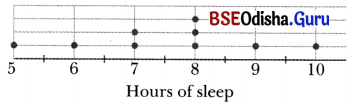
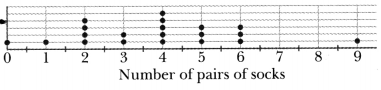
The following dot plot shows the hours of sleep taken by a child on different days.
Connecting the Dots Class 7 MCQ Maths Part 2 Chapter 5-1
The range of the number of hours of sleep is:
(a) 4
(b) 8
(c) 5
(d) 10
Solution:
(c) 5
We know, range of data = Highest value – Lowest value
In the given dot plot, minimum hours
= 5 and maximum hours = 10
∴ Range = Maximum hours – Minimum hours 10 – 5 = 5

Connecting the Dots Class 7 MCQ Maths Part 2 Chapter 5

Question 4.
The table shows the number of flowers that bloom in a garden in 7 days.

Day Mon Tue Wed Thu Fri Sat Sun
No. of flowers 5 4 6 7 3 5 2

What is the median number of flowers?
(a) 2
(b) 3
(c) 4
(d) 5
Solution:
(d) 5
Given, the number of flowers that bloom in garden for 7 days are: 5, 4, 6, 7, 3, 5, 2
Arranging the data in ascending order, we get: 2, 3, 4, 5, 5, 6, 7
Here, number of observations, n = 7, is odd.
∴ Median = \(\left(\frac{n+1}{2}\right)^{\text {th }}\) observation
= \(\left(\frac{7+1}{2}\right)^{\text {th }}\) observation = 4th observation
⇒ Median = 5

Question 5.
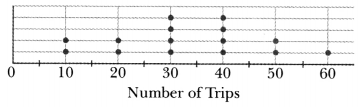
The difference between mean and median of the given dot plot showing number of trips taken by different families during an year, is:
Connecting the Dots Class 7 MCQ Maths Part 2 Chapter 5-2
(a) 0.33
(b) 3.33
(c) 0.0033
(d) None of these
Solution:
(b) 3.33
Writing down the data from the given dot plot, we get the values:
10, 10, 20, 20, 30, 30, 30, 30, 40, 40, 40, 40, 50, 50, 60
Total number of observations (n) =15 For mean,
Sum = (10 × 2) + (20 × 2) + (30 × 4) + (40 × 4) + (50 × 2) + (60 × 1)
= 20 + 40 + 120 + 160 + 100 + 60 = 500
Mean = \(\frac{500}{15}\) = 33.33
For median, (data is already in ascending order)
Since n = 15 is odd, median = \(\left(\frac{15+1}{2}\right)^{\text {th }}\) = 8th value of the data
The 8th value of the data is 30.
∴ Median = 30
Now, Difference = mean – median = 33.33 – 30 = 3.33]

Question 6.
Mean of 10 numbers is 20 and the mean of 5 numbers is 8. Then, the mean of all the 15 numbers is:
(a) 10
(b) 15
(c) 16
(d) 17
Solution:
(c) 16
Given, mean of 10 numbers = 20
∴ Sum of 10 numbers = Mean × 10
= 20 × 10 = 200
Also, mean of 5 numbers = 8
∴ Sum of 5 numbers = Mean × 5
= 8 × 5 = 40
Now, sum of all 15 numbers = Sum of 10 numbers + Sum of 5 numbers
= 200 + 40 = 240
∴ Mean of all 15 numbers
= \(\frac{Sum of 15 numbers}{15}\) = \(\frac{240}{15}\) = 16

Connecting the Dots Class 7 MCQ Maths Part 2 Chapter 5

Question 7.
If the median of \(\frac{x}{5}, x, \frac{x}{4}, \frac{x}{2} \text { and } \frac{x}{3}\) (where x > 0) is 8, then the value of x would be:
(a) 24
(b) 8
(c) 15
(d) 10
Solution:
(a) 24
Given, the observations are: \(\frac{x}{5}, x, \frac{x}{4}, \frac{x}{2}, \frac{x}{3}\)
To find the median, we first arrange-them in ascending order.
Since x > 0, the larger the denominator, the smaller the value.
Thus arranging the observations in ascending order, we get: \(\frac{x}{5}, \frac{x}{4}, \frac{x}{3}, \frac{x}{2}, x\)
Here, number of observations, n = 5, is odd.
∴ Median = \(\left(\frac{5+1}{2}\right)^{\text {th }}\) observation
= 3rd observation = \(\frac{x}{3}\)
According to the question,
Median = 8 ⇒ \(\frac{x}{3}\) = 8
⇒ r = 8 × 3 = 24

Question 8.
A cricket player scored 220 runs in 5 matches but did not bat in one of the innings. What is the mean score of the player?
(a) 36.67
(b) 38
(c) 55
(d) 45.67
Solution:
(c) 55
Given, the player scored 220 runs in 5 matches in total and did not bat in one inning.
∴ Mean = \(\frac{Total score}{Number of innings played}\)
= \(\frac{220}{4}\) = 55

Question 9.
The mean of five numbers is 18. If the number 32 is removed, what is the mean of the remaining four numbers?
(a) 12.5
(b) 14.5
(c) 13
(d) 16.5
Solution:
(b) 14.5
Given, mean of 5 numbers = 18
∴ Sum of 5 numbers = 5 × 18 = 90
As, number 32 is removed,
Sum of remaining 4 numbers = 90 – 32 = 58
∴ Mean of remaining four numbers
= \(\frac{58}{4}\) = 14.5

Connecting the Dots Class 7 MCQ Maths Part 2 Chapter 5

Question 10.
A data set contains 11 values arranged in ascending order. The 6th value is 42. Which of the following must be true?
(a) The mean is 42.
(b) The median is 42.
(c) All values are dose to 42.
(d) There is no outlier in the data.
Solution:
(b) The median is 42.
For an odd number of observations, the median is the middle value.
Here, the number of observations is 11 which is odd.
∴ Median = \(\left(\frac{11+1}{2}\right)^{\mathrm{th}}\) value = 6th value = 42

Question 11.
The median of prime numbers between 20 and 50 is:
(a) 31
(b) 37
(c) 41
(d) 43
Solution:
(b) 37
The prime numbers between 20 and 50 are:
23, 29, 31, 37, 41, 43, 47 (In ascending order) Here, number of observations, n = 7, is odd.
Median = \(\left(\frac{n+1}{2}\right)^{\mathrm{th}}\) observation
= \(\left(\frac{7+1}{2}\right)^{\mathrm{th}}\) observation = 4th observation
Thus, median = 37

Question 12.
A data set has mean = 50 and median = 70. Which of the following is most likely to be true?
(a) Presence of higher end outliers
(b) Presence of lower end outliers
(c) Data is balanced
(d) None of these
Solution:
(b) Presence of lower end outliers
Given, for a data set, mean = 50 and median = 70.
In this data set, the mean is much lower than the median (50 < 70).
The median tells us where the middle of the data is.
The mean is sensitive to outliers and gets pulled in their direction.
Because the mean has been pulled down to 50 (below the median), there must be very small numbers (lower-end outliers) dragging the average down.

Connecting the Dots Class 7 MCQ Maths Part 2 Chapter 5

Question 13.
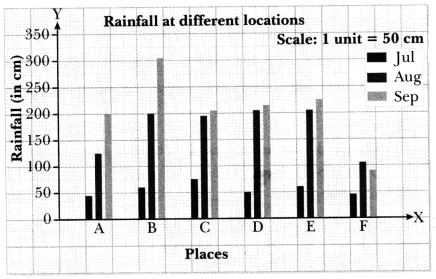
The following bar graph shows the rainfall at six selected locations (A, B, C, D, E and F) in certain months.
Connecting the Dots Class 7 MCQ Maths Part 2 Chapter 5-3
Which of the following statements is correct?
(a) July rainfall exceeds August rainfall by 100 cm at each location.
(b) September rainfall exceeds August rainfall by 50 cm at each location.
(c) July rainfall is lower than August rainfall at each location.
(d) None of the above
Solution:
(c) July rainfall is lower than August rainfall at each location.
From the bar graph, comparing July, August, and September rainfalls at each location A to F, we observe:

  • At every location, the August bar is higher than the July bar, i.e. July rainfall never exceeds August rainfall.
  • Also, July rainfall is lower than August rainfall in each location.
  • September rainfall is not exactly 50 cm more than August at each location.

Question 14.
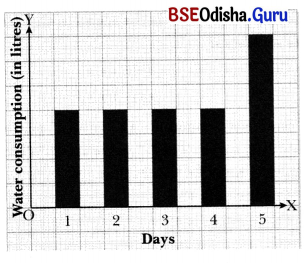
A bar graph represents the daily water consumption (in litres) of a household.
Connecting the Dots Class 7 MCQ Maths Part 2 Chapter 5-4
Which conclusion is most logically sound?
(a) Mean = Median
(b) Mean > Median
(c) Median > Mean
(d) Mean and Median cannot be compared
Solution:
(b) Mean > Median
From the graph, we observe that the water consumption on days 1, 2, 3 and 4 are the same (bars of same height), while the water consumption on day 5 is the highest (longest bar).

As the water consumption on day 5 is higher than the water consumption on other days, it will pull the mean upward.
However, the median water consumption will lie in middle.
Hence, Mean > Median.

Question 15.
A bar graph uses the scale: 1 unit =10 children on y-axis.
If the scale is changed to 1 unit = 20 children, then:
(a) the data values change
(b) the order of bars changes
(c) the height of bars changes
(d) the graph becomes incorrect
Solution:
(c) the height of bars changes
If scale is changed to 1 unit = 20 children, the height of bars will reduce in size, but the data values and order of bars remain unchanged.
So, only the height of bars will change.

Connecting the Dots Class 7 MCQ Maths Part 2 Chapter 5

Question 16.
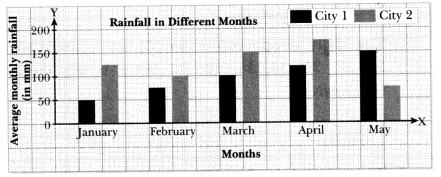
The given double bar graph represents the average rainfall of two cities in 5 months.
Connecting the Dots Class 7 MCQ Maths Part 2 Chapter 5-5
Which city sees increase in rainfall each month from January to May?
(a) City 1
(b) City 2
(c) Both city 1 and city 2
(d) Neither city 1 nor city 2
Solution:
(a) City 1
From the given bar graph:
Rainfall in City 1 increases steadily from January to May.
Rainfall in City 2 decreases from January to February, then increases from February to March to April and then again decreases in May.

Question 17.
The data given below shows the time (in minutes), taken by nine students to go to school from their homes. Which statement about the data is/are true?
115, 65, 225, 75, 115,65,155,125,115
(i) Median is 115.
(ii) The observation 65 is lowest observation.
(iii) The range of the data is 160.
(iv) The range of the data is 90.
Choose the correct option from the following:
(a) (i), (ii) and (iii)
(b) (i) and (iii) only
(c) (ii) and (iv) only
(d) (iv) only
Solution:
(a) (i), (ii) and (iii)
Arranging the data in ascending order, we get 65, 65, 75, 115, 115, 115, 125, 155, 225
Here, number of observations, n = 9, is odd.
∴ Median = \(\left(\frac{9+1}{2}\right)^{\text {th }}\) observation
= \(\left(\frac{10}{2}\right)^{\text {th }}\) observation = 5th observation =115
In the given data set, lowest observation = 65 and highest observation = 225.
So, the range of data set
= Highest value- Lowest value
= 225 – 65 = 160
Thus, statements (i), (ii) and (iii) are true.

Question 18.
The dot plots below show the distribution of the number of pockets on clothing for a group of boys and for a group of girls.
Connecting the Dots Class 7 MCQ Maths Part 2 Chapter 5-6
Based on the dot plots, which of the following statements are true?
(i) The data varies more for the girls than for the
(ii) The median number of pockets for the boys is more than that for the girls.
(iii) The mean number of pockets for the girls is more than that for the boys.
(iv) The maximum number of pockets for boys is greater than that for the girls.
Choose the correct option from the following:
(a) (i) and (ii)
(b) (iii) and (iv)
(c) (ii) and (iv)
(d) (i) and (iii)
Solution:
(a) (i) and (ii)
For boys: 3, 4, 4, 4, 4, 5, 5, 5, 5, 5, 6, 6
Range = highest value-lowest value = 6 – 3 = 3
For girls: 0, 2, 3, 3, 3, 3, 4, 4, 4, 4, 4, 5, 6
Range = highest value-lowest value = 6 – 0 = 6
As the range for girls is higher than the range for boys, the data for girls is more variable than that for boys.
For median:
Number of boys, n = 12, which is even
∴ Median number of pockets for the boys
= \(\frac{\left(\frac{12}{2}\right)^{\text {th }} \text { value }+\left(\frac{12}{2}+1\right)^{\text {th }} \text { value }}{2}\)
= \(\frac{6^{\text {th }} \text { value }+7^{\text {th }} \text { value }}{2}\)
= \(\frac{5+5}{2}=\frac{10}{2}\) = 5
Now, number of girls =13, which is odd.
∴ Median number of pockets for the girls
= \(\left(\frac{13+1}{2}\right)^{\text {th }}\) observation = 7th observation
= 4
Clearly, the median number of pockets for the boys is more than that for the girls.
For mean:
Total number of pockets for boys
= 3 + 4 + 4 + 4 + 4 + 5 + 5 + 5 + 5 + 5 + 6 + 6
= 3 + 16 + 25 + 12 = 56
∴ Mean number of pockets for boys
= \(\frac{\text { Total number of pockets }}{\text { Number of boys }}=\frac{56}{12}\) ≈ 4.67
Also, total number of pockets for girls
= 0 + 2 + 3 + 3 + 3 + 3 + 4 + 4 + 4 + 4 + 4 + 5 + 6
= 2 + 12 + 20 + 11 = 45
∴ Mean number of pockets for girls
= \(\frac{\text { Total number of pockets }}{\text { Number of girls }}=\frac{45}{13}\) ≈ 3.46
Clearly, the mean number of pockets for the girls is less than that for the boys.
Also, maximum number of pockets for both boys and girls is the same, i.e. 6.
Thus, statements (i) and (ii) are true.

Connecting the Dots Class 7 MCQ Maths Part 2 Chapter 5

Question 19.
A student’s weekly step counts (in thousands) are: 5, 5, 6, 7, 7, 8, 20
Which of the following will be largely affected by the removal of the outlier?
(i) Mean
(ii) Median
(iii) Range
(iv) None of these
Choose the correct answer from the following:
(a) (i) and (ii)
(b) (ii) and (iii)
(c) (i) and (iii)
(d) (iv) only
Solution:
(c) (i) and (iii)
Observing the given set of data, we see that most numbers are clustered between 5 and 8. The number 20 is much higher than the others and acts as an outlier.
With the presence of an outlier:
Mean steps = \(\frac{5+5+6+7+7+8+20}{7}=\frac{58}{7}\)
= 8.29
The data is already arranged in ascending order.
So, median = 7
Range of data = 20 – 5 = 15
On removing the outlier:
Mean steps: \(\frac{5+5+6+7+7+8}{6}=\frac{38}{6}\) = 6.33
Now, number of observations = 6 is even, so median is average of two middle values.
∴ Median = \(\frac{6+7}{2}=\frac{13}{2}\) = 6.5
Range of data = 8 – 5 = 3
Difference in mean = 8.29 – 6.33 = 1.96
Difference in median = 7 – 6.5 = 0.5
Difference in range = 15 – 3 =12
Therefore, both the mean and the range are largely affected by outliers.

Question 20.
Consider the given dot plot (for 20 students) representing the data of number of pairs of socks owned by a student.
Connecting the Dots Class 7 MCQ Maths Part 2 Chapter 5-7
Which of the following statements are correct?
(i) Total 77 pairs of socks are represented in thegiven dot plot.
(ii) Only one student has the highest number of pairs of socks.
(iii) Number of students that own more than 5 pairs is 4.
(iv) Range of the data is 4.
Choose the correct option from the following:
(a) (i), (ii) and (iii)
(b) (i) and (ii) only
(c) (ii) and (iv) only
(d) (iv) only
Solution:
(a)
The total number of pairs of socks
= 0 + 1 + (4 × 2) + (2 × 3) + (5 × 4) + (3 × 5) + (3 × 6) + 9
= 0 + 1 + 8 + 6 + 20 + 15 + 18 + 9 = 77
Since there is only one dot corresponding to 9
i. e. the highest number of pairs of socks, only one student has the highest number of pairs of socks.
The number of students that own more than 5 pairs is 4.
Range of data = Highest value – Lowest value = 9 – 0 = 9
Thus, statements (i), (ii) and (iii) are correct.

Connecting the Dots Class 7 MCQ Maths Part 2 Chapter 5

Connecting the Dots Class 7 Assertion and Reason Questions

The following questions are Assertion and Reason based questions. Two statements are given, one labelled as Assertion (A) and the other is labelled as Reason (R). Select the correct ansiyer to these questions from the codes (a), (b), (c) and (d) as given below.
(a) Both A and R are true and R is the correct explanation of A.
(b) Both A and R are true but R is not the correct explanation of A.
(c) A is true but R is false.
(d) A is false but R is true.

Question 1.
(A): If two data sets have the same mean, they must have the same sum.
(R): Mean = \(\frac{Sum of observations}{Number of observations}\)
Solution:
(d) A is false but R is true.
We know, Mean = \(\frac{Sum of observations}{Number of observations}\)
Thus, Reason (R) is true.

For two data sets to have the same mean, the ratio of their sum to the number of observations must be equal. However, if the number of observations (n) is different for each set, their sums will also be different even if the mean is the same. For example:

Set A: 10, 10 (Sum = 20, Number of observations = 2, Mean =10)
Set B: 10, 10, 10 (Sum = 30, Number of observations = 3, Mean = 10)
Both have the same mean, but different sums. Thus, the Assertion (A) is false.

Question 2.
(A): If a data set has an outlier at the higher end, then the mean is more likely to be greater than the median.
(R): The outlier at the higher end does not affect the mean.
Solution:
(c) A is true but R is false.
We know that, if in a dataset, the outlier lies at the higher end, the mean is pulled upward.

Because of this, the mean becomes greater than the middle value, i.e. the median.
Thus, Assertion (A) is true, but Reason (R) is false.

Connecting the Dots Class 7 MCQ Maths Part 2 Chapter 5

Question 3.
(A): An inappropriate scale on a column graph can make the data interpretation misleading.
(R): The scale decides the value represented by each unit length on the axis.
Solution:
(a) Both A and R are true and R is the correct explanation of A.
The height of the bars of column graph is entirely dependent on the chosen scale. Since the scale determines the value represented by each unit on the axis, an inappropriate scale leads to confusion while interpreting the graph.

Thus, both the Assertion (A) and the Reason (R) are true, and Reason (R) is the correct explanation of Assertion (A).

Connecting the Dots Class 7 Fill in the Blanks

Question 1.
If there are even number of observations in a data set, then median is average of _____ middle values.
Solution: two
When number of observations in a data set is even, there exists two middle values.
Thus, if there are even number of observations in a data set, then median is average of two middle values.

Question 2.
Mean of first five multiples of 2 is _________ .
Solution: 6
The first five multiples of 2 are 2, 4, 6, 8, 10.
∴ Mean = \(\frac{Sum of first five multiples of 2}{5}\)
= \(\frac{2+4+6+8+10}{5}=\frac{30}{5}\) = 6
Thus, mean of first five multiples of 2 is 6.

Connecting the Dots Class 7 MCQ Maths Part 2 Chapter 5

Question 3.
A question is said to be statistical only if its answer is expected to show _________.
Solution: variability
A question is said to be statistical only if its answer is expected to show variability.

Question 4.
The mecpan Qf first 15 odd natural numbers is ________ .
Solution: 15
The first 15 odd numbers in ascending order are: 1, 3, 5, 7, 9, 11, 13, 15, 17, 19, 21, 23, 25, 27, 29 Here, the number of observations, n = 15, is odd.
∴ Median = \(\left(\frac{15+1}{2}\right)^{\text {th }}\)
Observation = 8th observation =15
Thus, the median of the first 15 odd natural numbers is 15.

Another Peek Beyond the Point Class 7 MCQ Maths Part 2 Chapter 4

Regular revision with Class 7 Maths MCQ with Answers and Ganita Prakash Class 7 Maths Part 2 Chapter 4 Another Peek Beyond the Point MCQ improves accuracy in objective exams.

MCQ on Another Peek Beyond the Point Class 7

Another Peek Beyond the Point MCQ Class 7

Class 7 Maths Another Peek Beyond the Point MCQ

Question 1.
Which digit is in the thousandths place in the number 48.50736?
(a) 5
(b) 0
(c) 7
(d) 3
Solution:
(c) 7
In 48.50736, on the right side of the decimal point, the place values of digits are tenths (5), hundredths (0), thousandths (7) and so on.

Question 2.
Which of the following is the correct expansion of 32.406?
(a) 30 + 2 + 0.4 + 0.006
(b) 30 + 2 + 0.04 + 0.006
(c) 30 + 2 + 0.4 + 0.06
(d) 30 + 0.4 + 0.006
Solution:
(a) 30 + 2 + 0.4 + 0.006
The expanded form of 32.406 is given as
32.406 = 3 × 10 + 2 × 1 + 4 × \(\frac{1}{10}\) + 0 × \(\frac{1}{100}\) + 6 × \(\frac{1}{1000}\)
= 30 + 2 + 4 × 0.1 + 0 × 0.01 + 6 × 0.001
= 30 4- 2 + 0.4 + 0.006

Question 3.
The value of 0.385 + 4.07 + 12 is:
(a) 16.455
(b) 16.450
(c) 16.40
(d) 15.455
Solution:
(a) 16.455
Adding after aligning the decimal points in given numbers:
Another Peek Beyond the Point Class 7 MCQ Maths Part 2 Chapter 4-1

Another Peek Beyond the Point Class 7 MCQ Maths Part 2 Chapter 4

Question 4.
Which of the following is equal to 4.8 × 2.5?
(a) 10.2
(b) 12.0
(c) 11.75
(d) 9.5
Solution:
(b) 12.0
Multiplying the decimal numbers after converting them into fractions:
48 × 25 = \(\frac{48}{10} \times \frac{25}{10}=\frac{48 \times 25}{10 \times 10}=\frac{1200}{100}\) = 12

Question 5.
Cost of a pencil is ₹7.25. What is the cost of 12 pencils?
(a) ₹87
(b) ₹88.50
(c) ₹90
(d) ₹72.50
Solution:
(a) ₹87
Cost of one pencil = ₹7.25
∴ Cost of 12 pencils = 12 × 7.25
= (12 × 7) + (12 × 0.25)
= 84 + 12 × \(\frac{1}{4}\) = ₹87

Question 6.
7 + \(\frac{5}{10}+\frac{3}{100}+\frac{1}{1000}\) =
(a) 0.7531
(b) 75.31
(c) 7.531
(d) 0.7531
Solution:
(c) 7.531
7 + \(\frac{5}{10}+\frac{3}{100}+\frac{1}{1000}\)
= 7 + 0.5 + 0.03 + 0.001 = 7.531

Another Peek Beyond the Point Class 7 MCQ Maths Part 2 Chapter 4

Question 7.
A car covers a distance of 14.75 km in one litre of petrol. How much distance will it cover in 10 litres of petrol?
(a) 147.5 km
(b) 1475 km
(c) 1.475 km
(d) 14.075 km
Solution:
(a) 147.5 km
The distance covered by car in one litre of petrol = 14.75 km
The distance covered by car in 10 litres of petrol = 14.75 × 10 = 147.5 km

Question 8.
A shop packs sugar in 0.375 kg packets. If one full box contains 24 such packets, then the total weight of one full box is:
(a) 9.0 kg
(b) 8.75 kg
(c) 9.100 kg
(d) 8.25 kg
Solution:
(a) 9.0 kg
Weight of 1 packet of sugar = 0.375 kg
Since a box contains 24 packets of sugar,
Weight of one box = 0.375 kg × 24
= \(\frac{375}{1000} \times 24=\frac{9000}{1000}\)
= 9.0 kg

Question 9.
48.6 ÷ 10 =
(a) 4.86
(b) 0.486
(c) 48.06
(d) 486
Solution:
(a) 4.86
48.6 ÷ 10 = \(\frac{486}{10} \div 10=\frac{486}{10} \times \frac{1}{10}=\frac{486}{100}\) = 4.86

Another Peek Beyond the Point Class 7 MCQ Maths Part 2 Chapter 4

Question 10.
Which of the following division gives a quotient less than the dividend?
(a) 12.5 ÷ 0.5
(b) 7.29 ÷ 9
(c) 4.8 ÷ 0.08
(d) 18.6 ÷ 0.3
Solution:
(b) 7.29 ÷ 9
We know that in decimal division, if divisor is greater than 1, the quotient is less than the dividend.
Now, 9 > 1, so on dividing 7.29 by 9 we will get a quotient (0.81) less than 7.29.

Question 11.
Which of the following statements are correct with respect to the multiplication of the decimal number 8.879 by 89?
(i) 8.879 × 89 = 8.87 × 89 + 0.009 × 89
(ii) 8.879 × 89 = 8 × 89 + 0.8 × 89 + 0.79 × 89
(iii) 8.879 × 89 = 8 × 89 + 0.8 × 89 + 0.07 × 89 + 0.009 × 89
(iv) 8.879 × 89 = 8 × 89 + 0.879 × 89
Choose the correct option from the following:
(a) Only (i), (ii) and (iii)
(b) Only (iii)
(c) Only (i), (iii) and (iv)
(d) All of the above
Solution:
(c) Only (i), (iii) and (iv)
The expanded form of 8.879 is:
8.879 = 8 × 1 + 8 × \(\frac{1}{10}\) + 7 × \(\frac{1}{100}\) + 9 × \(\frac{1}{1000}\)
= 8 + 0.8 + 0.07 + 0.009
Now, 8.879 × 89 = (8 + 0.8 + 0.07 + 0.009) × 89 = 8 × 89 + 0.8 × 89 + 0.07 × 89 + 0.009 × 89
or 8.879 × 89 = (8 + 0.8 + 0.07 + 0.009) × 89 = (8.87 + 0.009) × 89 = 8.87 × 89 + 0.009 × 89
or 8.879 × 89 = (8 + 0.8 + 0.07 + 0.009) × 89 = (8 + 0.8 + 0.079) × 89 = 8 × 89 + 0.8 × 89 + 0.079 × 89
or 8.879 × 89 = (8 + 0.8 + 0.07 + 0.009) × 89 = (8 + 0.879) × 89 = 8 × 89 + 0.879 × 89
∴ The statements (i), (iii) and (iv) are correct.

Question 12.
Which of the following multiplications of decimal numbers are correct?
(i) 0.5 × 0.05 = 0.025
(ii) 1.2 × 100 = 1200
(iii) 2.5 × 4 = 10
(iv) 0.1 × 0.1 = 0.1
Choose the correct option from the following:
(a) (i) and (iii) only
(b) (ii) and (iv) only
(c) (i), (ii) and (iii)
(d) (ii), (iii) and(iv)
Solution:
(a) (i) and (iii) only
Statements (i) and (iii) are correct as 25
0.5 × 0.05 = \(\frac{5}{10} \times \frac{5}{100}=\frac{25}{1000}\) = 0.025 and
2.5 × 4 = 2 × 4 + 0.5 × 4 = 8 + 2 = 10
But statements (ii) and (iv) are incorrect as 1.2 ×x 100 = 120 and 0.1 × 0.1 = 0.01

Another Peek Beyond the Point Class 7 MCQ Maths Part 2 Chapter 4

Question 13.
Which of the following years are not leap years?
(i) 2024
(ii) 2100
(iii) 2000
(iv) 1800
Choose the correct option from the following:
(a) (ii) and (iv)
(b) (i) and (iv)
(c) (ii) and (iii)
(d) (i) and (iii)
Solution:
(a) (ii) and (iv)
A year divisible by 4 is a leap year; a year divisible by 100 is not a leap year; however, a year divisible by 400 is a leap year.
The year 2024 is divisible by 4 and not divisible by 100, so it is a leap year.
The year 2100 is divisible by 100 but not divisible by 400, so it is not a leap year.
The year 2000 is divisible by 400, so it is a leap year.
The year 1800 is divisible by 100 but not divisible by 400, so it is not a leap year. Therefore, the years that are not leap years are 2100 and 1800.

Another Peek Beyond the Point Class 7 Assertion and Reason Questions

The following questions are Assertion and Reason based questions. Two statements are given, one labelled as Assertion (A) and the other is labelled as Reason (R). Select the correct answer to these questions from the codes (a), (b), (c) and (d) as given below.
(a) Both A and R are true and R is the correct explanation of A.
(b) Both A and R are true but R is not the correct explanation of A.
(c) A is true but R is false.
(d) A is false but R is true.

Question 1.
(A): 32 × 3 tenths = 32.3
(R): Moving the decimal point to the right makes the number bigger.
Solution:
(d) A is false but R is true.
32 × 3 tenths = 32 × \(\frac{3}{10}=\frac{32 \times 3}{10}\)
= \(\frac{96}{10}\) = 9.6
So, Assertion (A) is false.
We know that multiplying a number by 10 shifts the decimal point one place to the right, making the number bigger.
For example, 1.2 × 10 = 12
So, Reason (R) is true.

Another Peek Beyond the Point Class 7 MCQ Maths Part 2 Chapter 4

Question 2.
(A): When 56.3 is multiplied by 1000, the result is 56300.
(R): When multiplying a decimal number by 10, 100, or 1000, the decimal point shifts to the left by as many places as there are zeroes in the multiplier.
Solution:
(c) A is true but R is false.
We know that, when multiplying a decimal number by 10, 100, or 1000, the decimal point shifts to the right (not left) by as many places as there are zeroes with one.

By using the above logic, when 56.3 is multiplied by 1000, the result is 563,00.
∴ Assertion (A) is true, but Reason (R) is false.

Question 3.
(A): The area of a square with a side length of 0.5 cm is 2.5 sQuestion cm.
(R): The area of a square of side a is calculated using the formula a × a.
Solution:
(d) A is false but R is true.
We know that the area of a square of side a is calculated using the formula a × a.
So, if the side length, a = 0.5 cm, then
area = a × a = 0.5 cm × 0.5 cm = 0.25 sq. cm
∴ Assertion (A) is false, but Reason (R) is true.

Question 4.
(A): The year 3100 is a leap year.
(R): A century year that is not divisible by 400 is not a leap year.
Solution:
(d) A is false but R is true.
Since 3100 is a century year, it must be divisible by 400 to be a leap year.
But 3100 is not divisible by 400, so it is not a leap year
Therefore, Assertion (A) is false, but Reason (R) is true.

Another Peek Beyond the Point Class 7 MCQ Maths Part 2 Chapter 4

Another Peek Beyond the Point Class 7 Fill in the Blanks

Question 1.
In the blanks below, fill ‘<’, ‘>’ or ‘ = ’ after analysing the expressions on the LHS and RHS.
(i) 17.89 × 5.9 ______ 185.2 × 0.57
(ii) 5.6 × 12.72 _____ 89.04 × 0.8
Solution: <, =
(i) LHS = 17.89 × 5.9
= \(\frac{1789}{100} \times \frac{59}{10}=\frac{105551}{1000}\) = 105.551
RHS = 185.2 × 0.57 = \(\frac{1852}{10} \times \frac{57}{100}=\frac{105564}{1000}\)
= 105.564
The whole number parts of both are equal i.e. 105.
Also, the digit in the tenths place is the same for both i.e. 5.
However, the digit in the hundredths place of the LHS i.e. 5 is less than that of the RHS i.e. 6.
Since 5 < 6, we conclude:
105.551 < 105.564
So, 17.89 × 5.9 < 185.2 × 0.57.

(ii) LHS = 56 × 12 72 = \(\frac{56}{10} \times \frac{1272}{100}=\frac{71232}{1000}\)
= 71.232
RHS = 8904 × 08 = \(\frac{8904}{100} \times \frac{8}{10}=\frac{71232}{1000}\)
= 71.232
Since all digits match, we conclude:
5.6 × 12.72 = 89.04 × 0.8

Question 2.
When a decimal number is multiplied by 10000, the decimal point shifts to the right by ______ places.
Solution: four
We know that the number of zeroes in the multiplier (10, 100, 1000, …) determines how many places the decimal point shifts to the right.
Since the multiplier (10000) hag 4 zeroes, the decimal point shifts four places to the right.

Question 3.
6.7 × 10 + 6.7 × 100 + 0.67 × 1000 = _______
Solution: 1407
6.7 × 10 + 6.7 × 100 + 0.67 × 1000
= 67 + 670 + 670 = 1407

Another Peek Beyond the Point Class 7 MCQ Maths Part 2 Chapter 4

Question 4.
Evaluate the following using the information 256 × 12 = 3072.
(i) 25.6 × 1.2 = _______
(ii) 307.2 ÷ 1.2 = _______
(iii) 30.72 ÷ 25.6 = ______
(iv) 0.256 × 0.12 = _____
Solution: 30.72, 256, 1.2, 0.03072
(i) 25.6 × 1.2 = \(\frac{256}{10} \times \frac{12}{10}\)
= \(\frac{256 \times 12}{100}=\frac{3072}{100}\) = 30.72

(ii) 307.2 ÷ 1.2 = \(\frac{3072}{10} \div \frac{12}{10}\)
= \(\frac{3072}{10} \times \frac{10}{12}=\frac{256 \times 12}{12}\) = 256

(iii) 30.72 ÷ 25.6 = \(\frac{3072}{100} \div \frac{256}{10}\)
= \(\frac{256 \times 12}{100} \times \frac{10}{256}=\frac{12}{10}\) = 1.2

(iv) 0.256 × 0.12 = \(\frac{256}{1000} \times \frac{12}{100}\)
= \(\frac{256 \times 12}{100000}=\frac{3072}{100000}\) = 0.03072

Question 5.
Fill in the blanks:
(i) 5.5 km = _____ m
(ii) 125.5 mL = _________ L
(iii) 14.5 cm = ______ mm
(iv) 68 g = _______ kg
Solution: 5500, 0.1255, 145, 0.068
(i) As 1 km = 1000 m
∴ 5.5 km = 5.5 × 1000 = 5500 m

(ii) As 1 mL = \(\frac{1}{1000}\) L
∴ 125.5 mL = \(\frac{125.5}{1000}\) = 0.1255 LHS

(iii) As 1 cm = 10 mm
∴ 14.5 cm = 14.5 × 10 = 145 mm

(iv) As 1 g = \(\frac{1}{1000}\) kg
∴ 68 g = \(\frac{68}{1000}\) = 0.068 kg

Finding Common Ground Class 7 MCQ Maths Part 2 Chapter 3

Regular revision with Class 7 Maths MCQ with Answers and Ganita Prakash Class 7 Maths Part 2 Chapter 3 Finding Common Ground MCQ improves accuracy in objective exams.

MCQ on Finding Common Ground Class 7

Finding Common Ground MCQ Class 7

Class 7 Maths Finding Common Ground MCQ

Question 1.
The correct prime factorisation of 168 is:
(a) 2 × 2 × 2 × 21
(b) 2 × 4 × 3 × 7
(c) 2 × 2 × 6 × 7
(d) 2 × 2 × 2 × 3 × 7
Solution:
(c) 2 × 2 × 6 × 7
Prime factorisation of number 168 using division method:
Finding Common Ground Class 7 MCQ Maths Part 2 Chapter 3-1
Thus, 168 = 2 × 2 × 2 × 3 × 7
Hence, the prime factorisation of 168 is 2 × 2 × 2 × 3 × 7

Question 2.
If the number 198 can be written as product of prime numbers as 198 = 2 × 3 × 11 × ______. The
missing prime factor is:
(a) 1
(b) 2
(c) 3
(d) 11
Solution:
(c) 3
Finding Common Ground Class 7 MCQ Maths Part 2 Chapter 3-2
Prime factorisation of number 198 using division method:
Thus, 198 = 2 × 3 × 3 × 11
Hence, the missing prime factor is 3.

Question 3.
The multiple of 5 × 3 × 7 is:
(a) 41
(b) 420
(c) (5 × 3 × 7) × 2
(d) Both (b) and (c)
Solution:
(d) Both (b) and (c)
The multiple of 5 × 3 × 7 is a number that contains all its factors.
Here, (5 × 3 × 7) × 2 and (5 × 3 × 7) × 4 i.e. 420, are multiples of 5 × 3 × 7.

Finding Common Ground Class 7 MCQ Maths Part 2 Chapter 3

Question 4.
21 mango trees, 42 apple trees and 56 orange trees have to be planted in rows such that each row contains the same number of trees of one variety only. Minimum number of rows in which the trees may be planted is:
(a) 3
(b) 15
(c) 17
(d) 20
Solution:
(c) 17
Maximum number of plants in each row
= HCF of 21, 42 and 56 = 7
Finding Common Ground Class 7 MCQ Maths Part 2 Chapter 3-3
Number of rows of mango trees = 21 ÷ 7 = 3
Number of rows of apple trees = 42 ÷ 7 = 6
Number of rows of orange trees = 56 ÷ 7 = 8
∴ Required number of rows = 3 + 6 + 8
= 17

Question 5.
All the factors of the number 96 are:
(a) 1, 2, 3, 4, 6, 8, 12, 16, 24, 32, 48
(b) 1, 2, 3, 4, 6, 8, 12, 16, 24, 32, 48, 96
(c) 1, 2, 4, 8, 16, 32, 64
(d) 1, 2, 3, 6, 8, 12, 24, 48, 96
Solution:
(b) 1, 2, 3, 4, 6, 8, 12, 16, 24, 32, 48, 96
Prime factorisation of 96 is given as
96 = 2 × 2 × 2 × 2 × 2 × 3
Taking combinations of prime factors, all factors of 96 are:
1, 2, 3, 4, 6, 8, 12, 16, 24, 32, 48, 96

Question 6.
The HCF of numbers 144, 216 and 360 is:
(a) 72
(b) 24
(c) 36
(d) 12
Solution:
(a) 72
Prime factorisations of 144, 216 and 360 are:
144 = 2 × 2 × 2 × 2 × 3 × 3
216 = 2 × 2 × 2 × 3 × 3 × 3
360 = 2 × 2 × 2 × 3 × 3 × 5
∴HCF (144, 216, 360) = 2 × 2 × 2 × 3 × 3 = 72

Finding Common Ground Class 7 MCQ Maths Part 2 Chapter 3

Question 7.
The LCM of 57 and 84 is:
(a) 1584
(b) 1596
(c) 4688
(d) 4788
Solution:
(b) 1596
Using prime factorisation method, we have
57 = 3 × 19 and
84 = 2 × 2 × 3 × 7
∴ LCM = 2 × 2 × 3 × 7 × 19 = 1596

Question 8.
The LCM and HCF of 117, 693 and 819 are:
(a) LCM = 9007, HCF = 9
(b) LCM = 9009, HCF = 7
(c) LCM = 9009, HCF = 9
(d) LCM = 9007, HCF = 7
Solution:
(c) LCM = 9009, HCF = 9
Prime factorisations of 117, 693 and 819 are:
117 = 3 × 3 × 13
693 = 3 × 3 × 7 × 11
819 = 3 × 3 × 7 × 13
Thus, HCF = 3 × 3 = 9
The LCM is the product of the highest occurrence of each prime factor, i.e.
LCM = 3 × 3 × 7 × 11 × 13 = 9009

Question 9.
The HCF of two numbers is 40, and their LCM is 8400. If one of the numbers is 240, what is the other number?
(a) 1200
(b) 1400
(c) 1600
(d) 1800
Solution:
(b) 1400
Let the unknown number be x.
We know,
Product of two numbers = HCF × LCM
⇒ 240 × x = 40 × 8400
⇒ x = \(\frac{40 \times 8400}{240}=\frac{8400}{6}\) = 1400

Finding Common Ground Class 7 MCQ Maths Part 2 Chapter 3

Question 10.
The HCF of two numbers is 8. Which one of the following can never be their LCM?
(a) 24
(b) 48
(c) 56
(d) 60
Solution:
(d) 60
We know, LCM of numbers is a multiple of their HCF.
Since 60 is not a multiple of 8, it can never be the LCM.

Question 11.
There are some sweets in a jar. The sweets can be put into boxes of 3 or 7 with no sweets left over. When the sweets are put into boxes of 20, there are 5 sweets left over. What is the smallest possible number of sweets in the jar?
(a) 48
(b) 105
(c) 125
(d) 165
Solution:
(b) 105
If the sweets can be packed in boxes of 3 or 7 with no remainder, then the number of sweets in the jar is a multiple of LCM of 3 and 7, i.e. 21.
Clearly, the required number is multiple of 21 which leaves a remainder of 5 when divided by
20, i.e. 105.

Question 12.
Which of the following statements are correct?
(i) Prime factorisation of 120 is 2 × 2 × 2 × 3 × 5.
(ii) 18 is a factor of 120.
(iii) Prime factorisation of 126 is 2 × 3 × 3 × 11.
(iv) 42 is a factor of 126.
Choose the correct option from the following:
(a) (i) and (iv)
(b) (ii) and (iii)
(c) (iii) and (iv)
(d) (ii) and (iv)
Solution:
(a) (i) and (iv)
(i) Prime factorisation of 120 is given as:
120 = 2 × 2 × 2 × 3 × 5
∴ (i) is correct.

(ii) Prime factorisation of 18 is 2 × 3 × 3
For 18 to be a factor of 120, the product 2 × 3 × 3 must be the part of the prime factorisation of 120.
Since 3 × 3 does not appear in the prime factorisation of 120, 18 is not a factor of 120.
∴ (ii) is not correct.

(iii) Prime factorisation of 126 is given as:
Finding Common Ground Class 7 MCQ Maths Part 2 Chapter 3-4
Thus, 126 = 2 × 3 × 3 × 7
∴ (iii) is not correct.

(iv) All factors of 126 are 1,2, 3,6, 7,9, 14, 18, 21, 42, 63 and 126.
∴ (iv) is correct.

Finding Common Ground Class 7 MCQ Maths Part 2 Chapter 3

Question 13.
A rectangular plot measures 168 metres by 196 metres. Find which of the following correctly represent the side length (in metres) of possible square tile that can be used to pave the entire plot without cutting any tiles.
(i) 3
(ii) 14
(iii) 28
(iv) 6
Choose the correct option from the following:
(a) (i) and (iv)
(b) (ii) and (iv)
(c) (i) and (iii)
(d) (ii) and (iii)
Solution:
(d) (ii) and (iii)
The possible square tiles that can be used to pave the entire plot without cutting any tiles includes HCF of the dimensions of the rectangular plot and its all factors.
HCF of 168 and 196 using common factor method:
Finding Common Ground Class 7 MCQ Maths Part 2 Chapter 3-5
∴ HCF (168, 196) = 2 × 2 × 7
All the factors of 28 are 1, 2, 4, 7, 14 and 28.
Thus, 14 and 28 are the possible tile sizes to cover the floor completely.

Question 14.
Which of the following statements are correct?
(i) 14 and 20 have exactly three common factors.
(ii) The LCM of 14 and 20 is 140.
(iii) 4 × 5 × 7 is a multiple of both 14 and 20.
(iv) 40 is a factor of LCM (4, 5, 10).
Choose the correct option from the following:
(a) (i) and (iv) only
(b) (i), (iii) and (iv)
(c) (ii) and (iii) only
(d) (i), (ii) and (iii)
Solution:
(c) (ii) and (iii) only
(i) As 14 = 2 × 7; 20 = 2 × 2 × 5
Common factors of 14 and 20 are 1 and 2 only.

(ii) We have, 14 = 2 × 7; 20 = 2 × 2 × 5
LCM of 14 and 20 = 2 × 2 × 5 × 7 = 140

(iii) As, 14 = 2 × 7 and 20 = 2 × 2 × 5
4 × 5 × 7 is the LCM of 14 and 20.
Thus, it is a multiple of both 14 and 20.

(iv) Prime factorisations of 4, 5 and.10 are:
4 = 2 × 2; 5 = 5; 10 = 2 × 5
The LCM is the product of the highest occurrence of each prime factor, i.e.
LCM (4, 5, 10) = 2 × 2 × 5 = 20
So, 40 is a multiple of 20 (not a factor).
Hence, statements (ii) and (iii) are correct.

Finding Common Ground Class 7 MCQ Maths Part 2 Chapter 3

Finding Common Ground Class 7 Assertion and Reason Questions

The following questions are Assertion and Reason based questions. Two statements are given, one labelled as Assertion (A) and the other is labelled as Reason (R). Select the correct answer to these questions from the codes (a), (b), (c) and (d) as given below.
(a) Both A and R are true and R is the correct explanation of A.
(b) Both A and R are true but R is not the correct explanation of A.
(c) A is true but R is false.
(d) A is false but R is true.

Question 1.
(A): The HCF of numbers 31 and 43 is 1.
(R): HCF of two prime numbers is always 1.
Solution:
(a) Both A and R are true and R is the correct explanation of A.
We know that a prime number has two factors only i.e. 1 and the number itself.
∴ HCF of two prime numbers is always 1.
Here, 31 and 43 are prime numbers.
∴ HCF(31, 43) = 1
Thus, both Assertion (A) and Reason (R) are true, and Reason (R) is the correct explanation of Assertion (A).

Question 2.
(A): The HCF of numbers 313 and 314 is 1.
(R): The HCF of any two consecutive numbers is always 1.
Solution:
(a) Both A and R are true and R is the correct explanation of A.
We know, the HCF of two consecutive natural numbers is always 1 because they have no common factor other than 1.
∴ HCF (313, 314) = 1
Thus, both Assertion (A) and Reason (R) are true, and Reason (R) is the correct explanation of Assertion (A).

Question 3.
(A): Two traffic lights change simultaneously every 60 seconds and 90 seconds. They will both change together again after 6 minutes.
(R): The time after which repeating events coincide is a multiple of the LCM.
Solution:
(a) Both A and R are true and R is the correct explanation of A.
Prime factorisations of 60 and 90 are:
60 = 2 × 2 × 3 × 5; 90 = 2 × 3 × 3 × 5
LCM is the product of the highest occurrence of each prime factor, i.e.
LCM (60, 90) = 2 × 2 × 3 × 3 × 5 = 180
So, both traffic lights will change together again after 180 seconds, i.e. 3 minute.
Thus, both lights will change together again after 3 minutes, 6 minutes, 9 minutes… (Multiples of 3).
Hence, both Assertion (A) and Reason (R) are true, and Reason (R) is the correct explanation of Assertion (A).

Finding Common Ground Class 7 MCQ Maths Part 2 Chapter 3

Question 4.
(A): If two numbers are co-prime, their HCF is 1 and their LCM is equal to their product.
(R): Co-prime numbers have no common factors except 1.
Solution:
(a) Both A and R are true and R is the correct explanation of A.
When two numbers are co-prime, they do not their highest common factor (HCF) is 1.

Since there are no common factors to be shared by two numbers, all the prime factors of both numbers, taken to their highest occurrence, are included while finding the LCM. As a result, the LCM becomes equal to the product of the two numbers.

Hence, both Assertion (A) and Reason (R) are true, and Reason (R)

Finding Common Ground Class 7 Fill in the Blanks

Question 1.
The HCF (336, 378) has the prime factorisation: 2 × 3 × ________ .
Solution: 7
Prime factorisations of 336 and 378 using division method:
336 = 2 × 2 × 2 × 2 × 3 × 7
378 = 2 × 3 × 3 × 3 × 7
Finding Common Ground Class 7 MCQ Maths Part 2 Chapter 3-7
∴ HCF (336, 378) = 2 × 3 × 7

Question 2.
Three mugs contain 145 mL, 235 mL and 495 mL of water respectively. The maximum capacity of a mug that can exactly measure the water of three mugs is _______ mL.
Solution: 5
We have, 145 = 5 × 29 ; 235 = 5 × 47 ;
495 = 5 × 9 × 11
Required capacity = HCF of 145, 235 and 495 = 5
Hence, the maximum capacity of a mug that can exactly measure the water of three mugs is 5 mL.

Finding Common Ground Class 7 MCQ Maths Part 2 Chapter 3

Question 3.
546 = 2 × 3 × ________ × 13.
Solution: 7
Prime factorisation of 546 is given as
Finding Common Ground Class 7 MCQ Maths Part 2 Chapter 3-6
Thus, 546 = 2 × 3 × 7 × 13

Question 4.
If the LCM of x and y is 720, their HCF is 12, and x is 144, then y is _____ .
Solution: 60
We know, product of two numbers = HCF × LCM
⇒ x × y = HCF × LCM
⇒ 144 × y = 12 × 720
⇒ y = \(\frac{12 \times 720}{144}\) ⇒ y = \(\frac{720}{12}\) = 60

Question 5.
_______ is the smallest number which, when divided by 12 and 18, leaves a remainder of 5 in each case.
Solution: 41
Required smallest number = LCM(12, 18) + 5
The LCM of 12 and 18 using prime factorisation method:
12 = 2 × 2 × 3
18 = 2 × 3 × 3
The LCM is the product of the highest occurrence of each prime factor.
Hence, LCM (12, 18) = 2 × 2 × 3 × 3 = 36
Thus, the smallest number = 36 + 5 = 41

Finding Common Ground Class 7 MCQ Maths Part 2 Chapter 3

Question 6.
If the product of two numbers is 600 and their HCF is 10, then their LCM is ______.
Solution: 60
Let two numbers be A and B, then according to question A × B = 600 and HCF =10.
Using the property: A × B = HCF × LCM
⇒ 600 = 10 × LCM
⇒ LCM = \(\frac{600}{10}\) = 60

Operations with Integers Class 7 MCQ Maths Part 2 Chapter 2

Regular revision with Class 7 Maths MCQ with Answers and Ganita Prakash Class 7 Maths Part 2 Chapter 2 Operations with Integers MCQ improves accuracy in objective exams.

MCQ on Operations with Integers Class 7

Operations with Integers MCQ Class 7

Class 7 Maths Operations with Integers MCQ

Question 1.
If sum of two integers is – 5, and one of the integers is 2, then the other integer is:
(a) -2
(b) -3
(c) -7
(d) -8
Solution:
(c) -7
Given, sum of two integers is – 5 and one of the integers is 2.
Let the other integer be 6.
Then, 2 + 6 = – 5 ⇒ b = – 5 – 2 = – 7

Question 2.
A pair of integers that give a product of – 20 is:
(a) -4, -5,
(b) 4, -3
(c) -5, 4
(d) -2, -10
Solution:
(c) -5, 4
We know, ( + ) × (-) = (-) or (-) × (+) = (-)
Thus, one integer must be negative and other must be positive to get product as – 20.
Also, we know that 4 ⇒ 5 = 20.
Taking 5 as negative, we get 4 ⇒ (- 5) = – 20
Thus, the pair of integers is -5 and 4.

Question 3.
For a pair of numbers, if the sum is 10 and the difference is 4, then least number in the pair is:
(a) 5
(b) 6
(c) 7
(d) 3
Solution:
(d) 3
Let a and b be the two numbers. Then,
a + b = 10 …(i)
and a – b = 4 …(ii)
Now, (a + b) + (a – b) = 10 + 4
[On adding (i) and (ii) ]
⇒ 2 × a = 14 ⇒ a = \(\frac{14}{2}\) = 7
Substituting a = 7 in a + b = 10, we get
7 + b = 10 ⇒ b = 10 – 7 = 3
Hence, the numbers are 7 and 3, and the least number in the pair is 3.

Operations with Integers Class 7 MCQ Maths Part 2 Chapter 2

Question 4.
The temperature at 12 noon at a certain place was 15°C. If it decreases at the rate of 3°C per hour at what time will it be – 12°C?
(a) 11 am
(b) 11 pm
(c) 10 am
(d) 9 pm
Solution:
(d) 9 pm
Given, temperature at 12 noon, i.e. 12 pm at certain place = 15°C
And, change in temperature in 1 hour = – 3°C
Suppose, – 12°C is the temperature x hours after 12 noon.
∴ x × (-3) = (- 12)- 15
⇒ x × (-3) = – 27 ⇒ x = 9
Thus, time after 9 hours
= 12 pm + 9 hours= 9 pm

Question 5.
What term is used to describe a pair of a positive and a negative token that cancel out each other in the token model?
(a) Additive inverse
(b) Opposite pair
(c) Zero pair
(d) Neutral set
Solution:
(c) Zero pair
A pair of a positive (green) and a negative (red) token is called zero pair.

Question 6.
(-3) × (-6) =
(a) 18
(b) -18
(c) 12
(d) -12
Solution:
(a) 18
We know (-) × (-) = ( + )
Thus, (- 3) × (- 6) = 3 × 6 = 18

Operations with Integers Class 7 MCQ Maths Part 2 Chapter 2

Question 7.
If both integers are same, then sum = ____ × integer.
(a) 2
(b) 0
(c) 3
(d) 4
Solution:
(a) 2
Let both integers be a.
Then, sum = a + a = 2 × a
Hence, sum = 2 × integer

Question 8.
If -400 × 3 × 3 + 567 = – 3033, then 43 – 3600 + 567 = ?
(a) – 2990
(b) -2980
(c) -3000
(d) -2970
Solution:
(a) – 2990
Given, – 400 × 3 × 3 + 567 = – 3033
⇒ (- 3600) + 567 = – 3033
Adding 43 to both sides, we get
43 + (- 3600) + 567 = 43 + (- 3033)
⇒ 43 – 3600 + 567 = 43 – 3033 = – 2990

Question 9.
If the sum and difference for a pair of integers is the same, one of the integers, is:
(a) 1
(b) 2
(c) 3
(d) 0
Solution:
(d) 0
Let the first integer be a and the second integer be 6.
We are given that, sum = difference
∴ a + b = a – b
⇒ a + b – a + b = 0 ⇒ 2b = 0 ⇒ b = 0
Thus, one of the integers is 0.

Operations with Integers Class 7 MCQ Maths Part 2 Chapter 2

Question 10.
What will be the sign of product if we multiply 37 negative integers and 63 positive integers?
(a) Sometimes positive
(b) Always negative
(c) Never positive
(d) Can’t be determined
Solution:
(b) Always negative
We know, product of odd number of negative integers is negative and product of any number of positive integers is positive.
∴ Product of 37 (odd) negative integers and 63 positive integers is always negative.

Question 11.
The value of (- 30) ÷ 10 is:
(a) 3
(b) -3
(c) 1
(d) 0
Solution:
(b) -3
(-30) ÷ 10 = -(30 + 10)
[∵ (-a) ÷ b = -(a ÷ b)]
= -(3) = -3

Question 12.
The value of 0 ÷ (- 12) is:
(a) 4
(b) -12
(c) 12
(d) 0
Solution:
(d) 0
0 ÷ (- 12) = -(0 ÷ 12)
[∵ a ÷ (-b) = -(a ÷ b)]
= -(0) = 0

Operations with Integers Class 7 MCQ Maths Part 2 Chapter 2

Question 13.
An integer which when multiplied by – 9 gives 117, is:
(a) 13
(b) -1053
(c) -13
(d) 1053
Solution:
(c) -13
Let the required integer be x.
Then, x × (- 9) = 117
⇒ x = 117 ÷ (-9) = -(117 ÷ 9) = – 13
Thus, the required integer is – 13.

Question 14.
If 11 × (a + 4) = 11 × (- 3) + 11 × 4, then a is :
(a) -1
(b) -2
(c) – 3
(d) – 4
Solution:
(c) -3
11 × (a + 4) = 11 × a + 11 × 4
[Using distributive property of multiplication over addition]
Given, 11 × (a + 4) = 11 × (- 3) + 11 × 4
⇒ 11 × a + 11 × 4 = 11 × (-3) + 11 × 4
On comparing, we get a = (- 3).

Question 15.
The value of (-36) ÷ (-9) is:
(a) 4
(b) – 9
(c) 6
(d) -2
Solution:
(a) 4
(-36) ÷ (-9) = 36 ÷ 9[∵ (-a) ÷ (-b) = a ÷ b]
= 4

Operations with Integers Class 7 MCQ Maths Part 2 Chapter 2

Question 16.
The value of [(- 7) + (- 5)] ÷ [(- 4) + 1] is:
(a) -7
(b) -5
(c) 7
(d) 4
Solution:
(d) 4
[(- 7) + (- 5)] ÷ [(- 4) + 1]
= (-7 – 5) ÷ (-4 + 1)
= (-12) ÷ (-3)
= 12 ÷ 3 [∵ (-a) ÷ (-b) = a ÷ b]
= 4

Question 17.
The value of [8 × (-5) + 15 × 2 + 2] ÷ [1 × (-4)] is:
(a) -15
(b) – 5
(c) 7
(d) 2
Solution:
(d) 2
[8 × (- 5) + 15 × 2 + 2] ÷ [1 × (- 4)]
= (-40 + 30 + 2) ÷ (- 4)
= (-40 + 32) ÷ (- 4)
= (- 8) ÷ (- 4)
= 8 ÷ 4 [∵ (-a) ÷ (-b) = a ÷ b]
= 2

Question 18.
Which of the following expressions are equal to -30?
(i) -20 – (-5 × 2)
(ii) (-6 × 10) + (6 × 5)
(iii) (-2 × 5) + (-4 × 5)
(iv) (-6) × 5
Choose the correct option from the following:
(a) (ii) and (iv) only
(b) (iii) and (iv) only
(c) (ii), (iii) and (iv)
(d) (i), (ii) and (iv)
Solution:
(c) (ii), (iii) and (iv)
(i) -20 – (-5 × 2) = -20 – (-10) = -20 + 10 = -10
(ii) (-6 × 10) + (6 × 5) = -60 + 30 = – 30
(iii) (-2 × 5) + (-4 × 5) = – 10 + (- 20)
= -10 – 20 = -30
(iv) (-6) × 5 = – 30
Thus, expressions (ii), (iii) and (iv) are equal to – 30.

Operations with Integers Class 7 MCQ Maths Part 2 Chapter 2

Question 19.
Which of the following expressions result in a negative integer?
(i) (-2) × (-3)
(ii) 10 + 3 × (-7)
(iii) (-5) × 2 + 10
(iv) (-5) × 7
Choose the correct option from the following:
(a) (i) and (iv)
(b) (iii) and (iv)
(c) (i) and (ii)
(d) (ii) and (iv)
Solution:
(d) (ii) and (iv)
(i) (- 2) × (- 3) = 6, which is a positive integer.
(ii) 10 + 3 × (- 7) = 10 + (- 21) = 10 – 21
= -11, which is a negative integer.
(iii) (-5) × 2 + 10 = -10 + 10 = 0, which is neither a positive nor a negative integer.
(iv) (-5) × 7 = -35, which is a negative integer.
Thus, the expressions (ii) and (iv) result in a negative integer.

Question 20.
Which of the following expressions are equal to -25?
(i) – 20 – (5 × 7)
(ii) (-7 × 1) + (- 3 × 6)
(iii) (-5 × 10) + (5 × 5)
(iv) (-5) × 8
Choose the correct option from the following:
(a) (ii) and (iii)
(b) (ii) and (iv)
(c) (iii) and (iv)
(d) (i) and (iv)
Solution:
(a) (ii) and (iii)
(i) -20 – (5 × 7) = – 20 – 35 = – 55 + – 25
(ii) (-7 × 1) + (-3 × 6) = -7 + (-18) = -7 – 18 = -25
(iii) (-5 × 10) + (5 × 5) = -50 + 25 = – 25
(iv) (-5) × 8 = -(5 × 8) = -40 ≠ -25
Thus, expressions (ii) and (iii) are equal to – 25.

Question 21.
Which of the following expressions result in odd integer?
(i) (-7) × (-3)
(ii) 10 + 3 × (- 2)
(iii) (-4) × 2 + 8
(iv) (-3) × 9
Choose the correct option from the following:
(a) (i) and (ii)
(b) (ii) and (iii)
(c) (iii) and (iv)
(d) (i) and (iv)
Solution:
(d) (i) and (iv)
(i) (-7) × (-3) = 21,
which is an odd integer.
(ii) 10 + 3 × (- 2) = 10 + (- 6) = 4, which is an even integer.
(iii) (-4) × 2 + 8 = -8 + 8 = 0, which is an even integer.
(iv) (- 3) × 9 = – 27, which is an odd integer.
Thus, the expressions (i) and (iv) result in odd integers.

Operations with Integers Class 7 MCQ Maths Part 2 Chapter 2

Question 22.
Which of the following expressions are correct?
(i) 72 ÷ (- 8) = – 9
(ii) 36 ÷ (-12) = – 3
(iii) (-78) ÷ (-2) = 38
Choose the correct option from the following:
(a) (i), (ii) and (iii)
(b) (ii) and (iii) only
(c) (i) and (ii) only
(d) (i) only
Solution:
(c) (i) and (ii) only
(i) 72 ÷ (- 8) = – (72 ÷ 8) = -(9) = – 9
(Correct)
(ii) 36 ÷ (-12) = -(36 ÷ 12) = -3 (Correct)
(iii) (-78) ÷ (-2) = 78 ÷ 2 = 39 (Incorrect)

Operations with Integers Class 7 Assertion and Reason Questions

The following questions are Assertion and Reason based questions. Two statements are given, one labelled as Assertion (A) and the other is labelled as Reason (R). Select the correct answer to these questions from the codes (a), (b), (c) and (d) as given below.
(a) Both A and R are true and R is the correct explanation of A.
(b) Both A and R are true but R is not the correct explanation of A.
(c) A is true but R is false.
(d) A is false but R is true.

Question 1.
(A): The additive inverse of (-12) × (-3) + 4 is -40.
(R): The additive inverse of a is – a.
Solution:
(a) Both A and R are true and R is the correct explanation of A.
(-12) × (- 3) + 4 = 36 + 4 = 40
We know, the additive inverse of a is – a.
∴ The additive inverse of 40 is – 40.
Hence, the additive inverse of (-12) × (-3) + 4 is – 40.
Thus, both Assertion (A) and Reason (R) are true, and Reason (R) is the correct explanation of Assertion (A).

Question 2.
(A): The value of (-3) × (-4) × 5 × 2 × (-1) is negative.
(R): The product of odd number of negative integers is positive.
Solution:
(c) A is true but R is false.
We know that the product of odd number of negative integers is always negative.
In product (-3) × (-4) × 5 × 2 × (-1), there are 3 (odd) negative integers.
So, the product is negative.
Thus, Assertion (A) is true, but Reason (R) is false

Operations with Integers Class 7 MCQ Maths Part 2 Chapter 2

Operations with Integers Class 7 Fill in the Blanks

Question 1.
60 + 40 + ______ = 0
Solution: -100
Let the required integer be a.
Then, 60 + 40 + a = 0 ⇒ 100 + a = 0
We know that the sum of an integer and its additive inverse is 0.
∴ a = – 100
Thus, 60 + 40 + (-100) = 0.

Question 2.
(-1) × _____ = – 43
Solution: 43
We know, (-1) × a = -a, for all integers a.
Thus, (-1) × 43 = -43

Question 3.
(-9) × (-5) × 6 × (-3) = _______
Solution: -810
The product of odd number of negative integers is negative.
∴ (-9) × (-5) × 6 × (-3)
= -(9 × 5 × 6 × 3) = -810

Operations with Integers Class 7 MCQ Maths Part 2 Chapter 2

Question 4.
If we multiply 17 positive integers and 92 negative integers, then the sign of the product is _________ .
Solution: positive
We know that the product of even number of negative integers is always positive.
Final product = (Product of 17 positive integers) × (Product of 92 negative integers)
= (Positive) × (Positive) = Positive
Thus, if we multiply 17 positive integers and 92 negative integers, then the sign of the product is
positive.

Question 5.
When two negative integers are added, we get a ______ integer.
Solution: negative
When two negative integers are added, we get a negative integer.

Question 6.
Find:
(i) -13 + 42 = _____
(ii) 47 + (-26) = ______
(iii) 91 – 19 = ______
(iv) -38 – (-29) = _____
Solution: 29, 21, 72, -9
(i) -13 + 42 = 29
(ii) 47 + (-26) = 21
(iii) 91 – 19 = 72
(iv) -38 – (-29) = – 9

Question 7.
(7 + 3) + (5 + 2) + ( _____ + 6)
= (3 + 6) + (5 + 7) + (2 + 9)
Solution: 9
RHS = (3 + 6) + (5 + 7) + (2 + 9)
= 3 + 6 + 5 + 7 + 2 + 9
= (7 + 3) + (5 + 2) + (6 + 9)
= (7 + 3) + (5 + 2) + (9 + 6) = LHS
∴ (7 + 3) + (5 + 2) + (9 + 6)
= (3 + 6) + (5 + 7) + (2 + 9)

Operations with Integers Class 7 MCQ Maths Part 2 Chapter 2

Question 8.
-19 + 23 – 8 + _____ = 12
Solution: 16
Let the required number be x. Then
-19 + 23 – 8 + x = 12 ⇒ 23 – 27 + x = 12
⇒ -4 + x = 12 ⇒ x = 12 + 4= 16
∴ -19 + 23 – 8 + 16 = 12

Question 9.
(-8) × (-9) + (-3) × (-3) × (-3) = _________
Solution: 45, 9, -36
(-8) × (- 9) + (- 3) × (- 3) × (- 3)
= (8 × 9) – (3 × 3 × 3) = 72 – 27 = 45

Question 10.
(-4) × (10 – 5 – 4 + 8) = (-4) × ____ = ______
Solution: 9, -36
(-4) × (10 – 5 – 4 + 8) = (-4) × 9 = – 36

Question 11.
When one of the multiplier or the multiplicand is positive and the other is negative, their product is _______ .
Solution: negative
We know that, when one of the multiplier or the multiplicand is positive and the other is negative, their product is negative.

Operations with Integers Class 7 MCQ Maths Part 2 Chapter 2

Question 12.
When both the multiplier and the multiplicand are negative, the product is __________ .
Solution: positive
When both the multiplier and the multiplicand are negative, the product is positive.

Question 13.
Fill in the blanks keeping in view the properties of multiplication and division of integers:
(i) (-2) × 5 = _____ × (-2)
(ii) (-4) × [(____) + (2)] = (-4) × (-5) + (______) × (2)
(iii) 100 × [(____) × (-45)] = [ ____ × (-4)] × (-45)
(iv) (-15) ÷ (_____) = (15) ÷ (-3)
Solution: 5, -5, -4, -4, 100, 3
(i) (-2) × 5 = 5 × (- 2)
[Using commutative law of multiplication]
(ii) (-4) × [(-5) + (2)] = (-4) × (- 5) + (-4) × (2)
[Using distributive law of multiplication]
(iii) 100 × [(-4) × (-45)] = [100 × (-4)] × (-45)
[Using associative law of multiplication]
(iv) (-15) ÷ (3) = (15) ÷ (-3)

Geometric Twins Class 7 MCQ Maths Part 2 Chapter 1

Regular revision with Class 7 Maths MCQ with Answers and Ganita Prakash Class 7 Maths Part 2 Chapter 1 Geometric Twins MCQ improves accuracy in objective exams.

MCQ on Geometric Twins Class 7

Geometric Twins MCQ Class 7

Class 7 Maths Geometric Twins MCQ

Question 1.
In the given figures, select the option in which figures I1 and I2 do not appear congruent.
Geometric Twins Class 7 MCQ Maths Part 2 Chapter 1-1
Solution:
(b) Geometric Twins Class 7 MCQ Maths Part 2 Chapter 1-6
The figures given in options (a), (c) and (d) have same shape and size. So, the figures are congruent.
In figure given in option (b), the shape is same, but sizes are different. So, they are not congruent.

Question 2.
If two squares are congruent, then which of the following is true?
(a) They have same length of sides.
(b) They have same length of diagonals.
(c) both (a) and (b)
(d) None of these
Solution:
(c) both (a) and (b)
If two squares are congruent, they have equal corresponding sides. Since the diagonals depend on the side length, their diagonals are also equal.

Question 3.
When checking congruence, which of the following movement is allowed?
(a) Moving (Sliding)
(b) Rotating
(c) Flipping (reflection)
(d) All of the above
Solution:
(d) All of the above
Moving, rotating or flipping the figure changes only its position or orientation. It does not change the shape or size of the figure. So, all the three movements are allowed.

Geometric Twins Class 7 MCQ Maths Part 2 Chapter 1

Question 4.
For two line segments to be congruent, which of the following is correct?
(a) They have the same orientation (direction).
(b) They have at least one common point.
(c) They have the same length.
(d) They have the different orientation (direction).
Solution:
(c) They have the same length.
For two line segments to be congruent, only their lengths need to be equal.

Question 5.
∆ABC and ∆XYZ are two triangles such that AB = XY = 6 cm, AC = XZ = 5 cm and ∠A = ∠X = 30°. ∆ABC and ∆XYZ are congruent by:
(a) SSS congruence rule
(b) SAS congruence rule
(c) ASA congruence rule
(d) The given information is not sufficient.
Solution:
(b) SAS congruence rule
Geometric Twins Class 7 MCQ Maths Part 2 Chapter 1-3
In ∆ABC and ∆XYZ, we have
AB = XY = 6 cm [Given]
AC = XZ = 5 cm [Given]
∠A = ∠X = 30° [Given]
∴ ∆ABC ≅ ∆XYZ [By SAS congruence rule]

Question 6.
If ∆ABC ≅ ∆FDE such that AB = 5 cm, ∠B = 40° and ∠A = 80°, then which of the following is true?
(a) DF = 5 cm, ∠F = 80°
(b) DF = 5 cm, ∠E = 80°
(c) DE = 5 cm, ∠E = 60°
(d) DE = 5 cm, ∠D = 40°
Solution:
(a) DF = 5 cm, ∠F = 80°
Given, ∆ABC ≅ ∆FDE,
AB = 5 cm, ∠B = 40°, ∠d = 80°
Geometric Twins Class 7 MCQ Maths Part 2 Chapter 1-4
The corresponding sides are: AB and FD, BC and DE, AC and FE.
The corresponding angles are: ∠A and ∠F, ∠B and ∠D, ∠C and ∠E.
∴ ∠F = ∠A = 80° and DF = BA = 5 cm

Geometric Twins Class 7 MCQ Maths Part 2 Chapter 1

Question 7.
In ∆PQR and ∆XYZ, PQ = XY, ∠P = ∠X and PR = XZ. ∆PQR and ∆XYZ are congruent by:
(a) SSS
(b) SAS
(c) ASA
(d) RHS
Solution:
(b) SAS
In ∆PQR and ∆XYZ, two sides and included angle are the same.
Geometric Twins Class 7 MCQ Maths Part 2 Chapter 1-5
∴ ∆PQR ≅ ∆XYZ [By SAS congruence rule]

Question 8.
In the given figure, if AO = OD and BO = OC then ∆AOB ≅ ∆DOC by:
Geometric Twins Class 7 MCQ Maths Part 2 Chapter 1-2
(a) SSS
(b) SAS
(c) ASA
(d) AAS
Solution:
(b) SAS
In ∆AOB and ∆DOC, we have
AO = DO [Given]
BO = CO [Given]
∠AOB = ∠DOC [Vertically opposite angles]
∴ ∆AOB ≅ ∆DOC [By SAS congruence rule]

Question 9.
Out of four given circles, identify the circles that are congruent?
(i) Circle with radius, r = 10 cm
(ii) Circle with area, A = 100π cm2
(iii) Circle with circumference, S = 30π cm
(iv) Circle with area, A = 25π cm2
Choose the correct option from the following:
(a) (i) and (iii)
(b) (ii) and (iv)
(c) (i) and (ii)
(d) (iii) and (iv)
Solution:
(c) (i) and (ii)
For two circles to he congruent, their radii must be the saune, and hence Perimeter (2πR) and area (πR2) will also be the same.
For (i): r = 10 cm
For (ii): A = 100π cm2
⇒ πr2 = 100π cm2 ⇒ r2 = 100 cm2
⇒ r = 10 cm
For (iii): S = 30π cm
⇒ 2πr = 30π cm ⇒ r = \(\frac{30 \pi}{2 \pi} \mathrm{~cm}\) = 150 cm
For (iv): A = 25π cm2
⇒ πr2 = 25π cm2 ⇒ r2 = 25 cm2
⇒ r = 5 cm
As circles given (i) and (ii) have same radii, they are congruent.

Geometric Twins Class 7 MCQ Maths Part 2 Chapter 1

Question 10.
In the given figure, BD = CE and BD and CE are altitudes of ∆ABC.
Which of the following are correct?
Geometric Twins Class 7 MCQ Maths Part 2 Chapter 1-7
(i) ∆BCD £ ∆CBE
(ii) ∠DBE = ∠DCE
(iii)) ∠DCB = ∠ECB
(iv) ∠DPE + ∠DAE = 180°
Choose the correct option from the following:
(a) (i) and (ii) only
(b) (ii), (iii) and (iv)
(c) (i), (ii) and (iv)
(d) (i) and (iv) only
Solution:
(c) (i), (ii) and (iv)
In ∆BDC and ∆CEB, we have
Geometric Twins Class 7 MCQ Maths Part 2 Chapter 1-8
BC = CB [Common side (Hypotenuse)]
BD = CE [Given]
∠CDB = ∠BEC [Each 90°]
∴ ∆BDC ≅ ∆CEB [By RHS congruence rule]
⇒ ∆BCD ≅ ∆CBE
⇒ ∠DCB = ∠EBC and ∠DBC = ∠ECB
[By CPCT]
⇒ ∠DCB – ∠ECB = ∠EBC – ∠DBC
⇒ ∠DCE = ∠EBD
In quadrilateral AEPD,
∠PEA + ∠PDA + ∠DPE + ∠DAE = 360°
[Sum of all interior angles is 360°]
⇒ 90° + 90° + ∠DPE + ∠DAE = 360°
⇒ ∠DPE + ∠DAE = 360° – 180° = 180°
So, (i), (ii) and (iv) are correct.

Geometric Twins Class 7 Assertion and Reason Questions

The following questions are Assertion and Reason based questions. Two statements are given, one labelled as Assertion (A) and the other is labelled as Reason (R). Select the correct answer to these questions from the codes (a), (b), (c) and (d) as given below.
(a) Both A and R are true and R is the correct explanation of A.
(b) Both A and R are true but R is not the correct explanation of A.
(c) A is true but R is false.
(d) A is false but R is true.

Question 1.
(A): If ∆ABC ≅ ∆RPQ, then BC = QR.
(R): Corresponding parts of two congruent triangles are equal.
Solution:
(d) A is false but R is true.
We have, ∆ABC ≅ ∆RPQ
Here, the corresponding vertices are: A and R, B and P, C and Question
⇒ BC – PQ [∵ Corresponding parts of two congruent triangles are equal.]
∴ Assertion (A) is false, but Reason (R) is true.

Question 2.
(A): In ∆PQR, if PQ = PR, then ∠P = ∠R.
(R): Angles opposite to equal sides of a triangle are equal.
Solution:
Geometric Twins Class 7 MCQ Maths Part 2 Chapter 1-9
(d) A is false but R is true.
In ∆PQR, we have
PQ = PR
⇒ ∠PRQ = ∠PQR
⇒ ∠R = ∠Q [Angles opposite to equal sides are equal.]
∴ Assertion (A) is false, but Reason (R) is true.

Geometric Twins Class 7 MCQ Maths Part 2 Chapter 1

Question 3.
(A): Two congruent triangles have all corresponding angles equal.
(R): AAA criterion is sufficient to prove congruency of two triangles.
Solution:
(c) A is true but R is false.
Two triangles are said to be congruent, if they can be superimposed exactly, one over the other.
∴ Two congruent triangles have all the corresponding sides and corresponding angles equal.
But AAA criterion is not enough to prove congruency of two triangles, because size of triangles might be different.
∴ Assertion (A) is true, but Reason (R) is false.

Question 4.
(A): In ∆ABC, if AB = AC and ∠B = 50°, then ∠C = 50°.
(R): In a triangle, angles opposite to equal sides are equal.
Solution:
Geometric Twins Class 7 MCQ Maths Part 2 Chapter 1-10
(a) Both A and R are true and R is the correct explanation of A.
Given, AB = AC and ∠B = 50°
We know that angles opposite to equal sides of a triangle are equal.
∴ ∠C = ∠B
⇒ ∠C = 50°
∴ Both .Assertion (A) and Reason (R) are true, and Reason (R) is the correct explanation of Assertion (A).

Geometric Twins Class 7 Fill in the Blanks

Question 1.
A rectangle of length 10 cm and breadth 5 cm is congruent to another rectangle with length _______ and breadth ___________ .
Solution: 10 cm, 5 cm.
For two rectangles to be congruent, their length and breadth must be same.
So, a rectangle of length 10 cm and breadth 5 cm is congruent to another rectangle with length 10 cm and breadth 5 cm.

Geometric Twins Class 7 MCQ Maths Part 2 Chapter 1

Question 2.
If two sides and a non-including angle are given, the triangle may or may not uniquely determined. This ambiguous situation is called _______ condition, which can produce ________ different triangles.
Solution: SSA, two
If two sides and a non-including angle are given, the triangle may or may not uniquely determined. This ambiguous situation is called SSA condition, which can produce two different triangles.

Question 3.
For congruent triangles, the perimeters of both triangles are __________ .
Solution: equal
If two triangles are congruent, their corresponding sides and angles are equal.
For congruent triangles, the perimeters of both triangles are equal.

Question 4.
If ∆ABC ≅ ∆XYZ, then AB = ___________, ∠B = ______ and BC = __________ .
Solution: XY, ∠Y, YZ
If two triangles are congruent, their corresponding sides and angles are equal.
Given, ∆ABC ≅ ∆XYZ, then AB = XY, ∠B = ∠Yand BC = YZ.

Working with Fractions Class 7 MCQ Maths Chapter 8

Regular revision with Class 7 Maths MCQ with Answers and Ganita Prakash Class 7 Maths Chapter 8 Working with Fractions MCQ improves accuracy in objective exams.

MCQ on Working with Fractions Class 7

Working with Fractions MCQ Class 7

Class 7 Maths Working with Fractions MCQ

Question 1.
The value of \(\frac{5}{6}\) of 30 is:
(a) 20
(b) 25
(c) 30
(d) 35
Solution:
(b) 25
We know, ‘of’ means multiplication.
∴ \(\frac{5}{6} \text { of } 30=\frac{5}{6} \times 30\) = 5 × 5 = 25

Question 2.
What is the value of \(\frac{5}{8}\) × 64 ?
(a) 35
(b) 40
(c) 45
(d) 50
Solution:
(b) 40
\(\frac{5}{8} \times 64\) = 5 × 8 = 40

Question 3.
The value of \(3 \frac{1}{2}+\frac{4}{3}-2 \frac{2}{5}\) is:
(a) \(\frac{89}{30}\)
(b) \(\frac{91}{30}\)
(c) \(\frac{87}{30}\)
(d) \(\frac{73}{30}\)
Solution:
(d) \(\frac{73}{30}\)
We can write, \(3 \frac{1}{2}=\frac{7}{2} \text { and } 2 \frac{2}{5}=\frac{12}{5}\)
∴ \(3 \frac{1}{2}+\frac{4}{3}-2 \frac{2}{5}=\frac{7}{2}+\frac{4}{3}-\frac{12}{5}=\frac{105}{30}+\frac{40}{30}-\frac{72}{30}\)
[∵ LCM of 2, 3 and 5 is 30.]
= \(\frac{105+40-72}{30}=\frac{73}{30}\)

Working with Fractions Class 7 MCQ Maths Chapter 8

Question 4.
The cost of one notebook is \(\frac{3}{4}\) rupees. What is the cost of 32 such notebooks?
(a) ₹20
(b) ₹22
(c) ₹24
(d) ₹26
Solution:
(c) ₹24
Given, the cost of one notebook is \(\frac{3}{4}\) rupees.
Therefore, the cost of 32 notebooks
= \(32 \times \frac{3}{4}\) = 8 × 3 = ₹24

Question 5.
The value of \(\frac{11}{18}+\left(\frac{7}{15} \times \frac{1}{4}\right)\) is:
(a) \(\frac{3}{180}\)
(b) \(\frac{56}{180}\)
(c) \(\frac{131}{180}\)
(d) \(\frac{9}{180}\)
Solution:
(c) \(\frac{131}{180}\)
Given, \(\frac{11}{18}+\left(\frac{7}{15} \times \frac{1}{4}\right)=\frac{11}{18}+\frac{7}{60}=\frac{110}{180}+\frac{21}{180}\)
[∵ LCM of 18 and 60 is 180]
= \(\frac{110+21}{180}=\frac{131}{180}\)

Question 6.
The reciprocal of \(\frac{8}{7}\) is:
(a) \(\frac{1}{8}\)
(b) \(\frac{7}{8}\)
(c) \(\frac{1}{7}\)
(d) \(\frac{8}{7}\)
Solution:
(b) \(\frac{7}{8}\)
The reciprocal of \(\frac{8}{7} \text { is } \frac{7}{8}\).

Working with Fractions Class 7 MCQ Maths Chapter 8

Question 7.
The value of \(5 \frac{2}{3} \div 1 \frac{5}{6}\) is:
(a) \(3 \frac{1}{11}\)
(b) \(2 \frac{2}{3}\)
(c) \(1 \frac{1}{6}\)
(d) \(3 \frac{2}{5}\)
Solution:
(a) \(3 \frac{1}{11}\)
We have, \(5 \frac{2}{3} \div 1 \frac{5}{6}\)
= \(\frac{17}{3} \div \frac{11}{6}=\frac{17}{8} \times \frac{6}{11}\)
[As \(5\frac{2}{3}=\frac{17}{3} \text { and } 1 \frac{5}{6}=\frac{11}{6}\)]
= \(\frac{17 \times 2}{1 \times 11}=\frac{34}{11}=3 \frac{1}{11}\)

Question 8.
\(\left(\frac{18}{6} \div \frac{3}{9}\right)+\left(\frac{21}{7} \div \frac{6}{4}\right)\) =
(a) 9
(b) 11
(c) 12
(d) 10
Solution:
(b) 11
We have, \(\left(\frac{18}{6} \div \frac{3}{9}\right)+\left(\frac{21}{7} \div \frac{6}{4}\right)\)
= \(\left(\frac{38}{6} \times \frac{3}{8}\right)+\left(\frac{21}{7} \times \frac{4}{6}\right)\)
= \(\frac{3 \times 3}{1 \times 1}+\frac{9 \times 2}{1 \times 3}\) = 9 + 2 = 11

Question 9.
The reciprocal of \(2 \frac{3}{4}\) is:
(a) \(\frac{11}{4}\)
(b) \(\frac{13}{4}\)
(c) \(\frac{4}{11}\)
(d) \(\frac{4}{13}\)
Solution:
(c) \(\frac{4}{11}\)
We have \(2\frac{3}{4}=\frac{(2 \times 4)+3}{4}=\frac{8+3}{4}=\frac{11}{4}\)
Now, reciprocal of \(\frac{11}{4} \text { is } \frac{4}{11}\)

Working with Fractions Class 7 MCQ Maths Chapter 8

Question 10.
The value of \(\frac{7}{8} \div 4\) is:
(a) \(\frac{7}{2}\)
(b) \(\frac{7}{32}\)
(c) \(\frac{4}{7}\)
(d) \(2\frac{1}{4}\)
Solution:
(b) \(\frac{7}{32}\)
We have, \(\frac{7}{8} \div 4=\frac{7}{8} \times \frac{1}{4}=\frac{7 \times 1}{8 \times 4}=\frac{7}{32}\)

Question 11.
The value of \(4 \frac{3}{5} \div 2 \frac{1}{4}\) is:
(a) \(2\frac{2}{45}\)
(b) \(3\frac{1}{5}\)
(c) \(1\frac{4}{9}\)
(d) \(2\frac{1}{4}\)
Solution:
(a) \(2\frac{2}{45}\)
We have, \(4 \frac{3}{5} \div 2 \frac{1}{4}=\frac{23}{5} \div \frac{9}{4}=\frac{23}{5} \times \frac{4}{9}\)
[∵ \(4 \frac{3}{5}=\frac{23}{5}, 2 \frac{1}{4}=\frac{9}{4}\)
= \(\frac{23 \times 4}{5 \times 9}=\frac{92}{45}=2 \frac{2}{45}\)

Question 12.
Which of the following is/are correct?
(i) \(36 \div \frac{3}{4}=48\)
(ii) \(20 \div 2 \frac{1}{2}=8\)
(iii) \(\frac{5}{6} \div \frac{1}{3}=\frac{5}{2}\)
(iv) \(3 \frac{1}{2} \div \frac{7}{4}=2\)
Choose the correct option from the following:
(a) (i), (ii) and (iii) only
(b) (i), (iii) and (iv) only
(c) (ii), (iii) and (iv) only
(d) (i), (ii), (iii) and (iv)
Solution:
(d) (i), (ii), (iii) and (iv)
Working with Fractions Class 7 MCQ Maths Chapter 8-1

Working with Fractions Class 7 MCQ Maths Chapter 8

Question 13.
Which of the following is/are correct?
(i) \(36 \div \frac{3}{4}=48\)
(ii) \(45 \div 5 \frac{5}{6}=6\)
(iii) \(\frac{7}{9} \div \frac{1}{3}=\frac{7}{2}\)
(iv) \(3 \frac{1}{2} \div \frac{7}{4}=2\)
Choose the correct option from the following:
(a) (i), (ii) and (iv)
(b) (ii), (iii) and (iv)
(c) (i) and (iv) only
(d) (i), (ii) and (iii)
Solution:
(c) (i) and (iv) only
(i) Working with Fractions Class 7 MCQ Maths Chapter 8-2
= 48 – correct

(ii) Working with Fractions Class 7 MCQ Maths Chapter 8-3
= \(\frac{9 \times 6}{7}=\frac{54}{7} \neq 6\) = Incorrect

(iii) Working with Fractions Class 7 MCQ Maths Chapter 8-4 – Incorrect

(iv) Working with Fractions Class 7 MCQ Maths Chapter 8-5 – Correct

A Tale of Three Intersecting Lines Class 7 Assertion and Reason Questions

The following questions are Assertion and Reason based questions. Two statements are given, one labelled as Assertion (A) and the other is labelled as Reason (R). Select the correct answer to these questions from the codes (a), (b), (c) and (d) as given below.
(a) Both A and R are true and R is the correct explanation of A.
(b) Both A and R are true but R is not the correct explanation of A.
(c) A is true but R is false.
(d) A is false but R is true.

Question 1.
(A): The product of \(\frac{2}{5} \text { and } \frac{3}{4} \text { is } \frac{6}{20}\)
(R): To multiply two fractions, we take the LCM of the denominators and then add the numerators.
Solution:
(c) A is true but R is false.
To multiply two fractions, we do not take the LCM or add numerators. Instead, we multiply numerators and denominators directly.
∴ \(\frac{2}{5} \times \frac{3}{4}=\frac{2 \times 3}{5 \times 4}=\frac{6}{20}\)
Thus, Assertion (A) is true, but Reason (R) is false.

Question 2.
(A): \(\frac{4}{3}\) of 15 is 20.
(R): In \(\frac{4}{3}\) of 15 , ‘of’ means ‘multiplication’.
Solution:
(a) Both A and R are true and R is the correct explanation of A.
In \(\frac{4}{3}\) of 15 , ‘of ’ means ‘multiplication’.
Thus, \(\frac{4}{3}\) of 15 = \(\frac{4}{3} \times 15\) = 4 × 5 = 20
Therefore, both Assertion (A) and Reason (R) are true, and Reason (R) is the correct explanation of Assertion (A).

Working with Fractions Class 7 MCQ Maths Chapter 8

Question 3.
(A): The product of \(\frac{2}{3}, \frac{3}{4} \text { and } \frac{1}{2} \text { is } \frac{1}{4}\)
(R): To multiply three fractions, we take the LCM of the denominators and then add the numerators.
Solution:
(c) A is true but R is false.
To multiply three fractions, we do not take the LCM or add the numerators.
Instead, we multiply the numerators and multiply the denominators directly.
∴ \(\frac{2}{3} \times \frac{3}{4} \times \frac{1}{2}=\frac{2 \times 3 \times  1}{3 \times 4 \times 2}=\frac{1}{4}\)
Therefore, Assertion (A) is true, but Reason (R) is false.

Question 4.
(A): The product of two improper fractions is not smaller than any of the two fractions.
(R): Multiplication of two improper fractions gives a result that is greater than both the fractions or equal to either of them.
Solution:
(a) Both A and R are true and R is the correct explanation of A.
An improper fraction has its numerator equal to or greater than the denominator (e.g. \(\frac{5}{4}, \frac{7}{3},\) 1, etc.). Its value is greater than or equal to 1.
Thus, the product of two improper fractions is equal to either of them or greater than each fraction.
Therefore, both Assertion (A) and Reason (R) are true, and Reason (R) is the correct explanation of Assertion (A).

A Tale of Three Intersecting Lines Class 7 Fill in the Blanks

Question 1.
The product of two proper fractions is found by multiplying the _______ of both and the _____ of both.
Solution: numerators, denominators
The product of two proper fractions is found by multiplying the numerators of both and the
denominators of both.

Working with Fractions Class 7 MCQ Maths Chapter 8

Question 2.
Priya is making lemonade. She uses \(\frac{2}{3}\) of a lemon for one glass. If she makes \(\frac{3}{4}\) of a glass, she will use ______ of a lemon.
Solution: \(\frac{1}{2}\) of a glass
Given, lemon used for 1 full glass is \(\frac{2}{3}\) and glass prepared = \(\frac{3}{4}\) of a glass
∴ Required lemon = \(\frac{3}{4} \times \frac{2}{3}=\frac{3 \times 2}{4 \times 3}=\frac{6}{12}=\frac{1}{2}\) = of a lemon.

Question 3.
The product of \(\frac{5}{8}\) and 96 is _______ .
Solution: 60
Product of \(\frac{5}{8}\) and 96 is \(\frac{5}{8} \times 96\) = 5 × 12 = 60

Question 4.
Ravi is painting a wall. He uses \(\frac{3}{5}\) of a bucket of paint for one wall. If he paints \(\frac{2}{3}\) of a wall, he wil use ______ of a bucket.
Solution: \(\frac{2}{5}\)
Given, paint required to paint 1 wall = \(\frac{3}{5}\) of a bucket
Paint required to paint \(\frac{2}{3}\) of a wall
= \(\frac{2}{3} \times \frac{3}{5}=\frac{2}{5}\) of a bucket

Working with Fractions Class 7 MCQ Maths Chapter 8

Question 5.
Complete the following:
Working with Fractions Class 7 MCQ Maths Chapter 8-6
Solution:
Working with Fractions Class 7 MCQ Maths Chapter 8-7

Question 6.
If the product of two numbers is ________ the numbers are called reciprocal of each other.
Solution: 1
If the product of two numbers is 1, then the numbers are called reciprocal of each other.

Question 7.
Reciprocal of \(\frac{5}{11}\) is ______.
Solution: \(\frac{11}{5}\)
Reciprocal of \(\frac{5}{11} \text { is } \frac{\mathbf{1 1}}{\mathbf{5}}\)

Question 8.
\(\frac{1}{5}\) is ________ of 5.
Solution: reciprocal or multiplicative inverse
\(\frac{1}{5}\) is reciprocal or multiplicative inverse of 5.

Working with Fractions Class 7 MCQ Maths Chapter 8

Question 9.
\(\frac{8}{5} \div \frac{9}{}=\frac{8}{5} \times \frac{7}{9}\)
Solution: \(\frac{9}{7}\)
\(\frac{8}{5} \div \frac{9}{7}=\frac{8}{5} \times \frac{7}{9}\)

A Tale of Three Intersecting Lines Class 7 MCQ Maths Chapter 7

Regular revision with Class 7 Maths MCQ with Answers and Ganita Prakash Class 7 Maths Chapter 7 A Tale of Three Intersecting Lines MCQ improves accuracy in objective exams.

MCQ on A Tale of Three Intersecting Lines Class 7

A Tale of Three Intersecting Lines MCQ Class 7

Class 7 Maths A Tale of Three Intersecting Lines MCQ

Question 1.
A triangle with two sides equal is called:
(a) Scalene triangle
(b) Equilateral triangle
(c) Isosceles triangle
(d) None of these
Solution:
(c) Isosceles triangle
We know that an isosceles triangle has exactly two equal sides and two equal angles opposite to equal sides.
Thus, a triangle with two equal sides is called isosceles triangle.

Question 2.
An equilateral triangle has angles measuring:
(a) 60°, 60°, 60°
(b) 90°, 45°, 45°
(c) 100°, 40°, 40°
(d) 120°, 30°, 30°
Solution:
(a) 60°, 60°, 60°
We know that all angles are equal in an equilateral triangle and each angle is 60°.

Question 3.
The symbol used to represent a triangle is:
(a) ∆
(b) ∠
(c) ||
(d) ⊥
Solution:
(a) ∆
The triangle is commonly denoted using the symbol ∆ as in ∆ABC. The other symbols given in the options represent angle (∠), two parallel lines (||) and two perpendicular lines (⊥).

A Tale of Three Intersecting Lines Class 7 MCQ Maths Chapter 7

Question 4.
Consider AB < BC < CA. Which of the following is sufficient to say ∆ABC exists?
(a) BC + CA > AB
(b) AB + CA > BC
(c) AB + BC > CA
(d) None of these
Solution:
(c) AB + BC > CA
Given, AB < BC < CA If sum of two smaller sides is greater than the third side (longest), then triangle inequality is automatically satisfied four all other combination of sides. Thus AB + BC > CA is sufficient to say ∆ABC exists.

Question 5.
A triangle with sides XY = 6.6 cm, YZ = 6 cm and XZ = 6.6 cm, is:
(a) Isosceles
(b) Scalene
(c) Equilateral
(d) None of these
Solution:
(a) Isosceles
Given, XY = 6.6 cm, YZ = 6 cm and XZ = 6.6 cm
Here, two sides have equal length.
We know that if any two sides of a triangle are equal in length, then it is called an isosceles triangle.
Thus, triangle XYZ is an isosceles triangle.

Question 6.
In a ∆ABC,which of the given condition holds?
(a) AB – BC > CA
(b) AB + BC < CA
(c) AB – BC < CA
(d) AB + CA < BC
Solution:
(c) AB – BC < CA
We know that the sum of any two sides of a triangle is greater than the third sides and the difference between the lengths of any two sides of a triangle is always smaller than the length of the third side. Therefore, AB – BC < CA.

A Tale of Three Intersecting Lines Class 7 MCQ Maths Chapter 7

Question 7.
Which of the following is true for an obtuse angled triangle?
(a) One angle = 90°
(b) All angles > 90°
(c) 90° < One angle < 180°
(d) Two angles > 90°
Solution:
(c) 90° < One angle < 180°
We know that if an angle of a triangle is greater than 90° (between 90° and 180°), then it is called an obtuse angled triangle.

Question 8.
If AB = 7 cm, ∠T = 50° and ∠B = 60°, then ∠C =
(a) 60°
(b) 70°
(c) 80°
(d) 100°
Solution:
(b) 70°
Given, AB = 7 cm, ∠A = 50° and ∠B = 60°
We know that the sum of all angles of a triangle is 180°.
∴ ∠A + ∠B + ∠C = 180°
⇒ 50° + 60° + ∠C = 180°
⇒ 110° + ∠C = 180°
⇒ ∠C = 180°- 110° = 70°

Question 9.
If AB = 5 cm, AC = 6 cm and ∠A = 90°, what type of triangle will be constructed?
(a) Acute angled triangle
(b) Right-angled triangle
(c) Obtuse angled triangle
(d) Equilateral triangle
Solution:
(b) Right-angled triangle
Given, AB = 5 cm, AC = 6 cm and ∠A = 90°
As ∠A = 90°, the triangle is a right-angled triangle.

A Tale of Three Intersecting Lines Class 7 MCQ Maths Chapter 7

Question 10.
How many altitudes (maximum) can a triangle have?
(a) 1
(b) 2
(c) 3
(d) Depend on type of triangle
Solution:
(c) 3
We know that every triangle has three altitudes, each drawn from a vertex to its opposite side.

Question 11.
Which of the following sets of data is sufficient to construct a triangle?
(i) Two sides and the included angle
(ii) Three angles
(iii) Two angles and the included side
(iv) Three sides
Choose the correct option from the following:
(a) Only (i) and (Hi)
(b) Only (i) and (iv)
(c) Only (i), (ii) and (iii)
(d) (i), (ii), (iii) and (iv)
Solution:
(d) (i), (ii), (iii) and (iv)
Triangles can be constructed if we are given three sides, three angles, two sides with the included angle, or two angles with the included side.
Therefore, all the data sets are sufficient.

Question 12.
Which of the following statements about altitudes of a triangle are correct?
(i) An altitude alwavs lies inside the triangle.
(ii) An altitude can lie outside the triangle.
(iii) Every triangle has three altitudes.
(iv) All three altitudes are equal in length.
Choose the correct option from the following:
(a) Only (i) and (ii)
(b) Only (i) and (iii)
(c) Only (ii) and (iii)
(d) (i), (ii), (iii) and (iv)
Solution:
(c) Only (ii) and (iii)
We know that every triangle has three altitudes, each drawn from a vertex to its opposite side (or its extension).
In right-angled triangles, two altitudes lie along sides of the triangle.
In obtuse-angled triangles, 2 altitudes lie outside the triangle.
In a scalene triangle, all three altitudes are of different lengths.
Thus, statements (ii) and (iii) are true.

A Tale of Three Intersecting Lines Class 7 MCQ Maths Chapter 7

A Tale of Three Intersecting Lines Class 7 Assertion and Reason Questions

The following questions are Assertion and Reason based questions. Two statements are given, one labelled as Assertion (A) and the other is labelled as Reason (R). Select the correct answer to these questions from the codes (a), (b), (c) and (d) as given below.
(a) Both A and R are true and R is the correct explanation of A.
(b) Both A and R are true but R is not the correct explanation of A.
(c) A is true but R is false.
(d) A is false but R is true.

Question 1.
(A): In ∆ABC, if ∠A = 60° and ∠B = 80°, then ∠C = 40°.
(R): In a triangle, the sum of all the angles is 180°.
Solution:
(a) Both A and R are true and R is the correct explanation of A.
Given, in ∆ABC, ∠d = 60° and ∠B = 80°
We know that the sum of all the angles of a triangle is 180°.
∴ ∠A + ∠B + ∠C = 180°
⇒ 60° + 80° + ∠C = 180°
⇒ 140° + ∠C = 180°
⇒ ∠C = 180°- 140° = 40°
Thus, both Assertion (A) and Reason (R) are true, and Reason (R) is the correct explanation of Assertion (A).

Question 2.
(A): If two angles in a triangle are equal, the third angle must be 90°.
(R): In an isosceles triangle, the two angles are equal
Solution:
(d) A is false but R is true.
We know that if two angles of a triangle areequal, then the triangle is called an isosceles triangle.
Let ∠d and ∠B be the equal angles in ∆ABC. We know that the sum of all angles of a triangle is 180°.
∴ ∠A + ∠B + ∠C = 180°
⇒ ∠A + ∠A + ∠C = 180° [∵ ∠d = ∠B]
⇒ 2∠A + ∠C = 180°
⇒ ∠C = 180° – 2∠d
As we can see that the value of ∠C will be 90° only when ∠d is 45°.
Thus, Assertion (A) is false, but Reason (R) is true.

Question 3.
(A): If one of the interior angles of a triangle is 90°, the adjacent exterior angle is also 90°.
(R): A straight angle measures 180°.
Solution:
(a) Both A and R are true and R is the correct explanation of A.
Given, one of the interior angles of a triangle is 90°.
We know that an interior angle and its adjacent exterior angle form a straight angle.
∴ Interior angle + Adjacent exterior angle = 180°
⇒ 90° + Adjacent exterior angle = 180°
⇒ Adjacent exterior angle = 180° – 90° = 90°
Thus, both Assertion (A) and Reason (R) are true, and Reason (R) is the correct explanation of Assertion (A).

A Tale of Three Intersecting Lines Class 7 MCQ Maths Chapter 7

Question 4.
(A): All angles of an acute-angled triangle are less than 90°.
(R): The sum of all angles of a triangle is 180°. equal.
Solution:
(b) Both A and R are true but R is not the correct explanation of A.
We know that if all three angles of a triangle are acute angles (between 0° and 90°), then it is called an acute angled triangle and the sum of all angles of a triangle is 180°.
Thus, both Assertion (A) and Reason (R) are true, but. Reason (R) is not the correct explanation of Assertion (A).

A Tale of Three Intersecting Lines Class 7 Fill in the Blanks

Question 1.
A triangle is a closed figure made up of three ________ line segments.
Solution: non-parallel
We know that a triangle is a closed figure made up of three non-parallel line segments.

Question 2.
Each angle in an equilateral triangle measures _________ degrees.
Solution: 60
We know that each angle in an equilateral triangle measures 60 degrees.

A Tale of Three Intersecting Lines Class 7 MCQ Maths Chapter 7

Question 3.
A triangle having all three sides of different lengths is called a _______ triangle.
Solution: scalene
We know that a triangle with all three sides of different lengths is called a scalene triangle.

Question 4.
An altitude of a triangle is a _________ from vertex to the opposite side.
Solution: perpendicular line segment
We know that in a triangle, an altitude is a line drawn from a corner (vertex) straight down to the opposite side, making a right angle (90°) with that side.
Thus, an altitude of a triangle is a perpendicular line segment from vertex to the opposite side.

Question 5.
The sum of the three angles in a triangle is __________ .
Solution: 180°
The sum of the three angles in a triangle is 180°.

A Tale of Three Intersecting Lines Class 7 MCQ Maths Chapter 7

Question 6.
In ∆ABC, if ∠A = 45° and ∠B = 65°, then the exterior angle at vertex C is _______ .
Solution: 110°
Given, ∠d = 45° and ∠B = 65°
We know that if a side of a triangle is produced or extended, then the exterior angle formed is equal to the sum of two interior opposite angles. ,
∴ Exterior angle at vertex C = Sum of interior angle at A and interior angle at B
= ∠A + ∠B = 45° + 65° = 110°
Thus, in triangle ABC, if ∠A = 45° and ∠B = 65°, then the exterior angle at vertex C is 110°.

Number Play Class 7 MCQ Maths Chapter 6

Regular revision with Class 7 Maths MCQ with Answers and Ganita Prakash Class 7 Maths Chapter 6 Number Play MCQ improves accuracy in objective exams.

MCQ on Number Play Class 7

Number Play MCQ Class 7

Class 7 Maths Number Play MCQ

Question 1.
Which of the following expressions has odd parity?
(a) 2 + 6
(b) 8 – 4
(c) 7 + 3
(d) 4 + 5
Solution:
(d) 4 + 5
The word parity is used to denote the property
of being even or odd.
Here, 2 + 6 = 8 (Even)
8 – 4 = 4 (Even)
7 + 3 = 10 (Even)
4 + 5 = 9 (Odd)

Question 2.
Which of the following statements is not true?
(a) The parity of the sum of any count of even numbers is even.
(b) The parity of the sum of even count of odd numbers is even.
(c) The parity of the sum of odd count of odd numbers is odd.
(d) If the parity of n is odd, then the parity of n2 is even.
Solution:
(d) If the parity of n is odd, then the parity of n2 is even.
If n is an odd number, then n1 is also an odd number.
For example, 5 is an odd number, and 52 = 25 is also an odd number.
∴ If the parity of n is odd, then the parity of n2 is also odd.
Statement (d) is not true.

Question 3.
Which of the following expressions has odd parity at n = 4?
(a) n2
(b) 2n + 1
(c) 3n
(d) n – 2
Solution:
(b) 2n + 1
At n = 4, n2 = 42 = 16 (Even)
At n = 4, 2n + 1 = 2 × 4 + 1 = 9 (Odd)
At n = 4, 3n = 3 × 4 = 12 (Even)
At n = 4, n – 2 = 4 – 2 = 2 (Even)

Number Play Class 7 MCQ Maths Chapter 6

Question 4.
Which of the following has an even parity?
(a) 3 + 8
(b) 7 – 2
(c) 52
(d) 5 + 7
Solution:
(d) 5 + 7
The word parity is used to denote the property of being even or odd.
Here, 3 + 8 = 11 (Odd)
7 – 2 = 5 (Odd)
52 = 25 (Odd)
5 + 7 = 12 (Even)

Question 5.
Which of the following has an odd parity?
(a) 8 × 88
(b) 7 × 72
(c) 92
(d) 82
Solution:
(c) 92
We know that the parity of the product is odd
if both numbers are odd and the parity of the product of two numbers is even if at least one of them is even.
∴ The parity of both 8 × 88 and 7 × 72 is even.
Also, the parity of n2 is the same as the parity of n.
∴ The parity of 92 is odd and the parity of 82 is even.

Question 6.
At what value of n, the expression 3n + 8 has an odd parity?
(a) 9
(b) 8
(c) 4
(d) 0
Solution:
(a) 9
Given expression, 3n + 8
At n = 9, 3 n + 8 = 3 × 9 + 8 = 27 + 8 = 35 (Odd)
At n = 8, 3 n + 8 = 3 × 8 + 8 = 24 + 8 = 32 (Even)
At w = 4, 3n + 8 = 3 × 4 + 8 = 12 + 8 = 20 (Even)
At n = 0, 3n + 8 = 3 × 0 + 8 = 0 + 8 = 8 (Even)
So, the expression has odd parity when n = 9.

Number Play Class 7 MCQ Maths Chapter 6

Question 7.
Which of the following months has days with odd parity?
(a) April
(b) June
(c) August
(d) November
Solution:
(c) August
Months that have an even number of days show even parity, while those with an odd number of days show odd parity.

April, June, and November each have 30 days, showing even parity, while August, with 31 days, shows odd parity.

Question 8.
If each number in a 3 × 3 magic square is increased by 1, the magic sum will increase by:
(a) 2
(b) 4
(c) 3
(d) 5
Solution:
(c) 3
We know that in a 3 × 3 magic square (using 1 – 9) if we increase each number by n the magic sum increases by 3n.
∴ If each number of a magic square is increased by 1, the magic sum will increase by 3.

Question 9.
What will be the magic sum of a magic square if the central number is 15?
(a) 45
(b) 40
(c) 30
(d) 35
Solution:
(a) 45
Here, central number = 15 = 3 × 5
We know that in a 3 × 3 magic square (using 1-9) if we multiply each number by n the new magic sum becomes 15 × n.
Here, new magic sum =15 × 3 = 45

Number Play Class 7 MCQ Maths Chapter 6

Question 10.
In how many different ways, number 6 can be written as a sum of Is and 2s?
(a) 12
(b) 13
(c) 14
(d) 15
Solution:
(b) 13
We know that the number of different ways in which number 6 can be written as the sum of Is and 2s is the 6th element of the Virahanka sequence.
Virahanka sequence is: 1, 2, 3, 5, 8, 13, …
Thus, 6 can be written as sum of Is and 2s in 13 different ways.

Question 11.
Two consecutive numbers in the Virahanka sequence are 144 and 233. The next number in the sequence is:
(a) 297
(b) 377
(c) 89
(d) 367
Solution:
(b) 377
We know that in Virahanka sequence, a number is the sum of previous two numbers.
∴ Required number = 144 + 233 = 377

Question 12.
If each number of a 3 × 3 magic square (with numbers 1 – 9) is multiplied by 4, the magic sum will increase by:
(a) 8
(b) 60
(c) 45
(d) 30
Solution:
(c) 45
We know that the magic sum of a 3 × 3 magic square filled using numbers 1-9 is 15.
If each number of a magic square is multiplied by 4, the new magic sum will be 15 × 4 = 60.
∴ The magic sum will increase by:
60 – 15 = 45.

Number Play Class 7 MCQ Maths Chapter 6

Question 13.
What will be the magic sum of a 3 × 3 magic square if the central number is 0?
(a) 3
(b) 2
(c) 1
(d) 0
Solution:
(d) 0
Generalised form of 3 × 3 magic square is:

m + 1 m – 4 m +3
m + 2 m m – 2
m – 3 m + 4 m – 1

Given, m = 0. The magic square with central number 0 is obtained as:

1 -4 3
2 0 -2
-3 4 -1

Here, magic sum = 1 – 4 + 3 = 0

Question 14.
How many rhythms are there with 7 beats consisting of short syllables and long syllables?
(a) 13
(b) 21
(c) 34
(d) 55
Solution:
(b) 21
The number of rhythms with 7 beats consisting of short syllables and long syllables is the 7th element of the Virahanka sequence.
Now, Virahanka sequence is: 1, 2, 3, 5, 8, 13, 21,…
As, the 7th element is 21, there are 21 rythms with 7 beats.

Question 15.
The number of different magic squares which can be formed with numbers 1-9, including reflection and rotation, are:
(a) 3
(b) 4
(c) 7
(d) 8
Solution:
(d) 8
Total 8 magic squares can be formed with numbers 1-9, including reflection and rotation.

Number Play Class 7 MCQ Maths Chapter 6

Question 16.
The expression n2 – 1 has even parity when:
(i) n = 2
(ii) n = 3
(iii) n = 4
(iv) n = 5
Choose the correct option from the following:
(a) (i) and (ii)
(b) (ii) and (in)
(c) (iii) and (iv)
(d) (ii) and (iv)
Solution:
(d) (ii) and (iv)
Given expression: n2 – 1
When n = 2, n2 – 1 = 22 – 1 = 4 – 1 = 3 (odd)
When n = 3, n2 – 1 = 32 – 1 = 9 – 1 = 8 (even)
When n = 4, n2 – 1 = 42 – 1 = 16 – 1 = 15 (odd)
When n = 5, n2 – 1 = 52 – 1 = 25 – 1 = 24 (even
Thus, the expression n2 – 1 has even parity when n is 3 and 5.

Question 17.
Which of the following 3 × 3 grid is a magic square:
(i)

8

1

6

3

5

7

4

9

2

(ii)

8

1

2

3

5

7

6

9

4

(iii)

6

1

8

7

5

3

2

9

4

(iv)

8

9

6

5

3

7

4

1

2

Choose the correct option from the following:
(a) (i) and (iii)
(b) (ii) and (iv)
(c) (i) and (iv)
(d) (ii) and (iii)
Solution:
(a) (i) and (iii)
We know that a 3 × 3 square grid of numbers is called a magic square if each row, each column and each diagonal, add up to the same number. This number is called the magic sum.

In grid (i), the sum of each row, each column and each diagonal is 15.
Thus, it is a magic square.
In grid (ii), the sum of first row (i.e. 8+1+2 = 11) is different from the sum of second row (i.e. 3 + 5 + 7 = 15).
Thus, it is not a magic square.

The grid (iii) is the vertical reflection of the grid (i).
Thus, it is also a magic square as sum of each row, each column and each diagonal is 15.

In grid (iv), the sum of first row (i.e. 8 + 9 + 6 = 23) is different from the sum of second row (i.e. 5 + 3 + 7 = 15).
Thus, it is not a magic square.

Number Play Class 7 Assertion and Reason Questions

The following questions are Assertion and Reason based questions. Two statements are given, one labelled as Assertion (A) and the other is labelled as Reason (R). Select the correct answer to these questions from the codes (a), (b), (c) and (d) as given below.
(a) Both A and R are true and R is the correct explanation of A.
(b) Both A and R are true but R is not the correct explanation of A.
(c) A is true but R is false.
(d) A is false but R is true.

Question 1.
(A): The parity of 100 × 101 is even.
(R): The parity of the product of two numbers is even when at least one of the numbers is even.
Solution:
(a) Both A and R are true and R is the correct explanation of A.
We know that the parity of the product of two numbers is even when both numbers are even, or when one is even and the other is odd.
Thus, the parity of 100 × 101 is even as 100 is even.
Therefore, both Assertion (A) and Reason (R) are true, and Reason (R) is the correct explanation of Assertion (A).

Question 2.
(A): The expression 2n + 7 always has an odd parity.
(R): The parity of the sum of an even number and an odd number is odd.
Solution:
(a) Both A and R are true and R is the correct explanation of A.
We know that 2n is an even number.
Also, even number + odd number = odd number
∴ The expression 2n + 7 always has odd parity.
Thus, both Assertion (A) and Reason (R) are true, and Reason (R) is the correct explanation of Assertion (A).

Number Play Class 7 MCQ Maths Chapter 6

Question 3.
(A): In a 3 × 3 magic square with numbers 1-9, the first row is [8 5 2],
(R): The magic sum of a 3 × 3 magic square is 15.
Solution:
(d) A is false but R is true.
We know that the magic sum of a 3 × 3 magic square is 15.
Since the number occurring at the centre of a magic square filled using 1-9 must he 5. Hence, the first row cannot be [8 5 2].
∴ Assertion (A) is false, but Reason (R) is true.

Question 4.
(A): The next 3 numbers in the Virahanka sequence: 1, 2, 3, 5, 8, 13,… are 21, 34 and 45.
(R): In Virahanka sequence, a number is the sum of previous two numbers.
Solution:
(d) A is false but R is true.
We know that in Virahanka sequence, a number is the sum of previous two numbers.
∴ The next 3 numbers in the Virahanka sequence: 1, 2, 3, 5, 8, 13, … are 8 + 13 = 21, 21 + 13 = 34 and 34 + 21 = 55.
∴ Assertion (A) is false, but Reason (R) is true.

Number Play Class 7 Fill in the Blanks

Question 1.
The parity of the sum of 99 even numbers is _______.
Solution: even
We know that the parity of sum of any count of even numbers is even.
Therefore, the parity of the sum of 99 even numbers is even.

Number Play Class 7 MCQ Maths Chapter 6

Question 2.
The parity of the expression n2 + n is always ________.
Solution: even
We know that the parity of n is the same as the parity of n.
Also, even number + even number = even number and odd number + odd number = even number.
Therefore, no matter if n is even or odd, the parity of the expression n2 + n is always even.

Question 3.
The parity of the sum of numbers from 1 to 20 is ______ .
Solution: even
From 1 to 20, there are 10 even numbers and 10 odd numbers.
We know that the parity of the sum of any count of even numbers is even. So, the sum of 10 even numbers is even.

Also, the parity of the sum of even count of odd numbers is even. So, the sum of 10 odd numbers is even.

Since even number + even number = even number, the parity of the sum of numbers from 1 to 20 is even.

Question 4.
If n is odd, then the parity of n × n × n is __________ .
Solution: odd
We know that,
odd number × odd number = odd number.
∴ If n is odd, then the parity of n ×n × n is odd.

Number Play Class 7 MCQ Maths Chapter 6

Question 5.
The sum of first 6 numbers in a Virahanka sequence is ______.
Solution: 32
Virahanka sequence is: 1, 2, 3, 5, 8, 13, …
Sum of first 6 numbers = 1 + 2 + 3 + 5 + 8 +13 = 32
Thus, the sum of first 6 numbers in a Virahanka sequence is 32.

Question 6.
The magic sum of a 4 × 4 magic square using numbers 1-16 is _______.
Solution: 34
The sum of numbers from 1 to 16 = 1 + 2 + 3 + …. + 14 + 15 + 16 = 136

We know that in a magic square, each row, each column and each diagonal add up to the same number called the magic sum.
∴ Magic sum = \(\frac{136}{4}\) = 34 [As there are 4 rows and 4 columns in a 4 × 4 magic square]
Thus, the magic sum of a 4 × 4 magic square using numbers 1-16 is 34.

Question 7.
The parity of 6th element in Virahanka sequence is _______ .
Solution: odd
Virahanka sequence is: 1, 2, 3, 5, 8, 13, …
The 6th element of Virahanka sequence is 13, which is an odd number.
∴ The parity of 6th element in Virahanka sequence is odd.

Number Play Class 7 MCQ Maths Chapter 6

Question 8.
The magic sum of a 4 × 4 magic square using numbers 1-16 is 34. The total of row sum is _______ .
Solution: 136
Given, the magic sum of a 4 × 4 magic square using numbers 1-16 is 34.
Since there are 4 rows, the total of row sum is 4 × 34 = 136.