Parallel and Intersecting Lines Class 7 MCQ Maths Chapter 5

Regular revision with Class 7 Maths MCQ with Answers and Ganita Prakash Class 7 Maths Chapter 5 Parallel and Intersecting Lines MCQ improves accuracy in objective exams.

MCQ on Parallel and Intersecting Lines Class 7

Parallel and Intersecting Lines MCQ Class 7

Class 7 Maths Parallel and Intersecting Lines MCQ

Question 1.
How many angles are formed when two lines intersect?
(a) 2
(b) 3
(c) 4
(d) 6
Solution:
(c) 4
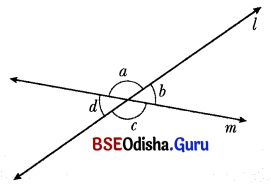
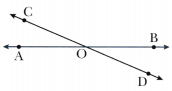
When two lines intersect, they form four angles at the point of intersection.
Parallel and Intersecting Lines Class 7 MCQ Maths Chapter 5-4

Question 2.
The sum of a linear pair of angles formed by intersecting lines is:
(a) 360°
(b) 180°
(c) 90°
(d) 45°
Solution:
(b) 180°
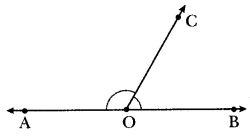
A linear pair of angles is formed when two angles are adjacent and their non-common arms form a straight line. This means the two angles lie on a straight line.
So, their sum is always 180°.
Parallel and Intersecting Lines Class 7 MCQ Maths Chapter 5-5
∠AOC + ∠BOC = 180°
So, they form linear pairs.

Question 3.
Which of the following is true about perpendicular lines?
(a) They form acute angles.
(b) They form obtuse angles.
(c) They do not intersect.
(d) They form four right angles.
Solution:
(d) They form four right angles.
When two lines are perpendicular, they form four right angles at the point of intersection .

Parallel and Intersecting Lines Class 7 MCQ Maths Chapter 5

Question 4.
If the complement of an angle is 42°, then the angle is:
(a) 28°
(b) 48°
(c) 138°
(d) 148°
Solution:
(b) 48°
We know that complement of angle x° is (90° – x°).
∴ Complement of 42° = 90° – 42° = 48°
Thus, the angle is 48°.

Question 5.
If the supplement of an angle is 42°, then the angle is:
(a) 28°
(b) 48°
(c) 138°
(d) 148°
Solution:
(c) 138°
We know that supplement ot’x0 is (180° – x°).
∴ Supplement of 42° = 180° – 42° = 138°.

Question 6.
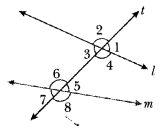
When a transversal cuts two lines, how many angles are formed in total?
(a) 4
(b) 6
(c) 8
(d) 10
Solution:
(c) 8
When a transversal cuts across two lines (whether parallel or not), it intersects each line and forms 4 angles with first line and 4 angles with second line.
So, total of 8 angles are formed when a transversal cuts two lines.

Parallel and Intersecting Lines Class 7 MCQ Maths Chapter 5

Question 7.
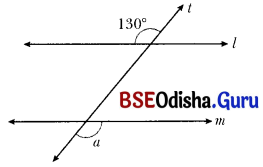
In the given figure, the parallel lines l and m are intersected by a transversal t. The value of ∠a is:
Parallel and Intersecting Lines Class 7 MCQ Maths Chapter 5-1
(a) 50°
(b) 80°
(c) 120°
(d) 130°
Solution:
(d) 130°
In the given figure, ∠a and 130° are alternate exterior angles.
We know that alternate exterior angles formed by a transversal intersecting a pair of parallel lines are always equal to each other.
So, ∠a = 130°

Question 8.
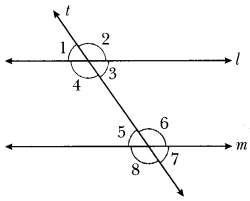
In the given figure, which pair of angles forms alternate interior angles?
Parallel and Intersecting Lines Class 7 MCQ Maths Chapter 5-2
(a) ∠1 and ∠5
(b) ∠2 and ∠6
(c) ∠4 and ∠5
(d) ∠3 and ∠5
Solution:
(d) ∠3 and ∠5
We know that alternate interior angles lie between the two lines and on opposite sides of the transversal.
From the figure, as ∠3 and ∠5 are on opposite sides of the transversal t and between the two lines l and m, they form a pair of alternate interior angles.

Question 9.
Which of the following is always true when a transversal intersects two lines?
(a) All angles are right angles.
(b) All vertically opposite angles are equal.
(c) All angles are different.
(d) All corresponding angles are equal.
Solution:
(b) All vertically opposite angles are equal.
Parallel and Intersecting Lines Class 7 MCQ Maths Chapter 5-6
When a transversal intersects two lines (whether parallel or not), vertically opposite angles are always equal at each point of intersection. This is a basic geometric property and does not depend on whether the lines are parallel or not.

Parallel and Intersecting Lines Class 7 MCQ Maths Chapter 5

Question 10.
Two parallel lines are cut by a transversal. If ∠x = 65° and it corresponds to ∠y, what is the measure of ∠y?
(a) 115°
(b) 65°
(c) 125°
(d) cannot be determined
Solution:
(b) 65°
We know that when two parallel lines are cut by a transversal, the corresponding angles are always equal.
∴ ∠y = ∠x = 65°

Question 11.
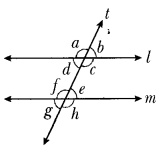
In the figure, if two lines l and m are parallel and ∠c = 110°, what is the measure of its alternate angle?
Parallel and Intersecting Lines Class 7 MCQ Maths Chapter 5-3
(a) 110°
(b) 70°
(c) 90°
(d) 100°
Solution:
(a) 110°
We know that when two parallel lines l and m are cut by a transversal t, the alternate interior angles are always equal. Here, ∠f is the alternate interior angle of ∠c.
Therefore, ∠f – ∠c = 110°.

Question 12.
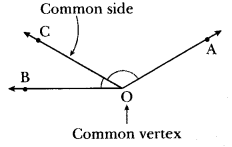
Which of the following are true for adjacent angles?
(i) They share a common vertex.
(ii) They lie on different planes.
(iii) They have a common arm.
(iv) Their non-common arms lie on the same side of the common arm.
Choose the correct option from the following:
(a) (i) and (ii)
(b) (ii) and (iv)
(c) (i) and (iii)
(d) (ii) and (iii)
Solution:
(c) (i) and (iii)
We know that two angles in a plane are said to be adjacent angles if:
Parallel and Intersecting Lines Class 7 MCQ Maths Chapter 5-7
(1) they have a common vertex,
(2) they have a common arm, and
(3) their other arms lie on the opposite side of the common arm.
Thus, (i) and (iii) are true.

Parallel and Intersecting Lines Class 7 MCQ Maths Chapter 5

Question 13.
Which of the following statements about supplementary angles are correct?
(i) Two angles are supplementary if their measures add up to 180°.
(ii) Two obtuse angles can be supplementary.
(iii) A pair of right angles is always supplementary.
(iv) Supplementary angles must always be adjacent.
(v) If one angle is 65°, its supplement is 115°.
Choose the correct option from the following:
(a) Only (i) and (iii)
(b) (i), (ii) and (iv)
(c) (i), (ii) and (v)
(d) (i), (iii) and (v)
Solution:
(d) (i), (iii) and (v)
We know that if the sum of the measures of two angles is 180°, then the angles are called supplementary angles.

Two obtuse angles cannot be supplementary angles as the sum of these angles will be more than 180°.

A pair of right angles, i.e. two right angles are always supplementary angles as the sum of these angles is 180° and supplementary angles may or may not be adjacent.

As 65° + 115° = 180°, 65° and 115° are supplement of each other.
Thus, (i), (iii) and (v) are correct.

Parallel and Intersecting Lines Class 7 Assertion and Reason Questions

The following questions are Assertion and Reason based questions. Two statements are given, one labelled as Assertion (A) and the other is labelled as Reason (R). Select the correct answer to these questions from the codes (a), (b), (c) and (d) as given below.
(a) Both A and R are true and R is the correct explanation of A.
(b) Both A and R are true but R is not the correct explanation of A.
(c) A is true but R is false.
(d) A is false but R is true.

Question 1.
(A): Two right angles can be complementary.
(R): Complementary angles are those angles whose sum is 90°.
Solution:
(d) A is false but R is true.
We know that if the sum of the measures of two angles is 90°, then the angles are called complementary angles.
A right angle measures exactly 90°, so sum of two right angles = 90° + 90° = 180°.
Thus, two right angles cannot be complementary.
Thus, Assertion (A) is false, but Reason (R) is true.

Question 2.
(A): Two obtuse angles can never be supplementary.
(R): Supplementary angles are those angles whose sum is 180°.
Solution:
(a) Both A and R are true and R is the correct explanation of A.
We know that if the sum of the measures of two angles is 180°, then the angles are called supplementary angles.

An obtuse angle is more than 90°. So, two obtuse angles will always have a sum greater than 180°, and hence they cannot be supplementary.

Thus, both Assertion (A) and Reason (R) are true, and Reason (R) is the correct explanation of Assertion (A).

Parallel and Intersecting Lines Class 7 MCQ Maths Chapter 5

Question 3.
(A): Linear pair of angles are always supplementary.
(R): Linear pair angles are adjacent and lie on a straight line.
Solution:
(a) Both A and R are true and R is the correct explanation of A.
We know that linear pair of angles are adjacent angles formed on a straight line.
Since a straight line forms 180° angle, the two adjacent angles always add up to 180°.
Hence, they are supplementary.
Thus, both Assertion (A) and Reason (R) are true, and Reason (R) is the correct explanation of Assertion (A).

Question 4.
(A): Parallel lines never intersect even if extended infinitely.
(R): Parallel lines are always equidistant from each other.
Solution:
(a) Both A and R are true and R is the correct explanation of A.
We know that parallel lines stay the same distance apart and lie on the same plane.
So, they never intersect, no matter how far extended.
Thus, both Assertion (A) and Reason (R) are true, and Reason (R) is the correct explanation of Assertion (A).

Parallel and Intersecting Lines Class 7 Fill in the Blanks

Question 1.
When two lines on a plane do not meet even when extended infinitely, they are called __________ lines.
Solution: parallel
When two lines on a plane do not meet even when extended infinitely, they are called parallel lines.

Parallel and Intersecting Lines Class 7 MCQ Maths Chapter 5

Question 2.
When two lines intersect and all four angles formed are equal, each angle measures ________ degrees.
Solution: 90
We know that when two lines intersect, they form four angles.
Parallel and Intersecting Lines Class 7 MCQ Maths Chapter 5-8
Given, all four angles formed are equal.
Let the four angles formed be ∠a, ∠b, ∠c and ∠d. Then,
∠a + ∠b + ∠c + ∠d = 360°
⇒ ∠a + ∠a + ∠a + ∠a = 360°
[∵ ∠a = ∠b = ∠c = ∠d]
⇒ 4∠a = 360° => ∠a = 90°
Thus, when two lines intersect and all four angles formed are equal, each angle measures 90 degrees.

Question 3.
Vertically opposite angles are always ________ .
Solution: equal
Vertically opposite angles are always equal.

Question 4.
________ lines always stay the same distance apart from each other.
Solution: Parallel
Parallel lines always stay the same distance apart from each other.

Expressions using Letter Numbers Class 7 MCQ Maths Chapter 4

Regular revision with Class 7 Maths MCQ with Answers and Ganita Prakash Class 7 Maths Chapter 4 Expressions using Letter Numbers MCQ improves accuracy in objective exams.

MCQ on Expressions using Letter Numbers Class 7

Expressions using Letter Numbers MCQ Class 7

Class 7 Maths Expressions using Letter Numbers MCQ

Question 1.
The value of the expression 2x – 7, when x = 5, is:
(a) 7
(b) 5
(c) 3
(d) -4
Solution:
(c) 3
Putting x = 5 in the expression 2x – 7, we get
2 × 5 – 7 = 10 – 7 = 3

Question 2.
The value of the expression 4p + 8q – 10, when p = 3 and q = -1, is:
(a) 8
(b) -24
(c) 14
(d) -6
Solution:
(d) -6
Putting p = 3 and q = – 1 in the expression
4p + 8q – 10,
we get 4 × 3 + 8 × (- 1) – 10 = 12 – 8 – 10
= 12 – 18 = – 6

Question 3.
The simplified form of 9x + 2y + 3x – 7y is:
(a) 12x – 5y
(b) 7xy
(c) 11x – 4y
(d) -3xy
Solution:
(a) 12x – 5y
Given, 9x + 2y + 3x – 7y
Here, 9x and 3x are like terms; 2y and -7y are like terms.
So, 9x + 2y + 3x – 7y = 9x + 3x + 2y – 7y
= 12x – 5y

Expressions using Letter Numbers Class 7 MCQ Maths Chapter 4

Question 4.
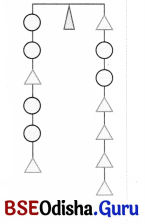
Shown alongside is a BALANCED hanger using circular and triangular cut-outs. The weight of each circular cut-out is 1 unit and of each triangular cut-out is p units.
Which of the following will help in finding the weight of triangular cut-out?
Expressions using Letter Numbers Class 7 MCQ Maths Chapter 4-1
(a) 6p = 7p
(b) 2p + 4 = 5p + 2
(c) 2(p + 4) = 5(p + 2)
(d) 4p + 2 = 2p + 5
Solution:
(b) 2p + 4 = 5p + 2
Left side: 4 circles and 2 triangles
Right side: 2 circles and 5 triangles
Thus, total weight on left side
= 4 × 1 + 2 × p = (4 + 2p) units
And total weight on right side
= 2 × 1 + 5 × p = (2 + 5p) units
Since the hanger is balanced, both sides must have equal weight.
∴ Weight on left side = Weight on right side
⇒ 4 + 2p = 2 + 5p
⇒ 2p + 4 = 5p + 2

Question 5.
Niharika is printing posters for an event using her home printer. It takes 15 seconds to set up the printer before it starts printing. Once it starts, each poster takes 6 seconds to print. Which of the following expressions shows the total time (in seconds) needed to print4p’ posters, assuming the printer is off initially?
(a) 15 + 6 + p
(b) (15 + 6)p
(c) 15 × 6p
(d) 15 + 6p
Solution:
(d) 15 + 6p
Time taken to set up the printer = 15 seconds (this happens only once).
Time taken to print 1 poster = 6 seconds
Therefore, time taken to print ‘p’ posters = 6p seconds
Thus, total time needed to print ‘p’ posters
= Time taken to set up the printer + Time taken to print ‘p’ posters = (15 + 6p) seconds

Question 6.
The simplified form of 5m – 2n – 7m + 10n + 3 is:
(a) 3
(b) 3m + 3n + 3
(c) 2m + 8n
(d) -2m + 8n + 3
Solution:
(d) -2m + 8n + 3
Given, 5m – 2n – 7m + 10n + 3
Here, 5m and -7m are like terms; -2n and 10n are like terms.
So, 5m – 2n – 7m + 10n + 3
= 5m – 7m – 2n + 10n + 3
= -2m + 8n + 3

Expressions using Letter Numbers Class 7 MCQ Maths Chapter 4

Question 7.
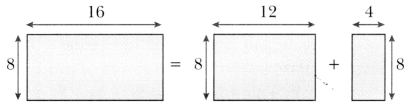
Shown below is a representation of one of the properties of whole numbers.
Expressions using Letter Numbers Class 7 MCQ Maths Chapter 4-2
Which of the following represents the property shown?
(a) a(b + c) = a × b + a × c
(b) a + b = b + a
(c) a × (b × c) = a × (b × c)
(d) a + (b + c) = (a + b) + c
Solution:
(a) a(b + c) = a × b + a × c
From figure, we have
Area on left side = Area on right side
⇒ 16 × 8 = 12 × 8 + 4 × 8
[∵ Area of rectangle = Length × Breadth]
⇒ 8 × 16 = 8 × 12 + 8 × 4
⇒ 8 × (12 + 4) = 8 × 12 + 8 × 4
[∵ 16 = 12 + 4]
Suppose a = 8, b = 12 and c = 4, we get
a(b + c) = a × b + a × c

Question 8.
Amit sells cold drinks and sandwiches at a school canteen. One cold drink costs ₹25 and one sandwich costs ₹40.
If m cold drinks and n sandwiches were sold in a day, which of the following expressions shows the total amount earned (in rupees) that day?
(a) 25m + 40n
(b) (25 + 40) × (m + n)
(c) 40m + 25n
(d) (25 + 40) × m + n
Solution:
(a) 25m + 40n
Cost of 1 cold drink = ₹25
Cost of 1 sandwich = ₹40
Money earned from m cold drinks
= 25 × m = 25m
Money earned from n sandwiches
= 40 × n = 40n
Total earnings = 25m + 40M

Question 9.
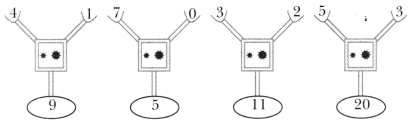
The formula of the given number machine is:
Expressions using Letter Numbers Class 7 MCQ Maths Chapter 4-3
(a) 2a + b
(b) a × b + 5
(c) a + 5 × b
(d) None of these
Solution:
(b) a × b + 5
We can see,
4 × 1 + 5 = 445 = 9, 7 × 0 + 5 = 0 + 5 = 5,
3 × 2 + 5 = 6 + 5 = 11, 5 × 3 + 5 = 15 + 5 = 20
Here, the rule followed is “5 more than the product of two numbers”.
Thus, if two numbers are a and b, the formula for the given machine is a × b + 5.

Expressions using Letter Numbers Class 7 MCQ Maths Chapter 4

Question 10.
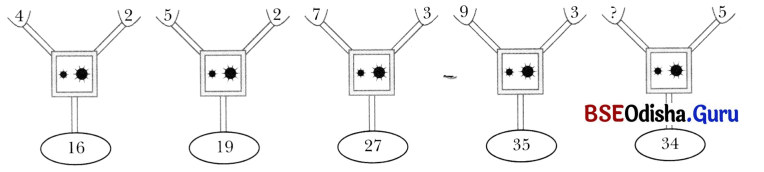
Consider the following number machine:
Expressions using Letter Numbers Class 7 MCQ Maths Chapter 4-4
What is the missing input?
(a) 8
(b) 10
(c) 12
(d) 15
Solution:
(a) 8
We can see,
4 × 3 + 2 × 2 = 12 + 4 = 16,
5 × 3 + 2 × 2=15 + 4=19,
7 × 3 + 3 × 2 = 21 + 6 = 27,
9 × 3 + 3 × 2 = 27 + 6 = 33
So, the rule for the given machine in algebraic expression is,
Output = a × 3 + b × 2, where a and b are inputs.
When output = 34 and b = 5,
34 = a × 3 + 5 × 2
⇒ 34 = 3a + 10 ⇒ 3a = 34 – 10 = 24
⇒ a = \(\frac{24}{3}\) = 8 3
Thus, the missing input is 8.

Question 11.
The value of expression 6m – 7n is:
(i) 6, when m = 4 and n = 2.
(ii) 9, when m = 5 and n = 3.
(iii) -9, when m = 2 and n = 3.
(iv) 10, when m = 3 and n = 1.
Choose the correct option from the following:
(a) (i) and (ii)
(b) (ii) and (iii) only
(c) (ii), (iii) and (iv)
(d) (i) and (iv)
Solution:
(b) (ii) and (iii) only
When m = 4 and n = 2;
6m – 7n = 6 × 4 – 7 × 2 = 24 – 14 = 10
When m = 5 and n = 3;
6m – 7n = 6 × 5 – 7 × 3 = 30 – 21 = 9
When m = 2 and n = 3;
6m – 7n = 6 × 2 – 7 × 3 = 12 – 21 = – 9
When m = 3 and n = 1;
6m – 7n = 6 × 3 – 7 × 1 = 18 – 7 = 11
So, (ii) and (iii) are correct.

Question 12.
If p is a number, then which of the following statements are correct?
(i) 2 more than 3 times the number is 2p + 3.
(ii) 4 less than 7 times the number is 7p – 4.
(iii) 4 more than 5 times the number is 5p + 4.
(iv) 8 less than 4 times the number is 8p – 4.
Choose the correct option from the following:
(a) (i) and (ii)
(b) (ii) and (iii) only
(c) (ii), (iii) and (iv)
(d) (i) and (iv)
Solution:
(b) (ii) and (iii) only
(i) 2 more than 3 times the number is 2 + 3 × p
= 3p + 2.
(ii) 4 less than 7 times the number is 7 × p – 4
= 7p – 4.
(iii) 4 more than 5 times the number is 4 + 5 × p
= 5p + 4.
(iv) 8 less than 4 times the number is 4 × p – 8
= 4p – 8.
So, (ii) and (iii) are correct.

Expressions using Letter Numbers Class 7 MCQ Maths Chapter 4

Question 13.
The expression 5x – 3y + 4 is equivalent to
(i) 7x – 2y – (2x + y + 2) + 6
(ii) 5x – y + 3 – 2(y + 2x) + 1
(iii) x – y – (2y – 4x) + 4
(iv) 2(2y – x – 2) + 7(1 – y + x) + 1
Choose the correct option from the following:
(a) (i) only
(b) (ii) and (iii) only
(c) (i), (iii) and (iv) only
(d) (i), (ii), (iii) and (iv)
Solution:
(c) (i), (iii) and (iv) only
(i) 7x – 2y – (2x + y + 2) + 6
= 7x – 2y – 2x – y – 2 + 6
= (7x – 2x) + (-2y – y) + 4
= 5x + (-3y) + 4 = 5x – 3y + 4

(ii) 5x – y + 3 – 2(y + 2x) + 1
= 5x – y + 3 – 2y – 4x + 1
= (5x – 4x) + (-y – 2y) + 3 + 1
= x + (-3y) + 4
= x – 3y + 4 ≠ 5x – 3y + 4

(iii) x – y – (2y – 4x) + 4
= x – y – 2y + 4x + 4
= (x + 4x) + (-y – 2y) + 4
= 5x + (-3y) + 4 = 5x – 3y + 4

(iv) 2(2y – x – 2) + 7(1 – y + x) + 1
= 4y – 2x – 4 + 7 – 7y + 7x + 1
= (-2x + 7x) + (4y – 7y) – 4 + 7 + 1
= 5x + (-3y) + 4 = 5x – 3y + 4
So, (i), (iii) and (iv) are correct.

Expressions using Letter Numbers Class 7 Fill in the Blanks

Question 1.
If n is a number, then:
(i) 7 more than the number is _____.
(ii) 3 less than the number is __.
(iii) 5 less than 7 times the number is _________.
(iv) 12 more than 9 times the number is _____.
Solution: n + 7, n – 3, 7n – 5, 9n + 12.
(i) 7 more than the number is n + 7.
(ii) 3 less than the number is n – 3.
(iii) 5 less than 7 times the number is 7n – 5.
(iv) 12 more than 9 times the number is 9n + 12.

Question 2.
If x = – 4, then 5 – x = ____.
Solution: 9
Putting x = – 4 in the expression 5 – x, we get
5 – (-4) = 5 + 4 = 9
∴ If x = – 4, then 5 – x = 9.

Expressions using Letter Numbers Class 7 MCQ Maths Chapter 4

Question 3.
If t = 21, then 3t = _______ .
Solution: 63
Putting t = 21 in the expression 31, we get
3 × 21 = 63
∴ If t = 21, then 3t = 63.

Question 4.
If p = 7 and q = – 3, then 3p + 2q = _______.
Solution: 15
Putting p = 7 and q = – 3 in the expression 3p + 2q, we get
3 × 7 + 2 × (- 3) = 21 – 6 = 15 .
∴ If p = 7 and q = – 3, then 3p + 2q = 15.

Question 5.
If x = 12, then 4x + 5 = ______.
Solution: 53
Putting x = 12 in the expression 4x + 5, we get
4 × 12 + 5 = 48 + 5 = 53
∴ If x = 12, then 4x + 5 = 53.

Question 6.
If m = – 4, then 5(m + 1) = _______.
Solution: -15
Putting m = -4 in the expression 5(m + 1), we get
5(- 4 + 1) = 5 × (- 3) = -15
∴ If = -4, then 5(m + 1) = -15.

Expressions using Letter Numbers Class 7 MCQ Maths Chapter 4

Question 7.
If p = – 10 and q = 5, then 5p + 10q = ______.
Solution: 0
Putting p = -10 and q = 5 in the expression 5p + 10q, we get
5 × (- 10) + 10 × 5 = – 50 + 50 = 0
∴ If p = – 10 and q = 5 then 5p + 10q = 0.

A Peek Beyond the Point Class 7 MCQ Maths Chapter 3

Regular revision with Class 7 Maths MCQ with Answers and Ganita Prakash Class 7 Maths Chapter 3 A Peek Beyond the Point MCQ improves accuracy in objective exams.

MCQ on A Peek Beyond the Point Class 7

A Peek Beyond the Point MCQ Class 7

Class 7 Maths A Peek Beyond the Point MCQ

Question 1.
How many tenths make a unit?
(a) \(\frac{1}{10}\)
(b) 10
(c) 100
(d) 1
Solution:
(b) 10
We know, 1 unit = 10 one-tenths.

Question 2.
The value of \(4 \frac{4}{10}+7 \frac{3}{10}\) is:
(a) \(7 \frac{7}{10}\)
(b) \(11 \frac{7}{10}\)
(c) \(10 \frac{1}{10}\)
(d) \(7 \frac{17}{10}\)
Solution:
(b) \(11 \frac{7}{10}\)
We can write, \(4 \frac{4}{10}=\frac{44}{10} \text { and } 7 \frac{3}{10}=\frac{73}{10}\)
Now, \(4 \frac{4}{10}+7 \frac{3}{10}=\frac{44}{10}+\frac{73}{10}\)
= \(\frac{117}{10}=\frac{110}{10}+\frac{7}{10}=11+\frac{7}{10}=11 \frac{7}{10}\)

Question 3.
How is one-hundredth represented in decimal form?
(a) 0.01
(b) 0.001
(c) 1.0
(d) 0.1
Solution:
(a) 0.01
One-hundredth represents 100 parts of a unit, i.e. \(\frac{1}{100}=\frac{01}{100}\)
Here, number of zeros in denominator is 2.
So, putting decimal point in the numerator 2 places to the left, we get 0.01.
Thus, the decimal representation of one- hundredth is 0.01.

A Peek Beyond the Point Class 7 MCQ Maths Chapter 3

Question 4.
The place value of 5 in the decimal 11.485 is:
(a) Five-tenths
(b) Five-hundredths
(c) Five-thousandths
(d) Five-ones
Solution:
(c) Five-thousandths
The expanded form of 11.485 is:
11.485 = 10 × 1 + 1 × 1 + \(\left(4 \times \frac{1}{10}\right)\) + \(\left(8 \times \frac{1}{100}\right)+\left(5 \times \frac{1}{1000}\right)\)
Thus, the place value of 5 in the decimal 11.485 is five-thousandths, i.e. 0.005.

Question 5.
The decimal form of 729 hundredths is:
(a) 729
(b) 72.9
(c) 7.29
(d) None of these
Solution:
(c) 7.29
The decimal form of 729 hundredths is \(\frac{729}{100}\) = 7.29.

Question 6.
The decimal representation of \(\frac{3}{4}\) is:
(a) 0.75
(b) 0.85
(c) 0.65
(d) 0.95
Solution:
(a) 0.75
We have, \(\frac{3}{4}=\frac{3 \times 25}{4 \times 25}=\frac{75}{100}\) = 0.75

A Peek Beyond the Point Class 7 MCQ Maths Chapter 3

Question 7.
The place value of the digit 7 in the number 3.476 is:
(a) 7 ones
(b) 7 tenths
(c) 7 hundredths
(d) 7 thousandths
Solution:
(c) 7 hundredths
3.476 can he represented in the decimal place value chart as:

Tens Ones . Tenths Hundredths Thousandths
3 . 4 7 6

Hence, the place value of the digit 7 in the number 3.476 is 7 hundredths, i.e. 0.07.

Question 8.
If a number line is divided into 10 equal parts between 3 and 4, then the decimal number at the 7th division is:
(a) 3.07
(b) 3.7
(c) 3.17
(d) 37
Solution:
(b) 3.7
The number line, divided into 10 equal parts between 3 and 4, is given as:
A Peek Beyond the Point Class 7 MCQ Maths Chapter 3-1
Thus, the decimal number at the 7th division is 3.7.

Question 9.
The greatest decimal number among the following is:
(a) 1.2
(b) 1.02
(c) 1.22
(d) 1.21
Solution:
(c) 1.22
The given decimal numbers are: 1.2, 1.02, 1.22, 1.21
Converting them to like decimals, we get 1.20, 1.02, 1.22, 1.21

Now, as the whole number part of all the decimal numbers is the same, i.e. 1, we compare the digits after the decimal point from left to right.

As 1.02 has 0 at the tenths place while other decimals have 2, 1.02 is the smallest.
Now, comparing the hundredths place of 1.20, 1.22, 1.21, we get
1.22 > 1.21 > 1.20 (As 2 >1 > 0)
Thus, 1.22 is the greatest among the given numbers.

A Peek Beyond the Point Class 7 MCQ Maths Chapter 3

Question 10.
Which of the following sequence is decreasing?
(a) 4.5, 4.55, 4.6
(b) 2.3, 2.2, 2.1
(c) 3.1, 3.0, 3.1
(d) 1.01,2.001,3.0001
Solution:
(b) 2.3, 2.2, 2.1
A sequence is decreasing if each term is smaller
than the one before it.
2.3, 2.2, 2.1 → each term decreases by 0.1 i.e. (2.3 > 2.2 > 2.1).
Thus, 2.3, 2.2, 2.1 is the decreasing sequence.

Question 11.
How can we express 0.5 hours in minutes?
(a) 50 minutes
(b) 45 minutes
(c) 25 minutes
(d) 30 minutes
Solution:
(d) 30 minutes
We know, 1 hour = 60 minutes
Thus, 0.5 hours = 0.5 × 60 = \(\frac{5}{10}\) × 60
= 30 minutes

Question 12.
Which of the following pairs of decimal numbers are equivalent?
(i) 0.5 and 0.500
(ii) 0.05 and 0.0500
(iii) 1.06 and 1.060
(iv) 0.06 and 0.600
Choose the correct option from the following:
(a) (i) and (iv)
(b) (ii) and (iii) only
(c) (i), (ii) and (iii)
(d) (i) and (iii) only
Solution:
(c) (i), (ii) and (iii)
We know that adding trailing zeros after the last non-zero digit of a decimal does not change its value. Thus,
(i) 0.5 and 0.500 are equivalent.
(ii) 0.05 and 0.0500 are equivalent.
(iii) 1.06 and 1.060 are equivalent.
(iv) 0.06 and 0.600 are not equivalent as 0.06 represents 6-hundredths, while 0.600 represents 6-tenths.

A Peek Beyond the Point Class 7 MCQ Maths Chapter 3

Question 13.
Which of these are correct comparisons of decimals?
(i) 0.70 = 0.7
(ii) 0.701 > 0.7
(iii) 0.65 < 0.605
(iv) 0.506 < 0.56
Choose the correct option from the following:
(a) (i) and (iii) only
(b) (ii) and (iv) only
(c) (i), (ii) and (iv)
(d) (i), (iii) and (iv)
Solution:
(c) (i), (ii) and (iv)
(i) 0.70 and 0.7 are equal in value, i.e. 7 tenths. Thus, this comparison is correct.
(ii) 0.701 is greater than 0.7 because it has a 1 in the thousandths place, while 0.7 has 0. Thus, this comparison is correct.
(iii) 0.65 is greater than 0.605, since 0.65 = 0.650. So, this comparison is incorrect.
(iv) 0.506 < 0.56, since 0.506 = 506 thousandths, and 0.56 = 560 thousandths. Thus, this comparison is correct.

Question 14.
Which of the following statements are true?
(i) The decimal number with the greater whole number part is greater.
(ii) Milligrams are used for measuring heavier weights like bags of rice, etc. while kilograms are used for very light weights like medicine dosage, etc.
(iii) 3.5 feet means 3 feet and 5 inches.
(iv) 2.4 hours means 2 hours 24 minutes.
Choose the correct option from the following:
(a) (ii) and (iv)
(b) (ii) and (iii)
(c) (i) and (iv)
(d) (i) and (iii)
Solution:
(c) (i) and (iv)
The decimal number with greater whole number part is greater. For example, 7.1 > 6.99 because 7 > 6.
Kilograms are used for heavier things (like bags of rice) while milligrams are used for very tiny weights (like medicine).
Since 1 foot =12 inches, 0.5 feet = 6 inches. So, 3.5 feet = 3 feet 6 inches.
0.4 hours = 0.4 × 60 = 24 minutes. So, 2.4 hours = 2 hours 24 minutes.
Thus, statements (i) and (iv) are true.

A Peek Beyond the Point Class 7 Assertion and Reason Questions

The following questions are Assertion and Reason based questions. Two statements are given, one labelled as Assertion (A) and the other is labelled as Reason (R). Select the correct answer to these questions from the codes (a), (b), (c) and (d) as given below.
(a) Both A and R are true and R is the correct explanation of A.
(b) Both A and R are true but R is not the correct explanation of A.
(c) A is true but R is false.
(d) A is false but R is true.

Question 1.
(A): Fractional part of a number is always less than 1.
(R): Decimal places represent values like
\(\frac{1}{10}, \frac{1}{100}, \frac{1}{1000},\) and so on. These are all parts of a whole.
Solution:
(a) Both A and R are true and R is the correct explanation of A.
Decimal places represent values like \(\frac{1}{10}, \frac{1}{100}, \frac{1}{1000},\)
and so on. These are a parts of a whole, they are less than 1.
That’s why fractional part of a number is always less than 1.
Thus, both Assertion (A) and Reason (R) are true, and Reason (R) is the correct explanation of Assertion (A).

A Peek Beyond the Point Class 7 MCQ Maths Chapter 3

Question 2.
(A): \(3 \frac{6}{100}\) is greater than \(3 \frac{6}{10}\).
(R): \(\frac{6}{100}\) has a larger denominator than \(\frac{6}{10}\).
Solution:
(d) A is false but R is true.
We can write \(3 \frac{6}{100}=\frac{306}{100}\) and \(3 \frac{6}{10}=\frac{36}{10}=\frac{360}{100}\)
Clearly, 360 > 306 ⇒ \(\frac{360}{100}>\frac{306}{100}\)
⇒ \(3 \frac{6}{10}>3 \frac{6}{100}\)
Thus, Assertion (A) is false.
Now, as 100 > 10, \(\frac{6}{100}\) has larger denominator than \(\).
Thus, Reason (R) is true.

Question 3.
(A): If we subtract 47.38 from 89.62, the whole number parts differ by 42, and the actual result is more than 41 and less than 43.
(R): When subtracting two decimal numbers, the result lies between one less than and one more than the difference of their whole number parts.
Solution:
(a) Both A and R are true and R is the correct explanation of A.
Whole number part of 89.62 = 89
Whole number part of 47.38 = 47
Difference of whole number parts
= 89 – 47 = 42
Actual difference: 89.62 – 47.38 = 42.24
Now, (42 – 1) < 42.24 < (42 + 1) i.e.
41 < 42.24 < 43.
Thus, both Assertion (A) and Reason (R) are true, and Reason (R) is the correct explanation of Assertion (A).

A Peek Beyond the Point Class 7 MCQ Maths Chapter 3

Question 4.
(A): 38 paise = ₹0.38
(R): One rupee =100 paise
Solution:
(a) Both A and R are true and R is the correct explanation of A.
We know that 1 rupee = 100 paise.
So, 1 paisa = \(\frac{1}{100}\) rupee
Therefore, 38 paise = ₹ \(\frac{38}{100}\) = ₹0.38
Hence, both Assertion (A) and Reason (R) are true, and Reason (R) is the correct explanation of Assertion (A).

A Peek Beyond the Point Class 7 Fill in the Blanks

Question 1.
The length \(2\frac{7}{10}\) cm is read as _____.
Solution: two and seven- tenths centimetres
The length \(2\frac{7}{10}\) cm is read as two and seven- tenths centimetres.

A Peek Beyond the Point Class 7 MCQ Maths Chapter 3

Question 2.
Kashvi cuts a 1-metre ribbon into 10 equal pieces. The length of one piece is ______ metre.
Solution: \(\frac{1}{10}\) or one-tenth
Given, length of ribbon is 1 metre and number of equal pieces is 10.
∴ Length of each piece = \(\frac{1}{10}\) metre
Thus, the length of one piece is \(\frac{1}{10}\) or one-tenth metre.

Question 3.
Fill in the blanks:
(i) __________ mm = 42.9 cm
(ii) 826 cm = ________ m
(iii) _____ g = 9.5 kg
(iv) 1834 mm = _____ cm
(v) 1749 g = ____ kg
(vi) ₹7 = _____ paise
(vii) ₹ 18.75 = ______ paise
(viii) ₹ _______ = 4250 paise
Solution: 429, 8.26, 9500, 183.4, 1.749, 700, 1875, 42.50
(i) We know that 1 cm = 10 mm.
Therefore, 42.9 cm = 42.9 × 10 mm
= \(\frac{429}{10}\) × 10 mm = 429 mm

(ii) We know that 1 cm = \(\frac{1}{100}\) m
Therefore, 826 cm = \(\frac{826}{100}\) m = 0.86 m

(iii) We know that 1 kg = 1000 g.
Therefore, 9.5 kg = 9.5 × 1000 g 95
= \(\frac{95}{10}\) × 1000 g = 9500 g

(iv) We know that 1 mm = \(\frac{1}{10}\) cm.
Therefore, 1834 mm = \(\frac{1834}{10}\) cm = 183.4 cm

(v) We know that 1 g = \(\frac{1}{1000}\) kg.
Therefore, 1749 g = \(\frac{1749}{100}\) kg = 1.749 kg

(vi) We know that 1 rupee = 100 paise.
Therefore, 7 rupees = 7 × 100 paise
= 700 paise

(vii) We know that 1 rupee =100 paise.
Therefore, ₹ 18.75 = 18.75 × 100 paise
= \(\frac{1875}{100}\) × 100 = 1875 paise

(viii) We know that 1 paise = \(\frac{1}{100}\) rupee
4250 paise = \(\frac{4250}{100}\) rupees = 42.50 rupees

Arithmetic Expressions Class 7 MCQ Maths Chapter 2

Regular revision with Class 7 Maths MCQ with Answers and Ganita Prakash Class 7 Maths Chapter 2 Arithmetic Expressions MCQ improves accuracy in objective exams.

MCQ on Arithmetic Expressions Class 7

Arithmetic Expressions MCQ Class 7

Class 7 Maths Arithmetic Expressions MCQ

Question 1.
The value of expression 8 + 7 + 6 is:
(a) 21
(b) 19
(c) 20
(d) 17
Solution:
(a) 21
We have, 8 + 7 + 6 = 15 + 6 = 21

Question 2.
Compare and choose the correct option to fill the box: 24 + 16 ☐ 56 – 16.
(a) >
(b) <
(c) =
(d) None of these
Solution:
(c) =
Given, 24 + 16 ☐ 56 – 16
Left hand side (LHS) = 24 + 16 = 40
Right hand side (RHS) = 56 – 16 = 40
Clearly, LHS = RHS So, 24 + 16 = 56 – 16

Question 3.
Compare and choose the correct option to fill the box: 4 × 3 ☐ 78 ÷ 6.
(a) >
(b) <
(c) =
(d) None of these
Solution:
(b) <
Left hand side (LHS): 4 × 3 = 12
Right hand side (RHS): 78 ÷ 6 = 13
Clearly, 12 < 13 ⇒ 4 × 3 < 78 ÷ 6

Arithmetic Expressions Class 7 MCQ Maths Chapter 2

Question 4.
In a sweet shop, Meena packed 12 laddoos in one box and 4 in another. Kunal packed 10 laddoos in one big box and none in the second. Who packed more laddoos?
(a) Meena
(b) Kunal
(c) Both packed the same number
(d) Depends on the sweetness
Solution:
(a) Meena
Laddoos packed by Meena = 12 + 4= 16
Laddoos packed by Kunal = 10 + 0= 10
Thus, Meena packed more laddoos.

Question 5.
The number of terms in the expression 40 – 7 × 3 + 8 ÷ 2 – 4is:
(a) 2
(b) 3
(c) 4
(d) 5
Solution:
(c) 4
We have, 40 – 7 × 3 + 8 ÷ 2 – 4
Arithmetic Expressions Class 7 MCQ Maths Chapter 2-1
So, there are 4 terms in the given expression.

Question 6.
The value of the expression 100 – {25 – (10 × 5)} is:
(a) 125
(b) 115
(c) 120
(d) 130
Solution:
(a) 125
We have, 100 – {25 – (10 × 5)}
We know, on removing the brackets preceded by a minus sign, the signs of all the terms inside the brackets change.
Thus, 100 – {25 – (10 × 5)}
= 100 – 25 + (10 × 5)
= 100 – 25 + 50 = 150 – 25 = 125

Arithmetic Expressions Class 7 MCQ Maths Chapter 2

Question 7.
The value of the expression 240 – [60 – (30 – 8 ÷ 2) + 10] is:
(a) 192
(b) 194
(c) 196
(d) 198
Solution:
(c) 196
240 – [60 – (30 – 8 ÷ 2) + 10]
= 240 – [60 – (30 – 4) + 10]
= 240 – [60 – 26 + 10]
= 240 – 44 = 196

Question 8.
Which of the following is equal to the expression ‘53 – 17 + 4’?
(a) 53 – (17 + 4)
(b) 53 + (17 – 4)
(c) 53 – (17 – 4)
(d) 4 + (17 – 53)
Solution:
(c) 53 – (17 – 4)
We know, on removing the brackets preceded by a minus sign, the signs of all the terms inside the brackets change.
So, 53 – (17 – 4) = 53 – 17 + 4

Question 9.
Which of the following expressions are the arithmetic expressions?
(i) 12 + (2 × 4 – 6)
(ii) 7x + 2y – 3
(iii) 18 ÷ 3 + 7
(iv) 4xy – 11
Choose the correct option from the following:
(a) (i) and (iii) only
(b) (ii) and (iv) only
(c) (i), (ii), (iii) and (iv)
(d) None of these
Solution:
(a) (i) and (iii) only
We know, an arithmetic expression is a
mathematical sentence that contains numbers and operations like addition (+), subtraction (-), multiplication (×) or division (÷).
So, 12 + (2 × 4 – 6) and 18 ÷ 3 + 7 are arithmetic expressions.
And, 7x + 2y – 3 and 4xy – 11 are not arithmetic expressions because x and y are not numbers.

Arithmetic Expressions Class 7 MCQ Maths Chapter 2

Question 10.
Which of the following are correct?
(i) The signs ‘>’, ‘=’ and ‘<’ are used to compare the values of two expressions.
(ii) 276- 19 < 275- 18 (iii) 366 – 20 = 380 – 34 (iv) 490 – 20 > 396 – 30
Choose the correct option from the following:
(a) (i) and (iii) only
(b) (ii) and (iv) only
(c) (i), (ii) and (iii)
(d) (i), (iii) and (iv)
Solution:
(d) (i), (iii) and (iv)
(i) Yes, the signs ‘>’, ‘=’ and ‘<’ are used to compare the values of two expressions.
So, (i) is correct.

(ii) Left-hand side (LHS): 276 – 19 = 257
Right-hand side (RHS): 275 – 18 = 257
Clearly, 276- 19 = 275- 18.
So, (ii) is incorrect.

(iii) Left-hand side (LHS): 366 – 20 = 346
Right-hand side (RHS): 380 – 34 = 346
Clearly, 366 – 20 = 380 – 34.
So, (iii) is correct.

(iv) Left-hand side (LHS): 490 – 20 = 470
Right-hand side (RHS): 396 – 30 = 366
Clearly, 470 > 366
⇒ 490 – 20 > 396 – 30
So, (iv) is correct.

Arithmetic Expressions Class 7 Assertion and Reason Questions

The following questions are Assertion and Reason based questions. Two statements are given, one labelled as Assertion (A) and the other is labelled as Reason (R). Select the correct answer to these questions from the codes (a), (b), (c) and (d) as given below.
(a) Both A and R are true and R is the correct explanation of A.
(b) Both A and R are true but R is not the correct explanation of A.
(c) A is true but R is false.
(d) A is false but R is true.

Question 1.
(A): 110 – 27 > 112 – 27
(R): When the same number is subtracted from two different numbers, the difference is greater for the larger number.
Solution:
(d) A is false but R is true.
We know, when the same number is subtracted
from two different numbers, the difference is greater for the larger number.
Since 112 is larger than 110,
110 – 27 < 112 – 27 Therefore, Assertion (A) is false, but Reason (R) is true.

Question 2.
(A): 568 + 247 > 572 + 248
(R): If a < b and c < d, then a + c < b + d, where a, b, c and d are numbers.
Solution:
(d) A is false but R is true.
If a < b and c < d, then a + c < b + d, where a,
b, c and d are numbers.
Clearly, 568 < 572 and 247 < 248
So, 568 + 247 < 572 + 248
Therefore, Assertion (A) is false, but Reason (R) is true.

Arithmetic Expressions Class 7 MCQ Maths Chapter 2

Question 3.
(A): 5 – 2 ≠ 5 + (-2)
(R): Subtracting a number is the same as adding its additive inverse.
Solution:
(d) A is false but R is true.
We know that subtracting a number is the same
as adding its additive inverse.
∴ 5 – 2 = 5 + (- 2) as – 2 is additive inverse of 2.
Therefore, Assertion (A) is false and Reason (R) is true.

Question 4.
(A) : 16 – (- 7 + 19) = 16 – 7 + 19
(R) : On removing the brackets preceded by a plus “ + ’ sign, the signs of all the terms inside the brackets remain same.
Solution:
(d) A is false but R is true.
We know, on removing the brackets preceded by a ‘+’ sign, the signs of all the terms inside the brackets remains same.
But in expression ‘16 – (-7 + 19)’, brackets are preceded by minus sign.
Therefore, 16 – (- 7 + 19) = 16 + 7 – 19
Therefore, Assertion (A) is false, but Reason (R) is true.

Arithmetic Expressions Class 7 Fill in the Blanks

Question 1.
Fill in the blanks with the correct sign: ‘<’ , ‘>’ or ‘=’:
(i) 111 – 28 _____ 85
(ii) 55 ÷ 11 ____ 5
Solution: <, =
(i) LHS: 111 – 28 = 83
RHS: 85
Clearly, 83 < 85 ⇒ 111 – 28 < 85

(ii) LHS: 55 ÷ 11 = 5
RHS: 5
Clearly, LHS = RHS ⇒ 55 – 11 = 5

Arithmetic Expressions Class 7 MCQ Maths Chapter 2

Question 2.
Fill in the blanks to make the expressions equal on both sides of the ‘ = ’ sign:
(i) 19 + 6 = ____ + 9
(ii) 9 × _____ = 72 ÷ 2
Solution: 16, 4
(i) 19 + 6 = 16 + 9
[∵ 19 + 6 = 25 and 16 + 9 = 25]
(ii) 9 × 4 = 72 ÷ 2
[∵ 72 ÷ 2 = 36 and 9 × 4 = 36]

Question 3.
In the blanks below, fill ‘<’, ‘>’ or ‘=’ after analysing the expressions on the LHS and RHS. Use reasoning and understanding of terms and brackets to figure this out, and not by evaluating the expressions.
(i) (12 – 7) × 36 _____ (7 – 12) × 36
(ii) 20 + 6 × 15 _____ (20 + 6) × 15
Solution: <, <
(i) LHS : (12 – 7) × 36 = Positive number × 36 → Positive number
RHS : (7 – 12) × 36 = Negative number × 36 → Negative number
We know, a positive number is always greater than a negative number.
Thus, LHS > RHS
Hence, (12 – 7) × 36 > (7 – 12) × 36

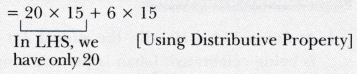
(ii) RHS : (20 + 6) × 15
Arithmetic Expressions Class 7 MCQ Maths Chapter 2-2
Thus, LHS < RHS
Hence, 20 + 6 × 15 < (20 + 6) × 15

Question 4.
Fill in the blanks with numbers and boxes with operation signs such that the expressions on both sides are equal.
(i) 21 + (___ ☐ ____) = 21 + 12 – 5
(ii) 32 – (3 + 8) = 32 ☐ 3 – _____
(iii) 25 – (11 ☐ 7) = 25 – 11 + 7
(iv) 19 – (17 – 12) = 19 ☐ 17 ☐ 12
Solution: 12 – 5, 8, -, -, +
(i) 21 + ( 12 – 5) = 21 + 12 – 5
(ii) 32 – (3 + 8) = 32 – 3 – 8
(iii) 25 – (11 – 7) = 25 – 11 + 7
(iv) 19 – (17 – 12) = 19 – 17 + 12

Large Numbers Around Us Class 7 MCQ Maths Chapter 1

Regular revision with Class 7 Maths MCQ with Answers and Ganita Prakash Class 7 Maths Chapter 1 Large Numbers Around Us MCQ improves accuracy in objective exams.

MCQ on Large Numbers Around Us Class 7

Large Numbers Around Us MCQ Class 7

Class 7 Maths Large Numbers Around Us MCQ

Question 1.
Which of the following numbers has 7 at the lakhs place?
(a) 7,50,812
(b) 70,15,902
(c) 5,74,210
(d) 52,08,701
Solution:
(a) 7,50,812
In 7,50,812, the digit 7 is at lakhs place.
In 70,15,902, the digit 7 is at ten lakhs place.
In 5,74,210, the digit 7 is at ten thousands place.
In 52,08,701, the digit 7 is at hundreds place.

Question 2.
(20 × 10,000) + (53 × 1,000) + (1 × 100) + (2 × 1) represents the number:
(a) 53,20,102
(b) 20,53,102
(c) 2,53,102
(d) 5,20,301
Solution:
(c) 2,53,102
(20 × 10,000) + (53 × 1,000) + (1 × 100) + (2 × 1) = 2,00,000 + 53,000 + 100 + 2
= 2,53,102

Large Numbers Around Us Class 7 MCQ Maths Chapter 1

Question 3.
The correct way of writing ‘sixty five lakh nine thousand four hundred twenty two’ in numbers is:
(a) 65,90,422
(b) 65,09,422
(c) 6,59,422
(d) 65,40,922
Solution:
(b) 65,09,422
Sixty five lakh nine thousand four hundred twenty two = 65,09,422

Question 4.
10 million is equal to:
(a) 100 crore
(b) 1 lakh
(c) 100 lakh
(d) 10,000 lakh
Solution:
(c) 100 lakh
We know,
1 million = 10 lakh
Thus, 10 million =10 × 10 lakh = 100 lakh

Large Numbers Around Us Class 7 MCQ Maths Chapter 1

Question 5.
The estimated difference of 1,76,346 and 3,865 rounded off to the nearest thousand is:
(a) 1,70,000
(b) 1,72,000
(c) 1,90,000
(d) 1,54,000
Solution:
(b) 1,72,000
1,76,346 is rounded off to nearest thousands as
1,76,000. [∵ At hundreds place, 3 < 5] 3,865 is rounded off to nearest thousands as 4.000. [∵ At hundreds place, 8 > 5]
Thus, estimated difference = 1,76,000 – 4,000
= 1,72,000

Question 6.
The product 974 × 95 will likely have:
(a) 3 digits
(b) 4 digits
(c) 6 digits
(d) 5 digits
Solution:
(d) 5 digits
Rounding 974 to nearest hundreds we get
1,0 and rounding 95 to nearest tens we get 100.
Thus, estimated product = 1,000 × 100
= 1,00,000.
So, the product will likely have five digits and it will be less than 1,00,000 as the numbers are rounded up and 1,00,000 is the smallest 6-digit number.
Verification: 974 × 95 = 92,530, which has five digits.

Large Numbers Around Us Class 7 MCQ Maths Chapter 1

Question 7.
The estimated sum of 5,47,86,326 and 45,56,767 rounded off to the nearest lakhs is:
(a) 5,94,00,000
(b) 59,40,000
(c) 54,90,000
(d) 9,47,000
Solution:
(a) 5,94,00,000
5,47,86,326 is rounded off to nearest lakhs as
5,48,0,000. [∵ At ten thousands place, 8 > 5]
45,56,767 is rounded off to nearest lakhs as
46,0,000. [∵ At ten thousands place, 5 = 5]
Thus, estimated sum
= 5,48,00,000 + 46,00,000 = 5,94,00,000

Question 8.
The product 105 × 93 will likely have:
(a) 3 digits
(b) 4 digits
(c) 6 digits
(d) 5 digits
Solution:
(b) 4 digits
Rounding off 105 to nearest hundreds, we get 100 and rounding off 93 to nearest tens we get 90,
Thus, estimated product = 100 × 90 = 9,000
So, the product will likely have four digits and it will be close to 9,000.
Verification: 105 × 93 = 9,765, which has four digits.

Large Numbers Around Us Class 7 MCQ Maths Chapter 1

Question 9.
1 billion is equal to:
(i) 100 crore
(ii) 100 million
(iii) 100 lakh
(iv) 10,000 lakh
Choose the correct option from the following:
(a) (i) and (iii)
(b) (ii) and (iii)
(c) (i) and (iv)
(d) (ii) and (iv)
Solution:
(c) (i) and (iv)
We know, 1 million = 10 lakh
And, 1 billion = 1,000 million
Thus, 1 billion = 1,000 × 10 lakh
= 10,000 lakh =100 crore [∵ 1 crore = 100 lakh]

Question 10.
In which of the following numbers the comma is placed incorrectly according to the Indian Number System?
(i) 23,56,76,145
(ii) 123,98,34,67
(iii) 780,444,112
(iv) 56,12,34,889
Choose the correct option from the following:
(a) (i) and (iv)
(b) (ii) and (iv)
(c) (i) and (iii)
(d) (ii) and (iii)
Solution:
(d) (ii) and (iii)
We know that while writing a number in Indian Number System, the commas are placed in 3-2-2-2… pattern from right to left.

In 23,56,76,145 and 56,12,34,889, the commas are placed in 3-2-2-2… pattern from right to left. They are written correctly according to Indian Number System.

However, in 123,98,34,67 the commas are not placed in 3-2-2-2… pattern from right to left.
Also, in 780,444,112 the commas are placed according to the International Number System,
i. e. in 3-3-3… pattern from right to left.

Thus, the commas are not placed correctly according to the Indian Number System in 123,98,34,67 and 780,444,112.

Large Numbers Around Us Class 7 MCQ Maths Chapter 1

Large Numbers Around Us Class 7 Assertion and Reason Questions

The following questions are Assertion and Reason based questions. Two statements are given, one labelled as Assertion (A) and the other is labelled as Reason (R). Select the correct answer to these questions from the codes (a), (b), (c) and (d) as given below.
(a) Both A and R are true and R is the correct explanation of A.
(b) Both A and R are true but R is not the correct explanation of A.
(c) A is true but R is false.
(d) A is false but R is true.

Question 1.
(A): 1,000 notes of ₹100 are needed to make ₹ 1,00,000.
(R): Place value helps us break large numbers into smaller, meaningful parts.
Solution:
(b) Both A and R are true but R is not the correct explanation of A.
As ₹1 ,00,000 ÷ 100 = 1,000,
1,000 notes of ₹100 are needed to make ₹1,00,000.
Thus, Assertion (A) is true.
And we know that place value helps us to express larger numbers into smaller, meaningful parts.
Thus, Reason (R) is true, but Reason (R) is not the correct explanation of Assertion (A).

Question 2.
(A): The digit 6 in the number 9,645,123 has a place value of 600,000 in the International Number System.
(R): The place value of a digit is the product of the digit and its position value.
Solution:
(a) Both A and R are true and R is the correct explanation of A.
We know that the place value of a digit in the number system is found by multiplying the
digit with the value of the position it occupies.

Thus, in 9,645, 123, the place value of 6 is 6 × 100,000 = 600,000.
Hence, both Assertion (A) and Reason (R) are true, and Reason (R) is tile correct explanation of Assertion (A).

Large Numbers Around Us Class 7 MCQ Maths Chapter 1

Question 3.
(A): When rounding 3,42,765 to the nearest lakhs, we get 4,00,000.
(R): Rounding to the nearest lakhs depends on the digit in the ten thousands place.
Solution:
(d) A is false but R is true.
When rounding 3,42,765 to nearest lakhs, we check the digit on the just right of lakhs place, i.e. the digit at the ten thousands place.
In 3,42,765, 4 is at ten thousands place and 4 < 5. So, the digit at the lakhs place, i.e. 3 remains unchanged.
Hence, if 3,42,765 is rounded off to nearest lakhs, we get 3,00,000.
Thus, Assertion (A) is false, but Reason (R) is true.

Question 4.
(A): If 98 × 102 is calculated, then the product will be very close to 10,000.
(R): Both numbers 98 and 102 are close to 100.
Solution:
(a) Both A and R are true and R is the correct explanation of A.
98 is rounded off to nearest tens as 100 and 102 is rounded off to nearest hundreds as 100. Thus, the product is estimated as 100 × 100 = 10,000.
This means that the actual product will be close to 10,000.
Thus, both Assertion (A) and Reason (R) are true, and Reason (R) is the correct explanation of Assertion (A).

Large Numbers Around Us Class 7 MCQ Maths Chapter 1

Large Numbers Around Us Class 7 Fill in the Blanks

Question 1.
In one lakh, 1 is follwed by _____________________ zeros.
Solution: five
We know, 1 lakh = 1,00,000, where the digit 1 is followed by five zeros.
∴ In one lakh, 1 is followed by five zeros.

Question 2.
In the Indian Number Svswm, the correct way to write the number 9625084 is __________.
Solution: 96,25,084
In the Indian Number System, commas are placed in a 3-2-2-2… pattern from the right to left. This helps to separate the digits into hundreds, thousands, lakhs, crores, and so on.
Therefore, in the Indian Number System, the correct way to write the number 9625084 is 96,25,084.

Large Numbers Around Us Class 7 MCQ Maths Chapter 1

Question 3.
The smallest 7—digit number is _______ lakh.
Solution: ten
The smallest 7-digit number is 10,00,000 i.e. ten lakh.

Question 4.
The largest 8—digit number is _________
Solution: 9,99,99,999
The largest 8-digit number is 9,99,99,999.

Large Numbers Around Us Class 7 MCQ Maths Chapter 1

Question 5.
The place value of 5 in 7,005,380 is _________.
Solution: 5000
Given number is 7,005,380, which is represented in International Number System.

Periods Millions Thousands Ones
Place Name HM TM M HTh TTh Th H T O
7,005,380 7 0 0 5 3 8 0

Thus, the place value of 5 in 7,005,380 is 5 thousand = 5 × 1000 = 5000.

Question 6.
The expanded form of the number 76,70,905 is _________.
Solution: (7 × 10,00,000) + (6 × 1,00,000) + (7 × 10,000) + (9 × 100) + (5 × 1)
The expanded form of the number 76,70,905 is
(7 × 10,00,000) + (6 × 1,00,000) + (7 × 10,000) + (9 × 100) + (5 × 1).

Large Numbers Around Us Class 7 MCQ Maths Chapter 1

Question 7.
In a crore, 1 is followed by ________ zeros.
Solution: seven
We know that 1 crore = 1,00,00,000, where 1 is followed by seven zeros.
∴ In a crore, 1 is followed by seven zeros.

Question 8.
If 728 is rounded off to the nearest hundreds, we get ________.
Solution: 700
In 728, the tens digit is 2 and 2 < 5. So, 7 at the hundreds place remains unchanged while rounded off to the nearest hundreds.
Thus, if 728 is rounded off to the nearest hundreds, we get 700.

Class 7 Maths MCQ with Answers

MCQ Questions for Class 7 Maths with Answers

Class 7 Maths MCQ Chapter Wise

Class 7 Maths MCQ Questions Part 1

Ganita Prakash Class 7 Part 2 MCQ

Also Read Ganita Prakash Class 7 Solutions

Parallel and Intersecting Lines Class 7 Solutions Maths Ganita Prakash Chapter 5

Students can refer to BSE Odisha Class 7 Math Solution and Ganita Prakash Chapter 5 Parallel and Intersecting Lines Class 7 Question Answer to understand textbook questions step by step.

Class 7 Maths Chapter 5 Parallel and Intersecting Lines Solutions

Ganita Prakash Class 7 Chapter 5 Solutions

Class 7 Maths Ganita Prakash Chapter 5 Solutions Parallel and Intersecting Lines

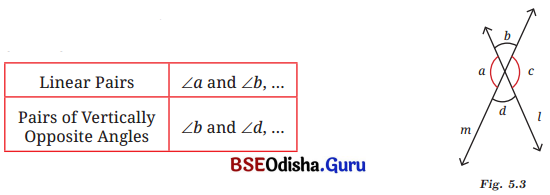
Question 1.
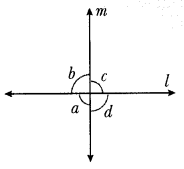
List all the linear pairs and vertically opposite angles you observe in the given figure:
Parallel and Intersecting Lines Class 7 Solutions Maths Ganita Prakash Chapter 5-1
Solution:
We know that adjacent angles formed by two intersecting lines, are called linear pairs. Linear pairs always add up to 180°.
And opposite angles formed by two intersecting lines, are called vertically opposite angles. Vertically opposite angles are always equal to each other.

Linear pairs ∠a and ∠b, ∠b and ∠c, ∠c and ∠d, ∠d and ∠a
Pairs of Vertically Opposite Angles ∠b and ∠d, ∠a and ∠c


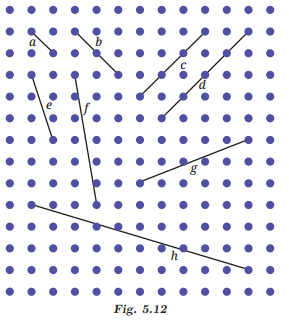
Question 2.
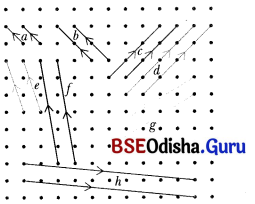
Using your sense of how parallel lines look, try to draw lines parallel to the line segments on this dot paper.
(a) Did you find it challenging to draw sorne of them?
(b) Which ones?
(c) How did you do ii?
Parallel and Intersecting Lines Class 7 Solutions Maths Ganita Prakash Chapter 5-2
Solution:
Parallel and Intersecting Lines Class 7 Solutions Maths Ganita Prakash Chapter 5-3
(a) Yes, some line segments are a litle more difficult to draw than others.
(b) Line segments e,f. h and g.
(c) Lines parallel to a given line segment are drawn by keeping thern equidistant from the given line segment.

Parallel and Intersecting Lines Class 7 Solutions Maths Ganita Prakash Chapter 5

Question 3.
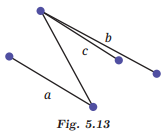
In the figure, which line is parallel to line a — line b or line c? How do you decide this?
Parallel and Intersecting Lines Class 7 Solutions Maths Ganita Prakash Chapter 5-4
Solution:
Line c is parallel to line a because the corresponding dots on these lines are equidistant from each other. So, they do not intersect, no matter how far they are extended.

Question 4.
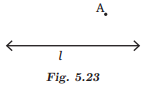
Can you draw a line parallel to l, that goes through point A? How will you do it with the tools from your geometry box? Describe your method.
Parallel and Intersecting Lines Class 7 Solutions Maths Ganita Prakash Chapter 5-5
Solution:
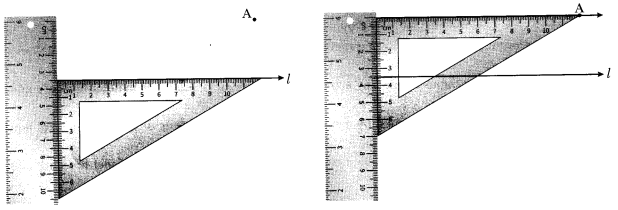
Tools needed: Ruler, Set-squares (right-angled triangle), Pencil Steps of Construction:
Step 1: Place the set square so that one side is along the line l.
Step 2: Hold the ruler against the other side of the set square (the ruler won’t move).
Step 3: Slide the set square along the ruler until one side reaches point A.
Step 4: Draw a line along the edge of the set square through point A.
Step 5: This new line is parallel to line l and passes through point A.
Parallel and Intersecting Lines Class 7 Solutions Maths Ganita Prakash Chapter 5-6

Parallel and Intersecting Lines Class 7 Solutions Maths Ganita Prakash Chapter 5

Question 5.
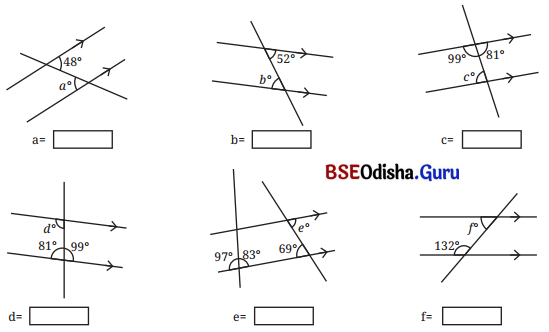
Find the angles marked below.
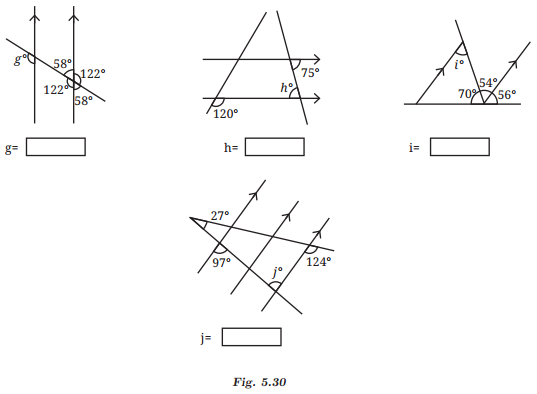
Parallel and Intersecting Lines Class 7 Solutions Maths Ganita Prakash Chapter 5-7
Parallel and Intersecting Lines Class 7 Solutions Maths Ganita Prakash Chapter 5-8
Solution:
(i) Since alternate interior angles formed by a transversal intersecting a pair of parallel lines are equal, we obtain a = 48°.

(ii) Since alternate interior angles formed by a transversal intersecting a pair of parallel lines are equal, we obtain b = 52°.

(iii) Since alternate interior angles formed by a transversal intersecting a pair of parallel lines are equal, we obtain c = 81°.

(iv) Since alternate interior angles formed by a transversal intersecting a pair of parallel lines are equal, we obtain d = 99°.

(v) Since alternate interior angles formed by a transversal intersecting a pair of parallel lines are equal, we obtain e = 69°.

(vi) Since the sum of interior angles on the same side of a transversal intersecting a pair of parallel lines is always equal to 180°,f + 132° = 180° ⇒ f = 180°- 132° ⇒ f = 48°

(vii) Since corresponding angles formed by a transversal intersecting a pair of parallel sides are equal, we obtain g = 122°.

(viii) Since alternate interior angles formed by a transversal intersecting a pair of parallel lines are equal, we obtain h = 75°.

(ix) Since alternate interior angles formed by a transversal intersecting a pair of parallel lines are equal, we obtain i = 54°.

(x) Since alternate interior angles formed by a transversal intersecting a pair of parallel lines are equal, we obtain j = 97°.

Question 6.
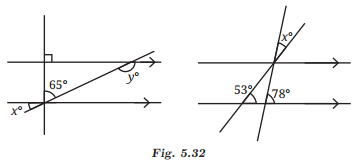
In the figures below, what angles do x and y stand for?
Parallel and Intersecting Lines Class 7 Solutions Maths Ganita Prakash Chapter 5-9
Solution:
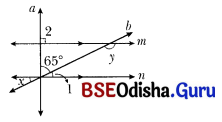
(i) The lines and angles are marked as shown in the figure.
Parallel and Intersecting Lines Class 7 Solutions Maths Ganita Prakash Chapter 5-10
Line m is parallel to line n and line a is a transversal.
∴ ∠2 = 65° + ∠1 [∵ Corresponding angles]
⇒ 90° = 65° + ∠1
⇒ ∠1 = 90°- 65°
⇒ ∠1 = 25°
And, ∠1 = x = 25° [∵ Vertically opposite angles]
Also, line m is parallel to line n and line b is a transversal.
∴ ∠1 +y = 180° [∵ Sum of co-interior angles = 180°]
⇒ 25° + y = 180° [∵ ∠1 = 25°]
⇒ y = 180° – 25° ⇒ y = 155°
Thus, the values of x and y are 25° and 155°, respectively.

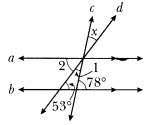
(ii) The lines and angles are marked as shown in the figure.
Parallel and Intersecting Lines Class 7 Solutions Maths Ganita Prakash Chapter 5-11
Line a is parallel to line b and line d is a transversal.
∴ ∠2 = 53° [∵ Alternate interior angles]
Also, line a is parallel to line b and c is a transversal.
∴ ∠1 + ∠2 = 78° [∵ Alternate interior angles]
⇒ ∠1 + 53° = 78° [∵ ∠2 = 53°]
⇒ ∠1 = 78°- 53°
⇒ ∠1 = 25°
Therefore, ∠1 = x = 25° [∵ Vertically opposite angles]

Parallel and Intersecting Lines Class 7 Solutions Maths Ganita Prakash Chapter 5

Question 7.
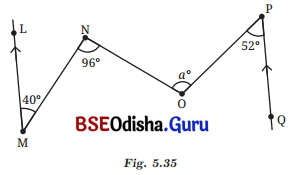
What is the measure of ∠NOP in the figure?
Parallel and Intersecting Lines Class 7 Solutions Maths Ganita Prakash Chapter 5-12
[Hint: Draw lines parallel to LM and PQ through points N and O.]
Solution:
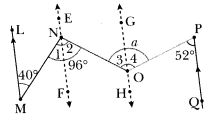
Lines parallel to LM and PQ through points N and O are drawn and angles are marked as shown in the figure.
Parallel and Intersecting Lines Class 7 Solutions Maths Ganita Prakash Chapter 5-13
Since LM is parallel to EF and MN is a transversal,
∠1 = 40° [∵ Alternate interior angles]
Now, ∠1 + ∠2 = 96°
⇒ 40° + ∠2 = 96° [∵ ∠1 = 40°]
⇒ ∠2 = 96° – 40°
⇒ ∠2 = 56°
Since EF is parallel to GH and AT is a transversal,
∠2 = ∠3 = 56° [∵ Alternate interior angles]
Also, GH is parallel to PQ and OP is a transversal.
∴ ∠4 = 52° [∵ Alternate interior angles]
So, a = ∠3 + ∠4
⇒ a = 56° + 52° ⇒ a = 108°
Thus, ∠NOP = 108°.

InText Questions

Question 1.
Can two straight lines intersect at more than one point?
Solution:
No, two straight lines cannot intersect at more than one point. If two lines intersect at more than one point, then they are coincident lines.

Parallel and Intersecting Lines Class 7 Solutions Maths Ganita Prakash Chapter 5

Question 2.
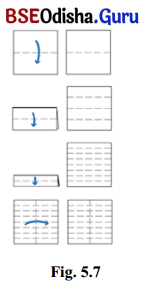
Take a plain square sheet of paper (use a newspaper for this).
Parallel and Intersecting Lines Class 7 Solutions Maths Ganita Prakash Chapter 5-14
(i) How would you describe the opposite edges of the sheet? They are ________ to each other.
(ii) How would you describe the adjacent edges of the sheet? The adjacent edges are ________ to each other. They meet at a point. They form right angles.
(iii) Fold the sheet horizontally in half. A new line is formed (see figure).
How many parallel lines do you see now?
(iv) Make one more horizontal fold in the folded sheet. How many parallel lines do you see now?
(v) What will happen if you do it once more? How many parallel lines will you get? Is there a pattern? Check if the pattern extends further, if you make another horizontal fold.
(vi) Make a vertical fold in the square sheet. This new vertical line is _________ to the previous horizontal lines.
(vii) Fold the sheet along a diagonal. Can you find a fold that creates a line parallel to the diagonal line?
Solution:
(i) They are parallel to each other.
(ii) The adjacent edges are perpendicular to each other.
(iii) We see three parallel horizontal lines — the top edge, the fold and the bottom edge. The new horizontal line is perpendicular to the vertical edges of paper.
(iv) On folding the paper horizontally one more time, we see five parallel horizontal lines.
(v) On folding the paper horizontally once more, we will get nine parallel lines. The number of horizontal parallel lines follow the sequence:
1st fold → 3 lines
2nd fold → 5 lines
3rd fold → 9 lines and so on
So, after each fold, the number of horizontal lines increases as folding doubles the sections and add extra fold lines. The pattern continues as we fold more.

(vi) This new vertical line is perpendicular to the previous horizontal lines.

(vii) Yes, we can make a fold parallel to the diagonal by folding the sheet in the same slanting direction at equal angles or by folding a smaller triangle inside the square.

Parallel and Intersecting Lines Class 7 Extra Questions

Parallel and Intersecting Lines Class 7 Very Short Question Answer

Question 1.
In the given figure, write the vertically opposite angles of ∠AOD and ∠AOC.
Parallel and Intersecting Lines Class 7 Solutions Maths Ganita Prakash Chapter 5-15
Solution:
We know that when two lines intersect, the angles opposite to each other are called vertically opposite angles. They are formed without sharing a common arm and are always equal.
Thus, in the given figure, ∠BOC is vertically opposite angle of ∠AOD and ∠BOD is vertically opposite angle of ∠AOC.

Parallel and Intersecting Lines Class 7 Solutions Maths Ganita Prakash Chapter 5

Question 2.
Find the complement of each of the following angles:
(i) 28°
(ii) 66°
(iii) 75°
(iv) 80°
Solution:
We know that complement of angle x° is (90° – x°).
(i) Complement of 28° = 90° – 28° = 62°
(ii) Complement of 66° = 90° – 66° = 24°
(iii) Complement of 75° = 90° – 75° = 15°
(iv) Complement of 80° = 90° – 80° = 10°

Question 3.
Find the supplement of each of the following angles:
(i) 28°
(ii) 95°
(iii) 130°
(iv) 155°
Solution:
We know that supplement of angle x° is (180° – x°).
(i) Supplement of 28° = 180° – 28° = 152°
(ii) Supplement of 95° = 180° – 95° = 85°
(iii) Supplement of 130° = 180° – 130° = 50°
(iv) Supplement of 155° = 180° – 155° = 25°

Parallel and Intersecting Lines Class 7 Solutions Maths Ganita Prakash Chapter 5

Question 4.
Find the complement of each of the following angles:
(i) 32°
(ii) 72°
(iii) 68°
(iv) 20°
Solution:
We know that complement of angle x° is (90 – x)°.
(i) Complement of 32° = 90° – 32° = 58°
(ii) Complement of 72° = 90° – 72° = 18°
(iii) Complement of 68° = 90° – 68° = 22°
(iv) Complement of 20° = 90° – 20° = 70°

Question 5.
Find the supplement of each of the following angles:
(i) 25°
(ii) 92°
(iii) 142°
(iv) 165°
Solution:
We know that supplement of angle x° is (180 – x)°.
(i) Supplement of 25° = 180° – 25° = 155°
(ii) Supplement of 92° = 180° – 92° = 88°
(iii) Supplement of 142° = 180° – 142° = 38°
(iv) Supplement of 165° =180° – 165° = 15°

Parallel and Intersecting Lines Class 7 Solutions Maths Ganita Prakash Chapter 5

Question 6.
In the given figure, write the angles that form a linear pair with ∠AOD and with ∠BOC.
Parallel and Intersecting Lines Class 7 Solutions Maths Ganita Prakash Chapter 5-16
Solution:
We know that the adjacent angles formed by two lines intersecting each other, are called linear pair of angles. Linear pairs always add up to 180°.
In the given figure, ∠AOC and ∠BOD form a linear pair of angles with ∠AOD.
∠AOC and ∠BOD form a linear pair of angles with ∠BOC.

Question 7.
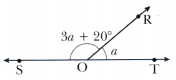
In the given figure, find the value of a.
Parallel and Intersecting Lines Class 7 Solutions Maths Ganita Prakash Chapter 5-17
Given,
∠SOR = 3a + 20° and ∠ROT = a
From the given figure, we can say that ∠SOR and ∠ROT form a linear pair.
∴ ∠SOR + ∠ROT = 180°
⇒ 3a + 20° + a = 180°
⇒ 4a = 160° ⇒ a = 40°

Parallel and Intersecting Lines Class 7 Solutions Maths Ganita Prakash Chapter 5

Question 8.
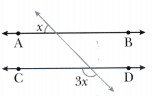
Find the value of x in the following figure, if AB is parallel to CD.
Parallel and Intersecting Lines Class 7 Solutions Maths Ganita Prakash Chapter 5-18
Solution:
Given, AB is parallel CD.
Since x and 3x are co-exterior angles on the same side of transversal, they add up to 180°.
∴ x + 3x = 180° ⇒ 4x = 180°
⇒ x = \(\frac{180^{\circ}}{4}\) ⇒ x = 45°

Question 9.
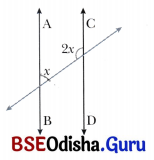
Find the value of x in the following figure, if AB is parallel to CD.
Parallel and Intersecting Lines Class 7 Solutions Maths Ganita Prakash Chapter 5-19
Solution:
Given, AB is parallel CD.
Since x and 2x are interior angles on the same side of transversal, they add up to 180°.
∴ x + 2x = 180°
⇒ 3x = 180° ⇒ x = 60°

Parallel and Intersecting Lines Class 7 Solutions Maths Ganita Prakash Chapter 5

Parallel and Intersecting Lines Class 7 Short Question Answer

Question 1.
Identify the complementary and supplementary pairs of angles from the following pairs:
(i) 42°, 48°
(ii) 85°, 95°
(iii) 30°, 60°
(iv) 135°, 45°
Solution:
We know that if the sum of the measures of two angles is 90°, then the angles are called complementary angles and if the sum of the measures of two angles is 180°, then the angles are called supplementary angles.
(i) The given angles are 42° and 48°.
Now, sum of given angles = 42° + 48° = 90°
Thus, the given angles are complementary angles.

(ii) The given angles are 85° and 95°.
Now, sum of given angles = 85° + 95° = 180°
Thus, the given angles are supplementary angles.

(iii) The given angles are 30° and 60°.
Now, sum of given angles = 30° + 60° = 90°
Thus, the given angles are complementary angles.

(iv) The given angles are 135° and 45°.
Now, sum of given angles = 135° + 45° = 180°
Thus, the given angles are supplementary angles.

Question 2.
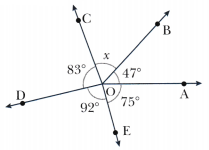
In the given figure, find the value of x.
Parallel and Intersecting Lines Class 7 Solutions Maths Ganita Prakash Chapter 5-20
Solution:
Given, ∠AOB = 47°, ∠BOC = x, ∠COD = 83°, ∠DOE = 92° and ∠EOA = 75°
Now, as ∠AOB, ∠BOC, ∠COD, ∠DOE and ∠EOA are angles at a point, they add up to 360°.
∴ ∠AOB + ∠BOC + ∠COD + ∠DOE + ∠EOA = 360°
⇒ 47° + x + 83° + 92° + 75°= 360°
⇒ 297° + x = 360°
⇒ x = 360° – 297° = 63°
Thus, the value of x is 63°.

Parallel and Intersecting Lines Class 7 Solutions Maths Ganita Prakash Chapter 5

Question 3.
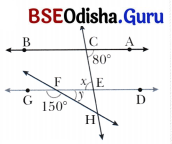
In the given figure, line AB is parallel to line DG. Find the value of x + y.
Parallel and Intersecting Lines Class 7 Solutions Maths Ganita Prakash Chapter 5-21
Solution:
Given, line AB is parallel to line DG.
∴ ∠ACE = ∠CEG
[∵ Alternate interior angles are equal]
⇒ x = 80° [∵ ∠ACE = 80° and ∠CEF = x]
Since ∠GFH and ∠EFH form linear pair, they add up to 180°.
∴ ∠GFH + ∠EFH = 180°
⇒ 150° + y = 180° [∵ ∠GFH = 150°]
⇒ y = 180° – 150° = 30°
∴ x + y = 80° + 30° = 110°

Question 4.
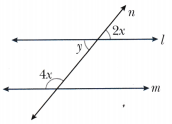
In the given figure, l is parallel to m. Find the value of x and y.
Parallel and Intersecting Lines Class 7 Solutions Maths Ganita Prakash Chapter 5-22
Solution:
Given, l is parallel to m and n is transversal to l and m.
Since 2x and y are vertically opposite angles, they are equal.
∴ y = 2x …(i)
Since 4x and y are interior angles on the same side of the transversal, they add up to 180°.
∴ 4x + y = 180°
⇒ 4x + 2x = 180° [From (i)]
⇒ 6x = 180° ⇒ x = 30°
Substituting the value of x in (i), we get
y = 2 × 30° = 60°

Parallel and Intersecting Lines Class 7 Solutions Maths Ganita Prakash Chapter 5

Parallel and Intersecting Lines Class 7 Long Question Answer

Question 1.
Which lines appear to be perpendicular to each other in the given figure?
Parallel and Intersecting Lines Class 7 Solutions Maths Ganita Prakash Chapter 5-23
Solution:
When two lines intersect and the angles formed are 90° (i.e. all four angles are equal), the lines are said to be perpendicular to each other.

In the given figure, since line i is parallel to line d, perpendicular to any of these lines is also perpendicular to other. Therefore, lines b, c, h and /are perpendicular to lines i and d.

Similarly, lines d and i are perpendicular to lines b, c, h andf.

Question 2.
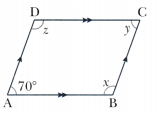
In the given figure, AB is parallel to CD and AD is parallel to BC. Find the values of x, y and z.
Parallel and Intersecting Lines Class 7 Solutions Maths Ganita Prakash Chapter 5-24
Solution:
Given, AB || CD, AD ||
BC and ∠BAD = 70°.
As AD || BC and AB is transversal, ∠ABC and ∠BAD are co-interior angles.
∴ ∠ABC + ∠BAD = 180°
⇒ x + 70° = 180° [∵ ∠BAD = 70°]
⇒ x = 180°- 70° = 110°
Now, as AB || DC and AD is transversal, ∠ADC and ∠BAD are co-interior angles.
∴ ∠ADC + ∠BAD = 180°
⇒ z + 70° = 180° [∵ ∠BAD = 70°]
⇒ z = 180°- 70° = 110°
Also, as AD || BC and DC is transversal, ∠ADC and ∠BCD are co-interior angles.
∴ ∠ADC + ∠BCD = 180°
⇒ 110°+ y = 180° [∵ ∠ADC =110°]
⇒ y = 180°- 110° = 70°

Parallel and Intersecting Lines Class 7 Solutions Maths Ganita Prakash Chapter 5

Question 3.
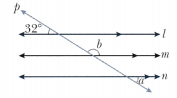
In the following figure, find the value of each marked angle.
Parallel and Intersecting Lines Class 7 Solutions Maths Ganita Prakash Chapter 5-25
Solution:
Given, line l || m || n.
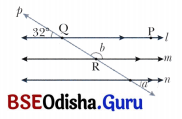
Let point P lie on line l, point R lie on line p and the point of intersection of lines p and l be Q, as shown in the figure.
Parallel and Intersecting Lines Class 7 Solutions Maths Ganita Prakash Chapter 5-26
Since ∠PQR and 32° are vertically opposite angles, they are equal.
∴ ∠PQR = 32°
As l || m, ∠b and ∠PQR are interior angles on the same side of transversal p.
∴ ∠b + ∠PQR = 180°
⇒ ∠b + 32° = 180° [∵ ∠PQR = 32°]
⇒ ∠b = 180°- 32° = 148°
As l || n, ∠a and ∠PQR are corresponding angles.
∴ ∠a = ∠PQR
⇒ ∠a = 32° [∵ ∠PQR = 32°]

Question 4.
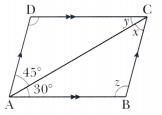
In the following figure, AB is parallel to CD and AD is parallel to BC. Find the values of x, y and z.
Parallel and Intersecting Lines Class 7 Solutions Maths Ganita Prakash Chapter 5-27
Solution:
Given, AB || CD, AD || BC, ∠DAC = 45° and ∠BAC = 30°.
As AB || CD anddC is transversal, ∠DAC and ∠ACB are alternate interior angles.
∴ ∠ACB = ∠DAC ⇒ x = 45°
[∵ ∠DAC = 45° and ∠ACB = x]
As AB || CD and AC is transversal, ∠BAC and ∠ACD are alternate interior angles.
∴ ∠ACD = ∠BAC ⇒ y = 30°
[∵ ∠BAC = 30° and ∠ACD = y]
As AD || BC and AB is transversal. ∠DAB and ∠ABC are co-interior angles.
∴ ∠DAB +∠ABC = 180°
⇒ ∠DAC + ∠CAB + ∠ABC = 180°
[∵ ∠DAB = ∠DAC + ∠CAB]
⇒ 45° + 30° + z = 180°
[∵ ∠DAC = 45°, ∠CAB = 30° and ∠ABC = z]
⇒ z = 180°- 75° = 105°

Parallel and Intersecting Lines Class 7 Solutions Maths Ganita Prakash Chapter 5

Parallel and Intersecting Lines Class 7 Case Based Questions

Question 1.
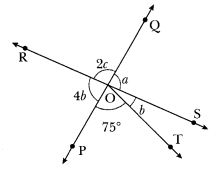
In the given figure, two straight lines PQ and RS intersect each other at O such that ∠POT = 75°.
Parallel and Intersecting Lines Class 7 Solutions Maths Ganita Prakash Chapter 5-28
Based on the above information, answer the following questions:
(i) Find the value of b.
(ii) Find the value of a.
(iii) Find the value of c.
Solution:
(i) Given, ∠ROP = 4b, ∠POT = 75°, ∠TOS = b
Here, ∠ROS = 180°
[Since ∠ROS is a straight angle]
⇒ ∠ROP + ∠POT + ∠TOS = 180°
⇒ 4b + 75° + b = 180°
⇒ 5b + 75° = 180°
⇒ 5b = 180° – 75° = 105°
b = \(\frac{105^{\circ}}{5}\) = 21°
Thus, the value of b is 21°.

(ii) Since ∠ROP and ∠QOS are vertically opposite angles, they are equal.
∴ ∠QOS = ∠ROP
⇒ a = 4b
⇒ a = 4 × 21° [∵ b = 21°]
⇒ a = 84°
Thus, the value of a is 84°.

(iii) Since ∠QOS and ∠QOR form a linear pair, they add up to 180°.
∴ ∠QOS + ∠QOR = 180°
⇒ a + 2c = 180°
⇒ 84° + 2c =180° [∵ a = 84°]
⇒ 2c = 180° – 84° = 96°
c = \(\frac{96^{\circ}}{2}\) = 48°
Thus, the value of c is 48°.

Parallel and Intersecting Lines Class 7 Solutions Maths Ganita Prakash Chapter 5

Question 2.
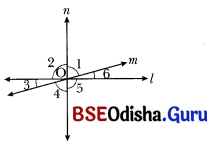
In a class, a teacher asked a student to draw three lines on the board. The student draws the lines on the board as shown.
Parallel and Intersecting Lines Class 7 Solutions Maths Ganita Prakash Chapter 5-29
The line l is perpendicular to line n and ∠1 = 75°.
Based on the above information answer the following questions:
(i) What is the measure of ∠6?
(ii) What is the measure of ∠5?
(iii) What is the measure of ∠3?
(iv) What is the sum of the measure of ∠2 and ∠1?
Solution:
(i) Given, line l is perpendicular to line n.
∴ ∠1 + ∠6 = 90°
⇒ 75° + ∠6 = 90° [∵ ∠1 = 75°]
⇒ ∠6 = 90° – 75° = 15°

(ii) Given, line l is perpendicular to line n.
∴ ∠5 = 90°

(iii) We have, ∠6 = 15°
Since ∠3 and ∠6 are vertically opposite angles, they are equal.
∴ ∠3 = ∠6 = 15°

(iv) Given, line l is perpendicular to line n. So, ∠2 is equal to 90°.
∴ ∠1 + ∠2 = 75° + 90° = 165°

Expressions using Letter Numbers Class 7 Solutions Maths Ganita Prakash Chapter 4

Students can refer to BSE Odisha Class 7 Math Solution and Ganita Prakash Chapter 4 Expressions using Letter Numbers Class 7 Question Answer to understand textbook questions step by step.

Class 7 Maths Chapter 4 Expressions using Letter Numbers Solutions

Ganita Prakash Class 7 Chapter 4 Solutions

Class 7 Maths Ganita Prakash Chapter 4 Solutions Expressions using Letter Numbers

Question 1.
One plate of Jowar roti costs ₹30 and one plate of Pulao costs ₹20. If x plates of Jowar roti and y plates of pulao were ordered in a day, which expressions(s) describe the total amount in rupees earned that day?
(a) 30x + 20y
(b) (30 + 20) × (x + y)
(c) 20x + 30)
(d) (20 + 30) × (x + y)
(e) 30x – 20y
Solution:
Cost of one plate of Jowar roti = ₹30
Cost of x plates of Jowar roti = ₹30x
Cost of one plate of Pulao = ₹20
Cost of y plate of Pulao = y
So, the expression for the total amount earned that day = 30x + 20y
Hence, the correct answer is option (a).

Question 2.
Write formulas for the perimeter of:
(i) triangle with all sides equal.
(ii) a regular pentagon.
(iii) a regular hexagon.
Solution:
(i) Let side length of triangle be a. Then,
Perimeter of triangle with all sides equal = a + a + a = 3a = 3 × side

(ii) Let side length of a regular pentagon be a. Then,
Perimeter of the regular pentagon = a + a + a + a + a = 5a = 5 × side

(iii) Let side length of a regular hexagon be a. Then,
Perimeter of the regular hexagon = a + a + a + a + a + a = 6a = 6 × side

Expressions using Letter Numbers Class 7 Solutions Maths Ganita Prakash Chapter 4

Question 3.
Munirathna has a 20 m long pipe. However, he wants a longer watering pipe for his garden. He joins another pipe of some length to this one. Give the expression for the combined length of the pipe. Use the letter- number to denote the length in metres of the other pipe.
Solution:
Length of pipe Munirathna has = 20 m
Length of another pipe Munirathna wants to join = k m
∴ Combined length of the pipe = (20 + k) m

Question 4.
What is the total amount Krithika has, if she has the following numbers of notes of ₹100, ₹20 and ₹5?
Complete the following table:
Expressions using Letter Numbers Class 7 Solutions Maths Ganita Prakash Chapter 4-1
Solution:

Number of ₹100 notes Number of ₹20 notes Number of ₹5 notes Expression and Total amount (in ₹)
3 5 6 3 × 100 + 5 × 20 + 6 × 5 = 430
6 4 3 6 × 100 + 4 × 20 + 3 × 5 = 695
8 4 z 8 × 100 + 4 × 20 + z × 5 = 880 + 5z
x y z x × 100 + y × 20 + z × 5 = 100x + 20y + 5z

Expressions using Letter Numbers Class 7 Solutions Maths Ganita Prakash Chapter 4

Question 5.
In a calendar month, if any 2 × 3 grid full of dates is chosen as shown in the picture, write expressions for the dates in the blank cells if the bottom middle cell has date ‘w’.
Expressions using Letter Numbers Class 7 Solutions Maths Ganita Prakash Chapter 4-2
Solution:
Date to the left to w will be 1 less than w.
Date to the right to w will be 1 more than w.
Since there are 7 clays in a week,
Date above w will be 7 less than w.
Date in the diagonally left cell to w will be 8 less than w.
Date in the diagonally right will to w will be 6 less than w.
Thus, the expressions in other five blank cells of the grid are as shown:

w – 1

w – 7

w – 6

w – 1

w

w + 1

Question 6.
A snail is trying to climb along the wall of a deep well. During the day it climbs up ‘u’ cm and during the night it slowly slips down ‘d’ cm. This happens for 10 days and 10 nights.
(1) Write an expression describing how far away the snail is from its starting position.
(ii) What can we say about the snail’s movement if d > u?
Solution:
(i) During the day the snail climbs up ‘u’ cm.
During the night the snail slips down ‘d’ cm.
So, the net distance covered in one day is (u – d) cm.
So, in 10 days and 10 nights the net distance covered by the snail = 10(u – d) cm.
Hence, the expression describing how far away the snail is from it starting position is 10(u – d).

(ii) If d > u, snail slips down more than it climbs.
It means the snail will never reach the top.

Expressions using Letter Numbers Class 7 Solutions Maths Ganita Prakash Chapter 4

Question 7.
Radha is preparing for a cycling race and practices daily. The first week she cycles 5 km every day. Every week she increases the daily distance cycled by ‘z’ km. How many kilometres would Radha have cycled after 3 weeks?
Solution:
In first week, Radha cycles 5 km every day.
So, she cycled 5 × 7 = 35 km in first week.
In second week, Radha cycles (5 + z) km every day.
In third week, she cycles 5 + z + z = (5 + 2z) km every day.
So, she cycled (5 + 2z) × 7 = (35 + 14z) km in third week.
Thus, number of kilometres Radha cycled in 3 weeks
= 35 + (35 + 7z) + (35 + 14z)
= (35 + 35 + 35) + (7z + 14z) = (105 + 21z)km

Question 8.
In the following figure, observe how the expression it w + 2 becomes 4w + 20 along one path. Fill in the missing blanks on the remaining paths. The ovals contain expressions and the boxes contain operations.
Expressions using Letter Numbers Class 7 Solutions Maths Ganita Prakash Chapter 4-3
Solution:
[(w + 2) – 5] × 3 = [w – 3] × 3 = 3w – 9
[(w + 2) – 8] – 4 = [w – 6] – 4 = w – 10
[(w + 2) – 4] × 3 = [w – 2] × 3 = 3w – 6
Expressions using Letter Numbers Class 7 Solutions Maths Ganita Prakash Chapter 4-4

Expressions using Letter Numbers Class 7 Solutions Maths Ganita Prakash Chapter 4

Question 9.
A local train from Yahapur to Vahapur stops at three stations at equal distances along the way. The time taken in minutes to travel from one station to the next station is the same and is denoted by t. The train stops for 2 minutes at each of the three stations.
(i) What is the algebraic expression for the time taken to travel from Yahapur to Yahapur?
(ii) If t = 4, what is the time taken to travel from Yahapur to Vahapur?
Solution:
(i) Expressions using Letter Numbers Class 7 Solutions Maths Ganita Prakash Chapter 4-5
Let the time taken to travel from one station to another station = t
So, time taken to travel from Yahanpur to Vahapur = 4t
As there are three stoppages between these two stations and the train stops for 2 minutes at each stoppage, total time taken during stoppages = 2 × 3 = 6 minutes.
So, the algebraic expression for total time taken (in minutes) is (4t + 6).

(ii) From (i), the algebraic expression for total time (in minutes) taken from Yahanpur to Vahapur is (4t + 6). So, the time taken to travel from Yahapur to Vahapur = 4 × 4 + 6 = 16 + 6 = 22 minutes.

Question 10.
Simplify the following expressions:
(i) 3a + 9b – 6 + 8a – 4b – 7a + 16
(ii) 3(3a – 3b) – 8a – 4b – 16
(iii) 2(2x – 3) + 8x + 12
(iv) 8x – (2x – 3) + 12
(v) 8h – (5 + 7h) + 9
(vi) 23 + 4(6m – 3n) – 8n – 3m – 18
Solution:
(i) 3a + 9b – 6 + 8a – 4b – 7a + 16 = (3a + 8a – 7a) + (9b – 4b) + (- 6 + 16) = 4a + 5b + 10
(ii) 3(3a – 3b) – 8a – 4b – 16 = 9a – 9b – 8a – 4b – 16 = (9a – 8a) + (-9b – 4b) – 16 = a – 13b – 16
(iii) 2(2x – 3) + 8x + 12 = 4x – 6 + 8x + 12 = (4x + 8x) + (-6 + 12) = 12x + 6
(iv) 8x – (2x – 3) + 12 = 8x – 2x + 3 + 12 = 6x + 15
(v) 8h – (5 + 7h) + 9 = 8h – 5 – 7h + 9 = 8h – 7h – 5 + 9 = h + 4
(vi) 23 + 4(6m – 3n) – 8n – 3m – 18 = 23 + 24m – 12n – 8n – 3m – 18
= 24m – 3m – 12w – 8n + 23 – 18 = 21m – 20n + 5

Expressions using Letter Numbers Class 7 Solutions Maths Ganita Prakash Chapter 4

Question 11.
Add the expressions given below:
(i) 4d – 7c + 9 and 8c – 11 +9d
(ii) – 6f + 19 – 8s and – 23 + 13f + 12s
(iii) 8d – 14c + 9 and 16c – (11 + 9d)
(iv) 6f – 20 + 8s and 23 – 13f – 12s
(v) 13m – 12n and 12n – 13m
(vi) – 26m + 24n and 26m – 24n
Solution:
(i) (4d – 7c + 9) + (8c – 11 + 9d) = (4d + 9d) + (- 7c + 8c) + (9 – 11) = 13d + c – 2
(ii) (-6f + 19 – 8s) + (-23 + 13f + 12s) = (-6f + 13f) + (-8s + 12s) + (19 – 23) = 7f + 4s – 4
(iii) (8d – 14c + 9) + [16c – (11 + 9d)] = (8d – 14c + 9) + (16c – 11 – 9d)
= (8d – 9d) + (-14c + 16c) + (9 – 11) = -d + 2c – 2
(iv) (6f – 20 + 8s) + (23 – 13f – 12s) = (6f – 13f) + (8s – 12s) + (-20 + 23) = -7f – 4s + 3
(v) (13m – 12n) + (12n – 13m) = (13m – 13m) + (- 12n + 12n) = 0
(vi) (-26m + 24n) + (26m – 24n) = (-26m + 26m) + (24n – 24n) = 0

Question 12.
Imagine a straight rope. If it is cut once as shown in the picture, we get 2 pieces. If the rope is folded once and then cut as shown, we get 3 pieces. Observe the pattern and find the number of pieces if the rope is folded 10 times and cut. What is the expression for the number of pieces when the rope is folded r times and cut?
Expressions using Letter Numbers Class 7 Solutions Maths Ganita Prakash Chapter 4-6
Solution:
Step 1 (0 fold): We get 0 + 2 = 2 pieces
Step 2 (1 fold): We get 1 + 2 = 3 pieces
Step 3 (2 folds): We get 2 + 2 = 4 pieces
In the same way, if rope is folded 10 times and cut, we get 10 + 2 = 12 pieces.
In the same way, when the rope is folded r times and cut, we get r + 2 pieces.

Expressions using Letter Numbers Class 7 Solutions Maths Ganita Prakash Chapter 4

Question 13.
Look at the matchstick pattern below. Observe and identify the pattern. How many matchsticks are required to make 10 such squares. How many are required to make w squares?
Expressions using Letter Numbers Class 7 Solutions Maths Ganita Prakash Chapter 4-7
Solution:
Step 1: To make 1 square, we need 4 matchsticks.
Step 2: To make 2 squares, we need 4 + 3 = 7 matchsticks.
Step 3: To make 3 squares, we need 4 + 3 + 3 = 10 matchsticks.
So, to make w squares, we need —
4 + (w – 1) × 3 = 4 + 3 (w – 1) = 4 + 3w – 3 = (3w + 1) matchsticks.
To make 10 squares, substituting w = 10, we get
Number of required matchsticks = 3(10) + 1 = 30 + 1 = 31

Question 14.
Observe the pattern below. How many squares will be there in Step 4, Step 10, Step 50? Write a general formula. How would the formula change if we want to count the number of vertices of all the squares?
Expressions using Letter Numbers Class 7 Solutions Maths Ganita Prakash Chapter 4-8
Solution:
Number of squares in step 1 = 5
Number of squares in step 2 = 5 + 4 = 9
Number of squares in step 3 = 5 + 4 + 4 = 5 + 2 × 4 = 5 + 8 = 13
Thus, number of squares in step 4 = 5 + 3 × 4 = 5 + 12 = 17
Number of squares in step 10 = 5 + 9 × 4 = 5 + 36 = 41
And, number of squares in step 50 = 5 + 49 × 4 = 5 + 196 = 201
So, the general formula for number of squares in step n = 5 + (n – 1) × 4 = 5 + 4 (n – 1) = 5 + 4n – 4 = 4n + 1
Number of vertices in step 1 = 16
Number of vertices in step 2 = 16 + 12 = 28
Number of vertices in step 3 = 16 + 12 + 12 = 16 + 2 × 12 = 16 + 24 = 40
Number of vertices in step n = 16 + (n – 1) × 12 = 16 + 12n – 12 = 12n + 4

Expressions using Letter Numbers Class 7 Solutions Maths Ganita Prakash Chapter 4

InText Questions

Question 1.
Shabnam is 3 years older than Aftab. When Aftab’s age is 10 years, Shabnam’s age will be 13 years. Now, Aftab’s age is 18 years, what will Shabnam’s age be?
Solution:
Shabnam’s age = Aftab’s age + 3
When .Aftab’s age = 18 years,
Shabnam’s age = 18 + 3 = 21 years

Question 2.
Find the values of the following arithmetic expressions:
(i) 23 – 10 × 2
(ii) 83 + 28 – 13 + 32
(iii) 34 – 14 + 20
(iv) 42 + 15 – (8 – 7)
(v) 68 – (18 + 13)
(vi) 7 × 4 + 9 × 6
(vii) 20 + 8 × (16 – 6)
Solution:
(i) 23 – 10 × 2 = 23 – 20 = 3
(ii) 83 + 28 – 13 + 32
= (83 – 13) + (28 + 32)
= 70 + 60 = 130
(iii) 34 – 14 + 20 = (34 – 14) + 20 = 20 + 20 = 40
(vi) 42 + 15 – (8 – 7) = 42 + 15 – 1
= 42 + 14 = 56
(v) 68 – (18 + 13) = 68 – 31 = 37
(vi) 7 × 4 + 9 × 6 = 28 + 54 = 82
(vii) 20 + 8 × (16 – 6) = 20 + 8 × 10
= 20 + 80 = 100

Expressions using Letter Numbers Class 7 Solutions Maths Ganita Prakash Chapter 4

Question 3.
Some simplifications are shown below where the letter-numbers are replaced by numbers and the value of the expression is obtained.
1. Observe each of them and identify if there is a mistake.
2. If you think there is a mistake, try to explain what might have gone wrong.
3. Then, correct it and give the value of the expression.
Expressions using Letter Numbers Class 7 Solutions Maths Ganita Prakash Chapter 4-9
Solution:
(1) If a = – 4, then 10 – a = 6 is wrong.

(2) If d = 6, then 3d = 36 is wrong.
As 10 – a = 10 – (-4) = 10 + 4 = 14
As 3d = 3 × d = 3 × 6 = 18
So, if a = -4, then 10 – a = 14 is correct.
So, if d = 6, then 3d = 18 is correct.

(3) Ifs = 7, then 3s – 2 = 15 is wrong.

(4) If r = 8, then 2r + 1 = 29 is wrong.
As 3s – 2 = 3 × 7 – 2 = 21 – 2 = 19
As 2r + 1 = 2 × 8 + 1 = 16 + 1 = 17
So, if s = 7, then 3s – 2 = 19 is correct.
So, if r = 8, then 2r + 1 = 17 is correct.

(5) If j = 5, then 2j = 10 is correct.

(6) If m = – 6, then 3(m + 1) = 19 is wrong.
As 2j = 2 × 5 = 10
As 3(m + 1) = 3 × (- 6 + 1) = 3 × (- 5) = – 15
So, if m = – 6, then 3(m + 1) = – 15 is correct.

(7) If f = 3, g = 1, then 2f – 2g = 2 is wrong.

(8) If t = 4, b = 3, then 2t + b = 24 is wrong.
As 2f – 2g = 2 × 3 – 2 × 1 = 6 – 2 = 4
As 2t + b = 2 × 4 + 3 = 8 + 3 = 11
So, if f = 3, g = 1, then 2f – 2g = 4 is correct.
So, if t = 4, b = 3, then 2t + b = 11 is correct,

(9) If h = 5, n = 6, then h – (3 – n) = 4 is wrong.
As h – (3 – n) = 5 – (3 – 6) = 5 – (- 3) = 5 + 3 = 8
So, if h = 5, n = 6, then h – (3 – n) = 8 is correct.

Question 4.
Here is a table showing the number of pencils and erasers sold in a shop. The price per pencil is c, and the price per eraser is d. Find the total money earned by the shopkeeper during these three days.
Expressions using Letter Numbers Class 7 Solutions Maths Ganita Prakash Chapter 4-10
(i) If c = ₹50, find the total amount earned by the sale of pencils.
(ii) Write the expression for the total money earned by selling erasers. Then, simplify the expression.
Solution:
Total money earned by the shopkeeper
= Money earned on day 1 + Money earned on day 2 + Money earned on day 3
= 5c + 4 d + 3c + 6d + 10c + d = 18c + 11d

(i) Total amount earned by the sale of pencils
= 5c + 3c + 10c = 18c
= 18 × ₹50 = ₹900

(ii) Given, the price per eraser is d.
Total money earned by selling erasers
= 4d + 6d + d = 11 d

Expressions using Letter Numbers Class 7 Solutions Maths Ganita Prakash Chapter 4

Question 5.
Fill in the blanks below by replacing the letter- numbers by numbers; an example is shown. Then compare the values that 5u and 5 + u take.
Expressions using Letter Numbers Class 7 Solutions Maths Ganita Prakash Chapter 4-11
Solution:

u 5u 5 + u
11 5 × 11 = 55 5 + 11 = 16
8 5 × 8 = 40 5 + 8 = 13
5 5 × 5 = 25 5 + 5 = 10

Expressions using Letter Numbers Class 7 Solutions Maths Ganita Prakash Chapter 4-12
We see that the values of 5u and 5 + u are not equal for different values of u. So, the expressions 5w and 5 + u are not equal.

Question 6.
Are the expressions 10y – 3 and 10(y – 3) equal?
After filling in the two diagrams (given below), do you think the two expressions are equal?
Expressions using Letter Numbers Class 7 Solutions Maths Ganita Prakash Chapter 4-13
Solution:

u 10y – 3 10(y – 3)
0 10 × 0 – 3 = -3 10(0 – 3) = -30
7 10 × 7 – 3 = 67 10(7 – 3) = 40
10 10 × 10 – 3 = 97 10(10 – 3) = 70

Expressions using Letter Numbers Class 7 Solutions Maths Ganita Prakash Chapter 4-14
Since the values of 10v – 3 and 10(y – 3) are not equal for different values of y, the expressions 10y – 3 and 10(y – 3) are not equal.

Expressions using Letter Numbers Class 7 Solutions Maths Ganita Prakash Chapter 4

Question 7.
Find the formulas of the number machines below and write the expression for each set of inputs.
Expressions using Letter Numbers Class 7 Solutions Maths Ganita Prakash Chapter 4-15
Solution:
(i) The formula for the number machine is “sum of first number and second number minus two” and the expression is a + b – 2.
The expression for each set of inputs are:
5 + 2 – 2 = 5, 8 + 1 – 2 = 7,
9 + 11 – 2 = 18, 10 + 10 – 2 = 18
and a + b – 2

(ii) The formula for the number machine is “product of first number and second number plus one” and the expression is a × b + 1.
The expression for each set of inputs are:
4 × 1 + 1= 5, 6 × 0 + 1 = 1,
3 × 2 + 1 = 7, 10 × 3 + 1 = 31
and a × b + 1 = ab + 1

Question 8.
Somjit noticed a repeating pattern along the border of a saree.
Expressions using Letter Numbers Class 7 Solutions Maths Ganita Prakash Chapter 4-16
Use this to find what design appears at positions 99, 122 and 148.
Solution:
We can see the design A, B and C appear at the positions 3n – 2, 3n – 1 and 3n, respectively.
For 99, the remainder on division by 3 is 0,’i.e. it is a multiple of 3.
So, at position 99, design C will appear.
For 122, the remainder on division by 3 is 2, i.e. it is 1 less than a multiple of 3, i.e. 3n – 1.
So, at position 122, design B will appear.
For 148 , the remainder on division by 3 is 1, i.e. it is 2 less than a multiple of 3, i.e. 3n – 2.
So, at position 148, design A will appear.

Expressions using Letter Numbers Class 7 Extra Questions

Expressions using Letter Numbers Class 7 Very Short Question Answer

Question 1.
Simplify the expression 7(u – 2v) + 2v.
Solution:
Using the distributive property, this expression can be simplified as
7(u – 2v) + 2v = 7u – 7 × 2v + 2v
= 7u – 14v + 2v = 7u – 12v
[Adding like terms together]

Expressions using Letter Numbers Class 7 Solutions Maths Ganita Prakash Chapter 4

Question 2.
What is the sum of the numbers in the given picture (unknown values are denoted by letter- numbers)?
Expressions using Letter Numbers Class 7 Solutions Maths Ganita Prakash Chapter 4-17
Solution:
Adding row wise, we get Sum of numbers
= (5 × 4) + (2g + 2h) + (2g + 2h) + (5 × 4)
= 20 + 2g + 2 h + 2g + 2h + 20
= (20 + 20) + (2g + 2g) + (2h + 2 h)
= 40 + 4g + 4 h

Expressions using Letter Numbers Class 7 Short Question Answer

Question 1.
Add the numbers in each picture below. Write their corresponding expressions and simplify them.
Expressions using Letter Numbers Class 7 Solutions Maths Ganita Prakash Chapter 4-18
Solution:
(i) (x + y + y + x + y + y + x + y + y + x + y + y) + (4 × 6)
= 4x + 8y + 24

(ii) 2 × 3y + 4 × 2 + 2 × (-4x) + 4 × (-8)
= 6y + 8 – 8x – 32
= 6y – 8x – 24

(iii) 4 × (- 3n) + 6 × 7m
= -12m + 42m
= 42m – 12n

Expressions using Letter Numbers Class 7 Solutions Maths Ganita Prakash Chapter 4

Question 2.
Simplify each of the following expressions:
(i) e + e + e + f + f
(ii) m + m – (m – n) – n – n
(iii) l – 7m + l – (m – 1)
(iv) 2x – x – (x + x)
(v) (3u – 2v) – (2u – 3v)
Solution:
(i) e + e + e + f + f = 3e + 2f
(ii) m + m – (m – n) – n – n = 2m – (m – n) – 2n
= 2m – m + n – 2n
= m – n

(iii) l – m + l – (m – l) = l + l – m – (m – l)
= 2l – m – m + l
= 3l – 2m

(iv) 2x – x – (x + x) = 2x – x – 2x = -x

(v) (3u – 2v) – (2u – 3v) = 3u – 2v – 2u + 3v
= 3u – 2v – 2v + 3u
= u + v

Expressions using Letter Numbers Class 7 Long Question Answer

Question 1.
Simplify the following expressions:
(i) 2x – 3y + 7x + y – 12
(ii) 4(x – 2y) + 3x – 5y + 1
(iii) 7 + 3h – 2g – (5h – 4g)
(iv) 3g + 9h – (5 + 6h – 2g)
(v) 5(2u + 7v – 2) – 3(8u – 10v + 4)
(vi) 17 – 13a + 19b – 2(9 + 7a – 3b)
Solution:
(i) 2x – 3y + 7x + y – 12
= 9x – 2y – 12

(ii) 4(x – 2y) + 3x – 5y + 1
= 4x – 8y + 3x – 5y + 1
= 7x – 13y + 1

(iii) 7 + 3h – 2g – (5h – 4g)
= 7 + 3h – 2g – 5h + 4g
= 7 – 2h + 2g

(iv) 3g + 9h – (5 + 6h – 2g)
= 3g + 9h – 5 – 6h + 2g
= 5g + 3h – 5

(v) 5(2u + 7v – 2) – 3(8u – 10v + 4)
= 10u + 35v – 10 – 24u + 30v – 12
= – 14u + 65v – 22

(vi) 17 – 13a + 19b – 2(9 + 7a – 3b)
= 17 – 13a + 19b – 18 – 14a + 6b
= – 27a + 25b – 1

Expressions using Letter Numbers Class 7 Solutions Maths Ganita Prakash Chapter 4

Question 2.
Add the expressions given below:
(i) 3d+ 6c – 7 and 3c – 4d + 2
(ii) -8g + 3h + 2 and 6g – 4h – 12
(iii) 11k + l + 10 and k – (11l – 10)
(iv) 21m – 7n and -17m + 10n + 13
(v) 5(x + 7y) – 3 and 2x + 3y – 2
(vi) 7a + 2b + 9 and 3a + 8b + 1
Solution:
(i) (3d + 6c – 7) + (3c – 4d + 2)
= 6c + 3c + 3d – 4d – 7 + 2 = 9c – d – 5

(ii) (-8g + 3h + 2) + (6g – 4h – 12)
= -8g + 6g + 3h – 4h + 2 – 12
= – 2g – h – 10

(iii) (11k + l + 10) + {k – (11l – 10)}
= 11k + l + 10 + k = 11l + 10
= 11k + k + l – 11l + 10 + 10
= 12k – 10l + 20

(iv) (21m – 7n) + (-17m + 10n + 13)
= 21m – 17m – 7n + 10n + 13
= 4m + 3n + 13

(v) 5(x + 7y) – 3 + (2x + 3y – 2)
= 5x + 35y – 3 + 2x + 3y – 2
= 5x + 2x + 35y + 3y – 3 – 2
= 7x + 38y – 5

(vi) (7a + 2b + 9) + (3a + 8b + 1)
= 7a + 3a + 2b + 8b + 9 + 1
= 10a + 10b + 10

Expressions using Letter Numbers Class 7 Case Based Questions

Question 1.
A movie theatre has 6 columns of seats (labelled A to F) and the seats are arranged in endless rows, starting from the front. Each seat is numbered sequentially row wise, beginning with Seat 1 in Column A of Row 1, moving left to right.
Expressions using Letter Numbers Class 7 Solutions Maths Ganita Prakash Chapter 4-19
Based on the above information, answer the following questions:
(i) In the seating layout, imagine selecting any 2 × 3 block of seats (2 rows and 3 columns), like the one shown in the picture.

x

If the seat in the top middle of selected block is numbered ‘x’ write expressions to represent the seat numbers in the other five blank positions of the block.

(ii) Look at the group of seats arranged in the shape.

4 6
11
16 18

Find the sum of all the seat numbers in this shape. Then compare this total with the number
at the centre i.e. 11.
Try this again with a different set of numbers arranged in the same shape and write your observation.
Solution:
(i) Number to the left of Y will be 1 less than x.
Number to the right of V will be 1 more than x.
Since there are 6 seats in one row,
Number below x will be 6 more than x.
Number in the diagonally left cell to ‘x’ will be 5 more than x for one less than x + 6).
Number in the diagonally right cell to ‘x’ will be 7 more thain x (or one more than x + 6).
Thus, the expressions in other five blank s positions of the block are as shown:

x – 1

x

x + 1

x + 5

x + 6

x + 7

(ii) Sum of all numbers
= 4 + 6 + 11 + 16 + 18 = 55 = 5 × 11
The sum is 5 times the number in the centre.
Now, let the number at the centre be 14, then the shape is given below:

7 9
17
19 21

Sum of all the numbers
= 7 + 9 + 14 + 19 + 21
= 70 = 5 × 14
Again, the sum is 5 times the number in the centre.
Now, let the number at the centre be 9, then the shape is given below:

2

4

9

14

16

Sum of all the numbers
= 2 + 4 + 9 + 14 + 16 = 45 = 5 × 9
Again, the sum is 5 times the number in the centre.

Expressions using Letter Numbers Class 7 Solutions Maths Ganita Prakash Chapter 4

Question 2.
Observe the picture below. It shows a growing pattern of huts made using toothbrushes.
In Step 1, there is 1 hut.
In Step 2, there are 2 huts.
In Step 3, there are 3 huts and this pattern continues.
Expressions using Letter Numbers Class 7 Solutions Maths Ganita Prakash Chapter 4-20
Based on the above information, answer the following questions:
(i) What is the general rule to find the number of toothbrushes in step n?
(ii) How many toothbrushes will be there in step 9, step 37 and step 54?
Solution:
(i) We can see that the number of toothbrushes increases by 3 at each step.

Step No. Number of Toothbrushes
1 4 = 4 + 0 × 3 = 4 + (4 – 1) × 3
2 4 + 3 = 4 + 1 × 3 = 4 + (2 – 1) × 3
3 4 + 3 + 3 = 4 + 2 × 3 = 4 + (3- 1) × 3
4 4 + 3 + 3 + 3 = 4 + 3 × 3 = 4 + (4 – 1) × 3

We can write general rule to find the number of toothbrushes in step n as:
4 + (n – 1) × 3 = 4 + 3n – 3 = 3n + 1,
where n = 1, 2, 3, …

(ii) Number of toothbrushes in step 9
= 3 × 9 + 1 = 27 + 1 = 28
Number of toothbrushes in step 37
= 3 × 37 + 1 = 111 + 1 = 112
Number of toothbrushes in step 54
= 3 × 54 + 1 = 162 + 1 = 163

Number Play Class 7 Solutions Maths Ganita Prakash Chapter 6

Students can refer to BSE Odisha Class 7 Math Solution and Ganita Prakash Chapter 6 Number Play Class 7 Question Answer to understand textbook questions step by step.

Class 7 Maths Chapter 6 Number Play Solutions

Ganita Prakash Class 7 Chapter 6 Solutions

Class 7 Maths Ganita Prakash Chapter 6 Solutions Number Play

Question 1.
Arrange the stick figure cutouts in order of their heights, ensuring that each child (from left to right) states the number of children standing ahead who are taller than them.
Number Play Class 7 Solutions Maths Ganita Prakash Chapter 6 1
Number Play Class 7 Solutions Maths Ganita Prakash Chapter 6 2
(i) 0, 1 , 1 , 2, 4, 1 , 5
(ii) 0, 0, 0, 0, 0, 0, 0
(iii) 0, 1, 2, 3, 4, 5, 6
(iv) 0, 1,0, 1, 0, 1, 0
(v) 0, 1, 1, 1, 1, 1, 1
(vi) 0,0,0,3,3,3,3
Solution:
(i) The required arrangement is FCBGADF:
Number Play Class 7 Solutions Maths Ganita Prakash Chapter 6 3

Number Play Class 7 Solutions Maths Ganita Prakash Chapter 6

(ii) The required arrangement is AECGBDF.
Number Play Class 7 Solutions Maths Ganita Prakash Chapter 6 4

(iii) The required arrangement is FDBGCEA
Number Play Class 7 Solutions Maths Ganita Prakash Chapter 6 5

(iv) The required arrangement is EAGCDBF
Number Play Class 7 Solutions Maths Ganita Prakash Chapter 6 6

(v) The required arrangement is FAECGBD
Number Play Class 7 Solutions Maths Ganita Prakash Chapter 6 7

(vi) The required arrangement is BDFAECG
Number Play Class 7 Solutions Maths Ganita Prakash Chapter 6 8

Number Play Class 7 Solutions Maths Ganita Prakash Chapter 6

Question 2.
We know that:
(i) even + even = even
(ii) 0dd + 0dd = 0dd
(iii) even + odd = odd
Similarly, find out the parity for the below scenarios:
(iv) even – even = ___________
(v) 0dd – 0dd = _______
(vi) even – odd = ________
(vii) odd – even = ________
Solution:
(iv) even – even
Example: 6 – 2 = 4 → even
8 – 4 = 4 → even
Parity of result = even
∴ even – even = even

(v) odd – odd
Example: 7 – 3 = 4 → even
9 – 5 = 4 = 4 → even
Parity of result = even
∴ old – old = even

Question 3.
How many different magic squares can be made using numbers 1-9?
Solution:
Using the numbers 1-9, there is exactly one unique magic square (excluding rotations and reflections).

8 1 6
3 5 7
4 9 2

If transformations like rotations are allowed, then there are 8 variations of this magic square.

Number Play Class 7 Solutions Maths Ganita Prakash Chapter 6

Question 4.
Create a magic square using numbers 2-10. What strategy would you use for this? Compare it with the magic squares made using 1-9.
Solution:
The numbers 2-10 are 9 consecutive numbers, just like 1-9, but increased up by 1.
Strategy: Start with the classic 1-9 magic square, and add 1 to each number.

8 1 6
3 5 7
4 9 2

Original: After adding 1 to each.
The magic square for numbers 2-10 would have a different magic sum (18) compared to numbers 1-9 (15). The structure remains similar, but the values are shifted up to 1.

9 2 7
4 6 8
5 10 3

Question 5.
Take a magic square, and
(i) increase each number by 1
(ii) double each number
In each case, is the resulting grid also a magic square?
How do the magic sums change in each case?
Solution:
Original:

8 1 6
3 5 7
4 9 2

(i) After increasing each number by 1:

9 2 7
4 6 8
5 10 3

This is still a magic square.
New magic sum = 15 + 3 × 1 = 18

(ii) After doubling each number

16 2 12
6 10 14
8 18 4

Still a magic square
New magic sum = 15 × 2 = 30

In case (i), adding a constant to every number → magic sum (for 3×3 grid) is increased by three times of that constant.
In case (ii), multiplying all by a constant → magic sum multiplied by that constant.

Number Play Class 7 Solutions Maths Ganita Prakash Chapter 6

Question 6.
Using the generalised form, find a magic square if the centre number is 25.
Solution:
The generalised form of a magic square is given below.

m + 3 m – 4 m + 1
m – 2 m m + 2
m – 1 m + 4 m – 3

If the centre number is 25, then m = 25.
Substituting m = 25 in generalised form of a magic square, we get
Number Play Class 7 Solutions Maths Ganita Prakash Chapter 6 15

Question 7.
Write the result obtained by—
(i) adding 1 to every term in the generalised form.
(ii) doubling every term in the generalised form.
Solution:
The generalised form of a magic square is given below.

m + 3 m – 4 m + 1
m – 2 m m + 2
m – 1 m + 4 m – 3

(i) Adding one to every term:

m + 4 m – 3 m + 2
m – 1 m + 1 m + 3
m m + 5 m – 2

(ii) Doubling every term:

2m + 6 2m – 8 2m + 2
2m – 4 2m 2m + 4
2m – 2 2m + 8 2m – 6

Number Play Class 7 Solutions Maths Ganita Prakash Chapter 6

Question 8.
Create a magic square whose magic sum is 60.
Solution:
A 3 × 3 magic square’s sum is 3 × middle element.
So, for a sum is 60, the middle element should be \(\frac{60}{3}\) = 20 .
To get a magic sum of 60, we will multiply the original magic square by 4 i.e.
Number Play Class 7 Solutions Maths Ganita Prakash Chapter 6 16

Question 9.
Is it possible to get a magic square by filling nine non-consecutive numbers?
Solution:
Yes, it is possible.
Justification: Let us consider the two magic squares with magic sum 45.

18 11 16
13 15 17
14 19 12

9 consecutive numbers
and

24 3 18
9 15 21
12 27 6

9 non-consecutive numbers

Question 10.
A light bulb is ON. Dorjee toggles its switch 77 times. Will the bulb be on or off? Why?
Solution:
Dorjee toggles the switch 77 times.

Each toggle changes the state of the bulb (ON to OFF or OFF to ON). Starting from ON.

An odd number of toggles will leaves the bulb OFF and an even number of toggles will leave the bulb ON. Since 77 is odd, after 77 toggles, the bulb will be OFF.

Number Play Class 7 Solutions Maths Ganita Prakash Chapter 6

Question 11.
Here is a 2 × 3 grid. For each row and column, the parity of the sum is written in the circle; ‘e’ for even and ‘o’ for odd. Fill the 6 boxes with 3 odd numbers (‘o’) and 3 even numbers (‘e’) to satisfy the parity of the row and column sums.
Number Play Class 7 Solutions Maths Ganita Prakash Chapter 6 17
Solution:
Let’s label the cells as:

A B C
D E F

So the constraints are:

  • Row 1 (A, B, C): sum is odd
  • Row 2 (D, E, F): sum is even
  • Column 1 (A, D): sum is even
  • Column 2 (B, E): sum is even
  • Column 3 (C, F): sum is odd

We’ll track parities only (o or e), not actual numbers.
Row 1: A = o, B = e, C = e, then o + e + e = odd
Column 1 (A, D) – e means A must be paired with D as odd to get the sum as even.
So, if A = o, D = o, then o + o = even
Similarly, if B = e, E = e, then e + e = even
Again, if C = e, F = o, then e + o = odd
So, the 6 boxes with 3 odd numbers and 3 even numbers can be filled as follows:
Number Play Class 7 Solutions Maths Ganita Prakash Chapter 6 18

Number Play Class 7 Solutions Maths Ganita Prakash Chapter 6

Question 12.
Make a 3 × 3 magic square with 0 as the magic sum. All numbers can not be zero. Use negative numbers, as needed.
Solution:
It is given that

  • The magic square is 3 × 3.
  • The magic sum is 0.
  • All numbers in the square cannot be zero, we can use negative numbers as needed.

So, we will use the numbers (- 4) to 4 to create a magic square whose magic sum is 0.
The required magic square is given below.

-3 2 1
4 0 -4
-1 -2 3

Question 13.
Two consecutive numbers in the Virahanka sequence are 987 and 1597. What are the next 2 numbers in the sequence? What are the previous 2 numbers in the sequence?
Solution:
Given numbers are 987 and 1597.
In the Virahanka sequence, each number is the sum of the two preceding numbers.
The next two numbers are:
987 + 1597 = 2584 and 1597 + 2584 = 4181
The previous two numbers are:
1597 – 987 = 610 and 987 – 610 = 377
The sequence is …, 377, 610, 987, 1597, 2584, 4181,…

Number Play Class 7 Solutions Maths Ganita Prakash Chapter 6

Question 14.
What is the parity of the 20th term of the Virahanka sequence.
Solution:
Consider the Virahanka sequence given below:
1,2, 3, 5, 8, 13, 21,34, 55, 89, 144, 233, 377, 610, 987, …
Let us observe the pattern of odd/even in Virahanka sequence.
Here 1 → odd;
2 → even;
3 → odd
5 → odd;
8 → even;
13 → odd
21 → odd;
34 → even;
55 → odd
So parity cycle: odd, even, odd, (repeats every 3 terms)
So the parity of 20th term in Virahanka sequence is even.

Question 15.
Solve the following cryptarithm:
Number Play Class 7 Solutions Maths Ganita Prakash Chapter 6 21
Solution:
Here, in TAT, letter T is a hundreds place.
So, T = 1.
⇒ A = 0 and U = 9.
So, we have U = 9, T = 1 and A = 0.
Number Play Class 7 Solutions Maths Ganita Prakash Chapter 6 22

Number Play Class 7 Solutions Maths Ganita Prakash Chapter 6

InText Questions

Question 1.
Kishor has a set of number cards and 5 boxes. If each box must contain exactly one number card, suggest an arrangement to help him distribute the cards, so that 5 cards add to 30? Is it possible?
Number Play Class 7 Solutions Maths Ganita Prakash Chapter 6 19
Solution:
No, it is not possible, as the sum of 5 odd numbers is always odd and 30 is an even number.

Question 2.
In a 3 × 3 grid, there are 9 small squares, which is an odd number. Meanwhile, in a 3 × 4 grid, there are 12 small squares, which is an even number.
Given the dimensions of a grid, can you tell the parity of the number of small squares without calculating the product?
Number Play Class 7 Solutions Maths Ganita Prakash Chapter 6 20
Solution:
Yes, we can determine the parity of the number of small squares in a grid without directly calculating the full product, simply by observing the parity of the dimensions.
Rule: The product of two numbers is:

  • Even if at least one of the numbers is even.
  • Odd if both numbers are odd.

Number Play Class 7 Solutions Maths Ganita Prakash Chapter 6

Question 3.
We can describe how the numbers within the magic square are related to each other, i.e. the structure of the magic square.
Choose any magic square that you have made so far using consecutive numbers. If m is the letter- number of the number in the centre, express how other numbers are related to m, how much more or less than m.
Solution:
Consider the magic square

8 1 6
3 5 7
4 9 2

We can express it using the letter- number m for the number in the centre as:

m + 3 m – 4 m + 1
m – 2 m m + 2
m – 1 m + 4 m – 3

Question 4.
Write the next 3 numbers in the sequence:
1, 2, 3, 5, 8, 13, 21, 34, 55, 89, , , , …
If you have to write one more number in the Sequence above, can you tell whether it will be an odd number or an even number (without adding the two previous numbers)?
Solution:
The next 3 terms in the sequence are:
55 + 89 = 144; 89 + 144 = 233; 144 + 233 = 377
Yes, we can determine the parity without adding the two previous number.
Since odd + odd = even
Hence, parity of next number in sequence is even.

Number Play Class 7 Solutions Maths Ganita Prakash Chapter 6

Question 5.
Find out what each letter stands for.
Number Play Class 7 Solutions Maths Ganita Prakash Chapter 6 23
Solution:
(i) YY is a two-digit number where both digits are the same. So it can be 99, 88, …
But Z is a 1-digit number and ZOO is a 3-digit number.
So, Y = 9, Z = 1 and O = 0.
Number Play Class 7 Solutions Maths Ganita Prakash Chapter 6 24
\(\begin{array}{r}
99 \\
+\quad 1 \\
\hline 1 \quad 00 \\
\hline
\end{array}\)

(ii)
Number Play Class 7 Solutions Maths Ganita Prakash Chapter 6 25

Number Play Class 7 Solutions Maths Ganita Prakash Chapter 6

(iii) Here, KP is a 2-digit number and PRR is a 3-digit number. Basically, 2 × (KP) = PRR.
If P = 1, then R = 2.
Hence, K = 6, P = 1 and R = 2.
Number Play Class 7 Solutions Maths Ganita Prakash Chapter 6 27
Here, C + 1 is a two-digit number i.e. 10.
Number Play Class 7 Solutions Maths Ganita Prakash Chapter 6 26

Number Play Class 7 Extra Questions

Number Play Class 7 Very Short Question Answer

Question 1.
A bag holds 100 balls, each marked with an odd number. If two balls are picked at random and their numbers are added, what will be the parity of the result?
Solution:
We know that odd number + odd number = even number.
Since each ball is marked with an odd number. If two balls are picked at random and their numbers are added, the parity of the sum will be even.

Number Play Class 7 Solutions Maths Ganita Prakash Chapter 6

Question 2.
A number has odd parity. What will be the parity of:
(i) Number + 7
(ii) Number – 2
(iii) Number + Number
Solution:
Given, a number has odd parity.
(i) Since the parity of the sum of two odd numbers is even, the parity of (Number + 7) will be even.
(ii) Since the parity of the difference of an even and an odd number is odd, parity of (N umber – 2) will be odd.
(iii) Since the parity of the sum of two odd numbers is even, the parity of (Number + Number) will be even.

Question 3.
Neha wants to climb a staircase with 7 steps. She has a simple rule: She can take either 1 step or 2 steps at a time. For example, one possible way to climb is: 2, 1, 2, 2.
In how many different ways can Neha climb to the top of the 7-step staircase?
Solution:
The number of different ways in which Neha can climb to the top of the 7-step staircase taking either 1 step or 2 steps at a time, is the 7th element of Virahanka sequence.
Virahanka sequence: 1, 2, 3, 5, 8, 13, 21, …
7th element of Virahanka sequence = 21
∴ Neha can climb to the top of the 7-step staircase in 21 different ways.

Number Play Class 7 Short Question Answer

Question 1.
During a maths quiz, a student says, “Two consecutive numbers add up to 98.” Is this claim correct? Justify your answer with reasoning.
Solution:
(i) The claim is not correct.
(ii) The counting numbers 1, 2, 3, 4, 5, … alternate between even and odd numbers.
In any two consecutive numbers, one will always be even and the other will always be odd.
We know that the parity of the sum of an even number and an odd number is odd.
Since 98 is an even number, his claim is incorrect.

Number Play Class 7 Solutions Maths Ganita Prakash Chapter 6

Question 2.
Form two expressions, one that always gives odd parity and another that always gives even parity.
Solution:
We know that the parity of the product is even if at least one of them is even.
Also, in any two consecutive numbers, one is alwavs even and the other is always odd.
∴ For any number n, the expression n(n + 1) = n2 + n always has even parity.
Since even number + odd number = odd number.
∴ The expression n2 + n + 1 always has odd parity.

Question 3.
Solve the following cryptarithms:
(i)
\(\begin{array}{r}
\mathrm{B} 2 \\
+6 \mathrm{C} \\
\hline \mathrm{EC} 6
\end{array}\)
(ii)
\(\begin{array}{r}
\mathrm{PQ} \\
+\mathrm{QR} \\
\hline \mathrm{QRQ}
\end{array}\)
Solution:
We know that in cryptarithms:

  • Each letter stands for unique digit and different letters represent different digits.
  • The same letter always means the same digit.

(i) Here, 2 + C = 6 ⇒ C = 4
Now, B + 6 = EC = E4 [Since C = 4]
⇒ B = 8 and E = 1

(ii) Here, Q + R = Q ⇒ R = 0
Now, P + Q = QR
⇒ P + Q = Q0
⇒ P = 9 and Q = 1

Number Play Class 7 Solutions Maths Ganita Prakash Chapter 6

Number Play Class 7 Long Question Answer

Question 1.
Aarav stores his stamp collection in small boxes. He has:

  • an odd number of boxes with 5 stamps each,
  • an odd number of boxes with 7 stamps each, and
  • an even number of boxes with 10 stamps each. He counts all his stamps and says the total is 175.

Did Aarav make a mistake? Explain your reasoning.
Solution:
We know that the parity of the product of two odd numbers is odd and the parity of the product of two even numbers is even. Thus,

  • An odd number of boxes with 5(odd) stamps each gives an odd number of stamps.
  • An odd number of boxes with 7(odd) stamps each also gives an odd number of stamps.
  • An even number of boxes with 10(even) stamps each gives an even number of stamps.

Since, odd number + odd number = even number And even number + even number = even number, the final total must be even number. But Aarav claims the total is 175, which is odd. Therefore, he must have made a mistake in his counting.

Question 2.
Two consecutive numbers in the Virahanka sequence are 377 and 610. What are the previous 2 numbers in the sequence?
Solution:
We know that in Virahanka sequence, a number is the sum of previous two numbers.
Let the previous two numbers be x and y respectively.
The sequence will be as: …, x,y, 377, 610, …
Then, y + 377 = 610
⇒ v = 610-377 = 233
Now, x + v = 377 ,
⇒ x + 233 = 377
⇒ x = 377 – 233 = 144
Thus, the previous two numbers in the Virahanka sequence are 144 and 233.

Number Play Class 7 Solutions Maths Ganita Prakash Chapter 6

Question 3.
Solve the following cryptarithms:
(i)
\(\begin{array}{r}
\mathrm{Tl} \\
+1 \mathrm{~T} \\
\hline 66
\end{array}\)
(ii)
\(\begin{array}{r}
\mathrm{D} 3 \\
+3 \mathrm{D} \\
\hline \mathrm{PPQ}
\end{array}\)
Solution:
(i) T + 1 = 6 ⇒ T = 5
Thus,
\(\begin{array}{r}
51 \\
+\quad 15 \\
\hline 66
\end{array}\)

Number Play Class 7 Solutions Maths Ganita Prakash Chapter 6

(ii) A three-digit number abc can be written as 100a + 10b + c.
D3 = 10D + 3, 3D = 3 × 10 + D = 30 + D and PPQ = 100P + 10P + Q = 110P + Q
Now, D3 + 3D = (10D + 3) + (30 + D)
= 11 D + 33
When D ranges from 1 to 6, the expression 11 D + 33, gives a two-digit number.
At D = 7, 11 × 7 + 33 = 77 + 33 = 110
Putting P = 1 and Q = 0, we get
110P + Q = 110 × 1 + 0 = 110
∴ P = 1, Q = 0 and D = 7

A Tale of Three Intersecting Lines Class 7 Solutions Maths Ganita Prakash Chapter 7

Students can refer to BSE Odisha Class 7 Math Solution and Ganita Prakash Chapter 7 A Tale of Three Intersecting Lines Class 7 Question Answer to understand textbook questions step by step.

Class 7 Maths Chapter 7 A Tale of Three Intersecting Lines Solutions

Ganita Prakash Class 7 Chapter 7 Solutions

Class 7 Maths Ganita Prakash Chapter 7 Solutions A Tale of Three Intersecting Lines

Question 1.
Use the points on the circle and/or the centre to form isosceles triangles.
A Tale of Three Intersecting Lines Class 7 Solutions Maths Ganita Prakash Chapter 7 1
Solution:
Select any two points on the circle and connect them with the centre of the circle.
Also, join these points to each other. This will form an isosceles triangle as the two radii are equal in length.
A Tale of Three Intersecting Lines Class 7 Solutions Maths Ganita Prakash Chapter 7 2

Question 2.
Can we say anything about the existence of a triangle for each of the following sets of lengths?
(i) 10 km, 10 km and 25 km
(ii) 5 mm. 10 mm and 20 mm
(iii) 12 cm. 20 cm and 40 cm
Solution:
(i) When we take direct path = 25 km.
Then roundabout path =10 km + 10 km = 20 km.
Since direct path is longer than the roundabout path.
So, existence of a triangle is not possible.

(ii) When we take direct path = 20 mm.
Then roundabout path = 10 mm + 5 mm = 15 mm.
Since direct path is longer than the roundabout path.
So, existence of a triangle is not possible.

(iii) When we take direct path = 40 cm.
Then roundabout path =12 cm + 20 cm = 32 cm.
Since direct path is longer than the roundabout path.
So, existence of a triangle is not possible.

A Tale of Three Intersecting Lines Class 7 Solutions Maths Ganita Prakash Chapter 7

Question 3.
Does there exist an equilateral triangle with sides 50, 50, 50? In general, does there exist an equilateral triangle of any sidelength? Justify your answer.
Solution:
Yes, an equilateral triangle with sides 50, 50, 50 exists because the sum of two sides is greater than the third side. For any positive number say x > 0, x + x > x. So, an equilateral triangle with all side lengths ‘x’ exists.

Question 4.
For each of the following, give at least 5 possible values for the third length so there exists a triangle having these as sidelengths (decimal values can also be chosen): ;
(i) 1, 100
(ii) 5, 5
(iii) 3, 7
Solution:
(i) 5 possible values for the third length would be 99.5. 99.8, 100, 100.5, 100.9
Since, 100 < 1 + 99.5, 100 < 1 + 99.8, 100 < 1 + 100, 100.5 < 1 + 100, and 100.9 < 1 + 100

(ii) 5 possible values for the third length would be 1, 3.5, 5, 7.5, 8.9
Since, 5 < 1 + 5, 5 < 5 + 3.5, 5 < 5 + 5, 7.5 < 5 + 5, and 8.9 < 5 + 5

(iii) 5 possible values for the third length would be 4.5, 5, 6.9, 8, 9.8
Since, 7 < 3 + 4.5, 7 < 5 + 3, 7 < 3 + 6.9, 8 < 3 + 7, 9.8 < 3 + 7

Question 5.
Construct triangles for the measurement, 3 cm, 120°, 8 cm, where the angle is included between the sides.
Solution:
A Tale of Three Intersecting Lines Class 7 Solutions Maths Ganita Prakash Chapter 7 3
Steps of construction are given below:
Step 1: Construct a side AB of length 8 cm.
Step 2: Construct ∠d = 120° by drawing the other arm of-the angle.
Step 3: Mark the point C on the other arm such that AC, = 3 cm.
Step 4: Join BC to get the required triangle.

A Tale of Three Intersecting Lines Class 7 Solutions Maths Ganita Prakash Chapter 7

Question 6.
Construct triangles for the measurements, 25°, 3 cm, 60° where the side is included between the angles.
Solution:
A Tale of Three Intersecting Lines Class 7 Solutions Maths Ganita Prakash Chapter 7 4
Steps of construction are given below:
Step 1: Draw the base AB of length 3 cm.
Step 2: Draw ∠d and ∠B of measure 25° and 60° respectively.
Step 3: Make the point of intersection of the two new arms of ∠d and ∠B as point C to get the required triangle.

Question 7.
Determine which of the following pairs can be the angles of a triangle and which cannot:
(i) 35°, 150°
(ii) 70°, 30°
Solution:
(i) The sum of the given angles 35° + 150° = 185°.
This is not possible because sum of the angles of the triangle exceeds 180°.

(ii) The sum of the given angles 70° + 30° = 100°.
Possible third angle 180°- 100° = 80°.
Since the possible third angle comes out positive (80°), the given angles can be angles of a triangle.

Question 8.
Find the third angle of a triangle (using a parallel line) when two of the angles are:
(i) 36°, 72°
(ii) 150°, 15°
Solution:
(i) Here ∠B = 36° and ∠C = 72°.
A Tale of Three Intersecting Lines Class 7 Solutions Maths Ganita Prakash Chapter 7 5
Since the line BC is parallel to AT.
So, ∠XAB = ∠B = 36° [Alternate angles] ………. (i)
and ∠YAC = ∠C = 72 [Alternate angles] ………. (i)
Also, ∠XAB + ∠B AC + ∠YAC = 180° [∠XAY is a straight angle]
⇒ 36° + ∠BAC + 72° = 180° [Using (i) and (ii)]
⇒ ∠BAC = 180°- 108° = 72°.

A Tale of Three Intersecting Lines Class 7 Solutions Maths Ganita Prakash Chapter 7

(ii) Here ∠B = 150° and ∠C = 15°.
A Tale of Three Intersecting Lines Class 7 Solutions Maths Ganita Prakash Chapter 7 6
Since the line BC is parallel to AY.
So, ∠XAB = ∠B = 150° [Alternate angles] ………. (i)
and ∠YAC = ∠C = 15° [Alternate angles] ………. (ii)
Also, ∠XAB + ∠BAC + ∠YAC = 180° [∠XAY is a straight angle]
⇒ 150° + ∠BAC + 15° = 180° [Using (i) and (ii)]
⇒ ∠BAC = 180° – 165° = 15°.

Question 9.
Here is a triangle in which we know ∠B = ∠C and ∠A = 50°, Can you find ∠B and ∠C?
A Tale of Three Intersecting Lines Class 7 Solutions Maths Ganita Prakash Chapter 7 7
Solution:
Given, ∠A = 50° and ∠B – ∠C.
A Tale of Three Intersecting Lines Class 7 Solutions Maths Ganita Prakash Chapter 7 8
Draw a line Xy which is parallel to BC.
Now, ∠XA B = ∠B and ∠YAC = ∠C [Alternate angles] ………… (i)
Also, ∠XAB + ∠BAC + ∠YAC = 180°
⇒ ∠B + 50° + ∠C = 180° [Using (i)]
⇒ ∠B + ∠C = 180° – 50° = 130°
⇒ 2 ∠B = 130° [∵ ∠B = ∠C]
⇒ ∠B = 65° = ∠C.

A Tale of Three Intersecting Lines Class 7 Solutions Maths Ganita Prakash Chapter 7

Question 10.
Construct a triangle TRY with RY = 4 cm, TR = 7 cm, ∠R = 140°. Construct an altitude from T to RY.
Solution:
Steps of construction are given below:
A Tale of Three Intersecting Lines Class 7 Solutions Maths Ganita Prakash Chapter 7 9
Step 1: Construct a side TR of length 7 cm.
Step 2: Construct ∠R = 140° by drawing the other arm of the angle.
Step 3: Mark the point 1 on the other arm such that RY = 4 cm.
Step 4: Join TY to get the required triangle.
Step 5: Keep the ruler aligned to RY. Place the set square along the ruler such that one of the edges of the right angle touches the ruler.
Step 6: Slide the set square along the ruler till the perpendicular edge of the set square touches the vertex T.
Step 7: Extend the line YR and then draw the altitude through T on extended YR using the perpendicular edge of the set square.
A Tale of Three Intersecting Lines Class 7 Solutions Maths Ganita Prakash Chapter 7 10

InText Questions

Question 1.
What happens when the three vertices lie on a straight line? Will these points form a triangle?
Solution:
When the three vertices lie on a straight line, they become collinear. This means they no longer form a triangle because the three points do not enclose any area.

A Tale of Three Intersecting Lines Class 7 Solutions Maths Ganita Prakash Chapter 7

Question 2.
Construct a triangle with sidelengths 3 cm, 4 cm, and 8 cm. What is happening? Are you able to construct the triangle?
Solution:
Let the triangle be ABC, where AB = 8 cm.
A Tale of Three Intersecting Lines Class 7 Solutions Maths Ganita Prakash Chapter 7 11
Since, the arcs from the points A and B do not meet. So, we are not able to construct the triangle with side lengths 3 cm, 4 cm, and 8 cm.

A Tale of Three Intersecting Lines Class 7 Extra Questions

A Tale of Three Intersecting Lines Class 7 Very Short Question Answer

Question 1.
In the adjoining figure:
A Tale of Three Intersecting Lines Class 7 Solutions Maths Ganita Prakash Chapter 7 12
(i) Name the vertex opposite to side PQ.
(ii) Name the side opposite to vertex Q.
(iii) Name the angle opposite to side QR.
(iv) Name the side opposite to ∠R.
Solution:
In the given figure,
(i) The vertex opposite to side PQ is R.
(ii) The side opposite to vertex Q is PR.
(iii) The angle opposite to side QR is ∠P.
(iv) The side opposite to ∠R is PQ.

A Tale of Three Intersecting Lines Class 7 Solutions Maths Ganita Prakash Chapter 7

Question 2.
In the given triangle ABC, find the value of x.
A Tale of Three Intersecting Lines Class 7 Solutions Maths Ganita Prakash Chapter 7 13
Solution:
Given, ∠T = 7x – 3°, ∠B = 130°, ∠C = 6x + 1°
We know that sum of all the angles in a triangle is 180°.
∴ ∠A + ∠B + ∠C = 180°
⇒ 7x – 3° + 130° + 6x + 1° = 180°
⇒ 13x + 128° = 180° ⇒ 13x = 180°- 128° = 52°
⇒ x = \(\frac{52^{\circ}}{13},\) = 4°
Thus, the value of x is 4°.

Question 3.
Can a triangle be formed for the following set of angles?
(i) 80°, 70° and 50°
(ii) 56°, 64° and 60°
Solution:
We know that the sum of all angles in a triangle is 180°.
(i) Given set of angles are 80°, 70° and 50°.
Now, sum of the angles = 80° + 70° + 50° = 200° ≠ 180°
Thus, the given set of angles cannot form a triangle.

(ii) Given set of angles are 56°, 64° and 60°.
Now, sum of the angles = 56° + 64° + 60° = 180°
Thus, the given set of angles can form a triangle.

A Tale of Three Intersecting Lines Class 7 Solutions Maths Ganita Prakash Chapter 7

Question 4.
In the following figure, find the value of p.
A Tale of Three Intersecting Lines Class 7 Solutions Maths Ganita Prakash Chapter 7 14
Solution:
In the given figure, ∠SPR is an exterior angle, and ∠PRQ and ∠PQR are two interior opposite angles to ∠SPR.
∴ ∠SPR = ∠PRQ + ∠PQR [Exterior angle property]
⇒ p = 105° + 45° = 150°
Thus, the value of p is 150°.

Question 5.
In ∆XYZ, YX is extended to O. If ∠Y = 57° and XY = XZ, then find ∠ZXO.
A Tale of Three Intersecting Lines Class 7 Solutions Maths Ganita Prakash Chapter 7 15
Solution:
Given, ∠Y = 57° and XY = XZ
We know that in an isosceles triangle, angles opposite to equal sides are equal.
∴ ∠Z = ∠Y = 57° ……… (i)
In the given figure, ∠ZXO is an exterior angle.
And, ∠Y and ∠Z are two interior opposite angle to ∠ZXO.
We know, Exterior angle = Sum of two interior opposite angles
∴ ∠ZXO = ∠Y + ∠Z
⇒ x – 57° + 57° = 114° [Using (i)]
Thus, the value of ∠ZXO is 114°.

A Tale of Three Intersecting Lines Class 7 Short Question Answer

Question 1.
Construct a triangle PQR such that PQ =3.5 cm, QR = 6.5 cm and PR = 4 cm.
Solution:
Given, PQ = 3.5 cm, QR = 6.5 cm and PR = 4 cm
A Tale of Three Intersecting Lines Class 7 Solutions Maths Ganita Prakash Chapter 7 16
To construct the triangle PQR of given sides, we follow the steps laid down below:
Step 1: Using ruler, draw a line segment PQ, 3.5 cm long.
Step 2: With P as centre, draw an arc with radius equal to 4 cm.
Step 3: With Q as centre, draw an arc with radius equal to 6.5 cm to cut the previous arc at R.
Step 4: Join R to P and Q. Thus, ∆PQR is required triangle.

A Tale of Three Intersecting Lines Class 7 Solutions Maths Ganita Prakash Chapter 7

Question 2.
Construct a triangle PQR such that PQ = 7 cm, QR = 8.5 cm and PR = 9 cm.
Solution:
Given, PQ = 7 cm, QR = 8.5 cm and PR = 9 cm.
A Tale of Three Intersecting Lines Class 7 Solutions Maths Ganita Prakash Chapter 7 17
To construct the triangle PQR of given side lengths, follow the steps laid down below:
Step 1: Using ruler, draw a line segment PQ, 7 cm long.
Step 2: With P as centre, draw an arc with radius equal to 9 cm.
Step 3: With Q as centre, draw an arc with radius equal to 8.5 cm to cut the previous arc at R.
Step 4: Join R to P and Q. Thus, ∆PQR is required triangle.

Question 3.
In the given figure, PQ is parallel to RS. Find the value of y.
A Tale of Three Intersecting Lines Class 7 Solutions Maths Ganita Prakash Chapter 7 18
Solution:
In ∆PQR, we have
∠QPR = 82°, ∠PRQ = 42° and ∠PQR = x
We know that the sum of all angles in a triangle is 180°. ‘
∴ ∠QPR + ∠PRQ + ∠PQR = 180°
⇒ 82° + 42° + x = 180°
⇒ 124° + x = 180°
⇒ x = 180°-124° = 56°
Since PQ is parallel to RS and QR is a transversal, ∠PQR and ∠QRS are alternate interior angles, they are equal.
⇒ ∠QRS = ∠PQR
⇒ Y = ,x = 56°
Thus, the value of y is 56°.

A Tale of Three Intersecting Lines Class 7 Solutions Maths Ganita Prakash Chapter 7

Question 4.
In the given figure, find the value of x.
A Tale of Three Intersecting Lines Class 7 Solutions Maths Ganita Prakash Chapter 7 19
Solution:
In ∆DBE, ∠DEF = 150° is an exterior angle.
We know that the exterior angle of a triangle is equal to the sum of opposite interior angles.
∴ ∠DEF = ∠ERD + ∠EDB
⇒ 150° = 50° + ∠EDB
⇒ ∠EDB = 150° – 50° = 100°
Again, in ADAG, ∠EDB is an exterior angle.
∴ ∠EDB = ∠DAG + ∠AGD
⇒ 100° = ∠DAG + 70°
[∵ ∠EDB = 100°, ∠AGD = 70°]
⇒ ∠DAG = 100° – 70° = 30°
Also, ∠DAG and ∠GAH form a linear pair of angles.
∴ ∠DAG + ∠GAH = 180°
[∵ ∠DAG = 100°, ∠GAH = x]
⇒ 30° + x = 180°
⇒ x = 180°-30° = 150°

A Tale of Three Intersecting Lines Class 7 Solutions Maths Ganita Prakash Chapter 7

Question 5.
In ∆IJK, if IJ = IK, ∠IKJ = 50°, ∠JIK = m, find the value of m.
A Tale of Three Intersecting Lines Class 7 Solutions Maths Ganita Prakash Chapter 7 20
Solution:
Given, IJ = IK, ∠IKJ = 50°, ∠JIK = m
We know that in an isosceles triangle, angles opposite to equal sides are equal.
∴ ∠IKJ = ∠IJK = 50°
Now, sum of all the angles = 180°
⇒ ∠JIK + ∠IKJ + ∠IJK = 180°
⇒ m + 50° + 50° = 180°
⇒ m + 100° = 180°
⇒ m = 180°- 100° = 80°
Thus, the value of m is 80°.

Question 6.
In the given figure, if ∠NMO = 84° and LM = MN, then find the values of ∠N and ∠L.
A Tale of Three Intersecting Lines Class 7 Solutions Maths Ganita Prakash Chapter 7 21
Solution:
Given, ∠NMO = 84° and LM = MN
We know that in an isosceles triangle, angles opposite to equal sides are equal.
∴ ∠N = ∠L ………. (i)
In the given figure, ∠NMO = 84° is an exterior angle.
And, ∠N and ∠L are two interior opposite angles to ∠NMO.
We know,
Exterior angle = Sum of two interior opposite angles
∴ ∠NMO = ∠N + ∠L
⇒ 84° = ∠N + ∠N [Using (i)]
⇒ 2∠N = 84° ⇒ ∠N = \(\frac{84^{\circ}}{2}\) = 42°
Thus, ∠N = ∠L = 42°

A Tale of Three Intersecting Lines Class 7 Solutions Maths Ganita Prakash Chapter 7

Question 7.
In the given figure, find the value of y.
A Tale of Three Intersecting Lines Class 7 Solutions Maths Ganita Prakash Chapter 7 22
Solution:
In the given figure, ∠BCD is an exterior angle.
And, ∠BAC and ∠ABC are two interior opposite angles to ∠BCD.
We know, Exterior angle = Sum of two interior opposite angles
∴ ∠BCD = ∠BAC + ∠ABC
⇒ 7y + 6° = 50° + 96°
⇒ 7v + 6° = 146°
⇒ 7y = 146° – 6° = 140°
⇒ y = \(\frac{140^{\circ}}{7}\) = 20°
Thus, the value of y is 20°.

Question 8.
In ∆PQR, ZQ is thrice of ∠P and ∠R is twice of sum of ∠P and ∠Q. Find the angles.
Solution:
Let ∠P be x. Then,
∠Q = 3 x, ∠P = 3x
and ∠R = 2(∠P + ∠Q) = 2(x + 3x) = 2 × 4x = 8x
We know that sum of all the angles in a triangle is 180°.
∴ ∠P + ∠Q + ∠R = 180°
⇒ x + 3x + 8x = 180°
⇒ 12x = 180°
⇒ x = \(\frac{180^{\circ}}{12}\) = 15°
Thus, ∠P = x = 15°, ∠Q = 3x = 3 × 15° = 45° and ∠R = 8x = 8 × 15° = 120°

A Tale of Three Intersecting Lines Class 7 Solutions Maths Ganita Prakash Chapter 7

A Tale of Three Intersecting Lines Class 7 Long Question Answer

Question 1.
Mrs. Roy gave straws of length 21 cm to her students and asked them to cut the straw to get three pieces, which can be used to form each of the three types of triangles. The lengths of the three pieces were supposed to be whole numbers (1, 2, 3, …) only. Based on these criteria, write any one possible combination of straw lengths in Column 3 of the below table.

Column 1 Column 2 Column 3
Type of triangle Side lengths (cm)
(a) Scalene triangle
(b) Isosceles triangle
(c) Equilateral triangle

Solution:
We know that if a given set of three lengths satisfies the triangle inequality (each length < sum of the other two lengths), then a triangle exists having those as side lengths.
(a) If all three sides of a triangle are different in length, then it is called a scalene triangle.
Thus, the possible sets of side lengths are:
(i) 2 cm, 9 cm and 10 cm
(ii) 3 cm, 8 cm and 10 cm
(iii) 4 cm, 7 cm and 10 cm
(iv) 4 cm, 8 cm and 9 cm
(v) 5 cm, 6 cm and 10 cm
(vi) 5 cm, 7 cm and 9 cm
(vii) 6 cm, 7 cm and 8 cm

(b) If any two sides of a triangle are equal in length, then it is called an isosceles triangle.
Thus, the possible sets of side lengths are:
(i) 6 cm, 6 cm and 9 cm
(ii) 8 cm, 8 cm and 5 cm
(iii) 9 cm, 9 cm and 3 cm
(iv) 10 cm, 10 cm and 1 cm

(c) If all three sides of a triangle are equal in length, then it is called an equilateral triangle. Thus, the possible set of side lengths is 7 cm, 7 cm, 7 cm.

A Tale of Three Intersecting Lines Class 7 Solutions Maths Ganita Prakash Chapter 7

Question 2.
In the given figure, find ∠EAB + ∠ABC + ∠BCD + ∠CDE + ∠DEA.
A Tale of Three Intersecting Lines Class 7 Solutions Maths Ganita Prakash Chapter 7 23
Solution:
We know that the sum of angles of a triangle is 180°.
∴ In ∆ABC, we have
∠CAB + ∠ABC + ∠BCA = 180° ………… (i)
In ∆ACD, we have
∠ACD + ∠CDA + ∠DAC = 180° ………. (ii)
And in AADE, we have
∠ADE + ∠DEA + ∠EAD = 180° ……….. (iii)
Adding (i), (ii) and (iii), we get
∠CAB + ∠ABC + ∠BCA + ∠ACD + ∠CDA + ∠DAC + ∠ADE + ∠DEA + ∠EAD = 180° + 180° + 180°
⇒ (∠EAD + ∠DAC + ∠CAB) + ∠ABC + (∠BCA + ∠ACD) + (∠CDA + ∠ADE) + ∠DEA = 540°
⇒ ∠EAB + ∠ABC + ∠BCD + ∠CDE + ∠DEA = 540°
[∵ ∠EAD + ∠DAC + ∠CAB = ∠EAB, ∠BCA + ∠ACD = ∠BCD and ∠CDA + ∠ADE = ∠CDE]

A Tale of Three Intersecting Lines Class 7 Solutions Maths Ganita Prakash Chapter 7

Question 3.
Two line segments PS and QR intersect at O. Joining PQ and SR, we get two triangles, ∆POQ and ∆ROS as shown in the figure. Find the values of ∠P and ∠Q.
A Tale of Three Intersecting Lines Class 7 Solutions Maths Ganita Prakash Chapter 7 24
Solution:
In ∆ROS, ∠R = 35° and ∠S = 70°
We know that sum of all the angles in a triangle is 180°.
∴ ∠R + ∠ROS + ∠S = 180°
⇒ 35° + ∠ROS + 70° = 180°
⇒ ∠ROS + 105° = 180°
⇒ ∠ROS = 180° – 105° = 75°
Since ∠ROS and ∠POQ are vertically opposite angles, ∠ROS = ∠POQ = 75°.
Now, in ∆POQ, ∠P = 5x, ∠POQ =75° and ∠Q = 4x + 6°
We know that sum of all the angles in a triangle is 180°.
∴ ∠P + ∠POQ + ∠Q = 180°
⇒ 5i + 75° + 4x + 6° = 180°
⇒ 9x + 81° = 180°
⇒ 9x = 180° – 81° = 99°
⇒ x = \(\frac{99^{\circ}}{9}\) = 11°
Thus, ∠P = 5x = 5 × 11° = 55° and ∠Q = 4x + 6° = 4 × 11° + 6° = 44° + 6° = 50°

A Tale of Three Intersecting Lines Class 7 Solutions Maths Ganita Prakash Chapter 7

Question 4.
Construct a triangle ∆XYZ with XY = 4 cm, YZ = 7 cm and ∠Y = 108°.
Solution:
Given, in ∆XYZ, XY = 4 cm, YZ = 7 cm and ∠Y = 108°
Steps of construction of ∆XYZ are as follows:
Step 1: Using a ruler, draw a line segment XY, 4 cm long.
Step 2: Using protractor, draw the given vertex angle, ∠Y = 108°.
Step 3: On the new arm created from point F, mark a point Z such that YZ = 7 cm using a ruler and a compass.
Step 4: Using a ruler, connect points X and Z to complete the required triangle XYZ.
A Tale of Three Intersecting Lines Class 7 Solutions Maths Ganita Prakash Chapter 7 25

A Tale of Three Intersecting Lines Class 7 Solutions Maths Ganita Prakash Chapter 7

Question 5.
Construct a triangle IJK if IJ = 5 cm, JK = 6 cm and included angle between sides IJ and JK is 37°.
Solution:
Given, in ∆IJK, IJ = 5 cm, JK = 6 cm and included angle between sides IJ and JK is 37°.
Steps of construction of ∆IJK are as follows:
Step 1: Using a ruler, draw a line segment IJ of 5 cm length.
Step 2: Using protractor, draw the given vertex angle, ∠J = 37°.
A Tale of Three Intersecting Lines Class 7 Solutions Maths Ganita Prakash Chapter 7 26
Step 3: On the new arm created from point K mark a point K such that JK = 6 cm using a ruler anti a compass.
Step 4: Using a ruler, connect points I and K to complete the triangle IJK.
A Tale of Three Intersecting Lines Class 7 Solutions Maths Ganita Prakash Chapter 7 27

A Tale of Three Intersecting Lines Class 7 Solutions Maths Ganita Prakash Chapter 7

Question 6.
Construct a triangle XYZ with ∠Z = 30°, ∠Y = 115° and YZ = 5 cm.
Solution:
Given, in ∆XYZ, ∠Z = 30°, ∠Y = 115° and YZ = 5 cm
Steps of construction of ∆XYZ are as follows:
Step 1: Using a ruler, draw a line segment YZ of 5 cm length.
Step 2: Using protractor, draw the given vertex angle, ∠Y = 115°.
A Tale of Three Intersecting Lines Class 7 Solutions Maths Ganita Prakash Chapter 7 28
Step 3: Using protractor, draw the given vertex angle, ∠Z = 30°.
Step 4: Mark the intersecting point of two new lines (arms of angles) as X. Thus, the required triangle, ∆XFZ is constructed.
A Tale of Three Intersecting Lines Class 7 Solutions Maths Ganita Prakash Chapter 7 29

A Peek Beyond the Point Class 7 Solutions Maths Ganita Prakash Chapter 3

A Peek Beyond the Point Class 7 Solutions Maths Ganita Prakash Chapter 3-1

Students can refer to BSE Odisha Class 7 Math Solution and Ganita Prakash Chapter 3 A Peek Beyond the Point Class 7 Question Answer to understand textbook questions step by step.

Class 7 Maths Chapter 3 A Peek Beyond the Point Solutions

Ganita Prakash Class 7 Chapter 3 Solutions

Class 7 Maths Ganita Prakash Chapter 3 Solutions A Peek Beyond the Point

Question 1.
Find the sums and differences:
(i) \(\frac{3}{10}+3 \frac{4}{100}\)
(ii) \(9 \frac{5}{10} \frac{7}{100}+2 \frac{1}{10} \frac{3}{100}\)
(iii) \(15 \frac{6}{10} \frac{4}{100}+14 \frac{3}{10} \frac{6}{100}\)
(iv) \(7 \frac{7}{100}-4 \frac{4}{100}\)
(v) \(8 \frac{6}{100}-5 \frac{3}{100}\)
(vi) \(12 \frac{6}{100} \frac{2}{100}-\frac{9}{10} \frac{9}{100}\)
Solution:
(i) \(\frac{3}{10}+3 \frac{4}{100}=\frac{3}{10}+3+\frac{4}{100}=3+\frac{30}{100}+\frac{4}{100}=3+\frac{34}{100}=3 \frac{34}{100}\)
(ii) \(9 \frac{5}{10} \frac{7}{100}+2 \frac{1}{10} \frac{3}{100}=(9+2)+\left(\frac{5}{10}+\frac{1}{10}\right)+\left(\frac{7}{100}+\frac{3}{100}\right)\)
= \(11+\frac{6}{10}+\frac{10}{100}=11+\frac{6}{10}+\frac{1}{10}=11+\frac{7}{10}=11 \frac{7}{10}\)

(iii) \(15 \frac{6}{10} \frac{4}{100}+14 \frac{3}{10} \frac{6}{100}=(15+14)+\left(\frac{6}{10}+\frac{3}{10}\right)+\left(\frac{4}{100}+\frac{6}{100}\right)\)
= \(29+\frac{9}{10}+\frac{10}{100}=29+\frac{9}{10}+\frac{1}{10}=29+\frac{10}{10}=29+1=30\)

(iv) \(7 \frac{7}{100}-4 \frac{4}{100}=\frac{707}{100}-\frac{404}{100}=\frac{707-404}{100}=\frac{303}{100}=3 \frac{3}{100}\)

(v) \(8 \frac{6}{100}-5 \frac{3}{100}=\frac{806}{100}-\frac{503}{100}=\frac{806-503}{100}=\frac{303}{100}=3 \frac{3}{100}\)

(vi) \(12 \frac{6}{100} \frac{2}{100}-\frac{9}{10} \frac{9}{100}=\left(\frac{1200}{100}+\frac{6}{100}+\frac{2}{100}\right)-\left(\frac{90}{100}+\frac{9}{100}\right)\)
= \(\frac{1208}{100}-\frac{99}{100}=\frac{1208-99}{100}=\frac{1109}{100}=11 \frac{9}{100}\)

Question 2.
Convert the following fractions into decimals:
(i) \(\frac{5}{100}\)
(ii) \(\frac{16}{1000}\)
(iii) \(\frac{12}{10}\)
(iv) \(\frac{254}{1000}\)
Solution:
(i) \(\frac{5}{100}\) = 0.05

(ii) \(\frac{16}{1000}=\frac{10}{1000}+\frac{6}{1000}\) = 0.01 + 0.006 = 0.016

(iii) \(\frac{12}{10}=\frac{10}{10}+\frac{2}{10}=1+\frac{2}{10}\) = 1 + 0.2 = 1.2

(iv) \(\frac{254}{1000}=\frac{200}{1000}+\frac{50}{1000}+\frac{4}{1000}=\frac{2}{10}+\frac{5}{100}+\frac{4}{1000}\) = 0.2 + 0.05 + 0.004 = 0.254

A Peek Beyond the Point Class 7 Solutions Maths Ganita Prakash Chapter 3

Question 3.
Convert the following decimals into a sum of tenths, hundredths and thousandths:
(i) 0.34
(ii) 1.02
(iii) 0.8
(iv) 0.362
Solution:
(i) 0.34 = 0.3 + 0.04 = \(\frac{3}{10}+\frac{4}{100}\)

(ii) 1.02 = 1 + 0.02 = \(\frac{100}{100}+\frac{2}{100}\)

(iii) 0.8 = \(\frac{8}{10}\)

(iv) 0.362 = 0.3 + 0.06 + 0.002 = \(\frac{3}{10}+\frac{6}{100}+\frac{2}{1000}\)

Question 4.
Will a decimal number with more digits be greater than a decimal number with fewer digits?
Solution:
No. It is not necessary as 0.9 > 0.123456789.

A Peek Beyond the Point Class 7 Solutions Maths Ganita Prakash Chapter 3

Question 5.
How many millimetres make 1 kilometre?
Solution:
We know that 1 km = 1,000 m and 1 m = 1,000 mm
Therefore, 1 km = 1000 × 1000 mm = 10,00,000 mm

Question 6.
Indian Railways offers optional travel insurance for passengers who book e-tickets. It costs 45 paise per passenger. If 1 lakh people opt for insurance in a day, what is the total insurance fee paid?
Solution:
The insurance fee paid for 1 passenger = 45 paise = ₹0.45
So, total insurance fee paid for 1 lakh passengers = ₹0.45 × 100000 = ₹45,000

A Peek Beyond the Point Class 7 Solutions Maths Ganita Prakash Chapter 3

Question 7.
Write the decimal forms of the following:
(i) 87 ones, 5 tenths and 60 hundredths
(ii) 12 tens and 12 tenths
(iii) 10 tens, 10 ones, 10 tenths, and 10 hundredths
(iv) 25 tens, 25 ones, 25 tenths, and 25 hundredths
Solution:
(i) 87 ones, 5 tenths and 60 hundredths = 87 × 1 + 5 × \(\frac{1}{10}\) + 60 × \(\frac{1}{100}\)
= 87 + \(\frac{5}{10}+\frac{60}{100}\) = 87 + 0.5 + 0.60 = 88.10

(ii) 12 tens and 12 tenths = 12 × 10 + 12 × \(\frac{1}{10}\) = 120 + \(\frac{12}{10}\)
= 120 + \(\frac{10}{10}+\frac{2}{10}\) = 120 + 1 + \(\frac{2}{10}\) = 121.2

(iii) 10 tens, 10 ones, 10 tenths, and 10 hundredths
= 10 × 10 + 10 × 1 + 10 × \(\frac{1}{10}+10 \times \frac{1}{100}\) = 100 + 10 + 1 + \(\frac{1}{10}\) = 111.1

(iv) 25 tens, 25 ones, 25 tenths, and 25 hundredths
= 25 × 10 + 25 × 1 + 25 × \(25 \times \frac{1}{10}+25 \times \frac{1}{100}\)
= 250 + 25 + \(\frac{20}{10}+\frac{5}{10}+\frac{20}{100}+\frac{5}{100}\)
= 275 + 2 + \(\frac{5}{10}+\frac{2}{10}+\frac{5}{100}=277+\frac{7}{10}+\frac{5}{100}\) = 277.75

Question 8.
Write the following fractions in decimal form:
(i) \(\frac{1}{2}\)
(ii) \(\frac{3}{2}\)
(iii) \(\frac{1}{4}\)
(iv) \(\frac{3}{4}\)
(v) \(\frac{1}{5}\)
(vi) \(\frac{4}{5}\)
Solution:
(i) \(\frac{1}{2} \times \frac{5}{5}=\frac{5}{10}\) = 0.5

(ii) \(\frac{3}{2} \times \frac{5}{5}=\frac{15}{10}=\frac{10}{10}+\frac{5}{10}=1+\frac{5}{10}\) = 1.5

(iii) \(\frac{1}{4} \times \frac{25}{25}=\frac{25}{100}=\frac{20}{100}+\frac{5}{100}=\frac{2}{10}+\frac{5}{100}\) =0.25

(iv) \(\frac{3}{4} \times \frac{25}{25}=\frac{75}{100}=\frac{70}{100}+\frac{5}{100}=\frac{7}{10}+\frac{5}{100}\) = 0.75

(v) \(\frac{1}{5} \times \frac{2}{2}=\frac{2}{10}\) = 0.2

(vi) \(\frac{4}{5} \times \frac{2}{2}=\frac{8}{10}\) = 0.8

A Peek Beyond the Point Class 7 Solutions Maths Ganita Prakash Chapter 3

InText Questions

Question 1.
In the following figure, screws are placed above a scale. Measure them and write their length in the space provided.
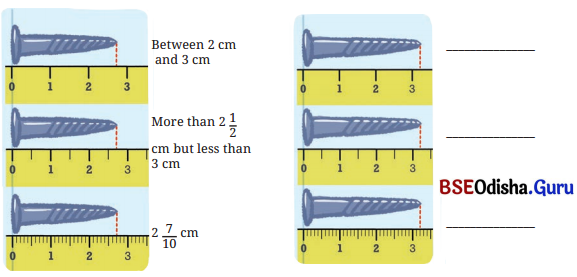
A Peek Beyond the Point Class 7 Solutions Maths Ganita Prakash Chapter 3-1
(i) Which scale helped you measure the length of the screws accurately? Why?
(ii) Can you explain why the unit was
Solution:
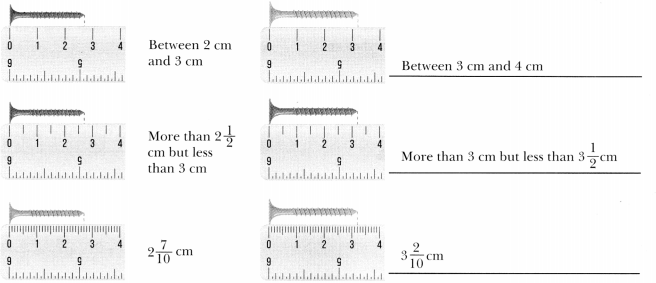
A Peek Beyond the Point Class 7 Solutions Maths Ganita Prakash Chapter 3-2
(i) The scale with the smallest divisions (marked in tenths of a centimetre, which are millimetres) allowed for the most accurate measurement. This is because the ends of the screws did not align perfectly with the whole or half centimetre marks, requiring finer divisions to determine the length more accurately.

(ii) The unit (centimetre) was divided into smaller parts (tenths, or millimetres) because the screws’ lengths were not exact whole numbers of centimeters. Smaller divisions are needed to measure lengths accurately that fall between the whole number marks.

Question 2.
Write the measurements of the objects shown in the picture:
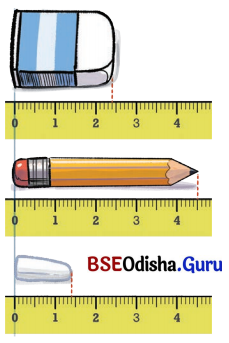
A Peek Beyond the Point Class 7 Solutions Maths Ganita Prakash Chapter 3-3
Solution:
Length of the eraser is \(2 \frac{4}{10}\)cm; Length of the pencil is \(4 \frac{5}{10}\)cm; Length of the chalk is \(1 \frac{4}{10}\)cm.

A Peek Beyond the Point Class 7 Solutions Maths Ganita Prakash Chapter 3

Question 3.
Arrange these lengths in increasing order:
(a) \(\frac{9}{10}\)
(b) \(1\frac{7}{10}\)
(c) \(\frac{130}{10}\)
(d) \(13\frac{1}{10}\)
(e) \(10\frac{5}{10}\)
(f) \(7\frac{6}{10}\)
(g) \(6\frac{7}{10}\)
(h) \(\frac{4}{10}\)
Solution:
The given fractions can be written as \(\frac{9}{10}\),
\(1 \frac{7}{10}=\frac{17}{10}, \frac{130}{10}, 13 \frac{1}{10}=\frac{131}{10}, 10 \frac{5}{10}=\frac{105}{10},\)
\(7 \frac{6}{10}=\frac{76}{10}, 6 \frac{7}{10}=\frac{67}{10} \text { and } \frac{4}{10} .\)
Comparing the given fractions and arranging in increasing order, we get
\(\frac{4}{10}<\frac{9}{10}<\frac{17}{10}<\frac{67}{10}<\frac{76}{10}<\frac{105}{10}<\frac{130}{10}<\frac{131}{10}\)
⇒ \(\begin{aligned}
\frac{4}{10}<\frac{9}{10} & <1 \frac{7}{10}<6 \frac{7}{10}<7 \frac{6}{10} \\
& <10 \frac{5}{10}<\frac{130}{10}<13 \frac{1}{10}
\end{aligned}\)

Question 4.
The lengths of the body parts of a honeybee are given. Find its total length.
A Peek Beyond the Point Class 7 Solutions Maths Ganita Prakash Chapter 3-4
Head; \(2\frac{3}{10}\)units
Thorax: \(5\frac{4}{10}\) units
Abdomen: \(7\frac{5}{10}\) units
Solution:
Total length of the honeybee = Length of the head + Length of the thorax + Length of the abdomen
= \(2\frac{3}{10}\) units + \(5\frac{4}{10}\) units + \(7\frac{5}{10}\) units
= ( 2 + 5 +7) units + \(\left(\frac{3}{10}+\frac{4}{10}+\frac{5}{10}\right)\)units
= (14 + \(\frac{12}{10}\)) units
= (14 + \(\frac{10}{10}+\frac{2}{10}\)) units = (14 + 1 + \(\frac{2}{10}\)) units
= (15 + \(\frac{2}{10}\)) units = 15\(\frac{2}{10}\) units

A Peek Beyond the Point Class 7 Solutions Maths Ganita Prakash Chapter 3

Question 5.
Find the difference of \(12\frac{4}{10}\) and \(6\frac{7}{10}\) by converting both lengths to tenths.
Solution:
Converting to tenths:
\(12 \frac{4}{10}=12+\frac{4}{10}=\frac{120}{10}+\frac{4}{10}=\frac{124}{10}\) and
\(6 \frac{7}{10}=6+\frac{7}{10}=\frac{60}{10}+\frac{7}{10}=\frac{67}{10}\)
Required difference = \(\frac{124}{10}-\frac{67}{10}=\frac{57}{10}\)
= \(\frac{50}{10}+\frac{7}{10}=5+\frac{7}{10}=5 \frac{7}{10}\) units

Question 6.
A Celestial Pearl Danio’s length is \(2\frac{4}{10}\) cm and the length of a Philippine Goby is \(\frac{9}{10}\) cm. What is the difference in their lengths?

A Peek Beyond the Point Class 7 Solutions Maths Ganita Prakash Chapter 3-5
Solution:
Length of a Celestial Pearl Danio fish
= \(2 \frac{4}{10} \mathrm{~cm}=\frac{20}{10}+\frac{4}{10}=\frac{24}{10} \mathrm{~cm}\)
Length of a Philippine Goby fish = \(\frac{9}{10}\) cm
So, the difference in their lengths
= \(\frac{24}{10} \mathrm{~cm}-\frac{9}{10} \mathrm{~cm}=\frac{15}{10} \mathrm{~cm}=1 \frac{5}{10} \mathrm{~cm}\)

A Peek Beyond the Point Class 7 Solutions Maths Ganita Prakash Chapter 3

Question 7.
Observe the given sequences of numbers. Identify the change after each term and extend the pattern:
(i) \(4,4 \frac{3}{10}, 4 \frac{6}{10}\), _______, _______, ______
(ii) \(8 \frac{2}{10}, 8 \frac{7}{10}, 9 \frac{2}{10}\), _______, _______, ______
(iii) \(3 \frac{5}{10}, 13,12 \frac{5}{10}\), _______, _______, ______
(iv) \(11 \frac{5}{10}, 10 \frac{4}{10}, 9 \frac{3}{10}\), _______, _______, ______
Solution:
(i) The given sequence is \(4,4 \frac{3}{10}, 4 \frac{6}{10}\), …….
Here, \(4 \frac{3}{10}-4=\frac{3}{10} ; 4 \frac{6}{10}-4 \frac{3}{10}=\frac{3}{10}\)
1st term = 4, any other term = previous term + \(\frac{3}{10}\)
The further terms are:
\(4 \frac{6}{10}+\frac{3}{10}=4 \frac{9}{10} ; 4 \frac{9}{10}+\frac{3}{10}\)
= \(4 \frac{12}{10}=5 \frac{2}{10} ; 5 \frac{2}{10}+\frac{3}{10}\)
= \(5 \frac{5}{10} ; 5 \frac{5}{10}+\frac{3}{10}=5 \frac{8}{10}\)
Thus, the sequence is
\(4,4 \frac{3}{10}, 4 \frac{6}{10}, \mathbf{4} \frac{\mathbf{9}}{\mathbf{1 0}}, \mathbf{5} \frac{\mathbf{2}}{\mathbf{1 0}}, \mathbf{5} \frac{\mathbf{5}}{\mathbf{1 0}}, \mathbf{5} \frac{\mathbf{8}}{\mathbf{1 0}}\), …..

(ii) Since, the sequence is
\(\begin{aligned}
& 8 \frac{2}{10}+\frac{5}{10}=8 \frac{7}{10}, 8 \frac{7}{10}+\frac{5}{10} \\
& =8 \frac{12}{10}=8+1+\frac{2}{10}=9 \frac{2}{10}
\end{aligned}\)
1st = \(8 \frac{2}{10}\), any other term = previous term + \(\frac{5}{10}\)
The further terms are:
\(\begin{aligned}
& 9 \frac{2}{10}+\frac{5}{10}=9 \frac{7}{10} ; 9 \frac{7}{10}+\frac{5}{10} \\
& =9 \frac{12}{10}=10 \frac{2}{10} ; 10 \frac{2}{10}+\frac{5}{10} \\
& =10 \frac{7}{10} ; 10 \frac{7}{10}+\frac{5}{10}=10 \frac{12}{10}=11 \frac{2}{10}
\end{aligned}\)
Thus, the sequence is
\(8 \frac{2}{10}, 8 \frac{7}{10}, 9 \frac{2}{10}, \mathbf{9} \frac{7}{\mathbf{1 0}}, \mathbf{1 0} \frac{2}{\mathbf{1 0}}, \mathbf{1 0} \frac{7}{\mathbf{1 0}}, \mathbf{1 1} \frac{2}{\mathbf{1 0}}\), …..

(iii) Since \(13 \frac{5}{10}-\frac{5}{10}=13 ; 13-\frac{5}{10}\)
= \(12+1-\frac{5}{10}=12+\frac{10}{10}-\frac{5}{10}=12 \frac{5}{10}\), ….
1st = \(13 \frac{5}{10}\), any other term = previous term – \(\frac{5}{10}\)
The further terms are:
\(13 \frac{5}{10}, 13,12 \frac{5}{10}, \underline{\mathbf{1 2}}, \mathbf{1 1 \frac { \mathbf { 5 } } { \mathbf { 1 0 } }}, \underline{\mathbf{1 1}}, \mathbf{1 0} \frac{\mathbf{5}}{\mathbf{1 0}}\)

(iv) Since \(\begin{aligned}
11 \frac{5}{10}-1 \frac{1}{10}=10 & \frac{4}{10} \\
& 10 \frac{4}{10}-1 \frac{1}{10}=9 \frac{3}{10}
\end{aligned}\); ….
1st = \(11 \frac{5}{10}\), any other term = previous term – \(1\frac{1}{10}\)
The further terms are:
\(11 \frac{5}{10}, 10 \frac{4}{10}, 9 \frac{3}{10}, \mathbf{8} \frac{\mathbf{2}}{\mathbf{1 0}}, \mathbf{7} \frac{\mathbf{1}}{\mathbf{1 0}}, \mathbf{6}, \mathbf{4} \frac{\mathbf{9}}{\mathbf{1 0}}\), ….

Question 8.
Observe the fiure below. Notice the markings and the corresponding lengths written in the boxes when measured from 0. Fill the lengths in the empty boxes.
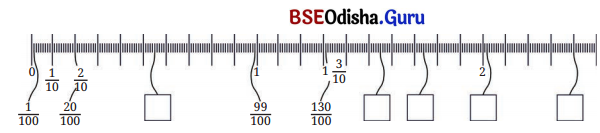
A Peek Beyond the Point Class 7 Solutions Maths Ganita Prakash Chapter 3-6
Solution:
\(\frac{55}{100}, \frac{155}{100}, \frac{174}{100}, \frac{202}{100}, \frac{240}{100}\)

A Peek Beyond the Point Class 7 Solutions Maths Ganita Prakash Chapter 3

Question 9.
For the lengths shown below write the measurements and read out the measures in words.
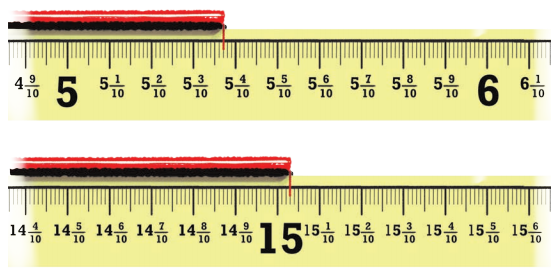
A Peek Beyond the Point Class 7 Solutions Maths Ganita Prakash Chapter 3-7
A Peek Beyond the Point Class 7 Solutions Maths Ganita Prakash Chapter 3-8
Solution:
(a) \(5 \frac{3}{10} \frac{7}{100}\) Five and three-tenths and seven-hundredths
or \(5 \frac{37}{100}\) Five and thirty seven-hundredths
or \(\frac{537}{100}\) Five hundred and thirty seven-hundredths

(b) \(15 \frac{3}{100}\) Fifteen and three-hundredths
or \(\frac{1503}{100}\) One thousand five hundred and three-hundredths

(c) \(7 \frac{5}{10} \frac{2}{100}\) Seven and five-tenths and two-hundredths
or \(7 \frac{52}{100}\) Seven and fifty two-hundredths or \(\frac{752}{100}\) Seven hundred and fifty two-hundredths

(d) \(9 \frac{8}{10}\) Nine and eight-tenths
or \(9 \frac{8}{100}\) Nine and eights-hundredths
or \(\frac{980}{100}\) Nine hundred and eighty-hundredths

Question 10.
Solve the difference \(25 \frac{9}{10}-6 \frac{4}{10} \frac{7}{100}\) by converting to hundredths.
Solution:
Converting to hundredths:
\(25 \frac{9}{10}=25 \frac{90}{100}=\frac{2500}{100}+\frac{90}{100}=\frac{2590}{100} ; 6 \frac{4}{10} \frac{7}{100}=\frac{600}{100}+\frac{40}{100}+\frac{7}{100}=\frac{647}{100}\)
Now, \(25 \frac{9}{10}-6 \frac{4}{10} \frac{7}{100}=\frac{2590}{100}-\frac{647}{100}=\frac{(2590-647)}{100}=\frac{1943}{100}=19 \frac{43}{100}\)

A Peek Beyond the Point Class 7 Solutions Maths Ganita Prakash Chapter 3

Question 11.
Write these quantities in decimal form:
(i) 234 hundredths
(ii) 105 tenths.
Solution:
(i) 234 hundredths can be expressed in decimal form as follows
234 hundredths = \(\frac{234}{100}=\frac{200}{100}+\frac{30}{100}+\frac{4}{100}=2+\frac{3}{10}+\frac{4}{100}\) = 2.34

(ii) 105 tenths can be expressed in decimal form as follows:
105 tenths = \(\frac{105}{10}=\frac{100}{10}+\frac{0}{10}+\frac{5}{10}=10+0+\frac{5}{10}\) = 10.5

Question 12.
Name all the divisions between 1 and 1.1 on the number line.

A Peek Beyond the Point Class 7 Solutions Maths Ganita Prakash Chapter 3-9
Solution:
The divisions between 1 and 1.1 represent the decimal numbers 1.01, 1.02, 1.03, 1.04, 1.05, 1.06, 1.07, 1.08 and 1.09 on the number line.

A Peek Beyond the Point Class 7 Solutions Maths Ganita Prakash Chapter 3

Question 13.
Identify and write the decimal numbers against the letters.

A Peek Beyond the Point Class 7 Solutions Maths Ganita Prakash Chapter 3-10
Solution:
The letters marked on the given number line represent the decimal numbers as follows: A = 5.09, B = 5.13, C = 5.2, D = 5.31

Question 14.
Identify the decimal number in the last number line in below figure denoted by ‘?’
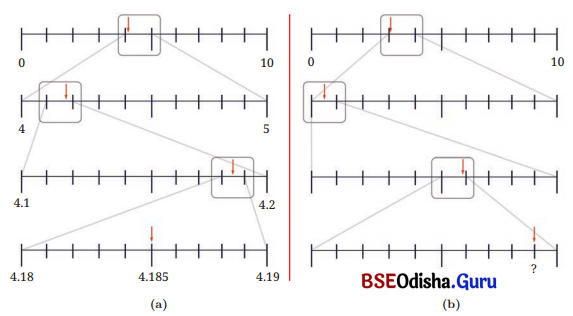
A Peek Beyond the Point Class 7 Solutions Maths Ganita Prakash Chapter 3-11
Solution:
By labelling the visualised segment of the number line, we find that the decimal number 3.059 is denoted by ?’
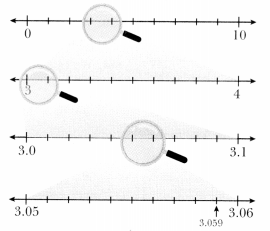
A Peek Beyond the Point Class 7 Solutions Maths Ganita Prakash Chapter 3-12

A Peek Beyond the Point Class 7 Solutions Maths Ganita Prakash Chapter 3

Question 15.
Locate the following decimal numbers on the number line:
(i) 9.876
(ii) 0.407
Solution:
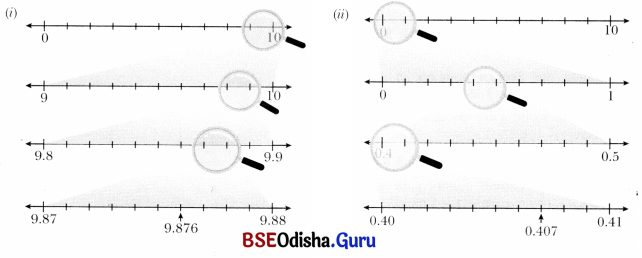
A Peek Beyond the Point Class 7 Solutions Maths Ganita Prakash Chapter 3-13

Question 16.
Which decimal number is greater?
(i) 1.23 or 1.32
(ii) 3.81 or 13.800
(iii) 1.009 or 1.090
Solution:
(i) Using decimal place value chart, we find that:

Tens Ones Decimal point Tenths Hundredths Thousandths
1 . 2 3
1 . 3 2

Both numbers have 1 unit but the first number has 2 tenths whereas the second number has 3 tenths.
Therefore, 1.23 < 1.32

(ii) Using decimal place value chart, we find that:

Tens Ones Decimal point Tenths Hundredths Thousandths
3 8 1
1 3 8 0 0

Here, the first number has 3 units whereas the second number has 1 ten and 3 units.
Therefore, 3.81 < 13.800

(iii) Using decimal place value chart, we find that:

Tens Ones Decimal point Tenths Hundredths Thousandths
1 . 0 0 9
1 . 0 9 0

Both numbers have 1 unit and the 0 tenths but the first number has 0 hundredths whereas the second number has 9 hundredths.
Therefore, 1.009 < 1.090

A Peek Beyond the Point Class 7 Solutions Maths Ganita Prakash Chapter 3

Question 17.
Which among these is closest to 4: 3.56, 3.65, 3.099?
Solution:
Arranging the decimal numbers in ascending order, we get 3.099 < 3.56 < 3.65 < 4.
Clearly, 3.65 is closest to 4 among the given decimal numbers.

Question 18.
Which among these is closest to 1: 0.8, 0.69, 1.08?
Solution:
Arranging the decimal numbers in ascending order, we get 0.69 < 0.8 < 1 < 1.08.
Among the neighbours of 1, 0.8 is \(\frac{2}{10}\), i.e. \(\frac{2}{100}\) away from 1 whereas 1.08 is \(\frac{8}{100}\) away from 1. Therefore, 1.08 is closest to 1.

A Peek Beyond the Point Class 7 Solutions Maths Ganita Prakash Chapter 3

Question 19.
In each case below use the digits 4, 1, 8, 2 and 5 exactly once and try to make a decimal number as close as possible to 25.
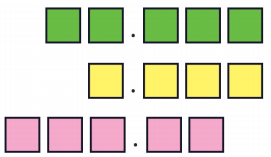
A Peek Beyond the Point Class 7 Solutions Maths Ganita Prakash Chapter 3-14
Solution:
We can make a decimal number closest to 25 using the digits 4, 1, 8, 2 and 5 with the given conditions as follows:
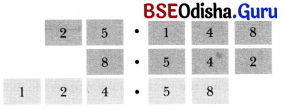
A Peek Beyond the Point Class 7 Solutions Maths Ganita Prakash Chapter 3-15

Question 20.
Write the detailed place value computation for 84.691 – 77.345, and its compact form.
Solution:
We can find the difference of 84.691 – 77.345 as follows:
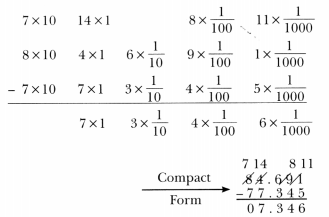
A Peek Beyond the Point Class 7 Solutions Maths Ganita Prakash Chapter 3-16

A Peek Beyond the Point Class 7 Solutions Maths Ganita Prakash Chapter 3

A Peek Beyond the Point Class 7 Extra Questions

A Peek Beyond the Point Class 7 Very Short Question Answer

Question 1.
For the length shown below, write the measurement and read out the measure in words.
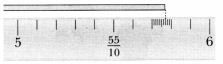
A Peek Beyond the Point Class 7 Solutions Maths Ganita Prakash Chapter 3-17
Solution:
From the figure, the strip covers 5 units, 7-tenths and 7-hundredths.
∴ The length of the strip is \(5 \frac{7}{10} \frac{7}{100}\) units.
It is read as “Five and seven-tenths and seven- hundredths”.

Question 2.
Find the value of \(8 \frac{6}{100}-4 \frac{5}{100}\).
Solution:
\(8 \frac{6}{100}-4 \frac{5}{100}=(8-4)+\left(\frac{6}{100}-\frac{5}{100}\right)=4+\frac{1}{100}\)
= \(4 \frac{1}{100}\)

A Peek Beyond the Point Class 7 Solutions Maths Ganita Prakash Chapter 3

Question 3.
For the length shown below write the measurement and read out the measure in words.
A Peek Beyond the Point Class 7 Solutions Maths Ganita Prakash Chapter 3-18
Solution:
From the figure, the strip covers 14 units, 8-tenths and 3-hundredths.
∴ The length of the strip is \(14 \frac{8}{10} \frac{3}{100}\) units.
It is read as “Fourteen and eight-tenths and three- hundredths”.

Question 4.
Convert into the decimal:\(\frac{57}{10}\)
Solution:
The number of zeros in denominator after 1 is 1.
Thus, starting from the extreme right digit of the numerator, we insert the decimal point 1 place to the left.
Therefore, \(\frac{57}{10}\) = 5.7

A Peek Beyond the Point Class 7 Solutions Maths Ganita Prakash Chapter 3

Question 5.
Which decimal is greater, 0.71 or 0.071?
Solution:
The whole number parts of both the numbers are 0.
Comparing the digits in the tenths place, we get 7 > 0. So, 0.71 > 0.071.

Question 6.
Add the following:
(i) 3.9732 and 0.8
(ii) 12.16, 34 and 87.943
Solution:
(i) \(\begin{array}{r}
3.9732 \\
+0.8000 \\
\hline 4.7732 \\
\hline
\end{array}\)
(ii) \(\begin{array}{r}
12.160 \\
34.000 \\
+87.943 \\
\hline 134.103
\end{array}\)

A Peek Beyond the Point Class 7 Solutions Maths Ganita Prakash Chapter 3

Question 7.
Subtract:
(i) 18.25 from 24.05
(ii) 233.326 from 507
Solution:
(i) \(\begin{array}{r}
24.05 \\
-18.25 \\
\hline 5.80 \\
\hline
\end{array}\)
(ii) \(\begin{array}{r}
507.000 \\
-233.326 \\
\hline 273.674 \\
\hline
\end{array}\)

Question 8.
Find the sum:
(i) 0.007 + 8.5 + 30.089
(ii) 0.75 + 25.892 + 200.097
Solution:
(i) \(\begin{array}{r}
0.007 \\
8.500 \\
+30.089 \\
\hline 38.596 \\
\hline
\end{array}\)
(ii) \(\begin{array}{r}
0.750 \\
25.892 \\
+200.097 \\
\hline 226.739 \\
\hline
\end{array}\)

A Peek Beyond the Point Class 7 Solutions Maths Ganita Prakash Chapter 3

Question 9.
A shirt costs ₹ 355.50 and a sweater costs ₹ 536.50. Find the total cost of shirt and sweater.
Solution:
To find the total cost of the shirt and a sweater, we simply add the two amounts.
Thus, total cost = ₹355.50 + ₹536.50 = ₹892.00

A Peek Beyond the Point Class 7 Short Question Answer

Question 1.
The lengths of the body part of an ant are as follows:
A Peek Beyond the Point Class 7 Solutions Maths Ganita Prakash Chapter 3-19
Head = \(\left(1 \frac{6}{10}\right)\) units; Throax = \(\left(2 \frac{3}{10}\right)\) units; Abdomen = \(\left(3 \frac{9}{10}\right)\) units.
Find the total length of the ant.
Solution:
Total length of the ant = Length of head + Length of thorax + Length of abdomen
= \(1 \frac{6}{10}+2 \frac{3}{10}+3 \frac{9}{10}\)
= ( 1 + 2 + 3) + \(\left(\frac{6}{10}+\frac{3}{10}+\frac{9}{10}\right)\)
= 6 + \(\frac{18}{10}=6+\frac{10}{10}+\frac{8}{10}\)
= 7 + \(\frac{8}{10}=7 \frac{8}{10}\) units
Thus, the total length of the ant is \(7 \frac{8}{10}\) units.

A Peek Beyond the Point Class 7 Solutions Maths Ganita Prakash Chapter 3

Question 2.
Write the following decimal numbers in ascending order:
5.64, 2.54, 3.05, 0.259 and 8.32
Solution:
As all the given decimal numbers have unequal whole number part, we can arrange the decimal numbers byjust comparing the whole number parts.
The whole number parts of given decimal numbers are 5, 2, 3, 0 and 8 respectively.
As 0 < 2 < 3 < 5 < 8
0.259 < 2.54 < 3.05 < 5.64 < 8.32

Question 3.
Among 1.95, 2.1, 2.05 and 1.99, which number is closest to 2?
Solution:
1.95 and 1.99 are smaller than 2. Thus,
2 – 1.95 = 0.05
2 – 1.99 = 0.01
2.1 and 2.05 are greater than 2. Thus,
2.1 – 2 = 0.1
2.05 – 2 = 0.05
Since 0.01 is the smallest difference, 1.99 is closest to 2.

A Peek Beyond the Point Class 7 Solutions Maths Ganita Prakash Chapter 3

Question 4.
Put the following decimal numbers in the appropriate boxes:
(a) 0.7
(b) 0.346
(c) 0.504
(d) 0.967
(e) 0.089
(f) 0.007
(g) 0.894
(h) 0.170
(i) 0.67
(j) 0.3
(k) 0.876
(l) 0.499

Numbers less than 0.5 Numbers greater than 0.5

Solution:

Numbers less than 0.5 Numbers greater than 0.5
(b) 0.346 (e) 0.089 (j) 0.007 (h) 0.170 (j) 0.3    (j) 0.499 (a) 0.7 (c) 0.504 (d) 0.967 (g) 0.894 (i) 0.67 (k) 0.876


Question 5.
On the number line given below, what decimal numbers do the letters ‘w’, v, ‘w’ and ‘x’ represent?
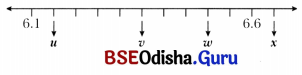
A Peek Beyond the Point Class 7 Solutions Maths Ganita Prakash Chapter 3-20
Solution:
There are 10 divisions between 6.1 and 6.6
So, each division is a tenth part of 0.5 or \(\) i.e., \(\) = 0.05 units.
Therefore, the first division after 6.1, denoted by V represents the decimal number 6.15, while the 5th division, denoted by ‘v’ represents the number 6.35.
The 8th division denoted by ‘x’ represents 6.50 and the first division after 6.6, denoted by ‘x’, represents the number 6.65.

A Peek Beyond the Point Class 7 Solutions Maths Ganita Prakash Chapter 3

Question 6.
Arrange the following in the descending order:
(i) 10.98, 10.089, 10.809, 10.908, 10.981
(ii) 22.31, 22.13, 22.331, 22.313, 22.133
Solution:
(i) We can write the given decimal numbers as like decimals as:
10.980, 10.089, 10.809, 10.908, 10.981
By comparing the digits from left to right after the decimal point, the given decimal numbers can be written in descending order as follows:
10.981, 10.98, 10.908, 10.809, 10.089

(ii) We can write the given decimal numbers as like decimals as:
22.310, 22.130, 22.331, 22.313, 22.133
By comparing the digits from left to right after the decimal point, the given decimal numbers can be written in descending order as follows:
22.331, 22.313, 22.31, 22.133, 22.13

Question 7.
A runner completed a race in 1.75 hours. How many minutes did he take to finish the race?
Solution:
Time taken by runner to complete the race = 1.75 hours
We know that 1 hour = 60 minutes.
Now, 1.75 hours = 1 hour + 0.75 hours = 60 minutes + (0.75 x 60) minutes
= 60 minutes + 45 minutes = 105 minutes
Thus, the runner took 105 minutes to complete the race.

A Peek Beyond the Point Class 7 Solutions Maths Ganita Prakash Chapter 3

Question 8.
From a packet of sugar weighing 0.875 kilograms, 437 grams of sugar was used up for making dessert. How much sugar is left in the packet? Give the answer in kilograms.
Solution:
Total sugar in packet = 0.875 kg
Sugar used = 437 grams = 0.437 kg
Sugar left in the packet = 0.875 kg – 0.437 kg
= 0.438 kg

A Peek Beyond the Point Class 7 Long Question Answer

Question 1.
Represent the following decimal numbers in the decimal place value chart. Give their expanded form (both fractional and decimal) and write the numbers in words.
(i) 235.25
(ii) 10.05
(iii) 0.755
(iv) 43.007
Solution:

Place Name Thousands Hundreds Tens Ones • Tenths Hundredths Thousandths
Place value 1000 100 10 1 • \(\frac{1}{10}\) \(\frac{1}{100}\) \(\frac{1}{1000}\)
(i) 235.25 2 3 5 • 2 5
(ii) 10.05 1 0 • 0 5
(iii) 0.755 0 • 7 5 5
(iv) 43.007 4 3 • 0 0 7

(i) 235.25 = 200 + 30 + 5 + 0.2 + 0.05 = 200 + 30 + 5 + \(\frac{2}{10}+\frac{5}{100}\)
= 235 + \(\frac{20}{100}+\frac{5}{100}=235+\frac{25}{100}=235 \frac{25}{100}\)
In words: Two hundred thirty five point two five

(ii) 10.05 = 10 + 0.05 = 10 + 0 + \(\frac{0}{10}+\frac{5}{100}=10+\frac{5}{100}=10 \frac{5}{100}\)
In words: Ten point zero five

(iii) 0.755 = 0.7 + 0.05 + 0.005 = \(\frac{7}{10}+\frac{5}{100}+\frac{5}{1000}=\frac{700}{1000}+\frac{50}{1000}+\frac{5}{1000}=\frac{755}{1000}\)
In words: Zero point seven five five

(iv) 43.007 = 40 + 3 + 0.007 = 40 + 3 + \(\frac{7}{1000}=43+\frac{7}{1000}=43 \frac{7}{1000}\)
In words: Forty three point zero zero seven

A Peek Beyond the Point Class 7 Solutions Maths Ganita Prakash Chapter 3

Question 2.
Represent the decimal number, 8.756 on number line (use multiple number lines to show subsequent magnifications).
Solution:
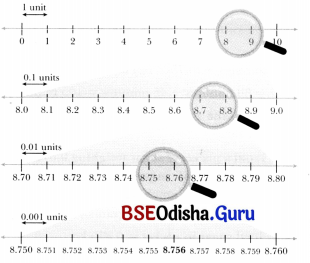
A Peek Beyond the Point Class 7 Solutions Maths Ganita Prakash Chapter 3-21

Question 3.
Ravi delivers 3.5 kg, 3.2 kg and 7.1 kg of vegetables to a store in the first three days. In 7 days, he delivers 20 kg of vegetables. What is the total quantity of vegetables delivered in the last four days?
Solution:
The total quantity of vegetables delivered in the
first 3 days = 3.5 kg + 3.2 kg + 7.1 kg = 13.8 kg
Given, total quantity of vegetables delivered in 7 days is 20 kg.
∴ Quantity of vegetables delivered in the last 4 days
= Quantity of vegetables delivered in 7 days – Quantity of vegetables delivered in 3 days
= 20- 13.8 = 6.2 kg
Hence, Ravi delivered 6.2 kg of vegetables in the last 4 days.

A Peek Beyond the Point Class 7 Case Based Questions

The Matki Phod game is a popular event during Janmashtami. In this game, a clay pot (called a Matki) filled with curd, butter or other milk- based food is tied at a height, and players form a multi-level human pyramid to reach and break it.
A Peek Beyond the Point Class 7 Solutions Maths Ganita Prakash Chapter 3-22
In one such event, the matki is tied at a height of \(13 \frac{5}{10}\) units from the ground. Each person in the pyramid is \(3 \frac{2}{10}\) units tall.
Based on the given information, answer the following questions:
(i) What is the total height of 3 such levels?
(ii) How many levels are needed to reach or cross the height of the matki?
Solution:
(i) Total height of three levels
= \(3 \frac{2}{10}+3 \frac{2}{10}+3 \frac{2}{10}=9 \frac{6}{10}\) units

(ii) We need to find the smallest number of levels such that:
Height > \(13 \frac{5}{10}\) units
Height of each level = \(3 \frac{2}{10}\) units Total height of 4 levels
= \(3 \frac{2}{10}+3 \frac{2}{10}+3 \frac{2}{10}+3 \frac{2}{10}=12 \frac{8}{10}\)units
Total height of 4 levels is less than \(13 \frac{5}{10}\) units,
so players will not reach upto the Matki.
Now, total height of 5 levels = Total height of 4 levels + \(3 \frac{2}{10}=12 \frac{8}{10}+3 \frac{2}{10}\) = 16 units.
On increasing one level, the height of Matki can be reached.
Hence, minimum 5 levels are required to cross the height of the Matki.

A Peek Beyond the Point Class 7 Solutions Maths Ganita Prakash Chapter 3

Question 2.
The table displays the rainfall (in cm) recorded in various months in delhi in year 2024.

A Peek Beyond the Point Class 7 Solutions Maths Ganita Prakash Chapter 3-23

Month Rainfall (in cm) Month Rainfall (in cm)
January 6.2 July 3.84
February 7 August 2.4
March 7.55 September 4.1
April 8.2 October 6
May 7.45 November 5.9
June 5.7 December 6.3

Based on the above information, answer the following questions:
(i) Find the total rainfall recorded in the first three months of the year.
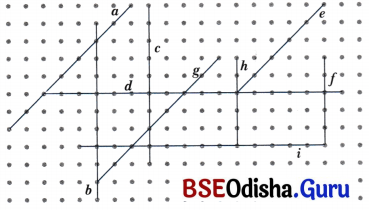
(ii) Find the total rainfall recorded in the last three months of the year.
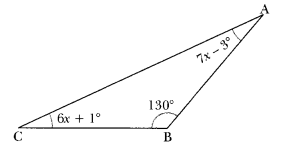
(iii) How much total rainfall was recorded during the three wettest months?
Solution:
(i) The total rainfall recorded in the first three months, i.e. January, February and March
= (6.2 + 7 4 – 7.55) cm = 20.75 cm

(ii) The total rainfall in the last three months of the year, i.e. October, November and December
= (6 + 5.9 + 6.3) cm = 18.2 cm

(iii) Comparing the rainfalls in all months, we find that the three wettest months are March, April and May with rainfall of 7.55 cm, 8.2 cm and 7.45 cm, respectively.
Thus, total rainfall recorded during three wettest months = (7.55 + 8.2 + 7.45) cm
= 23.2 cm.