A Greedy Fat Old Man (III) Question Answer Class 6 English Chapter 4 BSE Odisha

Odisha State Board BSE Odisha 6th Class English Solutions Lesson 4 A Greedy Fat Old Man (III) Textbook Exercise Questions and Answers.

Class 6th English Chapter 4 A Greedy Fat Old Man (III) Question Answers BSE Odisha

A Greedy Fat Old Man (III) Class 6 Questions and Answers

Session – 1 ( ସୋପାନ – ୧)
I. Pre-Reading (ପଢ଼ିବା ପୂର୍ବରୁ)

  • Socialization (ସାମାଜିକୀକରଣ):
  • This 3rd part is the most interesting and last part of the fantasy
    (ଏହି ତୃତୀୟ ଭାଗଟି ସବୁଠାରୁ ଅଧିକ ଆନନ୍ଦଦାୟକ ଏବଂ ଏହା କଳ୍ପନାର ଶେଷ ଭାଗ ଅଟେ !)
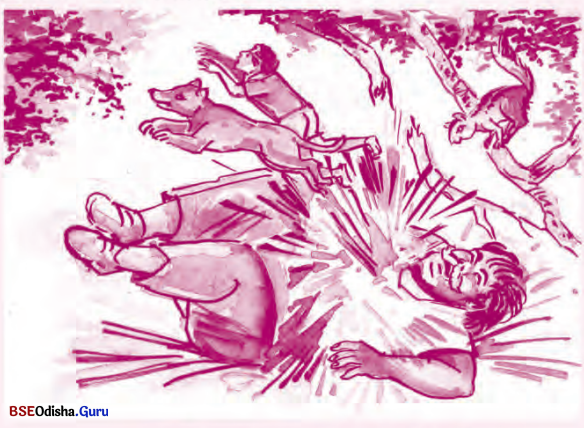
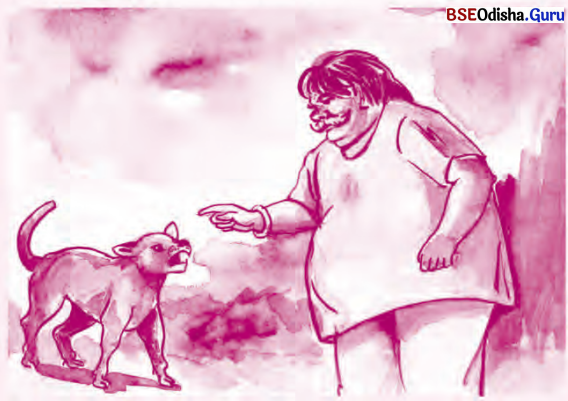
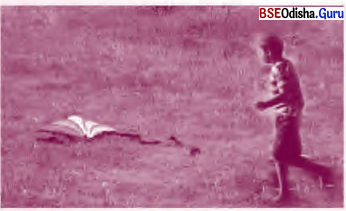
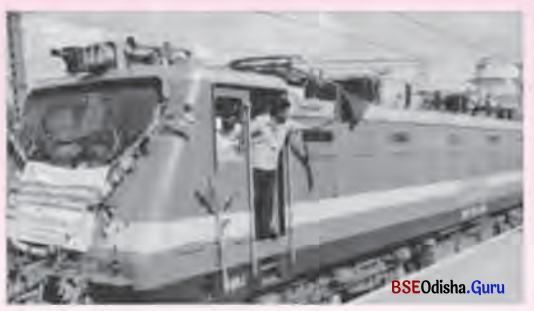
  • Look at the picture. What happened to the old man? Was he able to eat the squirrel? Let’s read the story and see.
    (ଛବିଟିକୁ ଚାହଁ । ବୁଢ଼ାଲୋକଟିର କ’ଣ ହେଲା ? ସେ ଗୁଣ୍ଡୁଚିମୂଷାଟିକୁ ଖାଇବାକୁ ସମର୍ଥ ହେଲା କି ? ଆସ ଗପଟିକୁ ପଢ଼ିବା ଏବଂ ଦେଖିବା ।)

BSE Odisha 6th Class English Solutions Lesson 4 A Greedy Fat Old Man (III) - Q.1

II. While-Reading (ପଢ଼ିବା ସମୟରେ):
Text – (ପାଠ୍ୟବସ୍ତୁ)

Read the last part silently and answer the questions that follow
(ଶେଷ ଭାଗଟିକୁ ନୀରବରେ ପଢ଼ ଏବଂ ପରବର୍ତ୍ତୀ ପ୍ରଶ୍ନଗୁଡ଼ିକର ଉତ୍ତର ଦିଅ ।)
After eating the dog, the man walked, walked, and walked till he met a little squirrel. The little squirrel asked the old man, ‘Old man, old man, what makes you so fat ?’ The old man said. “I’ve taken a very heavy breakfast. For my breakfast, I took two mugs of tea, two liters of milk, three tins of biscuits, and five big pieces of cakes.” Then I ate a little boy and a small dog. I’ll also eat you up if I can catch you.” “But you cannot catch me, old man,” said the active, agile, little squirrel.

Then the squirrel jumped up the tree, the old man also climbed up the tree. The little squirrel jumped up to the main branch of the tree. The old man also climbed up to the main branch of the tree. Next, the little squirrel jumped up to a thin branch. The old man also climbed up to the thin branch. But thrash ! the small branch broke and the old man fell to the ground. His big belly burst out. The little boy came out. The little dog came out. And the squirrel was also out because he was never ever in. Follow all four steps as in lessons 2 and 3.

BSE Odisha 6th Class English Solutions Lesson 4 A Greedy Fat Old Man (III)

ଓଡ଼ିଆ ଅନୁବାଦ :
କୁକୁରଟିକୁ ଖାଇସାରିବା ପରେ, ଲୋକଟି ଗୋଟିଏ ଛୋଟ ଗୁଣ୍ଡୁଚିମୂଷାକୁ ଭେଟିବା ପର୍ଯ୍ୟନ୍ତ ଦୀର୍ଘବାଟ ଚାଲିଲା । ସେହି ଛୋଟ ଗୁଣ୍ଡୁଚିମୂଷା ବୁଢ଼ାଲୋକଟିକୁ ପଚାରିଲା, ‘ବୁଢ଼ାଲୋକ, ହେ ବୁଢ଼ାଲୋକ, କ’ଣ ତୁମକୁ ଏତେ ମୋଟା କରିଛି ? ବୁଢ଼ାଲୋକଟି କହିଲା, ‘ମୁଁ ବହୁତଗୁଡ଼ାଏ ଜଳଖିଆ ଖାଇଦେଇଛି । ମୋର ଜଳଖିଆରେ, ମୁଁ ଦୁଇ ମଗ୍ ଚା’, ଦୁଇ ଲିଟର କ୍ଷୀର, ତିନି ଟିଣ ବିସ୍କୁଟ୍ ଏବଂ ପାଞ୍ଚଟା ବଡ଼ ବଡ଼ ପିଠା ଖାଇଲି । ତା’ପରେ ମୁଁ ଗୋଟିଏ ଛୋଟ ବାଳକକୁ ଏବଂ ଗୋଟିଏ ଛୋଟିଆ କୁକୁରକୁ ଖାଇଲି । ମୁଁ ମଧ୍ୟ ତୋତେ ଖାଇବି ଯଦି ମୁଁ ତୋତେ ଧରିପାରିବି ।’’ ‘‘କିନ୍ତୁ ତୁମେ ମୋତେ ଧରିପାରିବ ନାହିଁ, ହେ ବୁଢ଼ାଲୋକ’’ କର୍ମଠ, ଚଞ୍ଚଳ ଓ ଛୋଟିଆ ଗୁଣ୍ଡୁଚିମୂଷାଟି କହିଲା

। ଗଛର ମୁଖ୍ୟ ଶାଖା ଉପରକୁ ଡେଇଁ ପଡ଼ିଲା । ବୁଢ଼ାଲୋକଟି ମଧ୍ୟ ଗଛର ମୁଖ୍ୟ ଶାଖା ଉପରକୁ ଚଢ଼ିଗଲା । ତା’ପରେ ଛୋଟିଆ ଗୁଣ୍ଡୁଚିମୂଷାଟି ଗୋଟିଏ ସରୁ (ପତଳା) ଶାଖା (ଡାଳ) ଉପରକୁ ଡେଇଁ ପଡ଼ିଲା । ବୁଢ଼ାଲୋକ ଜଣକ ମଧ୍ୟ ସେହି ସରୁ (ପତଳା) ଡାଳ (ଶାଖା) ଉପରକୁ ଚଢ଼ିଗଲା । କିନ୍ତୁ ଏତେ ଓଜନ ସମ୍ଭାଳି ନପାରି ଛୋଟ ଡାଳଟି ଭାଙ୍ଗିଗଲା ଏବଂ ବୁଢ଼ାଲୋକ ଜଣକ ଭୂମି ଉପରେ ପଡ଼ିଗଲା । ତା’ର ବଡ଼ ପେଟଟା ଜୋର୍‌ରେ ଫାଟିଗଲା । ଛୋଟ ବାଳକଟି ବାହାରି ଆସିଲା । ଛୋଟିଆ କୁକୁରଟି ବାହାରି ଆସିଲା ଏବଂ ଛୋଟ ଗୁଣ୍ଡୁଚିମୂଷାଟି ବାହାରେ ଥିଲା ଯେହେତୁ ସେ କେବେହେଲେ ଭିତରେ ନଥିଲା ।
(ପାଠ ୨ ଏବଂ ୩ ର ସମସ୍ତ ଚାରୋଟି ସୋପାନ ଅନୁସରଣ କର ।)

Knowing The Key Words – (ମୁଖ୍ୟ ଶବ୍ଦଗୁଡ଼ିକୁ ଜାଣିବା)

Till – ପର୍ଯ୍ୟନ୍ତ
Squirrel – ଗୋଲମରିଚ
Little – ଛୋଟ
Active – ସକ୍ରିୟ
Agile – ଚତୁର
Jumped – ଡେଇଁପଡ଼ିଲା
Up – ପର୍ଯ୍ୟନ୍ତ
Climbed – ଆରୋହଣ
Main Branch – ମୁଖ୍ୟ ଶାଖା
Next – ପରବର୍ତ୍ତୀ
Thin – (ସରୁ ବା ପତଳା)
Thrash – ଥ୍ରାସର୍
Broke – ଭାଙ୍ଗିଗଲା
Fell – ପଡିଲା
On The Ground – ତଳ ମହଲାରେ
Big – ବଡ
Belly – ପେଟ
Burst Out – ଫାଟିଗଲା
Came Out – ବାହାରି ଆସିଲା
Never – କଦାପି ନୁହେଁ
Ever – ସବୁବେଳେ

BSE Odisha 6th Class English Solutions Lesson 4 A Greedy Fat Old Man (III)

Comprehension Questions – (ବୋଧମୂଳକ ପ୍ରଶ୍ନବଳୀ) :

Question 1.
Whom did the old man meet in this section ?
(ଏହି ଭାଗରେ ବୁଢ଼ାଲୋକଟି କାହାକୁ ଭେଟିଲା ?)
Answer:
In this section, the old man met a little squirrel.

Question 2.
What did the squirrel ask the old man?
(ବୁଢ଼ାଲୋକଟିକୁ ଗୁଣ୍ଡୁଚିମୂଷା କ’ଣ ପଚାରିଲା ?)
Answer:
The little squirrel asked the old man what made him so fat.

Question 3.
How many mugs of tea did the old man take? (Frame 3 more similar questions.)
(ବୁଢ଼ାଲୋକଟି କେତେ ମମ୍ ଚା’ ପିଇଲା ?) (ଆଉ ୩ଟି ଏକା ପ୍ରକାର ପ୍ରଶ୍ନ ତିଆରି କର ।)
Answer:
The old man took two mugs of tea.

(i) How many litres of milk did he take ?
(କେତେ ଲିଟର କ୍ଷୀର ସେ ପିଇଲା ?)
Answer:
He took two liters of milk

(ii) How many tins of biscuits did he take?
(କେତେ ଟିଣ ବିସ୍କୁଟ୍ ସେ ଖାଇଲା ?)
Answer:
He took three tins of biscuits.

BSE Odisha 6th Class English Solutions Lesson 4 A Greedy Fat Old Man (III)

(iii) How many big pieces of cakes did he take ?
(କେତେ ଖଣ୍ଡ ବଡ଼ ପିଠା ସେ ଖାଇଲା ?)
Answer:
He took five big pieces of cake.

Question 4.
Where did the squirrel jump up first? (Frame two more similar questions.)
(କେଉଁଠାକୁ ଗୁଣ୍ଡୁଚିମୂଷାଟି ପ୍ରଥମ ଡେଇଁଲା ?) (ଆଉ ଦୁଇଟି ଏକା ପ୍ରକାର ପ୍ରଶ୍ନ ତିଆରି କର ।)
Answer:
The squirrel jumped up the tree first.

(i) Where did the squirrel jump up second time ?
(କେଉଁଠାକୁ ଗୁଣ୍ଡୁଚିମୂଷା ଦ୍ଵିତୀୟ ଥର ଡେଇଁଲା ?)
Answer;
The squirrel jumped up to the main branch of the tree a second time.

(ii) Where did the squirrel jump up the third time?
(କେଉଁଠାକୁ ଗୁଣ୍ଡୁଚିମୂଷା ତୃତୀୟ ଥର ଡେଇଁଲା ?)
Answer:
The squirrel jumped up to a thin branch a third time.

Question 5.
Why did the old man fall down?
(ବୁଢ଼ାଲୋକଟି କାହିଁକି ପଡ଼ିଗଲା ?)
Answer:
When the old man climbed up to the thin branch of the tree, it broke suddenly and the old man fell down on the ground. Because the thin branch could not bear the weight of the fat old man.

BSE Odisha 6th Class English Solutions Lesson 4 A Greedy Fat Old Man (III)

Question 6.
What happened to the old man when he fell down?
(ଯେତେବେଳେ ବୁଢ଼ାଲୋକଟି ତଳେ ପଡ଼ିଗଲା ତା’ର କ’ଣ ହେଲା ?)
Answer:
When the old man fell down, his big belly burst out.

Question 7.
Who came out ?
(କିଏ ବାହାରି ଆସିଲେ ?)
Answer:
The little boy and the little dog came out.

Question 8.
Why was the squirrel out?
(କାହିଁକି ଗୁଣ୍ଡୁଚିମୂଷା ବାହାରେ ଥିଲା ?)
Answer:
The squirrel was out because he was never ever in. Really the squirrel was not eaten up by the old man.

Question 9.
Did you like the story ? (ଗପଟି ତୁମ ଭଲ ଲାଗିଲା କି ?)
Answer:
Yes, I liked the story very much.

BSE Odisha 6th Class English Solutions Lesson 4 A Greedy Fat Old Man (III)

Question10.
Whom do you like most – the boy, the dog, or the squirrel? Why?
(କାହାକୁ ତୁମେ ବେଶୀ ଭଲ ପାଅ – ବାଳକ, କୁକୁର କିମ୍ବା ଗୁଣ୍ଡୁଚିମୂଷା ? କାହିଁକି ?)
Answer:
I like the squirrel most. Because it was very active and agile. Really, it was the cleverest of all.

Session – 2 ( ସୋପାନ – ୨)
III. Post-Reading (ପଢ଼ିସାରିବା ପରେ)

1. Visual Memory Development Technique (VMDT) :
(ଦୃଶ୍ୟ ସ୍ମୃତି ଉନ୍ନୟନ କୌଶଳ (VMDT))
Picture : boy, dog, squirrel, old man, tree
(ଛବି : ବାଳକ, କୁକୁର, ଗୁଣ୍ଡୁଚିମୂଷା, ବୁଢ଼ାଲୋକ, ଗଛ)
Whole: Squirrel jumped up a tree, an old man telling about breakfast, the small branch broke off
( ସମସ୍ତ : ଗୁଣ୍ଡୁଚିମୂଷା ଗଛ ଉପରକୁ ଡେଇଁବା, ବୁଢ଼ାଲୋକଟି ଜଳଖିଅ ବିଷୟରେ କହିବା, ଛୋଟ ଡାଳଟି ଭାଙ୍ଗି ତଳେ ପଡ଼ିବା ।)

BSE Odisha 6th Class English Solutions Lesson 4 A Greedy Fat Old Man (III)

2. Listening – (ମନଯୋଗ ସହକାରେ ଶୁଣିବା)
(a) Your teacher will read aloud some of the words listed below. You tick the words when your teacher reads aloud
(ତୁମର ଶିକ୍ଷକ ନିମ୍ନଲିଖିତ ତାଲିକାଭୁକ୍ତ କେତେକ ଶବ୍ଦକୁ ବଡ଼ପାଟିରେ ପଢ଼ିବେ । ତୁମ ଶିକ୍ଷକ ବଡ଼ ପାଟିରେ ପଢ଼ିଲାବେଳେ ତୁମେ ସେହି ଶବ୍ଦଗୁଡ଼ିକରେ ( ) ଚିହ୍ନ ଦିଅ ।)
never, jump, tree, ever, climber, thrash, burst, belly
(Listen to your teacher and tick the words he/she reads aloud.)

(b) Your teacher reads aloud the last para of the story. You listen to him/her attentively and fill in the gaps.
(ତୁମ ଶିକ୍ଷକ ଗପର ଶେଷ ପାରା (ଅନୁଚ୍ଛେଦ)ଟିକୁ ବଡ଼ପାଟିରେ ପଢ଼ିବେ । ତୁମେ ତାଙ୍କୁ (ପୁ | ସ୍ତ୍ରୀ) ମନଯୋଗ ସହକାରେ ଶୁଣ ଏବଂ ଶୂନ୍ୟସ୍ଥାନଗୁଡ଼ିକୁ ପୂରଣ କର ।)
The little boy came out. The little dog came out. And the squirrel was also out because he was never ever in.

Session – 3 ( ସୋପାନ – ୩)

3. Speaking (କଥନ) :
(a) Chain drill : “But you cannot catch me old man”.
(ଶୃଙ୍ଖଳା-ଡ୍ରିଲ୍“: ‘କିନ୍ତୁ ତୁମେ ମୋତେ ଧରିପାରିବ ନାହିଁ ବୁଢ଼ାଲୋକ ।’’)
(b) Dialogues (କଥୋପକଥନ): Teacher vs Students (three times) (change the role) Students vs students (three times) (change the role)
Squirrel: “Old man, old man, what makes you so very very fat ?”
Old man: “I have taken a heavy breakfast.”
(ଶିକ୍ଷକ ବନାମ ଛାତ୍ରମାନେ (ତିନିଥର) (ଭୂମିକା ପରିବର୍ତ୍ତନ କର)
ଛାତ୍ରମାନେ ବନାମ ଛାତ୍ରମାନେ (ତିନିଥର) (ଭୂମିକା ପରିବର୍ତ୍ତନ କର)
ଗୋଲମରିଚ : ‘ବୁଢ଼ାଲୋକ, ହେ ବୁଢ଼ାଲୋକ, କ’ଣ ତୁମକୁ ଏତେ ମୋଟା କରିଛି ?’’
ବୃଦ୍ଧଲୋକ : ‘ମୁଁ ବହୁତ ଗୁଡ଼ାଏ ଜଳଖିଆ ଖାଇଛି ।’’)

BSE Odisha 6th Class English Solutions Lesson 4 A Greedy Fat Old Man (III)

4. Mental Talk : ମାନସିକ କଥାବାର୍ତ୍ତା:
“The little boy came out. The little dog came out.”
“The squirrel was also out because he was never ever in.”
(ଛୋଟ ବାଳକଟି ବାହାରି ଆସିଲା । ଛୋଟ କୁକୁରଟି ବାହାରି ଆସିଲା ।’’
“ଗୁଣ୍ଡୁଚିମୂଷାଟି ମଧ୍ୟ ବାହାରେ ଥିଲା, କାରଣ ସେ କେବେହେଲେ ଭିତରେ ନଥିଲା ।’’)

Session – 4 (ସୋପାନ – ୪)

5. Writing- (ଲେଖୁବା) :
(a) Answer the following questions.
(କବିତାଟି କେଉଁ ବିଷୟରେ ଆଧାରିତ ?)

Question (i).
Whom did the old man meet in this section?
(ବୁଢ଼ାଲୋକଟି ଏହି ଭାଗରେ କାହାକୁ ଭେଟିଲା ?)
The old_______________
Answer:
The old man met a little squirrel in this section.

Question (ii).
Where did the squirrel jump up first ?
(କେଉଁଠାକୁ ଗୁଣ୍ଡୁଚିମୂଷାଟି ପ୍ରଥମ ଡେଇଁଲା ?)
The squirrel jumped__________
Answer:
The squirrel jumped up the tree first.

Question (iii).
Why did the old man fall down?
(କାହିଁକି ବୁଢ଼ାଲୋକଟି ତଳେ ପଡ଼ିଗଲା ?)
_________ because __________
Answer:
The old man fell down because the small branch couldn’t bear his weight and broke.

BSE Odisha 6th Class English Solutions Lesson 4 A Greedy Fat Old Man (III)

Question (iv).
Who do you like most?
(କାହାକୁ ତୁମେ ସବୁଠାରୁ ବେଶୀ ଭଲ ପାଅ ?)
__________________
Answer:
I like the little squirrel most.

Session – 5 (ସୋପାନ – ୫)

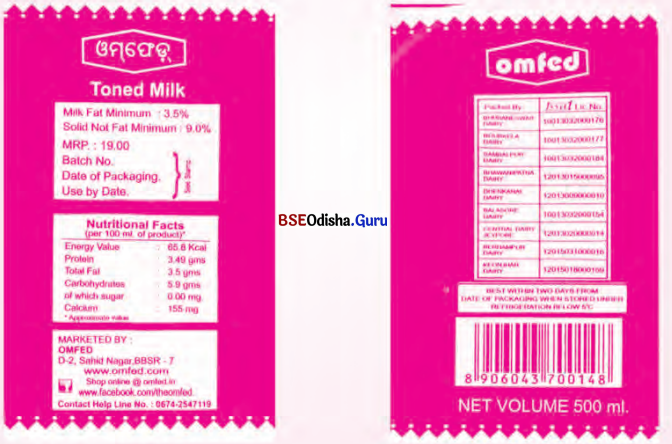
(b) Provided below is an OMFED milk packet. Read the English written on it. Fill in the form first. Then write a paragraph based on the filled-in
the form.
(ନିମ୍ନରେ ଏକ ଓମ୍‌ଫେଡ୍‌ କ୍ଷୀର ପ୍ୟାକେଟ୍ ଦିଆଯାଇଛି । ଏହା ଉପରେ ଲେଖା ଯାଇଥିବା ଇଂରାଜୀକୁ ପଢ଼ି । ପ୍ରଥମେ ଫର୍ମଟିକୁ ପୂରଣ କର । ତା’ପରେ ପୂରଣ କରାଯାଇଥିବା ଫର୍ମକୁ ଭିତ୍ତିକରି ଗୋଟିଏ ଅନୁଚ୍ଛେଦ ଲେଖ ।)
BSE Odisha 6th Class English Solutions Lesson 4 A Greedy Fat Old Man (III)

1 Name of the milk Omfed Toned Milk
2 Name of the company Omfed
3 Size of the packet (small/big) Small
4 Quantity of milk 500 ml.
5 Date of packing 01/04/2017
6 Price Rs. 19.00

Paragraph (ଅନୁଚ୍ଛେଦ):
The name of the milk is Omfed Toned Milk. The name of the company is Omfed. The size of the packet is small. The quantity of milk is 500 ml. The date of packing is 01/04/2017. Its price is Rs. 19.00.

BSE Odisha 6th Class English Solutions Lesson 4 A Greedy Fat Old Man (III)

Session – 6 (ସୋପାନ — ୬)

(c) Write your own story, (ନିଜର କାହାଣୀ ଲେଖ):
The old man met a boy, a dog, and finally a squirrel. You can add one more character before the squirrel or after the boy- a cat for example. Next, you can write a part of the story based on a new character. While writing the story, you can see that part of the story and copy most of the lines from it.
(ବୁଢ଼ାଲୋକଟି ଏକ ବାଳକ, ଏକ କୁକୁର ଏବଂ ଶେଷରେ ଏକ ଗୁଣ୍ଡୁଚିମୂଷାକୁ ଭେଟିଲା । ତୁମେ ଗୁଣ୍ଡୁଚିମୂଷା ପୂର୍ବରୁ କିମ୍ବା ବାଳକଟି ପରେ ଏକ ନୂଆ ଚରିତ୍ର ଉଦାହରଣସ୍ୱରୂପ ବିଲେଇ ଯୋଗ କର । ତା’ପରେ ସେହି ନୂଆ ଚରିତ୍ର ଆଧାରରେ ଗପର ଏକ ଭାଗ ଲେଖ । ଗପଟି ଲେଖୁବେଳେ ତୁମେ ଗପର ସେହି ଭାଗ ଦେଖୁପାର ଏବଂ ତା’ମଧ୍ୟରୁ ଅନେକ ଧାଡ଼ି ନକଲ କରିପାର ।
After eating the boy_______________________
_____________________________________
_____________________________________
_____________________________________
_____________________________________

Answer:
After eating the boy, the old man met a small cat. The small cat asked. “Old man, old man what makes you so fat ?” The old man said.” I’ve taken a very heavy breakfast.” “What did YOU take in your breakfast? asked the cat. “Two mugs of tea and two liters of milk.” replied the old man. “Only this much ?” asked the cat. “I’ve taken three tins of a biscuit”. replied the old man. “Only this much ?” asked the cat. “I also ate five big pieces of cake.” replied the old man. “Only this much ?” asked the cat. “I also ate a small boy”. replied the old man.

When the cat again asked the same question “Only this much ?” the old man lost his temper and said. ‘Til eat you up if I can catch you.” Then the old man caught the cat and ate it up.

BSE Odisha 6th Class English Part – I

A Greedy Fat Old Man (II) Question Answer Class 6 English Chapter 3 BSE Odisha

Odisha State Board BSE Odisha 6th Class English Solutions Lesson 3 A Greedy Fat Old Man (II) Textbook Exercise Questions and Answers.

Class 6th English Chapter 3 A Greedy Fat Old Man (II) Question Answers BSE Odisha

A Greedy Fat Old Man (II) Class 6 Questions and Answers

Session – 1 ( ସୋପାନ – ୧)
I. Pre-Reading (ପଢ଼ିବା ପୂର୍ବରୁ)

  • Socialization (ସାମାଜିକୀକରଣ):
  • You read the first part of the story, which is a fantasy
  • Look at the picture. Who is the old man talking to? Will the greedy old man eat up the dog? Let’s read and see.

BSE Odisha 6th Class English Solutions Lesson 3 A Greedy Fat Old Man (II)
(ତୁମେ ଗପଟିର ପ୍ରଥମ ଭାଗ ପଢ଼ିଲ, ଯାହା ଏକ କଳ୍ପନା ଅଟେ । ଛବିଟିକୁ ଚାହଁ । ବୁଢ଼ାଲୋକଟି କାହା ଗିଳିଦେବ କି ? ଆସ ପଢ଼ିବା ଏବଂ ସହିତ କଥା ହେଉଛି ? ଲୋଭୀ (ପେଟୁ) ବୁଢ଼ାଲୋକଟି କୁକୁରକୁ ଦେଖିବା ।)

II. While-Reading (ପଢ଼ିବା ସମୟରେ)
Text – (ପାଠ୍ୟବସ୍ତୁ)

Follow all four steps of the previous lesson
(ପୂର୍ବବର୍ତ୍ତୀ ପାଠ (ବିଷୟବସ୍ତୁ)ର ଚାରିଟି ସୋପାନକୁ ଅନୁସରଣ କର ।)

Read the second part of the story silently and answer the questions that follow.
(ଗପର ଦ୍ଵିତୀୟ ଭାଗକୁ ନୀରବରେ ପଢ଼ ଏବଂ ତା’ପରେ ଥିବା ପ୍ରଶ୍ନଗୁଡ଼ିକର ଉତ୍ତର ଦିଅ ।)

After eating the boy, the old man met a small dog. The small dog asked,
“Old man, old man, what makes you so fat ?”
“The old man said, “I’ve taken a very heavy breakfast.”
“What did you take in your breakfast ?” asked the dog.
“Two mugs of tea and two liters of milk,” replied the old man.
“Only this much ?” asked the dog.
“I’ve taken three tins of biscuits,” replied the old man.
“Only this much ?” asked the dog.
“I also ate five big pieces of cake,” replied the old man.
“Only this much ?” asked the dog.
“I also ate a small boy,” replied the old man.
When the dog again asked the same question “Only this much ?” the old man lost his temper and said, “I’ll eat you up if I can catch you.” Then the old man caught the dog and ate it up

BSE Odisha 6th Class English Solutions Lesson 3 A Greedy Fat Old Man (II)

ଓଡ଼ିଆ ଅନୁବାଦ :
ବାଳକଟିକୁ ଖାଇସାରିବା ପରେ, ବୁଢ଼ାଲୋକଟି ଗୋଟିଏ ଛୋଟ କୁକୁରକୁ ଭେଟିଲା । ଛୋଟ କୁକୁରଟି
ପଚାରିଲା, ‘ବୁଢ଼ାଲୋକ, ହେ ବୁଢ଼ାଲୋକ, କ’ଣ ତୁମକୁ ଏତେ ମୋଟା କରିଛି ?’’
ବୁଢ଼ାଲୋକଟି କହିଲା, ‘ମୁଁ ବହୁତଗୁଡ଼ାଏ ଜଳଖିଆ ଖାଇଛି ।’’
‘‘ତୁମେ ତୁମ ଜଳଖିଆରେ କ’ଣ ଖାଇଲ ?’’ କୁକୁରଟି ପଚାରିଲା ।
‘‘ଦୁଇ ମର୍ (ଜଗ୍) ଚା’ ଏବଂ ଦୁଇ ଲିଟର କ୍ଷୀର,’’ ବୁଢ଼ାଲୋକଟି ଉତ୍ତର ଦେଲା ।
‘‘କେବଳ ଏତିକି ମାତ୍ର ?’’ କୁକୁରଟି ପଚାରିଲା ।
‘ମୁଁ ତିନିଟିଣ ବିସ୍କୁଟ୍ ଖାଇଛି,’’ ବୁଢ଼ାଲୋକଟି ଉତ୍ତର ଦେଲା ।
‘‘କେବଳ ଏତିକି ମାତ୍ର ?’’ କୁକୁରଟି ପଚାରିଲା ।
‘‘ମୁଁ ମଧ୍ଯ ପାଞ୍ଚଟି ବଡ଼ ବଡ଼ ପିଠା ଖାଇଥିଲି,’’ ବୁଢ଼ାଲୋକଟି ଉତ୍ତର ଦେଲା ।
‘‘କେବଳ ଏତିକି ମାତ୍ର ?’’ କୁକରଟି ପଚାରିଲା ।
“ମୁଁ ମଧ୍ୟ ଗୋଟିଏ ଛୋଟ ବାଳକକୁ ଖାଇଲି,’’ ବୁଢ଼ାଲୋକଟି ଉତ୍ତର ଦେଲା । ଯେତେବେଳେ କୁକୁରଟି ପୁନର୍ବାର ସେହି ଏକା ପ୍ରଶ୍ନ ‘କେବଳ ଏତିକି ମାତ୍ର ?’’ ପଚାରିଲା ବୁଢ଼ାଲୋକଟି କ୍ରୋଧରେ ଅଧୀର ହୋଇପଡ଼ିଲା ଏବଂ କହିଲା, ‘ମୁଁ ତୋତେ ଗିଳିଦେବି ଯଦି ମୁଁ ତୋତେ ଧରିପାରିବି ।’’ ତା’ପରେ ବୁଢ଼ାଲୋକ ଜଣକ କୁକୁରଟିକୁ ଧରି ପକାଇଲା ଏବଂ ଏହାକୁ ଗିଳିଦେଲା ।

Word-Meaning ((ଶବ୍ଦାର୍ଥ))

after – ପରେ
small – ଛୋଟ
when- ଯେତେବେଳେ (while)
heavy – ଭାରୀ
asked- ପଚାରିଲା
replied- ଉତ୍ତର ଦେଲା
only – କେବଳ ତୁମେ
much – ବହୁତ
taken- ଖାଇଲେ (eaten)
again – ପୁନର୍ବାର
same – ଏଠାରେ ସମାନ
lost his temper – ସେ କ୍ରୋଧ ହରାଇଲେ
if- ଯଦି
then – ତାପରେ
caught – ଧରିଲା (catchର Past Tense)

BSE Odisha 6th Class English Solutions Lesson 3 A Greedy Fat Old Man (II)

Comprehension Questions – (ବୋଧମୂଳକ ପ୍ରଶ୍ନବଳୀ) :

Question 1.
Whom did the old man meet in this part of the story?
(ଗପର ଏହି ଅଂଶରେ ବୁଢ଼ାଲୋକ ଜଣକ କାହାକୁ ଭେଟିଲା | ସାକ୍ଷାତ କଲା ?)
Answer:
In this part of the story, the old man met a small dog.

Question 2.
Who asked most of the questions in this section – the dog or the old man ?
(ଗପର ଏହି ଭାଗରେ କିଏ ଅଧ‌ିକ ପ୍ରଶ୍ନ ପଚାରିଲା – କୁକୁର କିମ୍ବା ବୃଦ୍ଧବ୍ୟକ୍ତି ?)
Answer:
The dog asked most of the questions in this section.

Question 3.
What was the dog’s first question to the old man ?
(ବୁଢ଼ାଲୋକଟିକୁ କୁକୁରର ପ୍ରଥମ ପ୍ରଶ୍ନ କ’ଣ ଥିଲା ?)
Answer:
The dog’s first question to the old man was what made him so fat.

Question 4.
After the first question, the dog asked the same question again and again. What is the question?
(ପ୍ରଥମ ପ୍ରଶ୍ନ ପରେ, କୁକୁରଟି ବାରମ୍ବାର ସେହି ଏକା ପ୍ରକାର ପ୍ରଶ୍ନ ପଚାରିଲା । ଏହି ପ୍ରଶ୍ନଟି କ’ଣ ?)
Answer:
This question is “Only this much ?”

BSE Odisha 6th Class English Solutions Lesson 3 A Greedy Fat Old Man (II)

Question 5.
Was the old man’s answer to the same question similar or different ?
(ସେହି ଏକାପ୍ରକାର ପ୍ରଶ୍ନ ପାଇଁ ବୁଢ଼ାଲୋକର ଉତ୍ତର ସମାନ କିମ୍ବା ଭିନ୍ନ ଥିଲା ? )
Answer:
The old man’s answers to the same question were different.

Question 6.
Why did the old man lose his temper ?
(କାହିଁକି ବୁଢ଼ା ଲୋକଟି ତା’ର କ୍ରୋଧ ସମ୍ଭାଳି ପାରିଲା ନାହିଁ ?)
Answer:
The old man lost his temper because/as the dog asked the same question again though the old man had told about all things he had taken in his breakfast. He had nothing else to say to the same question.

Question 7.
What did he do with the dog?
( ସେ କୁକୁର ସହ କ’ଣ କଲା ?)
Answer:
He caught the dog and ate it up.

Session – 2 ( ସୋପାନ – ୨)
III. Post-Reading (ପଢ଼ିସାରିବା ପରେ)

1. Visual Memory Development Technique (VMDT) :
(ଦୃଶ୍ୟ ସ୍ମୃତି ଉନ୍ନୟନ କୌଶଳ (VMDT))

Pic. : Small dog, old man
( ଛବି : ଛୋଟ କୁକୁର, ବୁଢ଼ାଲୋକ)
Part: Old man ate the dog, five big pieces of cake, two mugs of tea, and three tins of biscuits.
( ଅଂଶ : ବୁଢ଼ାଲୋକଟି କୁକୁର, ପାଞ୍ଚଟି ବଡ଼ ବଡ଼ ପିଠା, ଦୁଇ ମଗ୍ ଚା’, ତିନି ଟିଣ ବିସ୍କୁଟ ଖାଇଲା ।)

BSE Odisha 6th Class English Solutions Lesson 3 A Greedy Fat Old Man (II)

2. Listening – (ମନଯୋଗ ସହକାରେ ଶୁଣିବା)

(i) “Your teacher reads aloud a paragraph of the story. You listen to him/her attentively and fill in the gaps
(ଶିକ୍ଷକ ବଡ଼ପାଟିରେ ଗପର ଗୋଟିଏ ଅନୁଚ୍ଛେଦ ପଢ଼ିବେ । ତୁମେ ମନଦେଇ ତାଙ୍କୁ (ପୁ | ସ୍ତ୍ରୀ) ଶୁଣ ଏବଂ ଶୂନ୍ୟସ୍ଥାନଗୁଡ଼ିକୁ ପୂରଣ କର ।)
When the dog____________ asked ‘‘Only_________ much ?”the___________ man lost his temper and___________ “I ’ll __________ you up if I___________ catch you.” Then the old man caught the _________ and ate it__________.

Answer:
When the dog again asked “Only this much ?” the old man lost his temper and said, “I ’ll eat you up if I can catch you.” Then the old man caught the dog and ate it up.

Session – 3 ( ସୋପାନ – ୩)

3. Speaking (କଥନ) :

(i) Chain-drill: “I’ve taken a heavy breakfast.”
(ଶୃଙ୍ଖଳା-ଡ୍ରିଲ୍ : ‘‘ମୁଁ ବହୁତଗୁଡ଼ାଏ ଜଳଖିଆ ଖାଇଦେଇଛି ।’’)
(ii) Dialogue : Teacher vs. Students (three times), Students vs. Students (three times).
(ସଂଳାପ ଲେଖା :ଶିକ୍ଷକ ବନାମ ଛାତ୍ର ମାନେ (ତିନିଥର), ଛାତ୍ର ମାନେ ବନାମ ଛାତ୍ରମାନେ (ତିନିଥର ))
Dog: ‘Old man, old man, what makes you so fat?
Old man: “I have taken a very heavy breakfast.”
( ବୃଦ୍ଧଲୋକ: ‘ବୁଢ଼ାଲୋକ, ହେ ବୁଢ଼ା ଲୋକ, କ’ଣ ତୁମକୁ ଏତେ ମୋଟା “)

BSE Odisha 6th Class English Solutions Lesson 3 A Greedy Fat Old Man (II)

Session – 4 (ସୋପାନ – ୪)

5. Writing- (ଲେଖୁବା) :
(a) Answer the following questions
(କବିତାଟି କେଉଁ ବିଷୟରେ ଆଧାରିତ ?)

Question (i)
Whom did the old man meet in this part of the story?
(ବୁଢ଼ାଲୋକଟି ଗପର ଏହି ଅଂଶରେ କାହାକୁ ଭେଟିଲା ?)
Answer:
In this part of the story, the old man met a small dog.

Question (ii)
Who asked most of the questions in this part?
(ଏହି ଅଂଶରେ କିଏ ସବୁଠାରୁ ଅଧ‌ିକ ପ୍ରଶ୍ନ ପଚାରିଥିଲା ?)
Answer:
The small dog asked most of the questions in this part.

BSE Odisha 6th Class English Solutions Lesson 3 A Greedy Fat Old Man (II)

Question (iii)
What question did the dog ask the old man most of the time?
(କୁକୁରଟି ବୁଢ଼ାଲୋକକୁ ଅଧିକାଂଶ ସମୟରେ କେଉଁ ପ୍ରଶ୍ନ ପଚାରିଥିଲା ?)
Answer:
Most of the time the dog asked the old man the same question “Only this much ?’’

Question (iv)
Why did the old man lose his temper?
(କାହିଁକି ବୁଢ଼ା ଲୋକଟି ତା’ର କ୍ରୋଧ ସମ୍ଭାଳି ପାରିଲା ନାହିଁ ?)
Answer:
When the dog asked the same question “Only this much ?” again after he had told everything that he had taken in his breakfast, the old man lost his temper.

Session – 5 (ସୋପାନ – ୫)

(b) Suppose this is what Gopal does on Monday.
“Gopal gets up at 6 a.m. He brushes his teeth at 6.30 a.m. He takes his bath at 7 a.m. He takes his breakfast at 7.30 a.m. He goes to school at 9.30 a.m. He comes back from school at 4.30 p.m.” Can you write about Gopal and what he did last Monday? The first line is given to start with. “Last Monday Gopal got up at 6 a.m ___________
‘‘ଗୋପାଳ ପୂର୍ବାହ୍ନ ୬ ଟାରେ ଉଠେ । ସେ ସକାଳ ୬ଟା ୩୦ ମିନିଟ୍‌ରେ ତା’ର ଦାନ୍ତ ସଫା କରେ । ସେ ସକାଳ ୭ ଟାରେ ସ୍ନାନ କରେ । ସେ ସକାଳ ୭ଟା ୩୦ ମିନିଟ୍‌ରେ ତା’ର ଜଳଖିଆ ଖାଏ । ସେ ସକାଳ ୯ଟା ୩୦ମି.ରେ ବିଦ୍ୟାଳୟକୁ ଯାଏ । ସେ ଅପରାହ୍ନ ୪ଟା ୩୦ମି.ରେ ବିଦ୍ୟାଳୟରୁ ଫେରେ ।’’
ତୁମେ ଲେଖିପାରିବ କି ଗୋପାଳ ବିଷୟରେ ଯାହା ସେ ଗତ ସୋମବାର କରିଥିଲା ? ଆରମ୍ଭ କରିବାକୁ ଥିବା ପ୍ରଥମ ଧାଡ଼ିଟି ଦିଆଯାଇଛି।
‘ଗତ ସୋମବାର ଗୋପାଳ ସକାଳ ୬ ଟାରେ ଉଠିଲା । ________ )”
Answer:
“Last Monday Gopal got up at 6 a.m.
He brushed his teeth at 6.30 a.m. He took his bath at 7 a.m. He took his breakfast at 7.30 a.m. He went to school at 9.30 a.m. He came back from school at 4,30 p.m.”

BSE Odisha 6th Class English Solutions Lesson 3 A Greedy Fat Old Man (II)

Now join the six sentences into two as you did in the previous lesson.
(ବର୍ତ୍ତମାନ ଛଅଟିଯାକ ବାକ୍ୟକୁ ଯୋଗ କରି ଦୁଇଟି କର ଯେପରି ତୁମେ ପୂର୍ବ ବିଷୟରେ କରିଥିଲ ।)
Answer:
Last Monday Gopal got up at 6 a.m.. brushed his teeth at 6.30 a.m. and took his bath at 7 a.m. He took his breakfast at 7.30 a.m.. went to school at 9.30 a.m. and came back from school at 4.30 p.m.

Session – 6 (ସୋପାନ — ୬)

(c) Provided below is the wrapper (cover) of a biscuit packet. First, fill in the form and next write a paragraph on the biscuit
(ନିମ୍ନରେ ଗୋଟିଏ ବିସ୍କୁଟ୍‌ ପ୍ୟାକେଟ୍‌ ଖୋଳ ଦିଆଯାଇଛି । ପ୍ରଥମେ ଫର୍ମଟି ପୂରଣ କର ଏବଂ ତା’ପରେ ବିସ୍କୁଟ୍ ଉପରେ ଏକ ଅନୁଚ୍ଛେଦ ଲେଖ ।)
BSE Odisha 6th Class English Solutions Lesson 3 A Greedy Fat Old Man (II)

1 Name of the biscuit Nutri Choice Essentials
2 Nutri Choice Essentials Nutri Choice
3 Date of packing 07/11/2016
4 Price of the packet Rs. 60.00
5 Time of use Morning and evening
6 Things it contains Oat cookies, complex carbohydrates, high dietary fiber

(c) Paragraph (ଅନୁଚ୍ଛେଦ):
The name of the biscuit is Nutri Choice Essentials. The name of the company is Nutri Choice. The date of packing is 07/11/16. The price of the packet is Rs. 60.00. The time of use is morning and evening. Things it contains are oats cookies, complex carbohydrates high dietary fiber.

BSE Odisha 6th Class English Solutions Lesson 3 A Greedy Fat Old Man (II)

(d) Framing Questions (ପ୍ରଶ୍ନବଳୀ ତିଆରି କରିବା) :
Provided below is what Gopal did last Sunday. Make six questions from the paragraph. Hints are provided.
(ଗତ ରବିବାର ଦିନ ଗୋପାଳ ଯାହା କରିଥିଲା ନିମ୍ନରେ ଦିଆଯାଇଛି । ଅନୁଚ୍ଛେଦରୁ ଛଅଟି ପ୍ରଶ୍ନ ତିଆରି କର । ସୂଚନା ଦିଆଯାଇଛି ।)

“Last Sunday, Gopal went to Cuttack at 10 a.m. by bus with his friends to see his mother ”___________
1. Who went to Cuttack?
2. Where did he go?
3. When did he go?
4. How did he go?
5. With whom did he go?
6. Why did he go?

BSE Odisha 6th Class English Part – I

BSE Odisha 10th Class Life Science Solutions Chapter 5 ନିୟନ୍ତ୍ରଣ ଓ ସମନ୍ଵୟ

Odisha State Board BSE Odisha 10th Class Life Science Solutions Chapter 5 ନିୟନ୍ତ୍ରଣ ଓ ସମନ୍ଵୟ Textbook Exercise Questions and Answers.

BSE Odisha Class 10 Life Science Solutions Chapter 5 ନିୟନ୍ତ୍ରଣ ଓ ସମନ୍ଵୟ

Question 1.
ଫାଇଟୋହରମୋନ୍ କ’ଣ ? ସେଗୁଡ଼ିକର ପ୍ରକାରଭେଦ ଓ କାର୍ଯ୍ୟ ବର୍ଣ୍ଣନା କର ।
ଉ-
ଫାଇଟୋହରମୋନ୍ – ଉଦ୍ଭଦରେ ଥ‌ିବା ହରମୋନକୁ ଫାଇଟୋହରମୋନ୍ କୁହାଯାଏ ।
ଫାଇଟୋହରମୋନ୍‌ର ପ୍ରକାରଭେଦ – ଉଦ୍ଭଦରେ ଥ‌ିବା ଫାଇଟୋହରମୋନ୍‌ଗୁଡ଼ିକୁ ମୁଖ୍ୟତଃ 5 ଭାଗରେ ବିଭକ୍ତ କର।ଯ।ଇଛି: ଯଥା-

  1. ଅକ୍‌ସିନ୍
  2. ଜିବରେଲିନ୍
  3. ସାଇଟୋକାଇନିନ୍
  4. ଏଥ୍ଲିନ୍
  5. ଆବ୍‌ସିକ୍ ଅମ୍ଳ

BSE Odisha 10th Class Life Science Solutions Chapter 5 ନିୟନ୍ତ୍ରଣ ଓ ସମନ୍ଵୟ

BSE Odisha 10th Class Life Science Solutions Chapter 5 ନିୟନ୍ତ୍ରଣ ଓ ସମନ୍ଵୟ 1
(i) ଫାଇଟୋହରମୋନ୍ ଉଭିଦର ବିଭିନ୍ନ ଜୈବ ପ୍ରକ୍ରିୟାର ନିୟନ୍ତ୍ରଣ ଓ ସମନ୍ଵୟ ରକ୍ଷାକରିବା ସହିତ ମୁଖ୍ୟତଃ ଦୁଇପ୍ରକାର କାର୍ଯ୍ୟ କରିଥାଏ, ଯଥା- ବୃଦ୍ଧି ନିୟନ୍ତ୍ରଣ ଓ ଚଳନଶକ୍ତିର ନିୟନ୍ତ୍ରଣ ।
ବୃଦ୍ଧି ନିୟନ୍ତ୍ରଣ – ଫାଇଟୋହରମୋନ୍ ଦୁଇ ପ୍ରକାରର; ଯଥା – ବୃଦ୍ଧିକାରକ ହର୍‌ମୋନ୍ ଓ ବୃଦ୍ଧିହ୍ରାସକ ହରମୋନ୍ ।

ବୃଦ୍ଧିକାରକ ହରମୋନ୍ :
(ii) ଫାଇଟୋହର୍‌ମୋନ୍ ମଧ୍ଯରୁ ଅକ୍‌ସିନ୍, ଜିବରେଲିନ୍ ଓ ସାଇଟୋକାଇନିନ୍ ପ୍ରଭୃତି ବୃଦ୍ଧିକାରକ ହରମୋନ ଅଟନ୍ତି ।
(iii) ଜିବରେଲିନ୍ ଓ ଅକ୍‌ସିନ୍ ଶାଖା ଓ କାଣ୍ଡର ବୃଦ୍ଧିରେ ସହାୟକ ହୋଇଥା’ନ୍ତି ।
(iv) ସାଇଟୋକାଇନିନ୍ କୋଷ ବିଭାଜନର ହାର ବୃଦ୍ଧି କରିଥାଏ ଓ ଏହି ହରମୋନ୍ ସାଧାରଣତଃ କ୍ଷିପ୍ରଭାବେ-
(v) କାଣ୍ଡ ଓ ମୂଳର ଅଗ୍ରଭାଗରେ କୋଷ ବୃଦ୍ଧିକାରକ ହରମୋନ୍ ବହୁ ପରିମାଣରେ ଥବାରୁ ସେଠାରେ ବହୁଳ ତଥା ତ୍ବରାନ୍ବିତ କୋଷ ବିଭାଜନ ହୋଇ ଅଗ୍ରଭାଗ ବୃଦ୍ଧିପାଏ ।

ବୃଦ୍ଧିହ୍ରାସକ ହରମୋନ୍ :
(vi) ଅଗ୍ରଭାଗ ତଳକୁ ହର୍‌ମୋନ୍‌ର ପରିମାଣ କ୍ରମଶଃ ହ୍ରାସ ପାଉଥିବାରୁ ବୃଦ୍ଧି ପରିମାଣ ମଧ୍ଯ ତଦନୁସାରେ କମ୍ ହୋଇଥାଏ ।
(vii) ଉଭିଦମାନଙ୍କରେ କେତେକ ବୃଦ୍ଧିହ୍ରାସକ ହର୍‌ମୋନ୍ ରହିଥା’ନ୍ତି । ଆକ୍‌ସିସିକ୍ ଏସିଡ୍ ଓ ଏଥୁଲିନ୍ ଏହି ଶ୍ରେଣୀର ଅନ୍ତର୍ଭୁକ୍ତ ।
(viii) ଏହି ହରମୋନ୍‌ଗୁଡ଼ିକ ସାଧାରଣତଃ ଉଭିଦର ବୃଦ୍ଧି ହ୍ରାସ କରିବା, ପତ୍ର, ଫୁଲ, ଫଳ ଝଡ଼ାଇବା ସହିତ ଉଭିଦର ବାର୍ଷକ୍ୟ ତ୍ବରାନ୍ବିତ କରିଥା’ନ୍ତି । ପାଚିଲା ଫଳ, ଫୁଲ ଓ ପତ୍ର ଝଡ଼ିବା ପୂର୍ବରୁ ସେଥ‌ିରେ ଏହି ବୃଦ୍ଧିହ୍ରାସକ

ଚଳନଶକ୍ତିର ନିୟନ୍ତ୍ରଣ :

  • ଆଲୋକ, ମାଧ୍ୟାକର୍ଷଣ ବଳ ପରି ବାହ୍ୟ ଉଦ୍ଦୀପନାଦ୍ୱାରା ପ୍ରଭାବିତ ହୋଇ ହରମୋନ୍‌ଗୁଡ଼ିକ ଉଦ୍ଭଦର ଚଳନଶକ୍ତିକୁ ନିୟନ୍ତ୍ରଣ କରିଥା’ନ୍ତି ।
  • ଉଭିଦରେ ଦୁଇ ପ୍ରକାର ଚଳନ ଦେଖାଯାଏ । ଯଥା କାଣ୍ଡର ଆଲୋକାନୁବର୍ତ୍ତନ ଓ ଚେରର ଜ୍ୟାନୁବର୍ତ୍ତନ ।
    • ଆଲୋକାନୁବର୍ତ୍ତନ – ଉଭିଦର କାଣ୍ଡ ଆଲୋକ ଆଡ଼କୁ ଗତି କରିବାକୁ ଅନୁକୂଳ ଆଲୋକାନୁବର୍ତ୍ତନ ଓ ଚେର ଆଲୋକର ବିପରୀତ ଦିଗରେ ଗତି କରିବାକୁ ପ୍ରତିକୂଳ ଆଲୋକାନୁବର୍ତ୍ତନ କୁହାଯାଏ ।
    • କ୍ୟାନୁବର୍ତ୍ତନ – ମାଧ୍ୟାକର୍ଷଣ ବଳଦ୍ଵାରା ଉଭିଦର ମୂଳ ପୃଥ‌ିବୀର କେନ୍ଦ୍ର ଆଡ଼କୁ ଆକର୍ଷିତ ହେବାକୁ ଜ୍ୟାନୁବର୍ତନ କୁହାଯାଏ ।

Question 2.
ବାହ୍ୟ ଉଦ୍ଦୀପନା କ’ଣ ? ଏହା ଫଳରେ ଉଦ୍ଭଦରେ ଦେଖାଯାଉଥ‌ିବା ଜ୍ୟାନୁବର୍ତ୍ତନ ବର୍ଣ୍ଣନା କର ।
ଉ-
ବାହ୍ୟ ଉଦ୍ଦୀପନା :
(i) ଆଲୋକ, ମାଧ୍ୟାକର୍ଷଣ ବଳ, ଜଳ, ରାସାୟନିକ ପଦାର୍ଥ ପ୍ରଭୃତି ଉଭିଦର କାଣ୍ଡ, ଚେର ଓ ପତ୍ରର ଅଗ୍ରଭାଗରେ ପ୍ରତିକ୍ରିୟା ସୃଷ୍ଟି କରିଥା’ନ୍ତି । ଫଳରେ ସେଠାରେ ହର୍‌ମୋନ୍ କ୍ଷରଣ ବୃଦ୍ଧି ପାଉଥ‌ିବାରୁ ଏହାକୁ ବାହ୍ୟ ଉଦ୍ଦୀପନା କୁହାଯାଏ ।

ଜ୍ୟାନୁବର୍ତ୍ତନ –
(ii) ବା ଏହାର ଅଂଶବିଶେଷ ମାଟି ତଳକୁ ଗତି କରିଥାଏ । ଏହାକୁ ଜ୍ୟାନୁବର୍ତ୍ତନ ବା ମାଧ୍ୟାକର୍ଷଣ ଅନୁବର୍ତ୍ତନ କୁହାଯାଏ ।
(iii) ମାଧ୍ୟାକର୍ଷଣ ବଳ ପ୍ରଭାବରେ ଉଭିଦର ଚେର ଓ ମୂଳ ପୃଥ‌ିବୀର କେନ୍ଦ୍ରଆଡ଼କୁ ଆକର୍ଷିତ ହୋଇଥାଏ । ଏହାକୁ ଅନୁକୂଳ ଜ୍ୟାନୁବର୍ତ୍ତନ କୁହାଯାଏ ।
(iv) ଉଭିଦର କାଣ୍ଡ ଚେରର ବିପରୀତ ଦିଗକୁ ଗତିକରେ । ଏହାକୁ ପ୍ରତିକୂଳ ଜ୍ୟାନୁବର୍ତ୍ତନ କୁହାଯାଏ ।
(v) ମାଧ୍ୟାକର୍ଷଣ ବଳ, କାଣ୍ଡ, ଚେର ଓ ପତ୍ରର ଅଗ୍ରଭାଗରେ ପ୍ରତିକ୍ରିୟା ସୃଷ୍ଟିକରେ । ଫଳରେ ସେଠାରେ ହରମୋନ୍ କ୍ଷରଣ ବୃଦ୍ଧିପାଏ ଓ ସେଗୁଡ଼ିକର ବୃଦ୍ଧି ହରମୋନ୍‌ଦ୍ୱାରା ନିୟନ୍ତ୍ରିତ ହୋଇଥାଏ ।

Question 3.
ଏକ ପରୀକ୍ଷାଦ୍ବାରା ଉଭିଦରେ ଅକ୍‌ସିର ପ୍ରଭାବ ଦର୍ଶାଅ ।

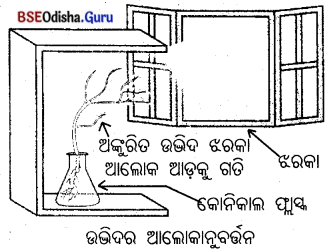
  • ଗୋଟିଏ କୋନିକାଲ୍ ଫ୍ଲସ୍କରେ ପାଣି ଭର୍ତ୍ତି କରାଯାଉ ।
  • ଫ୍ଲାସ୍କର ବେକକୁ ଏକ ତାରଜାଲିରେ ଆଚ୍ଛାଦନ କରାଯାଉ ।
  • ତାର ଜାଲି ଉପରେ 2 ବା 3ଟି ସଦ୍ୟ ଅଙ୍କୁ ରୋଦ୍ ଗମ ହୋଇଥ‌ିବା ବିନ୍ ମଞ୍ଜି
  • ଏକପାଖ ଖୋଲାଥିବା ଏକ ମୋଟା କାଗଜ ବାକ୍ସ ନିଆଯାଉ ।
  • ଫ୍ଲାସ୍କଟିକୁ ବର୍ତ୍ତମାନ ଏହି ବାକ୍ସ ମଧ୍ଯରେ ଏପରିଭାବରେ ରଖାଯାଉ ଯେପରି ଝରକାରେ ଆସୁଥ‌ିବା ଆଲୋକ ବାକ୍ସର ଖୋଲାପାର୍ଶ୍ଵ ଦେଇ ସଦ୍ୟ ଅଙ୍କୁରିତ ଉଭିଦ ଉପରେ ପଡ଼ିବ ।

BSE Odisha 10th Class Life Science Solutions Chapter 5 ନିୟନ୍ତ୍ରଣ ଓ ସମନ୍ଵୟ 2

ପର୍ଯ୍ୟବେକ୍ଷଣ :

  1. ଦୁଇ ତିନିଦିନ ପରେ ସେଗୁଡ଼ିକୁ ଲକ୍ଷ୍ୟ କଲେ ଦେଖାଯିବଯେ ଉଦ୍ଭଦଟି କ୍ରମଶଃ ଆଲୋକୋନ୍ମୁ ଖୀ ହୋଇ ଆଲୋକ ଆଡ଼କୁ ବଙ୍କେଇ ଯାଇଛି ।
  2. ସିଦ୍ଧାନ୍ତ – ଯେତେବେଳେ କ୍ରମବର୍ଦ୍ଧିଷ୍ଣୁ ଉଭିଦଟି ଆଲୋକ ପାଏ, ସେତେବେଳେ ଏହାର ଅଗ୍ରଭାଗରେ ଅକ୍‌ସିନ୍ ସଂଶ୍ଳେଷିତ ହୁଏ । ଯେତେବେଳେ ଏକ ନିର୍ଦ୍ଦିଷ୍ଟ ଦିଗରୁ ଆଲୋକ ଆସେ ଅକ୍‌ସିନ୍ ବିପରୀତ ଦିଗକୁ ପରିବାହିତ ହୁଏ । ଅକ୍‌ସିନ୍‌ ପରିମାଣ ବଢ଼ିବାରୁ ସେଠାରେ ଥ‌ିବା କୋଷଗୁଡ଼ିକର ବୃଦ୍ଧି ଘଟେ । ଫଳତଃ ଅନ୍ଧାରରେ ଥିବା “ପାର୍ଶ୍ଵ ଆଲୋକ ପଟକୁ ଥିବା ପାର୍ଶ୍ବ ଅପେକ୍ଷା ଅଧିକ ଲମ୍ବା ହୋଇଥାଏ । କ୍ରମଶଃ ଉଭିଦଟି ଆଲୋକ ଆଡ଼କୁ ବଙ୍କେଇଯାଏ ।

Question 4.
ମାନବ ମସ୍ତିଷ୍କର ବିଭିନ୍ନ ଅଂଶର ନାମ ଓ କାର୍ଯ୍ୟର ଏକ ବିବରଣୀ ଦିଅ ।
ଉ-
ମାନବ ମସ୍ତିଷ୍କର ବିଭିନ୍ନ ଅଂଶର ନାମ :
BSE Odisha 10th Class Life Science Solutions Chapter 5 ନିୟନ୍ତ୍ରଣ ଓ ସମନ୍ଵୟ 3
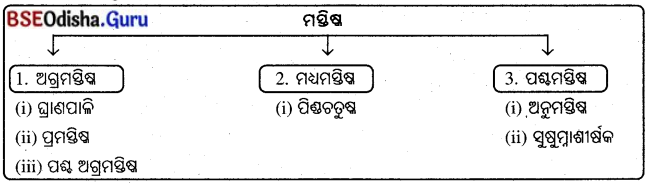
ମାନବ ମସ୍ତିଷ୍କ ତିନି ଭାଗରେ ବିଭକ୍ତ; ଯଥା-
(I) ଅଗ୍ରମସ୍ତିଷ୍କ,
(II) ମଧ୍ଯ ମସ୍ତିଷ୍କ,
(III) ପଶ୍ଚ ମସ୍ତିଷ୍କ
ମାନବ ମସ୍ତିଷ୍କର ବିଭିନ୍ନ ଅଂଶର କାର୍ଯ୍ୟ-

(I) ଅଗ୍ରମସ୍ତିଷ୍କ :
(i) ଅଗ୍ରମସ୍ତିଷ୍କରେ ଘ୍ରାଣପାଳି, ପ୍ରମସ୍ତିଷ୍କ ଓ ପଶ୍ଚଅଗ୍ରମସ୍ତିଷ୍କ ରହିଛି । ଅଗ୍ରମସ୍ତିଷ୍କରେ ଥ‌ିବା ଘ୍ରାଣପାଳି ମନୁଷ୍ୟଠାରେ ଅତି କ୍ଷୀଣଭାବେ ରହିଥାଏ । ତେଣୁ ମନୁଷ୍ୟର ଘ୍ରାଣଶକ୍ତି ଦୁର୍ବଳ । କିନ୍ତୁ କୁକୁର, ବିଲେଇ ଓ ବାଘ ଇତ୍ୟାଦି ପ୍ରାଣୀଙ୍କଠାରେ ଘ୍ରାଣପାଳି ଉନ୍ନତ ହୋଇଥିବାରୁ ସେମାନଙ୍କର ଘ୍ରାଣଶକ୍ତି ପ୍ରଖର ।

ପ୍ରମସ୍ତିଷ୍କ :
(ii) ପ୍ରମସ୍ତିଷ୍କ ମସ୍ତିଷ୍କର ସବୁଠାରୁ ବଡ଼ ଅଂଶ ଏବଂ ଏହାର ଉପରିଭାଗ ବହୁଳଭାବେ ଭାଙ୍ଗଯୁକ୍ତ । ଆମର ସ୍ମରଣ ଶକ୍ତି ଏହି ଭାଙ୍ଗ ଉପରେ ନିର୍ଭର କରିଥାଏ ।
(iii) ପ୍ରମସ୍ତିଷ୍କ ତାପ, କଷ୍ଟ, ଚାପ, ସ୍ପର୍ଶ ପରି ଉଦ୍ଦୀପନାକୁ ଗ୍ରହଣକରି ପ୍ରତିକ୍ରିୟା ପ୍ରକାଶ କରିବାରେ ସାହାଯ୍ୟ କରେ ।
(iv) ଏଥୁସହିତ କୌଣସି ଘଟଣା ବିଷୟରେ ଶୁଣି, ଭାବି, କଥା ମାଧ୍ୟମରେ ମନର ଆବେଗ ପ୍ରକାଶ କରିବା କାର୍ଯ୍ୟ ମଧ୍ଯ ମସ୍ତିଷ୍କର ଏହି ଅଂଶ ନିୟନ୍ତ୍ରଣ କରେ ।

BSE Odisha 10th Class Life Science Solutions Chapter 5 ନିୟନ୍ତ୍ରଣ ଓ ସମନ୍ଵୟ

ପଶ୍ଚଅଗ୍ରମସ୍ତିଷ୍କ :
(v) ପଶ୍ଚଅଗ୍ରମସ୍ତିଷ୍କର ଉପରିଭାଗରେ ପିନିଆଲ ଗ୍ରନ୍ଥି ରହିଛି । ଏହାର ନିମ୍ନଭାଗରେ ଥ‌ିବା ହାଇପୋଥାଲାମସ୍ ଆମ ଶରୀରର ହୃନ୍ଦନ, ରକ୍ତଚାପ, ନିଦ୍ରା, ଭୟ, ରାଗ, ଆନନ୍ଦ ଇତ୍ୟାଦି ନିୟନ୍ତ୍ରଣ କରେ ।

(II) ମଧ୍ୟମସ୍ତିଷ୍କ :

  • ମଧ୍ୟମସ୍ତିଷ୍କ ଦୁଇଯୋଡ଼ା ବର୍ତ୍ତୁଳ ନିଦାପିଣ୍ଡକୁ ନେଇ ଗଠିତ ।
  • ଉପର ଦୁଇଟି ପିଣ୍ଡ, ଦୃଷ୍ଟି ସମ୍ବନ୍ଧୀୟ ପ୍ରତିକ୍ଷେପକୁ ନିୟନ୍ତ୍ରଣ କରୁଥିବାବେଳେ ନିମ୍ନଭାଗର ଦୁଇଟି ପିଣ୍ଡ ଶରୀରର ଶ୍ରବଣ ସମ୍ବନ୍ଧୀୟ ପ୍ରତିକ୍ଷେପକୁ ନିୟନ୍ତ୍ରଣ କରେ ।

(III) ପଶ୍ଚ ମସ୍ତିଷ୍କ :

  • ପଶ୍ଚିମସ୍ତିଷ୍କର ଆଗ ଅଂଶରେ ରହିଛି ଅନୁମସ୍ତିଷ୍କ । ଏହା ମସ୍ତିଷ୍କର ଦ୍ଵିତୀୟ ବୃହତ୍ତମ ଭାଗ !
  • ଏହା ଶରୀରର ସନ୍ତୁଳନ ଓ ଭାରସାମ୍ୟ ରକ୍ଷାକରେ ।
  • କୌଣସି କାରଣରୁ ହଠାତ୍ ଗୋଡ଼ ଖସିଗଲେ ବା ଝୁଣ୍ଟି ପଡ଼ିଯିବା ଅବସ୍ଥାରେ ଶରୀରର ଭାରସାମ୍ୟ ରକ୍ଷାକରି ଠିକ୍ ଭାବରେ ଦୁଇ ଗୋଡ଼ରେ ଠିଆହେବା ପାଇଁ ଏହା ଦାୟୀ ଅଟେ ।
  • ମସ୍ତିଷ୍କର ସୁଷୁମ୍ନାଶୀର୍ଷ ଅନୁମସ୍ତିଷ୍କର ପଛକୁ ରହିଛି । ଏହା ଆମ ଶରୀରର ଶ୍ଵାସକେନ୍ଦ୍ର ଓ ହୃତ୍‌କେନ୍ଦ୍ର । ରକ୍ତଚାପ, ଛିଙ୍କ, କାଶ, ବାନ୍ତି ଓ ଖାଦ୍ୟ ଗିଳିବା ପରି କାର୍ଯ୍ୟକୁ ସୁଷୁମ୍ନାଶୀର୍ଷକ ନିୟନ୍ତ୍ରଣ କରିଥାଏ ।

Question 5.
ପ୍ରତିକ୍ଷେପ କ୍ରିୟା କ’ଣ ? ଆମ ଶରୀରରେ ଘଟୁଥିବା ଏକକ ସିନାପ୍‌ଟିକ ପ୍ରତିକ୍ଷେପ ବର୍ଣନା କର ।
ଉ-
ପ୍ରତିକ୍ଷେପ କ୍ରିୟା :

  • ମସ୍ତିଷ୍କ ଆମ ସ୍ନାୟୁସଂସ୍ଥାର ମୁଖ୍ୟ ଅଟେ I ଆମ ଶରୀରରେ ଘଟୁଥ‌ିବା ସବୁ ଘଟଣାର ଖବର ମସ୍ତିଷ୍କ ପାଖରେ ପହଞ୍ଚେ ।
  • ମସ୍ତିଷ୍କ ସବୁ ଅଙ୍ଗପ୍ରତ୍ୟଙ୍ଗ ମଧ୍ୟରେ ସମନ୍ଵୟ ରକ୍ଷା କରି ଶରୀରକୁ ନିଜର ନିୟନ୍ତ୍ରଣରେ ରଖେ ।
  • ମସ୍ତିଷ୍କ ବା ସୁଷୁମ୍ନାକାଣ୍ଡ ଦ୍ୱାରା ପରିଚାଳିତ ସ୍ବତଃସ୍ଫୁର୍ଭ ଓ ସ୍ଵତଃପ୍ରବୃତ୍ତ ପ୍ରକ୍ରିୟାକୁ ପ୍ରତିକ୍ଷେପ କ୍ରିୟା କୁହାଯାଏ ।

ଏକକ ସିନାପ୍‌ଟିକ୍ ପ୍ରତିକ୍ଷେପ :

  • ଆମ ଶରୀରରେ ସମ୍ପାଦିତ ହେଉଥ‌ିବା ସବୁଠାରୁ ସରଳ ପ୍ରତିକ୍ଷେପ କ୍ରିୟାରେ
    • ସୁଷୁମ୍ନାକାଣ୍ଡ,
    •  ଗୋଟିଏ ସେନ୍ସରୀ ସ୍ନାୟୁ ଓ
    • ଗୋଟିଏ ମୋଟର ସ୍ନାୟୁ ସଂଶ୍ଳିଷ୍ଟ ହୋଇଥାଏ ।
  • ସେନ୍ସରୀ ସ୍ନାୟୁ ଗ୍ରାହୀଅଙ୍ଗରୁ ଆବେଗ ଆଣି ସୁଷୁମ୍ନାକାଣ୍ଡ ନିକଟରେ ପହଞ୍ଚାଏ ।
  • ସୁଷୁମ୍ନାକାଣ୍ଡ ଖବର ଗ୍ରହଣ କରି ତୁରନ୍ତ କାର୍ଯ୍ୟକାରୀ ଅଙ୍ଗକୁ ମୋଟର ସ୍ନାୟୁ ମାଧ୍ୟମରେ ନିର୍ଦ୍ଦିଷ୍ଟ କାର୍ଯ୍ୟ କରିବାକୁ ନିର୍ଦ୍ଦେଶ ଦିଏ ।
  • ଏହି ପ୍ରକ୍ରିୟାରେ ମାତ୍ର ଗୋଟିଏ ସେନ୍ସରୀ ସ୍ନାୟୁ ଓ ଗୋଟିଏ ମୋଟର ସ୍ନାୟୁ ସଂଶ୍ଳିଷ୍ଟ ଥ‌ିବାରୁ ଏହାକୁ ଏକକ
  •  ଶରୀରରେ ସେନ୍ସରୀ ସ୍ନାୟୁ, ସୁଷୁମ୍ନାକାଣ୍ଡ ଓ ମୋଟର ସ୍ନାୟୁର ଅବସ୍ଥିତି ଏକ ଜ୍ୟାମିତିକ ଚାପ (Arc) ଆକାରରେ ଥ‌ିବାରୁ ଏହାକୁ ପ୍ରତିକ୍ଷେପ ଚାପ କୁହାଯାଏ ।

Question 6.
ସ୍ନାୟୁକୋଷର ଗଠନ ଏବଂ କାର୍ଯ୍ୟ ବର୍ଣ୍ଣନା କର ।
ଉ-
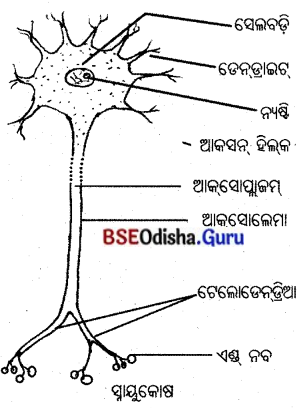
ଉଚ୍ଚ ସ୍ନାୟୁକୋଷର ଗଠନ :

  • ସ୍ନାୟୁକୋଷ ଆମ ସ୍ନାୟୁତନ୍ତ୍ରର ଗଠନିକ ଏବଂ କ୍ରିୟାତ୍ମକ ଏକକ ଅଟେ ।
  • ସ୍ନାୟୁକୋଷରେ ଗୋଟିଏ ନ୍ୟଷ୍ଟି ବା ନ୍ୟୁକ୍ଲିଅସ୍ ଓ
  • ନ୍ୟଷ୍ଟି ଥିବା ଅଂଶକୁ ସେଲବଡ଼ି କୁହାଯାଏ ।
  • ପ୍ରତ୍ୟେକ ସ୍ନାୟୁ କୋଷର ଗୋଟିଏ ପଟରେ ଅନେକଗୁଡ଼ିଏ କ୍ଷୁଦ୍ର ଶାଖାୟିତ ତନ୍ତୁ ଥାଏ । ଏଗୁଡ଼ିକୁ ଡେନ୍ସାଇଟ୍ କୁହାଯାଏ ।
  • ଡେନ୍ସାଇଟ୍‌ର ଠିକ୍ ବିପରୀତ ପଟରେ ସେଲବଡ଼ିରୁ ଏକ ଲମ୍ବ ଆକସନ୍ ବାହାରିଥାଏ ।
  • ସ୍ନାୟୁକୋଷ ଆମ ଶରୀରର ସବୁଠାରୁ ଲମ୍ବା କୋଷ ଅଟେ ।
  • ସେଲ୍‌ବଡ଼ିର ଯେଉଁ ସ୍ଥାନରୁ ଆକସନ ବାହାରିଥାଏ ବିଭାଜିତ ହୋଇ ଟେଲୋଡେନ୍ସିଆ ସୃଷ୍ଟି ହୁଏ ଓ ଟେଲୋଡେନ୍‌ଡ୍ରିଆର ଅଗ୍ରଭାଗ ସ୍ତ୍ରୀତ ହୋଇ ଏଣ୍ଡ୍‌ନବ୍ ତିଆରି ହୋଇଥାଏ ।

BSE Odisha 10th Class Life Science Solutions Chapter 5 ନିୟନ୍ତ୍ରଣ ଓ ସମନ୍ଵୟ 4

ସ୍ନାୟୁକୋଷର କାର୍ଯ୍ୟ :

  • ଆଖୁ, ନାକ, କାନ, ଜିଭ ଓ ଚର୍ମ ଆମର ଗ୍ରାହୀଅଙ୍ଗ ଅଟନ୍ତି ।
  • ଆମେ ଆଖୁ ଆଗରେ ଯାହା ଦେଖୁଛୁ ତା’ର ଖବର ଆଖ୍ ଭିତରେ ଥ‌ିବା ସ୍ନାୟୁକୋଷର ଡେନ୍ସାଇଟ୍ ଗ୍ରହଣ କରି ମସ୍ତିଷ୍କକୁ ପଠାଏ । ସେହିପରି ପରିବେଶରେ ସୃଷ୍ଟି ହେଉଥ‌ିବା ଶବ୍ଦକୁ କାନ ଭିତରେ ଥ‌ିବା ସେନ୍ସରୀ କୋଷର ଡେଡ୍ରାଇଟ୍‌ ଗ୍ରହଣ କରିଥା’ନ୍ତି ।
  • ଖଟା, ମିଠା, ପିତା ପରି ସ୍ବାଦକୁ ଜିଭରେ ଥ‌ିବା ସେନ୍ସରୀ ସ୍ନାୟୁର ଡେନ୍ସାଇଟ୍ ଗ୍ରହଣ କରେ ।
  • ଡେନ୍ସାଇଟ୍ ସଂଗ୍ରହ କରୁଥିବା ସ୍ନାୟବିକ ଆବେଗ ବିଦ୍ୟୁତ୍ ରାସାୟନିକ ପ୍ରକ୍ରିୟାଦ୍ଵାରା ସ୍ନାୟୁକୋଷର ଆକ୍‌ସନ୍ ମଧ୍ୟଦେଇ ସଞ୍ଚରିତ ହୋଇ ସିନାପସ୍ ନିକଟରେ ପହଞ୍ଚାଏ ।
  • ଆକ୍‌ସନ୍‌ର ଶେଷଭାଗରେ ବାର୍ତ୍ତା ପହଞ୍ଚିଲେ ସେଠାରୁ ଏସିଟିଲ୍‌କୋଲିନ୍ ନାମକ ଏକ ପ୍ରକାର ରାସାୟନିକ ପଦାର୍ଥର କ୍ଷରଣ ହୁଏ ଓ ଏହା ଏକ ସ୍ନାୟବିକ ସଞ୍ଚାରକ ଅଟେ ।
  • ଏହା ପରବର୍ତ୍ତୀ ସ୍ନାୟୁକୋଷର ଡେଡ୍ରାଇଟ୍‌ରେ ଏକ ନୂଆ ବିଦ୍ୟୁତ୍ ରାସାୟନିକ ଆବେଗ ସୃଷ୍ଟିକରେ । ଏହିପରି ଭାବରେ ବାର୍ତ୍ତା ଗୋଟିଏ ସ୍ନାୟୁକୋଷରୁ ଅନ୍ୟ ସ୍ନାୟୁକୋଷରୁ ଦ୍ରୁତଗତିରେ ପ୍ରସାରିତ ହୋଇ ଶେଷରେ ମସ୍ତିଷ୍କଠାରେ ପହଞ୍ଚେ ।

BSE Odisha 10th Class Life Science Solutions Chapter 5 ନିୟନ୍ତ୍ରଣ ଓ ସମନ୍ଵୟ

Question 7.
ସଂକ୍ଷେପରେ ଉତ୍ତର ଦିଅ ।
(କ) ସିନାପ୍‌ସ୍ କହିଲେ କ’ଣ ବୁଝ ?
ଉ-
ଗୋଟିଏ ସ୍ନାୟୁକୋଷର ଆକସନ୍‌ର ଶାଖାଯୁକ୍ତ ଶେଷଭାଗ ନିକଟବର୍ତ୍ତୀ ଅନ୍ୟ ସ୍ନାୟୁକୋଷର ଡେଡ୍ରାଇଗୁଡ଼ିକର ଅତି ନିକଟରେ ଥାଏ । ଏହି ସ୍ଥାନକୁ ସିନାପ୍‌ସ୍ କୁହାଯାଏ ।

(ଖ) ଭାସୋପ୍ରେସିର କାର୍ଯ୍ୟ ଲେଖ ।
ଉ-
ଭାସୋପ୍ରେସିନ୍‌ର ପ୍ରଭାବରୁ ବୃକ୍‌କର ମୂତ୍ରଜନ ନଳିକାରୁ ଜଳ ପୁନଃଶୋଷିତ ହୁଏ । ସେଥ‌ିପାଇଁ ଏହି ହର୍‌ମୋନ୍‌ର ଅନ୍ୟ ନାମ ହେଉଛି ଏକ୍ସିଡାଇୟୁରେଟିକ ହର୍‌ମୋନ୍ । ଯଦି କୌଣସି କାରଣବଶତଃ ପିଟୁଇଟାରିରୁ ଅଳ୍ପ ପରିମାଣର ଭାସୋପ୍ରେସିନ୍ କ୍ଷରିତ ହୁଏ, ତେବେ ସେହି ବ୍ୟକ୍ତି ଗୋଟିଏ ଦିନରେ ପାଖାପାଖୁ 20 ଲିଟର ପର୍ଯ୍ୟନ୍ତ ପରିସ୍ରା କରେ । ଏହି ଅବସ୍ଥାକୁ ଡଶଇବେଟିସ୍ ଇନ୍‌ୟସିପିଡ଼ସ୍ ବା ବହୁମୂତ୍ର ରୋଗ କୁହାଯାଏ ।

(ଗ) ଆଇଲେଟ୍‌ସ୍ ଅଫ୍ ଲାଙ୍ଗର୍‌ହାନସ୍ କେଉଁଠି ଥାଏ ? ଏହାର କୋଷଗୁଡ଼ିକର ନାମ ଓ କାର୍ଯ୍ୟ ଲେଖ ।
ଉ-

  • ଆମ ଶରୀରରେ ପାକସ୍ଥଳୀର ଠିକ୍ ତଳକୁ ଗ୍ରହଣୀଫାସ ମଧ୍ୟରେ ଗୋଟିଏ ଅଗ୍ନ୍ୟାଶୟ ରହିଛି ।
  • ଏହା ଏକ ମିଶ୍ରିତ ଗ୍ରନ୍ଥି, କାରଣ ଏଥୁରୁ ଏନ୍‌ଜାଇମ୍ ଓ ହର୍‌ମୋନ୍ ଉଭୟ କ୍ଷରିତ ହୁଏ ।
  • ଅଗ୍ନ୍ୟାଶୟର ହର୍‌ମୋନ୍ କ୍ଷରଣ କରୁଥିବା ଅଂଶକୁ ଆଇଲେସ୍ ଅଫ୍ ଲାଙ୍ଗରହା କୁହାଯାଏ ।
  • ଏହି ଅଂଶରେ ଆଲ୍‌ଫା-କୋଷ, ବିଟା-କୋଷ ଓ ଡେଲ୍‌ କୋଷ ପରି ସ୍ରାବୀ କୋଷମାନ ରହିଥାଏ ।
  • ଆଲ୍‌ଫା -କୋଷରୁ ଗୁ କାଗନ୍, ବିଟା-କୋଷରୁ ଇନ୍‌ସୁଲିନ୍ ଓ ଡେଲଟା-କୋଷରୁ ସୋମାଟୋଷ୍ଟାଟିନ୍ ହର୍‌ମୋନ୍ କ୍ଷରିତ ହୁଏ ।
  • ଇନ୍‌ସୁଲିନ୍ ଶରୀରରେ ଶର୍କରା (Glucose) ପରିମାଣ ସ୍ଥିର ରଞ୍ଝାରେ ସାହାଯ୍ୟକରେ ।
  • ଇନ୍‌ସୁଲିନ୍‌ର ଅଭାବରେ ରକ୍ତରେ ଶର୍କରା ପରିମାଣ ବଢ଼ି ମଧୁମେହ ରୋଗ (ଡାଇବେଟିସ୍ ମେଲିଟସ୍) ହୁଏ ।

(ଘ) ଅନ୍ତଃସ୍ରାବୀ ଗ୍ରନ୍ଥି ଓ ବହିଃସ୍ରାବୀ ଗ୍ରନ୍ଥି ମଧ୍ୟରେ ପ୍ରଭେଦ ଦର୍ଶାଅ ।
ଉ-
ଅନ୍ତଃସ୍ରାବୀ ଗ୍ରନ୍ଥି

  • ଏଥୁରୁ ହର୍‌ମୋନ୍ କ୍ଷରିତ ହୁଏ ।
  • କ୍ଷରିତ ହର୍‌ମୋନ୍ ସିଧାସଳଖ ରକ୍ତରେ ମିଶେ ।
  • ଉଦାହରଣ : ପିଟୁଇଟାରି, ଥାଇରଏଡ୍ ଇତ୍ୟାଦି।

ବହିଃସ୍ରାବୀ ଗ୍ରନ୍ଥ

  • ଏଥିରୁ ଏନ୍‌ଜାଇମ୍ ଓ ଅନ୍ୟ ପଦାର୍ଥ କ୍ଷରିତ ହୁଏ ।
  • କ୍ଷରିତ ପଦାର୍ଥ ନିର୍ଦ୍ଦିଷ୍ଟ ନାଳ ଦେଇ ଗ୍ରନ୍ଥି ବାହାରକୁ ଆସେ ।
  • ଉଦାହରଣ : ଲାଳଗ୍ରନ୍ଥି, ଯକୃତ୍ ଇତ୍ୟାଦି ।

Question 8.
ସଂକ୍ଷିପ୍ତ ଟିପ୍ପଣୀ ଲେଖ ।
ଉ-
(କ) ହର୍‌ମୋନ୍
ହୋଇଥାଏ । ଉଭିଦରେ ଥ‌ିବା ହରମୋନ୍‌କୁ ଫାଇଟୋହରମୋନ୍ କୁହାଯାଏ । ଏହା ମୁଖ୍ୟତଃ 5 ପ୍ରକାରର; ଯଥା- ଅକ୍‌ସିନ୍, ଜିବରେଲିନ୍, ସାଇଟୋକାଇନିନ୍, ଏଥୁଲିନ୍, ଆବ୍‌ସିକ୍ ଅମ୍ଳ ।

  • ହରମୋନ୍ ଉଦ୍ଭଦରେ ଆଲୋକାନୁବର୍ତ୍ତନ, ଜ୍ୟାନୁବର୍ତ୍ତନ, ଅନ୍ତକୁଞ୍ଚନ ଗତି, ଷ୍ଟୋମାଟାର ଗତି ଓ ଫଳ ପାଚିବା ଇତ୍ୟାଦିକୁ ନିୟନ୍ତ୍ରଣ କରେ ।
  • ପ୍ରାଣୀ ଶରୀରରେ ବିଭିନ୍ନ ଅନ୍ତଃସ୍ରାବୀ ଗ୍ରନ୍ଥିରୁ କ୍ଷରିତ ହରମୋନ୍‌ଦ୍ୱାରା ରାସାୟନିକ ସମନ୍ବୟ ସମ୍ଭବ ହୋଇଥାଏ ।
  • ହରମୋନ୍ ସିଧାସଳଖ ରକ୍ତରେ ମିଶେ ଓ ଏହା ମାଧ୍ୟମରେ ଦୂର ସ୍ଥାନକୁ ଯାଇ ନିର୍ଦ୍ଦିଷ୍ଟ ଅଙ୍ଗରେ କାର୍ଯ୍ୟ କରେ ।
  • କାର୍ଯ୍ୟ ସରିବା ପରେ ହରମୋନ୍ ନଷ୍ଟ ହୋଇଯାଏ । ତେଣୁ ଏହା ଥରେ ମାତ୍ର କାର୍ଯ୍ୟକ୍ଷମ ଅଟେ ।

(ଖ) ବାମନତା ଓ ଅତ୍ରିକାୟତ୍ଵ
ଉ-

  • ଏଡିନୋହାଇପୋଫାଇସିସ୍‌ରୁ କ୍ଷରିତ ହର୍‌ମୋନ୍‌ର ନାମ ଗ୍ରୋଥ୍ ହରମୋନ୍ ଅଟେ ।
  • ଏହା ଶରୀରର ବୃଦ୍ଧି ନିୟନ୍ତ୍ରଣ କରେ ।
  • ବାଲ୍ୟାବସ୍ଥାରେ ଏହାର କ୍ଷରଣ କମ୍ ହେଲେ ବ୍ୟକ୍ତିର ଶରୀର ବାମନପ୍ରାୟ ହୁଏ । ଏହାକୁ ‘ବାମନତା’ କୁହାଯାଏ ।
  • ଯଦି ଏହାର କ୍ଷରଣ ଅଧ୍ଵ ହୁଏ, ଅତ୍ୟଧିକ ବୃଦ୍ଧି ଘଟି ବ୍ୟକ୍ତି ୫ ଓ ୨ ଫୁଟ ପର୍ଯ୍ୟନ୍ତ ଉଚ୍ଚ ହୁଏ । ଏହାକୁ ଅତିକାୟତ୍ଵ କୁହାଯାଏ ।

(ଗ) ଡେଡ୍ରାଇଟ୍‌ ଓ ଆକ୍‌ସନ୍
ଉ-

  • ପ୍ରତ୍ୟେକ ସ୍ନାୟୁକୋଷର ଗୋଟିଏ ପଟରେ ଅନେକଗୁଡ଼ିଏ କ୍ଷୁଦ୍ର ଶାଖାୟିତ ତନ୍ତୁ ଥାଏ । ଏଗୁଡ଼ିକୁ ଡେଡ୍ରାଇଟ୍ କୁହାଯାଏ ।
  • ଡେନ୍ସାଇଟ୍‌ର ଠିକ୍ ବିପରୀତ ପଟରେ ସେଲବଡ଼ିରୁ ଏକ ଲମ୍ବ ଆକସନ୍ ବାହାରିଥାଏ ।
  • ଗ୍ରାହୀ ଅଙ୍ଗମାନଙ୍କଠାରୁ ଆସୁଥିବା ଉଦ୍ଦୀପନାକୁ ସ୍ନାୟୁକୋଷର ଡେଡ୍ରାଇଟ୍ ଗ୍ରହଣ କରେ ।
  • ଡେନ୍‌ଡ୍ରାଇଟ୍ ସଂଗ୍ରହ କରୁଥିବା ସ୍ନାୟବିକ ଆବେଗ ବିଦ୍ୟୁତ୍ ରାସାୟନିକ ପ୍ରକ୍ରିୟାଦ୍ଵାରା ସ୍ନାୟୁକୋଷର ଆକ୍ସନକୁ ସଞ୍ଚରିତ ହୁଏ ।

(ଘ) ଡାଇବେଟିସ୍ ଇନ୍‌ସିପିଡସ୍ ଓ ଡାଇବେଟିସ୍ ମେଲିଟସ୍
ଉ-

  • ଯଦି କୌଣସି କାରଣବଶତଃ ପିଟୁଇଟାରିରୁ ଅଳ୍ପ ପରିମାଣର ଭାସୋପ୍ରେସିନ୍ କ୍ଷରିତ ହୁଏ, ତେବେ ସେହି ବ୍ୟକ୍ତି ଗୋଟିଏ ଦିନରେ ପାଖାପାଖୁ 20 ଲିଟର ପର୍ଯ୍ୟନ୍ତ ପରିସ୍ରା କରେ । ଏହି ଅବସ୍ଥାକୁ ଡାଇବେଟିସ୍ ଇନ୍‌ସିପିଡସ୍ ବା ବହୁମୂତ୍ର ରୋଗ କୁହାଯାଏ ।
  • ଇନ୍‌ସୁଲିନ୍‌ର ଅଭାବରେ ରକ୍ତରେ ଶର୍କରା ପରିମାଣ ବଢ଼ିଗଲେ ଡାଇବେଟିସ୍ ମେଲିଟସ୍ ବା ମଧୁମେହ ରୋଗ ହୋଇଥାଏ ।

(ଙ) ଅକ୍‌ସିର କାର୍ଯ୍ୟ
ଉ-

  • ଏହି ହରମୋନ୍ ଜୀବକୋଷର ବୃଦ୍ଧି, ଫୁଲ ଓ ଫଳର ଗଠନ ଆଦି ବିଭିନ୍ନ ପ୍ରକ୍ରିୟାକୁ ପ୍ରଭାବିତ କରିଥାଏ । ଏହା ଉଦ୍ଭଦର ବୃଦ୍ଧି ନିୟନ୍ତ୍ରଣ କରେ ।
  • ଏହା ଉଦ୍ଭଦର ବୃଦ୍ଧି ନିୟନ୍ତ୍ରଣ କରେ ।
  • ଏହି ହରମୋନ ଉଭିଦର ଶାଖା ଓ କାଣ୍ଡର ବୃଦ୍ଧିରେ ସହାୟକ ହୋଇଥାଏ ।

BSE Odisha 10th Class Life Science Solutions Chapter 5 ନିୟନ୍ତ୍ରଣ ଓ ସମନ୍ଵୟ

Question 9.
ଗୋଟିଏ ବାକ୍ୟରେ ଉତ୍ତର ଦିଅ ।
(କ) ଏସିଟିଲ୍‌କୋଲିନ୍‌ର କାର୍ଯ୍ୟ କ’ଣ ?
ଉ-

  • ସ୍ନାୟୁକୋଷରେ ଥିବା ଆକ୍‌ସନ୍‌ର ଶେଷଭାଗରେ ବାର୍ତ୍ତା ପହଞ୍ଚିଲେ ସେଠାରୁ ଏସିଟିଲ୍‌କୋଲିନ୍ ନାମକ ଏକ ପ୍ରକାର ରାସାୟନିକ ପଦାର୍ଥର କ୍ଷରଣ ହୁଏ ।
  • ଏହା ଏକ ସ୍ନାୟବିକ ସଞ୍ଚାରକ ଅଟେ ।
  • ଏହା ପରବର୍ତ୍ତୀ ସ୍ନାୟୁକୋଷର ଡେଡ୍ରାଇଟ୍‌ରେ ଏକ ନୂଆ ବିଦ୍ୟୁତ୍ ରାସାୟନିକ ଆବେଗ ସୃଷ୍ଟିକରେ ।
  • ଏହିପରି ଭାବରେ ବାର୍ତ୍ତା ଗୋଟିଏ ସ୍ନାୟୁକୋଷରୁ ଅନ୍ୟ ସ୍ନାୟୁକୋଷକୁ ଦ୍ରୁତଗତିରେ ପ୍ରସାରିତ ହୋଇ ଶେଷରେ

(ଖ) ଏଡ୍ରିନାଲ୍‌କୁ ଆପଦକାଳୀନ ଗ୍ରନ୍ଥି କୁହାଯାଏ କାହିଁକି ?
ଉ-

  • ଏଡ୍ରିନାଲ ଗ୍ରନ୍ଥିରୁ ଅନେକଗୁଡ଼ିଏ ହରମୋନ୍ କ୍ଷରିତ ହୁଏ ଓ ସେଥୁମଧ୍ୟରୁ ଏଡ୍ରିନାଲିନ୍ ହରମୋନ ଅନ୍ୟତମ
  • ଏହି ହର୍‌ମୋନ୍ ଆକସ୍ମିକ ଆଘାତ, ଭୟ, ଅବଶ ଓ ଉତ୍ତେଜିତ ଅବସ୍ଥାରେ କ୍ଷରିତ ହୁଏ ।
  • ଉପରୋକ୍ତ କାର୍ଯ୍ୟମାନଙ୍କ ଯୋଗୁ ଏହି ଗ୍ରନ୍ଥିକୁ ‘ଆପଦକାଳୀନ ଗ୍ରନ୍ଥି’ କୁହାଯାଏ ।

(ଗ) ଇଣ୍ଟ୍ରୋଜେନ୍‌ର କାର୍ଯ୍ୟ କ’ଣ ?
ଉ-

  • ଡିମ୍ବାଶୟରୁ ଇଷ୍ଟୋଡ୍ରେନ୍ ନାମକ ହରମୋନ୍ କ୍ଷରଣ ହୁଏ ।
  • ଏହି ହର୍‌ମୋନ୍‌ର ପ୍ରଭାବରେ ବାଳିକାମାନଙ୍କ ଶରୀରରେ ସ୍ତ୍ରୀ-ଗୌଣ ଲିଙ୍ଗୀୟ ଲକ୍ଷଣମାନ ଦେଖାଯାଏ ।

(ଘ) ଅଗ୍ନ୍ୟାଶୟକୁ କାହିଁକି ମିଶ୍ରିତ ଗ୍ରନ୍ଥି କୁହାଯାଏ ?
ଉ-
ଅଗ୍ନ୍ୟାଶୟକୁ ଏକ ମିଶ୍ରିତ ଗ୍ରନ୍ଥି କୁହାଯାଏ, କାରଣ ଏଥୁରୁ ଏନ୍‌ଜାଇମ୍ ଓ ହରମୋନ୍ ଉଭୟ କ୍ଷରିତ ହୋଇଥାଏ ।

(ଙ) ଲାଜକୁଳୀ ଲତାରେ କି ପ୍ରକାର ଗତି ଦେଖାଯାଏ ?

  • ଲାଜକୁଳୀ ଲତାର ଡାଳ କିମ୍ବା ପତ୍ରକୁ ଛୁଇଁଦେବା ମାତ୍ରେ ଲତାରେ ଥ‌ିବା ପତ୍ରଗୁଡ଼ିକ ନଇଁଯାଇ ଝାଉଁଳି ପଡ଼େ ।
  • ସ୍ପର୍ଶ ପ୍ରତି ଅନୁକ୍ରିୟା ପ୍ରଦର୍ଶନ ସ୍ୱରୂପ ପତ୍ରଗୁଡ଼ିକ ଜାକି ହୋଇଯା’ନ୍ତି ।
  • ଲାଜକୁଳୀ ଲତାର ଏହି ଗତିକୁ ଅନ୍ତର୍କୁଞ୍ଚନ ଗତି କୁହାଯାଏ ।
  • ଏହା ସ୍ପର୍ଶଜନିତ ଉଦ୍ଦୀପନାର ଏକ ବିଶେଷ ଉଦାହରଣ ଅଟେ ।

Question 10.
ଗୋଟିଏ ଶବ୍ଦରେ ଉତ୍ତର ଦିଅ ।
(କ) ମଣିଷ ଶରୀରରେ କେତେ ଯୋଡ଼ା କ୍ରାନିଆଲ୍ ସ୍ନାୟୁ ରହିଛି ?
(ଖ) ସୁଷୁମ୍ନାକାଣ୍ଡର ବାହ୍ୟ ଆବରଣକୁ କ’ଣ କୁହାଯାଏ ?
(ଗ) ଆଣ୍ଟିଡାଇୟୁରେଟିକ୍ ହରମୋନ୍‌ର ଅନ୍ୟ ନାମ କ’ଣ ?
(ଘ) କେଉଁଟି ଏକ ସାମୟିକ ଅନ୍ତଃସ୍ରାବୀ ଗ୍ରନ୍ଥି ?
(ଙ) ଉଭିଦର ଚେରରେ କେଉଁ ପ୍ରକାର ଗତି ପରିଲକ୍ଷିତ ହୁଏ ?

Answers
(କ) 12 ଯୋଡ଼ା
(ଖ) ମେନିଞ୍ଜେସ୍
(ଗ) ଭାସୋପ୍ରେସିନ୍
BSE Odisha 10th Class Life Science Solutions Chapter 5 ନିୟନ୍ତ୍ରଣ ଓ ସମନ୍ଵୟ 5
(ଙ) ଜ୍ଯାନୁବର୍ତ୍ତନ

Question 11.
ଶୂନ୍ୟସ୍ଥାନ ପୂରଣ କର ।
(କ) ଉଭିଦର ଫଳ ଓ ଫୁଲ ଝଡ଼ିବା ସହ ବାର୍ଦ୍ଧକ୍ୟ ତ୍ୱରାନ୍ବିତ ହେବା ଏଥୁଲିନ୍ ଓ ……………………. ଦ୍ଵାରା ନିୟନ୍ତ୍ରିତ ।
(ଖ) ହରମୋନ୍ ଭ୍ରୁଣକାଣ୍ଡର ……………………… ରେ ତିଆରି ହୁଏ ।
(ଗ) ମସ୍ତିଷ୍କର ………………….. ଭାଗ ଆମ ସ୍ମୃତି ପାଇଁ ଦାୟୀ ।
(ଘ) ଆମ ଶରୀରର ସନ୍ତୁଳନ ଓ ଭାରସାମ୍ୟ ମସ୍ତିଷ୍କର ………………… ନିୟନ୍ତ୍ରଣ କରେ ।
(ଙ) ମସ୍ତିଷ୍କର ଅଗୋଚରରେ ଶରୀରରେ ଘଟୁଥ‌ିବା ଅତି ଜରୁରୀ କାର୍ଯ୍ୟକୁ ………………….. କୁହାଯାଏ ।
(ଚ) ସ୍ନାୟୁକୋଷରେ ……………….. ନଥ‌ିବାରୁ ଏହା ବିଭାଜିତ ହୋଇପାରେ ନାହିଁ ।

Answers
(କ) ଆବ୍‌ସିକ୍ ଅମ୍ଳ
(ଖ) ଅଗ୍ରଭାଗ
(ଗ) ଅଗ୍ରମସ୍ତିଷ୍କ (ପ୍ରମସ୍ତିଷ୍କ )
(ଘ) ଅନୁମସ୍ତିଷ୍କ
(ଙ) ପ୍ରତିକ୍ଷେପ କ୍ରିୟା
(ଚ) ସେଣ୍ଡ୍ରୋଜୋମ୍

Question 12.
ବାକ୍ୟରେ ଚିହ୍ନିତ ରେଖାଙ୍କିତ ଶବ୍ଦ|ଶବ୍ଦପୁଞ୍ଜକୁ ବଦଳାଇ ଠିକ୍ ବାକ୍ୟ ଲେଖ ।
(କ) ଉଭିଦର କାଣ୍ଡ ଆଲୋକ ଆଡ଼କୁ ଗତି କରିବାକୁ ଜ୍ୟାନୁବର୍ତ୍ତନ କୁହାଯାଏ ।
ଉ-
ଉଭିଦର କାଣ୍ଡ ଆଲୋକ ଆଡ଼କୁ ଗତି କରିବାକୁ ଆଲୋକାନୁବର୍ତ୍ତନ କୁହାଯାଏ ।

(ଖ) ଉଦ୍ଭଦରେ ଥ‌ିବା ହର୍‌ମୋନ୍‌ଗୁଡ଼ିକୁ ଟ୍ରପିକ୍ ହରମୋନ୍ କୁହାଯାଏ ।
ଉ-
ଉଭିଦରେ ଥିବା ହର୍‌ମୋନ୍‌ଗୁଡ଼ିକୁ ଫାଇଟୋ ହରମୋନ୍ କୁହାଯାଏ ।

(ଗ) ଥାଇରଏଡ଼ ଗ୍ରନ୍ଥିରୁ ଅକ୍‌ସିଟୋସିନ୍ ହରମୋନ୍ କ୍ଷରିତ ହୁଏ ।
ଉ-
ଥାଇରଏଡ଼ ଗ୍ରନ୍ଥିରୁ ଥାଇରକ୍‌ସିନ୍ ହରମୋନ୍ କ୍ଷରିତ ହୁଏ ।

(ଘ) ବାଲ୍ୟାବସ୍ଥାରେ ପ୍ରୋଲାକ୍ଟିନ ହରମୋନ୍ କ୍ଷରଣ କମ୍ ହେଲେ ବ୍ୟକ୍ତିର ଶରୀର ବାମନ ପ୍ରାୟ ହୁଏ ।
ଉ-
ବାଲ୍ୟାବସ୍ଥାରେ ଗ୍ରୋଥ ହରମୋନ କ୍ଷରଣ କମ୍ ହେଲେ ବ୍ୟକ୍ତିର ଶରୀର ବାମନ ପ୍ରାୟ ହୁଏ ।

(ଙ) ଅଗ୍ନ୍ୟାଶୟକୁ ଆପଦକାଳୀନ ଗ୍ରନ୍ଥି କୁହାଯାଏ ।
ଉ-
ଏଡ୍ମିନାଲ ଗ୍ରନ୍ଥି ଆପଦକାଳୀନ ଗ୍ରନ୍ଥି କୁହାଯାଏ ।

BSE Odisha 10th Class Life Science Solutions Chapter 5 ନିୟନ୍ତ୍ରଣ ଓ ସମନ୍ଵୟ

Question 13.
ପ୍ରଥମ ଦୁଇଟି ଶବ୍ଦର ସମ୍ପର୍କକୁ ଦେଖ୍ ତୃତୀୟ ଶବ୍ଦ ସହ ସମ୍ପର୍କିତ ଶବ୍ଦଟି କ’ଣ ହେବ ଲେଖ ।
(କ) ବାମନତା : ଗ୍ରୋଥ ହରମୋନ୍ :: ରୂପାନ୍ତରଣ : ………………….
(ଖ) ଡିମ୍ବାଶୟ : ଇଣ୍ଟ୍ରୋଜେନ୍ :: ଶୁକ୍ରାଶୟ : ………………….
(ଗ) ଫୁଲ ଝଡ଼ିବା : ଏଥୁଲିନ୍ :: ଫୁଲ ଧରିବା : ………………….
(ଘ) ଏଡ୍ରିନାଲ ଗ୍ରନ୍ଥି : ଅନ୍ତଃସ୍ରାବୀ :: ଯକୃତ୍ : ………………….
(ଙ) ଗର୍ଭାବସ୍ଥା ହର୍‌ମୋନ୍ : ପ୍ରୋଜେଷ୍ଟିରନ୍ :: ଗର୍ଭସଞ୍ଚାର ନିର୍ଣ୍ଣାୟକ ହରମୋନ୍ : ………………….

Answers
(କ) ଥାଇରକ୍‌ସିନ୍,
(ଖ) ଟେଷ୍ଟୋଷ୍ଟିରନ୍,
(ଗ) ଫ୍ଲୋରିଜେନ୍ ଓ ଫାଇଟୋକ୍ରୋମ୍,
(ଘ) ବହିଃସ୍ରାବୀ ଗ୍ରନ୍ଥି,
(ଙ) ନ୍ୟୁମାନ୍ କୋରିଓନିକ୍ ଗୋନାଡୋଟ୍ରଫିକ୍ ହର୍‌ମୋନ୍

BSE Odisha 10th Class Odia Solutions Chapter 2 ବନ୍ଦେ ଉତ୍କଳ ଜନନୀ

Odisha State Board BSE Odisha 10th Class Odia Solutions Chapter 2 ବନ୍ଦେ ଉତ୍କଳ ଜନନୀ Textbook Exercise Questions and Answers.

BSE Odisha Class 10 Odia Solutions Chapter 2 ବନ୍ଦେ ଉତ୍କଳ ଜନନୀ

Question ୧।
ପ୍ରତ୍ୟେକର ଦୁଇଟି ଲେଖାଏଁ ପ୍ରତିଶବ୍ଦ ଲେଖ ।
ପୟୋଧ, ତଟିନୀ, ସମୀର, ଭୂଧର, ଉଟଜ, ଅରି
Answer:

ଶବ୍ଦ ପ୍ରତିଶବ୍ଦ
ପୟୋଧି ସମୁଦ୍ର, ସାଗର
ସମାର ପବନ, ବାୟୁ
ଉଟଜ କୁଟାର କୁଡ଼ିଆ
ଭଗିନା ନଦୀ, ସଗିତ
ଭୂଧର ପର୍ବତ, ଅଚଳ
ଅରି ଶତ୍ରୁ, ଅରାତି, ବୈରା

Question ୨ ।
ନିମ୍ନଲିଖ୍ ଶବ୍ଦଗୁଡ଼ିକର ବିପରୀତାର୍ଥବୋଧକ ଶବ୍ଦ ଲେଖ ।
ଶୁଭ୍ର, ଘନ, ସୁନ୍ଦର, ପବିତ୍ର, ପୁଣ୍ୟ, ଦର୍ପିତ
Answer:

ଶବ୍ଦ ବିପରୀତାର୍ଥବୋଧକ ଶବ୍ଦ
ଶୁଭ୍ର ମଳିନ
ପୂର୍ବର ଅସୁନ୍ଦର
ପୁଣ୍ୟ ପାପ
ଘନ ତରଳ
ପବିତ୍ର ଅପବିତ୍ର
ବର୍ଷତ ବିନୀତ

Question ୩ ।
ନିମ୍ନଲିଖ୍ ଶବ୍ଦମାନଙ୍କୁ ନେଇ ସାର୍ଥକ ବାକ୍ୟ ରଚନା କର।
ବିଧୌତ, ସୁଶୋଭିତ, ରାଜିତ, କଳକଳ, ଜ୍ଞାନବିଜ୍ଞାନ, ଭଟଜ
Answer:
ବିଧୌତ – ଜ୍ୟୋତ୍ସ୍ନା ବିଧୌତ ରାତ୍ରି ଭାବୁକକୁ ବିମୋହିତ କରେ।
ସୁଶୋଭିତ – ରାମଚନ୍ଦ୍ରଙ୍କ ସୁଶୋଭିତ ରୂପ ଦେଖ୍ ମୁନିମାନେ ବିମୋହିତ ହୋଇଥିଲେ।
ରାଜିତ – ଆଶ୍ରମରେ ପୁଷ୍ପରାଜିତ ଦୃଶ୍ୟ ଚିତ୍ତ ହରଣ କରେ ।
କଳକଳ – ଚିଲିକାରେ ପକ୍ଷୀମାନଙ୍କର କଳକଳ ଶବ୍ଦ ଶୁଣାଯାଏ ।
ଜ୍ଞାନବିଜ୍ଞାନ – ବର୍ତ୍ତମାନ ଓଡ଼ିଶା ଜ୍ଞାନବିଜ୍ଞାନରେ ଯଥେଷ୍ଟ ଆଗେଇ ଗଲାଣି ।
ଉଟଇ – ଘନ ଅରଣ୍ୟରେ ମୁନିମାନେ ଉଟଜ ତିଆରି କରି ରହୁଥିଲେ।

BSE Odisha 10th Class Odia Solutions Chapter 2 ବନ୍ଦେ ଉତ୍କଳ ଜନନୀ

Question ୪।
‘କଳକଳ’ ଭଳି ଆଉ ପାଞ୍ଚଗୋଟି ଧ୍ୱନ୍ୟାତ୍ମକ ଯୁଗ୍ମଶବ୍ଦ ଲେଖ ।
Answer:
ଧ୍ଵନ୍ୟାତ୍ମକ ଯୁଗ୍ମଶବ୍ଦ – ଧଡ଼ଧଡ଼, ଫଡ଼ଫଡ଼, ଘଡ଼ଘଡ଼, ମଡ଼ମଡ଼, ଖରଖର, ଝରଝର।

Question ୫।
ପଠିତ କବିତା ଅବଲମ୍ବନରେ ଶୂନ୍ୟସ୍ଥାନ ପୂରଣ କର । (ପ୍ରଶ୍ନ ସହିତ ଉତ୍ତର)
Answer:
(କ) ପୂତ ପୟୋଧ ବିଧୌତ ଶରୀରା
(ଗ) ଶୁଭ୍ରତଟିନୀ କୂଳ – ଶୀକର, ସମୀରା
(ଙ) ନୀଳ ଭୂଧରମାଳା ସାଜେ ତରଙ୍ଗେ
(ଛ) ସୁନ୍ଦର ଶାଳି ସୁଶୋଭିତ କ୍ଷେତ୍ରା,
(ଝ) ଯୋଗୀ ଋଷିଗଣ ଉଟଜ ପବିତ୍ରା ଅର୍ଥଗତ ପାର୍ଥକ୍ୟ ଦର୍ଶାଅ ।
(ଖ) ତାଳତମାଳ ସୁଶୋଭିତ, ତୀରା
(ଚ) କଳକଳ ମୁଖରିତ ଚାରୁ ବିହଙ୍ଗେ।
(ଜ) ଜ୍ଞାନ ବିଜ୍ଞାନ ପ୍ରଦର୍ଶିତ ନେତ୍ରା,
(ଞ) ସୁନ୍ଦର ମନ୍ଦିର ମଣ୍ଡିତ ଦେଶ,

Question ୬ ।
ଅର୍ଥଟତ ପାର୍ଥକ୍ୟା ଦର୍ଶ ଆ
ସୁର – ଶୂର, ପୂତ – ପୁତ, ଶାଳି – ଶାଳୀ, ବଳି – ବଳୀ, କୂଳ
Answer:
ପୁର – ଦେବତା
ଶୂର – ବାର
ପୁତ – ପବିତ୍ର
ପୁତ – ପୁଅ, ସନ୍ତାନ
ଶାଳି – ଧନ୍ୟ ବିଶେଷ
ଶୀଳା – ପ୍ରାର ସାନଭଉଣ।
ବଳି – ପୂଜା ସାମଗ୍ର।, ଦୈତରଜ ଚିରୋଜ ବିରୋଚନଙ୍କ ପୁତ୍ର
ବଳା – ବଳବାନ୍
କୁଳ – ନଦା, ସମୁନ୍ଦ୍ର ପ୍ରଭୃତିର କଟ
କୁଳ – ବଂଶ

କ୍ଷୁଦ୍ର ଉତ୍ତରମୂଳକ ପ୍ରଶ୍ନୋତ୍ତର

Question ୭।
ଚାରୁହାସମୟୀ ଚାରୁଭାଷମୟୀ କାହାକୁ କୁହାଯାଇଛି?
Answer:
ଉତ୍କଳ ଜନନୀକୁ ଚାରୁହାସମୟୀ ଚାରୁଭାଷମୟୀ ବୋଲି କୁହାଯାଇଛି । ଚାରୁହାସମୟୀ କହିବାଦ୍ୱାରା ଉତ୍କଳର ଗୌରବମୟ ଅବସ୍ଥାକୁ ସୂଚାଇ ଦିଆଯାଇଛି । କାରଣ ସନ୍ତାନମାନଙ୍କର ଗୌରବରେ ଜନନୀ ମୁଖରେ ମଧୁର ହସ ଖେଳିଥାଏ । ପୁନଶ୍ଚ ଓଡ଼ିଆ ଭାଷାର ମୁହୂତା ଓ ମଧୁରତା ହେତୁ ଉତ୍କଳ ଜନନୀକୁ ଚାରୁଭାଷମୟୀ ବୋଲି କୁହାଯାଇଛି ।

Question ୮।
ଉତ୍କଳ ଜନନୀକୁ କିଏ ଧୋଇ ଦେଇଛି ?
Answer:
ପୂତ ମହୋଦଧୂ ଉତ୍କଳ ଜନନୀକୁ ଧୋଇ ଦେଉଛି ।

Question ୯।
ସମୁଦ୍ରକୂଳ କେଉଁ କେଉଁ ବୃକ୍ଷଦ୍ବାରା ସୁଶୋଭିତ ?
Answer:
ସମୁଦ୍ରକୂଳ ତାଳ ଓ ତମାଳ ବୃକ୍ଷଦ୍ଵାରା ସୁଶୋଭିତ ।

BSE Odisha 10th Class Odia Solutions Chapter 2 ବନ୍ଦେ ଉତ୍କଳ ଜନନୀ

Question ୧୦ ।
ଉତ୍କଳର ଆକାଶ କାହାର କଳରବରେ ମୁଖରିତ ?
Answer:
ଉତ୍କଳର ଆକାଶ ସୁନ୍ଦର ସ୍ବନ କରୁଥିବା ବିହଙ୍ଗମାନଙ୍କ କଳରବରେ ମୁଖରିତ ।

Question ୧୧ ।
ପର୍ବତମାଳାଗୁଡ଼ିକ ଉତ୍କଳ ଜନନୀଙ୍କ ଦେହରେ କିଭଳି ଭାବେ ଶୋଭାପାଇଛି ?
Answer:
ପର୍ବତାମାଳାଗୁଡ଼ିକ ଉତ୍କଳ ଜନନୀଙ୍କ ଦେହରେ ତରଙ୍ଗାକାରରେ ସଜ୍ଜିତ ହେଲାଭଳି ଶୋଭାପାଉଛି ।

Question ୧୨ ।
କେଉଁମାନଙ୍କ କୁଟୀରଦ୍ଵାରା ଉତ୍କଳ ପବିତ୍ର ହୋଇଛି ?
Answer:
ଯୋଗୀ ଓ ଋଷିମାନଙ୍କ କୁଟୀରଦ୍ଵାରା ଉତ୍କଳ ପବିତ୍ର ହୋଇଛି। ‘

Question ୧୩ ।
ଶ୍ରେଷ୍ଠ କବିମାନେ କାହାର କୀର୍ତ୍ତି ବନ୍ଦନା କରୁଛନ୍ତି ?
Answer:
ଶ୍ରେଷ୍ଠ କବିମାନେ ଉତ୍କଳ ଜନନୀଙ୍କର କୀର୍ତ୍ତି ବନ୍ଦନା କରୁଛନ୍ତି । ଫଳରେ ଉତ୍କଳ ଜନନୀଙ୍କର କୀର୍ତ୍ତି ସାରା ପୃଥ‌ିବୀରେ ଖ୍ୟାତି ଲାଭ କରିଛି

ପପ୍ରସଙ୍ଗ ସରଳାର୍ଥ

Question ୧୪ ।
ପୂତ-ପୟୋଧ-ବିଧୌତ-ଶରୀରା,
ପୂତ-ପାୟୋଧ…….ସୁଶୋଭିତ ତାରା
Answer:
ଉକ୍ତ ପଦ୍ୟାଶଟି କାନ୍ତକବି ଲକ୍ଷ୍ମୀକାନ୍ତ ମହାପାତ୍ରଙ୍କ ବିରଚିତ ‘ବନ୍ଦେ ଉତ୍କଳ ଜନନୀ’’ ଶୀର୍ଷକ ଜାତୀୟ ଭାବନା ପ୍ରଣୋଦିତ କବିତାରୁ ଗୃହୀତ ହୋଇଛି । ଏଠାରେ କବି ପ୍ରିୟ ଜନ୍ମଭୂମି ‘ଉତ୍କଳ ଜନନୀଭାବନା’ ର ଭୌଗୋଳିକ ସ୍ଥିତି ବା ବାହ୍ୟ ଶୋଭାର ବର୍ଣ୍ଣନା ଦେଇଛନ୍ତି ଆମର ଜନ୍ମଭୂମି ଉତ୍କଳର ପୂର୍ବ ଦିଗର ସୀମା ବଙ୍ଗୋପସାଗର ଦ୍ଵାରା ବେଷ୍ଟିତ । ଏହି ବଙ୍ଗୋପସାଗରକୁ ପୁରାଣ ଶାସ୍ତ୍ରକାରମାନେ ପବିତ୍ର ମହୋଦଧୂ ଭାବେ ପରିଚିତ କରାଇଛନ୍ତି । କବିଙ୍କ ମତରେ ସେହି ମହୋଦଧୂର ପବିତ୍ର ଜଳ ଉତ୍କଳ ଜନନୀର ଶରୀରକୁ ବିଧୌତ କରୁଛି ।

ମହୋଦଧୂର ପବିତ୍ର ଜଳଦ୍ଵାରା ଉତ୍କଳ ଜନନୀର ଶରୀର ବିଧୌତ ହେବାଦ୍ଵାରା ସେ‘ ସଦା ପବିତ୍ର ହେଉଛି । ପୁନଶ୍ଚ ଏହାର ତଟଦେଶରେ ଶୋଭାପାଇଥାଏ ମାଳମାଳ ତାଳ ଓ ତମାଳ ବୃକ୍ଷ । ସେହି ବୃକ୍ଷର ସବୁଜିମାରେ ଉତ୍କଳ ଜନନୀ ଅପୂର୍ବ ଶ୍ରୀ ଧାରଣ କରିଥାଏ । ଏଠାରେ କବି ଉତ୍କଳର ଭୌଗୋଳିକ ସ୍ଥିତିକୁ କାବ୍ୟକ ରୂପ ଦେଇଛନ୍ତି । କବିଙ୍କର ଏଭଳି ପରିକଳ୍ପନା ହୃଦୟସ୍ପର୍ଶୀ ହୋଇଛି । ଏଭଳି ବର୍ଣ୍ଣନାରେ କବିଙ୍କର ଜାତୀୟତାବୋଧ ମଧ୍ଯ ପ୍ରକାଶିତ ହୋଇଛି ।

BSE Odisha 10th Class Odia Solutions Chapter 2 ବନ୍ଦେ ଉତ୍କଳ ଜନନୀ

Question ୧୫ ।
ଘନଘନ ବନଭୂମି ରାଜିତ ଅଙ୍ଗେ,
ନୀଳ ଭୂଧରମାଳା ସାଜେ ତରଙ୍ଗେ,
Answer:
ଘନଘନ ………………………. ସାଜେ ତରଇେଁ
ଶସିତ ପଦ୍ୟାଂଶଟି କାନ୍ତକବି ଲକ୍ଷ୍ମୀକାନ୍ତ୍ର ମହାପାତ୍ରଙ୍କ ଦେଶାସରୋଧକ ସଙ୍ଗୀତ ବିନ୍ଦେ ଉତ୍କଳ ଜନନା ରୁ ଗୃହାତ ହୋଇଛି । ଏଥ‌ିରେ କବି ଉତ୍କଳ ଜନନୀଙ୍କର ଅରଣ୍ୟ ଓ ପର୍ବତମାଳାର ଶୋଭାକୁ ଛନ୍ଦାୟିତ ଭାବରେ ପରିପ୍ରକାଶ କରିଛନ୍ତି । ଆମ ଉତ୍କଳ ପ୍ରଦେଶ ଉପକୂଳ ପ୍ରାକୃତିକ ପରିବେଶରେ ସୁଶୋଭିତ । ଏହାର ବିସ୍ତୀର୍ଣ୍ଣ ଅଞ୍ଚଳ ନିଘଞ୍ଚ ଅରଣ୍ୟାନୀଦ୍ଵାରା ଆଚ୍ଛାଦିତ । ଏହି ବନଭୂମି ଶାଳ, ପିଆଶାଳ, ଅସନ, କୁରୁମ, ଶିଶୁ, କେନ୍ଦୁ, ଆମ୍ବ, ଚାକୁଣ୍ଡା, ବର, ଓସ୍ତ, ଗମ୍ଭାରି, ନିମ ଆଦି ଦ୍ରୁମଦ୍ୱାରା ପରିପୂର୍ଣ୍ଣ । ପୁନଶ୍ଚ ଏହି ବନରେ ବାସକରନ୍ତି ବାଘ, ଭାଲୁ, ହାତୀ, ହରିଣ, ଝିଙ୍କ, ଠେକୁଆ, ସମ୍ବର, କୁଟୁରା ଆଦି ପ୍ରାଣୀମାନେ ।

ନାନାଜାତିର ପଶୁ ସାଙ୍ଗକୁ ମୟୂର, କୋଇଲି, କେଚିଳାଖାଇ, ଶୁଆ, ସାରୀ ଆଦି ପକ୍ଷୀମାନେ ମଧ୍ୟ କରନ୍ତି ବହଳ ଗଛ ସାଙ୍ଗକୁ ପଶୁପକ୍ଷୀଙ୍କର ଲୀଳାଖେଳା ଦର୍ଶକକୁ ବିମୋହିତ କରେ । ଉତ୍କଳର ସ୍ଥାନେ ସ୍ଥାନେ ଦେଖାଦିଏ’ ସବୁଜବୃକ୍ଷ । ଆଚ୍ଛାଦିତ ଢଙ୍ଗ ପର୍ବତମାଳା । ସେହି ପର୍ବତମାଳା ଦୂରରୁ ମନୋରମ ଦେଖାଯାଏ । ଛୋଟବଡ଼ ପାହାଡ଼ଗୁଡ଼ିକ ପାଖକୁ ପାଖ ସଜେଇ ହେଲାଭଳି ରହିଥା’ନ୍ତି । ସମୁଦ୍ର ମଧ୍ୟରେ ଉତ୍ତାଳ ତରଙ୍ଗ ଯେପରି ଦେଖାଯାଏ, ଏହି ନୀଳ ପର୍ବତଗୁଡ଼ିକ ସେହିପରି ଦେଖାଯା’ନ୍ତି । କବି ଉତ୍କଳର ଶୋଭାକୁ ଯଥାର୍ଥ ଭାବରେ ବର୍ଣ୍ଣନା କରିବାକୁ ଯାଇ ଏହାର ଅତି ଘଞ୍ଚ ବନପ୍ରଦେଶ ଓ ପର୍ବତମାଳାର, ରୂପକୁ ଦେଖାଇବାକୁ ଚେଷ୍ଟା କରିଛନ୍ତି । କରିଙ୍କର ଉପସ୍ଥାପନା କ। ବ୍ୟାକଚ ଓ ମନୋଜ୍ଞ ହୋଇପାରିଛି।

Question ୧୬ ।
ସୁନ୍ଦରଶାଳି – ମୁଶୋଭିତ – କ୍ଷେତ୍ରା
ଞ୍ଜାନବିଜ୍ଞାନ – ପ୍ରଦର୍ଶିତ – ନେତ୍ରା
Answer:
ସୁନ୍ଦରଶାଳି …………………. ପ୍ରଦର୍ଶିତ ନେତ୍ରା
ଉକ୍ତ ପଦ୍ୟାଶଟି କାନ୍ତକବି ଲକ୍ଷ୍ମୀକାନ୍ତ ମହାପାତ୍ରଙ୍କ ବିରଚିତ ‘ବନ୍ଦେ ଉତ୍କଳ ଜନନୀ’ ଶୀର୍ଷକ ଜାତୀୟ ଭାବନା ପ୍ରଣୋଦିତ କବିତାରୁ ଗୃହୀତ ହୋଇଛି । ଏଠାରେ କବି ପ୍ରିୟ ଜନ୍ମଭୂମି ଉତ୍କଳ ଶସ୍ୟଶୋଭିତ ସୁନ୍ଦର କ୍ଷେତ୍ର ଏବଂ ଜ୍ଞାନବିଜ୍ଞାନରେ ମହିମାନ୍ବିତ ହୋଇଥିବା କଥା ଉଲ୍ଲେଖ କରିଛନ୍ତି ।

ଓଡ଼ିଆପୁଅର ମୂଳ ଖାଦ୍ୟ ହେଉଛି ଭାତ । କୃଷକ ପଖାଳ କଂସାରେ ତା’ର ଉଦର ପୂରଣ କରେ । କାରଣ ଧାନ ହେଉଛି ଉତ୍କଳର ପ୍ରଧାନ ଫସଲ । ଏଠାରେ ଦିଗସ୍ତବିସ୍ତାରି ଶସ୍ୟକ୍ଷେତ୍ର ଦେଖାଯାଏ । ଶରତ ଋତୁରେ ଚାରିଆଡ଼େ ଧାନକ୍ଷେତ୍ରର ସବୁଜିମା ନୟନ ମନକୁ ହରଣ କରିନିଏ । ପୁଣି ସେହି ସବୁଜକ୍ଷେତ୍ର ଶୀତଋତୁରେ ସୁବର୍ଷବର୍ଷ ଧାରଣ କରି କେବଳ କୃଷକକୁ ହିଁକି ଯେକୌଣସି ଦର୍ଶକକୁ ପ୍ରାଣଭରା ଆନନ୍ଦ ଦିଏ । କବି ଏଠାରେ ଏକ ବିଶେଷଧରଣର ଶାଳିଧାନ କଥା ସୂଚାଇ ଅଛନ୍ତି। କୂଳ ଭୂମିର ସନ୍ତାନମାନେ ଜ୍ଞାନ ଓ ବିଜ୍ଞାନରେ ଅଧିକ ପାରଙ୍ଗମ । ଏହାକୁ ବୁଝାଇବାକୁ ଯାଇ କବି କହିଛନ୍ତି, ଉତ୍କଳ ଜନନୀଙ୍କ ନତ୍ରରୁ ପ୍ରକାଶିତ ହେଉଛି ଜ୍ଞାନାଲୋକ ଓ ବିଜ୍ଞାନର ଅପୂର୍ବ ଜ୍ୟୋତି I କବିଙ୍କର ଏଭଳି କହିବାର ଉଦ୍ଦେଶ୍ୟ ହେଉଛି, ଏହି ପବିତ୍ର ଉତ୍କଳ ମାଟିରେ ଜନ୍ମ ନେଇଛନ୍ତି ଅନେକ ଜ୍ଞାନୀ ଓ ବିଜ୍ଞାନୀ । ସେମାନେ ଜ୍ଞାନ ଓ ବିଜ୍ଞାନ ବଳରେ କାଳଜୟୀ କୃତିତ୍ଵ ହାସଲ କରିଛନ୍ତି। କବିଙ୍କର ଏଭଳି ବର୍ଣ୍ଣନା ଉତ୍କଳ ଜନନୀ ପାଇଁ ଯଥାର୍ଥ ମନେହୁଏ।

Question ୧୭ ।
ଉତ୍କଳ ଶୂରବର-ଦର୍ପିତ ଗେହା,
ଅରିକୂଳ – ଶୋଣିତ – ଚର୍ଚ୍ଚିତ – ଦେହା,
Answer:
ଉତ୍କଳ ଶ୍ଵରବର ……………….. ଚର୍ଚିତ ଦେହା
ଶଂସିତ ପଦ୍ୟାଶଟି କାନ୍ତକବି ଲକ୍ଷ୍ମୀକାନ୍ତ ମହାପାତ୍ରଙ୍କ ବିରଚିତ ‘ବନ୍ଦେ ଉତ୍କଳ ଜନନୀ’ ଶୀର୍ଷକ ଦେଶାତ୍ମବୋଧକ କବିତାରୁ ଗୃହୀତ ହୋଇଛି । ଏଠାରେ କବି ଉତ୍କଳ ଜନନୀକୁ ବୀରପ୍ରସବିନୀ ଗୌରବରେ ଗୌରବାନ୍ବିତ କରିବାକୁ ଚାହିଁଛନ୍ତି । ଉତ୍କଳ ହେଉଛି ବୀରମାଟି । ଏଠାରେ ଜନ୍ମ ନେଇଛନ୍ତି ଶୌର୍ଯ୍ୟବନ୍ତ ଓ ବୀର୍ଯ୍ୟବନ୍ତ ବୀରମାନେ । ସେମାନଙ୍କର ବୀରତ୍ଵ ଓ ଗରିମା ସମଗ୍ର ଭାରତବର୍ଷରେ ପରିଚିତ ଓ ପ୍ରଚାରିତ । ତେଣୁ କବି ଉତ୍କଳଭୂମିକୁ ବୀରଶ୍ରେଷ୍ଠମାନଙ୍କର ଗୃହ ବୋଲି କହିଛନ୍ତି । ସେହି ବୀରମାନଙ୍କୁ ନେଇ ସେ ଗୌରବବିମଣ୍ଡିତା । ଅସଂଖ୍ୟ ଶତ୍ରୁଙ୍କୁ ସେହି ବୀରସନ୍ତାନଗଣ ବିନାଶ କରିଛନ୍ତି । ଯେଉଁମାନେ ମ୍ଭର ସହିତ ଶତ୍ରୁମାନଙ୍କୁ ସମ୍ମୁଖୀନ ହୋଇଛନ୍ତି ଏବଂ ସେମାନଙ୍କୁ ବିନାଶ କରିଛନ୍ତି । ଏଠାରେ କବି ଉତ୍କଳର ଐତିହ୍ୟ ସୂଚିତ କରି, ଉତ୍କଳବାସୀଙ୍କ ମନରେ ଜାତୀୟତାବୋଧ ସୃଷ୍ଟି କରିବାକୁ ଚାହିଁଛନ୍ତି ।

BSE Odisha 10th Class Odia Solutions Chapter 2 ବନ୍ଦେ ଉତ୍କଳ ଜନନୀ

Question ୧୮ ।
‘‘ବନ୍ଦେ ଉତ୍କଳ ଜନନୀ’’ କବିତାରୁ ଉତ୍କଳର ବୈଶିଷ୍ଟ୍ୟ ଉଲ୍ଲେଖ କର ।
Answer:
ଟ୍ୟକାର, ଗାଳ୍ପିକ, ପ୍ରାବନ୍ଧିକ ଓ ପତ୍ରିକା ସମ୍ପାଦକ । ବ୍ୟଙ୍ଗକବି ଭାବରେ ଓଡ଼ିଆ ସାହିତ୍ୟରେ ସେ ସ୍ବତନ୍ତ୍ର ସ୍ଥାନ ଅଧିକାର କରିଛନ୍ତି । ସେ ସ୍ଵଚ୍ଛଳ ଜମିଦାର ପରିବାରର ଦାୟଦ ହୋଇ ଉଚ୍ଚଶିକ୍ଷା ଲାଭ କରିଥିଲେ ବି ଆଜୀବନ ରୋଗବ୍ୟାଧ ତାଙ୍କ
‘ତିଷ୍ଠ ହେବା କାରଣରୁ ନିଜକୁ ଅତି ଅସହାୟ ମନେକରିଥିଲେ । ତଥାପି ଜୀବନସାରା ସାହିତ୍ୟ ସାଧନରେ ନିଜକୁ ସେ ହଜାଇ ଦେବାକୁ ଚାହିଁଥିଲେ । ତାଙ୍କଦ୍ୱାରା ରଚିତ ‘ଜାତୀୟ ସଙ୍ଗୀତ’, ‘ଜୀବନ ସଙ୍ଗୀତ’, ‘ଚଟକ ଚନ୍ଦ୍ରହାସ ଚମ୍ପୂ’ ତାଙ୍କ କବି ପ୍ରତିଭାର `ଳିଷ୍ଠ ସ୍ଵାକ୍ଷର । ‘ସେ ‘ଶରଦ୍ରାସ’, ‘କଣ୍ଠ’, ‘କାଳୀୟ ଦଳନ’ ପ୍ରଭୃତି ଅନେକ ପୌରାଣିକ ନାଟକ ରଚନା କରିଥିଲେ ।

କଥାକାର ଭାବରେ ‘କଣାମାମୁ’ ଉପନ୍ୟାସ ଓ ‘ବୁଢ଼ାଶଙ୍ଖାରି’ ଭଳି ଗଳ୍ପ ତାଙ୍କ ପ୍ରତିଭାର ଯଥାର୍ଥ ପ୍ରମାଣ । ତାଙ୍କର ଦେଶାତ୍ମବୋଧକ କବିତାଗୁଚ୍ଛ ‘ଜାତୀୟ ସଙ୍ଗୀତ’ର ପ୍ରଥମ କବିତା ‘ବନ୍ଦେ ଉତ୍କଳ ଜନନୀ’ । ସଂଗ୍ରାମୀ ପରିବାରର ଦାୟାଦ ଭାବରେ ସେ ମାତୃଭୂମିକୁ ଅତ୍ୟନ୍ତ ଭଲ ପାଉଥିଲେ । ତାଙ୍କ ଦୃଷ୍ଟିରେ ତାଙ୍କର ମାତୃଭୂମି ଅନନ୍ୟା ଓ ଅତୁଳନୀୟା । ଉତ୍କଳ ଜନନୀର ବିମୋହିତ ଛବିକୁ ସେ ସ୍ବଚକ୍ଷୁରେ ଦେଖୁଛନ୍ତି । ତାଙ୍କ ମାନସପଟରେ ଭାସିଉଠିଛି, ମାତୃଭୂମିର ଅନିନ୍ଦ୍ୟ ରୂପ । ଉତ୍କଳ ଜନନୀର ଭୁବନମୋହିନୀ ରୂପଶୋଭା, ହୃଦୟସ୍ପର୍ଶୀ ଭୌଗୋଳିକ ସ୍ଥିତି କବିଙ୍କ ମନରେ ସୃଷ୍ଟି କରିଛି ଉଚ୍ଚାଟିତ ଭାବ । ତାଙ୍କର ସେହି ଭାବକୁ ପ୍ରୀତି ଅର୍ଘ୍ୟଭାବରେ ସେ ଜଣାଇ ଦେଇଛନ୍ତି ।

କବିଙ୍କ ଦୃଷ୍ଟିରେ ଉତ୍କଳ ହେଉଛି ଚାରୁହାସ୍ୟମୟୀ ଅର୍ଥାତ୍ ଉତ୍କଳ ଜନନୀର ହସ ଖୁବ୍ ସୁନ୍ଦର । ତାଙ୍କର ବାଣୀ ମଧ୍ୟ ମଧୁର । ପବିତ୍ର ପୟୋଧ ତାଙ୍କର ଶରୀରକୁ ସଦାବିଧୌତ କରି ପବିତ୍ରୀକୃତ କରିଛି । ସାଗରର ତୀରେ ତୀରେ ଲମ୍ବିଯାଇଛି ତାଳ ଓ ତମାଳ ଭଳି ସୁଦୃଶ୍ୟ ବୃକ୍ଷଶ୍ରେଣୀ । କେତେ କେତେ ସୁନିର୍ମଳ ସ୍ରୋତସ୍ଵିନୀ ପ୍ରବାହିତ ହେଉଛନ୍ତି ଉତ୍କଳ ଜନନୀ ଶରୀରରେ । ସେହି ତଟିନୀର ତରଙ୍ଗାୟିତ ଜଳରୁ ବାଷ୍ପ ଗ୍ରହଣ କରି ସମୀରଣ ହୋଇଛି ସୁଶୀତଳ । ଉତ୍କଳର ଏହି ପ୍ରାକୃତିକ ଶୋଭା ଦେଖାଇ । କବି ଲେଖୁଛନ୍ତି –

‘ପୂତ-ପୟୋଧ-ବିଧୌତ-ଶରୀରା,
ତାକତମାଳ – ସୁଶୋଭିତ – ତାରା
ଶୁଭ୍ର – ତଟିନା – ତ୍କଳ – ଶାଙ୍କର – ସମାରା
ଜନନୀ, ଜନନୀ, ଜନନୀ ।’’

ଉତ୍କଳ ଜନନୀ ଧାରଣ କରିଛି ଘନଘନ ବନରାଜି । ଘଞ୍ଚ ଅରଣ୍ୟରେ ସେ ସବୁଜଶ୍ରୀ ଧାରଣ କରିଛି । ସ୍ଥାନେ ସ୍ଥାନେ ରହିଛି ତରଙ୍ଗାୟିତ ନୀଳ ଭୂଧରମାଳା । ସୁନ୍ଦର ପକ୍ଷୀମାନଙ୍କର କାକଳି ବା କଳଧ୍ଵନିରୂପକ ସଙ୍ଗୀତରେ ଭୂଭାଗ ହେଉଛି ମୁଖରିତ । ଦିଗନ୍ତବିସ୍ତାରି ଶାଳିଧାନର କ୍ଷେତରେ ସୁଶୋଭିତ ଜନନୀ ଅନ୍ନପୂର୍ଣ୍ଣା ସଦୃଶ ଖାଦ୍ୟର ଭଣ୍ଡାର ଖୋଲିଦେଇଛି । ତା’କୋଳରେ ଜୀବନଧାରଣ କରିଥିବା ସନ୍ତାନମାନଙ୍କର ଉଦର ପ୍ରତିପୋଷଣର ସେ ହୋଇଛି କାରଣ । ଜନନୀର ଉନ୍ନୀଳିତ ନେତ୍ରରେ ରହିଛି ଜ୍ଞାନ ଓ ବିଜ୍ଞାନର ଦୃଷ୍ଟିଭଙ୍ଗୀ । ଏଠାରେ ରହିଛନ୍ତି ଊଟଜବାସୀ ଯୋଗୀଋଷି । ସେମାନଙ୍କ କଣ୍ଠରୁ ସ୍ଫୁରିତ ବେଦଧ୍ଵନିରେ ଏ ମାଟି ହୋଇଛି ପବିତ୍ର ।

ଉତ୍କଳ ହେଉଛି କାରୁକାର୍ଯ୍ୟପୂର୍ଣ୍ଣ ମନ୍ଦିରମାଳିନୀ । ସେହି ମନ୍ଦିର ଗାତ୍ରରେ ଉତ୍କଳର ଶିଳ୍ପୀମାନଙ୍କର ବୈଶିଷ୍ଟ୍ୟ ପ୍ରତିଫଳିତ ପାବନ ତୀର୍ଥଭୂମିରେ ଉତ୍କଳ ପରିପୂର୍ଣ୍ଣ । ଉତ୍କଳରେ ବହୁ ଶୂରବୀର ଜନ୍ମ ନେଇଛନ୍ତି । ସେମାନେ ଶତ୍ରୁକୁ ପଦାନତ କରି ଉତ୍କଳ ମାଟିକୁ କରିଛନ୍ତି ଗୌରବ ବିମଣ୍ଡିତା । ସମଗ୍ର ବିଶ୍ବରେ ଉତ୍କଳ ବୀରମାନଙ୍କ ଶୌର୍ଯ୍ୟର ରହିଛି ପ୍ରମାଣ କବିଙ୍କ ଭାଷାରେ –

‘ଉତ୍କଳ ଶୂରବର-ଦର୍ପିତ ଗେହା,
ଅଟିକୁଳ – ଶୋଣିତ – ଚର୍ଚିତ – ଦେହା
ବିଶ୍ୱଭୂମଣ୍ଡଳ – କୃତବର – ସ୍ନେହା
ଜନନୀ, ଜନନୀ, ଜନନୀ ।’’

ଉତ୍କଳ ଜନନୀ ଜନ୍ମ ଦେଇଛ ଅନେକ କାଳଜୟୀ କବିଙ୍କୁ । ସେହି କବିମାନେ ଜନନୀର ସୁଯୋଗ୍ୟ ସନ୍ତାନ ଭାବରେ ମାତୃଭୂମିର ବନ୍ଦନା ଗାନ କରିଛନ୍ତି । ତାଙ୍କର ସେହି କବିକୃତି ହୋଇଛି ଅନିନ୍ଦ୍ୟ କୀର୍ତି । ତାଙ୍କୁ ଦେହରେ ଧାରଣ କରି ଉତ୍କଳ ଜନନୀ ହୋଇଛି ଧନ୍ୟା, ପୂଣ୍ୟା ଓ ଚରଶରଣା । କବିତାଟିରେ କବି ଉତ୍କଳ ଜନନୀର ଅନିନ୍ଦ୍ୟ ରୂପଶୋଭା, ଐତିହ୍ୟ ଓ ଐଶ୍ବର୍ଯ୍ୟକୁ ଯଥାର୍ଥଭାବରେ ବର୍ଣ୍ଣନା କରିଛନ୍ତି ।

BSE Odisha 10th Class Odia Solutions Chapter 2 ବନ୍ଦେ ଉତ୍କଳ ଜନନୀ

Question ୧୯ ।
‘‘ବନ୍ଦେ ଉତ୍କଳ ଜନନୀ’ ଏକ ମାତୃଭୂମି ପ୍ରଶଂସାତ୍ମକ କବିତା – ଉକ୍ତିଟିର ଯଥାର୍ଥତା ପ୍ରତିପାଦନ କ ।
Answer:
‘ବନ୍ଦେ ଉତ୍କଳ ଜନନୀ’ କବିତାର କବି କାନ୍ତକବି ଲକ୍ଷ୍ମୀକାନ୍ତ ମହାପାତ୍ର । ସେ ତାଙ୍କର ସାରସ୍ବତ ସୃଷ୍ଟିରେ ଉତ୍କଳ ଜାତୀୟ ଜୀବନ, ସାମାଜିକ ରୀତିନୀତି ଓ ସାଂସ୍କୃତିକ ଅପରୂପକୁ ଯଥାର୍ଥ ଭାବରେ ଦେଖାଇଛନ୍ତି । ନିଜର କାନ୍ତକୋମଳ ବଜାୟ ରଖୁଛନ୍ତି । ତାଙ୍କଦ୍ୱାରା ରଚିତ ‘ଜୀବନ ସଙ୍ଗୀତ’ରେ କବି ନିଜର ଦାର୍ଶନିକ ଓ ଭାସ୍ତିକ ଭାବକୁ ଉପସ୍ଥାପନ କରିଛନ୍ତି । କବି ଜନ୍ମଭୂମି ପ୍ରତି ତାଙ୍କ ହୃଦୟରେ ରହିଥ‌ିବା ଅନାବିଳ ଭାବକୁ ଦେଖାଇଛନ୍ତି । ‘ବନ୍ଦେ ଉତ୍କଳ ଜନନୀ’ ସେହି କବିତାଗୁଛ ପ୍ରଥମ କବିତା ଏବଂ କବିତାର ଛତ୍ରେ ଛତ୍ରେ କବି ଏହି ଉତ୍କଳ ଜନନୀର ବିଶେଷତ୍ଵକୁ ଦେଖାଇବାକୁ ଚେଷ୍ଟା କରିଛନ୍ତି । ତାଙ୍କର ‘ଜାତୀୟ ସଙ୍ଗାତ’ କବିତାଗୁଚ୍ଛରେ ୩୩ଟି ମାତୃଭୂମି ପ୍ରଙ୍ଗସାମ୍ନାକ କବିତା ରହିଛି। ସବୁଥିରେ ଜନ୍ମଭୂମିର ଚନ୍ଦନା ଗାନ କରି କବି ଜନ୍ମଭୂମି ପ୍ରତି ତାଙ୍କ ହୃଦୟରେ ରହିଥ‌ିବା ଅନାବିଳ ଭାବକୁ ଦେଖାଇଛନ୍ତି । ‘ବନ୍ଦେ ଉତ୍କଳ ଜନନୀ’ ସେହି କବିତାଗୁଛର ପ୍ରଥମ କବିତା ଏବଂ କବିତାର ଛତ୍ରେ ଛତ୍ରେ କବି ଏହି ଉତ୍କଳ ଜନନୀର ବିଶେଷତ୍ଵକୁ ଦେଖାଇବାକୁ ଚେଷ୍ଟା କରିଛନ୍ତି ।

ଜନନୀ ଜନ୍ମଦିଏ, ମାତ୍ର ଜନ୍ମଭୂମି ସନ୍ତାନର ବଞ୍ଚିବାର କାରଣ ହୁଏ । ଜନନୀ ସ୍ଵଳ୍ପକାଳ ପାଇଁ ସନ୍ତାନକୁ କ୍ଷୀର ଦେଇଁ ଅପତ୍ୟ ସ୍ନେହରେ ଲାଳନ ପାଳନ କରେ; ମାତ୍ର ମାତୃଭୂମି ଜନ୍ମଠାରୁ ମୃତ୍ୟୁ ପର୍ଯ୍ୟନ୍ତ ସନ୍ତାନକୁ ତା’ର କୋଳରେ ଧରିରଖେ । ଜନ୍ମଭୂମିର ମାଟି, ପାଣି, ପବନରେ ସେ ବର୍ଜିତ ହୁଏ, ପରିପୁଷ୍ଟ ହୁଏ । ତୁଳନାତ୍ମକ ଭାବରେ ଦେଖୁଲେ ମାତାଠାରୁ ମାତୃଭୂମିନ୍ ମହତ୍ତ୍ଵ ଅଧିକ । ମାତାଠାରୁ ମାତୃଭୂମି ଗରୀୟସୀ । କବିଙ୍କ ମନରେ ମାତୃଭୂମି ପ୍ରତି ଏହି ଭାବ ବଳବତ୍ତର ହୋଇଛି । ତାଙ୍କର ବିଚାରରେ ମାତୃଭୂମି ତା’କୋଳରେ ଜନ୍ମନେଇ ବଢ଼ିଥିବା ସନ୍ତାନମାନଙ୍କ ପାଇଁ କେତେ ଯେ ମହାନ୍, ତାହା ପ୍ରକାଶ କରି ହେବ ନାହିଁ । ତେଣୁ କବିତାରେ କବି ମାତୃଭୂମିର ବନ୍ଦନା ଗାନକରି ତାହାର ଅସାମାନ୍ୟତାକୁ ସୂଚାଇ ଅଛନ୍ତି ।

କବି ମାତୃଭୂମିର ପ୍ରଶଂସା ଗାନ କରି କହିଛନ୍ତି, ଉତ୍କଳ ଜନନୀ ହେଉଛି ଚାରୁହାସ୍ୟମୟୀ । ତା’ର ନଭ, ଜଳ, ସ୍ଥଳରେ ହସ ହସ ମନୋମୁଗ୍ଧକର ଭାବ ଦେଖିବାକୁ ମିଳେ । ସେହି ହସ ହସ ଦୃଶ୍ୟକୁ ଦେଖୁ ଦର୍ଶକ ମନରେ ଅପାର ଆନନ୍ଦ ସୃଷ୍ଟି ହୁଏ । ସେ ମଧ୍ଯ ଚାରୁ ଭାଷମୟୀ । ତାହାର ଭାଷା ଅତ୍ୟନ୍ତ ମଧୁର । ସେହି ଭାଷା ଶ୍ରୋତା ମନରେ ଅମୃତମୟ ଭାବ ସୃଷ୍ଟି କରେ । ଉତ୍କଳର ଗାତ୍ର ହେଉଛି ପବିତ୍ର । ସେହି ପବିତ୍ର ଗାତ୍ରକୁ ଆହୁରି ପବିତ୍ର କରେ ମହୋଦଧୂର ଜଳରାଶି । ତାହାର ସାଗର ତୀରରେ ଶୋଭାପାଉଛି ତାଳ ତମାଳ ବୃକ୍ଷରାଜି । ଉତ୍କଳ ଭୂମିରେ ପ୍ରବାହିତ ହେଉଛି ନିର୍ମଳ ସ୍ରୋତ ବିଶିଷ୍ଟ ସ୍ରୋତସ୍ଵିନୀ । ସେହି ସ୍ରୋତସ୍ବିନୀ ଜଳକୁ ସ୍ପର୍ଶକରି ପ୍ରବାହିତ ହେଉଥ‌ିବା ମୃଦୁସମୀର ଶୀତଳତାର ସ୍ପର୍ଶ ଦେଇଥାଏ । ଶୀତଳ ସମୀରରେ ପ୍ରାଣ ଶୀତଳ ହେଲାଭଳି ଅନୁଭବ ହୁଏ ।

କବିଙ୍କ ମାତୃଭୂମିର ଅଙ୍ଗେ ଅଙ୍ଗେ ଭରିରହିଛି ନିଘଞ୍ଚ ବନରାଜି । ନୀଳ ପର୍ବତମାଳା ସମତଳଭୂମି ଉପରେ ଏପରି ଭାବରେ ଦଣ୍ଡାୟମାନ ହୋଇଛି, ଯାହାକୁ ଦେଖ‌ିଲେ ସମୁଦ୍ରର ଜଳରାଶି ଉପରେ ଉତ୍‌ତ ନୀଳ ତରଙ୍ଗର ଭ୍ରମ ସୃଷ୍ଟି ହେଉଛି । ସେଥ‌ିରେ ପୁଣି ସୁନ୍ଦର ସୁନ୍ଦର ପକ୍ଷୀମାନଙ୍କର କଳରବରେ ଚତୁର୍ଦ୍ଦିଗ ମୁଖରିତ ହେଉଛି । କବିଙ୍କ ଭାଷାରେ-

ଘନଘନ ବନଭୂମି ରାଜିତ ଅଙ୍ଗେ,
ନ।ଳ ଭୂଧରମାଳା ସାଜେ ତରଙ୍ଗେ ,
କଳଳକ ମୁଖରିତ ଚାରୁ ଗିହଙ୍ଗେ,
ଜନନୀ, ଜନନୀ, ଜନନୀ ।’’

ଜନ୍ମଭୂମିର ପ୍ରଶଂସା ଗାନକରି କବି କହିଛନ୍ତି, ଦିଗନ୍ତବିସ୍ତାରି କ୍ଷେତଗୁଡ଼ିକ ଶାଳିଧାନରେ ସୁଶୋଭିତ । ଉତ୍କଳ ଜନନୀ ଜ୍ଞାନବିଜ୍ଞାନ ନେତ୍ର ବିଶିଷ୍ଟ । ଅନେକ କୃତୀ ସନ୍ତାନଙ୍କର ସେ ଜନ୍ମଦାତ୍ରୀ । ସେଥ‌ିରେ ପୁଣି ରହିଛି ଯୋଗୀ ଋଷିଙ୍କର ଉଟଜ । ସେହି ଯୋଗୀ ଋଷିଙ୍କର ମନ୍ତ୍ରଧ୍ଵନିରେ ପରିବେଶ ହୋଇଛି ମୁଗ୍ଧ । ଉତ୍କଳଭୂମିର ବହୁସ୍ଥାନରେ ରହିଛି କାରୁକାର୍ଯ୍ୟପୂର୍ଣ୍ଣ ମନ୍ଦିର । ସୂକ୍ଷ୍ମ କଳାସମୂହଦ୍ଵାରା ସେଗୁଡ଼ିକ ସୁଶୋଭିତ । ଏହିଭୂମି ପୁଣ୍ୟତୀର୍ଥ ସମୂହରେ ପରିପୂର୍ଣ୍ଣ ।

ଉତ୍କଳ ଶୂରବୀରମାନଙ୍କ ଭୂଖଣ୍ଡ ଭାବରେ ସାରା ବିଶ୍ବରେ ପରିଚିତ । ଶତ୍ରୁକୁଳର ରକ୍ତରେ ଏହା ରଞ୍ଜିତ । ଏଥ‌ିରେ ଜନ୍ମ ନଇଛନ୍ତି ଅନେକ ଯଶସ୍ବୀ କବି । ଯାହାଫଳରେ ଉତ୍କଳ ଜନନୀ ହୋଇଛି ଧନ୍ୟା, ପୁଣ୍ୟା ଓ ଚିରଶରଣ୍ୟା । କବି ଏଠାରେ ନିଜର ମାତୃଭୂମି ମହନୀୟତା ବଖାଣି ବସିବା ସହିତ ତାହାର ଜୟଗାନ ଓ ବନ୍ଦନା କରିବାକୁ ପ୍ରକାରାନ୍ତରେ ପ୍ରେରଣା ଦେଇଛନ୍ତି କବିଙ୍କର ଏଭଳି ଚିନ୍ତାଧାରା, ତାଙ୍କର ଜନ୍ମଭୂମି ପ୍ରୀତିର ପରିଚୟ ଦେଇଥାଏ

BSE Odisha 10th Class Odia Solutions Chapter 2 ବନ୍ଦେ ଉତ୍କଳ ଜନନୀ

Question ୬୦ ।
‘‘ବନ୍ଦେ ଉତ୍କଳ ଜନନୀ’ ଏକ ଜାତୀୟତାବାଦୀ କବିତା – ବିଚାର କର ।
Answer:
କବି ସଦାସର୍ବଦା ନିଜର ମାଟି ଓ ମାତୃଭୂମି ପ୍ରତି ଅନୁରାଗୀ । ସାହିତ୍ୟ ସମାଜର ମୁକୁର । ସମାଜକୁ ଉପେକ୍ଷା କରି ସେ ସାହିତ୍ୟ ସୃଷ୍ଟି କରିପାରେନା । ପରିବେଶ, ପରିସର ଓ ପ୍ରକୃତି ତା’ ଚିନ୍ତା-ରାଜ୍ୟକୁ ସଦା ଆବୋରି ବସିଛି । ଫଳରେ ସମାନଙ୍କୁ ନେଇ ଚିନ୍ତାକରିବା ତା’ ପକ୍ଷରେ ସ୍ବାଭାବିକ ହୋଇପଡ଼େ । ଜନ୍ମଭୂମିର ରୂପ ତା’ପାଇଁ ହୁଏ ମନୋରମ ଭାବବିମୁଗ୍ଧ କାରକ । ମାତୃଭୂମି ପ୍ରତି ରହିଥ‌ିବା ଗଭୀର ଆନ୍ତରିକତା ଓ ମମତାବୋଧକୁ ସେ ଯଥାର୍ଥଭାବେ ସଂଯୋଜିତ କରିବସେ କବିତା ଆକାରରେ । ମାତୃଭୂମି, ଜନ୍ମମାଟି ତା’ର ଐତିହ୍ୟ ଓ ଅନାଗତ ଭବିଷ୍ୟତ ସ୍ରଷ୍ଟା ମାନସର ମସୃଣ ଫଳକରେ ପ୍ରତିବିମ୍ବିତ ହୁଏ । ଫଳସ୍ବରୂପ ମାଟିର କଥା, ଜାତିର କଥାକୁ ସେ କେବଳ ଚିନ୍ତା କରେ ନାହିଁ ବରଂ ସେ ଜାତିର ଅତୀତ ଭବିଷ୍ୟତକୁ ନିରୀକ୍ଷଣ କରେ । ତା’କୁ ନେଇ ସେ ସୃଷ୍ଟିକରେ ଜାତୀୟତାବାଦୀ କବିତା ।

‘ବନ୍ଦେ ଉତ୍କଳ ଜନନୀ’ର କବି କାନ୍ତକବି ଲକ୍ଷ୍ମୀକାନ୍ତ ମହାପାତ୍ର । ଉତ୍କଳର ଅତୀତ ଓ ତତ୍କାଳୀନ ସ୍ଥିତିକୁ ସେ ଭଲଭାବରେ ଅନୁଭବ କରିଥିଲେ । ପୁନଶ୍ଚ ତତ୍କାଳୀନ ରାଜନୈତିକ ପ୍ରଭାବ ତାଙ୍କ ଉପରେ ପଡ଼ିଥିଲା । ଉତ୍କଳ ଗୌରବ ମଧୁସୂଦନ ଦାସ ସେ ମୟରେ ଭାଷାଭିତ୍ତିକ ଉତ୍କଳି ପ୍ରଦେଶ ଗଠନ କରି ବାପାଇଁ ଉତ୍କଳ ସମ୍ମିଳନା ମାଧ୍ୟମରେ ଉତ୍କଳୀୟଙ୍କ ମନରେ ଜାତୀୟ ତ।ବୋଧ ସୃଷ୍ଟି କରିବାକୁ ଚାହିଁଥିଲେ । କାନ୍ତକବି ଲକ୍ଷ୍ମୀକାନ୍ତ ୧୯୧୨ ମସିହାରେ ଏହି କବିତାଟିକୁ ରଚନା କରି ଉତ୍କଳ ସମ୍ମିଳନୀ ଧୂବେଶନରେ ଗାନ କରାଇବାର ଯୋଜନା କରିଥିଲେ । ଏହି କବିତା ଗାନପରେ କବିତାର ସମୟୋପଯୋଗୀ ଉପସ୍ଥାପନା ସମସ୍ତଙ୍କୁ ମୁଗ୍ଧ କରିଥିଲେ । ଏହାର ବିଶେଷତାକୁ ଅନୁଭବ କରି ପରବର୍ତ୍ତୀ ସମୟରେ ୨୦୨୦ ମସିହାରେ ଓଡ଼ିଶା ସରକାର ଏହାକୁ ରାଜ୍ୟ ସଙ୍ଗୀତ ମାନ୍ୟତା ପ୍ରଦାନ କରିଥିଲେ ।

କବିତାର ପ୍ରଥମ ପର୍ଯ୍ୟାୟରେ କବି ନିଜ ମାତୃଭୂମିର ବିଶେଷତାକୁ ବିଶେଷ ଭାବରେ ଦେଖାଇଛନ୍ତି । ତାଙ୍କ ବିଚାରରେ ଉତ୍କଳ ହେଉଛି ଚାରୁ ହାସମୟୀ ଓ ଚାରୁ ଭାଷମୟୀ । ଅର୍ଥାତ୍ ଏହାର ପ୍ରାକୃତିକ ଶୋଭା, ଐତିହ୍ୟ ଯେପରି ସମସ୍ତଙ୍କ ମନରେ ଉଲ୍ଲସିତ, ଉତ୍‌ଫୁଲ୍ଲିତ ଭାବ ସୃଷ୍ଟିକରେ । ଏହାକୁ ଯେକୌଣସି ଦୃଷ୍ଟିରୁ ଦେଖ‌ିଲେ ମନରେ ପୂରିଯାଏ ହସର ଉଲ୍ଲାସ । ମାତୃଭୂମିର ପ୍ରାକୃତିକ ରୂପ ଯେପରି ହସର କାରଣ ହୋଇଯାଏ । ପୁନଶ୍ଚ ଏହାର ଭାଷା ମଧ୍ୟ ଅତ୍ୟନ୍ତ ମଧୁର । କବି ଜନନୀକୁ ଏହିଭଳି ସମ୍ବୋଧନ କରି ନିଜର ମାତୃଭୂମିମନସ୍କ ବିଚାରବୋଧକୁ ସୂଚାଇ ଦେଇଛନ୍ତି ।

ଉତ୍କଳ ହେଉଛି ପବିତ୍ର ଭୂଖଣ୍ଡ । ପବିତ୍ର ମହୋଦଧୂ ଏହାକୁ ସଦାସର୍ବଦା ବିଧୌତ କରୁଛି । ତା’ର ତୀରବର୍ତ୍ତୀ ଅଞ୍ଚ ତାଳ ତମାଳ ବୃକ୍ଷରାଜିରେ ସୁଶୋଭିତ । ତା’ଦେହରେ ପ୍ରବାହିତ ହେଉଛି ନିର୍ମଳ ଜଳ ବିଶିଷ୍ଟ ସ୍ରୋତସ୍ଵିନୀ । ସେହି ନଦୀଜଳ ସ୍ପର୍ଶରେ ମୃଦୁ ସମୀରଣ ହେଉଛି ସୁଶୀତଳ । ଏହି ମାଟିରେ ରହିଛି ଘନବନାନୀ ଓ ତରଙ୍ଗାୟିତ ଶୋଭା ଧାରଣ କରିଥିବା ନୀ ଭୂଧରମାଳା । ପୁନଶ୍ଚ ଏହାର ବିସ୍ତୃତ କ୍ଷେତଗୁଡ଼ିକ ଶାଳିଧାନରେ ସୁଶୋଭିତ । ଜ୍ଞାନ ଓ ବିଜ୍ଞାନଦ୍ୱାରା ସମୁଜ୍ଜ୍ବଳ ନେତ୍ର ବିଶିଷ୍ଟ ଅନେକ କୃତି ସନ୍ତାନ ଏଥ‌ିରେ ଜନ୍ମ ନେଇଛନ୍ତି । ଯୋଗୀ ଋଷିଙ୍କର ଯୋଗସାଧନା ଓ ମନ୍ତ୍ରଧ୍ଵନି ଏହି ମାଟିକୁ କରିଛି ମନ୍ତ୍ରମୁଗ୍ଧ କବି ଏହାକୁ ବିଚାର କରି ଲେଖିଛନ୍ତି –

ସୁନ୍ଦରଶାଳି – ସୁଗୋଭିତି – କ୍ଷେତ୍ରା,
ଞ୍ଜାନବିଜ୍ଞାନ – ପ୍ରଦର୍ଶିତ – ନେତ୍ରା,
ଯୋଗାରଷିଗଣ – ଭାଟଜ – ପରିତ୍ରା,
ଜନନୀ, ଜନନୀ, ଜନନୀ ।’’

ପରୀକ୍ଷା ଉପଯୋଗୀ ଅତିରିକ୍ତ ପ୍ରଶ୍ନୋତ୍ତର

A. ଚାରିଗୋଟି ବିକଳ୍ପ ଉତ୍ତର ମଧ୍ୟରୁ ସଠିକ୍ ଉତ୍ତରଟି ବାଛି ଲେଖ।

1. ‘ବନ୍ଦେ ଉତ୍କଳ ଜନନୀ’ କବିତାର କବି କିଏ?
(A) ରାଧାନାଥ ରାୟ
(B) ଗୋଦାବରୀଶ ମହାପାତ୍ର
(C) ଲକ୍ଷ୍ମୀକାନ୍ତ ମହାପାତ୍ର
(D) କୁନ୍ତଳାକୁମାରୀ ସାବତ
Answer:
(C) ଲକ୍ଷ୍ମୀକାନ୍ତ ମହାପାତ୍ର

2. ଲକ୍ଷ୍ମୀକାନ୍ତ ମହାପାତ୍ର କେଉଁ କବି ରୂପେ ସୁପରିଚିତ ?
(A) କାନ୍ତକବି
(B) ପଲ୍ଲୀକବି
(C) ବ୍ୟଙ୍ଗକବି
(D) ଆଶୁକବି
Answer:
(A) କାନ୍ତକବି

3. ବନ୍ଦେ ଉତ୍କଳ ଜନନା ……………………. ର ଏକ ମନୋଜ୍ଞ କୃତ ।
(A) ପଲ୍ଲୀଭାବନା
(B) ଦେଶାତ୍ମଭାବନା
(C) ଭାରତଭାବନା
(D) ପ୍ରକୃତିଭାବନା
Answer:
(B) ଦେଶାତ୍ମଭାବନା

4. ‘ବନ୍ଦେ ଉତ୍କଳ ଜନନୀ’ ଓଡ଼ିଶା ସରକାରଙ୍କଦ୍ଵାରା କେଉଁ ମସିହାରେ ରାଜ୍ୟସଙ୍ଗୀତର ମାନ୍ୟତା ଲାଭକରିଛ ?
(A) ୧୯୧୯
(B) ୧୯୨୦
(C) ୧୯୨୧
(D) ୧୯୧୮
Answer:
(B) ୧୯୨୦

BSE Odisha 10th Class Odia Solutions Chapter 2 ବନ୍ଦେ ଉତ୍କଳ ଜନନୀ

5. ପ୍ରକୃତି ପରିଶୋଭିତ ଉତ୍କଳ ଜନନୀଙ୍କ ……………………..ସୁନ୍ଦର ।
(A) ରୂପ ଓ ଗୁଣ
(B) ଐତିହ୍ୟ ଓ ମାଧୁର୍ଯ୍ୟ
(C) ହସ ଓ ଭାଷା
(D) ପ୍ରକୃତି ଓ ଐଶ୍ବର୍ଯ୍ୟ
Answer:
(C) ହସ ଓ ଭାଷା

6. କବି ବାରମ୍ବାର କାହାର ବନ୍ଦନା କରିଛନ୍ତି ?
(A) ଭାରତମାତା
(B) ଜନ୍ମଭୂମି
(C) ଉତ୍କଳ ଜନନୀ
(D) ଗ୍ରାମ ମାଟି
Answer:
(C) ଉତ୍କଳ ଜନନୀ

7. ପୂତ ……………………….. ବିଧୌତ ଶରୀରା।
(A) ଜଳଧୂ
(B) ବାରିସ୍
(C) ପୟୋଧ୍
(D) ଉଦଧୂ
Answer:
(C) ପୟୋଧ୍

8. ଉତ୍କଳର ତଟ ପ୍ରଦେଶ କେଉଁ ବୃକ୍ଷରାଜିରେ ସୁଶୋଭିତ ?
(A) ଆମ୍ବ ଓ ନଡ଼ିଆ
(B) ନାରୀକେଳ ଓ ଗୁବାକ
(C) ତାଳ ଓ ତମାଳ
(D) ପଣସ ଓ ବର
Answer:
(C) ତାଳ ଓ ତମାଳ

9. ସମ୍ବଦ୍ରର ପବିତ୍ର ଜଳଧାରା ଉତ୍କଳ ଜନନଙ୍କ ………………………… କୁ ଧୋଇଦିଏ ।
(A) ଶରୀର
(B) ପାଦ
(C) ମଥା
(D) ହସ୍ତ
Answer:
(A) ଶରୀର

10. ଉତ୍କଳର …………………… ଜଳ ଧାରଣ କରିଥିବା ନଦୀତଟରେ ଶୀତଳ ପବନ ପ୍ରବାହିତ ହୋଇଥାଏ ।
(A) ଆବିଳ
(B) ସ୍ଵଚ୍ଛ
(C) ନୀଳ
(D) ଫେଣ
Answer:
(B) ସ୍ଵଚ୍ଛ

BSE Odisha 10th Class Odia Solutions Chapter 2 ବନ୍ଦେ ଉତ୍କଳ ଜନନୀ

11. ଉତ୍କଳ ଜନନୀର ଶରୀର କେଉଁଥରେ ପରିଶୋଭିତ ?
(A) ତାଳତମାଳ
(B) ଘଞ୍ଚବନ
(C) ନଦୀନାଳ
(D) ବନପର୍ବତ
Answer:
(B) ଘଞ୍ଚବନ

12. ନୀଳ ……………………. ତରଙ୍ଗ ଆକାରରେ ପ୍ରକାଶ ପାଇଥାଏ ।
(A) ପର୍ବତମାଳା
(B) ସମୁଦ୍ର
(C) ନଦୀ
(D) ଆକାଶ
Answer:
(B) ସମୁଦ୍ର

13. ଉତ୍କଳ ଜନନୀଙ୍କ ଆକାଶ ସୁନ୍ଦର …………………………….. କଳକଳ ଭାବରେ ମୁଖରିତ ହୋଇଥାଏ ।
(A) ପଶୁମାନଙ୍କ
(B) ଜୀବଜନ୍ତୁମାନଙ୍କ
(C) ପକ୍ଷୀମାନଙ୍କ
(D) ଝରଣାମାନଙ୍କ
Answer:
(C) ପକ୍ଷୀମାନଙ୍କ

14. ଉତ୍କଳର ଶସ୍ୟକ୍ଷେତ୍ର ସୁନ୍ଦର ……………………. ରେ ପରିପୂର୍ଣ୍ଣ ।
(A) ଗହମ
(B) ଫୁଲ
(C) ଫଳ
(D) ଧାନ
Answer:
(D) ଧାନ

15. ଉତ୍କଳର ଚକ୍ଷୁ …………………….ପ୍ରଦର୍ଶନରେ ଉଦ୍‌ଭାସିତ ।
(A) ଜ୍ଞାନବିଜ୍ଞାନ
(B) ସୁଖଶାନ୍ତି
(C) ଧନସମ୍ପଦ
(D) ପ୍ରେମଆନନ୍ଦ
Answer:
(A) ଜ୍ଞାନବିଜ୍ଞାନ

16. ବହୁ ଯୋଗୀଋଷିଙ୍କ …………………..ଦ୍ଵାରା ଉତ୍କଳ ଜନନା ପବିଚ୍ତା
(A) ଜ୍ଞାନ
(B) ତପସ୍ୟା
(C) କୁଟୀର
(D) ଓଁକାର ଧ୍ବନି
Answer:
(C) କୁଟୀର

BSE Odisha 10th Class Odia Solutions Chapter 2 ବନ୍ଦେ ଉତ୍କଳ ଜନନୀ

17. ଉତ୍କଳର ମନ୍ଦିର ………………….ଦ୍ଵାରା ସୁଶୋଭିତ ।
(A) କାରୁକଳା
(B) ଚାରୁକଳା
(C) ଶିଳ୍ପକଳା
(D).ପ୍ରସ୍ତର କଳା
Answer:
(B) ଚାରୁକଳା

’18. ଅନେକ ପୁଣ୍ୟ ……………………….. ରେ ଉତ୍କଳ ପ୍ରଦେଶ ପରିପୂର୍ଣ୍ଣ ।
(A) ନଦୀ
(B) ସମୁଦ
(C) ମନ୍ଦିର
(D) ତୀର୍ଥ
Answer:
(D) ତୀର୍ଥ

19. ବହୁ ବୀର ଯୋଦ୍ଧାଙ୍କର ………………………… ଉତ୍କଳ ।
(A) ତୀର୍ଥଭୂମି
(B) ପୁଣ୍ୟଭୂମି
(C) ରଣଭୂମି
(D) ବାସଭୂମି
Answer:
(D) ବାସଭୂମି

20. ଶତ୍ରୁମାନଙ୍କ …………………..ରେ ଉତ୍କଳ ଜନନୀ ଦେହ ଅନୁରଞ୍ଜିତ ହୋଇଛି ।
(A) ଲୁହ
(B) ଶୋଣିତ
(C) ମେଦ
(D) ମାଂସ
Answer:
(B) ଶୋଣିତ

କବି ପରିଚୟ :
କାନ୍ତକବି ଲକ୍ଷ୍ମୀକାନ୍ତ ମହାପାତ୍ର ଓଡ଼ିଆ ସାହିତ୍ୟରେ ଜଣେ ଯଶସ୍ବୀ କବି ଭାବରେ ପରିଚିତ । ସେ ଏକାଧାରରେ ଥିଲେ କବି, ନାଟ୍ୟକାର, ଔପନ୍ୟାସିକ, ଗାଳ୍ପିକ, ସଂପାଦକ ଏବଂ ବ୍ୟଙ୍ଗକାର । ସେ ଜୀବନ ଯୁଦ୍ଧରେ ବହୁ କଷ୍ଟ ସ୍ଵୀକାର କରିଥିଲେ ମଧ୍ୟ ସାହିତ୍ୟ ସାଧନାରେ ନିଜକୁ ନିୟୋଜିତ କରି ବିଦଗ୍ଧ ପାଠକଙ୍କ ହୃଦୟରେ ସ୍ବତନ୍ତ୍ର ଆବେଦନ ସୃଷ୍ଟି କରିଛନ୍ତି ।

କବି ଲକ୍ଷ୍ମୀକାନ୍ତ ୧୮୮୮ ମସିହା, ଡିସେମ୍ବର ମାସ ୯ ତାରିଖରେ ମାଣବସା ଗୁରୁବାର ଦିନ ଭଦ୍ରକ ଜିଲ୍ଲା ତାଳପଦା ଗ୍ରାମରେ ଜନ୍ମଗ୍ରହଣ କରିଥିଲେ । ମାଣବସା ଗୁରୁବାରରେ ଜନ୍ମଗ୍ରହଣ କରିଥିବାରୁ ତାଙ୍କର ନାମ ଦିଆଯାଇଥିଲା ଲକ୍ଷ୍ମୀକାନ୍ତ । ତାଙ୍କ ପିତାଙ୍କ ନାମ ଥିଲା ଚୌଧୁରୀ ଭାଗବତ ପ୍ରସାଦ ସାମନ୍ତରାୟ ମହାପାତ୍ର ଏବଂ ମାତାଙ୍କ ନାମ ରାଧାମଣି ଦେବୀ । ଛାତ୍ର ସମୟରୁ ପାଠପଢ଼ା ସହିତ ସେ ଜଣେ ଦକ୍ଷ ଖେଳାଳୀ, ଅଭିନେତା ହେବା ସହ କବିତା ଲେଖା ଆଦିରେ ମନୋନିବେଶ କରିଥିଲେ । ବାଲେଶ୍ଵର ସ୍କୁଲରୁ ଏଣ୍ଟ୍ରାନ୍ସ ପାସ୍ କଲାପରେ କଟକରେ ଆଇ.ଏ. ଓ କଲିକତାରେ ବି.ଏ. ଅଧ୍ୟୟନ କରିଥିଲେ । କବିତା ଲେଖାରେ ତାଙ୍କର କୃତିତ୍ବ ପାଇଁ ୧୯୩୪ ମସିହାରେ ଭଦ୍ରକ ହାଇସ୍କୁଲରେ ଏକ ସମ୍ବର୍ଦ୍ଧନା ସଭା ଆୟୋଜନ କରାଯାଇ, ତାଙ୍କୁ କାନ୍ତକବି ରୂପେ ପରିଚିତ କରାଯାଇଥିଲା । ଭାଗ୍ୟର ବିଡ଼ମ୍ବନା ହେତୁ ଶାରୀରିକ ଅସୁସ୍ଥତା ପାଇଁ ଶିକ୍ଷାକ୍ଷେତ୍ରରେ ସେ ଅଧିକ ଆଗେଇ ପାରିନଥିଲେ । ଗୁରୁ ବାବାଜୀ ରାମଦାସଙ୍କ ପ୍ରରୋଚନାରେ ସେ ସଙ୍ଗୀତ ସୃଷ୍ଟିରେ ମନୋନିବେଶ କରିଥିଲେ ।

କାନ୍ତକବିଙ୍କର କାବ୍ୟଚେତନାର ଆଦର୍ଶ ଥିଲେ ଓଡ଼ିଶାର ଜନନେତା ପଣ୍ଡିତ ଗୋପବନ୍ଧୁ ଦାସ । ସେ ନିଜେ ସ୍ଵୀକାର କରିଛନ୍ତି- ‘‘ମୋର କବିତା ଲେଖାର ଆଦ୍ୟଗୁରୁ ଭାବରେ ସେ ମୋର ପୂଜ୍ୟ । ତାଙ୍କରି କବିତା ମୋର ପ୍ରାଣରେ କବିତାର ଉନ୍ମେଷ ସୃଷ୍ଟି କରିଛି । ତାଙ୍କରି ପ୍ରେରଣା ମୋ ପ୍ରାଣରେ କବିତାର ଭୂର୍ଭି ଆଣିଦେଇଛି । ଏକଥା ସ୍ଵୀକାର କଲାବେଳେ ଛାତି ମୋର ଫୁଲି ଫୁଲି ଉଠୁଛି, ଗର୍ବରେ ଶିର ନତ ହୋଇଯାଉଛି ତାଙ୍କରି ପବିତ୍ର ଚରଣରେ । (କାନ୍ତ ସାହିତ୍ୟ ମାଳା -୧ମ ଖଣ୍ଡ ପୃ୫୪୦) କାନ୍ତକବିଙ୍କ ପରିବାର ଥିଲା ସଂଗ୍ରାମୀ ପରିବାର । ତାଙ୍କର ପିତା ଭାଗବତ ପ୍ରସାଦ, ଭଉଣୀ ମାଳା-୧ମ ଖଣ୍ଡ କୋକିଳା ଦେବୀ, ଜାହ୍ନବୀ ଦେବୀ, ସାନଭାଇ କମଳାକାନ୍ତ, ଜ୍ୟେଷ୍ଠପୁତ୍ର ନିତ୍ୟାନନ୍ଦ ଅସହଯୋଗ ଆନ୍ଦୋଳନରେ ଯୋଗ ଦେଇଥିଲେ ।

ସେହି ଚିନ୍ତାଧାରାକୁ ନେଇ କାନ୍ତକବି ‘ଉତ୍କଳ ସାହିତ୍ୟ’ ପତ୍ରିକାରେ ‘ଅସହଯୋଗୀର ଆତ୍ମକଥା’ ପର୍ଯ୍ୟାୟ କ୍ରମେ ପ୍ରକାଶ କରୁଥିଲେ । ତାଙ୍କ ମନରେ ରହିଥିଲା ଅସହଯୋଗ ଓ ଜାତୀୟ ଚେତନାର ଭାବ । ତାହାର ପ୍ରକାଶିତ ରୂପ ହେଉଛି କେତେକ ’ଜାତୀୟ ସଂଗୀତ’ । ପରବର୍ତ୍ତୀ ସମୟରେ ବୈଷ୍ଣବ ଭାବାପନ୍ନ ହେଲା ପରେ ତାଙ୍କ କବିତାରେ ଭକ୍ତସୁଲଭ ଭାବାବେଗ, ପ୍ରେମ, କରୁଣା ତିତିକ୍ଷାରେ ରସସିକ୍ତ ଭାବକୁ ସେ ଦେଖାଇଛନ୍ତି । ସେହିସବୁ ଆଧ୍ୟାତ୍ମ କବିତାଗୁଡ଼ିକ କବିଙ୍କର ‘ଜୀବନ ସଙ୍ଗୀତ’ କବିତା ସଂକଳନରେ ପ୍ରକାଶିତ । ଏଥର ବିଭୁପ୍ରୀତ ଯେଭଳି ରହିଛି, ବୈଷ୍ଣବ -ସୁଲଭ ଭାବାବେଗ ମଧ୍ଯ ସେହିପରି ରହିଛି । କବି ଆନନ୍ଦମୟ ଅନୁଭୂତିରେ ଆମ୍ବହରା ହୋଇ ଯାଇଛନ୍ତି –

‘ଦେ ମୋତେ ବାଇଆ କରି ଆରେ ମୋର ବାଇଆ ରଜା
ନାଚିବି ମୁଁ ଲଙ୍ଗଳା ହୋଇ ତାଳି ମାରି ଦେଖୁ ମଜା ।’’

ଜୀବନର ପରିଣତ ବୟସରୁ କବି ଲକ୍ଷ୍ମୀକାନ୍ତ କେତେଗୁଡ଼ିଏ (Parody) ରଚନା କରିଛନ୍ତି । ସେହି ଲାଳିକାଗୁଡ଼ିକ ‘ଚଟକ ଚନ୍ଦ୍ରହାସ ଚମ୍ପୂ’’ ସଂକଳନରେ ସଂକଳିତ । ଏହାର ଶୁଦ୍ଧ ଓ ବିମଳ ଆନନ୍ଦ ପ୍ରଦାନ ଭଳି ଭାବ ରହିଛି । ହାସ୍ୟରସର ଅନ୍ତରାଳରେ ବ୍ୟଙ୍ଗ ଓ ବିସ୍ତୂପର ବାଣ ମଧ୍ୟ ସେ ନିକ୍ଷେପ କରିଛନ୍ତି ।

କାନ୍ତକବି ଗୋଟିଏ ମାତ୍ର ଉପନ୍ୟାସ ରଚନା କରି ଉପନ୍ୟାସ ସ୍ରଷ୍ଟା ଭାବରେ ନିଜର ବୈଶିଷ୍ଟ୍ୟ ପ୍ରତିପାଦିତ କରିଛନ୍ତି । ତାଙ୍କଦ୍ୱାରା ରଚିତ ଉପନ୍ୟାସ ‘କଣାମାମୁ’ । ସେହି ଉପନ୍ୟାସଟି ଇଂରେଜ ସରକାର ବିରୁଦ୍ଧରେ ସଂଗ୍ରାମ କରିବାର ପ୍ରେକ୍ଷାପଟ ଉପରେ ରଚନା କରାଯାଇଛି । ‘ଦେହି ପଦ ପଲ୍ଲବ ମୁଦାରମ୍’ ତାଙ୍କର ଗଳ୍ପ ସଂକଳନ । ଅପତ୍ୟସ୍ନେହର ଆବେଗକୁ ସୁନ୍ଦର ଭାବରେ ପ୍ରକାଶ କରିଛନ୍ତି । ୧୯୩୭ ମସିହାର ‘ଡଗର’ ପତ୍ରିକା ସେ ପ୍ରକାଶ କରିଥିଲେ । ଯେହେତୁ ସେ ଥିଲେ ଅଭିନେତା ଏବଂ ରଙ୍ଗମଞ୍ଚ ସହିତ ତାଙ୍କର ସମ୍ପର୍କ ରହିଥିଲା ସେହି ଦୃଷ୍ଟିରୁ ସେତେବେଳେ ନାଟକ ରଚନା କରି, ତାହାକୁ ମଞ୍ଚସ୍ଥ କରାଇଥିଲେ । ସେହିପରି ସେ ସମୟର ସମାଜକୁ ଆଖିଆଗରେ ରଖ୍ କେତେଗୁଡ଼ିଏ ପ୍ରବନ୍ଧ ରଚନା କରିଥିଲେ । ପ୍ରାୟ ପ୍ରତ୍ୟେକ ସୃଷ୍ଟିରେ କବିଙ୍କର ଜୀବନଦର୍ଶନ ହୋଇଥିଲା ପ୍ରତିଫଳିତ ।

କଟିକାର ପୃଷ୍ଟଭୂମି:

‘ବନ୍ଦେ ଉତ୍କଳ ଜନନୀ’ କବିତାଟି ଓଡ଼ିଶାର ଜନପ୍ରିୟ ଜାତୀୟ ଗୀତିକା ଭାବରେ ପରିଚିତ । ଏଥରେ ମାତୃଭୂମିର ମହତ୍ତ୍ବ, ଐତିହ୍ୟ, ଐଶ୍ବର୍ଯ୍ୟ ସାର୍ଥକଭାବରେ ପ୍ରତିପାଦିତ । ସୁପ୍ତ ଜାତିକୁ କର୍ମମୁଖର ଓ ଜାଗ୍ରତ କରାଇବା ଉଦ୍ଦେଶ୍ୟରେ ଏହି କବିତାଟି ସୃଷ୍ଟି କରାଯାଇଥିଲା । କବିଙ୍କର ‘ଜାତୀୟ ସଂଗୀତ’ କବିତା ଗୁଚ୍ଛର ଏହାଥିଲା ପ୍ରଥମ ସଙ୍ଗୀତ । ଓଡ଼ିଶା ସରକାରଙ୍କଦ୍ଵାରା ୨୦୨୦ ମସିହାରେ ଏହି ସଙ୍ଗୀତଟି ରାଜ୍ୟ ସଙ୍ଗୀତର ମାନ୍ୟତା ଲାଭ କରିଛି ।

ଆମେ ସମସ୍ତେ ଓଡ଼ିଶାବାସୀ ବା ଉତ୍କଳବାସୀ ଉତ୍କଳ ମାତାର ସନ୍ତାନ । ଏହାର ମାଟି, ପାଣି, ପବନରେ ଆମେ ବର୍ଦ୍ଧିତ ଓ ପରିପୁଷ୍ଟ । ମାତ୍ର ଆମେ ଆମ ଜନ୍ମମାଟିର ବୈଶିଷ୍ଟ୍ୟକୁ ଅନେକ ସମୟରେ ବିସ୍ତ୍ରୁତ ହୋଇଯାଉ । ଏହି ଜନ୍ମଭୂମି ଯେ ବୀରପ୍ରସବିନୀ, କୀର୍ତ୍ତିଶାଳନୀ ଓ ଅପାସୋରା ସୌନ୍ଦର୍ଯ୍ୟରେ ବିମଣ୍ଡତା, ତାହାକୁ ନେଇ ନିଜର ପରିଚୟ ସୃଷ୍ଟି କରୁନା। କାନ୍ତକବି ଲକ୍ଷ୍ମୀକାନ୍ତ ଉତ୍କଳସନ୍ତାନଙ୍କ ମନରେ ମାତୃଭୂମି ପ୍ରତି ଯଥାର୍ଥ ମର୍ଯ୍ୟାଦା ସୃଷ୍ଟି ପାଇଁ, ‘ଉତ୍କଳ ସନ୍ତାନ’ ସଙ୍ଗୀତର ଏକ ମନୋଜ୍ଞ ଚିତ୍ର ଉପସ୍ଥାପିତ କରିଛନ୍ତି । ଉତ୍କଳବାସୀଙ୍କ ମନରେ ଜନ୍ମଭୂମିକୁ ନେଇ ଜାତୀୟ ଚେତନା ସୃଷ୍ଟି କରିବାପାଇଁ କବି ପ୍ରୟାସ କରିଛନ୍ତି ।

BSE Odisha 10th Class Odia Solutions Chapter 2 ବନ୍ଦେ ଉତ୍କଳ ଜନନୀ

କଟିକାର ମର୍ମବଶା:

କବିତାର ଘୋଷା ପଦରେ, କବି ଉତ୍କଳଜନନୀର ବନ୍ଦନା ଗାନ କରିଛନ୍ତି । ନିଜ ମାତୃଭୂମିକୁ ନମସ୍ୟା ଦେବୀ ଭାବରେ ଅଭ୍ୟର୍ଥନା ଜ୍ଞାପନ କରିଛନ୍ତି । ବିଭିନ୍ନ ବିଶେଷଣରେ ବିଶେଷିତା କରିଛନ୍ତି । କବି ଯୋଗ୍ୟ ସନ୍ତାନଭାବରେ କହିଛନ୍ତି, ହେ ଉତ୍କଳ ଜନନୀ ! ମୁଁ ତୁମର ବନ୍ଦନା କରୁଅଛି । ତୁମର ହସ ଅତ୍ୟନ୍ତ ସୁନ୍ଦର ଓ ମନୋମୁଗ୍ଧକର । ତେଣୁ ତୁମେ ଚାରୁହାସମୟୀ । ସେହିପରି ତୁମର ଭାଷା ମଧ୍ୟ ବହୁତ ମଧୁର, ଯାହାକୁ ଶ୍ରବଣ କଲେ ହୃଦୟରେ ଅପୂର୍ବ ପୁଲକ ସୃଷ୍ଟି ହୁଏ । ସୁତରାଂ ତୁମେ ଦେଉଛ ଚାରୁଭାଷମୟୀ । ଏଠାରେ କବି ପ୍ରିୟ ଜନ୍ମଭୂମିର ମନୋମୁଗ୍‌ଧକର ହସ ଓ ହୃଦୟସ୍ପର୍ଶୀ ଭାଷାର ସୂଚନା ଦେଇଛନ୍ତି ।

କବିତାର ପ୍ରଥମ ପଦରେ କବି ଜନ୍ମଭୂମିକୁ ସମ୍ବୋଧନ ଜଣାଇ କହିଛନ୍ତି, ହେ ଉତ୍କଳ ଜନନୀ ତୁମର ଶରୀର ଅତ୍ୟନ୍ତ ପବିତ୍ର, ଯାହାକୁ କେବେବି ଅପବିତ୍ରତାର କାଳିମା ସ୍ପର୍ଶକରିପାରିବ ନାହିଁ । କାରଣ ତୁମର ଶରୀରକୁ ସଦାସର୍ବଦା ପବିତ୍ର ମହାସାଗର ବିଧୌତ କରୁଅଛି । ତୁମର ଶରୀର ସାଗର ବେଷ୍ଟିତ। ସେହି ସାଗର ତୀରବର୍ତ୍ତୀ ଅଞ୍ଚଳ ତାଳ ଓ ତମାଳ ବୃକ୍ଷରାଜିର ସୁଶୋଭିତ । ତୁମ ଦେହକୁ ପବିତ୍ରକୃତ କରି ପ୍ରବାହିତ ହେଉଛି ଅନେକ ନଦୀ । ସେହି ନଦୀମାନଙ୍କର ସ୍ରୋତ ନିର୍ମଳ । ଯାହାକୁ ଶୁଭ୍ର ସ୍ରୋତସ୍ଵିନୀ

ଭାବରେ ବିଚାର କରାଯାଇପାରେ । ସେହି ନଦୀଜଳକୁ ସ୍ପର୍ଶ କରି ପ୍ରବାହିତ ହେଉଥ‌ିବା ମୁଦ୍ରା ସମୀରଣ ଜଳକଣା ସଂଯୁକ୍ତ ହୋଇ ଶୀତଳ ହୋଇଥାଏ । ସେହି ସୁଶୀତଳ ବାୟୁର ସ୍ପର୍ଶ ପ୍ରାଣକୁ ଶୀତଳ କରିଦେଇଥାଏ। ହେ ଉତ୍କଳ ଜନନୀ ! ତୁମ ଅଙ୍ଗେ ଅଙ୍ଗେ ସୁଶୋଭିତ ଘନ ବନାନୀ । ସେହି ନିଘଞ୍ଚ ବନରାଜିର ଅପୂର୍ବ ଶ୍ରୀରେ ତୁମେ ସୁଶୋଭିତା। ନୀଳ ପର୍ବତମାଳା ସମତଳଭୂମି ଉପରେ ଏପରି ଦଣ୍ଡାୟମାନ ହୋଇ ରହିଥା’ନ୍ତି, ଯାହାକୁ ଦେଖ‌ିଲେ ସେଗୁଡ଼ିକ ସମୁଦ୍ରର ନୀଳଜଳରାଶି ଉପରେ ଉତ୍‌ତ ନୀଳତରଙ୍ଗ ଭଳି ପ୍ରତୀୟମାନ ହୁଅନ୍ତି । ସମଗ୍ର ଭୂଭାଗ, ଅର୍ଥାତ୍ ନଭ, ଜଳ, ସ୍ଥଳ, ବିଭିନ୍ନ ପକ୍ଷୀମାନଙ୍କର କାକଳାରେ ପରିପୂର୍ଣ୍ଣ। ଅର୍ଥାତ୍ ସୁନ୍ଦର ପକ୍ଷାମାନଙ୍କର କଳରବରେ ଚତୁର୍ଦ୍ଦଗ ମୁଖରିତ।

ହେ ଉତ୍କଳ ଜନନୀ ! ତୁମର ଦିଗନ୍ତବିସ୍ତାରି କ୍ଷେତଗୁଡ଼ିକ ଶାଳିଧାନରେ ସୁଶୋଭିତ । ଜ୍ଞାନ ଓ ବିଜ୍ଞାନ ହେଉଛି ତୁମର ନେତ୍ରଦ୍ଵୟ । ଜ୍ଞାନ ଓ ବିଜ୍ଞାନଦ୍ୱାରା ସମୁଜ୍ଜ୍ବଳ ନେତ୍ର ବିଶିଷ୍ଟ ଅନେକ କୃତୀ ସନ୍ତାନର ତୁମେ ଜନ୍ମଦାତ୍ରୀ । ଅର୍ଥାତ ଉତ୍କଳର ସନ୍ତାନମାନେ ଜ୍ଞାନ ଓ ବିଜ୍ଞାନ ବଳରେ ଯଶସ୍ବୀ ହୋଇପାରିଛନ୍ତି। ପୁନଶ୍ଚ ଯୋଗୀ ଋଷି ଏଠାରେ କୁଟୀର କରି ସେମାନଙ୍କ ମନ୍ତ୍ରପୂତ ଧ୍ଵନିରେ ଭୂଭାଗକୁ ପବିତ୍ର କରିଛନ୍ତି ।

ହେ ଉତ୍କଳଜନନୀ, ତୁମେ ହେଉଛ ମନ୍ଦିର ମାଳିନୀ । ସୁନ୍ଦର କାରୁକାର୍ଯ୍ୟ ପୂର୍ଣ୍ଣ ମନ୍ଦିର ରାଜିରେ ତୁମେ ବିମଣ୍ଡିତା । ସୂକ୍ଷ୍ମକଳା ସମୂହଦ୍ଵାରା ତୁମର ବେଶ ସୁଶୋଭିତ । ସେହିପରି ତୁମର ସମଗ୍ର ପ୍ରଦେଶ ପୁଣ୍ୟ ତୀର୍ଥସମୂହରେ ପରିପୂର୍ଣ୍ଣ । ଏଠାରେ – କବି କାରୁକାର୍ଯ୍ୟପରିପୂର୍ଣ୍ଣ ମନ୍ଦିର ଓ ପୁଣ୍ୟ ତୀର୍ଥକ୍ଷେତ୍ରଦ୍ଵାରା ଉତ୍କଳଜନନୀ ମହନୀୟା ହୋଇଛି ବୋଲି ସମ୍ବୋଧନ କରିଛନ୍ତି ।

ବୀର ପ୍ରସବିନୀ ଉତ୍କଳମାତାର ମହିମା ଗାନ କରି କବି କହିଛନ୍ତି – ହେ ଉତ୍କଳ ଜନନୀ! ତୁମେ ହେଉଛ ଉତ୍କଳର ଶ୍ରେଷ୍ଠବୀର ମାନଙ୍କର ନିବାସସ୍ଥଳୀ । ଅର୍ଥାତ୍ ବହୁ ବୀରଶ୍ରେଷ୍ଠଙ୍କର ଏହା ହେଉଛି ଗୃହ । ଉତ୍କଳରେ ଜନ୍ମ ନେଇ ସେହି ସନ୍ତାନମାନେ ବୀରଭାବରେ ନିଜର ଅସମାନ୍ୟ ବୀରତ୍ଵ ପ୍ରଦର୍ଶନ କରିଛନ୍ତି । ସେମାନେ ଶତ୍ରୁକୁ ପଦାନତ କରିଛନ୍ତି । ଫଳସ୍ୱରୂପ ଶତ୍ରୁକୁଳର ରକ୍ତରେ ତୁମ ଦେହ ହେଇଛି ରଞ୍ଜିତ । ଏହି ବୀରତ୍ବ ପାଇଁ ତୁମର ରହିଛି ସ୍ଵତନ୍ତ୍ର ମର୍ଯ୍ୟାଦା । ବିଶ୍ଵ-ଭୂମଣ୍ଡଳ ପ୍ରତି ତୁମର ମଧ୍ୟ ରହିଛି ଅଗାଧ ସ୍ନେହ, ସମସ୍ତଙ୍କୁ ଆପଣେଇ ନେବାର ଭାବ ।

ଉତ୍କଳରେ ଅନେକ ଯଶସ୍ବୀ କବି ଜନ୍ମ ନେଇଛନ୍ତି । ସେମାନଙ୍କ କଳାକୃତିରେ ସେମାନେ ଉତ୍କଳର ବାଣୀଭଣ୍ଡାରକୁ କରିଛନ୍ତି ରୁଦ୍ଧିମନ୍ତ । ତେଣୁ କବି କହିଛନ୍ତି, ହେ ଉତ୍କଳଜନନୀ ! କବିଶ୍ରେଷ୍ଠ ତଥା ସୁଯୋଗ୍ୟ ପୁତ୍ରମାନଙ୍କଦ୍ୱାରା ତୁମେ ହୋଇଛ ବନ୍ଦନୀୟା । ସେହି ଯଶସ୍ବୀ କବିମାନଙ୍କ ପାଇଁ ବା ସେମାନଙ୍କର ଅନିନ୍ଦ୍ୟ କୀର୍ତ୍ତିପାଇଁ ତୁମେ ସାରା ପୃଥ‌ିବୀରେ ଖ୍ୟାତି ଅର୍ଜନ କରିଛ । ତୁମେ, ଧନ୍ୟା ତୁମେ ପୁଣ୍ୟବତୀ । ତୁମର ସେହି ପବିତ୍ର, ଐତିହ୍ୟ ପରିପୂର୍ଣ୍ଣ ଭୂମିରେ ଆମେ ସବୁଦିନ ପାଇଁ ଆଶ୍ରୟ ନେଇଛୁ । ଅର୍ଥାତ୍ ଉତ୍କଳ ଜନନୀ ସର୍ବଦା ଶରଣଦାତ୍ରୀଭାବରେ ଚିର ନମସ୍ୟା ।

କଠିନ ଶବ୍ଦାର୍ଥ ଓ ଟିପ୍ପଣୀ:

  • ଗରୁ ହାସମୟୀ – ଯେଉଁ ନାଗାର ହସ ଖୁବ ସୁନ୍ଦର ବା ମନୋମୁ ପ୍ପକର
  • ଚାରୁ ଭାଷମୟୀ – ଯେଉଁ ନାଗାର କଥା ଖୁବା ସୁନ୍ଦର ବା ହୃଦୟସ୍ପର୍ଶୀ
  • ପୂତ – ପବିତ୍ର
  • ପର୍ବୋଧ୍ – ସମୁଦ୍ର
  • ବିଧୋତ – ଧୋଉଥିବା
  • ତାଳ – ଚାଳକୃଷ
  • ତମାଳ – ସମାନ ଗଛ
  • ପୁଶୋଭିତ – ସୁନ୍ଦର ଭାବରେ ଶୋଭାପାଉଥିବା
  • ଚ୍ଚାରା – କୂଳ ଯାହାର
  • ଶୁଭ୍ରତଟିନୀ – ସ୍ୱଚ୍ଛ ଜଳ ଧାରଣ କରିଥିବା ନତା
  • ଶାକର – ଜଳକଣା
  • ସମାର – ପବନ/ବାକୁ
  • ଘନପାନ – ଅତିଘଞ୍ଚ
  • ରାଜିତ – ଶୋଭାପାଏ
  • ନାଳ – ଗାଢ଼ ସବୁଜ
  • ଭୂଧରମାଳା – ପବିତମାଳା/ପର୍ବତଶ୍ରେଣୀ
  • ସାରଜ ତରଙ୍ଗ – ତେଉପରି ପଜିତ ହୋଇଥାଏ
  • କଳକଳ ମୁଖରିତ – ପକ୍ଷୀମାନଙ୍କ ଶବ୍ଦରେ ଶବ୍ଦାୟିତ
  • ଚାରୁ – ସୁନ୍ଦର
  • ବିହଙ୍ଗ – ପକ୍ଷା
  • ଶାଳି – ଧାନ୍ୟ ବିଶେଷ
  • ଜ୍ଞାନ ବିଜ୍ଞାନ ପ୍ରଦର୍ଶିତ ନେତ୍ର – ଯେଉଁ ଦିବ୍ୟ ଦୃଷ୍ଟିରେ ଜ୍ଞାନ ଏବଂ ବିଜ୍ଞାନକୁ ଦେଖ ହୁଏ
  • ଚେତ୍ର – ଚକ୍ଷ୍ମା ଆଖ୍
  • ଗଣ – ସମୂହ
  • ଭଟାଇ – କୁଝାର କୁଡିଆ
  • କଳାକଳା – କଳାସମୂହ (ଏଠାରେ ଚିତ୍ରକଳା, ଶିଳ୍ପକଳା ଉଦ୍ଦେଶ୍ୟରେ କୁହାଯାଇଛି)
  • ବେଶା – ‘ବେଶ’ର ବିଶେଷଣ ହୋଇଥିବା ବେଶ ସଂପୃକ୍ତ କଳାଗୁଡ଼ିକ ଗ୍ରହଣ କରିବାକୁ ହେବ
  • ଘର୍ଥବୟ ପୂର୍ଣ୍ଣ – ପାର୍ଥ ସ୍ଥାନ ସମୂହରେ ପରିପୂର୍ଣ୍ଣ
  • ଶ୍ଵରଚାର – ଶ୍ରେଷ୍ଠ ବାର/ବାର ଶ୍ରେଷ୍ଠ
  • ଗେହ – ଗୃହ
  • ଅରିକୁଳ – ଶତ୍ରୁବଂଶ/ ଖତୁସମୂହ
  • ଶୋଣିତ – ରକ୍ତ
  • ଚର୍ଚିତ ଦେହା – ଦେହରେ ବୋଳି ହୋଇଥିବା
  • ଗଣ୍ଠଭୂମଣ୍ଡଳ – ସମଗ୍ର ପୃଥିବୀ
  • କୃତବର – ବିଦ୍ୱାନ
  • କରିକୂଳ – କରିବଂଶ
  • କରିକୁଳ ମୌଲି – କବିକୁଳର ମୌଳି ବା ମୁକ୍ଟଟ ସରୂପ
  • ସୁନନ୍ଦନ – ଉତ୍ତମ ସନ୍ତାନ/ଯୋଦ୍ଧା ସନ୍ତାନ
  • ଚନ୍ଦ୍ୟା – ଚନ୍ଦନାୟ
  • ଭୁବନଘୋଷିତ କାର୍ତ୍ତି – ଯେଉଁ କାଉଁ ପୃଥିବୀରେ ଖ୍ୟାତ ବା ଆଲୋଚ୍ୟ
  • ଅନିନ୍ଦ୍ୟା – ଯାହା ନିନ୍ଦାର ଅଯୋଗ୍ୟ/ ପ୍ରଶସନାୟ
  • ଧନ୍ୟେ – ଧନ୍ୟ ଶବ୍ଦର ସମ୍ବୋଧନ
  • ପୁଣ୍ୟେ – ପୁଣ୍ୟ ଶବ୍ଦର ସମ୍ବୋଧନ
  • ଚିର – ସବୁଦିନ/ପୂର୍ବକାଳ
  • ଶରଣ୍ୟେ – ଶରଶ୍ୟା ଶବ୍ଦର ସମ୍ବୋଧନ (ଶରଣ ପ୍ରଦାନ କରୁଥିବା)

Raghunath Murmu Question Answer Class 6 English Chapter 8 BSE Odisha

Odisha State Board BSE Odisha 6th Class English Solutions Lesson 8 Raghunath Murmu Textbook Exercise Questions and Answers.

Class 6th English Chapter 8 Raghunath Murmu Question Answers BSE Odisha

Raghunath Murmu Class 6 Questions and Answers

Session – 1

I. Pre-Reading

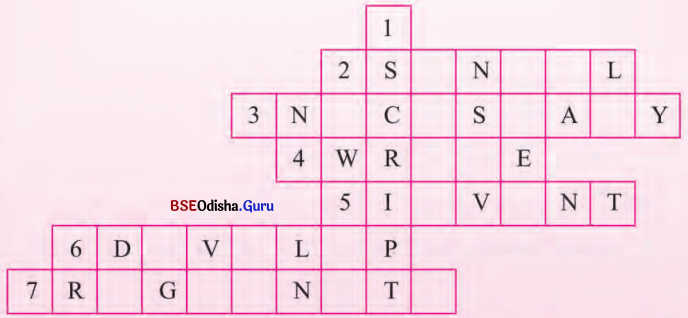
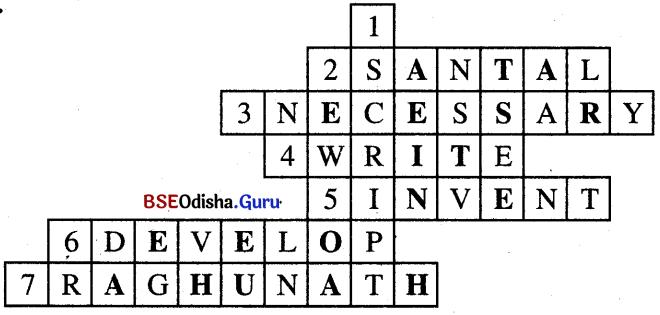
□ Do you know who made the Santili 01 Chiki script ? Think and say what made him do it. Let us read a lesson to know more about it.
(ତୁମେ ଜାଣକି କିଏ ‘ସାନ୍ତାଳି ଓଲ୍‌ ଚିକ୍ ଲିପି ତିଆରି କରିଥିଲେ ? ଭାବ ଏବଂ କୁହ କାହିଁକି ସେ ଏହା କରିଥିଲେ । ଆସ ଏହି ବିଷୟରେ ଅଧ୍ବକ ଜାଣିବାକୁ ଆମେ ଗୋଟିଏ ଗପ ପଢ଼ିବା ।)

Do you know who made the Santili 01 Chiki script

II. While-Reading

Text

SGP-1
Read paragraph – 1 silently and answer the questions that follow.
( ଅନୁଚ୍ଛେଦ– ୧ କୁ ନୀରବରେ ପଢ଼ ଏବଂ ପରବର୍ତୀ ପ୍ରଶ୍ନଗୁଡ଼ିକର ଉତ୍ତର ଦିଅ ।)
1. On Makar holidays Raghunath would come to his village Dandbose, a few kilometres away from Rairangpur town in the district of Mayurbhanj. He was then working at Baripada. In those days he was the only educated man in his area. When he came home, Santals from nearby villages would come to him with their problems. Once an old man came to him. He carefully brought out a letter which he had tightly tied to one end of – his cloth and asked, “Raghu, can you read this letter for me ? It must be from my cousin who lives at Midnapur of West Bengal”.

ଓଡ଼ିଆ ଅନୁବାଦ :
୧. ମକର ଛୁଟିରେ ରଘୁନାଥ ତାଙ୍କ ଗ୍ରାମ ଦାଣ୍ଡବୋସେକୁ ଆସିଥା’ନ୍ତି, ଯାହା ମୟୂରଭଞ୍ଜ ଜିଲ୍ଲାରେ ରାଇରଙ୍ଗପୁର ସହରଠାରୁ ଅଳ୍ପ କେତେ କିଲୋମିଟର ଦୂରରେ ଅବସ୍ଥିତ । ସେତେବେଳେ ସେ ବାରିପଦାରେ କାମ କରୁଥା’ନ୍ତି । ସେ କାଳରେ ସେ ତାଙ୍କ ଅଞ୍ଚଳରେ ଏକମାତ୍ର ଶିକ୍ଷିତ ଲୋକ ଥିଲେ । ଯେତେବେଳେ ସେ ଗାଁକୁ ଆସୁଥିଲେ, ନିକଟସ୍ଥ ଗାଁମାନଙ୍କରୁ ସାନ୍ତାଳମାନେ ତାଙ୍କ ନିକଟକୁ ସେମାନଙ୍କର ସମସ୍ୟାକୁ ନେଇ ଆସୁଥିଲେ । ଥରେ ଜଣେ ବୁଢ଼ା ଲୋକ ତାଙ୍କ ନିକଟକୁ ଆସିଲେ । ସେ ଯତ୍ନ ସହକାରେ ବାହାରକଲେ ଗୋଟିଏ ଚିଠି ଯାହାକୁ ସେ ଶକ୍ତକରି ତାଙ୍କ ଲୁଗାର ଗୋଟିଏ ମୁଣ୍ଡରେ ବାନ୍ଧିଥିଲେ ଏବଂ ପଚାରିଲେ, ‘ରଘୁ, ତୁମେ ଏହି ଚିଠିଟି ମୋ ପାଇଁ ପଢ଼ିପାରିବ କି ? ଏହା ନିଶ୍ଚିତ ମୋ’ର ସମ୍ପର୍କୀୟ ଭାଇ ପାଖରୁ ଆସିଥ୍‌ ଯିଏକି ପଶ୍ଚିମବଙ୍ଗର ମେଦିନାପୁରରେ ରହୁଛି ।)

BSE Odisha 6th Class English Solutions Lesson 8 Raghunath Murmu

Comprehension Questions

Question 1.
What is this lesson about?
(ଏହି ଗପଟି କାହା ବିଷୟରେ ଲେଖାଯାଇଛି ?)
Answer:
This lesson is about Raghunath Murmu.

Question 2.
What is the name of his village ?
(ତାଙ୍କ ଗ୍ରାମର ନାମ କ’ଣ ?)
Answer:
The name of his village is Dandbose.

Question 3.
When would he come there?
(କେବେ ସେ ସେଠାକୁ ଆସନ୍ତି ?)
Answer:
He would come there on the Makar holidays.

Question 4.
How far is it from Rairangpur town?
(ଏହା ରାଇରଙ୍ଗପୁର ସହରଠାରୁ କେତେ ଦୂର ?)
Answer:
It is a few kilometers away from Rairangpur town.

Question 5.
Where is Rairangpur ?
(ରାଇରଙ୍ଗପୁର କେଉଁଠାରେ ?)
Answer:
Rairangpur is in the district of Mayurbhanj.

Question 6.
Where was he working then ?
(ସେତେବେଳେ ସେ କେଉଁଠାରେ କାମ କରୁଥିଲେ ?)
Answer:
Then he was working at Baripada.

Question 7.
Why was he popular in his area ?
(ସେ ତାଙ୍କ ଅଞ୍ଚଳରେ କାହିଁକି ଜନପ୍ରିୟ ଥିଲେ ?)
Answer:
In those days, he was the only educated man in his area. So he was popular in his area.

Question 8.
Why did Santals come to him?
(କାହିଁକି ସାନ୍ତାଳମାନେ ତାଙ୍କ ନିକଟକୁ ଆସୁଥିଲେ ?)
Answer:
Santals came to him to solve their problems.

Question 9.
Why did the old man come to him ?
(କାହିଁକି ବୁଢ଼ାଲୋକଟି ତାଙ୍କ ନିକଟକୁ ଆସିଥିଲା ?)
Answer:
The old man came to him with a letter to read to him.

Question 10.
How did he carry the letter?
(ସେ କିପରି ଚିଠିଟିକୁ ଆଣିଥିଲା ?)
Answer:
He carried the letter carefully by tieing it tightly to one end of his cloth.

Question 11.
Who was the letter from?
(କାହାଠାରୁ ଚିଠିଟି ଆସିଥିଲା ?)
Answer:
The letter was from the old man’s cousin who lives in Midnapur West Bengal.

BSE Odisha 6th Class English Solutions Lesson 8 Raghunath Murmu

Session – 2

SGP-2
Read paragraphs 2-3 silently and answer the questions that follow.
(ଅନୁଚ୍ଛେଦ ୨ – ୩ କୁ ନୀରବରେ ପଢ଼ ଏବଂ ପରବର୍ତୀ ପ୍ରଶ୍ନଗୁଡ଼ିକର ଉତ୍ତର ଦିଅ ।)
2. Raghunath opened the letter and found that the letter was written in Bengali. In those days he did not know Bengali well. He could only read a few words. So he replied sadly, “Sorry Uncle, I can’t read it. It is written in Bengali”.
3. “But when my cousin came here last time, I told him to write in Santah”, the old man said. “Yes Uncle, he has written in Santah,” Raghu replied, “but he has written it in Bengali script”. “Why didn’t he write it in Santali script ?” asked the old man. “Because we don’t have a script of our own, uncle” replied Raghunath. This surprised the old man. It also made Raghunath unhappy and sad. About ten years later he invented a script for Santah. The script is known as Ol Chiki.

ଓଡ଼ିଆ ଅନୁବାଦ :
୨. ରଘୁନାଥ ଚିଠିଟିକୁ ଖୋଲିଲେ ଏବଂ ଦେଖିବାକୁ ପାଇଲେ ଯେ ଚିଠିଟି ବଙ୍ଗଳା ଭାଷାରେ ଲେଖାଯାଇଛି । ସେ କାଳରେ ସେ ବଙ୍ଗଳା ଭଲଭାବରେ ଜାଣିନଥିଲେ । ସେ ଅଳ୍ପ କେତୋଟି ଶବ୍ଦ ମାତ୍ର ପଢ଼ିପାରିଥିଲେ । ତେଣୁ ସେ ଦୁଃଖରେ ଉତ୍ତର ଦେଲେ, ‘ଦୁଃଖିତ ଦାଦା/କକା, ମୁଁ ଏହାକୁ ପଢ଼ିପାରିବି ନାହିଁ ।’’ ଏହା ବଙ୍ଗଳାରେ ଲେଖାଯାଇଛି ।’’
୩. ‘‘କିନ୍ତୁ ଗତଥର ଯେତେବେଳେ ମୋ ସମ୍ବର୍କୀୟ ଭାଇ ଆସିଥିଲେ, ମୁଁ ତାଙ୍କୁ କହିଥିଲି ସାନ୍ତାଳୀ ଭାଷାରେ ଲେଖିବାକୁ’’, ବୁଢ଼ାଟି କହିଲା । ‘ହଁ କକା/ଦାଦା ସେ ସାନ୍ତାଳୀରେ ଲେଖିଛନ୍ତି,’’ ରଘୁନାଥ ଉତ୍ତର ଦେଲେ, ‘କିନ୍ତୁ ସେ ଏହାକୁ ବଙ୍ଗଳା ଲିପି ବା ଅକ୍ଷରରେ ଲେଖିଛନ୍ତି ।’ବୁଢ଼ାଲୋକଟି ପଚାରିଲା, ‘‘ସେ ସାନ୍ତାଳୀ ଲିପି ବା ଅକ୍ଷରରେ ଲେଖିଲେ ନାହିଁ କାହିଁକି ?’’ ‘‘କାରଣ ଆମ ନିଜର ଏକ ଲିପି | ଅକ୍ଷର ନାହିଁ, କକା | ଦାଦା’’ ରଘୁନାଥ ଉତ୍ତର ଦେଲେ, ଏହା ବୁଢ଼ାଲୋକଟିକୁ ଆଶ୍ଚର୍ଯ୍ୟ କରିଦେଲା । ଏହା ମଧ୍ୟ ରଘୁନାଥଙ୍କୁ ଅସୁଖୀ ଓ ଦୁଃଖିତ କରିଦେଲା । ପ୍ରାୟ ଦଶ ବର୍ଷପରେ ସେ ସାନ୍ତାଳମାନଙ୍କ ପାଇଁ ଏକ ଲିପି ବା ଅକ୍ଷର ଉଦ୍ଭାବନ କଲେ । ଏହି ଲିପି ‘ଓଲ୍ ଚିକି’’ ରୂପେ ପରିଚିତ | ଜଣାଶୁଣା ।

Comprehension Questions

Question 1.
Could Raghunath read the letter? Why?
(ରଘୁନାଥ ଚିଠିଟି ପଢ଼ିପାରିଲେ କି ? କାହିଁକି ?)
Answer:
No, Raghunath could not read the letter. Because the letter was written in Bengali and he did not know Bengali well then.

Question 2.
Which language was used in the letter?
(କେଉଁ ଭାଷା ଚିଠିରେ ବ୍ୟବହାର ହୋଇଥିଲା ?)
Answer:
Santali language was used in the letter.

Question 3.
Why did the cousin write in Bengali script ?
(କାହିଁକି ତାଙ୍କ ସମ୍ପର୍କୀୟ ଭାଇ ବଙ୍ଗଳା ଅକ୍ଷରରେ ଚିଠିଟି ଲେଖିଥିଲେ ?)
Answer:
The cousin wrote in Bengali script as/because they did not have Santali script of their own then.

Question 4.
What surprised the old man?
(ବୁଢ଼ାଟିକୁ କ’ଣ ଆଶ୍ଚର୍ଯ୍ୟ କରିଦେଲା ?)
Answer:
When Raghunath replied that they did not have a script of their own, -it surprised the old man.

Question 5.
What made Raghunath unhappy?
(ରଘୁନାଥଙ୍କୁ କ’ଣ ବିଷଣ୍ଣ|ଅସୁଖୀ କରିଦେଲା ?)
Answer:
The old man’s surprise made Raghunath unhappy and sad.

Question 6.
Who invented the Santali Script ?
(କିଏ ସାନ୍ତାଳୀ ଲିପି ଉଦ୍ଭାବନ କରିଥିଲେ ?)
Answer:
Raghunath invented the Santali Script.

Question 7.
What is the Santali Script called ?
(ସାନ୍ତାଳୀ ଲିପିକୁ କ’ଣ କୁହାଯାଏ ?)
Answer:
The Santali Script is called ‘01 Chiki”.

Question 8.
Do you think that it would benefit the Santals and others? How?
(ତୁମେ ଭାବୁଛ କି ଏହା ସାନ୍ତାଳମାନଙ୍କର ଓ ଅନ୍ୟମାନଙ୍କର ସୁବିଧା କରିବ ? କିପରି ?)
Answer:
Yes, I think that it would surely benefit the Santals and others a lot (9go). Because the Santals could write in their own language in their script and – the other people could know more about Santali tradition and culture.

BSE Odisha 6th Class English Solutions Lesson 8 Raghunath Murmu

SGP-3
Read paragraph – 4 silently and answer the questions that follow.
(ଅନୁଚ୍ଛେଦ – ୪ କୁ ନୀରବରେ ପଢ଼ ଏବଂ ପରବର୍ତ୍ତୀ ପ୍ରଶ୍ନଗୁଡ଼ିକର ଉତ୍ତର ଦିଅ ।)
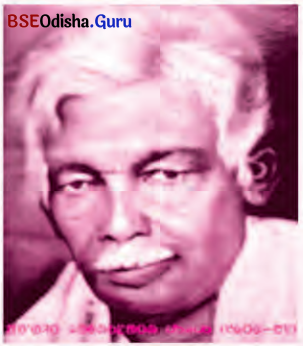
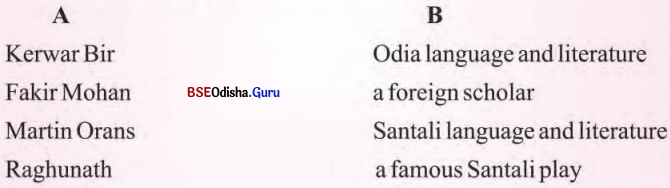
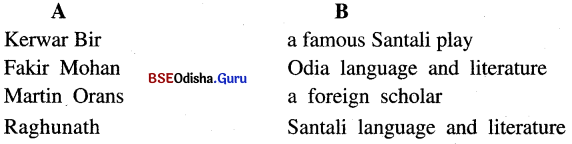
4. Raghunath Murmu was also a great writer. He had written many plays, novels, and poems in Santali. His most-important play is “Kherwar Bir”. Martin Orans, a foreign scholar and writer, called this the Santal Mahabharata. Raghunath was awarded by the Odisha Sahitya Academy for his contribution to the Santali language and literature. The Government of Odisha has named the Medical College at Banpada after his name. What Fakir Mohan Senapati is to Odia language and literature, Raghunath Murmu is to Santali language and literature.

ଓଡ଼ିଆ ଅନୁବାଦ :
୪. ରଘୁନାଥ ମୁମୁ ମଧ୍ୟ ଜଣେ ବିଶିଷ୍ଟ ଲେଖକ ଥିଲେ । ସେ ସାନ୍ତାଳୀ ଭାଷାରେ ଅନେକ ନାଟକ, ଉପନ୍ୟାସ ଓ କବିତାମାନ ଲେଖିଥିଲେ । ତାଙ୍କର ସବୁଠାରୁ ଅଧ‌ିକ ଗୁରୁତ୍ଵପୂଣ୍ଣ ନାଟକ ହେଉଛି, ‘‘ଖେରୱାର୍ ବିର୍’’ । ମାର୍ଟିନ୍ ଓରାନ୍‌ସ, ଜଣେ ବିଦେଶୀ ପଣ୍ଡିତ ଓ ଲେଖକ, ଏହାକୁ ସାନ୍ତାଳ ମହାଭାରତ ବୋଲି କହିଥିଲେ । ସାନ୍ତାଳୀ ଭାଷା ଓ ସାହିତ୍ୟ ପ୍ରତି ତାଙ୍କର ଅବଦାନ ଯୋଗୁଁ ରଘୁନାଥ ଓଡ଼ିଶା ସାହିତ୍ୟ ଏକାଡ଼େମୀଦ୍ୱାରା ପୁରସ୍କୃତ ହୋଇଥିଲେ । ଓଡ଼ିଶା ସରକାର ତାଙ୍କ ନାମାନୁ ସାରେ ବାରି ପଦାରେ ଥ‌ିବା ମେଡ଼ିକାଲ କଲେଜକୁ ନାମକରଣ କରିଛନ୍ତି । ଫକୀର ମୋହନ ସେନାପତି ଓଡ଼ିଆ ଭାଷା ଓ ସାହିତ୍ୟ ପାଇଁ ଯାହା କରିଛନ୍ତି, ରଘୁନାଥ ମୁର୍ମୁ ମଧ୍ୟ ସାନ୍ତାଳୀ ଭାଷା ଓ ସାହିତ୍ୟ ପାଇଁ ସେହି କାମ କରିଛନ୍ତି ।

Comprehension Questions

Question 1.
Raghunath Murmu was the father of Santali Script. What else made him so famous?
(ରଘୁନାଥ ମୁର୍ମୁ ସାନ୍ତାଳୀ ଲିପିର ଜନକ । ଆଉ କ’ଣ ତାଙ୍କୁ ଏତେ ପ୍ରସିଦ୍ଧ କରିଥିଲା ?)
Answer:
Raghunath Murmu was the father of Santali Script. Again, (g9£l) he was also a great writer. So all his writings made him so famous.

Question 2.
What did he write in Santali?
(ସେ ସାନ୍ତାଳୀ ଭାଷାରେ କ’ଣ ଲେଖୁଥିଲେ ?)
Answer:
He had written many plays, novels and poems in Santali language.

Question 3.
Which book is Raghunath’s most important play?
(କେଉଁ ବହିଟି ରଘୁନାଥଙ୍କର ସବୁଠାରୁ ଅଧିକ ଗୁରୁତ୍ବପୂର୍ଣ୍ଣ ନାଟକ ଅଟେ ?)
Answer:
Raghunath’s most important play is “Kherwar Bir”.

Question 4.
Who was Martin Orans?
(ମାର୍ଟିନ୍ ଓରାନ୍ସ କିଏ ଥିଲେ ?)
Answer:
Martin Orans was a foreign scholar and writer.

Question 5.
Was he in high praise of Raghunath’s writings?
(ସେ ରଘୁନାଥଙ୍କ ଲେଖାଗୁଡ଼ିକର ଉଚ୍ଚ ପ୍ରଶଂସା କରିଥିଲେ କି ?)
Answer:
Yes, he was in high praise of Raghunath’s writings.

Question 6.
Which book is called the Santal Mahabharat?
(କେଉଁ ବହିକୁ ସାନ୍ତାଳ ମହାଭାରତ କୁହାଯାଏ ?)
Answer:
The play ‘Kherwar Bir’ written by Raghunath Murmu is called the Santal Mahabharata.

Question 7.
What did the Odisha Sahitya Academy award him for?
(କ’ଣ ପାଇଁ ଓଡ଼ିଶା ସାହିତ୍ୟ ଏକାଡ଼େମୀ ତାଙ୍କୁ ପୁରସ୍କୃତ କରିଥିଲା ?)
Answer:
The Odisha Sahitya Academy awarded Raghunath for his contribution to the Santali language and literature.

Question 8.
What has the Government of Odisha done in his honor?
(ତାଙ୍କର ସମ୍ମାନ ପାଇଁ ଓଡ଼ିଶା ସରକାର କ’ଣ କରିଛନ୍ତି ?)
Answer:
‘In his honor, the Government of Odisha has named the Medical College at Baripada after his name.

Question 9.
Who is Raghunath Murmu compared to?
(କାହା ସହିତ ରଘୁନାଥ ମୁର୍ମୁଙ୍କୁ ତୁଳନା କରାଯାଏ ?)
Answer:
Raghunath Murmu is compared to Fakir Mohan Senapati.

Question 10.
How are they equal?
(ସେମାନେ କିପରି ସମାନ ?)
Answer:
What Fakir Mohan Senapati is to Odia language and literature, Raghunath Murmu is to Santali language and literature.

Question 11.
Do you like Raghunath Murmu ? Why?
(ତୁମେ ରଘୁନାଥ ମୁର୍ମୁଙ୍କୁ ପସନ୍ଦ କରକି ? କାହିଁକି ?)
Answer:
Yes, we like Raghunath Murmu. Because he invented Santali Script and helped the Santali people lot. Again, as a great writer, he wrote many plays, novels, and poems in Santali.

BSE Odisha 6th Class English Solutions Lesson 8 Raghunath Murmu

III. Post-Reading

1. Visual Memory Development Technique (VMDT):
(ଦୃଶ୍ୟ ସ୍ମୃତି ଉନ୍ନୟନ କୌଶଳ (VMDT))

Whole Text (ସମସ୍ତ ବିଷୟବସ୍ତୁ):
Raghunath – his village Dandbose – the only educated man in his area – the letter was written in Bengali – Santali script – 01 Child – great writer

Last Paragraph (ଶେଷ ଅନୁଚ୍ଛେଦ):
Kherwar Bir – Odisha Sahitya Academy – Fakir Mohan Senapati

2. Comprehension Activities

(a)MCQs- Choose the right alternatives and complete the sentences :
(ସଠିକ୍ ବିକଳ୍ପଟି ବାଛ ଏବଂ ବାକ୍ୟଗୁଡ଼ିକୁ ସମ୍ପୂର୍ଣ୍ଣ କର ।)

Question 1.
Raghunath would come to his village Dandbose _________________?
(a) every Sunday
(b) on Maker holidays
(c) every holiday
(d) everyday
Answer:
(b) on Maker holidays

Question 2.
Raghunath was the only educated man in ________________?
(a) his area
(b) Odisha
(c) West Bengal
(d) Bihar
Answer:
(a) his area

Question 3.
The ___________ asked, “Why didn’t he write in Santali script?“
(a) old man’s cousin
(b) students in Badamatolia School
(c) old man
(d) a person who couldn’t read the letter
Answer:
(c) old man

Question 4.
years after meeting the old man, Raghunath invented 01 Child?
(a) five
(b) seven
(c) ten
(d) twenty
Answer:
(c) ten

Question 5.
Raghunath Murmu was awarded by the Odisha Sahitya Academy for his contribution to ___________?
(a) Santali language and literature.
(b) Santali novels
(c) Santali pomes
(d) Santali plays.
Answer:
(a) Santali language and literature.

(b) Match items under A with items under B.

Match items under A with items under B.

Answer:

Match items under A with items under B Answer

BSE Odisha 6th Class English Solutions Lesson 8 Raghunath Murmu

Session – 4

3. Listening

Your teacher will read the following paragraph. There are some blanks. Fill them in while listening to your teacher. (Question with Answer)
(ତୁମ ଶିକ୍ଷକ ନିମ୍ନଲିଖିତ ଅନୁଚ୍ଛେଦଟି ପଢ଼ିବେ । ସେଥ‌ିରେ କେତେକ ଶୂନ୍ୟସ୍ଥାନ ଅଛି । ଶିକ୍ଷକଙ୍କୁ ଶୁଣିବା ସମୟରେ ସେହି ଶୂନ୍ୟସ୍ଥାନଗୁଡ଼ିକୁ ପୂରଣ କର ।)
On Makar holidays Raghunath would come to his village Dandbose, a few kilometers away from Rairangpur town in the district of Mayurbhanj. He was then working at Baripada. In those days he was the only educated man in his area. When he came home, Santals from nearby villages would come to him with their problems. Once an old man came to him. He carefully brought out a letter which he had tightly tied to one end of his cloth and asked, “Raghu, can you read this letter for me ? It must be from my cousin who lives at Midnapur of West Bengal”.

Session – 5

4. Speaking

(a) Chain-drill ( ଶୃଙ୍ଖଳା – ଅଭ୍ୟାସ ): “The Santali script is known as Ol Chiki”.
(b) Dialogues (ସଂଳାପ) :
Old man     : Good morning, Raghu!
Raghunath : Good morning, uncle! Is there any problem?
Old man     : Yes Raghu. Here is a letter. Can you read it for me?
Raghunath : With pleasure!

Session – 6

5. Vocabulary

(a) Solve the following word puzzle. Use the clues given for each word.
(ନିମ୍ନଲିଖତ ଶବ୍ଦ-ପ୍ରହେଳିକାକୁ ସମାଧାନ କର । ନିମ୍ନରେ ଦିଆଯାଇଥ‌ିବା ପ୍ରତ୍ୟେକ ସୂଚନାଗୁଡ଼ିକୁ ବ୍ୟବହାର କର ।)

Solve the following word-puzzle. Use the clues given for each word

Clues :
1. A set of letters (e. g. a, b, c…) used for writing a language
2. The tribal people mostly live in Mayurbhanj.
3. A word made from ‘need’.
4. We do it with our pen on paper.
5. If someone does it, he/she is the first person to think and make it.
6. Change and make something better.
7. The person who invented the Santali script.

Answer:

Solve the following word-puzzle. Use the clues given for each word Answer

BSE Odisha 6th Class English Solutions Lesson 8 Raghunath Murmu

6. Usage

There are eight sentences given below. Find the word in each which can take ‘-ly’ and then add My* to it. Rewrite the sentences correctly.
ନିମ୍ନରେ ଆଠଟି ବାକ୍ୟ ଦିଆଯାଇଛି । ପ୍ରତ୍ୟେକରେ ଶବ୍ଦଟିକୁ ଖୋଜ ଯେଉଁଥ‌ିରେ ‘−ly’ ଯୋଗ କରାଯାଇ ପାରିବ ଏବଂ ତା’ପରେ ସେଥ‌ିରେ ‘–Jy’ ଯୋଗ କର । ବାକ୍ୟଟିକୁ ସଠିକ୍ ଭାବରେ ଆଉଥରେ ଲେଖ ।

Question (i)
The old man brought out a letter careful.
Answer:
The old man brought out a letter carefully.

Question (ii)
He had tied the letter tight to one end of his cloth.
Answer:
He had tied the letter tightly to one end of his cloth.

Question (iii)
Raghunath replied sad.
Answer:
Raghunath replied sadly.

Question (iv)
Santals main live in Bihar.
Answer:
Santals mainly live in Bihar.

Question (v)
The old man went home happy.
Answer:
The old man went home happily.

Question (vi)
The boy came inside the class silent.
Answer:
The boy came inside the class silently.

Question (vii)
Ramesh works very slow.
Answer:
Ramesh works very slowly.

Question (viii)
He quick got into the room.
Answer:
He quickly got into the room.

Session – 7

7. Writing

Question (i)
Where was Raghunath Murmu from?
(କେଉଁଠାରୁ ରଘୁନାଥ ମୁର୍ମୁ ଆସିଥିଲେ ?)
Answer:
Raghunath Murmu was from Dandbose. a village in the Mayurbhani district of Odisha.

Question (ii)
Why would Santals from nearby villages come to Raghunath?
(କାହିଁକି ନିକଟସ୍ଥ ଗ୍ରାମମାନଙ୍କରୁ ସାନ୍ତାଳମାନେ ରଘୁନାଥଙ୍କ ପାଖକୁ ଆସନ୍ତି ?)
Answer:
Santals from nearby villges would come to Raghunath to solve

Question (iii)
What is the name of the Santali script?
(ସାନ୍ତାଳି ଲିପିର ନାମ କ’ଣ ?)
Answer:
The name of the Santali script is Ol Chiki.

Question (iv)
What did Martin Orans call “Kherwar Bir”?
(ମାର୍ଟିନ୍ ଓରାନ୍ସ ‘ଖେରୱାର୍‌ ବୀର୍’’କୁ କ’ଣ ବୋଲି କହିଥିଲେ ?)
Answer:
Martin Orans called “Kherwar Bir” the Santal Mahabharata.

Question (v)
Why was he awarded by Odisha Sahitya Academy?
(କାହିଁକି ସେ ଓଡ଼ିଶା ସାହିତ୍ୟ ଏକାଡ଼େମୀ ଦ୍ଵାରା ପୁରସ୍କୃତ ହୋଇଥିଲେ ?)
Answer:
Raghunath was awarded by the Odisha Sahitya Academy for his contribution to the Santali language and literature.

BSE Odisha 6th Class English Solutions Lesson 8 Raghunath Murmu

Session – 8

(b) Fill in the gaps in the paragraph given below with information under the stone idol picture of Raghunath Murmu.
(ରଘୁନାଥ ମୁର୍ମୁଙ୍କ ପ୍ରସ୍ତର ପ୍ରତିମୂର୍ତ୍ତି ତଳେ ଥ‌ିବା ସୂଚନାକୁ ନେଇ ନିମ୍ନରେ ଦିଆଯାଇଥବା ଅନଚ୍ଛେଦର ଶୂନ୍ୟସ୍ଥାନଗୁଡିକ ପୁରଣ କର ।)

Murmu’s stone idol (someone who is admired and respected) in Odisha, Bhubaneswar
Name – Raghunath Murmu
Born on     – 5 May 1905
Born at      – Dandbose in the district of Mayurbhanj
Occupation – ideologist, playwright, and writer
Invented    – Santali script
Died          – 1 February 1981
Age at the time of death – 81

Now use the facts and complete the paragraph on Raghunath Murmu.
(ଏବେ ତଥ୍ୟଗୁଡ଼ିକୁ ବ୍ୟବହାର କର ଏବଂ ରଘୁନାଥ ମୁର୍ମୁଙ୍କ ଉପରେ ଥ‌ିବା ଅନୁଚ୍ଛେଦକୁ ସଂପୂର୍ଣ୍ଣ କର ।)
The stone idol stands for _____________ He was born on ____________ He was born at _________. He was an ideologist, __________, and ________. He invented __________. He died on ___________ He was __________ years old at the time of his death. He is one of the most memorable people in India.

Answer:
Now use the facts and complete the paragraph on Raghunath Murmu. The stone idol stands for Raghunath Murmu. He was born on 5 May 1905. He was born at Dandbose in the district of Mayurbhanj. He was an ideologist, playwright, and writer. He invented the Santali script. He died on 1 February 1981. He was 81 years old at the time of his death. He is one of the most memorable people in India.

8. Mental Talk

Mentally repeat the following sentence.
“What Fakir Mohan is to Odia language and literature, Raghunath is to Santali language and literature.”

BSE Odisha 6th Class English Solutions Lesson 8 Raghunath Murmu

9. Let Us Think

How are scripts and language related?

BSE Odisha 6th Class English Part – II

Birsa Munda Question Answer Class 7 English Chapter 4 BSE Odisha

Odisha State Board BSE Odisha 7th Class English Solutions Lesson 4 Birsa Munda Textbook Exercise Questions and Answers.

Class 7th English Chapter 4 Birsa Munda Question Answers BSE Odisha

Birsa Munda Class 7 Questions and Answers

Session – 1 (ଶବ୍ଦାବଳୀ)

I. Pre-Reading (ପୂର୍ବ ପ୍ରସ୍ତୁତି)

Do you know some names of great men who fought against the Britishers to make our country free from their rule? Can you tell me
the names of some tribal (Adibasi) leaders who died in the freedom fight for our motherland?
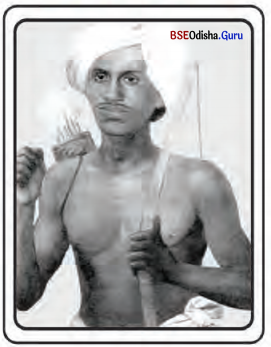
Let's read about a great tribal leader who opposed superstitions, and also fought against the Britishers for five years till his death in jail.(ତୁମେ କେତେକ ମହାନ୍ ବ୍ୟକ୍ତିଙ୍କ ନାମ ଜାଣିଛ କି ଯେଉଁମାନେ କି ବ୍ରିଟିଶ୍ମାନଙ୍କଠାରୁ ଆମ ଦେଶକୁ ମୁକ୍ତ କରିବା ନିମିତ୍ତ ଲଢ଼େଇ କରିଥିଲେ । ଆମ ଦେଶମାତୃକାର ମୁକ୍ତି ସଂଗ୍ରାମରେ ଜୀବନ ଦେଇଥିବା କେତେକ ଆଦିବାସୀ ନେତାଙ୍କର ନାମ କହିପାରିବ କି ?)

Let’s read about a great tribal leader who opposed superstitions, and also fought against the Britishers for five years till his death in jail.
(ଆସନ୍ତୁ ଜାଣିବା ଅନ୍ଧବିଶ୍ୱାସକୁ ବିରୋଧ କରିଥିବା ଜଣେ ମହାନ ଆଦିବାସୀ ନେତାଙ୍କ ବିଷୟରେ, ଏବଂ ଏହା ମଧ୍ୟ ସେ ଜେଲରେ ମୃତ୍ୟୁ ପର୍ୟ୍ୟନ୍ତ 5 ବର୍ଷ ଧରି ଇଂରେଜଙ୍କ ବିରୋଧରେ ଲଢ଼ିଥିଲେ।)

II. While Reading (ପଠନକାଳୀନ)

Text(ପାଠ୍ୟବସ୍ତୁ)

  • SGP-1 (Sense Group Paragraph-1)
  • Read para – 1 silently and answer the questions that follow.
    (ଅନୁଚ୍ଛେଦ ୧କୁ ନୀରବରେ ପାଠ କର ଏବଂ ନିମ୍ନ ପ୍ରଶ୍ନଗୁଡ଼ିକର ଉତ୍ତର ଦିଅ ।)

1. Birsa Munda was bom in a poor family in Bihar (now in Jharkhand) in 1875. His father Sugana Munda worked as a labourer. For a short time Birsa studied in a school at Katanga. But he could not continue his study because of poverty. From the very young age he worked as a cowboy of a landlord. One day the landlord saw Birsa reading a book leaving the cows to graze on paddy field. So he removed Birsa from the job.

ଓଡ଼ିଆ ଅନୁବାଦ :
୧. ବିର୍ସା ମୁଣ୍ଡା ବିହାର (ବର୍ତ୍ତମାନର ଝାଡ଼ଖଣ୍ଡ )ର ଏକ ଗରିବ ପରିବାରରେ ୧୮୭୫ ମସିହାରେ ଜନ୍ମଗ୍ରହଣ କରିଥିଲେ । ତାଙ୍କ ପିତା ସୁଗନା ମୁଣ୍ଡା ଜଣେ ଶ୍ରମିକ ରୂପେ କାର୍ଯ୍ୟ କରୁଥିଲେ । ଅଳ୍ପଦିନ ପାଇଁ ବିର୍ସା କଟାଙ୍ଗର ଏକ ବିଦ୍ୟାଳୟରେ ଅଧ୍ୟୟନ କରିଥିଲେ । ଦାରିଦ୍ର୍ୟବଶତଃ ସେ ଅଧ୍ୟୟନ ଜାରି ରଖିପାରି ନଥିଲେ । ପିଲାଟି ଦିନରୁ ସେ ଜଣେ ଜମିଦାରଙ୍କର ଗୋରୁ ଚରାଳି ପିଲା ରୂପେ କାର୍ଯ୍ୟ କରୁଥିଲେ । ଦିନେ ଜମିଦାର ଦେଖ‌ିଲେ ଯେ ବିର୍ସା ଗୋରୁମାନଙ୍କୁ ଧାନକ୍ଷେତରେ ଚରିବାକୁ ଛାଡ଼ିଦେଇ ଗୋଟିଏ ବହି ପଢ଼ୁଛି । ତେଣୁ ସେ ବିର୍ସାଙ୍କୁ ଚାକିରିରୁ ବାହାର କରିଦେଲେ ।

Notes And Glossary: (ଶବ୍ଦାର୍ଥ) :
labourer (ଲେବରର) – ଶ୍ରମିକ
leave (ଲିଭ୍) – ଛାଡ଼ିବା
continue (କଣ୍ଟିନ୍ୟୁ ) – ଚାଲୁ ରଖୁ
cowboy ( କାଓବଏ ) – ଗାଈଜଗାଳି
because of (ବିକଜ୍ ଅଫ୍)– ହେତୁ, କାରଣ ଯୋଗୁଁ
poverty (ପଭର୍ଟି) – ଦାରିଦ୍ର୍ୟ
landlord (ଲ୍ୟାଣ୍ଡଲର୍ଡ) – ଜମିଦାର
removed (ରିମୁଭ୍) – ବାହାର କରିଦେଲେ

BSE Odisha 7th Class English Solutions Lesson 4 Birsa Munda

Comprehension Questions (ବୋଧପରିମାପକ ପ୍ରଶ୍ନବଳୀ) :

Question 1.
What is this para about?
(ଏହି ପାରାଟି କେଉଁ ବିଷୟରେ ଲିଖ୍ ?)
Answer:
This para is about Birsa’s poor life in his childhood days. It also tells about his birth, and birth place.

Question 2.
Where was Birsa born? When?
(ବିର୍ସା କେଉଁଠାରେ ଜନ୍ମ ହୋଇଥିଲେ ? କେବେ ?)
Answer:
Birsa was bom in 1875 in Bihar (now in Jharkhand).

Question 3.
Who was his father?
(ତାଙ୍କର ପିତା କିଏ ଥିଲେ ?)
Answer:
Sugana Munda was his father.

Question 4.
What was his father?
(ତାଙ୍କର ପିତା କ’ଣ ଥିଲେ ?)
Answer:
His father was a labourer.

Question 5.
Where did Birsa begin his study?
(ବିର୍ସା କେଉଁଠି ତାଙ୍କର ଶିକ୍ଷା ଆରମ୍ଭ କରିଥିଲେ ?)
Answer:
Birsa began his study in a school at Katanga.

Question 6.
Did he continue his study ? Why?
(ସେ ତାଙ୍କର ଅଧ୍ୟୟନ ଚାଲୁ ରଞ୍ଝାପାରିଥିଲେ କି ? କାହିଁକି ?)
Answer:
He could not continue his study because of his poverty(ଦାରିଦ୍ର୍ୟ).

Question 7.
What work did Birsa do at a young age?
(ପିଲାଟି ବୟସରୁ ବିର୍ସା କେଉଁ କାର୍ଯ୍ୟ କରୁଥିଲେ ?)
Answer:
Birsa worked as a cowboy of a landlord at a young age.

Question 8.
Did Birsa like the work?
(ବିର୍ସା କ’ଣ ସେ କାର୍ଯ୍ୟକୁ ପସନ୍ଦ କରୁଥିଲେ କି ?)
Answer:
No, Birsa did not like the job.

Question 9.
Who was his master ? Was he a good man ? How do you know this ? (ତାଙ୍କର ମୁନିବ କିଏ ଥିଲେ ? ସେ କ’ଣ ଭଦ୍ରଲୋକ ? ତୁମେ କିପରି ଜାଣୁଛ ?)
Answer:
His master was a landlord of the place. He was not at all a good man. His master removed him from his job for a little mistake.

Question 10.
Why did the master get angry with Birsa?
((ମୁନିବ ବିର୍ସା ଉପରେ ରାଗିଗଲେ କାହିଁକି ?)
Answer:
One day his master saw Birsa reading a book leaving the cows to graze on paddy field. Therefore he got angry with him.

BSE Odisha 7th Class English Solutions Lesson 4 Birsa Munda

Question 11.
Why did Birsa lose his job?
(ବିର୍ସା କାହିଁକି ତାଙ୍କର ଚାକିରି ହରାଇଲେ ?)
Answer:
Birsa lost his job because he did not do his work properly. The landlord saw him reading a book leaving cows to graze on paddy field.

Question 12.
Who does ‘he’ in the last line refer to?
(ଶେଷ ଧାଡିରେ ‘ସେ’ କାହାକୁ ସୂଚାଏ ? )
Answer:
In the last line ‘he’ refers to the landlord.

Question 13.
Which quality of Birsa do you like most?
(ବିର୍ସାଙ୍କ କେଉଁ ଗୁଣ ତୁମକୁ ସବୁଠାରୁ ବେଶୀ ଭଲ ଲାଗେ ?)
Answer:
We like Birsa’s interest for reading books.

Question 14.
Do you think Birsa will request the landlord to continue his job?
(ତୁମେ କ’ଣ ଭାବୁଛ ବିର୍ସା ତାଙ୍କର ଚାକିରି ଚାଲୁ ରଖ୍ ପାଇଁ ଜମିଦାରଙ୍କୁ ଅନୁରୋଧ କରିବେ ? )
Answer:
No, we think he did not request the landlord to continue his job.

Let’s read the next part and see.
(ଚାଲ ପରବର୍ତ୍ତୀ ଅଂଶ ପଢ଼ିବା ଓ ଦେଖିବା)

Session – 2 (ଦ୍ଵିତୀୟ ପର୍ଯ୍ୟାୟ)

  • SGP-2 (Sense Group Paragraph-2)
  • Read the second paragraph silently and answer the questions that follow:
    (ଦ୍ଵିତୀୟ ଅନୁଚ୍ଛେଦକୁ ନୀରବରେ ପାଠ କର ଏବଂ ନିମ୍ନପ୍ରଦତ୍ତ ପ୍ରଶ୍ନଗୁଡ଼ିକର ଉତ୍ତର ଦିଅ ।)

2. From very young days Birsa was against superstition. Once, his left leg was wounded while cutting wood. He went to a village quack. The quack said that the wound was caused by an evil spirit. Birsa would have to sacrifice a goat to cure himself of his wound. Birsa did not do this. Instead, he told people not to believe in superstitions. His fight against superstitions turned into a movement. He fought against cruel money lenders and policemen. The number of Birsa’s followers increased day by day. They fought against superstitions, cruel money leanders, landlords and policemen. Considering him as a threat, the British Government joined hands with the money lenders and landlords. Small battles were fought between the Government and followers of Birsa. In one battle at Khunti, the British police force was defeated.

ଓଡ଼ିଆ ଅନୁବାଦ :
୨. ଖୁବ୍ ପିଲାଟି ବେଳରୁ ବିର୍ସା କୁସଂସ୍କାରର ବିରୋଧୀ ଥିଲେ । ଥରେ କାଠ କାଟୁଥିଲାବେଳେ ତାଙ୍କ ବାମ ଗୋଡ଼ଟି କ୍ଷତବିକ୍ଷତ ହୋଇଗଲା । ସେ ଗ୍ରାମର ଜଣେ ବଇଦ ପାଖକୁ ଗଲେ । ଗୁଣିଆ କହିଲେ ଯେ ଗୋଟେ ମନ୍ଦ ଆତ୍ମାର ଅଭିଶାପ କ୍ଷତ ଉପରେ ପଡ଼ିଛି । ବିର୍ସାଙ୍କୁ ସେଥୁରୁ (କ୍ଷତ) ଆରୋଗ୍ୟ ଲାଭ କରିବାକୁ ହେଲେ ଗୋଟିଏ ଛେଳି ବଳି ଦେବାକୁ ହେବ । ବିର୍ସା ତାହା କରିନଥିଲେ । ବଦଳରେ ବିର୍ସା ଲୋକଙ୍କୁ ବୁଝାଇଲେ ଯେ କୁସଂସ୍କାରକୁ ବିଶ୍ଵାସ କର ନାହିଁ । ତାଙ୍କର କୁସଂସ୍କାର ବିରୋଧୀ ସ୍ଵର ଏକ ଜନ ଆନ୍ଦୋଳନର ରୂପ ନେଲା । ସେ ନିଷ୍ଠୁର ଋଣ ପ୍ରଦାନକାରୀ ମହାଜନ ଏବଂ ପୋଲିସ ବିରୋଧରେ ସଂଗ୍ରାମ କରୁଥିଲେ । ବିର୍ସାଙ୍କର ଅନୁଗାମୀମାନଙ୍କର ସଂଖ୍ୟା ଦିନକୁ ଦିନ ବୃଦ୍ଧି ପାଇବାରେ ଲାଗିଲା । ସେମାନେ କୁସଂସ୍କାର, ନିଷ୍ଠୁର କରଜଦାତା ଜମିଦାର ଏବଂ ପୋଲିସ୍ ବିରୋଧରେ ସଂଗ୍ରାମ କଲେ । ତାଙ୍କୁ ଏକ (ଆସନ) ବିପଦ ବୋଲି ଚିନ୍ତାକରି ଇଂରେଜ ସରକାର ମଧ୍ୟ ଜମିଦାର ଏବଂ କରଜାଦାତାମାନଙ୍କ ସହିତ ହାତ ମିଳାଇଲେ । ଛୋଟ ଛୋଟ ସଂଗ୍ରାମ ସବୁ ଚାଲିଲା ସରକାର ଓ ବିର୍ସାଙ୍କ ସମର୍ଥକମାନଙ୍କ ମଧ୍ୟରେ । ଖୁଣ୍ଟିଠାରେ ଏକ ସଂଗ୍ରାମରେ ଇଂରେଜ ପୋଲିସ୍ଟାବାହିନୀ ପରାସ୍ତ ହେଲେ ।

BSE Odisha 7th Class English Solutions Lesson 4 Birsa Munda

Notes And Glossary
cause (କଜ୍) – କାରଣ
evil spirit (ଇଭିଲ୍ ସ୍ପିରିଟ୍) – ଖରାପ ଆତ୍ମା
sacrifice (ସାକ୍ରିଫାଇସ୍ ) – ବଳି
instead of (ଇଡ୍‌ ଅଫ୍) – ପରିବର୍ତ୍ତେ
movement (ମୁଗ୍‌ମେଣ୍ଟ) – ଆନ୍ଦୋଳନ
increased (ଇନ୍‌କ୍ରିଜ୍‌) – ବଢ଼ିଲା
cruel (କୁଏଲ୍) – ନିଷ୍ଠୁର
consider (କନ୍‌ସିଡ଼ର୍) – ବିଚାର କରିବା
battle (ବ୍ୟାଟଲ୍ ) – ଯୁଦ୍ଧ
defeat (ଡିଫିଟ୍) – ପରାସ୍ତ କରିବା

Comprehension Questions:

Question 1.
Which quality of Birsa is described in this passage?
(ଏହି ଅନୁଚ୍ଛେଦରେ ବିର୍ସାଙ୍କର କେଉଁ ଗୁଣ ବର୍ଣ୍ଣିତ ହୋଇଛି ?)
Answer:
Birsa was against superstition and he started a movement against superstitions to stop them. This quality of Birsa is described in this
passage.

Question 2.
What happened to Birsa while he was cutting wood?
(କାଠ କାଟୁଥିବାବେଳେ ବିର୍ସାଙ୍କର କ’ଣ ଘଟିଲା ?)
Answer:
While Birsa was cutting wood, his left leg was wounded.

Question 3.
There is a word in the 2nd sentence which means ‘doctor’. Find the word?
(ଦ୍ଵିତୀୟ ବାକ୍ୟରେ ଏକ ଶବ୍ଦ ଅଛି ଯାହାର ଅର୍ଥ ‘ଡାକ୍ତର’ । ଶବ୍ଦଟିକୁ ଖୋଜି ବା)
Answer:
In second sentence there is a word ‘quack’, which means ‘a doctor’.

Question 4.
Why did Birsa go to a village quack?
(ବିର୍ସା କାହିଁକି ଗ୍ରାମର ଏକ ବଇଦ ପାଖକୁ ଯାଇଥିଲା ?)
Answer:
Birsa went to village quack to recover his wound.

Question 5.
What did the quack advise Birsa?
(ବଇଦ ବିର୍ସାଙ୍କୁ କ’ଣ ଉପଦେଶ ଦେଲା ?)
Answer:
The quack advised Birsa to sacrifice a’ goat to cure himself of his wound.

Question 6.
Did Birsa follow his advice ? Which line says so?
(ବିର୍ସା କ’ଣ ତାଙ୍କ ଉପଦେଶ ପାଳନ କଲେ ? କେଉଁ ଧାଡ଼ି ଏପରି କହିଛି ?)
Answer:
Birsa did not follow his advice. The line “Birsa did not do this” says so.

Question 7.
Would you obey the quack’s advice if you were Birsa?
(ତୁମେ ବିର୍ସା ହୋଇଥିଲେ କ’ଣ ବଇଦର ଉପଦେଶ ମାନିଥା’ନ୍ତ ?)
Answer:
If I were Birsa I wouldn’t obey the quack’s advice.

Question 8.
Is the tradition of sacrificing animals to Gods or Goddesses good ? What did Birsa do to check this superstition?
(ଦେବଦେବୀଙ୍କ ପାଖରେ ପଶୁମାନଙ୍କୁ ବଳି ଦେବା ପ୍ରଥା ଭଲ କି ? ଏହି ଅନ୍ଧବିଶ୍ଵାସକୁ ପ୍ରତିରୋଧ କରିବାକୁ ବିର୍ସା କ’ଣ କଲା ?)
Answer:
No, sacrificing animals before Gods or Goddesses is not good. To check this superstition Birsa led a movement against superstitions.

Question 9.
Birsa told people not to follow this type of superstition. Did people like it ? How do you know this?
(ବିର୍ସା ଏ ପ୍ରକାର କୁସଂସ୍କାରକୁ ଅନୁସରଣ ନକରିବାକୁ ଲୋକମାନଙ୍କୁ କହିଲେ ? ଲୋକମାନେ ଏହାକୁ ପସନ୍ଦ କଲେ କି ? ତୁମେ କିପରି ଜାଣୁଛ ?)
Answer:
Yes, people like it. Birsa fought against superstitions and soon it turned into a movement. From this we know it.

BSE Odisha 7th Class English Solutions Lesson 4 Birsa Munda

Question 10.
The writer says in this para that Birsa fought against three things. What are they?
(ଲେଖକ ଏ ଅନୁଚ୍ଛେଦରେ କହିଛନ୍ତି ଯେ ବିର୍ସା ତିନୋଟି ଜିନିଷ ବିରୋଧରେ ସଂଗ୍ରାମ କରିଥିଲେ ? ସେଗୁଡ଼ିକ କ’ଣ କ’ଣ ?)
Answer:
Birsa fought against three things. These are superstitions, cruel money lenders, policemen and landlords.

Question 11.
A lot of people became Birsa’s followers. What qualities of Birsa could have attracted them towards him?
(ବହୁତ ଲୋକ ବିର୍ସାଙ୍କର ଅନୁଗାମୀ ପାଲଟିଗଲେ । ବିର୍ସାଙ୍କର କେଉଁ ଗୁଣସବୁ ସେମାନଙ୍କୁ ଆକର୍ଷି କରିଥିଲା ? )
Answer:
A lot of people followed him because Birsa checked the superstition and moved against the cruel act of money lenders and landlords. This types of social work attracted people towards him.

Question 12.
Why did the British Government join hands with the moneylenders and the landlords?
(ଇଂରେଜ ସରକାର କାହିଁକି କରଜଦାତା ଏବଂ ଜମିଦାରଙ୍କ ସହିତ ହାତ ମିଳାଇଲେ ? )
Answer:
Birsa made a movement against the cruel act of moneylenders, landlords and policemen. A number of his followers increased day by day. So considering him a threat British Government join hands with them.

Question 13.
Who fought against the followers of Birsa?
(ବିର୍ସାଙ୍କର ଅନୁଗାମୀମାନଙ୍କ ବିରୋଧରେ କିଏ ସଂଗ୍ରାମ କଲେ ?)
Answer:
The landlords, the money lenders and the British Government fought against the followers of Birsa.

Question 14.
Where was the British force defeated by Birsa and his followers?
(ବିର୍ସା ଏବଂ ତାଙ୍କ ଅନୁଗାମୀମାନଙ୍କଦ୍ଵାରା କେଉଁଠାରେ ଇଂରେଜ ଶକ୍ତି ପରାସ୍ତ ହୋଇଥିଲା ? )
Answer:
The British force was seriously defeated at Khunti by Birsa and his followers.

What would happen to Birsa and his followers? Will they be rewarded or punished? Read the next part and see.
(ତା’ପରେ ବିର୍ସାର କ’ଣ ହେବ ? ସେମାନେ କ’ଣ ପୁରସ୍କୃତ ହେବେ ନା ଦଣ୍ଡ ପାଇବେ ? ପରବର୍ତୀ ଅନୁଚ୍ଛେଦ ପଢ଼ ଓ ଦେଖ ।)

BSE Odisha 7th Class English Solutions Lesson 4 Birsa Munda

Session – 3

  • SGP-3 (Sense Group Paragraph-3)
  • Read paragraph-3 and 4 silently and answer the questions that follow.
    (ଅନୁଚ୍ଛେଦ ୩ ଓ ୪କୁ ପାଠ କର ଏବଂ ନିମ୍ନପ୍ରଦତ୍ତ ପ୍ରଶ୍ନଗୁଡ଼ିକର ଉତ୍ତର ଦିଅ ।)

3. Birsa’s movement became a movement against the British Government. In one of the battles at Dumari Hill, near Ranchi, hundreds of innocent tribals including women and children were killed. But the police failed to arrest Birsa. For about four years Birsa continued his fight against the Government without getting arrested. So the Government declared rewards to capture Birsa.

4. Learned about the reward, nine persons of Jerkel village searched for Birsa. One day, deep at night they captured Birsa while he was sleeping inside a small hut in a forest. By that time Birsa was tired of running from place to place and was not in good health. He was handed over to the police at Ranchi where hundreds of his followers gathered. While he was taken to the prison, he told to his followers in tearful eyes, “Do not feel disappointed. Do not think I am running away leaving you behind. Do not think our fight has come to an end. We’ll continue our fight till we die”

ଓଡ଼ିଆ ଅନୁବାଦ :
୩. ବିର୍ସାଙ୍କର ଆନ୍ଦୋଳନ ଏକ ଇଂରେଜ ସରକାର ବିରୋଧୀ ଆନ୍ଦୋଳନରେ ପରିଣତ ହେଲା । ରାଞ୍ଚ୍ ନିକଟସ୍ଥ ଦୁମାରୀ ପାହାଡ଼ଠାରେ ଏକ ଯୁଦ୍ଧରେ ଶହ ଶହ ନିରୀହ ଆଦିବାସୀ ମହିଳା ଓ ଶିଶୁଙ୍କୁ ହତ୍ୟା କରାଗଲା । କିନ୍ତୁ ପୋଲିସ ବିର୍ସାଙ୍କୁ ବନ୍ଦୀ କରିବାରେ ବିଫଳ ହେଲା । ପ୍ରାୟ ଚାରିବର୍ଷ କାଳ ବିର୍ସା ଧରା ନଦେଇ ଇଂରେଜ ସରକାର ବିରୋଧରେ ସଂଗ୍ରାମ ଚାଲୁ ରଖିଲେ । ତେଣୁ ସରକାର ବିର୍ସାଙ୍କୁ ଧରିବାପାଇଁ ପୁରସ୍କାର ଘୋଷଣା କଲେ ।

୪. ପୁରସ୍କାର ଘୋଷଣା କଥା ଜାଣିପାରି, ଜରକେଲ୍ ଗ୍ରାମର ନଅଜଣ ଲୋକ ବିର୍ସାଙ୍କୁ ଖୋଜିବାରେ ଲାଗିଲେ । ଦିନେ ଗାଢ଼ ଅନ୍ଧାର ରାତିରେ ସେମାନେ ଜଙ୍ଗଲର ଏକ ଛୋଟ କୁଡ଼ିଆରେ ବିର୍ସା ଶୋଇଥିବାବେଳେ ତାକୁ ଧରି ପକାଇଲେ । ସେତେବେଳକୁ ବିର୍ସା ଏ ଜାଗାରୁ ସେ ଜାଗାକୁ ଘୂରିଘୂରି କ୍ଳାନ୍ତ ହୋଇପଡ଼ିଥିଲେ ଏବଂ ତାଙ୍କ ଦେହ ସୁସ୍ଥ ନଥିଲା । ତାଙ୍କୁ ରାଞ୍ଚ୍ ପୋଲିସକୁ ହସ୍ତାନ୍ତର କରାଗଲା ଯେଉଁଠିକି ତାଙ୍କର ଶହ ଶହ ସମର୍ଥକ ଜମା ହୋଇ ସାରିଥିଲେ । ବନ୍ଦୀଶାଳାକୁ ନିଆଯିବାବେଳେ ସେ ଅଶ୍ରୁପୂର୍ଣ୍ଣ ନୟନରେ ତାଙ୍କର ଅନୁଗାମୀମାନଙ୍କୁ କହିଥିଲେ – ‘ହତାଶ ଅନୁଭବ କର ନାହିଁ, ଭାବ ନାହିଁ ଯେ ମୁଁ ତୁମମାନଙ୍କୁ ପଛରେ ଛାଡ଼ି ପଳାଇ ଯାଉଛି । ଭାବନାହିଁ ଯେ ଏତିକିରେ ଆମର ସଂଗ୍ରାମ ଶେଷ ହୋଇଗଲା । ଆମ୍ଭେମାନେ ଆମର ସଂଗ୍ରାମ ମୃତ୍ୟୁ ପର୍ଯ୍ୟନ୍ତ ଚାଲୁ ରଖୁବା ।’’

Notes And Glossary
innocent (ଇନୋସେଣ୍ଡ୍‌) – ନିରୀହ
reward (ରିଓ୍ବାର୍ଡ) – ପୁରସ୍କାର
searched for (ସର୍ଜେଡ୍ ଫର) – ଖୋଜିବା
hut (ହଟ୍) — କୁଡ଼ିଆ
handed over (ହ୍ୟାଣ୍ଡେଡ୍ ଓଭର୍ ) ହସ୍ତାନ୍ତର କଲେ
tearful (ଟିଅରଫୁଲ୍) – ଲୁହଭରା
disappointed (ଡିସାପଏଣ୍ଟେଡ୍) – ହତୋତ୍ସାହ
come to an end (କମ୍ ଟୁ ଆନ୍ ଏଣ୍ଡ୍) – ଶେଷ

BSE Odisha 7th Class English Solutions Lesson 4 Birsa Munda

Comprehension Questions:

Question 1.
What is the third para about ?
(ତୃତୀୟ ଅନୁଚ୍ଛେଦ କେଉଁ ସମ୍ବନ୍ଧରେ ?)
Answer:
The third part is about Birsa’s battle against the British and how he was captured and sent to jail.

Question 2.
Why did the British Government get angry with Birsa?
(ଇଂରେଜ ସରକାର ବିର୍ସା ଉପରେ କାହିଁକି ରାଗିଗଲେ ?)
Answer:
The Britishers got angry with Birsa. Because he fought against the Britishers and the police failed to arrest him.

Question 3.
Which battle was very painful for Birsa?
(କେଉଁ ସଂଗ୍ରାମଟି ବିର୍ସାଙ୍କ ପାଇଁ ଯନ୍ତ୍ରଣାଦାୟକ ଥିଲା ?)
Answer:
The battle at Dumari Hill near Ranchi was very painful for Birsa.

Question 4. What happened in this battle at Dumari hill ?
((ଦୁମାରି ପାହାଡ଼ରେ ହୋଇଥିବା ଏହି ଯୁଦ୍ଧରେ କ’ଣ ହେଲା ?)
Answer:
Hundreds of innocent tribals including women, and children were killed by British police in the battle at Dumari Hill.

Question 5.
Was Birsa arrested in this battle? What did he do?
( ଏହି ଯୁଦ୍ଧରେ କ’ଣ ବିର୍ସା ଗିରଫ/ବନ୍ଦୀ ହେଲେ କି ? ସେ କ’ଣ କଲେ ?)
Answer:
Birsa was not arrested in this battle. He ran away and continued his fight against the Britishers for four years.

Question 6.
What did the Government declare for Birsa’s capture?
(ସରକାର ବିର୍ସାଙ୍କୁ ଧରିବା ପାଇଁ କ’ଣ ଘୋଷଣା କରିଥିଲେ ?)
Answer:
The Government declared rewards to capture Birsa.

Question 7.
Who helped the Britishers to arrest Birsa?
(କିଏ ବିର୍ସାଙ୍କୁ ବନ୍ଦୀ କରିବାରେ ଇଂରେଜମାନଙ୍କୁ ସାହାଯ୍ୟ କରିଥିଲା ?)
Answer: Nine persons of Jerkel village helped the Britishers to arrest Birsa.

Question 8.
Where and when did the British army arrest Birsa?
(ଇଂରେଜ ସୈନ୍ୟବାହିନୀ କେଉଁଠି, କେତେବେଳେ ବିର୍ସାଙ୍କୁ ବନ୍ଦୀ କରିଥିଲେ ?)
Answer:
Nine persons of Jerkel village captured Birsa while he was sleeping inside a small hut in a forest. They handed him to Ranchi police.
Then the British army arrested him.

Question 9.
Who does ‘they’ in the second sentence in para-4 refer to?
(ଚତୁର୍ଥ ଅନୁଚ୍ଛେଦର ଦ୍ଵିତୀୟ ବାକ୍ୟରେ ଥିବା ‘ସେମାନେ’ (they) କାହାକୁ ସୂଚାଏ ?)
Answer:
In the second sentence para-4 ‘they’ refers to the nine persons of Jerkel village.

Question 10.
Were the persons of Jerkel village right to help the Britishers to arrest Birsa?
(ଜେର୍‌କେଲ୍ ଗ୍ରାମର ଲୋକମାନେ ବିର୍ସାଙ୍କୁ ଗିରଫ କରିବାରେ ଇଂରେଜମାନଙ୍କୁ ସାହାଯ୍ୟ କରି ଠିକ୍ କଲେ କି ?)
Answer:
No, the persons of Jerkel village were not right to help the Britishers to arrest Birsa.

BSE Odisha 7th Class English Solutions Lesson 4 Birsa Munda

Question 11.
Where was Birsa handed over to the police?
(ତାଙ୍କୁ ପୋଲିସ୍‌କୁ ହସ୍ତାନ୍ତର କଲାବେଳେ କ’ଣ ଘଟିଲା ?)
Answer:
Birsa was handed over to the police at Ranchi.

Question 12.
What happened when he was handed over to the police?
(ତାଙ୍କୁ ପୋଲିସ୍‌କୁ ହସ୍ତାନ୍ତର କଲାବେଳେ କ’ଣ ଘଟିଲା ?)
Answer:
When he was handed over to the police at Ranchi, hundreds of his followers gathered there.

Question 13.
What did Birsa tell his followers?
(ବିର୍ସା ତାଙ୍କ ଅନୁଗାମୀମାନଙ୍କୁ କ’ଣ କହିଲେ ?)
Answer:
Birsa told his followers not to be disappointed. He advised them to continue their fight till their death.

Question 14.
Which words of Birsa do you like most?
(ବିର୍ସାଙ୍କର କେଉଁ କଥା/ଶବ୍ଦକୁ ତୁମେ ବେଶି ଭଲପାଅ ?)
Answer:
“We will continue our fight till we die”. We like these words of Birsa most.

Will the Britishers make Birsa free from jail? Let’s read the last part and see.
(ବ୍ରିଟିଶ୍ ସରକାର ବିର୍ସାକୁ ଜେଲରୁ ମୁକ୍ତ କଲେ କି ? ଆସ ଆମେ ଶେଷ ଅଂଶଟି ପଢ଼ିବା ଏବଂ ଦେଖିବା )

  • SGP-4 (Sense Group Paragraph-4)
  • Read paragraph 5 silently and answer the questions that follow.
    (ଅନୁଚ୍ଛେଦ ୫କୁ ନୀରବରେ ପାଠ କର ଏବଂ ନିମ୍ନ ପ୍ରଶ୍ନଗୁଡିକର ଉତ୍ତର ଦିଅ ।)

5. Later it was said that Birsa died of cholera in Ranchi jail on 30th May 1900. But it was suspected by many that he was poisoned. Thus ended the life of the greatest of tribal heroes. Birsa died more than a hundred years ago. But he still lives in our memory. The Government of India and many state governments have named many institutes such as Birsa Munda Airport, Birsa Institute of Technical Education etc. after him. A university, ’Birsa Agricultural University is named after him. The Government of India has also produced a documentary film on Birsa Munda.

ଓଡ଼ିଆ ଅନୁବାଦ :
5. ଶେଷରେ କୁହାଗଲା ଯେ ବିର୍ସା ୧୯୦୦ ମସିହା ମେ ମାସ ୩୦ ତାରିଖରେ ରାଞ୍ଚ୍ ଜେଲ୍‌ରେ ହଇଜାରେ ମୃତ୍ୟୁବରଣ କଲେ । କିନ୍ତୁ ଅନେକ ସନ୍ଦେହ କରନ୍ତି ଯେ ଜେଲରେ ତାଙ୍କୁ ବିଷ ଦିଆଯାଇଥିଲା । ଏହିପରି ଭାବରେ ଜଣେ ମହାନ୍ ଆଦିବାସୀ ନେତାଙ୍କର ପରିସମାପ୍ତି ଘଟିଲା । ଶହେ ବର୍ଷରୁ ଊର୍ଦ୍ଧ୍ଵହେବ ସେ ମୃତ୍ୟୁବରଣ କଲେଣି । ତଥାପି ସେ ଆମମାନଙ୍କର ସ୍ମୃତିରେ ଅଛନ୍ତି । ତାଙ୍କ ନାମରେ ଭାରତ ସରକାର ଏବଂ ଅନେକ ରାଜ୍ୟ ସରକାର ଅନେକ ଅନୁଷ୍ଠାନର ନାମକରଣ କରିଛନ୍ତି ଯେପରିକି ବିର୍ସା ମୁଣ୍ଡା ବିମାନ ବନ୍ଦର, ବିର୍ସା ଯାନ୍ତ୍ରିକ ଶିକ୍ଷାନୁଷ୍ଠାନ ଇତ୍ୟାଦି । ଗୋଟିଏ ବିଶ୍ୱବିଦ୍ୟାଳୟ ଚଳଚ୍ଚିତ୍ର ନିର୍ମାଣ କରିଛନ୍ତି ।

Notes And Glossary
suspect (ସସପେକୁ) – ସନ୍ଦେହ କରିବା
poison (ପଏଜନ୍) – ବିଷ | ବିଷଦେବା
memory (ମେମୋରୀ) – ସ୍ମରଣ | ସ୍ମୃତି ଶକ୍ତି
institute –  (ଇନ୍‌ଷ୍ଟିଟ୍ୟୁଟ୍)

BSE Odisha 7th Class English Solutions Lesson 4 Birsa Munda

Comprehension Questions:

Question 1.
What does the writer talk about Birsa Munda in the last paragraph?
ଶେଷ ଅନୁଚ୍ଛେଦରେ ଲେଖକ ବିର୍ସା ମୁଣ୍ଡାଙ୍କ ବାବଦରେ କ’ଣ କହିଛନ୍ତି ? )
Answer:
In the last paragraph, the writer says about the death of Birsa Munda, the people’s homage for him and the work of the Government of India and many state governments to memorize him.

Question 2.
What was said about Birsa’s death?
(ବିର୍ସାଙ୍କ ମୃତ୍ୟୁ ବାବଦରେ କ’ଣ କୁହାଯାଇଥିଲା ?)
Answer:
It was said that Birsa died of cholera in Ranchi Jail on 30th May, 1900.

Question 3.
Do all the people believe it?
(ସବୁଲୋକ କ’ଣ ଏହା ବିଶ୍ଵାସ କରନ୍ତି ?)
Answer:
No, all the people did not believe it.

Question 4.
What do many people suspect?
(ଅନେକ ଲୋକ କ’ଣ ସନ୍ଦେହ କରନ୍ତି ?)
Answer:
Many people suspected that he was poisoned.

Question 5.
The writer says that after 100 years of Birsa’s death, ‘he still lives in our memory’. Why does he say so?
(ଲେଖକ କହିଛନ୍ତି ‘ବିର୍ସାଙ୍କ ମୃତ୍ୟୁ ୧୦୦ ବର୍ଷ ବିତିଗଲାଣି, ତଥାପି ଜୀବିତ ।’ ସେ ଏପରି କାହିଁକି କହିଛନ୍ତି ?)
Answer:
Birsa was a tribal hero. All his work for the people and self-sacrifice made him great in everybody’s heart.

Question 6.
What have the Government of India and many other state governments done in the memory of Birsa Munda?
(ବିର୍ସା ମୁଣ୍ଡାଙ୍କ ସ୍ମୃତି ଉଦ୍ଦେଶ୍ୟରେ ଭାରତ ସରକାର ଏବଂ ଅନ୍ୟ କେତେକ ରାଜ୍ୟ ସରକାର କ’ଣ ସବୁ କରିଛନ୍ତି ?)
Answer:
In memory of Birsa Munda, the Government of India and many other state governments have named many institutes after him. The Government of India has also produced a documentary film on Birsa Munda.

Question 7.
Which quality of Birsa Munda do you like most?
(ତୁମେ ବିର୍ସାମୁଣ୍ଡାଙ୍କର କେଉଁ ଗୁଣକୁ ସବୁଠାରୁ ଅଧିକ ପସନ୍ଦ କର ?)
Answer:
Birsa fought against British Government to save tribal people from cruel treatment of Britishers and sacrificed his life. This quality of Birsa we like most.

Question 8.
How many years did Birsa Munda live?
(ବିର୍ସାମୁଣ୍ଡା କେତେ ବର୍ଷ ପର୍ଯ୍ୟନ୍ତ ଜୀବିତ ଥିଲେ ?)
Answer:
Birsa Munda lived for 25 (1875 to 1900) years.

Question 9.
Can you tell some names of freedom fighters of Odisha who have sacrificed their lives for our motherland?
(ଆମ ମାତୃଭୂମି ପାଇଁ ବଳିଦାନ ଦେଇଥିବା ଓଡ଼ିଶାର ସ୍ୱାଧୀନତା ସଙ୍ଗ୍ରାମୀମାନଙ୍କ କିଛି ନାମ ଆପଣ କହିପାରିବେ କି?)
Answer:
The names of freedom fighters of Odisha who had sacrificed their lives for our motherland were Harekrushna Mahatab, Gopabandhu Das, Gopabandhu Choudhury, Krushna Chandra Gajapati, Malati Devi, Rama Devi, Madhusudan Das etc.

BSE Odisha 7th Class English Solutions Lesson 4 Birsa Munda

III. Pre-Reading (ପୂର୍ବ ପ୍ରସ୍ତୁତି)

Session – 4

Visual Memory Development Technique (VMDT) :
(ଦୃଶ୍ୟ ସ୍ମୃତି ବିକାଶ କୌଶଳ)

(a) Whole Text :
Birsa’s birth year – 1875, battle of Khunti, reading a book, died of cholera, evil spirit, village quack, battle of Dumari hill, The police failed to arrest Birsa, Birsa was taken into prison

(b) Part-text :
Para-4- Jerkel village, a small hut, the police at Ranchi, “Don’t feel disappointed. We’ll continue our fight till we die.

Comprehension Activities:

(a) Complete the following sentences choosing the most appropriate alternatives from the options.
Question (i)
Birsa Munda was bom in the year ___________?
(A) 1875
(B) 1857
(C) 1900
(D) 1885
Answer:
(A) 1875

Question (ii)
Did he work as a cowboy because __________?
(A) his father was cruel
(B) his family was poor
(C) he did not like to study
(D) he did not study well
Answer:
(B) his family was poor

Question (iii)
Birsa was fond of ___________?
(A) moving in the forest
(B) guarding cows in the jungle
(C) reading books
(D) talking to many people
Answer:
(C) reading books

Question (iv)
He did not obey the village quack’s advice to sacrifice a goat because ___________?
(A) he believed in superstitions
(B)he did not like him
(C) the quack was a messenger of the British government
(D) he did not believe in superstitions
Answer:
(D) he did not believe in superstitions

Question (v)
The British force was defeated in a battle at ___________?
(A) Katanga
(B) Khunti
(C) Ranchi
(D) Jerkel
Answer:
(B) Khunti

BSE Odisha 7th Class English Solutions Lesson 4 Birsa Munda

Question (vi)
The British police killed hundreds of innocent tribals _____________?
(A) at Khunti
(B) at Dumari hill
(C) at Ranchi
(D) at Jerkel
Answer:
(B) at Dhumari hill

(b) Put the following characters in order as they are used in the text.
The landlord, Sugana Munda, The police of Ranchi, The village quack, Birsa Munda, The villagers of Jerkel
Answer:
Birsa Munda, Sugana Munda, the village quack, The landlord, The villagers of Jerkel, The police of Ranchi.

(c) Given below are some sentences about Birsa Munda. They are not in order. Order them writing their serial numbers in brackets. (Qns. with
Answers)
1. A village quack advised him to sacrifice a goat to cure his wound. ( )
2. He worked as a cowboy of a landlord from his early days. ( )
3. The British rulers became his enemy. ( )
4. Once his left leg was wounded while cutting wood. ( )
5. He did not believe it and told people not to believe in superstition. ( )
6. He fought against moneylenders and policemen. ( )
7. He fought against the British force in the jungle with his followers. ( )
8. The British Government declared a reward to capture him. ( )
9. At last with the help of 9 men from Jarkel village, the police arrested him. ( )
10. He died in Ranchi jail on 30th May 1900. ( )
11. Birsa Munda was born into a poor family in 1875. ( )
Answer:
1. A village quack advised him to sacrifice a goat to cure his wound. (4)
2. He worked as a cowboy of a landlord from his early days. (2)
3. The British rulers became his enemy. (7)
4. Once his left leg was wounded while cutting wood. (3)
5. He did not believe it and told people not to believe in superstition. (5)
6. He fought against money lenders and policemen. (6)
7. He fought against the British force in the jungle with his followers. (8)
8. The British Government declared a reward to capture him. (9)
9. At last with the help of 9 men from Jarkel village, the police arrested him. (10)
10. He died in Ranchi jail on 30th May 1900. (11)
11. Birsa Munda was born in a poor family in 1875. (1)

Session – 5 (ପଞ୍ଚମ ପର୍ୟ୍ୟାୟ)

3. Listening

Your teacher will read aloud some of the phrases about Birsa Munda. You listen to him or her and tick those which are read aloud.
(ତୁମ ଶିକ୍ଷକ ବିର୍ସା ମୁଣ୍ଡା ବିଷୟରେ କେତେକ ବାକ୍ୟଶ ପଢ଼ିବେ । ତୁମେ ତାଙ୍କୁ ମନଦେଇ ଶୁଣ ଏବଂ ସେଗୁଡିକୁ ଚିହ୍ନ ଦିଅ ।)

Phrases :
– bom in the year 1875.
– fought with the Britishers.
– wounded while cutting wood.
– was arrested in a small hut deep in the night.
– died on 30th May 1900.
– did not obey the advice of the village quack.
– worked as a cowhered.

Speaking:
(a) Chain-drill : “Birsa is dead. Long live Birsa.”
(b) Dialogue Practice
[Teacher vs. students, students vs. students with change of roles]
Birsa : I have a wound on my left leg. Please give me medicine.
Quack : This wound is caused by an evil spirit.
Birsa : No Sir, I cut my leg myself.
Quack : You fool; you don’t know anything, come with a goat tomorrow.
Birsa : Will a small hen do Sir?
Quack : No.
Birsa : Why?
Quack : The evil spirit wants a goat.
Birsa : The evil spirit or you? You yourself is a great evil spirit.
Quack : What? (Birsa runs away)

BSE Odisha 7th Class English Solutions Lesson 4 Birsa Munda

Session – 6 (ଷଷ୍ଠ ପର୍ଯ୍ୟାୟ)

5. Vocabulary:

Match words under ‘A’ with the words under ‘B’ Write the word numbers of ‘A’ in the boxes of ‘B’. One is done for you. Then write them in the blank places provided below. (Question with Answer)
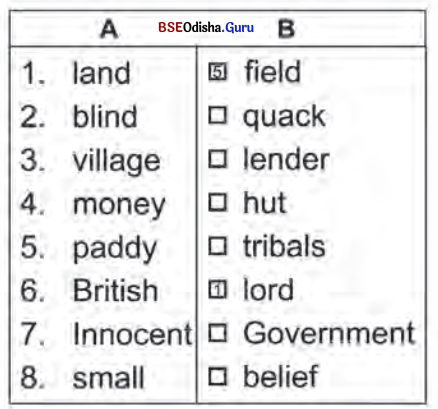
Match words under 'A' with the words under 'B' Write the word numbers of 'A' in the boxes of 'B'
Answer:
Match words under 'A' with the words under 'B' Write the word numbers of 'A' in the boxes of 'B' Answer

One is done for you. Then write them in the blank places provided below

Answer:

1. Land-lord
2. Blind – belief
3. Village – quack
4. Money-lender
5. Paddy-field
6. British – Government
7. Innocent – tribals
8. Small – hut

6. Usage:

(a) Fill in the blanks with the words chosen from brackets. [from, in, of, against, at, with]

(i) Birsa Munda was born ___________ to a poor family in 1875
(ii) He studied in a school ____________ Katanga.
(iii) The landlord removed Birsa __________ from the job.
(iv) Birsa told people not to believe ____________ superstition.
(v) He was ____________ blind belief or superstition.
(vi) He fought against the British force ____________his followers
(vii) Birsa went to the village quack to cure himself _________his wounds.
Answer:
(i) Birsa Munda was born in a poor family in 1875.
(ii) He studied in a school at Katanga.
(iii) The landlord removed Birsa from the job.
(iv) Birsa told people not to believe in superstition.
(v) He was against blind belief or superstition.
(vi) He fought against the British force with his followers.
(vii) Birsa went to the village quack to cure himself from his wounds.

(b) We use the second form of the verbs to talk about past things (events).
For example: in the sentence – “Birsa’s father Sugana Munda worked as a laborer”- the underlined and bold word, ‘worked’ is the second form of the word (verb) ‘work’ to say about Birsa’s past life i.e. past tense of the word.

Now write the second forms of the following verbs in the space provided. You can refer to the text if necessary.
(କ୍ରିୟାପଦର ୨ୟ ଫର୍ମ ବ୍ୟବହାର କର ।) (Question with Answer)
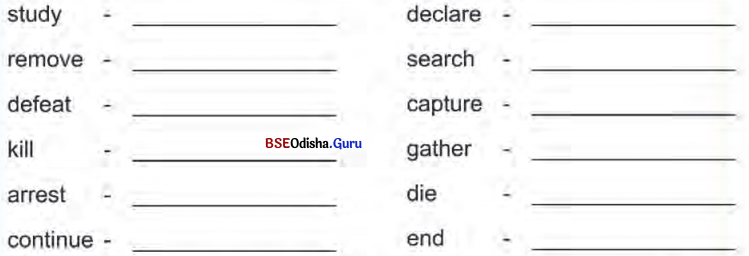
Now write the second forms of the following verbs in the space provided. You can refer to the text if necessary.
Answer:
study – studied
declare – declared
remove – removed
defeat – defeated
kill – killed
arrest – arrested
continue – continued
declare – declared
search – searched
capture – captured
gather – gathered
die – died
end – ended

BSE Odisha 7th Class English Solutions Lesson 4 Birsa Munda

(c) Match words under ‘A’ with the words under ‘B’. Write the numbers of ‘A’ in the boxes of ’B’. (Question with Answer)
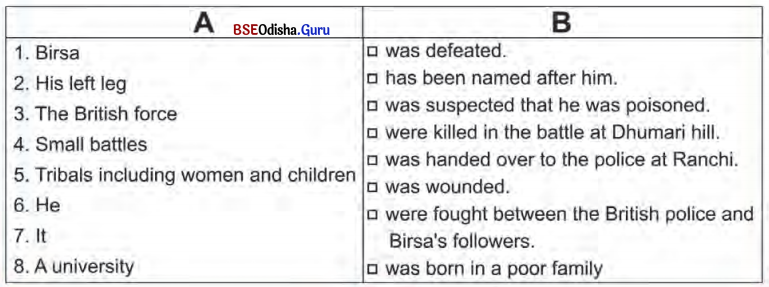
Match words under 'A' with the words under 'B'. Write the numbers of 'A' in the boxes of ’B'

Answer:

Match words under 'A' with the words under 'B'. Write the numbers of 'A' in the boxes of ’B'Answer

Session – 7 (ସପ୍ତମ ପର୍ୟ୍ୟାୟ)

C. Writing:

(a) Write answers to the following questions in the space provided below.

Question (i)
Where and when was Birsa born?
(ବିର୍ସା କେବେ ଏବଂ କେଉଁଠାରେ ଜନ୍ମ ହୋଇଥିଲେ ?)
Answer:
Birsa was bom in 1875 in Bihar (now in Jharkhand).

Question (ii)
Why did the landlord remove Birsa from his job?
(ବିର୍ସାକୁ ଜମିଦାର ତା’ର କାମରୁ କାହିଁକି ବାହାର କରିଦେଲେ ?)
Answer:
The landlord removed Birsa from his job because of his negligence in work. The landlord found him reading a book leaving the cows to graze on paddy field.

Question (iii)
What made Birsa go to the village quack?
(ବିର୍ସା କାହିଁକି ଗାଁ ବୈଦ୍ୟ ପାଖକୁ ଗଲେ ?)
Answer:
Birsa went to the village quack for treatment of his left leg which was wounded while cutting wood.

Question (iv)
What did Birsa tell his people not to do?
(ବିର୍ସା ତା’ର ଲୋକମାନଙ୍କୁ କ’ଣ ନ କରିବାକୁ କହିଲା ?)
Answer:
Birsa told his people not to believe in superstitions.

Question (v)
Why did the British Government join hands with the moneylenders and the landlords?
(ଇଂରେଜ ସରକାର କାହିଁକି ଜମିଦାର ଏବଂ ମହାଜନଙ୍କ ସହିତ ଯୋଗଦେଲେ ?)
Answer:
Birsa’s fight against the cruel act of money lenders, landlords and policemen turned into a movement. Number of his followers increased day by day. So considering him a threat the British Government joined hands with them.

Question (vi)
In which battle did Birsa and his followers defeat the British police?
(କେଉଁ ଯୁଦ୍ଧରେ ବିର୍ସା ଏବଂ ତା’ର ଅନୁଗାମୀମାନେ ଇଂରେଜ ପୁଲିସଙ୍କୁ ପରାସ୍ତ କ)
Answer:
Birsa and his followers defeated the British police in battle at Khunti.

Question (vii)
Where and when was Birsa arrested?
(ବିର୍ସା କେତେବେଳେ ଏବଂ କେଉଁ ସ୍ଥାନରେ ଗିରଫ ହେଲେ ? )
Answer:
Birsa was arrested at Ranchi when nine persons of Jerkel village captured him from a forest and handed over him to the police.

Question (viii)
When did Birsa die and how?
(କେତେବେଳେ ଓ କିପରି ବିର୍ସା ମୃତ୍ୟୁବରଣ କଲେ ?)
Answer:
Birsa’s died of cholera in Ranchi jail on 30th May 1900. But many people suspected that he was poisoned.

BSE Odisha 7th Class English Solutions Lesson 4 Birsa Munda

(b) Fill in the Bio-data form of Birsa Munda. (Read the text, if you need). (Question with Answer)
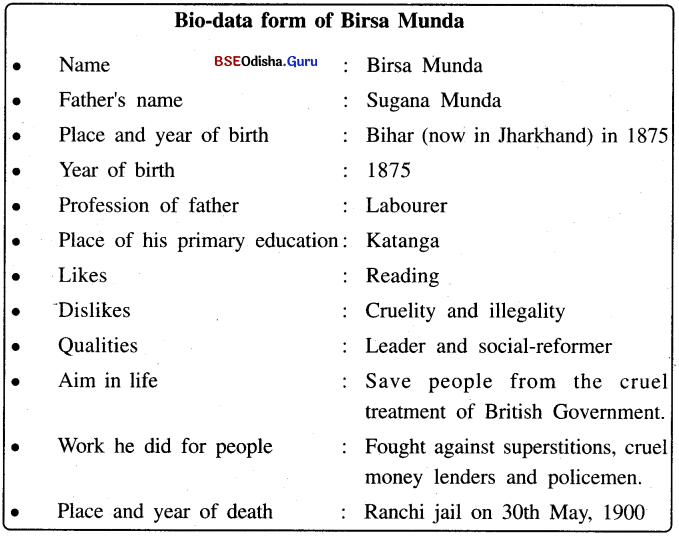
Fill in the Bio-data form of Birsa Munda

(c) Now complete the sentence with the above information in the following paragraph about Birsa Munda.
Birsa Munda bom _________.His father’s name was __________. His father ___________. Birsa __________ in a school _________.
He liked to __________. He disliked ____________ and ___________. He was _____________. He wanted to __________. He died in _________.

Answer:
Birsa Munda bom in 1875. His father’s name was Sugana Munda. His father worked as a labourer. Birsa studied in a school at Katanga. He liked to read. He disliked cmelitv and illegality. He was a great leader and social reformer. He wanted to save people from the cruel treatment of British Government. He died in Ranchi iail on 30th Mav, 1900.

d) Now prepare your own ‘Bio-data’ form and write a small para about yourself following the above bio-data and paragraph under 7(b) and (c).

Bio-data
______________________
______________________
______________________

(Students will prepare their bio-data taking help of the teacher or parents)

8. Mental Talk:

“Let’s fight against superstitions. We’ll continue our fight till we die.”

9. Let’s Think:

(i) Think of ways to abolish the tradition of animal sacrifice.
(ii) Let’s think of ways to remember our great heroes.

BSE Odisha 7th Class English Solutions Lesson 4 Birsa Munda

BSE Odisha 7th Class English Solutions Lesson 4 Birsa Munda Important Questions and Answers

(A) Choose the right answer from the options.

Question 1.
Birsa Munda was bom in a __________?
(a) rich family
(b) poor family
(c) joint family
(d) aristorcratic family
Answer:
(b) poor family

Question 2.
His father’s name was __________?
(a) Sugana Munda
(b) Laxman Munda
(c) Sovan Munda
(d) None of these
Answer:
(a) Sugana Munda

Question 3.
He was a cow boy of a land lord because of ___________?
(a) his poverty
(b) his low grade family
(c) a little boy
(d) None of these
Answer:
(a) his poverty

Question 4.
Birsa was _________ the superstition from his early age?
(a) for
(b) against
(c) encouraging
(d) None of these
Answer:
(b) against

Question 5.
The village quack said his wound could be cured by __________?
(a) animal sacrifice
(b) worshiping the evil spirit
(c) sacrificing a goat only
(d) sacrificing a hen only
Answer:
(c) sacrificing a goat only

Question 6.
Birsa was caught in the end because __________?
(a) Birsa was not in good health
(b) he was tired of running here and there
(c) he wanted to be caught by the nine people of Jerkel village
(d) both (a) and (b)
Answer:
(d) both (a) and (b)

BSE Odisha 7th Class English Solutions Lesson 4 Birsa Munda

(B) Answer the following Questions 

Question 1.
What did he advise the people about blind belief?
Answer:
Birsa was against the blind belief. He advised the people not to follow the quack. Because there was no evil spirit that could cause any disease. Nobody could be cured by animal sacrifice.

Question 2.
Why did the Government delcare rewards, to capture Birsa?
Answer:
Police failed to arrest Birsa. For four years the Government could not capture Birsa. So British Government declared reward to capture him.

Question 3.
Why do we remember Birsa even after 100 years of his death?
Answer:
The tribal hero Birsa Munda was the bravest freedom fighter. He fought against Britishers for more than four years. He was also a reformer of the society. He also advised the people not to follow the superstition. So we remember him till today.

BSE Odisha 7th Class English Solutions Part – II

CHSE Odisha Class 12 Math Solutions Chapter 9 Integration Ex 9(h)

Odisha State Board Elements of Mathematics Class 12 Solutions CHSE Odisha Chapter 9 Integration Ex 9(h) Textbook Exercise questions and Answers.

CHSE Odisha Class 12 Math Solutions Chapter 9 Integration Exercise 9(h)

Evaluate the following Integrals.
Question 1.
(i) ∫\(\frac{d x}{4+5 \cos x}\)
Solution:
CHSE Odisha Class 12 Math Solutions Chapter 9 Integration Ex 9(h) Q.1(1)

(ii) ∫\(\frac{d x}{3+\cos x}\)
Solution:
CHSE Odisha Class 12 Math Solutions Chapter 9 Integration Ex 9(h) Q.1(2)

CHSE Odisha Class 12 Math Solutions Chapter 9 Integration Ex 9(h)

(iii) ∫\(\frac{d x}{3+\sin x}\)
Solution:
CHSE Odisha Class 12 Math Solutions Chapter 9 Integration Ex 9(h) Q.1(3)

(iv) ∫\(\frac{d x}{1+2 \sin x}\)
Solution:
CHSE Odisha Class 12 Math Solutions Chapter 9 Integration Ex 9(h) Q.1(4)

(v) ∫\(\frac{d x}{2 \sin x+3 \cos x}\)
Solution:
CHSE Odisha Class 12 Math Solutions Chapter 9 Integration Ex 9(h) Q.1(5)

BSE Odisha

(vi) ∫\(\frac{d x}{1+\cos x+\sin x}\)
Solution:
CHSE Odisha Class 12 Math Solutions Chapter 9 Integration Ex 9(h) Q.1(6)

Question 2.
(i) ∫\(\frac{3 \sin x+28 \cos x}{5 \sin x+6 \cos x}\) dx
Solution:
CHSE Odisha Class 12 Math Solutions Chapter 9 Integration Ex 9(h) Q.2(1)

(ii) ∫\(\frac{12 \sin x-2 \cos x+3}{\sin x+\cos x}\) dx
Solution:
Let 12 sin x – 2 cos x = A (sin x + cos x) + B ( cos x – sin x)
[Note that cos x – sin x is the derivative of sin x + cos x]
Then A – B = 12, A + B = -2
⇒ 2A = 10
⇒ A = 5, B = -7
Thus 12 sin x – 2 cos x = 5 (sin x + cos x) – 7 (cos x – sin x)
CHSE Odisha Class 12 Math Solutions Chapter 9 Integration Ex 9(h) Q.2(2)

(iii) ∫\(\frac{5 \sin x}{3-2 \sin x}\) dx
Solution:
CHSE Odisha Class 12 Math Solutions Chapter 9 Integration Ex 9(h) Q.2(3)

CHSE Odisha Class 12 Math Solutions Chapter 9 Integration Ex 9(h)

(iv) ∫\(\frac{2 \cos x+7}{4-\sin x}\) dx
Solution:
CHSE Odisha Class 12 Math Solutions Chapter 9 Integration Ex 9(h) Q.2(4)
CHSE Odisha Class 12 Math Solutions Chapter 9 Integration Ex 9(h) Q.2(4.1)

Question 3.
(i) ∫\(\frac{d x}{2 \cos ^2 x+3 \cos x}\)
Solution:
CHSE Odisha Class 12 Math Solutions Chapter 9 Integration Ex 9(h) Q.3(1)

(ii) ∫\(\frac{d x}{4 \sin ^2 x-\sin x}\)
Solution:
CHSE Odisha Class 12 Math Solutions Chapter 9 Integration Ex 9(h) Q.3(2)
CHSE Odisha Class 12 Math Solutions Chapter 9 Integration Ex 9(h) Q.3(2.1)

CHSE Odisha Class 12 Math Solutions Chapter 9 Integration Ex 9(h)

(iii) ∫\(\frac{\sin x \cos x}{x \sin ^2 x-2 \sin x+3}\) dx
Solution:
CHSE Odisha Class 12 Math Solutions Chapter 9 Integration Ex 9(h) Q.3(3)

(iv) ∫\(\frac{d x}{\cos x-\cos 3 x}\)
Solution:
CHSE Odisha Class 12 Math Solutions Chapter 9 Integration Ex 9(h) Q.3(4)

Question 4.
(i) ∫\(\frac{d \theta}{4+3 \sin ^2 \theta}\)
Solution:
CHSE Odisha Class 12 Math Solutions Chapter 9 Integration Ex 9(h) Q.4(1)

(ii) ∫\(\frac{d \theta}{2-3 \cos ^2 \theta}\)
Solution:
CHSE Odisha Class 12 Math Solutions Chapter 9 Integration Ex 9(h) Q.4(2)

(iii) ∫\(\frac{d \theta}{4 \cos ^2 \theta+9 \sin ^2 \theta}\)
Solution:
CHSE Odisha Class 12 Math Solutions Chapter 9 Integration Ex 9(h) Q.4(3)

(iv) ∫\(\frac{d \theta}{2+3 \cos ^2 \theta-4 \sin ^2 \theta}\)
Solution:
CHSE Odisha Class 12 Math Solutions Chapter 9 Integration Ex 9(h) Q.4(4)

Question 5.
(i) ∫\(\frac{\sin 3 x}{\cos 7 x \cos 4 x}\) dx
Solution:
CHSE Odisha Class 12 Math Solutions Chapter 9 Integration Ex 9(h) Q.5(1)

(ii) ∫\(\frac{\cos 2 x}{\sin 7 x \cos 5 x}\) dx
Solution:
CHSE Odisha Class 12 Math Solutions Chapter 9 Integration Ex 9(h) Q.5(2)

CHSE Odisha Class 12 Math Solutions Chapter 9 Integration Ex 9(h)

Question 6.
(i) ∫\(\frac{d x}{\cos x(5+3 \cos x)}\)
Solution:
CHSE Odisha Class 12 Math Solutions Chapter 9 Integration Ex 9(h) Q.6(1)

(ii) ∫\(\frac{d x}{\cos x(1+2 \sin x)}\)
Solution:
CHSE Odisha Class 12 Math Solutions Chapter 9 Integration Ex 9(h) Q.6(2)

Stopping By Woods On A Snowy Evening Question Answer Class 11 Invitation English Poem Chapter 1 CHSE Odisha

Odisha State Board CHSE Odisha Class 11 Invitation to English 1 Solutions Poem 1 Stopping By Woods On A Snowy Evening Textbook Exercise Questions and Answers.

Class 11th Invitation English Poem Chapter 1 Stopping By Woods On A Snowy Evening Question Answers CHSE Odisha

Stopping By Woods On A Snowy Evening Class 11 Questions and Answers

Think it out

Question 1.
How is ‘woods’ different from ‘forest’?
Answer:
‘Woods’ is different from the forest, because the former refers to an area of trees, smaller than a forest.

Question 2.
Where does the rider stop?
Answer:
The rider stops by some woods.

Question 3.
Why does he stop?
Answer:
The beauty of the woods tempts him to stop and enjoy the beauty of snow wood.

CHSE Odisha Class 11 English Solutions Poem 1 Stopping By Woods On A Snowy Evening

Question 4.
“He will not see me stopping here” – what does this expression mean?
Answer:
The expression ‘He will not see me stopping here’ means the owner of the woods living in the village will not see the poet stopping by the woods.

Question 5.
Why does the horse give his harness bells a shake?
Answer:
The poet, riding across the countryside, stops by snow-wrapped woods. The horse is accustomed to stopping at farmhouses, but on the present occasion, he finds it strange that though his master has stopped, there is no farmhouse nearby. Therefore, the horse gives his harness bells a shake as if to ask whether his master has stopped there by mistake

Question 6.
What is ‘the only other sound’ besides that of harness bells?
Answer:
The only other sound besides the harness bells is the sound of easily flowing wind and falling snow.

Question 7.
Why does the poet use the expressions ‘dark’, ‘deep’, and ‘darkest’?
Answer:
The poet uses the expressions ‘dark’, ‘deep’, and ‘deepest’ to express the fact that he is fascinated by the natural beauty of the woods.

CHSE Odisha Class 11 English Solutions Poem 1 Stopping By Woods On A Snowy Evening

Question 8.
How do the speaker, the owner of the woods, and the horse react to the beauties of nature?
Answer:
It may be noted that the fascination of the woods is felt only by the speaker, not by the horse (who is a sub-human) or by the practical man (the owner of the woods).

Question 9.
What picture of natural beauty do you get from the poem?
Answer:
The beauty we get from the poem is natural. It is one of near-silence. The lovely, dark, and deep woods prove this fact.

Question 10.
In the final stanza, the speaker says that he is not yet ready to ‘sleep’. What has he to do before he can take a rest?
Answer:
The poet has his routine duties to do before he can take a rest.

Question 11.
What does the expression, “The darkest evening of the year”, suggest? Does it mean ‘the longest night of the year’ or ‘the most depressing state of his mind’? Give a reasoned answer.
Answer;
The expression ‘the darkest evening of the year’ means the darkest night of the year. Because he has a long way to go. Besides, the poet’s delight in contemplating the woods filling up with snow seems to him to be an abandonment of his responsibilities when he realizes that he has an appointment to keep with his death.

CHSE Odisha Class 11 English Solutions Poem 1 Stopping By Woods On A Snowy Evening

Question 12.
A four-line stanza is called a quatrain. How many quatrains are there in the poem?
Answer:
There are four quatrains in the poem.

Post-Reading Activities.

Question 1.
Arrange the following sentences in their logical order to narrate the theme of the poem.
(a) He passes by the woods which are ‘lovely, dark and deep’.
(b) The poet is riding his horse to a destination.
(c) But he remembers that he has ‘promises to keep’ before he can rest.
(d) It is snowing and the wind blows gently.
(e) The beauty of the woods tempts him to stop and enjoy the sight.
(f) It is an evening in winter.

Answer:
(f) It is an evening in winter.
(d) It is snowing and the wind blows gently.
(b) The poet is riding his horse to a destination.
(a) He passes by the woods which are ‘lovely, dark and deep’.
(e) The beauty of the woods tempts him to stop and enjoy the sight.
(c) But he remembers that he has ‘promises to keep’ before he can rest.

CHSE Odisha Class 11 English Solutions Poem 1 Stopping By Woods On A Snowy Evening

Question 2.
Note the rhyme scheme in the first quatrain. It is AABA (‘know’, ‘though’, ‘here’ ‘snow’). What is the rhyme scheme in other quatrains?
Answer:
The rhyme scheme is BBCB (queer, near, lake, year), CCDE (shake, mistake, sweep, flake), and EEEE (deep, keep, sleep, sleep) in 2nd, the 3rd, and 4th quatrains respectively.

CHSE Odisha Class 11 English Stopping By Woods On A Snowy Evening Important Questions and Answers

A. short Answer Type Questions with Answers

1. Read through the extract and answer the questions that follow.

Whose woods these are I think I know ……
His house is in the village though;
He will not see me stopping here
To watch his woods fill up with snow.

My little horse must think it queer
To stop without a farm house near
Between the woods and frozen lake
The darkest evening of the year.

He gives his harness bells a shake
To ask if there is some mistake
The only other sound’s the sweep
Of easy wind and downy flake.

The woods are lovely, dark and deep
But I have promises to keep
And miles to go before I sleep
And miles to go before I sleep.

Questions :
(i) Where does the owner of the woods live?

(ii) ‘He will not see me stopping here.’ Who is ‘He’ here?

(iii) Describe the woods.

(iv) What is the theme of the poem?

(v) Explain the significance of the repetition of :
‘And miles to go before I sleep,
And miles to go before I sleep.’

Answers :
(i) The owner of the woods lives in a village.

(ii) Here ‘he’ is the owner of the woods.

(iii) Robert Frost gives a beautiful description of the woods. They are lovely, dark, and deep. The sight of the woods being gradually covered with snow is so fascinating that the poet would like to watch it a little longer. The woods are outside the village and their owner does not live here. The poet knows him. Woods that constitute the essence of the poem suggests perilous enchantment.

(iv) The theme of the poem lies in the speaker’s delight in contemplating the woods filling up with snow seems to him to be an abandonment of his responsibilities when he realizes that he has an appointment to keep with death.

(v) The repetition of these lines is quite significant. It brings out the poet’s strong determination. He knows that death is the end of life. Instead of enjoying the fascinating beauty of the woods, he goes on to fulfill the mission of his life. He remembers that he has ‘promises to keep’, duties to perform, and a long journey to complete before he can rest. The repetition of these lines beautifully exemplifies this and indicates the depth of the poet’s feelings.

CHSE Odisha Class 11 English Solutions Poem 1 Stopping By Woods On A Snowy Evening

2. Read through the extract and answer the questions that follow.

Whose woods these are I think I know …..
His house is in the village though;
He will not see me stopping here
To watch his woods fill up with snow.

My little horse must think it queer
To stop without a farmhouse near
Between the woods and frozen lake
The darkest evening of the year.

He gives his harness bells a shake
To ask if there is some mistake
The only other sound’s the sweep
Of easy wind and downy flake.

The woods are lovely, dark, and deep
But I have promises to keep
And miles to go before I sleep
And miles to go before I sleep.

Questions :
(i) Explain the expression ‘whose woods’.

(ii) What does the line ‘I think I know’ signify?

(iii) What interpretation does this extract admit?

(iv) What moment does the poem capture?

(v) ‘Besides going to sleep, the poet must perform duties.’ What else does the last stanza convey?

Answer:
(i) The implied question is whether the woods belong to the owner or the person who watches or enjoys them. Or is it of God?

(ii) The line ‘I think I know’ signifies characteristically a Frostian hovering between eloquence and silence, understanding and reticence.

(iii) This extract lends itself to a variety of interpretations: Why does the speaker stop by some woods? The reader may ask some pertinent questions: Does the speaker move on rather reluctantly? What is Frost’s attitude toward nature?

(iv) The poem captures a moment of pure delight in mid-winter – a fleeting mood of reflection on the beauty of snow-capped woods before the poet must go on with routine duties.

(v) The last stanza also conveys the poet’s death wish.

CHSE Odisha Class 11 English Solutions Poem 1 Stopping By Woods On A Snowy Evening

Multiple Choice Questions (MCQs) with Answers
Choose the correct option.
Warm-up
Do you know…… inspiring it is.
Question 1.
The poem “Stopping by Woods on a Snowy Evening” is written by :
(a) John Keats.
(b) Robert Frost.
(c) Thomas Hardy.
(d) William Wordsworth.
Answer:
(b) Robert Frost.

Question 2.
This poem was a great favorite of :
(a) R. N. Tagore.
(b) Sarojini Naidu.
(c) Jawaharlal Nehru.
(d) Khushwant Singh.
Answer:
(c) Jawaharlal Nehru.

Question 3.
The attraction in this poem is of :
(a) matter.
(b) nature.
(c) a great person.
(d) a great responsibility.
Answer:
(b) nature.

Question 4.
The speaker stops his horse by some_______on a snowy evening.
(a) forest.
(b) river bank.
(c) woods.
(d) sea beach.
Answer:
(c) woods.

Question 5.
The journey through the woods is suggestive of a journey through__________itself.
(a) sea
(b) life
(c) heaven
(d) hill
Answer:
(b) life

CHSE Odisha Class 11 English Solutions Poem 1 Stopping By Woods On A Snowy Evening

The Text
Stanza – I
Whose woods………. with snow.
Question 6.
‘Woods’ here means :
(a) forest.
(b) jungle.
(c) an area of trees, smaller than a forest.
(d) a hillside.
Answer:
(c) an area of trees, smaller than a forest.

Question 7.
From this line ‘Whose woods these are I think I know”, it is clear that these woods belong to :
(a) a person to whom the poet knows.
(b) the animals who live in it.
(c) the forest authority.
(d) none of the above.
Answer:
(a) a person to whom the poet knows.

Question 8.
The owner of the woods lives in a :
(a) town.
(b) hilltop.
(c) village.
(d) Riverside.
Answer:
(c) village.

CHSE Odisha Class 11 English Solutions Poem 1 Stopping By Woods On A Snowy Evening

Question 9.
He will not see me stopping here. In this sentence ‘He’ refers to :
(a) the author of the poem.
(b) the owner of the woods.
(c) the God.
(d) the Nature.
Answer:
(b) the owner of the woods.

Question 10.
The poet watchers that woods are covered with :
(a) snow.
(c) fruits.
(b) hilltop.
(d) Riverside.
Answer:
(a) snow.

CHSE Odisha Class 11 English Solutions Poem 1 Stopping By Woods On A Snowy Evening

Stanza – II
My little………. of the year.
Question 11.
My little horse must think it queer. In this sentence, the word ‘little’ means :
(a) small.
(c) nothing.
(b) humble.
(d) short.
Answer:
(b) humble.

Question 12.
What does the word ‘queer’ mean?
(a) Search.
(c) strange.
(b) stop.
(d) sound.
Answer:
(c) strange.

Question 13.
Where do they usually stop?
(a) at a guest house.
(b) at an inn.
(c) at a cottage.
(d) at a farmhouse.
Answer:
(d) at a farmhouse.

CHSE Odisha Class 11 English Solutions Poem 1 Stopping By Woods On A Snowy Evening

Question 14.
What has made the horse feel strange and uncomfortable?
(a) stopping on the way where there is no farmhouse.
(b) stopping in the mid of the forest where life is full of danger.
(c) stopping in a frozen land where life is at risk.
(d) none of the above.
Answer:
(a) stopping on the way where there is no farmhouse.

Question 15.
At what time of the day the poet was passing by the woods?
(a) morning.
(c) evening.
(b) afternoon.
(d) at night.
Answer:
(c) evening.

Stanza – III
He gives ………… downy flake
Question 16.
In the first line of stanza III, there is the word ‘harness bells’ which is tied to the neck of an animal. Which is that animal?
(a) ox.
(b) horse.
(c) bullock.
(d) donkey.
Answer:
(b) horse.

CHSE Odisha Class 11 English Solutions Poem 1 Stopping By Woods On A Snowy Evening

Question 17.
Why does the horse shake the harness bells?
(a) to show some fun
(b) to show some urgency
(c) to show some mistake
(d) to show that he is hungry
Answer:
(c) to show some mistake

Question 18.
Apart from the sounds of harness bells, there are other two natural sounds near the woods. What are they?
(a) sounds of animals and spring.
(b) sounds of stones and rustling of trees.
(c) sounds of easy wind and downy flake.
(d) sounds of spirits and ghosts.
Answer:
(c) sounds of easy wind and downy flake.

Question 19.
What do you mean by the word ‘downy flake’?
(a) down falling water.
(b) down falling stones.
(c) down falling logs.
(d) down falling snow.
Answer:
(d) down falling snow.

CHSE Odisha Class 11 English Solutions Poem 1 Stopping By Woods On A Snowy Evening

Stanza – IV
The woods are ………… before I sleep.

Question 20.
How were the woods according to the poet?
(a) dense, dangerous, and difficult.
(b) natural, attractive, and enjoyable.
(c) lovely, dark, and deep.
(d) none of the above.
Answer:
(c) lovely, dark, and deep.

Question 21.
Why is the poet not willing to stay near the wood?
(a) He has urgent work.
(b) He has promises to keep.
(c) He has no interest to stay.
(d) His horse is unwilling to stay.
Answer:
(b) He has promises to keep.

CHSE Odisha Class 11 English Solutions Poem 1 Stopping By Woods On A Snowy Evening

Question 22.
‘And miles to go before I sleep’. This statement of the poet indicates :
(a) a long journey of life before he leaves for heavenly rest.
(b) a long distance to be traveled by the poet.
(c) a long life of rest and sleep.
(d) none of the above.
Answer:
(a) a long journey of life before he leaves for heavenly rest.

CHSE Odisha Class 11 English Solutions Poem 1 Stopping By Woods On A Snowy Evening

Detailed Summaries and Glossary
Stanza – I (Lines 1-4)

Gist with Glossary
Gist :
The poet, who has to ride long distances in order to fulfill what he has promised, finds himself by the woods late in the evening. It is snowing. So he stops for a while to lose himself in the enjoyment of natural beauty. He thinks he knows the owner of the woods, and also that the owner cannot see him admiring the woods, as he lives in a village away from the woods.

Glossary:
woods: an area of trees, smaller than a forest ( ଛୋଟକାଟିଆ ଜଙ୍ଗଲ )
whose woods: These woods are outside a village and the poet knows the owner of the woods who lives in the village.

CHSE Odisha Class 11 English Solutions Poem 1 Stopping By Woods On A Snowy Evening

Stanza – II (Lines 5-8)
Gist with Glossary
Gist :
The poet’s horse cannot understand why there should be a stop when there is no firm house in sight and also in such an uncomfortable situation as it is snowing. The horse is accustomed to stopping at farmhouses. The master has, as a matter of fact, stopping not for rest but for a brief enjoyment of the beauty of the woods.

Glossary:
Little : humble and ordinary (ସାଧାରଣ ).
Queer : strange (ଆଶ୍ଚର୍ଯ୍ୟ) .
think it queer….. near: The poet says that the horse considers it surprising that the master stops in the midst of the woods and not near any farmhouse.
Frozen Lake : lake turned into ice (ବରଫ ପାଲଟିଥ‌ିବା ହ୍ରଦ).

CHSE Odisha Class 11 English Solutions Poem 1 Stopping By Woods On A Snowy Evening

Stanza – III (Lines 9-12)
Gist with Glossary
Gist :
The poet’s horse is not impressed by the woods. It does not understand why they have stopped in such a lonely place, especially as there is no sign of any farmhouse nearby. The horse shakes his harness bells as if to ask whether his master has stopped there by mistake. But the only sound that is there is the swift movement of the wind and the fall of the flakes of snow.

Glossary:
Harness Bells: small bells attached to a strap/band around the neck of a horse. (ଘୋଡ଼ା ବେକର ଘଣ୍ଟି )
Easy Wind: easily flowing wind. (ମୃଦୁ ପବନ)
Flakes: pieces of snow that are soft, light, and white. (ନ ର ମ ହାଲୁକା ଧଳା )
Downy Flakes: downfalling snow. (ତଳକୁ ଖସୁଥ‌ିବା ବରଫ)

CHSE Odisha Class 11 English Solutions Poem 1 Stopping By Woods On A Snowy Evening

Stanza – IV (Lines 13-16)

Gist with Glossary
Gist:
The beauty of the woods tempts the poet powerfully to stop the journey and to lose himself in the enjoyment of natural beauty. But he remembers that he has ‘promises to keep’, duties to perform, and a long journey to complete before he can rest. The intensity of the poet’s feeling finds a beautiful expression in this stanza.

Glossary:
Promises : assurance to perform certain duties and miles….. (କଉଁ ବ୍ଯ ପାଳନର ପ୍ରତିଜ୍ଞା)
before I sleep: the poet brings out the idea that he has to perform a long, long journey, and before it is completed, he can have no rest. The repetition is indicative of the depth of the poet’s feelings. ‘
Mile : a distane of 1.6 kilometres (1.6 କି.ମି. ଦୂରତ୍ବ)

CHSE Odisha Class 11 English Solutions Poem 1 Stopping By Woods On A Snowy Evening

Introducing The Poet

Robert Lee Frost, perhaps the best-loved of American poets, was born in San Francisco, California, on 26 March 1874. On the death of his father when he was only ten, he was taken to Lawrence, Massachusetts. Frost attended Lawrence High School and Dartmouth College, which he left after a few months. He taught in school, tried his hand at farming, and also worked as a newspaperman. In 1885 he married Elinor White, his former sweetheart at the high school. Though he enrolled at Harvard University as a special student in 1897 he left it after only two years.

In 1912 the Frosts moved to England. A Boy’s Will, Frost’s first book of poems, was published in England in 1913. North of Boston in 1914, contains some of the finest of Frost’s lyrics. In 1915 the Frosts returned to America and settled on a farm in New Hampshire. Other significant collections of his poems are Mountain Interval (1916), New Hampshire (1923), West-Running Brook (1928), A Further Range (1936), A Witness Tree (1942), and Steeple Bush (1947).

The complete poem of Robert Frost appeared in 1949. He gave public readings of his poems at several American Universities. In his later years, he achieved the status of a folk hero. He died in Boston in 1963. He was awarded the Pulitzer Prize for poetry four times in 1924, 1931, 1937, and 1943. Surprisingly however his first book of poetry was published in England in 1913. No American publisher had accepted it.

It is not difficult to understand why Frost is Americans’ favorite poet. He writes very simply about familiar, ordinary things. However, the simplicity is only on the surface, Frost’s poems actually talk about ideas and thoughts that are deep, not ordinary. The poems talk about truth, they teach you wisdom. Frost is a poet whose style is as fine as a goldsmith’s skill. His poems are delightful to read. Frost himself has said, that for him, a poem begins in delight and ends in wisdom.

CHSE Odisha Class 11 English Solutions Poem 1 Stopping By Woods On A Snowy Evening

About The Poem

Stopping by Woods on a Snowy Evening presents the thoughts that pass through the poet’s mind as he stops his horse in wood on an evening when the snow has begun to fall. The poet conveys the idea that the beauties of nature can be very attractive but man has to perform his duties and keep his promises. He has to continue the journey of life and cannot afford to spend his time only watching the scenic beauties of nature. The poet brings out this message through a presentation of the conflict between the lovely woods and the promises that he has to keep.

Summary

The poem starts with a concrete situation arising from the ordinary life of a man but moves on to philosophic speculation about the relationship between man and nature. It is a dark and quiet evening of winter, and it is snowing. The poet, riding a horse to a destination, passes by woods that are lovely, dark, and deep. These woods are outside a village. The poet knows the owner of the woods who lives in the village.

The beauty of the woods tempts him powerfully to stop the journey and to lose himself in the enjoyment of natural beauty. He says that the horse considers it surprising that the master stops in the midst of the woods and is not near any farmhouse. The horse is accustomed to stopping at farmhouses, but on the present occasion, his reaction is natural.

He knows if his master, in the course of riding across the countryside stops at all, he stops at some farmhouse where both can find food and rest. The master has, as a matter of fact, stopped in such a lonely place not for the rest but for a brief enjoyment of the scenic beauty of the woods. The horse shakes his harness bells as if to ask whether his master has stopped there by mistake.

There are no other sounds except the swift movement of the wind and the fall of snowflakes which are soft, light, and white as feathers. The poem ends on a note of wisdom. In spite of wishing to enjoy the natural beauty, the poet cannot linger there. He moves on as he has to cover long distances in order to keep his promises. He cannot stay back the mission in his life still awaits completion. He remembers that he has ‘promises to keep’, duties to perform a long journey to complete before he can rest

CHSE Odisha Class 11 English Solutions Poem 1 Stopping By Woods On A Snowy Evening

ସାରାଂଶ:
ମଧ୍ୟରେ ଯେଉଁ ସମ୍ପର୍କ ବିଦ୍ୟମାନ, କବି ତାକୁ ଏକ ଦାର୍ଶନିକ ଦୃଷ୍ଟିଭଙ୍ଗୀରୁ ଦେଖୁଛନ୍ତି । ଶୀତକାଳର ଗୋଟିଏ ନୀରବ ସନ୍ଧ୍ୟା । ଅନ୍ଧକାର ପୃଥ‌ିବୀକୁ ଆଚ୍ଛାଦିତ କରିଛି । ଆକାଶରୁ ଝରିପଡ଼ୁଛି ବରଫରାଶି । କବି ଅଶ୍ୱାରୋହଣ କରି ତାଙ୍କର ସୁଦୂର ଲକ୍ଷ୍ୟସ୍ଥଳ ଅଭିମୁଖେ ଯାତ୍ରା କରୁଛନ୍ତି । ଚାରିପଟରେ ଘନ ଜଙ୍ଗଲ । କବିଙ୍କ ଭାଷାରେ, ‘ସୁନ୍ଦର, ଅନ୍ଧକାରାଚ୍ଛନ୍ନ ଓ ଘଞ୍ଚ’’ ଗ୍ରାମାଞ୍ଚଳର ଉପକଣ୍ଠରେ ବିସ୍ତୃତ ହୋଇ ରହିଛି ସେହି ଅରଣ୍ୟ । ଏହି ଜଙ୍ଗଲର ମାଲିକଙ୍କୁ କବି ଜାଣନ୍ତି । ସେ ନିକଟସ୍ଥ ଗ୍ରାମର ଅସ୍ଵାସୀ । ଜଙ୍ଗଲର ସୌନ୍ଦର୍ଯ୍ୟ କବିଙ୍କୁ ପ୍ରଲୁବ୍‌ଧ କରୁଛି । ଶକ୍ତିଶାଳୀ ତା’ର ଆକର୍ଷଣ । ଯାତ୍ରାକୁ ସ୍ଥଗିତ ରଖି ପ୍ରାକୃତିକ ସୁଷମା ଭିତରେ ନିଜକୁ ହଜାଇ ଦେବାପାଇଁ ସେହି ଅରଣ୍ୟ ତାଙ୍କୁ ଯେପରି ଆମନ୍ତ୍ରଣ କରୁଛି । ଯାତ୍ରା ବନ୍ଦକରି ବନାନୀର ଶୋଭା ଦର୍ଶନ କରୁଥିବା ମାଲିକଙ୍କୁ ଦେଖ୍ ତାଙ୍କର ଘୋଡ଼ା ବିସ୍ମିତ ହୋଇଛି । କାରଣ ରହିଯାଇଥ‌ିବାରୁ ଅଶ୍ଵଟି ବିସ୍ମିତ ହୋଇଛି । ଅଶ୍ଵଟିର ଏହି ପ୍ରତିକ୍ରିୟା ଅତ୍ୟନ୍ତ ସ୍ଵାଭାବିକ । କାରଣ ଖମାରଗୃହ ପାଖରେ ଥିଲେ ଉଭୟ ମାଲିକ ଓ ସେ ଖାଦ୍ୟ ଓ ବିଶ୍ରାମ ପାଇ ପାରିଥା’ନ୍ତେ । ମାତ୍ର କବିଙ୍କର ଉଦ୍ଦେଶ୍ୟ ଭିନ୍ନ । ସେ ବିଶ୍ରାମ ଉଦ୍ଦେଶ୍ୟରେ ଏଠାରେ ଅଟକି ଯାଇନାହାନ୍ତି ।

ଅରଣ୍ୟର ନୈସର୍ଗିକ ସୌନ୍ଦର୍ଯ୍ୟକୁ ମନଭରି ଉପଭୋଗ କରିବାପାଇଁ ସେ ସେଠାରେ ଅଟକି ଯାଇଛନ୍ତି । ମାତ୍ର ଅବୋଧ ପଶୁ ସେ କଥା ବୁଝିବ କିପରି ? ଭାବୁଛି, ତା’ର ମାଲିକ ହୁଏତ ଭ୍ରମବଶତଃ ସେଠାରେ ଅଟକି ଯାଇଛନ୍ତି । ତାଙ୍କୁ ସେ କଥା ମନେପକାଇ ଦେବାପାଇଁ ଘୋଡ଼ାଟି ତା’ର ସାମ୍ପୁରେ ଲାଗିଥିବା ଘଣ୍ଟିକୁ ବଜାଇ ଦେଉଛି । ନିର୍ଜନ ଅରଣ୍ୟର ନୀରବତାର ରାଜତ୍ଵ । କେବଳ ବାୟୁର ମୁଦ୍ରା ପ୍ରବାହ ସେହି ନୀରବତାକୁ ଭଙ୍ଗ କରୁଛି । ନରମ, ହାଲୁକା ଓ ପକ୍ଷୀପର ଭଳି ମୁଲାୟମ ତୁଷାର କେବଳ ଝରିପଡ଼ୁଛି । କବିଙ୍କର ମୁଗ୍ଧସଭା ସେହି ଜଙ୍ଗଲର ଆକର୍ଷଣକୁ ଛାଡ଼ି ଆଗ୍ରସର ହେବାପାଇଁ ପ୍ରତିଜ୍ଞାବଦ୍ଧ । ଇଚ୍ଛା ଥିଲେ ବି ସେ ନିରୁପାୟ । କାରଣ ଲକ୍ଷ୍ୟସ୍ଥଳରେ ପହଞ୍ଚିବା ପାଇଁ ତାଙ୍କୁ ସୁଦୂର ପଥ ଯାତ୍ରା କରିବାକୁ ହେବ । କାରଣ ତାଙ୍କୁ ତାଙ୍କର ପ୍ରତିଜ୍ଞା ପୂରଣ କରିବାକୁ ହେବ । ଯେପର୍ଯ୍ୟନ୍ତ ସେହି ଲକ୍ଷ୍ୟ ହାସଲ ହୋଇନାହିଁ, ସେପର୍ଯ୍ୟନ୍ତ ତାଙ୍କର ବିଶ୍ରାମ ନାହିଁ । ତାଙ୍କର ଠିକ୍ ମନେଅଛି, ତାଙ୍କୁ ଗୋଟାଏ ଦୀର୍ଘ ପଥ ଅତିକ୍ରମ କରିବାକୁ ହେବ, ତାଙ୍କର କର୍ତ୍ତବ୍ୟ ସାଧନ କରିବାକୁ ହେବ । ତା’ ପୂର୍ବରୁ ସେ ବିଶ୍ରାମ ନେଇପାରିବେ ନାହିଁ ।

CHSE Odisha 11th Class English Poetry:

BSE Odisha 9th Class Political Science Solutions Chapter 2 ମୌଳିକ କର୍ତ୍ତବ୍ୟ

Odisha State Board BSE Odisha 9th Class Political Science Solutions Chapter 2 ମୌଳିକ କର୍ତ୍ତବ୍ୟ Textbook Exercise Questions and Answers.

BSE Odisha Class 9 Political Science Solutions Chapter 2 ମୌଳିକ କର୍ତ୍ତବ୍ୟ

୧। ପ୍ରତ୍ୟେକ ପ୍ରଶ୍ନର ଉତ୍ତର ୬୦ ଗୋଟି ଶବ୍ଦରେ ଲେଖ ।

(କ) ଭାରତର ସମ୍ବିଧାନରେ ପ୍ରଦତ୍ତ ମୌଳିକ କର୍ତ୍ତବ୍ୟର ତାତ୍ପର୍ଯ୍ୟ ବର୍ଣ୍ଣନା କର ।
Answer:

  • ଅଧିକାର ଓ କର୍ତ୍ତବ୍ୟ ପରସ୍ପର ପରିପୂରକ । ନାଗରିକମାନେ ମୌଳିକ ଅଧିକାର ପାଇଥିବାରୁ ମୌଳିକ କର୍ତ୍ତବ୍ୟ ପାଳନ କରିବା ଦରକାର ।
  • ବ୍ୟକ୍ତିର ବିକାଶ ପାଇଁ ଓ ତା’ର ବ୍ୟକ୍ତିତ୍ଵର ପରିପ୍ରକାଶ ପାଇଁ ସେ ଯେପରି ଅଧ୍ୟାର ଭୋଗ କରେ, ସେହିପରି ରାଷ୍ଟ୍ରର ସୁପରିଚାଳନା ନିମନ୍ତେ ସେ ଜଣେ ରାଷ୍ଟ୍ରପ୍ରେମୀ ହୋଇ ମୌଳିକ କର୍ତ୍ତବ୍ୟ ପାଳନ କରିବା ଆବଶ୍ୟକ ।
  • ଅଧିକାର ଓ କର୍ତ୍ତବ୍ୟ ଗୋଟିଏ ମୁଦ୍ରାର ଦୁଇଟି ପାର୍ଶ୍ୱ ପରି । ଅଧିକାର ଓ କର୍ତ୍ତବ୍ୟ ମଧ୍ଯରେ ସୁସମନ୍ଵୟ ରକ୍ଷା ହିଁ ଏକ ଆଦର୍ଶ ଗଣତାନ୍ତ୍ରିକ ରାଷ୍ଟ୍ର ଗଠନରେ ସାହାଯ୍ୟ କରିଥାଏ ।
  • ମୌଳିକ କର୍ଭବ୍ୟଗୁଡ଼ିକ ନାଗରିକମାନଙ୍କର ଆଇନଗତ, ରାଜନୈତିକ, ସାମାଜିକ, ସାଂସ୍କୃତିକ, ନୈତିକ, ଅର୍ଥନୈତିକ ଓ ଶିକ୍ଷାଗତ ଦାୟିତ୍ୱବୋଧକୁ ହିଁ ବୁଝାଇଥାଏ । ଏହାକୁ ପ୍ରତ୍ୟେକ ନାଗରିକ ପାଳନ କଲେ ସମାଜରେ
  • ମୌଳିକ କର୍ତ୍ତବ୍ୟଗୁଡ଼ିକ ଭାରତୀୟ ନାଗରିକମାନଙ୍କ ପାଇଁ ଉଦ୍ଦିଷ୍ଟ । କୌଣସି ଭାରତୀୟ ନାଗରିକ ଏହି ମୌଳିକ କର୍ତ୍ତବ୍ୟ ସମ୍ପାଦନ ନ କଲେ, ତାଙ୍କ ବିରୋଧରେ କୌଣସି ଆଇନଗତ କାର୍ଯ୍ୟାନୁଷ୍ଠାନ ଗ୍ରହଣ କରାଯାଇପାରିବ ନାହିଁ ।

BSE Odisha 9th Class Political Science Book Solutions Chapter 2 ମୌଳିକ କର୍ତ୍ତବ୍ୟ

(ଖ) ମୌଳିକ କର୍ତ୍ତବ୍ୟଗୁଡ଼ିକ ‘ଏକ ଅଭିନବ ବ୍ୟବସ୍ଥା’ – ଏହା କାହିଁକି କୁହାଯାଏ ?
Answer:

  • ଭାରତର ସମ୍ବିଧାନରେ ମୌଳିକ କର୍ତ୍ତବ୍ୟ ଏକ ଅଭିନବ ବ୍ୟବସ୍ଥା । ମୂଳ ସମ୍ବିଧାନରେ ନାଗରିକମାନଙ୍କୁ ମୌଳିକ ଅଧିକାର ପ୍ରଦାନ କରାଯାଇଥିବାବେଳେ, ମୌଳିକ କର୍ତ୍ତବ୍ୟ ସମ୍ପର୍କରେ କୌଣସି ସୂଚନା ପ୍ରଦାନ କରାଯାଇ ନ ଥିଲା ।
  • ୧୯୭୬ ମସିହା ଫେବୃୟାରୀ ମାସରେ ସମ୍ବିଧାନରେ କିଛି ପରିବର୍ତ୍ତନ ଆଣିବାପାଇଁ ସ୍ଵରଣ ସିଂହ କମିଟି ଗଠନ କରିଥିଲା ।
  • ଏତଦ୍‌ବ୍ୟତୀତ ସମ୍ବିଧାନରେ ନାଗରିକମାନଙ୍କର ମୌଳିକ କର୍ତ୍ତବ୍ୟଗୁଡ଼ିକର ଏକ ତାଲିକା ଅନ୍ତର୍ଭୁକ୍ତ କରିବାପାଇଁ ସୁପାରିସ କରିଥିଲା ।
  • ୧୯୭୬ ମସିହାର ୪୨ତମ ସଂଶୋଧନ ଆଇନଦ୍ୱାରା ସମ୍ବିଧାନରେ ‘ମୌଳିକ କର୍ଭବ୍ୟ’ଗୁଡ଼ିକୁ ଯୋଗ କରାଗଲା ଓ ଭାରତ ସମ୍ବିଧାନର ଚତୁର୍ଥ ଭାଗ (କ)ର ଧାରା ୫୧(କ)ରେ ୧୦ ଗୋଟି ମୌଳିକ କର୍ତ୍ତବ୍ୟ ବିଷୟରେ
  • ପରବର୍ତୀ ସମୟରେ ୨୦୦୨ ମସିହାର ୮୬ତମ ସମ୍ବିଧାନ ସଂଶୋଧନ ଆଇନ ବଳରେ ଆଉ ଗୋଟିଏ ମୌଳିକ କର୍ତ୍ତବ୍ୟ ଯୋଗ କରାଯିବାରୁ ସମୁଦାୟ ମୌଳିକ କର୍ତ୍ତବ୍ୟ ସଂଖ୍ୟା ୧୧କୁ ବୃଦ୍ଧି ପାଇଲା ।

୨।ପ୍ରତ୍ୟେକ ପ୍ରଶ୍ନର ଉତ୍ତର ୨୦ ଗୋଟି ଶବ୍ଦରେ ଲେଖ ।

(କ) ଏକାଦଶତମ ମୌଳିକ କର୍ତ୍ତବ୍ୟର ଗୁରୁତ୍ଵ ବୁଝାଇ ଲେଖ ।
Answer:
ଏକାଦଶତମ ମୌଳିକ କର୍ତ୍ତବ୍ୟରେ ଉଲ୍ଲେଖ ଅଛି ଯେ ମାତା, ପିତା ବା ଅଭିଭାବକ, ତାଙ୍କର ଛଅ ବର୍ଷରୁ ଚଉଦ ବର୍ଷ ବୟସ ମଧ୍ୟରେ ଥ‌ିବା ସନ୍ତାନ ବା ପାଳିତଙ୍କୁ ଶିକ୍ଷାଲାଭର ସୁଯୋଗ ଯୋଗାଇଦେବେ । ଏହି ମୌଳିକ କର୍ତ୍ତବ୍ୟଟି ଭାରତରେ ଶିକ୍ଷାର ବିକାଶ କ୍ଷେତ୍ରରେ ସହାୟକ ହୋଇଛି ।

(ଖ) ଉଦାହରଣ ସହିତ ସାମାଜିକ ମୌଳିକ କର୍ତ୍ତବ୍ୟ ବିଷୟ ଆଲୋଚନା କର ।
Answer:

  • ଭାରତୀୟ ନାଗରିକମାନଙ୍କର ସାମାଜିକ ମୌଳିକ କର୍ତ୍ତବ୍ୟ ହେଉଛି, ନିଜ ନିଜ ମଧ୍ୟରେ ସଦ୍‌ଭାବ ଓ ଭ୍ରାତୃଭାବ ପ୍ରତିଷ୍ଠା କରିବା ଏବଂ ମହିଳାମାନଙ୍କର ମର୍ଯ୍ୟାଦା ରକ୍ଷା କରିବା ।
  • ଆମ ଦେଶରେ ସରକାରୀ ଚାକିରି କ୍ଷେତ୍ରରେ ଓ ଲୋକସଭା, ରାଜ୍ୟସଭା, ରାଜ୍ୟ ବିଧାନସଭା ଓ ପଞ୍ଚାୟତ

BSE Odisha 9th Class Political Science Book Solutions Chapter 2 ମୌଳିକ କର୍ତ୍ତବ୍ୟ

(ଗ) ‘ଭାରତୀୟ ନାଗରିକମାନଙ୍କର ମୌଳିକ ଅଧିକାର ଓ ମୌଳିକ କର୍ତ୍ତବ୍ୟ ପରସ୍ପର ପରିପୂରକ’ – ଏହାର ତାତ୍ପର୍ଯ୍ୟ ଲେଖ ।
Answer:

  • ଅଧିକାର ଓ କର୍ତ୍ତବ୍ୟ ପରସ୍ପର ପରିପୂରକ । ଅଧିକାର ଉପଭୋଗ କରିବାକୁ ହେଲେ ନାଗରିକମାନଙ୍କୁ ରାଷ୍ଟ୍ର ପାଇଁ କିଛି କର୍ତ୍ତବ୍ୟ କରିବାକୁ ହେବ ।
  • ବ୍ୟକ୍ତିର ବିକାଶ ପାଇଁ ଓ ତା’ର’ବ୍ୟକ୍ତିତ୍ୱର ପରିପ୍ରକାଶ ପାଇଁ ରାଷ୍ଟ୍ର ଯେଉଁଭଳି ଅଧିକାର ବ୍ୟକ୍ତିକୁ ପ୍ରଦାନ କରିଥାଏ ପ୍ରତିବଦଳରେ ସେହିଭଳି ରାଷ୍ଟ୍ର ନିଜର ସୁପରିଚାଳନା ନିମନ୍ତେ ବ୍ୟକ୍ତିଠାରୁ କିଛି ମୌଳିକ କର୍ତ୍ତବ୍ୟ ଆଶା କରିଥାଏ । ଅଧିକାର ଓ କର୍ତ୍ତବ୍ୟ ଗୋଟିଏ ମୁଦ୍ରାର ଦୁଇ ପାର୍ଶ୍ବ ସଦୃଶ ଅଟେ ।

(ଘ) ଭାରତୀୟ ନାଗରିକମାନଙ୍କର ରାଜନୈତିକ କର୍ତ୍ତବ୍ୟ ବୁଝାଇ ଲେଖ ।
Answer:

  • ଭାରତୀୟ ନାଗରିକମାନଙ୍କର ରାଜନୈତିକ କର୍ଭବ୍ୟ ହେଉଛି ଦେଶର ସାର୍ବଭୌମ ରକ୍ଷା କରିବା, ଜାତୀୟ ସଂହତି ବଜାୟ ରଖିବା ଓ ଦେଶର ସୁରକ୍ଷା କରିବା ।
  • ବିଭିନ୍ନ ଭାଷା, ଜାତି ଓ ସଂପ୍ରଦାୟକୁ ନେଇ ଗଠିତ ଭାରତବର୍ଷର ସାର୍ବଭୌମ ଓ ଏକତା ରକ୍ଷା ପାଇଁ ଏହି କର୍ତ୍ତବ୍ୟ ପାଳନ କରିବା ଏକାନ୍ତ ଅପରିହାର୍ଯ୍ୟ ।

୩ । ପ୍ରତ୍ୟେକ ପ୍ରଶ୍ନର ଉତ୍ତର ଗୋଟିଏ ବାକ୍ୟରେ ଲେଖ ।

(କ) କେଉଁମାନଙ୍କ ପାଇଁ ଆମ ଦେଶରେ ମୌଳିକ କର୍ତ୍ତବ୍ୟଗୁଡ଼ିକ ଉଦ୍ଦିଷ୍ଟ ?
Answer:
ଭାରତୀୟ ନାଗରିକମାନଙ୍କ ପାଇଁ ଆମ ଦେଶରେ ମୌଳିକ କର୍ତ୍ତବ୍ୟଗୁଡ଼ିକ ଉଦ୍ଦିଷ୍ଟ ।

BSE Odisha 9th Class Political Science Book Solutions Chapter 2 ମୌଳିକ କର୍ତ୍ତବ୍ୟ

(ଖ) ଜଣେ ନାଗରିକ ନିଜର ମୌଳିକ କର୍ତ୍ତବ୍ୟ ସମ୍ପାଦନ ନ କଲେ ତାଙ୍କ ବିରୋଧରେ ଆଇନଗତ ବ୍ୟବସ୍ଥା କରାଯାଇ ପାରିବ କି ?
Answer:
ଜଣେ ନାଗରିକ ନିଜର ମୌଳିକ କର୍ତ୍ତବ୍ୟ ସମ୍ପାଦନ ନ କଲେ ତାଙ୍କ ବିରୋଧରେ ଆଇନଗତ ବ୍ୟବସ୍ଥା ଗ୍ରହଣ କରାଯାଇ ପାରିବ ନାହିଁ ।

(ଗ) ମୌଳିକ କର୍ତ୍ତବ୍ୟଗୁଡ଼ିକ ମୁଖ୍ୟତଃ କେତେ ପ୍ରକାରର ?
Answer:
ମୌଳିକ କର୍ତ୍ତବ୍ୟଗୁଡ଼ିକ ମୁଖ୍ୟତଃ ପାଞ୍ଚ ପ୍ରକାରର ।

BSE Odisha 9th Class Political Science Book Solutions Chapter 2 ମୌଳିକ କର୍ତ୍ତବ୍ୟ

(ଘ) କେବେ ମୌଳିକ କର୍ତ୍ତବ୍ୟଗୁଡ଼ିକ ଆମ ସମ୍ବିଧାନରେ ଯୋଗ କରାଯାଇଛି ?
Answer:
୧୯୭୬ ମସିହାରେ ୧୦ ଗୋଟି ଓ ୨୦୦୨ ମସିହାରେ ୧ ଗୋଟି ମୌଳିକ କର୍ତ୍ତବ୍ୟ ଆମ ସମ୍ବିଧାନରେ ଯୋଗ କରାଯାଇଛି ।

Kite Question Answer Class 6 English Chapter 1 BSE Odisha

Odisha State Board BSE Odisha 6th Class English Solutions Lesson 1 Kite Textbook Exercise Questions and Answers.

Class 6th English Chapter 1 Kite Question Answers BSE Odisha

Kite Class 6 Questions and Answers

Session – 1 ( ସୋପାନ – ୧)
I. Pre-Reading (ପଢ଼ିବା ପୂର୍ବରୁ)

Have you ever flown kite? Have you ever observed Kite when they fly and they lie on the ground? Do kite look different when in the air? Do they also act differently?
(ତୁମେ କେବେ ଗୁଡ଼ି ଉଡ଼ାଇଛ କି ? ତୁମେ କେବେ ଗୁଡ଼ିଗୁଡ଼ିକୁ ଲକ୍ଷ୍ୟକରିଛ କି ଯେତେବେଳେ ସେମାନେ ଉଡୁଥା’ନ୍ତି ଏବଂ ଭୂମି ଉପରେ ପଡ଼ିଥା’ନ୍ତି ? ଗୁଡ଼ିସବୁ ବାୟୁମଣ୍ଡଳରେ ବା ଶୂନ୍ୟରେ ଥିଲାବେଳେ ଭିନ୍ନ ବା ଅଲଗା ପ୍ରକାର ଦେଖାଯାଆନ୍ତି କି ? ସେମାନେ ମଧ୍ୟ ଭିନ୍ନ ଭାବରେ କାର୍ଯ୍ୟ କରିଥାଆନ୍ତି କି ?)
Have you ever flown kites?
See the two pictures of the kite and guess. Is it possible to write a poem on this two stages-kite on the ground and kite in the sky? Let’s read this poem and see.
(ଗୁଡ଼ିର ଛବି ଦୁଇଟିକୁ ଦେଖ ଏବଂ ଅନୁମାନ କର । ଏହା ସମ୍ଭବ କି ଏହି ଦୁଇଟି ଅବସ୍ଥା ସମ୍ବନ୍ଧରେ ଗୋଟିଏ କବିତା ଲେଖିବା – ଯେତେବେଳେ ଗୁଡ଼ି ଭୂମି ଉପରେ ପଡ଼ିଥାଏ ଏବଂ ଆକାଶରେ ଉଡୁଥାଏ ? ଆସ ଆମେ ଏହି କବିତାକୁ ପଢ଼ିବା ଏବଂ ଦେଖିବା ।)
Is it possible to write a poem on this two stages-kite on the ground and kite in the sky?

II. While-Reading (ପଢ଼ିବା ସମୟରେ)

Text – (ପାଠ୍ୟବସ୍ତୁ)
A kite on the ground
Is just paper and string,
But up in the air
It will dance and sing.

A kite in the air
Will dance and caper,
But back on the ground
Is just string and paper.

BSE Odisha 6th Class English Solutions Lesson 1 Kite

ଓଡ଼ିଆ ଉଚ୍ଚାରଣ :
ଏ କାଇଟ୍ ଅନ୍ ଦ’ ଗ୍ରାଉଣ୍ଡ୍
ଇଜ୍ ଜଷ୍ଟ୍ ପେପର୍ ଆଣ୍ଡ୍ ଷ୍ଟ୍ରିଙ୍ଗ୍,
ବଟ୍ ଅପ୍ ଇନ୍ ଦ’ ଏୟାର୍
ଇଟ୍ ଉଇଲ୍ ଡ୍ୟାନ୍ସ ଆଣ୍ଡ୍ ସିଙ୍ଗ୍ ।

ଏ କାଇଟ୍ ଇନ୍ ଦ’ ଏୟାର୍
ଉଇଲ୍ ଡ୍ୟାନ୍ସ ଆଣ୍ଡ୍ କ୍ୟାପର୍,
ବଟ୍ ବ୍ୟାକ୍ ଅନ୍ ଦି ଗ୍ରାଉଣ୍ଡ୍
ଇଜ୍ ଜଷ୍ଟ ଷ୍ଟ୍ରିଙ୍ଗ୍ ଆଣ୍ଡ୍ ପେପର୍ ।

Knowing The Key Words – (ମୁଖ୍ୟ ଶବ୍ଦଗୁଡ଼ିକୁ ଜାଣିବା)
Stanza – 1.
kite – ଗୁଡ଼ି
ground – ଭୂମି
just – କେବଳ ମାତ୍ର
up in the air – ବାୟୁମଣ୍ଡଳରେ ଥିବା ସମୟରେ
dance – ନୃତ୍ୟ
sing – ଗୀତ ଗାଇବା
string – ଷ୍ଟ୍ରିଙ୍ଗ୍

Stanza – 2.
caper – ଲମ୍ଫ ଦେବା, ଡେଇଁବା
back on the ground – ଭୂମିରେ
paper – କାଗଜ
up in the air – ଆକାଶରେ |
dance – ନୃତ୍ୟ
sing – ଗୀତ ଗାଇବା
string – ଷ୍ଟ୍ରିଙ୍ଗ୍

BSE Odisha 6th Class English Solutions Lesson 1 Kite

ଓଡ଼ିଆ ଅନୁବାଦ :
ଭୂମି ଉପରେ ପଡ଼ିଥିବା ସମୟରେ ଗୋଟିଏ ଗୁଡ଼ି କେବଳ ମାତ୍ର କାଗଜ ଓ ସୂତା ଅଟେ, କିନ୍ତୁ ଉପରେ ବାୟୁମଣ୍ଡଳରେ ଉଡୁଥ‌ିବା ସମୟରେ ଏହା ନାଚୁଥାଏ ଏବଂ ଗୀତ ଗାଉଥାଏ । ବାୟୁମଣ୍ଡଳରେ ଗୁଡ଼ିଟି ନାଚେ ଏବଂ ଡିଏଁ, ଭୂମି ଉପରକୁ ଫେରିଲେ ଏହା କେବଳ ମାତ୍ର ସୂତା ଓ କାଗଜ ଅଟେ ।

  • The teacher reads aloud the poem pointing at each word. S/he reads (showing the poem to the students). Students listen and look at the teacher closing their books.
    ଶିକ୍ଷକ ପ୍ରତ୍ୟେକ ଶବ୍ଦକୁ ସୂଚାଇ କବିତାଟିକୁ ବଡ଼ପାଟିରେ ପଢ଼ିବେ । ସେ (ପୁ/ସ୍ତ୍ରୀ) ଶିକ୍ଷାର୍ଥୀମାନଙ୍କୁ କବିତାଟିକୁ ଦେଖାଇ ପଢ଼ିବେ । ଶିକ୍ଷାର୍ଥୀମାନେ ସେମାନଙ୍କର ବହିସବୁ ବନ୍ଦକରି ଶିକ୍ଷକଙ୍କ ଆଡ଼କୁ ଚାହିଁ ଶୁଣିବେ ।
  • Teacher reads aloud as before, students listen and see their text.
    ଶିକ୍ଷକ ପୂର୍ବପରି ବଡ଼ ପାଟିରେ ପଢ଼ିବେ, ଛାତ୍ରମାନେ ମନଦେଇ ଶୁଣିବେ ଏବଂ ସେମାନଙ୍କର ପାଠ୍ୟବିଷୟକୁ ଦେଖିବେ ।
  • Teacher reads aloud one line, students repeat after him / her in chorus
    ଶିକ୍ଷକ ବଡ଼ପାଟିରେ ଗୋଟିଏ ଧାଡ଼ିକୁ ପଢ଼ିବେ, ଶିକ୍ଷାର୍ଥୀମାନେ ତାଙ୍କ (ପୁ | ସ୍ତ୍ରୀ) ପଛରେ ସମବେତ କଣ୍ଠସ୍ଵରରେ ଏହାକୁ ପୁନରାବୃତ୍ତି କରିବେ ।
  • Students read the poem silently.
    ଶିକ୍ଷାର୍ଥୀମାନେ କବିତାଟିକୁ ନୀରବରେ ପଢ଼ିବେ ।
  • Students Answer the following questions asked by the teacher.
    ଶିକ୍ଷାର୍ଥୀମାନେ ଶିକ୍ଷକ ପଚାରିଥିବା ନିମ୍ନଲିଖିତ ପ୍ରଶ୍ନଗୁଡ଼ିକର ଉତ୍ତର ଦେବେ ।

Comprehension Questions – (ବୋଧମୂଳକ ପ୍ରଶ୍ନବଳୀ) :

Question 1.
What is the poem about?
(କବିତାଟି କେଉଁ ବିଷୟରେ ଆଧାରିତ ?)
Answer:
The poem is about a kite.

Question 2.
The poet speaks of two situations of a kite. What are they? (Kite on ground and ___________ )
(କବି ଗୁଡ଼ିର ଦୁଇଟି ପରିସ୍ଥିତି ବିଷୟରେ କହିଛନ୍ତି । ସେଗୁଡ଼ିକ କ’ଣ ?) (ଗୁଡ଼ି ଭୂମି ଉପରେ ଏବଂ__________ )
Answer:
Kite on the ground and kite in the sky/air.

Question 3.
In which stituation is the kite more active- in the air or on the ground?
(କେଉଁ ପରିସ୍ଥିତିରେ ଗୁଡ଼ିଟି ଅଧ୍ଵ ସକ୍ରିୟ – ବାୟୁମଣ୍ଡଳରେ କିମ୍ବା ଭୂମି ଉପରେ ?)
Answer:
The kite is more active in the air.

Question 4.
What does it do when it is in the air?
(ଏହା ବାୟୁମଣ୍ଡଳରେ ଥିବାବେଳେ କ’ଣ କରେ ?)
Answer:
When the kite is in the air, it dances, sings and capers.

BSE Odisha 6th Class English Solutions Lesson 1 Kite

Question 5.
How is it when on the ground?
(ଏହା ଭୂମି ଉପରେ ଥ‌ିବାବେଳେ କିପିର ଥାଏ ?)
Answer:
When the kite is on the ground, it is just paper and string.

Question 6.
Where is the kite very happy – in the air or on the ground?
(କେଉଁଠାରେ ଗୁଡ଼ିଟି ଅଧ୍ବକ ଖୁସି ଥାଏ – ବାୟୁମଣ୍ଡଳରେ କିମ୍ବା ଭୂମି ଉପରେ ?)
Answer:
The kite is very happy in the air.

Question 7.
How many stanzas are there in the poem?
(କବିତାଟିରେ କେତୋଟି ପଦ ଅଛି ?)
Answer:
There are two stanzas in the poem.

Question 8.
What does the first stanza talk about?
(ପ୍ରଥମ ପଦଟି କେଉଁ ବିଷୟରେ କହେ ?)
Answer:
The first stanza talks about how the kite is on the ground and up in the air.

BSE Odisha 6th Class English Solutions Lesson 1 Kite

Question 9.
What does the second stanza talk about?
(ଦ୍ଵିତୀୟ ପଦଟି କେଉଁ ବିଷୟରେ କହେ ?)
Answer:
The second stanza talks about how the kite is in the air and back on the ground.

Question 10.
What do the first two lines of the first stanza talk about – kite on the ground or kite in the air?
(ପ୍ରଥମ ପଦର ପ୍ରଥମ ଦୁଇଟି ଧାଡ଼ି କେଉଁ ବିଷୟରେ କହେ ବାୟୁମଣ୍ଡଳରେ ?) – ଗୁଡ଼ି ଭୂମି ଉପରେ କିମ୍ବା ଗୁଡ଼ି
Answer:
The first two lines of the first stanza talk about- a kite on the ground.

Question 11.
What do the first two lines of the 2nd stanza talk about – kite on the ground or kite in the air?
(ଦ୍ଵିତୀୟ ପଦର ପ୍ରଥମ ଧାଡ଼ି ଦୁଇଟି କେଉଁ ବିଷୟରେ କହେ ବାୟୁମଣ୍ଡଳରେ ?) – ଗୁଡ଼ି ଭୂମି ଉପରେ କିମ୍ବା ଗୁଡ଼ି
Answer:
The first two lines of the second stanza talk about – a kite in the air.

Session – 2 ( ସୋପାନ – ୨)

III. Post-Reading (ପଢ଼ିସାରିବା ପରେ)
1. Visual Memory Development Technique (VMDT) :
(ଦୃଶ୍ୟ ସ୍ମୃତି ଉନ୍ନୟନ କୌଶଳ (VMDT))
kite flying (Pic), kite flying (Pic), string, caper, sing
(ଗୁଡ଼ି ଉଡ଼ାଇବା (ଚିତ୍ର), ଗୁଡ଼ି ଉଡ଼ାଇବା (ଚିତ୍ର), ସୂତା, ଡେଇଁବା, ଗୀତ ଗାଇବା

BSE Odisha 6th Class English Solutions Lesson 1 Kite

2. Listening – (ମନଯୋଗ ସହକାରେ ଶୁଣିବା)
(i) Your teacher will read aloud some of the words listed below. You tick the words in your book
ground, kite, string, dance, sing, caper
(ନିମ୍ନ ତାଲିକାଭୁକ୍ତ କେତେକ ଶବ୍ଦକୁ ତୁମର ଶିକ୍ଷକ ବଡ଼ପାଟିରେ ପଢ଼ିବେ । ତୁମେ ସେହି ଶବ୍ଦଗୁଡ଼ିକୁ ତୁମ ବହିରେ ଚିହ୍ନ ଦିଅ ।
ଭୂମି, ଗୁଡ଼ି, ସୂତା, ନାଚିବା, ଗୀତ ଗାଇବା, ଡେଇଁବା)
(Listen to the teacher and tick the word in your book she/he reads aloud.)
(ii) Your teacher reads aloud the first stanza, you listen to him/her and fill in the blanks.
(ତୁମର ଶିକ୍ଷକ ବଡ଼ପାଟିରେ ପ୍ରଥମ ପଦଟି ପଢ଼ିବେ, ତୁମେ ତାଙ୍କୁ (ପୁ | ସ୍ତ୍ରୀ) ମନଦେଇ ଶୁଣ ଏବଂ ଶୂନ୍ୟସ୍ଥାନଗୁଡ଼ିକୁ ପୂରଣ କର ।)

Question 1.
A________ On the_______.
Answer:
A kite on the ground

Question 2.
Is _______ paper and _________.
Answer:
Is just paper and string,

Question 3.
But ________ in the __________.
Answer:
But up in the air

BSE Odisha 6th Class English Solutions Lesson 1 Kite

Question 4.
It will __________ and sing.
Answer:
It will dance and sing.

3. Speaking (କଥନ) :

(i) Chain-drill: “A kite on the ground, A kite in the air.”
‘‘ଗୋଟିଏ ଗୁଡ଼ି ଭୂମି ଉପରେ, ଗୋଟିଏ ଗୁଡ଼ି ବାୟୁମଣ୍ଡଳରେ ।’’)

(ii) Reading aloud :“Teacher Vs. Students, Students Vs. Students (all the lines)
(ବଡ଼ ପାଟିରେ ପଢ଼ିବା : ଛାତ୍ରମାନେ ବନାମ ଛାତ୍ରମାନେ (ସମସ୍ତ ଧାଡ଼ିଗୁଡ଼ିକ)

Teacher reads aloud first line; the students, the second line. One group of students reads aloud the first line; other group, the second line.
(ଶିକ୍ଷକ ବଡ଼ପାଟିରେ ପ୍ରଥମ ଧାଡ଼ିଟିକୁ ପଢ଼ିବେ; ଛାତ୍ରମାନେ, ଦ୍ଵିତୀୟ ଧାଡ଼ିଟିକୁ । ଗୋଟିଏ ଦଳ ଛାତ୍ର ପ୍ରଥମ ଧାଡ଼ିଟିକୁ ବଡ଼ ପାଟିରେ ପଢ଼ିବେ; ଅନ୍ୟ ଦଳ, ଦ୍ଵିତୀୟ ଧାଡ଼ି ।)

4. Mental Talk – (ମାନସିକ କଥୋପକଥନ) :
“A kite on the ground
Just paper and string.”
(‘‘ଭୂମି ଉପରେ ପଡ଼ିଥିବା ଗୋଟିଏ ଗୁଡ଼ି କେବଳ ମାତ୍ର କାଗଜ ଏବଂ ସୂତା ଅଟେ ।’’)

Session – 3 ( ସୋପାନ – ୩)

5. Writing- (ଲେଖୁବା) :
(a) Answer the following questions
(କବିତାଟି କେଉଁ ବିଷୟରେ ଆଧାରିତ ?)

Question (i)
What is the poem about?
(କବିତାଟି କେଉଁ ବିଷୟରେ ଆଧାରିତ ?)
Answer:
The poem is about a kite.

Question (ii)
The two states of a kite are kite on the and kite ___________ and kite __________
(ଗୋଟିଏ ଗୁଡ଼ିର ଦୁଇଟି ଅବସ୍ଥା ହେଉଛି : ଗୁଡ଼ିଟି___________ ଉପରେ ଏବଂ ଗୁଡ଼ିଟି _________ ।)
Answer:
The two states of a kite are kite on the ground and kite in the air.

Question (iii)
What does a kite do when in the air?
(ବାୟୁମଣ୍ଡଳରେ ଥିବାବେଳେ ଗୋଟିଏ ଗୁଡ଼ି କ’ଣ କରେ ?)
Answer:
When a kite is in the air, it dances, sings and capers.

BSE Odisha 6th Class English Solutions Lesson 1 Kite

Question (iv)
What do the first two lines of the first stanza talk about? (Kite on the ground)
(ପ୍ରଥମ ପଦଟିର ପ୍ରଥମ ଦୁଇଟି ଧାଡ଼ି କେଉଁ ବିଷୟରେ କହେ ? ) (ଗୁଡ଼ିଟି ଭୂମି ଉପରେ)
Answer:
The first two lines of the first stanza talk about a kite on the ground.

Question (v)
What do the first two lines of the second stanza talk about? (Kite in the air)
(ଦ୍ଵିତୀୟ ପଦର ପ୍ରଥମ ଦୁଇଟି ଧାଡ଼ି କେଉଁ ବିଷୟରେ କହେ ?)
Answer:
The first two lines of the second stanza talk about a kite in the air.

(b) Given below are four pairs of lines on one side and two themes on the other side. Match them.
(ନିମ୍ନରେ ଚାରିଯୋଡ଼ା ଧାଡ଼ି ଗୋଟିଏ ପାର୍ଶ୍ବରେ ଏବଂ ଅନ୍ୟ ପାର୍ଶ୍ଵରେ ଦୁଇଟି ପ୍ରସଙ୍ଗ ଦିଆଯାଇଛି । ସେଗୁଡ଼ିକୁ ଯୋଡ଼ ।)
BSE Odisha 6th Class English Solutions Lesson 1 Kite Q.1
Answer:
BSE Odisha 6th Class English Solutions Lesson 1 Kite

BSE Odisha 6th Class English Solutions Lesson 1 Kite  Important Questions and Answers

Question 1.
What do children like to fly?
Answer:
Children like to fly kites.

Question 2.
What is a kite made of?
Answer:
A kite is made of paper and string.

BSE Odisha 6th Class English Solutions Lesson 1 Kite

Question 3.
How many states are there of a kite? What are they?
Answer:
There are two states of a kite. They are- kites on the ground and kites in the air.

Question 4.
What is the first stage of a kite?
Answer:
The first stage of a kite is on the ground.

Question 5.
What is the second state of a kite?
Answer:
The second stage of a kite is in the air.

Question 6.
Where does the kite fly?
Answer:
The kite flies in the sky.

Question 7.
What helps to fly the kite?
Answer: The wind helps to fly the kite.

BSE Odisha 6th Class English Solutions Lesson 1 Kite

Question 8.
Where does the kite go up?
Answer:
The kite goes up in the air.

Question 9.
Where does the kite come back?
Answer:
The kite comes back to the ground

Question 10.
When is the kite alive?
Answer:
The kite is alive in the air.

Question 11.
When is the kite dead?
Answer:
The kite is dead on the ground.

BSE Odisha 6th Class English Solutions Lesson 1 Kite

Question 12.
Match the words on one side with their themes on the other side.

C:\Users\Madura\Pictures\BSE Odisha 6th Class English Solutions Lesson 1 Kite.png

BSE Odisha 6th Class English Part – I

When I Grow Up Question Answer Class 6 English Chapter 7 BSE Odisha

Odisha State Board BSE Odisha 6th Class English Solutions Lesson 7 When I Grow Up Textbook Exercise Questions and Answers.

Class 6th English Chapter 7 When I Grow Up Question Answers BSE Odisha

When I Grow Up Class 6 Questions and Answers

Session – 1

I. Pre-Reading

1. Teacher will say, “Now you are students. What do you want to be in your future ?”
ଶିକ୍ଷକ କହିବେ, ‘ବର୍ତ୍ତମାନ ତୁମେସବୁ ଛାତ୍ର/ଛାତ୍ରୀ । ତୁମେମାନେ ତୁମ ଭବିଷ୍ୟତରେ କ’ଣ ହେବାକୁ ଚାହୁଁଛ |

2. Teacher will collect answers from a number of students and then s/he will say :
Let us read a poem to know about a child’s wish, what he wants to be in his future when he grows up.
(ଶିକ୍ଷକ ଅନେକ ଛାତ୍ରଛାତ୍ରୀଙ୍କଠାରୁ ଉତ୍ତର ସଂଗ୍ରହ କରିବେ ଏବଂ ତା’ପରେ ସେ (ପୁ/ସ୍ତ୍ରୀ) କହିବେ, “‘ଆସ ଆମେ ଗୋଟିଏ ପିଲାର ଇଚ୍ଛା ଜାଣିବାକୁ ଏକ କବିତା ପଢ଼ିବା, ଭବିଷ୍ୟତରେ ଯେତେବେଳେ ସେ ବଡ଼ ହେବ ସେ କ’ଣ ହେବାକୁ ଚାହେଁ ।)

BSE Odisha 6th Class English Solutions Lesson 7 When I Grow Up

II. While-Reading

Text

SGP-1
• Read the poem silently and answer the questions that follow.
(କବିତାଟିକୁ ନୀରବରେ ପଢ଼ ଏବଂ ନିମ୍ନଲିଖ ପ୍ରଶ୍ନଗୁଡ଼ିକର ଉତ୍ତର ଦିଅ ।)

Read the poem silently and answer the questions that follow

1. When I grow up
I want to be
A detective
With a master key.

2. I could be a soldier
Perhaps a sailor too.
Or become a keeper
At Nandan Kanan Zoo.

3. I’d like to own a trumpet
And play a musical tune;
Or buy a private space-ship
To fly me to the moon.

4. I’d like to be the driver
Of an express diesel train;
Or be a light house-keeper
Where I want and when.

5. For the more one lives
The more one learns.
I think I will be all these things
And go on taking turns.

• Your teacher reads the poem aloud.
(ତୁମ ଶିକ୍ଷକ କବିତାଟିକୁ ବଡ଼ପାଟିରେ ପଢ଼ିବେ ।)
• Your teacher asks you : who is there in the poem
(ତୁମ ଶିକ୍ଷକ ତୁମମାନଙ୍କୁ ପଚାରିବେ : କବିତାରେ କିଏ ଅଛନ୍ତି ? )
• Your teacher reads the poem aloud second time. You listen to him / her and at the same time see the poem in your book.
(ତୁମ ଶିକ୍ଷକ କବିତାଟିକୁ ଦ୍ଵିତୀୟ ଥର ପାଇଁ ବଡ଼ ପାଟିରେ ପଢ଼ିବେ । ତୁମେ ତାଙ୍କୁ (ପୁ/ସ୍ତ୍ରୀ) ମନଦେଇ ଶୁଣ ଏବଂ ସେହି ସମୟରେ କବିତାଟିକୁ ତୁମ ବହିରେ ଦେଖ ।)

BSE Odisha 6th Class English Solutions Lesson 7 When I Grow Up

Read the poem silently and answer the questions that follow para

କବିତାଟିର ଓଡ଼ିଆ ଉଚ୍ଚାରଣ :
(୧) ହୋଏନ୍ ଆଇ ଗ୍ରୋ ଅପ୍
ଆଇ ୱାଣ୍ଟ୍ ଟୁ ବି
ଏ ଡିଟେକ୍ଟିଭ୍
ଉଇଥ୍ ଏ ମାଷ୍ଟର କି ।

(୨) ଆଇ କୁଡ଼୍ ବି ଏ ସୋଲଜର୍
ପରହାପ୍‌ସ ଏ ସେଲର ଠୁ ।
ଅର୍ ବିକମ୍ ଏ କିପର୍
ଆଟ୍ ନନ୍ଦନ କାନନ କୁ ।

(୩) ଆଇଡ୍ ଲାଇକ୍ ଟୁ ଓନ୍ ଏ ଟ୍ରମ୍ପଟ୍
ଆଣ୍ଡ୍ ପ୍ଲେ ଏ ମିଉଜିକାଲ୍ ଟିଉନ୍;
ଅର୍ ବାୟୁ ଏ ପ୍ରାଇଭେଟ୍ ସ୍ପେସ୍ -ସିପ୍
ଟୁ ଫ୍ଲାଏ ମି ଟୁ ଦ’ ମୁନ୍ ।

(୪,) ଆଇଡ୍ ଲାଇକ୍ ଟୁ ବି ଦ’ ଡ୍ରାଇଭର୍
ଅଫ୍ ଆନ୍ ଏକ୍ସପ୍ରେସ୍ ଡିଜେଲ୍ ଟ୍ରେନ୍;
ଅର୍ ବି ଏ ଲାଇଟ୍ ହାଉସ୍-କିପର୍
ହୋୟାର ଆଇ ୱାଣ୍ଟ ଆଣ୍ଡ ହୋଏନ୍ ।

(୫) ଫର୍ ଦ’ ମୋର ୱାନ୍ ଲିଭ୍ସ୍‌ସ
ଦି ମୋର ୱାନ୍ ଲର୍ଡ଼ସ୍ ।
ଆଇ ଥୁଙ୍ଗୁ ଆଇ ୱିଲ୍ ବି ଅଲ୍ ଦିଜ୍ ଥୁଙ୍ଗୁସ
ଆଣ୍ଡ ଗୋ ଅନ୍ ଟେକିଙ୍ଗ ଟର୍ଣ୍ଣସ୍ ।

କବିତାର ସାରକଥା :
(୧) ଯେତେବେଳେ ମୁଁ ବଡ଼ ହେବି,
ମୁଁ ଚାହେଁ ହେବାକୁ
ଜଣେ ଗୁଇନ୍ଦା ପୋଲିସ୍
ରଖିବାକୁ ଏକ ମୁଖ୍ୟ ଚାବି ।

(୨) ମୁଁ ହୋଇପାରେ ଜଣେ ସୈନିକ
ବୋଧହୁଏ ଜଣେ ନାବିକ ମଧ୍ଯ ।
କିମ୍ବା ଜଣେ ରକ୍ଷକ କର୍ମଚାରୀ
ନନ୍ଦନକାନନ ଚିଡ଼ିଆ ଖାନାରେ

(୩) ମୁଁ ପସନ୍ଦ କରେ ଗୋଟିଏ ତୂରୀବାଦ୍ୟ ନିଜର ରଖୁବାକୁ
ଏବଂ ବଜାଇବାକୁ ଗୋଟିଏ ସଙ୍ଗୀତ ସ୍ଵର;
କିମ୍ବା କିଣିବାକୁ ଗୋଟିଏ ଘରୋଇ ମହାକାଶ-ଯାନ
ଉଡ଼ାଇ ନେବାକୁ ମୋତେ ଚନ୍ଦ୍ର ରାଇଜକୁ ।

(୪) ମୁଁ ପସନ୍ଦ କରେ ହେବାକୁ ଚାଳକଟିଏ
ଗୋଟିଏ ଦ୍ରୁତଗାମୀ ଡିଜେଲ -ରେଳଗାଡ଼ିର ;
କିମ୍ବା ହେବି ଗୋଟିଏ ବତୀଘର-ରକ୍ଷକ କର୍ମଚାରୀ
ଯେଉଁଠି ମୁଁ ଚାହେଁ ଏବଂ ଯେତେବେଳେ ।

(୫) କାରଣ ଜଣେ ଯେତେ ଅଧିକ କାଳ ବଞ୍ଚିବ
ଜଣେ ସେତେ ଅଧ୍ଵ ଶିଖ୍ବବ ।
ମୁଁ ଭାବେ ମୁଁ ଏହି ସବୁକିଛି ହେବି
ଏବଂ ଆଗେଇ ଯିବ ଗୋଟିକ ପରେ ଗୋଟିଏ ପାଳି କରି।

BSE Odisha 6th Class English Solutions Lesson 7 When I Grow Up

Comprehension Questions

Question 1.
Who is “I” in the poem?
(କବିତାଟିରେ ‘ମୁଁ’ କିଏ ?)
Answer:
In the poem, ‘I’ is the poet himself.

Question 2.
What does the child want to be in the 1st stanza?
(କବିତାର ପ୍ରଥମ ପଦରେ ପିଲାଟି କ’ଣ ହେବାକୁ ଚାହେଁ ?)
Answer:
In the 1st stanza of the poem, the child wants to be a detective.

Question 3.
In the 2nd stanza the child likes three professions. What are they?
(ଦ୍ଵିତୀୟ ପଦରେ ପିଲାଟି ତିନୋଟି ବୃତ୍ତିକୁ ପସନ୍ଦ କରିଛି । ସେଗୁଡ଼ିକ କ’ଣ ?)
Answer:
In the 2nd stanza of the poem the child likes three professions. They are – soldier, sailor and keepers at Nandan Kanan Zoo.

Question 4.
In which stanza does the poet describe a child’s interest for music?
(କେଉଁ ପଦରେ କବି ପିଲାଟିର ସଙ୍ଗୀତ ପ୍ରତି ଆଗ୍ରହ ବିଷୟରେ ବର୍ଣ୍ଣନା କରିଛନ୍ତି ?)
Answer:
In the third stanza the poet describes a child’s interest for music.

Question 5.
How does he want to fly to the moon?
(କିପରି ସେ ଚନ୍ଦ୍ରକୁ ଉଡ଼ିଯିବାକୁ ଚାହେଁ ? )
Answer:
He wants to fly to the moon by buying a private spaceship.

Question 6.
What does the child want in stanza 4?
(ଚତୁର୍ଥ ପଦରେ ଶିଶୁଟି କ’ଣ ଚାହିଁଛି ?)
Answer:
In stanza 4 of the poem, the child wants to be the driver of an express diesel train and a light housekeeper.

Question 7.
Is the last stanza different from other stanzas? How?
(ଶେଷ ପଦଟି ଅନ୍ୟ ପଦମାନଙ୍କଠାରୁ ଭିନ୍ନ ଅଟେ କି ? କିପରି ? )
Answer:
Yes, the last stanza of the poem is different from other stanzas. Because there is a moral lesson (ff1©liiai) in it. Again, the child thinks to be all these things on taking turns.

Question 8.
Which two lines of the last stanza tell the reason why he wants to take up different jobs?
(ଶେଷ ପଦର କେଉଁ ଦୁଇଟି ଧାଡ଼ି ସେ କାହିଁକି ଭିନ୍ନ ଭିନ୍ନ ବୃତ୍ତି ଗ୍ରହଣ କରିବାକୁ ଚାହିଁଛି ତା’ର କାରଣ ବିଷୟରେ କହେ ?)
Answer:
The first two lines of the last stanza in the poem tell the reason why he wants to take up different jobs.

Question 9.
Does he want to take up only one job he describes or all the jobs one after another?
(ସେ ବର୍ଣ୍ଣନା କରିଥିବା ବୃଷ୍ଟି ମଧ୍ୟରୁ ଗୋଟିଏ କିମ୍ବା ଗୋଟିଏ ପରେ ଆଉ ଗୋଟିଏ କରି ସମସ୍ତ ବୃତ୍ତି ଗ୍ରହଣ କରିବାକୁ ଚାହିଁଛି ?)
Answer:
No, he doesn’t want to take up only one job he describes. Rather he wants to take up all the jobs one after another.

Question 10.
Which word/phrase tells so in the last stanza?
(ଶେଷ ପଦରେ କେଉଁ ଶବ୍ଦ/ଖଣ୍ଡବାକ୍ୟ ସେପରି କହେ ?)
Answer:
In the last stanza, the phrase – “And go on taking turns” tells so.

BSE Odisha 6th Class English Solutions Lesson 7 When I Grow Up

Question 11.
Why does he want to take up all the jobs one after another?
( ସେ କାହିଁକି ଗୋଟିଏ ପରେ ଆଉ ଗୋଟିଏ କରି ସମସ୍ତ ବୃତ୍ତିକୁ ଗ୍ରହଣ କରିବାକୁ ଚାହିଁଛି ?)
Answer:
He wants to take up all the jobs one after another because he wants to learn more by them.

Session – 2

III. Post-Reading

1. Visual Memory Development Technique (VMDT) :
(ଦୃଶ୍ୟ ସ୍ମ ତି ଉନ୍ନୟନ କୌଶଳ (VMDT))

Whole Text: detective, wants to be all, wants three jobs, musician, driver

2. Comprehension Activities:

(a) MCQs- Complete the sentences choosing the correct options.
(ସଠିକ୍ ଉତ୍ତର ବାଛି ବାକ୍ୟଗୁଡ଼ିକୁ ସମ୍ପୂର୍ଣ୍ଣ କର ।)

Question 1.
The child wants not to become a ______________?
(a) detective
(b) soldier
(c) doctor
(d) sailor
Answer:
(c) doctor

Question 2.
The child/poet wants not to be a ______________?
(a) zoo-keeper
(b) sailor
(c) driver
(d) engineer
Answer:
(d) engineer

Question 3.
The child/poet wants not to become a _____________________?
(a) painter
(b) soldier
(c) detective
(d) light housekeeper
Answer:
(a) painter

BSE Odisha 6th Class English Solutions Lesson 7 When I Grow Up

(ii) Match items under A with items under B.
(A ତଳେ ଥ‌ିବା ବିଷୟକୁ B ତଳେ ଥିବା ବିଷୟ ସହିତ ଯୋଡ଼ ।)

Match items under A with items under B

Answer:

Match items under A with items under B Answer

Session – 3

3. Listening

(a) Stated below are some jobs/professions. Your teacher will read aloud some of them. Listen to him/her attentively and tick those s/he reads aloud.
(ନିମ୍ନରେ କେତେକ କାମ ବା ବୃତ୍ତିଗୁଡ଼ିକ ଦର୍ଶାଇ ଦିଆଯାଇଛି । ତୁମ ଶିକ୍ଷକ ସେଗୁଡ଼ିକ ମଧ୍ୟରୁ କେତେକକୁ ବଡ଼ପାଟିରେ ପଢ଼ିବେ । ତାଙ୍କୁ (ପୁ/ସ୍ତ୍ରୀ) ମନଦେଇ ଶୁଣ ଏବଂ ସେ ବଡ଼ ପାଟିରେ ପଢୁଥିବା ଶବ୍ଦଗୁଡ଼ିକ ଉପରେ ଠିକ ଚିହ୍ନ (✓) ମାର ।)
plumber, sweeper, police, driver, electrician, mechanic, engineer, doctor, teacher, pilot, sailor, zoo-keeper
(ପାଇପ୍‌ମିସ୍ତ୍ରୀ, ଝାଡ଼ୁଦାର, ପୋଲିସ୍, ଗାଡ଼ିଚାଳକ, ଇଲେକ୍‌ଟ୍ରିକ୍‌ ମିସ୍ତ୍ରୀ, ଯାନ୍ତ୍ରିକ ମିସ୍ତ୍ରୀ, ଯନ୍ତ୍ରୀ, ଚିକିତ୍ସକ, ଶିକ୍ଷକ, ଉଡ଼ାଜାହାଜ ଚାଳକ, ନାବିକ, ଚିଡ଼ିଆଖାନା କର୍ମଚାରୀ । )
[Listen to your teacher and tick the words that s/he reads aloud.]

(b) Your teacher reads aloud the last stanza; you listen to him/her and fill in the blanks.
(ତୁମ ଶିକ୍ଷକ ବଡ଼ପାଟିରେ ଶେଷ ପଦଟିକୁ ପଢ଼ିବେ; ତୁମେ ତାଙ୍କୁ (ପୁ/ସ୍ତ୍ରୀ) ମନେଦେଇ ଶୁଣ ଏବଂ ଶୂନ୍ୟସ୍ଥାନଗୁଡ଼ିକୁ ପୂରଣ କର ।)

Your teacher reads aloud the last stanza; you listen to him her and fill in the blanks

Answer:

For the more one lives
The more one learns.
I think I’ll be all these things
And go on taking turns.

BSE Odisha 6th Class English Solutions Lesson 7 When I Grow Up

4. Speaking

(a) Chain-drill: “When I grow up, I want to become a detective.”

(b) Reading aloud:
(i) The teacher reads aloud one line, students repeat after him/her.
(ଶିକ୍ଷକ ବଡ଼ପାଟିରେ ଗୋଟିଏ ଧାଡ଼ି ପଢ଼ିବେ, ଛାତ୍ରଛାତ୍ରୀମାନେ ତାଙ୍କ ପରେ ପୁନରାବୃତ୍ତି କରିବେ । )
(ii) Two groups : one group one line, the other group the next line.
(ଗୋଟିଏ ଦଳ ଗୋଟିଏ ଧାଡ଼ି ପଢ଼ିବେ, ଅନ୍ୟ ଦଳଟି ତା’ପରବର୍ତୀ ଧାଡିଟି ପଢିବେ ।)
Chain-drill : one student one line, the next student the next line till the whole class is covered. (looking at the book)
(ଶୃଙ୍ଖଳ -ଅଭ୍ଯାସ) : (ଜଣେ ଛାତ୍ର/ଛାତ୍ରୀ ଗୋଟିଏ ଧାଡ଼ି ପଢ଼ିବେ, ତା’ପରବର୍ତ୍ତୀ ଛାତ୍ର ଛାତ୍ରୀ ତା’ପର ଧାଡ଼ିଟି ପଢ଼ିବେ ଏହିପରି ସମଗ୍ର ଶ୍ରେଣୀର ଛାତ୍ର/ ଛାତ୍ରୀମାନେ ଶେଷ ହେବା ପର୍ଯ୍ୟନ୍ତ ।) ( ବହିକୁ ଚାହିଁ)

Session – 4

5. Vocabulary

Stated below are some jobs/professions. Describe each of the jobs as shown in the example with the tips.
tailor, teacher, doctor, zoo-keeper, sailor, pilot, driver, football player, cricketer, and tennis player.
(ନିମ୍ନରେ କେତେକ କାମ | ବୃତ୍ତି ଦର୍ଶାଇ ଦିଆଯାଇଛି । ଉଦାହରଣରେ ଦର୍ଶାଯାଇଥିବା ଭଳି ପ୍ରତ୍ୟେକ କାମ/ବୃତ୍ତିକୁ ବର୍ଣ୍ଣନା କର ।)
(ଦରଜି, ଶିକ୍ଷକ, ଚିକିତ୍ସକ, ଚିଡ଼ିଆଖାନା କର୍ମଚାରୀ, ନାବିକ, ଉଡ଼ାଜାହାଜ ଚାଳକ, ଗାଡ଼ିଚାଳକ, ଫୁଟବଲ୍ ଖେଳାଳି, କ୍ରିକେଟ୍ ଖେଳାଳି, ଟେନିସ୍ ଖେଳାଳି।)
Tailor: One who stitches cloth is a tailor.
ଦରଜି : ଜଣେ ଯିଏ କପଡ଼ା ସିଲେଇ କରେ ସେ ଏକ ଦରଜି ।

driver      : One who drives a train, bus or truck is a driver.
football player : One who plays football is a football player.
cricketer  : One who plays cricket as a cricketer.
doctor     : (treat patients) One who treats patients is a doctor.
teacher    : One who teaches is a teacher.
zoo-keeper : One who takes care of the zoo is a zookeeper.
sailor       : (sails ship) One who sails the ship is a sailor.
player      : One who plays the game is a player.
tennis player : One who plays tennis is a tennis player.
pilot        : One who drives the airplane is a pilot.

Session – 5

6. Usage:

Look at this sentence: The more one reads, the more one learns. Using the hints given, write similar sentences. One is done for you.
(ଏହି ବାକ୍ୟଟିକୁ ଦେଖ : ଜଣେ ଯେତେ ଅଧିକ ପଢ଼ିବ, ସେ ସେତେ ଅଧ୍ବକ ଶିଖୁବ । ଏହି ସୂଚନାକୁ ବ୍ୟବହାର କରି ସେହିପରି ବାକ୍ୟସବୁ ଲେଖ, ଗୋଟିଏ ତୁମ ପାଇଁ କରିଦିଆଯାଇଛି ।)
(Question with Answer)
1. (read, learn) – The more one reads, the more one learns.
2. (save, become rich)- The more one saves, the more one becomes rich.
3. (do exercises, become healthy) – The more one does exercises, the more one becomes healthy.
4. (get, want) – The more one gets, the more one wants.
5. (earn, spend) – The more one earns, the more one spends.

BSE Odisha 6th Class English Solutions Lesson 7 When I Grow Up

7. Writing

(a) Answer the following questions.
(ନିମ୍ନଲିଖତ ପ୍ରଶ୍ନଗୁଡ଼ିକର ଉତ୍ତର ଦିଅ ।)

Question (i)
What does the child/poet want to become in the third stanza?
(ତୃତୀୟ ପଦରେ ପିଲାଟି | କବି କ’ଣ ହେବାକୁ ଚାହିଁଛି ?)
Answer:
The poet wants to be a musician and a spaceman in the third stanza.

Question (ii)
In which zoo does he want to be a keeper?
(କେଉଁ ଚିଡ଼ିଆଖାନାରେ ସେ ଚାହାନ୍ତି ଜଣେ କର୍ମଚାରୀ ହେବାକୁ ?)
Answer:
He wants to be a keeper at Nandan Kanan Zoo.

Question (iii)
Where does he want to fly with the spaceship?
(କେଉଁଠାକୁ ସେ ଚାହାନ୍ତି ଉଡ଼ିଯିବାକୁ ମହାକାଶ ଯାନରେ ?)
Answer:
He wants to fly to the moon with the spaceship.

Question (iv)
Why does he want to take up many jobs?
(କାହିଁକି ସେ ଚାହାଁନ୍ତି ଅନେକ ବୃତ୍ତି ଗ୍ରହଣ କରିବାକୁ ?)
Answer:
He wants to take up many jobs because he wishes to learn more by that.

BSE Odisha 6th Class English Solutions Lesson 7 When I Grow Up

Session – 6

(b) Take an interview and write a brief report. Students move around in the class and interview five of their classmates. Teacher to guide and help.
(ଗୋଟିଏ ସାକ୍ଷାତ୍‌କାର ନିଅ ଏବଂ ଏକ ସଂକ୍ଷିପ୍ତ ବିବରଣୀ ଲେଖ । ଛାତ୍ରମାନେ ଶ୍ରେଣୀର ଚାରିଆଡ଼େ ବୁଲିବେ ଏବଂ ତାଙ୍କର ସହପାଠୀମାନଙ୍କ ମଧ୍ୟରୁ ପାଞ୍ଚଜଣକୁ ସାକ୍ଷାତ୍‌କାର କରିବେ । ଶିକ୍ଷକ ତତ୍ତ୍ବବଧାନ ନେବେ ଏବଂ ସାହାଯ୍ୟ କରିବେ ।)

Take an interview and write a brief report

Answer:

Take an interview and write a brief report. Students move around in the class and interview five of their classmates

Write the responses of the person interviewed and write a report using the format given.
(ସାକ୍ଷାତ୍‌କାର ହୋଇଥ‌ିବା ବ୍ୟକ୍ତିର ପ୍ରତ୍ୟୁତ୍ତର ଲେଖ ଏବଂ ପ୍ରଦତ୍ତ ଫର୍ମ ଅନୁରୂପ ବିବରଣୀ ଲେଖ ।)

Write the responses of the person interviewed and write a report using the format given Question


Answer:
I interviewed five of my classmates. They are Sumit, and Animesh. Bijaya. Karnala and Rina.
Sumit wants to become a pilot.
Animesh wants to become a train driver.
Bijaya wants to come to a detective.
Kamala wants to become a musician.
Rina wants to become a zoo keeper.

BSE Odisha 6th Class English Solutions Lesson 7 When I Grow Up

Session – 7

(a) Write a poem of your own. The poem will have two stanzas of four lines each. The last word of the second line rhymes with the last word of the fourth line.
(Rhyming words : sailor, tailor / sweeper, keeper)
(ତୁମ ନିଜର ଗୋଟିଏ କବିତା ଲେଖ । କବିତାରେ ଦୁଇଟି ପଦ ରହିବ, ପ୍ରତ୍ୟେକଟିରେ ଚାରିଟି ଧାଡ଼ି ରହିବ । ଦ୍ଵିତୀୟ ଧାଡ଼ିର ଶେଷ ଶବ୍ଦଟିର ଯତିପାତ ପଡ଼ିବ ଚତୁର୍ଥ ଧାଡ଼ିର ଶେଷ ଶବ୍ଦ ସହିତ ।)
(ଯତିପାତ ଶବ୍ଦଗୁଡ଼ିକ ହେଲା – ସେଲର୍, ଟେଲର | ସୁଇପର୍, କିପର୍)

Write a poem of your own. The poem will have two stanzas of four lines each

Answer:
I want to be a sailor.
I want to be a tailor.
I want to be a sweeper.
I want to be a zoo-keeper.
I want to be a soldier.
I want to be a train-driver.
I want to be a musician.
I want to be a light house-keeper.

8. Mental Talk

The more one lives,
the more one learns.

BSE Odisha 6th Class English Solutions Lesson 7 When I Grow Up

9. Let Us Think

Closely observe the job the poet wants to take up. Why does not he want to take up normal jobs (doctor, engineer, teacher…). This tells something about his nature/character.

BSE Odisha 6th Class English Part – II