CHSE Odisha Class 12 Political Science Unit 5 Issues in International Politics Short Answer Questions

Odisha State Board CHSE Odisha Class 12 Political Science Solutions Unit 5 Issues in International Politics Short Answer Questions.

CHSE Odisha 12th Class Political Science Unit 5 Issues in International Politics Short Answer Questions

Short Questions With Answers

Question 1.
What is security?
Answer:
The concept of security in general refers to freedom from the risk of loss or damage to a thing that is important to survival and well-being. It can have both broad and narrow application, and it can apply to a limited set of objects to be secured, or to a deeper array of interconnected elements in a social system. In its shallowest and narrowest form, which is also its most influential and widespread interpretation, security refers to the security of the nation-state from attack from armed forces.

Question 2.
Define National security.
Answer:
Richard Ullman (1983), for example, has defined a national security threat as anything that can quickly degrade the quality of life of the inhabitants of a state, or that narrows the choices available to people and organizations within the state.

Question 3.
What is securitization?
Answer:
Indeed, because security is a “speech act” that raises the profile of a problem to be of paramount importance to whoever constructs the discourse, broadening the range of security risks without explicitly identifying a referent object that is not the state most often operationalizes state monopolization of responses to meet the new security challenges. This is what is implied in the idea of “securitization”.

Question 4.
What is “Global”?
Answer:
The scale of consumption and pollution in modem, high-energy societies has caused large decreases in primary forest cover; biodiversity losses; depletion of fish stocks; land degradation; water pollution and scarcity; coastal and marine degradation; the contamination of people, plants and animals by chemicals and radioactive substances; and climate change and sea-level rise. These environmental changes are “global” because they are ubiquitous and because some pollutants such as greenhouse gases and radioactive wastes have global consequences.

Question 5.
Define human security.
Answer:
Human security is the combination of threats associated with war, genocide, and the displacement of populations. At a minimum, human security means freedom from violence and from the fear of violence.

Question 6.
Define corporative security.
Answer:
Corporate security is the involvement of international corporation depending on the nature of threat and the willingness and ability of countries to respond.

Question 7.
Mention any two human rights in poltical field.
Answer:
One is freedom of speech and expression and second is freedom to assemble in peaceful maimer.

Question 8.
Which is the greatest danger to security as per traditional notion of secuirity?
Answer:
It is from military threats which lies in another country to endanger the core value of sovereignty independence and territoirial integration of country.

Question 9.
What is meant by disarmament?
Answer:
Disarmament bound state to give up certain kinds weapon to avoid mass destruction through signing various treaties.

Question 10.
What is global poverty?
Answer:
Global poverty signifies a condition available in the state to suffer from low income and less economic growth that is developing or underdeveloped countries.

Question 11.
Is the notion of security applicable to all the state.
Answer:
All states do not experience the same threat at a time hence security is groued into two as per requirements. Traditional and non-traditional conception.

Question 12.
Suggest any one effective step which would limit war and violence between countries.
Answer:
An effective step may be in the form of cooperative security only that involves international corporation which may be bilateral, regional, continental or global which depends upon the nature of threats and the willingness and ability of countries to respond to limit war or violence corporative security place at national and international levels.

CHSE Odisha Class 12 Political Science Unit 5 Issues in International Politics Short Answer Questions

Question 13.
Highlight any two threats of country’s security as per traditional notion of security or explain traditional concept of security.
Answer:
Traditional notion of security covers both internal and external threats of country’s security. External threats consist of four components that is military threats, threat of war, balance of power and alliance building. Internal threats include maintenance of internal peace and order and recognise corporative security to limit violence.

Question 14.
What is military threats?
Answer:
Military threats refers to military action from another country to endanger the core value of country’s sovereignty, independence and territorial integrity. Military action often targets men and women that is ordinary citizens.

Question 15.
Explain non-traditional concept of security.
Answer:
Non-traditional concept of security includes human an4 global security covering a wide range of threats affecting human existence.
(1) It does not covers the state only but also the individual and community.
(2) It emphasize on security on nature of threats and right approach to deal with threat.

Question 16.
Write a note on Arms control.
Answer:
Arms control regulates the acquisition or development of weapons by adopting following measures:

  • The Anti Ballistic Missiles Treaty in 1992 stopped the US and Soviet Union from using ballistic missiles to limit large scale production.
  • Other arms control treaties were also signed i.e. Strategic Arms Reduction Treaty (START), Strategic Arms Limitation Treaty and Nuclear non-proliferation Treaty (NPT) to limit the weapons which may bring large scale destruction.
  • NPT regulated the acquisition of nuclear weapons in 1968.
  • NPT did not abolish nuclear weapons rather it limited number of countries that could have them.

Question 17.
What is global security?
Answer:
Defining global security In an address in 1993 I defined “global security” as the absence of threats to the vital interests of the planet, and I argued that this new concept should replace that of “national security.” Furthermore, the idea of security must extend well beyond its traditional military dimension to encompass the interrelated military, political, economic, environmental, health and other threats I list above. Now is an opportune time to build global consensus on these issues and the logical party to take the initiative would clearly be a revitalized UN. International cooperation will become increasingly important in achieving our shared global security goals. We will need new theories and analytic frameworks for global security to replace traditional theories such as containment, balance of power, deterrence, and hegemonic stability.

Question 18.
What is Human security?
Answer:
Defining human security “Human security” will be defined here as the absence of threats to the vital interests of individual people on a worldwide basis. In the words of the UN Development Programme, which originated the concept, human security is “freedom from pervasive threats to people’s rights, safety or lives,” involving both “safety for people from violent threats, such as organized conflict, gross violations of human rights, terrorism and violent crime” and “safety from non-violent threats, such as environmental degradation, economic crises, illicit drugs, infectious diseases and natural disasters.” These two concepts of security, global security and human security, are not inconsistent; rather, they are both complementary and mutually reinforcing.

Question 19.
What are the main features of Human Security?
Answer:
Human security brings together the ‘human elements of security, rights and development. As such, it is an inter-disciplinary concept that displays the following characteristics: people-centered multi-sectoral comprehensive context-specific prevention-oriented As a people-centered concept, human security places the individual at the ‘centre of analysis. ’

Consequently, it considers a broad range of conditions which threaten survival, livelihood and dignity, and identifies the threshold below which human life is intolerably threatened. Human security is also based on a multi-sectoral understanding of insecurities.

Therefore, human security entails a broadened understanding of threats and includes causes of insecurity relating for instance to economic, food,health, environmental, personal, community and political security.

Question 20.
Explain the concept of environmental degradation.
Answer:
Environment constitutes a. very important part of our life. To understand life without studying the impact of environment is simply impossible. The need to protect environment can be ignored only at our peril. We use environmental resources in our day to day life. These resources are renewabteand non-renewable. We have to be more cautious in consuming non-renewable resources like coal and petroleum, which are prone to depletion.

All human activities have an impact on environment. But in the last two centuries or so, the human influence on environment has increased manifold due to the rapid population, growth and the fast development in science and technology. These two are the major factors in reducing the quality of environment and causing its degradation. The environmental degradation poses a great danger to man’s own survival.

It should be realized, sooner than later, that conservation and improvement ofthe environment are vital for the survival, and well being of mankind. Natural resources of land, air and water have to be used wisely as a trust to ensure a healthy environment for the present and future generations.

Question 21.
Write about awareness about environment problem.
Answer:
In the past two decades, environment has attracted the attention of decision makers, scientists and even laymen in many parts of the world. They are becoming increasingly, conscious of issues such as famines, droughts, floods, scarcity of fuel, firewood and fodder, pollution of air and, water, problems of hazardous chemicals and radiation, depletion of natural resources, extinction of wildlife and dangers to flora and fauna.

People are now aware of the need to protect the natural environmental resources of air, water, soil and plant life that constitute the natural capital on which man depends. The environmental issues are important because the absence of their solutions is more horrible. Unless environmental issues are not solved or not taken care of the coming generations may find earth worth not living. The need of the planet and the needs of the person have become one.

There is no denying the fact that environment has to be protected and conserved so to make future life possible. Indeed, man’s needs are increasing and accordingly, the environment is also being altered, indeed, nature’s capacity is too accommodating and too regenerative yet there is a limit to nature’s capacity, especially when pressure of exploding population and technology keep mounting. What is required is the sustenance, conservation and improvement of the changing and fragile environment.

Question 22.
Which third weapon both the superpowers did not want to give up under the concept of disarmament?
Answer:
Disarmament requires all states to give up certain kinds of weapons i.e. the 1972 Biological Weapons Convention (BWC) and 1992 Chemical Weapons Convention (CWC) banned the production and possession of these weapons. Despite the US and Soviet Union were not ready to give up the third type of weapons of mass destruction namely nuclear weapons.

CHSE Odisha Class 12 Political Science Unit 5 Issues in International Politics Short Answer Questions

Question 23.
“The secure states do not imply the secure people in itself”. Examine the statement.
Answer:
The secure states are supposed to protect their people from an individual in security also rather the territorial security only. Hence they are required to provide security from foreign attacks hunger, diseases and natural disasters, etc. because it destructs the people rather than war.

Question 24.
How is global poverty a source of insecurity? Explain.
Answer:
Global poverty refers to low economic growth, low national income, and low standard of living of developing or least developed countries. It is a source of insecurity because:

  • Half the world’s population growth occurs in just six countries- India, China, Pakistan, Nigeria, Bangladesh, and Indonesia, considered developing countries, and even in the poorest countries population is expected to triple in the next 50 years.
  • Globally, this disparity contributes to the gap between the northern and southern countries of the world.
  • Poverty in the south has also led to a large migration to seek better economic opportunities in the north.
  • All these created international political fiction as international law and norms make a distinction between migrants and refugees as they do not get ready to accept migrants.

CHSE Odisha Class 12 Political Science Unit 5 Issues in International Politics Objective Questions

Odisha State Board CHSE Odisha Class 12 Political Science Solutions Unit 5 Issues in International Politics Objective Questions and Answers.

CHSE Odisha 12th Class Political Science Unit 5 Issues in International Politics Objective Questions

Multiple Choice Questions With Answers

Question 1.
Propnens of narrow concept of human security focus on?
(a) Violent threats to individual.
(b) Violent threat to country
(c) Violent threat
(d) None
Answer:
(a) Violent threats to individual.

Question 2.
Strategic Arms limitation Treaty was signed by?
(a) Brezne
(b) W.Carter
(c) Brezhnev and Jimmy Carter
(d) None
Answer:
(c) Brezhnev and Jimmy Carter

Question 3.
The art of reducing,limiting or abolishing weapn was termed as?
(a) Disbarment
(b) Armcontrol
(c) Armrace
(d) Unarm
Answer:
(a) Disbarment

True or False

1. Coal is a renewable resource.
Answer: False

2. The fast development in science and technology is a major factor contributing to the environmental degradation.
Answer: True

3. The growing population in India does not contribute to the environmental degradation.
Answer: False

4. Trees are a good example of non-renewable resource.
Answer: False

CHSE Odisha Class 12 Political Science Unit 5 Issues in International Politics Objective Questions

Passage Based Questions With Answers

Passage 1.
Read the following passage carefully and answer the questions:
The US and Soviet Union signed a number of other arms control treaties including the strategic Arms Limitations Treaty II (SALT II) and the Strategic Arms Reduction Treaty (START). The Nuclear Non-proliferation Treaty (NPT) of 1968 was an arms control treaty in the sense that it regulated the acquisition of nuclear weapons, those countries that had tested and manufactured nuclear weapons before 1967 were allowed to keep their weapons and those that had not done so were to give up the right to acquire them. The NPT did not abolish nuclear weapons; rather; it limited the number of countries that could have them.

Question 1.
What is arms control treaty?
Answer:
To regulate the acquisition or development of weapons among countries.

Question 2.
Was NPT an arms control treaty? Why?
Answer:
Yes, because it regulated the acquisition of nuclear weapons to protect world from large seat destruction.

Question 3.
What was the intention behind regulation of NPT?
Answer:
It did not abolish nuclear weapons rather it limited the number of countries that could have them.

Passage 2.
Read the following passage carefully and answer the questions:
Global poverty is another source of insecurity. The world population- now at 650 crores will reach 700 to 800 crore within 25 years and many eventually level out of 900 to 1000 crore. Currently, half the world’s population growth occurs in just six countries – India, China, Pakistan, Nigeria, Bangladesh, and Indonesia. Among the world’s poorest countries, the population is expected to triple in the next 50 years whereas many rich countries will see population shrinkage in that period, high per capita income and low population growth make rich states or rich social groups get richer, whereas low incomes and high population growth reinforce each other to make poor states and poor groups get poorer.

Question 1.
Name the countries expected to occur half the world’s population growth.
Answer:
India, China, Pakistan, Nigeria, Bangladesh, and Indonesia.

Question 2.
Mention two reasons to make rich states higher.
Answer:
(i) High per capita income
(ii) Low population growth.

Question 3.
What makes poor countries poorer?
Answer:
Low income and high population growth.

CHSE Odisha Class 11 Political Science Unit 2 Basic Concept Long Answer Questions Part 1

Odisha State Board CHSE Odisha Class 11 Political Science Solutions Unit 2 Basic Concept Long Answer Questions Part 1.

CHSE Odisha 11th Class Political Science Unit 2 Basic Concept Long Answer Questions Part 1

Long Answer Type Questions

Question 1.
Define liberty and discuss various kinds of liberty. Or
Make a classification of liberty.
Answer:
Liberty is a democratic concept that has been existing since the state of nature. Liberty is essential for the development of individual personality. An individual cannot lead a restricted life. Liberty is abstract and hypothetical in nature. It is difficult to give a comprehensive definition of liberty.

The word ‘Liberty’ has been derived from the Latin word ‘Liber’ which means ‘freedom’ But, liberty does not mean the absence of restraint. No individual in the modem society can be given the freedom to do whatever he likes. This is regarded as negative liberty. J.S. Mill, Locke, Spencer, and Friedman, etc.

supported this view of liberty. But negative liberty is founded on the postulate for an atomized and unsocial individual. So, Laski, Barker and Macpherson, etc. have talked of the positive aspects of liberty. Laski says, “Liberty is the eager maintenance of an atmosphere in which mean have the opportunity to be their best selves.” This means that individuals should be at free to avail opportunities to develop his personality but such freedom cannot be enjoyed in the absence of restraints.

Liberty is a product of rights. The. state through a grant of rights creates an atmosphere of self-realization. Thus, positive liberty looks upon the state as a positive agency to promote social welfare. Liberty in this sense means the removal of hindrances from the path of the good life and the creation of opportunity for all.

Classification of Liberty:
Liberty can be classified into natural, civil, political, economic, national and international liberty. It can be classified in the following manner.

Natural Liberty :
The idea of natural liberty has its origin from the state of nature and Rousseau is the principal exponent of this liberty. He said men in the state of nature enjoyed natural liberty or unrestricted freedom. But, with the emergence of civil society, the concept has lost its significance. Modern political thinkers consider natural liberty as vague and abstract. They say, there can be no liberty in the absence of the state.

Civil Liberty :
It is the liberty that man enjoys in a civil society. Civil liberty is considered useful, as it provides facilities of good life to the citizen. Civil liberty is available to an individual in the capacity of a person and it consists of the rights and privileges that the state creates and enforces such as freedom of thought and expression, freedom of religion, freedom of life, liberty and property, equality before law etc. It enables an individual the opportunity of self-expression and self-expansion.

Political Liberty :
Every democratic country grants political liberty to its citizens. It refers to the right to take part in the management of the state. Political liberty constitutes the right of the citizen to form and exercise control over the government. It includes the right to vote, the right to contest an election, to hold public office, to criticize Govt, or to form a political party etc. It can be enjoyed by educated citizens with adequate means of information.

Economic Liberty:
This kind of liberty enables an individual to earn his livelihood. It is available in the capacity of the worker. This means freedom of profession, occupation, trade or business. Economic liberty lies in the absence of exploitation, unemployment inequality, unfair wage and substandard living and it grants each person the security and opportunity to earn his daily bread. Economic liberty consists of the right to work, the right to a decent wage, right to leisure. It is the foundation of civil and political liberty.

National Liberty :
National liberty envisages that every nation must be free from foreign domination. It implies the right of the people to rule over themselves. It is opposed to colonialism and imperialism. National liberty means that the nation is free to exercise control over citizens and subjects residing within the territory of the state.

International liberty :
International liberty is a modem concept that means the renounciation of war, limitations on production and use of ornaments, giving up of the use of force, peaceful settlement of disputes etc. In the co-existence of nation-states, international cooperation and creation of a peaceful world order.

Moral Liberty:
It means the freedom of the person to act according to one’s conscience to sense of justice.lt refers to the freedom to act according to one’s real self. Moral liberty has meaning only in the context of the common good and it gives every individual the scope to develop his personality.

CHSE Odisha Class 11 Political Science Unit 2 Basic Concept Long Answer Questions Part 1

Question 2.
Describe the safeguard, of liberty. Or
Examine the various safeguards of liberty. Or
How liberty of an individual can be safeguard?
Answer:
Liberty is the product of rights available to the citizen in a democracy. Every democratic country grants certain rights to individuals and thereby enables him to seek the best possible development of his personality. Thus, there can be no liberty without rights and as the stage grants rights, without the state there can be no liberty for individuals.

Safeguards of Liberty: Liberty is a socially useful concept that every individual requires in his social life. It is guaranteed by a democratic state through the constitutional character of liberty. It is to be safeguarded from possible encroachments of the state and the legal system. The conditions essential for safeguarding liberty can be discussed below.

Rule of Law:
Law is the best safeguard of liberty. The state creates conditions of liberty through laws. Law treats each person equally and prevents discrimination on artificial grounds. Thus, law safeguards liberty from the arbitrary interference of the state.

Fundamental Rights :
The Constitutional guarantee of fundamental right also act as a safeguard of liberty. These rights restrict the scope of government activity and neither the legislature nor the executive can interfere in the affairs of the liberty of the individual.

Democratic System :
A democratic form of government is the best safeguard of liberty. Because in a democracy the people have ample opportunity to protect their right from all types of threats.

Separation of Powers :
It is another safeguard of liberty Concentration of powers in few hands endangers the liberty of the people. Unless the three branches, the executive, the legislature and the judiciary are separated from each other. There will be no mis-utilisation of public authority and the liberty of every individual shall be safeguarded. The separation will check every branch of government from encroaching upon individual liberty.

Independent Judiciary :
Individual liberty and rights cannot be safeguarded unless the judiciary is impartial and independent. If the Judges remain sub-servant to the executive or legislature, individual liberty is threatened. If the Judges remain free from the undue influences of the executive and legislature they can maintain the integrity of the Judiciary and the liberty of the citizens.

Absence of Special Privileges:
Liberty is the possession of every individual and it must be enjoyed by all equally. A society where special privileges are given to any class or group individual liberty and freedom s threatened.

Decentralization of Power:
It is another safeguard of liberty. The concentration of power in a few hands is inimical to liberty for which every democratic system, functional and territorial decentralization of authority is made. Devolution of powers to the democratic local bodies is considered to be a safeguard of individual liberty.

Eternal Vigilance:
It is said that, eternal vigilance is the price of liberty. This statement of Laski suggests that unless the people of a country are vigilant and conscious of their liberty and rights cannot be safeguarded. The people themselves must be conscious of defending their liberty against all sorts of encroachments. Laski says, “Liberty is never real unless the government is called to account when it invades the rights of the people”.

Organized Public Opinion:
Strong and effective public opinion is another safeguard of individual liberty. Where-the public opinion is vigorous and organized the Govt, cannot venture to invade individual rights, has the liberty of the individual remains safe.

Free Press and Well-organised Party-System:
Freedom of the press is another essential condition for the safeguarding of individual liberty. Press supplies useful information to the people and helps in the organization of public opinion. Free press criticizes the loops of the ruling party and opposition and that prevents the Govt, from endangering individual liberty. An organized party system and the presence of an organized opposition is other safeguards of individual liberty. Whether the people are courageous to oppose and resist the tyranny of the government they can enjoy liberty safely in that country.

Question 3.
Describe the relationship between law and liberty. Or
Explain how law is related to liberty. Or
Law is a Condition of liberty. Comment.
Answer:
The relationship between law and liberty is controversial. One cannot exactly point out what is the point of the relationship between law and liberty in concrete terms. A few political philosophers hold that law is detrimental for the realization of liberty. Law hinders the enjoyment of liberty. But there are others who point out that law does not go against liberty rather law creates conditions for the realization of liberty and without law there would be no liberty. It is law alone that safeguards and protects liberty from encroachments.

Whatever may be the differences among political scientists with regard to the exact relationship between law and liberty, whether law creates conditions for liberty or law destroys liberty can be discussed below.

  • First view :
    According to some people, the law is the very opposite of liberty. The more there is law, the less there would be liberty. The Sophists in ancient Greece on the basis of the principles of laissez fairs theory advocated that the enactment of laws means the curtailment of liberty. The anarchists even went to the extent of advocating for the abolition of the state in order to ensure complete liberty for all individuals.
  • Second view:
    But on the order hand, some people advocated that law is regarded as a condition of liberty. One must not consider liberty as a license. One should obey the laws of the state to enjoy liberty. From the above description of the two antagonistic views, it is very much clear that both schools have sufficient grounds for their argument. So what is the actual relationship between law and liberty? The true answer to this question lies in the reconciliation of the two views.

One can definitely say that a law supported by public opinion is undoubtedly a condition of liberty. Such type of law does not necessarily encroach upon liberty but such a law paves the way for the successful realization of liberty. In welfare countries where various welfare laws are passed by the state, i.e., fixation of wages for laborers, prohibition of child labor, legislation to stop economic exploitation etc. must be regarded as the conditions of liberty. The fixation of such laws guarantees the liberty of the workers against encroachment by selfish employers. But all laws are not welfare in nature. There are also laws that are passed with a view to meeting the callous and self-interest of the ruler. When such laws are passed in complete disregard of public opinion.

Liberty is being hampered and the disregard of such law does not go against the justice or the interest of the state. In conclusion, it can be told that all laws supported by public opinion are the conditions of liberty. Because good laws impose restrictions on individuals retaining them from doing harm to others. Laws which are protected and supported by public opinion are not detrimental to liberty. Thus, laws and liberty are both complementary and supplementary to each other and there is no contradiction between them.

CHSE Odisha Class 11 Political Science Unit 2 Basic Concept Long Answer Questions Part 1

Question 4.
Define equality and discuss various kinds of equality.
Answer:
In common parlance, equality refers to giving equal opportunities to all and the elimination of privileges for any particular section of society or the group of people living in the society. Equality implies a leveling process in which chances are given to all for the development of their potentialities. There should be no discrimination on the ground of sex, caste, color or creed and the state should provide equal and adequate opportunities to all for developing their abilities to their full stature. arouse out of two main incidents like the French and American Revolutions.

The American Declaration of Independence proclaims that, all men are created equal and the French Declaration proclaims that men are born and always continue free and equal in respect of their rights.” Whatever may be the opinions about the conception of equality but the term equality has no definite meaning. Perfect equality is an impossible task. When nature has created inequality among men, it is different to have perfect equality in society.

Equality is a leveling process that insists that all men are politically equal and entitled to take part in political life equally. According to Professor Laski, “Equality means that no man shall be placed in the society that he can overreach his neighbor to the extent which constitutes a denial of the latter’s citizenship. Another political philosopher Lipson defines, “Equality as the absence of man-made and socially fostered discriminations in the avenues of advancement.

So, from the above viewpoints, it is very much clear that equality has been derived from the supreme value of the development of personality in each alike and equally. Equally implies that all persons should be treated under any circumstances. It amounts to equal distribution of rights by the state.

Various kinds of Equality: There are various kinds of equality found in different societies and political systems which are discussed below.

Civil Equality:
Civil equality implies that all citizens be treated equally and alike in the matter of possession of their rights other than political rights. Civil equality in a slate refers to that all persons are subject to the same law in enjoyment of their various rights and duties, Particularly, in the context of the democratic setup of government, civil equality is highly honored.

Political Equality :
Political equality implies that all men should have an equal right to select their representatives for the management of the State or the opportunity to be elected to any public office without any discrimination Political right further spells that everybody should have equal access to all public offices of authority. Political equality refers to that everybody should have the right top form political parties, to contest the election and to form the government and for that there should not be any discrimination. All the above-mentioned political rights are normally seen in a democratic form of government.

Economic Equality:
Economic equality refers to the wealth that should be enjoyed by all. According to Lord Bryce, economic equality “is an attempt to expunge all differences in wealth allotting to every man and woman an equal share in worldly goods,” Economic equality in welfare states further implies that poverty should be abolished and basic amenities should be provided to all. Political equality or political democracy is meaningless without economic equality. The importance on economic equality is immense in all the communist countries which oppose the accumulation of wealth in the hands of a few people. But perfect economic equality seems to be an impossible phenomenon in complex economic situations.

Social Equality :
Social equality refers to that each and every member of society should be treated alike and there should be no such social barriers like caste, color or untouchability etc. Every member of society must enjoy equal opportunity and there should be the absence of privileges. So equality condemns any sort of inequality to the enjoyment of privileges by a particular caste or class of people in the social setup. It is not possible to do away with the social loopholes existing in society. Though there are legal provisions in India against social inequality, it has not been completely eliminated from society.

Natural Equality:
Natural equality means that all men are born free and equal and they are gifted with equal talents and abilities. It is a primitive notion that demands that the state should always try to reduce inequality or man¬made discrimination based on race, sex, color or caste. It is based On the feeling that

  • all men are ruled by the law of nature.
  • all men are the children of God, and
  • the desires of all men are identical But, the idea of natural equality is an unattainable phenomenon.

International Equality:
It refers to the equality prevailing among sovereign nation-states. It means equality among the nation-states in the international community of nations. It prevents interference in the internal affairs of a nation. It believes in the settlement of inter-nation disputes through peaceful means, abandonment of use of force, eradication of distribution of scientific and technological knowledge among nations etc. Thus, equality can be classified into different forms, but perfect equality is an impossible disposition.

Question 5.
Examine the relationship between liberty and Equality. Or
“Liberty and Equality are antithetic,” Comment. Or
“Equality and Liberty are complementary to each other” Discuss. Or
“Both Liberty and Equality matter, but equality matters more than Liberty.” Discuss
Answer :
Liberty and equality are two different democratic concepts that an ordinary individual cannot understand. Both of them are not contradictory but related to each other in such a way that, one while enjoying liberty must be conscious of the liberty of others as it is the equal possession of all. Absolute liberty is inimical to the enjoyment of equality hence liberty is to be enjoyed under restraint. So far as, the relationship between liberty and equality is concerned two opposite views have been expressed.

  • Liberty and equality are antithetical and
  • Liberty and equality are complementary to each other.

Liberty and equality are antithetical:

  1. Lord Action, Alex De Tocqueville, Lecky, Bagehot Hume, May, Cartland etc. hold that liberty and equality are opposed to each other. Lord Acton regards equality as opposed to being endowed with unequal capacities and powers, freedom of action would enable those with better talents to make better use of their opportunities and rise higher than the rest. Thus, equality destroys individual liberty. Absolute equality is neither possible nor desirable because man by birth is unequal. Some are physically strong while others are weak. Some are intelligent, and sharply minded while others are dull. Therefore, liberty gives rise to inequality. If an attempt is made to ensure equality then liberty is to be retained.
  2. De Tocqueville says, the rise of equality implies the decline of liberty. Liberty believes in the absence of restraints while equality presupposes some restraints. Thus, the desire for equality1 results in limitations of liberty.
  3. Equality is unfair to the honest and intelligent but liberty has no, meaning for the poor and distressed.
  4. Equality demands positive state action which curtails individual liberty.

Liberty and equality are complementary to each other:

The second proposition is given by scholars like Harrington, Maitland, Laski, Barker, Pollard, etc. who say that liberty far from inimical to equality is necessary for it. Liberty would be hollow without equality and equality will be meaningless without liberty. Equality in no way hampers liberty.

  • They say that the first group of thinkers: have defined liberty in the negative sense, as the absence of restraints, such a conception of liberty would amount to liberty for the privileged few and the absence of liberty for the vast majority. Liberty in order to be enjoyed by all should be qualified by equality.
  • Equality does not mean mechanical uniformity in society and liberty is to be interpreted in a positive sense. Equality by securing legal capacity to all leads to the university of liberty.
  • Democracy is meaningless without equality and liberty cannot be enjoyed outside a democratic policy. Hence, Liberty is related to equality.
  • According to Pollard, liberty lies in inequality. Liberty without equality degenerates into license and equality in the absence of liberty lapses into uniformity.
  • Liberty and equality both have a common goal, i.e, the development of human personality. A large measure of liberty is essential for equality. Thus, liberty and equality are complementary. Equality is the true basis of liberty. But, liberty is more useful for equality and equality serves the requirement of liberty.

CHSE Odisha Class 11 Political Science Unit 2 Basic Concept Long Answer Questions Part 1

Question 7.
Discuss, the detail about various civil rights of a citizen.
Answer:
The following are some of the civil rights of an individual.

Right of life:
The right of life is one of the be£ important civil rights of an individual. The individual must have after all the security to life and the state must provide adequate provision for the personal safety of an individual. The right to life may otherwise the termed as the right to self-defense and the prevention of suicide.

Right to Liberty :
The right to liberty would otherwise be termed as the right, to free movement in his own country. According to this right, the individual might tint he is detained ordinarily and if he happens to be detained there must be an adequate reason behind his detention. There must be adequate constitutional provisions for the right to liberty constitutionally.

Right to Property :
The right to property in almost all democratic countries has been guaranteed either in the form of a fundamental right or a legal right. Right to property is regarded as one of the best conditions for the enhancement of individual initiative. In socialistic countries there is provision for the abolition of the private property yet without the right to the property there is a very poor possibility of profit and adequate production.

Freedom of Press :
In a democratic country, the press has been democratically accepted as the fourth estate of democracy. The right to press ordinarily refers to the right of the individual to public opinion which is done lawfully. Freedom of the press in an essential requirement to moral public opinion and which is also necessary top have a check and balance on the working to democracy.

Right to Freedom of Speech :
Right to speech refers to the free expression of an individual to express his views without any restraint. Citizens must have a free opinion to raise their voice against injustice and unlawful acts of authority. So in the modern age right to freedom strives for the development of the individual.

Right to Contract :
Right to contract is one of the important civil rights of the life of the modem age in numerous manage to maintain his life. The individual must freely for work life, work and earn. The contract is the mutual agreement among the parties imposing some obligations on each other. The contract is also the basis of society.

Right to Association :
The civil right, the right to an association means to provide a free Option to the individual to act freely for the development of his inner dignity. Unlike the best, the human being cannot manage to live in isolation and he must collaborate with others for the satisfaction of his multifarious needs culminating in the formation of associations. It is only through mutual cooperation and association that human being would be able to develop his individuality.

Right to Religion and Conscience :
Man cannot manage to refrain from his inner urge to think about the ethical and spiritual aspects of life. The man’s salvation its inheritance, the migration of some, etc. for which there are different ways and means for the choice of which should n6t be any external barrier of a hindrance. Accordingly, it has been guaranteed through various civil laws of the land.

Right to Language and Culture :
Unlike beasts or any other creatures, human being cannot remain indifferent towards the long-established and long-existing values, beliefs, customs, traditions, etc. which are different to different sections of people. So the law provides that no culture should be hindered which does not go against the principles of humanity. Other than, the above-mentioned civil rights there are also other civil rights. The right to equality and the right to family are of such standard.

CHSE Odisha Class 12 Foundations of Education Unit 3 Current Issues in Education Short Answer Questions

Odisha State Board CHSE Odisha Class 12 Foundations of Education Solutions Unit 3 Current Issues in Education Short Answer Questions.

CHSE Odisha 12th Class Foundations of Education Unit 3 Current Issues in Education Short Answer Questions

Short Type Questions With Answers

Question 1.
What is wastage?
Answer:
Wastage means the immature or premature withdrawal of students from any class before the completion of primary course. This is due to social, economic and geographical causes.

Question 2.
What is stagnation?
Answer:
According to Hartog Committee 1929, the retention of the children in primary classes for more than one year in a class, not promoted to next class is stagnation. It is due to educational defects.

Question 3.
Give three educational causes of wastage and stagnation?
Answer:
Three educational causes of wastage and stagnation are:

  • Heavy and uninteresting curriculum.
  • Defective method of teaching.
  • Irregularities of attendance.

Question 4.
Give two activities which develop national integration in Elementary schools?
Answer:

  •  By observing national days in the school.
  • Co-curricular activities like games, sports, debates should be organised.

Question 5.
Give the function of DPEP?
Answer:

  • Stress on child-centred education,
  • Emphasis on minimum levels of learning.
  • Emphasis on qualitative and quantiative education.
  • Joyful learning and work education to be emphasized.

Question 6.
Give three steps for universalization?
Answer:

  • Necessary teaching aids which are attractive.
  • Midtime meals provision and supply of play materials,
  • Stock of maximum play materials in school.

Question 7.
Give three causes of dropouts?
Answer:

  • Poor economic condition of parents.
  • Rapid population growth and lack of schools.
  • Indifferent attitude towards women education.
  • Geographical causes.

Question 8.
Give the elements of Operation Black-board?
Answer:

  • Two classrooms with a big verandah.
  • Supply of necessary play materials.
  • Black-board, maps, and chart, globes and aids.

Question 9.
Give three educational functions of National Integration?
Answer:

  • Evoke democratic thoughts among the children by discussion and seminars.
  • All should participate in play, games, sports, visting etc. without feeling of caste, creed and religion.
  • All should participate in the observation of National Days.

Question 10.
Give two measures to inculcate a spirit of N.I.?
Answer:
The measures to insulate the spirit of national Unity are:

  • Celebrate various National days.
  • The lives and works of great freedom fighters to be included in the curriculum
  • Teachings of great religious leaders should be included in the curriculum.
  • Organise inter matches.

CHSE Odisha Class 12 Foundations of Education Unit 3 Current Issues in Education Short Answer Questions

Question 11.
Give three remedial measures to check wastage and stagnation?
Answer:

  • School hours to be fixed to the geographical situation of the child.
  • Enrolment system to be modified to the universal enrolment system.
  • Necessary equipments and teaching aids to be provided to schools.

Question 12.
Give three causes that hampers universalization?
Answer:

  • Universal provision.
  • Apathy to the female education.
  • Lack of proper facilities in the school.
  • Poor condition of parents.

Question 13.
Give three obstacles of N.I?
Answer:

  • Provincialism.
  • Multilingualism.
  • Unsuitable curriculum
  • Lackofnatkaialsystonofeducatioa

Question 14.
Give two activities which develop national integration in Elementary Schools?
Answer:

  • By observing national days in the school.
  • Co-curricular activities like games and sports, debates should be encouraged.

Question 15.
Give two needs of national integration?
Answer:

  • To safeguard the country from foreign aggression and terrorism.
  • To safeguard our democracy.
  • To develop the spirit of oneness without communal disparities.

Question 16.
Give two measures to inculcate the spirit of NI?
Answer:

  • Celebrating various national days.
  • The lives and works of great freedom fighters to be included in the curriculum
  • Teachings of great religious leaders should be included in the curriculum

Question 17.
Explain three co-curricular activities to promote NI?
Answer:

  • Observe national festivals.
  • Holding picnics, NCC camps, NSS camps, etc.
  • Holding picnics and excursions, debates and seminars, etc.

Question 18.
Give three Educational functions of NI?
Answer:

  • Evoke democratic thoughts among the children by discussion and seminars.
  • All should participate in play, games, and sports, visiting, etc. Without the feelings of caste, creed, and religion.
  • All should participate in the national days celebration.

Question 19.
Explain three elements of values?
Answer:
In national curriculum such intrinsic elements are kept to develop value education such as:

  • History of India’s freedom struggle.
  • Constitutional rights and duties.
  • Equality without men and women before law and other aspects.
  • Develop scientific attitude.

Question 20.
What is Eternal values?
Answer:
Eternal values builds man with Saty-Siva-Sundar. Joy is the last aims of man. Such joy is eternal value. Idealists believe in eternal value because those values are spiritual, eternal and everlasting. It remains and remains forever in future. It is permanent and unchangeable.

CHSE Odisha Class 12 Foundations of Education Unit 3 Current Issues in Education Short Answer Questions

Question 21.
Explain the main causes of wastage and stagnation?
Answer:
In 1929, Hartog Committee explored the causes and stagnation in Education. To him, the main impediment on the way of universal primary education is wastage and stagnation.
For wastage and stagnation, there are a number of causes, like social, economic, geographical, and educational They are as follows:

  • Single-teacher school.
  • Lack of trained teachers and women teachers.
  • Lack of proper educational equipment and aids.
  • Lack of suitable timetable.
  • Lack of adequate teaching methods.
  • Unsuitable curriculum.
  • Lack of a national system of education.
  • Poverty of parents.

Question 22.
What are the measures taken in the school to inculcate the spirit of National Integration?
Answer:
Education plays a major role in inspecting the national integration and the following measures are taken in promoting National Integration.

  • Observance of various national days and foil participation of the teachers and students. .
  • The lives of great men, their contributions and sacrifices of great freedom fighters and national leaders should be included in the curriculum.
  • The curriculum should be designed according to national ideals and pay respect to the constitution the fundamental rights and duties.

Question 23.
Explain the major co-curricular activities which can promote national unity or national integration?
Answer:
The following are some of the major co-curricular activities which can promote national unity, are as follows :

  • Observance of national festivals like Independence Day, Republic Day and Birth Anniversaries of National heroes should be celebrated in the school.
  • Talks and seminars on national ideals.
  • Co-curricular activities like sports and games, drama and debate.
  • Stamp collection pen-friendship.
  • In schools the students should be taken on tours, travels, excursions etc.

Question 24.
Discuss the factors of intrinsic values?
Answer:
In national education curriculum, the following intrinsic values are included. Such as:

  • The history of India’s freedom struggle.
  • Constitutional rights and duties. ‘
  • Ancient heritage and cultural traditions.
  • Equality despite ofmen and women.
  • Eradication of social evils.
  • Decision of snail family.
  • Creation of scientific attitude.
  • Common harmony, democracy and secularism.

Question 25.
Aims and objectives of value education?
Answer:
The aims and objectives of value education are as follows:

  • To develop the moral, spiritual, aesthetic and cultural values among the children.
  • To acquaint pupils with democracy, socialism, secularism, law and justice, scientific attitude, etc.
  • To develop the character and morality of children.
  • Purpose utilization of leisure.
  • To develop cultural values among the children.
  • To create the awareness of social service attitude and social efficiency with the school children.
  • To make our children to be dutiful and an ideal citizen.

Question 26.
What are the problems on the way of value education?
Answer:
The main problems on the way of value education are as follows:

  • Value education is a continuous process and so it is not possible to achieve values in one day or so.
  • For change in value education there is need of patience.
  • A child’s nearest environment is polluted choosing values because which is beautiful attractive, essential for one, it is ugly, unuseful to other.

Question 27.
What is Indian Values, Explain?
Answer:
From time immemorial for ages together India has influenced the world with the fight pf education and civilization. In the exploration of knowledge with world the role of India’s education, civilization and culture contributes greatly.

Dedication, tapasya (worship), and tapovan are the important characteristics of Indian culture. The whole world is a family in such feelings were created in Ancient education. Dharma, Artha, Kama and Mokshya were the four elements which helps in the salvation of man.

Indians are influenced by non-violence, simplicity, cooperation, peace, sanctity and love. Buddha, Shankaracharya, Kabir and Sura Das were the creator of such values.Under the leadership of Gandhi, India got its independence by non-violence and truth.

The fundamental principle of one national system of education are socialism, freedom, equality, brotherhood, nationality and international attitude. After independence Indian bears the values like modernisation, productivity, balance of environment, small family and national integration.

Question 28.
Explain, the ways and means of making universalization of primary education of our State successful?
Answer:
A few measures are suggested below for making universalization of primary education a success in our State.
(1) Workout universal provision – According to Article – 45 of the Indian Constitution 6 to 14 age groups of all children to be given free and compulsory education. Now every village having a school. To support this D.P.E.P. is working in the district level.

(2)Free education -Primary education has become free of tuition fee, provision of mid time meals for children, free medical service, supply of dress, scholarships and maintenance allowance for parents.

(3)Equal education facilities – Privileges equal educational opportunities is given, abolition of tuition fee from primary stage, supply of textbooks and development of an elaborate programme of scholarships, supply of bicycles, etc.

(4)Harnessing wastage and stagnation – Adequate steps taken to minimize of incidence of wastage.

Question 29.
Write down the advantages and disadvantages of I.T. in Education?
Answer:
Advantages –
Although CAI is developed on the principle of programmed learning it also utilises the concept of audio-visual education communication theory, system analysis, data processing and learning theory.

CAI provides learning experiences effectively and efficiently. A good amount of information stored in the computer is made available the learner more rapidly than any other media.
The interaction between a student and instrumental programme is made more dynamic and more individualised. A careful programming is essential for this.

Disadvantages –
CAI is extremely expensive which is not possible in a poor country like India. It is also mostly mechanical and deprived of human touch. So innovation will dehumanize the education system and the teaching-learning process will lifeless and mechanical

Question 30.
Discuss the role of CAI in the field of education?
Answer:
CAI can deal the problem of quality in education more effectively and more flexibly for a student. A learner can make progress at one’s pace receive immediate feedback on the basis of his personal needs and choose material level of instruction freely.

Since each learner’s performance is recorded and evaluated and education can be provided easily. Any lesson in any subject can be programmed for CAI if the objectives be clearly defined and learning materials be represented in words, visuals, and experiments. So CAI is beneficial to a student.

CHSE Odisha Class 12 Foundations of Education Unit 3 Current Issues in Education Short Answer Questions

Question 31.
Explain the function of computer in Education?
Answer:
Now computer is considered as a super teaching machine. Its use in education is innovative. In developed countries, its teaching efficiency has proved. The computer has been helping the teacher in the following ways.

  • Evaluation of students’ performance and classification of children according to abilities.
  • Preparation of timetable and schedules.
  • Allocation of fearing materials according to individual needs and interests.
  • Maintenance of progress cards efficiently.
  • Providing information/data for guidance and reference.
  • Provision of direct interaction between pupils and subjects in tutorial work.
  • Providing immediate feedback to students for better interaction and motivation.

Question 32.
What is Internet?
Answer:
The Internet is a vast computer network of information and technology in which large number of small network is connected. It is called the super highway of information. The importance of the internet is W (world wave) which is connected with persons, and institutions of the world. By online sendee telecommunication and e-mail, service is possible.

In this short time, information, letters, and pictures are sent from one computer to another computer. Now e-library facilities are there and qualitative information are collected.

For international qualitative education at the international level as well as an e-journal, e-leaming and e-governance is possible.

Question 33.
What is input devices? Give its kinds?
Answer:
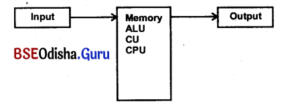
An input device is a machine that feeds data into a computer. The input unit is actually a device that provides man-to-machine communication with the computer.

Data and instructions data. Input data may be characters, symbols, audio, visual, or audio-visual The following functions are performed by input devices,

  • It accepts the list of instructions and data from the outside world,
  • It converts these instructions and data into binary form for acceptance by the computer.
  • It supplies converted instructions and data to a computer system for further processing.

The number of input devices inputting information into a computer such as – keyboard, mouse, joystick, lightpen, optical character, recognition bar code scanner, speed recognition, and graphic scanner, etc.

Question 34.
What is an output device? Give kinds of it.
Answer:
The device through which we get information from the computer is known as an output device.

The output coming from the CPU is in the form of electronic binary signals which needs conversion in the same form which can be easily understood by human beings, i.e. graphical
The output can be given:

  • On the screen by the visual display unit.
  • In printed form by printers.
  • In graphic form by plotters.
  • In audible sound form by speech.

The output devices may adopt, hard copy devices, and soft copy devices and hard copy devices produce a permanent record on media such as paper sheets.

CHSE Odisha Class 11 Political Science Unit 3 Understanding Political Theory Long Answer Questions

Odisha State Board CHSE Odisha Class 11 Political Science Solutions Unit 3 Indian Constitution Long Answer Questions.

CHSE Odisha 11th Class Political Science Unit 3 Understanding Political Theory Long Answer Questions

Long Type Questions With Answers

Question 1.
Discuss the composition and functions of the constituent assembly of India. Or, Narrate the organization and role of the Indian Constituent Assembly?
Answer :
The constitution of free India was framed by a constituent assembly. The assembly was a representative body that was organized on the recommendation of the Cabinet mission and with the purpose of formulating a new constitution.

Composition :
The assembly comprised members elected from provincial legislatures. As per the recommendation, members were chosen in the ratio of one in every one million (10 lakh) population. Members were elected on the basis of propositional representation through a single transferable vote. There was a special provision for the election of members on communal lines. The total strength of the Assembly was 389, out of which 210 seats were reserved for general candidates. 78 for Muslims for sixth and the rest four for chief commissioner provinces. 93 seats out of 389 were reserved for the representatives of princely states.

Election to the Assembly was held in November 1946 in which the Congress was 211 seats out of 296, Muslim league won 73 and the rest 12 went to Sikhs, independents, and others. Princely states did not participate in the election to the constituent assembly. The dominance of the congress was unbearable for Muslim League for which it did not participate in tire assembly, The very first meeting of the constituent assembly was held in the central hall of Parliament under the presidentship of Dr. S.N. Sinha, Later Dr. Rajendra Prasad was elected as Chairman and Dr. H.C. Mukherji as vice chairman.

The first meeting was held on 9th December 1946. The assembly was represented by eminent lawyers. Statesmen said activists intellectuals and other luminaries of India. Status of the Assembly: The constituent Assembly was never a sovereign body and all its powers were derived from the authority of the British parliament. But, after formation, a resolution was passed to strengthen its states so that the British parliament could not dissolve it at will. After independence, the Assembly became fully sovereign and continued up to 25th January 1950.

Role and Functions:
The Assembly had to perform two major functions The making of the new constitution and Acting as the parliament of India till a new parliament is elected. The constituent assembly adopted the objective resolution on 22nd January 1947 and thereby specified its goal. On the 15th of August 1947, when India became free the assembly enjoyed sovereign states as the most powerful legislature of new India.
The Constituent Assembly was divided into several committees and sub-committees to expedite the process. These committees discharged.

their responsibility and committees discharged their responsibility and submitted the final proposal to the Assembly for approval. The Assembly tried to take all decisions by unanimity, not by majority. The Drafting committee played a very. crucial role in the making of the constitution of India. It was formed on 29th August 1947 with Dr. B.R. Ambedkar as its Chairman and seven other outstanding legal seminaries and its members.

The entire constitution was drafted by this committee after thorough examination, review, and discussion on all major issues.
The final draft was approved on 25th November 1949 by the constituent assembly. The constitution came into force on 26th January 1950.

Question 2.
Discuss the organization of the constituent assembly and its objective resolution. Or,’ Explain the composition and objective resolution of the constituent assembly?
Answer :
The Indian constitution is a hand made of constituent assembly. It was a representative body that took 2 years, 11 months, and 18 days to prepare the constitution of India. The Assembly was established under the provisions of the cabinet mission plan. The idea of the Constituent, Assembly, as a representative body, was framed specifically for the purpose of formulating the fundamental law of the nation.

Composition:
The Constituent Assembly consisted of the representatives of the principal communities in India. Seats were distributed roughly among the different provinces in the ratio of one member for every one million population. The legislative Assembly of each province elected this representative on the basis of proportional representation by means of a single transferable vote.

The total strength of the constituent assembly was fixed at 389, out of which 210 seats were reserved for the general candidates. 78 for the Muslims, four for the Sikhs, and the rest for the Chief Commissioners’ provinces, and 93 seats were reserved for the representatives of the princely states.

After the election to the Assembly Congress won 211 seats out of 296, Muslim League won 73, and the rest 12 went to the independents and other parties. The princely states did not join the Assembly for which its membership came down to 296. The dominance of the congress party was unbearable to the Muslim League which remain absent.

The Constituent Assembly for the first time met on 9th December 1946 with Dr. Rajendra Prasad as the Chairman and Dr. H.K. Mukherjee as Vice-Chairman. It was mostly represented by eminent lawyers, politicians, and statesmen. Dr. B.R. Ambedkar was the chairman of the Drafting Committee and for his contribution, he is regarded as the father of Indian constitution. The Assembly took a period of 2 years II months and 18 days to frame the new constitution.

Objective resolution :
The Constituent Assembly met in its second plenary session from January 20 to 309 in the year 1947 Pandit Nehru adopted an objective resolution in this session. The resolution declared that India must be a Sovereign Democratic Republic and the Programmes of the constitution were outlined thereon. The principles of the resolution may be discussed below.

The territories that now comprise British India, the territories that now form the Indian state, and such other parts of India as the outside. British India and the states as well as such other territories as they willing to be constituted into independent sovereign India shall be a union of them also.

The territories with their present boundaries and with such others as may be determined by the Constituent Assembly and thereafter according to the law of the constitution shall possess and retain the status of automatic units together with residuary powers and exercise all powers and functions of government and administration, except such powers and functions as are as assigned to the union or a’s are implied in the union or other form.

All powers and authority of sovereign India, its constituent parts, and organs of government are derived from the people.
The constitution shall guarantee and secure to the people of India, social, economic and political equality of status and opportunity and before the law freedom of thought, expression, faith, belief worship, vocation, association, and action subject to the law and public morality.

Adequate safeguards are provided for minorities of backward and tribal areas and other backward classes. The integrity and sovereignty shall be maintained on land, sea, and air according to the law of the nation. India will attain its honorable place in the world and make its constitution towards peace and welfare of mankind.

Question 3.
Explain the preamble to the Indian Constitution. Discuss the basic principles of the Preamble to the Indian Constitution. Or, Write an essay on the Preamble to the Indian Constitution?
Answer :
The Indian Constitution starts with the Preamble which outlines the aims, objectives, and ideals of the Constitution. It is the soul of the Constitution and an introduction to the political setup. The preamble reads “WE THE PEOPLE OF INDIA having solemnly resolved to constitute India into a SOVEREIGN SOCIALIST SECULAR DEMOCRATIC REPUBLIC and to secure to all its citizens. JUSTICE, social, economic, and political LIBERTY of thought expression, faith, belief, and worship.

EQUALITY of status and opportunity and to promote among them all. FRATERNITY assuring the dignity of the individual and die unity and integrity of die nation IN OUR CONSTITUENT ASSEMBLY this twenty-sixth day of November; 1949 do hereby ADOPT ENACT AND GIVE TO OURSELVES THIS CONSTITUTION. The 42nd Constitutional Amendment has introduced the words, SOCIALIST and SECULAR, in place of SOVEREIGN DEMOCRATIC REPUBLIC, and in plae of unity of the nation, the word ‘integrity’ has been added.

Significance :
The Preamble is considered to be the soul of the Constitution and it explains about the aims and objectives in a nutshell. The preamble speaks of four things.

  • the source of the constitution.
  • the aims and objectives of the constitution.
  • the ideas and philosophy of the Constitution.
  • and the data of its approval. The Preamble contains the fundamental principles of the Constitution and the words used in it make it sublime.

The Supreme Court has said that the preamble indicates the general purposes for which the people have ordained and established the Constitution. It explains about the nature and spirit of the Indian Policy.

Basic Principles:
The basic principles of the Preamble can be discussed below:
We the People of India :
The Preamble starts with the phrase we the people of India which boldly declares about popular sovereignty. The constitution is considered to be framed by the representatives of the Indian citizens and not an Imposition from above. The Constitution is made by the people and it embodies popular ideals and aspirations.

Sovereign, Socialist, Secular, and Democratic Republic:
The Preamble depicts India as a Sovereign Socialist Secular Democratic Republic.  India is a sovereign independent entity. It is externally free from the control and influence of others and internally, it is a component to adopt principles of governance. None can interfere in its domestic matters.

The term Socialist indicates the country’s determination to follow the principles of socialism like the nationalization of industries, protection of the interests of the economically backward sections of the society, etc. The term ‘secular’ represents tolerance towards minority groups and equality of opportunity and protection to all religious groups. Indian Political System is organized on the basis of democratic principles.

The Parliament and state legislatures are elective bodies. A franchise is extended universally to all adults above 18 years of age. The citizens are granted with rights and freedom and the Govt is responsible to the people, hence it is a democratic country. Republic represents the elective office of the President and the representative character of the Head of State.

Justice:
The Preamble also clarifies the intention of the Govt, to ensure justice in the social, economic, and political spheres. The Constitution has abolished untouchability and offered equal opportunity to all in matters of public employment to ensure social justice. Equitable distribution of national resources is meant to ensure economic justice and universal suffrage is guaranteed as a mark of political justice.

Liberty :
The preamble also emphasizes on grant of liberty to the Indian citizens, such as liberty of thought, freedom of expression, faith, belief, and worship. These are provided under the Fundamental Rights.

Equality :
Equality is an essential attribute of the state in India. The Constitution has assured equality of status and opportunity to all irrespective of discrimination. The enjoyment of equal rights and political equality are significant aspects of the principle of equality.

Fraternity :
The constitution has sought to maintain universal brotherhood among its citizens so as to maintain the unity and integrity of the nation in the face of disintegrating forces.

Date of adaptation :
The Preamble states that the Constitution has been adopted by the Constituent Assembly on 26th November 1949. The Preamble of the Constitution thus reflects the soul and substances of the Constitution in brief.

CHSE Odisha Class 11 Political Science Unit 3 Understanding Political Theory Long Answer Questions

Question 4.
Discuss the salient features of the Indian Constitution, Or, Analyse the basic principles of Indian Constitution. Or, Brief the unique features of Indian Constitutional system?
Answer :
The Constitution is the basic law of the land or the principles of governance. Every democratic country today possesses a written Constitution of its own. Similarly, in India – there is a written Constitution which is prepared after going through some useful democratic constitutions of the world. The framers incorporated those principles which they felt suitable for our nation and the people. The basic feature of our Constitution can be discussed below.

Sovereign Socialist Secular Democratic and Republic :
Indian Constitution declares it to be Sovereign, the master of its’ own destiny. India is internally free to control it’s subjects and externally independent of all other sovereign states. The Constitution provides for a democratic election where people enjoy adequate rights and liberties.

Constitution clearly mentions about the republican aspect of the Constitution The head of the state, the President is indirectly elected by the people. Indian Constitution also provides for a secular state where everybody enjoys an opportunity to profess any religion, any belief or worship any God for his salvation. The minority community is not left unsafe.

There is tolerance of the minority. The state does not follow any particular religion and does not assign any privilege to any particular religion. All are equal before and must enjoy freedom equally. Liberty is guaranteed to every kind of religious person. Constitution provides for the socio-economic and political right of the individual.

The largest Constitution in the world :
At present, the constitution of India is the largest constitution in the world. It consists of 395 Articles and 12 Schedules with the inclusion of Panchayat Raj, the seventy-third Constitutional amendment of 1992.

Every possibility of efforts have been taken to reflect the will and opinion of the people in the Consti tution of India. The Constitutional fathers, considering the heterogeneity aspect of the Constitution, and the experiences of communalism, have taken all sorts of initiative to have a balanced and effective Constitution.

Again in other federal Constitutions like U.S.A. and Switzrland where lies a separate Constitution for the state, the same does not exist in India. The power and authority of state have been enumerated in the same Constitution. Various provisions have been made to meet the different needs of the people and there are also special provisions to safeguard the interests of the minority.

The Schedule Caste and Schedule Tribes have been accorded special benefits under the constitution. The detailed chapters on fundamental rights and directive principles of the state policy, emergency, provisions, fundamental duties have caused for large size of constitution.

Parliamentary form of Government :
The Constitution of India proposes a Parliamentary form of Government where there is daily and periodic assessment of responsibility of government. The Parliamentary form of Government was adopted in the Constitution of India because of our long association with British Government.

Federal in form but unitary in spirit:
Although there is no mention of the term federation yet the Constitution of India in its Article – 1 declares that India is a Union of States. In India there are the features of a federal like he dual polity, written constitutional government, independent judiciary etc. are reflected in the constitutional of India. Though there are, federal features in the Constitution of India but there is also strong unitary spirit in the Constitution. The central Government bears preferential treatment over the Stats Government.

The emergency provisions, the appointment of the Govemer by the Central Government, the provisions of all India services, the integrated judiciary, single citizenship etc. are clear illustrations of all those things. Often the Constitution of India has been criticized by critics as Quasi federal, federal in form but unitary in spirit etc.

Balance between rigidity and flexibility:
The constitution of India is a happy blending of both rigidity and flexibility. So far as the amendment of the Constitution is concerned a balanced is struck between rigidity and flexibility. A flexible constitution is one which can be easily amended without having any rigid procedure.

India is partly flexible because certain provisions of the Constitution can be simply amended by the simple majority of the Parliament but on the other hand a rigid Constitution is one whose amendment procedure is very much difficult. In India there are certain provisions which can not ordinarily be amended by the simple majority of the parliament and it requires ratification by the states.

In India the provisions like the creation of new states, abolition of the second chamber of the states, changes in citizenship requires simple majority. But other requires the two-third majority of the House. The presidential power, mode of election, the executive and legislative powers of the state provisions regarding the supreme court and high courts, etc.

a Majority of the total membership of the House of Parliament Not less than 2/3rds members of each House present and voting. Rectification by one-half of the states. The above analysis clearly shows how the Constitution of India, is a happy blending of both rigidity and flexibility.

Fundamental Rights :
Unlike the bill of rights of the American Constitution, the Constitution of India provides a scheme of fundamental rights which has been incorporated and discussed in the III part of our Constitution. The Constitution in its Articles 12 to 35 deals with the scheme of fundamental rights. There are six categories of fundamental rights. Those are

  • Right to equality,
  • Right to freedom,
  • Right against exploitation,
  • Right to freedom or religion,
  • Cultural and educational rights
  • Right to constitutional remedies.

Fundamental duties :
Rights without duty is meaningless which was realized in the 42nd constitutional amendment in 1976. A scheme of fundamental duties waš incorporated into the Constitution of India in Article 51A. The Constitution of India provides for 10 categories of fundamental duties.

Directive Principles of State Policy :
Following the Spanish and Irish Constitution, the Constitution of India have incorporated a scheme of Directive Principle of State Policy which are fundamental principles for the governance of the country. The Directive Principles óf State Policy contains the socialist Gandhian and the liberal ideals.

Single CitizenshIp :
Though there are federal principles in the Constitution of India yet it has not opted for double citizenship. In India, there is provision of single citizenship which implies that irrespective of birth or residence all are citizenship which implies that irrespective of birth or residence all are citizens of India are entitled to enjoy all civil and political rights. They are free to purchase land and to settle anywhere in the country. Single citizenship is a great step forward in the creation of an integrated Indian society.

Secular State :
The constitution of India in its preamble contains the secular conception of the state. The secular state assigns no special privilege or patronage to any particular kind of religion and the state has no religion. Article -16 of the Constitution provides for equal opportunity for employment under the stale without discrimination against any religious community. The state also does not possess any power for the imposition of any religious taxes.

Thus, an all-around attempt has been made by our Constitution makers to embody secularism in our Constitution and absolute freedom is given to the citizens to profess or practice and worship any kind of religion they prefer.

Integrated and Independent Judiciary :
Normally a federal state has a dual form of the judiciary at one the federal level the other in the states. But in India, there is the provision for an independent and integrìted Judiciary for the country. The judiciary is organized on a hierarchical basis which begins from the Supre Court to the level of Naya Panchayats.

The judiciary in India also remains independent from the legislature and executive. Originally the judiciary enjoys the powers of judicial review and it can declare any law as ultra vires or void if the law does not conform to the values and beliefs of the constitution.

Universal Adult Franchise :
The Constitution of India in its Article 326 provides a universal adult franchise which reads The election to the House of the People and the House of the State, Legislative Assembly shall be in the basis of Universal adult suffrage. In other words, it can be told that any person who is a òitìzen of India and have attained the age of eighteen will be entitled to cast his right to vote for the purpose of selection of representatives.

Parliamentary Form of Government and Judicial Supremacy:
Normally in all Parliamentary forms of government, the Parliament enjoys comparatively a high degree of power because there is no strict separation of power and the judiciary in the Parliamentary form of Government does not enjoy that much power by which it can declare any law of the state as ultra vires or void.

Though our Constitution is silent with regard to the power of the Supreme Court to declare any Act of Parliament as ultra vires but in practice, it is observed that the Supreme Court of India has got a limited judicial review. Again Parliament and amend the Constitution with the prescribed majority. Once the Constitution is amended the Supreme Court will accept it. Thus, the powers of the Parliament and judiciary are balanced.

Welfare State :
The Indian Constitution under Art. 38 does ordain to establish a welfare state. The directives inserted into the Constitution are intended to transform the policy into a welfare state. The Govt pledges to provide basic minimum needs to every Indian. It has undertaken a variety of steps to maintain social security, justice, and equality reducing the gap between rich and poor. Thus, the Indian Constitution is considered to be a model Constitution for new, independent backward nations.

Question 5.
Write an essay on Art. 368 of the Indian Constitution. Or, Discuss the procedure of Constitutional Amendment in India. Or, Is the Indian Constitution rigid?
Answer :
No democratic Constitution can be static. It must be dynamic and in course of time, it must be amended in response to the needs of society. Therefore, the framers of the Indian Constitution have adopted a flexible procedure of amendment with rigidity on federal matters to make the constitution a dynamic one.

The procedure of Amendment: The Indian Constitution under Art. 368 has Procedure of Amendment The Indian Constitution under Art. 368 has empowered the Parliament to make necessary alternations, revisions, addition, repeal, variation, or detection of any provision of the Constitution. Such a proposal can be introduced into either House of Parliament and after approval, in both Houses, the President can make necessary changes in the Constitution. Art. 368 prescribes three different procedures for amendment of the Constitution.

Flexible Procedure :
The first procedure is a flexible one and the provisions like

  • Creation of a new state;
  • Creation on the abolition of the second chamber of the states;
  • Change in citizenship;
  • Changes or alternations of the boundary of states; can be amended if the proposal is approved in both the Houses of Parliament by a simple majority of votes.

Neither rigid nor flexible :
The second procedure is a combination or rigidity and flexibility. In this procedure, most of the provisions of the Constitution can be amended such as; fundamental rights, directive principles, emergency provisions, etc. such a proposal of an amendment requires a special majority in both the Houses of Parliament, viz.

By 2/3rd majority of members present and voting in both houses and By majority membership in each house. Such a proposal shall be effective only after receiving President’s assent. The president can’t withhold assent to an amendment bill.

Rigid Process :
This is the most difficult process in which the federal provisions, mode of appointment and election of president his powers and procedure of removal, the appointment of High Court, Supreme Court judges center state relations, etc. can be amended. Any such proposal of amendment must e passed in both the Houses of Parliament by a special majority and must be ratified by at least half of the state legislature. Thereafter with presidential consent, the constitution stands amended.

Thus from the above description, it is clear that the procedure of amendment strikes a balance between rigidity and flexibility. In case of disagreement, the proposal is killed and a joint sitting can not be convened in matters of the amendment. However, due to party Govt, the procedure is more flexible than rigid.

CHSE Odisha Class 11 Political Science Unit 3 Understanding Political Theory Long Answer Questions

Question 6.
“India is a Sovereign Socialist Secular Democratic Republic.” Justify?
Answer :
The Constitution of India in its Preamble states that we the people have solemnly resolved to constitute India into a sovereign socialist, secular, democratic, republic, lire following discussion illustrates the justification of the embodiment of above conception.

Sovereign :
The Constitution of India declares India to be a sovereign state. It is the sole proprietor of its own destiny. The supreme power of India is exercised that used not by any outside power but rather by its own authority. Internally it possesses the power to control and regulate the citizens and subjects residing within the territory of India. India possesses absolute jurisdiction over them. Viewed from an external point of view it is also independent of all other external or outside powers.

It possesses the right to maintain an independent and equal relationship in relation to foreign powers. Socialist: The Constitution of India also declares it to be a socialist state. It does not prefer the concentration of wealth in the hands of a few persons leading to a monopoly of production and exploitation. The state also endeavors to ensure the upliftment of the standards of the poor and downtrodden through its Directive principles of state policy.

Secular :
The socialist and secular conception of the Constitution of India was incorporated in the 42nd constitutional amendment. By which the state must honor all religions equally and internally. The state has no religion and the state will not hinder in the spread of any religion and the individual must not be compelled to accept or renounce any particular religion.

Rather maximum authority and independence is provided to every individual to profess and worship any kind of religion according to their sweet will. Article 16 provides for equal opportunity for employment under state government without any religious discrimination. The state-managed educational institutions are debarred from imparting any kind of religious instruction in the educational institutions. The Constitution also prohibits any kind of religious taxes etc.

Democratic :
Liberty, equality and fraternity, rule of law limited constitutional government, representative form of democracy, free press and public opinion and popular sovereignty, etc. are commonly accepted as the pillars of democracy. The Constitution of India has taken the best possible steps to owe and observe all those above-mentioned principles to materialize.

Maximum efforts has been taken to enhance the common good welfare conception of the state has been accepted. So India can be regarded as a democratic form of state when people by their franchise select the representatives and governs the state through their representatives.

Republic:
Finally, India is also a republic state. A republic state is one where the head of state must be directly or indirectly elected by the people. The constitution provides that with regard to the election of President of India who is the head of state is elected by an indirect election by an electoral college which is formed on behalf of the people.

Question 7.
Discuss the basic features of Indian Fundamental Rights?
Answer :
The Indian Constitution in Part – III under Art. 12-35 has provided six fundamental rights to Indian citizens. These rights are borrowed from the democratic constitutions of the USA, France, and Japan and they provide adequate opportunities to the people for self-development.

Features:
The basic features of Indian fundamental rights can be discussed below.

  • The fundamental rights in India are elaborate and comprehensive in character. These are discussed in 24 articles. Initially, there were seven rights but after the 44th Amendment Act, of 1978 the people today enjoy only six rights.
  • The fundamental rights do not contain any natural rights.
  • The constitution has guaranteed certain special rights for the protection of minorities. It has been abolished untouchably and granted special rights for women and children.
  • The Fundamental Rights contain both negative and positive rights. The negative rights impose restrictions on state activity
    while positive rights grant certain freedom to the citizen.
  • No social and economic rights are included in the list of Fundamental Rights
  • All the fundamental rights are guaranteed to the citizens but there are some rights available to the aliens, such as the right to equality before the law & freedom of religion, etc.
  • The fundamental rights in India are not absolute in character. The parliament is empowered to impose reasonable restrictions on the enjoyment of these rights. The Supreme Court is there to find out whether parliamentary restrictions are reasonable or not.
  • These rights are binding equally upon the Union, the State, and other state authorities.
  • The constitution not only guarantees fundamental rights but also provides legal sanctions for the enforcement of these rights. The Supreme Court and High Courts can issue writs for protecting the rights of the people.
  • Parliament of India can amend the fundamental rights excluding the basic structure.
  • During an emergency under Art. 352 the rights guaranteed under Act. 19 and 3 / cease to have any value.
  • The constitution under Art. 21-A has guaranteed the Right to Education to children belonging to the age group of 6 to 14 years.
  • These rights are enjoyed by the citizens of India when they live in India and abroad.
  • Parliament can modify by law as to the application of fundamental rights to the members of armed forces or to any other persons.
  • These rights are superior to ordinary laws of the land and directive principles. If any law of the Union or state goes against any right it is declared void.

CHSE Odisha Class 11 Political Science Unit 3 Understanding Political Theory Long Answer Questions

Question 8.
Describe the fundamental rights of the Indian citizens?
Answer :
a democratic constitutional Indian constitution has incorporated a list of fundamental rights for the citizens. These rights are mostly political in character and they are essential For the development of individual personality. Some of these rights are meant for aliens, but all them are useful for citizens. These fundamental rights are constitutional in character and justifiable in nature. In case of violation, the courts can enforce them by the issue of writs.

The original constitution prescribed for seven fundamental rights-, but the 44th Amendment Act of 1979 has deleted the right to property from fundamental rights, so we now enjoy only six fundamental rights which can be discussed below.

Right to Equality :
The constitution under Art. 14 to 18 has discussed about right to equality. Art. 14; guarantees equality before the law and equal protection of laws to all citizens within India. Art. 15 prohibits discrimination on grounds, of religion, race, caste, sex or place of birth, etc. in regard to access to shops, public restaurants, hotels and places of public entertainment, or the use of roads and place of public resorts ‘ maintained wholly or partly out of state funds.

But, the state can make special provisions for women and children, (c) Art. 16 grants of opportunity to all citizens in matters of employment under the state. But, reservations for backward classes does not hinder this equality, (d) Under Art. 17 untouchability is abolished and its practice in any form is forbidden, (e) Art. 18, denies conferment of titles and honors except that of military or academic in character.

Right to Freedom:
This right is mentioned from Arts. 19 to 22. As per Art. 19. All citizens of India shall have the right.

  • to freedom of speech and expression;
  • to assemble peacefully without arms;
  • to form associations or unions;
  • to move freely throughout India;
  • to reside and settle in any part of India, and
  • to practice any profession, trade, or business.

Article 19 (2) provides that the right to freedom is not absolute in nature, and the state can. impose reasonable restrictions on those rights in the interest of the state, and friendly relations with the foreign state. public order or in matters of Article – 20 provides that no person shall be deprived of his life or personal liberty except according to procedure established by law. Article – 22 deals with protection against arbitrary arrest and detention.

Right against Exploitation :
Article 23 of the constitution prohibits all forms of forced labor, unpaid labor, and traffic in human beings. It frees the poor, downtrodden, and dumb people of the Indian states from the curse of beggars. Further Article – 24 provides that no child below the age of 14 years shall be made to work in any factory or mines or engaged in any other hazardous work. Thus it gives security to the weaker sections.

Right to Freedom of Religion:
Article 25 provides that all persons are equally entitled to freedom of conscience and the right to profess, organize and propagate religion subject to public order, morality and health.

Article 26 provides, that subject to the moral order, public order health, every religion, denomination or any section thereof shall have the right to establish and maintain institutions for religious and charitable purposes, to manage its own affairs in matters of religions to owe and acquire movable and immovable property and to administer such property in accordance with the law.

Article-27 provides that no person shall ‘ be compelled to pay any tax which are expended for the purpose of promotion of any particular religion. Article 28 provides that no religious instruction shall be provided in any educational institution with entirely managed funds. But it is not applicable to institutions which have been established under an endowment or trust.

Cultural and Educational Rights:
Cultural and educational rights have been guaranteed from Article-29 to 30. Article 29 provides that any citizen residing in any part of the territory of India having a distinct language, script, or culture of its own, shall have the right to conserve the same. No citizen shall be prohibited to take admission into any educational institution maintained by the state or receiving aid from out-of-state funds.

According to Article 30, all minorities are guaranteed cultural freedom too. preserve its language, script and culture. All minorities possess right to establish and manage educational institutions at their own. The cultural and educational rights of minorities are constitutionally protected. 6. Right to Constitutional

Remedies:
The right to constitutional remedies refers to the enforcement of the rights mentioned in the Constitution. Article 32 provided that the Supreme Court shall uphold the fundamental rights and entitles the citizens to go to such court by appropriate proceedings for the enforcement of fundamental rights.

According to Article 32 the Supreme Court is the protector of fundamental rights. The Supreme Court can accept direct complaints for the violation of the fundamental right and may also hear appeals against the decision of the High Court. But in case of emergency, some of the fundamental rights can be suspended.

Question 9.
Discuss various writs issued by the judiciary for the protection of Fundamental Rights?
Answer :
The constitution has empowered the Supreme Court to act as the guardian of fundamental rights. The Supreme Court can protect it on the basis of issuing various writs which are five in number. These are Habeas Corpus, Mandamus, Prohibition, Quo-warranto, and Certiorari which are discussed below in detail.

Habeas Corpus :
Habeas Corpus is a Latin term which means to have the body. This is the power of the Supreme Court to ask the Government or the executive authority about the allegation against the person, whether the ‘person has been lawfully ‘detained or not.

If a person is found to have been arrested without having any valid reason, the court orders for his release. The sole purpose behind issuing the writ of Habeas Corpus is to ensure the liberty of a person who has been confined without any legal justification. This writ is issued by the Supreme Court and the High Court.

Mandamus :
Mandamus is a Latin word that refers to “We order”. Mandamus is an order which commands a person or to authority to do a certain thing that falls under his jurisdiction. Normally in India, this type of. writs are issued to. public officers. It is used for public purposes to ensure the performance of public duties.

Prohibition:
Usually, this type of write is issued to lower Courts prohibiting the lower court to, r Train from usurping a jurisdiction in which it is not legally competent. In other words, it is the authority of the Supreme Court and High Court in India to direct the lower court to keep itself within the jurisdiction what is assigned to lower court.

Certiorari:
Certiorari is the writ by which higher court can direct the lower court to transfer the case from lower court to higher court. It can be done before the trial or during a trial to quash an order which has been made without jurisdiction.

Quo-warranto:
The writ of Quo- warranto is issued by Supreme Court or High Court to prevent an illegal assumption to any public office. Quo-warranto means by what authority. Suppose a person who is contesting in the election is below 25 years of age and if he is elected the court can declare him unfit and the post vacant as he is under aged.

Before the enactment of the present constitution this type of writ was particularly exercised and issued by the High Court of Bombay, Madras, and Calcutta High Court but now it is being enjoyed by both Supreme Court and High Court.

Question 10.
Fundamental rights are neither fundamental nor right. Discuss?
Answer :
Though the Constitution of India has boldly declared about the fundamental rights in the Constitution, the heterogeneity and mutual opposition of certain articles of the Constitution has been subjected to scathing criticism. Many other critics are of the view that there are so many limitations on the working of the fundamental rights that practically the citizens do not enjoy much substantial rights, the fundamental rights have been described as neither fundamental nor rights because of the following reasons.

The provisions of preventive detentions suspension of Article-19 to 32 during emergency causes for direct encroach upon the fundamental rights of the people. What are given in the form of fundamental rights that are taken away on the assumption of national security and declaration of emergency by the Government of India

Further fundamental rights have left a number of important categories of rights such as the right to work, the right to rest and leisure, right to education and right to social security, So there is a vast gap between the fundamental rights guaranteed in the constitution and the limited reality of those rights in India nowadays.

Further, the frequent constitutional amendments have restricted the exercise of fundamental rights. The right to freedom which has been amended for so many times out of which the right to freedom has lost its concrete shape. Though Article 17 of the Constitution prohibits the systems of untouchability. evil still exists in various parts of the country. The frequent misuse of preventive detention has subordinated and decayed the sanctity of fundamental rights.

Though there are historic judicial interpretations in favor of the protection of fundamental rights like the judgment in 1967 in favor of the Right to property, there is no strict judicial review. Unlike the Constitution of America, the Supreme Court of India does not possess the power of judicial review which became clear in the 42nd Constitutional Amendment of 1976. In India, there is a parliamentary democracy where popular sovereignty resides in the Parliament and the Supreme Court processes no power to override the intention of the Parliament.

Further presence of Directive Principles of State Policy has caused a point of limitation over fundamental rights. In the 42nd constitutional the union legislature was of the opinion that Directive Principles of State Policy seek to promote and the interest of the community as a whole which intends to promote justice in the society but fundamental rights are concerned with the interest of the individual alone.

So the Directive Principles of State Policy should prevail over fundamental rights. From the above-mentioned reason, it is
clear that though constitutionally the fundamental rights have been guaranteed to citizens in India yet there are several loopholes that restrict the operation of fundamental rights. Various political philosophers criticize them as un fundamentalistic.

CHSE Odisha Class 11 Political Science Unit 3 Understanding Political Theory Long Answer Questions

Question 11.
Make a brief statement of the Directive Principles of State policy as embodied in the constitutions?
Answer :
The Directive Principles of State Policy are the feature of the socialism, and liberalism. and Gandhism which has been discussed in Part. IV of the Constitution of India. India being a poor country where there is .uneven distribution of resources the economic fundamental rights is not possible for realization. Considering the lack of finance and backwardness of the nation the Constituent; Assembly made a special provision which are known as the Directives in order to protect the interest of all but not a few.

There are sixteen directives enumerated in the Constitution of India which extends from Articles 36 to 51 of the Constitution. The Directive Principles of State Policy are often considered guidelines to central government and the state governments. The state and central government at the time of formulation of laws should keep in mind the instructions contained in the Directive Principles of State Policy.

Those Directive Principles of State Policy are often considered as the fundamental principles for the governance of a state. Those principles are welfarist in nature and intend to promote the socio-political and economic well-being of the people. Unlike fundamental rights, the Directive Principles of State Policy are not enforceable in a court of law. But the working of the constitution since 1950 has proved that; Directive Principles of State Policy are superior in comparison to fundamental rights. Jha Directive Principles of State Policy can be broadly divided into three categories, viz.

the Gandhian Principles, the Marxian Principles, and the Liberal Principles which are discussed below:
Gandhian Principle:
Gandhian Principles are based on the ideology and principles of MK Gandhi. Those are the Revival and organization of Village Panchayats which will work as self-governing autonomous units. Promotion of village or cottage industries in rural areas. The state should take special initiative for an educational and economical promoters and progress of the backward and weaker section in society. Prevention of slaughter of cows, calves, and other milchy cattle. Prohibition of drugs and intoxicants, except for medical use.

Marxian or Socialist Principles:
Socialistic principles refer to abolition of the economic exploitation in society and the establishment of economic democracy on the basis of the socialistic pattern of society. The state should follow and implement the following principles in order to establish Marxian or socialistic principles in society. The state should endeavor to provide v adequate means of livelihood to all citizens. The state should ensure the equitable distribution of material resources of the country so as to prevent the concentration of wealth from leading to exploitation.

To ensure equal pay for equal work both for men and women. Promotion of the standards of the working class. To make provision for securing the right to work to education and to public assistance in case of unemployment, old age pension, sickness, and other similar cases.
To ensure a decent standard of living and facilities of leisure for all workers.

(3)Liberal Principles:
The third category of Directive Principles of State Policy contains some general principles which can be branded as liberal’ principles which are considered for the general well-being of the people. They are the following category. The state shall take steps to separate the judiciary from the executive in the public services of the state. Article-44provides that the state should provide for its citizens a uniform civil and criminal code throughout the territory of the country.

Article-49 provides that it shall be the obligation of the state to protect eve monuments of late or objects of historic interest. Article 51 states that the state shall endeavor to promote national peace and security, and will maintain just and honorable relations between nations in order to foster respect for international law and peace obligations, should encourage the settlement of an international dispute by peaceful arbitration.

Other than the above-mentioned principles the 42nd constitutions amendment of 1976 inserted new Jiree kinds of Directive Principle of State Policy as 39-A, 43-A & 48-A. Article-3 9-A reads that the state shall secure the operation of the legal system for the promotion of justice on the basis, of equal opportunity and shall provide free legal aid by suitable legislation or in any other way to ensure that the operation of justice is not, denied to anyone on the ground of economic or any other disabilities.

Article-43-(A) provides for the participation of workers in industries, undertakings or in any other organizations. Article-48-(A) reads that the state shall endeavor to protect and improve the environment and to safeguard the forest and will live off the country. The sole purpose behind the creation of Directive Principles State Policy is to have social and economic democracy in order to sustain the political democratic government in the interest of the state is gradually implementing the Directive Principles of State Policy.

Question 12.
Analyze the importance of Directive Principles of State Policy in the Constitutional setup of India?
Answer :
Directive Principles of State Policy is considered as the fundamental basis for the governance of India. It is a bunch of directions or principles, which are enlisted in the Constitution of India which the Central and the State Governments shall gradually implement in the administration of the state.

Originally those directive principles of state policy has been inherited Com the Irish and Spanish Constitution. The Directive Principles of State Policy are socioeconomic instructions to the government which guide the government in the affairs of formulation and execution of certain socioeconomic principles for the management of the affairs of the state.

These principles provide a criterion or standard to adjudge the performance of the ruling party. The Directive Principles of State Policy are positive in nature because it provides a wider scope to the government to enact them as the laws of the state. Unlike the fundamental rights, the Directive Principles of State Policy are not enforceable in a court of law but the Directive Principles of State Policy occupy a significant position in the administration of the state and the government should consider them with utmost importance and implement them gradually.

Significance:
The Directive Principles of State Policy are the directive or creative part of the Constitution of India. They are considered as the ideals of the Indian Constitution which seek, to promote the socioeconomic justice of the citizens of India.

The Directive Principles of State Policy are induced in the Constitution with a view to providing opportunities for state initiation in the socio-economic life of Indians. There was no legal basis behind the operation of Directive Principles of State Policy but the 42 Constitutional amendments of 1976 assigned a comparatively comfortable position to it.

Though it may not have the desired level basis yet it would be self-sufficient to say that the voice of people of public opinion is the real support in a democratic setup. If the government will display an apathetic posture toward the execution of Directive Principles of State Policy then it would likely to lose the support of the people.

The Directive Principles of State Policy act as a guideline for the legislators of the rulers in India in order to promote the welfare of the nation as a whole. The importance of Directive Principles of State Policy lies for the successful working of democracy. There is only a legal basis with regard to political democracy but it is well known and commonly accepted that political democracy without having a sound socio and economic basis would turn into a fiasco considering the socio-economic backwardness and lack of resources in India.

The Directive Principles of State Policy does riot provide an) legal basis but at the same time, it provides that the state must look after the Directive Principles of State Policy and, implement it gradually ir the interest of the community. The Directive Principles of State Policy is regarded as the foundation stone o socio-economic democracy in India. The Indian Constitution will be meaningless without Directive Principles of State Policy.

Thus, it is a matter of compulsion on the part of the particular political party not to exhibit any sign of indifferent attitude toward the execution .of tries principles because India essentially believes in socialism, and any political party may remain power but it should be instrumental for the execution of those principles.

The Constitution has specially given importance to fundamental rights and accorded it their legal status and any person or institution who violates those principles will be penalized by the legal procedure. But during the working of the Constitution since the 1950’s the Directive Principles of State Policy has enjoyed a preferential position over fundamental rights. Even the judiciary has recognized and upheld the importance of Directive Principles of State Policy.

Chief Justice Kania once remarked that Directive Principles of State Policy do not represent the will of the majority temporarily but it possesses the wisdom of the nation. Because the court was of the opinion that the fundamental rights are directed to remote political democracy and a safeguard for the protection of the individual interest but the Directive Principles of State Policy paves the way for socio and economic democracy without which no political democracy would be workable and which seeks to promote and protect the interest of all i.e.

the interest of the community. For the above reasons, Directive Principles of State Policy has been declared by the Constitution as the fundamental principles in the governance of the country. These are an asset to the progressive forces in the country which lays down the foundation stone of democracy.

Question 13.
Differentiate and distinguish between Fundamental Rights and Directive Principles of State Policy?
Answer :
The following points of distinction can be asserted between fundamental rights and Directive Principles of State Policy. The first point of difference between fundamental rights and Directive Principles of State Policy is that fundamental rights are justifiable but the Directive Principles of State Policy are not justifiable in a court of law.

If the fundamental rights are violated by any particular person or institution the aggrieved party may move to Supreme Court or High Court to get the right re¬enforced and his suffering might be redressed but if a Directive Principle is violated in cannot be re-forced in the court of law. The fundamental rights are considered as the foundation stone of the political democracy in India whereas the aim of the Directive Principles of State Policy is to ensure and achieve socioeconomic democracy in India.

Directive Principles of State Policy constitute very comprehensive political social and economic programs for the successful working, of a modem democratic state. The fundamental rights are prohibitory in nature and instruct the central and the state Government to refrain from doing certain things which would encroach upon the rights and liberties of the individual.

They are negative in character. But oft the other hand Directive Principles of State Policy are positive in nature. The Directive Principles, of State Policy, are a bunch of obligations of the state towards the citizens and the subjects which intend for the improvement or upliftment of the socio-economic conditions of the citizens.

These directives are affirmative instructions to the government to do certain things. The Directives are non-justifiable and in case of conflict between fundamental rights and directive principles these principles run subsidiary to the fundamental rights. The directives are to ‘ be implemented carefully so that fundamental rights are not infringed. In case of conflict, the rights prevail upon the directives.

CHSE Odisha Class 11 Political Science Unit 3 Understanding Political Theory Long Answer Questions

Question 14.
Discuss the Fundamental Duties of the Indian Citizens?
Answer :
The Indian Constitution on the lines of the Japanese, Chinese and Soviet constitutions has mentioned about fundamental duties under Art. 51-(A) in Part IV-A. These duties were inserted. into the constitution after the 42nd Amendment Act of 1976. Initially, there were ten fundamental duties but after 86th Amendment Act, of 2002 one more duty was added making it eleven. The duties are the responsibilities of the I citizens and with their inclusion into the constitution it was expected that all Indians The duties are enumerated below:
would be playing their part in the die nation-building process.

  • To abide by the constitution and respect its ideals and institutions, the National Flag and National Anthem.
  • To Cherish and follow the noble ideals which inspired our national struggle for freedom.
  • To uphold and protect sovereignty. Unity and integrity of India.
  • To defend the country and render national service whenever called upon to do so.
  • To promote harmony and spirit of common brotherhood among all the people of India and to renounce practices derogatory to the dignity of women.
  • To value and preserve the rich heritage of Our composite culture.
  • To protect and improve the natural environment including lakes, rivers, and wildlife, and to have compassion for living creatures.
  • To develop scientific temper, humanism, and the spirit of inquiry arid reform.
  • To safeguard public property and to abjure violence.
  • To strive towards excellence in all spheres of individual collective activity so that the nation constantly rises to higher levels of endeavor and achievement.
  • All Indian parents to send their children to school between the age of 6 to 14 years.

Question 15.
Narrate the Socialistic Principles of the Directives?
Answer :
The socialistic principles of the directives underline the goal of a welfare state. These principles are meant for the poor backward people, women children, and the working class. These principles can be enumerated below.

  • The state shall strive to promote the welfare of the people by securing a social order in which social, economic and political justice will prevail. (Art. 38)
  • The state shall provide adequate means of livelihood to all citizens, men, and women. (Art. 39)
  • The state shall secure the equitable distribution of material resources of the community to ensure common good. (Art. 39-(b)
  • The state shall regulate the economy. system in such a way as to prevent the concentration of wealth and means of production in a few hands. (Art. 39-(c))
  • The state shall try to provide equal pay for equal work for both men and women. (Art. 39-(d))
  • The state shall try to protect the health and strength of workers, men, and women, to protect the children from entering vocations. Unsuited to their age and strength. (Art. 39-(e))
  • The state shall try to protect children and youth from exploitation, and moral and material abandonment. (Art. 39-(f))
  • Art. 39-(A) has been added after the 42nd Amendment Act, 1976 which states that: the state shall provide free legal aid to people, to economically disabled persons to secure social justice; and to secure participation of works in the management of industries.
  • The state shall try to secure right to work, to education, and to public assistance in cases of unemployment, old age, sickness, and disablement and in other cases of undeserved want. (Art. 41)
  • The state shall try to make provisions for securing just and humane conditions of work and for maternity relief. (Art. 42)
  • The state shall try to secure to all workers’ right to work, a living wage, conditions of work, a decent standard of life, and full enjoyment of leisure and socio-cultural opportunities. (Art. 43)
  • The state shall try to promote the educational and economic interests of the weaker sections of the society and to protect them from injustice and all forms of exploitation. (Art. 46)
  • The state shall try to raise the (eve: of nutrition and the living standards of the people and improve public health.

CHSE Odisha Class 12 Sociology Unit 1 Introducing Indian Society Long Answer Questions

Odisha State Board CHSE Odisha Class 12 Sociology Solutions Unit 1 Introducing Indian Society Long Answer Questions.

CHSE Odisha 12th Class Sociology Unit 1 Introducing Indian Society Long Answer Questions

Long Questions With Answers

Question 1.
What do you mean by Unity in diversity? Discuss the various factors promoting unity in India?
Answer:
In spite of diversity, there is unity in India. There are bonds of unity may be located in certain mechanisms of integration Herbert Rosley census commissioner in 1911, was right when he observed “Beneath the manifold diversity of physical and social type, language, custom and religion which strikes the observer and in India.

there can still be discovered a certain underlying uniformity of life from the Himalayas to cape Cambrian. The concept of one united India has always been the fascinating idea of many great thinkers of this land. Since time immemorial India has been regarded as. one district society, unity in India. In the production of certain factors. We will now describe each of them.

Geographical Unity:
From a very early time. India has been visualised as one nation covering the whole landmass from the Himalayas to the ocean on the other sides. The Aryan thinkers and other philosophers named this landmass as Bharat Varsha. The term Bharat Varsha i.e., India has always referred to thus the vast expense of the land expanding from the Himalayas in North to the cap commotion on the South and from the Brahmputra in the East to the Indus in the west. These natural boundaries give the land geographical unity.

Religious Unity:
Although India in a land of many religions, religion has been one of the bases of national unity. As Srinivas says. The concept of the unity of India is essentially a religious one Hinduism being the religion of the majority of the people of India provides a basis for unity. Religious unity of the country in expressed through the existence of pilgrimage centres of great spiritual merits in the four parts of the country. Badrinaryan in the North. Rameswaram in the South, Dwarika in the West and Puri in the East eloquently speak the religious unity in India.

Cultural Unity :
India has cultural unity. The fundamental approaches to art, philosophy and literature are typically Indian in the character. Social institutions like the caste system and the joint family are found all over India which are once again topically Indian. Caste in such a widespread social institution in India that every Indian whether a Hindu, a Muslim or a Christian finds himself a universe of caste. These common social institutions and cultural traditions faster unity among the Indians.

Political Unity :
India has also political unity in India in the product of cultural and religious unity. The idea of bringing the whole country under one central authority is not new to Indians. Unification of vast areas and populations under one rule has been the highest goal of the kings statements. The ancient Indian political concept of Chakravarti clearly refers to the idea of political unification of the whole land. Many great kings right from Dilip, Yayati, Mandhata and Yudhisthira to Chandragupta Maurya.

Ashoka and Samudra Gupta of the later period had established there in sovereignty almost all over India the country and achieved the distinction of being a Chartkravai or universal ever lord. In the past kings often waged wars on one another with another purpose than to achieve thus indicating that religious support extended to the idea of political unification of the country.

Emotional Unity:
Last but not least there is an emotional bond that binds all the inhabitants of this vast land. The very name Bharat Mata emotionally brings all Indians together. Although linguistic diversity poses a threat to emotional integration, Sanskrit being the mother of all Indian languages serves as a significant untying bond in the emotional integration of the people.

A tradition of Independence:
We have had a remarkable tradition to independence which has held us together throughout countries. One manifestation is found in the form of the jamjar system. It is a system of independence of castes. The term Jajamani refers generally to a relationship between food-producing formally and the families that supported them with goods and services. These came to be called the Jajamani relations Jajamani system as the backbone of rural economy and social order under this system each caste group within a village is expected to give certain stand and used services to the families of other castes.

The tradition of Accommodation:
We have heard of the syncretic quality of Indian culture and its remarkable quality of accommodation and tolerance. Hinduism, which is the majority religion of India has an elastic character. We know that Hinduism as not a homogeneous religion. It is not a religion having one God, one book and one temple. It is described as a federation of faiths. goes to the extent of accommodating village-level deities of the tribal faiths. Hinduism has been open religion an encompassing religion.

CHSE Odisha Class 12 Sociology Unit 1 Introducing Indian Society Long Answer Questions

Question 2.
Write a brief essay on the “Unity in Diversity” in Indian society. Or, Indian Society essentially presents a “Unity in Diversity”.Discuss?
Answer:
India is not only the world’s largest but also probably the most complex federal democracy. While its democratic structure protects its political unity, its federal form guarantees the harmonious co-existence of socio-cultural diversities. That is why political unity is super imposed by the constitution and cherished by the major national parties.

The world has seldom known a country like India with an age-old socio-cultural diversity which gives a unique impression of pluralism. None of the federal politics, old or new, the bourgeoisie or socialist, Imperial Prussia, Austro-Hungarian Empire, Switzerland, United States, Canada, Nigeria, Malaysia, Yugoslavia or the Soviet Union are known to encompass such a wide range of distinct sub-national identities and that too with a long historical past as is the case with India.

Viewing the unity and its rich cultural heritage intellectuals say that India presents diversity in unity while others say that “India presents unity in diversity.” It is a fact that India is the second-largest state in the world in terms of population. It is the sixth-largest state in terms of territory. All the eight major religious communities of the world have a place in this benevolent motherland.

The problems of Indian society are very in number. Conflict takes place between states for sharing of river water. Still, there is a border dispute between different states. The terrorist and secessionist activities in different parts of India poses threat to Are very unity of India. The crossing of borders from alien countries creates very many problems in Indian society. There are several diversifying factors, among Communication, Casteism, Linguism and Regionalism are notable.

Communalism in Indian society refers to feelings of rivalry based on religious differences. We all know communalism was responsible for the division of the country into India and Pakistan in 1947. Even partition could not solve this problem in India because it still left a large Muslim minority in the country. The world’s major religious groups are found in India.

They are Hindus, Muslims, Christians, Sikhs, Buddhists, Jains, Parsis and Jews. Apart from the tribes who also constitute about 7% of the total Indian population, Hindus constitute an overwhelming majority which in percentages is about four times more than the total of all the other religious communities put together. Adherence to religion and the religious system is not communalism.

The exploitation of religion is communalism. Using a religious community against other communities and against nations is communalism. So, due to religious differences, sometimes conflicts and tensions are created among people of different communities. The political parties at the centre create a vote bank in favour of them depending upon religious groups. This appeasement policy of govt creates hatred feeling among other communities.

Now, there is not uniform civil code for all the nationals of India. Though there is a provision in the constitution in favour of a common civil code. Such a critical period is dawned that the national song for every people comes into question. Some of religious groups are getting assistance from outside to disturb national development and also to disintegrate Indian society.

Casteism is another serious problem in the way of national Integration. Though democracy and caste system both oppose each other in their principle yet it is seen that casteism is gradually strengthening in modem democratic India. Casteism is a feeling that creates a favourable attitude towards one’s own caste and hatred towards other castes. Thus, casteism is blind loyalty towards one’s own caste.

In other words, when the consideration of superiority between the castes and the tendency to consider the interest of one’s own caste as opposed to other castes is called casteism. Among other causes social inequality, social distance, illiteracy conservatism, development in the means of transportation and communication etc. are responsible for casteism.

It is also seen that many political parties are formed on the basis of caste in India encouraging caste loyalties to win the elections, which creates ill- feeling among different castes and hence hampers national unity. India is not only a multi-ethnic and multi-religious but also a multi-linguistic society. India, therefore, has rightly been called a “veritable tower of babel”.

Eighteen languages are recognized as the major languages of India, linguisticians are not unanimous about the total Languages spoken in India. All the eighteen languages listed in the eighth schedule of the constitution with the exception of Sanskrit. Indian states are reorganized on the basis of language. The real problem in India is that no link language has yet evolved. Though Hindi has been constitutionally recognized as the national language to replace English, its enforcement as of India appears to be problematic.

Being motivated by a group blindly one who raises his voice against the other language is called linguism. It is an anti-linguistic attitude or feeling of people towards other languages and a positive feeling towards their own language. Regionalism is another problem which poses a problem to the federal infrastructure of Indian society. Owing to its vastness, India is divided in to a number of regions and the territory of each region is determined on the basis of language.

Regionalism as we mean is the love and loyalty towards own region. Even people of one region try to develop their own region even at the cost of other regions. At other times it is seen that this feeling does not allow people from other regions to work and settle in their region. Thus regionalism militates against nationalism and thereby impedes the process of national integration. Regionalism refers to the sub-nationalism demanding preference of the region as against the country as a whole.

In spite of these diversities, there are other diversifying factors which pose a problem for national unity. But behind all in Indian society, the idea of unity is not something new to India. The concept of one unified India has always been the fascinating idea of many great thinkers of this land.

Geographical unity:
India, though very large in size possesses geographical unity with natural boundaries. It is surrounded on one side by the great Himalayas and on the other side by the high seas. Religious thinkers political philosophers, poets, statements and kings have always conceived Bharat Varsha as expanding from the Himalayas in the north to Cape Cameron in the south and from the Brahmaputra in the east to the Indus in the west.

Religious unity:
Though India is a land of many religions, some say that the concept of the unity of India is essentially a religious one. Hinduism is the religion of the majority of people of India and provides a basis for unity. The same myths, legends and deities are shared by all the Hindus in spite of their sectarian differences. Epics like Ramayan, Mahabharat and Bhagabat Gita are read by every people.

pilgrimage centres like Badrinarayan, Rameswaram, Dwarika and Puri four comers speak the religious unity of this vast land. The rivers like Ganga, Jamuna, Godavari etc. are regarded as sacred for every Hindu. Each Indian regard each inch of this Bharat Varsha as sacred.

Cultural unity :
India possesses cultural unity which runs through every aspect of Indian social life. The art, literature, philosophy, customs, traditions etc, are typically Indian in character. Social institutions like the caste system and joint family system are found all over the country. Every Indian, whether he is a Hindu, a Muslim, a Sikh, or a Buddhist finds himself in a universe of caste. Similarly, festivals are observed all over the country with a very similar fashion.

Political unity :
Political unity is not new to India. The idea of bringing the whole country under one central authority has always been a preoccupation with great kings and statesmen in India. The concept of “Chakravarti” clearly refers to this idea of the political unification of India under one authority. The prevalence of religious practices like the Aswamedha Yajna only indicates the religious support extended to the idea of political unification of India under one central authority.

Emotional unity:
There is an emotional bond in India that binds all the inhabitants of the land. The very Name ‘Bharatmata’ brings all Indians emotionally closer to one another. From the above discussion, it is very clear that in India there is an undercurrent of unity running through the apparent diversity of race, religion, language, customs etc. India is thus a fine example of unity in diversity.

CHSE Odisha Class 12 Sociology Unit 1 Introducing Indian Society Long Answer Questions

Question 3.
Discuss the Religious Composition of Indian Society?
Answer:
India is a country, where the world’s almost all major religions are found. Here are Hindus, Islam, Christianity, Sikhism, Buddhism, Zoroastrianism and Animism. Again each of these main religions has a number of sects of its own. A real man of God i. e. a. true believer in religion is also expected to be a good human being, and indeed most of the time.

In Indian people seem to be more loyal to their respective religions than to their nation. This religious diversity has been a factor and a source of dis- unity and disharmony in the country. It is also a fact that religious difference was responsible for the development of the two-nation theory and the consequent partition of the country into India and Pakistan.

The partition of India neither solved the Muslim minority problem nor it has created a homogeneous population in India from a religious point of view. The religious differences in Indian society sometimes create communalism which results in loss of life and property and poses problems in the way of national integration. Let us look at the composition of Indian society from a religious point of view.

Hinduism:
Hinduism is the religion of the majority of the people of India. Some also say that Hinduism is not a religion but a way of life. Anyone can adopt the way of life provided by Hinduism, for a better life. Hinduism is the amalgamation of Indo- Aryan, Dravidian and Pre- Dravidian religious, elements. Nearly about 83% of the Indian population are Hindus.

Hindus (the Caste Hindus and scheduled caste) constitute an overwhelming majority which in percentages is about four times more than the total of all the other religious communities put together. In fact, even the aggregate and the percentage of the caste Hindus alone is singly bigger than that of all the rest. Hinduism is not a monolithic religion, it allows a number of possible conceptions of God and also a variety of alternative ways of attaining union with God.

This does not mean that there is nothing common among the Hindus. There are certain beliefs which are shared by all Hindus irrespective of the sects they belong to. For example, every Hindu believes in the immortality of the soul, transmigration of the soul, law of Karma, Dharma, Moksha, Maya etc. Hinduism as a religion of the majority of people provides a basis for national unity.

Hinduism unites more than two-thirds of the Indian population by means of common Gods, common beliefs, common festivals etc. Lingayat, Kabirpanthi, Sakta, Radhaswamy, Satnami, Brahmasamaj and a host of other sects are a number of sects of Hinduism.

Islam:
Islam is the religion of Muslims. Muslims constitute about 13% of India’s total population. In undivided, India Muslims constituted nearly 24% of the total population. Muslims living in India are more in number than in Pakistan. Today, India has the second-largest Muslim population in the world. Muslims entered India towards the end of the twelfth century A.D.

They spread and settled in India under the political patronage of Muslim rulers. The number of Muslims gradually swelled mainly due to conversions from Buddhism and Hinduism, Majority of the Indian Muslims are the descendants of converts. Therefore, they are not very different from their Hindu neighbours Muslims are mainly of two sects. They are the Sunni and the Shia.

Christianity:
Christians constitute more than 2% of the population in India. In Kerala, their population is about 25% of the state’s population. Christians are widely scattered all over the country. In northern India, Christianity is mainly confined to certain sections of the tribal population and depressed castes. There are mainly three sects in Christianity. They are

  • Romo- Syrians,
  • Roman Catholics,
  • Protestants.

Sikhism:
The Sikh population in India is around 2% which is mainly concentrated in Punjab. Sikhism was founded by Guru Nanak in the 16th century A.D. The Sikhs are ideologically nearer to the Hindus than to Muslims. The Sikhs can easily be identified by anyone, because of the five ‘K’s they always wear. The five ‘K’s are – Kesh, Kanga, Kaccha, Kera and Kripan.

Buddhism:
The founder of Buddhism is Gautam. Buddhism originated in India during the 6th century B.C. Buddhism enjoyed royal patronage for a long period beginning from the great emperor Ashoka in the 3rd century B.C. As a result, Buddhism spread not only in India but also in countries outside India. Practically Buddhism lost its influence, by the 1 Oth century A.D.

The Buddhists represent only less than 1 % of the total population. Its main creed is Ahimsa. The Buddhists are found in Maharashtra as a result of the recent conversions under the leadership of Dr Ambedkar. Buddhism has two sects, namely- Hinayana and the Mahayana.

Jainism:
Jainism was established by Lord Mahavir, in India during 6th century B.C. It represents only a small portion of the Indian population i.e. 0.45% of our population. Jainism is very close to Hinduism. Many of the Hindu doctrines are retained in it. They worship cows and enter into Hindu temples. Jains are mainly urban people and are found in the towns and cities of Punjab, U.P., Rajasthan, Gujarat and Maharashtra. Jains are divided in to three sects namely.

  • Digambaras,
  • Svetambaras,
  • Dhundias.

Zoroastrianism or Parsi:
The Parsis or the followers of Zoroaster of Zarathushtra came to India in the 7th century A.D. from Persia in order to escape the forcible conversions to Islam. They worship fire. They expose their dead on the so-called ‘towers of silence to be eaten up by vultures so that the elements- earth, fire and water are not defiled by the contact of the dead matter. They are about 0.3% in number and half of which live in the city of Bombay alone. They are mainly urban and are on the top of the economic ladder of India.

Animism :
Animism is a tribal faith. It is a very primitive religion, according to which man is believed to be surrounded by a number of impersonal ghostly powers. These powers are said to reside in rocks, rivers, trees stones etc. In India, there are about 2 5 million people who believe in Animism.

CHSE Odisha Class 12 Sociology Unit 1 Introducing Indian Society Long Answer Questions

Question 4.
Discuss the Racial composition of Indian Society?
Answer:
Indian society is a multi-ethnic, multi-religious, multi-linguistic and multi-racial society. Its people worship differently. Its people have different faiths and different ideologies. The Indian society, the vast population is composed of people having diverse creeds, customs and colours. Let us see the racial composition of Indian society. A.W. Green says that “A race is a large biological human grouping with a number of distinctive inherited characteristics which vary within a certain range.

Similarly, A.L. Krober says that “A race is a valid biological concept. It is a group united by heredity, a breed or genetic strain or a sub-species. The Indian sub-continent received a large number of migratory races mostly from the western and eastern directions. Observing C.B. Memoria remarks that the “Indian population contains many primitive strains of mankind not found elsewhere to the same extent.

Different scholars have described the racial composition of Indian society. The first racial classification of the Indian population on scientific lines is probably of Sir Herbert Risely. He classified the Indian population into seven types. They are

  • Turko – Iranian
  • Indo-Aryan
  • Scytho-Dravidian
  • Arya-Dravidian
  • Mongolo-Dravidian
  • Mongoloid
  • Dravidian

Turko- Iranian:
People having this strain in their blood are mainly found in Beluchisthan and Afghanistan, which are now outside the political borders of India.

Indo- Aryan:
Indo- Aryan strain is mainly found in east Punjab, Raj as than and Kashmir, especially among the people belonging to the castes of Rajput, Khatri and Jat.

Scythe- Dravidian :
Scythe – Dravidian is a mixed racial type of Scythians and Dravidians. People having this racial ancestry are said to be found in Saurashtra, Coorg, and the hilly tracts of Madhya Pradesh. It is said that the upper strata people are of Scythians while the lower strata people are dominated by Dravidians.

Arya- Dravidian :
Arya- Dravidian racial type is an admixture of Indo- Aryan and Dravidian elements. The Aryan elements is more pronounced among the upper castes, especially Brahmins. The Dravidian element is more prominent among the Harijans and other lower-caste people.

Mongol – Dravidian:
Mongols- Dravidian racial type is the intermixture of the Dravidian and Mongolian races. The Brahmins and Kayasthas of Bengal and Odisha are believed to belong to this race.

Mongoloid:
Mongoloid racial element is mainly found among the tribal people of North-East Frontier and Assam.

Dravidian:
The people of south India and Madhya Pradesh are claimed to be of this stock. Most of anthropologists are not ready to accept the racial classification of Risley. D. N. Mazumdar says that the ‘Dravidian’ like the term ‘Aryan’ is a linguistic classification and not a racial classification. A.C. Haddon gives his own classification dis- regarding the classification of Risley.

According to him the principal races are

  • The Pre- Dravidian
  • The Dravidian
  • The Indo-Aryan
  • The Indo-Alpine
  • The Mongolian

J.N. Hutton also describes about the composition of the Indian population. But it is Dr B.S. Guha, after having revised the earlier classification has presented his own list of races that are believed to have composed the Indian population. His classifications are

The Negrito:
The presence of Negrito race in India is a controversial issue among anthropologists who say the presence of Negrito race say that they are relatively in pure form are still found in Andaman Island and also among some South Indian tribal people. Keeping these facts in view the protagonists of this view believe that the earliest occupants of India were Negritos, who were later displaced by Proto- Australoid.

But the antagonists of this view say that there is no weighty evidence to prove conclusively the existence ofNegrito element in the Indian population. So it may be safely said that Negrito race though existed in past, has left little trace in India today.

The Proto- Austroloid:
Indian tribal population is by and large dominated by this racial element. The Santals, the Juangs, the Koreas, the Soares, the Parjas, the Khonds, the Chenchus are a few of the many tribes of this race.

The Mongoloid:
The Mongoloid race came to India from Northwestern China, via- Tibet. People of this racial element are mainly found in North-Eastern India. This race consists of two fundamental types. They are

Palaeo- Mongoloid:
The Palaeo- Mongoloid consists of a long-headed type and of broad-headed type.

Tibeto- Monogoloid :
The people of Sikkim and Bhutan are said to belong to the Tibeto-Mongoloid race.

The Mediterranian:
The Mediterranian race is divided into three types. They are

Palaeo – Mediterranian:
This racial type is represented by the Tamil and Telugu Brahmins of the South.

The Mediterranian:
People of this racial type are believed to be the builders of the Indus valley civilization.

Oriental:
This race is very much similar to the Mediterranean type. The Mediterranean race as a whole, once a predominant race all over India, is now mainly concentrated in the south.

Western Brachycephals:
Western- Brachycephal race entered India from the west. The Alpinoid, the Dinaric and the Armenoid are the three main types of this race.

Alpinoid:
The people of Saurashtra, Gujarat and also Bengal are said to have of this race.

Dinaric:
This strain is claimed to be found among the people of Odisha, Bengal and Coorg.

Armenoid:
The Parsis of Bombay are believed to be the true representatives of this racial type.

Nordic Race :
People belonging to the Nordic race came to India from the North and spread all over Northern India during the 2nd millennium B.C. The people of this stock are believed to have enriched Indian culture by contributing new ideas to its philosophy and literature. From the above-discussed races, the first three races namely the Proto-Austroloid and the Mongoloid and Negrito constitute the Indian tribal population, while the other three races namely the Mediterranian, the Alpo- Dinaric and the Nordic, constitute the general population of India.

From the above discussion, it is very clear that the Indian population is composed of almost all the important races of the world. Today, there is no such race in India which is completely pure. All the races have got inter- mixed with one another. The intermixture of race is thorough that even in the same family we find one brother is quite fair while the other is quite dark. So India is rightly called a “Museum of races” or a “Melting pot of races”.

CHSE Odisha Class 12 Sociology Unit 1 Introducing Indian Society Long Answer Questions

Question 5.
India is a ‘Spectacle of Museum of tongues’- Explain. Or. Discuss the linguistic composition of Indian society?
Answer:
India is not only a multi-ethnic and multi-religious but also a polyglot society. Apart from English which is one of the major languages of administration, law higher academic teaching and research, Journalism and inter-regional communication, eighteen languages are recognized as the major languages of India. Linguists are not unanimous about the total number of languages spoken in India. Various enumerations are given in support of different criteria.

Dr George Grierson in the ‘Linguistic Survey of India’ tests 179 major languages and 544 dialects. The Linguistic Survey of India conducted in the first decade of this century recorded that “Language changes every 20 miles in India.” While the 1931 census lists more than 200 languages dialects, the 1961 census registered 1652 spoken languages of which 1549 were indigenous to India. Of these, about 572 covered almost 90% of the total population.

The multiplicity of languages creates new social cleavages in the already divided population of India by caste and creed. In the words of A.R. Desai, “India presents a spectacle of the museum of tongues.” Some also say that India is a ‘Veritable tower of babe. ’ We all know that all the eighteen languages listed in the Eighth Schedule of the constitution with the exception of Sanskrit. By 1966 partly by design and partly by the accident of political action, the linguistic formula acquired legitimacy as the primary criterion of state re¬organization in India.

These numerous Indian languages can however be grouped into four different speech families. They are

  • Indo-Aryan
  • The Dravidian
  • TheAustric
  • The Sino- Tibetan

Indo- Aryan Languages:
Hindi is the most important language, of all the languages belonging to the Indo- Aryan speech family. The Indian constitution recognizes Hindi as the national language which eventually is to replace English as the official link language on the lingua franca of India Hindi along with other allied languages like Hindusthani, Urdu, and Punjabi is claimed to be the mother tongue of 46.3% of India’s total population.

The people inhabiting the great Indo- Gangetic plains in Northern India speak this language in one form or the other. The other Indo-Aryan languages are Assamese, Bengali, Odia, Gujarathi, Marathi, and Kashmiri. These languages are spoken by the people of the states named after these languages. Hindi, unlike Urdu, borrowed words from Sanskrit and used Devanagari as its script. Hindi and Urdu were together known as Hindustani till 1947. These two languages are very similar in their spoken form, though they greatly differ in their written form.

At present Hindi is progressively being Sanskritized by dropping Persian words and incorporating itself more and more Sanskrit words. Punjabi is the language of mainly Sikh religious minorities. Though it resembles Hindi in its spoken form, it differs from it in its written form. Urdu freely borrowed a large number of words from the Persian language. It also adopted the Persian script as its own.

Dravidian Languages:
Tamil, Telugu, Kannada and Malayalam, the four southern languages belonging to the Dravidian speech family. Tamil is the language spoken by the people of Tamil Nadu who constitute 8.2% of our population. Telugu is the language of the people of Andhra Pradesh. It represents 10.2% of the total population of India and as such form the second-largest linguistic group in India after Hindi. The people of Karnataka speak Kannada, which constitutes 4.5% of the total population. Malayalam is the language spoken by the Keralites form 4.1% of our population.

Austria – Languages:
Most of the languages and dialects are spoken by the tribes of Central India belong to the Austric speech family.

Sino- Tibetan Languages :
The languages and dialects of North- Eastern tribal population are mainly of the Sino- Tibetan speech family. Nearly 3.2% of India’s total population speak one or the other of the 23 tribal languages belonging to either the Austric or the Sino-Tibetan speech families. At present India is divided into states along linguistic lines for the simple reason that most of these major languages are localized in different parts of the country.

While each language tends to concentrate in a particular part of the country, there is much overlapping of two or more languages, especially in areas near the borders. Therefore there are linguistic minorities in each of the linguistic states as well as in big cities. Viewing such linguistic composition of Indian society an American specialist in Indian languages says that villagers in the locality may find it difficult to understand the speech of their relatives living a hundred miles away from them.

CHSE Odisha Class 12 Sociology Unit 1 Introducing Indian Society Long Answer Questions

Question 6.
Discuss the Tribal composition of Indian society?
Answer:
India is claimed to have the largest total tribal population compared to any other single country in the world. The tribal population in India constitutes nearly 7% of the total population. The vast tribal population in India is not a homogeneous group. Rather it is composed of different tribes. According to the scheduled tribe’s list modification order 1956, there are 414 tribes in India. All these tribes are classified into different groups on various bases like geographical location, language, race and levels of economic and social development.

1. On the basis of geographical location:
On the band of geographical or territorial location tribes are divided into three main zones, namely

The North-North Eastern zone :
Eastern Kashmir, Eastern Punjab, Himachal Pradesh, North Uttar Pradesh, Nagaland, Assam etc. constitute this zone. The Aka, Mishmi, Chulikata, and Naga are some of the tribes of this zone.

Central Zone:
Bihar, Bengal, Southern, U.P., Southern Rajasthan, Madhya Pradesh and Odishacome are under this zone. The Savara, the Khond, the Santhal, the Bhil, the Gond, the Muria and the Bangla etc. live in this zone.

Southern Zone:
The Southern zone is comprised of the four Southern states, namely Andhra Pradesh, Tamilnadu, Karnataka and Kerala. The Toda, the Chenchu, the Kedar etc. are some of the important tribes of this zone.

Classification on the basis of Language:
The languages of the tribes of the three zones belong to three different speech families namely

Sino- Tibetan linguistic group :
Most of the tribes of the North- North- Eastern zone speak Sino- Tibetan languages in one form or other.

Austro- Asiatic linguistic group:
The dialects and languages spoken by most of the central zone belong to the Austric speech family. But some of the important tribes of this region like the Gonds and the Khonds speak languages having an affinity with the Dravidian speech family.

Dravidian Linguistic groups:
Tribal people in the Southern Zone in one form on other the Dravidian languages. Telugu, Tamil, Kannada and Malayalam.

Classification on the Basis of Race:
Indian tribes are broadly classified into three racial groups. They are.

The Mongoloid:
The North- North – Eastern zone tribes, in habiting the Himalayan regions belong to the one on the other type of Mongoloid race.

The Proto- Austroloid :
The central Indian tribes are mainly found to be Proto- Austroloid in their physical features.

The Negrito:
A few tribes like the Kadar of the extreme South and the Andamanese are said to be of this racial origin.

On the basis of cultural development:
Dr Elvin has classified Indian tribes into four classes on the basis of their levels of cultural development and contact with the plains.

Class -I:
The members of the tribes of class 1 are more or less isolated, and primitive, lead a communal life and cultivate with axes.

Class – II:
The people belonging to class – II are more individualistic, less simple, less honest, more used to outside life and less occupied with axe cultivation than the members of class-1 tribes.

Class – III:
People of this category are most exposed to external influence and they represent the largest section of the Indian tribal population. These people are already on the way of losing their tribal culture, religion and social organization as a result of external influences.

Class -IV:
The Bills and Nagas are members of this class of tribes. Dr Elvin believes that these people are the representatives of the old aristocracy of the country. Madan and Mazumdar have clarified the tribal communities into three main groups exclusively on the basis of cultural distance maintained from the rural-urban groups. The first group of tribes are culturally far away from the rural-urban groups. It includes all those tribes which have not come in contact with rural-urban groups in any significant way.

The second group consists of tribes which are in active contact with and under the direct influence of the outside rural-urban groups. As a consequence, these tribal communities are experiencing discomfort and problems. The third group consists of those tribes that have come into contact with the rural-urban groups but have not suffered from it. That is to say, these tribes have been successfully acculturated into the rural-urban way of life.

The tribal Welfare- Committee has suggested a classification of Indian tribes into four classes.
Tribal Communities:
These communities are by and large confined to their forest habitat and still lead a primitive way of life.

Semi-Tribal Communities:
The communities have come out of their forest habitat to settle in the rural areas and have taken up agricultural and other allied occupations.

Acculturate Tribal Communities:
These are the communities which have migrated to urban and semi-urban centres and have taken up occupations in modem industries and other works. They also have adopted many of the cultural traits of modem society.

Totally Assimilated Tribal Communities:
These are the tribes which have totally got assimilated into the modem way of life. An attempt has been made by Madan and Mazumdar to make a classification of Indian tribes on the basis of economic development. The first category of tribes are mainly dependent on forests for their livelihood and their economy is food gathering.

The tribes of the second category are those whose economy falls midway between food gathering and primitive agriculture. The economy of the third category is mainly agriculture but is supplemented by forest produce whenever and wherever possible. Finally, there is a new economic category of tribal men which is coming up in India with the growth of Industry. This new economic category includes those tribes who have been driven out of their traditional occupations and habitat and are employed in modern industry.

CHSE Odisha Class 12 Sociology Unit 1 Introducing Indian Society Short Answer Questions

Odisha State Board CHSE Odisha Class 12 Sociology Solutions Unit 1 Introducing Indian Society Short Answer Questions.

CHSE Odisha 12th Class Sociology Unit 1 Introducing Indian Society Short Answer Questions

Short Answer Type Questions

Question 1.
What is Unity?
Answer:
Unity means integration where in hitherto divisive people and culture are synthesized into a united whole. It connotes a sense of oneness, a sense of oneness. It stands for the bonds which hold the members of a society together.

Question 2.
What is diversity?
Answer:
Diversity means difference, however, means something more than more difference. It means collective differences that is differences which mark off one group of people from other. These differences may be biological, religious linguistic, etc.

Question 3.
Mention two factors of diversity.
Answer:
Mention two factors of diversity

  • Racial Diversity
  • Linguistic Diversity

Question 4.
Mention two factors of Unity.
Answer:

  • Geographical Unity
  • Religious Unity

5. Define race.
Answer:
A. W. Green says A race as a large biological human grouping with a number of distinctive inherited characteristics which vary within a certain range.

Question 6.
What is Racial Diversity?
Answer:
India is a museum of different races. Herbert Rosely had classified the people of India into seven racial types. These are Turko- Indian, Indo- Aryan, Scytho Dravidian Aryo – Dravidian, Mangolo Dravidian Mongolid and Dravidian.

Question 7.
What is Linguistic Diversity?
Answer:
According to A. R. Desai India presents as a spectacle of a museum of tongues. The famous linguist given dismissive noted that India has 179 languages and 544 dialects.

Question 8.
What is Religious Diversity?
Answer:
India is a land of many religions. There are also followers of various faiths particularly of Hinduism, Islam, Christianity, Buddhism, Jainism, and Zoroastrianism among others, etc.

Question 9.
Caste Diversity?
Answer:
Indis is a country of castes. The caste as peculiar to Indian society. There are more than 3,000 castes or Jati in India. These are hierarchically graded on different ways on different regions.

Question 10.
Geographical Unity?
Answer:
From very early times, India has been visualized as one nation covering the whole landmass from the Himalayan to the ocean on the other sides. The Aryan thinkers and other philosophers named this landmass as Bharatvarsha.

CHSE Odisha Class 12 Sociology Unit 1 Introducing Indian Society Short Answer Questions

Question 11.
Religious Unity?
Answer:
Although India as a land of many religious religions has been one of the basis of national unity. As Srinivas says. The concept of the unity of India is essentially a religious one Hinduism being the religion of the majority of the people of India provides a basis for unity.

Question 12.
Cultural Unity?
Answer:
India has cultural unity. The fundamental approaches to art, philosophy and literature and typically Indian on the character. Social institutions like the caste system and the joint family are found all over India which are once again typically Indian.

Question 13.
Political Unity?
Answer:
India has also political unity. Political unity in India as the product of cultural and religious unity. The Idea of being the whole country under one central authority as not new to Indians.

Question 14.
Emotional Unity?
Answer:
The emotional bond that binds all the inhabitants of this vast land. The very same Bharat Mata emotionally brings all Indians together. Although linguistic diversity poses a threat to emotional integration.

Question 15.
Tribal Composition of Ridia?
Answer:
The tribal population in India constitutes nearly 7% of the total population India is cleaned to have the largest total tribal population compared to any other single country on the world.

CHSE Odisha Class 12 Sociology Unit 1 Introducing Indian Society Short Answer Questions

Question 16.
Geographical Unity?
Answer:
From very early time India has been visualized as one nation covering the whole landmass from the Himalayans to the ocean on the other sides. The Aryan thinkers and other philosophers named this landmass as Bharat Varsha. The term Bharat Varsha i.e., India has always referred to this vast expense of the land expanding from the Himalayas in North to the cap camo rain on the south and from the Brahmaputra on the East to the Indus the west. These national boundaries given the land geographical unity.

Question 17.
Religious Unity?
Answer:
Although India is land of many religious religions has been one of the basis of national unity. As Srinivas says. The concept of the unity of India is monolithic essentially religious one Hinduism the religion of the majority of the people of India. Provides a basis for unity. It is a fact that Hinduism is not a religion, There are number seats of in Hinduism. But they have some faith in common with slight variation.

Question 18.
Cultural Unity?
Answer:
India has cultural unity. The fundamental approaches to art philosophy and literature are typically Indian in the character. Social institutions like the caste system and the joint family are found all over India which are once again topically Indian. Caste is such a social institution in India that every Indian whether a Hindu, a Muslim or a Christian finds himself a universe of caste. The common social institutions and cultural traditions foster unity among the Indians.

Question 19.
Political Unity?
Answer:
India has also political unity, political unity in India in the product of cultural and religious unity. The idea of bringing the whole country under one central authority is not new to Indians. Unification of vast area and populations under one rule has been the highest goal of the things and statesmen. The ancient Indian political unification of the whole land.

Many great things right from Dilip, Yayati, Mandhata and Yudhistira to Chandragupta Maurya, Ashoka and Samudra Gupta of later period had established theory sovereignty all most all over India the country and achieved the distinction of being a Chakravarti or universal overlord.

Question 20.
Emotional Unity?
Answer:
The emotional bond that binds all the inhabitants of this vast land. The very name Bharat Mata emotionality brings all Indians together. Although linguistic diversity poses a threat to emotional integration. Sanskrit belongs the mother of all Indian languages and serves as a significant unifying bond in the emotional integration of the people.

CHSE Odisha Class 12 Sociology Unit 1 Introducing Indian Society Short Answer Questions

Question 21.
What do you mean by Unity in diversity?
Answer:
Unity means integration. Where in hitherto divisive people and culture are synthesized into a united whole. It connotes a sense of oneness, a sense of we-ness. It stands for the bonds which hold the members of a society together. There is a difference between unity and uniformity, uniformity presupposes similarly, but unity does not.

Unity may be bom out of similarity. It many or many not be based in uniformity. Diversity means difference it however means something more than more difference. It means collective differences that as a difference which mark off one group of people from other.

Question 22.
Discuss various religions in India?
Answer:
Different religions have coexisted in India in past centuries. The history of our religious movements have been such that out us incorporated diverse faiths and values. Religion has been, on the one hand, the basis of national unity. On the other hand, religious diversity has been a factor of disunity and disharmony in out severity. India as a country where all the world’s major religions are found. In India are come across Hindus, Buddhists, Jains, Zeroastorms, Sikhs, Muslims and Christians etc.

Question 23.
Racial Composition?
Answer:
A race as a biological human grouping with a number of distinctive physical characteristics. A group of people are distinguished from other groups of people on the basis of physical characteristics such as completion height and shape of face etc. A such distinctive group of human beings is each called a race. These races are Aryan, Dravidian, Austroheld and Mongoloid, etc.

CHSE Odisha Class 12 Sociology Unit 1 Introducing Indian Society Short Answer Questions

Question 24.
Linguistic Groups?
Answer:
A says, A.R. Desai. India presents a spectacle of the museum of tongues. According to the 1951 census, there are 845 different languages and dialects spoken in India. But the actual number is estimated to be around 1000, George Grierson, in his linguistic. Survey of spoken alone in North India. While a few of these languages are spoken by crores of people a large number of them have less than a hundred thousand speakers each. All these Indian languages and dialects can be grouped into four speech families mainly.

  • Indo-Aryan,
  • Dravidian,
  • Austria, and
  • Sino – Tibetan, etc.

Question 25.
Tribal Groups?
Answer:
The tribes of India form an important part of the total population. The tribal population in India constitutes about 7% of the Indian population. India has the largest total tribal population compared to any other country in the world. The large tribal population of India is not a homogeneous group.

It is composed of a number of different tribes – our constitution recognized 212 tribes and these tribes are found in different parts of the country. According to the scheduled Tribes’ last modification order in 1956, there are 414 tribes in India. The tribes of India are classified into different groups on the basis of geographical location, language, race, and levels of socioeconomic development.

CHSE Odisha Class 12 Sociology Unit 1 Introducing Indian Society Objective Questions

Odisha State Board CHSE Odisha Class 12 Sociology Solutions Unit 1 Introducing Indian Society Objective Questions and Answers.

CHSE Odisha 12th Class Sociology Unit 1 Introducing Indian Society Objective Questions

Multiple Choice Questions With Answers

Question 1.
Does unity mean _____?
(a) Integration
(b) difference
(c) Uniformity
(d) Above all
Answer:
(a) Integration

Question 2.
Does diversity mean _____?
(a) Integration
(b) Difference
(c) Uniformity
(d) None of the above all
Answer:
(b) Difference

Question 3.
Which of the following forms of Diversity?
(a) Racial Diversity
(b) Linguistic Diversity
(c) Religious Diversity
(d) Above all
Answer:
(d) Above all

Question 4.
Which of the following Bonds of Unity?
(a) Geographical Unity
(b) Religious Unity
(c) Cultural Unity
(d) Above all
Answer:
(d) Above all

Question 5.
A Race is a ____?
(a) Biological human grouping
(b) A human grouping
(c) Complexion
(d) Above all
Answer:
(a) Biological human grouping

Question 6.
Who says that race is a valid Biological concept? it is a group united by heredity a breed or genetic strain or a subspecies?
(a) A.L. Krober
(b) FrazzBoas
(c) A. W. Green
(d) None of the above
Answer:
(a) A. L. Krober

Question 7.
Who says that In common parlance when we speak of race, we mean of a group of people that have certain blindly and perhaps also mental characteristics in common”?
(a) A.L. Krober
(b) FrazzBoas
(c) A. W. Green
(d) None of the above
Answer:
(b) Frazz Boas

Question 8.
Who says that “A race is a biological human grouping with a member of distinctive inherited characteristics which vary within a certain range”?
(a) A. L. Krober
(b) FrazzBoas
(c) A. W. Green
(d) Above all
Answer:
(c) A. W. Green

Question 9.
Which of the following HerbertRistey’s Racial classification?
(a) The Turko Iranian
(b) Indo Aryan
(c) saythodravidian
(d) Above all
Answer:
(d) Above all

Question 10.
Which of the following classification of A.C. Haddon?
(a) the pre-Dravidian Jungle tribes
(b) the Dravidians who are long-headed and brunette
(c) the Indo-Aryans who are fair-complexioned and long-headed
(d) Above all
Answer:
(d) Above all

CHSE Odisha Class 12 Sociology Unit 1 Introducing Indian Society Objective Questions

Question 11.
Which of the following is the classification of B.S Guha in the race?
(a) The Proto-Australoid
(b) Monogoloid
(c) TheTibetomongoloid
(d) Above all
Answer:
(d) Above all

Question 12.
Which of the following religious composition of India?
(a) Hinduism
(b) Islam
(c) Christians
(d) Above all
Answer:
(d) Above all

Question 13.
Which of the following are the linguistic Groups of India?
(a) Indo-Aryan
(b) Dravidriari
(c) A Rastrick
(d) Above all
Answer:
(d) Above all

Question 14.
Which of the following are the tribal groups in India?
(a) North-North Eastern zone
(b) Central Zone
(c) Southern Zone
(d) Above all
Answer:
(d) Above all

Question 15.
Which of the following the classification on the basis of language?
(a) The Sino Tibetan
(b) Austric Linguistic group
(c) The Dravidian Linguistic Group
(d) Above all
Answer:
(d) Above all

Question 16.
Which of the following the classification on the basis of race?
(a) The Mongoloid
(b) The Australoid
(c) TheNegreto
(d) Above all
Answer:
(d) Above all

Question 17.
Which of the following the classification on the basis of the socioeconomic level of Development?
(a) class-I
(b) class-II
(c) class -III
(d) Above all
Answer:
(d) Above all

Question 18.
Which of the following classification of Indian tribes?
(a) Tribal Communities
(b) Semi- Tribal Communities
(c) Accultarated Tribal Communities
(d) Above all
Answer:
(d) Above all

Question 19.
Who says that “Race refers to human stocks that are genetically distinguished to major physiological difference to a remote separation of ancestry”?
(a) Maclver
(b) A.W. Green
(c) D.N.Majumdar
(d) None of the above.
Answer:
(a) Maclver

Question 20.
Who says that “If a group of people who by their possession of a member of common physical traits can be distinguished from others, even of the members of this biological groups are widely scattered they form a race”?
(a) A. W. Green
(b) Maclver
(c) A.L. Krober
(d) D. N. Majumdar.
Answer:
(d) D.N. Majumdar

CHSE Odisha Class 12 Sociology Unit 1 Introducing Indian Society Objective Questions

Question 21.
Which of the following classification ofJ.H. Hutton?
(a) Negritos
(b) Proto-Australoid
(c) Pre-Dravidiran
(d) Above all
Answer:
(d) Above all

Question 22.
The 1961 census shows nearly of the Indian population as Hindusim?
(a) 86%
(b) 84%
(c) 85%
(d) 90%
Answer:
(b) 84%

Question 23.
Which of the following classification of tribes on the basis of geographical location?
(a) North-North Eastern Zone
(b) Central Zone
(c) Southern Zone
(d) Above all
Answer:
(d) Above all

Question 24.
Which of the following the classification ofB.S.Guha?
(a) The Negritos
(b) The Proto Australoids
(c) TheMongoids
(d) Above all
Answer:
(d) Above all

Question 25.
Who says that Persia as the land of light Greece the land of grace India- the land of dreams, Rome the land of empire, doubt India is the land of dreams – a dream that strives to blend inextricably her various similarities and differences?
(a) Hegel
(b) Guha
(c) Huddem
(d) None of above
Answer:
(a) Hegel

CHSE Odisha Class 12 Sociology Unit 1 Introducing Indian Society Objective Questions

One Word Answers

Question 1.
unity mean ________?
Answer:
Unity means integration

Question 2.
Diversity means _________?
Answer:
Diversity means difference

Question 3.
Mentions one forms of Diversity in India?
Answer:
Racial Diversity

Question 4.
Mentions one Bonds of Unity in India?
Answer:
Geographical Unity

Question 5.
Mentions one racial composition of Indian Society?
Answer:
The Tunku Iranian.

Question 6.
Mentions one religion’s composition?
Answer:
Hinduism

Question 7.
Mentions one linguistic Group?
Answer:
Dravidian Languages.

Question 8.
Mentions one tribal Group?
Answer:
North-North Eastern Zone.

Question 9.
Mentions one on the basis of language?
Answer:
The Sino-Tibetan

Question 10.
Mentions one on the basics of Race?
Answer:
The Mongoloid

CHSE Odisha Class 12 Sociology Unit 1 Introducing Indian Society Objective Questions

Question 11.
Mentions one classification on the basis of the socio-economic level of Development?
Answer:
The tribes of class-I

Question 12.
Mentions one of the classifications of Haddon, race?
Answer:
The Pre-Dravidian.

Question 13.
Mention one classification of the J.H. button of race?
Answer:
Mongoloids.

Question 14.
Mention one of the Dr B.S. Guha of race ________?
Answer:
The Negrito.

Question 15.
Mention one of the classification of tribes on the basis of geographical location?
Answer:
North – North – Eastern zone.

Question 16.
Mention one contributing to the unity of India?
Answer:
Religious Unity

Question 17.
Does mention 1971 census show a total languages spoken in India?
Answer:
1108

Question 18.
Who says that A race as a large biological human grouping with a number of distinctive inherited characteristics which very within a certain range?
Answer:
A. W. Green

Question 19.
Who said that Race reforms to human stocks that are genetically distinguished to major physiological differences to a remote separation of ancestry?
Answer:
Maclver

Question 20.
Who says that race as a valid biological concept? It is a group united by hereditary, a breed or genetic strain or a sub-species?
Answer:
A. L. Krober

CHSE Odisha Class 12 Sociology Unit 1 Introducing Indian Society Objective Questions

Question 21.
Who says that “If a group of people who by their possession of a number of common physical traits can be distinguished from others, even of the members of thus biological group are widely scattered they form a race”?
Answer:
D.N. Majumdar.

Correct The Sentences

1. Unity means difference?
Answer:
Unity means integration.

2. Diversity means integration?
Answer:
Diversity means difference.

3. India is a museum of the different region?
Answer:
India is a museum of different race?

4. A. R. Desai India presents a spectacle of the museum of tongues?
Answer:
right of all

5. A. L. Krober says The sale a large group of people is intensified by inherited physical differences?
Answer:
BiesazandBiesanz

6. A. W. Green says A race as a biological concept. It is a group united by heredity a breed or genetic strown or sub-species?
Answer:
A.L. Kroeber says a race is a biological concept It is a group united by hereditary a breed or genetic strain or subspecies.

7. Biesaz and Biesanz say in common when we speak of race, are mean of group of people that have certain bodily and perhaps also mental characteristics on common?
Answer:
Frazz Boas says in common parlance when we speak of race we mean of a group of people that have certain bodily and perhaps also mental characteristics in common.

8. A. L. Krober A race as a biological human grouping with a number or distinctive inherited characteristics which very which a certain range?
Answer:
A. W. Green A race as a biological human group with a number of distinctive inherited characteristics which vary within a certain range.

9. A race is a psychological human grouping with a number of distinctive physical characteristics?
Answer:
A race is a biological human grouping with a number of distinctive physical characteristics.

10. India is a Tower port of races?
Answer:
India as a melting pot of races.

CHSE Odisha Class 12 Sociology Unit 1 Introducing Indian Society Objective Questions

11. A. R. Desai presents a spectacle of the museum of tongues?
Answer:
Right

12. Animism as a Hinduism faith?
Answer:
Animism is atribal faith.

13. Joins the followers of lord Mahavira?
Answer:
Right

14. Sikhism is founded by Mahama?
Answer:
Sikhism is founded by Guru Nanak.

15. Zoroastrians are followers of Zoroaster?
Answer:
Right

16. Budhism emerged on India during the 7th century B.C Gautam?
Answer:
Buddism emerged in India during the 6th century B.C. Gautam.

17. Islam as the religion of Muslims. Did it extend in India towards the end of the 10th century A.D?
Answer:
Islam as the religion of Muslims. It extended in India towards the end of the 12th century A.D.

18. Muslim in India constitute nearly 12% of the total population?
Answer:
Muslims in India constitutes nearly 10% of the total population.

19. Christians constitute more than 5% of the Indian population?
Answer:
Christians constitute more than 2% of the Indian Population.

20. Tribal population in India constitutes about 10% of the Indian population?
Answer:
The tribal population in India constitutes about 7% of the Indian population.

CHSE Odisha Class 12 Sociology Unit 1 Introducing Indian Society Objective Questions

21. Constitutions recognize 210 tribes and these tribes are found in different parts of the country?
Answer:
Constitutions recognize 212 tribes and these tribes are found in different points of the country.

22. Scheduled Tribes’ last modification order 1956, therefore 414 tribes in India?
Answer:
Right

Fill In The Blanks.

1. Unity means ______.
Answer: Integration

2. Diversity means ______.
Answer: difference

3. India is a ______ of different races.
Answer: Museum

4. A. R. Desai India presents a spectacle of ______ of tongues.
Answer: Museum

5. India is a _____ of many religions.
Answer: Lord

6. India is a country of ______.
Answer: Castes

7. A race is a _____ human grouping with a number of distinctive physical characteristics.
Answer: biological

8. race is a valid ______ concept.
Answer: biological

9. _____ religions have coexisted in India in part centuries.
Answer: Different

10. Zoroastrians are followers of _______.
Answer: Zoroaster

CHSE Odisha Class 12 Sociology Unit 1 Introducing Indian Society Objective Questions

11. Sikhism was founded by _______.
Answer: GuruNanak

12. Jains the followers of ______.
Answer: LordMahavir

13. Buddhism emerged in India during ______ Century B.C. Gautam.
Answer: 6th

14. Christians Constitute more than _____ of the Indian population.
Answer: 2%

15. Muslim in India Constitute nearly ______ of the total population.
Answer: 10%

16. Islam is the ______ of Muslims.
Answer: Religious

17. Majority of the people of India are ______.
Answer: Hindus.

18. A.R. Desai India presents a ______ of the museum of tongues.
Answer: Spectacle

19. Tribal population in India constitutes about 7% of the ______ population.
Answer: Indian

20. Our Constitution recognizes 212 tribes and these tribes are founded in different parts of the ______.
Answer: Country

CHSE Odisha Class 12 Sociology Unit 1 Introducing Indian Society Objective Questions

21. Tribes Cast modification order 1956 there are _______ tribes in India.
Answer: 414

22. Varrier Elvira has classified Indian tribes into ______classes.
Answer: Four

CHSE Odisha Class 11 Political Science Unit 2 Basic Concept Objective Questions

Odisha State Board CHSE Odisha Class 11 Political Science Solutions Unit 2 Basic Concept Objective Questions and Answers.

CHSE Odisha 11th Class Political Science Unit 2 Basic Concept Objective Questions

Objective Questions With Answers

Question 1.
From which term the word liberty has been derived?
(a) Greek word liber
(b) Latin word liber
(c) French word liber
(d) English word liber
Answer:
(b) Latin word liber

Question 2.
Who says liberty means absence of law.
(a) Ilobbes
(b) Locke
(c) Rousseau
(d) Montesquieu
Answer:
(a) Ilobbes

Question 3.
Which of the following is a safeguard of liberty?
(a) Rule of law
(b) Democratic setup
(c) Constitutional govt.
(d) All of these
Answer:
(d)All of these

Question 4.
What does liberty mean?
(a) Absence of restraints
(b) Unrestrained freedom
(c) Freedom under legal system
(d) None of these
Answer:
(c)Freedom under legal system

Question 5.
Who says liberty and equality are antithetic?
(a) Laski
(b) Pollard
(c) Barker
(d) Lord Acton
Answer:
(d) Lord Acton

Question 6.
Economic equality pre supposes?
(a) Equalisation of income
(b) Adequate opportunity to earn livelihood
(c) Reduction of gap between rich and poor
(d) Equal income for all
Answer:
(b) Adequate opportunity to earn livelihood

Question 7.
What does social equality imply?
(a) Absence of special privilege
(b) Prohibition of discrimination
(c) Equal opportunity to men and women
(d) All the above
Answer:
(d) All the above

Question 8.
Liberty is the product of_________?
(a) Rights
(b) Freedom
(c) Law
(d) Equality
Answer:
(a) Rights

Question 9.
Who enjoy rights in a state?
(a) Citizens
(b) Nationals
(c) Subjects
(d) Leaders
Answer:
(a) Citizens

Question 10.
which of the following is not a political right?
(a) Right to vote
(b) Right to contesting election
(c) Right to form political parties
(d) Right to form association
Answer:
(d) Right to form association

CHSE Odisha Class 11 Political Science Unit 2 Basic Concept Objective Questions

Question 11.
Which of the following is not a legal right?
(a) Civil right
(b) Political right
(c) Moral right
(d) Right to contract
Answer:
(c) Moral right

Question 12.
Which of the following is not a civil right?
(a) Right to property
(b) Right to contract
(c) Right to life
(d) Right to residence
Answer:
(d) Right to residence

Question 13.
Which day is observed every year as world Human Rights Day?
(a) January 8
(b) March 15
(c) November 10
(d) December 10
Answer:
(d) December 10

Question 14.
In which year National Human Right Commission was set up?
(a) 1950
(b) 1951
(c) 1981
(d) 1993
Answer:
(d)1993

Question 15.
What does religious liberty mean?
(a) Equality of all religions
(b) Freedom from Religion
(c) Absence of state religion
(d) All of these
Answer:
(d) All of these

Question 16.
Law is opposed to liberty, who says it?
(a) Hobbes
(b) Rousseau
(c) Locke
(d) Laski
Answer:
(b)Rousseau

Question 17.
Who says “Man is born free but everywhere in chains.
(a) Aristotle
(b) Gandhiji
(c) Rousseau
(d) J.S.Mill
Answer:
(c) Rousseau

Question 18.
Which theory regards liberty as absence of restraint?
(a) Individualism
(b) Socialism
(c) Welfare state
(d) Imperialism
Answer:
(a)Individualism

Question 19.
Which liberty believes in maintenance of world peace and brotherhood?
(a) National liberty
(b) Political liberty
(c) International liberty
(d) Natural liberty
Answer:
(b) Political liberty

Question 20.
Which of the following is not a safeguard of liberty?
(a) Rule of law
(b) Constitutional guarantee of rights
(c) Independentjudiciary
(d) Morality
Answer:
(d)Morality

CHSE Odisha Class 11 Political Science Unit 2 Basic Concept Objective Questions

Question 21.
What does liberty imply?
(a) Absence of restraint
(b) Righttowork
(c) Natural freedom
(d) Reasonable restraints on individual freedom
Answer:
(d) Reasonable restraints on individual freedom

Question 22.
What does liberty mean in a secular state?
(a) Equality to all religions
(b) Absence of state religion
(c) Religious freedom
(d) All of these
Answer:
(d) All of these

Question 23.
Which of the following is the most important safeguard of liberty?
(a) Equality of rights
(b) Interest for rights
(c) Educated citizens
(d) Eternal vigilance
Answer:
(d) Eternal vigilance

Question 24.
Who says ‘Liberty and equality are complementary’?
(a) I.aski
(b) Lord Acton
(c) A.de Tocqueville
(d) Plato
Answer:
(a) I.aski

Question 25.
What is equality?
(a) Absolute equality
(b) Elimination of gap between rich and poor
(c) Equal right to all
(d) Equal rights and liberty to all
Answer:
(d)Equal rights and liberty to all

Question 26.
Who was the advocate of natural liberty?
(a) Hobbes
(b) Locke
(c) Rousseau
(d) J.S.Mill
Answer:
(c) Rousseau

Question 27.
Which of the following is not a safeguard of liberty?
(a) Organised public opinion
(b) Local government
(c) Fundamental rights
(d) Independent judiciary
Answer:
(b) Local government

Question 28.
Which of the following is not a political right?
(a) Right to public meeting
(b) Right to petition the government
(c) Right to form political party
(d) Right to freedom of speech & expression
Answer:
(d) Right to freedom of speech & expression

29. Which is not a nature of right?
(a) Rights are available in society
(b) Rights are absolute
(c) Rights are recognized by society
(d) Rights change with change in time
Answer:
(b) Rights are absolute

Question 30.
What is the nature of human rights?
(a) Social
(b) Political
(c) Economic
(d) Moral
Answer:
(d) Moral

CHSE Odisha Class 11 Political Science Unit 2 Basic Concept Objective Questions

Question 31.
Who is responsible for defending human rights?
(a) state
(b) society
(c) judiciary
(d) All of these
Answer:
(d) All of these

Question 32.
In which year Universal Declaration of Human Rights was approved?
(a) 1945
(b) 1948
(c) 1950
(d) 1952
Answer:
(b) 1948

Question 33.
What is the value of liberty?
(a) Public opinion
(b) Eternal vigilance
(c) Legal Consciousness
(d) Economic equality
Answer:
(b) Eternal vigilance

Question 34.
Who says liberty is the opposite of over-government?
(a) H.J. Laski
(b) P.B. Seeley
(c) J.S.Mill
(d) Johnlocke
Answer:
(b) P.B. Seeley

Question 35.
Which of the following is not a safeguard of liberty?
(a) Rule of law
(b) Free media
(c) Alert public opinion
(d) Social equality
Answer:
(d) Social equality

Question 36.
Which type of equality is established by abolition of untouchability?
(a) Social equality
(b) Political equality
(c) Economic equality
(d) Caste equality
Answer:
(a)Social equality

Question 37.
Which of the following revaluations was the first of its kind against inequality?
(a) American war of Independence
(b) France Revolution
(c) Glorious Revolution
(d) Russian Revolution
Answer:
(b) France Revolution

Question 38.
In which century the concept of equality developed first?
(a) 16th century
(b) 17th century
(c) 18th century
(d) 19th century
Answer:
(c) 18th century

Question 39.
By entry into public service which type of justice prevails?
(a) Legal justice
(b) Political justice
(c) Social justice
(d) Economic justice
Answer:
(b) Political justice

Question 40.
Who was the advocate of distributive justice?
(a) Plato
(b) Aristotle
(c) Milton
(d) Socrates
Answer:
(b) Aristotle

CHSE Odisha Class 11 Political Science Unit 2 Basic Concept Objective Questions

Question 41.
What type of right is Right to Residence?
(a) Civil right
(b) Political right
(c) Economic right
(d) Natural right
Answer:
(b) Political right

Question 42.
The western model of development is otherwise known as _________?
(a) Socialist development
(b) Capitalist development
(c) Material development
(d) Liberal development
Answer:
(b) Capitalist development

Question 43.
What is sustainable development?
(a) Present oriented development
(b) Future oriented development
(c) Balanced development with hope for future
(d) Slow and steady development
Answer:
(c) Balanced development with hope for future

Question 44.
What is development?
(a) Individual developments
(b) Social development
(c) Sustainable development
(d) Industrial development
Answer:
(c) Sustainable development

Question 45.
From which Latin term secular has come from?
(a) secular
(b) saicular
(c) saculum
(d) saecutam
Answer:
(c) saculum

Question 46.
what is Indian concept of secularism?
(a) Equal treatment to all religions
(b) Freedom from religious discrimination
(c) Religious tolerance and freedom
(d) All of these
Answer:
(d) All of these

Question 47.
What is western conception of secularism?
(a) Religious freedom
(b) Religious tolerance
(c) Non interference in religious sphere
(d) Unity of all religions
Answer:
(c) Non interference in religious sphere

Question 48.
Which of the following is a principle of capitalist model of development?
(a) Centrally controlled economy
(b) Abolition of economic inequality
(c) Welfare state
(d) Liberal society economy and administration
Answer:
(d) Liberal society economy and administration

Question 49.
What is sustainable development?
(a) Development of society
(b) Development of individual
(c) Modernisation
(d) Development of society, economic and environment
Answer:
(d) Development of society, economic and environment

Question 50.
Which model of development believes in free market economy?
(a) Capitalist development
(b) Socialist development
(c) Sustainable development
(d) None of these
Answer:
(a) Capitalist development

CHSE Odisha Class 11 Political Science Unit 2 Basic Concept Objective Questions

Question 51.
Which development model believes in environmental safety?
(a) Socialist development
(b) Capitalist development
(c) Sustainable development
(d) None of these
Answer:
(c) Sustainable development

Answer The Following Questions 

Question 1.
From which word the term liberty derived?
Answer:
Latin word liber

Question 2.
What is negative liberty?
Answer:
Absence of restraint

Question 3.
The freedom which gives an individual the opportunity to participate actively in the affairs of state is _________?
Answer:
Political liberty

Question 4.
What is the other name of legal equality?
Answer:
Civil equality

Question 5.
What is the essence one man one vote?
Answer:
Political equality

Question 6.
What is the motto of justice?
Answer:
Let right be done

Question 7.
Which type of justice eliminates the gap between rich and poor?
Answer:
Economic justice

Question 8.
Which type justice can be maintained by abolition of untouchability?
Answer: Social justice

Question 9.
Reservation of scheduled caste, and scheduled tribes, is meant to ensure which form of justice?
Answer:
Social justice

Question 10.
What emerges from the product of rights?
Answer:
Liberty

CHSE Odisha Class 11 Political Science Unit 2 Basic Concept Objective Questions

Question 11.
who says ’man is born free but everywhere in chains?
Answer:
Rousseau

Question 12.
‘Might is right’ symbolizes which type of liberty?
Answer:
Natural liberty

Question 13.
What does national liberty imply?
Answer:
Independence of the state

Question 14.
Absence of special privilege implies which type of equality?
Answer:
Negative equality

Question 15.
Discrimination based on sex and color prohibits which type of equality.
Answer:
Social equality

Question 16.
Who says ‘Liberty and equality are opposed to each other.
Answer:
Lord Acton and A. De Tocqueville

Question 17.
Who says ‘Liberty and equality are complementary.
Answer:
Laski and Barker.

Question 18.
Which body approved the universal declaration of human rights?
Answer:
UN General Assembly

Question 19.
Which type of justice can be realized by universal suffrage?
Answer:
Political justice

Question 20.
John Austin and Thomas Hobbes were the exponents of which form of justice?
Answer:
Legal justice

CHSE Odisha Class 11 Political Science Unit 2 Basic Concept Objective Questions

Question 21.
Who says ’Rights are the conditions of social life?
Answer:
Laski

Question 22.
A socialist state opposes which right?
Answer:
Right to property

Question 23.
Which was the first written document on Human Rights?
Answer:
Magnacarta of 1215 AD

Question 24.
Which day is observed as World Human Rights Day?
Answer:
December, 10

Question 25.
Which type of right gives you the opportunity to ask for something from your friend?
Answer:
Moral right

Question 26.
Rights are valueless without which right?
Answer:
Right to life

Question 27.
Which model of development gives priority to market based development?
Answer:
Capitalist model

Question 28.
Which model of development thinks of the present as well as future?
Answer:
Sustainable development

Question 29.
Which secularism approach pleads for separation of Religion from politics?
Answer:
Western Secularism

Question 30.
In which country secularism is considered a slogan for vote bank politics?
Answer:
India

CHSE Odisha Class 11 Political Science Unit 2 Basic Concept Objective Questions

Fill in the blanks

1. Liberty is derived from the___________word liber.
Answer: Latin

2. National liberty means ___________.
Answer: Independence

3. Liberty is the product of___________.
Answer: Rights

4. Liberty means absence of ___________.
Answer: Restraints

5. __________ is not license.
Answer: Liberty

6. Absence of restraint means ___________ liberty.
Answer: Negative

7. Reasonable restraint on the liberty of individual is, __________ liberty.
Answer: Positive

8. Liberty and __________ are complementary.
Answer: Equality

9. Eternal vigilance is the price of ___________.
Answer: Liberty

10. Equality means absence of ___________.
Answer: Special privilege

CHSE Odisha Class 11 Political Science Unit 2 Basic Concept Objective Questions

11. one man one vote is a principle of equality, ___________.
Answer: Political

12. __________ equality is necessary for the successful working of democracy.
Answer: Political

13. The state grants __________for the development of individual personality.
Answer: Rights

14. Right to property is a __________ right.
Answer: Civil

15. Right to vote is a __________ right.
Answer: Political

16. In a __________ state economic rights are secured.
Answer: Socialist

17. Human Rights are __________ rights.
Answer: Moral

18. Political rights are enjoyed only by __________ in a state.
Answer: Citizens

19. The term justice has been derived from the Latin word __________.
Answer: equality

20. _________ was the advocate of natural liberty.
Answer: Rousseau

CHSE Odisha Class 11 Political Science Unit 2 Basic Concept Objective Questions

21. Political liberty is valueless without __________.
Answer: Economic

22. Right to freedom of religion seeks to make India a __________ state.
Answer: Secular

23. Rule of law is a condition of __________.
Answer: Safeguard of Liberty

24. Law is a condition of __________.
Answer: Liberty

25. __________ eliminates all discriminations based on caste, religion and regionalism.
Answer: Social equality

26. Sex discrimination violates ___________ equality.
Answer: Social

27. The state by providing basic minimum needs for all establishes __________ justice.
Answer: Economic

28. The eliminates social discriminations to ___________ ensure justice.
Answer: Social

29. Right to life is a __________ right.
Answer: Civil

30. Right to residence is a __________ right.
Answer: Political

CHSE Odisha Class 11 Political Science Unit 2 Basic Concept Objective Questions

31. Right to property is a _________ right.
Answer: Civil

32. Right to freedom of speech and expression is a _________ right.
Answer: Civil

33. Right to rest and leisure is a _________ right.
Answer: Economic

34. _________ model of development believes in free economic competition.
Answer: Capitalist

35. Economic inequality considers in a _________ model of development.
Answer: Capitalist

36. _________ development model gives protection to the working class.
Answer: Socialist

37. __________ development model ensures due regard to environmental safety.
Answer: Sustainable

38. Protection of minorities is the catchword of __________ secularism.
Answer: Indian

39. __________ secularism rejects violence and bloodshed in the name of religion.
Answer: Indian

40. The National Human Rights Commission was set up in the year __________.
Answer: 1993

CHSE Odisha Class 11 Political Science Unit 2 Basic Concept Objective Questions

Answer In One Sentence

Question 1.
What is liberty?
Answer:
Liberty means freedom enjoyed by the people under the law of state.

Question 2.
What is equality?
Answer:
Equality means absence of special privilege and equal opportunity to all.

Question 3.
what is negative liberty?
Answer:
Negative liberty means absence of restraint on individual freedom.

Question 4.
What is positive liberty?
Answer:
The rights and freedom guaranteed by the state to the individuals for their development is known as positive liberty.

Question 5.
What is political liberty?
Answer:
Political liberty consists of those political rights through which an individual takes active part in the affairs of state.

Question 6.
What is economic liberty?
Answer:
Economic liberty means the freedom of an individual from economic exploitation and insecurity.

Question 7.
What is civil liberty?
Answer:
Civil liberty consists of those rights which an individual enjoys as a member of civil society.

Question 8.
What is moral liberty?
Answer:
Moral liberty means respect for moral values and principles and the freedom to act as per the instruction of conscience,

Question 9.
What is natural liberty?
Answer:
Natural liberty is an abstract idea which people enjoyed in the imaginary state of nature.

Question 10.
What is National liberty?
Answer:
National liberty means freedom from foreign control or independence of the state.

CHSE Odisha Class 11 Political Science Unit 2 Basic Concept Objective Questions

Question 11.
What is rule of law?
Answer:
Rule of law means law is sovereign and all individuals are equally subjected to it.

Question 12.
What is separation of power?
Answer:
Separation of power means distribution of powers between executive, legislation and judiciary in a state.

Question 13.
What is decentralization of power?
Answer:
Decentralization of power means division of responsibility between Union Government, State and local bodies.

Question 14.
What is natural equality?
Answer:
Natural equality implies that God has gives all individuals with equal psychological traints mental ability and capacity.

Question 15.
What is legal equality?
Answer:
Legal equality means equality before law and equal protection of law to one and all.

Question 16.
What is social equality?
Answer:
Social equality means giving equal social opportunities and privileges to all.

Question 17.
What is political equality?
Answer:
Political equality means equal opportunity to all citizens to participate in the affairs of state.

Question 18.
What is economic equality?
Answer:
Economic equality means to give fair and adequate opportunity to an for work and to earn their livelihood.

Question 19.
What is international equality?
Answer:
International equality means grant of equal status to each state in the international sphere irrespective of its physical and maternal strength.

Question 20.
What is justice?
Answer:
Justice implies rituality, fair treatment to all and maintenance of social discipline.

CHSE Odisha Class 11 Political Science Unit 2 Basic Concept Objective Questions

Question 21.
What is legal justice?
Answer:
The justice maintained by the legal system is called legal justice.

Question 22.
What is social justice?
Answer:
Social justice believes in an ideal social order in which social equality and rights are enjoyed by all.

Question 23.
what is political justice?
Answer:
Political justice refers to the freedom and opportunity provided to each individual to participate in the political life of the community.

Question 24.
What is economic justice?
Answer:
Economic justice means freedom from economic Exploitation inequality and die opportunity to earn one’s livelihood.

Question 25.
What is distributive justice?
Answer:
Distributive justice means to give every individual his due on the basis of his caliber and efficiency.

Question 26.
What is corrective justice?
Answer:
Corrective justice means to give compensation to a sufferer and to rectify the wrong done to an individual.

Question 27.
What is right?
Answer:
Rights are the conditions of social life which the state guarantees to all individuals.

Question 28.
What is moral right?
Answer:
The rights which are based on the moral values and conscience of an individual are called moral right.

Question 29.
What is a legal rights?
Answer:
The rights which are guaranteed through the law of state are called legal rights.

Question 30.
What is civil right?
Answer:
Civil right comprises of those rights which enable an individual to lead a decent social life.

CHSE Odisha Class 11 Political Science Unit 2 Basic Concept Objective Questions

Question 31.
What is political right?
Answer:
Political rights are those rights which enable an individual to participate actively in the affairs of state.

Question 32.
What is economic right?
Answer:
The economic rights are those opportunities which provide economic security and necessity to an individual.

Question 33.
What is human right?
Answer:
Human rights are those universal natural rights which enable an individual to lead a dignified life in society.

Question 34.
What is universal declaration of Human Rights?
Answer:
Universal declaration of human rights is a solemn affirmation by the world community about the value and importance of human rights.

Question 35.
What is development?
Answer:
Development is an indication of social political, economic and cultural progress of a nation.

Question 36.
What is sustainable development?
Answer:
Sustainable development refers to a process of development ensuring socio economic progress of the nation along with protection of environment.

Question 37.
What is socialist model of development?
Answer:
Socialist model of development refers to socio economic progress of the nation with state control over production and distribution.

Question 38.
What is capitalist development model?
Answer:
Capitalist model of development believes in industrial technological development of the nation under a liberal free market economy.

Question 39.
What is secularism?
Answer:
Secularism is a policy of keeping die state administration and policy-making process free from religious influence.

CHSE Odisha Class 12 Political Science Unit 4 India in World Politics Long Answer Questions

Odisha State Board CHSE Odisha Class 12 Political Science Solutions Unit 4 India in World Politics Long Answer Questions.

CHSE Odisha 12th Political Science Unit 4 India in World Politics Long Answer Questions

Long Type Questions With Answers

Question 1.
Identify the basic principles of India’s foreign policy?
Answer:
Every sovereign country has its foreign policy. India too has one. Foreign policy refers to the sum total of principles, interests and objectives which a country promotes while interacting with other countries. Even though there are certain basic features of a foreign policy it is not a fixed .concept. The thrust of foreign policy keeps on changing according to changing international conditions. India’s foreign policy is shaped by several factors including its history, culture, geography and economy. Our Prime Minister, Jawaharlal Nehru, gave a definite shape to the country’s foreign policy.

Preservation of national interest, achievement of world peace, disarmament, independence for Afro-Asian nations have been important objectives of India’s foreign policy. These objectives are sought to be achieved through some principles viz. Panchsheel; no alignment; anti-colonialism, anti-imperialism, anti-racism, and strengthening the UN. It would be befitting to expand these principles.

Question 2.
What is Panchsheel?
Answer:
Nehru was a believer in world peace. He understood the linkage between peace for development and survival of mankind. He had seen the destruction caused by the two world wars and therefore realized that for the progress of a nation a long spell of peace was needed. In its absence social and economic priorities relating to development tend to get pushed to the background.

The production of nuclear weapons strengthened Nehru’s faith in the peaceful philosophy even more. Hence he gave utmost importance to world peace in his policy planning. India’s desired peaceful and friendly relations with all countries, particularly the big powers and the neighbouring nations; while signing an agreement with China, on April 28, 1954, India advocated adherence to five guiding principles known as Panchsheel for the conduct of bilateral relations. It includes the following:

  • Mutual respect for each other’s territorial integrity and sovereignty.
  • Mutual non-aggression.
  • Mutual non-interference in each other’s internal affairs.
  • Equality and mutual benefit.
  • Peaceful co-existence.
  • The Panchsheel agreement enumerates best the principles of peaceful co-existence with neighbours. It is an important component of India’s foreign policy.

Question 3.
Explain the meaning and significance of non-alignment.
Answer:
Non-alignment has been regarded as the most important feature of India’s foreign policy. Non alignment aimed to maintain national independence in foreign affairs by not joining any military alliance formed by the USA and Soviet Union in the aftermath of the Second World War. Non-alignment was neither neutrality nor non-involvement nor isolationism.

It was a dynamic concept which meant not committing to any military bloc but taking an independent stand on international issues according to the merits of each case. The policy of non-alignment won many supporters in the developing countries as it provided an opportunity to them for protecting their sovereignty as also retaining their freedom of action during the tension ridden cold war period.

India played an important role in forging the non-aligned movement (NAM). The concept of NAM emerged through a gradual process. Nehru took the initiative to convene the Asian Relations Conference in New Delhi in 1947. Later on a Conference, of 29 countries of Asia and Africa was held in Bandung (Indonesia) in 1955.

This was the first gathering of its kind which pledged to work together for colonial liberation, peace, cultural, economic and political cooperation. Bandung to Belgrade in 1961 where the first NAM conference was held was a logical process to project an alternative to cold war bloc politics and assertion of newly independent countries of their independent and sovereign rights.

Question 4.
Analyse the relevance of non-alignment in the post cold war period.
Answer:
Cold War was intense rivalry between USA and Soviet Union without fighting a direct war to attract allies in Africa, Asia and Latin America. It started soon after the Second World War and continued for forty five years. These two big countries became two opposite poles known as East and West. The world politics revolved around these two poles. Thus the world became bipolar. Among the non-aligned, Nehru had evolved special relationship with President Tito of Yugoslavia and Nasser of Egypt.

These three are regarded as the founding fathers of the Non-Aligned Movement. The non-aligned movement was a group of the newly independent states who refused to accept the dictates of the former colonial masters and decided to act according to their own judgement on issues of international concern. Non-aligned India and the World movement is anti-imperialist in approach. India as the prime architect of non-alignment and as one of the leading members of the non-aligned movement has taken an active part in its growth.

The Non-Aligned Movement is providing all member states, regardless of size and importance, an opportunity to participate in global decision making and world politics. India hosted the Seventh NAM Summit at New Delhi in 1983. India hoped NAM take up the cause of development, disarmament and the Palestine question.

Since NAM was a product of the cold war scenario and the bipolar world, many scholars have questioned the relevance of NAM after the end of cold war and demise of the Soviet Union. However, even in the present scenario NAM has a significant role to play, First, with the disintegration of Soviet Union, the world faces threat from unipolar world. The NAM can act as a check against US dominance.

Secondly the developed (North) and developing (South) world are divided over several economic issues. The NAM remains a very relevant forum for third world countries to engage the developed nations in a productive dialogue. Moreover, the NAM can prove to be powerful instrument for South-South cooperation. Such a thing is essential if the third world countries are to increase their bargaining power vis-a-vis the developed world. India continues to take active part in the non-aligned movement even after the end of cold war. Finally, the developing countries united under the forum of NAM have to fight for the reform of UN and change it according to the requirements of 21st century.

CHSE Odisha Class 12 Political Science Unit 4 India in World Politics Long Answer Questions

Question 5.
Explain the major concerns in India’s foreign policy in the post cold war period.
Answer:
The end of cold war in 1989 has brought about significant changes in the international scene and hence new policy problems for the various states in the developing world including India. The new situation is made by greater uncertainty and complexity. For India, disintegration of the Soviet Union has meant uncertainty on several aspects viz.

supply of weapons system, supply of spare parts, diplomatic support on Kashmir and other politico-strategic issues in and outside the United Nations and as a counter weight to US in South Asia. During the last one decade and a half international politics has undergone major changes.

The cold war has ended, the world has become unipolar, a number of states have disintegrated, cold war military blocs have lost their significance, some such blocs have dissolved and new regional economic blocs are shaping up. Globalisation has given rise to new set of problems such as terrorism, money laundering, proliferation of weapons, global warming etc.

These problems are not endemic to any region but affect all the countries to some extent or the other. This has forced many nation states which were hitherto enemies to cooperate with each other to solve problems which are universal in nature. In this changed international scenario it has become imperative for UN to restructure and reform itself if it is to effectively respond to emerging challenges.

Militancy in Kashmir has emerged as the formost challenge to our foreign policy. Pakistan and the Western countries blamed India for violating human rights and denial of rights to self determination. Gradually, India brought: situation under control. Because of the Kashmir dispute, India’s relations with Pakistan sharply deteriorated. India accused Pakistan of fanning trouble through cross border terrorism in Kashmir and other parts of our country.

India conducted nuclear weapon tests in 1998, followed by Pakistan’s tests. Pakistan resorted to further mischief by secretly sending its soldiers into Kargil in India and the World order to cut off the Kashmir valley from the rest of India. India handled the challenge firmly and effectively. Now engaging Pakistan in a constructive and composite dialogue process remains a challenge to India’s foreign policy, because there is a great deal of push from the United States.

Spread of terrorism to corners beyond Kashmir is a challenge as well as opportunity for our foreign policy nowadays. India is interested in forging anti-terrorism coalition with as many countries as possible. Keeping old friendship and looking for new friendships is another challenge for our foreign policy after the cold war has ended. For example, India is interested in strengthening its relations without damaging its relations with Arab countries.

Similarly,’ India’s foreign policy is tackling new tasks like deepening economic and security cooperation with the United States, while at the same time opposing unilateral actions against Iraq and Yugoslavia. Finally, India is realizing the growing importance of economic aspects of foreign policy. Hence, it is trying to establish a new basis for its relations with neighbouring countries in South Asia, China and the South East Asian counties.

CHSE Odisha Class 12 Political Science Unit 4 India in World Politics Long Answer Questions

Question 6.
Recognise India’s contribution to UN efforts for peace and disarmament.
Answer:
The United Nations which came into being on Oct. 24, 1945 has been the most important international organisation since the Second World War. The formal basis for UN activities is the UN charter. The UN has a vital role in world affairs. For more than fifty years UN has helped to manage relations between states and regulate a broad range of international activities.

It has worked to protect the security of people and promote peace and development. One way in which UN has contributed to world peace is by taking up the cause of disarmament India has also contributed immensely to UN’s disarmament efforts. Disarmament is limitation, reduction and possible elimination of dangerous (like nuclear) weapons.

Since independence, India has consistently pursued the objective of global disarmament based on the principles of non-discrimination. Given the destructive capacity of nuclear weapons, India has always believed that a world free of nuclear weapons would enhance global security. Thus India has always advocated that highest priority be given to nuclear disarmament as a first step towards general and complete disarmament.

India has contributed to UN significantly on disarmament in terms of ideas, resolutions, initiatives and bridging differences through action plans. In 1948, India had proposed limiting the use of atomic energy to peaceful purposes and elimination of nuclear weapons from national arsenals. In 1950, India suggested formation of a UN Peace Fund created through peaceful reduction of arms and directing the amount thus released towards development purposes. In 1954, India advocated the cause for a comprehensive nuclear test ban treaty.

India was the first to become party to partial Test Ban Treaty in 1963. Hence India strongly and consistents refused to join the Treaty. In 1964, India took the initiative to place the item ‘non-proliferation of weapons’ on UN agenda. However, the purpose was defeated by the (1968) carried that a large numbering of counties from going nuclear, without firm restrictions on the few nuclear weapon countries activities Nuclear Non¬proliferation Treaty Although our country allged to the oppose to problem.

In 1984, India launched a Six-Nation Five Continent Peace Initiative along with Argentina, Greece, Mexico, Sweden and Tanzania. Four years later (in a joint declaration issued on the occasion of visit of President Gorbachev of Soviet Union the then Prime Minister, Rajiv Gandhi made a forceful plea for the elimination of nuclear weapons.

The Delhi declaration enumerated ten principles for building a nuclear weapon free world). In 1988, Rajiv Gandhi proposed an Action Plan for ushering in a nuclear weapon free and nonviolent world order. The Action Plan envisaged a binding commitment by all nations to the elimination of nuclear weapons in stages by 2010.

India is also an original signatory to the Chemical Weapons Convention, having signed it on Jan. 14, 1993 and was among the first 65 countries to have ratified the treaty. In 1993 India sponsored a resolution on comprehensive test ban along with the US within the overall framework of advancing towards nuclear disarmament. India was distressed when final version of the CTBT was rushed through without consenses. And it failed to address the security reasons of India.

Hence it bravely stood against the steadlity fashion in which some tests use canned while sophisticated nuclear tests were not in a way, India’s conduct of nuclear tests in 1998 could we linked to the unfair framework of CTBT, though many initially misunderstood India’s tests as a negative development for disarmament; India pledged to continue to work for inaugural and non-discriminaly nuclear disarmament.

Question 7.
Explain India’s participation in UN peace keeping and its claim for a permanent seat in the Security Council.
Answer:
India’s history of participation in UN peacekeeping operations is a long one. India’s contribution has been described as excellent by many political observers. In UN. India’s contribution has been acknowledged by members of the international communities.

Peace keeping stands for prevention, containment and termination of hostilities between or within states through the non offensive activities of multinational forces of soldiers, police and civilian people sent unto the authority of the United Nations with the consent of the countries concerned. Peacekeeping nations changed in its scope and nature according to needs of a conflict situation.

India has taken part in 35 of UN peacekeeping operations in four continents. Its most significant contribution has been to peace and stability in Africa and Asia. Presently India is ranked as the largest troop contributor to UN.

The saga of India’s role in UN peace keeping began with the establishment of the United Nation’s Emergency Force (UNEF) in the Gaza strip and the Sinai in 1956 after Israeli war against Egypt ended.The Congo in Africa benefitted significantly from troop presence. India’s contributed to keep unity and integrity of that history in 1960s.

After the end of cold war, India’s contribution to UN peacekeeping remains significant equaly, if not more, military personal at the request of the United Nations Secretery General to Angola, Cambodia, Somalia, El Salvador and Sierra Leone etc. Many of these countries were victims of chaos caused by civil wars. No government machinery collapsed or was discredited. India sent not just troops, but police, doctors, engineers and administrators.

As you already know, the efficiency of peace maintenance in the world depends on the effectiveness of the Security Council but the Council has suffered in this regard due to its outdated, unchanged membership.

Presently the permanent membership of the Security Council is confined to US, Russia, Great Britain, France and China. However, such composition of the Security Council does not take into account the current global power configuration which has changed since the days when these countries were inducted as permanent members.

Since India has emerged as the fourth fastest growing economy and also because of the leadership it has provided in all international fora, its contribution to UN peacekeeping, its track record in espousing the cause of the third world, India has a strong case for a permanent seat in the Security Council. We are getting support from many friendly countries. A final decision on the matter is likely to take some time, because of its complexity.

CHSE Odisha Class 12 Political Science Unit 4 India in World Politics Long Answer Questions

Question 8.
India and China are the two great giants of Asia- Explain.
Answer:
Besides being the most populous countries, they are also two of the most ancient civilisations of the world. Historically, several historians have successfully traced the cultural linkages dating back to 2nd century BC. As a result of the communist revolution in 1949, China became the People’s Republic of China (PRC), under the leadership of Mao Tse Tung.

Nehru regarded India as China’s rival for the leadership of the non-white people of the world. India, on the other hand, tried India and the World its best to come close to China. It was the first non-communist country to recognise communist China in 1949. India fully supported China’s claim for membership in the United Nations. It also acknowledged China’s claim over Formosa (Taiwan).

It refused to be a party to peace treaty with Japan without China. In the Korean crisis too, India refused to brand China as aggressor when China intervened on behalf of North Korea. In fact, India supported China even though the Western bloc especially USA was displeased with it.

Nehru’s China policy received the first jolt in 1950, when China occupied Tibet in 1950. It is important to remember in this context that India had long term interests in Tibet because it was a buffer lying between India and China. India even enjoyed certain special privileges in Tibet. Therefore direct Chinese control over Tibet was likely to endanger these, and India’s security.

India’s suggestions for a peaceful settlement of the Tibet problem were treated as interference by the communist regime. Gradually the Tibetans grew restless under China’s yoke and rose in revolt in 1959. China ruthlessly suppressed the movement and declared Tibet as an integral part of China. The head of Tibet, Dalai Lama took shelter in India while Tibet lost whatever autonomy it still enjoyed.

The granting of political shelter to Dalai Lama by India added to China’s distrust. China appreciated India’s neutral and mediatory role in easing the Korean problem (1950-53). Thus, began a period of friendship between the two countries, with the signing of the Sino-Indian Treaty of friendship in 1954. This treaty put a seal of approval upon Chinese suzerainty over Tibet.

The Preamble of the treaty embodies the famous ‘Panchsheel Principles’ about which you have studied (lesson number 26). This agreement initiated a period of relaxed relationship, marked by the slogan of Hindi Chini Bhai Bhai. It is interesting to note that at the Bandung Conference (1955), Nehru actively brought China into the hold of the Afro-Asian solidarity.

Question 9.
Write about the Boundary Dispute between India and China.
Answer:
The 1950s were marked by the boundary dispute between India and China, the- flash point of which unfortunately caused a war between the two countries in 1902. China first started to claim large parts of Indian territory in North East Frontier Agency (NEFA, now Arunachal Pradesh) and Ladakh by publishing maps in which these were shown as included in China. China continued extending its borders and also constructed a 110 mile long road -across Aksai China area (Ladakh) of India in 1956-57.

In 1959, China put claim to some 50, appa sq. miles of Indian territory and also denied the validity of McMahon Line. By. this time Tibet had been fully integrated into China; it was in a strong position at the India-China border with Chinese troops posted all along.

While the two countries were m dispute over the McMahon line issue, China launched a massive attack on India in October. 1962, in the NEFA as well as the Ladakh sector. After overrunning large areas of Indian territory, China announced a unilateral ceasefire after occupying huge territory of India-200’s Question miles in the North Eastern sector and 15,000 s Question miles in Ladakh.

A futile attempt to work out a peaceful settlement between the two countries was made by Sri Lanka. The Colombo Proposals failed because China refused to agree on conditions contained in them. For long in the years following the war, China-India relations did not show any improvement. In fact, China went out of the way to make friends with Pakistan, just to isolate and contain India.

Question 10.
Discuss Normalisation of Relations restored between India and Pakistan.
Answer:
Although the two countries resumed diplomatic relations in 1976 by exchanging ambassadors. The efforts of normalisation of Sino-Indian relations received a boost when then Prime Minister Rajiv Gandhi paid a successful five day visit to China in 1988. The two countries pledged to settle the border dispute through dialogue.

Several high level visits followed including visit by Ex-Prime Minister Atal Bihari Vajpayee in 2003. The two countries agreed to keep the border dispute apart and develop friendly relations in other fields. Until the border dispute is resolved, both countries agreed to maintain peace and tranquillity on the Line of Actual Control (LAC).

One could see a clear shift in the Chinese attitude towards India. The fact that erstwhile USSR had mended fences with China, there were no more apprehensions from the South. Moreover, China’s post-1979 economic transformation demanded big markets for its massive production under economic liberalisation.

President Jiang Zemin’s visit.to India in 1996 witnessed a major consolidation of this progress. This was first ever visit of China’s head of State to India. China’s withdrawal of support to Naga and Mizo rebels; meaningful silence on the status of Sikkim (China considered Sikkim’s status as that of an independent state) and a neutral stand on Kashmir issue could be seen as positive shift in Chinese attitude towards India.

Nevertheless, there was suddenly a brief setback in the mutual ties of the two after the nuclear explosions by India during 1998. These were followed by sharp Chinese reaction and its leading role in getting the resolutions condemning the tests in UN and similar fora, passed. These tests by India were seen as neutralising Chinese prominence in the region.

But the Chinese posture of neutrality during thp Indo-Pak military showdown in Kashmir, Kargil sector in 1999 exhibited China’s inclination to toe a softer and friendly line with India. In fact, Chinese refusal to interfere in the conflict forced Pakistan for cessation of hostilities with India.

However, Ex-Prime Minister Atal Bihari Vajpayee’s 2003 visit to China is a renewed effort in the promotion of close and cordial ties between the two neighbours. The border agreement has recognised the Nathula Pass in Sikkim as a border pass, implying that China no more considers Sikkim- as an independent state.

Another positive breakthrough was the Joint Declaration that underlined the need to explore a framework of a boundary settlement at political level of bilateral relations. This is an acknowledgement that the key issue in resolving the dispute is political.

This is seen as Beijing’s readiness to give up its policy of delaying dialogue. India’s National Security Advisor and Chinese Vice Minister have been appointed for holding the tasks. The developments at the diplomatic and political levels have been supplemented by fresh initiatives at the economic level to strengthen bilateral relations. The border trade between India and China has crossed $ 10 billion quickly.

CHSE Odisha Class 12 Political Science Unit 4 India in World Politics Long Answer Questions

Question 11.
India Pakistan relationship.
Answer:
No two countries in the world have so much in common as India and Pakistan. Yet they have perpetually been in a state of undeclared war with varying degree of intensity. Pakistan’s aggression in Kargil (1999) brought the two countries even on the verge of a nuclear confrontation. The legacy of suspicion and mistrust predates the partition of India in 1947. During the freedom struggle the Muslim League, under the leadership of Mohammad Ali Jinnah propounded the two-nation theory, in support of a separate Muslim state.

Jinnah insisted that since Hindus and Muslims, were two communities, two separate states must be constituted for the two communities. The Indian National Congress (INC)’s long rejection of and reluctant acceptance of partition gave room for suspicion in Pakistan that India would try to undo the partition and divide Pakistan.

Moreover, Pakistan was concerned at the possibility of India’s domination in the region and its inability to match India’s power all by itself. Pakistan developed a perception that it is an incomplete state without Kashmir being incorporated into it. On the other hand, India perceives Kashmir’s accession and integration into India as an essential element of its secular and federal democratic structure.

Question 12.
Discuss about the problems of The Kashmir Issue.
Answer:
At the time of partition Jammu and Kashmir (J&K) was one of those several princely states, the fate of which was left uncertain in 1947. Pakistan desired that Kashmir with Muslim majority population should join Muslim country, Pakistan. But the popular leader of National Congress opposed Pakistan’s ideology.

Maharaja Hari Singh did not take a decision until Pakistan sent armed intruders into the Kashmir valley in October 1947. Seeking Indian help to repulse the Pakistani intruders Maharaja signed the ‘Instrument of Accession’ making Jammu and Kashmir a part of Indian Union.

On this occasion, as true democrat, Prime Minister Nehru assured that after Pakistani aggression was cleared* the future status of the state would be decided on the basis of wishes of the people of Kashmir. Since India did not want an open clash with Pakistan, it referred the matter to the United Nations.

Indian forces saved Srinagar from the invaders, pushed back the Pakistanis from the Kashmir Valley. But the whole of Kashmir could not be recaptured, at it would have meant direct and difficult war between the two new nations. India sought United Nations help in 1948. A ceasefire came to be implemented on January 1, 1949.

It left a large part of Jammu and Kashmir (nearly 2/5 of the State) under Pakistan’s possession, which We call Pakistan Occupied Kashmir (POK). In 1950s the UN mediators put forward several plans to resolve the dispute, but they failed to bridge the differences between the two countries.

The problem of Kashmir is still pending. Plebiscite was to be conducted only after Pakistan withdrew its forces from the occupied territory, as per the UN*resolution of 1948, which Pakistan refused to comply. Hence India pleaded that the wishes of the people were ascertained in 1954 in the form the direct election to the Constituent Assembly which satisfied the accession of Jammu and Kashmir to India. The mediation come to an end.

Pakistan was desperate to capture Kashmir. Thinking that India’s army was weak after defeat in the war with China in 1962, Pakistan tried through a war to take Kashmir in 1965. But Indian forces defeated the Pakistani designs. Moreover, Pakistan suffered another humiliation, when its eastern wing, 1000 miles away from West Pakistan successfully waged independence struggle in 1971.

India played a key role in the war to liberate Bangladesh. The birth of Bangladesh proved to be the final burial of two-nation theory on the basis of which Pakistan put a claim to Kashmir. Pakistan was reduced to one-fourth of the size of India.

This altered the power equation in South Asia in India’s favour. In order to normalise relations India invited Pakistan for an agreement, the result of which was the Shimla Pact of 1972.

This Shimla agreement however bears important significance as the two countries agreed to seek the settlement of all bilateral problems, including Kashmir, mutually without the intervention of any third party. Thus under the Shimla Pact, the Kashmir issue cannot be raised in international or any other forum, although Pakistan has not hesitated to ignore the sprit of the agreement. The agreement also talked about the return of Prisoners of War (POW).

Though Pakistan’s territory in India’s possession was returned, a new cease-fire line (in place of the old cease-fire line of 1948-49) was drawn, which is known as the LoC, Pakistan found ways other than open war to destabilise India by encouraging and assisting terrorism in Punjab, and the State-sponsored militancy in Jammu and Kashmir since the mid 1980s.

Pakistan still continues to encourage terrorist and separatist tendencies in Kashmir, operatirigtnainly from terrorist training camps situated in POK.

CHSE Odisha Class 12 Political Science Unit 4 India in World Politics Long Answer Questions

The sanctity of the LoC that came to be agreed upon between India and Pakistan under the Shimla Agreement of 1972, was violated by Pakistan in May 1999 as a part of a big plan. This was done when the Pakistani forces infiltrated into India, after crossing the line of control in Kargil, Drass and Batelik sectors of J &K. Indian army once again gave a befitting defeat in a war that continued for about 60 days.

The purpose of Pakistani operation in Kargil was to create a crisis with a threat of nuclear war, which would in turn ensure intervention by the United States in its favour on Kashmir dispute. Neither United States nor China came to Pakistan’s help. In fact, Pakistan had a diplomatic and military defeat.

Question 13.
Discuss about Nuclear Tests and Efforts Towards Improvement of Relations.
Answer:
Indo-Pakistan relations acquired an entirely new dimension in the context Of nuclear tests by both India and Pakistan in May 1998. The relations between the two neighbours hit a India and the World new low. India has been facing a nuclear threat arising out of China’s clandestine support to build up of the nuclear weapon capability of Pakistan since the mid-seventies.

No doubt, Pakistan’s nuclear policy is targeted against India The extreme bitterness and tension between India and Pakistan in the aftermath of the nuclear tests of May 1998 did bring with it an increasing realisation on both sides that things could not continue in the same manner indefinitely. That, some meeting ground between the two neighbours has to be found.

Thus, foreign secretary level talks started, and a direct bus service between Delhi and Lahore was proposed. Prime Minister Vajpayee’s Bus Diplomacy in 1999 marked a tremendous goodwill between the two countries. The Lahore Declaration signed at the time underlined the need for resolving all outstanding issues, including that of Kashmir, through peaceful meAnswer: While India agreed to bring Kashmir onto the agreed agenda along with other areas of mutual benefits, Pakistan conceded to bilateralism.

The reference to the ‘composite and integrated’ dialogue process implied that the two would not be a hostage to any single issue. Despite the rupture caused by the Kargil war and the terrorist attack against our Parliament (December 2001) the unconditional dialogue has been resumed.

The emphasis in these talks is to promote people to people contacts across LoC, and also improve economic ties between India and Pakistan. Change of government in India has not meant any deviation from our commitment to peaceful and prosperous co-existence with Pakistan.

Question 14.
India Relation with Sri Lanka.
Answer:
Sri Lanka, earlier known as Ceylon (until 1972), is a small island country situated in the Indian Ocean to the south of India. Its total area is 25,332 s Question miles. Of all countries, it has geographical proximity to India. Only 18 miles wide shallow water in the Palk Straits separates Jaffna in northern Sri Lanka from the Southernmost tip of the Indian state of Tamil Nadu.

Its geostrategic location in the Indian Ocean (at the centre of commercial and strategic sea and air routes) and its closeness to US naval base in Deigo Garcia indicates its importance far beyond its size, population and resources. The history of cultural relations between India and Sri Lanka dates back to the ancient times.

Out of the total population of Sri Lanka, about 64 percent believe in Buddhism and about 15 percent believe in Hinduism. Sri Lanka became a British colony in early 19th century. It was granted independence on February 4,1948. India-Sri Lanka relations have generally been cordial, though there have been occasions of tense relations due to the ethnic conflict between Tamils and the Sinhalese.

Despite ethnic problems, India has never sought to impose its will on Sri Lanka and has always based its foreign policy towards this southern neighbour on mutual understanding and friendship.

An important area of common interest between the two neighbours is the foreign policy of non-alignment. Sri Lanka has generally stood neutral in Sino-Indian disputes. In fact, it made efforts to mediate between India and China after the war of 1962. Sri Lanka also showed understanding when India become nuclear. Recently in 2005, India extended valuable help to Sri Lanka after Tsunami devastated the coastal areas of that country.

Question 15.
Write about the Problem of Indian Tamils.
Answer:
Jaffna province of Sri Lanka has large concentration of Tamil population. The problem became serious when Tamilians began demanding a national homeland or “Eelam” in northern Sri Lanka. It is important to understand that there are essentially two categories of Tamilians in Sri Lanka: The Ceylon Tamils whose forefathers had migrated to Sri Lanka centuries ago.

They are estimated to be one million. The second category is of Indian Tamils whose forefathers were taken by the Britishers as plantation workers in the 19th century. They are another one million, many of them without citizenship. The problem of their status dominated early India-Sri Lanka relations. The conflict with Ceylon Tamils came later. The Sinhalese fear Tamil domination, which is the principal reason behind the ethnic conflict.

The difference between the two communities was exploited by British rulers in order to check the growing Sinhalese nationalism. The Tamils were allowed to enter the administration structure and thus gradually took control of the trade and profession. Scarce economic resources and opportunities plus the majority pressure from its own people forced the Government of Sri Lanka to pass series of steps to reducing the importance of Tamils- Indian and the Ceylonese.

The representation of Tamilians in public service in 1948 was 30 percent, but by 1975 it had fallen to mere 5 percent. The Sinhalese were encouraged to settle down in Tamil dominated areas in large numbers. The citizenship law of 1948 and 1949 had deprived about 10 lakh Indian Tamils of political rights. The Tamil youth who had lost faith in non-violence organised themselves into Liberation Tigers. The aim of these ‘Tigers’ is a sovereign Tamil State of Eelam.

The issue of Tamilians, and the policy pursued by government cast a dark shadow on Indo-Sri Lanka relations. India from time to time complained against the discriminatory policy of the Ceylon government. The agreement of 1964 sought to solve the problem of stateless persons (Indian Tamils) in Sri Lanka.

About 3 lakhs of these people were to be granted Sri Lankan citizenship and about 5 lakh 25 thousand persons were to be given citizenship of India. These people were given 15 years time to shift to India in instalments.

Later in 1974, the fate of the rest 1 lakh 50 thousand stateless persons was decided. It was agreed between the two countries that half of them were to be given citizenship of Sri Lanka and rest would become Indian nationals. Thus, the issue of stateless persons was sorted out peacefully between the two countries.

A territorial dispute arose between India and Sri Lanka over the ownership of one mile India and the World long and only 300 yard wide small island known as Kacchativu, in 1968. In 1974 under the agreement signed between the two countries, India accepted Sri Lankan ownership of the island.

CHSE Odisha Class 12 Political Science Unit 4 India in World Politics Long Answer Questions

Question 16.
Short Notes on Tamil Separatism.
Answer:
The ethnic problem between Tamils and Sinhalese had a long history. It assumed serious proportions in 1983. As the gulf between the communities developed, militancy, separatist organisations became active. Tamil United Liberation Front (TULF) demanded separate homeland for Tamils in 1988 – Tamil Eelam. A reign of terror was unleashed against the agitating Tamils in 1983. During 1983 – 86, about 2 lakh Tamils were rendered homeless. The worst racial riots in the history of the country made thousands of Tamils refugees in India.

India offered to help resolve the crisis but it was interpreted as “Indian intervention in Sri Lanka” on behalf of the Tamils. When the situation became grim, India and Sri Lanka signed an agreement in 1987. India offered military assistance under the Accord. Indian Peace Keeping Force (IPKF) was sent to Sri Lanka to help restore normalcy in the country.

The deployment of IPKF was also an extension of India’s policy of reminding Sri Lanka and outside powers that if their involvement inside the region were to have an anti-Indian orientation, New Delhi would not remain a mute spectator.

Though the accord of 1987 was a triumph of Indian diplomacy, it proved to be costly for India. India lost about 1200 soldiers and it costed Rs. 2 crore a day on IPKF in the height of its involvement. The worst part was that the Tamils turned against IPKF and a fighting broke out between the two. Rajiv Gandhi, the architect of India-Sri Lanka Accord of 1987 was assassinated in 1991 at the behest of LTTE (Liberation Tigers of Tamil Eelam) leader, Velupillai Prabhakaran.

Question 17.
Short notes on Areas of Mutual Cooperation.
Answer:
Systematic efforts at strengthening economic ties have been taken by India and Sri Lanka since the 1990s, especially after the withdrawal of Indian troops. In 1998, the two countries set up an Indo Sri Lankan Foundation for increasing bilateral exchanges in various fields. They have agreed on a free trade area to facilitate trade, which has gone up greatly.

India encouraged Sri Lanka to invite the peace process between the Tamils and the Sinhalese. In 1998 Sri Lanka invited Norway to work out a peaceful solution to the ethnic problem. India stands for unity of Sri Lanka The greatest milestone of this process was the cease-fire agreement of2002 between LTTE and Sri Lanka and the revival of the dialogue between the two.

From India’s long term point of view, Norway recognised India’s legitimate interests in Sri Lanka and stated that it has no desire to come in the way of any Indian initiative to end the conflict in the region.

Question 18.
Trace the origins of the United Nations (UN).
Answer:
The first half of the twentieth century witnessed two World Wars that caused death to 80million people. Each of those wars strengthened the determination of world leaders and people to set up institutions for peaceful world. Even before the complete defeat of the enemy countries (viz. Germany, Japan, and Italy)in the Second World War, the allied powers led by the USA, former Soviet Union and the UK started planning an organization in place of the League of Nations.

The US president, Roosevelt’ and the British Prime Minister, Winston Churchill signed the Atlantic Charter in August 1941 indicating their desire for a post-war peace institution.

Then, a series of conferences followed at Moscow, Teheran, Dumbarton Oaks and Yalta to discuss various ideas and proposals. Finally, the United States hosted the San Francisco Conference in early 1945 to finalise and sign the Charter of the new organisation, the ‘United Nations’.

The United Nations was established on 24th October 1945. Since then, we celebrate 24th October as UN Day. The Charter is the Constitution of the United Nations. It lists the purposes of the organization,the principles guiding the conduct of both the United Nations and its member countries, the principal organs along with their composition and powers.

Question 19.
Purposes and Principles of the organisation of UN.
Answer:
The Charter indicates, at the very beginning, four broad objectives of the United Nations. They are:

  • to maintain international peace and security through collective measures for
    suppression of aggression and through peaceful settlement of disputes;
  • to develop friendly relations among countries based on full respect for the principle of equality and self-determination;
  • to achieve international cooperation in the economic, social, cultural or humanitarian fields, and
  • to encourage respect for “human rights and fundamental freedoms.

In pursuit of the above objectives, both the United Nations and its member states are required to adhere to a set of important guiding principles. The foremost among them is the principle of equality among countries whether big or small, strong or weak. The United Nations will not interfere in the domestic matters of the member countries.

The member states of the United Nations are expected to resolve their disputes with other states in a peaceful manner without endangering international peace and security. Further, the member states should refrain from threats or use of force against another member. It is the duty of the members to assist the United Nations in the enforcement of peace.

As we have already noted, the maintenance of international peace and security is a very important purpose of the UN. Other purposes are complementary to the purpose of peace. In discussing the role of the UN, we should bear in mind one basic aspect of the world body. It is a political body serving its member governments in the context of global politics. Neither the preferences of governments, nor the trends in international politics are static; they change from time to time.

Hence, in the exercise of its powers, the UN cannot be rigid, mechanical or uniform. The role of the UN is marked, therefore, by flexibility and pragmatism. Generally, the UN preferred not to take a harsh view or condemn the aggressor country whenever it received complaints on a breach of peace. Instead, it directed its efforts to stop the fighting immediately and to seek withdrawal of troops to pre-war locations.

Question 20.
The composition and function of General Assembly.
Answer:
Among the principal organs, the General Assembly is the central body. The principles of sovereign equality and universality are embodied in its composition. All members of the United Nations (presently! 91) are members of the General Assembly. Irrespective of size or strength, every member has one vote in the Assembly.

A vote cast by the United States, for example, is equivalent to the vote of Bhutan or Cuba. The Assembly discusses problems brought to it, makes recommendations on peace and security questions, admits new members, and adopts UN budget. On important matters, it adopts resolutions with the support of two-third majority. Procedural decisions require only a simple majority. The Assembly meets in regular session every year. It has convened 59 such sessions so far.

The Assembly also meets, when need arises, in special sessions and emergency special sessions. The General Assembly is some times called as the world parliament. It can discuss any matter. It discusses matters which include peace and security questions, environmental protection, economic development, problems of colonial administration, disarmament, refugees, population explosion, use of global commons like outer space and deep seaboard.

CHSE Odisha Class 12 Political Science Unit 4 India in World Politics Long Answer Questions

It can only make recommendations. As part of this function, the Assembly has adopted a number of important declarations containing principles of international cooperation in political, economic, social and other matters. The Universal Declaration of Human Rights (1948), the Declaration on Decolonisation (1960), Declaration on New International Economic Order (1974), Declaration on Rights of the Child (1989), Declaration on International Terrorism (1994) are only a few examples.

They are common goals desirable for governments to implement in their national policies and programmes. The Declarations are not binding on countries. Yet, they carry great moral and political weight. Therefore, governments find it difficult to ignore them.

The Assembly has also adopted several laws like the covenant on civil, political, economic rights of individuals, the laws of exploitation of seas, laws prohibiting or controlling chemical and biological weapons, and so on. These laws are not like the laws of our Parliament which are automatically binding on all of us whereas these international laws and convention sare legally binding only on those states that agree to comply with them.

The Assembly elects members of various organiser: It appoints the Secretary General. It supervises the work of the Economic and Social Council, the Security Council, the Trusteeship Council and other bodies. The Assembly has the power to approve the budget of the United Nations and to apportion the amount among all the member countries.

CHSE Odisha Class 12 Political Science Unit 4 India in World Politics Long Answer Questions

Question 21.
The composition and function of Security Council.
Answer:
The Security Council is the most powerful decision-making body of the United Nations. It has the main responsibility to maintain international peace and security. The Council is a contrast from the General Assembly, in respect of both its composition and the decision-making procedure. Unlike the Assembly, the membership of the Council is limited to 15 countries only, out of which five are permanent members. These five countries are China, France, Russia, the UK and the USA.

The remaining ten members- called non-permanent members are elected by the General Assembly for a term of two years. They represent different geographical regions of the world like Asia, Africa, Latin America, Western and Eastern Europe. It was initially hoped that its small size could make it easy for the Council to take decisions on procedural matters by nine affirmative votes (simple majority).

On substantive questions, the nine affirmative votes should include concurring vote of the permanent members. In other words, the Council cannot take decisions of major significance if any one of the five permanent members casts a negative vote. This special privilege of the permanent members is popularly known as the veto power. To abstain from voting in the Security Council is not veto.

The veto provision has faced criticism from the very beginning. The veto power dilutes the principle of sovereign equality of member countries. The power and functions of the Security Council are limited to the task of maintenance of international peace and security. In case, a dispute arises between two or more countries the Council can make appropriate recommendations in the interest of peaceful settlement of the dispute.

Nevertheless, these recommendations are not binding on the unwilling states. For example, on the Jammu and Kashmir dispute, the Security Council resolutions are not legally binding on either India or Pakistan unless both countries willingly accept them. The Council can use extraordinary power to deal with wars or threats of war between countries.

In such an event, the Council can determine who the aggressor is and can call for necessary steps to restore peace. These steps may include, at the discretion of the Council, economic sanctions like freezing of assets abroad, banning of exports and imports, or military action by land, sea or air.

Notably, whenever the Security Council takes such steps, they are binding not only on the states directly involved in the war but also on all members of the United Nations. Once, the Security Council takes a decision, it is the duty of the member countries to carry out decisions. Obviously, the Council can take such important decisions only with the agreement among the permanent members. In the recent years, after the end of the cold war, the Council has frequently used its binding powers to deal with various problems of international peace and security.

The role of the Security Council in discharging its functions depends on the specific circumstances of each case and the existence of broad agreement among the five permanent members. It is important to note that the Security Council has imposed varying sets of economic and diplomatic sanctions against 25 countries so far. These sanctions included cutting off diplomatic relations, stopping of oil imports and exports, banning weapons supplies, freezing of assets abroad, etc.

Haiti, Iraq, Libya, Somalia, South Africa were among the targets of these sanctions. Since no armed forces are placed under the UN to fight an aggressor even after five decades of the Charter’s commitment to it, it has requested member countries to contribute towards such a force to take military action for restoring peace.

Question 22.
The Economic and Social Council.
Answer:
The Economic and Social Council works to promote international cooperation in economic and social fields. It comprises 54 members all of whom are elected for a term of three years by the General Assembly, giving representation to various geographical regions. Decisions are taken by a simple majority of members present and voting. It considers international economic, social, cultural and humanitarian problems. The Council has set up commissions to study and advise on the status of women, population, human rights, etc.

It has the power to coordinate the activities of various specialized agencies like the International Labour Organisation, the World Health Organisation etc. (which are discussed in a separate lesson in this book). Another important function of the Council is to bring Non-Governmental Organizations (NGOs) to take part in its deliberations.

The powers of the Council are quite modest as compared to its responsibilities. By means of study, discussion and coordination, the Council is expected to promote full employment, higher standards of living and solution of international economic and social problems.

Question 23.
The Trusteeship Council.
Answer:
The Trusteeship Council was created to supervise the working of the international trusteeship system. All the 11 territories, originally placed under the trusteeship system have become free. Now that there is no trust territory to be administered, the Trusteeship Council has ceased to play an active role in the UN system and does not hold meetings. The Charter has to be amended to dissolve this organ.

Question 24.
The International Court of Justice.
Answer:
The International Court of Justice, known as the World Court, located at The Hague (The Netherlands), is the principal judicial organ of the United Nations. The Court consists of 15 judges; who are elected jointly by the General Assembly and the Security Council for a term of nine years. Let us not confuse this court with national court like the Supreme Court of India. Only member nations, not private individuals, can bring cases before the Court. And the judgements are not binding. So far the Court has handled 72 cases.

Question 25.
The Secretariat.
Answer:
The Secretariat General comprises the international staff posted at the UN headquarters, New York and other locations throughout the world. They are expected to be impartial and independent in the discharge of their responsibilities, the United Nations and not any particular member country.

The Chief of the Secretariat is the Secretary General who is appointed by the General Assembly on the recommendation of the Security Council for a term of five years. Since the inception of the Organization, six persons have served as the Secretary-General.

They are; Trygve Lie of Norway, Dag Hammarskjold of Sweden (1953 – 61), U Thant of Myanmar (1961 – 71), Kurt Waldheim of Austria (1972 – 96) and Javier Perez De Cuellar of Peru (1982 – 91) Boutros Boutros-Ghali of Egypt (1992 – 96) Kofi Annan from Ghana. Presently, Ban Kimoon of South Korea is occupying this prestigious office.

CHSE Odisha Class 12 Political Science Unit 4 India in World Politics Long Answer Questions

Question 26.
Fight against Colonialism and Racism.
Answer:
As we know India was a British colony for nearly 200 years before Independence in 1947 India was not alone to come under colonial rule. Most parts of Africa and Asia. were not free in 1945 when the United Nations was set up. For UN, ending colonial rule became essential for achieving world peace and progress. Freeing millions of people from foreign colonial rule is a historic achievement of the UN.

The UNs anti-colonial territories covered two categories of dependent population. They were the trust territories for which UN was directly responsible. Then there were several territories administered by western colonial powers like Britain, France, etc.

‘Trust’ territories were placed under the responsibility of the UN until the people of the territories concerned would be able to determine freely their future status. Cameroon, Nauru, New Guinea, the Pacific Islands, Rwanda-Urundi, Somaliland, Tanganyika, Togoland were among them. By 1994 all trust territories became free with the help provided by the UN.

Seven have become independent and four chose to merge with the neighbouring countries. The UN interest in the liberation for subject people extended beyond trust territories.

Its built up this campaign against colonialism was the adoption of the Declaration of Decolonisation by the General Assembly in 1960, demanding immediate independence of all colonial territories and populations. Since that time, 60 territories have become free under the sustained pressure built in the UN.

Namtria, Eritrea, East Timor are among the recent examples of successful fight against colonialism. There are now only very few like western Sahara waiting to exercise their free choice. There is some confusion that the fight against colonialism blesses the right of some disgruntled people to separate from their newly formed independent state. Right to- ‘self-determination’ applies to people under foreign colonial rule only.

The UN opposition to racism in South Africa known as apartheid-is also remarkable. The organizations interest in the matter dates back to early 1946. South African white minority regime did not pay heed to the gentle pleas by the UN. Later pressure was built to force white South African government to end its policy of discrimination against the Black population.

South African teams were passed to participate in international sports events. The Security Council joined the effort later by banning arms sales. South Africa felt the heat and agreed to end its policy in 1993. The widely respected black leader, Nelson Mandela was released after 27 years of imprisonment. The apartheid laws were revoked.

Internationally supervised free elections were held, leading to the installation of a government under President Mandela in 1994. Soon afterwards, the UN revoked all previous punishments and restored to the new South Africa its rightful place in the world body.

Question 27.
Promotion of Human Rights.
Answer:
Promotion of human rights culture through worldwide human rights standards has been another major contribution of the United Nations. Nearly 80 declarations and conventions touching upon various facets of human rights have been adopted by the UN in the past five decades. The Universal Declaration of Human Rights was the first among the UN declarations.

The day of its adoption-10 December 1948 is observed every year as the Human Rights day. The Declaration contains a broad range of civil, political, economic, social and cultural rights that all people are entitled to, without any discrimination. Admittedly, the Universal
Declaration, as any declaration, is not binding on governments.

However, it gave inspiration to the drafting of two legally binding covenants, one on economic, social and cultural rights and the other on civil and political rights. Both these covenants became applicable to the signatory states from 1976 onwards. These two covenants, together with the universal declaration, are known as ‘the International Bill of Rights.

The covenant on economic, social and cultural rights highlights the right to work in just condition, the right to adequate standard of living and the right to social protection. The Covenant on civil and political rights emphasizes freedom of movement, equality before the law, freedom of religion, freedom of participation in elections, and protection of minority rights.

A specially constituted committee monitors the compliance of the signatory states to this covenant on HR. A remarkable feature is the UN is empowered under the civil and political rights covenant to receive and redress complaints from individuals against the behavior of their own respective governments.

The UN has adopted other declarations and covenants with the aim of stopping the practice of torture and racial discrimination or protecting vulnerable section like children, women and migrant workers

The activities of the UN include the convening of periodical conferences on human rights. Recently, in 1993 the UN organized at Vienna an international conference on Human rights. Acting upon the recommendations of the conference, the General Assembly appointed in 1994 the UN high commissioner for HR whose task is to promote more scrupulous respect for human rights throughout the world.

Question 28.
Need for Re-Structureing the United Nation.
Answer:
Although the United Nations has done a responsible job there are some obstacles which limit its performance. For example, a few organs of the United Nations have not changed, though the changes in the world around require it. Let us look at the Security Council as an example. Unlike the General Assembly; the permanent membership of the Security CounciLis limited to 15 countries only.

Out of that, P-5 (China, France, Russia, UK and USA) are permanent. They were given permanent status in 1945 due to some historical arid political reasons. The remaining ten members are non-permanent members elected by the General Assembly for a term of two years. This arrangement is six decades old, when most of Africa and Asian countries were not part of the United Nations. Now with membership of the world body rising by four times, the council’s composion needs to be suitably changed.

There is a strong case to add a few countries like India as permanent members. The member of non-permanent members should also be increased so that different countries can get a feeling that the Council works for their future. The Third World countries are of the opinion that United Nations is an agent of Western countries especially the United States. To correct this image, the number of Permanent members has to be increased.

Japan, India, Germany, Brazil and Nigeria are the claimant for it. Japan and Germany are no longer enemy states and because of their economic strength and contribution to the UN budget are considered as the most eligible for permanent membersnip of the Security Council. India’s contribution in several UN Peacekeeping forces and its active role in peace making processes facilitates its obvious claim to be a permanent member of the Council.

India has been a founder member of the United Nations. Besides India is the second largest populous country and is the largest democracy in the world.

Question 29.
Explain the working of the United Nations Development programme (UNDP).
Answer:
The United Nations structure for planning, coordinating, administering and implementing its economic and social programmes is vast and decentralized. At the apex of the structure are the General Assembly and the Economic and Social Council (ECOSOC). The General Assembly provides general direction and supervision for economic and social activities.

CHSE Odisha Class 12 Political Science Unit 4 India in World Politics Long Answer Questions

ECOSOC concentrates solely on this work and has operated with the assistance of functional commissions. These are the Statistical Commission, Human Rights Commission, the Commission on the Status of Women, the Commission for Social Development, the Commission on Narcotic Drugs.

There are also regional economic commissions, which focus on the problems salient to their geographical areas. Five such commissions have been established: the Economic Commission for Europe (ECE); the Economic Commission for Asia and the Pacific (ESC AP), the Economic Commission for Latin America, the Economic Commission for Africa (ECA) and the Economic Commission for Western Asja.

A number of other bodies exist in the economic and. social field which are not as directly subject to ECOSOC direction or control but which are closely related to ECOSOC activities.

These agencies include :
(1) the United Nations Development Programme (UNDP)
(2) The United Nations International Children’s Emergency Fund (UNICEF)
(3) The United Nations High Commissioner for Refugees (UNCR)
(4) The United Nations Conference on Trade and Development (UNCTAD)
(5) The United Nations Industrial Development Organization (UNIDO)
(6) World Food Programme
(7) The United Nations Environment Programme (UNEP).

There are Specialized Agencies of the United Nations. Though these agencies are part of the UN system, they function independently of United Nations organs and are generally described as autonomous organizations. Each has its own headquarters, constitution, staff and budget. Each was created in the same manner as the United Nations by an international conference. Membership of these specialized agencies and membership of the United Nations is not identical.

These agencies are universal in membership. States which are not UN members can be admitted as the members of the specialized agencies (see box) Each specialized Agency is an inter-government agency and is established by international treaty or by an agreement between the agency and the United Nations.

This agreement is negotiated between the agency and ECOSOC subject to approval by the General Assembly. There are about 15 specialized agencies, which operate in affiliation with the United Nations, we shall identify and describe the activities of following UN development agencies, such as UNDP, UNICEF, the World Health Organization (WHO), the United National Educational Scientific and Cultural Organization (UNESCO) and the World Bank.

Question 30.
Describe the role of UNICEF in promoting the welfare of children.
Answer:
Created in 1946, UNICEF concentrates exclusively on the task of improving the lot of disadvantaged children. UNICEF has undertaken projects on health, education, malaria eradication, nutrition, rural development, family and child welfare and emergency aid to promote child welfare. In recognition of its social and humanitarian efforts, UNICEF was awarded the Nobel Peace Prize in 1965.

It focuses on India in a very big way. UNICEF has made an important contribution to a better environment for children in India and identified the problem of excess flouride in groundwater resources. Rajasthan and Andhra Pradesh are the most severely affected states.

CHSE Odisha Class 12 Political Science Unit 4 India in World Politics Long Answer Questions

WHO’s aims are: (i) preventing the spread of disease, (ii) curing disease and (iii) preventing the outbreak of disease. The means adopted to prevent the spread of disease include Conventions providing international standards for public health.

WHO’s has been a clearing house for scientific knowledge and a exchange of information for curing disease. WHO’s activity in the area of preventing the outbreak of disease is to facilitate the exchange of findings and promotion of research.

It has encouraged research with cheap preventatives, especially vaccines for tuberculosis and DDT for malaria. The campaign against malaria has been one of WHO’s biggest all-out programme.

Since heterosexual transmission of the human immune deficiency virus (HIV) that causes AIDS is becoming the predominant mode of spread of HIV in most countries of the world, WHO is engaged in research for vaccine to cure AIDS for which it needs necessary financial support from rich member countries to meet the challenge of this deadly disease.

A very important WHO programme is Polio Eradication Immunization. Polio is the first disease of the 21 st century to be eradicated. Another important campaign of UN health agency, WHO is against the use of tobacco especially in developing countries.

The Food and Agriculture Organisation (FAO) concentrates on rural development. This Rome based agency works for alleviation of poverty and hunger by promoting agriculture development, improved nutrition and easy access of food. The international Labour Organization (ILO) helps nations in enhancing the living and working standards of industrial workers.

UN Industrial Development Organization strives for industrial development of developing countries in the era of globalization. With the end of the Second World War, came the conviction that wars begin in the minds of men and the ignorance fosters suspicions and hatreds on which wars breed. It was felt that international collaboration could bring knowledge and greater understanding among people.

Question 31.
Describe the functions of the World Bank as the main UN financial agency for Development.
Answer:
Some of the programmes of the various UN agencies discussed in the previous section entail substantial financial contributions to the purpose of development. For example, an annual budget of approximately 670 million dollars for UNDP is devoted exclusively to aiding the development process. Capital is a primary component for development. The most important financial agencies of the United Nation are the International Bank for Reconstruction and Development (IBRD) or World Bank and the International Monetary Fund (IMF).

These are also called the Bretton Words institutions as these agencies came into being in December 1945 at the Bretton Woods Conference held in New Hampshire, USA. IMF provides temporary funds to aid governments in correcting balance of payment deficits. The World Bank group is the largest multilateral source of funds for development projects for infrastructure development. About 300 billion dollars worth of aid has been given so far for development projects.

However, the World Bank and the IMF are under severe criticism. They are dominated by rich countries. They are also not accountable to the United Nations. Their composition is not democratic. Voting in these institutions is not based on the principle of one nation one vote as in the General Assembly. There is weighted voting i.e. a member country’s number of votes are as per the amount of financial contribution or shares in these bodies.

World Bank’s loan falls into two broad categories. Investment loans are long-term loans aimed to create the physical and social infrastructure necessary for poverty reduction and sustainable development. World Bank loans helped developing countries to construct basic education schools. Other projects include poverty reduction, rural development, water and sanitation, natural resource management and health. Investment loans have accounted for 75 to 80 percent of all World Bank lending.

Adjustment loans have become an important component of World Bank lending and are short-term loans to promote the market structures as well as political institutional reform. During the last 20 years, adjustment loans have accounted for between 20 and 25 percent of all World Bank lending.

Other important sources of multilateral financing for development include regional banks, such as the Inter- American Development Bank and the Asian Development Bank, have been major sources of development financing for hundred of projects within their respective regions.

CHSE Odisha Class 12 Political Science Unit 4 India in World Politics Objective Questions

Odisha State Board CHSE Odisha Class 12 Political Science Solutions Unit 4 India in World Politics Objective Questions and Answers.

CHSE Odisha 12th Class Political Science Unit 4 India in World Politics Objective Questions

Multiple Choice Questions With Answers

Question 1.
Who is known as the architect of foreign Polity of India?
(a) Mahatma Gandhi
(b) Indira Gandhi
(c) Rajiv Gandhi
(d) Jawaharlal Nehru
Answer:
(d) Jawaharlal Nehru

Question 2.
Non-alignment is totally opposed to:
(a) Military Alliances
(b) Security blocs
(c) Cold War
(d) All the above
Answer:
(d) All the above

Question 3.
The key word that can be used for describing Foreign Policy of India
(a)Non-alignment
(b) Anti-imperialism
(c) Panchsheel
(d) World Peace
Answer:
(a) Non-alignment.

Question 4.
India is a strong contender for a permanent seat in:
(a) ICJ
(b) WTO
(c) World Bank
(d) UN Security Council
Answer:
(d) UN Security Council

Question 5.
Third World Countries means :
(a) Poor Countries
(b) Asian Countries
(c) Latin American Countries
(d) Developing Countries
Answer:
(d) Developing Countries

Question 6.
India became a Nuclear Weapon State in:
(a) January 1950
(b) October 2008
(c) May 1974
(d) May 1998
Answer:
(d) May 1998

Question 7.
India has consistently refused to sign:
(a) PTBT
(b) NPT
(c) NPT & CTBT
(d) CTBT
Answer:
(c) NPT & CTBT

Question 8.
Third World Countries means:
(a) 15 August 1947
(b) 26 January 1950
(c) 26 November 1949
(d) 30 October 1945
Answer:
(d) 30 October 1945

Question 9.
India is totally opposed to:
(a) Racial Discrimination
(b) Uni-Polarism
(c) Colonialism
(d) All the above
Answer:
(d) All the above

Question 10.
Non-Alignment Stands:
(a) Opposition to military alliances
(b) Independence in foreign relations
(c) Opposition to Cold War
(d) All the above
Answer:
(d) All the above

CHSE Odisha Class 12 Political Science Unit 4 India in World Politics Objective Questions

Question 11.
China became a Communist Country in the year:
(a) 1947
(b) 1949
(c) 1962
(d) 1967
Answer:
(c) 1962

Question 12.
Bandung Conference of Afro-Asian Countries was held in the year:
(a) 1945
(b) 1949
(c) 1955
(d) 1967
Answer:
(c) 1955

Question 13.
Which line serves as the boundary line between India and China in the Eastern Sector?
(a) Huang Hua border
(b) Me. Mohan Line
(c) Indo-China border
Answer:
(c) Indo-China border

Question 14.
Who is the President of China visited India in the year 1996?
(a) Chou-Enlai
(b) Mao Tse Tung
(c) Jiang Zemin
Answer:
(c) Jiang Zemin

Question 15.
The United Nations Charter was signed in 1945 at the City of:
(a) Geneva
(b) New York
(c) San Francisco
(d) India
Answer:
(c) San Francisco

Question16.
How many countries were the original members of the United Nation?
(a) 45
(b) 51
(c) 172
(d) 191
Answer:
(b) 51

Question 17.
Which organ at the United Nations performs the function of coordinating the activities of the specialized agencies?
(a) General Assembly
(b) Security Council
(c) Economic & Social Council
(d) All the above
Answer:
(c) Economic & Social Council

Question 18.
The Judges of the World Court are elected by:
(a) General Assembly
(b) Security Council
(c) Both Security Council & General Assembly
Answer:
(c) Both Security Council & General Assembly

Question 19.
India has always stood for:
(a) A nuclear weapons free world
(b) A world where every country has nuclear weapons.
(c) A world where nuclear weapons are selectively held by few countries.
Answer:
(a) A nuclear weapons free world

Question 20.
The first Peacekeeping nation with Indian troops was sent to:
(a) Korea
(b) Sinai
(c) Congo
(d) Kalombo
Answer:
b) Sinai

CHSE Odisha Class 12 Political Science Unit 4 India in World Politics Objective Questions

Question 21.
Which of the following is not a permanent member of the Security Council?
(a) Russia
(b) Great Britain
(c) India
(d) China
Answer:
(c) India

Question 22.
Which of the following statements is false?
(a) Cold War is over
(b) Soviet Union has disintegrated
(c) Globalisation is a reality
(d) United Nations has been dissolved
Answer:
(d) United Nations has been dissolved

Question 23.
The first peacekeeping nation with Indian troops was sent to
(a) Korea
(b) Sinai
(c) Congo
Answer:
(b) Sinai

Question 24.
Which of the following statements is false?
(a) India is one of the second largest troop contributors to UN peace-keeping.
(b) Peace-keeping was confined to cold war years.
(c) India’s role was significant in protecting the Congo from separation.
Answer:
(c) India’s role was significant in protecting the Congo from separation.

Question 25.
India’s contribution to peacekeeping included
(a) only troops.
(b) only non-military staff.
(c) both military and civilian staff.
Answer:
(c) both military and civilian staff.

Question 26.
Which of the following is not a permanent member of the Security Council?
(a) Russia
(b) Great Britain
(c) India
(d) China
Answer:
(c) India

Question 27.
Which of the following statements is false?
(a) Cold war is over
(b) Soviet Union has disintegrated
(c) Globalisation is a reality
(d) United Nations has been dissolved.
Answer:
(d) United Nations has been dissolved.

CHSE Odisha Class 12 Political Science Unit 4 India in World Politics Objective Questions

Fill In The Blanks

1. ______ was the main architect of India’s foreign policy.
Answer:
Nehru

2. The Afro-Asian Conference, 1955 was held at _______.
Answer:
Bandung

3. The first NAM Conference was held at ________ in the year _______.
Answer:
Belgrade, 1961

4. The Panchsheel agreement was signed between _______ and _______.
Answer:
India, China

5. India hosted NAM Summit in _______.
Answer:
New Delhi

6. China became a communist country in the year __________.
Answer:
1949

7. Bandung Conference of Afro-Asian countries was held in the year ________.
Answer:
1955

8. _________ serves as the boundary line between India and China in the eastern sector.
Answer:
McMahon Line

9. China liberalised its economy in ________.
Answer:
Late 1970s

10. ________ the President of China visited India in the year 1996.
Answer:
Jiang Zemin

CHSE Odisha Class 12 Political Science Unit 4 India in World Politics Objective Questions

11. The United Nations Charter was signed in 1945 at the city of____________.
Answer:
San Francisco

12. ___________countries were the original members of the United Nations.
Answer:
51

13. The main purpose of the United Nations Charter is _________.
Answer:
Maintenance of international peace and security

14. The permanent members of enjoy the veto power, _______.
Answer:
The Security Council

15. How many territories did The Trusteeship Council used to administer?
Answer:
11

16. Which organ of the United Nations performs the function of coordinating the activities of the specialized agencies?
Answer:
The Economic and Social Council

17. _______ is at present the UN Secretary General.
Answer:
Bam Ki-moon

18. The judges of the World Court are elected by_________.
Answer:
Both the Security Council and the General Assembly

20. When did Sri Lanka gain her independence?
Answer:
February 4, 1948

CHSE Odisha Class 12 Political Science Unit 4 India in World Politics Objective Questions

21. Name the two categories of Tamil-speaking people in Sri Lanka.
Answer:
Indian Tamils and Ceylonese Tamils

23. Regarding which island did India surrender her claims to Sri Lanka in 1974?
Answer:
Kacchativu island

24. In what year did India send IPKF to Sri Lanka?
Answer:
1987

True or False

1. Non-alignment and neutrality can be treated as same.
Answer:
False

2. India opposed the policy of apartheid as practised by the government of South Africa.
Answer:
True

3. Nehru along with Tito and Nasser played a major role in the founding of NAM.
Answer:
True

4. International relations in the post cold war period is based upon the bipolar model.
Answer:
False

5. Kashmir issue became the biggest foreign policy problem for India in 1990s.
Answer:
True

6. India’s foreign policy after cold war wants to neglect Arab countries and embrace Israel.
Answer:
False

7. India is trying to forge a coalition of countries to counter terrorism.
Answer:
True

8. The two-nations theory was accepted by Indian National Congress.
Answer:
False

9. Maharaja Hari Singh of Jammu and Kashmir demanded assistance from both India and Pakistan but only India responded.
Answer:
False

10. Pakistan occupied Kashmir is known as Azad Kashmir in Pakistan.
Answer:
True

CHSE Odisha Class 12 Political Science Unit 4 India in World Politics Objective Questions

11. The people of East Pakistan declared themselves independent in April 1971.
Answer:
True

12. The Shimla Agreement was signed between India and Bangladesh in 1972.
Answer:
False

13. Kargil war happened immediately after the nuclear test by India in May l972.
Answer:
False

14. Sovereign equality among the member states is a cardinal principle of the United
Nations.
Answer:
True

15. The United Nations cannot normally take up the domestic problems of its member countries.
Answer:
False

16. The United Nations’ membership has not increased since its existence.
Answer:
False

17. Private individuals can bring disputes before the World Court.
Answer:
False