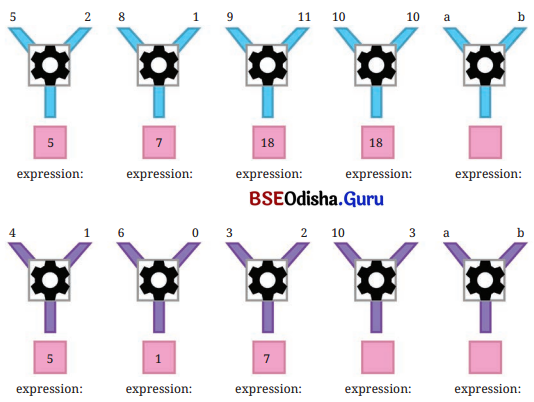
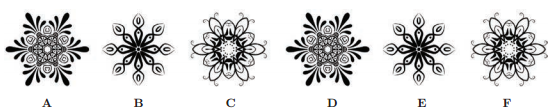
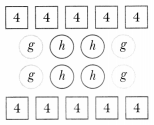
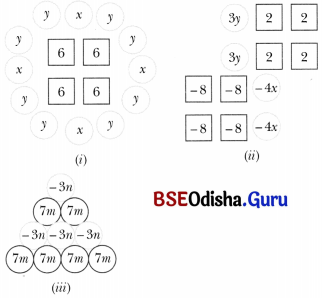
Patterns in Mathematics Class 6 Solutions Maths Ganita Prakash Chapter 1

Students can refer to BSE Odisha Class 6 Math Solution and Ganita Prakash Chapter 1 Patterns in Mathematics Class 6 Question Answer to understand textbook questions step by step.

Class 6 Maths Chapter 1 Patterns in Mathematics Solutions

Ganita Prakash Class 6 Chapter 1 Solutions

Class 6 Maths Ganita Prakash Chapter 1 Solutions Patterns in Mathematics

Question 1.
Why are 1, 3, 6, 10, 15, … called triangular numbers? Why are 1, 4, 9, 16, 25, … called square numbers or squares? Why are 1, 8, 27, 64, 125, … called cubes?
Solution:
As the dot representation of sequence 1,3, 6, 10, 15, … forms triangles, it is called triangular numbers sequence. As the dot representation of sequence 1,4, 9, 16, 25, … forms squares, it is called square numbers sequence.

As the dot representation of sequence 1,8, 27, 64, 125, … forms cubes, it is called cube numbers sequence.

Patterns in Mathematics Class 6 Solutions Maths Ganita Prakash Chapter 1

Question 2.
You will have noticed that 36 is both a triangular number and a square number! That is, 36 dots can be arranged perfectly both in a triangle and in a square. Make pictures in your notebook illustrating this!
This shows that the same number can be represented differently and play different roles, depending on the context. Try representing some other numbers pictorially in different ways!
Solution:
Representation of 36 as a triangular number:
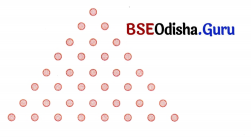
Patterns in Mathematics Class 6 Solutions Maths Ganita Prakash Chapter 1 1
Representation of 36 as a square number:
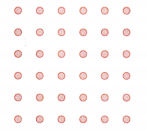
Patterns in Mathematics Class 6 Solutions Maths Ganita Prakash Chapter 1 2

Representation of 10 as even number:
Patterns in Mathematics Class 6 Solutions Maths Ganita Prakash Chapter 1 3
Representation of 10 as triangular number:
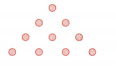
Patterns in Mathematics Class 6 Solutions Maths Ganita Prakash Chapter 1 4

Question 3.
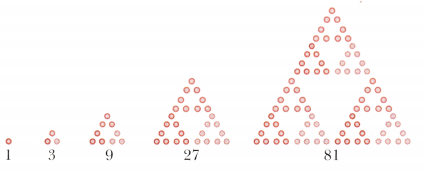
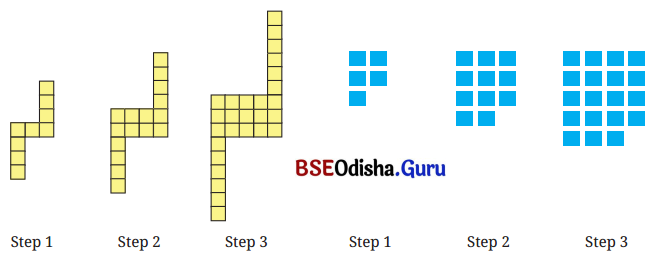
Can you think of pictorial way to visualise the sequence of Powers of 2? Powers of 3?
Solution:
Powers of 2 can be visualised as:
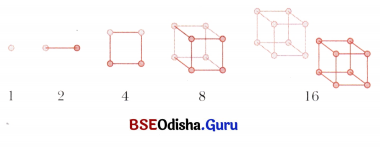
Patterns in Mathematics Class 6 Solutions Maths Ganita Prakash Chapter 1 5

Powers of 3 can be visualised as:
Patterns in Mathematics Class 6 Solutions Maths Ganita Prakash Chapter 1 6

Question 4.
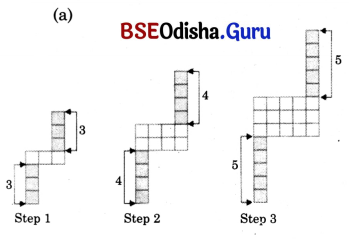
Can you find a similar pictorial explanation for why adding counting numbers up and down, i.e., 1, 1+2 + 1,1+2 + 3 + 2 + 1, … , gives square numbers?
Solution:
Yes,
As we can see, the dot representation of the addition of counting numbers up and down forms the dot representation of square numbers.

Patterns in Mathematics Class 6 Solutions Maths Ganita Prakash Chapter 1

Question 5.
Which sequence do you get when you start to add the All 1’s sequence up? What sequence do you get when you add the All l’s sequence up and down?
Solution:
Adding all 1 ’s sequence up
1 = 1
1 + 1 = 2
1 + 1 + 1 = 3
1 + 1 + 1 + 1 = 4 and so on.
Here, we get a sequence of counting numbers i.e. 1, 2, 3, 4, … .

Adding all l’s sequence up and down 1 = I
1 + 1 + 1 = 3
1 + 1 + 1 + 1 + 1 = 5 and so on.
Here, we get a sequence of odd numbers.

Question 6.
What happens when you add up pairs of consecutive triangular numbers? That is, take 1 + 3, 3 + 6, 6 + 10, 10 + 15,… ? Which sequence do you get?
Solution:
Adding up pairs of consecutive triangular numbers, we get
1 + 3 = 4;
3 + 6 = 9;
6 + 10 = 16;
10 + 15 = 25 and so on.
Here, we get a sequence of square numbers.

Patterns in Mathematics Class 6 Solutions Maths Ganita Prakash Chapter 1

Question 7.
What happens when you multiply the triangular numbers by 6 and add 1 ? Which sequence do you get?
Solution:
Triangular numbers are 1, 3, 6, 10, 15, …
On multiplying triangular numbers by 6 and add 1 to it, we get
1 × 6 + 1 = 7;
3 × 6 + 1 = 19;
6 × 6 + 1 = 37;
10 × 6 + 1 = 61;
15 × 6 + 1 = 91 and so on.
Hence, we get a sequence of hexagonal numbers.

InText Questions

Question 1.
Observe the pattern given below:
1 = 1
1 + 3 = 4
1 + 3 + 5 = 9
Why does this happen? Do you think it will happen forever?
Solution:
The sequence of odd numbers is: 1, 3, 5, 7, 9, 11,…
Sum of first 1 odd number = 1 = 12
Sum of first 2 odd numbers = 1 + 3 = 4 = 22
Sum of first 3 odd numbers = 1 + 3 + 5 = 9 = 32
Sum of first 4 odd numbers =1 + 3 + 5 + 7 = 16 = 42
Sum of first 5 odd numbers =1+3 + 5 + 7 + 9 = 25 = 52
Sum of first 6 odd numbers =1 + 3 + S + 7 + 9 + 11 = 36 = 62
Each time we add another odd number, the total becomes a perfect square.
Since the sequence of odd numbers keeps going forever, and the sum of the first n odd numbers is always n2, this pattern will continue forever.

Patterns in Mathematics Class 6 Solutions Maths Ganita Prakash Chapter 1

Question 2.
Pictorially represent and find the sum of the first 10 odd numbers.
Solution:
From figure, it is clear that
1 + 3 + 5 + 7 + 9 + 11 + 13 + 15 + 17 + 19 = 100 = 102
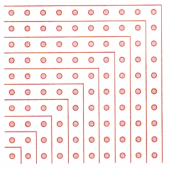
Patterns in Mathematics Class 6 Solutions Maths Ganita Prakash Chapter 1 7

Patterns in Mathematics Class 6 Extra Questions

Patterns in Mathematics Class 6 Very Short Question Answer

Question 1.
Find the next term of the sequence 1, 4, 9, 16,… .
Solution:
Given sequence is 1, 4, 9, 16, …, i.e. 12, 22, 32, 42, …, which is a sequence of squares.
So, next term, i.e. fifth term = 52 = 25

Question 2.
What is the sum of first 10 terms of the sequence of counting numbers?
Solution:
We know, the sequence of counting numbers is 1, 2, 3, 4, ….
Now, sum of first 10 terms of the sequence of counting numbers
= 1 + 2 + 3 + 4 + 5 + 6 + 7 + 8 + 9 + 10 = 55

Patterns in Mathematics Class 6 Solutions Maths Ganita Prakash Chapter 1

Question 3.
Identify the rule in the following number pattern and write the missing entries:
111 × 11 = 1221
121 × 11 = 1331
131 × 11 = 1441
141 × _____ = ______
_____ × 11 = 1661
161 × 11 = ______
Solution:
We observe that the first number on the left side increases by 10 each time: 111, 121, 131, 141, 151, 161,…
The result also increases by 110 each time: 1221, 1331, 1441, 1551, 1661, 1771, …
The first number is multiplied by 11 each time.
Thus, the missing numbers are as follows:
141 × 11 = 1551;
151 × 11 = 1661;
161 × 11 = 1771

Question 4.
Find the next term of the sequence 2 + 1, 2 + 2, 2 + 3, 2 + 4,… .
Solution:
Given sequence is 2 + 1, 2 + 2, 2 + 3, 2 + 4, ….
First term = 2 + 1
Second term = 2 + 2
Third term = 2 + 3
Fourth term = 2 + 4
So, next term, i.e. fifth term = 2 + 5

Question 5.
Find the next term of the sequence 2, 6, 12, 20, …
Solution:
C liven sequence is 2, 6, 12, 20, ….
Here, 2 = 1 × 2
6 = 2 × 3
12 = 3 × 4
20 = 4 × 5
So, next term = 5 × 6 = 30

Patterns in Mathematics Class 6 Solutions Maths Ganita Prakash Chapter 1

Question 6.
Find the next term of the sequence 1, 3, 6, 10, 15,
Solution:
Given sequence is 1, 3, 6, 10, 15
First term = 1
Second term = 3 = 1 + 2 (First term + 2)
Third term = 6 = 3 + 3 (Second term + 3)
Fourth term = 10 = 6 + 4 (Third term + 4)
Fifth term = 15 = 10 + 5 (Fourth term + 5)
So, next term = Fifth term + 6 = 15 + 6 = 21

Question 7.
What is the sum of first 12 terms of the sequence of all 1s?
Solution:
We know, the sequence of all 1 s is 1, 1, 1, 1, ….
Now, sum of first 12 terms of the sequence of all 1s
= 1 + 1 + 1 + 1 + 1 + 1 + 1 + 1 + 1 + 1 + 1 + 1 = 12

Question 8.
What is the sum of first 6 terms of the sequence of odd numbers?
Solution:
The sequence of odd numbers is 1, 3, 5, 7
Now, sum of first 6 terms of the sequence of odd numbers = 1 + 3 + 5 + 7 + 9 + 11 = 36 = 62

Question 9.
Write the first 5 square numbers.
Solution:
We know, the sequence of square numbers is 1, 4, 9, 16, 25, 36, …….
So, the first 5 square numbers are 1, 4, 9, 16 and 25.

Patterns in Mathematics Class 6 Solutions Maths Ganita Prakash Chapter 1

Question 10.
Write the first 4 triangular numbers.
Solution:
We know, the sequence of triangular numbers is 1, 3, 6, 10, 15, 21, 28, … .
So, the first 4 triangular numbers are 1, 3, 6 and 10.

Question 11.
Which sequence do you get on adding the counting numbers up?
Solution:
We know, the sequence of counting numbers is 1. 2, 3, 4, 5, … .
Now, on adding the counting numbers up, we get the following sequence:
1 = 1
1 + 2 = 3
1 + 2 + 3 = 6
1 + 2 + 3 + 4 = 10
1 + 2 + 3 + 4 + 5 = 15
So, the sequence is 1, 3, 6, 10, 15, …, which is the sequence of triangular numbers.

Patterns in Mathematics Class 6 Short Question Answer

Question 1.
Find the next term of the sequence 2, 16, 54, 128,
Solution:
Given sequence is 2, 16, 54, 128, ….
First term = 2 = 2 × 1 = 2 × 13
Second term = 16 = 2 × 8 = 2 × 23
Third term = 54 = 2 × 27 = 2 × 33
Fourth term = 128 = 2 × 64 = 2 × 43
So, next term, i.e. fifth term = 2 × 53 = 2 × 125 = 250

Patterns in Mathematics Class 6 Solutions Maths Ganita Prakash Chapter 1

Question 2.
Can you identify numbers which are both triangular as well as square numbers? Find 2 such numbers.
Solution:
We know, the sequence of triangular numbers is 1, 3, 6, 10, 15, 21, 28, 36, 45, ….
And the sequence of squares is 1,4, 9, 16, 25, 36, 49, 64, 81, ….
So, 1 and 36 are both triangular as well as square numbers.

Question 3.
Observe the pattern shown below and write the next three steps:
1 × 9 + 2 = 11
12 × 9 + 3 = 111
123 × 9 + 4 = 1111
Solution:
We observe that

  • On the left side, the first number starts at 1, then becomes 12, then 123, each time we add the next digit in order.
  • We multiply by 9 each time.
  • Then, we add next number (2, then 3, then 4)
  • On the right side the answer is made of all 1 s and the number of Is is one more than the number of digits in starting number.

So, next three steps will be:
1234 × 9 + 5 = 11111
12345 × 9 + 6 = 111111
123456 × 9 + 7 = 1111111

Question 4.
Identify the pattern in the following number pattern and write the missing terms:
2178 × 4 = 8712
21978 × 4 = 87912
219978 × 4 = _______
_____ × 4 = 8799912
21999978 × 4 = ________
219999978 × ______ = 879999912
Solution:
In the first number, we start with 2178 and keep adding one more 9 before 78 in each step.
Then, we multiply the number by 4. The result is a number starting with 87, followed by the same number of 9s, and ending with 12.
The missing numbers are as follows:
2178 × 4 = 8712
21978 × 4 = 87912
219978 × 4 = 879912
2199978 × 4 = 8799912
21999978 × 4 = 87999912
219999978 × 4 = 879999912

Patterns in Mathematics Class 6 Solutions Maths Ganita Prakash Chapter 1

Question 5.
Pairs of consecutive triangular numbers are added (i.e. 1 + 3, 3 + 6, …). Which sequence will you get on such addition? Write the 6th term of the new obtained sequence.
Solution:
We know, the sequence of triangular numbers is 1, 3, 6, 10, 15, 21, 28, … .
Now, on adding pairs of consecutive triangular numbers we get the following sequence:
1 + 3 = 4
3 + 6 = 9
6 + 10 = 16
10 + 15 = 25
15 + 21 = 36
21 + 28 = 49
So, the sequence is 4, 9, 16, 25, 36, 49, …, which represents the square numbers starting with 4.
Now, 6th term of the new obtained sequence is 49.

Question 6.
Which sequence do you get on adding the odd numbers up?
Solution:
We know, the sequence of odd numbers is 1, 3, 5, 7, 9, … .
Now, on adding the odd numbers up, we get the following sequence:
1 = 1
1 + 3 = 4
1 + 3 + 5 = 9
1 + 3 + 5 + 7 = 16
1 + 3 + 5 + 7 + 9 = 25
So, the sequence is 1,4, 9, 16, 25, …, which is the sequence of square numbers.

Patterns in Mathematics Class 6 Solutions Maths Ganita Prakash Chapter 1

Patterns in Mathematics Class 6 Long Question Answer

Question 1.
What will happen if you multiply the triangular numbers by 6 and add 1? Which sequence do you get?
Solution:
We know, the sequence of triangular numbers is 1, 3, 6, 10, 15, 21, 28, 36, 45, … .
Now, if we multiply the triangular numbers by 6 and add 1, we get the following sequence:
1 × 6 + 1 = 6 + 1 = 7
3 × 6 + 1 = 18 + 1 = 19
6 × 6 + 1 = 36 + 1 = 37
10 × 6 + 1 = 60 + 1 = 61
15 × 6 + 1 = 90 + 1 = 91
So, the required sequence is 7, 19, 37, 61, 91, …, which represents hexagonal numbers starting with 7.

Question 2.
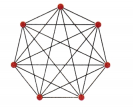
Find the number of line segments connecting any two distinct vertices of the polygon as shown in the figure.

Patterns in Mathematics Class 6 Solutions Maths Ganita Prakash Chapter 1 9
Solution:
We know, in a complete graph, every pair of vertices is connected by a unique line segment. The number of line segments in a complete graph with n vertices is given by \(\frac{n(n-1)}{2}\).
For K7 (Heptagon):
Number of vertices = 7
∴ Number of line segments
= \(\frac{n(n-1)}{2}\) = \(\frac{7(7-1)}{2}\) = 7 × 3 = 21
Patterns in Mathematics Class 6 Solutions Maths Ganita Prakash Chapter 1 10

Question 3.
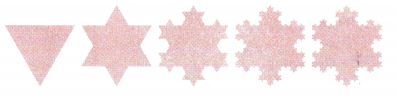
Find the number of sides of a Koch Snowflake obtained after 5 iterations.
Solution:
To get from one shape to the next shape in the Koch Snowflake sequence, each line segment ‘_______’ is replaced by a speed bump ‘Patterns in Mathematics Class 6 Solutions Maths Ganita Prakash Chapter 1 11‘
Patterns in Mathematics Class 6 Solutions Maths Ganita Prakash Chapter 1 12

Number of iterations No. of sides
0 3 = 3 × 40
1 12 = 3 × 41
2 48 = 3 × 42
3 192 = 3 × 43
4 768 = 3 × 44

Thus,
After 5 iterations, number of sides = 3 × 45 = 3 × 1024 = 3072.

Patterns in Mathematics Class 6 Solutions Maths Ganita Prakash Chapter 1

Patterns in Mathematicse Class 6 Case Based Questions

Question 1.
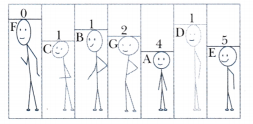
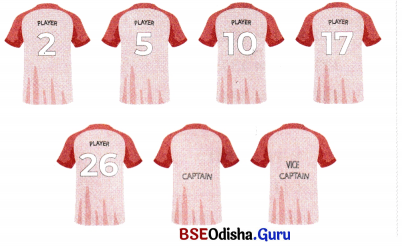
Players wear different jersey numbers to help fans and broadcasters identify them, especially in games like cricket and football where they look similar on the field.
Patterns in Mathematics Class 6 Solutions Maths Ganita Prakash Chapter 1 8
One day, Ashish went to the stadium to watch a cricket match. There, he observed the jersey numbers of some cricketers and found them to follow a sequence.
Based on the above information, answer the following questions:
(i) Write the rule for the sequence followed by the given numbers in words.
(ii) What will be the number on Captain’s jersey?
(iii) What will be the number on Vice-captain’s jersey?
Solution:
(i) Numbers on the jersey of players are given as
2 = 12 + 1;
5 = 22 + 1;
10 = 32 + 1;
17 = 42 + 1;
26 = 52 + 1
Rule of the sequence: n2 + 1; n = 1, 2, 3, …
(ii) Since captain is at 6th position, the number on his jersey is 62 + 1 = 36 + 1 = 37.
(iii) Since vice-captain is at 7th position, the number on his jersey is 72 + 1 = 49 + 1 = 50

Patterns in Mathematics Class 6 Solutions Maths Ganita Prakash Chapter 1

Question 2.
In Ms. Rina’s class, each student is given a unique roll number. One day, while arranging the books in the library, she noticed that the roll numbers of the students returning books followed a specific number pattern. She found that the roll numbers were: 1, 2, 3, 5, 8, 13, …
Based on the above information, answer the following questions:
(i) Write the rule for the sequence followed by the given numbers.
(ii) What is the name of the number sequence followed by the given numbers?
(iii) What will be the roll number of the 10th student?
Solution:
The given numbers are 1, 2, 3, 5, 8, 13, …
(i) First number = 1
Second number = 2
Third number = 3 = 1 + 2
(First number + Second Number)
Fourth number = 5 = 2 + 3
(Second number + Third Number)
Fifth number = 8 = 3 + 5
(Third number + Fourth Number)
Sixth number = 13 = 5 + 8
(Fourth number + Fifth Number)
Therefore, the rule for the sequence is,
First number = 1, Second number = 2, any other number = sum of previous two numbers

(ii) The given numbers are known as Virahanka numbers.

(iii) Observing the pattern (from above)
Seventh number = Fifth number + Sixth number
= 8 + 13 = 21
Eighth number = Sixth number + Seventh number
= 13 + 21 = 34
Ninth number = Seventh number + Eighth number
= 21 + 34 = 55
Tenth number = Eighth number + Ninth number
= 34 + 55 = 89
Therefore, the roll number of 10th student is 89.

Proportional Reasoning 1 Class 8 Solutions Maths Ganita Prakash Chapter 7

Students can refer to BSE Odisha Class 8 Math Solution and Ganita Prakash Chapter 7 Proportional Reasoning 1 Class 8 Question Answer to understand textbook questions step by step.

Class 8 Maths Chapter 7 Proportional Reasoning 1 Solutions

Ganita Prakash Class 8 Chapter 7 Solutions

Class 8 Maths Ganita Prakash Chapter 7 Solutions Proportional Reasoning 1

1. PROBLEM SOLVING WITH PROPORTIONAL REASONING
Figure it Out (Page 165 – 167) :

Question 1.
Circle the following statements of proportion that are true.
(i) 4 : 7 :: 12 : 21
(ii) 8 : 3 :: 24 : 6
(iii) 7 : 12 :: 12 : 7
(iv) 21 : 6 :: 35 : 10
(v) 12 : 18 – 28 : 12
(vi) 24 : 8 :: 9 : 3
Answer:
(i) Given statement is 4 : 7 :: 12 : 21.
This is true if \(\frac{4}{7}\) = \(\frac{12}{21}\) or if \(\frac{4}{7}\) = \(\frac{4}{7}\), which is true.
∴ The given statement is true.

(ii) Given statement is 8 : 3 :: 24 : 6.
This is true if \(\frac{8}{3}\) = \(\frac{24}{6}\) or if \(\frac{8}{3}\) = 4, which is false.
∴ The given statement is not true.

(iii) Given statement is 7 : 12 :: 12 : 7.
This is true if \(\frac{7}{12}\) = \(\frac{12}{7}\) which is false.
∴ The given statement is not true.

(iv) Given statement is 21 : 6 :: 35 : 10.
This is true if \(\frac{21}{6}\) = \(\frac{35}{10}\) or if \(\frac{7}{2}\) = \(\frac{7}{2}\), which is true.
∴ The given statement is true.

(v) Given statement is 12 : 18 :: 28 : 12.

This is true if \(\frac{12}{18}\) = \(\frac{28}{12}\) or if \(\frac{2}{3}\) = \(\frac{7}{3}\) or 2 = 7, which is false.
∴ The given statement is not true.

(vi) Given statement is 24 : 8 :: 9 : 3.
This is true if \(\frac{24}{8}\) = \(\frac{9}{3}\) or if 3 = 3, which is true.
∴ The given statement is true.

Question 2.
Give 3 ratios that are proportional to 4 : 9.
__________ : ____________ __________ : ____________ __________ : ____________
Answer:
To find ratios proportional to 4 : 9, we multiply both terms by the same number:
4 × 2 : 9 × 2 = 8 : 18.
4 × 3 : 9 × 3 = 12 : 27.
4 × 5 : 9 × 5 = 20 : 45.
So, three ratios proportional to 4 : 9 are 8 : 18; 12 : 27 and 20 : 45.

Proportional Reasoning 1 Class 8 Solutions Maths Ganita Prakash Chapter 7

Question 3.
Fill in the missing numbers for these ratios that are proportional to 18 : 24.
3 : ________, 12 : ________ ,20 : ________ , 27 : ________
Answer:
(i) Given ratio is 18 : 24.
Let 18 : 24 : : 3 : x
∴ \(\frac{18}{24}\) = \(\frac{x}{3}\) or \(\frac{3}{4}\) = \(\frac{3}{x}\) or x = 4
∴ 24 X or 4 = X or x = 4
∴ Missing number in the ratio : 3 _________ is 4.

(ii) Let 18 : 24 : : 12 : x.
∴ \(\frac{18}{24}\) = \(\frac{12}{x}\) or \(\frac{3}{4}\) = \(\frac{12}{x}\)
or 3x = 48 or x = \(\frac{48}{3}\) = 16
∴ Missing number in the ratio 12 : _________ is 16.

(iii) Let 18 : 24 : : 20 : x.
∴ \(\frac{18}{24}\) = \(\frac{20}{x}\) or \(\frac{3}{4}\) = \(\frac{20}{x}\)
or 3x = 80 or x = \(\frac{80}{3}\)
Missing number in the ratio 20 : ___________ is \(\frac{80}{3}\)

(iv) Let 18 : 24 : : 27 : x.
∴ \(\frac{18}{24}\) = \(\frac{27}{x}\) or \(\frac{3}{4}\) = \(\frac{27}{x}\)
or 3x = 108 or x = \(\frac{108}{3}\) = 36
∴ Missing number in the ratio 27 : ____________ is 36.

Question 4.
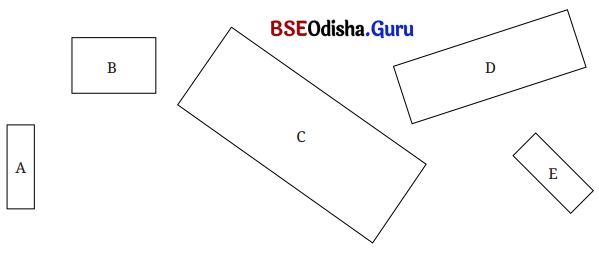
Look at the following rectangles. Which rectangles are similar to each other? You can verify this by measuring the width and height using a scale and comparing their ratios.
Proportional Reasoning 1 Class 8 Solutions Maths Ganita Prakash Chapter 7 1
Answer:

Rectangle Width Height Ratio
A 0.5 cm 1.5 cm 0.5 : 1.5 = 1 : 3
B 1.5 cm 1 cm 1.5 : 1 = 3 : 2
C 4.5 cm 2 cm 4.5 : 2 = 9 : 4
D 3.5 cm 1 cm 3.5 : 1 = 7 : 2
E 0.5 cm 1.5 cm 0.5 : 1.5 = 1 : 3

Since rectangles A and E have the same simplified ratio 1 : 3. So, they are similar to each other.

Question 5.
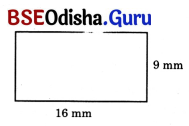
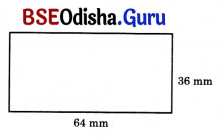
Look at the following rectangle. Can you draw a smaller rectangle and a bigger rectangle with the same width to height ratio in your notebooks? Compare your rectangles with your classmates’ drawings.
Are all of them the same? If they are different from yours, can you think why? Are they wrong?
Proportional Reasoning 1 Class 8 Solutions Maths Ganita Prakash Chapter 7 2
Answer:
For the given rectangle;
Width = 32 mm and height = 18 mm
∴ Ratio is 32 : 18.
We shall draw smaller and bigger rectangles and similar to the given rectangle by considering different ‘factors of change’.
Let the factor of change be \(\frac{1}{2}\).
∴ New width = \(\frac{1}{2}\) × 32 = 16 mm
and New height = \(\frac{1}{2}\) × 18 = 9 mm
A new, similar rectangle is shown in the figure.
Proportional Reasoning 1 Class 8 Solutions Maths Ganita Prakash Chapter 7 3
Let ‘factor of change’ be 2.
∴ New width = 2 × 32 = 64 mm and new height = 2 × 18 = 36 mm
Proportional Reasoning 1 Class 8 Solutions Maths Ganita Prakash Chapter 7 4
A new, similar rectangle is shown in the figure. The rectangles drawn by other classmates are all different, but they are all similar to the given rectangle.

Question 6.
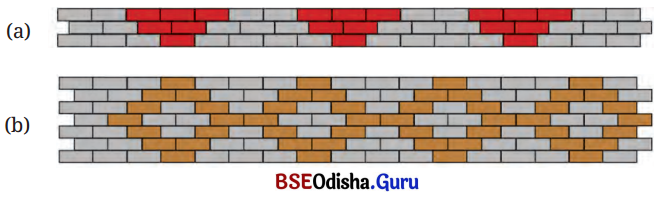
The following figure shows a small portion of a long brick wall with patterns made using coloured bricks. Each wall continues this pattern throughout the wall. What is the ratio of grey bricks to coloured bricks? Try to give the ratios in their simplest form.
Proportional Reasoning 1 Class 8 Solutions Maths Ganita Prakash Chapter 7 5
Answer:
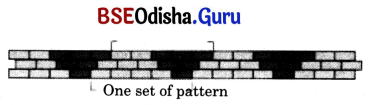
(a) We consider one set of patterns in the given wall.
Proportional Reasoning 1 Class 8 Solutions Maths Ganita Prakash Chapter 7 6
Number of grey bricks in one set of pattern = 2 + 3 + 4 = 9
Number of coloured bricks in one set of pattern = 3 + 2 + 1 = 6
∴ Ratio of grey bricks to coloured bricks = 9 : 6
We have 9 : 6 = 3 : 2
∴ Ratio in the simplest form = 3 : 2

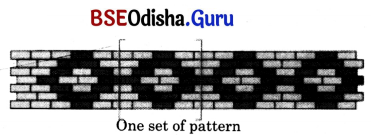
(b) We use one set of patterns on the given wall
Proportional Reasoning 1 Class 8 Solutions Maths Ganita Prakash Chapter 7 7
One set of pattern
Number of grey bricks in one set of pattern
= (\(\frac{1}{2}\) + 1 + 1 + \(\frac{1}{2}\)) + (1 + 1) + (\(\frac{1}{2}\) + 1 + \(\frac{1}{2}\)) + (1 + 1) + (\(\frac{1}{2}\) + 1 + \(\frac{1}{2}\)) + (1 + 1) + (\(\frac{1}{2}\) + 1 + 1 + \(\frac{1}{2}\))
= 3 + 2 + 2 + 2 + 2 + 2 + 3 = 16
Number of coloured bricks in one set of pattern
= 1 + (1 + 1) + (1 + 1) + (1 + 1) + (1 + 1) + (1 + 1) + 1
= 1 + 2 + 2 + 2 + 2 + 2 + 1 = 12
∴ Ratio of grey bricks to coloured bricks = 16 : 12
We have 16 : 12 = 4 : 3
∴ Ratio in the simplest form = 4 : 3.

Question 7.
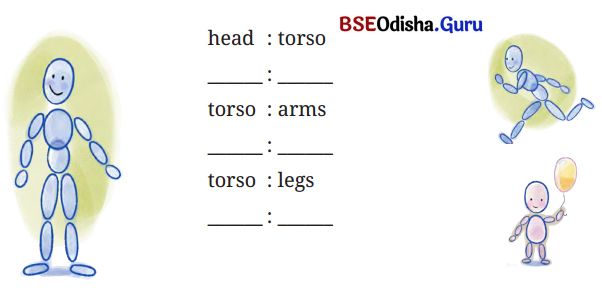
Let us draw some human figures. Measure your friend’s body-the lengths of their head, torso, arms, and legs. Write the ratios as mentioned below-
Proportional Reasoning 1 Class 8 Solutions Maths Ganita Prakash Chapter 7 8
Answer:
My friend’s body measurements :
(i) Head = 22 cm

(ii) Torso (neck to hip) = 50 cm

(iii) Arms (shoulder to fingertip) = 60 cm

(iv) Legs (hip to foot) = 80 cm

1. Head : Torso = 22 : 50
Simplify by dividing both by 2 → 11 : 25.

2. Torso : Arms = 50 : 60
Simplify by dividing both by 10 → 5 : 6.

3. Torso : Legs = 50 : 80
Simplify by dividing both by 10 → 5 : 8.
So the ratios are:

  • Head : Torso = 11 : 25
  • Torso : Arms = 5 : 6
  • Torso : Legs = 5 : 8

Proportional Reasoning 1 Class 8 Solutions Maths Ganita Prakash Chapter 7

Figure it Out (Page 170 – 171) :

Question 1.
The Earth travels approximately 940 million kilometres around the Sun in a year. How many kilometres will it travel in a week?
Answer:
We know that:
1 million = 10 lakh = 10,00,000
and 1 year = \(\frac{365}{7}\) weeks.
940 million kilometres, i.e., 940 × 10,00,000 kilometres, are travelled by the Earth in 1 year, i.e., in \(\frac{365}{7}\) weeks.
Let the fiarth travel x kilometres in 1 week
∴ The ratios 940 × 10,00,000 : \(\frac{365}{7}\) and x : 1 are
in proportion.
⇒ \(\frac{940 \times 10,00,000}{\frac{365}{7}}\) = \(\frac{x}{1}\)
⇒ x = \(\frac{940 \times 10,00,000 \times 7}{365}\)
⇒ x = \(\frac{188 \times 70,00,000}{73}\)
⇒ x = 1,80,27,397 (nearly)
∴ In 1 week, Earth travels nearly 1,80,27,397 kilometres around the Sun.

Question 2.
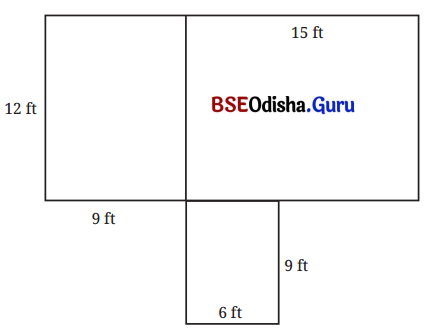
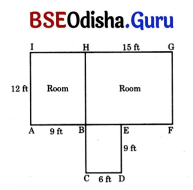
A mason is building a house in the shape shown in the diagram. He needs to construct both the outer walls and the inner wall that separates two rooms. To build a wall of 10-feet, he requires approximately 1450 bricks. How many bricks would he need to build the house? Assume all walls are of the same height and thickness.
Proportional Reasoning 1 Class 8 Solutions Maths Ganita Prakash Chapter 7 9
Answer:
Number of bricks required for a 10ft wall =1450
∴ Ratio of length of wall to number of bricks = 10 : 1450
Proportional Reasoning 1 Class 8 Solutions Maths Ganita Prakash Chapter 7 10
Total length of walls = AI + CH + DE + FG + IG + AF + CD
= 12 + (9 + 12) + 9 + 12 + (9 + 15) + (9 + 15) + 6 = 108 ft
Let x bricks be required for a 108 ft long wall.
∴ Ratio of length of wall to number of bricks = 108 : x
These ratios are in proportion.
∴ 10 : 1450 :: 108 : x
⇒ \(\frac{10}{1450}\) = \(\frac{108}{x}\)
⇒ \(\frac{1}{145}\) = \(\frac{108}{x}\)
⇒ x = 145 × 108 = 15,660
∴ Number of required bricks = 15,660.

Figure it Out (Page 175) :

Question 1.
Divide ₹4,500 into two parts in the ratio 2 : 3.
Answer:
Given ratio = 2 : 3
Amount to be divided = ₹ 4,500
∴ First part = \(\frac{2}{2 + 3}\) × 4,500
= \(\frac{2}{5}\) × 4,500 = 2 × 900 = ₹ 1,800
∴ Second part= \(\frac{3}{2 + 3}\) × 4,500 = \(\frac{3}{5}\) × 4,500
= 3 × 900 = ₹ 2,700
∴ Two parts are ₹ 1,800 and ₹ 2,700.
Verification:
1,800 : 2,700 = \(\frac{1,800}{2,700}\)
\(\frac{18}{27}\) = \(\frac{2}{3}\) = 2 : 3 and 1,800 + 2,700 = 4,500.

Question 2.
In a science lab, acid and water are mixed in the ratio of 1 : 5 to make a solution. In a bottle that has 240 mL of the solution, how much acid and water does the solution contain?
Answer:
Ratio of acid and water = 1 : 5
Quantity of solution = 240 mL
∴ Quantity of acid = \(\frac{1}{1 + 5}\) × 240
= \(\frac{1}{6}\) × 240 = 40 mL
∴ Quantity of water = \(\frac{1}{1 + 5}\) × 240
= \(\frac{5}{6}\) × 240 = 200 mL
∴ Quantities of acid and water in the solution are 40 mL and 200 mL.
Verification: 4Q
40 : 200 = \(\frac{40}{200}\)
\(\frac{1}{5}\) = 1 : 5 and 40 + 200 = 240.

Question 3.
Blue and yellow paints are mixed in the ratio of 3 : 5 to produce green paint. To produce 40 mL of green paint, how much of these two colours are needed? To make the paint a lighter shade of green, I added
20 mL of yellow to the mixture. What is the new ratio of blue and yellow in the paint?
Answer:
Ratio of blue and yellow paints = 3 : 5
Quantity of green paint = 40 mL
∴ Quantity of blue paint = \(\frac{3}{3 + 5}\) × 40
= \(\frac{3}{8}\) × 40 = 15 mL
∴ Quantity of yellow paint = \(\frac{5}{3 + 5}\) × 40
= \(\frac{5}{8}\) × 40 = 25 mL
Addition of yellow paint to the mixture = 20 mL
∴ New quantity of blue paint =15 mL
∴ New quantity of yellow paint = 25 mL + 20 mL = 45 mL
∴ New ratio of blue and yellow paints
= 15 : 45 = 1 : 3.

Question 4.
To make soft idlis, you need to mix rice and urad dal in the ratio of 2 : 1. If you need 6 cups of this mixture to make idlis tomorrow morning, how many cups of rice and urad dal will you need?
Answer:
Ratio of rice and urad dal = 2 : 1
Total number of cups of mixture = 6
∴ Number of cups of rice = \(\frac{2}{2 + 1}\) × 6
= \(\frac{2}{3}\) × 6 = 4
∴ Number of cups of urad dal = \(\frac{1}{2 + 1}\) × 6
= \(\frac{1}{3}\) × 6 = 2
∴ 4 cups of rice and 2 cups of urad dal are to be mixed.

Proportional Reasoning 1 Class 8 Solutions Maths Ganita Prakash Chapter 7

Question 5.
I have one bucket of orange paint that I made by mixing red and yellow paints in the ratio of 3 : 5. I added another bucket of yellow paint to this mixture. What is the ratio of red paint to yellow paint in the new mixture?
Answer:
Let the capacity of one bucket be x L.
Ratio of red paint and yellow paint = 3 : 5
∴ Quantity of red paint in the bucket = \(\frac{3}{3 + 5}\) × x = \(\frac{3 x}{8}\)
∴ Quantity of yellow paint in the bucket = \(\frac{5}{3 + 5}\) × x = \(\frac{5 x}{8}\)
One bucket of yellow paint is added to the mixture.
∴ New quantity of red paint in the mixture = \(\frac{3 x}{8}\)
∴ New quantity of yellow paint in the mixture = \(\frac{5 x}{8}\)
+ x = \(\frac{13 x}{8}\)
∴ New ratio of red paint and yellow paint in the mixture = \(\frac{3 x}{8}\) : \(\frac{13 x}{8}\) = 3 : 13

Figure it Out (Page 176 – 177) :

Question 1.
Anagh mixes 600 mL of orange juice with 900 mL of apple juice to make a fruit drink. Write the ratio of orange juice to apple juice in its simplest form.
Answer:
Quantity of orange juice = 600 mL
Quantity of apple juice = 900 mL
∴ Ratio of orange juice to apple juice = 600 : 900
Ratio in the simplest form = 600 : 900 = 2:3

Question 2.
Last year, we hired 3 buses for the school trip. We had a total of 162 students and teachers who went on that trip and all the buses were full. This year we have 204 students. How many buses will we need? Will all the buses be full?
Answer:
Number of buses for 162 students and teachers = 3
Since the buses were full, the capacity of 1 bus = \(\frac{162}{3}\) = 54
∴ Ratio of number of seats to the number of buses is 54 : 1.
We have
54 : 1 = 2(54) : 2(1) = 108 : 2
54 : 1 = 3(54) : 3(1) = 162 : 3
54 : 1 = 4(54): 4(1) = 216 : 4
∴ Capacity of 4 buses = 216
∴ For 204 students, we shall need 4 buses.
Since 216 – 204 = 12, we have 12 vacant seats in the buses.

Question 3.
The area of Delhi is 1,484 sq. km and the area of Mumbai is 550 sq. km. The population of Delhi is approximately 30 million and that of Mumbai is 20 million people. Which city is more crowded? Why do you say so?
Answer:
Area of Delhi = 1,484 sq.km
Population of Delhi = 30 million
Area of Mumbai = 550 sq. km
Population of Mumbai = 20 million
∴ Ratio of area to population for Delhi = 1484 : 30
∴ Ratio of area to population for Mumbai = 550 : 20
Factor of change of area = \(\frac{550}{1484}\) = 0.371 (nearly)
Factor of change of population = \(\frac{20}{30}\) = 0.667 (nearly)
Since 0.667 > 0.371, Mumbai is more crowded than Delhi.
Alternative Method:
Ratio of area to population for Delhi = 1484 : 30
Let the density of Delhi and Mumbai be the same, and there be x people in Mumbai.
∴ The ratios 1,484 : 30 and 550 : x are in proportion.
∴ \(\frac{1,484}{30}\) = \(\frac{550}{x}\)
⇒ 1484x = 30 × 550 = 16,500
⇒ x = \(\frac{16500}{1484}\) = 11.118
There should be 11.118 million people in Mumbai. But the population of Mumbai is 20 million.
∴ Mumbai is more crowded than Delhi.

Question 4.
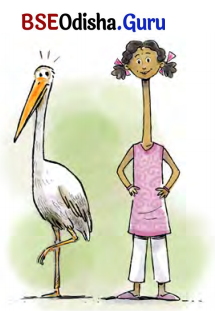
A crane of height 155 cm has its neck and the rest of its body in the ratio 4 : 6. For your height, if your neck and the rest of the body also had this ratio, how tall would your neck be?
Proportional Reasoning 1 Class 8 Solutions Maths Ganita Prakash Chapter 7 11
Answer:
The ratio of the height of the neck and the height of the rest of the body of a crane is 4 : 6. My height is 65 inches, i.e., 165 cm.
Let the ratio of the height of my neck and the height of the rest of my body also be 4 : 6.
∴ Height of my neck = (\(\frac{4}{4 + 6}\) × 165)cm = 66 cm

Question 5.
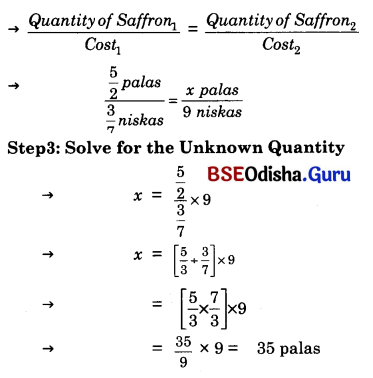
Let us try an ancient problem from Lilavati. At that time weights were measured in a unit named palas and niskas was a unit of money. “If 2\(\frac{1}{2}\) palas of saffron costs \(\frac{3}{7}\) niskas, O expert businessman! tell me quickly what quantity of saffron can be bought for 9 niskas?”
Answer:
A proportional relationship between the quantity of saffron and its cost is described. The cost of a known quantity of saffron is provided, and the quantity of saffron that can be purchased for a different amount of money is to be determined.

Step 1: Convert Mixed Numbers to Improper Fractions
= The given quantity of saffron, 2\(\frac{1}{2}\) palas, converted to an improper fraction:
→ 2\(\frac{1}{2}\) = \(\frac{2 \times 2+1}{2}\) = \(\frac{5}{2}\)
= The given cost, \(\frac{3}{7}\) niskas.

Step 2 : Set Up the Proportion
A proportion is established relating the quantity of saffron to its cost. Let x be the unknown quantity of saffron.
Proportional Reasoning 1 Class 8 Solutions Maths Ganita Prakash Chapter 7 12

Proportional Reasoning 1 Class 8 Solutions Maths Ganita Prakash Chapter 7

Question 6.
Harmain is a 1-year-old girl. Her elder brother is 5 years old. What will be Harmain’s age when the ratio of her age to her brother’s age is 1 : 2?
Answer:
The current ages are given as Harmain being 1 year old and her brother being 5 years old.
→ The age difference = 5 – 1 = 4 years.
= The difference will remain constant over time.
= Let x be the number of years that pass untill the desired ratio is achieved.
= After x years, Harmain age will be 1 + x years
= After x years, her brother’s age will be 5 + x years
= Ratio is given as 1 : 2.
Can be expressed as \(\frac{1 + x}{5 + x}\) = \(\frac{1}{2}\)
→ 2(1 + x) = 1(5 + x)
→ 2 + 2x = 5 + x
→ 2x – x = 5 – 2
→ x = 3
= Harmain’s age when the ratio is 1 : 2 is found by adding * to her current age.
→ 1 + 3 = 4 years.
Harmain’s age will be 4 years when the ratio of her age to her brother’s age is 1 : 2

Question 7.
The mass of equal volumes of gold and water are in the ratio 37 : 2. If 1 litre of water is 1 kg in mass, what is the mass of 1 litre of gold?
Answer:
The given ratio of the mass of the gold to the mass of water for equal Volumes is 37 : 2
This Can be expressed as \(\frac{\text { Mass of gold }}{\text { Mass of water }}\) = \(\frac{37}{2}\)
= It is stated that 1 litre of water has a mass of 1kg.
Mass of 1 litre of gold = 1kg × \(\frac{37}{2}\)
= \(\frac{37}{2}\) kg = 18.5 kg
= The mass of 1 litre of gold is 18.5 kg.
= Mass of 1L of water is given as 1kg.
= Ratio to find the mass of 1L of gold
= Ratio of mass of equal volumes of gold to water is 37 : 2
\(\frac{\text { Mass of gold }}{\text { Mass of water }}\) = \(\frac{37}{2}\)
= Mass of Gold = Mass of water × \(\frac{37}{2}\)
= Mass of Gold = \(\frac{37}{2}\)kg = 18.5 kg.
So… Mass of 1 litre of gold is 18.5 kg.

Question 8.
It is good farming practice to apply 10 tonnes of cow manure for 1 acre of land. A farmer is planning to grow tomatoes in a plot of size 200 ft by 500 ft. How much manure should he buy? (Please refer to the section on Unit Conversions earlier in this chapter).
Answer:
Let’s Calculate the area of the plot in square feet.
Area = Length × width
Area = 500ft × 200ft = 100,000ft2
Convert the area from Square feet to acres we knew 1 acre = 43560ft2
Area in acres = \(\frac{100000 f^2}{43560 f^2}\) = 2.2956 acres
Calculate the total amount of manure required.
Manure required = 2.2956 acres × 10 tonnes/acres
= 22.956 tonnes.

Question 9.
A tap takes 15 seconds to fill a mug of water. The volume of the mug is 500 mL. How much time does the same tap take to fill a bucket of water if the bucket has a 10-litre capacity?
Answer:
Time taken by the tap for 500 mL of water = 15 seconds
∴ Ratio of volume to time = 500 : 15
We know 1 litre = 1,000 mL
10 litre = 10 × 1,000 = 10,000 mL
Let the time taken to fill a bucket of 10,000 mL be x seconds.
∴ Ratio of volume to time = 10,000 : x
These ratios are proportional.
∴ 500 : 15 :: 10,000 : x
⇒ \(\frac{500}{15}\) = \(\frac{10,000}{x}\)
⇒ 500x = 1,50,000
⇒ x = 300
∴ Time to fill bucket = 300 seconds \(\frac{300}{60}\) = minutes = 5 minutes.

Question 10.
One acre of land costs ₹15,00,000. What is the cost of 2,400 square feet of the same land?
Answer:
We know that 1 acre = 43,560 square feet.
∴ Cost of 43,560 sq. ft. land = ₹15,00,000
∴ Ratio of area of land to cost = 43,560 : 15,00,000
Let the cost of 2,400 sq. ft. of land be ₹x.
∴ Ratio of area of land to cost = 2,400 : x
These ratios are proportional.
∴ 43,560 : 15,00,000 :: 2,400 : x
⇒ \(\frac{43,560}{15,00,000}\) = \(\frac{2,400}{x}\)
⇒ 43,560x = 2,400 × 15,00,000
⇒ x = \(\frac{2,400 \times 15,00,000}{43,560}\)
⇒ x = 82,664.63
∴ Cost of land = ₹82,664.63.

Question 11.
A tractor can plough the same area of a field 4 times faster than a pair of oxen. A farmer wants to plough his 20-acre field. A pair of oxen takes 6 hours to plough an acre of land. How much time would it take if the farmer used a pair of oxen to plough the field? How much time would it take him if he decides to use a tractor instead?
Answer:
Ratio of efficiency of a tractor to a pair of oxen = 4 : 1
Time taken by a pair of oxen to plough 1 acre of field = 6 hours
∴ Time taken by a tractor to plough 1 acre field = \(\frac{6}{4}\) = 1.5 hours
∴ Time taken by a pair of oxen to plough 20 20- acre field = 20 × 6 = 120 hours
∴ Time taken by a tractor to plough a 20-acre field = 20 × 1.5 = 30 hours

Proportional Reasoning 1 Class 8 Solutions Maths Ganita Prakash Chapter 7

Question 12.
The ₹10 coin is an alloy of copper and nickel called ‘cupro-nickel’. Copper and nickel are mixed in a 3 : 1 ratio to get this alloy. The mass of the coin is 7.74 grams. If the cost of copper is ₹906 per kg and the cost of nickel is ₹1,341 per kg, what is the cost of these metals in a ₹10 coin?
Answer:
Ratio of copper and nickel in ₹10 coin = 3 : 1
Mass of one ₹10 coin = 7.74 grams
∴ Mass of copper in one ₹10 coin = \(\frac{3}{3 + 1}\) × 7.74
\(\frac{3}{4}\) × 7.74 = 5.805 grams
Maas of nickel in one ₹10 coin = \(\frac{1}{3 + 1}\) × 7.74
= \(\frac{1}{4}\) × 7.74 = 1.935 grams
Cost of 1 kg copper = ₹ 906
∴ Cost of 1000 grams of copper = ₹ 906
∴ Cost of 5.805 grams copper = \(\frac{906}{1000}\) × 5.805
= ₹5.26
Cost of 1 kg nickel = ₹1341
∴ Cost of 1000 grams of nickel = ₹1341
∴ Cost of 1.935 grams nickel = \(\frac{1341}{1000}\) × 1.935
= ₹2.59
∴ In one ₹10 coin, the cost of copper and the cost of nickel are respectively ₹5.26 and ₹2.59.

Proportional Reasoning 1 Class 8 Extra Questions

Multiple Choice Questions

Question 1.
The ratio 72 : 96 in its simplest form is:
(a) 2 : 3
(b) 3 : 4
(c) 2 : 5
(d) 1 : 2
Solution:
HCF of 72 and 96 = 24
Now, \(\frac{72}{96}\) = \(\frac{72 \div 24}{95 \div 24}\) = \(\frac{3}{4}\)
(b) 3 : 4

Question 2.
The equivalant ratio, for the ratio 2 : 3 in the simplest form, is :
(a) 24 : 48
(b) 13 : 39
(c) 50 : 75
(d) 36 : 90
Solution:
HCF of 50 and 75 = 25
∴, \(\frac{50}{75}\) = \(\frac{50 \div 25}{75 \div 25}\) = \(\frac{2}{3}\)
∴, equivalant ratio of 2 : 3 is 50 : 75

Question 3.
If 14 : 21 :: 2 : x, then the value of x is :
(a) 1
(b) 2
(c) 14
(d) 3
Solution:
Since, 14 : 21 in the simplest form is 2 : 3.
Hence, x = 3
(d) 3

Question 4.
If 24 : x :: 48 : 72, then the value of x is:
(a) 36
(b) 30
(c) 48
(d) 32
Solution:
For 24 : x : : 48 : 72, we write
\(\frac{24}{x}\) = \(\frac{48}{72}\) ⇒ \(\frac{24}{x}\) = \(\frac{2}{3}\) ⇒ 2x = 2 × 3
⇒ x = \(\frac{24 \times 3}{2}\) ⇒ x = 36
(a) 36

Question 5.
If 15 : 35 = x : y, then x : y is :
(a) 5 : 7
(b) 3 : 7
(c) 1 : 3
(d) 3 : 4
Solution:
Hence, 15 : 35 = \(\frac{15}{35}\) = \(\frac{3}{7}\) = 3 : 7
(b) 3 : 7

Proportional Reasoning 1 Class 8 Solutions Maths Ganita Prakash Chapter 7

Assertion and Reasoning

(a) Assertion (A) and Reason (R) both are true and Reason (R) is the correct explanation for the Assertion (A).
(b) Assertion (A) and Reason (R) both are true but Reason (R) is not the correct explanation for the Assertion (A).
(c) Assertion (A) is true but Reason (R) is false.
(d) Assertion (A) is false but Reason (R) is true.

Question 1.
Assertion (A) : The ratio 60 : 40 can be written as 3 : 2 in simplest form.
Reason (R) : To get the ratio in simplest form we divide both numerator and denominator by the HCF of them.
Solution:
\(\frac{60}{40}\) = \(\frac{60 \div 20}{40 \div 20}\) = \(\frac{3}{2}\) (HCF (60, 40) = 20)
(a) Assertion (A) and Reason (R) both are true and Reason (R) is the correct explanation for the Assertion (A).

Question 2.
Assertion (A) : 15 : 20 : : 12 : 16
Reason (R) : a : b :: c : d ⇔ \(\frac{a}{b}\) = \(\frac{c}{d}\)
Solution:
If \(\frac{x}{y}\) = \(\frac{z}{u}\), then x : y and z : u are in proportion.
Hence, x : y : : z : u
(a) Assertion (A) and Reason (R) both are true and Reason (R) is the correct explanation for the Assertion (A).

Case Based Questions

Question 1.
For the mid-day meal in a school with 600 students, the cook usually makes 75 kg of rice. On a certain day, only 120 students came to school.
Proportional Reasoning 1 Class 8 Solutions Maths Ganita Prakash Chapter 7 13
(i) How much rice in grams is cooked for each student?
(ii) How much rice will be cooked if 120 students came to school?
(iii) What is the factor of change in the first term of 600 : 75 : 120:?
(iv) If on a certain day 180 students came to school, then how much rice will be cooked on that day?
Answer:
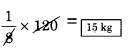
(i) Since, 75 kg of rice is cooked for 600 students Hence, for 1 student the amount of rice cooked Proportional Reasoning 1 Class 8 Solutions Maths Ganita Prakash Chapter 7 14

(ii) If 120 students come to school, then the amount of rice to be cooked 15. Proportional Reasoning 1 Class 8 Solutions Maths Ganita Prakash Chapter 7 15

(iii) Factor of change in the first term is : \(\frac{120}{600}\) = \(\frac{1}{5}\)

(iv) If 180 students come to school, then the amount of rice to be cooked on that day = \(\frac{1}{8}\) × 180 kg = 22.5 kg

Parallel and Intersecting Lines Class 7 Solutions Maths Ganita Prakash Chapter 5

Students can refer to BSE Odisha Class 7 Math Solution and Ganita Prakash Chapter 5 Parallel and Intersecting Lines Class 7 Question Answer to understand textbook questions step by step.

Class 7 Maths Chapter 5 Parallel and Intersecting Lines Solutions

Ganita Prakash Class 7 Chapter 5 Solutions

Class 7 Maths Ganita Prakash Chapter 5 Solutions Parallel and Intersecting Lines

Question 1.
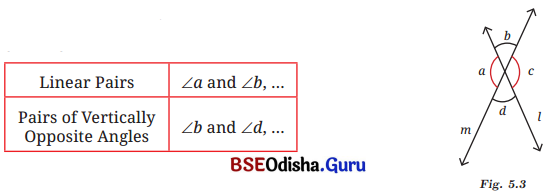
List all the linear pairs and vertically opposite angles you observe in the given figure:
Parallel and Intersecting Lines Class 7 Solutions Maths Ganita Prakash Chapter 5-1
Solution:
We know that adjacent angles formed by two intersecting lines, are called linear pairs. Linear pairs always add up to 180°.
And opposite angles formed by two intersecting lines, are called vertically opposite angles. Vertically opposite angles are always equal to each other.

Linear pairs ∠a and ∠b, ∠b and ∠c, ∠c and ∠d, ∠d and ∠a
Pairs of Vertically Opposite Angles ∠b and ∠d, ∠a and ∠c


Question 2.
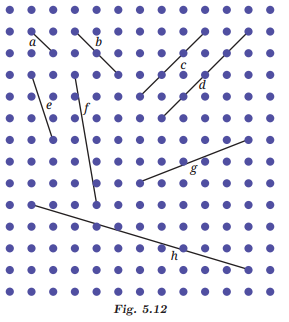
Using your sense of how parallel lines look, try to draw lines parallel to the line segments on this dot paper.
(a) Did you find it challenging to draw sorne of them?
(b) Which ones?
(c) How did you do ii?
Parallel and Intersecting Lines Class 7 Solutions Maths Ganita Prakash Chapter 5-2
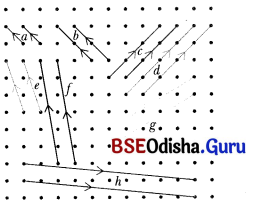
Solution:
Parallel and Intersecting Lines Class 7 Solutions Maths Ganita Prakash Chapter 5-3
(a) Yes, some line segments are a litle more difficult to draw than others.
(b) Line segments e,f. h and g.
(c) Lines parallel to a given line segment are drawn by keeping thern equidistant from the given line segment.

Parallel and Intersecting Lines Class 7 Solutions Maths Ganita Prakash Chapter 5

Question 3.
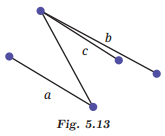
In the figure, which line is parallel to line a — line b or line c? How do you decide this?
Parallel and Intersecting Lines Class 7 Solutions Maths Ganita Prakash Chapter 5-4
Solution:
Line c is parallel to line a because the corresponding dots on these lines are equidistant from each other. So, they do not intersect, no matter how far they are extended.

Question 4.
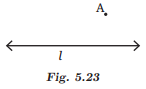
Can you draw a line parallel to l, that goes through point A? How will you do it with the tools from your geometry box? Describe your method.
Parallel and Intersecting Lines Class 7 Solutions Maths Ganita Prakash Chapter 5-5
Solution:
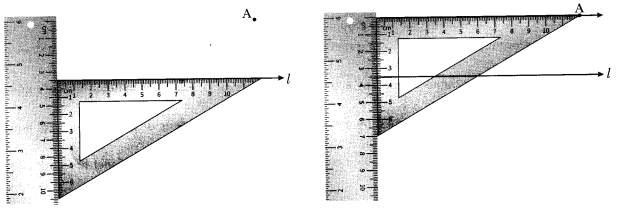
Tools needed: Ruler, Set-squares (right-angled triangle), Pencil Steps of Construction:
Step 1: Place the set square so that one side is along the line l.
Step 2: Hold the ruler against the other side of the set square (the ruler won’t move).
Step 3: Slide the set square along the ruler until one side reaches point A.
Step 4: Draw a line along the edge of the set square through point A.
Step 5: This new line is parallel to line l and passes through point A.
Parallel and Intersecting Lines Class 7 Solutions Maths Ganita Prakash Chapter 5-6

Parallel and Intersecting Lines Class 7 Solutions Maths Ganita Prakash Chapter 5

Question 5.
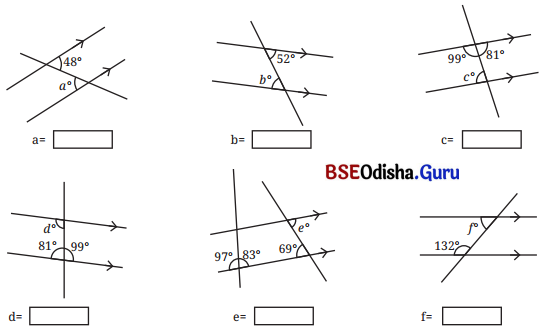
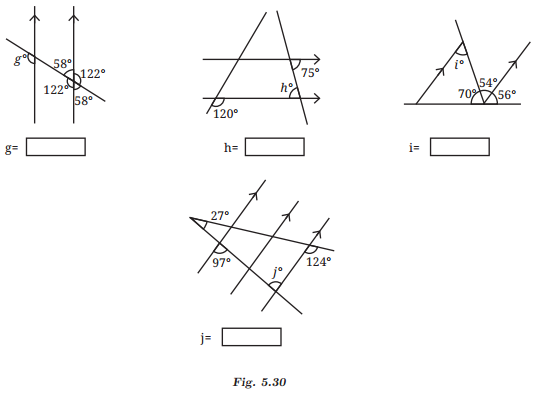
Find the angles marked below.
Parallel and Intersecting Lines Class 7 Solutions Maths Ganita Prakash Chapter 5-7
Parallel and Intersecting Lines Class 7 Solutions Maths Ganita Prakash Chapter 5-8
Solution:
(i) Since alternate interior angles formed by a transversal intersecting a pair of parallel lines are equal, we obtain a = 48°.

(ii) Since alternate interior angles formed by a transversal intersecting a pair of parallel lines are equal, we obtain b = 52°.

(iii) Since alternate interior angles formed by a transversal intersecting a pair of parallel lines are equal, we obtain c = 81°.

(iv) Since alternate interior angles formed by a transversal intersecting a pair of parallel lines are equal, we obtain d = 99°.

(v) Since alternate interior angles formed by a transversal intersecting a pair of parallel lines are equal, we obtain e = 69°.

(vi) Since the sum of interior angles on the same side of a transversal intersecting a pair of parallel lines is always equal to 180°,f + 132° = 180° ⇒ f = 180°- 132° ⇒ f = 48°

(vii) Since corresponding angles formed by a transversal intersecting a pair of parallel sides are equal, we obtain g = 122°.

(viii) Since alternate interior angles formed by a transversal intersecting a pair of parallel lines are equal, we obtain h = 75°.

(ix) Since alternate interior angles formed by a transversal intersecting a pair of parallel lines are equal, we obtain i = 54°.

(x) Since alternate interior angles formed by a transversal intersecting a pair of parallel lines are equal, we obtain j = 97°.

Question 6.
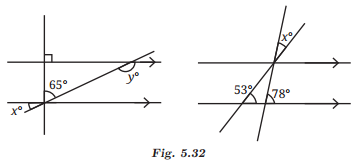
In the figures below, what angles do x and y stand for?
Parallel and Intersecting Lines Class 7 Solutions Maths Ganita Prakash Chapter 5-9
Solution:
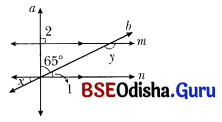
(i) The lines and angles are marked as shown in the figure.
Parallel and Intersecting Lines Class 7 Solutions Maths Ganita Prakash Chapter 5-10
Line m is parallel to line n and line a is a transversal.
∴ ∠2 = 65° + ∠1 [∵ Corresponding angles]
⇒ 90° = 65° + ∠1
⇒ ∠1 = 90°- 65°
⇒ ∠1 = 25°
And, ∠1 = x = 25° [∵ Vertically opposite angles]
Also, line m is parallel to line n and line b is a transversal.
∴ ∠1 +y = 180° [∵ Sum of co-interior angles = 180°]
⇒ 25° + y = 180° [∵ ∠1 = 25°]
⇒ y = 180° – 25° ⇒ y = 155°
Thus, the values of x and y are 25° and 155°, respectively.

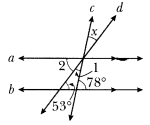
(ii) The lines and angles are marked as shown in the figure.
Parallel and Intersecting Lines Class 7 Solutions Maths Ganita Prakash Chapter 5-11
Line a is parallel to line b and line d is a transversal.
∴ ∠2 = 53° [∵ Alternate interior angles]
Also, line a is parallel to line b and c is a transversal.
∴ ∠1 + ∠2 = 78° [∵ Alternate interior angles]
⇒ ∠1 + 53° = 78° [∵ ∠2 = 53°]
⇒ ∠1 = 78°- 53°
⇒ ∠1 = 25°
Therefore, ∠1 = x = 25° [∵ Vertically opposite angles]

Parallel and Intersecting Lines Class 7 Solutions Maths Ganita Prakash Chapter 5

Question 7.
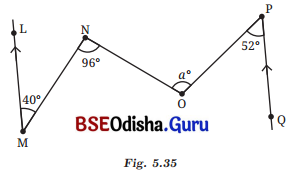
What is the measure of ∠NOP in the figure?
Parallel and Intersecting Lines Class 7 Solutions Maths Ganita Prakash Chapter 5-12
[Hint: Draw lines parallel to LM and PQ through points N and O.]
Solution:
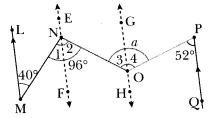
Lines parallel to LM and PQ through points N and O are drawn and angles are marked as shown in the figure.
Parallel and Intersecting Lines Class 7 Solutions Maths Ganita Prakash Chapter 5-13
Since LM is parallel to EF and MN is a transversal,
∠1 = 40° [∵ Alternate interior angles]
Now, ∠1 + ∠2 = 96°
⇒ 40° + ∠2 = 96° [∵ ∠1 = 40°]
⇒ ∠2 = 96° – 40°
⇒ ∠2 = 56°
Since EF is parallel to GH and AT is a transversal,
∠2 = ∠3 = 56° [∵ Alternate interior angles]
Also, GH is parallel to PQ and OP is a transversal.
∴ ∠4 = 52° [∵ Alternate interior angles]
So, a = ∠3 + ∠4
⇒ a = 56° + 52° ⇒ a = 108°
Thus, ∠NOP = 108°.

InText Questions

Question 1.
Can two straight lines intersect at more than one point?
Solution:
No, two straight lines cannot intersect at more than one point. If two lines intersect at more than one point, then they are coincident lines.

Parallel and Intersecting Lines Class 7 Solutions Maths Ganita Prakash Chapter 5

Question 2.
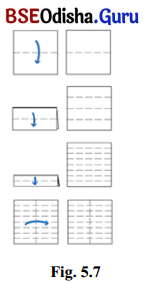
Take a plain square sheet of paper (use a newspaper for this).
Parallel and Intersecting Lines Class 7 Solutions Maths Ganita Prakash Chapter 5-14
(i) How would you describe the opposite edges of the sheet? They are ________ to each other.
(ii) How would you describe the adjacent edges of the sheet? The adjacent edges are ________ to each other. They meet at a point. They form right angles.
(iii) Fold the sheet horizontally in half. A new line is formed (see figure).
How many parallel lines do you see now?
(iv) Make one more horizontal fold in the folded sheet. How many parallel lines do you see now?
(v) What will happen if you do it once more? How many parallel lines will you get? Is there a pattern? Check if the pattern extends further, if you make another horizontal fold.
(vi) Make a vertical fold in the square sheet. This new vertical line is _________ to the previous horizontal lines.
(vii) Fold the sheet along a diagonal. Can you find a fold that creates a line parallel to the diagonal line?
Solution:
(i) They are parallel to each other.
(ii) The adjacent edges are perpendicular to each other.
(iii) We see three parallel horizontal lines — the top edge, the fold and the bottom edge. The new horizontal line is perpendicular to the vertical edges of paper.
(iv) On folding the paper horizontally one more time, we see five parallel horizontal lines.
(v) On folding the paper horizontally once more, we will get nine parallel lines. The number of horizontal parallel lines follow the sequence:
1st fold → 3 lines
2nd fold → 5 lines
3rd fold → 9 lines and so on
So, after each fold, the number of horizontal lines increases as folding doubles the sections and add extra fold lines. The pattern continues as we fold more.

(vi) This new vertical line is perpendicular to the previous horizontal lines.

(vii) Yes, we can make a fold parallel to the diagonal by folding the sheet in the same slanting direction at equal angles or by folding a smaller triangle inside the square.

Parallel and Intersecting Lines Class 7 Extra Questions

Parallel and Intersecting Lines Class 7 Very Short Question Answer

Question 1.
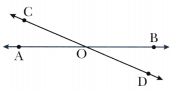
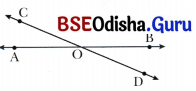
In the given figure, write the vertically opposite angles of ∠AOD and ∠AOC.
Parallel and Intersecting Lines Class 7 Solutions Maths Ganita Prakash Chapter 5-15
Solution:
We know that when two lines intersect, the angles opposite to each other are called vertically opposite angles. They are formed without sharing a common arm and are always equal.
Thus, in the given figure, ∠BOC is vertically opposite angle of ∠AOD and ∠BOD is vertically opposite angle of ∠AOC.

Parallel and Intersecting Lines Class 7 Solutions Maths Ganita Prakash Chapter 5

Question 2.
Find the complement of each of the following angles:
(i) 28°
(ii) 66°
(iii) 75°
(iv) 80°
Solution:
We know that complement of angle x° is (90° – x°).
(i) Complement of 28° = 90° – 28° = 62°
(ii) Complement of 66° = 90° – 66° = 24°
(iii) Complement of 75° = 90° – 75° = 15°
(iv) Complement of 80° = 90° – 80° = 10°

Question 3.
Find the supplement of each of the following angles:
(i) 28°
(ii) 95°
(iii) 130°
(iv) 155°
Solution:
We know that supplement of angle x° is (180° – x°).
(i) Supplement of 28° = 180° – 28° = 152°
(ii) Supplement of 95° = 180° – 95° = 85°
(iii) Supplement of 130° = 180° – 130° = 50°
(iv) Supplement of 155° = 180° – 155° = 25°

Parallel and Intersecting Lines Class 7 Solutions Maths Ganita Prakash Chapter 5

Question 4.
Find the complement of each of the following angles:
(i) 32°
(ii) 72°
(iii) 68°
(iv) 20°
Solution:
We know that complement of angle x° is (90 – x)°.
(i) Complement of 32° = 90° – 32° = 58°
(ii) Complement of 72° = 90° – 72° = 18°
(iii) Complement of 68° = 90° – 68° = 22°
(iv) Complement of 20° = 90° – 20° = 70°

Question 5.
Find the supplement of each of the following angles:
(i) 25°
(ii) 92°
(iii) 142°
(iv) 165°
Solution:
We know that supplement of angle x° is (180 – x)°.
(i) Supplement of 25° = 180° – 25° = 155°
(ii) Supplement of 92° = 180° – 92° = 88°
(iii) Supplement of 142° = 180° – 142° = 38°
(iv) Supplement of 165° =180° – 165° = 15°

Parallel and Intersecting Lines Class 7 Solutions Maths Ganita Prakash Chapter 5

Question 6.
In the given figure, write the angles that form a linear pair with ∠AOD and with ∠BOC.
Parallel and Intersecting Lines Class 7 Solutions Maths Ganita Prakash Chapter 5-16
Solution:
We know that the adjacent angles formed by two lines intersecting each other, are called linear pair of angles. Linear pairs always add up to 180°.
In the given figure, ∠AOC and ∠BOD form a linear pair of angles with ∠AOD.
∠AOC and ∠BOD form a linear pair of angles with ∠BOC.

Question 7.
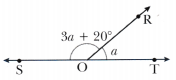
In the given figure, find the value of a.
Parallel and Intersecting Lines Class 7 Solutions Maths Ganita Prakash Chapter 5-17
Given,
∠SOR = 3a + 20° and ∠ROT = a
From the given figure, we can say that ∠SOR and ∠ROT form a linear pair.
∴ ∠SOR + ∠ROT = 180°
⇒ 3a + 20° + a = 180°
⇒ 4a = 160° ⇒ a = 40°

Parallel and Intersecting Lines Class 7 Solutions Maths Ganita Prakash Chapter 5

Question 8.
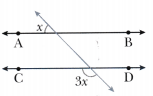
Find the value of x in the following figure, if AB is parallel to CD.
Parallel and Intersecting Lines Class 7 Solutions Maths Ganita Prakash Chapter 5-18
Solution:
Given, AB is parallel CD.
Since x and 3x are co-exterior angles on the same side of transversal, they add up to 180°.
∴ x + 3x = 180° ⇒ 4x = 180°
⇒ x = \(\frac{180^{\circ}}{4}\) ⇒ x = 45°

Question 9.
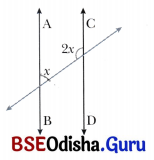
Find the value of x in the following figure, if AB is parallel to CD.
Parallel and Intersecting Lines Class 7 Solutions Maths Ganita Prakash Chapter 5-19
Solution:
Given, AB is parallel CD.
Since x and 2x are interior angles on the same side of transversal, they add up to 180°.
∴ x + 2x = 180°
⇒ 3x = 180° ⇒ x = 60°

Parallel and Intersecting Lines Class 7 Solutions Maths Ganita Prakash Chapter 5

Parallel and Intersecting Lines Class 7 Short Question Answer

Question 1.
Identify the complementary and supplementary pairs of angles from the following pairs:
(i) 42°, 48°
(ii) 85°, 95°
(iii) 30°, 60°
(iv) 135°, 45°
Solution:
We know that if the sum of the measures of two angles is 90°, then the angles are called complementary angles and if the sum of the measures of two angles is 180°, then the angles are called supplementary angles.
(i) The given angles are 42° and 48°.
Now, sum of given angles = 42° + 48° = 90°
Thus, the given angles are complementary angles.

(ii) The given angles are 85° and 95°.
Now, sum of given angles = 85° + 95° = 180°
Thus, the given angles are supplementary angles.

(iii) The given angles are 30° and 60°.
Now, sum of given angles = 30° + 60° = 90°
Thus, the given angles are complementary angles.

(iv) The given angles are 135° and 45°.
Now, sum of given angles = 135° + 45° = 180°
Thus, the given angles are supplementary angles.

Question 2.
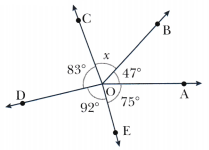
In the given figure, find the value of x.
Parallel and Intersecting Lines Class 7 Solutions Maths Ganita Prakash Chapter 5-20
Solution:
Given, ∠AOB = 47°, ∠BOC = x, ∠COD = 83°, ∠DOE = 92° and ∠EOA = 75°
Now, as ∠AOB, ∠BOC, ∠COD, ∠DOE and ∠EOA are angles at a point, they add up to 360°.
∴ ∠AOB + ∠BOC + ∠COD + ∠DOE + ∠EOA = 360°
⇒ 47° + x + 83° + 92° + 75°= 360°
⇒ 297° + x = 360°
⇒ x = 360° – 297° = 63°
Thus, the value of x is 63°.

Parallel and Intersecting Lines Class 7 Solutions Maths Ganita Prakash Chapter 5

Question 3.
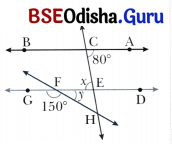
In the given figure, line AB is parallel to line DG. Find the value of x + y.
Parallel and Intersecting Lines Class 7 Solutions Maths Ganita Prakash Chapter 5-21
Solution:
Given, line AB is parallel to line DG.
∴ ∠ACE = ∠CEG
[∵ Alternate interior angles are equal]
⇒ x = 80° [∵ ∠ACE = 80° and ∠CEF = x]
Since ∠GFH and ∠EFH form linear pair, they add up to 180°.
∴ ∠GFH + ∠EFH = 180°
⇒ 150° + y = 180° [∵ ∠GFH = 150°]
⇒ y = 180° – 150° = 30°
∴ x + y = 80° + 30° = 110°

Question 4.
In the given figure, l is parallel to m. Find the value of x and y.
Parallel and Intersecting Lines Class 7 Solutions Maths Ganita Prakash Chapter 5-22
Solution:
Given, l is parallel to m and n is transversal to l and m.
Since 2x and y are vertically opposite angles, they are equal.
∴ y = 2x …(i)
Since 4x and y are interior angles on the same side of the transversal, they add up to 180°.
∴ 4x + y = 180°
⇒ 4x + 2x = 180° [From (i)]
⇒ 6x = 180° ⇒ x = 30°
Substituting the value of x in (i), we get
y = 2 × 30° = 60°

Parallel and Intersecting Lines Class 7 Solutions Maths Ganita Prakash Chapter 5

Parallel and Intersecting Lines Class 7 Long Question Answer

Question 1.
Which lines appear to be perpendicular to each other in the given figure?
Parallel and Intersecting Lines Class 7 Solutions Maths Ganita Prakash Chapter 5-23
Solution:
When two lines intersect and the angles formed are 90° (i.e. all four angles are equal), the lines are said to be perpendicular to each other.

In the given figure, since line i is parallel to line d, perpendicular to any of these lines is also perpendicular to other. Therefore, lines b, c, h and /are perpendicular to lines i and d.

Similarly, lines d and i are perpendicular to lines b, c, h andf.

Question 2.
In the given figure, AB is parallel to CD and AD is parallel to BC. Find the values of x, y and z.
Parallel and Intersecting Lines Class 7 Solutions Maths Ganita Prakash Chapter 5-24
Solution:
Given, AB || CD, AD ||
BC and ∠BAD = 70°.
As AD || BC and AB is transversal, ∠ABC and ∠BAD are co-interior angles.
∴ ∠ABC + ∠BAD = 180°
⇒ x + 70° = 180° [∵ ∠BAD = 70°]
⇒ x = 180°- 70° = 110°
Now, as AB || DC and AD is transversal, ∠ADC and ∠BAD are co-interior angles.
∴ ∠ADC + ∠BAD = 180°
⇒ z + 70° = 180° [∵ ∠BAD = 70°]
⇒ z = 180°- 70° = 110°
Also, as AD || BC and DC is transversal, ∠ADC and ∠BCD are co-interior angles.
∴ ∠ADC + ∠BCD = 180°
⇒ 110°+ y = 180° [∵ ∠ADC =110°]
⇒ y = 180°- 110° = 70°

Parallel and Intersecting Lines Class 7 Solutions Maths Ganita Prakash Chapter 5

Question 3.
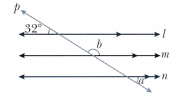
In the following figure, find the value of each marked angle.
Parallel and Intersecting Lines Class 7 Solutions Maths Ganita Prakash Chapter 5-25
Solution:
Given, line l || m || n.
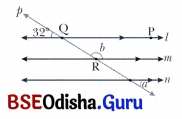
Let point P lie on line l, point R lie on line p and the point of intersection of lines p and l be Q, as shown in the figure.
Parallel and Intersecting Lines Class 7 Solutions Maths Ganita Prakash Chapter 5-26
Since ∠PQR and 32° are vertically opposite angles, they are equal.
∴ ∠PQR = 32°
As l || m, ∠b and ∠PQR are interior angles on the same side of transversal p.
∴ ∠b + ∠PQR = 180°
⇒ ∠b + 32° = 180° [∵ ∠PQR = 32°]
⇒ ∠b = 180°- 32° = 148°
As l || n, ∠a and ∠PQR are corresponding angles.
∴ ∠a = ∠PQR
⇒ ∠a = 32° [∵ ∠PQR = 32°]

Question 4.
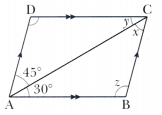
In the following figure, AB is parallel to CD and AD is parallel to BC. Find the values of x, y and z.
Parallel and Intersecting Lines Class 7 Solutions Maths Ganita Prakash Chapter 5-27
Solution:
Given, AB || CD, AD || BC, ∠DAC = 45° and ∠BAC = 30°.
As AB || CD anddC is transversal, ∠DAC and ∠ACB are alternate interior angles.
∴ ∠ACB = ∠DAC ⇒ x = 45°
[∵ ∠DAC = 45° and ∠ACB = x]
As AB || CD and AC is transversal, ∠BAC and ∠ACD are alternate interior angles.
∴ ∠ACD = ∠BAC ⇒ y = 30°
[∵ ∠BAC = 30° and ∠ACD = y]
As AD || BC and AB is transversal. ∠DAB and ∠ABC are co-interior angles.
∴ ∠DAB +∠ABC = 180°
⇒ ∠DAC + ∠CAB + ∠ABC = 180°
[∵ ∠DAB = ∠DAC + ∠CAB]
⇒ 45° + 30° + z = 180°
[∵ ∠DAC = 45°, ∠CAB = 30° and ∠ABC = z]
⇒ z = 180°- 75° = 105°

Parallel and Intersecting Lines Class 7 Solutions Maths Ganita Prakash Chapter 5

Parallel and Intersecting Lines Class 7 Case Based Questions

Question 1.
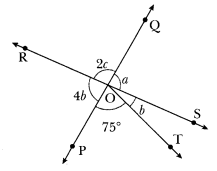
In the given figure, two straight lines PQ and RS intersect each other at O such that ∠POT = 75°.
Parallel and Intersecting Lines Class 7 Solutions Maths Ganita Prakash Chapter 5-28
Based on the above information, answer the following questions:
(i) Find the value of b.
(ii) Find the value of a.
(iii) Find the value of c.
Solution:
(i) Given, ∠ROP = 4b, ∠POT = 75°, ∠TOS = b
Here, ∠ROS = 180°
[Since ∠ROS is a straight angle]
⇒ ∠ROP + ∠POT + ∠TOS = 180°
⇒ 4b + 75° + b = 180°
⇒ 5b + 75° = 180°
⇒ 5b = 180° – 75° = 105°
b = \(\frac{105^{\circ}}{5}\) = 21°
Thus, the value of b is 21°.

(ii) Since ∠ROP and ∠QOS are vertically opposite angles, they are equal.
∴ ∠QOS = ∠ROP
⇒ a = 4b
⇒ a = 4 × 21° [∵ b = 21°]
⇒ a = 84°
Thus, the value of a is 84°.

(iii) Since ∠QOS and ∠QOR form a linear pair, they add up to 180°.
∴ ∠QOS + ∠QOR = 180°
⇒ a + 2c = 180°
⇒ 84° + 2c =180° [∵ a = 84°]
⇒ 2c = 180° – 84° = 96°
c = \(\frac{96^{\circ}}{2}\) = 48°
Thus, the value of c is 48°.

Parallel and Intersecting Lines Class 7 Solutions Maths Ganita Prakash Chapter 5

Question 2.
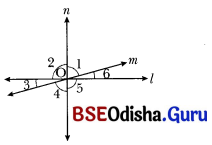
In a class, a teacher asked a student to draw three lines on the board. The student draws the lines on the board as shown.
Parallel and Intersecting Lines Class 7 Solutions Maths Ganita Prakash Chapter 5-29
The line l is perpendicular to line n and ∠1 = 75°.
Based on the above information answer the following questions:
(i) What is the measure of ∠6?
(ii) What is the measure of ∠5?
(iii) What is the measure of ∠3?
(iv) What is the sum of the measure of ∠2 and ∠1?
Solution:
(i) Given, line l is perpendicular to line n.
∴ ∠1 + ∠6 = 90°
⇒ 75° + ∠6 = 90° [∵ ∠1 = 75°]
⇒ ∠6 = 90° – 75° = 15°

(ii) Given, line l is perpendicular to line n.
∴ ∠5 = 90°

(iii) We have, ∠6 = 15°
Since ∠3 and ∠6 are vertically opposite angles, they are equal.
∴ ∠3 = ∠6 = 15°

(iv) Given, line l is perpendicular to line n. So, ∠2 is equal to 90°.
∴ ∠1 + ∠2 = 75° + 90° = 165°

Nature of Matter: Elements, Compounds, and Mixtures Class 8 Question Answer Science Chapter 8

Go through BSE Odisha Class 8 Science Solutions Chapter 8 Nature of Matter: Elements, Compounds, and Mixtures Question Answer to understand textbook questions more clearly.

Class 8 Science Curiosity Chapter 8 Question Answer

Class 8 Science Ch 8 Nature of Matter: Elements, Compounds, and Mixtures Question Answer

Class 8 Science Chapter 8 Nature of Matter: Elements, Compounds, and Mixtures Question Answer

Probe and Ponder Questions

Question 1.
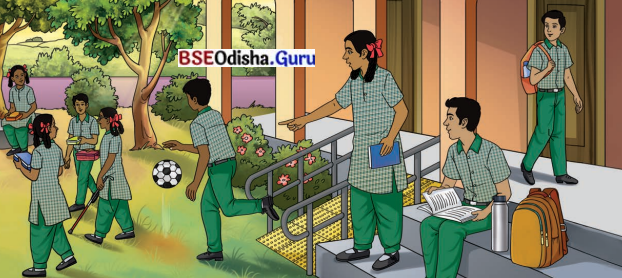
Which of the entities in the picture consist of matter and which of them do not?
Nature of Matter Elements, Compounds, and Mixtures Class 8 Question Answer Science Chapter 8.1
Answer:

  • Entities consisting of matter include physical objects like staircases, air, water, food, clothes, shoes, books, trees, balls and sticks as these have mass and occupy space.
  • They are made of tiny particles. Entities that do not consist of matter include light, heat, electricity, thoughts and emotions as they lack mass and do not occupy space.

Question 2.
How can elements be combined to form a compound?
Answer:

  • Elements combine chemically in fixed ratios to form compounds.
  • For example, hydrogen and oxygen combine in a 2:1 ratio to form water, where the atoms bond tightly, creating a new substance with properties different from the original elements.
  • This requires a chemical reaction, not just physical mixing.

Nature of Matter: Elements, Compounds, and Mixtures Class 8 Question Answer Science Chapter 8

Question 3.
How could the discovery of a compound that absorb carbon dioxide from the air contribute to solving environmental challenges?
Answer:

  • Such a compound could reduce atmospheric carbon dioxide levels, mitigating global warming and climate change.
  • For instance, it might be used in technologies to capture emissions from industries or vehicles, similar to how calcium hydroxide reacts with carbon dioxide to form calcium carbonate.
  • This could help address air pollution and support environmental cleanup efforts.

Question 4.
Share your questions …………………….
Answer:
Based on the chapter, questions could include:

  • What happens when elements like iron and sulfur are heated together?
  • Why does water extinguish fire while its components (hydrogen and oxygen) support combustion?
  • How do alloys like stainless steel improve everyday material?

InText Questions

Question 1.
According to science, how would you classify milk, packed fruit juice, baking soda, sugar, and soil as mixtures or pure substances? (Page 121)
Answer:

  • Milk: Mixture (contains water, fats, proteins, etc.)
  • Packaged fruit juice: Mixture (water sugars, flavors, vitamins, etc.)
  • Baking soda: Pure substance (if chemically pure-only sodium bicarbonate)
  • Sugar: Pure substance (if only sucrose)
  • Soil: Mixture (sand, clay, minerals, organic matter, water, air)

In science, “pure” means that the substance consists of the same kind of particle everywhere in the sample.

Nature of Matter: Elements, Compounds, and Mixtures Class 8 Question Answer Science Chapter 8

Question 2.
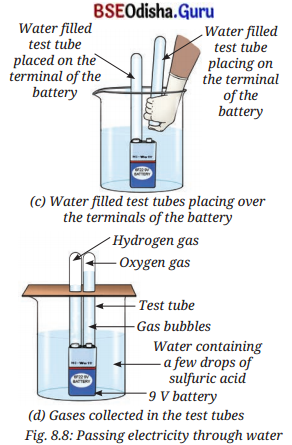
Electrolysis of water produces two different gases. Can these collected gases be water vapour ? (Page 122)
Answer:
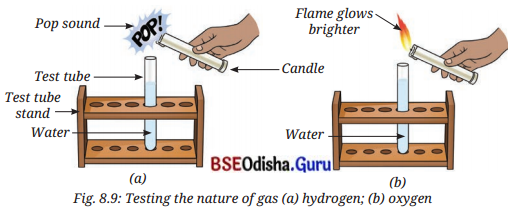
These gases are Hydrogen and oxygen not water vapour otherwise they would have condensed back to form water.

Question 3.
When electric current is passed through water, it breaks down into hydrogen and oxygen. Is this a chemical change or a physical change? (Page 123)
Answer:
This is a chemical change because the properties of hydrogen and oxygen are different from original substance water and it is irreversible by simple physical method.

Question 4.
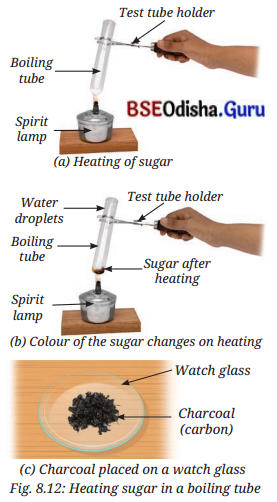
After heating sugar in a boiling tube what is left behind? Also, we observe a small droplets of water inside the boiling tube. Where did this water come from?
Answer:
Charcoal (carbon) is left behind in the boiling tube. Water must have come from the dry sugar and not from the air.

Nature of Matter: Elements, Compounds, and Mixtures Class 8 Questions and Answers

Keep the Curiosity Alive (Pages 131-132)

Question 1.
Consider the following reaction where two substances, A and B, combine to form a product C :
A+B →C
Assume that A and B cannot be broken down into simpler substances by chemical reactions. Based on this information, which of the following statements is correct?
(i) A, B, and C are all compounds, and only C has a fixed composition.
(ii) C is a compound, and A and B have a fixed composition.
(iii) A and B are compounds, and C has a fixed composition.
(iv) A and B are elements, C is a compound, and has a fixed composition.
Answer:
(iv) A and B are elements, C is a compound, and has a fixed composition.
A and B are elements, because elements are pure substances made of only one kind of atom and cannot be broken down chemically. When A and B combine chemically to form C, the result is a compound. A compound is formed when two or more elements combine in a fixed ratio through a chemical reaction. Therefore, A and B are elements, and C is a compound with a fixed composition.

Question 2.
Assertion: Air is a mixture.
Reason: A mixture is formed when two or more substances are mixed, without undergoing any chemical change.
(i) Both Assertion and Reason are true and Reason is the correct explanation for Assertion.
(ii) Both Assertion and Reason are true, but Reason is not the correct explanation for Assertion.
(iii) Assertion is true, but Reason is false.
(iv) Assertion is false, but Reason is true.
Answer:
(i) Both Assertion and Reason are true and Reason is the correct explanation for assertion.
Air is indeed a mixture because it is composed of various gases like nitrogen. oxygen, and carbon dioxide, which are mixed without any chemical reaction between them. The properties of these individual gases are retained within the air.

Question 3.
Water, a compound, has different properties compared to those of the elements oxygen and hydrogen from which it is formed. Justify this statement.
Answer:
Water has properties which is completely different from hydrogen and oxygen. Like water is liquid in form, whereas hydrogen (H) and oxygen (O) are gases. This is because a compound’s properties depends on its molecular structure.

Nature of Matter: Elements, Compounds, and Mixtures Class 8 Question Answer Science Chapter 8

Question 4.
In which of the following cases are all the examples correctly matched? Give reasons in support of your answers.
(i) Elements – water, nitrogen, iron, air.
(ii) Uniform mixtures – minerals, seawater. bronze, air.
(iii) Pure substances – carbon dioxide, iron, oxygen, sugar.
(iv) Non-uniform mixtures – air, sand, brass, muddy water.
Answer:
(iii) Pure substances – Carbon dioxide, iron, oxygen, and sugar are all pure substances. (Correctly matched).
A pure substance is composed of only one type of particle. Carbon dioxide, iron, and oxygen are all elements, meaning they are made up of only one type of atom. Sugar is a compound. but it is still considered a pure substance because it consists of only one type of molecule.

Question 5.
Iron reacts with moist air to form iron oxide, and magnesium burns in oxygen to form magnesium oxide. Classify all the substances involved in the above reactions as elements, compounds, or mixtures, with justification.
Answer:

  • Iron: Element (pure metal, cannot be broken down).
  • Moist air: Mixture (air gases plus water vapor, components retain properties).
  • Iron oxide: Compound (iron and oxygen combined chemically).
  • Magnesium: Element (pure metal).
  • Oxygen: Element (pure gas).
  • Magnesium oxide: Compound (magnesium and oxygen in fixed ratio).
  • Justification: Elements are simplest substance; compounds form from elements via chemical reactions with new properties; mixtures do not involve chemical bonding.

Question 6.
Classify the following as elements, compounds, or mixtures in the Table.
Carbon dioxide, sand, seawater, magnesium oxide, muddy water, aluminum, gold, oxygen, rust, iron sulfide, glucose, air, water, fruit juice, nitrogen, sodium chloride, sulfur, hydrogen, and baking soda.

Elements Compounds Mixtures

Identify pure substances amongst these and list them below.

pure substances

Answer:
Pure Substances: Aluminium, gold, oxygen, nitrogen, sulfur, hydrogen, carbon dioxide, magnesium oxide, iron sulfide, glucose, water, sodium chloride, baking soda.

Elements Compounds Mixtures
Aluminium Carbon Dioxide CO2 Sand
Gold Magnesium Oxide (MgO) Seawater
Oxygen Rust (Fe2O3) Muddy Water
Nitrogen Iron Sulfide (FeS) Air
Sulfur Glucose (C6 H12O6 ) Fruit Juice
Hydrogen Water (H2O)
Sodium Chloride(NaCl)
Baking Soda NaHCO3

Question 7.
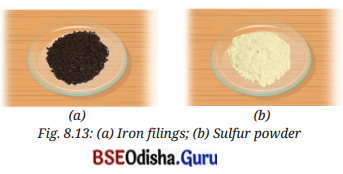
What new substance is formed when a mixture of iron filings and sulfur powder is heated, and how is it different from the original mixture? Also, write the word equation for the reaction.
Answer:
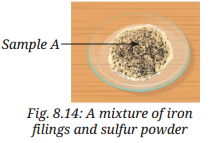
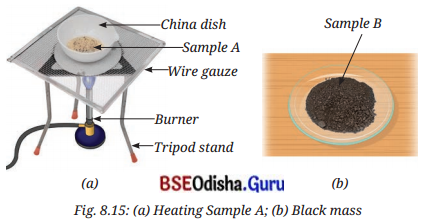
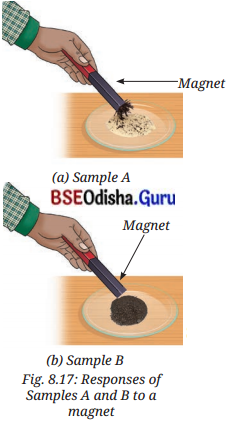
When iron filings and sulfur powder are heated, they react to form a new substance called ferrous sulfide (FeS), also known as iron sulfide. This is a chemical change, and the resulting compound has different properties from the original iron and sulfur.
The word equation for the reaction is :
Iron + Sulfur → Ferrous Sulfide.

Nature of Matter: Elements, Compounds, and Mixtures Class 8 Question Answer Science Chapter 8

Question 8.
Is it possible for a substance to be classified as both an element and a compound? Explain why or why not.
Answer:
No, a substance cannot be classified as both an element and a compound. Elements are pure substances that cannot be broken down into simpler substances by chemical means, while compounds are formed when two or more different elements are chemically bonded together. The defining characteristic of a compound is that it is composed of multiple elements, whereas an element is a single type of atom. Therefore, a substance cannot be both a single type of atom and a combination of different types of atoms simultaneously.

Question 9.
How would our daily lives be changed if water were not a compound but a mixture of hydrogen and oxygen?
Answer:
Water’s role in life and nature depends on it being a compound with stable properties. If it were a mixture, it would be dangerous and unusable, making life as we know it impossible.

Impact on Daily Life

  • No safe drinking water → Life would not be possible.
  • No water for agriculture →Crops would not grow.
  • No water for cleaning or cooking → Daily tasks would be unsafe.
  • No aquatic life → Fish and underwater plants would die.
  • Increased fire hazards → Hydrogen and oxygen together are explosive.

Question 10.
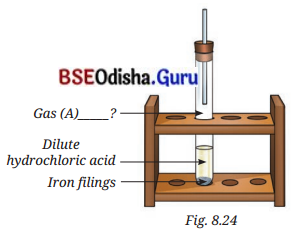
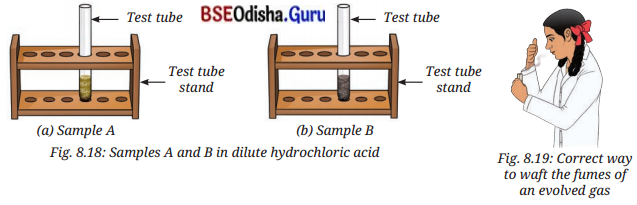
Analyse the figure. Identify Gas A. Also, write the word equation of the chemical reaction.
Nature of Matter Elements, Compounds, and Mixtures Class 8 Question Answer Science Chapter 8.2
Answer:
By analysing the figure, it is found that there will be a chemical reaction inside the test tube between dilute HCl and Fe.
2HCl+Fe →FeCl2+H2 ↑
So the reaction forms Iron Chloride (FeCl2) and the gas above will be Hydrogen (H2).
Hydrochloric Acid + Iron filing → Iron Chloride + Hydrogen (g)
Thus, Gas A = Hydorgen

Question 11.
Write the names of any two compounds made only from non-metals, and also mention two uses of each of them.
Answer:
1. Carbon Dioxide (CO2)
Made of: Carbon and Oxygen (both nonmetals)
Uses:

  • Used in fire extinguishers to put out flames.
  • Used by plants during photosynthesis to make food.

2. Sulfur Dioxide (SO2)
Made of: Sulfur and Oxygen (both nonmetals)
Uses:

  • Used as a preservative in dried fruits and wines.
  • Used in the manufacture of sulfuric acid, an important industrial chemical.

Question 12.
How can gold be classified as both a mineral and a metal?
Answer:
A mineral is a naturally occurring substance with a definite chemical composition.
Gold is found in nature in its native form, often embedded in rocks or alluvial deposits. It is extracted through mining, making it a metallic mineral. Minerals like gold are formed by natural geological processes.

Gold as a Metal
After extraction, gold is refined and used as a metal. It is a pure element (symbol: Au ) with typical metallic properties :

  • Lustrous (shiny)
  • Malleable (can be beaten into sheet)
  • Ductile (can be drawn into wires)
  • Good conductor of electricity
  • Used in jewelry, electronics, and currency.

Class 8 Science Chapter 8 Question Answer

Activity 1.

Let us experiment

Aim: To demonstrate the presence of carbon dioxide in the air.
Materials Required: Calcium oxide (Quick lime), a petri dish a glass tumbler, a glass rod.

Nature of Matter Elements, Compounds, and Mixtures Class 8 Question Answer Science Chapter 8.3
Procedure:

  • For this activity we need a glass tumbler which is half filled with water.
  • Now, add a small amount of calcium oxide (quick lime) slowly to it.
  • Note down your observation.
  • Calcium oxide reacts vigorously with water to form calcium hydroxide and releases heat.
  • Now, stir the mixture with a glass rod to make a solution of calcium hydroxide. This solution is called lime water.
  • Filter it using a filter paper and observe its colour.
  • Leave this colourless solution in a petri dish for a few hours [Figure (a)].
  • We should stirr the solution at regular intervals.
  • Note down your observation. [Figure (b)]

Nature of Matter: Elements, Compounds, and Mixtures Class 8 Question Answer Science Chapter 8

Observations:

  • Glass tumbler becomes hot when calcium oxide is added to it.
  • After sometime, the clear solution of lime water turns milky.

Inferences:

  • Lime water turns milky because carbon dioxide in the air reacts with calcium hydroxide to produce insoluble calcium carbonate (which looks milky).
    Calcium hydroxide + Carbon dioxide → Calcium carbonate + Water
  • It shows the presence of carbon dioxide in the air.

Activity 2.

Let us explore

Aim: To show that air contains dust particles.
Materials Required: A black sheet of paper, a magnifying glass.

Nature of Matter Elements, Compounds, and Mixtures Class 8 Question Answer Science Chapter 8.4

Procedure:

  • Take a black sheet of paper. Remember that it should be free from any visible dust particles.
  • Fix the black sheet of paper on an open window [Figure (a)], or in the near by garden, for a few hours.
  • Note down your observation.
  • You may use a magnifying glass to see the particles.

Observations: We observed that tiny particles settled on its surface.

Inference:

  • This shows that dust particles are suspended in the air.
  • Since they are not an integral part of the air therefore are considered as pollutants. The nature and the amount of dust particles in the air may vary from time to time and from place to place.

Activity 3.

Let us experiment (Demonstration activity)
Aim: To demonstrate that water is composed of two different constituents by passing electricity through it.
Materials Required: 9 V battery, a beaker or a glass tumbler, dilute sulphuric acid.

Procedure:

  • First of all we will take two small test tubes, a beaker or a glass tumbler, and a 9 V battery.
  • Now, fill about 2/3rd of the beaker with water and add a few drops of dilute sulfuric acid to it.
    Nature of Matter Elements, Compounds, and Mixtures Class 8 Question Answer Science Chapter 8.5
    Nature of Matter Elements, Compounds, and Mixtures Class 8 Question Answer Science Chapter 8.6
  • Fill both the small test tubes completely with water taken from the beaker [Figure (a)].
  • Now, keep a 9V battery inside the beaker [Figure (b)].
  • We should take precaution that water cannot be spilled out.
  • Now, carefully place the water-filled test tubes on each of the terminals of the battery [Fig (c)].
  • Now, we will wait for a few minutes.
  • Are you observing the formation of any gas bubbles at both the terminals inside the test tubes?
  • Now, you will continue it for 10-15 minutes.
  • Observe the volume of gas collected in each test tube [Figure (d)].
  • Is the volume of the gas collected the same in both the test tubes?
  • Remove these test tubes one-by-one carefully.
  • Test these gases one-by-one by bringing a burning candle close to the mouth of the test tubes.

Nature of Matter: Elements, Compounds, and Mixtures Class 8 Question Answer Science Chapter 8

Observations:

  • Bubbles at both the terminals inside the test tube are formed.
  • Volume of gas collected in each test tube in 2:1.
  • Electrolysis of water produces two different gases (not water vapor): one that makes a “pop” sound with a flame (hydrogen), the other that makes a flame glow brighter (oxygen).

Nature of Matter Elements, Compounds, and Mixtures Class 8 Question Answer Science Chapter 8.7

Inference:

  • Water breaks down (chemically) into hydrogen and oxygen, proving it is a compound made of two elements.
  • Water is composed of two different constituents-hydrogen and oxygen.

Nature of Matter Elements, Compounds, and Mixtures Class 8 Question Answer Science Chapter 8.8

Precaution:

  • This activity must be performed under the supervision of the teacher.
  • Be careful while handling sulfuric acid. Do not use a lithium-ion battery.
  • Perform gas testing with care. Maintain a safe distance from the set-up.

Activity 4.

Let us experiment

Aim: To show that sugar is a chemical compound and after heating it gives carbon (charcoal) and water.
Materials Required: A test tube, a test tube holder, a teaspoon of sugar.

Nature of Matter Elements, Compounds, and Mixtures Class 8 Question Answer Science Chapter 8.12

Procedure:

  • Take a teaspoon of sugar and put in a boiling tube.
  • Now, start heating gently see figure (a).
  • Note your observation.

Observations:

  • After heating the sugar, it turns into brown [see figure (b)]. After sometime, it begins to char, i.e., it turns blackish [see figure (c)].
  • We can observe a small droplets of water inside the boiling tube near its open end.

Inference:

  • Since we are heating the tube, the water must have come from the dry sugar and not from the air.
  • Charcoal (carbon) is left behind in the boiling tube. We can scoop it out in a watch glass [see figure (c)] and explore if it burns like coal.
  • Sugar decomposes on heating and gives carbon and water.
  • We may conclude that sugar is a chemical compound consisting of the elements carbon, hydrogen, and oxygen.

Precaution: This activity must be performed in the presence of a teacher.

Activity 5.

Let us experiment (Demonstration activity)
Aim: To differentiate between mixture and compound.

Materials Required: A tripod stand, wire gauze, iron filings, sulfur powder.

Nature of Matter Elements, Compounds, and Mixtures Class 8 Question Answer Science Chapter 8.13

Procedure:

  • In this experiment, we explore how iron and sulfur behave as a mixture before heating and form a compound after heating.
  • This highlights key differences between mixtures (where substances stay separate) and compounds (where they combine chemically into something new). Let’s break it down step by step, starting with the initial mixture.

Demonstration:
Before Heating: Forming Sample A (The Mixture)
To begin, mix iron filings and sulfur powder together to create Sample A. This is a classic example of a mixture, where two substances are simply combined without any chemical change.

Nature of Matter Elements, Compounds, and Mixtures Class 8 Question Answer Science Chapter 8.14

Observations:
Step 1 Appearance

  • You can clearly see both components as separate substances-dark grey (or greyish-black) iron filings and yellow sulfur powder-making it look non-uniform.

Step 2 Magnet test

  • When you bring a magnet near Sample A, it attracts only the iron filings, leaving the sulfur behind. This shows the components retain their individual properties.

Nature of Matter: Elements, Compounds, and Mixtures Class 8 Question Answer Science Chapter 8

Step 3 Acid test

  • Add dilute hydrochloric acid to Sample A. The iron reacts to produce hydrogen gas (which makes a pop sound when ignited); but the sulfur does not react and remains as a yellow solid.

Inference:

  • The above three tests confirm that in a mixture, substances can be separated easily and keep their original traits or properties.
  • The reaction can be represented as – Iron + Dilute Hydrochloric acid → Iron chloride + Hydrogen gas

After Heating: Forming Sample B (The Compound)

  • Take half of Sample ‘A’ in a China dish and heat it gently with continuous stirring. This causes a chemical reaction, resulting in a new black mass called iron sulfide (Sample ‘B’). The transformation shows how elements combine to form a compound with entirely new properties.
  • Let the content of the China dish cool.
  • Place this black mass in a mortar and grind it with the help of a pestle.
  • Observe the appearance, result of magnetic test and acid test.

Nature of Matter Elements, Compounds, and Mixtures Class 8 Question Answer Science Chapter 8.15

Observations:

  • Step 1 – Appearance
    The black mass looks uniform throughout. No separate iron or sulfur visible anywhere.
  • Step 2 – Magnet test
    Unlike Sample A, a magnet has no effect on Sample B. The iron is now chemically bounded and doesn’t lost their magnetic property.
  • Step 3 Acid test
    Add dilute hydrochloric acid to Sample B. It produces hydrogen sulfide gas, which has a distinct rotten egg smell-completely different from the odourless hydrogen.

Nature of Matter Elements, Compounds, and Mixtures Class 8 Question Answer Science Chapter 8.17

Inference:

  • The above three tests confirms that Sample B is a compound, the properties of its constituents do not retain.
  • At this point, iron and sulfur can no longer be separated by physical methods like magnets or simple filtering. A compound has formed, with fixed ratios and unique characteristics that differ from the original elements.
    The reaction can be represented as –

Nature of Matter Elements, Compounds, and Mixtures Class 8 Question Answer Science Chapter 8.18

Iron sulfide Dilute Hydrochloric acid → Iron chloride + Hydrogen sulfide
Nature of Matter Elements, Compounds, and Mixtures Class 8 Question Answer Science Chapter 8.9
Answer:
Nature of Matter Elements, Compounds, and Mixtures Class 8 Question Answer Science Chapter 8.10

Nature of Matter Elements, Compounds, and Mixtures Class 8 Question Answer Science Chapter 8.19

Precautions:

  • Be careful while handling hydrochloric acid.
  • Never smell anything directly.
  • This activity may be demonstrated under the supervision of the teacher. It may be performed in a fume hood or a well-ventilated area. Do not inhale the gases.

Nature of Matter: Elements, Compounds, and Mixtures Class 8 Extra Questions and Answers

Short Answer Type Questions

Question 1.
What are metals and non-metals?
Answer:
Metals are elements that are shiny, good conductors of heat and electricity. Whereas. non-metals are dull in appearance and poor conductors of heat and electricity.

Nature of Matter: Elements, Compounds, and Mixtures Class 8 Question Answer Science Chapter 8

Question 2.
What is the main difference between physical and chemical change ?
Answer:
When physical change happens, no new substance forms and it is reversible whereas in a chemical change, new substance is formed and it is irreversible.

Question 3.
What do you mean by metalloids ?
Answer:
Metalloids are elements that have properties of both metals and non-metals. They are known as semimetals. For example; Silicon, Germ.anium.

Question 4.
What do you mean by adulteration ?
Answer:
Adulteration is the illegal act of mixing lower-quality or harmful substances into foods or products that increase quantity or cut costs, but this reduces quality and can be dangerous to health.

Question 5.
How do metals form compounds ?
Answer:
Metals form compounds by donating electrons to non-metals during chemical reactions. This results in ionic bonding, creating substances like metal oxides and metal chlorides.

Question 6.
What is a mineral and how is it different from rock?
Answer:
A mineral is a naturally occurring, inorganic substance with a definite chemical composition and a crystalline structure. In contrast, a rock is a solid material made up of one or more minerals.

Question 7.
What are pure substances ?
Answer:
A pure substance is a type of matter that has a uniform and definite composition. It contains only one kind of particle, either a single element (like oxygen or gold) or a single compound (water or salt) and cannot be separated into other substances by physical means.

Long Answer Type Questions

Question 1.
Discuss the importance and applications of elements, compounds and mixtures in our daily lives.
Answer:
Elements, compounds and mixtures are the basic building blocks of all matter. They play key roles in daily life and various industries.

Elements Importance: Elements are the simplest form of matter and cannot be further broken down, making them the foundation of all other substances.

Applications:

  • Metals like iron, copper and aluminium are used in construction, wiring and packaging due to their strength, conductivity and malleability.
  • Non-metals like oxygen are essential for respiration and combustion.
  • Silicon is vital for electronics and computer technology.
  • Gold and silver are valued for jewelry and in some electronic components.

Compounds
Importance: Compounds are formed by the chemical combination of elements, resulting in substances with unique properties necessary for life and various technological advancements.

Nature of Matter: Elements, Compounds, and Mixtures Class 8 Question Answer Science Chapter 8

Applications:

  • Water (H2O) is indispensable for life, used for drinking, cooking and industrial processes.
  • Table salt (NaCl) is a fundamental seasoning and food preservative.
  • Sugar (C12H22 O11) is a crucial energy source.
  • Many medicines and pharmaceuticals are pure compounds designed to interact with the body in specific ways.
    Carbon dioxide (CO2) is involved in respiration and photosynthesis.

Mixtures
Importance: Most of the matter encountered daily exists as mixtures. Understanding mixtures is essential for various applications.

Applications:

  • Air, a mixture of gases like Nitrogen and Oxygen, is vital for breathing and weather phenomena.
  • Alloys, like steel and bronze, are mixtures of metals that possess enhanced properties like strength or corrosion resistance, used in construction and various manufactured goods.
  • Food products like milk, juice and granola are mixtures, combining different components for taste, nutrition or texture.
  • Soil is a complex mixture of minerals, organic matter and living organisms, crucial for plant growth.
  • Many everyday products like paints, cleaning solutions and cosmetics are mixtures designed for specific purposes.

Question 2.
Why are compounds considered pure substances, while mixtures are not?
Answer:
Compounds are pure substances because they are made up of only one type of molecule and have a uniform and definite composition throughout. For example, every molecule of water (H2O) is identical, consisting of two hydrogen atoms and one oxygen atom chemically bonded together. This fixed composition results in consistent physical and chemical properties, like a specific boiling point and density.

Mixtures are not pure substances because they consist of two or more substances that are physically blended, not chemically bonded. The components of a mixture retain their individual properties and can be present in varying proportions. For example, air is a mixture of Nitrogen, Oxygen and other gases and amount of each gas can vary.

Case-Study Based Questions

Question 1.
Read the following passage carefully and answer the questions that follow: A mixture contains more than one susbtance (element and/or compound) mixed in any proportion. Mixtures can be separated into pure substances using appropriate separation techniques. Pure substances can be elements or compounds.

An elements is a form of matter that cannot be broken down by chemical reactions into simpler substances. A compound is a substance composed of two or more different types of elements, chemically combined in a fixed proportion. Properties of a compound are different from its constituent elements where as a mixture shows the properties of its constituting elements or compounds.

(i) Which of the following are homogeneous in nature ?
A. Ice
B. Wood
C. Soil
D. Air
(a) A and C
(b) B and D
(c) A and D
(d) C and D
Answer:
(c) A and D

(ii) Two chemical species X and Y combine together to form a product P which contains both X and Y.
X+Y → P
X and Y cannot be broken down into simpler substances by simple chemical reactions. Which of the following concerning the species X, Y and P are correct?
A. P is a compound
B. X and Y are compounds
C. X and Y are elements
D. P has a fixed composition
(a) A, B and C
(b) A, B and D
(c) B, C and D
(d) A, C and D
Answer:
(d) A, C and D

Nature of Matter: Elements, Compounds, and Mixtures Class 8 Question Answer Science Chapter 8

(iii) Give two points of differences between an element and a compound.
Answer:

Element Compound
1. An element is made up of same kind of atoms. 1. A compound is obtained from different kinds of atoms.
2. An element cannot be split by physical or chemical methods. 2. A compound can be split into new substances by chemical methods.

(iv) Which of the following are not compounds?
(a) Chlorine gas
(b) Potassium chloride
(c) Iron
(d) Iron sulphide
(e) Aluminium
(f) Iodine
(g) Carbon
(h) Carbon monoxide
(i) Sulphur powder
Answer:
Chlorine gas, iron, aluminium, iodine, carbon, sulphur powder.

Picture Based Questions

I. Look at the pictures and answer the following questions :
(a) Identify the pictures (i) and (ii).
Nature of Matter Elements, Compounds, and Mixtures Class 8 Question Answer Science Chapter 8.11
Answer:
(i) Graphene aerogel
(ii) Dhokra art

(b) Write the use of figure (i).
Answer:
(i) It is used as an environment cleaner
(ii) It is useful in fabricating energy saving devices and special coating for buildings.

(c) In which states this craft is popular [see figure (ii)] ?
(a) Bihar
(b) Odisha
(c) both (a) and (b)
(d) None of these
Answer:
(c) both (a) and (b)

Nature of Matter: Elements, Compounds, and Mixtures Class 8 MCQ

Multiple Choice Questions (Mcqs)

Question 1.
What is a mixture?
(a) A substance formed by chemical reaction
(b) A single pure substance
(c) A combination of substances without chemical reaction
(d) A new element
Answer:
(c) A combination of substances without chemical reaction

Question 2.
What is a component in a mixture ?
(a) A new element
(b) An individual substance in the mixture
(c) A type of atom
(d) A compound
Answer:
(b) An individual substance in the mixture

Question 3.
Which of the following is a compound ?
(a) Brass
(b) Salt (NaCl)
(c) Air
(d) Lemonade
Answer:
(b) Salt (NaCl)

Question 4.
What is a pure substance ?
(a) Any liquid
(b) Substance with only one type of particle
(c) Mixture of water and sugar
(d) A combination of many substances
Answer:
(b) Substance with only one type of particle

Nature of Matter: Elements, Compounds, and Mixtures Class 8 Question Answer Science Chapter 8

Question 5.
Which of the following statements are true for pure substances?
(i) Pure substances contain only one kind of particles.
(ii) Pure substances may be compounds or mixtures.
(iii) Pure substances have the same composition throughout.
(iv) Pure substances can be exemplified by all elements other than nickel.
(a) (i) and (ii)
(b) (i) and (iii)
(c) (iii) and (iv)
(d) (ii) and (iii)
Answer:
(b) (i) and (iii)

Assertion and Reasoning

These questions consist of two statements, each printed as Assertion (A) and Reason (R). While answering these questions, you are required to choose any one of the following four responses.
(a) Assertion (A) and Reason (R) both are correct and reason is correct explanation for assertion.
(b) Assertion (A) and Reason (R) both are correct and reason is not correct explanation for assertion.
(c) Assertion (A) is correct but the Reason (R) is wrong.
(d) Assertion (A) is wrong but the Reason (R) is correct.

1. Assertion (A): Copper is called an element.
Reason (R): Copper cannot be broken down to simpler substances by chemical reactions.
Answer:
(a) Assertion (A) and Reason (R) both are correct and reason is correct explanation for assertion.

2. Assertion (A): Elements combine and react to form a compound.
Reason (R): The constituents of a compound can be separated easily by physical methods.
Answer:
(c) Assertion (A) is correct but the Reason (R) is wrong.

Fill in the blanks

1. The atoms of most of the elements cannot exist ………….
Answer:
independently

2. Two or more atoms combine and form a stable particle of that element called a ………….
Answer:
molecule

3. Baking powder is a mixture of baking soda and …………acid.
Answer:
tartaric

4. In ancient Indian Texts, Bronze is also known as ………….
Answer:
Kamsya

5. Bronze is an alloy made of copper and ………….
Answer:
tin

True or False

1. The properties of a mixture depend upon the properties of its components and no new substances is formed.
Answer:
True

2. The composition of a compound is always fixed.
Answer:
True

3. Brass is a compound of copper and zinc.
Answer:
False

4. Air is not a mixture.
Answer:
False

Nature of Matter: Elements, Compounds, and Mixtures Class 8 Question Answer Science Chapter 8

5. Lime water turns milky in the presence of carbon dioxide.
Answer:
True

Expressions using Letter Numbers Class 7 Solutions Maths Ganita Prakash Chapter 4

Students can refer to BSE Odisha Class 7 Math Solution and Ganita Prakash Chapter 4 Expressions using Letter Numbers Class 7 Question Answer to understand textbook questions step by step.

Class 7 Maths Chapter 4 Expressions using Letter Numbers Solutions

Ganita Prakash Class 7 Chapter 4 Solutions

Class 7 Maths Ganita Prakash Chapter 4 Solutions Expressions using Letter Numbers

Question 1.
One plate of Jowar roti costs ₹30 and one plate of Pulao costs ₹20. If x plates of Jowar roti and y plates of pulao were ordered in a day, which expressions(s) describe the total amount in rupees earned that day?
(a) 30x + 20y
(b) (30 + 20) × (x + y)
(c) 20x + 30)
(d) (20 + 30) × (x + y)
(e) 30x – 20y
Solution:
Cost of one plate of Jowar roti = ₹30
Cost of x plates of Jowar roti = ₹30x
Cost of one plate of Pulao = ₹20
Cost of y plate of Pulao = y
So, the expression for the total amount earned that day = 30x + 20y
Hence, the correct answer is option (a).

Question 2.
Write formulas for the perimeter of:
(i) triangle with all sides equal.
(ii) a regular pentagon.
(iii) a regular hexagon.
Solution:
(i) Let side length of triangle be a. Then,
Perimeter of triangle with all sides equal = a + a + a = 3a = 3 × side

(ii) Let side length of a regular pentagon be a. Then,
Perimeter of the regular pentagon = a + a + a + a + a = 5a = 5 × side

(iii) Let side length of a regular hexagon be a. Then,
Perimeter of the regular hexagon = a + a + a + a + a + a = 6a = 6 × side

Expressions using Letter Numbers Class 7 Solutions Maths Ganita Prakash Chapter 4

Question 3.
Munirathna has a 20 m long pipe. However, he wants a longer watering pipe for his garden. He joins another pipe of some length to this one. Give the expression for the combined length of the pipe. Use the letter- number to denote the length in metres of the other pipe.
Solution:
Length of pipe Munirathna has = 20 m
Length of another pipe Munirathna wants to join = k m
∴ Combined length of the pipe = (20 + k) m

Question 4.
What is the total amount Krithika has, if she has the following numbers of notes of ₹100, ₹20 and ₹5?
Complete the following table:
Expressions using Letter Numbers Class 7 Solutions Maths Ganita Prakash Chapter 4-1
Solution:

Number of ₹100 notes Number of ₹20 notes Number of ₹5 notes Expression and Total amount (in ₹)
3 5 6 3 × 100 + 5 × 20 + 6 × 5 = 430
6 4 3 6 × 100 + 4 × 20 + 3 × 5 = 695
8 4 z 8 × 100 + 4 × 20 + z × 5 = 880 + 5z
x y z x × 100 + y × 20 + z × 5 = 100x + 20y + 5z

Expressions using Letter Numbers Class 7 Solutions Maths Ganita Prakash Chapter 4

Question 5.
In a calendar month, if any 2 × 3 grid full of dates is chosen as shown in the picture, write expressions for the dates in the blank cells if the bottom middle cell has date ‘w’.
Expressions using Letter Numbers Class 7 Solutions Maths Ganita Prakash Chapter 4-2
Solution:
Date to the left to w will be 1 less than w.
Date to the right to w will be 1 more than w.
Since there are 7 clays in a week,
Date above w will be 7 less than w.
Date in the diagonally left cell to w will be 8 less than w.
Date in the diagonally right will to w will be 6 less than w.
Thus, the expressions in other five blank cells of the grid are as shown:

w – 1

w – 7

w – 6

w – 1

w

w + 1

Question 6.
A snail is trying to climb along the wall of a deep well. During the day it climbs up ‘u’ cm and during the night it slowly slips down ‘d’ cm. This happens for 10 days and 10 nights.
(1) Write an expression describing how far away the snail is from its starting position.
(ii) What can we say about the snail’s movement if d > u?
Solution:
(i) During the day the snail climbs up ‘u’ cm.
During the night the snail slips down ‘d’ cm.
So, the net distance covered in one day is (u – d) cm.
So, in 10 days and 10 nights the net distance covered by the snail = 10(u – d) cm.
Hence, the expression describing how far away the snail is from it starting position is 10(u – d).

(ii) If d > u, snail slips down more than it climbs.
It means the snail will never reach the top.

Expressions using Letter Numbers Class 7 Solutions Maths Ganita Prakash Chapter 4

Question 7.
Radha is preparing for a cycling race and practices daily. The first week she cycles 5 km every day. Every week she increases the daily distance cycled by ‘z’ km. How many kilometres would Radha have cycled after 3 weeks?
Solution:
In first week, Radha cycles 5 km every day.
So, she cycled 5 × 7 = 35 km in first week.
In second week, Radha cycles (5 + z) km every day.
In third week, she cycles 5 + z + z = (5 + 2z) km every day.
So, she cycled (5 + 2z) × 7 = (35 + 14z) km in third week.
Thus, number of kilometres Radha cycled in 3 weeks
= 35 + (35 + 7z) + (35 + 14z)
= (35 + 35 + 35) + (7z + 14z) = (105 + 21z)km

Question 8.
In the following figure, observe how the expression it w + 2 becomes 4w + 20 along one path. Fill in the missing blanks on the remaining paths. The ovals contain expressions and the boxes contain operations.
Expressions using Letter Numbers Class 7 Solutions Maths Ganita Prakash Chapter 4-3
Solution:
[(w + 2) – 5] × 3 = [w – 3] × 3 = 3w – 9
[(w + 2) – 8] – 4 = [w – 6] – 4 = w – 10
[(w + 2) – 4] × 3 = [w – 2] × 3 = 3w – 6
Expressions using Letter Numbers Class 7 Solutions Maths Ganita Prakash Chapter 4-4

Expressions using Letter Numbers Class 7 Solutions Maths Ganita Prakash Chapter 4

Question 9.
A local train from Yahapur to Vahapur stops at three stations at equal distances along the way. The time taken in minutes to travel from one station to the next station is the same and is denoted by t. The train stops for 2 minutes at each of the three stations.
(i) What is the algebraic expression for the time taken to travel from Yahapur to Yahapur?
(ii) If t = 4, what is the time taken to travel from Yahapur to Vahapur?
Solution:
(i) Expressions using Letter Numbers Class 7 Solutions Maths Ganita Prakash Chapter 4-5
Let the time taken to travel from one station to another station = t
So, time taken to travel from Yahanpur to Vahapur = 4t
As there are three stoppages between these two stations and the train stops for 2 minutes at each stoppage, total time taken during stoppages = 2 × 3 = 6 minutes.
So, the algebraic expression for total time taken (in minutes) is (4t + 6).

(ii) From (i), the algebraic expression for total time (in minutes) taken from Yahanpur to Vahapur is (4t + 6). So, the time taken to travel from Yahapur to Vahapur = 4 × 4 + 6 = 16 + 6 = 22 minutes.

Question 10.
Simplify the following expressions:
(i) 3a + 9b – 6 + 8a – 4b – 7a + 16
(ii) 3(3a – 3b) – 8a – 4b – 16
(iii) 2(2x – 3) + 8x + 12
(iv) 8x – (2x – 3) + 12
(v) 8h – (5 + 7h) + 9
(vi) 23 + 4(6m – 3n) – 8n – 3m – 18
Solution:
(i) 3a + 9b – 6 + 8a – 4b – 7a + 16 = (3a + 8a – 7a) + (9b – 4b) + (- 6 + 16) = 4a + 5b + 10
(ii) 3(3a – 3b) – 8a – 4b – 16 = 9a – 9b – 8a – 4b – 16 = (9a – 8a) + (-9b – 4b) – 16 = a – 13b – 16
(iii) 2(2x – 3) + 8x + 12 = 4x – 6 + 8x + 12 = (4x + 8x) + (-6 + 12) = 12x + 6
(iv) 8x – (2x – 3) + 12 = 8x – 2x + 3 + 12 = 6x + 15
(v) 8h – (5 + 7h) + 9 = 8h – 5 – 7h + 9 = 8h – 7h – 5 + 9 = h + 4
(vi) 23 + 4(6m – 3n) – 8n – 3m – 18 = 23 + 24m – 12n – 8n – 3m – 18
= 24m – 3m – 12w – 8n + 23 – 18 = 21m – 20n + 5

Expressions using Letter Numbers Class 7 Solutions Maths Ganita Prakash Chapter 4

Question 11.
Add the expressions given below:
(i) 4d – 7c + 9 and 8c – 11 +9d
(ii) – 6f + 19 – 8s and – 23 + 13f + 12s
(iii) 8d – 14c + 9 and 16c – (11 + 9d)
(iv) 6f – 20 + 8s and 23 – 13f – 12s
(v) 13m – 12n and 12n – 13m
(vi) – 26m + 24n and 26m – 24n
Solution:
(i) (4d – 7c + 9) + (8c – 11 + 9d) = (4d + 9d) + (- 7c + 8c) + (9 – 11) = 13d + c – 2
(ii) (-6f + 19 – 8s) + (-23 + 13f + 12s) = (-6f + 13f) + (-8s + 12s) + (19 – 23) = 7f + 4s – 4
(iii) (8d – 14c + 9) + [16c – (11 + 9d)] = (8d – 14c + 9) + (16c – 11 – 9d)
= (8d – 9d) + (-14c + 16c) + (9 – 11) = -d + 2c – 2
(iv) (6f – 20 + 8s) + (23 – 13f – 12s) = (6f – 13f) + (8s – 12s) + (-20 + 23) = -7f – 4s + 3
(v) (13m – 12n) + (12n – 13m) = (13m – 13m) + (- 12n + 12n) = 0
(vi) (-26m + 24n) + (26m – 24n) = (-26m + 26m) + (24n – 24n) = 0

Question 12.
Imagine a straight rope. If it is cut once as shown in the picture, we get 2 pieces. If the rope is folded once and then cut as shown, we get 3 pieces. Observe the pattern and find the number of pieces if the rope is folded 10 times and cut. What is the expression for the number of pieces when the rope is folded r times and cut?
Expressions using Letter Numbers Class 7 Solutions Maths Ganita Prakash Chapter 4-6
Solution:
Step 1 (0 fold): We get 0 + 2 = 2 pieces
Step 2 (1 fold): We get 1 + 2 = 3 pieces
Step 3 (2 folds): We get 2 + 2 = 4 pieces
In the same way, if rope is folded 10 times and cut, we get 10 + 2 = 12 pieces.
In the same way, when the rope is folded r times and cut, we get r + 2 pieces.

Expressions using Letter Numbers Class 7 Solutions Maths Ganita Prakash Chapter 4

Question 13.
Look at the matchstick pattern below. Observe and identify the pattern. How many matchsticks are required to make 10 such squares. How many are required to make w squares?
Expressions using Letter Numbers Class 7 Solutions Maths Ganita Prakash Chapter 4-7
Solution:
Step 1: To make 1 square, we need 4 matchsticks.
Step 2: To make 2 squares, we need 4 + 3 = 7 matchsticks.
Step 3: To make 3 squares, we need 4 + 3 + 3 = 10 matchsticks.
So, to make w squares, we need —
4 + (w – 1) × 3 = 4 + 3 (w – 1) = 4 + 3w – 3 = (3w + 1) matchsticks.
To make 10 squares, substituting w = 10, we get
Number of required matchsticks = 3(10) + 1 = 30 + 1 = 31

Question 14.
Observe the pattern below. How many squares will be there in Step 4, Step 10, Step 50? Write a general formula. How would the formula change if we want to count the number of vertices of all the squares?
Expressions using Letter Numbers Class 7 Solutions Maths Ganita Prakash Chapter 4-8
Solution:
Number of squares in step 1 = 5
Number of squares in step 2 = 5 + 4 = 9
Number of squares in step 3 = 5 + 4 + 4 = 5 + 2 × 4 = 5 + 8 = 13
Thus, number of squares in step 4 = 5 + 3 × 4 = 5 + 12 = 17
Number of squares in step 10 = 5 + 9 × 4 = 5 + 36 = 41
And, number of squares in step 50 = 5 + 49 × 4 = 5 + 196 = 201
So, the general formula for number of squares in step n = 5 + (n – 1) × 4 = 5 + 4 (n – 1) = 5 + 4n – 4 = 4n + 1
Number of vertices in step 1 = 16
Number of vertices in step 2 = 16 + 12 = 28
Number of vertices in step 3 = 16 + 12 + 12 = 16 + 2 × 12 = 16 + 24 = 40
Number of vertices in step n = 16 + (n – 1) × 12 = 16 + 12n – 12 = 12n + 4

Expressions using Letter Numbers Class 7 Solutions Maths Ganita Prakash Chapter 4

InText Questions

Question 1.
Shabnam is 3 years older than Aftab. When Aftab’s age is 10 years, Shabnam’s age will be 13 years. Now, Aftab’s age is 18 years, what will Shabnam’s age be?
Solution:
Shabnam’s age = Aftab’s age + 3
When .Aftab’s age = 18 years,
Shabnam’s age = 18 + 3 = 21 years

Question 2.
Find the values of the following arithmetic expressions:
(i) 23 – 10 × 2
(ii) 83 + 28 – 13 + 32
(iii) 34 – 14 + 20
(iv) 42 + 15 – (8 – 7)
(v) 68 – (18 + 13)
(vi) 7 × 4 + 9 × 6
(vii) 20 + 8 × (16 – 6)
Solution:
(i) 23 – 10 × 2 = 23 – 20 = 3
(ii) 83 + 28 – 13 + 32
= (83 – 13) + (28 + 32)
= 70 + 60 = 130
(iii) 34 – 14 + 20 = (34 – 14) + 20 = 20 + 20 = 40
(vi) 42 + 15 – (8 – 7) = 42 + 15 – 1
= 42 + 14 = 56
(v) 68 – (18 + 13) = 68 – 31 = 37
(vi) 7 × 4 + 9 × 6 = 28 + 54 = 82
(vii) 20 + 8 × (16 – 6) = 20 + 8 × 10
= 20 + 80 = 100

Expressions using Letter Numbers Class 7 Solutions Maths Ganita Prakash Chapter 4

Question 3.
Some simplifications are shown below where the letter-numbers are replaced by numbers and the value of the expression is obtained.
1. Observe each of them and identify if there is a mistake.
2. If you think there is a mistake, try to explain what might have gone wrong.
3. Then, correct it and give the value of the expression.
Expressions using Letter Numbers Class 7 Solutions Maths Ganita Prakash Chapter 4-9
Solution:
(1) If a = – 4, then 10 – a = 6 is wrong.

(2) If d = 6, then 3d = 36 is wrong.
As 10 – a = 10 – (-4) = 10 + 4 = 14
As 3d = 3 × d = 3 × 6 = 18
So, if a = -4, then 10 – a = 14 is correct.
So, if d = 6, then 3d = 18 is correct.

(3) Ifs = 7, then 3s – 2 = 15 is wrong.

(4) If r = 8, then 2r + 1 = 29 is wrong.
As 3s – 2 = 3 × 7 – 2 = 21 – 2 = 19
As 2r + 1 = 2 × 8 + 1 = 16 + 1 = 17
So, if s = 7, then 3s – 2 = 19 is correct.
So, if r = 8, then 2r + 1 = 17 is correct.

(5) If j = 5, then 2j = 10 is correct.

(6) If m = – 6, then 3(m + 1) = 19 is wrong.
As 2j = 2 × 5 = 10
As 3(m + 1) = 3 × (- 6 + 1) = 3 × (- 5) = – 15
So, if m = – 6, then 3(m + 1) = – 15 is correct.

(7) If f = 3, g = 1, then 2f – 2g = 2 is wrong.

(8) If t = 4, b = 3, then 2t + b = 24 is wrong.
As 2f – 2g = 2 × 3 – 2 × 1 = 6 – 2 = 4
As 2t + b = 2 × 4 + 3 = 8 + 3 = 11
So, if f = 3, g = 1, then 2f – 2g = 4 is correct.
So, if t = 4, b = 3, then 2t + b = 11 is correct,

(9) If h = 5, n = 6, then h – (3 – n) = 4 is wrong.
As h – (3 – n) = 5 – (3 – 6) = 5 – (- 3) = 5 + 3 = 8
So, if h = 5, n = 6, then h – (3 – n) = 8 is correct.

Question 4.
Here is a table showing the number of pencils and erasers sold in a shop. The price per pencil is c, and the price per eraser is d. Find the total money earned by the shopkeeper during these three days.
Expressions using Letter Numbers Class 7 Solutions Maths Ganita Prakash Chapter 4-10
(i) If c = ₹50, find the total amount earned by the sale of pencils.
(ii) Write the expression for the total money earned by selling erasers. Then, simplify the expression.
Solution:
Total money earned by the shopkeeper
= Money earned on day 1 + Money earned on day 2 + Money earned on day 3
= 5c + 4 d + 3c + 6d + 10c + d = 18c + 11d

(i) Total amount earned by the sale of pencils
= 5c + 3c + 10c = 18c
= 18 × ₹50 = ₹900

(ii) Given, the price per eraser is d.
Total money earned by selling erasers
= 4d + 6d + d = 11 d

Expressions using Letter Numbers Class 7 Solutions Maths Ganita Prakash Chapter 4

Question 5.
Fill in the blanks below by replacing the letter- numbers by numbers; an example is shown. Then compare the values that 5u and 5 + u take.
Expressions using Letter Numbers Class 7 Solutions Maths Ganita Prakash Chapter 4-11
Solution:

u 5u 5 + u
11 5 × 11 = 55 5 + 11 = 16
8 5 × 8 = 40 5 + 8 = 13
5 5 × 5 = 25 5 + 5 = 10

Expressions using Letter Numbers Class 7 Solutions Maths Ganita Prakash Chapter 4-12
We see that the values of 5u and 5 + u are not equal for different values of u. So, the expressions 5w and 5 + u are not equal.

Question 6.
Are the expressions 10y – 3 and 10(y – 3) equal?
After filling in the two diagrams (given below), do you think the two expressions are equal?
Expressions using Letter Numbers Class 7 Solutions Maths Ganita Prakash Chapter 4-13
Solution:

u 10y – 3 10(y – 3)
0 10 × 0 – 3 = -3 10(0 – 3) = -30
7 10 × 7 – 3 = 67 10(7 – 3) = 40
10 10 × 10 – 3 = 97 10(10 – 3) = 70

Expressions using Letter Numbers Class 7 Solutions Maths Ganita Prakash Chapter 4-14
Since the values of 10v – 3 and 10(y – 3) are not equal for different values of y, the expressions 10y – 3 and 10(y – 3) are not equal.

Expressions using Letter Numbers Class 7 Solutions Maths Ganita Prakash Chapter 4

Question 7.
Find the formulas of the number machines below and write the expression for each set of inputs.
Expressions using Letter Numbers Class 7 Solutions Maths Ganita Prakash Chapter 4-15
Solution:
(i) The formula for the number machine is “sum of first number and second number minus two” and the expression is a + b – 2.
The expression for each set of inputs are:
5 + 2 – 2 = 5, 8 + 1 – 2 = 7,
9 + 11 – 2 = 18, 10 + 10 – 2 = 18
and a + b – 2

(ii) The formula for the number machine is “product of first number and second number plus one” and the expression is a × b + 1.
The expression for each set of inputs are:
4 × 1 + 1= 5, 6 × 0 + 1 = 1,
3 × 2 + 1 = 7, 10 × 3 + 1 = 31
and a × b + 1 = ab + 1

Question 8.
Somjit noticed a repeating pattern along the border of a saree.
Expressions using Letter Numbers Class 7 Solutions Maths Ganita Prakash Chapter 4-16
Use this to find what design appears at positions 99, 122 and 148.
Solution:
We can see the design A, B and C appear at the positions 3n – 2, 3n – 1 and 3n, respectively.
For 99, the remainder on division by 3 is 0,’i.e. it is a multiple of 3.
So, at position 99, design C will appear.
For 122, the remainder on division by 3 is 2, i.e. it is 1 less than a multiple of 3, i.e. 3n – 1.
So, at position 122, design B will appear.
For 148 , the remainder on division by 3 is 1, i.e. it is 2 less than a multiple of 3, i.e. 3n – 2.
So, at position 148, design A will appear.

Expressions using Letter Numbers Class 7 Extra Questions

Expressions using Letter Numbers Class 7 Very Short Question Answer

Question 1.
Simplify the expression 7(u – 2v) + 2v.
Solution:
Using the distributive property, this expression can be simplified as
7(u – 2v) + 2v = 7u – 7 × 2v + 2v
= 7u – 14v + 2v = 7u – 12v
[Adding like terms together]

Expressions using Letter Numbers Class 7 Solutions Maths Ganita Prakash Chapter 4

Question 2.
What is the sum of the numbers in the given picture (unknown values are denoted by letter- numbers)?
Expressions using Letter Numbers Class 7 Solutions Maths Ganita Prakash Chapter 4-17
Solution:
Adding row wise, we get Sum of numbers
= (5 × 4) + (2g + 2h) + (2g + 2h) + (5 × 4)
= 20 + 2g + 2 h + 2g + 2h + 20
= (20 + 20) + (2g + 2g) + (2h + 2 h)
= 40 + 4g + 4 h

Expressions using Letter Numbers Class 7 Short Question Answer

Question 1.
Add the numbers in each picture below. Write their corresponding expressions and simplify them.
Expressions using Letter Numbers Class 7 Solutions Maths Ganita Prakash Chapter 4-18
Solution:
(i) (x + y + y + x + y + y + x + y + y + x + y + y) + (4 × 6)
= 4x + 8y + 24

(ii) 2 × 3y + 4 × 2 + 2 × (-4x) + 4 × (-8)
= 6y + 8 – 8x – 32
= 6y – 8x – 24

(iii) 4 × (- 3n) + 6 × 7m
= -12m + 42m
= 42m – 12n

Expressions using Letter Numbers Class 7 Solutions Maths Ganita Prakash Chapter 4

Question 2.
Simplify each of the following expressions:
(i) e + e + e + f + f
(ii) m + m – (m – n) – n – n
(iii) l – 7m + l – (m – 1)
(iv) 2x – x – (x + x)
(v) (3u – 2v) – (2u – 3v)
Solution:
(i) e + e + e + f + f = 3e + 2f
(ii) m + m – (m – n) – n – n = 2m – (m – n) – 2n
= 2m – m + n – 2n
= m – n

(iii) l – m + l – (m – l) = l + l – m – (m – l)
= 2l – m – m + l
= 3l – 2m

(iv) 2x – x – (x + x) = 2x – x – 2x = -x

(v) (3u – 2v) – (2u – 3v) = 3u – 2v – 2u + 3v
= 3u – 2v – 2v + 3u
= u + v

Expressions using Letter Numbers Class 7 Long Question Answer

Question 1.
Simplify the following expressions:
(i) 2x – 3y + 7x + y – 12
(ii) 4(x – 2y) + 3x – 5y + 1
(iii) 7 + 3h – 2g – (5h – 4g)
(iv) 3g + 9h – (5 + 6h – 2g)
(v) 5(2u + 7v – 2) – 3(8u – 10v + 4)
(vi) 17 – 13a + 19b – 2(9 + 7a – 3b)
Solution:
(i) 2x – 3y + 7x + y – 12
= 9x – 2y – 12

(ii) 4(x – 2y) + 3x – 5y + 1
= 4x – 8y + 3x – 5y + 1
= 7x – 13y + 1

(iii) 7 + 3h – 2g – (5h – 4g)
= 7 + 3h – 2g – 5h + 4g
= 7 – 2h + 2g

(iv) 3g + 9h – (5 + 6h – 2g)
= 3g + 9h – 5 – 6h + 2g
= 5g + 3h – 5

(v) 5(2u + 7v – 2) – 3(8u – 10v + 4)
= 10u + 35v – 10 – 24u + 30v – 12
= – 14u + 65v – 22

(vi) 17 – 13a + 19b – 2(9 + 7a – 3b)
= 17 – 13a + 19b – 18 – 14a + 6b
= – 27a + 25b – 1

Expressions using Letter Numbers Class 7 Solutions Maths Ganita Prakash Chapter 4

Question 2.
Add the expressions given below:
(i) 3d+ 6c – 7 and 3c – 4d + 2
(ii) -8g + 3h + 2 and 6g – 4h – 12
(iii) 11k + l + 10 and k – (11l – 10)
(iv) 21m – 7n and -17m + 10n + 13
(v) 5(x + 7y) – 3 and 2x + 3y – 2
(vi) 7a + 2b + 9 and 3a + 8b + 1
Solution:
(i) (3d + 6c – 7) + (3c – 4d + 2)
= 6c + 3c + 3d – 4d – 7 + 2 = 9c – d – 5

(ii) (-8g + 3h + 2) + (6g – 4h – 12)
= -8g + 6g + 3h – 4h + 2 – 12
= – 2g – h – 10

(iii) (11k + l + 10) + {k – (11l – 10)}
= 11k + l + 10 + k = 11l + 10
= 11k + k + l – 11l + 10 + 10
= 12k – 10l + 20

(iv) (21m – 7n) + (-17m + 10n + 13)
= 21m – 17m – 7n + 10n + 13
= 4m + 3n + 13

(v) 5(x + 7y) – 3 + (2x + 3y – 2)
= 5x + 35y – 3 + 2x + 3y – 2
= 5x + 2x + 35y + 3y – 3 – 2
= 7x + 38y – 5

(vi) (7a + 2b + 9) + (3a + 8b + 1)
= 7a + 3a + 2b + 8b + 9 + 1
= 10a + 10b + 10

Expressions using Letter Numbers Class 7 Case Based Questions

Question 1.
A movie theatre has 6 columns of seats (labelled A to F) and the seats are arranged in endless rows, starting from the front. Each seat is numbered sequentially row wise, beginning with Seat 1 in Column A of Row 1, moving left to right.
Expressions using Letter Numbers Class 7 Solutions Maths Ganita Prakash Chapter 4-19
Based on the above information, answer the following questions:
(i) In the seating layout, imagine selecting any 2 × 3 block of seats (2 rows and 3 columns), like the one shown in the picture.

x

If the seat in the top middle of selected block is numbered ‘x’ write expressions to represent the seat numbers in the other five blank positions of the block.

(ii) Look at the group of seats arranged in the shape.

4 6
11
16 18

Find the sum of all the seat numbers in this shape. Then compare this total with the number
at the centre i.e. 11.
Try this again with a different set of numbers arranged in the same shape and write your observation.
Solution:
(i) Number to the left of Y will be 1 less than x.
Number to the right of V will be 1 more than x.
Since there are 6 seats in one row,
Number below x will be 6 more than x.
Number in the diagonally left cell to ‘x’ will be 5 more than x for one less than x + 6).
Number in the diagonally right cell to ‘x’ will be 7 more thain x (or one more than x + 6).
Thus, the expressions in other five blank s positions of the block are as shown:

x – 1

x

x + 1

x + 5

x + 6

x + 7

(ii) Sum of all numbers
= 4 + 6 + 11 + 16 + 18 = 55 = 5 × 11
The sum is 5 times the number in the centre.
Now, let the number at the centre be 14, then the shape is given below:

7 9
17
19 21

Sum of all the numbers
= 7 + 9 + 14 + 19 + 21
= 70 = 5 × 14
Again, the sum is 5 times the number in the centre.
Now, let the number at the centre be 9, then the shape is given below:

2

4

9

14

16

Sum of all the numbers
= 2 + 4 + 9 + 14 + 16 = 45 = 5 × 9
Again, the sum is 5 times the number in the centre.

Expressions using Letter Numbers Class 7 Solutions Maths Ganita Prakash Chapter 4

Question 2.
Observe the picture below. It shows a growing pattern of huts made using toothbrushes.
In Step 1, there is 1 hut.
In Step 2, there are 2 huts.
In Step 3, there are 3 huts and this pattern continues.
Expressions using Letter Numbers Class 7 Solutions Maths Ganita Prakash Chapter 4-20
Based on the above information, answer the following questions:
(i) What is the general rule to find the number of toothbrushes in step n?
(ii) How many toothbrushes will be there in step 9, step 37 and step 54?
Solution:
(i) We can see that the number of toothbrushes increases by 3 at each step.

Step No. Number of Toothbrushes
1 4 = 4 + 0 × 3 = 4 + (4 – 1) × 3
2 4 + 3 = 4 + 1 × 3 = 4 + (2 – 1) × 3
3 4 + 3 + 3 = 4 + 2 × 3 = 4 + (3- 1) × 3
4 4 + 3 + 3 + 3 = 4 + 3 × 3 = 4 + (4 – 1) × 3

We can write general rule to find the number of toothbrushes in step n as:
4 + (n – 1) × 3 = 4 + 3n – 3 = 3n + 1,
where n = 1, 2, 3, …

(ii) Number of toothbrushes in step 9
= 3 × 9 + 1 = 27 + 1 = 28
Number of toothbrushes in step 37
= 3 × 37 + 1 = 111 + 1 = 112
Number of toothbrushes in step 54
= 3 × 54 + 1 = 162 + 1 = 163

Number Play Class 7 Solutions Maths Ganita Prakash Chapter 6

Students can refer to BSE Odisha Class 7 Math Solution and Ganita Prakash Chapter 6 Number Play Class 7 Question Answer to understand textbook questions step by step.

Class 7 Maths Chapter 6 Number Play Solutions

Ganita Prakash Class 7 Chapter 6 Solutions

Class 7 Maths Ganita Prakash Chapter 6 Solutions Number Play

Question 1.
Arrange the stick figure cutouts in order of their heights, ensuring that each child (from left to right) states the number of children standing ahead who are taller than them.
Number Play Class 7 Solutions Maths Ganita Prakash Chapter 6 1
Number Play Class 7 Solutions Maths Ganita Prakash Chapter 6 2
(i) 0, 1 , 1 , 2, 4, 1 , 5
(ii) 0, 0, 0, 0, 0, 0, 0
(iii) 0, 1, 2, 3, 4, 5, 6
(iv) 0, 1,0, 1, 0, 1, 0
(v) 0, 1, 1, 1, 1, 1, 1
(vi) 0,0,0,3,3,3,3
Solution:
(i) The required arrangement is FCBGADF:
Number Play Class 7 Solutions Maths Ganita Prakash Chapter 6 3

Number Play Class 7 Solutions Maths Ganita Prakash Chapter 6

(ii) The required arrangement is AECGBDF.
Number Play Class 7 Solutions Maths Ganita Prakash Chapter 6 4

(iii) The required arrangement is FDBGCEA
Number Play Class 7 Solutions Maths Ganita Prakash Chapter 6 5

(iv) The required arrangement is EAGCDBF
Number Play Class 7 Solutions Maths Ganita Prakash Chapter 6 6

(v) The required arrangement is FAECGBD
Number Play Class 7 Solutions Maths Ganita Prakash Chapter 6 7

(vi) The required arrangement is BDFAECG
Number Play Class 7 Solutions Maths Ganita Prakash Chapter 6 8

Number Play Class 7 Solutions Maths Ganita Prakash Chapter 6

Question 2.
We know that:
(i) even + even = even
(ii) 0dd + 0dd = 0dd
(iii) even + odd = odd
Similarly, find out the parity for the below scenarios:
(iv) even – even = ___________
(v) 0dd – 0dd = _______
(vi) even – odd = ________
(vii) odd – even = ________
Solution:
(iv) even – even
Example: 6 – 2 = 4 → even
8 – 4 = 4 → even
Parity of result = even
∴ even – even = even

(v) odd – odd
Example: 7 – 3 = 4 → even
9 – 5 = 4 = 4 → even
Parity of result = even
∴ old – old = even

Question 3.
How many different magic squares can be made using numbers 1-9?
Solution:
Using the numbers 1-9, there is exactly one unique magic square (excluding rotations and reflections).

8 1 6
3 5 7
4 9 2

If transformations like rotations are allowed, then there are 8 variations of this magic square.

Number Play Class 7 Solutions Maths Ganita Prakash Chapter 6

Question 4.
Create a magic square using numbers 2-10. What strategy would you use for this? Compare it with the magic squares made using 1-9.
Solution:
The numbers 2-10 are 9 consecutive numbers, just like 1-9, but increased up by 1.
Strategy: Start with the classic 1-9 magic square, and add 1 to each number.

8 1 6
3 5 7
4 9 2

Original: After adding 1 to each.
The magic square for numbers 2-10 would have a different magic sum (18) compared to numbers 1-9 (15). The structure remains similar, but the values are shifted up to 1.

9 2 7
4 6 8
5 10 3

Question 5.
Take a magic square, and
(i) increase each number by 1
(ii) double each number
In each case, is the resulting grid also a magic square?
How do the magic sums change in each case?
Solution:
Original:

8 1 6
3 5 7
4 9 2

(i) After increasing each number by 1:

9 2 7
4 6 8
5 10 3

This is still a magic square.
New magic sum = 15 + 3 × 1 = 18

(ii) After doubling each number

16 2 12
6 10 14
8 18 4

Still a magic square
New magic sum = 15 × 2 = 30

In case (i), adding a constant to every number → magic sum (for 3×3 grid) is increased by three times of that constant.
In case (ii), multiplying all by a constant → magic sum multiplied by that constant.

Number Play Class 7 Solutions Maths Ganita Prakash Chapter 6

Question 6.
Using the generalised form, find a magic square if the centre number is 25.
Solution:
The generalised form of a magic square is given below.

m + 3 m – 4 m + 1
m – 2 m m + 2
m – 1 m + 4 m – 3

If the centre number is 25, then m = 25.
Substituting m = 25 in generalised form of a magic square, we get
Number Play Class 7 Solutions Maths Ganita Prakash Chapter 6 15

Question 7.
Write the result obtained by—
(i) adding 1 to every term in the generalised form.
(ii) doubling every term in the generalised form.
Solution:
The generalised form of a magic square is given below.

m + 3 m – 4 m + 1
m – 2 m m + 2
m – 1 m + 4 m – 3

(i) Adding one to every term:

m + 4 m – 3 m + 2
m – 1 m + 1 m + 3
m m + 5 m – 2

(ii) Doubling every term:

2m + 6 2m – 8 2m + 2
2m – 4 2m 2m + 4
2m – 2 2m + 8 2m – 6

Number Play Class 7 Solutions Maths Ganita Prakash Chapter 6

Question 8.
Create a magic square whose magic sum is 60.
Solution:
A 3 × 3 magic square’s sum is 3 × middle element.
So, for a sum is 60, the middle element should be \(\frac{60}{3}\) = 20 .
To get a magic sum of 60, we will multiply the original magic square by 4 i.e.
Number Play Class 7 Solutions Maths Ganita Prakash Chapter 6 16

Question 9.
Is it possible to get a magic square by filling nine non-consecutive numbers?
Solution:
Yes, it is possible.
Justification: Let us consider the two magic squares with magic sum 45.

18 11 16
13 15 17
14 19 12

9 consecutive numbers
and

24 3 18
9 15 21
12 27 6

9 non-consecutive numbers

Question 10.
A light bulb is ON. Dorjee toggles its switch 77 times. Will the bulb be on or off? Why?
Solution:
Dorjee toggles the switch 77 times.

Each toggle changes the state of the bulb (ON to OFF or OFF to ON). Starting from ON.

An odd number of toggles will leaves the bulb OFF and an even number of toggles will leave the bulb ON. Since 77 is odd, after 77 toggles, the bulb will be OFF.

Number Play Class 7 Solutions Maths Ganita Prakash Chapter 6

Question 11.
Here is a 2 × 3 grid. For each row and column, the parity of the sum is written in the circle; ‘e’ for even and ‘o’ for odd. Fill the 6 boxes with 3 odd numbers (‘o’) and 3 even numbers (‘e’) to satisfy the parity of the row and column sums.
Number Play Class 7 Solutions Maths Ganita Prakash Chapter 6 17
Solution:
Let’s label the cells as:

A B C
D E F

So the constraints are:

  • Row 1 (A, B, C): sum is odd
  • Row 2 (D, E, F): sum is even
  • Column 1 (A, D): sum is even
  • Column 2 (B, E): sum is even
  • Column 3 (C, F): sum is odd

We’ll track parities only (o or e), not actual numbers.
Row 1: A = o, B = e, C = e, then o + e + e = odd
Column 1 (A, D) – e means A must be paired with D as odd to get the sum as even.
So, if A = o, D = o, then o + o = even
Similarly, if B = e, E = e, then e + e = even
Again, if C = e, F = o, then e + o = odd
So, the 6 boxes with 3 odd numbers and 3 even numbers can be filled as follows:
Number Play Class 7 Solutions Maths Ganita Prakash Chapter 6 18

Number Play Class 7 Solutions Maths Ganita Prakash Chapter 6

Question 12.
Make a 3 × 3 magic square with 0 as the magic sum. All numbers can not be zero. Use negative numbers, as needed.
Solution:
It is given that

  • The magic square is 3 × 3.
  • The magic sum is 0.
  • All numbers in the square cannot be zero, we can use negative numbers as needed.

So, we will use the numbers (- 4) to 4 to create a magic square whose magic sum is 0.
The required magic square is given below.

-3 2 1
4 0 -4
-1 -2 3

Question 13.
Two consecutive numbers in the Virahanka sequence are 987 and 1597. What are the next 2 numbers in the sequence? What are the previous 2 numbers in the sequence?
Solution:
Given numbers are 987 and 1597.
In the Virahanka sequence, each number is the sum of the two preceding numbers.
The next two numbers are:
987 + 1597 = 2584 and 1597 + 2584 = 4181
The previous two numbers are:
1597 – 987 = 610 and 987 – 610 = 377
The sequence is …, 377, 610, 987, 1597, 2584, 4181,…

Number Play Class 7 Solutions Maths Ganita Prakash Chapter 6

Question 14.
What is the parity of the 20th term of the Virahanka sequence.
Solution:
Consider the Virahanka sequence given below:
1,2, 3, 5, 8, 13, 21,34, 55, 89, 144, 233, 377, 610, 987, …
Let us observe the pattern of odd/even in Virahanka sequence.
Here 1 → odd;
2 → even;
3 → odd
5 → odd;
8 → even;
13 → odd
21 → odd;
34 → even;
55 → odd
So parity cycle: odd, even, odd, (repeats every 3 terms)
So the parity of 20th term in Virahanka sequence is even.

Question 15.
Solve the following cryptarithm:
Number Play Class 7 Solutions Maths Ganita Prakash Chapter 6 21
Solution:
Here, in TAT, letter T is a hundreds place.
So, T = 1.
⇒ A = 0 and U = 9.
So, we have U = 9, T = 1 and A = 0.
Number Play Class 7 Solutions Maths Ganita Prakash Chapter 6 22

Number Play Class 7 Solutions Maths Ganita Prakash Chapter 6

InText Questions

Question 1.
Kishor has a set of number cards and 5 boxes. If each box must contain exactly one number card, suggest an arrangement to help him distribute the cards, so that 5 cards add to 30? Is it possible?
Number Play Class 7 Solutions Maths Ganita Prakash Chapter 6 19
Solution:
No, it is not possible, as the sum of 5 odd numbers is always odd and 30 is an even number.

Question 2.
In a 3 × 3 grid, there are 9 small squares, which is an odd number. Meanwhile, in a 3 × 4 grid, there are 12 small squares, which is an even number.
Given the dimensions of a grid, can you tell the parity of the number of small squares without calculating the product?
Number Play Class 7 Solutions Maths Ganita Prakash Chapter 6 20
Solution:
Yes, we can determine the parity of the number of small squares in a grid without directly calculating the full product, simply by observing the parity of the dimensions.
Rule: The product of two numbers is:

  • Even if at least one of the numbers is even.
  • Odd if both numbers are odd.

Number Play Class 7 Solutions Maths Ganita Prakash Chapter 6

Question 3.
We can describe how the numbers within the magic square are related to each other, i.e. the structure of the magic square.
Choose any magic square that you have made so far using consecutive numbers. If m is the letter- number of the number in the centre, express how other numbers are related to m, how much more or less than m.
Solution:
Consider the magic square

8 1 6
3 5 7
4 9 2

We can express it using the letter- number m for the number in the centre as:

m + 3 m – 4 m + 1
m – 2 m m + 2
m – 1 m + 4 m – 3

Question 4.
Write the next 3 numbers in the sequence:
1, 2, 3, 5, 8, 13, 21, 34, 55, 89, , , , …
If you have to write one more number in the Sequence above, can you tell whether it will be an odd number or an even number (without adding the two previous numbers)?
Solution:
The next 3 terms in the sequence are:
55 + 89 = 144; 89 + 144 = 233; 144 + 233 = 377
Yes, we can determine the parity without adding the two previous number.
Since odd + odd = even
Hence, parity of next number in sequence is even.

Number Play Class 7 Solutions Maths Ganita Prakash Chapter 6

Question 5.
Find out what each letter stands for.
Number Play Class 7 Solutions Maths Ganita Prakash Chapter 6 23
Solution:
(i) YY is a two-digit number where both digits are the same. So it can be 99, 88, …
But Z is a 1-digit number and ZOO is a 3-digit number.
So, Y = 9, Z = 1 and O = 0.
Number Play Class 7 Solutions Maths Ganita Prakash Chapter 6 24
\(\begin{array}{r}
99 \\
+\quad 1 \\
\hline 1 \quad 00 \\
\hline
\end{array}\)

(ii)
Number Play Class 7 Solutions Maths Ganita Prakash Chapter 6 25

Number Play Class 7 Solutions Maths Ganita Prakash Chapter 6

(iii) Here, KP is a 2-digit number and PRR is a 3-digit number. Basically, 2 × (KP) = PRR.
If P = 1, then R = 2.
Hence, K = 6, P = 1 and R = 2.
Number Play Class 7 Solutions Maths Ganita Prakash Chapter 6 27
Here, C + 1 is a two-digit number i.e. 10.
Number Play Class 7 Solutions Maths Ganita Prakash Chapter 6 26

Number Play Class 7 Extra Questions

Number Play Class 7 Very Short Question Answer

Question 1.
A bag holds 100 balls, each marked with an odd number. If two balls are picked at random and their numbers are added, what will be the parity of the result?
Solution:
We know that odd number + odd number = even number.
Since each ball is marked with an odd number. If two balls are picked at random and their numbers are added, the parity of the sum will be even.

Number Play Class 7 Solutions Maths Ganita Prakash Chapter 6

Question 2.
A number has odd parity. What will be the parity of:
(i) Number + 7
(ii) Number – 2
(iii) Number + Number
Solution:
Given, a number has odd parity.
(i) Since the parity of the sum of two odd numbers is even, the parity of (Number + 7) will be even.
(ii) Since the parity of the difference of an even and an odd number is odd, parity of (N umber – 2) will be odd.
(iii) Since the parity of the sum of two odd numbers is even, the parity of (Number + Number) will be even.

Question 3.
Neha wants to climb a staircase with 7 steps. She has a simple rule: She can take either 1 step or 2 steps at a time. For example, one possible way to climb is: 2, 1, 2, 2.
In how many different ways can Neha climb to the top of the 7-step staircase?
Solution:
The number of different ways in which Neha can climb to the top of the 7-step staircase taking either 1 step or 2 steps at a time, is the 7th element of Virahanka sequence.
Virahanka sequence: 1, 2, 3, 5, 8, 13, 21, …
7th element of Virahanka sequence = 21
∴ Neha can climb to the top of the 7-step staircase in 21 different ways.

Number Play Class 7 Short Question Answer

Question 1.
During a maths quiz, a student says, “Two consecutive numbers add up to 98.” Is this claim correct? Justify your answer with reasoning.
Solution:
(i) The claim is not correct.
(ii) The counting numbers 1, 2, 3, 4, 5, … alternate between even and odd numbers.
In any two consecutive numbers, one will always be even and the other will always be odd.
We know that the parity of the sum of an even number and an odd number is odd.
Since 98 is an even number, his claim is incorrect.

Number Play Class 7 Solutions Maths Ganita Prakash Chapter 6

Question 2.
Form two expressions, one that always gives odd parity and another that always gives even parity.
Solution:
We know that the parity of the product is even if at least one of them is even.
Also, in any two consecutive numbers, one is alwavs even and the other is always odd.
∴ For any number n, the expression n(n + 1) = n2 + n always has even parity.
Since even number + odd number = odd number.
∴ The expression n2 + n + 1 always has odd parity.

Question 3.
Solve the following cryptarithms:
(i)
\(\begin{array}{r}
\mathrm{B} 2 \\
+6 \mathrm{C} \\
\hline \mathrm{EC} 6
\end{array}\)
(ii)
\(\begin{array}{r}
\mathrm{PQ} \\
+\mathrm{QR} \\
\hline \mathrm{QRQ}
\end{array}\)
Solution:
We know that in cryptarithms:

  • Each letter stands for unique digit and different letters represent different digits.
  • The same letter always means the same digit.

(i) Here, 2 + C = 6 ⇒ C = 4
Now, B + 6 = EC = E4 [Since C = 4]
⇒ B = 8 and E = 1

(ii) Here, Q + R = Q ⇒ R = 0
Now, P + Q = QR
⇒ P + Q = Q0
⇒ P = 9 and Q = 1

Number Play Class 7 Solutions Maths Ganita Prakash Chapter 6

Number Play Class 7 Long Question Answer

Question 1.
Aarav stores his stamp collection in small boxes. He has:

  • an odd number of boxes with 5 stamps each,
  • an odd number of boxes with 7 stamps each, and
  • an even number of boxes with 10 stamps each. He counts all his stamps and says the total is 175.

Did Aarav make a mistake? Explain your reasoning.
Solution:
We know that the parity of the product of two odd numbers is odd and the parity of the product of two even numbers is even. Thus,

  • An odd number of boxes with 5(odd) stamps each gives an odd number of stamps.
  • An odd number of boxes with 7(odd) stamps each also gives an odd number of stamps.
  • An even number of boxes with 10(even) stamps each gives an even number of stamps.

Since, odd number + odd number = even number And even number + even number = even number, the final total must be even number. But Aarav claims the total is 175, which is odd. Therefore, he must have made a mistake in his counting.

Question 2.
Two consecutive numbers in the Virahanka sequence are 377 and 610. What are the previous 2 numbers in the sequence?
Solution:
We know that in Virahanka sequence, a number is the sum of previous two numbers.
Let the previous two numbers be x and y respectively.
The sequence will be as: …, x,y, 377, 610, …
Then, y + 377 = 610
⇒ v = 610-377 = 233
Now, x + v = 377 ,
⇒ x + 233 = 377
⇒ x = 377 – 233 = 144
Thus, the previous two numbers in the Virahanka sequence are 144 and 233.

Number Play Class 7 Solutions Maths Ganita Prakash Chapter 6

Question 3.
Solve the following cryptarithms:
(i)
\(\begin{array}{r}
\mathrm{Tl} \\
+1 \mathrm{~T} \\
\hline 66
\end{array}\)
(ii)
\(\begin{array}{r}
\mathrm{D} 3 \\
+3 \mathrm{D} \\
\hline \mathrm{PPQ}
\end{array}\)
Solution:
(i) T + 1 = 6 ⇒ T = 5
Thus,
\(\begin{array}{r}
51 \\
+\quad 15 \\
\hline 66
\end{array}\)

Number Play Class 7 Solutions Maths Ganita Prakash Chapter 6

(ii) A three-digit number abc can be written as 100a + 10b + c.
D3 = 10D + 3, 3D = 3 × 10 + D = 30 + D and PPQ = 100P + 10P + Q = 110P + Q
Now, D3 + 3D = (10D + 3) + (30 + D)
= 11 D + 33
When D ranges from 1 to 6, the expression 11 D + 33, gives a two-digit number.
At D = 7, 11 × 7 + 33 = 77 + 33 = 110
Putting P = 1 and Q = 0, we get
110P + Q = 110 × 1 + 0 = 110
∴ P = 1, Q = 0 and D = 7

A Tale of Three Intersecting Lines Class 7 Solutions Maths Ganita Prakash Chapter 7

Students can refer to BSE Odisha Class 7 Math Solution and Ganita Prakash Chapter 7 A Tale of Three Intersecting Lines Class 7 Question Answer to understand textbook questions step by step.

Class 7 Maths Chapter 7 A Tale of Three Intersecting Lines Solutions

Ganita Prakash Class 7 Chapter 7 Solutions

Class 7 Maths Ganita Prakash Chapter 7 Solutions A Tale of Three Intersecting Lines

Question 1.
Use the points on the circle and/or the centre to form isosceles triangles.
A Tale of Three Intersecting Lines Class 7 Solutions Maths Ganita Prakash Chapter 7 1
Solution:
Select any two points on the circle and connect them with the centre of the circle.
Also, join these points to each other. This will form an isosceles triangle as the two radii are equal in length.
A Tale of Three Intersecting Lines Class 7 Solutions Maths Ganita Prakash Chapter 7 2

Question 2.
Can we say anything about the existence of a triangle for each of the following sets of lengths?
(i) 10 km, 10 km and 25 km
(ii) 5 mm. 10 mm and 20 mm
(iii) 12 cm. 20 cm and 40 cm
Solution:
(i) When we take direct path = 25 km.
Then roundabout path =10 km + 10 km = 20 km.
Since direct path is longer than the roundabout path.
So, existence of a triangle is not possible.

(ii) When we take direct path = 20 mm.
Then roundabout path = 10 mm + 5 mm = 15 mm.
Since direct path is longer than the roundabout path.
So, existence of a triangle is not possible.

(iii) When we take direct path = 40 cm.
Then roundabout path =12 cm + 20 cm = 32 cm.
Since direct path is longer than the roundabout path.
So, existence of a triangle is not possible.

A Tale of Three Intersecting Lines Class 7 Solutions Maths Ganita Prakash Chapter 7

Question 3.
Does there exist an equilateral triangle with sides 50, 50, 50? In general, does there exist an equilateral triangle of any sidelength? Justify your answer.
Solution:
Yes, an equilateral triangle with sides 50, 50, 50 exists because the sum of two sides is greater than the third side. For any positive number say x > 0, x + x > x. So, an equilateral triangle with all side lengths ‘x’ exists.

Question 4.
For each of the following, give at least 5 possible values for the third length so there exists a triangle having these as sidelengths (decimal values can also be chosen): ;
(i) 1, 100
(ii) 5, 5
(iii) 3, 7
Solution:
(i) 5 possible values for the third length would be 99.5. 99.8, 100, 100.5, 100.9
Since, 100 < 1 + 99.5, 100 < 1 + 99.8, 100 < 1 + 100, 100.5 < 1 + 100, and 100.9 < 1 + 100

(ii) 5 possible values for the third length would be 1, 3.5, 5, 7.5, 8.9
Since, 5 < 1 + 5, 5 < 5 + 3.5, 5 < 5 + 5, 7.5 < 5 + 5, and 8.9 < 5 + 5

(iii) 5 possible values for the third length would be 4.5, 5, 6.9, 8, 9.8
Since, 7 < 3 + 4.5, 7 < 5 + 3, 7 < 3 + 6.9, 8 < 3 + 7, 9.8 < 3 + 7

Question 5.
Construct triangles for the measurement, 3 cm, 120°, 8 cm, where the angle is included between the sides.
Solution:
A Tale of Three Intersecting Lines Class 7 Solutions Maths Ganita Prakash Chapter 7 3
Steps of construction are given below:
Step 1: Construct a side AB of length 8 cm.
Step 2: Construct ∠d = 120° by drawing the other arm of-the angle.
Step 3: Mark the point C on the other arm such that AC, = 3 cm.
Step 4: Join BC to get the required triangle.

A Tale of Three Intersecting Lines Class 7 Solutions Maths Ganita Prakash Chapter 7

Question 6.
Construct triangles for the measurements, 25°, 3 cm, 60° where the side is included between the angles.
Solution:
A Tale of Three Intersecting Lines Class 7 Solutions Maths Ganita Prakash Chapter 7 4
Steps of construction are given below:
Step 1: Draw the base AB of length 3 cm.
Step 2: Draw ∠d and ∠B of measure 25° and 60° respectively.
Step 3: Make the point of intersection of the two new arms of ∠d and ∠B as point C to get the required triangle.

Question 7.
Determine which of the following pairs can be the angles of a triangle and which cannot:
(i) 35°, 150°
(ii) 70°, 30°
Solution:
(i) The sum of the given angles 35° + 150° = 185°.
This is not possible because sum of the angles of the triangle exceeds 180°.

(ii) The sum of the given angles 70° + 30° = 100°.
Possible third angle 180°- 100° = 80°.
Since the possible third angle comes out positive (80°), the given angles can be angles of a triangle.

Question 8.
Find the third angle of a triangle (using a parallel line) when two of the angles are:
(i) 36°, 72°
(ii) 150°, 15°
Solution:
(i) Here ∠B = 36° and ∠C = 72°.
A Tale of Three Intersecting Lines Class 7 Solutions Maths Ganita Prakash Chapter 7 5
Since the line BC is parallel to AT.
So, ∠XAB = ∠B = 36° [Alternate angles] ………. (i)
and ∠YAC = ∠C = 72 [Alternate angles] ………. (i)
Also, ∠XAB + ∠B AC + ∠YAC = 180° [∠XAY is a straight angle]
⇒ 36° + ∠BAC + 72° = 180° [Using (i) and (ii)]
⇒ ∠BAC = 180°- 108° = 72°.

A Tale of Three Intersecting Lines Class 7 Solutions Maths Ganita Prakash Chapter 7

(ii) Here ∠B = 150° and ∠C = 15°.
A Tale of Three Intersecting Lines Class 7 Solutions Maths Ganita Prakash Chapter 7 6
Since the line BC is parallel to AY.
So, ∠XAB = ∠B = 150° [Alternate angles] ………. (i)
and ∠YAC = ∠C = 15° [Alternate angles] ………. (ii)
Also, ∠XAB + ∠BAC + ∠YAC = 180° [∠XAY is a straight angle]
⇒ 150° + ∠BAC + 15° = 180° [Using (i) and (ii)]
⇒ ∠BAC = 180° – 165° = 15°.

Question 9.
Here is a triangle in which we know ∠B = ∠C and ∠A = 50°, Can you find ∠B and ∠C?
A Tale of Three Intersecting Lines Class 7 Solutions Maths Ganita Prakash Chapter 7 7
Solution:
Given, ∠A = 50° and ∠B – ∠C.
A Tale of Three Intersecting Lines Class 7 Solutions Maths Ganita Prakash Chapter 7 8
Draw a line Xy which is parallel to BC.
Now, ∠XA B = ∠B and ∠YAC = ∠C [Alternate angles] ………… (i)
Also, ∠XAB + ∠BAC + ∠YAC = 180°
⇒ ∠B + 50° + ∠C = 180° [Using (i)]
⇒ ∠B + ∠C = 180° – 50° = 130°
⇒ 2 ∠B = 130° [∵ ∠B = ∠C]
⇒ ∠B = 65° = ∠C.

A Tale of Three Intersecting Lines Class 7 Solutions Maths Ganita Prakash Chapter 7

Question 10.
Construct a triangle TRY with RY = 4 cm, TR = 7 cm, ∠R = 140°. Construct an altitude from T to RY.
Solution:
Steps of construction are given below:
A Tale of Three Intersecting Lines Class 7 Solutions Maths Ganita Prakash Chapter 7 9
Step 1: Construct a side TR of length 7 cm.
Step 2: Construct ∠R = 140° by drawing the other arm of the angle.
Step 3: Mark the point 1 on the other arm such that RY = 4 cm.
Step 4: Join TY to get the required triangle.
Step 5: Keep the ruler aligned to RY. Place the set square along the ruler such that one of the edges of the right angle touches the ruler.
Step 6: Slide the set square along the ruler till the perpendicular edge of the set square touches the vertex T.
Step 7: Extend the line YR and then draw the altitude through T on extended YR using the perpendicular edge of the set square.
A Tale of Three Intersecting Lines Class 7 Solutions Maths Ganita Prakash Chapter 7 10

InText Questions

Question 1.
What happens when the three vertices lie on a straight line? Will these points form a triangle?
Solution:
When the three vertices lie on a straight line, they become collinear. This means they no longer form a triangle because the three points do not enclose any area.

A Tale of Three Intersecting Lines Class 7 Solutions Maths Ganita Prakash Chapter 7

Question 2.
Construct a triangle with sidelengths 3 cm, 4 cm, and 8 cm. What is happening? Are you able to construct the triangle?
Solution:
Let the triangle be ABC, where AB = 8 cm.
A Tale of Three Intersecting Lines Class 7 Solutions Maths Ganita Prakash Chapter 7 11
Since, the arcs from the points A and B do not meet. So, we are not able to construct the triangle with side lengths 3 cm, 4 cm, and 8 cm.

A Tale of Three Intersecting Lines Class 7 Extra Questions

A Tale of Three Intersecting Lines Class 7 Very Short Question Answer

Question 1.
In the adjoining figure:
A Tale of Three Intersecting Lines Class 7 Solutions Maths Ganita Prakash Chapter 7 12
(i) Name the vertex opposite to side PQ.
(ii) Name the side opposite to vertex Q.
(iii) Name the angle opposite to side QR.
(iv) Name the side opposite to ∠R.
Solution:
In the given figure,
(i) The vertex opposite to side PQ is R.
(ii) The side opposite to vertex Q is PR.
(iii) The angle opposite to side QR is ∠P.
(iv) The side opposite to ∠R is PQ.

A Tale of Three Intersecting Lines Class 7 Solutions Maths Ganita Prakash Chapter 7

Question 2.
In the given triangle ABC, find the value of x.
A Tale of Three Intersecting Lines Class 7 Solutions Maths Ganita Prakash Chapter 7 13
Solution:
Given, ∠T = 7x – 3°, ∠B = 130°, ∠C = 6x + 1°
We know that sum of all the angles in a triangle is 180°.
∴ ∠A + ∠B + ∠C = 180°
⇒ 7x – 3° + 130° + 6x + 1° = 180°
⇒ 13x + 128° = 180° ⇒ 13x = 180°- 128° = 52°
⇒ x = \(\frac{52^{\circ}}{13},\) = 4°
Thus, the value of x is 4°.

Question 3.
Can a triangle be formed for the following set of angles?
(i) 80°, 70° and 50°
(ii) 56°, 64° and 60°
Solution:
We know that the sum of all angles in a triangle is 180°.
(i) Given set of angles are 80°, 70° and 50°.
Now, sum of the angles = 80° + 70° + 50° = 200° ≠ 180°
Thus, the given set of angles cannot form a triangle.

(ii) Given set of angles are 56°, 64° and 60°.
Now, sum of the angles = 56° + 64° + 60° = 180°
Thus, the given set of angles can form a triangle.

A Tale of Three Intersecting Lines Class 7 Solutions Maths Ganita Prakash Chapter 7

Question 4.
In the following figure, find the value of p.
A Tale of Three Intersecting Lines Class 7 Solutions Maths Ganita Prakash Chapter 7 14
Solution:
In the given figure, ∠SPR is an exterior angle, and ∠PRQ and ∠PQR are two interior opposite angles to ∠SPR.
∴ ∠SPR = ∠PRQ + ∠PQR [Exterior angle property]
⇒ p = 105° + 45° = 150°
Thus, the value of p is 150°.

Question 5.
In ∆XYZ, YX is extended to O. If ∠Y = 57° and XY = XZ, then find ∠ZXO.
A Tale of Three Intersecting Lines Class 7 Solutions Maths Ganita Prakash Chapter 7 15
Solution:
Given, ∠Y = 57° and XY = XZ
We know that in an isosceles triangle, angles opposite to equal sides are equal.
∴ ∠Z = ∠Y = 57° ……… (i)
In the given figure, ∠ZXO is an exterior angle.
And, ∠Y and ∠Z are two interior opposite angle to ∠ZXO.
We know, Exterior angle = Sum of two interior opposite angles
∴ ∠ZXO = ∠Y + ∠Z
⇒ x – 57° + 57° = 114° [Using (i)]
Thus, the value of ∠ZXO is 114°.

A Tale of Three Intersecting Lines Class 7 Short Question Answer

Question 1.
Construct a triangle PQR such that PQ =3.5 cm, QR = 6.5 cm and PR = 4 cm.
Solution:
Given, PQ = 3.5 cm, QR = 6.5 cm and PR = 4 cm
A Tale of Three Intersecting Lines Class 7 Solutions Maths Ganita Prakash Chapter 7 16
To construct the triangle PQR of given sides, we follow the steps laid down below:
Step 1: Using ruler, draw a line segment PQ, 3.5 cm long.
Step 2: With P as centre, draw an arc with radius equal to 4 cm.
Step 3: With Q as centre, draw an arc with radius equal to 6.5 cm to cut the previous arc at R.
Step 4: Join R to P and Q. Thus, ∆PQR is required triangle.

A Tale of Three Intersecting Lines Class 7 Solutions Maths Ganita Prakash Chapter 7

Question 2.
Construct a triangle PQR such that PQ = 7 cm, QR = 8.5 cm and PR = 9 cm.
Solution:
Given, PQ = 7 cm, QR = 8.5 cm and PR = 9 cm.
A Tale of Three Intersecting Lines Class 7 Solutions Maths Ganita Prakash Chapter 7 17
To construct the triangle PQR of given side lengths, follow the steps laid down below:
Step 1: Using ruler, draw a line segment PQ, 7 cm long.
Step 2: With P as centre, draw an arc with radius equal to 9 cm.
Step 3: With Q as centre, draw an arc with radius equal to 8.5 cm to cut the previous arc at R.
Step 4: Join R to P and Q. Thus, ∆PQR is required triangle.

Question 3.
In the given figure, PQ is parallel to RS. Find the value of y.
A Tale of Three Intersecting Lines Class 7 Solutions Maths Ganita Prakash Chapter 7 18
Solution:
In ∆PQR, we have
∠QPR = 82°, ∠PRQ = 42° and ∠PQR = x
We know that the sum of all angles in a triangle is 180°. ‘
∴ ∠QPR + ∠PRQ + ∠PQR = 180°
⇒ 82° + 42° + x = 180°
⇒ 124° + x = 180°
⇒ x = 180°-124° = 56°
Since PQ is parallel to RS and QR is a transversal, ∠PQR and ∠QRS are alternate interior angles, they are equal.
⇒ ∠QRS = ∠PQR
⇒ Y = ,x = 56°
Thus, the value of y is 56°.

A Tale of Three Intersecting Lines Class 7 Solutions Maths Ganita Prakash Chapter 7

Question 4.
In the given figure, find the value of x.
A Tale of Three Intersecting Lines Class 7 Solutions Maths Ganita Prakash Chapter 7 19
Solution:
In ∆DBE, ∠DEF = 150° is an exterior angle.
We know that the exterior angle of a triangle is equal to the sum of opposite interior angles.
∴ ∠DEF = ∠ERD + ∠EDB
⇒ 150° = 50° + ∠EDB
⇒ ∠EDB = 150° – 50° = 100°
Again, in ADAG, ∠EDB is an exterior angle.
∴ ∠EDB = ∠DAG + ∠AGD
⇒ 100° = ∠DAG + 70°
[∵ ∠EDB = 100°, ∠AGD = 70°]
⇒ ∠DAG = 100° – 70° = 30°
Also, ∠DAG and ∠GAH form a linear pair of angles.
∴ ∠DAG + ∠GAH = 180°
[∵ ∠DAG = 100°, ∠GAH = x]
⇒ 30° + x = 180°
⇒ x = 180°-30° = 150°

A Tale of Three Intersecting Lines Class 7 Solutions Maths Ganita Prakash Chapter 7

Question 5.
In ∆IJK, if IJ = IK, ∠IKJ = 50°, ∠JIK = m, find the value of m.
A Tale of Three Intersecting Lines Class 7 Solutions Maths Ganita Prakash Chapter 7 20
Solution:
Given, IJ = IK, ∠IKJ = 50°, ∠JIK = m
We know that in an isosceles triangle, angles opposite to equal sides are equal.
∴ ∠IKJ = ∠IJK = 50°
Now, sum of all the angles = 180°
⇒ ∠JIK + ∠IKJ + ∠IJK = 180°
⇒ m + 50° + 50° = 180°
⇒ m + 100° = 180°
⇒ m = 180°- 100° = 80°
Thus, the value of m is 80°.

Question 6.
In the given figure, if ∠NMO = 84° and LM = MN, then find the values of ∠N and ∠L.
A Tale of Three Intersecting Lines Class 7 Solutions Maths Ganita Prakash Chapter 7 21
Solution:
Given, ∠NMO = 84° and LM = MN
We know that in an isosceles triangle, angles opposite to equal sides are equal.
∴ ∠N = ∠L ………. (i)
In the given figure, ∠NMO = 84° is an exterior angle.
And, ∠N and ∠L are two interior opposite angles to ∠NMO.
We know,
Exterior angle = Sum of two interior opposite angles
∴ ∠NMO = ∠N + ∠L
⇒ 84° = ∠N + ∠N [Using (i)]
⇒ 2∠N = 84° ⇒ ∠N = \(\frac{84^{\circ}}{2}\) = 42°
Thus, ∠N = ∠L = 42°

A Tale of Three Intersecting Lines Class 7 Solutions Maths Ganita Prakash Chapter 7

Question 7.
In the given figure, find the value of y.
A Tale of Three Intersecting Lines Class 7 Solutions Maths Ganita Prakash Chapter 7 22
Solution:
In the given figure, ∠BCD is an exterior angle.
And, ∠BAC and ∠ABC are two interior opposite angles to ∠BCD.
We know, Exterior angle = Sum of two interior opposite angles
∴ ∠BCD = ∠BAC + ∠ABC
⇒ 7y + 6° = 50° + 96°
⇒ 7v + 6° = 146°
⇒ 7y = 146° – 6° = 140°
⇒ y = \(\frac{140^{\circ}}{7}\) = 20°
Thus, the value of y is 20°.

Question 8.
In ∆PQR, ZQ is thrice of ∠P and ∠R is twice of sum of ∠P and ∠Q. Find the angles.
Solution:
Let ∠P be x. Then,
∠Q = 3 x, ∠P = 3x
and ∠R = 2(∠P + ∠Q) = 2(x + 3x) = 2 × 4x = 8x
We know that sum of all the angles in a triangle is 180°.
∴ ∠P + ∠Q + ∠R = 180°
⇒ x + 3x + 8x = 180°
⇒ 12x = 180°
⇒ x = \(\frac{180^{\circ}}{12}\) = 15°
Thus, ∠P = x = 15°, ∠Q = 3x = 3 × 15° = 45° and ∠R = 8x = 8 × 15° = 120°

A Tale of Three Intersecting Lines Class 7 Solutions Maths Ganita Prakash Chapter 7

A Tale of Three Intersecting Lines Class 7 Long Question Answer

Question 1.
Mrs. Roy gave straws of length 21 cm to her students and asked them to cut the straw to get three pieces, which can be used to form each of the three types of triangles. The lengths of the three pieces were supposed to be whole numbers (1, 2, 3, …) only. Based on these criteria, write any one possible combination of straw lengths in Column 3 of the below table.

Column 1 Column 2 Column 3
Type of triangle Side lengths (cm)
(a) Scalene triangle
(b) Isosceles triangle
(c) Equilateral triangle

Solution:
We know that if a given set of three lengths satisfies the triangle inequality (each length < sum of the other two lengths), then a triangle exists having those as side lengths.
(a) If all three sides of a triangle are different in length, then it is called a scalene triangle.
Thus, the possible sets of side lengths are:
(i) 2 cm, 9 cm and 10 cm
(ii) 3 cm, 8 cm and 10 cm
(iii) 4 cm, 7 cm and 10 cm
(iv) 4 cm, 8 cm and 9 cm
(v) 5 cm, 6 cm and 10 cm
(vi) 5 cm, 7 cm and 9 cm
(vii) 6 cm, 7 cm and 8 cm

(b) If any two sides of a triangle are equal in length, then it is called an isosceles triangle.
Thus, the possible sets of side lengths are:
(i) 6 cm, 6 cm and 9 cm
(ii) 8 cm, 8 cm and 5 cm
(iii) 9 cm, 9 cm and 3 cm
(iv) 10 cm, 10 cm and 1 cm

(c) If all three sides of a triangle are equal in length, then it is called an equilateral triangle. Thus, the possible set of side lengths is 7 cm, 7 cm, 7 cm.

A Tale of Three Intersecting Lines Class 7 Solutions Maths Ganita Prakash Chapter 7

Question 2.
In the given figure, find ∠EAB + ∠ABC + ∠BCD + ∠CDE + ∠DEA.
A Tale of Three Intersecting Lines Class 7 Solutions Maths Ganita Prakash Chapter 7 23
Solution:
We know that the sum of angles of a triangle is 180°.
∴ In ∆ABC, we have
∠CAB + ∠ABC + ∠BCA = 180° ………… (i)
In ∆ACD, we have
∠ACD + ∠CDA + ∠DAC = 180° ………. (ii)
And in AADE, we have
∠ADE + ∠DEA + ∠EAD = 180° ……….. (iii)
Adding (i), (ii) and (iii), we get
∠CAB + ∠ABC + ∠BCA + ∠ACD + ∠CDA + ∠DAC + ∠ADE + ∠DEA + ∠EAD = 180° + 180° + 180°
⇒ (∠EAD + ∠DAC + ∠CAB) + ∠ABC + (∠BCA + ∠ACD) + (∠CDA + ∠ADE) + ∠DEA = 540°
⇒ ∠EAB + ∠ABC + ∠BCD + ∠CDE + ∠DEA = 540°
[∵ ∠EAD + ∠DAC + ∠CAB = ∠EAB, ∠BCA + ∠ACD = ∠BCD and ∠CDA + ∠ADE = ∠CDE]

A Tale of Three Intersecting Lines Class 7 Solutions Maths Ganita Prakash Chapter 7

Question 3.
Two line segments PS and QR intersect at O. Joining PQ and SR, we get two triangles, ∆POQ and ∆ROS as shown in the figure. Find the values of ∠P and ∠Q.
A Tale of Three Intersecting Lines Class 7 Solutions Maths Ganita Prakash Chapter 7 24
Solution:
In ∆ROS, ∠R = 35° and ∠S = 70°
We know that sum of all the angles in a triangle is 180°.
∴ ∠R + ∠ROS + ∠S = 180°
⇒ 35° + ∠ROS + 70° = 180°
⇒ ∠ROS + 105° = 180°
⇒ ∠ROS = 180° – 105° = 75°
Since ∠ROS and ∠POQ are vertically opposite angles, ∠ROS = ∠POQ = 75°.
Now, in ∆POQ, ∠P = 5x, ∠POQ =75° and ∠Q = 4x + 6°
We know that sum of all the angles in a triangle is 180°.
∴ ∠P + ∠POQ + ∠Q = 180°
⇒ 5i + 75° + 4x + 6° = 180°
⇒ 9x + 81° = 180°
⇒ 9x = 180° – 81° = 99°
⇒ x = \(\frac{99^{\circ}}{9}\) = 11°
Thus, ∠P = 5x = 5 × 11° = 55° and ∠Q = 4x + 6° = 4 × 11° + 6° = 44° + 6° = 50°

A Tale of Three Intersecting Lines Class 7 Solutions Maths Ganita Prakash Chapter 7

Question 4.
Construct a triangle ∆XYZ with XY = 4 cm, YZ = 7 cm and ∠Y = 108°.
Solution:
Given, in ∆XYZ, XY = 4 cm, YZ = 7 cm and ∠Y = 108°
Steps of construction of ∆XYZ are as follows:
Step 1: Using a ruler, draw a line segment XY, 4 cm long.
Step 2: Using protractor, draw the given vertex angle, ∠Y = 108°.
Step 3: On the new arm created from point F, mark a point Z such that YZ = 7 cm using a ruler and a compass.
Step 4: Using a ruler, connect points X and Z to complete the required triangle XYZ.
A Tale of Three Intersecting Lines Class 7 Solutions Maths Ganita Prakash Chapter 7 25

A Tale of Three Intersecting Lines Class 7 Solutions Maths Ganita Prakash Chapter 7

Question 5.
Construct a triangle IJK if IJ = 5 cm, JK = 6 cm and included angle between sides IJ and JK is 37°.
Solution:
Given, in ∆IJK, IJ = 5 cm, JK = 6 cm and included angle between sides IJ and JK is 37°.
Steps of construction of ∆IJK are as follows:
Step 1: Using a ruler, draw a line segment IJ of 5 cm length.
Step 2: Using protractor, draw the given vertex angle, ∠J = 37°.
A Tale of Three Intersecting Lines Class 7 Solutions Maths Ganita Prakash Chapter 7 26
Step 3: On the new arm created from point K mark a point K such that JK = 6 cm using a ruler anti a compass.
Step 4: Using a ruler, connect points I and K to complete the triangle IJK.
A Tale of Three Intersecting Lines Class 7 Solutions Maths Ganita Prakash Chapter 7 27

A Tale of Three Intersecting Lines Class 7 Solutions Maths Ganita Prakash Chapter 7

Question 6.
Construct a triangle XYZ with ∠Z = 30°, ∠Y = 115° and YZ = 5 cm.
Solution:
Given, in ∆XYZ, ∠Z = 30°, ∠Y = 115° and YZ = 5 cm
Steps of construction of ∆XYZ are as follows:
Step 1: Using a ruler, draw a line segment YZ of 5 cm length.
Step 2: Using protractor, draw the given vertex angle, ∠Y = 115°.
A Tale of Three Intersecting Lines Class 7 Solutions Maths Ganita Prakash Chapter 7 28
Step 3: Using protractor, draw the given vertex angle, ∠Z = 30°.
Step 4: Mark the intersecting point of two new lines (arms of angles) as X. Thus, the required triangle, ∆XFZ is constructed.
A Tale of Three Intersecting Lines Class 7 Solutions Maths Ganita Prakash Chapter 7 29

A Peek Beyond the Point Class 7 Solutions Maths Ganita Prakash Chapter 3

A Peek Beyond the Point Class 7 Solutions Maths Ganita Prakash Chapter 3-1

Students can refer to BSE Odisha Class 7 Math Solution and Ganita Prakash Chapter 3 A Peek Beyond the Point Class 7 Question Answer to understand textbook questions step by step.

Class 7 Maths Chapter 3 A Peek Beyond the Point Solutions

Ganita Prakash Class 7 Chapter 3 Solutions

Class 7 Maths Ganita Prakash Chapter 3 Solutions A Peek Beyond the Point

Question 1.
Find the sums and differences:
(i) \(\frac{3}{10}+3 \frac{4}{100}\)
(ii) \(9 \frac{5}{10} \frac{7}{100}+2 \frac{1}{10} \frac{3}{100}\)
(iii) \(15 \frac{6}{10} \frac{4}{100}+14 \frac{3}{10} \frac{6}{100}\)
(iv) \(7 \frac{7}{100}-4 \frac{4}{100}\)
(v) \(8 \frac{6}{100}-5 \frac{3}{100}\)
(vi) \(12 \frac{6}{100} \frac{2}{100}-\frac{9}{10} \frac{9}{100}\)
Solution:
(i) \(\frac{3}{10}+3 \frac{4}{100}=\frac{3}{10}+3+\frac{4}{100}=3+\frac{30}{100}+\frac{4}{100}=3+\frac{34}{100}=3 \frac{34}{100}\)
(ii) \(9 \frac{5}{10} \frac{7}{100}+2 \frac{1}{10} \frac{3}{100}=(9+2)+\left(\frac{5}{10}+\frac{1}{10}\right)+\left(\frac{7}{100}+\frac{3}{100}\right)\)
= \(11+\frac{6}{10}+\frac{10}{100}=11+\frac{6}{10}+\frac{1}{10}=11+\frac{7}{10}=11 \frac{7}{10}\)

(iii) \(15 \frac{6}{10} \frac{4}{100}+14 \frac{3}{10} \frac{6}{100}=(15+14)+\left(\frac{6}{10}+\frac{3}{10}\right)+\left(\frac{4}{100}+\frac{6}{100}\right)\)
= \(29+\frac{9}{10}+\frac{10}{100}=29+\frac{9}{10}+\frac{1}{10}=29+\frac{10}{10}=29+1=30\)

(iv) \(7 \frac{7}{100}-4 \frac{4}{100}=\frac{707}{100}-\frac{404}{100}=\frac{707-404}{100}=\frac{303}{100}=3 \frac{3}{100}\)

(v) \(8 \frac{6}{100}-5 \frac{3}{100}=\frac{806}{100}-\frac{503}{100}=\frac{806-503}{100}=\frac{303}{100}=3 \frac{3}{100}\)

(vi) \(12 \frac{6}{100} \frac{2}{100}-\frac{9}{10} \frac{9}{100}=\left(\frac{1200}{100}+\frac{6}{100}+\frac{2}{100}\right)-\left(\frac{90}{100}+\frac{9}{100}\right)\)
= \(\frac{1208}{100}-\frac{99}{100}=\frac{1208-99}{100}=\frac{1109}{100}=11 \frac{9}{100}\)

Question 2.
Convert the following fractions into decimals:
(i) \(\frac{5}{100}\)
(ii) \(\frac{16}{1000}\)
(iii) \(\frac{12}{10}\)
(iv) \(\frac{254}{1000}\)
Solution:
(i) \(\frac{5}{100}\) = 0.05

(ii) \(\frac{16}{1000}=\frac{10}{1000}+\frac{6}{1000}\) = 0.01 + 0.006 = 0.016

(iii) \(\frac{12}{10}=\frac{10}{10}+\frac{2}{10}=1+\frac{2}{10}\) = 1 + 0.2 = 1.2

(iv) \(\frac{254}{1000}=\frac{200}{1000}+\frac{50}{1000}+\frac{4}{1000}=\frac{2}{10}+\frac{5}{100}+\frac{4}{1000}\) = 0.2 + 0.05 + 0.004 = 0.254

A Peek Beyond the Point Class 7 Solutions Maths Ganita Prakash Chapter 3

Question 3.
Convert the following decimals into a sum of tenths, hundredths and thousandths:
(i) 0.34
(ii) 1.02
(iii) 0.8
(iv) 0.362
Solution:
(i) 0.34 = 0.3 + 0.04 = \(\frac{3}{10}+\frac{4}{100}\)

(ii) 1.02 = 1 + 0.02 = \(\frac{100}{100}+\frac{2}{100}\)

(iii) 0.8 = \(\frac{8}{10}\)

(iv) 0.362 = 0.3 + 0.06 + 0.002 = \(\frac{3}{10}+\frac{6}{100}+\frac{2}{1000}\)

Question 4.
Will a decimal number with more digits be greater than a decimal number with fewer digits?
Solution:
No. It is not necessary as 0.9 > 0.123456789.
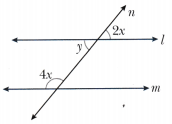
A Peek Beyond the Point Class 7 Solutions Maths Ganita Prakash Chapter 3

Question 5.
How many millimetres make 1 kilometre?
Solution:
We know that 1 km = 1,000 m and 1 m = 1,000 mm
Therefore, 1 km = 1000 × 1000 mm = 10,00,000 mm

Question 6.
Indian Railways offers optional travel insurance for passengers who book e-tickets. It costs 45 paise per passenger. If 1 lakh people opt for insurance in a day, what is the total insurance fee paid?
Solution:
The insurance fee paid for 1 passenger = 45 paise = ₹0.45
So, total insurance fee paid for 1 lakh passengers = ₹0.45 × 100000 = ₹45,000

A Peek Beyond the Point Class 7 Solutions Maths Ganita Prakash Chapter 3

Question 7.
Write the decimal forms of the following:
(i) 87 ones, 5 tenths and 60 hundredths
(ii) 12 tens and 12 tenths
(iii) 10 tens, 10 ones, 10 tenths, and 10 hundredths
(iv) 25 tens, 25 ones, 25 tenths, and 25 hundredths
Solution:
(i) 87 ones, 5 tenths and 60 hundredths = 87 × 1 + 5 × \(\frac{1}{10}\) + 60 × \(\frac{1}{100}\)
= 87 + \(\frac{5}{10}+\frac{60}{100}\) = 87 + 0.5 + 0.60 = 88.10

(ii) 12 tens and 12 tenths = 12 × 10 + 12 × \(\frac{1}{10}\) = 120 + \(\frac{12}{10}\)
= 120 + \(\frac{10}{10}+\frac{2}{10}\) = 120 + 1 + \(\frac{2}{10}\) = 121.2

(iii) 10 tens, 10 ones, 10 tenths, and 10 hundredths
= 10 × 10 + 10 × 1 + 10 × \(\frac{1}{10}+10 \times \frac{1}{100}\) = 100 + 10 + 1 + \(\frac{1}{10}\) = 111.1

(iv) 25 tens, 25 ones, 25 tenths, and 25 hundredths
= 25 × 10 + 25 × 1 + 25 × \(25 \times \frac{1}{10}+25 \times \frac{1}{100}\)
= 250 + 25 + \(\frac{20}{10}+\frac{5}{10}+\frac{20}{100}+\frac{5}{100}\)
= 275 + 2 + \(\frac{5}{10}+\frac{2}{10}+\frac{5}{100}=277+\frac{7}{10}+\frac{5}{100}\) = 277.75

Question 8.
Write the following fractions in decimal form:
(i) \(\frac{1}{2}\)
(ii) \(\frac{3}{2}\)
(iii) \(\frac{1}{4}\)
(iv) \(\frac{3}{4}\)
(v) \(\frac{1}{5}\)
(vi) \(\frac{4}{5}\)
Solution:
(i) \(\frac{1}{2} \times \frac{5}{5}=\frac{5}{10}\) = 0.5

(ii) \(\frac{3}{2} \times \frac{5}{5}=\frac{15}{10}=\frac{10}{10}+\frac{5}{10}=1+\frac{5}{10}\) = 1.5

(iii) \(\frac{1}{4} \times \frac{25}{25}=\frac{25}{100}=\frac{20}{100}+\frac{5}{100}=\frac{2}{10}+\frac{5}{100}\) =0.25

(iv) \(\frac{3}{4} \times \frac{25}{25}=\frac{75}{100}=\frac{70}{100}+\frac{5}{100}=\frac{7}{10}+\frac{5}{100}\) = 0.75

(v) \(\frac{1}{5} \times \frac{2}{2}=\frac{2}{10}\) = 0.2

(vi) \(\frac{4}{5} \times \frac{2}{2}=\frac{8}{10}\) = 0.8

A Peek Beyond the Point Class 7 Solutions Maths Ganita Prakash Chapter 3

InText Questions

Question 1.
In the following figure, screws are placed above a scale. Measure them and write their length in the space provided.
A Peek Beyond the Point Class 7 Solutions Maths Ganita Prakash Chapter 3-1
(i) Which scale helped you measure the length of the screws accurately? Why?
(ii) Can you explain why the unit was
Solution:
A Peek Beyond the Point Class 7 Solutions Maths Ganita Prakash Chapter 3-2
(i) The scale with the smallest divisions (marked in tenths of a centimetre, which are millimetres) allowed for the most accurate measurement. This is because the ends of the screws did not align perfectly with the whole or half centimetre marks, requiring finer divisions to determine the length more accurately.

(ii) The unit (centimetre) was divided into smaller parts (tenths, or millimetres) because the screws’ lengths were not exact whole numbers of centimeters. Smaller divisions are needed to measure lengths accurately that fall between the whole number marks.

Question 2.
Write the measurements of the objects shown in the picture:
A Peek Beyond the Point Class 7 Solutions Maths Ganita Prakash Chapter 3-3
Solution:
Length of the eraser is \(2 \frac{4}{10}\)cm; Length of the pencil is \(4 \frac{5}{10}\)cm; Length of the chalk is \(1 \frac{4}{10}\)cm.

A Peek Beyond the Point Class 7 Solutions Maths Ganita Prakash Chapter 3

Question 3.
Arrange these lengths in increasing order:
(a) \(\frac{9}{10}\)
(b) \(1\frac{7}{10}\)
(c) \(\frac{130}{10}\)
(d) \(13\frac{1}{10}\)
(e) \(10\frac{5}{10}\)
(f) \(7\frac{6}{10}\)
(g) \(6\frac{7}{10}\)
(h) \(\frac{4}{10}\)
Solution:
The given fractions can be written as \(\frac{9}{10}\),
\(1 \frac{7}{10}=\frac{17}{10}, \frac{130}{10}, 13 \frac{1}{10}=\frac{131}{10}, 10 \frac{5}{10}=\frac{105}{10},\)
\(7 \frac{6}{10}=\frac{76}{10}, 6 \frac{7}{10}=\frac{67}{10} \text { and } \frac{4}{10} .\)
Comparing the given fractions and arranging in increasing order, we get
\(\frac{4}{10}<\frac{9}{10}<\frac{17}{10}<\frac{67}{10}<\frac{76}{10}<\frac{105}{10}<\frac{130}{10}<\frac{131}{10}\)
⇒ \(\begin{aligned}
\frac{4}{10}<\frac{9}{10} & <1 \frac{7}{10}<6 \frac{7}{10}<7 \frac{6}{10} \\
& <10 \frac{5}{10}<\frac{130}{10}<13 \frac{1}{10}
\end{aligned}\)

Question 4.
The lengths of the body parts of a honeybee are given. Find its total length.
A Peek Beyond the Point Class 7 Solutions Maths Ganita Prakash Chapter 3-4
Head; \(2\frac{3}{10}\)units
Thorax: \(5\frac{4}{10}\) units
Abdomen: \(7\frac{5}{10}\) units
Solution:
Total length of the honeybee = Length of the head + Length of the thorax + Length of the abdomen
= \(2\frac{3}{10}\) units + \(5\frac{4}{10}\) units + \(7\frac{5}{10}\) units
= ( 2 + 5 +7) units + \(\left(\frac{3}{10}+\frac{4}{10}+\frac{5}{10}\right)\)units
= (14 + \(\frac{12}{10}\)) units
= (14 + \(\frac{10}{10}+\frac{2}{10}\)) units = (14 + 1 + \(\frac{2}{10}\)) units
= (15 + \(\frac{2}{10}\)) units = 15\(\frac{2}{10}\) units

A Peek Beyond the Point Class 7 Solutions Maths Ganita Prakash Chapter 3

Question 5.
Find the difference of \(12\frac{4}{10}\) and \(6\frac{7}{10}\) by converting both lengths to tenths.
Solution:
Converting to tenths:
\(12 \frac{4}{10}=12+\frac{4}{10}=\frac{120}{10}+\frac{4}{10}=\frac{124}{10}\) and
\(6 \frac{7}{10}=6+\frac{7}{10}=\frac{60}{10}+\frac{7}{10}=\frac{67}{10}\)
Required difference = \(\frac{124}{10}-\frac{67}{10}=\frac{57}{10}\)
= \(\frac{50}{10}+\frac{7}{10}=5+\frac{7}{10}=5 \frac{7}{10}\) units

Question 6.
A Celestial Pearl Danio’s length is \(2\frac{4}{10}\) cm and the length of a Philippine Goby is \(\frac{9}{10}\) cm. What is the difference in their lengths?
A Peek Beyond the Point Class 7 Solutions Maths Ganita Prakash Chapter 3-5
Solution:
Length of a Celestial Pearl Danio fish
= \(2 \frac{4}{10} \mathrm{~cm}=\frac{20}{10}+\frac{4}{10}=\frac{24}{10} \mathrm{~cm}\)
Length of a Philippine Goby fish = \(\frac{9}{10}\) cm
So, the difference in their lengths
= \(\frac{24}{10} \mathrm{~cm}-\frac{9}{10} \mathrm{~cm}=\frac{15}{10} \mathrm{~cm}=1 \frac{5}{10} \mathrm{~cm}\)

A Peek Beyond the Point Class 7 Solutions Maths Ganita Prakash Chapter 3

Question 7.
Observe the given sequences of numbers. Identify the change after each term and extend the pattern:
(i) \(4,4 \frac{3}{10}, 4 \frac{6}{10}\), _______, _______, ______
(ii) \(8 \frac{2}{10}, 8 \frac{7}{10}, 9 \frac{2}{10}\), _______, _______, ______
(iii) \(3 \frac{5}{10}, 13,12 \frac{5}{10}\), _______, _______, ______
(iv) \(11 \frac{5}{10}, 10 \frac{4}{10}, 9 \frac{3}{10}\), _______, _______, ______
Solution:
(i) The given sequence is \(4,4 \frac{3}{10}, 4 \frac{6}{10}\), …….
Here, \(4 \frac{3}{10}-4=\frac{3}{10} ; 4 \frac{6}{10}-4 \frac{3}{10}=\frac{3}{10}\)
1st term = 4, any other term = previous term + \(\frac{3}{10}\)
The further terms are:
\(4 \frac{6}{10}+\frac{3}{10}=4 \frac{9}{10} ; 4 \frac{9}{10}+\frac{3}{10}\)
= \(4 \frac{12}{10}=5 \frac{2}{10} ; 5 \frac{2}{10}+\frac{3}{10}\)
= \(5 \frac{5}{10} ; 5 \frac{5}{10}+\frac{3}{10}=5 \frac{8}{10}\)
Thus, the sequence is
\(4,4 \frac{3}{10}, 4 \frac{6}{10}, \mathbf{4} \frac{\mathbf{9}}{\mathbf{1 0}}, \mathbf{5} \frac{\mathbf{2}}{\mathbf{1 0}}, \mathbf{5} \frac{\mathbf{5}}{\mathbf{1 0}}, \mathbf{5} \frac{\mathbf{8}}{\mathbf{1 0}}\), …..

(ii) Since, the sequence is
\(\begin{aligned}
& 8 \frac{2}{10}+\frac{5}{10}=8 \frac{7}{10}, 8 \frac{7}{10}+\frac{5}{10} \\
& =8 \frac{12}{10}=8+1+\frac{2}{10}=9 \frac{2}{10}
\end{aligned}\)
1st = \(8 \frac{2}{10}\), any other term = previous term + \(\frac{5}{10}\)
The further terms are:
\(\begin{aligned}
& 9 \frac{2}{10}+\frac{5}{10}=9 \frac{7}{10} ; 9 \frac{7}{10}+\frac{5}{10} \\
& =9 \frac{12}{10}=10 \frac{2}{10} ; 10 \frac{2}{10}+\frac{5}{10} \\
& =10 \frac{7}{10} ; 10 \frac{7}{10}+\frac{5}{10}=10 \frac{12}{10}=11 \frac{2}{10}
\end{aligned}\)
Thus, the sequence is
\(8 \frac{2}{10}, 8 \frac{7}{10}, 9 \frac{2}{10}, \mathbf{9} \frac{7}{\mathbf{1 0}}, \mathbf{1 0} \frac{2}{\mathbf{1 0}}, \mathbf{1 0} \frac{7}{\mathbf{1 0}}, \mathbf{1 1} \frac{2}{\mathbf{1 0}}\), …..

(iii) Since \(13 \frac{5}{10}-\frac{5}{10}=13 ; 13-\frac{5}{10}\)
= \(12+1-\frac{5}{10}=12+\frac{10}{10}-\frac{5}{10}=12 \frac{5}{10}\), ….
1st = \(13 \frac{5}{10}\), any other term = previous term – \(\frac{5}{10}\)
The further terms are:
\(13 \frac{5}{10}, 13,12 \frac{5}{10}, \underline{\mathbf{1 2}}, \mathbf{1 1 \frac { \mathbf { 5 } } { \mathbf { 1 0 } }}, \underline{\mathbf{1 1}}, \mathbf{1 0} \frac{\mathbf{5}}{\mathbf{1 0}}\)

(iv) Since \(\begin{aligned}
11 \frac{5}{10}-1 \frac{1}{10}=10 & \frac{4}{10} \\
& 10 \frac{4}{10}-1 \frac{1}{10}=9 \frac{3}{10}
\end{aligned}\); ….
1st = \(11 \frac{5}{10}\), any other term = previous term – \(1\frac{1}{10}\)
The further terms are:
\(11 \frac{5}{10}, 10 \frac{4}{10}, 9 \frac{3}{10}, \mathbf{8} \frac{\mathbf{2}}{\mathbf{1 0}}, \mathbf{7} \frac{\mathbf{1}}{\mathbf{1 0}}, \mathbf{6}, \mathbf{4} \frac{\mathbf{9}}{\mathbf{1 0}}\), ….

Question 8.
Observe the fiure below. Notice the markings and the corresponding lengths written in the boxes when measured from 0. Fill the lengths in the empty boxes.
A Peek Beyond the Point Class 7 Solutions Maths Ganita Prakash Chapter 3-6
Solution:
\(\frac{55}{100}, \frac{155}{100}, \frac{174}{100}, \frac{202}{100}, \frac{240}{100}\)

A Peek Beyond the Point Class 7 Solutions Maths Ganita Prakash Chapter 3

Question 9.
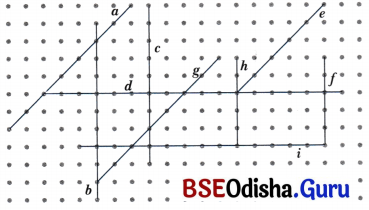
For the lengths shown below write the measurements and read out the measures in words.
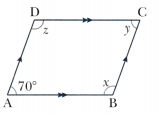
A Peek Beyond the Point Class 7 Solutions Maths Ganita Prakash Chapter 3-7
A Peek Beyond the Point Class 7 Solutions Maths Ganita Prakash Chapter 3-8
Solution:
(a) \(5 \frac{3}{10} \frac{7}{100}\) Five and three-tenths and seven-hundredths
or \(5 \frac{37}{100}\) Five and thirty seven-hundredths
or \(\frac{537}{100}\) Five hundred and thirty seven-hundredths

(b) \(15 \frac{3}{100}\) Fifteen and three-hundredths
or \(\frac{1503}{100}\) One thousand five hundred and three-hundredths

(c) \(7 \frac{5}{10} \frac{2}{100}\) Seven and five-tenths and two-hundredths
or \(7 \frac{52}{100}\) Seven and fifty two-hundredths or \(\frac{752}{100}\) Seven hundred and fifty two-hundredths

(d) \(9 \frac{8}{10}\) Nine and eight-tenths
or \(9 \frac{8}{100}\) Nine and eights-hundredths
or \(\frac{980}{100}\) Nine hundred and eighty-hundredths

Question 10.
Solve the difference \(25 \frac{9}{10}-6 \frac{4}{10} \frac{7}{100}\) by converting to hundredths.
Solution:
Converting to hundredths:
\(25 \frac{9}{10}=25 \frac{90}{100}=\frac{2500}{100}+\frac{90}{100}=\frac{2590}{100} ; 6 \frac{4}{10} \frac{7}{100}=\frac{600}{100}+\frac{40}{100}+\frac{7}{100}=\frac{647}{100}\)
Now, \(25 \frac{9}{10}-6 \frac{4}{10} \frac{7}{100}=\frac{2590}{100}-\frac{647}{100}=\frac{(2590-647)}{100}=\frac{1943}{100}=19 \frac{43}{100}\)

A Peek Beyond the Point Class 7 Solutions Maths Ganita Prakash Chapter 3

Question 11.
Write these quantities in decimal form:
(i) 234 hundredths
(ii) 105 tenths.
Solution:
(i) 234 hundredths can be expressed in decimal form as follows
234 hundredths = \(\frac{234}{100}=\frac{200}{100}+\frac{30}{100}+\frac{4}{100}=2+\frac{3}{10}+\frac{4}{100}\) = 2.34

(ii) 105 tenths can be expressed in decimal form as follows:
105 tenths = \(\frac{105}{10}=\frac{100}{10}+\frac{0}{10}+\frac{5}{10}=10+0+\frac{5}{10}\) = 10.5

Question 12.
Name all the divisions between 1 and 1.1 on the number line.
A Peek Beyond the Point Class 7 Solutions Maths Ganita Prakash Chapter 3-9
Solution:
The divisions between 1 and 1.1 represent the decimal numbers 1.01, 1.02, 1.03, 1.04, 1.05, 1.06, 1.07, 1.08 and 1.09 on the number line.

A Peek Beyond the Point Class 7 Solutions Maths Ganita Prakash Chapter 3

Question 13.
Identify and write the decimal numbers against the letters.
A Peek Beyond the Point Class 7 Solutions Maths Ganita Prakash Chapter 3-10
Solution:
The letters marked on the given number line represent the decimal numbers as follows: A = 5.09, B = 5.13, C = 5.2, D = 5.31

Question 14.
Identify the decimal number in the last number line in below figure denoted by ‘?’
A Peek Beyond the Point Class 7 Solutions Maths Ganita Prakash Chapter 3-11
Solution:
By labelling the visualised segment of the number line, we find that the decimal number 3.059 is denoted by ?’
A Peek Beyond the Point Class 7 Solutions Maths Ganita Prakash Chapter 3-12

A Peek Beyond the Point Class 7 Solutions Maths Ganita Prakash Chapter 3

Question 15.
Locate the following decimal numbers on the number line:
(i) 9.876
(ii) 0.407
Solution:
A Peek Beyond the Point Class 7 Solutions Maths Ganita Prakash Chapter 3-13

Question 16.
Which decimal number is greater?
(i) 1.23 or 1.32
(ii) 3.81 or 13.800
(iii) 1.009 or 1.090
Solution:
(i) Using decimal place value chart, we find that:

Tens Ones Decimal point Tenths Hundredths Thousandths
1 . 2 3
1 . 3 2

Both numbers have 1 unit but the first number has 2 tenths whereas the second number has 3 tenths.
Therefore, 1.23 < 1.32

(ii) Using decimal place value chart, we find that:

Tens Ones Decimal point Tenths Hundredths Thousandths
3 8 1
1 3 8 0 0

Here, the first number has 3 units whereas the second number has 1 ten and 3 units.
Therefore, 3.81 < 13.800

(iii) Using decimal place value chart, we find that:

Tens Ones Decimal point Tenths Hundredths Thousandths
1 . 0 0 9
1 . 0 9 0

Both numbers have 1 unit and the 0 tenths but the first number has 0 hundredths whereas the second number has 9 hundredths.
Therefore, 1.009 < 1.090

A Peek Beyond the Point Class 7 Solutions Maths Ganita Prakash Chapter 3

Question 17.
Which among these is closest to 4: 3.56, 3.65, 3.099?
Solution:
Arranging the decimal numbers in ascending order, we get 3.099 < 3.56 < 3.65 < 4.
Clearly, 3.65 is closest to 4 among the given decimal numbers.

Question 18.
Which among these is closest to 1: 0.8, 0.69, 1.08?
Solution:
Arranging the decimal numbers in ascending order, we get 0.69 < 0.8 < 1 < 1.08.
Among the neighbours of 1, 0.8 is \(\frac{2}{10}\), i.e. \(\frac{2}{100}\) away from 1 whereas 1.08 is \(\frac{8}{100}\) away from 1. Therefore, 1.08 is closest to 1.

A Peek Beyond the Point Class 7 Solutions Maths Ganita Prakash Chapter 3

Question 19.
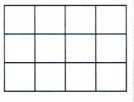
In each case below use the digits 4, 1, 8, 2 and 5 exactly once and try to make a decimal number as close as possible to 25.
A Peek Beyond the Point Class 7 Solutions Maths Ganita Prakash Chapter 3-14
Solution:
We can make a decimal number closest to 25 using the digits 4, 1, 8, 2 and 5 with the given conditions as follows:
A Peek Beyond the Point Class 7 Solutions Maths Ganita Prakash Chapter 3-15

Question 20.
Write the detailed place value computation for 84.691 – 77.345, and its compact form.
Solution:
We can find the difference of 84.691 – 77.345 as follows:
A Peek Beyond the Point Class 7 Solutions Maths Ganita Prakash Chapter 3-16

A Peek Beyond the Point Class 7 Solutions Maths Ganita Prakash Chapter 3

A Peek Beyond the Point Class 7 Extra Questions

A Peek Beyond the Point Class 7 Very Short Question Answer

Question 1.
For the length shown below, write the measurement and read out the measure in words.
A Peek Beyond the Point Class 7 Solutions Maths Ganita Prakash Chapter 3-17
Solution:
From the figure, the strip covers 5 units, 7-tenths and 7-hundredths.
∴ The length of the strip is \(5 \frac{7}{10} \frac{7}{100}\) units.
It is read as “Five and seven-tenths and seven- hundredths”.

Question 2.
Find the value of \(8 \frac{6}{100}-4 \frac{5}{100}\).
Solution:
\(8 \frac{6}{100}-4 \frac{5}{100}=(8-4)+\left(\frac{6}{100}-\frac{5}{100}\right)=4+\frac{1}{100}\)
= \(4 \frac{1}{100}\)

A Peek Beyond the Point Class 7 Solutions Maths Ganita Prakash Chapter 3

Question 3.
For the length shown below write the measurement and read out the measure in words.
A Peek Beyond the Point Class 7 Solutions Maths Ganita Prakash Chapter 3-18
Solution:
From the figure, the strip covers 14 units, 8-tenths and 3-hundredths.
∴ The length of the strip is \(14 \frac{8}{10} \frac{3}{100}\) units.
It is read as “Fourteen and eight-tenths and three- hundredths”.

Question 4.
Convert into the decimal:\(\frac{57}{10}\)
Solution:
The number of zeros in denominator after 1 is 1.
Thus, starting from the extreme right digit of the numerator, we insert the decimal point 1 place to the left.
Therefore, \(\frac{57}{10}\) = 5.7

A Peek Beyond the Point Class 7 Solutions Maths Ganita Prakash Chapter 3

Question 5.
Which decimal is greater, 0.71 or 0.071?
Solution:
The whole number parts of both the numbers are 0.
Comparing the digits in the tenths place, we get 7 > 0. So, 0.71 > 0.071.

Question 6.
Add the following:
(i) 3.9732 and 0.8
(ii) 12.16, 34 and 87.943
Solution:
(i) \(\begin{array}{r}
3.9732 \\
+0.8000 \\
\hline 4.7732 \\
\hline
\end{array}\)
(ii) \(\begin{array}{r}
12.160 \\
34.000 \\
+87.943 \\
\hline 134.103
\end{array}\)

A Peek Beyond the Point Class 7 Solutions Maths Ganita Prakash Chapter 3

Question 7.
Subtract:
(i) 18.25 from 24.05
(ii) 233.326 from 507
Solution:
(i) \(\begin{array}{r}
24.05 \\
-18.25 \\
\hline 5.80 \\
\hline
\end{array}\)
(ii) \(\begin{array}{r}
507.000 \\
-233.326 \\
\hline 273.674 \\
\hline
\end{array}\)

Question 8.
Find the sum:
(i) 0.007 + 8.5 + 30.089
(ii) 0.75 + 25.892 + 200.097
Solution:
(i) \(\begin{array}{r}
0.007 \\
8.500 \\
+30.089 \\
\hline 38.596 \\
\hline
\end{array}\)
(ii) \(\begin{array}{r}
0.750 \\
25.892 \\
+200.097 \\
\hline 226.739 \\
\hline
\end{array}\)

A Peek Beyond the Point Class 7 Solutions Maths Ganita Prakash Chapter 3

Question 9.
A shirt costs ₹ 355.50 and a sweater costs ₹ 536.50. Find the total cost of shirt and sweater.
Solution:
To find the total cost of the shirt and a sweater, we simply add the two amounts.
Thus, total cost = ₹355.50 + ₹536.50 = ₹892.00

A Peek Beyond the Point Class 7 Short Question Answer

Question 1.
The lengths of the body part of an ant are as follows:
A Peek Beyond the Point Class 7 Solutions Maths Ganita Prakash Chapter 3-19
Head = \(\left(1 \frac{6}{10}\right)\) units; Throax = \(\left(2 \frac{3}{10}\right)\) units; Abdomen = \(\left(3 \frac{9}{10}\right)\) units.
Find the total length of the ant.
Solution:
Total length of the ant = Length of head + Length of thorax + Length of abdomen
= \(1 \frac{6}{10}+2 \frac{3}{10}+3 \frac{9}{10}\)
= ( 1 + 2 + 3) + \(\left(\frac{6}{10}+\frac{3}{10}+\frac{9}{10}\right)\)
= 6 + \(\frac{18}{10}=6+\frac{10}{10}+\frac{8}{10}\)
= 7 + \(\frac{8}{10}=7 \frac{8}{10}\) units
Thus, the total length of the ant is \(7 \frac{8}{10}\) units.

A Peek Beyond the Point Class 7 Solutions Maths Ganita Prakash Chapter 3

Question 2.
Write the following decimal numbers in ascending order:
5.64, 2.54, 3.05, 0.259 and 8.32
Solution:
As all the given decimal numbers have unequal whole number part, we can arrange the decimal numbers byjust comparing the whole number parts.
The whole number parts of given decimal numbers are 5, 2, 3, 0 and 8 respectively.
As 0 < 2 < 3 < 5 < 8
0.259 < 2.54 < 3.05 < 5.64 < 8.32

Question 3.
Among 1.95, 2.1, 2.05 and 1.99, which number is closest to 2?
Solution:
1.95 and 1.99 are smaller than 2. Thus,
2 – 1.95 = 0.05
2 – 1.99 = 0.01
2.1 and 2.05 are greater than 2. Thus,
2.1 – 2 = 0.1
2.05 – 2 = 0.05
Since 0.01 is the smallest difference, 1.99 is closest to 2.

A Peek Beyond the Point Class 7 Solutions Maths Ganita Prakash Chapter 3

Question 4.
Put the following decimal numbers in the appropriate boxes:
(a) 0.7
(b) 0.346
(c) 0.504
(d) 0.967
(e) 0.089
(f) 0.007
(g) 0.894
(h) 0.170
(i) 0.67
(j) 0.3
(k) 0.876
(l) 0.499

Numbers less than 0.5 Numbers greater than 0.5

Solution:

Numbers less than 0.5 Numbers greater than 0.5
(b) 0.346 (e) 0.089 (j) 0.007 (h) 0.170 (j) 0.3    (j) 0.499 (a) 0.7 (c) 0.504 (d) 0.967 (g) 0.894 (i) 0.67 (k) 0.876


Question 5.
On the number line given below, what decimal numbers do the letters ‘w’, v, ‘w’ and ‘x’ represent?
A Peek Beyond the Point Class 7 Solutions Maths Ganita Prakash Chapter 3-20
Solution:
There are 10 divisions between 6.1 and 6.6
So, each division is a tenth part of 0.5 or \(\) i.e., \(\) = 0.05 units.
Therefore, the first division after 6.1, denoted by V represents the decimal number 6.15, while the 5th division, denoted by ‘v’ represents the number 6.35.
The 8th division denoted by ‘x’ represents 6.50 and the first division after 6.6, denoted by ‘x’, represents the number 6.65.

A Peek Beyond the Point Class 7 Solutions Maths Ganita Prakash Chapter 3

Question 6.
Arrange the following in the descending order:
(i) 10.98, 10.089, 10.809, 10.908, 10.981
(ii) 22.31, 22.13, 22.331, 22.313, 22.133
Solution:
(i) We can write the given decimal numbers as like decimals as:
10.980, 10.089, 10.809, 10.908, 10.981
By comparing the digits from left to right after the decimal point, the given decimal numbers can be written in descending order as follows:
10.981, 10.98, 10.908, 10.809, 10.089

(ii) We can write the given decimal numbers as like decimals as:
22.310, 22.130, 22.331, 22.313, 22.133
By comparing the digits from left to right after the decimal point, the given decimal numbers can be written in descending order as follows:
22.331, 22.313, 22.31, 22.133, 22.13

Question 7.
A runner completed a race in 1.75 hours. How many minutes did he take to finish the race?
Solution:
Time taken by runner to complete the race = 1.75 hours
We know that 1 hour = 60 minutes.
Now, 1.75 hours = 1 hour + 0.75 hours = 60 minutes + (0.75 x 60) minutes
= 60 minutes + 45 minutes = 105 minutes
Thus, the runner took 105 minutes to complete the race.

A Peek Beyond the Point Class 7 Solutions Maths Ganita Prakash Chapter 3

Question 8.
From a packet of sugar weighing 0.875 kilograms, 437 grams of sugar was used up for making dessert. How much sugar is left in the packet? Give the answer in kilograms.
Solution:
Total sugar in packet = 0.875 kg
Sugar used = 437 grams = 0.437 kg
Sugar left in the packet = 0.875 kg – 0.437 kg
= 0.438 kg

A Peek Beyond the Point Class 7 Long Question Answer

Question 1.
Represent the following decimal numbers in the decimal place value chart. Give their expanded form (both fractional and decimal) and write the numbers in words.
(i) 235.25
(ii) 10.05
(iii) 0.755
(iv) 43.007
Solution:

Place Name Thousands Hundreds Tens Ones • Tenths Hundredths Thousandths
Place value 1000 100 10 1 • \(\frac{1}{10}\) \(\frac{1}{100}\) \(\frac{1}{1000}\)
(i) 235.25 2 3 5 • 2 5
(ii) 10.05 1 0 • 0 5
(iii) 0.755 0 • 7 5 5
(iv) 43.007 4 3 • 0 0 7

(i) 235.25 = 200 + 30 + 5 + 0.2 + 0.05 = 200 + 30 + 5 + \(\frac{2}{10}+\frac{5}{100}\)
= 235 + \(\frac{20}{100}+\frac{5}{100}=235+\frac{25}{100}=235 \frac{25}{100}\)
In words: Two hundred thirty five point two five

(ii) 10.05 = 10 + 0.05 = 10 + 0 + \(\frac{0}{10}+\frac{5}{100}=10+\frac{5}{100}=10 \frac{5}{100}\)
In words: Ten point zero five

(iii) 0.755 = 0.7 + 0.05 + 0.005 = \(\frac{7}{10}+\frac{5}{100}+\frac{5}{1000}=\frac{700}{1000}+\frac{50}{1000}+\frac{5}{1000}=\frac{755}{1000}\)
In words: Zero point seven five five

(iv) 43.007 = 40 + 3 + 0.007 = 40 + 3 + \(\frac{7}{1000}=43+\frac{7}{1000}=43 \frac{7}{1000}\)
In words: Forty three point zero zero seven

A Peek Beyond the Point Class 7 Solutions Maths Ganita Prakash Chapter 3

Question 2.
Represent the decimal number, 8.756 on number line (use multiple number lines to show subsequent magnifications).
Solution:
A Peek Beyond the Point Class 7 Solutions Maths Ganita Prakash Chapter 3-21

Question 3.
Ravi delivers 3.5 kg, 3.2 kg and 7.1 kg of vegetables to a store in the first three days. In 7 days, he delivers 20 kg of vegetables. What is the total quantity of vegetables delivered in the last four days?
Solution:
The total quantity of vegetables delivered in the
first 3 days = 3.5 kg + 3.2 kg + 7.1 kg = 13.8 kg
Given, total quantity of vegetables delivered in 7 days is 20 kg.
∴ Quantity of vegetables delivered in the last 4 days
= Quantity of vegetables delivered in 7 days – Quantity of vegetables delivered in 3 days
= 20- 13.8 = 6.2 kg
Hence, Ravi delivered 6.2 kg of vegetables in the last 4 days.

A Peek Beyond the Point Class 7 Case Based Questions

The Matki Phod game is a popular event during Janmashtami. In this game, a clay pot (called a Matki) filled with curd, butter or other milk- based food is tied at a height, and players form a multi-level human pyramid to reach and break it.
A Peek Beyond the Point Class 7 Solutions Maths Ganita Prakash Chapter 3-22
In one such event, the matki is tied at a height of \(13 \frac{5}{10}\) units from the ground. Each person in the pyramid is \(3 \frac{2}{10}\) units tall.
Based on the given information, answer the following questions:
(i) What is the total height of 3 such levels?
(ii) How many levels are needed to reach or cross the height of the matki?
Solution:
(i) Total height of three levels
= \(3 \frac{2}{10}+3 \frac{2}{10}+3 \frac{2}{10}=9 \frac{6}{10}\) units

(ii) We need to find the smallest number of levels such that:
Height > \(13 \frac{5}{10}\) units
Height of each level = \(3 \frac{2}{10}\) units Total height of 4 levels
= \(3 \frac{2}{10}+3 \frac{2}{10}+3 \frac{2}{10}+3 \frac{2}{10}=12 \frac{8}{10}\)units
Total height of 4 levels is less than \(13 \frac{5}{10}\) units,
so players will not reach upto the Matki.
Now, total height of 5 levels = Total height of 4 levels + \(3 \frac{2}{10}=12 \frac{8}{10}+3 \frac{2}{10}\) = 16 units.
On increasing one level, the height of Matki can be reached.
Hence, minimum 5 levels are required to cross the height of the Matki.

A Peek Beyond the Point Class 7 Solutions Maths Ganita Prakash Chapter 3

Question 2.
The table displays the rainfall (in cm) recorded in various months in delhi in year 2024.
A Peek Beyond the Point Class 7 Solutions Maths Ganita Prakash Chapter 3-23

Month Rainfall (in cm) Month Rainfall (in cm)
January 6.2 July 3.84
February 7 August 2.4
March 7.55 September 4.1
April 8.2 October 6
May 7.45 November 5.9
June 5.7 December 6.3

Based on the above information, answer the following questions:
(i) Find the total rainfall recorded in the first three months of the year.
(ii) Find the total rainfall recorded in the last three months of the year.
(iii) How much total rainfall was recorded during the three wettest months?
Solution:
(i) The total rainfall recorded in the first three months, i.e. January, February and March
= (6.2 + 7 4 – 7.55) cm = 20.75 cm

(ii) The total rainfall in the last three months of the year, i.e. October, November and December
= (6 + 5.9 + 6.3) cm = 18.2 cm

(iii) Comparing the rainfalls in all months, we find that the three wettest months are March, April and May with rainfall of 7.55 cm, 8.2 cm and 7.45 cm, respectively.
Thus, total rainfall recorded during three wettest months = (7.55 + 8.2 + 7.45) cm
= 23.2 cm.

We Distribute Yet Things Multiply Class 8 Solutions Maths Ganita Prakash Chapter 6

Students can refer to BSE Odisha Class 8 Math Solution and Ganita Prakash Chapter 6 We Distribute Yet Things Multiply Class 8 Question Answer to understand textbook questions step by step.

Class 8 Maths Chapter 6 We Distribute Yet Things Multiply Solutions

Ganita Prakash Class 8 Chapter 6 Solutions

Class 8 Maths Ganita Prakash Chapter 6 Solutions We Distribute Yet Things Multiply

IS THIS A MULTIPLF OF?
Figure it Out (Page 142 – 143) :

Question 1.
Observe the multiplication grid below. Each number inside the grid is formed by multiplying two numbers. If the middle number of a 3 x 3 frame is given by the expression pq, as shown in the figure, write the expressions for the other numbers in the grid.
We Distribute Yet Things Multiply Class 8 Solutions Maths Ganita Prakash Chapter 6 1
Answer:

3 × 5 3 × 6 3 × 7
4 × 5 4 × 6 4 × 7
5 × 5 5 × 6 5 × 7
(p – 1)(q – 1) (p – 1)q (p – 1) (q + 1)
P(q – 1) pq P(q + 1)
(p + 1) (q – 1) (p + 1)q (p + 1) (q + 1)

Question 2.
Expand the following products.
(i) (3 + u) (v – 3)
(ii) \(\frac{2}{3}\)(15 + 6a)
(iii) (10a + b) (10c + d)
(iv) (3 – x) (x – 6)
(v) (-5a + b) (c + d)
(vi) (5 + z) (y + 9)
Answer:
(i) (3 + u) (v – 3) = 3(v – 3) + u(v – 3)
= 3v – 9 + uv – 3u = 3v – 3u + uv – 9

(ii) \(\frac{2}{3}\) (15 + 6a) = \(\frac{2}{3}\) × 15 + \(\frac{2}{3}\) × 6a = 10 + 4a

(iii) (10a + b) (10c + d)
= 10a × 10c + 10a × d + b × 10c + b × d
= 100ac + 10ad + 10bc + bd

(iv) (3 – x) (x – 6) = 3(x – 6) – x(x – 6)
= 3x – x2 – 18 + 6x = – x2 + 9x – 18.

(v) (- 5a + b) (c + d)
= (- 5a + b)c + (- 5a + b)d
= – 5ac + bc – 5ad + bd
= – 5ac – 5ad + bc + bd.

(vi) (5 + z) (y + 9)
= (5 + z)y + (5 + z)9
= 5y + zy + 45 + 9z
= 5y + 9z + zy + 45.

We Distribute Yet Things Multiply Class 8 Solutions Maths Ganita Prakash Chapter 6

Question 3.
Find 3 examples where the product of two numbers remains unchanged when one of them is increased by 2 and the other is decreased by 4.
Answer:
Let the two numbers be x and y, then:
x × y = (x + 2) × (y – 4)
xy = (x + 2)y – (x + 2)4
xy = xy + 2y – (4x + 8)
xy = xy + 2y – 4x – 8
xy – xy = 2y – 4x – 8
0 = 2y – 4x – 8
4x + 8 = 2y
2(2x + 4) = 2y
y = 2x + 4.
Examples :
(i) x = 1, y = 6 → Product = 1 × 6 = 6
Check : (1 + 2) × (6 – 4) = 3 × 2 = 6.

(ii) x = 2, y = 8 → Product = 16
Check : (2 + 2) × (8 – 4) = 4 × 4 =16.

(iii) x = 5, y = 14 → Product = 5 × 14 = 70
Check : (5 + 2) × (14 – 4) = 7 × 10 = 70.
Therefore, (1, 6), (2, 8), and (5, 14) are three examples for the given situation.

Question 4.
Expand
(i) (a + ab – 3b2) (4 + b), and
(ii) (4y + 7)(y + 11z – 3).
Answer:
(i) (a + ab – 3b2) (4 + b)
= (a + ab – 3b2)4 + (a + ab – 3b2)b
= 4a + 4ab – 12b2 + ab + ab2 – 3b3
= – 3b3 – 12b2 + ab2 + 4ab + ab + 4a
= – 3b3 – 12b2 + ab2 + 5ab + 4a.

(ii) (4y + 7) (y + 11z – 3)
= (4y + 7)y + (4y + 7)11z – (4y + 7)3
= 4y2 + 7y + 44yz + 77z – (12y + 21)
= 4y2 + 7y + 44yz + 77z – 12y – 21
= 4y2 + 7y – 12y + 44yz + 77z – 21
= 4y2 – 5y + 44yz + 77z – 21.

Question 5.
Expand (i) (a – b) (a + b),
(ii) (a – b) (a2 + ab + b2) and
(iii) (a – b)(a3 + a2b + ab2 + b3), Do you see a pattern? What would be the next identity in the pattern that you see? Can you check it by expanding?
Answer:
(i) (a – b)(a + b) = (a – b)a + (a – b)b
= a2 – ab + ab – b2 = a2 – b2.

(ii) (a – b) (a2 + ab + b2)
= (a – b)a2 + (a – b)ab + (a – b)b2
= a3 – a2b + a2b – ab2 + ab2 – b3 = a3 – b3.

(iii) (a – b)(a3 + a2b + ab2 + b3)
= (a – b)a3 + (a – b)a2b + (a – b)ab2 + (a – b)b3
= a4 – a3b + a3b – a2b2 + a2b2 – ab3 + ab3 – b4
= a4 – b4.
The next identity would be : (a – b)(a4 + a3b + a2b2 + ab3 + b4) = a5 – b5.
By expanding we can check it as :
(a – b) (a4 + a3b + a2b2 + ab3 + b4)
= a(a4 + a3b + a2b2 + ab3 + b4) – b(a4 + a3b + a2b2 + ab3 + b4)
= a5 + a4b + a3b2 + a2b3 + ab4 – a4b – a3b2 – ab4 – b5 = a5 – b5

2. SPECIAL CASES OFTHE DISTRIBUTIVE PROPERTY
Figure it Out (Page 149) :

Question 1.
Which is greater: (a – b)2 or (b – a)2? Justify your answer.
Answer:
Here, (a – b)2 = a2 + b2 – 2ab ……….. (1)
and (b – a)2 = b2 + a2 – 2ba
b2 + a2 = a2 + b2 and ba = ab
(b – a)2 = a2 + b2 – 2ab ……… (2)
Comparing (1) and (2), we get
(a – b)2 = (b – a)2

Question 2.
Express 100 as the difference of two squares.
Answer:
a2 – b2 = 100
(a + b) (a – b) = 100
[100 = 1 × 100, 2 × 50, 4 × 25, 5 × 20, 10 × 10]
We can take anyone
Let us take 50 × 2 = 100
Hence, (a + b) (a – b)= 50 × 2
a + b = 50 ……… (1)
a – b = 2 …….. (2)
Adding (1) and (2)
2a = 52
⇒ a = 26
Substituting a = 26 in (1)
26 + b = 50
⇒ b = 50 – 26 = 24
Let us check 262 – 242 = 676 – 576 = 100
Hence 262 – 242 = 100

Question 3.
Find 4062, 722, 1452, 10972 and 1242 using the identities you have learnt so far.
Answer:
(i) 4062 = (400 + 6)2
= 4002 + 2 × 400 × 6 + 62
= 160000 + 4800 + 36 = 164836

(ii) 722 = (50 + 22)2
= 502 + 2 × 50 × 22 + 222
= 2500 + 2200 + 484 = 5184

(iii) 1452 = (150 – 5)2
= 1502 – 2 × 150 × 5 + 52
= 22500 – 1500 + 25
= 21025

(iv) 10972 = (1100 – 3)2
= 11002 – 2 × 1100 × 3 + 32
= 1210000 – 6600 + 9
= 1203409

(v) 1242 = (100 + 24)2
= 1002 + 2 × 100 × 24 + 242
= 10000 + 4800 + 576
= 15376

We Distribute Yet Things Multiply Class 8 Solutions Maths Ganita Prakash Chapter 6

Question 4.
Do Patterns 1 and 2 hold only for counting numbers? Do they hold for negative integers as well? What about fractions? Justify your answer.
Answer:
Pattern 1
2(a2 + b2) – (a + b)2 + (a – b)2
Case-I
Let a = 4, b = 2
LHS = 2(42 + 22)
= 2 × (16 + 4) = 40
RHS = (4 + 2)2 + (4 – 2)2
= 36 + 4 = 40
∴ Pattern 1 holds for counting numbers.

Case-II
Let a = -4, b = -2
LHS = 2((-4)2 + (-2)2)
= 2 × (16 + 4) = 2 × 20 = 40
RHS = (-4 + (-2))2 + (-4 – (-2))2
= (- 4 – 2)2 + (- 4 + 2)2
= (-6)2 + (-2)2 = 36 + 4 = 40
LHS = RHS
∴ Pattern 1 holds for negative integers also.

Case-III
We Distribute Yet Things Multiply Class 8 Solutions Maths Ganita Prakash Chapter 6 2
The pattern holds for fractions also.

Pattern 2
a2 – b2 = (a + b) (a – b)
Case – I
Let a = 5, b = 3
LHS = 52 – 32 = 25 – 9 = 16
RHS = (5 + 3) (5 – 3) = 8 × 2 = 16
∴ LHS = RHS
∴ Pattern 2 holds for counting numbers.

Case-II
Let a = -5, b = -3
Now, LHS = (-5)2 – (-3)2 = 25 – 9 = 16
and RHS = [(-5) + (-3)] [(-5) – (-3)]
= (- 5 – 3) (- 5 + 3)
= (-8)(-2) = 16
∴ LHS = RHS
∴ Pattern 2 holds for negative integers also.

Case-III
We Distribute Yet Things Multiply Class 8 Solutions Maths Ganita Prakash Chapter 6 3
and RHS = (\(\frac{1}{2}\) + \(\frac{1}{3}\)) (\(\frac{1}{2}\) – \(\frac{1}{3}\))
= (\(\frac{3 + 2}{6}\)) (\(\frac{3 – 2}{6}\))
= \(\frac{5}{6}\) \(\frac{1}{6}\) = \(\frac{5}{36}\)
∴ LHS = RHS
∴ Pattern 2 holds for fractions also.

3. THIS WAY OR THAT WAY, ALL WAYS LEAD TO THE BAY
Figure it Out (Page 154 – 156) :

Question 1.
Compute these products using the suggested identity.
(i) 462 using Identity 1A for (a + b)2
(ii) 397 × 403 using Identity 1C for (a + b) (a – b)
(iii) 912 using Identity 1B for (a – b)2
(iv) 43 × 45 using Identity 1C for (a + b) (a – b)
Answer:
(i) 462 = (40 + 6)2 = 402 + 2 × 40 × 6 + 62
[∵ (a + b)2 = a2 + 2ab + b2]
= 1600 + 480 + 36 = 2116

(ii) 397 × 403 = (400 – 3) (400 + 3)
[∵ (a + b) × (a – b) = a2 – b2] = 4002 – 32 = 160000 – 9 = 159991

(iii) 912 = (100 – 9)2 = 1002 – 2 × 100 × 9 + 92
[∵ (a – b)2 = a2 + b2 – 2ab] = 10000 – 1800 + 81 = 8281

(iv) 43 × 45 = (44 – 1) (44 + 1)
[∵ a2 – b2 = (a + b) × (a – b)]
= 442 – 12 = 1936 – 1 = 1935

Question 2.
Use either a suitable identity or the distributive property to find each of the following products.
(i) (p – 1) (p + 11)
(ii) (3a – 9b) (3a + 9b)
(iii) -(2y + 5) (3y + 4)
(iv) (6x + 5y)2
(v) (2x – \(\frac{1}{2}\))2
(vi) (7p) × (3r) × (p + 2)
Answer:
(i) (p – 1) (p + 11) = p(p + 11) – 1(p + 11)
= p2 + 11p – p – 11 = p2 + 10p – 11

(ii) (3a – 9b) (3a + 9b) = (3a)2 – (9b)2 = 9a2 – 81b2

(iii) – (2y + 5)(3y + 4) = (- 2y – 5) (3y + 4)
= – 2y(3y + 4) – 5(3y + 4)
= – 6y2 – 8y – 15y – 20 = – 6y2 – 23y – 20

(iv) (6x + 5y)2 = (6x)2 + 2(6x) (5y) + (5y)2
= 36x2 + 60xy + 25y2

(v) (2x – \(\frac{1}{2}\))2 = (2x)2 – 2 × 2x × \(\frac{1}{2}\) + (\(\frac{1}{2}\))2
= 4x2 – 2x + \(\frac{1}{4}\)

(vi) (7p) × (3r) × (p + 2) = 7p × 3r × (p + 2)
= 21pr(p + 2) = 21pr × p + 21pr × 2
= 21p2r + 42pr

Question 3.
For each statement identify the appropriate algebraic expression(s).
(i) Two more than a square number.
2 + s (s + 2)2 s2 + 2 s2 + 4 2s2 22s

(ii) The sum of the squares of two consecutive numbers
m2 + n2 (m + n)2
m2 + 1 m2 + (m + 1)2
m2 + (m – 1)2
(m + (m + 1))2 (2m)2 + (2m + 1)2
Answer:
(i) For “Two more than a square number”: The correct expression is s2 + 2.

(ii) For “The sum of the squares of two consecutive numbers”: The correct expression is m2 + (m + 1)2.

Question 4.
Consider any 2 by 2 square of numbers in a calendar, as shown in the figure.
We Distribute Yet Things Multiply Class 8 Solutions Maths Ganita Prakash Chapter 6 4
Find products of numbers lying along each diagonal – 4 × 12 = 48, 5 × 11 = 55. Do this for the other 2 by 2 squares. What do you observe about the diagonal products? Explain why this happens.
Hint: Label the numbers in each 2 by 2 square as

a (a + 1)
a + 7 (a + 8)

Answer:
Case – I

6 7
13 14

Here, 6 × 14 = 84
13 × 7 = 91
Difference = 91 – 84 = 7

Case – II

9 10
16 17

Here, 9 × 17 = 153
16 × 10= 160
Difference = 160 – 153 = 7

We observe that the difference of the diagonal products in both cases is always 7.

Question 5.
Verify which of the following statements are true.
(i) (k + 1) (k + 2) – (k + 3) is always 2.

(ii) (2q + 1) (2q – 3) is a multiple of 4.

(iii) Squares of even numbers are multiples of 4, and squares of odd numbers are 1 more than multiples of 8.

(iv) (6n + 2)2 – (4n + 3)2 is 5 less than a square number.
Answer:
(i) (k + 1)(k + 2) – (k + 3) is a multiple of 2
Let k = 5, Then (5 + 1) (5 + 2) – (5 + 3)
= 6 × 7 – 8 = 42- 8 = 34
34 is a multiple of 2.
∴ The statement is true.

(ii) (2q + 1) (2q – 3) is a multiple of 4.
Let q = 3, Then (6 + 1) (6 – 3)
= 7 × 3 = 21
21 is not a multiple of 4
∴ The statement is false.

(iii) The square of an even number is a multiple of 4.
22 – 4 = 4 × 1
42 = 16 = 4 × 4
62 = 36 = 4 × 9
∴ The statement is true.
The square of an odd number is 1 more than a multiple of 8.
32 = 9 = 8 × 1 + 1
52 = 25 = 8 × 3 + 1
72 = 49 = 8 × 6 + 1
∴ The statement is true.

(iv) (6n + 2)2 – (4n + 3)2 is 5 less than a square number.
Let n = 2, (6 × 2 + 2)2 – (4 × 2 + 3)2
= 142 – 112 = 196 – 121 = 75 = 80 – 5
But 80 is not a square number.
∴ The statement is false.

We Distribute Yet Things Multiply Class 8 Solutions Maths Ganita Prakash Chapter 6

Question 6.
A number leaves a remainder of 3 when divided by 7, and another number leaves a remainder of 5 when divided by 7. What is the remainder when their sum, difference, and product are divided by 7?
Answer:
Let the numbers be x and y.
x = 7a + 3, y = 7b + 5
Sum = x + y
= 7a + 3 + 7b + 5 = 7(a + b) + 8
= 7(a + b) + 7 + 1 = 7(a + b + 1) + 1
∴ The remainder on division by 7 is 1.
Difference = x – y
= (7a + 3) – (7b + 5)
= 7a + 3 – 7b – 5 = 7(a – b) – 2
= 7(a – b) – 1 + 5 (∵ -2 = – 7 + 5)
= 7(a – b – 1) + 5
∴ The remainder on division by 7 is 5.
Product = xy
= (7a + 3) (7b + 5)
= 49ab + 35a + 21b + 15
= (49ab + 35a + 21b + 14) + 1
= 7(7ab + 5a + 3b + 2) + 1
∴ The remainder on division by 7 is 1.

Question 7.
Choose three consecutive numbers, square the middle one, and subtract the product of the other two. Repeat the same with other sets of numbers. What pattern do you notice? How do we write this as an algebraic equation? Expand both sides of the equation to check that it is a true identity.
Answer:
Let us take the numbers 7, 8, 9
Now, 82 – 7 × 9 = 64 – 63 = 1
Let us take the numbers 10, 11, 12
Then 112 – 10 × 12 = 121 – 120 = 1
Generalizing:
Let the numbers be a – 1, a, a + 1
Then a2 – (a + 1) (a – 1) = 1
LHS = a2 – (a + 1)(a – 1)
= a2 – (a2 – 1)
= a2 – a2 + 1 = 1
LHS = RHS
∴ Hence, the identity is correct.

Question 8.
What is the algebraic expression describing the following steps – add any two numbers. Multiply this by half of the sum of the two numbers? Prove that this result will be half of the square of the sum of the two numbers.
Answer:
Let the two numbers be a and b.
Step 1: a + b
Step 2: (a + b) × \(\frac{1}{2}\) (a + b)
∴ (a + b) × \(\frac{1}{2}\) (a + b) = \(\frac{1}{2}\) (a + b)2

Question 9.
Which is larger? Find out without fully computing the product.
(i) 14 × 26 or 16 × 24
(ii) 25 × 75 or 26 × 74
Answer:
(i) Let p = 14 × 26
p’ = 16 × 24
= (14 + 2) (26 – 2)
= 14 × 26 + 2 × 26 – 14 × 2 – 2 × 2
= 14 × 26 + 2(26 – 14 – 2)
= 14 × 26 + 2 × 10
p’ = p + 2 × 10
∴ p’ > p or 16 × 24 > 14 × 26

(ii) Let p = 25 × 75
p’= 26 × 74
=(25 + 1) (75 – 1)
=25 × 75 + 75 × 1 – 25 × 1 – 1 × 1
= p + (75 – 25 – 1) = p + 49
∴ p’ > p or 26 × 74 > 25 × 75

Question 10.
A tiny park is coming up in Dhauli. The plan is shown in the figure. The two square plots, each of area g2 sq. ft., will have a green cover. All the remaining area is a walking path w ft. wide that needs to be tiled. Write an expression for the area that needs to be tiled.
We Distribute Yet Things Multiply Class 8 Solutions Maths Ganita Prakash Chapter 6 5
Answer:
Length = w + g + 2w + g + w = 4w + 2g
Breadth = w + g + w = 2w + g
Area of park = (4w + 2g) (2w + g)
= 8w2 + 4wg + 4wg + 2g2
= 8w2 + 8wg + 2g2
Area of path = Area of park – Area of green cover
= 8w2 + 8wg + 2g2 – 2g2
= 8w2 + 8wg
∴ (8w2 + 8wg) sq. feet area needs to be tiled.

Question 11.
For each pattern shown below,
(i) Draw the next figure in the sequence.
(ii) How many basic units are there in Step 10?
(iii) Write an expression to describe the number of basic units in Step y.
We Distribute Yet Things Multiply Class 8 Solutions Maths Ganita Prakash Chapter 6 6
Answer:
We Distribute Yet Things Multiply Class 8 Solutions Maths Ganita Prakash Chapter 6 7
Step 1: 2 vertical strips of 3 units each + 1 vertical strip of 3 units
= 3 strips of 3 units each
= 9 units squares = (1 + 2)2 unit squares

Step 2: 4 strips of 4 units each
= 16 units squares = (2 + 2)2 unit squares

Step 3: 5 strips of 5 units each
= 25 units squares = (3 + 2)2 unit squares
We Distribute Yet Things Multiply Class 8 Solutions Maths Ganita Prakash Chapter 6 8

Step 4: (i) 6 strips of 6 units each = 2 are vertical and 4 are horizontal
(ii) Number of unit squares in step 10
= (10 + 2)2 = 144

(iii) Number of unit squares in step y = (y + 2)2
(b) (i) We Distribute Yet Things Multiply Class 8 Solutions Maths Ganita Prakash Chapter 6 9
Number of unit squares in step 1 = 5 = 22 + 1
Number of unit squares in step 2 = 11 = 32 + 2
Number of unit squares in step 3 = 19 = 42 + 3
We Distribute Yet Things Multiply Class 8 Solutions Maths Ganita Prakash Chapter 6 10
(ii) Step 1 has (1 + 1)2 + 1 or 5 squares
Step 2 has (2 + 1 )2 + 2 or 11 squares
Step 3 has (3 + 1)2 + 3 or 19 squares
Hence step 10 has (10 + 1)2 + 10 or 131 squares

(iii) Step y has [(y + 1)2 + y] squares

We Distribute Yet Things Multiply Class 8 Solutions Maths Ganita Prakash Chapter 6

We Distribute Yet Things Multiply Class 8 Extra Questions

Multiple Choice Questions

Question 1.
The product of 28 and 17 increase by which number if the value of 28 is increased by 1?
(a) 17
(b) 28
(c) 45
(d) 11
Solution:
Here, (28 + 1) × 17 = (28 × 17) + 17, which is 17 more than the product 28 × 17.
(a) 17

Question 2.
The product of 28 × 17 increases by what value if 17 is increased by 1?
(a) 17
(b) 28
(c) 45
(d) 11
Solution:
Here, 28 × (17 + 1) = 28 × 17 + 28, which is 28 more than the product 28 × 17.
(b) 28

Question 3.
The product 12 × 15 will increase by what value if both the numbers are increased by 1?
(a) 12
(b) 15
(c) 27
(d) 28
Solution:
Here, (12 + 1) (15 + 1)
= (12 × 15) + 12 × 1 + 1 × 15 + 1 × 1
= (12 × 15) + 12 + 15 + 1
= (12 × 15) + 28
(d) 28

Question 4.
Let a, b, and c be three numbers.
a × (b + c) = a × b + a × c
The propery by which the above happens is :
(a) Commutative
(b) Associative
(c) Distributive
(d) Closure
Solution:
a × (b + c) = a × b + a × c is by distributive property.
(c) Distributive

Question 5.
Expanded form of a (b + c – 1) is :
(a) ab + bc – 1
(b) ab + ab – 1
(c) ab + bc – a
(d) ab + ac – a
Solution:
Here, a (b + c – 1) = ab + ac – a
Answer:
(d) ab + ac – a

Assertion and Reasoning

(a) Assertion (A) and Reason (R) both are true and Reason (R) is the correct explanation for the Assertion (A).
(b) Assertion (A) and Reason (R) both are true but Reason (R) is not the correct explanation for the Assertion (A).
(c) Assertion (A) is true but Reason (R) is false.
(d) Assertion (A) is false but Reason (R) is true.

Question 1.
Assertion (A) : (a + 4) (b + 4) = ab + 4
Reason (R) : (x + y) + (u) = x + y + u
Solution:
∵ (a + 4) (b + 4) = ab + 4a + 4b + 16, So,
Assertion (A) is false.
Answer:
(d) Assertion (A) is false but Reason (R) is true.

Question 2.
Assertion (A) : A number divisible by 4 and another number divisible by 3, have sum which is always divisible by 12.
Reason (R) : A number divisible by 12 can be algebraically represented by ‘12k’, where ‘k’ is an integer.
Solution:
Let the number represented by 4 be represented by 4 m and the number represented by 3 be represented by 3n, where m and n be integers.
Now, 4m + 3n may not be divisible by 12 for all values of m and n.
Answer:
(d) Assertion (A) is false but Reason (R) is true.

We Distribute Yet Things Multiply Class 8 Solutions Maths Ganita Prakash Chapter 6

Case Based Questions

Question 1.
Consider any 2 × 2 square numbers (grid) in a calender, as shown in the figure.
We Distribute Yet Things Multiply Class 8 Solutions Maths Ganita Prakash Chapter 6 11
Answer the following questions based on the above assumptions:
(i) Write the numbers in the highlighted box as they appear.
(ii) Find the products of numbers lying along each diagonal. Find their difference.
(iii) Take any other 2 × 2 square of numbers and write it as the numbers appear- in it.
(iv) Find the product of numbers lying along each diagonal. Find their difference. Are the difference obtained in (ii) and now same?
Answer:
(i)

6 7
13 14

(ii) 6 × 14 = 84, 13 × 7 = 91
Difference = 91 – 84 = 7

(iii) Let us consider

2 3
9 10

(iv) 2 × 10 = 20, 9 × 3 = 27
Difference = 27 – 20 = 7

Working with Fractions Class 7 Solutions Maths Ganita Prakash Chapter 8

Students can refer to BSE Odisha Class 7 Math Solution and Ganita Prakash Chapter 8 Working with Fractions Class 7 Question Answer to understand textbook questions step by step.

Class 7 Maths Chapter 8 Working with Fractions Solutions

Ganita Prakash Class 7 Chapter 8 Solutions

Class 7 Maths Ganita Prakash Chapter 8 Solutions Working with Fractions

Question 1.
A team of workers can make 1 km of a water canal in 8 days. So, in one day, the team can make _______ km of the water canal. If they work 5 days a week, they can make _______ km of the water canal in a week.
Solution:
Water canal made by team of workers in 8 days = 1 km
So, water canal made by team of workers in 1 dav = \(\frac{1}{8}\) km
The length of the water canal made by the team of workers in 5 days = 5 × \(\frac{1}{8}\) km = \(\frac{5}{8}\) km
Hence, the team can make \(\frac{5}{8}\) km of the water canal in one week.

Question 2.
Safia saw the Moon setting on Monday at 10 pm. Her mother, who is a scientist, told her that every day the Moon sets \(\frac{5}{6}\) hour later than the previous day. How many hours after 10 pm will the moon set on Thursday?
Solution:
There are 3 days from Monday to Thursday. Since the Moon sets \(\frac{5}{6}\) hours later than previous day, the number of hours the Moon will set later on Thursday than Monday = 3 × \(\frac{5}{6}\) hours = \(\frac{15}{6}\) hours = \(\frac{5}{2}\) hours.
We know that 1 hour = 60 minutes
⇒ \(\frac{5}{2}\) hours = \(\frac{5}{2}\) × 60 minutes = \(\frac{300}{2}\) minutes = 150 minutes
Now, 150 minutes = 120 minutes + 30 minutes = 2 hours 30 minutes
Hence, on Thursday the Moon will set 2 hours 30 minutes after 10 pm.

Working with Fractions Class 7 Solutions Maths Ganita Prakash Chapter 8

Question 3.
Find the following products. Use a unit square as a whole for representing the fractions and carrying out the operations.
(i) \(\frac{2}{3}\) × \(\frac{4}{5}\)
(ii) \(\frac{1}{4}\) × \(\frac{2}{3}\)
Solution:
(i) Each row represents \(\frac{1}{5}\) and each column represents \(\frac{1}{3}\). The whole is divided into 5 rows and 3 columns creating 5 x 3 = 15 equal parts and 2 × 4 = 8 of the parts is double-shaded, that is \(\frac{8}{15}\) of the whole is double-shaded.
Therefore, \(\frac{2}{3}\) × \(\frac{4}{5}\) = \(\frac{8}{15}\)
Working with Fractions Class 7 Solutions Maths Ganita Prakash Chapter 8 1

(ii) Each row represents \(\frac{1}{3}\) and each column represents \(\frac{1}{4}\). The whole is divided into 3 rows and 4 columns, creating 3×4=12 equal parts and 2 of the parts are double-shaded, that is \(\frac{2}{12}\) of the whole is double-shaded.
Therefore, \(\frac{1}{4}\) × \(\frac{2}{3}\) = \(\frac{2}{12}\) = \(\frac{1}{6}\)
Working with Fractions Class 7 Solutions Maths Ganita Prakash Chapter 8 2

Question 4.
A water tank is filled from a tap. If the tap is open for 1 hour, \(\frac{7}{10}\) of the tank gets filled. How much of the tank is filled if the tap is open for
(i) \(\frac{1}{3}\) hours
(ii) \(\frac{7}{10}\) hours
Solution:
In 1 hour, part of the tank gets filled = \(\frac{7}{10}\)
(i) In \(\frac{1}{3}\) hours, part oLthe tank gels filled = \(\frac{1}{3}\) × \(\frac{7}{10}\) = \(\frac{1 \times 7}{3 \times 10}\) = \(\frac{7}{30}\)
Therefore, in \(\frac{1}{3}\) hours, \(\frac{7}{30}\) of the tank gets filled.

(ii) In \(\frac{7}{10}\) hours, part of the tank gets filled = \(\frac{7}{10}\) × \(\frac{7}{10}\) = \(\frac{7 \times 7}{10 \times 10}\) = \(\frac{49}{100}\)
Therefore, in \(\frac{7}{10}\) hours, \(\frac{49}{100}\) of the tank gets filled.

Working with Fractions Class 7 Solutions Maths Ganita Prakash Chapter 8

Question 5.
Tsewang plants four saplings in a row in his garden. The distance between two saplings is \(\frac{3}{4}\) m. Find the distance between the first and last sapling.
Solution:
Working with Fractions Class 7 Solutions Maths Ganita Prakash Chapter 8 3
The distance between the first and the last sapling = \(\frac{3}{4}\) + \(\frac{3}{4}\) + \(\frac{3}{4}\) = 3 × \(\frac{3}{4}\) = \(\frac{9}{4}\) m

Question 6.
Which is heavier: \(\frac{12}{15}\) of 500 grams or \(\frac{3}{20}\) of 4 kg?
Solution:
We have \(\frac{12}{15}\) of 500 g = \(\frac{12}{15}\) × 500 g = \(\frac{12 \times 500}{15}\) = 400 g
And \(\frac{3}{20}\) × 4000 g = \(\frac{3 \times 4000}{20}\) g = 600 g [∵ 1 kg = 1000 g]
∵ 600 g is heavier than 400 g.
∵ \(\frac{3}{20}\) of 4 kg is heavier than \(\frac{12}{15}\) of 500 grams.

Working with Fractions Class 7 Solutions Maths Ganita Prakash Chapter 8

Question 7.
(i) 3 ÷ \(\frac{7}{9}\)
(ii) \(\frac{14}{6}\) \(\frac{7}{3}\)
(iii) \(\frac{1}{6}\) ÷ \(\frac{11}{12}\)
(iv) 3\(\frac{2}{3}\) ÷ 1\(\frac{3}{8}\)
Solution:
(i) 3 ÷ \(\frac{7}{9}\) = 3 × \(\frac{9}{7}\) = \(\frac{9}{7}\) = \(\frac{3 \times 9}{7}\)
= 3\(\frac{6}{7}\)

(ii) \(\frac{14}{6}\) \(\frac{7}{3}\) = \(\frac{14}{6}\) × \(\frac{3}{7}\) = \(\frac{14 \times 3}{6 \times 7}\)
= \(\frac{42}{42}\) = 1

(iii) \(\frac{1}{6}\) ÷ \(\frac{11}{12}\) = \(\frac{1}{6}\) × \(\frac{12}{11}\) = \(\frac{1 \times 12}{6 \times 11}\)
= \(\frac{2}{11}\)

(iv) 3\(\frac{2}{3}\) ÷ 1\(\frac{3}{8}\) = \(\frac{11}{3}\) ÷ \(\frac{11}{8}\) = \(\frac{11}{3}\) × \(\frac{11}{8}\)
= \(\frac{11 \times 8}{3 \times 11}\)
= \(\frac{8}{3}\) = 2\(\frac{2}{3}\)

Question 8.
Patiganita a book written by Sridharacharya in the 9th century CE, mentions this problem: “Friend, after thinking, what sum will be obtained by adding together 1÷ \(\frac{1}{6}\), 1 ÷ \(\frac{1}{10}\), 1 ÷ \(\frac{1}{13}\), 1 ÷ \(\frac{1}{9}\) and 1 ÷ \(\frac{1}{2}\). What should the friend say?
Solution:
1÷ \(\frac{1}{6}\) = 1 × 6 = 6, 1 ÷ \(\frac{1}{10}\) = 1 × 10 = 10, 1 ÷ \(\frac{1}{13}\) = 1 × 13 = 13, 1 ÷ \(\frac{1}{9}\) = 1 × 9 = 9 and 1 ÷ \(\frac{1}{2}\) = 1 × 2 = 2
Therefore, the sum obtained by adding together
1÷ \(\frac{1}{6}\), 1 ÷ \(\frac{1}{10}\), 1 ÷ \(\frac{1}{13}\), 1 ÷ \(\frac{1}{9}\) and 1 ÷ \(\frac{1}{2}\)
= 6 + 10 + 13 + 9 + 2 = 40
Thus, the friend should say the ‘sum’ is 40.

Working with Fractions Class 7 Solutions Maths Ganita Prakash Chapter 8

Question 9.
Amritpal decides on a destination for his vacation. If he takes a train, it will take him 5\(\frac{1}{6}\) hours to get there. If he takes a plane, it will take him \(\frac{1}{2}\) hour. How many hours does the plane save?
Solution:
The difference between the two durations = 5\(\frac{1}{6}\) – \(\frac{1}{2}\) = \(\frac{31}{6}\) – \(\frac{1}{2}\) [∵ 5\(\frac{1}{6}\) = \(\frac{31}{6}\)]
= \(\frac{31}{6}\) – \(\frac{3}{6}\) = \(\frac{31-3}{6}\) = \(\frac{28}{6}\)
= \(\frac{14}{3}\) = 4\(\frac{2}{3}\) hours
Hence, the plane saves 4\(\frac{2}{3}\) hours.

Question 10.
What fraction of the whole square is shaded?
Working with Fractions Class 7 Solutions Maths Ganita Prakash Chapter 8 4
Solution:
In the given figure, the big square is divided into 4 identical squares. So, one small square occupies \(\frac{1}{4}\) of the area of the big square. Now, consider the smaller square.
The small square in the figure is divided into 8 identical triangles in which 3 are shaded.
Working with Fractions Class 7 Solutions Maths Ganita Prakash Chapter 8 5
So, the shaded part is \(\frac{3}{8}\) of the small square.
But the small square is \(\frac{3}{8}\) of the big square.
∴ The shaded part is \(\frac{1}{4}\) × \(\frac{3}{8}\) = \(\frac{3}{32}\) of the big square.
Hence, \(\frac{3}{32}\) of the whole square is shaded.

Working with Fractions Class 7 Solutions Maths Ganita Prakash Chapter 8

Question 11.
A colony of ants set out in search of food. As they search, they keep splitting equally at each point (as shown in the Fig. 8.7) and reach two food sources, one near a mango tree and another near a sugarcane field. What fraction of the original group reached each food source?
Working with Fractions Class 7 Solutions Maths Ganita Prakash Chapter 8 6
Solution:
At first point ants split in two ways. So, fraction of ants at each way is 1 ÷ \(\frac{1}{2}\) = \(\frac{1}{2}\).
At the second point. ants split in two ways.
So the fraction of ants at each war \(\frac{1}{2}\) ÷ 2 = \(\frac{1}{2}\) × \(\frac{1}{2}\) = \(\frac{1}{4}\)
Working with Fractions Class 7 Solutions Maths Ganita Prakash Chapter 8 7
At the third point, ants split in four ways.
So, fraction of ants at each way
= \(\frac{1}{4}\) ÷ 4 = \(\frac{1}{4}\) × \(\frac{1}{4}\) = \(\frac{1}{16}\)
At the fourth point, ants split in 2 wars.
So fraction of ants at each way
= \(\frac{1}{16}\) ÷ 2 = \(\frac{1}{16}\) × \(\frac{1}{2}\) = \(\frac{1}{32}\)
Hence, fraction of ants at mango tree = \(\frac{1}{2}\) + \(\frac{1}{4}\) + \(\frac{1}{16}\) + \(\frac{1}{16}\) + \(\frac{1}{32}\)
= \(\frac{16}{32}\) + \(\frac{8}{32}\) + \(\frac{2}{32}\) + \(\frac{2}{32}\) + \(\frac{1}{32}\) = \(\frac{16+8+2+2+1}{32}\)
= \(\frac{29}{32}\)
Fraction of ants near sugarcane field = \(\frac{1}{32}\) + \(\frac{1}{16}\) = \(\frac{1}{32}\) + \(\frac{2}{32}\)
= \(\frac{1+2}{32}\) = \(\frac{3}{32}\)

Working with Fractions Class 7 Solutions Maths Ganita Prakash Chapter 8

Question 12.
What is (1 – \(\frac{1}{2}\))?
(1 – \(\frac{1}{2}\)) × (1 – \(\frac{1}{3}\) ?
(1 – \(\frac{1}{2}\)) × (1 – \(\frac{1}{3}\)) × (1 – \(\frac{1}{4}\)) × (1 – \(\frac{1}{5}\)) ?
(1 – \(\frac{1}{2}\)) × (1 – \(\frac{1}{3}\)) × (1 – \(\frac{1}{4}\)) × (1 – \(\frac{1}{5}\)) × (1 – \(\frac{1}{6}\)) × (1 – \(\frac{1}{7}\)) × (1 – \(\frac{1}{8}\)) × (1 – \(\frac{1}{9}\)) × (1 – \(\frac{1}{10}\)) ?
Make a general statement and explain.
Solution:
1 – \(\frac{1}{2}\) = \(\frac{1}{2}\)
(1 – \(\frac{1}{2}\)) × (1 – \(\frac{1}{3}\) = \(\frac{1}{2}\) × \(\frac{2}{3}\) = \(\frac{1}{3}\);
(1 – \(\frac{1}{2}\)) × (1 – \(\frac{1}{3}\)) × (1 – \(\frac{1}{4}\)) × (1 – \(\frac{1}{5}\)) = \(\frac{1}{2}\) × \(\frac{2}{3}\) × \(\frac{3}{4}\) × \(\frac{4}{5}\) = \(\frac{1}{5}\);
(1 – \(\frac{1}{2}\)) × (1 – \(\frac{1}{3}\)) × (1 – \(\frac{1}{4}\)) × (1 – \(\frac{1}{5}\)) × (1 – \(\frac{1}{6}\)) × (1 – \(\frac{1}{7}\)) × (1 – \(\frac{1}{8}\)) × (1 – \(\frac{1}{9}\)) × (1 – \(\frac{1}{10}\))
= \(\frac{1}{2}\) × \(\frac{2}{3}\) × \(\frac{3}{4}\) × \(\frac{4}{5}\) × \(\frac{5}{6}\) × \(\frac{6}{7}\) × \(\frac{7}{8}\) × \(\frac{8}{9}\) × \(\frac{9}{10}\) = \(\frac{1}{10}\)
Here, we observe that in this pattern, denominator of each term cancels the numerator of the next term, and found that the final product has the numerator of the first term and the denominator of the last term.
In general, (1 – \(\frac{1}{2}\)) × (1 – \(\frac{1}{3}\)) × (1 – \(\frac{1}{4}\)) × ………… × (1 – \(\frac{1}{n}\)) = \(\frac{1}{n}\)

InText Questions

Question 1.
In each of the figures given below, find the fraction of the big square that the shaded region occupies.
Working with Fractions Class 7 Solutions Maths Ganita Prakash Chapter 8 8
Solution:
(i) In the figure. the smaller square in the up- right corner is divided into 4 smaller squares and each square within it is further divided into 2 triangles.
Working with Fractions Class 7 Solutions Maths Ganita Prakash Chapter 8 9
∴ Total number of triangles in whole square
= (4 × 2) × 4 = 32
Out of these 32 triangles. 12 triangular regions are shaded.
∴ Fraction of shaded region = \(\frac{12}{32}\) = \(\frac{3}{8}\)
Thus, the shaded region occupies \(\frac{3}{8}\) of the area of the whole square.

Working with Fractions Class 7 Solutions Maths Ganita Prakash Chapter 8

(ii) In the figure, the smaller square is divided into 4 triangles and a square, which can be divided into 4 triangles having the same area. Therefore, total triangle in 1 smaller square is 8.
Working with Fractions Class 7 Solutions Maths Ganita Prakash Chapter 8 10
∴ Total number of triangles in whole square = 8 × 4 = 32
Out of these 32 triangles, 2 triangular regions are shaded.
∴ Fraction of shaded region = \(\frac{2}{32}\) = \(\frac{1}{16}\)
Thus, the shaded region occupies \(\frac{1}{16}\) of the area of the whole square.

Working with Fractions Class 7 Extra Questions

Working with Fractions Class 7 Very Short Question Answer

Question 1.
A library has 2400 books, and \(\frac{5}{8}\) of them are placed on the ground floor. The rest are kept on the first floor. How many books are on the first floor?
Solution:
Given, total number of books in library = 2400
Number of books on ground floor
= \(\frac{5}{8}\) of total books = \(\frac{5}{8}\) × 2400 = 5 × 300 = 1500
Hence, number of books on the first floor
= 2400 – 1500 = 900.

Working with Fractions Class 7 Solutions Maths Ganita Prakash Chapter 8

Question 2.
A water tank can hold 1250 litres of water. If 2\(\frac{1}{5}\) of such tanks are filled, how much water is used in total?
Solution:
Given, capacity of one tank = 1250 litres
And, 2\(\frac{1}{5}\) of such tanks are filled.
∴ Total water used = 2\(\frac{1}{5}\) × capacitv of one tank
= \(\frac{11}{5}\) × capacity of one tank
= \(\frac{11}{5}\) × 125o = 11 × 250
= 2750 litres

Question 3.
Divide:
(i) 25 by \(\frac{1}{3}\)
(ii) 48 by 3\(\frac{3}{4}\)
Solution:
(i) 25 ÷ \(\frac{1}{3}\) = 25 × \(\frac{3}{1}\)
= \(\frac{25 \times 3}{1}\) = 75

(ii) 48 ÷ 3\(\frac{3}{4}\) = 48 ÷ \(\frac{15}{4}\)
= 48 × \(\frac{4}{15}\) [∵ 3\(\frac{3}{4}\) = \(\frac{15}{4}\)]
= \(\frac{16 \times 4}{5}\) = \(\frac{64}{5}\) = 12\(\frac{4}{5}\)

Question 4.
Solve the following:
(i) \(\frac{3}{4}\) ÷ \(\frac{2}{5}\)
(ii) 2\(\frac{1}{2}\) ÷ \(\frac{5}{8}\)
Solution:
(i) \(\frac{3}{4}\) ÷ \(\frac{2}{5}\) = \(\frac{3}{4}\) ÷ \(\frac{5}{2}\)
= \(\frac{3 \times 5}{4 \times 2}\) = \(\frac{15}{8}\)

(ii) 2\(\frac{1}{2}\) ÷ \(\frac{5}{8}\) = \(\frac{5}{2}\) ÷ \(\frac{5}{8}\)
= \(\frac{5}{2} \times \frac{8}{5}\) = \(\frac{5 \times 8}{2 \times 5}\) = 4

Working with Fractions Class 7 Solutions Maths Ganita Prakash Chapter 8

Question 5.
Solve:
(i) \(\frac{5}{6}\) ÷ 3
(ii) 1\(\frac{2}{3}\) ÷ 4
Solution:
(i) \(\frac{5}{6}\) ÷ 3 = \(\frac{5}{6}\) × \(\frac{1}{3}\) = \(\frac{5 \times 1}{6 \times 3}\) = \(\frac{5}{18}\)

(ii) 1\(\frac{2}{3}\) ÷ 4 = \(\frac{5}{3}\) ÷ 4 = \(\frac{5}{3}\) × \(\frac{1}{4}\) = \(\frac{5 \times 1}{3 \times 4}\) = \(\frac{5}{12}\) [∵ 1\(\frac{2}{3}\) = \(\frac{5}{3}\)]

Question 6.
During a community health program, each participant was provided \(\frac{2}{5}\) litres of clean water per day. If 40 litres were distributed on a particular day, calculate the number of participants who received the water.
Solution:
Quantity of water for I participant = \(\frac{2}{5}\) litres
Total quantity oÍ waler = 40 litres
Now, number of participants
= \(\frac{\text { Total quantity of water }}{\text { Quantity of water for } 1 \text { participant }}\)
= 40 ÷ \(\frac{2}{5}\) = 40 × \(\frac{5}{2}\) = 100

Working with Fractions Class 7 Solutions Maths Ganita Prakash Chapter 8

Question 7.
What number should be multiplied by 5\(\frac{3}{4}\) to get 3\(\frac{3}{5}\)?
Solution:
Let the required number be x. Then,
x × 5\(\frac{3}{4}\) = 3\(\frac{3}{5}\)
⇒ x = \(\frac{3 \frac{3}{5}}{5 \frac{3}{4}}\)
⇒ x = \(\frac{\frac{18}{5}}{\frac{23}{4}}\) = \(\frac{15}{5}\) × \(\frac{4}{23}\) = \(\frac{18 \times 4}{5 \times 23}\)
= \(\frac{72}{115}\)

Question 8.
Each guest is served 1\(\frac{3}{5}\) litres of juice. If 40 litres of juice is available, how many guests can be served?
Solution:
Given, juice served to each guest.
= 1\(\frac{3}{5}\) litres = \(\frac{8}{5}\)litres
Total quantity of juice available = 40 litres
Now, number of guests that can be served
= \(\frac{\text { Total quantity of juice available }}{\text { Juice served to each guest }}\)
= \(\frac{40}{\frac{8}{5}}\) = 40 × \(\frac{5}{8}\) = 5 × 5 = 25

Working with Fractions Class 7 Short Question Answer

Question 1.
Multiply the following fractions and express as mixed fraction:
(i) 1\(\frac{3}{4}\) × 2\(\frac{2}{5}\)
(ii) 4\(\frac{1}{3}\) × \(\frac{3}{7}\)
(iii) 5\(\frac{2}{9}\) × 1\(\frac{1}{6}\)
(iv) 3\(\frac{4}{5}\) × 2\(\frac{3}{8}\)
Solution:
(i) 1\(\frac{3}{4}\) × 2\(\frac{2}{5}\) = \(\frac{7}{4}\) × \(\frac{12}{5}\)
= \(\frac{7 \times 3}{1 \times 5}\) = \(\frac{21}{5}\)
= 4\(\frac{1}{5}\)

(ii) 4\(\frac{1}{3}\) × \(\frac{3}{7}\) = \(\frac{13}{3}\) × \(\frac{3}{7}\)
= \(\frac{13 \times 1}{1 \times 7}\) = \(\frac{13}{7}\)
= 1\(\frac{6}{7}\)

(iii) 5\(\frac{2}{9}\) × 1\(\frac{1}{6}\) = \(\frac{47}{9}\) × \(\frac{7}{6}\)
= \(\frac{47 \times 7}{9 \times 6}\) = \(\frac{329}{54}\)
= 6\(\frac{5}{54}\)

(iv) 3\(\frac{4}{5}\) × 2\(\frac{3}{8}\) = \(\frac{19}{5}\) × \(\frac{19}{8}\)
= \(\frac{19 \times 19}{5 \times 8}\) = \(\frac{361}{40}\)
= 9\(\frac{1}{4}\)

Working with Fractions Class 7 Solutions Maths Ganita Prakash Chapter 8

Question 2.
Meena invited \(\frac{2}{7}\) of her students to a weekend workshop. If \(\frac{3}{5}\) of the invited students were girls, how many boys were present at the workshop if her class has 105 students?
Solution:
Given, total students in the class = 105
∴ Nunber of students invited
= \(\frac{2}{7}\) × Total students =
= \(\frac{2}{7}\) × 105 = 2 × 15 = 30
Now, girls among invited students
= \(\frac{3}{5}\) of the invited students
= \(\frac{3}{5}\) × 30 = 3 × 6 = 18
Hence, number of boys present at the workshop
= 30 – 18 = 12.

Question 3.
A library donated \(\frac{3}{8}\) of its books to a village school. If \(\frac{2}{3}\) of the donated books were story books, how many non-story books were donated to the school if the library originally had 1280 books?
Solution:
Given, total number of books in library = 1280
Number of books donated = \(\frac{3}{8}\) of total books
= \(\frac{3}{8}\) × 1280 = 3 × 160 = 480
Story books among donated books = \(\frac{2}{3}\) × of donated books = \(\frac{2}{3}\) × 480 = 2 × 160 = 320
Hence, number of non-story books among donated books = 480 – 320 = 160

Question 4.
The area of a rectangular field is 63\(\frac{3}{5}\) m2. If its length is 7\(\frac{1}{2}\)m, find its breadth?
Solution:
Given area of rectangular field = 63\(\frac{3}{5}\) = \(\frac{318}{5}\) m2
length of rectangular field = 7\(\frac{1}{2}\) = \(\frac{15}{2}\) m
We know.
Area of rectangle length × Breadth
⇒ Breadth = \(\frac{\text { Area of rectangle }}{\text { Length }}\) = \(\frac{318}{5}\) ÷ \(\frac{15}{2}\)
= \(\frac{318}{5}\) × \(\frac{2}{15}\) = \(\frac{106 \times 2}{5 \times 5}\)
= \(\frac{212}{25}\) = 8\(\frac{12}{25}\) m

Working with Fractions Class 7 Solutions Maths Ganita Prakash Chapter 8

Question 5.
Determine the number by which 5\(\frac{4}{7}\) must be multiplied to obtain 4\(\frac{3}{5}\).
Solution:
We have. 5\(\frac{4}{7}\) = \(\frac{39}{7}\) and 4\(\frac{3}{5}\) = \(\frac{23}{5}\)
Let the number to be found b x. Then,
\(\frac{39}{7}\) × x = \(\frac{23}{5}\)
Multiplying by the reciprocal of \(\frac{39}{7}\) on both sides, we get
\(\frac{7}{39}\) × \(\frac{39}{7}\) × x = \(\frac{7}{39}\) × \(\frac{23}{5}\) [∵ Reciprocal of \(\frac{39}{7}\) is \(\frac{7}{39}\)]
⇒ x = \(\frac{7 \times 23}{39 \times 5}\) = \(\frac{161}{195}\)

Question 6.
A bookstore sells journals at ₹ 6\(\frac{1}{2}\) per copy. If the shop’s revenue from journal sales totalled ₹ 975, how many dozens of journals were sold?
Solution:
Given, total revenue from journal sales = ₹ 975
Price of 1 journal = ₹ 6\(\frac{1}{2}\) = ₹ \(\frac{13}{2}\)
Now, number of journals sold
= \(\frac{\text { Total revenue from journal sales }}{\text { Price of } 1 \text { journal }}\)
⇒ Number of journals sold = \(\frac{975}{\frac{13}{2}}\) = 975 × \(\frac{2}{13}\)
= \(\frac{75 \times 2}{1}\) = 150
Now, the number of journals sold (in dozens)
= \(\frac{150}{12}\) = \(\frac{25}{2}\) = 12\(\frac{1}{2}\) [∵ 1 dozen = 12]
Thus, 12\(\frac{1}{2}\) dozens of journals were sold.

Working with Fractions Class 7 Solutions Maths Ganita Prakash Chapter 8

Question 7.
Divide:
(i) 36 by \(\frac{3}{8}\)
(ii) 54 by 2\(\frac{2}{5}\)
(iii) 42 by \(\frac{7}{6}\)
Solution:
(i) 36 ÷ \(\frac{3}{8}\) = 36 × \(\frac{8}{3}\) = 12 × 8 = 96

(ii) 54 ÷ 2\(\frac{2}{5}\)
= 54 ÷ \(\frac{12}{5}\) = 54 × \(\frac{5}{12}\)
= \(\frac{9 \times 5}{2}\) = \(\frac{45}{2}\) = 22\(\frac{1}{2}\) [∵ 2\(\frac{2}{5}\) = \(\frac{12}{5}\)]

(iii) 42 ÷ \(\frac{2}{5}\) = 42 × \(\frac{6}{7}\)
= 6 × 6 = 36

Question 8.
How many square tiles with a side length of \(\frac{1}{2}\) m are required to cover an area of 12\(\frac{1}{4}\) m2?
Solution:
Given, the side length of a square tile is \(\frac{1}{2}\) m.
Therefore, area of one tile = Side × Side
= \(\frac{1}{2}\) × \(\frac{1}{2}\) = \(\frac{1}{4}\) m2
Area to be covered by the tiles = 12\(\frac{1}{4}\) m2 = \(\frac{49}{4}\) m2
Now, number of required tiles = Total area that need to be covered ÷ Area of one tile
= \(\frac{49}{4}\) ÷ \(\frac{1}{4}\) = \(\frac{49}{4}\) × \(\frac{4}{1}\) = 49
Thus, the number of required tiles is 49.

Working with Fractions Class 7 Solutions Maths Ganita Prakash Chapter 8

Question 9.
A fruit seller earns ₹ 4\(\frac{1}{2}\) per apple. He earns ₹864. How many dozens of apples did he sell?
Solution:
Given, total earnings = ₹864
Amount earned per apple = ₹4\(\frac{1}{2}\) = ₹\(\frac{9}{2}\)
Now, number of apples sold = \(=\frac{\text { Total earnings }}{\text { Amount earned per apple}}\)
= \(\frac{864}{\frac{9}{2}}\) = 864 × \(\frac{2}{9}\) = 96 × 2 = 192
So, number of apples sold (in dozens)
= \(\frac{192}{12}\) = 16 [∵ 1 dozen = 12]

Working with Fractions Class 7 Long Question Answer

Question 1.
Fill in the boxes using <, > or = without actually finding the product:
(i) \(\frac{3}{8}\) × \(\frac{2}{7}\) ☐ \(\frac{2}{7}\)
(ii) \(\frac{5}{9}\) × \(\frac{4}{11}\) ☐ \(\frac{5}{9}\)
(iii) 4\(\frac{1}{2}\) × 3\(\frac{3}{4}\) ☐ 4\(\frac{1}{2}\)
(iv) \(\frac{6}{13}\) × \(\frac{15}{4}\) ☐ \(\frac{15}{4}\)
Solution:
(i) We know, the product of two proper fractions is less than each of them.
Here, \(\frac{3}{8}\) and \(\frac{2}{7}\) are proper tractions.
∴ \(\frac{3}{8}\) × \(\frac{2}{7}\) < \(\frac{2}{7}\)

(ii) We know, the product of two proper fractions is less than each of them.
Here. \(\frac{5}{9}\) and \(\frac{4}{11}\) are proper fractions.
∴ \(\frac{5}{9}\) × \(\frac{4}{11}\) < \(\frac{5}{9}\)

(iii) We know, the product of two improper fractions is greater than both the fractions or equal to either of them.
Here, 4\(\frac{1}{2}\) and 3\(\frac{3}{4}\) are mixed tractions and mixed tractions can he converted into improper fractions.
∴ 4\(\frac{1}{2}\) × 3\(\frac{3}{4}\) > 4\(\frac{1}{2}\)

(iv) We know, the product of a proper fraction and an improper fraction (greater than 1) lies between both the fractions.
Here. \(\frac{6}{13}\) is a proper traction and \(\frac{15}{4}\) is an improper traction (greater than 1).
∴ \(\frac{6}{13}\) × \(\frac{15}{4}\) < \(\frac{15}{4}\)

Working with Fractions Class 7 Solutions Maths Ganita Prakash Chapter 8

Question 2.
Solve the following and write the result in simplest form:
(i) 8 × \(\frac{5}{6}\)
(ii) 4 × \(\frac{2}{5}\)
(iii) 7 × \(\frac{3}{8}\)
(iv) 5 × \(\frac{4}{3}\)
(v) \(\frac{11}{4}\) × 3
(vi) 10 × \(\frac{1}{5}\)
Solution:
(i) 8 × \(\frac{5}{6}\) = \(\frac{48 \times 5}{6}\) = \(\frac{4 \times 5}{3}\)
= \(\frac{20}{3}\)

(ii) 4 × \(\frac{2}{5}\) = \(\frac{4 \times 2}{5}\)
= \(\frac{8}{5}\)

(iii) 7 × \(\frac{3}{8}\) = \(\frac{7 \times 3}{8}\)
= \(\frac{21}{8}\)

(iv) 5 × \(\frac{4}{3}\) = \(\frac{5 \times 4}{3}\)
= \(\frac{20}{3}\)

(v) \(\frac{11}{4}\) × 3 = \(\frac{11 \times 3}{4}\)
= \(\frac{33}{4}\)

(vi) 10 × \(\frac{1}{5}\) = 2 × 1 = 2

Working with Fractions Class 7 Solutions Maths Ganita Prakash Chapter 8

Question 3.
Solve the following and express as a mixed fraction:
(i) 3\(\frac{5}{8}\) × 2\(\frac{1}{4}\)
(ii) 7\(\frac{2}{3}\) × 4\(\frac{3}{5}\)
(iii) 5\(\frac{3}{10}\) × 3\(\frac{4}{7}\)
(iv) \(\frac{4}{9}\) × 6\(\frac{2}{5}\)
(v) \(\frac{7}{10}\) × 9\(\frac{1}{6}\)
(vi) \(\frac{3}{8}\) × 8\(\frac{5}{9}\)
Solution:
(i) 3\(\frac{5}{8}\) × 2\(\frac{1}{4}\) = \(\frac{29}{8}\) × \(\frac{9}{4}\) = \(\frac{29 \times 9}{8 \times 4}\)
= \(\frac{261}{32}\) = 8\(\frac{5}{32}\)

(ii) 7\(\frac{2}{3}\) × 4\(\frac{3}{5}\) = \(\frac{23}{3}\) × \(\frac{23}{5}\) = \(\frac{23 \times 23}{3 \times 5}\)
= \(\frac{529}{15}\) = 35\(\frac{4}{15}\)

(iii) 5\(\frac{3}{10}\) × 3\(\frac{4}{7}\) = \(\frac{53}{10}\) × \(\frac{25}{7}\)
= \(\frac{265}{14}\) = 18\(\frac{13}{14}\)

(iv) \(\frac{4}{9}\) × 6\(\frac{2}{5}\) = \(\frac{4}{9}\) × \(\frac{32}{5}\) = \(\frac{4 \times 32}{9 \times 5}\)
= \(\frac{128}{45}\) = 2\(\frac{38}{45}\)

(v) \(\frac{7}{10}\) × 9\(\frac{1}{6}\) = \(\frac{7}{10}\) × \(\frac{55}{6}\)
= \(\frac{77}{12}\) = 6\(\frac{5}{12}\)

(vi) \(\frac{3}{8}\) × 8\(\frac{5}{9}\) = \(\frac{3}{8}\) × \(\frac{77}{9}\) = \(\frac{1 \times 77}{8 \times 3}\)
= \(\frac{77}{24}\) = 3\(\frac{5}{24}\)

Working with Fractions Class 7 Solutions Maths Ganita Prakash Chapter 8

Question 4.
A car travels 5\(\frac{1}{4}\) km north, then \(\frac{1}{2}\) km west and 4\(\frac{3}{8}\) km north. Find total distance travelled (in km)?
What fraction of the journey was travelled in the north direction?
Solution:
Given: Distance travelled in north direction
d1 = 5\(\frac{1}{4}\) km = \(\frac{21}{4}\) km
Distance travelled in west direction, d2 = \(\frac{1}{2}\) km
Distance travelled in north direction again.
d3 = 4\(\frac{3}{8}\)km = \(\frac{35}{8}\) km
∴ Total distance travelled = d1 + d2 + d3
= \(\frac{21}{4}\) + \(\frac{1}{2}\) + \(\frac{35}{8}\) = \(\frac{42}{8}\) + \(\frac{4}{8}\) + \(\frac{35}{8}\)
= \(\frac{42+4+35}{8}\) = \(\frac{81}{8}\) = 10\(\frac{1}{8}\) km
Total distance travelled in north direction
= d1 + d3 = \(\frac{21}{4}\) + \(\frac{35}{8}\) = \(\frac{42+35}{8}\) = \(\frac{77}{8}\) km
∴ Fraction of the journey travelled in the north direction
= \(\frac{d_1+d_3}{d_1+d_2+d_3}\) = \(\frac{\frac{77}{8}}{\frac{81}{8}}\)
= \(\frac{77}{8}\) × \(\frac{8}{81}\) = \(\frac{77}{81}\)

Arithmetic Expressions Class 7 Solutions Maths Ganita Prakash Chapter 2

Students can refer to BSE Odisha Class 7 Math Solution and Ganita Prakash Chapter 2 Arithmetic Expressions Class 7 Question Answer to understand textbook questions step by step.

Class 7 Maths Chapter 2 Arithmetic Expressions Solutions

Ganita Prakash Class 7 Chapter 2 Solutions

Class 7 Maths Ganita Prakash Chapter 2 Solutions Arithmetic Expressions

Question 1.
Fill in the blanks to make the expressions equal on both sides of the ‘=’ sign:
(i) 13 + 4 = _____ + 6
(ii) 22 + = 6 × 5
(iii) 8 × = 64 4 2
(iv) 34 – _____ = 25
Solution:
(i) 13 + 4 = 11 + 6 [∵ 13 + 4 = 17 and 11 + 6 = 17]
(ii) 22 + 8 = 6 × 5 [∵ 6 × 5 = 30 and 22 + 8 = 30]
(iii) 8 × 4 = 64 ÷ 2 [∵ 64 ÷ 2 = 32 and 8 × 4 = 32]
(iv) 34 – 9 = 25

Question 2.
Arrange the following expressions in ascending (increasing) order of their values.
(i) 67 – 19
(ii) 67 – 20
(iii) 35 × 25
(iv) 5 × 11
(v) 120 ÷ 3
Solution:
(i) 67 – 19 = 48
(ii) 67 – 20 = 47
(iii) 35 + 25 = 60
(iv) 5 × 11 = 55
(v) 120 ÷ 3 = 40
Clearly, 40 < 47 < 48 < 55 < 60
∴ 120 ÷ 3 < 67 – 20 < 67 – 19 < 5 × 11 < 35 4 25
Hence, (v) < (ii) < (i) < (iv) < (iii).

Arithmetic Expressions Class 7 Solutions Maths Ganita Prakash Chapter 2

Question 3.
For each of the following situations, write the expression describing the situation, identify its terms and find the value of the expression.
(i) Queen Alia gave 100 gold coins to Princess Elsa and 100 gold coins to Princess Anna last year. Princess Elsa used the coins to start a business and doubled her coins. Princess Anna bought jewellery and has only half of the coins left. Write an expression describing how many gold coins Princess Elsa and Princess Anna together have.
(ii) A metro train ticket between two stations is ₹40 for an adult and ₹20 for a child. What is the total cost of tickets:
(a) for four adults and three children?
(b) for two groups having three adults each?
(iii) Find the total height of the window by writing an expression describing the relationship among the measurements shown in the picture.
Arithmetic Expressions Class 7 Solutions Maths Ganita Prakash Chapter 2-1
Solution:
(i) Number of gold coins Princess Elsa got = 100
Number of gold coins Princess Anna got = 100
Princess Elsa used the coins to start the business and double her coins.
So, the number of coins Princess Elsa has = 2 × 100
Princess Anna bought jewellery and has only half of the coins left.
So, the total number of coins Princess Anna has = \(\frac{100}{2}\)
Therefore, the total number of gold coins Princess Elsa and Princess Anna have together
= 2 × 100 + \(\frac{100}{2}\) = 200 + 50 = 250
Thus, the expression describing the above situation is, 2 × 100 + \(\frac{100}{2}\).
Terms: 2 × 100, \(\frac{100}{2}\)

(ii) (a) Fare of metro train ticket for an adult = ₹40
So, the fare of metro train ticket for four adults (in ₹) = 4 × 40
Fare of metro train ticket for a child = ₹20
So, the fare of metro train ticket for three children (in ₹) = 3 × 20
Therefore, the expression describing the total cost of tickets (in ₹) for four adults and three children is 4 × 40 + 3 × 20.
Total fare = 4 × ₹40 + 3 × ₹20 = ₹ 160 + ₹60 = ₹220
Terms: 4 × 40, 3 × 20

(b) Fare of metro train ticket for an adult = ₹40
So, the fare of metro train ticket for a group of three adults (in ₹) = 3 × 40
Therefore, the expression describing the total cost of tickets (in ₹) for the two groups having three adults each is 2 × (3 × 40).
Total fare = 2 × (3 × ₹ 40) = 2 × ₹120 = ₹240
Terms: 2 × (3 × 40)

(iii) By observing the given picture, the total height of the window
= Number of gaps × 5 cm + Number of grills × 2 cm + Number of borders × 3 cm
Here, total number of gaps = 7; Total number of grills = 6; Total number of borders = 2
∴ Total height of window (in cm) = 7 × 5 + 6 × 2 + 2 × 3 = 35 + 12 + 6 = 47 + 6 = 53
Terms: 7 × 5, 6 × 2, 2 ×3

Question 4.
Remove the brackets and write the expression having the same value.
(i) 14 + (12 + 10)
(ii) 14 – (12 + 10)
(iii) 14 + (12 – 10)
(iv) 14 – (12 – 10)
(v) -14 + 12 – 10
(vi) 14 – (-12 – 10)
Solution:
(i) 14 + (12 + 10) = 14 + 12 + 10 = 14 + 22 = 36
(ii) 14 – (12 + 10) = 14 – 12 – 10 = 14 – 22 = -8
(iii) 14 + (12 – 10) = 14 + 12 – 10 = 14 + 2 = 16
(iv) 14 – (12 – 10) = 14 – 12 + 10 = 14 – 2 = 12
(v) – 14 + 12 – 10 = – 14 + 2 = – 12
(vi) 14 – (-12 – 10) = 14 + 12 + 10 = 14 + 22 = 36
Here, expressions given in (i) and (vi) have same value.

Arithmetic Expressions Class 7 Solutions Maths Ganita Prakash Chapter 2

Question 5.
Find the values of the following expressions. For each pair, first try to guess whether they have the same value. When are the two expressions equal?
(i) (6 + 10) – 2 and 6 + (10 – 2)
(ii) 16 – (8 – 3) and (16 – 8) – 3
(iii) 27 – (18 + 4) and 27 + (-18 – 4)
Solution:
(i) (6 + 10) – 2 = 16 – 2 = 14 and 6 + (10 – 2) = 6 + 8 = 14
Clearly, (6 + 10) – 2 = 6 + (10 – 2)
Hence, both the expressions have the same value.

(ii) 16 – (8 – 3) = 16 – 5 = 11 and (16 – 8) – 3 = 8 – 3 = 5
Clearly, 16 – (8 – 3) ≠ (16 – 8) – 3
Hence, both the expressions do not have the same value.

(iii) 27 – (18 + 4) = 27 – 22 = 5 and 27 + (-18 – 4) = 27 + (- 22) = 27 – 22 = 5
Clearly, 27 – (18 + 4) = 27 + (-18 – 4)
Hence, both the expressions have the same value.

Question 6.
Add brackets at appropriate places in the expressions such that they lead to the values indicated.
(i) 34 – 9 + 12 = 13
(ii) 56 – 14 – 8 = 34
(iii) – 22 – 12 + 10 + 22 = – 22
Solution:
(i) 34 – (9 + 12) = 34 – 21 = 13
(ii) (56 – 14) – 8 = 42 – 8 = 34
(iii) – 22 – (12 + 10) + 22 = – 22 – 22 + 22 = – 22

Arithmetic Expressions Class 7 Solutions Maths Ganita Prakash Chapter 2

Question 7.
Find out the sum of the numbers given in each picture below in at least two different ways. Describe how you solved it through expressions.
Arithmetic Expressions Class 7 Solutions Maths Ganita Prakash Chapter 2-2
Solution:
For I : 5 × 4 + 4 × 8 = 20 + 32 = 52 or 4 × (4 + 8) + 4 = 4 × 12 + 4 = 52
For II : 8 × (5 + 6) = 8 × 11 = 88 or 8 × 5 + 8 × 6 = 40 + 48 = 88

Question 8.
Read the situations given below. Write appropriate expressions for each of them and find their values.
(i) The district market in Begur operates on all seven days of a week. Rahim supplies 9 kg of mangoes each day from his orchard and Shyam supplies 11 kg of mangoes each day from his orchard to this market. Find the amount of mangoes supplied by them in a week to the local district market.
(ii) Binu earns ₹20,000 per month. She spends ₹5,000 on rent, ₹5,000 on food and ₹2,000 on other expenses every month. What is the amount Binu will save by the end of a year?
(iii) During the daytime a snail climbs 3 cm up a post, and during the night while asleep, accidentally slips down by 2 cm. The post is 10 cm high, and a delicious treat is on its top. In how many days will the snail get the treat?
Solution:
(i) Amount of mangoes supplied by Rahim each day = 9 kg
Amount of mangoes supplied by Shyam each day = 11 kg
Total supplies of mangoes in the market on each day = (9 + 11) kg
∴ Total supplies of mangoes in the market in a week (7 days) = 7 × (9 + 11) = 7 × 20 = 140 kg

(ii) Binu’s per month earning = ₹20,000
Binu’s total monthly expenditures
= ₹5,000 on rent + ₹5,000 on food + ₹ 2,000 on other expenses
= ₹(5,000 + 5,000 + 2,000)
Therefore, Binu’s monthly savings = ₹20,000 – ₹(5,000 + 5,000 + 2,000) = ₹20,000 – ₹12,000 = ₹8,000
Thus, Binu’s total yearly savings = 12 × 8000 = ₹96000
Hence, Binu will save ₹96000 by the end of the year.

(iii) Since the snail climbs 3 cm up the post in daytime and slips down by 2 cm at night.
The distance climbed by the snail in a day = 3 – 2 = 1 cm
∴ The distance climbed in 7 days = 7 cm
The height of the post is 10 cm.
The distance climbed on the 8th day before slipping = 7 + 3=10 cm
So, the snail will take 8 days to reach the top of the post and get the delicious treat.

Arithmetic Expressions Class 7 Solutions Maths Ganita Prakash Chapter 2

Question 9.
Find different ways of evaluating the following expressions:
(i) 1 – 2 + 3 – 4 + 5 – 6 + 7 – 8 + 9 – 10
(ii) 1 – 1 + 1 – 1 + 1 – 1 + 1 – 1 + 1 – 1
Solution:
(i) 1 – 2 + 3 – 4 + 5 – 6 + 7 – 8 + 9 – 10 = (1 + 3 + 5 + 7 + 9) + (-2 – 4 – 6 – 8 – 10) = 25 + (- 30) = – 5
OR
1 – 2 + 3 – 4 + 5 – 6 + 7 – 8 + 9 – 10 = (1 – 2) + (3 – 4) + (5 – 6) + (7 – 8) + (9 – 10)
= (-1) + (-1) + (-1) + (-1) + (-1) = -5

(ii) 1 – 1 + 1 – 1 + 1 – 1 + 1 – 1 + 1 – 1 = (1 – 1) + (1 – 1) + (1 – 1) + (1 – 1) + (1 – 1)
= 0 + 0 + 0 + 0 + 0 = 0
OR
1 – 1 + 1 – 1 + 1 – 1 + 1 – 1 + 1 – 1= (1 + 1 + 1 + 1 + 1) + (- 1 – 1 – 1 – 1 – 1)
= 5 + (- 5) = 0

Question 10.
Identify which of the following expressions are equal to the given expression without computation. You may rewrite the expressions using terms or removing brackets. There can be more than one expression which is equal to the given expression.
(i) 83 – 37 – 12
(a) 84 – 38 – 12
(b) 84 – (37 + 12)
(c) 83 – 38 – 13
(d) -37 + 83 – 12
(ii) 93 + 37 × 44 + 76
(a) 37 + 93 × 44 + 76
(b) 93 + 37 x× 76 + 44
(c) (93 + 37) × (44 + 76)
(d) 37 × 44 + 93 + 76
Solution:
(i) 83 – 37 – 12 = 83 – 37 – 12 + (1 – 1) = (83 + 1) – 37 – 1 – 12 = 84 – 38 – 12
Also, 83 – 37 – 12 = – 37 + 83 – 12
Hence, (a) and (d) are equal to the given expression 83 – 37 – 12.

(ii) 93 + 37 × 44 + 76
Rearranging the terms, we get 37 × 44 + 93 + 76, which is equal to the given expression in option (d). Hence, (d) is equal to the given expression 93 + 37 × 44 + 76.

Arithmetic Expressions Class 7 Solutions Maths Ganita Prakash Chapter 2

InText Questions

Question 1.
Use ‘>’ or ‘<’ or ‘=’ in each of the following expressions to compare them. Can you do it without complicated calculations? Explain your thinking in each case.
Arithmetic Expressions Class 7 Solutions Maths Ganita Prakash Chapter 2-3
Solution:
(i) Arithmetic Expressions Class 7 Solutions Maths Ganita Prakash Chapter 2-4
∴ 245 + 289 > 246 + 285

(ii) Arithmetic Expressions Class 7 Solutions Maths Ganita Prakash Chapter 2-5
∴ 273 – 145 = 272 – 144

(iii) Arithmetic Expressions Class 7 Solutions Maths Ganita Prakash Chapter 2-6
∴ 364 + 587 < 363 + 589

(iv) Arithmetic Expressions Class 7 Solutions Maths Ganita Prakash Chapter 2-7
∴ 142 + 245 < 129 + 245

(v) Arithmetic Expressions Class 7 Solutions Maths Ganita Prakash Chapter 2-8
∴ 213 – 77 < 214 – 76

Question 2.
Can you explain why subtracting a number is the same as adding its inverse, using the Token Model of integers that we saw in the Class 6 textbook of mathematics?
Solution:
In the token model:
Subtracting a positive number (e.g. subtracting 3) means removing 3 positive tokens.
Adding a negative number (e.g. adding- 3) meaning adding 3 negative tokens. These 3 negative tokens cancel out 3 existing positive tokens (by forming zero pairs), which is equivalent to removing 3 positive tokens.
Since both actions result in removing the same number of positive tokens, the final value is the same.

Arithmetic Expressions Class 7 Solutions Maths Ganita Prakash Chapter 2

Question 3.
Does adding the terms of an expression in any order give the same value? Take some expressions and check. Consider expressions with more than 3 terms also.
Solution:
Yes
(-2) + (-3) + (-4) + (-5)
= (-2) + (-3) + (-4) + (-5)
= (- 5) + (-4) + (-5)
= (-9) + (-5) = -14

(-2) + (-3) + (-4) + (-5)
= (-2) + (-3) + (-4) + (-5)
= (-2) + (-7) + (-5)
= (-2) + (-12) = -14

(-2) + (-3) + (-4) + (-5)
= (-2) + (-3) + (-4) + (-5)
= (-2) + (-3) + (-9)
= (-5) + (- 9) = -14
Note: Students can do on their own by taking different numbers.

Question 4.
5 × 4 + 3 ≠ 5 × (4 + 3). Can you explain why?
Is 5 × (4 + 3) = 5 × (3 + 4) = (3 + 4) × 5?
Solution:
Expression 5 × 4 + 3 means 3 more than 5 × 4, which is equal to 23, but 5 × (4 + 3) means 5 times the sum of 3 and 4 which is equal to 35.
Hence, 5 × 4 + 3 + 5 ×(4 + 3)
Now, 5 × (4 + 3), 5 × (3 + 4), and (3 + 4) × 5 have the same meaning, which is 5 times the sum of 3 and 4 and give the same value.
Hence, 5 × (4 + 3) = 5 × (3 + 4) = (3 + 4) × 5

Arithmetic Expressions Class 7 Solutions Maths Ganita Prakash Chapter 2

Question 5.
Use distributive property to find the following products:
(i) 95 × 8
(ii) 104 × 15
(iii) 49 × 50
Is this quicker than the multiplication procedure you use generally?
Solution:
(i) 95 × 8
= (100 – 5) × 8
= (100 × 8) – (5 × 8)
= 800 – 40 = 760

(ii) 104 × 15
= (100 + 4) × 15
= (100 × 15) + (4 × 15)
= 1500 + 60 = 1560

(iii) 49 × 50
= (50 – 1) × 50
= (50 × 50) – (50 × 1)
= 2500 – 50 = 2450
Yes, this procedure is quicker than the general multiplication procedure.

Arithmetic Expressions Class 7 Extra Questions

Arithmetic Expressions Class 7 Very Short Question Answer

Question 1.
Riya buys 5 notebooks per day for 4 days and 7 notebooks per day for the remaining 3 days of a week. Form an expression to represent the total number of notebooks she buys in that week.
Solution:
For 4 days: Riya buys 5 notebooks per day
For 3 days: Riya buys 7 notebooks per day
Thus, expression for total number of notebooks
= 4 × 5 + 3 × 7

Arithmetic Expressions Class 7 Solutions Maths Ganita Prakash Chapter 2

Question 2.
Compare which is greater: 79 – 96 or 117 – 130.
Solution:
The value of 79 – 96 is – 17.
The value of 117 – 130 is – 13.
Clearly, – 17 < -13
Hence, 117 – 130 is greater than 79 – 96.

Question 3.
Anaya is preparing for a temple festival. She decorates 5 pillars, placing 7 marigold garlands on each. However, 2 garlands fall and cannot be used. Find the total number of garlands finally used.
Solution:
Total garlands before any fall = 5 × 7 = 35
Garlands that cannot be used = 2
Now, total garlands finally used = 35 – 2 = 33

Arithmetic Expressions Class 7 Solutions Maths Ganita Prakash Chapter 2

Question 4.
Priya buys 2 packs of biscuits for ₹15 each and a juice for ₹20. What is the total cost that Priya needs to pay?
Solution:
Given, Priya buys 2 packs of biscuits for ₹15 each and a juice for ₹20.
Cost of biscuits = 2 × ₹15
Cost of juice = ₹ 20
Now, total cost = 2 × ₹ 15 + ₹20 = ₹30 + ₹20
= ₹50

Question 5.
Add brackets at appropriate places in the expressions such that they lead to the values indicated.
(i) 25 – 7 + 12 = 6
(ii) 42 – 15 – 7-9 = 29
(iii) – 32 – 18 + 14 + 32 = – 32
(iv) 35 – 18 – 5 + 10 = 32
Solution:
(i) 25 – (7 + 12) = 6
(ii) 42 – 15 – (7 – 9) = 29
(iii) – 32 – (18 + 14) + 32 = – 32
(iv) 35 – (18 – 5) + 10 = 32

Arithmetic Expressions Class 7 Solutions Maths Ganita Prakash Chapter 2

Arithmetic Expressions Class 7 Short Question Answer

Question 1.
Ankit is planning a birthday party. He buys:

  • 5 party hats, each costing ₹ 60
  • 2 big balloons, each costing ₹90
  • If the total cost exceeds ₹400, he receives a discount of ₹50.

Write the expression that shows the amount (in ₹) Ankit has to pay.
Solution:
Given, cost of five party hats = 5 × ₹ 60
Cost of two big balloons = 2 × ₹90
Discount = ₹50 [If total cost > ₹400]
Now, total cost (in ₹) = 5 × 60 + 2 × 90 = 300 + 180 = 480
As 480 > 400, Ankit gets a discount of ₹50.
So, the expression that shows the amount (in ₹) Ankit has to pay (after applying the discount) is
5 × 60 + 2 × 90 – 50.

Question 2.
Simplify:
(i) (-40) × (-1) + 28 ÷ 7
(ii) 7 – [13 – 2{4 × (- 4)}]
(iii) 81 × [59 – {7 × 8 + (13 – 2 × 5)}]
Solution:
(i) (-40) × (- 1) + 28 ÷ 7
= (40 × 1) + 28 ÷ 7
= 40 + 4 = 44 [∵ (-) × (-) = ( + )]

(ii) 7 – [13 – 2{4 × (- 4)}]
= 7 – [13 – 2 × {-16}] [∵ (+) × (-) = (-)]
= 7 – [13 + 32] = 7 – 45 = -38

(iii) 81 × [59 – {7 × 8 + (13 – 2 × 5)}]
= 81 × [59 – {7 × 8 + (13 – 10)}]
= 81 × [59 – {56 + 3}]
= 81 × [59 – 59] = 81 × 0 = 0

Arithmetic Expressions Class 7 Solutions Maths Ganita Prakash Chapter 2

Question 3.
Find the following products using the distributive property.
(i) 107 × 12
(ii) 98 × 14
Solution:
(i) Let’s break 107 as 100 + 7.
Now, 107 × 12 = (100 + 7) × 12
= 100 × 12 + 7 × 12 [Using distributive property]
= 1200 + 84 = 1284
Hence, 107 × 12 = 1284

(ii) Let’s break 98 as 100 – 2.
Now, 98 × 14 = (100 – 2) × 14
= 100 × 14 – 2 × 14
= 1400 – 28 = 1372
Hence, 98 × 14 = 1372

Question 4.
Simplify: 659 – [219 – (750 — 255 ÷ 5 × 9)]
Solution:
We know, on removing the brackets preceded by a minus sign, the signs of all the terms inside the brackets change.
Thus, 659 – [219 – (750 – 255 ÷ 5 × 9)]
= 659 – 219 + (750 – 255 ÷ 5 × 9)
= 659 – 219 + (750 – 51 × 9) [As 255 ÷ 5 = 51]
= 659 – 219 + (750 – 459) [As 51 × 9 = 459]
= 1409-678
[As 659 + 750 = 1409 and – 219 – 459 = – 678]
= 731
Hence, 659 – [219 – (750 – 255 ÷ 5 × 9)] = 731

Arithmetic Expressions Class 7 Solutions Maths Ganita Prakash Chapter 2

Question 5.
Simplify:
63 – (- 3){- 2 – 8 – 3} ÷ {5 + (- 2)(- 1)}
Solution:
63 – (-3){-2 – 8 – 3} ÷ {5 + (-2)(-1)}
= 63 – (- 3){-2 – 5} ÷ {5 + (- 2)(- 1)}
[Removal of bar]
= 63 + 3{-2 – 5} ÷ {5 + 2}
[As – (-3) = 3 and (-2) (-1) = 2]
= 63 + 3{-7} ÷ 7
= 63 – 21 ÷ 7[As 3(-7) = -21]
= 63 – 3 = 60[As 21 ÷ 7 = 3]

Question 6.
Ravi took part in a painting competition and got scores 34, 37 and 31 from three judges. Later, it was found that second judge had mistakenly given 37 instead of the correct score 35. What are Ravi’s initial and updated total scores?
Solution:
Given, Ravi got scores 34, 37 and 31 from three judges.
So, the initial total score = 34 + 37 + 31 = 102
Later, the second judge’s score was corrected from 37 to 35, which is 2 less than the initial score.
Since only the second score changed, the updated total score = 102 – 2 = 100
Hence, Ravi’s updated total score is 100.

Arithmetic Expressions Class 7 Solutions Maths Ganita Prakash Chapter 2

Question 7.
Remove the brackets and write the expression having the same value.
(i) 18 + (12 + 6)
(ii) 18 + (12 – 6)
(iii) 18 – (12 + 6)
(iv) 18 – (12 – 6)
(v) 18 – (-12 – 6)
(vi) 18 – (-12 + 6)
Solution:
On removing the brackets preceded by a plus sign, the signs of all the terms inside the brackets remain same.
(i) 18 + (12 + 6) = 18 + 12 + 6
(ii) 18 + (12 – 6) = 18 + 12 – 6
On removing the brackets preceded by a minus sign, the signs of all the terms inside the brackets change.
(iii) 18 – (12 + 6) = 18 – 12 – 6
(iv) 18 – (12 – 6) = 18 – 12 + 6
(v) 18 – (-12 – 6) = 18 + 12 + 6
(vi) 18 – (-12 + 6) = 18 + 12 – 6

Question 8.
Leela is organizing candles for a festival. She places 36 candles in one box and 27 in another. She gives away 8 candles from the second box to her neighbour.
Write an expression for the number of candles Leela is left with.
Solution:
Candles in the first box = 36
Candles in the second box = 27
Candles given to neighbour = 8
Now, the number of candles left with Leela
= Candles in the first box + Candles in the second box – Candles given to neighbour
= 36 + 27 – 8, which is the required expression.

Arithmetic Expressions Class 7 Solutions Maths Ganita Prakash Chapter 2

Question 9.
In three sections of a school library, 64, 93 and 81 books were recorded respectively.
Later, the librarian found that there were mistakes in two sections:

  • The first section actually had 84 books, not 64.
  • The second section actually had 73 books, not 93.

What is the difference between total number of books initially and after correcting the record?
Solution:
The error in the number of books in the first section was + 20 (i.e., 84 – 64 = +20).
The error in the second section was -20
(i.e., 73 – 93 = – 20).
Since these two errors cancel each other out, the overall total remains unchanged.
Therefore, there is no difference in the total number of books.

Arithmetic Expressions Class 7 Long Question Answer

Question 1.
Find the following products using the distributive property.
(i) 125 × 16
(ii) 87 × 13
(iii) 106 × 104
(iv) 107 × 91
Solution:
(i) Let’s break 125 as 100 + 25.
Now, 125 × 16 = (100 + 25) × 16
= 100 × 16 + 25 × 16 = 1600 + 400 = 2000
Hence, 125 × 16 = 2000

(ii) Let’s break 87 as 100 -13.
Now, 87 × 13 = (100 – 13) × 13
= 100 × 13 – 13 × 13 = 1300 – 169 = 1131
Hence, 87 × 13 = 1131

(iii) Let’s break 106 as 100 + 6.
Now, 106 × 104 = (100 + 6) × 104
= 100 × 104 + 6 × 104 = 10400 + 6 × (100 + 4)
[As 104 = 100 + 4]
= 10400 + 6 × 100 + 6 × 4
= 10400 + 600 + 24 = 11024
Hence, 106 × 104 = 11024

(iv) Let’s break 107 as 100 + 7.
Now, 107 × 91 = (100 + 7) × 91
= 100 × 91 + 7 × 91 = 9100 + 7 × (100 – 9)
[As 91 = 100 – 9]
= 9100 + 7 × 100 – 7 × 9
= 9100 + 700 – 63
= 9800 – 63 = 9737
Hence, 107 × 91 = 9737.

Arithmetic Expressions Class 7 Solutions Maths Ganita Prakash Chapter 2

Question 2.
Simplify:
(i) 121 ÷ [17 – {15 – 3(7 – 4)}]
(ii) 32 ÷ [32 + {32 – (32 + 32 – 32 )}]
(iii) 15 – (-3) × [{4- 7 – 3} + 3 × {5 + (-3) × (-6)}]
Solution:
(i) 121 ÷ [17 – {15 – 3(7 – 4)}]
= 121 ÷ [17 – {15 – 3 × 3}]
= 121 ÷ [17 – {15 – 9}]
= 121 ÷ [17 – 6]
= 121 ÷ 11 = 11

(ii) 32 ÷ [32 + {32 – (32 + 32 – 32 )}]
= 32 ÷ [32 + {32 – (32 + 0)}]
= 32 ÷ [32 + {32 – 32}]
= 32 ÷ [32 + 0] = 32 + 32 = 1

(iii) 15 – (-3) × [{4 – 7 – 3 } ÷ 3 × {5 + (-3) × (-6)}]
= 15 + 3 × [{4 – 4} ÷ 3 × {5 + 18}]
= 15 + 3 × [0 ÷ 3 × 23]
= 15 + 3 × [0 × 23] [As 0 ÷ 3 = 0]
= 15 + 3 × 0 = 15

Arithmetic Expressions Class 7 Case Based Questions

Question 1.
At Surya Vidya Mandir, the annual Art Festival is being celebrated. Ishan is participating in the event and earning performance points based on his art scenes.
Here’s how the points are awarded:

  • In the 1st scene, he puts in a solid effort and earns 22 points.
  • In the 2nd scene, he gets more confident and scores 8 more points than in the 1st scene.
  • In the 3rd scene, he is slightly exhausted and earns half the points he got in the 2nd scene.

Based on the above information, answer the following questions:
(i) Write arithmetic expressions to represent the number of points earned in the 2nd and 3rd scenes respectively.
(ii) What is the total number of points earned in all three scenes?
(iii) If each point is worth ₹50, how much money can Ishan claim?
Solution:
Points earned in 1st scene = 22
Points earned in 2nd scene
= 8 more points than in the 1st scene
= 22 + 8 = 30
Points earned in 3rd scene
= \(\frac{1}{2}\) × (Points earned in 2nd scene)
= \(\frac{1}{2}\) × 30 = 15

(i) Arithmetic expression to represent the number of points earned in 2nd scene = 22 + 8
Arithmetic expression to represent the number of points earned in 3rd scene = \(\frac{1}{2}\) × 30

(ii) Total number of points earned in all three scenes = 22 + 30 + 15 = 67

(iii) Given, 1 point = ₹50
Total money that Ishan can claim
= ₹50 × 67 = ₹3,350

Arithmetic Expressions Class 7 Solutions Maths Ganita Prakash Chapter 2

Question 2.
Ria buys 5 packs of pencils for her art class.
Each pack has 6 coloured pencils and 4 graphite pencils. But she loses 3 coloured pencils on the way.
Based on the above information, answer the following questions
Arithmetic Expressions Class 7 Solutions Maths Ganita Prakash Chapter 2-9
(i) How many coloured pencils does Ria have?
(ii) How many graphite pencils does she have?
(iii) What is the total number of pencils Ria finally has?
Solution:
(i) In 1 pack, there are 6 coloured pencils.
So, number of coloured pencils in 5 packs
= 5 × 6 = 30
Given, Ria lost 3 coloured pencils on the way.
Now, number of remaining coloured pencils
= 30 – 3 = 27

(ii) In 1 pack, there are 4 graphite pencils.
So, number of graphite pencils in 5 packs
= 4 × 5 = 20

(iii) Total number of pencils with Ria
= Number of coloured pencils + Number of graphite pencils
= 27 + 20 = 47