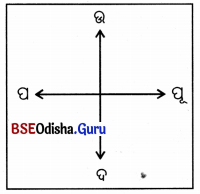
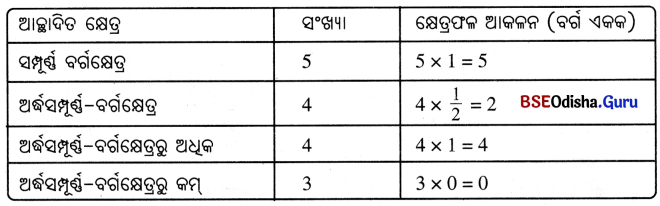
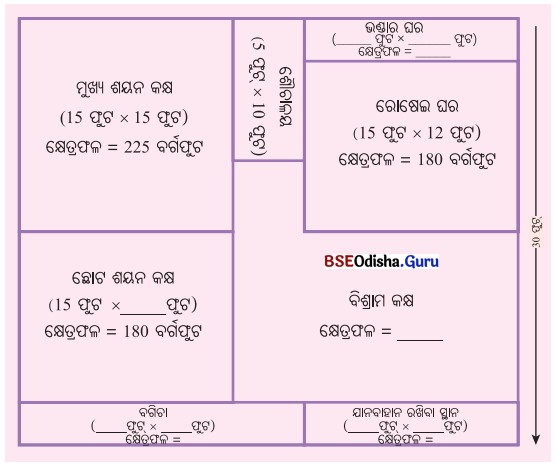
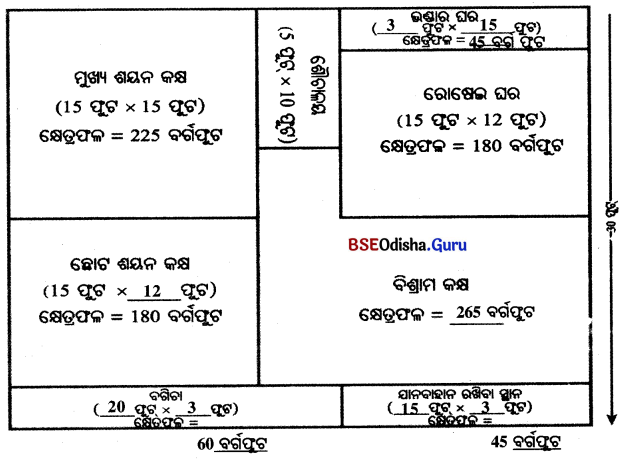
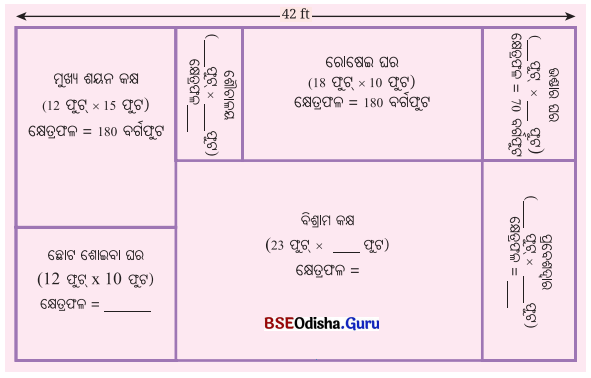
Class 6 Social Science Chapter 3 Question Answer Odia Medium ଭୂମିରୂପ ଏବଂ ଜୀବନ

Go through Class 6 Social Science Solutions Odia Medium and Class 6 Social Science Chapter 3 Question Answer Odia Medium ଭୂମିରୂପ ଏବଂ ଜୀବନ to understand textbook questions more clearly.

6th Class Social Science Chapter 3 Question Answer Odia Medium

Class 6 Social Science Chapter 3 Odia Medium

ପ୍ରଶ୍ନ, ଅଭ୍ୟାସକାର୍ଯ୍ୟ ଏବଂ ପ୍ରକଳ୍ପ :

Question 1.
ତୁମ ଗ୍ରାମ, ସହର ଓ ମହାନଗରରେ କେଉଁ ପ୍ରକାର ଭୂମିରୂପ ଦେଖୁଛ ? ଏହି ଅଧ୍ୟାୟରେ ଉଲ୍ଲେଖ କରାଯାଇଥିବା କେଉଁ ବୈଶିଷ୍ଟ୍ୟଗୁଡ଼ିକ ତୁମେ ଆଖପାଖରେ ଦେଖୁଛ ?
Answer:
ମୁଁ ଏକ ଗ୍ରାମରେ ବାସ କରୁଛି ଯେଉଁଠାରେ ଭୂମିରୂପ ସମତଳ ଅଟେ । ଆମର ଏହି ଭୂମି ଉପରେ କୃଷି କାର୍ଯ୍ୟ ହୁଏ । ପାଖରେ ଥ‌ିବା ନଦୀର ଜଳ ବଢ଼ି ସମୟରେ କ୍ଷେତକୁ ମାଡ଼ିଆସି ତାହାକୁ ପଟୁମାଟିଦ୍ଵାରା ଉର୍ବର କରିଥାଏ । ଆମ ଅଞ୍ଚଳର କୃଷକମାନେ ଉଭୟ ଖରିଫ୍ ଓ ରବି ଫସଲ ଋତୁ ଅନୁସାରେ ଚାଷ କରିଥା’ନ୍ତି । ଅନେକ ଚାଷୀ ମଧ୍ଯ ପନିପରିବା ଚାଷ କରିଥା’ନ୍ତି । କିନ୍ତୁ ଆମ ଦେଶର ଅନ୍ୟ ସ୍ଥାନମାନଙ୍କରେ ମାଳଭୂମି ରହିଛି । ସେହିପରି ପର୍ବତ ମଧ୍ୟ କିଛି ସ୍ଥାନରେ ରହିଅଛି । ମରୁଭୂମିମଧ୍ୟ ଏକ ଭୂମିରୂପ ଯାହା ଆମ ଦେଶରେ ଥର୍ ମରୁଭୂମି ଭାବେ ରହିଅଛି ।

Question 2.
ଆସ ଛୋଟନାଗପୁରରୁ ପ୍ରୟାଗରାଜ ଏବଂ ଆଲମୋଡ଼ାକୁ କରିଥିବା ପ୍ରାରମ୍ଭିକ ଯାତ୍ରାକୁ ଆଉଥରେ ପଢ଼ିବା ଓ ଦେଖ‌ିବା । ବାଟରେ ଦେଖାଯାଉଥ‌ିବା ତିନୋଟି ଭୂମିରୂପକୁ ବର୍ଣ୍ଣନା କର ।
Answer:
ଆମେ ଛୋଟନାଗପୁରରୁ ପ୍ରୟାଗରାଜ ଏବଂ ଆଲମୋଡ଼ାକୁ ଯାତ୍ରା କଲେ ସାଧାରଣତଃ ତିନୋଟି ଭୂମିରୂପ ଦେଖୁଥାଉ ।
(୧) ଛୋଟନାଗପୁର ଏକ ମାଳଭୂମି ଅଟେ । ଏହା ପଥୁରିଆ କିନ୍ତୁ ଖଣିଜ ସମ୍ପଦରେ ପରିପୂର୍ଣ୍ଣ ଅଟେ । ଏଠାରେ ଛୋଟ ଛୋଟ ପାହାଡ଼ ସହିତ ନଦୀ ଉପତ୍ୟକା ଅଛି । ଏହା ଭାରତର ପୂର୍ବରେ ଅଛି ଏବଂ ଝାଡ଼ଖଣ୍ଡ, ଛତିଶଗଡ଼, ଓଡ଼ିଶା, ପଶ୍ଚିମବଙ୍ଗର କିଛି କିଛି ଅଂଶ ଏହା ମଧ୍ଯରେ ଅଛି ।

(୨) ପ୍ରୟାଗରାଜ ଉତ୍ତରପ୍ରଦେଶର ଗଙ୍ଗାନଦୀ ସମତଳ ଅଞ୍ଚଳରେ ଅଛି ଯାହାର ମୃତ୍ତିକା କୃଷି ପାଇଁ ଅତ୍ୟନ୍ତ ଉପଯୋଗୀ । ଏହା ଏକ ପ୍ରସିଦ୍ଧ ତୀର୍ଥସ୍ଥାନ ।

(୩) ଆଲମୋଡ଼ା ଉତ୍ତରାଖଣ୍ଡର ଏକ ସୁନ୍ଦରତମ ସ୍ଥାନ ଯାହାକି କୁମାୟୁନ ପର୍ବତଶ୍ରେଣୀରେ ଅଛି ।

Question 3.
ଭାରତର କେତେକ ପ୍ରସିଦ୍ଧ ତୀର୍ଥସ୍ଥାନ ସହିତ ସେଗୁଡ଼ିକ କେଉଁ ଭୂମିରୂପରେ ଦେଖିବାକୁ ମିଳେ ତାହାର ତାଲିକା କର ।
Answer:
ଭାରତର କେତେଗୁଡ଼ିଏ ପ୍ରସିଦ୍ଧ ତୀର୍ଥସ୍ଥାନ ଏବଂ ସେମାନଙ୍କର ଭୂମିରୂପ ନିମ୍ନରେ ପ୍ରଦାନ କରାଯାଇଛି ।
(କ) ପାର୍ବତ୍ୟାଞ୍ଚଳରେ ଥିବା ତୀର୍ଥସ୍ଥାନଗୁଡ଼ିକ ହେଲା ଅମରନାଥ, ବୈଷୋଦେବୀ, ବଦ୍ରିନାଥ, ମାଉଣ୍ଟଆବୁ ଇତ୍ୟାଦି ।
(ଖ) ସମତଳ ଅଞ୍ଚଳରେ ଥିବା ତୀର୍ଥସ୍ଥାନଗୁଡ଼ିକ ହେଲା ପ୍ରୟାଗରାଜ, ହରିଦ୍ଵାର, ଋଷିକେଶ, ମଥୁରା, ଅମୃତସର, ବାରାଣସୀ ।
(ଗ) ମାଳଭୂମି ଅଞ୍ଚଳରେ ଥିବା ତୀର୍ଥସ୍ଥାନଗୁଡ଼ିକ ହେଲା ଦେବଗଡ଼, ଉଜ୍ଜୟିନୀ ଇତ୍ୟାଦି ।
(ଘ) ଉପକୂଳ ଅଞ୍ଚଳରେ ଥିବା ତୀର୍ଥସ୍ଥାନଗୁଡ଼ିକ ହେଲା ପୁରୀ, ରାମେଶ୍ଵରମ୍ ଇତ୍ୟାଦି ।

Question 4.
ଭୁଲ୍ କି ଠିକ୍ କୁହ ।
(କ) ହିମାଳୟ ହେଉଛି ଗୋଲାକାର ଶୀର୍ଷ ଥ‌ିବା ଯୁବ ଭଙ୍ଗିଳ ପର୍ବତ ।
(ଖ) ଗୋଟିଏ ପଟୁ ମାଳଭୂମି ପ୍ରାୟ ଉଠିକରି ଥାଏ ।
(ଗ) ପର୍ବତ ଓ ପାହାଡ଼ ସମାନ ଭୂମିରୂପ ଅଟେ ।
(ଘ) ଭାରତର ପର୍ବତ, ମାଳଭୂମି ଓ ନଦୀରେ ସମାନ ପ୍ରକାରର ଉଭିଦ ଓ ଜୀବଜନ୍ତୁ ବାସ କରନ୍ତି ।
(ଙ) ଗଙ୍ଗାନଦୀ, ଯମୁନାର ଏକ ଉପନଦୀ ଅଟେ ।
(ଚ) ମରୁଭୂମିରେ ସ୍ଵତନ୍ତ୍ର ଉଭିଦ ଓ ଜୀବଜନ୍ତୁ ଦେଖିବାକୁ ମିଳେ ।
(ଛ) ବରଫ ତରଳିବା ହେତୁ ନଦୀର ଜଳସ୍ତର ବୃଦ୍ଧି ପାଇଥାଏ ।
(ଜି) ସମତଳ ଅଞ୍ଚଳରେ ଜମା ହୋଇଥିବା ନଦୀଗୁଡ଼ିକର ପଟୁମାଟିରୁ ଉର୍ବର ଜମି ପ୍ରସ୍ତୁତ ହୋଇଥାଏ ।
(ଝ) ସବୁ ମରୁଭୂମି ଗରମ ଓ ଉଷ୍ଣ ।
Answer:
(କ) ଭୁଲ୍,
(ଖ) ଭୁଲ୍,
(ଗ) ଠିକ୍,
(ଘ) ଭୁଲ୍,
(ଙ) ଭୁଲ୍,
(ଚ) ଠିକ୍,
(ଛ) ଠିକ୍,
(କ) ଠିକ୍,
(ଝ) ଭୁଲ୍ ।

Question 5.
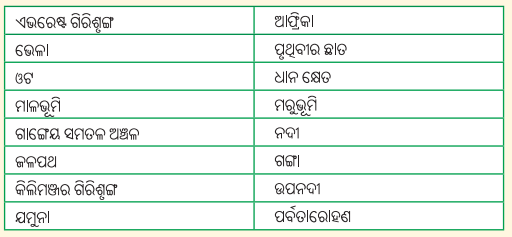
ସାରଣୀର ବାମ ପଟରେ ଥ‌ିବା ଶବ୍ଦଗୁଡ଼ିକୁ ଡାହାଣ ପଟର ଠିକ୍ ଶବ୍ଦ ସହିତ ମିଳାଅ ।
Class 6 Social Science Chapter 3 Question Answer Odia Medium ଭୂମିରୂପ ଏବଂ ଜୀବନ-4
Answer:

ଏଭେରେଷ୍ଟ ଗିରିଶୃଙ୍ଗ ପର୍ବତାରୋହଣ
ଭେଳା ନଦୀ
ଓଟ ମରୁଭୂମି
ମାଳଭୂମି ପୃଥ‌ିବୀର ଛାତ
ଗାଙ୍ଗେୟ ସମତଳ ଅଞ୍ଚଳ ଧାନକ୍ଷେତ
ଜଳପଥ ଗଙ୍ଗା
କିଲିମଞ୍ଜର ଗିରିଶୃଙ୍ଗ ଆଫ୍ରିକା
ଯମୁନା ଉପନଦୀ

Class 6 Social Science Chapter 3 Question Answer Odia Medium ଭୂମିରୂପ ଏବଂ ଜୀବନ

ଦୀର୍ଘ ଉତ୍ତରମୂଳକ ପ୍ରଶ୍ନୋତ୍ତର

Question 1.
ମୁଖ୍ୟ ଭୂମିରୂପଗୁଡ଼ିକ କ’ଣ ? ଏହା ମନୁଷ୍ୟର ଜୀବନ ଓ ସଂସ୍କୃତି ପାଇଁ କିପରି ମହତ୍ତ୍ଵପୂର୍ଣ୍ଣ ଅଟେ ?
Answer:
ପୃଥ‌ିବୀର ଭୂପୃଷ୍ଠରେ ଥ‌ିବା ମୁଖ୍ୟ ଭୂମିରୂପଗୁଡ଼ିକ ହେଉଛି, ପର୍ବତ ବା ପର୍ବତମାଳା, ମାଳଭୂମି ଏବଂ ସମତଳଭୂମି ।
ପର୍ବତ – ଚତୁଃପାର୍ଶ୍ଵସ୍ଥ ଭୂମିରୂପଠାରୁ ହଠାତ୍ ଉପରକୁ ଉଠିଥିବା ଉଚ୍ଚଭୂମିଗୁଡ଼ିକୁ ପର୍ବତ କୁହାଯାଏ । ଏଗୁଡ଼ିକର ଆଧାର ଭୂମି ପ୍ରଶସ୍ତ ଏବଂ ଉଚ୍ଚତା ବଢ଼ିବା ସହ କ୍ରମଶଃ ସଂକୀର୍ଣ୍ଣ ହୋଇ ଶଙ୍କୁ ଆକାରର ହୋଇଥାଏ । କିଛି ପର୍ବତର ଶିଖର ଅଧୂକ ଉଚ୍ଚତାରେ ଥ‌ିବାରୁ ତାହା ସର୍ବଦା ବରଫାବୃତ ହୋଇ ରହିଥାଏ । କିନ୍ତୁ ଅଳ୍ପ ଉଚ୍ଚତାରେ ଥ‌ିବା ପର୍ବତର ବରଫ ଗ୍ରୀଷ୍ମଋତୁରେ ତରଳି ଏହା ନଦୀରେ ମିଶିଥାଏ । ଅଳ୍ପ ଉଚ୍ଚତା, ଅଳ୍ପ ଢାଲୁ ଏବଂ ଗୋଲାକାର ଶୀର୍ଷଭୂମିକୁ ପାହାଡ଼ କୁହାଯାଏ ।

ମାଳଭୂମି : ମାଳଭୂମି ହେଉଛି ଏକ ଭୂମିରୂପ ଯାହା ଚତୁଃପାର୍ଶ୍ୱସ୍ଥ ଭୂମିରୁ ତୀଖ ଭାବରେ ଉପରକୁ ଉଠିଥାଏ । ଆମ ଦେଶ ଭାରତରେ ଦୁଇଟି ପୁରାତନ ମାଳଭୂମି ଅଛି ଯଥା, ତିବ୍ଦତୀୟ ମାଳଭୂମି ଯାହାକି ବିଶ୍ୱର ସର୍ବବୃହତ୍ ଏବଂ ସର୍ବୋଚ୍ଚ ଏବଂ ଅନ୍ୟଟି ଡେକାନ୍ ମାଳଭୂମି ।

ସମତଳ ଅଞ୍ଚଳ : ସମୁଦ୍ର ପତ୍ତନରୁ ୩୦୦ ମିଟର ବା କମ୍ ଉଚ୍ଚତାରେ ଥ‌ିବା ବିସ୍ତୀର୍ଣ୍ଣ ସମୟ ପ୍ରାୟ ଭୂମିକୁ ସମତଳଭୂମି କୁହାଯାଏ । ଏଗୁଡ଼ିକର ପୃଷ୍ଠଭୂମି ଚଟକା ଏବଂ ଅତି କମ୍ ଢାଲୁ ବିଶିଷ୍ଟ । ଏଗୁଡ଼ିକରେ କୌଣସି ବଡ଼ ପାହାଡ଼ କିମ୍ବା ଗଭୀର ଉପତ୍ୟକା ଦେଖାଯାଏ ନାହିଁ ।
ଭୂପୃଷ୍ଠର ଯେକୌଣସି ଭୂମିରୂପ ମାନବ ଜୀବନ ଧାରଣ ଏବଂ

(୧) ପାର୍ବତ୍ୟ ଅଞ୍ଚଳରେ ଜୀବନ – ଅଧିକାଂଶ ପାର୍ବତ୍ୟ ସଂସ୍କୃତିପାଇଁ ଅନେକ ମହତ୍ତ୍ଵପୂର୍ଣ୍ଣ ଅଟେ । ଅଞ୍ଚଳରେ ଜୀବନ କଷ୍ଟକର ହେଲେ ମଧ୍ୟ ସୁଖଦାୟକ ଅଟେ । ଯଦିଓ ଏ ଅଞ୍ଚଳରେ ଜନସଂଖ୍ୟା କମ୍ ଥାଏ ତଥାପି ସେମାନେ କୃଷି, ଗୋପାଳନ ଇତ୍ୟାଦି କାର୍ଯ୍ୟକରି ଜୀବିକା ନିର୍ବାହ କରନ୍ତି । ବର୍ତ୍ତମାନ ଯୁଗରେ ପର୍ଯ୍ୟଟନରୁ ଏମାନେ ଉତ୍ତମ ରୋଜଗାର କରୁଛନ୍ତି । ପାର୍ବତ୍ୟ ଅଞ୍ଚଳଗୁଡ଼ିକ ଅନେକ ଉଦ୍ଭଦ ଏବଂ ଜୀବଜନ୍ତୁରେ ପରିପୂର୍ଣ ହୋଇଥାଏ । ଏହିମାନଙ୍କ ଗହଣରେ ପାର୍ବତ୍ୟ ଅଞ୍ଚଳର ଅଧ‌ିବାସୀମାନେ ବଞ୍ଚିବା ସହ ନିଜର ସଂସ୍କୃତିକୁ ମଧ୍ୟ ବଞ୍ଚାଇ ରଖୁଛନ୍ତି ।

(୨) ମାଳଭୂମି – ମାଳଭୂମିମାନଙ୍କରେ ମଧ୍ଯ ଜୀବିକା ନିର୍ବାହର ବିଭିନ୍ନ ପନ୍ଥା ରହିଛି । କାରଣ ଏଗୁଡ଼ିକ ପ୍ରାୟତଃ ଖଣିଜ ସମ୍ପଦ ଭରା । ଉଦାହରଣ ସ୍ଵରୂପ, ଆଫ୍ରିକୀୟ ମାଳଭୂମି ଅଞ୍ଚଳରେ ସୁନା ଓ ହୀରାଖଣି ଦେଖିବାକୁ ମିଳେ । ସେହିପରି ଭାରତର ଛୋଟନାଗପୁର ମାଳଭୂମି ଅଞ୍ଚଳରେ ପ୍ରଚୁର ପରିମାଣରେ ଲୌହ ଓ କୋଇଲା ଖଣି ରହିଅଛି ।

ମାଳଭୂମିର ପରିବେଶ ଭିନ୍ନ ପ୍ରକାରର ଅଟେ । ଅଧିକାଂଶ ମାଳଭୂମିରେ ପଥୁରିଆ ମାଟି ଥୁବାରୁ ତାହା କୃଷି ପାଇଁ ସହାୟକ ହୋଇନଥାଏ । ତେଣୁ ଅଧିକାଂଶ ଅଧ୍ୟାବାସୀ ଖଣିରେ କାର୍ଯ୍ୟକରି ଜୀବିକା ନିର୍ବାହ କରିଥା’ନ୍ତି ।

ମାଳଭୂମିଗୁଡ଼ିକରେ ଅଧ୍ବକ ଆକର୍ଷଣୀୟ ଜଳପ୍ରପାତ ଦେଖିବାକୁ ମିଳିଥାଏ ।
ସମତଳଭୂମିରେ ଜୀବନ – ହଜାର ହଜାର ବର୍ଷ ତଳେ ନଦୀଗୁଡ଼ିକର ଅବବାହିକାରେ, ଉର୍ବର ସମତଳ ଭୂମିରେ ମାନବ ସଭ୍ୟତାମାନ ଗଢ଼ି ଉଠିଥିଲା । ପୃଥିବୀର ଜନସଂଖ୍ୟାର ଅଧିକାଂଶ ଭାଗ ସମତଳ ଅଞ୍ଚଳରେ ବସବାସ କରନ୍ତି । ପୃଥ‌ିବୀର ଅଧିକାଂଶ ବଡ଼ ନଗରୀ ସମତଳଭୂମି ଉପରେ ନଦୀ ଅବବାହିକାରେ ଗଢ଼ି ଉଠିଛି । ସମତଳ ଅଞ୍ଚଳର ଅଧିକାଂଶ ଅଧିବାସୀଙ୍କର ମୁଖ୍ୟ ଜୀବିକା ହେଉଛି କୃଷି । କୃଷି ସହିତ ସମତଳ ଅଞ୍ଚଳରେ ବାଣିଜ୍ୟ ବ୍ୟବସାୟ ବିଶେଷକରି ନୌବାଣିଜ୍ୟ, ଅର୍ଥନୈତିକ କାର୍ଯ୍ୟକଳାପକୁ ବିଶେଷ ସହାୟକ ହୋଇଥାଏ । ସମତଳ ଅଞ୍ଚଳର ଜନସାଧାରଣଙ୍କର ସଂସ୍କୃତିକ ଜୀବନ ଯେତିକି ଋଦ୍ଧିମନ୍ତ ସେତିକି ଗୌରବମୟ । ଅନେକ ରୀତିନୀତି, ପର୍ବପର୍ବାଣି, ନୃତ୍ୟଗୀତରେ ଏମାନେ ଜୀବନ ବିତାଇଥା’ନ୍ତି । ସୁତରାଂ ମୋଟାମୋଟି ଭାବରେ କହିବାକୁ ଗଲେ ପ୍ରତ୍ୟେକ ଭୂମିରୂପରେ ପାର୍ବତ୍ୟାଞ୍ଚଳ ହେଉ କିମ୍ବା ମାଳଭୂମି କିମ୍ବା ସମତଳ ଭୂମିରେ ମାନବ ତା’ର ଜୀବନ ଧାରଣ ଏବଂ ଜୀବିକା ନିର୍ବାହ କରିପାରିଛି । ଏହା ସହିତ ଏକ ଉଚ୍ଚକୋଟୀର ସାଂସ୍କୃତିକ ପରମ୍ପରାରେ ସେ ହୋଇଛି ଋଦ୍ଧିମନ୍ତ ।

Question 2.
ପ୍ରତ୍ୟେକ ଭୂମିରୂପ ସହିତ ଜଡ଼ିତ ଜୀବନର ଆହ୍ବାନ ଏବଂ ସୁଯୋଗଗୁଡ଼ିକ କ’ଣ ?
Answer:
ଭୂପୃଷ୍ଠର ପ୍ରତ୍ୟେକ ଭୂମିରୂପରେ ଜୀବନ ଅନେକ ଆହ୍ଵାନ ଏବଂ ସୁଯୋଗ ଦେଇ ଗତି କରିଥାଏ । ତା’ ଭିତରେ ମନୁଷ୍ୟ ଅନେକ ବାଧାବିଘ୍ନ ଏବଂ ପ୍ରାକୃତିକ ବିପର୍ଯ୍ୟୟକୁ ମଧ୍ୟ ସାମ୍ନା କରିଥାଏ ।

ପାର୍ବତ୍ୟ ଅଞ୍ଚଳରେ ବିପଦପୂର୍ଣ୍ଣ ଜୀବନ ପାର୍ବତ୍ୟ ଅଞ୍ଚଳରେ ଜୀବନଧାରଣ ଏକ ଆହ୍ୱାନ । ଏହାର ମୁଖ୍ୟ କାରଣ ହେଲା, ଏସବୁ ଅଞ୍ଚଳରେ ପ୍ରାକୃତିକ ବିପର୍ଯ୍ୟୟ ଯଥା, ତୁଷାରପାତ, ଭୂସ୍ଖଳନ, ବାଦଲଫଟା ବର୍ଷା ଏବଂ ହଠାତ୍ ବନ୍ୟା ମାଡ଼ି ଆସିଥାଏ । ଏତଦ୍‌ବ୍ୟତୀତ ପାହାଡ଼ିଆ ଅଞ୍ଚଳ ଅତ୍ୟନ୍ତ ଆବଡ଼ାଖାବଡ଼ା, ତୀଖ, ଅଣଓସାରିଆ ରାସ୍ତା ହୋଇଥିବାରୁ ଜୀବନ ସର୍ବଦା ବିପଦସଙ୍କୁଳ ହୋଇଥାଏ । ଅନେକ କଷ୍ଟରେ ସେମାନେ ସୋପାନ କୃଷି କରିଥା’ନ୍ତି ।

ପାର୍ବତ୍ୟ ଅଞ୍ଚଳରେ ସୁଯୋଗ କ’ଣ ? : ପାର୍ବତ୍ୟ ଅଞ୍ଚଳରେ ପ୍ରକୃତିର ସୌନ୍ଦର୍ଯ୍ୟ ଭରି ରହିଛି, ବିଭିନ୍ନ ପ୍ରକାର ଉଭିଦ, ଜୀବଜନ୍ତୁ ଏଠାରେ ଦେଖିବାକୁ ମିଳିଛି । ସବୁଠାରୁ ବଡ଼ କଥା, ଏବେ ଏହି ସ୍ଥାନଗୁଡ଼ିକ ପର୍ଯ୍ୟଟନସ୍ଥଳୀ ହୋଇଥ‌ିବାରୁ ପ୍ରତିବର୍ଷ ହଜାର ହଜାର ପର୍ଯ୍ୟଟକ ଏଠାକୁ ଆସିଥା’ନ୍ତି । ଯାହାଫଳରେ ସ୍ଥାନୀୟ ଲୋକ ଏକ ଉତ୍ତମ ରୋଜଗାରର ସୁଯୋଗ ପାଇଥା’ନ୍ତି ।

ମାଳଭୂମିରେ ଜୀବନ – ମାଳଭୂମିରେ ମଧ୍ଯ ଜନଜୀବନ ଅନେକ ସମୟରେ ବିପଦସଙ୍କୁଳ ହୋଇଥାଏ । ଏହି ସ୍ଥାନମାନଙ୍କରେ ଥ‌ିବା ତୀଖ ପାହାଡ଼ର କ୍ଷୟ ହୋଇଥାଏ, ଯାହାକି ଅନେକ ସମୟରେ କୃଷିକୁ ବାଧାପ୍ରାପ୍ତ କରିଥାଏ । ମାଳଭୂମିକୁ କାଟି ରାସ୍ତା ନିର୍ମାଣ କରିବାଦ୍ଵାରା ବିକାଶର ପଥ ଖୋଲିଥିଲେ ମଧ୍ୟ ତାହା ମୃତ୍ତିକାକ୍ଷୟର କାରଣ ହୋଇଥିଲା ।

ମାଳଭୂମିରେ ସୁଯୋଗ – ମାଳଭୂମି ସାଧାରଣତଃ ଖଣିଜ ପଦାର୍ଥରେ ଭରପୂର । ଏହାକୁ ଖଣିଜ ପଦାର୍ଥର ଭଣ୍ଡାର ବୋଲି କୁହାଯାଏ । ଏସବୁ ଅଞ୍ଚଳରେ ଖଣି ଖନନ ଏବଂ ଖଣିଜ ପଦାର୍ଥର ଉତ୍ତୋଳନ ଇତ୍ୟାଦି ଏକ ଅର୍ଥନୈତିକ କାର୍ଯ୍ୟ ହୋଇଥିବାରୁ ଅନେକ ଲୋକଙ୍କୁ ଏଠାରେ କାର୍ଯ୍ୟ; କରିବାର ସୁଯୋଗ ମିଳିବା ସହିତ ରୋଜଗାର ମିଳିଥାଏ ।

ସମତଳ ଅଞ୍ଚଳରେ ଜୀବନର ଆହ୍ବାନ ଓ ସୁଯୋଗ ସମତଳ ଅଞ୍ଚଳ କୃଷି, ବାଣିଜ୍ୟ, ବ୍ୟବସାୟ, ଗୋପାଳନ ଏବଂ ଅନ୍ୟାନ୍ୟ ଛୋଟବଡ଼ ବୃଦ୍ଧି ପାଇଁ ଅନେକ ସୁଯୋଗ ଆଣି ଦେଇଥାଏ । ତେଣୁ ପୃଥ‌ିବୀର ଅଧିକାଂଶ ଲୋକ ସମତଳ ଅଞ୍ଚଳରେ ବସବାସ କରିବାକୁ ପସନ୍ଦ କରିଥା’ନ୍ତି । କିନ୍ତୁ ଅନେକ ସମୟରେ ବନ୍ୟା, ବଢ଼ି, ମରୁଡ଼ି ଭଳି ପ୍ରାକୃତିକ ବିପର୍ଯ୍ୟୟକୁ ମଧ୍ୟ ସେମାନଙ୍କୁ ସାମ୍‌ନା କରିବାକୁ ପଡ଼ିଥାଏ । ଏତଦ୍‌ବ୍ୟତୀତ ଜନସଂଖ୍ୟା ବୃଦ୍ଧି, ପ୍ରଦୂଷଣ ଇତ୍ୟାଦି ମଧ୍ଯ ଜନଜୀବନକୁ କ୍ଷତି ପହଞ୍ଚାଇଥାଏ ।

ଆସ ଅନୁସନ୍ଧାନ କରିବା :

Question 1.
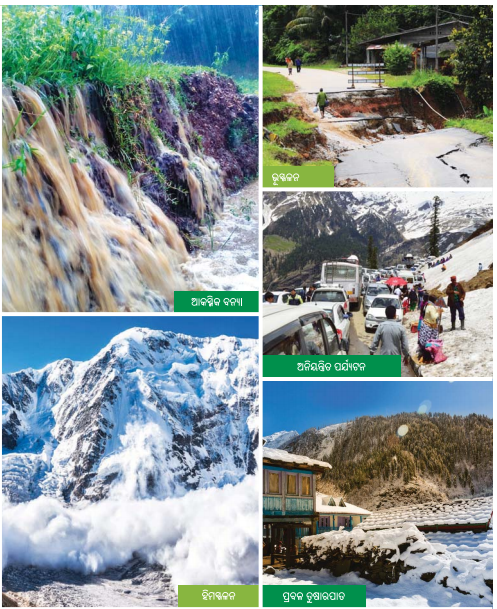
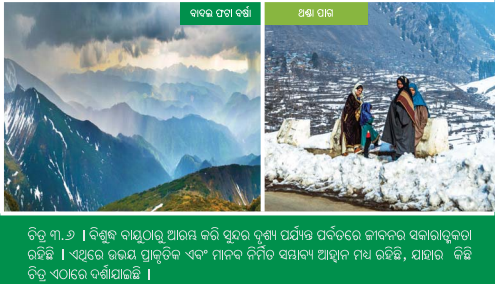
ପାର୍ଶ୍ୱସ୍ଥ ଚିତ୍ରଗୁଡ଼ିକ ପର୍ବତରେ ବାସ କରୁଥିବା ଲୋକମାନେ ସମ୍ମୁଖୀନ ହେଉଥ‌ିବା କିଛି ଆହ୍ବାନ ଦର୍ଶାଉଛି । ଶ୍ରେଣୀରେ ଦଳଗତ ଭାବରେ ଆଲୋଚନା କରି, ପ୍ରତ୍ୟେକ ଚିତ୍ର ଉପରେ ଗୋଟିଏ ଅନୁଚ୍ଛେଦ ଲେଖ । ଏପରି ଅନେକ ଆହ୍ବାନ ଅସୁବିଧା ସେତ୍ତ୍ୱେ ଲୋକମାନେ କାହିଁକି ଏବେ ବି ପାହାଡ଼ରେ ରହିବାକୁ ପସନ୍ଦ କରୁଛନ୍ତି ସେ ବିଷୟରେ ମଧ୍ୟ ଆଲୋଚନା କର ।
Class 6 Social Science Chapter 3 Question Answer Odia Medium ଭୂମିରୂପ ଏବଂ ଜୀବନ-1

Class 6 Social Science Chapter 3 Question Answer Odia Medium ଭୂମିରୂପ ଏବଂ ଜୀବନ-2
Answer:
ଉପରୋକ୍ତ ଚିତ୍ର ଦର୍ଶାଏ ଯେ କିଭଳି ଭାବରେ ପାର୍ବତ୍ୟ ଅଞ୍ଚଳର ଲୋକେ ଏହିସବୁ ବିପଦକୁ ସାମ୍‌ନା କରିଥାନ୍ତି । ଏହା ସତ୍ତ୍ବେ ସେମାନେ ସେଠାରେ ଜୀବନଯାପନ କରନ୍ତି ଏବଂ ସେଠାକାର ପରି ବେଶ ସହିତ ନି ଜକୁ ଖାପ ଖୁଆଇ ଚାଲି ଥା’ନ୍ତି । ଏହି ସବୁ ସ୍ଥାନମାନଙ୍କରେ ହଠାତ୍ ଆକସ୍ମିକ ବନ୍ୟା ହୁଏ, ହିମ ସ୍ଖଳନ ହୁଏ, ବାଦଲଫଟା ବର୍ଷା, ଭୂସ୍ଖଳନ, ପ୍ରବଳ ତୁଷାର ପାତ ଏବଂ ଥଣ୍ଡା ଲାଗି ରହିଥାଏ । ବେଳେବେଳେ ପର୍ଯ୍ୟଟନ ବ୍ୟବସ୍ଥା ମଧ୍ୟ ନିୟନ୍ତ୍ରଣ ବାହାରକୁ ଚାଲିଯାଏ । ଏସବୁ ସତ୍ତ୍ବେ ଏଠାରେ ମାନବ ଜୀବନଧାର ଣ କରିଥାଏ ।

Question 2.
ଚିତ୍ର ୩.୮ରେ ଦର୍ଶାଯାଇଥିବା ଭୂମିରୂପଗୁଡ଼ିକର ରଙ୍ଗ ପାଇଁ ଦିଆଯାଇଥିବା ନିର୍ଦ୍ଦିଷ୍ଟ କୋଡ଼କୁ ବ୍ୟବହାର କର । ଉଦାହରଣ ସ୍ୱରୂପ ‘ତିବ୍ବତୀୟ ମାଳଭୂମି’, ‘ରକି ପର୍ବତଶ୍ରେଣୀ’, ନୀଳନଦୀର ସମତଳ ଭାଗ’ ।
Class 6 Social Science Chapter 3 Question Answer Odia Medium ଭୂମିରୂପ ଏବଂ ଜୀବନ-3
Answer:
(୧) ତିବ୍ଦତୀୟ ମାଳଭୂମି ପାଇଁ ଆମେ ଗାଢ଼ ଧୂସର ରଙ୍ଗ ବ୍ୟବହାର କରିବା ।
(୨) ପଥୁରିଆ ରକି ପର୍ବତଶ୍ରେଣୀ ପାଇଁ ଫିକା ଧୂସର ରଙ୍ଗ ବ୍ୟବହାର କରିବା ।
(୩) ନୀଳନଦୀ, ଆମାଜନ ନଦୀ, ମସିସିପି ଏବଂ ଗଙ୍ଗାନଦୀର ସମତଳ ଅଞ୍ଚଳ ପାଇଁ ଫିକା ସବୁଜ ରଙ୍ଗ ବ୍ୟବହାର କରିବା ।

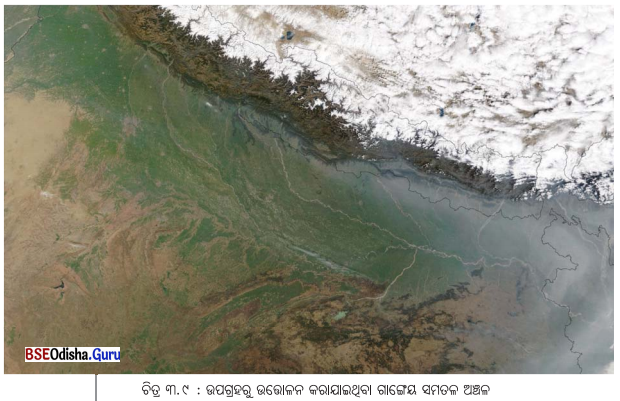
ଚିତ୍ର ୩.୯ରେ ଉତ୍ତର ଭାରତର ଏକ ଅଂଶକୁ ଉପଗ୍ରହଦ୍ଵାର ବହୁ ଉଚ୍ଚରୁ ଉତ୍ତୋଳ ନ କରାଯାଇଥ୍ ବା ଫଟୋଚିତ୍ର ମାଧ୍ୟମରେ ଦର୍ଶାଯାଇଛି । ଶିକ୍ଷଣ କାର୍ଯ୍ୟ ଭାବରେ ଏହାକୁ ଅନୁଧ୍ୟାନ କର ।

Question 3.
ଗାଙ୍ଗେୟ ସମତଳ କେଉଁ ରଙ୍ଗର ?
Answer:
ଗାଙ୍ଗେୟ ସମତଳ ସବୁଜ ରଙ୍ଗର ଅଟେ ।

Question 4.
ଧଳା ରଙ୍ଗ କ’ଣ ଦର୍ଶାଉଛି ?
Answer:
ଚିତ୍ରରେ ପର୍ବତମାନଙ୍କର ଶିଖରରେ ଦେଖାଯାଉଥ‌ିବା ଧଳା ରଙ୍ଗ ଦର୍ଶାଉଛି ଯେ ସେଗୁଡ଼ିକ ବରଫ ଆଚ୍ଛାଦିତ ।

Question 5.
ଚିତ୍ରର ନିମ୍ନରେ ବାମପଟେ ଥିବା ଧୂସର ରଙ୍ଗ କ’ଣ ଦର୍ଶାଉଛି ?
Answer:
ଏହା ଦାକ୍ଷିଣାତ୍ୟ ମାଳଭୂମିକୁ ଦର୍ଶାଉଛି ।

Class 6 Social Science Chapter 3 Question Answer Odia Medium ଭୂମିରୂପ ଏବଂ ଜୀବନ

Question 6.
ତୁମେ ତୁମ ଅଞ୍ଚଳର ନଦୀ ଉତ୍ସ କିମ୍ବା ସଙ୍ଗମର ଉଦାହରଣ ଦେଇପାରିବ କି ଯାହାକୁ କୌଣସି ସମ୍ପ୍ରଦାୟ ପବିତ୍ର ଭାବରେ ବିବେଚନା କରନ୍ତି ?
Answer:
ଗଙ୍ଗାନଦୀ ହିନ୍ଦୁମାନଙ୍କ ପାଇଁ ସବୁଠାରୁ ପବିତ୍ରତମ ନଦୀ । ଏହି ନଦୀ ବାହାରିଥିବା ଗଙ୍ଗୋତ୍ରୀ କ୍ଲାସିୟରକୁ ପବିତ୍ର ମନେକରାଯାଏ । ଗଙ୍ଗାନଦୀକୁ ଦେବୀ ଗଙ୍ଗାମାତା ବୋଲି ହିନ୍ଦୁମାନେ ମାନି ତା’ କୂଳରେ ସ୍ନାନ କରି ସମସ୍ତ ପୂଜା କ୍ରିୟାକାର୍ଯ୍ୟ କରିଥା’ନ୍ତି । ଗଙ୍ଗା ଓ ଯମୁନା ନଦୀର ସଙ୍ଗମ ସ୍ଥଳକୁ ପ୍ରୟୋଗରାଜ ବା ତ୍ରିବେଣୀ ସଙ୍ଗମ କୁହାଯାଏ । ଏଠି ଅନୁଷ୍ଠିତ କୁମ୍ଭମେଳା ବିଶ୍ଵପ୍ରସିଦ୍ଧ । ଏହି ସ୍ଥାନକୁ ହିନ୍ଦୁ ସମ୍ପ୍ରଦାୟ ପବିତ୍ର ଭାବରେ ବିବେଚନା କରନ୍ତି ।

Question 7.
ନିକଟସ୍ଥ ନଦୀକୁ ଯାଅ ଏବଂ ସେଠାରେ ଅର୍ଥନୈତିକ ହେଉ କି ସାଂସ୍କୃତିକ ସମସ୍ତ କାର୍ଯ୍ୟକଳାପ ଅନୁଧ୍ୟାନ କର । ସେଗୁଡ଼ିକ ଲିପିବଦ୍ଧ କର ଏବଂ ତୁମ ସହପାଠୀଙ୍କ ସହିତ ଆଲୋଚନା କର ।
Answer:
(ଛାତ୍ରଛାତ୍ରୀମାନେ ନିଜେ କରିବେ ।)

Question 8.
ଭାରତର କେତେକ ଲୋକପ୍ରିୟ ପର୍ଯ୍ୟଟନସ୍ଥଳୀର ତାଲିକା ପ୍ରସ୍ତୁତ କର ଏବଂ ସେହି ସ୍ଥାନରେ କେଉଁ ପ୍ରକାର ଭୂମିରୂପ ଦେଖାଯାଏ, ତାହାକୁ ଚିହ୍ନଟ କର ।
Answer:
ଭାରତରେ ଅନେକ ପର୍ଯ୍ୟଟନସ୍ଥଳୀ ରହିଛି । କେତେକ ପର୍ବତ ଉପରେ, କେତେକ ମାଳଭୂମିରେ ଏବଂ କେତେକ ସମତଳଭୂମି ଉପରେ ଗଢ଼ିଉଠିଛି । ଉଦାହରଣ ସ୍ଵରୂପ ସିମଳା, ମନାଲି, ଲେହ ହିମାଳୟ ପର୍ବତରେ ରହିଅଛି । ସେହିପରି ଜୟସାଲମେର, ବିକାନୀର ଥର୍ ମରୁଭୂମିରେ ରହିଅଛି । ସେହିପରି ବନାରସ, ଋଷିକେଶ ଏବଂ ହରିଦ୍ଵାର ଗଙ୍ଗାନଦୀର ସମତଳଭୂମି ଉପରେ ରହିଅଛି ।

ମରୁଭୂମି – କମ୍ ଦୃଷ୍ଟିପାତ ସହିତ ବିସ୍ତୀର୍ଣ୍ଣ ଶୁଖୁଲା ଅଞ୍ଚଳକୁ ମରୁଭୂମି କୁହାଯାଏ । ଏଗୁଡ଼ିକର ଉଭିଦ ଓ ଜୀବଜନ୍ତୁ ମଧ୍ଯ ଅନନ୍ୟ ଅଟନ୍ତି । ଆଫ୍ରିକାର ସାହାରା ମରୁଭୂମି, ଭାରତର ଥର୍ ମରୁଭୂମି ଅତ୍ୟନ୍ତ ଗରମ ଅଟେ । କିନ୍ତୁ ଏସିଆର ଗୋବି ମରୁଭୂମି ଥଣ୍ଡା ଅଟେ । କେତେକ ବିଶେଷଜ୍ଞ ଆଣ୍ଟର୍କଟିକା ମହାଦେଶକୁ ମଧ୍ୟ ମରୁଭୂମି ବୋଲି ବର୍ଣ୍ଣନା କରିଛନ୍ତି । ଜୀବନଯାପନ ପାଇଁ କଠିନ ପରିସ୍ଥିତି ସତ୍ତ୍ଵେ ଅଧିକାଂଶ ମରୁଭୂମିରେ ଲୋକମାନେ ମଧ୍ୟ ବସଦ. 2 କରନ୍ତି । ମନୁଷ୍ୟ ସମସ୍ତ ଭୂମିରୂପକୁ ନିଜର ଘର କରିପାରିଛି ।

ଆସ ଜାଣିବା :

Question 1.
ଶିକ୍ଷଣ କାର୍ଯ୍ୟ– ଚାରି କିମ୍ବା ପାଞ୍ଚଜଣ ଛାତ୍ରଛାତ୍ରୀଙ୍କୁ ନେଇ ଦଳ ଗଠନ କରି ପ୍ରତ୍ୟେକ ଦଳକୁ ବିଦ୍ୟାଳୟ ଆଖପାଖକୁ ନିରୀକ୍ଷଣ କରିବାପାଇଁ ସୂଚନା ଦିଆଯିବ ଏବଂ ନିମ୍ନ ପ୍ରଶ୍ନଗୁଡ଼ିକୁ ଆଲୋଚନା କରି ଅନ୍ୟ ଦଳ ସହ ତୁଳନା କର । ତୁମେ କେଉଁ ପ୍ରକାରର ଭୂମିରୂପ ଦେଖୁଛ ? କିଛି କିଲୋମିଟର ଦୂରରେ ବା ପାଖାପାଖୁ ୫୦ କିଲୋମିଟର ଭିତରେ ଏହା ବଦଳି ଯିବ କି ?
Answer:
ଆମ ଚତୁଃପାର୍ଶ୍ଵରେ ଆମେ ଯେଉଁ ଭୂମିରୂପ ଦେଖୁଛୁ, ସେଥ‌ିରେ କିଛିଟା ଫରକ ରହିଛି, କେଉଁଠି ସମତଳ ଭୂମି ତ କେଉଁଠି ଢାଲୁ ଅଞ୍ଚଳ ଏବଂ କେଉଁଠି ମାଳଭୂମିର ତୀଖ ପାହାଡ଼ିଆ ଅଞ୍ଚଳ ଇତ୍ୟାଦି । କିନ୍ତୁ ଯେକୌଣସି ଭୂମିରୂପ ପ୍ରାୟ ୫୦ କିଲୋମିଟର ଭିତରେ ବଦଳି ନଥାଏ ।

Question 2.
ଦଳରେ, ତୁମମାନଙ୍କ ମଧ୍ୟରୁ କେହି ଜଣେ ଓଡ଼ିଶାର ଏକ ଅଞ୍ଚଳ ଦେଇ କରିଥିବା ଯାତ୍ରା ବିଷୟରେ ଆଲୋଚନା କର । ବାଟରେ ଦେଖୁଥ‌ିବା ବିଭିନ୍ନ ଭୂମିରୂପର ତାଲିକା ପ୍ରସ୍ତୁତ କର । ଅନ୍ୟ ଦଳ ସହ ତୁଳନା କର ।
Answer:
ଯେତେବେଳେ ଆମେ ଓଡ଼ିଶାର କୌଣସି ଏକ ଅଞ୍ଚଳ ମଧ୍ୟଦେଇ ଯାତ୍ରା କରୁ ଆମେ ବାଟରେ ବିଭିନ୍ନ ଭୂମିରୂପ ଦେଖୁ; ଯଥା- ପର୍ବତ, ମାଳଭୂମି, ସମତଳ ଅଞ୍ଚଳ ଏବଂ ଉପକୂଳ ଅଞ୍ଚଳ । ଓଡ଼ିଶା ମଧ୍ଯରେ ଏକ ଦୀର୍ଘ ଯାତ୍ରା କଲେ ଏସବୁ ଭୂମିରୂପ ଦେଖିବା ଏକ ପ୍ରକାର ନିଶ୍ଚିତ ହୋଇଥାଏ ।

ଭୂମିରୂପ ପୃଥ‌ିବୀ ପୃଷ୍ଠରେ ଥିବା ଏକ ଭୌତିକ ଅଂଶ ଅଟେ । ଭୂମିରୂପ ଗଠନ ପାଇଁ ଲକ୍ଷ ଲକ୍ଷ ବର୍ଷ ନେଇଥାଏ ଏବଂ ଏହାର ପରିବେଶ ଓ ଜୀବନ ସହିତ ଏକ ଗୁରୁତ୍ଵପୂର୍ଣ୍ଣ ସମ୍ପର୍କ ରହିଛି ।

ଭୂମିରୂପକୁ ମୁଖ୍ୟତଃ ତିନୋଟି ଶ୍ରେଣୀରେ ବିଭକ୍ତ କରାଯାଇଥାଏ, ଯଥା- ପର୍ବତ, ମାଳଭୂମି ଏବଂ ସମତଳଭୂମି ।

ଭୂମିରୂପଗୁଡ଼ିକର ଜଳବାୟୁ ଭିନ୍ନ ଅଟେ ଏବଂ ଏଠାରେ ବିଭିନ୍ନ ପ୍ରକାରର ଉଭିଦ ଓ ଜୀବଜନ୍ତୁ ବାସ କରନ୍ତି ।

ମନୁଷ୍ୟ ସବୁପ୍ରକାର ଭୂମିରୂପ ସହ ନିଜକୁ ଖାପଖୁଆଇ ପାରିଛି । କେବଳ ଜନସଂଖ୍ୟା ବିଭିନ୍ନ ଭୂମିରୂପ ଅନୁଯାୟୀ କମ୍ ବେଶୀ ହୋଇଥାଏ ।

ଏହି ଶ୍ଳୋକର ଆଧାରରେ ନିମ୍ନ ପ୍ରଶ୍ନର ଆଲୋଚନା କର ।

Question 1.
ପଶ୍ଚିମରୁ ପୂର୍ବ ମହାସାଗରର ଅର୍ଥ କ’ଣ ? ତୁମେ ଚିତ୍ର ୫.୨ରେ ଏହି ମହାସାଗର ଏବଂ ପର୍ବତର ଦେବତାଙ୍କୁ ଚିହ୍ନଟ କରିପାରିବ କି ‘?
Answer:
ପଶ୍ଚିମରୁ ପୂର୍ବ ମହାସାଗର ସୂଚାଏ ଯେ ଭାରତରେ ପଶ୍ଚିମରେ ଆରବ ସାଗର ଓ ପୂର୍ବରେ ବଙ୍ଗୋପସାଗର ରହିଅଛି । ସେହିପରି ପର୍ବତ ଦେବତା କହିଲେ ଆମ ଦେଶର ‘ହିମାଳୟ ପର୍ବତମାଳାକୁ’’ ବୁଝାଏ ଯାହା ଉତ୍ତର ଦିଗରେ ବିଦ୍ୟମାନ ଅଛି ।

Question 2.
ଗଙ୍ଗା ସମ୍ପର୍କରେ କାହିଁକି ଉଲ୍ଲେଖ କରାଯାଇଛି ? (ସୂଚନା : ଏହାର ଅନେକ କାରଣ ଥାଇପାରେ)
Answer:
ମହାକବି କାଳିଦାସ ତାଙ୍କ କୁମାରସମ୍ଭବଂ କାବ୍ୟରେ ଗଙ୍ଗାନଦୀକୁ ଭାରତର ପବିତ୍ର ଓ ପୁଣ୍ୟତୋୟା ନଦୀ ଭାବରେ ଅନେକ କାରଣପାଇଁ ବର୍ଣନା କରିଛନ୍ତି । ତାଙ୍କ ଭାଷାରେ ଗଙ୍ଗାନଦୀ ହେଉଛି ପବିତ୍ରତା ଏବଂ ଐଶ୍ୱରୀକତାର ପ୍ରତୀକ ଯାହାକି ପୃଥ‌ିବୀକୁ ଦେବୀ ରୂପେ ବହିଆସିଛି ଓ କୁମାର କାର୍ତ୍ତିକେୟଙ୍କ ଜନ୍ମ ପାଇଁ ଏକ ବିଶେଷ ଭୂମିକା ଗ୍ରହଣ କରିଛି । ଏହାର ପବିତ୍ର ପାଣିକୁ ଆମେ ଅନେକ ଆଧ୍ୟାତ୍ମିକ କାର୍ଯ୍ୟରେ ଲଗାଇଥାଉ ।

ସଂକ୍ଷିପ୍ତ ଉତ୍ତରମୂଳକ ପ୍ରଶ୍ନୋତ୍ତର

Question 1.
ଭୂମିରୂପ କେତେ ଭାଗରେ ବିଭକ୍ତ ଓ କ’ଣ କ’ଣ ?
Answer:
ପୃଥ‌ିବୀର ଭୂମିରୂପ ସାଧାରଣତଃ ତିନି (୩) ଭାଗରେ ବିଭକ୍ତ; ଯଥା- ପାର୍ବତ୍ୟଭୂମି, ମାଳଭୂମି ଓ ସମତଳ ଭୂମି ।

Class 6 Social Science Chapter 3 Question Answer Odia Medium ଭୂମିରୂପ ଏବଂ ଜୀବନ

Question 2.
ଏପରି ଏକ ପର୍ବତର ନାମ ଲେଖ ଯାହା ଏକ ପର୍ବତମାଳାର ଅନ୍ତର୍ଗତ ନୁହେଁ ।
Answer:
ଆଫ୍ରିକାର କିଲିମଞ୍ଜର ଗିରିଶୃଙ୍ଗ ଯାହା ଏକ ଗୋଟିକିଆ ପର୍ବତ । ଏହା କୌଣସି ପର୍ବତମାଳାର ଅଂଶ ନୁହେଁ ।

Question 3.
ପାହାଡ଼ କାହାକୁ କୁହାଯାଏ ? ଉଦାହରଣ ସହ ବୁଝାଅ ।
Answer:
ପାହାଡ଼ କହିଲେ ସମତଳଠାରୁ ଉଚ୍ଚ ସ୍ଥାନକୁ ବୁଝାଏ । କିନ୍ତୁ ପର୍ବତ ତୁଳନାରେ ସେଗୁଡ଼ିକ ଉଚ୍ଚତାରେ ବହୁତ କମ୍ ଅଟନ୍ତି । ଏଗୁଡ଼ିକର ଉପରିଭାଗ ଗୋଲାକାର ଥାଏ ଏବଂ ତଳୁ ଉପରକୁ ସୋପାନଗୁଡ଼ିକ ମଧ୍ୟ କମ୍ ଥାଏ । ଉଦାହରଣ ସ୍ଵରୂପ କାର୍ଡ଼ମମ୍ ପାହାଡ଼, ଆନାମଲାଇ ପାହାଡ଼ ।

Question 4.
ମାଳଭୂମିଗୁଡ଼ିକ ସମତଳ ଅଞ୍ଚଳମାନଙ୍କଠାରୁ ସେମାନଙ୍କ ଭୂମିରୂପ ଅନୁସାରେ ଭିନ୍ନ ଅଟନ୍ତି । କାରଣ ଦର୍ଶାଅ ।
Answer:
ଯଦିଓ ଉଭୟ ମାଳଭୂମି ଓ ସମତଳଭୂମିର ପୃଷ୍ଠଭାଗ ଚଟକା ଏବଂ ଭୂସମାନ୍ତର ତଥାପି ମାଳଭୂମିଗୁଡ଼ିକର ଏକ ପାଖି ତୀଖ ଏବଂ ଉଚ୍ଚା ମାଳଭୂମିର ଅଧିକାଂଶ ଅଞ୍ଚଳ ପଥୁରିଆ ଅଟେ ।

Question 5.
ତୁଷାର କ’ଣ ?
Answer:
ଜଳର କଠିନ ଅବସ୍ଥାକୁ ତୁଷାର କୁହାଯାଏ । ଏହା ଯେତେବେଳେ ପାହାଡ଼ର ଶିଖରରେ ବର୍ଷଣ ହୋଇ ପଡ଼ି ରହିଥାଏ ତାହା ଏକ ଧବଳ ଚାଦର ଭଳି ଦେଖାଯାଏ ।

Question 6.
ତୁଷାର ବର୍ଷଣ ବା ବୃଷ୍ଟି କେଉଁ ଆକାରରେ ହୋଇଥାଏ ?
Answer:
ଅଧିକାଂଶ ତୁଷାର ବର୍ଷଣ ବର୍ଷା ଏବଂ ନୂଆପଥର ରୂପରେ ହୋଇଥାଏ ।

Question 7.
ଭାରତରେ ତୁମେ କେଉଁ ସ୍ଥାନମାନଙ୍କରେ ଏହିସବୁ ତୁଷାର ବର୍ଷଣ ଦେଖୁଛ ଲେଖ ।
Answer:
ଭାରତରେ ତୁଷାର ବୃଷ୍ଟି ଅନେକ ସ୍ଥାନରେ ଯଥା ଲଦାଖ୍, କାଶ୍ମୀର, ହିମାଚଳ ପ୍ରଦେଶ, ଉତ୍ତରାଖଣ୍ଡ, ସିକିମ୍ ଏବଂ ଅରୁଣାଚଳ ପ୍ରଦେଶରେ ହୋଇଥାଏ ।

Class 6 Social Science Chapter 2 Question Answer Odia Medium ମହାସାଗର ଏବଂ ମହାଦେଶ

Go through Class 6 Social Science Solutions Odia Medium and Class 6 Social Science Chapter 2 Question Answer Odia Medium ମହାସାଗର ଏବଂ ମହାଦେଶ to understand textbook questions more clearly.

6th Class Social Science Chapter 2 Question Answer Odia Medium

Class 6 Social Science Chapter 2 Odia Medium

ପ୍ରଶ୍ନ, ଅଭ୍ୟାସକାର୍ଯ୍ୟ ଏବଂ ପ୍ରକଳ୍ପ :

Question 1.
ନିମ୍ନଲିଖତ ଶବ୍ଦର ଅର୍ଥ ବର୍ଣ୍ଣନା କର ।
(କ) ମହାଦେଶ
(ଖ) ମହାସାଗର
(ଗ) ଦ୍ଵୀପ
Answer:
(କ) ମହାଦେଶ – ଏକ ନିରନ୍ତର ବିସ୍ତାରିତ ଭୂଖଣ୍ଡ (ବିଶାଳ ଭୂମି)କୁ ମହାଦେଶ କୁହାଯାଏ, ଯଥା- ଏସିଆ, ୟୁରୋପ ଓ ଉତ୍ତର ଆମେରିକା ।
(ଖ) ମହାସାଗର – ପୃଥ‌ିବୀ ପୃଷ୍ଠରେ ଥ‌ିବା ବିଶାଳ ଜଳରାଶିକୁ ମହାସାଗର କୁହାଯାଏ । ଉଦାହରଣ- ପ୍ରଶାନ୍ତ ମହାସାଗର, ଭାରତ ମହାସାଗର, ଆଟ୍‌ଲାଣ୍ଟିକ୍ ମହାସାଗର ।
(ଗ) ଦ୍ଵୀପ – ଯେଉଁ ସ୍ଥଳଦ ଗର ଚତୁଃପାର୍ଶ୍ଵରେ ଜଳ ଘେରିକର ଥାଏ ତାକୁ ନୀପ କୁହାଯାଏ । ଉଦାହରଣ ସ୍ଵରୂପ, ଆମ- ସୁଞ୍ଜ ଇତ୍ୟାଦି ।

Question 2.
ଆସ ଚିତ୍ର ଆଙ୍କିବା – ଏହି ଅଧ୍ୟାୟରେ ଥ‌ିବା ମାନଚିତ୍ରଗୁଡ଼ିକୁ ନ ଦେଖ୍, ଏକ କାଗଜରେ ମହାଦେଶଗୁଡ଼ିକୁ ଅଙ୍କନ କର ଏବଂ ସେଗୁଡ଼ିକୁ ରଙ୍ଗ କର । ତା’ପରେ ଏହି ଅଧ୍ୟାୟରେ ଦିଆଯାଇଥିବା ମହାସାଗର ଏବଂ ମହାଦେଶର ମାନଚିତ୍ର ସହିତ ତୁମ ଚିତ୍ରକୁ ତୁଳନା କର ।
Answer:
ଛାତ୍ରଛାତ୍ରୀମାନେ ନିଜେ କରିବେ ।

Question 3.
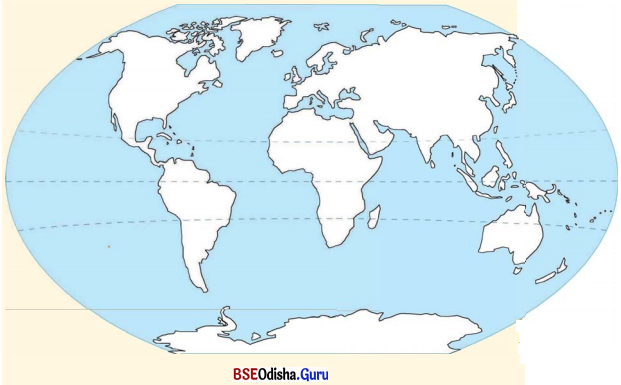
ଆସ କରିବା – ନିମ୍ନରେ ଦିଆଯାଇଥବା ପୃଥ‌ିବୀର ରେଖାଙ୍କିତ ମାନଚିତ୍ରରେ ମହାଦେଶ ଓ ମହାସାଗରଗୁଡ଼ିକର ନାମ ଲେଖ ।
Class 6 Social Science Chapter 2 Question Answer Odia Medium ମହାସାଗର ଏବଂ ମହାଦେଶ-2
Answer:
ଛାତ୍ରଛାତ୍ରୀମାନେ ନିଜେ କରିବେ ।

Question 4.
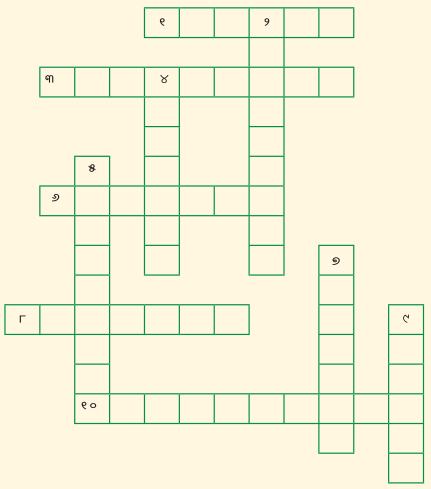
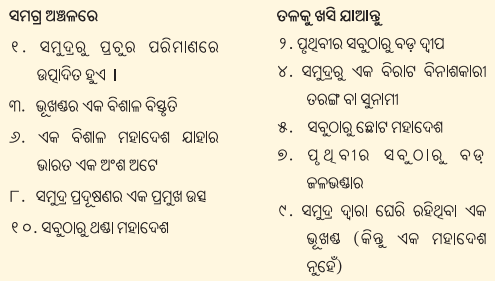
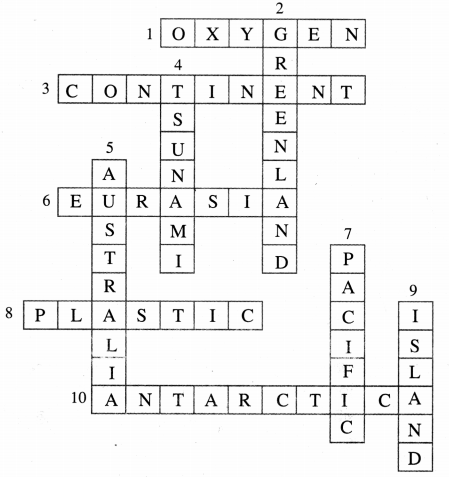
ନିମ୍ନରେ ଦିଆଯାଇଥୁବା ତଥ୍ୟ ଅନୁସାରେ ଗ୍ରୀଡ଼କୁ ବନ୍ଧନୀ ମଧ୍ଯରେ ଦିଆଯାଇଥିବା ଇଂରାଜୀ ଶବ୍ଦକୁ ବ୍ୟବହାର କରି ପୂରଣ କର । (ପ୍ରଶ୍ନ ସହିତ ଉତ୍ତର)
(ISLAND, PACIFIC, ANTARCTICA, PLASTIC, AUSTRALIA, CONTINENT, OXYGEN, GREENLAND, EURASIA, T-SUNAMI)
Class 6 Social Science Chapter 2 Question Answer Odia Medium ମହାସାଗର ଏବଂ ମହାଦେଶ-3

Class 6 Social Science Chapter 2 Question Answer Odia Medium ମହାସାଗର ଏବଂ ମହାଦେଶ-4
Answer:
Class 6 Social Science Chapter 2 Question Answer Odia Medium ମହାସାଗର ଏବଂ ମହାଦେଶ-5

ସମଗ୍ର ଅଞ୍ଚଳରେ ତଳକୁ ଖସି ଯାଆନ୍ତୁ
୧। ସମୁଦ୍ରରୁ ପ୍ରଚୁର ପରିମାଣରେ ଉତ୍ପାଦିତ ହୁଏ । ୨। ପୃଥିବୀର ସବୁଠାରୁ ବଡ଼ ଦ୍ଵୀପ
୩ । ଭୂଖଣ୍ଡର ଏକ ବିଶାଳ ବିସ୍ତୃତି ୪ । ସମୁଦ୍ରରୁ ଏକ ବିରାଟ ବିନାଶକାରୀ ତରଙ୍ଗ ବା ସୁନାମୀ ।
୬ । ଏକ ବିଶାଳ ମହାଦେଶ ଯାହାର ଭାରତ ଏକ ଅଂଶ ଅଟେ । ୫ । ସବୁଠାରୁ ଛୋଟ ମହାଦେଶ
୮ । ସମୁଦ୍ର ପ୍ରଦୂଷଣର ଏକ ପ୍ରମୁଖ ଉତ୍ସ । ୭। ପୃଥିବୀର ସବୁଠାରୁ ବଡ଼ ଜଳଭଣ୍ଡାର ।
୧୦ । ସବୁଠାରୁ ଥଣ୍ଡା ମହାଦେଶ ୯ । ସମୁଦ୍ରଦ୍ଵାରା ଘେରି ରହିଥ‌ିବା ଏକ ଭୂଖଣ୍ଡ
(କିନ୍ତୁ ଏକ ମହାଦେଶ ନୁହେଁ)


Class 6 Social Science Chapter 2 Question Answer Odia Medium ମହାସାଗର ଏବଂ ମହାଦେଶ

ଦୀର୍ଘ ଉତ୍ତରମୂଳକ ପ୍ରଶ୍ନୋତ୍ତର

Question 1.
ମହାସାଗର ଏବଂ ମହାଦେଶ କ’ଣ ? ସେଗୁଡ଼ିକ କିପରି ନାମିତ ହୋଇଛନ୍ତି ଏବଂ ସେମାନଙ୍କର ବଣ୍ଟନ କିପରି ହୋଇଛି ?
Answer:
ସମଗ୍ର ପୃଥ‌ିବୀକୁ ସାଧାରଣତଃ ମହାସାଗର ଏବଂ ମହାଦେଶଗୁଡ଼ିକରେ ବଣ୍ଟନ କରାଯାଇଛି । କିନ୍ତୁ ଏହାର ଜଳଭାଗ ତିନି ଚତୁର୍ଥାଂଶ Class 6 Social Science Chapter 2 Question Answer Odia Medium ମହାସାଗର ଏବଂ ମହାଦେଶ-6 ଥିବାବେଳେ ସ୍ଥଳଭାଗ ଏକ ଚତୁର୍ଥାଂଶ Class 6 Social Science Chapter 2 Question Answer Odia Medium ମହାସାଗର ଏବଂ ମହାଦେଶ-7 ଅଛି ।

ପୃଥ‌ିବୀ ପୃଷ୍ଠରେ ଥିବା ବିଶାଳ ଜଳରାଶିକୁ ମହାସାଗର କୁହାଯାଏ । ଏହା ପାଞ୍ଚଟି ମହାସାଗର ଭାବେ ନାମିତ ହୋଇଥିଲେ ମଧ୍ୟ ବାସ୍ତବରେ ଏଗୁଡ଼ିକ ପରସ୍ପର ସହ ସଂଶ୍ଳିଷ୍ଟ ଅଟନ୍ତି ।

ସେହିପରି ସମଗ୍ର ସ୍ଥଳଭାଗକୁ ୭ଟି ମହାଦେଶରେ ବିଭକ୍ତ କରାଯାଇଛି । ସେଗୁଡ଼ିକ ହେଲା ଏସିଆ, ଆଫ୍ରିକା, ୟୁରୋପ, ଅଷ୍ଟ୍ରେଲିଆ, ଉତ୍ତର ଆମେରିକା, ଦକ୍ଷିଣ ଆମେରିକା, ଆଣ୍ଟାର୍କଟିକା ।

ଏସିଆ ମହାଦେଶ – ଏସିଆ ମହାଦେଶ ସବୁଠାରୁ ବଡ଼ ମହାଦେଶ ଏବଂ ଏହା ଆୟତନରେ ପୃଥ‌ିବୀର ଏକ ତୃତୀୟାଂଶ । ଏହା ୟୁରୋପଠାରୁ ଉରାଲ ପର୍ବତଦ୍ଵାରା ଅଲଗା ହୋଇଛି । ଉଭୟ ଏସିଆ ଏବଂ ୟୁରୋପକୁ ଏକତ୍ର ରୂପରେ ୟୁରେସିଆ କୁହାଯାଏ । ଏହି ମହାଦେଶକୁ ତିନୋଟି ମହାସାଗର ଘେରି ରହିଛି । ଏହାର ଉତ୍ତରରେ ଆର୍କଟିକ୍ ମହାସାଗର, ପୂର୍ବରେ ପ୍ରଶାନ୍ତ ମହାସାଗର ଏବଂ ଦକ୍ଷିଣରେ ଭାରତ ମହାସାଗର ରହିଅଛି ।

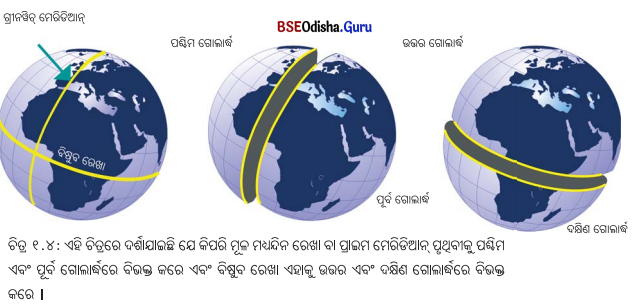
ଆଫ୍ରିକା ମହାଦେଶ – ଏହି ମହାଦେଶ ମଧ୍ୟରେ ତିନୋଟି ଅକ୍ଷାଂଶ ଯାଇଅଛି । ସେଗୁଡ଼ିକ ହେଲା କର୍କଟ କ୍ରାନ୍ତି, ବିଷୁବରେଖା ଏବଂ ମକରକ୍ରାନ୍ତି । ପ୍ରାମାଣିକ ମଧ୍ଯରେଖା (ପ୍ରାଇମ୍ ମେରିଡ଼ିଆନ୍) ମଧ୍ୟ ଏହି ମହାଦେଶ ଦେଇଯାଇଅଛି । ଏସିଆ ମହାଦେଶ ଭଳି ଏହାର ମଧ୍ୟ ତିନିପାର୍ଶ୍ଵରେ ଜଳରାଶି ରହିଅଛି । ଏସିଆ ଏବଂ ଆଫ୍ରିକାକୁ ସୁଏଜ୍ କେନାଲ ଅଲଗା କରିଅଛି ।

ଉତ୍ତର ଆମେରିକା – ଉତ୍ତର ଆମେରିକା ମଧ୍ୟ ତିନୋଟି ମହାସାଗର ଦ୍ଵାରା ଆବଦ୍ଧ ହୋଇ ରହିଛି । ଏହାର ଉତ୍ତରରେ ଆର୍କଟିକ୍ ମହାସାଗର, ପୂର୍ବରେ ଆଟ୍‌ଲାଣ୍ଟିକ୍ ମହାସାଗର ଏବଂ ପଶ୍ଚିମରେ ପ୍ରଶାନ୍ତ ମହାସାଗର ରହିଅଛି । ପୂର୍ବରୁ ଉତ୍ତର ଓ ଦକ୍ଷିଣ ଆମେରିକା ପାନାମା ଇସ୍ତମାସ୍‌ଦ୍ୱାରା ଯୁକ୍ତ ହୋଇ ରହିଥିଲା, କିନ୍ତୁ ବର୍ତ୍ତମାନ ଏହା ତାକୁ ଅଲଗା କରି ରଖୁଛି ।

ଦକ୍ଷିଣ ଆମେରିକା : ଏହାର ମଧ୍ୟ ତିନିପଟେ ପ୍ରାୟ ମହାସାଗରମାନ ଘେରି ରହିଛି । ଏହାର ପଶ୍ଚିମ ପାର୍ଶ୍ଵରେ ପ୍ରଶାନ୍ତ ମହାସାଗର, ପୂର୍ବରେ ଆଟଲାଣ୍ଟିକ୍ ମହାସାଗର ଏବଂ ଦକ୍ଷିଣରେ ଦକ୍ଷିଣ ମହାସାଗର ରହିଅଛି ।

ଆଣ୍ଟାର୍କଟିକା : ଏହି ମହାଦେଶ ପୂର୍ଣ୍ଣମାତ୍ରାରେ ଦକ୍ଷିଣ ଗୋଲାର୍ଦ୍ଧରେ ଅବସ୍ଥିତ । ଦକ୍ଷିଣ ମେରୁ ଏହାର କେନ୍ଦ୍ରରେ ଅଛି । ଏହି ମହାଦେଶ ପୂର୍ଣ୍ଣ ବରଫାବୃତ ରହୁଥ‌ିବାରୁ ଏହାକୁ ବରଫ ମହାଦେଶ ବା ଧବଳ ମହାଦେଶ କୁହାଯାଏ । ଏହି ମହାଦେଶରେ ମନୁଷ୍ୟ ବାସ କରନ୍ତି ନାହିଁ ।

ୟୁରୋପ : ଏହି ମହାଦେଶ ଏସିଆ ମହାଦେଶ ନିକଟରେ ଅବସ୍ଥିତ । ଏହାର ପଶ୍ଚିମରେ ଆଟଲାଣ୍ଟିକ୍ ମହାସାଗର, ଉତ୍ତରରେ ଆର୍କଟିକ୍ ମହାସାଗର ଏବଂ ଦକ୍ଷିଣରେ ଭୂମଧ୍ଯସାଗର ରହିଅଛି ।

ଅଷ୍ଟ୍ରେଲିଆ : ଏହି ମହାଦେଶ ସବୁଠାରୁ ସାନ ମହାଦେଶ । ଏହା ଏକ ଦ୍ଵୀପ ହୋଇଥିବାରୁ ଏହାର ଚାରିପଟେ ସମୁଦ୍ର ରହିଅଛି ।

ପଞ୍ଚ ମହାସାଗର : ସମଗ୍ର ପୃଥ‌ିବୀରେ ଏକ ବିଶାଳ ଜଳରାଶି ରହିଅଛି । ଏହାର ତିନି ଚତୁର୍ଥାଂଶ ଜଳମଗ୍ନ ହୋଇ ରହିଅଛି । ଏହି ଜଳରାଶିକୁ ପାଞ୍ଚଟି ମହାସାଗରରେ ବିଭକ୍ତ କରାଯାଇଛି । ସେଗୁଡ଼ିକ ହେଲା- ପ୍ରଶାନ୍ତ ମହାସାଗର, ଆଟ୍‌ଲାଣ୍ଟିକ୍ ମହାସାଗର, ଭାରତ ମହାସାଗର, ଦକ୍ଷିଣ ମହାସାଗର, ଉତ୍ତର ମହାସାଗର (ଆର୍କଟିକ୍ ମହାସାଗର ।

ପ୍ରଶାନ୍ତ ମହାସାଗର : ସମସ୍ତ ମହାସାଗର ମଧ୍ଯରେ ପ୍ରଶାନ୍ତ ମହାସାଗର ସବୁଠାରୁ ବଡ଼ । ଏହି ମହାସାଗର ପୃଥ‌ିବୀର ଶତକଡ଼ା ୩୦ ଭାଗ ସ୍ଥାନ ପୁରଣ କରିଛି । ଏହା ଆକୃତିରେ ବୃତ୍ତାକାର ଏବଂ ଗଭୀରତମ ମହାସାଗର । ଏହା ମଧ୍ୟରେ ମାରିଆନା ଟ୍ରେଞ୍ଚ ଗଭୀରତମ ସ୍ଥାନ ଅଟେ । ଏହି ପ୍ରଶାନ୍ତ ମହାସାଗରର ପଶ୍ଚିମରେ ଏସିଆ ଓ ଅଷ୍ଟ୍ରେଲିଆ ମହାଦେଶ ରହିଥିଲାବେଳେ ପୂର୍ବରେ ଉତ୍ତର ଆମେରିକା ଓ ଦକ୍ଷିଣ ଆମେରିକା ମହାଦେଶ ରହିଛି ।

ଆଟଲାଣ୍ଟିକ୍ ମହାସାଗର : ଏହି ମହାସାଗର ପୃଥ‌ିବୀର ଦ୍ଵିତୀୟ ବୃହତ୍ତମ ମହାସାଗର ଅଟେ । ଏହା ଆକୃତିରେ ଇଂରାଜୀ ଅକ୍ଷର ‘S’’ ସଦୃଶ ଅଟେ । ଏହାର ପଶ୍ଚିମ ପାର୍ଶ୍ଵରେ ଉତ୍ତର ଏବଂ ଦକ୍ଷିଣ ଆମେରିକା ରହିଥ‌ିବାବେଳେ ପୂର୍ବ ପାର୍ଶ୍ବରେ ୟୁରୋପ ଏବଂ ଆଫ୍ରିକା ମହାଦେଶ ଅଛି । ଏହି ମହାସାଗରରେ ଅନେକ ପ୍ରାକୃତିକ ପୋତାଶ୍ରୟ ଦେଖିବାକୁ ମିଳିଥାଏ । ବାଣିଜ୍ୟ ବ୍ୟବସାୟ କ୍ଷେତ୍ରରେ ଏହି ମହାସାଗର ସବୁବେଳେ ବ୍ୟସ୍ତଥାଏ ।

ଭାରତ ମହାସାଗର : ଭାରତ ମହାସାଗର ହେଉଛି ତୃତୀୟ ବୃହତ୍ତମ ମହାସାଗର । ଏହା ଆମ ଦେଶ ଭାରତ ନାମରେ ନାମିତ ହୋଇଛି । ଏହି ମହାସାଗର ତ୍ରିଭୂଜାକାର ଅଟେ । କିନ୍ତୁ କେତେକ ଏହାକୁ ଇଂରାଜୀ ଅକ୍ଷର ‘M’’ ଆକୃତିର କହିଥା’ନ୍ତି । ଏହାର ଉତ୍ତରରେ ଏସିଆ, ପଶ୍ଚିମରେ ଆଫ୍ରିକା, ପୂର୍ବରେ ଅଷ୍ଟ୍ରେଲିଆ ଏବଂ ଦକ୍ଷିଣରେ ଦକ୍ଷିଣ ମହାସାଗର ରହିଛି । ଏହାର ପଶ୍ଚିମରେ ଆରବସାଗର ଏବଂ ପୂର୍ବରେ ବଙ୍ଗୋପସାଗର ରହିଛି ।

ଦକ୍ଷିଣ ମହାସାଗର : ଏହି ମହାସାଗର ଆଣ୍ଟାର୍କଟିକା ମହାଦେଶକୁ ଘେରିକରି ରହିଅଛି । ଏହି ମହାସାଗର ଅନ୍ୟ ତିନୋଟି ମହାସାଗରର ଜଳରାଶିକୁ ଲାଗି ରହିଅଛି । ଏହାକୁ ଲୋକେ ଆଣ୍ଟାର୍କଟିକା ମହାସାଗର ବୋଲି ମଧ୍ୟ କହିଥା’ନ୍ତି ।

ଆର୍କଟିକ୍ ମହାସାଗର ବା ଉତ୍ତର ମହାସାଗର : ଏହି ମହାସାଗର ସବୁଠାରୁ କ୍ଷୁଦ୍ରତମ ମହାସାଗର । ଏହା ଉତ୍ତର ମେରୁକୁ ଘେରି ରହିଅଛି । ଏହି ମହାସାଗର ବାସ୍ତବରେ ଆଟ୍‌ଲାଣ୍ଟିକ୍ ମହାସାଗରର ଉତ୍ତର ଆଡ଼କୁ ବର୍ଷିତ ହୋଇ ରହିଛି । ଏହି ମହାସାଗରରୁ ଏକ ଅଣଓସାରିଆ ଜଳରାଶି ବେଜିଂ ଷ୍ଟେଟ୍ ପ୍ରଶାନ୍ତ ମହାସାଗରକୁ ସଂଯୁକ୍ତ କରିଛି । ଏହା ଉତ୍ତର ଆମେରିକା ଏବଂ ୟୁରେସିଆର ଉତ୍ତର ଉପକୂଳ ରୂପେ ରହିଅଛି ।

ଉପସଂହାର ଏହିଭଳି ଭାବରେ ସପ୍ତ ମହାଦେଶ ଏବଂ ପଞ୍ଚ ମହାସାଗର ପୃଥ‌ିବୀ ପୃଷ୍ଠରେ ରହିଅଛି ।

Question 2.
ମହାସାଗର ଓ ମହାଦେଶ ମାନବ ଜୀବନ ସମେତ ପୃଥ‌ିବୀର ଅନ୍ୟାନ୍ୟ ଜୀବଜଗତକୁ କେଉଁ ଉପାୟରେ ପ୍ରଭାବିତ କରିଥାଏ ?
Answer:
ମହାସାଗର ଏବଂ ମହାଦେଶ ମାନବ ଜୀବନ ସହିତ ପୃଥ‌ିବୀର ଅନ୍ୟାନ୍ୟ ଜୀବଜଗତକୁ ଅନେକ ଉପାୟରେ ପ୍ରଭାବିତ କରିଥାଏ । ସେମାନେ ପୃଥ‌ିବୀର ଜଳବାୟୁର ଆକୃତିକୁ ପରିଚାଳନା କରିବାରେ ମୁଖ୍ୟ ଭୂମିକା ଗ୍ରହଣ କରିଥା’ନ୍ତି । ମହାସାଗରଗୁଡ଼ିକ ନିଜର ସାମୁଦ୍ରିକ କରେଣ୍ଟଦ୍ଵାରା ଉତ୍ତାପକୁ ବିଷୁବରେଖା ପାଖରୁ ମେରୁ ଆଡ଼କୁ ତ୍ୱରାନ୍ଵିତ କରିଥା’ନ୍ତି । ଏଥ‌ିରେ ଉତ୍ତାପ କ୍ରମେ ହ୍ରାସପାଇ ମେରୁ ଅଞ୍ଚଳରେ ପ୍ରବଳ ଥଣ୍ଡା କରିଥାଏ । ମହାସାଗରଗୁଡ଼ିକ ସୂର୍ଯ୍ୟଙ୍କର ଉତ୍ତାପର ଶତକଡ଼ା ୯୮ ଭାଗକୁ ଗ୍ରହଣ କରିଥା’ନ୍ତି ।

ସେମାନେ ମହାଦେଶଗୁଡ଼ିକରେ ବର୍ଷା କରାଇବାରେ ସହାୟକ ହୋଇଥା’ନ୍ତି । ସମୟ ଅନୁସାରେ ବର୍ଷା କୃଷିଉପଯୋଗୀ ହୋଇଥାଏ ।

ମହାସାଗରଗୁଡ଼ିକ ଆମେ ପୃଥ‌ିବୀରେ ବ୍ୟବହାର କରୁଥିବା ଅମ୍ଳଜାନର ଅଧା ଅଂଶ ଉତ୍ପାଦନ କରିଥା’ନ୍ତି । ମହାସାଗର ଆମକୁ ଅନେକ ସାମୁଦ୍ରିକ ଖାଦ୍ୟ ମତ୍ସ୍ୟ ଇତ୍ୟାଦି ଯୋଗାଇଥା’ତ୍ତି ଏବଂ ଅନେକ ଲୋକ ମତ୍ସ୍ୟଜୀବୀ ଭାବରେ ଜୀବିକା ନିର୍ବାହ କରିଥା’ନ୍ତି । ଏତଦ୍‌ବ୍ୟତୀତ ଆମେମାନେ ସାମୁଦ୍ରିକ ବାଣିଜ୍ୟ ବ୍ୟବସାୟର ସୁଯୋଗ ପାଇଥାଉ ।

ସମୂଦ୍ର ଯେ କେବଳ ମାନବକୁ ଲାଭ ଦେଇଥାଏ, ତା’ନୁହେଁ, ଅନେକ ବିପର୍ଯ୍ୟୟର କାରଣ ମଧ୍ୟ ହୋଇଥାଏ । ଅନେକ ସମୟରେ ସାମୁଦ୍ରିକ ଝଡ଼, ଜୁଆର ଓ ସୁନାମି ଇତ୍ୟାଦି ଭୟଙ୍କର ବିପର୍ଯ୍ୟୟ ଘଟାଇଥାଏ ।

ମହାସାଗର ଭଳି ମହାଦେଶ ମଧ୍ଯ ପୃଥ‌ିବୀର ଜୀବଜଗତକୁ ପ୍ରଭାବିତ କରିଥା’ନ୍ତି ।

ଭୂପୃଷ୍ଠରେ ସ୍ଥଳଭାଗ ପୃଥ‌ିବୀର ଏକ ଚତୁର୍ଥାଂଶ ହେଲେ ବି ଏହା ସାତଟି ମହାଦେଶରେ ବିଭକ୍ତ ହୋଇଛି ।

ପ୍ରତ୍ୟେକ ମହାଦେଶରେ ଭୂପୃଷ୍ଠର ବିଭିନ୍ନ ଭୂମିରୂପ ଦେଖାଯାଏ, ଯଥା- ପାହାଡ଼ ପର୍ବତ, ମାଳଭୂମି ଏବଂ ସମତଳଭୂମି । ଏତଦ୍‌ବ୍ୟତୀତ କେତେଗୁଡ଼ିଏ ମରୁଭୂମି ବି ରହିଛି । ବିଭିନ୍ନ ଭୂମିରୂପ ଏବଂ ତା’ ଉପରେ ଜନ୍ମିତ ଉଭିଦ ଓ ପ୍ରାଣୀମାନେ ଏକ ସୁନ୍ଦର ପ୍ରାକୃତିକ ପରିବେଶ ସୃଷ୍ଟି କରିଛନ୍ତି । କୃଷି ଏବଂ ମାନବର ସ୍ଥାୟୀ ବସତି ସ୍ଥାପନ କ୍ଷେତ୍ରରେ ଭୂପୃଷ୍ଠର ସ୍ଥଳଭାଗ ଅନେକ ସହାୟକ ହୋଇଛି । ବିଭିନ୍ନ ମହାଦେଶରେ ଆଧୁନିକ ମାନବ ବର୍ତ୍ତମାନ ବୈଜ୍ଞାନିକ ପଦ୍ଧତିରେ ଅନେକ ଅଗ୍ରଗତି କରି ସୁନ୍ଦର ସୁନ୍ଦର ପ୍ରାସାଦ ନିର୍ମାଣ ସହ ବିଦ୍ୟୁତ୍ରାଳିତ ଯାନବାହନର ବ୍ୟବହାର କରୁଛି । ବର୍ତ୍ତମାନ ପରିବେଶକୁ ସୁସ୍ଥ ରଖୁ ସମଗ୍ର ପୃଥ‌ିବୀକୁ ସବୁଦିନ ପାଇଁ ଜୀବଜଗତ ରହିବା ଉପଯୋଗୀ କରିବା ମାନବର ପରମ ଧର୍ମ ହେବା ଆବଶ୍ୟକ ।

ଆସ ଅନୁସନ୍ଧାନ କରିବା :

Question 1.
ପ୍ରତ୍ୟେକ ମାନଚିତ୍ରରେ ଥ‌ିବା ବୃତ୍ତାକାର ରେଖାଗୁଡ଼ିକୁ କ’ଣ କୁହାଯାଏ ? ଏହା ତୁମେ ଜାଣ କି ଦୁଇଟି ମେରୁକୁ ଯୋଗ କରୁଥିବା ରେଖାଗୁଡ଼ିକୁ କ’ଣ କୁହାଯାଏ ?
Answer:
ମାନଚିତ୍ରରେ ଥୁବା ବୃତ୍ତାକାର ରେଖାଗୁଡ଼ିକୁ ଅକ୍ଷାଂଶର ସମାନ୍ତରାଳ ବା ସମାକ୍ଷରେଖା କୁହାଯାଏ । ଦୁଇ ମେରୁ ଅଞ୍ଚଳରୁ ଯୋଗ କରୁଥିବା ରେଖାଗୁଡ଼ିକୁ ଦ୍ରାଘିମା ବା ମଧ୍ଯରେଖା କୁହାଯାଏ ।

Class 6 Social Science Chapter 2 Question Answer Odia Medium ମହାସାଗର ଏବଂ ମହାଦେଶ

Question 2.
କେଉଁ ଗୋଲାର୍ଦ୍ଧରେ ଅଧ୍ବକ ଜଳ ରହିଛି ?
Answer:
ଦକ୍ଷିଣ ଗୋଲାର୍ଦ୍ଧରେ ଅଧୂକ ଜଳ ରହିଛି ।

Question 3.
ଉତ୍ତର ଗୋଲାର୍ଦ୍ଧ ଏବଂ ଦକ୍ଷିଣ ଗୋଲାର୍ଦ୍ଧର ଜଳଭାଗ ଓ ସ୍ଥଳଭାଗର ଆନୁମାନିକ ଅନୁପାତ କ’ଣ ହୋଇପାରେ ବୋଲି ତୁମେ ଭାବୁଛ ? ନିଜ ଦଳରେ ଆଲୋଚନା କର ।
Answer:
ଉତ୍ତର ଗୋଲାର୍ଦ୍ଧରେ ଆନୁମାନିକ ଶତକଡ଼ା ୪୦ ଭାଗ ସ୍ଥଳ ଏବଂ ଶତକଡ଼ା ୬୦ ଭାଗ ଜଳ ରହିଛି, ସେହିପରି ଦକ୍ଷିଣ ଗୋଲାର୍ଦ୍ଧରେ ଆନୁମାନିକ ଶତକଡ଼ା ୨୦ ଭାଗ ସ୍ଥଳ ଥିବାବେଳେ ଶତକଡ଼ା ୮୦ ଭାଗ ଜଳ ରହିଛି ।

Question 4.
ସବୁ ମହାସାଗର ପରସ୍ପର ସହ ସଂଯୁକ୍ତ କି ? ହଁ ନା । ମାନଚିତ୍ର ଦେଖୁ ଏହାର କାରଣ ବର୍ଣ୍ଣନା କର
Answer:
ହଁ, ସବୁ ମହାସାଗର ପରସ୍ପର ସହ ସଂଯୁକ୍ତ । କିଛି ମହାସାଗର ଆର୍କଟିକ୍ ମହାସାଗରଦ୍ଵାରା ସଂଯୁକ୍ତ । ଆର୍କଟିକ୍ ମହାସାଗର ମଧ୍ୟରେ ଥ‌ିବା ବେଲିଂ ଷ୍ଟ୍ରେଟ୍ ଉଭୟ ପ୍ରଶାନ୍ତ ମହାସାଗର ଏବଂ ଆର୍କଟିକ୍ ମହାସାଗରକୁ ସଂଯୁକ୍ତ କରିଛି । ତଥାପି ଅନ୍ୟ କିଛି ମହାସାଗର ଏକ ଅଣଓସାରିଆ ସ୍ଥଳଦ୍ଵାରା ଦକ୍ଷିଣ ଆମେରିକା ଏବଂ ଆଣ୍ଟର୍କଟିକାକୁ ସଂଯୁକ୍ତ କରିଛି ।

ପୃଥ‌ିବୀ ପୃଷ୍ଠରେ ଥ‌ିବା ସମୁଦାୟ ଜଳଭାଗର ପ୍ରାୟ ଅଧିକାଂଶ ଭାଗ ମହାସାଗର ଓ ସାଗରରେ ରହିଛି । ଏହି ଜଳ ଲୁଣିଆ । ସୁତରାଂ ଏହା ମନୁଷ୍ୟ ତଥା ଜୀବଜଗତର ସିଧାସଳଖ ବ୍ୟବହାର ଉପଯୋଗୀ ନୁହେଁ ।

ମଧୁର ଜଳ ପୃଥ‌ିବୀର ଜଳ ସମ୍ପଦର ବହୁତ କମ୍ ଅଂଶ ଅଟେ । ପର୍ବତ ଶିଖରରେ ହିମବାହ (Glacier), ନଦୀ, ହ୍ରଦ, ପୁଷ୍କରିଣୀ ଇତ୍ୟାଦି ଏହି ପ୍ରକାର ଜଳର ମୁଖ୍ୟ ଉତ୍ସ । ବାୟୁମଣ୍ଡଳରେ ଜଳୀୟବାଷ୍ପ ଓ ଭୂତଳ ଜଳ ମଧ୍ୟ ମଧୁର ଜଳର ଅନ୍ତର୍ଭୁକ୍ତ ।

Question 5.
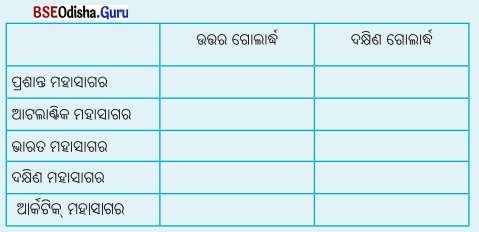
ମାନଚିତ୍ର ଦେଖୁ ପାଞ୍ଚଟି ମହାସାଗରକୁ ଚିହ୍ନଟ କର ଏବଂ ନିମ୍ନରେ ଥ‌ିବା ସାରଣୀରେ, କେଉଁଟି କେଉଁ ଗୋଲାର୍ଦ୍ଧରେ ଅବସ୍ଥିତ ତାହା ଚିହ୍ନଟ କରି ଲେଖ । (ପ୍ରଶ୍ନ ସହିତ ଉତ୍ତର)
Class 6 Social Science Chapter 2 Question Answer Odia Medium ମହାସାଗର ଏବଂ ମହାଦେଶ-1
Answer:

ଉତ୍ତର ଗୋଲାର୍ଦ୍ଧ ଦକ୍ଷିଣ ଗୋଲାର୍ଦ୍ଧ
ପ୍ରଶାନ୍ତ ମହାସାଗର ଉତ୍ତର ଗୋଲାର୍ଦ୍ଧ ଦକ୍ଷିଣ ଗୋଲାର୍ଦ୍ଧ
ଆଟ୍‌ଲାଣ୍ଟିକ୍ ମହାସାଗର ଉତ୍ତର ଗୋଲାର୍ଦ୍ଧ ଦକ୍ଷିଣ ଗୋଲାର୍ଦ୍ଧ
ଭାରତ ମହାସାଗର ଉତ୍ତର ଗୋଲାର୍ଦ୍ଧ ଦକ୍ଷିଣ ଗୋଲାର୍ଦ୍ଧ
ଦକ୍ଷିଣ ମହାସାଗର ଦକ୍ଷିଣ ଗୋଲାର୍ଦ୍ଧ
ଆର୍କଟିକ୍ ମହାସାଗର ଉତ୍ତର ଗୋଲାର୍ଦ୍ଧ

Question 6.
ପାର୍ଶ୍ୱସ୍ଥ ବର୍ଗର ସଂଖ୍ୟା ଗଣନା କରି ବୃହତ୍ତମ ଏବଂ କ୍ଷୁଦ୍ରତମ ମହାଦେଶର ନାମ ଲେଖ ।
Answer:
ଉପରୋକ୍ତ ବର୍ଗର ସଂଖ୍ୟା ଗଣନା କରିବାରୁ ଜଣାପଡ଼ିଲା ଯେ ଏସିଆ ମହାଦେଶରେ ସର୍ବାଧ‌ିକ ୪୪ଟି ବର୍ଗ ରହିଛି ଏବଂ ଅଷ୍ଟ୍ରେଲିଆ ମହାଦେଶରେ ସର୍ବନିମ୍ନ ୯ଟି ବର୍ଗ ରହିଛି । ସୁତରାଂ ଏସିଆ ମହାଦେଶ ସବୁଠାରୁ ବଡ଼ ଏବଂ ଅଷ୍ଟ୍ରେଲିଆ ମହାଦେଶ ସବୁଠାରୁ ସାନ ।

Question 7.
କେଉଁଟି ବଡ଼ ?
(କ) ଉତ୍ତର ଆମେରିକା ନା ଦକ୍ଷିଣ ଆମେରିକା ?
(ଖ) ଆଫ୍ରିକା ନା ଉତ୍ତର ଆମେରିକା
(ଗ) ଆଣ୍ଟାର୍କଟିକା ନା ଅଷ୍ଟ୍ରେଲିଆ ?
Answer:
ଉତ୍ତର ଆମେରିକାଠାରୁ ଦକ୍ଷିଣ ଆମେରିକା ବଡ଼, (ଖ) ଉତ୍ତରର ଆମେରିକାଠାରୁ ଆଫ୍ରିକା ବଡ଼ (ଗ) ଅଷ୍ଟ୍ରେଲିଆଠାରୁ ଆଣ୍ଟାର୍କଟିକା ବଡ଼ ।

Class 6 Social Science Chapter 2 Question Answer Odia Medium ମହାସାଗର ଏବଂ ମହାଦେଶ

Question 8.
ୟୁରୋପ ଏବଂ ଏସିଆ ପାଇଁ ଗୋଟିଏ ରଙ୍ଗ ଦେଇ ଚିତ୍ରକୁ ପୁନଶ୍ଚ ରଙ୍ଗ କର ଏବଂ ଏହାକୁ ୟୁରେସିଆ ନାମରେ ନାମିତ କର । ଏହାର ଆକାରକୁ ଦକ୍ଷିଣ ଆମେରିକା ସହ ତୁଳନା କର ।
Answer:
ୟୁରେସିଆ ୫୪ ବର୍ଗ ଏବଂ ଦକ୍ଷିଣ ଆମେରିକା ୧୮ ବର୍ଗ । ସୁତରାଂ ୟୁରେସିଆ ଦକ୍ଷିଣ ଆମେରିକାଠାରୁ ତିନିଗୁଣ ବଡ଼ ।

Question 9.
କ୍ଷୁଦ୍ରରୁ ବୃହତ୍ତମ କ୍ରମରେ ମହାଦେଶଗୁଡ଼ିକର ତାଲିକା କର ।
Answer:
ସାତଟି ମହାଦେଶକୁ କ୍ଷୁଦ୍ରରୁ ବୃହତ୍ତମ କ୍ରମରେ ନିମ୍ନରେ ପ୍ରଦତ୍ତ କରାଗଲା । (୧) ଅଷ୍ଟ୍ରେଲିଆ, (୨) ୟୁରୋପ, (୩) ଆଣ୍ଟାର୍କଟିକା, (୪) ଉତ୍ତର ଆମେରିକା, (୫) ଦକ୍ଷିଣ ଆମେରିକା, (୬) ଆଫ୍ରିକା, (୭) ଏସିଆ

ଏହି ବିଷୟରେ ଚିନ୍ତା କର :

Question 1.
ପୃଥ‌ିବୀରେ ଯଦି ଏତେ ପରିମାଣର ଜଳ ଅଛି, ‘ଜଳ ଅଭାବ’ ବା ଜଳ ସଙ୍କଟ ବିଷୟରେ ଏତେ ଚର୍ଚ୍ଚା କାହିଁକି ?
Answer:
(i) ବାସ୍ତବରେ ପୃଥ‌ିବୀରେ ବହୁ ପରିମାଣରେ ଜଳ ଅଛି କିନ୍ତୁ ଏହା ସତ୍ତ୍ଵେ ଜଳାଭାବ ଓ ଜଳ ସଙ୍କଟ ଦେଖାଦେଇଛି । ଏହାର କାରଣ କାହାକୁ ଅଛପା ନାହିଁ । ପ୍ରଥମତଃ, ପୃଥ‌ିବୀରେ ଥିବା ତିନି ଚତୁର୍ଥାଂଶ ଜଳ ମହାସାଗରରେ ଅଛି, କିନ୍ତୁ ଏହା ବାସ୍ତବରେ ଲୁଣିଆ ଏବଂ ପ୍ରାଣୀଜଗତ ଏବଂ ମାନବର ବ୍ୟବହାର ପାଇଁ ଅନୁପଯୁକ୍ତ ।

(ii) ମଧୁର ଜଳ ମାତ୍ର ଶତକଡ଼ା ୩ ଭାଗ ରହିଛି । ସେଥୁରୁ ନଦୀ ଏବଂ ହ୍ରଦରୁ ଆମେ ୧.୨% ପାଇଥାଉ । ବାକି ଜଳ ବରଫବୃତ ହୋଇ ରହିଥାଏ ।

(iii) ମଧୁର ଜଳର ଅଭାବ ସାଧାରଣତଃ ଅନୁଭବ ହୋଇଥାଏ । ଏହାର ମୁଖ୍ୟ କାରଣ ଜନସଂଖ୍ୟା ବୃଦ୍ଧି ଏବଂ କଳକାରଖାନାମାନଙ୍କରେ ଜଳର ବ୍ୟବହାର । ବର୍ତ୍ତମାନ ପୃଥ‌ିବୀରେ ଜଳର ଅଭାବ ଅନେକ ସ୍ଥାନରେ ଦେଖ‌ିବାକୁ ମିଳୁଛି ।

(iv) ଜଳ ଅଭାବର ଅନ୍ୟ ଏକ କାରଣ ହେଉଛି ପ୍ରଦୂଷଣ । କଳକାରଖାନାମାନଙ୍କ ଯୋଗୁଁ ଯେଉଁଭଳି ଭାବରେ ଜଳ ପ୍ରଦୂଷିତ ହେଉଛି ତାହା ବ୍ୟବହାର ନ ହୋଇ ନଷ୍ଟ ହେଉଛି । ସୁତରାଂ ପୃଥ‌ିବୀରେ ଜଳର ଅଭାବ ଦେଖାଯାଉଛି ।

Question 2.
ଜଳ ସଂରକ୍ଷଣର କେଉଁ ଉପାୟ ବିଷୟରେ ତୁମେ ଜାଣିଛ ? ତୁମେ ତୁମ ଘରେ, ବିଦ୍ୟାଳୟରେ ଏବଂ ଗାଁ କିମ୍ବା ସହରରେ ଜଳ ସଂରକ୍ଷଣର ବିଭିନ୍ନ ଉପାୟ ଅବଲମ୍ବନ ହେଉଥ‌ିବା ଦେଖୁଛ କି ?
Answer:
(i) ଜଳ ହେଉଛି ପ୍ରକୃତିର ଅମୂଲ୍ୟ ଦାନ ଏବଂ ଜଳ ହିଁ ଜୀବନ । ଏହାର ସଂରକ୍ଷଣ ଏବଂ ସୁଚାରୁ ବ୍ୟବହାର ଆମ୍ଭମାନଙ୍କୁ ଜଳକଷ୍ଟରୁ ରକ୍ଷା କରିପାରିବ । ଆମକୁ ସାଧାରଣତଃ ଘରେ ଜଳର ବ୍ୟବହାର କଲାବେଳେ ଅନେକ ସାବଧାନତା ଆଚରଣ କରିବାକୁ ପଡ଼େ ।

(ii) ବକେଟ୍ ଏବଂ ମଗ୍ ସାହାଯ୍ୟରେ ପାଣିର ବ୍ୟବହାର, ଲିକ୍ ହେଉଥ‌ିବା ପାଣିକୁ ବନ୍ଦ କରିବା, କଳକୁ ଖୋଲିଲାବେଳେ ଖୁବ୍ ଜୋର୍‌ରେ ନ ଖୋଲିବା ଏବଂ କଳକୁ ଭଲ ଭାବରେ ବନ୍ଦ କରିବା ଉଚିତ । ଦାନ୍ତ ଘଷିବା ଏବଂ ଗାଧେଇବାବେଳେ କଳକୁ ଖୋଲା ଛାଡ଼ି ନଦେବା, ବର୍ଷା ଦିନେ ଜଳକୁ ବିଭିନ୍ନ ଉପାୟରେ ସଂରକ୍ଷଣ କରିବା, ବ୍ୟବହାର ହୋଇଥିବା ଜଳକୁ ବାଡ଼ିବଗିଚାରେ ଥିବା ଗଛକୁ ଜଳ ଦେବା ଉଦ୍ଦେଶ୍ୟରେ ପୁନଃ ବ୍ୟବହାର କରିବା । ପାଣି ଟାଙ୍କିରୁ ଜଳ ଭର୍ତ୍ତି ହୋଇ ବାହାରକୁ ନ ପଡ଼ିବା, ଗାଡ଼ି ମଟର ଧୋଇଲାବେଳେ ଅଧିକ ଜଳ ବ୍ୟବହାର ନ କରିବା ଆବଶ୍ୟକ ।

(iii) ସେହିପରି ବିଦ୍ୟାଳୟରେ ମଧ୍ୟ ଆମେ ବ୍ୟବହାର କରୁଥିବା ପାଣିକଳକୁ ବ୍ୟବହାର କରି ସାରିବା ପରେ ତତ୍‌କ୍ଷଣାତ୍ ବନ୍ଦ କରିଦେବା, ଲିକ୍ କରୁଥୁବା କଳକୁ ଠିକ୍ ସମୟରେ ସଜାଡ଼ିବା, ବିଦ୍ୟାଳୟରେ ପାଣି ବ୍ୟବହାର ପାଇଁ ଏକ କାର୍ଯ୍ୟକାରୀ ଦଳ ଗଠନ କରିବା, ଛାତ୍ରଛାତ୍ରୀମାନଙ୍କୁ ଜଳର ଉଚିତ ବ୍ୟବହାର କରିବାପାଇଁ ଶିଖାଇବା, ପାଇଖାନାରେ ବାରମ୍ବାର ଅନାବଶ୍ୟକଭାବେ ପାଣି ନ ଢାଳିବା, ସର୍ବଶେଷରେ ପାଣିର ଉଚିତ ବ୍ୟବହାର କରିବାପାଇଁ ଛାତ୍ରଛାତ୍ରୀଙ୍କ ମଧ୍ୟରେ ଜାଗରଣ ସୃଷ୍ଟି କରିବା ।

(iv) ସେହିପରି ଗ୍ରାମ ଏବଂ ସହରମାନଙ୍କରେ ପାଣିର ବ୍ୟବହାର ପାଇଁ ଯଥେଷ୍ଟ ସତର୍କତା ଅବଲମ୍ବନ କରିବା ଉତିତ । ବିଭିନ୍ନ ସମ୍ପ୍ରଦାୟର ଲୋକଙ୍କୁ ଜଳର ଉଚିତ ବ୍ୟବହାର କରିବାପାଇଁ ଶିଖାଇବା ଉଚିତ । ଜଳସେଚନ ମାଧ୍ୟମରେ କୃଷିକ୍ଷେତ୍ରକୁ ସଠିକ୍ ପରିମାଣର ଜଳ ଯୋଗାଇବା ଦରକାର ।

(v) ପୋଖରୀ, କେନାଲ ଇତ୍ୟାଦି ଖନନ କରି ଜଳସଞ୍ଚୟର ବ୍ୟବସ୍ଥା କରିବା, ମଇଳା ଜଳକୁ ସଠିକ୍ ଭାବରେ ପୁନଃବ୍ୟବହାର ପାଇଁ ବୈଜ୍ଞାନିକ ପଦ୍ଧତି ଆପଣେଇବା ସାବଧାନତା ଅବଲମ୍ବନ କଲେ ଆମେ ଜଳ ସଂରକ୍ଷଣ ସହିତ ଜଳର ଅଭାବକୁ ଦୂର କରିପାରିବା ।

ଅତିସଂକ୍ଷିପ୍ତ ଉତ୍ତରମୂଳକ ପ୍ରଶ୍ନୋତ୍ତର

Question 1.
ଗ୍ଲୋବ୍‌ କିମ୍ବା ପୃଥ‌ିବୀର ମାନଚିତ୍ରରେ କେଉଁ ରଙ୍ଗ ଅଧୁକ ସ୍ଥାନ ଗ୍ରହଣ କରିଥିବାର ଦେଖାଯାଏ ? ଏହା କ’ଣ ସୂଚନା ଦେଇଥାଏ ?
Answer:
ଗ୍ଲୋବ୍ ବା ପୃଥ‌ିବୀର ମାନଚିତ୍ରରେ ଅଧିକ ସ୍ଥାନ ଗ୍ରହଣ କରିଥିବା ରଙ୍ଗ ହେଉଚି ନୀଳ (Blue) । ଏହା ପୃଥ‌ିବୀ ପୃଷ୍ଠରେ ଥ‌ିବା ଜଳରାଶିକୁ ସୂଚାଇଥାଏ ।

Class 6 Social Science Chapter 2 Question Answer Odia Medium ମହାସାଗର ଏବଂ ମହାଦେଶ

Question 2.
ଏକ ବିସ୍ତୃତ ଭୂମିକୁ କ’ଣ କୁହାଯାଏ ? ଏକ ବିଶାଳ ଓ କ୍ରମଶଃ ବଦ୍ଧିତ ଭୂମିକୁ କ’ଣ କୁହାଯାଏ ?
Answer:
ଏକ ବିସ୍ତୃତ ଭୂମିକୁ ଭୂମିରୂପର ସ୍ଥଳଭାଗ କୁହାଯାଏ ଏବଂ ଏକ କ୍ରମଶଃ ବଦ୍ଧିତ ଭୂମି ଯାହାକି ବିଭିନ୍ନ ଦେଶକୁ ତା’ର ଅନ୍ତର୍ଗତ କରିଥାଏ ତାହାକୁ ମହାଦେଶ କୁହାଯାଏ ।

Question 3.
ମହାସାଗରର ଜଳ କାହିଁକି ମାନବ ବ୍ୟବହାର ପାଇଁ ଅନୁପଯୁକ୍ତ ?
Answer:
ମହାସାଗର ବା ସମୁଦ୍ରର ଜଳ ଲବଣଯୁକ୍ତ ବା ଲୁଣିଆ ହୋଇଥିବାରୁ ଏହା ମାନବ ବ୍ୟବହାର ପାଇଁ ଅନୁପଯୁକ୍ତ ।

Question 4.
ସାମୁଦ୍ରିକ ବୃକ୍ଷଲତା ଏବଂ ସାମୁଦ୍ରିକ ପ୍ରାଣୀ ମଧ୍ୟରେ ଗୋଟିଏ ତଫାତ ଲେଖ ।
Answer:
ସାମୁଦ୍ରିକ ବୃକ୍ଷଲତା କହିଲେ ସମୁଦ୍ର କୂଳରେ ଓ ସମୁଦ୍ର ମଧ୍ୟରେ ଜନ୍ମିଥିବା ବିଭିନ୍ନ ପ୍ରକାରର ଗଛଲତା ଅଟେ । କିନ୍ତୁ ସାମୁଦ୍ରିକ ପ୍ରାଣୀ କହିଲେ ଅନେକ ପ୍ରକାରର ମା’ମନ୍ଦିନ ମାଛ, ତିମି ମାଛ ଏବଂ ଅନେକ ପ୍ରକାରର ରହସ୍ୟମୟ ଜୀବଜନ୍ତୁଙ୍କୁ ବୁଝାଏ ।

Question 5.
ଭାରତ ମହାସାଗରର ସୀମା ନିର୍ଦ୍ଧାରଣ କର ।
Answer:
ଭାରତ ମହାସାଗର ସୀମା ନିର୍ଦ୍ଧାରଣ କଲେ ଦେଖାଯାଏ ଏହାର ଉତ୍ତରରେ ଏସିଆ, ପଶ୍ଚିମରେ ଆଫ୍ରିକା, ପୂର୍ବରେ ଅଷ୍ଟ୍ରେଲିଆ ଏବଂ ଦକ୍ଷିଣରେ ଦକ୍ଷିଣ ମହାସାଗର ରହିଛି ।

Question 6.
ଭାରତ ମହାସାଗର ଦୁଇଟି ଅଂଶ ଭାରତର ପୂର୍ବ ଓ ପଶ୍ଚିମରେ ଅଛି । ସେଗୁଡ଼ିକର ନାମ କ’ଣ ?
Answer:
ଭାରତ ମହାସାଗରର ଦୁଇଟି ଅଂଶ ଭାରତର ପୂର୍ବ ଓ ପଶ୍ଚିମରେ ଅବସ୍ଥିତ । ସେମାନଙ୍କ ମଧ୍ୟରୁ ପୂର୍ବରେ ଥ‌ିବା ଅଂଶର ନାମ ବଙ୍ଗୋପସାଗର ଏବଂ ପଶ୍ଚିମରେ ଥିବା ଅଂଶର ନାମ ଆରବ ସାଗର ଅଟେ ।

Question 7.
ତୁମ ପୁସ୍ତକର ପୃଷ୍ଠା ୩୩ରେ ପ୍ରଦତ୍ତ ଭାରତ ମାନଚିତ୍ରକୁ ଦେଖ ଏବଂ ଭାରତର ଦ୍ଵୀପପୁଞ୍ଜଗୁଡ଼ିକର ନାମ ଲେଖ ।
Answer:
ଭାରତ ମାନଚିତ୍ରରେ ଦର୍ଶାଯାଇଥିବା ଦ୍ଵୀପପୁଞ୍ଜଗୁଡ଼ିକ ହେଲା ଆଣ୍ଡାମାନ ଓ ନିକୋବର ଦ୍ଵୀପପୁଞ୍ଜ ଯାହାକି ବଙ୍ଗୋପସାଗରରେ ଅଛି । ସେହିପରି ଲାକ୍ଷାଦ୍ଵୀପ ଦ୍ଵୀପପୁଞ୍ଜ ଯାହାକି ଆରବ ସାଗରରେ ଅଛି ।

Question 8.
ଭାରତ ସରକାରଙ୍କ କେଉଁ ସଂସ୍ଥା ସମସ୍ତ ପ୍ରକାରର ପ୍ରାକୃତିକ ବିପର୍ଯ୍ୟୟ ପରିଚାଳନା କରିଥାଏ ?
Answer:
ଭାରତରେ ସମସ୍ତ ପ୍ରକାରର ପ୍ରାକୃତିକ ବିପର୍ଯ୍ୟୟକୁ ପରିଚାଳନା କରିବାପାଇଁ ଏକ ସଂସ୍ଥା ଗଠନ କରାଯାଇଛି ଯାହାର ନାମ ହେଉଛି ‘ଜାତୀୟ ବିପର୍ଯ୍ୟୟ ପରିଚାଳନା ପ୍ରାଧ୍ଵକରଣ ବା ନ୍ୟାସିନାଲ ଡିଜାଷ୍ଟର ମ୍ୟାନଜମେଣ୍ଟ ଅଥରିଟି (NDMA)

Class 6 Social Science Chapter 2 Question Answer Odia Medium ମହାସାଗର ଏବଂ ମହାଦେଶ

Question 9.
ପୃଥ‌ିବୀର ବୃହତ୍ତମ ଦ୍ଵୀପ କେଉଁଟି ? ଭାରତ ସହିତ ଏହାର ଆକାର ତୁଳନା କର ।
Answer:
ପୃଥିବୀର ବୃହତ୍ତମ ଦ୍ଵୀପ ହେଉଛି ଗ୍ରୀନଲ୍ୟାଣ୍ଡ । ଏହାର ଆକାର ଭାରତର ୧୦ଟି ବଡ଼ ରାଜ୍ୟର ସମଷ୍ଟି ସହିତ ସମାନ ।

ସଂକ୍ଷିପ୍ତ ଉତ୍ତରମୂଳକ ପ୍ରଶ୍ନୋତ୍ତର

Question 1.
ପୃଥ‌ିବୀର ମାନଚିତ୍ରରେ ଧୂସର ବା ବ୍ରାଉନ ରଙ୍ଗର ଅଂଶମାନ ଦେଖିବାକୁ ମିଳେ । ଏହା କି ସୂଚନା ଦିଏ ?
Answer:

  1. ପୃଥ‌ିବୀ ମାନଚିତ୍ରରେ ପ୍ରଦର୍ଶିତ ଧୂସର ରଙ୍ଗ ହେଉଛି ଭୂମିରୂପ । ଏହା ପୃଥ‌ିବୀର ଏକ ଚତୁର୍ଥାଂଶ Class 6 Social Science Chapter 2 Question Answer Odia Medium ମହାସାଗର ଏବଂ ମହାଦେଶ-7 ଅଟେ ।
  2. ଏଥରେ ପର୍ବତ, ମାଳଭୂମି ଓ ସମତଳଭୂମି ଅଛି ।
  3. ଏଥରେ ସାତଟି ମହାଦେଶ ଗଢ଼ିଉଠିଛି ।
  4. ସେମାନଙ୍କ ମଧ୍ୟରେ ଏସିଆ ମହାଦେଶ ବୃହତ୍ତମ ଏବଂ ଅଷ୍ଟ୍ରେଲିଆ କ୍ଷୁଦ୍ରତମ ଅଟେ ।
  5. ଅନ୍ୟ ମହାଦେଶଗୁଡ଼ିକ ହେଲା ଆଫ୍ରିକା, ଦକ୍ଷିଣ ଆମେରିକା, ଉତ୍ତରର ଆମେରିକା, ଆଣ୍ଟାର୍କଟିକା ଏବଂ ୟୁରୋପ ।
  6. ଏତଦ୍‌ବ୍ୟତୀତ ଅନେକ ପାହାଡ଼, ପର୍ବତ ଓ ମାଳଭୂମି ରହିଅଛି ।
  7. ହିମାଳୟ, ଆଲକସ୍ ଓ ଆଣ୍ଡିଜ୍ ଭଳି ପର୍ବତଶ୍ରେଣୀ ଅଛି ।

Question 2.
ଆଣ୍ଟାର୍କଟିକା ମହାଦେଶ ସହିତ ଭାରତର କିଛି ସମ୍ପର୍କକୁ ସଂକ୍ଷେପରେ ଲେଖ ।
Answer:
(i) ଆଣ୍ଟାର୍କଟିକା ମହାଦେଶ ହେଉଛି ଏକ ଥଣ୍ଡାପ୍ରବଣ ଏବଂ ନୈରାଶ୍ୟଜନକ ପରିବେଶ । ଏହି ମହାଦେଶରେ ଭାରତ ୧୯୮୧ ମସିହାରୁ ଏକ ଅଭିଯାନ ଆରମ୍ଭ କରିଅଛି ଯାହାର ନାମ ହେଉଛି Exploring Antarctica |

(ii) ୧୯୮୩ ମସିହାରେ ଭାରତ ଏଠାରେ ତା’ର ପ୍ରଥମ ବୈଜ୍ଞାନିକ ଗବେଷଣା କେନ୍ଦ୍ର ପ୍ରତିଷ୍ଠା କରିଥିଲା ଯାହାର ନାମ ‘ଦକ୍ଷିଣ ଗଙ୍ଗୋତ୍ରୀ’ ଅଟେ । ତାପରଠାରୁ ଭାରତ ସେଠାରେ ଅନ୍ୟ ଦୁଇଟି ଗବେଷଣାକେନ୍ଦ୍ର ପ୍ରତିଷ୍ଠା କରିଛି । ସେଗୁଡ଼ିକ ହେଲା ‘ମୈତ୍ରୀ ଏବଂ ଭାରତ’ ।

(iii) ଏବେସୁଦ୍ଧା ସେଠାରେ ପ୍ରାୟ ୪୦ଟି ଭାରତୀୟ ବୈଜ୍ଞାନିକ ଦଳ କାମ କରୁଛନ୍ତି । ସେମାନଙ୍କ ମୁଖ୍ୟ ଉଦ୍ଦେଶ୍ୟ ହେଉଛି କିପରି ସେମାନେ ସେଠାରେ ଜଳବାୟୁର ପରିବର୍ତ୍ତନ ଆଣିବା ସହିତ ପରିବେଶରେ ସୁଧାର ଆଣିପାରିବେ ।

Question 3.
ଜଳବାୟୁ ଉପରେ ମହାସାଗର କିପରି ପ୍ରଭାବ ପକାଏ ?
Answer:

  1. ମହାସାଗର ସୂର୍ଯ୍ୟ ଉତ୍ତାପକୁ ଗ୍ରହଣ କରି ପୃଥ‌ିବୀର ଜଳବାୟୁ ଉପରେ ପ୍ରଭାବ ପକାଇଥାଏ । ସୂର୍ଯ୍ୟ ଉତ୍ତାପର ଶତକଡ଼ା ୯୮ ଭାଗ ଉତ୍ତାପ ମହାସାଗରଗୁଡ଼ିକ ଗ୍ରହଣ କରି ଜଳବାୟୁର ତାପମାତ୍ରାକୁ ନିୟନ୍ତ୍ରଣ କରିଥା’ନ୍ତି ।
  2. ତା’ପରେ ସେମାନେ ଉତ୍ତାପକୁ ପୁନଃ ପୃଥ‌ିବୀରେ ବଣ୍ଟନ କରିଥା’ନ୍ତି । ଏହାକୁ ମହାସାଗର ତା’ର ମହାସାଗରୀୟ ପ୍ରବାହଦ୍ଵାରା କରିଥାଏ ।
  3. ମହାସାଗରଗୁଡ଼ିକ ମଧ୍ୟ ବାୟୁମଣ୍ଡଳରୁ ପ୍ରାୟ ୪୦% C୦, ଗ୍ରହଣ କରିଥା’ନ୍ତି ।
  4. ସେମାନେ ମଧ୍ୟ ବାୟୁମଣ୍ଡଳର ଆର୍ଦ୍ରତାକୁ ବଢ଼ାଇଥା’ନ୍ତି ଏବଂ ମହାଦେଶଗୁଡ଼ିକୁ ବର୍ଷା ପଠାଇଥା’ନ୍ତି । ଉଦାହରଣ ସ୍ଵରୂପ ଭାରତରେ ମୌସୁମୀ ବାୟୁପ୍ରବାହ ସମୁଦ୍ରରୁ ହିଁ ହୋଇଥାଏ ।

Question 4.
୨୬ ଡିସେମ୍ବର ୨୦୦୪ ମସିହା କାହିଁକି ପ୍ରାକୃତିକ ବିପର୍ଯ୍ୟୟ ସହିତ ଜଡ଼ିତ କାରଣ ଦର୍ଶାଅ l
Answer:

  1. ୨୬ ଡିସେମ୍ବର ୨୦୦୪ ମସିହା ଦିନ ଭାରତ ମହାସାଗରରେ ଏକ ଶକ୍ତିଶାଳୀ ସୁନାମି ସୃଷ୍ଟି ହୋଇ ଭାରତ ସମେତ ୧୩ଗୋଟି ଦେଶକୁ କ୍ଷତି ପହଞ୍ଚାଇଥିଲା ଯେଉଁଥିରେ ଲକ୍ଷାଧ୍ଵ ଲୋକ ସମୁଦ୍ରକୁ ଭାସିଯାଇ ପ୍ରାଣ ହରାଇଥିଲେ ।
  2. ଇଣ୍ଡୋନେସିଆ ସମୁଦ୍ରରେ ଏକ ଭୂମିକମ୍ପ ହେବାଦ୍ଵାରା ଯେଉଁ ସୁନାମି ସୃଷ୍ଟି ହେଲା ସେଥ୍ରେ ପ୍ରାୟ ୨ଲକ୍ଷ ଲୋକ ପ୍ରାଣ ହରାଇଲେ ।
  3. ଭାରତରେ ଆଣ୍ଡାମାନ ଓ ନିକୋବର ଦ୍ଵୀପପୁଞ୍ଜ ସହ କେରଳ ଓ ତାମିଲନାଡୁ ଉପକୂଳ ଭୟଙ୍କର ଭାବରେ କ୍ଷତିଗ୍ରସ୍ତ ହୋଇଥିଲା । ଏଥିରେ ଧନସମ୍ପତ୍ତି ନଷ୍ଟ ହେବା ସହ ଅନେକ ଲୋକ ପ୍ରାଣ ହରାଇଥିଲେ ।

Question 5.
ସୁନାମି କ’ଣ ପ୍ରାୟ ଘଟିଥାଏ କି ? ସୁନାମି ସମୟରେ ଆମ୍ଭେ କିପରି ଧନ ଓ ଜୀବନ ସୁରକ୍ଷା କରିପାରିବା ?
Answer:
(i) ସୁନାମି କ୍ଵଚିତ୍ ଘଟିଥାଏ, କିନ୍ତୁ ସେଗୁଡ଼ିକ କିଛିବର୍ଷ ବ୍ୟବଧାନରେ ହୋଇଥାଏ । ସୁନାମିରେ ସମୁଦ୍ର ଜଳ ପ୍ରାୟ କୂଳରୁ ୨୦ ରୁ ୨୫ କିଲୋମିଟର ସ୍ଥଳଭାଗକୁ ମାଡ଼ିଆସିଥାଏ । ଫଳରେ ଅନେକ ଧନ ଓ ଜୀବନର କ୍ଷତି ଘଟିଥାଏ । ୨୦୦୪ ମସିହା ଡିସେମ୍ବର ୨୬ ତାରିଖରେ ଭାରତ ମହାସାଗରରେ ସୃଷ୍ଟି ହୋଇଥ‌ିବା ସୁନାମି ଥିଲା ବିରଳ ।

(ii) ତେବେ ସୁନାମି ସମୁଦ୍ରକୂଳକୁ ମାଡ଼ି ଆସିବାର ପ୍ରାୟ କିଛି ସମୟ ପୂର୍ବରୁ ଜାଣିପାରି ହେବ । ବହୁତ ଦେଶ ଏବେ ସୁନାମି ସତର୍କ ଯନ୍ତ୍ରର ବ୍ୟବହାର କଲେଣି ।

(iii) ଭାରତ ମହାସାଗରରେ ସୁନାମି ସତର୍କ ପାଇଁ ଭାରତ ସମେତ କିଛି ଦେଶ ସୁନାମି ସତର୍କ ପଦ୍ଧତି ଆପଣେଇବା ସହ ଧନ ଓ ଜୀବନ ସୁରକ୍ଷା ପାଇଁ ପଦକ୍ଷେପ ନେଇଛନ୍ତି ।

Class 6 Social Science Chapter 1 Question Answer Odia Medium ପୃଥିବୀରେ ସ୍ଥାନ ଚିହ୍ନଟ କରିବା

Go through Class 6 Social Science Solutions Odia Medium and Class 6 Social Science Chapter 1 Question Answer Odia Medium ପୃଥିବୀରେ ସ୍ଥାନ ଚିହ୍ନଟ କରିବା to understand textbook questions more clearly.

6th Class Social Science Chapter 1 Question Answer Odia Medium

Class 6 Social Science Chapter 1 Odia Medium

ପ୍ରଶ୍ନ, ଅଭ୍ୟାସକାର୍ଯ୍ୟ ଏବଂ ପ୍ରକଳ୍ପ :

Question 1.
୧୮ ୨.୫ ସେ.ମି. = ୫୦୦ କି.ମି. ଏହି ମାପକୁ ଆଧାର କରି ପଞ୍ଚମ ଅଧ୍ୟାୟରେ ଚିତ୍ର ୫.୨ରେ ଥ‌ିବା ମାନଚିତ୍ରର ପୃଷ୍ଠା ୭୮ ଅନୁସାରେ ନର୍ମଦା ନଦୀର ମୁହାଣରୁ ଗଙ୍ଗାନଦୀର ମୁହାଣ ପର୍ଯ୍ୟନ୍ତ ପ୍ରକୃତ ଦୂରତା ନିର୍ଣ୍ଣୟ କର । (ସୂଚନା : ତୁମ ମାପଟିକୁ ଏକ ପୂର୍ଣ୍ଣ ସଂଖ୍ୟାରେ ପ୍ରକାଶ କର ।)
Answer:
ପ୍ରଦତ୍ତ ମାନଚିତ୍ରର ମାପରୁ ଜଣାପଡ଼େ ଯେ ନର୍ମଦା ନଦୀର ମୁହାଣଠାରୁ ଗଙ୍ଗାନଦୀର ମୁହାଣ ପର୍ଯ୍ୟନ୍ତ ଦୂରତା ୧୦ ସେ.ମି. ଅଟେ ।
ସୁତରାଂ ଯଦି ୨.୫ ସେ.ମି. = ୫୦୦ କି.ମି.
ତେବେ ୧୦ ସେ.ମି. = 800 × 8 = ୨୦୦୦ କି.ମି.
ତେଣୁ ନର୍ମଦା ନଦୀର ମୁହାଣଠାରୁ ଗଙ୍ଗା ନଦୀର ମୁହାଣର ଦୂରତା ୨୦୦୦ କି.ମି. ଅଟେ ।

Question 2.
ଲଣ୍ଡନରେ ମଧ୍ୟାହ୍ନ ୧୨ଟା ବାଜିଥିବାବେଳେ ଭାରତର ଅପରାହ୍ଣ ସାଢ଼େ ୫ଟା କାହିଁକି ?
Answer:
ଲଣ୍ଡନରେ ମଧ୍ୟାହ୍ନ ୧୨ଟା ସମୟବେଳେ ଭାରତରେ ଅପରାହ୍ନ ୫.୩୦ ହୋଇଥାଏ । ଏହାର କାରଣ
ଲଣ୍ଡନ ଗ୍ରୀନୱିଚ ମିନ୍ ଟାଇମ (GMT) ଅନୁସାରେ ୦° ଦ୍ରାଘିମା ଥିବାବେଳେ ଭାରତର ଷ୍ଟାଣ୍ଡାର୍ଡ଼ ମେରିତିଆନ
82% E ଦ୍ରାଘିମା ଅଟେ ।
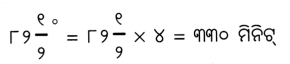
ତେଣୁ ୧° = ୪ ମିନିଟ୍
Class 6 Social Science Chapter 1 Question Answer Odia Medium ପୃଥିବୀରେ ସ୍ଥାନ ଚିହ୍ନଟ କରିବା-5
୩୩୦ ମିନିଟ୍ ÷ ୬୦ = ୫ ଘଣ୍ଟା ୩୦ ମିନିଟ୍
ସୁତରାଂ ଭାରତୀୟ ଷ୍ଟାଣ୍ଡାର୍ଡ଼ ଟାଇମ୍ ଲଣ୍ଡନ ସମୟଠାରୁ ଘ୫.୩୦ମିନିଟ ଆଗୁଆ । ତେଣୁ ଲଣ୍ଡନର ସମୟ ମଧ୍ୟାହ୍ନ ୧୨ଟା ସମୟରେ ଭାରତରେ ଷ୍ଟାଣ୍ଡାର୍ଡ଼ ସମୟ ୫ ଘଣ୍ଟା ୩୦ ମିନିଟ୍ ଆଗୁଆ ହେତୁ ସେତେବେଳେ ଭାରତରେ ଅପରାହ୍ନ ୫.୩୦ ହୋଇଥାଏ ।

Question 3.
ଆମେ ମାନଚିତ୍ରରେ କାହିଁକି ସଙ୍କେତ ଓ ରଙ୍ଗର ବ୍ୟବହାର କରୁ ?
Answer:
ସଙ୍କେତ ଏବଂ ରଙ୍ଗ ମାନଚିତ୍ରର ମୁଖ୍ୟ ଅଂଶ ଅଟେ । ଏହା ମାଧ୍ୟମରେ ମାନଚିତ୍ରର ସ୍ୱଳ୍ପ ସ୍ଥାନ ମଧ୍ୟରେ ଆମେ ଅନେକ ପାହାଡ଼, ନଦୀ, ସହର, କୋଠାଘର, ମନ୍ଦିର, ରାସ୍ତା ଏବଂ ଅନ୍ୟାନ୍ୟ ବୈଶିଷ୍ଟ୍ୟ ଦେଖାଇଥାଉ ।

ସଙ୍କେତ ଏବଂ ରଙ୍ଗଦ୍ଵାରା ପାଠକ ସହଜରେ ବିଭିନ୍ନ ସ୍ଥାନକୁ ବୁଝିପାରେ ଏବଂ ଅନ୍ୟକୁ ବୁଝାଇପାରେ ।
ଭାରତ ସରକାରଙ୍କ ସର୍ଭେ ଅଫ୍ ଇଣ୍ଡିଆଦ୍ଵାରା ଏକ ପ୍ରକାର ନିର୍ଦ୍ଦିଷ୍ଟ ସଙ୍କେତ ଓ ରଙ୍ଗ ନିର୍ଦ୍ଦିଷ୍ଟ ସ୍ଥାନ ଦର୍ଶାଇବା ପାଇଁ ବ୍ୟବହାର ହୋଇଥାଏ ।

Question 4.
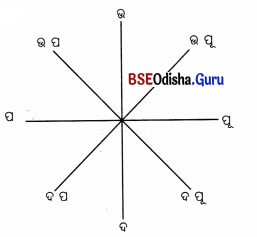
ତୁମ ଘର କିମ୍ବା ବିଦ୍ୟାଳୟର ଆଠଟି ଦିଗରେ କ’ଣ ଅଛି ତାହାର ଏକ ତାଲିକା ପ୍ରସ୍ତୁତ କର ।
Answer:
ପ୍ରଥମେ ତୁମେ ତୁମ ଘରକୁ କେନ୍ଦ୍ରକରି ଭାବି ଦେଖ ଯେ ଯେଉଁ ଆଠଟି ଦିଗ ଉପରେ ଦର୍ଶାଯାଇଛି ତା’ର ପ୍ରତିଟି ଦିଗରେ କ’ଣ ଅଛି । ସେଗୁଡ଼ିକୁ ଉଲ୍ଲେଖ କର ।
Class 6 Social Science Chapter 1 Question Answer Odia Medium ପୃଥିବୀରେ ସ୍ଥାନ ଚିହ୍ନଟ କରିବା-6
(୧) ଉତ୍ତର ପୋଖରୀ
(୨) ଉତ୍ତର ପୂର୍ବ – ବିଦ୍ୟାଳୟ
(୩) ପୂର୍ବ ପଞ୍ଚାୟତ ଅଫିସ
(୪) ଦକ୍ଷିଣ ପୂର୍ବ – କଲ୍ୟାଣ ମଣ୍ଡପ
(୫) ଦକ୍ଷିଣ ଯାତ୍ରା ପଡ଼ିଆ
(୬) ଦକ୍ଷିଣ ପଶ୍ଚିମ – ପାଣି ଟାଙ୍କି
(୭) ପଶ୍ଚିମ – ହାଟ
(୮) ଉତ୍ତର ପଶ୍ଚିମ – ମୁଣ୍ଡିଆ ପାହାଡ଼

(ଉପରୋକ୍ତ ଉତ୍ତରଟି ଉଦାହରଣ ଭାବେ ଦିଆଯାଇଛି । ପିଲାମାନେ ନିଜ ଘର କିମ୍ବା ବିଦ୍ୟାଳୟର ଅବସ୍ଥିତି ଅନୁସାରେ କେଉଁ ଦିଗରେ କ’ଣ ଅଛି ଲେଖୁବେ ।)

Question 5.
ସ୍ଥାନୀୟ ସମୟ ଏବଂ ପ୍ରମାଣ ସମୟ ମଧ୍ୟରେ ପାର୍ଥକ୍ୟ କ’ଣ ? ଏହାକୁ ଦଳରେ ଆଲୋଚନା କରି ପ୍ରତ୍ୟେକ ଦଳ ୧୦୦ ରୁ ୧୫୦ ଶବ୍ଦରେ ଏକ ଉତ୍ତର ଲେଖ ? ଉତ୍ତରଗୁଡ଼ିକୁ ତୁଳନା କର ।
Answer:
ଉଭୟ ସ୍ଥାନୀୟ ସମୟ ଏବଂ ପ୍ରମାଣ ସମୟ ସେମାନଙ୍କ ମଧ୍ୟନ୍ଦିନ ରେଖା (ମେରିଡ଼ିଆନ) ଉପରେ ପର୍ଯ୍ୟବସିତ । ବିଦ୍ୟାଳୟରେ ଏକ ଶ୍ରେଣୀ କାର୍ଯ୍ୟକ୍ରମଭାବେ ଛାତ୍ରଛାତ୍ରୀମାନେ କେତେକ ଦଳରେ ବିଭକ୍ତ ହୋଇ ଏହା ସମ୍ପର୍କରେ ଆଲୋଚନା କରିପାରିବେ ।

ଦଳ ‘କ’, ‘ଖ’ ଓ ‘ଗ’ରେ ବିଭକ୍ତ ହୋଇ ପ୍ରତ୍ୟେକ ଦଳରେ ପ୍ରାୟ ୧୨ ଜଣ ଲେଖାଏଁ ପିଲା ରହିପାରନ୍ତି । ଦଳ ‘କ’ ଆମ ଦେଶ ଭାରତକୁ ଉଦାହରଣ ରୂପେ ନେଇ ଆଲୋଚନା କରି କହିଲା, ମୂଳ ମଧ୍ୟଦିନ (ପ୍ରାଇମ୍ ମେରିଡ଼ିଆନ୍)ଠାରୁ ଯେଉଁ ସ୍ଥାନ ଯେତେ ପୂର୍ବକୁ ରହିବ ସେହି ସ୍ଥାନର ସ୍ଥାନୀୟ ସମୟ ୧°କୁ ୪ମିନିଟ୍ ହିସାବରେ ବଢ଼ି ବଢ଼ି ଯିବ ଏବଂ ଯେଉଁ ସ୍ଥାନ ପ୍ରାଇମ୍ ମେରିଡିଆନ୍‌ଠାରୁ ଯେଉଁ ସ୍ଥାନ ଯେତେ ପଶ୍ଚିମକୁ ରହିବ ତାହାର ସ୍ଥାନୀୟ ସମୟ ୧° କୁ ୪ ମିନିଟ୍ ହିସାବରେ କମି କମି ଯିବ ।

ଅର୍ଥାତ୍ ମୂଳ ମଧ୍ୟଦିନ ପାଖରେ ଯଦି ମଧ୍ୟାହ୍ନ ୧୨ଟା ୧୨.୦୪ ହୋଇଥିବାବେଳେ ୧° ପଶ୍ଚିମକୁ ସମୟ ହୋଇଥବ ତେବେ ତା’ର ୧° ପୂର୍ବକୁ ସମୟ ୧୧.୫୬ ମିନିଟ୍ ହୋଇଥ‌ିବ ।

ଗୋଟିଏ ଦେଶ ମଧ୍ୟରେ ଅନେକଗୁଡ଼ିକଏ ମଧ୍ୟନ୍ଦିନ ରେଖା ଥିଲେ ମଧ୍ୟ ଗୋଟିଏ ମଧ୍ୟନ୍ଦିନରେଖା ଉପରିସ୍ଥ ସମୟକୁ ଦେଶର ପ୍ରମାଣ ସମୟ ରୂପେ ଗ୍ରହଣ କରାଯାଏ । ଯେପରି Class 6 Social Science Chapter 1 Question Answer Odia Medium ପୃଥିବୀରେ ସ୍ଥାନ ଚିହ୍ନଟ କରିବା-7 ପୂର୍ବ ମଧ୍ୟନ୍ଦିନ ରେଖାର ସ୍ଥାନୀୟ ସମୟକୁ ଭାରତର ପ୍ରମାଣ ସମୟ ରୂପେ ଗ୍ରହଣ କରାଯାଇଛି । ଏହି ମଧ୍ୟନ୍ଦିନ ରେଖାର ସ୍ଥାନୀୟ ସମୟକୁ ସାରା ଦେଶରେ ବ୍ୟବହାର କରାଯାଏ ।

ଏହି କାରଣରୁ ଅପରାହ୍ନ ଘ ୪.୦୦ ସମୟରେ ଭାରତର ପୂର୍ବରେ ଥିବା ଆସାମର ତିନିସୁକିଆଠାରେ ସୂର୍ଯ୍ୟ ଅସ୍ତ ହେବାକୁ ଯାଉଥିବାବେଳେ ପଶ୍ଚିମରେ ଥ‌ିବା ପୋରବନ୍ଦରଠାରୁ ସୂର୍ଯ୍ୟ ଅସ୍ତ ହେବାକୁ ୨ ଘଣ୍ଟା ବାଜିଥାଏ ।

ଭାରତର ପୂର୍ବ ପ୍ରାନ୍ତ ଓ ପଶ୍ଚିମ ପ୍ରାନ୍ତ ମଧ୍ୟରେ ସ୍ଥାନୀୟ ସମୟରେ ପ୍ରାୟ ୨ ଘଣ୍ଟା ପାର୍ଥକ୍ୟ ଥ‌ିବାବେଳେ ପ୍ରମାଣ ସମୟ ଏକା ରହିଥାଏ ।

Question 6.
ଦିଲ୍ଲୀ ଓ ବେଙ୍ଗାଲୁରୁର ଅକ୍ଷାଂଶ ଯଥାକ୍ରମେ ୨୯° ଉତ୍ତର ଓ ୧୩° ଉତ୍ତର ଏବଂ ସେମାନଙ୍କର ଦ୍ରାଘିମା ପ୍ରାୟ ୭୭° ପୂର୍ବ । ଦୁଇ ସହର ମଧ୍ୟରେ ସ୍ଥାନୀୟ ସମୟର ପାର୍ଥକ୍ୟ କେତେ ରହିବ ?
Answer:
ଦିଲ୍ଲୀ ଓ ବେଙ୍ଗାଲୁର ସହର ମଧ୍ୟରେ ସ୍ଥାନୀୟ ସମୟକୁ ନେଇ କୌଣସି ପାର୍ଥକ୍ୟ ରହିବ ନାହିଁ । ଯେହେତୁ ଉଭୟ ସହର ଦ୍ରାଘିମାର ଗୋଟିଏ ମଧ୍ୟନ୍ଦିନ ରେଖାରେ ଅନ୍ତର୍ଗତ । ସମୟ ନିର୍ଦ୍ଧାରଣ କ୍ଷେତ୍ରରେ ଅକ୍ଷାଂଶର କିଛି ଭୂମିକା ନଥାଏ, ଏହା କେବଳ ଦ୍ରାଘିମା ଉପରେ ନିର୍ଭର କରେ ।

Question 7.
ନିମ୍ନଲିଖତ ଭକ୍ତିଗୁଡ଼ିକୁ ମଧ୍ୟରୁ ଭୁଲ୍ କିମ୍ବା ଠିକ୍ ଚିହ୍ନଟ କରି ତୁମ ଉତ୍ତରକୁ ଗୋଟିଏ କିମ୍ବା ଦୁଇଟି ବାକ୍ୟରେ ପ୍ରକାଶ କର ।
(କ) ସମସ୍ତ ସମାକ୍ଷରେଖାର ଦୈର୍ଘ୍ୟ ସମାନ ।
(ଖ) ଏକ ଦ୍ରାଘିମାର ଦୈର୍ଘ୍ୟ, ବିଷୁବ ବୃତ୍ତର ପ୍ରାୟ ଅଧା ଅଟେ ।
(ଗ) ଦକ୍ଷିଣ ମେରୁର ଅକ୍ଷାଂଶ ୯୦° ଦକ୍ଷିଣ ଅଟେ ।
(ଘ) ଆସାମରେ ସ୍ଥାନୀୟ ସମୟ ଏବଂ ଭାରତର ପ୍ରମାଣ ସମୟ (IST) ସମାନ ।
(ଙ) ସମସ୍ତ ମଣ୍ଡଳକୁ ଅଲଗା କରୁଥିବା ରେଖାଗୁଡ଼ିକ ମଧ୍ୟନ୍ଦିନ ରେଖା ।
(୦) ବିଷୁବରେଖା ଏକ ସମାକ୍ଷରେଖା ଅଟେ ।
Answer:
(କ) ଏହା ଭୁଲ୍ । ସମସ୍ତ ସମାକ୍ଷରେଖାର ଦୈର୍ଘ୍ୟ ସମାନ ନୁହେଁ । କାରଣ ଆମ ପୃଥ‌ିବୀ ଏକ ପୂର୍ଣ୍ଣ ଗୋଲାକାର ନ ହୋଇ ଉଭୟ ମେରୁ ଅଞ୍ଚଳରେ ଚେପ୍‌ଟା ହୋଇଅଛି । ସୁତରାଂ ସମାକ୍ଷରେଖା ବିଷୁବ ବୃତ୍ତଠାରେ ଦୀର୍ଘତମ ହୋଇଥିବାବେଳେ ଉଭୟ ମେରୁଆଡ଼କୁ ଏହାର ଦୈର୍ଘ୍ୟ କମି କମି ଯାଏ ।

(ଖ) ହଁ, ଏହା ସତ୍ୟ । ସମସ୍ତ ମଧ୍ୟନ୍ଦିନ ରେଖା ମେରୁ ନିକଟରେ ପହଞ୍ଚିବାରୁ ସମାନ ଉତ୍ତର-ଦକ୍ଷିଣ ରେଖା ସୃଷ୍ଟି କରିଥା’ନ୍ତି ।

(ଗ) ହଁ, ଠିକ୍ । ଇକ୍ଟେଟର ବା ବିଷୁବ ବୃତ୍ତର ୦° ଠାରୁ ୯୦° ଉତ୍ତର ଏବଂ ୯୦° ଦକ୍ଷିଣକୁ ଅକ୍ଷାଂଶ ରହିଛି ଯାହାକି ଉଭୟ ଉତ୍ତର ମେରୁ ଓ ଦକ୍ଷିଣ ମେରୁକୁ ସ୍ପର୍ଶ କରିଅଛି । ସୁତରାଂ ଦକ୍ଷିଣ ମେରୁର ଅକ୍ଷାଂଶ ୯୦° ଦକ୍ଷିଣ ଅଟେ ।

(ଘ) ଏହା ଭୁଲ୍ । ଭାରତର ଷ୍ଟାଣ୍ଡାର୍ଡ଼ ଟାଇମ୍ (IST) ବା ପ୍ରମାଣ ସମୟକୁ ୮୨ କରାଯାଇଛି । ଆସାମ କିନ୍ତୁ ୮୨ ଠାରୁ ଅଧ‌ିକ ପୂର୍ବକୁ ଅଛି । ତେଣୁ ଆସାମର ସ୍ଥାନୀୟ ସମୟ ଏବଂ ଭାରତର ପ୍ରମାଣ ସମୟ ସମାନ ନୁହେଁ । କିନ୍ତୁ ଆସାମ ଭାରତର ପ୍ରମାଣ ସମୟକୁ ଗ୍ରହଣ କରିନେଇଛି କାରଣ ସମଗ୍ର ଦେଶରେ ଏପରିକି ସମଗ୍ର କେନ୍ଦ୍ରାଞ୍ଚଳରେ ମଧ୍ୟ ଭାରତୀୟ ପ୍ରମାଣ ସମୟ (IST) କାର୍ଯ୍ୟକାରୀ ହୋଇଅଛି ।

(ଙ) ହଁ ଏହା ଠିକ୍ । ସମସ୍ତ ମଣ୍ଡଳଗୁଡ଼ିକ ପ୍ରତି ୧୫° ଦ୍ରାଘିମାରେ ସ୍ଥାନୀୟ ସମୟ ଅନୁସାରେ ପ୍ରତି ୧ ଘଣ୍ଟାରେ ପରିବର୍ତ୍ତନ ହୋଇଥାଏ । ଯେହେତୁ ବୃତ୍ତଟି ୩୬୦° ତେଣୁ ପୃଥ‌ିବୀ ୨୪ ଘଣ୍ଟାରେ ଏକ ପୂର୍ଣ୍ଣ ପୂର୍ବକ କରିଥାଏ । ତେଣୁ ଦିନକୁ ୨୪ ଘଣ୍ଟା ଧରାଯାଏ । ସବୁ ସମୟ ମଣ୍ଡଳ ଏକାପରି ହୋଇଥିବା ହେତୁ ସେମାନଙ୍କ ମଧ୍ୟନ୍ଦିନ ରେଖା ଉଭୟ ପୂର୍ବ ଏବଂ ପଶ୍ଚିମକୁ ୦°, ୧୫°, ୩୦°, ୪୫°, ୬୦°, ୫୫°……. ୧୮୦° ପର୍ଯ୍ୟନ୍ତ ଯାଇଥାଏ ।

(ଚ) ହଁ, ଏହା ଠିକ୍ । ବିଷୁବ ରେଖା ହେଉଛି ସବୁଠାରୁ ମୁଖ୍ୟ ସମାନ୍ତରାଳ ରେଖା ଯାହା ୦° ଅକ୍ଷାଂଶରେ ପୃଥ‌ିବୀର ମଧ୍ୟଦେଇ ଗତିକରି ପୃଥ‌ିବୀକୁ ସମାନ ଦୁଇଭାଗରେ ଉତ୍ତର ଗୋଲାର୍ଦ୍ଧ ଓ ଦକ୍ଷିଣ ଗୋଲାର୍ଦ୍ଧରେ ବିଭକ୍ତ କରିଅଛି । ସୁତାରଂ ବିଷୁବ ବୃତ୍ତ ହେଉଛି ସବୁଠାରୁ ବଡ଼ ସମାକ୍ଷ ବୃତ୍ତ । ବିଷୁବ ବୃତ୍ତଠାରୁ ସମାନ୍ତରାଳ ଅକ୍ଷାଂଶଗୁଡ଼ିକର ଦୈର୍ଘ୍ୟ ଉଭୟ ଉତ୍ତର ଓ ଦକ୍ଷିଣକୁ କମି କମି ଯାଇଥାଏ ।

Class 6 Social Science Chapter 1 Question Answer Odia Medium ପୃଥିବୀରେ ସ୍ଥାନ ଚିହ୍ନଟ କରିବା

Question 8.
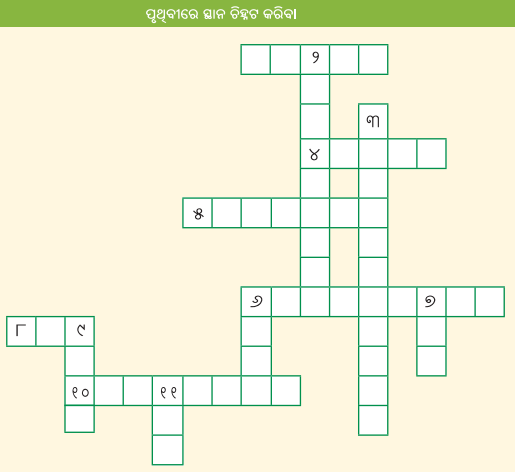
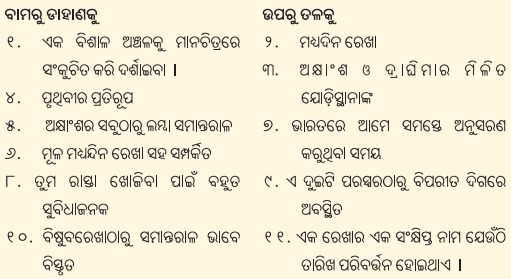
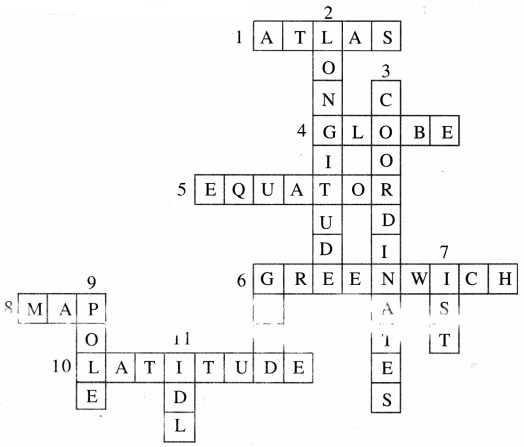
ନିମ୍ନରେ ଦିଆଯାଇଥିବା ତଥ୍ୟଅନୁସାରେ ଗ୍ରୀଡକୁ ବନ୍ଧନୀ ମଧ୍ଯରେ ଦିଆଯାଇଥବା ଇଂରାଜୀ ଶବ୍ଦକୁ ବ୍ୟବହାର କରି ପୂରଣ କର ।
(LATITUDE, POLE, GLOBE, ATLAS, LONGITUDE, EQUATOR, COORDINATES, GREENWICH, IST, MAP, IDL)
Class 6 Social Science Chapter 1 Question Answer Odia Medium ପୃଥିବୀରେ ସ୍ଥାନ ଚିହ୍ନଟ କରିବା-8

Class 6 Social Science Chapter 1 Question Answer Odia Medium ପୃଥିବୀରେ ସ୍ଥାନ ଚିହ୍ନଟ କରିବା-9
Answer:
୧. ATLAS
୨.LONGITUDE
୩. COORDINATES
୪. GLOBE
୫. EQUATOR
୬. GREENWICH
୭. IST
୮. MAP
୯. POLE
୧୦. LATTITUDE
୧୧. IDL
Class 6 Social Science Chapter 1 Question Answer Odia Medium ପୃଥିବୀରେ ସ୍ଥାନ ଚିହ୍ନଟ କରିବା-10

ଦୀର୍ଘ ଉତ୍ତରମୂଳକ ପ୍ରଶ୍ନୋତ୍ତର

Question 1.
ମାନଚିତ୍ର କହିଲେ କ’ଣ ବୁଝ ଏବଂ ଆମେ ଏହାକୁ କିପରି ବ୍ୟବହାର କରୁ ? ଏହାର ମୁଖ୍ୟ ଉପାଦାନ ସବୁ କ’ଣ ?
Answer:
ମାନଚିତ୍ର ହେଉଛି ପୃଥ‌ିବୀର କୌଣସି ସ୍ଥାନର ଚିତ୍ର ଯାହାକୁ ଆମେ ଚିତ୍ରିତ ଉପସ୍ଥାପନା କରିଥାଉ । ସେ ଚିତ୍ର ଯେକୌଣସି ଛୋଟ କିମ୍ବା ବଡ଼ ଅଞ୍ଚଳ ହୋଇଥାଇପାରେ । ଏପରିକି ଦେଶ, ରାଜ୍ୟ କିମ୍ବା ପୃଥ‌ିବୀର ମଧ୍ଯ ହୋଇପାରେ ।
ଗୋଟିଏ ମାନଚିତ୍ରରୁ ଅନେକ ତଥ୍ୟ ମିଳିଥାଏ ।
ବିଭିନ୍ନ ମାନଚିତ୍ରମାନଙ୍କର ଏକ ସମନ୍ବିତ ପୁସ୍ତକକୁ ଭୂଚିତ୍ରାବଳୀ (ATLAS) କୁହାଯାଏ । ମାନଚିତ୍ର ସାଧାରଣତଃ ତିନି ପ୍ରକାରର ଥାଏ, ଯଥା-
(୧) ଭୌତିକ ବା ପ୍ରାକୃତିକ ମାନଚିତ୍ର
(୨) ରାଜନୈତିକ ମାନଚିତ୍ର
(୩) ତଥ୍ୟଭିଭିକ ମାନଚିତ୍ର ।

(୧) ଭୌତିକ ବା ପ୍ରାକୃତିକ ମାନଚିତ୍ର – ଏହି ମାନଚିତ୍ରରେ ପୃଥ‌ିବୀର ପ୍ରାକୃତିକ ବୈଶିଷ୍ଟ୍ୟ ଯଥା ପର୍ବତ, ଜଙ୍ଗଲ, ମହାସାଗର ଏବଂ ନଦୀ ଓ ଝରଣା ଇତ୍ୟାଦି ପ୍ରଦର୍ଶିତ ହୋଇଥାଏ ।

(୨) ରାଜନୈତିକ ମାନଚିତ୍ର – ଏହି ମାନଚିତ୍ରରେ ବିଭିନ୍ନ ଦେଶ, ସେମାନଙ୍କର ସୀମା ଓ ରାଜଧାନୀ, ବୃହତ୍ ସହର ଓ ବାଣିଜ୍ୟ କେନ୍ଦ୍ର ଇତ୍ୟାଦି ପ୍ରଦର୍ଶିତ ହୋଇଥାଏ । ଆମ ଦେଶ ଭାରତର ମାନଚିତ୍ରରେ ଆମେ ସମସ୍ତ ରାଜ୍ୟ, କେନ୍ଦ୍ରଶାସିତ ଅଞ୍ଚଳ ଏବଂ ଦେଶ ଓ ରାଜ୍ୟର ରାଜଧାନୀମାନ ଦେଖ‌ିବାକୁ ପାଉ ।

(୩) ତଥ୍ୟଭିତ୍ତିକ ମାନଚିତ୍ର – ଏହି ମାନଚିତ୍ରରେ ଏକ ନିର୍ଦ୍ଦିଷ୍ଟ ପ୍ରକାରର ସୂଚନା ସହିତ ତଥ୍ୟଭିଭିକ ବା ପ୍ରାସଙ୍ଗିକ ଶୀର୍ଷକ ସ୍ଥାନ ପାଇଥାଏ । ଉଦାହରଣ ସ୍ୱରୂପ କୋଇଲା ଖଣି, ଜନସଂଖ୍ୟା ଓ ଖଣିଜ ମାନଚିତ୍ର ଇତ୍ୟାଦି ଅଟେ ।

ମାନଚିତ୍ରର ଉପାଦାନ – ପ୍ରତ୍ୟେକ ମାନଚିତ୍ରର ତିନୋଟି ମୌଳିକ ଉପାଦାନ ଥାଏ । ସେଗୁଡ଼ିକ ମୁଖ୍ୟତଃ ତିନୋଟି ଯଥା ଦୂରତା, ଦିଗ ଓ ସଙ୍କେତ ।

ଦୂରତା – ମାନଚିତ୍ରରେ ପ୍ର୧୦ ସେଣ୍ଟିମିଟର, ଭୂମିରେ ଏକ ନିର୍ଦ୍ଦିଷ୍ଟ ଦୂରତା ଦେଖାଇଥାଏ । ଏହା ମାନଚିତ୍ର ନିମ୍ନ ବାମ କୋଣରେ ରୁଲରେ ଦର୍ଶାଯାଇଥାଏ । ଯଦି ମାନଚିତ୍ରର ମାନ ୧ ସେ.ମି. = ୨ କି.ମି. ହୁଏ, ଏହାର ଅର୍ଥ ମାନଚିତ୍ରରେ ୧ ସେ.ମି. ଦୂରତା ଭୂମି ଉପରେ ୨ କିଲୋମିଟର ଦୂରତା ସହ ସମାନ ହୋଇଥାଏ । ସମଗ୍ର ଦେଶର ମାନଚିତ୍ର ଏକ କାଗଜ ଉପରେ ଅଙ୍କନ କଲାବେଳେ ଏହି ମାନ ଉପରେ ଗୁରୁତ୍ଵ ଦିଆଯାଏ ।

ଦୂରତା – ମାନଚିତ୍ରର ଉପର ଡାହାଣ କୋଣରେ ଦିଗସୂଚକ ରେଖା ଥାଏ । ସାଧାରଣତଃ ମାନଚିତ୍ରର ଉପରଭାଗ ଉତ୍ତରଦିଗ, ତଳ ଭାଗ ଦକ୍ଷିଣ ଦିଗ, ଡାହାଣ ପାର୍ଶ୍ଵ ପୂର୍ବ ଦିଗ ଓ ବାମ ପାର୍ଶ୍ଵ ପଶ୍ଚିମ ଦିଗ ସୂଚାଇଥାଏ ।

ସଙ୍କେତ – ବୃହତ୍ ସହର ବା ଦେଶ ଅଙ୍କନ କରିବା ପାଇଁ ମାନଚିତ୍ରରେ ପର୍ଯ୍ୟାପ୍ତ ସ୍ଥାନ ନଥାଏ । ବିଭିନ୍ନ ପ୍ରକାର କୋଠା (ରେଳଷ୍ଟେସନ, ବିଦ୍ୟାଳୟ, ଡାକଘର), ରାସ୍ତା ଏବଂ ରେଳ ଲାଇନ ଏବଂ ନଦୀ ପୋଖରୀ କିମ୍ବା ଜଙ୍ଗଲ ପରି ପ୍ରାକୃତିକ ଉପାଦାନ ପାଇଁ ସ୍ଵତନ୍ତ୍ର ସଙ୍କେତ ବ୍ୟବହୃତ ହୁଏ । ମାନଚିତ୍ରକୁ ବ୍ୟବହାରକାରୀମାନଙ୍କଦ୍ଵାରା ଅଧ୍ବକ ସହଜରେ ବୁଝିବା ପାଇଁ ମାନଚିତ୍ରର ପ୍ରସ୍ତୁତକାରୀ (cartographer) ନିର୍ଦ୍ଦିଷ୍ଟ ସଙ୍କେତ ବ୍ୟବହାର କରନ୍ତି । ବିଭିନ୍ନ ଦେଶ ଭିନ୍ନଭିନ୍ନ ସଙ୍କେତ ବ୍ୟବହାର କରନ୍ତି । ଭାରତୀୟ ସର୍ବେକ୍ଷଣ ସଂସ୍ଥା (Survey of India), ଏକ ସରକାରୀ ସଂସ୍ଥା, ଏହା ଭାରତର ମାନଚିତ୍ର (ଭାରତର କିଛି ଅଂଶ) ପାଇଁ ଏକ ସଙ୍କେତ ସେଟ୍ ସ୍ଥିର କରିଛି ।

Question 2.
ଯୋଡ଼ିସ୍ଥାନାଙ୍କ (coordinate) କ’ଣ ? ଅକ୍ଷାଂଶ ଓ ଦ୍ରାଘିମାର ବ୍ୟବହାର କରି ଆମେ ପୃଥ‌ିବୀର ଯେକୌଣସି ସ୍ଥାନର ଅବସ୍ଥିତି କିପରି ନିରୂପଣ କରିପାରିବା ?
Answer:
ପୃଥ‌ିବୀ ମାନଚିତ୍ରରେ ଯେକୌଣସି ସ୍ଥାନକୁ ଚିହ୍ନଟ କରିବାପାଇଁ ଯୋଡ଼ିସ୍ଥାନାଙ୍କକୁ ବ୍ୟବହାର କରାଯାଏ । ଏହି ଯୋଡ଼ିସ୍ଥାନାଙ୍କ ହେଉଛି ଅକ୍ଷାଂଶ ଏବଂ ଦ୍ରାଘିମା ଯାହାକୁ ବ୍ୟବହାର କରି ଆମେ ପୃଥ‌ିବୀ ମାନଚିତ୍ରରେ ବିଭିନ୍ନ ସ୍ଥାନର ଅବସ୍ଥିତି ନିରୁପଣ କରିଥାଉ । ଆମ ଗ୍ଲୋବ୍ ଉପରେ ଏହି ଦୁଇଟି ରେଖା ଯଦିଓ କାଳ୍ପନିକ ଅଟେ ତଥାପି ଏହାକୁ ବ୍ୟବହାର କରି ସ୍ଥାନଗୁଡ଼ିକୁ ସ୍ଥିର କରାଯାଏ ।

ଅକ୍ଷାଂଶଗୁଡ଼ିକ ହେଉଛି ସମାନ୍ତର ବୃତ୍ତ ଯାହାଦ୍ଵାରା ବିଷୁବରେଖାଠାରୁ ଉତ୍ତର ଓ ଦକ୍ଷିଣକୁ ଦୂରତା ମାପ କରାଯାଇଥାଏ । ଅକ୍ଷାଂଶଦ୍ଵାରା ବିଷୁବରେଖାଠାରୁ କୌଣିକ ଦୂରତା ମାପ କରାଯାଏ । ଦ୍ରାଘିମାଗୁଡ଼ିକ ହେଉଛି ଅର୍ଥବୃତ୍ତ ଯାହା ଉତ୍ତର ମେରୁ ସହ ଦକ୍ଷିଣ ମେରୁକୁ ସଂଯୋଗ କରିଥାଏ । ଲଣ୍ଡନ ନିକଟବର୍ତ୍ତୀ ଗ୍ରୀନ୍ୱିଚ୍ ସହର ଦେଇ ଯାଇଥିବା ମୂଳ ମଧ୍ୟଦିନ ରେଖାଠାରୁ କେଉଁ ସ୍ଥାନ କେତେକ ପୂର୍ବ ବା ପଶ୍ଚିମକୁ ଅବସ୍ଥିତ ତାହା ଦ୍ରାଘିମାଦ୍ଵାରା ମପାଯାଏ । ଏହା ମଧ୍ୟ ଏକ କୌଣିକ ଦୂରତା ।

ଅକ୍ଷାଂଶ ଓ ଦ୍ରାଘିମାଗୁଡ଼ିକ ପରସ୍ପରକୁ ଛେଦ କରିଥାନ୍ତି । ଏହି ଛେଦ ବିନ୍ଦୁର ଉଭୟ ଅକ୍ଷାଂଶ ସ୍ଥାନାଙ୍କ ଓ ଦ୍ରାଘିମା ସ୍ଥାନାଙ୍କ ଥାଏ । ଏହାକୁ ଯୋଡ଼ି ସ୍ଥାନାଙ୍କ କୁହାଯାଏ । ଏହି ଯୋଡ଼ି ସ୍ଥାନାଙ୍କରୁ ପୃଥ‌ିବୀ ପୃଷ୍ଠରେ କୌଣସି ସ୍ଥାନ କେଉଁଠାରେ ଅବସ୍ଥିତ ତାହା ଜାଣିହୁଏ ।

Question 3.
ଦ୍ରାଘିମା ସହିତ ସ୍ଥାନୀୟ ସମୟ ଏବଂ ପ୍ରମାଣ ସମୟ କିପରି ସଂଶ୍ଳିଷ୍ଟ ?
Answer:
ସ୍ଥାନୀୟ ସମୟ ଓ ପ୍ରମାଣ ସମୟ ଦ୍ରାଘିମା ସହ ସମ୍ପର୍କିତ । କାରଣ ଦ୍ରାଘିମା ସମୟ ଗଣନା କରିବାରେ ସାହାଯ୍ୟ କରେ ।

ପୃଥ‌ିବୀର ଗତିକୁ ନେଇ ସମୟ କଳନା କରାଯାଏ । ପୃଥ‌ିବୀ ଏହାର ଅକ୍ଷ ଚାରିପଟେ ୨୪ ଘଣ୍ଟାରେ ୩୬୦° ଘୂର୍ଣ୍ଣନ କରିଥାଏ । ଅର୍ଥାତ୍ ପୃଥ‌ିବୀ ପ୍ରତି ଘଣ୍ଟାରେ ୧୫° ଅଥବା ପ୍ରତି ୪ ମିନିଟ୍‌ରେ ଏକ ଡିଗ୍ରୀ ଦ୍ରାଘିମା ଅତିକ୍ରମ କରେ ।

ପ୍ରତି ୧୫° କୁ ଗୋଟିଏ ସମୟମଣ୍ଡଳ ଭାବେ ପୃଥ‌ିବୀକୁ ୨୪ଟି ସମୟମଣ୍ଡଳରେ ଭାଗ କରାଯାଇଛି ।

ମୂଳ ଦ୍ରାଘିମାଠାରୁ ପୂର୍ବ ଦିଗକୁ ପ୍ରତି ୧୫° ବ୍ୟବଧାନରେ ୧୨ଟି ସମୟମଣ୍ଡଳ, ସେହିପରି ପଶ୍ଚିମକୁ ୧୨ଟି ସମୟ ମଣ୍ଡଳ ରହିଛି ।

ପ୍ରତ୍ୟେକ ସ୍ଥାନର ସୂର୍ଯ୍ୟୋଦୟ ଓ ସୂର୍ଯ୍ୟାସ୍ତ ସମୟ ଭିନ୍ନ ଭିନ୍ନ ହୋଇଥାଏ ।

ଗ୍ରୀନିଚ୍ ବା ମୂଳ ଦ୍ରାଘିମାର ପୂର୍ବକୁ ସୂର୍ଯ୍ୟୋଦୟର ସମୟ ଆଗୁଆ ଏବଂ ପଶ୍ଚିମକୁ ପଛୁଆ ହୋଇଥାଏ ।

ସ୍ଥାନୀୟ ସମୟ ହେଉଛି ସ୍ଥାନଟି ଅବସ୍ଥିତ ଥ‌ିବା ମଧ୍ୟଦିନ ରେଖାର ସମୟ ଏବଂ ପ୍ରମାଣ ସମୟ ହେଉଛି ଦେଶର ମଧ୍ୟଭାଗ ଦେଇ ଯାଇଥିବା ମଧ୍ୟଦିନ ରେଖାର ସମୟ ଯାହାକୁ ସର୍ବସମ୍ମତିକ୍ରମେ ଗ୍ରହଣ କରାଯାଇଥାଏ ।

ଆମ ଦେଶ ଭାରତରେ ପ୍ରମାଣ ସମୟ Class 6 Social Science Chapter 1 Question Answer Odia Medium ପୃଥିବୀରେ ସ୍ଥାନ ଚିହ୍ନଟ କରିବା-11 ପୂ. ଦ୍ରାଘିମାର ସମୟ ଅଟେ, ଯାହାକି ଦେଶର ସର୍ବତ୍ର ଗ୍ରହଣୀୟ, ମାତ୍ର ସୂର୍ଯ୍ୟୋଦୟ ଓ ସୂର୍ଯ୍ୟାସ୍ତ ବିଭିନ୍ନ ଅଞ୍ଚଳର ଭିନ୍ନଭିନ୍ନ ସମୟରେ ହୋଇଥାଏ ।

Question 4.
୧୮୦° ଦ୍ରାଘିମା କ୍ଷେତ୍ରରେ ‘ପ କିମ୍ବା ପୂ’ ବ୍ୟବହାରର ଆବଶ୍ୟକତା ନାହିଁ କାହିଁକି ? ଏହି ୧୮୦° ଦ୍ରାଘିମାର ଗୁରୁତ୍ଵ କ’ଣ ?
Answer:
ହଁ, ଏହାର ଆବଶ୍ୟକତା ନାହିଁ, କାରଣ ପଶ୍ଚିମ କିମ୍ବା ପୂର୍ବରେ ଅନ୍ୟ ଦ୍ରାଘିମାଗୁଡ଼ିକର ମୂଳ ଦ୍ରାଘିମା (୦°) ଅଟେ ।

ମୂଳ ଦ୍ରାଘିମାର ବିପରୀତ ଥିବା ୧୮୦° ଦ୍ରାଘିମାକୁ ଆନ୍ତର୍ଜାତିକ ତାରିଖ ରେଖା (IDL) କୁହାଯାଏ ।

ଆନ୍ତର୍ଜାତିକ ତାରିଖ ରେଖା (IDL) କୁ ଅତିକ୍ରମ କଲେ ଗୋଟିଏ ଦିନ ତାରିଖ ବଦଳିଯାଏ ।

ଯଦି ତୁମେ ଆନ୍ତର୍ଜାତିକ ତାରିଖ ରେଖାର (180°E) ପୂର୍ବକୁ ପୂର୍ବକୁ ଅତିକ୍ରମ କର ତେବେ ତୁମେ ଗୋଟିଏ ଦିନ ତାରିଖରେ ଯୋଗ କରିବ ।

ଯଦି ତୁମେ ପଶ୍ଚିମକୁ ଅତିକ୍ରମ କର ତେବେ ତୁମେ ଗୋଟିଏ ଦିନ ବିଯୁକ୍ତ କରିବ ।

ତୁମେ ଲୋକମାନେ କହୁଥିବାର ଶୁଣିଥ‌ିବ ଯେ ସେ ଭାରତରୁ ଉଡ଼ାଜାହାଜରେ ଯାତ୍ରା ଆରମ୍ଭ କରି ସେହିଦିନ ଆମେରିକାରେ ପହଞ୍ଚିଗଲେ । ବାସ୍ତବରେ ତାହା ସେପରି ଜଣାପଡ଼େ କାହିଁକି ଭାରତ ଆନ୍ତର୍ଜାତିକ ତାରିଖ ରେଖା (IDL)ର ପୂର୍ବରେ ଅବସ୍ଥିତ ମାତ୍ର ଆମେରିକା ଭକ୍ତରେଖାର ପଶ୍ଚିମରେ ଅବସ୍ଥିତ ।

ଆସ ଅନୁସନ୍ଧାନ କରିବା

Question 1.
ଚିତ୍ର ୧.୧ରେ ଥ‌ିବା ରେଖାଚିତ୍ର ବା ସ୍କେଚ୍‌ରେ–
Class 6 Social Science Chapter 1 Question Answer Odia Medium ପୃଥିବୀରେ ସ୍ଥାନ ଚିହ୍ନଟ କରିବା-1

Question (୧).
ଡାକ୍ତରଖାନାକୁ ଚିହ୍ନିତ କର ।
Answer:
ଚିତ୍ରକୁ ଦେଖ‌ିଲେ ଜାଣିବ ଯେ ଡାକ୍ତରଖାନା
ସହରର ମଧ୍ୟଭାଗରେ ଅଛି ଯାହାଉପରେ ‘+’ ଚିହ୍ନ ଲଗାଯାଇଛି ।

Class 6 Social Science Chapter 1 Question Answer Odia Medium ପୃଥିବୀରେ ସ୍ଥାନ ଚିହ୍ନଟ କରିବା

Question (ଖ).
ନୀଳ ରଙ୍ଗ ଚିହ୍ନିତ ଅଞ୍ଚଳର ଅର୍ଥ କ’ଣ ?
Answer:
ନୀଳ ରଙ୍ଗ ଚିହ୍ନିତ ଅଞ୍ଚଳଗୁଡ଼ିକ ଜଳାଶୟ ଅଟେ, ଯଥା – ପୋଖରୀ, ଝରଣା ।

Question (ଗ).
କେଉଁଟି ରେଳଷ୍ଟେସନଠାରୁ ବହୁତ ଦୂରରେ ରହିଛି ? (ବିଦ୍ୟାଳୟ, ନଗର ପଞ୍ଚାୟତ କିମ୍ବା ସର୍ବସାଧାରଣ ବଗିଚା) ।
Answer:
ସର୍ବସାଧାରଣ ବଗିଚା ।

Question 2.
ଏକ ଶ୍ରେଣୀ ଶିକ୍ଷଣକାର୍ଯ୍ୟ ଭାବରେ, ତିନି କିମ୍ବା ଚାରି ଜଣ ଲେଖାଏଁ ଛାତ୍ରଛାତ୍ରୀଙ୍କୁ ନେଇ ଏକ ଦଳ ଗଠନ କର । ପ୍ରତ୍ୟେକ ଦଳକୁ ତୁମ ବିଦ୍ୟାଳୟ ଏବଂ ଏହାକୁ ଯାଉଥିବା କିଛି ରାସ୍ତା ଏବଂ ଆଖପାଖରୁ କିଛି ଘରର ଏକ ରେଖଚିତ୍ର ବା ସ୍କେଚ୍ ଆଙ୍କିବାକୁ ଦିଅ । ଶେଷରେ, ସମସ୍ତ ରେଖାଚିତ୍ର ବା ସ୍କର୍‌ ତୁଳନା କରି ଆଲୋଚନା କର ।
Answer:
ଶିକ୍ଷକଙ୍କ ସହାୟତାରେ ଛାତ୍ରଛାତ୍ରୀମାନେ ନିଜେ କରିବେ ।

Question 3.
ତୁମ ବିଦ୍ୟାଳୟର ଖେଳପଡ଼ିଆର ଏକ ସରଳ ମାନଚିତ୍ର ପ୍ରସ୍ତୁତ କର । ଆସ ଅନୁମାନ କରିବା ଯେ ଏହାର ଆକାର ଯଥା ଦୈର୍ଘ୍ୟ ୪୦ ମିଟର ଏବଂ ପ୍ରସ୍ଥ ୩୦ ମିଟର । ୧ ସେ.ମି. = ୧୦ ମିଟର ମାନ ବା ସ୍କେଲରେ ତୁମେ ରୁଲରଦ୍ଵାରା ଏହାକୁ ଠିକ୍ ଭାବରେ ଅଙ୍କନ କର ।
Answer:
Class 6 Social Science Chapter 1 Question Answer Odia Medium ପୃଥିବୀରେ ସ୍ଥାନ ଚିହ୍ନଟ କରିବା-2
୧ ସେ.ମି. = ୧୦ ମିଟର
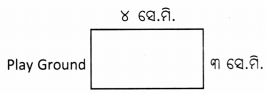
ତେଣୁ ଖେଳପଡ଼ିଆର ଲମ୍ବ ୪୦ ମିଟର ଓ ଓସାର ୩୦ ମିଟରକୁ ଯଥାକ୍ରମେ ୪ ସେ.ମି. ଏବଂ ୩ ସେ.ମି. ଧରାଯାଇ ତା’ର ମାନଚିତ୍ର ଅଙ୍କାଯିବ ।

Question 4.
ଏହି ଅଙ୍କିତ ଆୟତଚିତ୍ରର କର୍ତ୍ତକୁ ମାପ କର । ତୁମେ କେତେ ସେଣ୍ଟିମିଟର ପାଇଲ ? ସ୍କେଲ ବ୍ୟବହାର କରି, ଖେଳପଡ଼ିଆର କର୍ଣ୍ଣର ଦୈର୍ଘ୍ୟ, ମିଟରରେ ଗଣନା କର ।
Answer:
ଉକ୍ତ ଖେଳପଡ଼ିଆର ଚିତ୍ରର କର୍ଣ୍ଣକୁ ସ୍କେଲରେ ମାପ କଲେ ତାହା ୫ ସେ.ମି. ହେବ ।
ଯେହେତୁ ୧ ସେ.ମି. = ୧୦ ମିଟର ଧରାଯାଇଛି
ତେଣୁ ୫ ସେ.ମି. = ୧୦ × ୫ = ୫୦ ମିଟର
ଅତଏବ ଖେଳପଡ଼ିଆର କର୍ଣ୍ଣର ଲମ୍ବ ବାସ୍ତବରେ ୫୦ ମିଟର ଅଟେ ।

Question 5.
ପୁଣି ଥରେ ଛୋଟ ସହରର ରେଖାଚିତ୍ର ବା ସ୍କେଚ୍ ଉପରେ ବିଚାର କର । ନିମ୍ନ ତାଲିକାରେ ଠିକ୍ (✓) ଏବଂ ଭୁଲ୍ (✗) ଉକ୍ତିଗୁଡ଼ିକୁ ଚିହ୍ନଟ କର ।
୧। ଡାକ୍ତରଖାନାର ଉତ୍ତରରେ ବଜାର ରହିଛି ।
୨। ସଂଗ୍ରହାଳୟଟି ବ୍ୟାଙ୍କର ଦକ୍ଷିଣ-ପୂର୍ବ ଦିଗରେ ଅବସ୍ଥିତ ।
୩ । ରେଳଷ୍ଟେସନ ହସ୍ପିଟାଲର ଉତ୍ତର-ପଶ୍ଚିମରେ ରହିଛି ।
୪। ଜଳାଶୟ ଆପାର୍ଟମେଣ୍ଟ ବ୍ଲକଠାରୁ ଉତ୍ତର-ପଶ୍ଚିମରେ ଅବସ୍ଥିତ ।
Answer:
(କ) (✗)
(ଖ) (✓)
(ଗ) (✓)
(ଘ) (✗)

Question 6.
ତୁମ ବିଦ୍ୟାଳୟକୁ ମୂଳବିନ୍ଦୁ ଭାବରେ ଗ୍ରହଣ କରି ତୁମେ କହିପାରିବ କି ତୁମ ଘର କେଉଁ ଦିଗରେ ଅବସ୍ଥିତ ? ଶିକ୍ଷକ ଓ ପିତାମାତାଙ୍କ ସହ ଆଲୋଚନା କର ।
Answer:
ଶିକ୍ଷକ ଓ ପିତାମାତାଙ୍କ ସହ ଆଲୋଚନା କରି ପିଲାମାନେ ନିଜ ଘରର ଦିଗ ନିର୍ଣ୍ଣୟ କରିବେ ।- ମାନଚିତ୍ରର ଅନ୍ୟ ଏକ ଗୁରୁତ୍ଵପୂର୍ଣ୍ଣ ଉପାଦାନ ହେଉଛି ସଙ୍କେତ ।

Question 7.
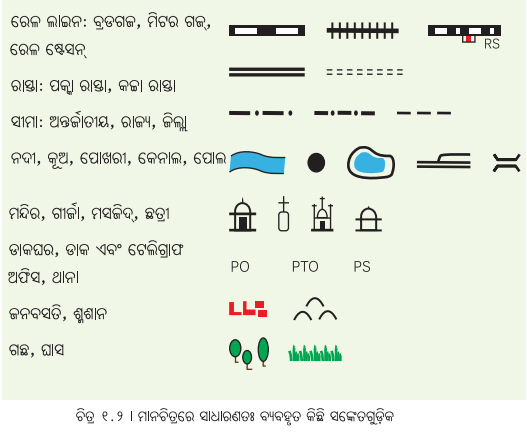
ତୁମ ଘର, ବିଦ୍ୟାଳୟ ଏବଂ ଅନ୍ୟ କେତେକ ଗୁରୁତ୍ଵପୂର୍ଣ୍ଣ ସ୍ଥାନ ସମେତ ତୁମ ଅଞ୍ଚଳ କିମ୍ବା ତୁମ ଗାଁର ଏକ ମାନଚିତ୍ର ବା ରେଖାଚିତ୍ର ପ୍ରସ୍ତୁତ କର । ମୁଖ୍ୟ ଦିଗଗୁଡ଼ିକୁ ଦର୍ଶାଅ ଏବଂ କିଛି ଗୁରୁତ୍ଵପୂର୍ଣ୍ଣ ସଙ୍କେତ ବ୍ୟବହାର କରିବାପାଇଁ ଚିତ୍ର ୧.୨ ରେ ଦର୍ଶାଯାଇଥିବା କିଛି ସଙ୍କେତଗୁଡ଼ିକୁ ବ୍ୟବହାର କର ।
Answer:
ପିଲାମାନେ ଶିକ୍ଷକଙ୍କ ସହାୟତା ନେଇ ମାନଚିତ୍ର ଅଙ୍କନ କରିବେ ।
Class 6 Social Science Chapter 1 Question Answer Odia Medium ପୃଥିବୀରେ ସ୍ଥାନ ଚିହ୍ନଟ କରିବା-3

Question 8.
ସମାନ ସର୍ତ୍ତାବଳୀ ବ୍ୟବହାର କରି, ଯଦି ତୁମେ କଳା ଦଳ ହୋଇ ଖେଳ ତେବେ ତୁମ ଗତିବିଧଗୁଡ଼ିକୁ ଯୋଡ଼ିସ୍ଥାନାଙ୍କ (co-ordinate) ଅନୁସାରେ ଲେଖ ।
Answer:
ଚେସ୍‌ରେ ‘କଳା ପକ୍ଷ’ ଖେଳ ଆରମ୍ଭ କରି ରାଣୀ ସମ୍ମୁଖରେ ଥିବା ସୈନ୍ୟକୁ ମଧ୍ଯ ଦୁଇପାଦ ଆଗକୁ ନେଇପାରିବେ ସେହି ସୈନ୍ୟଟି ଘ୭ରୁ ଘକୁ ଯିବ ।

Question 9.
ଯଦି ତୁମ ଶ୍ରେଣୀରେ ଥ‌ିବା ଗ୍ଲୋବ୍‌ କିମ୍ବା ଆଟଲାସ୍‌ରେ ଅକ୍ଷାଂଶ ଏବଂ ଦ୍ରାଘିମା ଭଲ ଭାବରେ ଚିହ୍ନିତ ଅଛି, ତେବେ (୧) ମୁମ୍ବାଇ (୨) କୋଲକାତା (୩) ସିଙ୍ଗାପୁର (୪) ପ୍ୟାରିସ୍‌ର ଅକ୍ଷାଂଶ ଓ ଦ୍ରାଘିମା ପାଇଁ ଆନୁମାନିକ ମୂଲ୍ୟ ନିର୍ଦ୍ଧାରଣ କରିବାକୁ ଚେଷ୍ଟା କର ।
Answer:
ନିମ୍ନଲିଖୂତ ସହରମାନଙ୍କର ଆନୁମାନିକ ଅକ୍ଷାଂଶ ଓ ଦ୍ରାଘିମା
(କ) ମୁମ୍ବାଇ 19° N ଅକ୍ଷାଂଶ 72 E ଦ୍ରାଘିମା
(ଖ) କୋଲକତା 22° N ଅକ୍ଷାଂଶ 88° E ଦ୍ରାଘିମା
(ଗ) ସିଙ୍ଗାପୁର 1 N ଅକ୍ଷାଂଶ 103° E ଦ୍ରାଘିମା
(ଘ) ପ୍ୟାରିସ୍ 48° N ଅକ୍ଷାଂଶ 2 E ଦ୍ରାଘିମା
Class 6 Social Science Chapter 1 Question Answer Odia Medium ପୃଥିବୀରେ ସ୍ଥାନ ଚିହ୍ନଟ କରିବା-4

Question 10.
ଜଣେ ପୋର ବନ୍ଦର (ଗୁଜରାଟ) ଏବଂ ଅନ୍ୟ ଜଣେ ତିନସୁକିଆ (ଆସାମ)ରେ ବସିଥିବା ଦୁଇ ସାଙ୍ଗ ଅପରାହ୍ନରେ ଫୋନରେ କଥା ହେଉଛନ୍ତି । ତିନିସୁକିଆରେ ଥିବା ସାଙ୍ଗ କହୁଛି ଯେ ଆସାମରେ ସୂର୍ଯ୍ୟ ଅସ୍ତ ହେଲାଣି ଏବଂ ବର୍ତ୍ତମାନ ଅନ୍ଧାର ହୋଇଛି । ପୋରବନ୍ଦରରେ ଥିବା ସାଙ୍ଗ ଆଶ୍ଚର୍ଯ୍ୟ ହୋଇ କହିଲେ, “‘କିନ୍ତୁ ଏଠାରେ ଏବେବି ପୂରା ଦିନ ଅଛି ।’’ ଏହାର କାରଣ ବର୍ଣ୍ଣନା କର ଏବଂ ଶିକ୍ଷଣ କାର୍ଯ୍ୟଭାବରେ ଆଲୋଚନା କରି ନିରୂପଣ କର ଯେ ସେହି ଦୁଇଟି ସହର ମଧ୍ୟରେ ସ୍ଥାନୀୟ ସମୟର ପାର୍ଥକ୍ୟ କେତେ ? (ସୂଚନା : ପୋର ବନ୍ଦର ଏବଂ ତିନସୁକିଆ ମଧ୍ୟରେ ଦ୍ରାଘିମାରେ ପାର୍ଥକ୍ୟ ୩୦° ବୋଲି ବିଚାର କରି ଠିକ୍ ମୂଲ୍ୟ ନିରୂପଣ କର ।)
Answer:
ପୋର ବନ୍ଦର (ଗୁଜରାଟ) ଏବଂ ତିନସୁକିଆ (ଆସାମ) ମଧ୍ୟରେ ୩୦°ର ପାର୍ଥକ୍ୟ ଦର୍ଶାଯାଇଛି ।
ତେଣୁ ସ୍ଥାନୀୟ ସମୟର ବ୍ୟବଧାନ ୧° = ୪ ମିନିଟ୍ ହିସାବରେ ଧରାଗଲେ
୧° = ୪ ମିନିଟ୍, ୩୦° = ୪ × ୩୦ = ୧୨୦ ମିନିଟ୍ ଅର୍ଥାତ୍ ୨ ଘଣ୍ଟା
ଆମ ଦେଶ ଭାରତ ଗ୍ରୀନ୍ୱିଚ୍ ସମୟ ଅନୁସାରେ 82% E ଷ୍ଟାଣ୍ଡାର୍ଡ ଟାଇମ୍ ରେଖାଯାଇଥିବାରୁ ଏହାର ସମସ୍ତ ସ୍ଥାନ ସ୍ଥାନୀୟ ସମୟ ଅନୁସାରେ ଚାଲିବ । ସୁତରାଂ ସ୍ଥାନୀୟ ସମୟ ଅନୁସାରେ ପୋରବନ୍ଦର ଏବଂ ତିନସୁକିଆ ମଧ୍ୟରେ ସୂର୍ଯ୍ୟ ଉଦୟ ଏବଂ ଅସ୍ତ କ୍ଷେତ୍ରରେ ସବୁବେଳେ ୨ ଘଣ୍ଟା ପାର୍ଥକ୍ୟ ରହିବ ।

ପୃଥ‌ିବୀର ଯେକୌଣସି ସ୍ଥାନର ସ୍ଥାନୀୟ ଗଣନା କରିବା ପାଇଁ ସମାନ ପଦ୍ଧତି ବ୍ୟବହାର କରାଯାଇଥାଏ । କିନ୍ତୁ ଏକ ଦେଶ ପାଇଁ ଅନେକ ସ୍ଥାନୀୟ ସମୟ ବ୍ୟବହାର କରିବା ସୁବିଧାଜନକ ହେବ ନାହିଁ । ସେଥ୍ପାଇଁ ଅଧିକାଂଶ ଦେଶ ସେମାନଙ୍କ ମଧ୍ୟଦେଇ ଯାଉଥ‌ିବା ମଧ୍ୟଦିନ ରେଖା ଆଧାରରେ ଏକ ପ୍ରମାଣ ସମୟ ଗ୍ରହଣ କରନ୍ତି । ଗ୍ରୀନ୍ ୱିଚ୍ (Greenwich Mean Time ବା GMT)ର ସ୍ତାନୀୟ ସମୟଠାରୁ ଭାରତୀୟ ମାନକ ସମୟ (IST) ୫ ଘଣ୍ଟା ୩୦ ମିନିଟ୍ ଆଗୁଆ ।

Class 6 Social Science Chapter 1 Question Answer Odia Medium ପୃଥିବୀରେ ସ୍ଥାନ ଚିହ୍ନଟ କରିବା

Question 11.
ଗୁଜରାଟ ଏବଂ ଆସାମରେ ବସିଥିବା ଦୁଇ ବନ୍ଧୁଙ୍କ କଥାବାର୍ତ୍ତା ଉଦାହରଣକୁ ନେଇ ସ୍ଥାନୀୟ ସମୟ ଏବଂ ପ୍ରମାଣ ସମୟ ମଧ୍ୟରେ ଥିବା ପାର୍ଥକ୍ୟ ବୁଝାଅ ।
Answer:
ଦ୍ରାଘିମାକୁ ନେଇ ଉଭୟ ରାଜ୍ୟ ମଧ୍ୟରେ ଯଦିଓ ସ୍ଥାନୀୟ ସମୟରେ ତାରତମ୍ୟ ଦେଖାଯାଏ କିନ୍ତୁ ସମଗ୍ର ଦେଶ (ଭାରତ) ପାଇଁ ଷ୍ଟାଣ୍ଡାର୍ଡ଼ ଟାଇମ୍ ସବୁବେଳେ ସମାନ ଥାଏ । ଏହା ଭାରତର ମଧ୍ଵନ୍ଦିନ ରେଖା ଆଧାରରେ କରାଯାଇଛି ।

ଅତିସଂକ୍ଷିପ୍ତ ଉତ୍ତରମୂଳକ ପ୍ରଶ୍ନୋତ୍ତର

Question 1.
ମାନଚିତ୍ର କ’ଣ ?
Answer:
ମାନଚିତ୍ର ହେଉଛି କୌଣସି ଅଞ୍ଚଳର ଏକ ଚିତ୍ରିତ ଉପସ୍ଥାପନା ।

Question 2.
ଭୂଚିତ୍ରାବଳୀ କ’ଣ ?
Answer:
ଭୂଚିତ୍ରାବଳୀ (ATLAS) ହେଉଛି ଅନେକଗୁଡ଼ିଏ ମାନଚିତ୍ରର ଏକ ସମନ୍ଵିତ ପୁସ୍ତକ ।

Question 3.
ପ୍ରତ୍ୟେକ ମାନଚିତ୍ରର କେତୋଟି ମୌଳିକ ଉପାଦାନ ଥାଏ । ସେଗୁଡ଼ିକ କ’ଣ ?
Answer:
ପ୍ରତ୍ୟେକ ମାନଚିତ୍ରର ତିନୋଟି ମୌଳିକ ଉପାଦାନ ଥାଏ । ସେଗୁଡ଼ିକ ହେଉଛି – ଦୂରତା, ଦିଗ ଓ ସଙ୍କେତ ।

Question 4.
ଦୂରତାକୁ ମାନଚିତ୍ରରେ କିପରି ଦର୍ଶାଯାଇଥାଏ ?
Answer:
ଦୂରତାକୁ ମାନଚିତ୍ରରେ ସାଧାରଣ ମାନ (Scale) ମାଧ୍ୟମରେ ଦର୍ଶାଯାଇଥାଏ ।

Question 5.
କାର୍ଡ଼ିନାଲ କ’ଣ ?
Answer:
ଯେକୌଣସି ମାନଚିତ୍ରରେ ଚାରିଗୋଟି ଦିଗ ପ୍ରଦର୍ଶିତ ହୋଇଥାଏ । ସେଗୁଡ଼ିକ ହେଲା- ଉତ୍ତର, ପୂର୍ବ, ଦକ୍ଷିଣ ଓ ପଶ୍ଚିମ । ଏଗୁଡ଼ିକୁ କାର୍ଡ଼ନାଲ ବା ଚତୁଃଦିଗ କୁହାଯାଏ ।

Question 6.
ମାନଚିତ୍ରରେ ସଙ୍କେତ କାହିଁକି ବ୍ୟବହାର କରାଯାଇଥାଏ ?
Answer:
ମାନଚିତ୍ରରେ କମ୍ ସ୍ଥାନ ମଧ୍ୟରେ ଅନେକ ସ୍ଥାନ ପ୍ରଦର୍ଶନ ସମ୍ଭବପର ନୁହେଁ । ତେଣୁ ବିଭିନ୍ନ ପ୍ରକାରର କୋଠା ଯଥା ରେଳଷ୍ଟେସନ, ଡାକଘର, ବିଦ୍ୟାଳୟ, ନଦୀ, ବ୍ରିଜ, ରେଳଲାଇନ୍ ଇତ୍ୟାଦିର ସୂଚନାପାଇଁ କେତେକ ସଙ୍କେତ ବ୍ୟବହାର କରାଯାଏ ।

Question 7.
ଭାରତର କେଉଁ ସଂସ୍ଥା ରେଳଲାଇନ୍, ରେଳଷ୍ଟେସନ, ରାସ୍ତା, ନଦୀ, ପୋଲ, ମନ୍ଦିର, ଅଫିସ, ଡାକଘର ଇତ୍ୟାଦିର ସଙ୍କେତ ମାନଚିତ୍ରରେ ପ୍ରଦର୍ଶନ ପାଇଁ ନିଷ୍ପତ୍ତି ନିଅନ୍ତି ?
Answer:
ଭାରତ ସରକାରଙ୍କ ସର୍ଭେ ଅଫ୍ ଇଣ୍ଡିଆ ।

Question 8.
ଅକ୍ଷାଂଶ କ’ଣ ?
Answer:
ଅକ୍ଷାଂଶ ଏକ କୌଣିକ ଦୂରତ୍ୱ । ଭୂପୃଷ୍ଠରେ ଅବସ୍ଥିତ ଯେକୌଣସି ସ୍ଥାନ ପୃଥ‌ିବୀର କେନ୍ଦ୍ରଠାରୁ ବିଷୁବ ସମତଳ ସହ, ଉତ୍ତର ଓ ଦକ୍ଷିଣ ଦିଗରେ ଯେଉଁ କୋଣ ସୃଷ୍ଟି କରେ ତାହାକୁ ସେହି ସ୍ଥାନର ଅକ୍ଷାଂଶ କୁହାଯାଏ ।

Question 9.
ସମଶୀତୋଷ୍ଣ ମଣ୍ଡଳ (Temperature zone) କ’ଣ ?
Answer:
ବିଷୁବରେଖାଠାରୁ ଉଭୟ ମେରୁ ଆଡ଼କୁ ଉଷ୍ଣତା କମି କମି ଯାଏ । ତେଣୁ ବିଷୁବରେଖା ଓ ମେରୁ ମଧ୍ୟବର୍ତୀ ଅଞ୍ଚଳରେ ଅଧ୍ଵ ଗରମ କିମ୍ବା ଅଧ‌ିକ ଥଣ୍ଡା ଅନୁଭୂତ ହୋଇନଥାଏ । ତେଣୁ ସେହି ସ୍ଥାନରେ ସମଶୀତୋଷ୍ଣ ଜଳବାୟୁ ଅନୁଭୂତ ହୁଏ ।

Question 10.
ଉଷ୍ଣମଣ୍ଡଳ କାହାକୁ କୁହାଯାଏ ?
Answer:
ବିଷୁବରେଖା ନିକଟରେ ଜଳବାୟୁ ସାଧାରଣତଃ ଗରମ ହୋଇଥାଏ । ଏହାକୁ ଉଷ୍ଣମଣ୍ଡଳ (Torrid zone) କୁହାଯାଏ ।

Question 11.
ହିମମଣ୍ଡଳ କାହାକୁ କୁହାଯାଏ ?
Answer:
ବିଷୁବ ବୃତ୍ତଠାରୁ ମେରୁଆଡ଼କୁ ଗଲେ ଉଷ୍ଣତା କମି କମି ଯାଏ । ସୁତାରଂ ଉଭୟ ମେରୁ ଅଞ୍ଚଳରେ ପ୍ରବଳ ଥଣ୍ଡା ଅନୁଭୂତ ହୁଏ, ଯାହାକୁ ହିମ ମଣ୍ଡଳ (Frigid zone) କୁହାଯାଏ । ଅକ୍ଷାଂଶ ବଢ଼ିଲେ ତାପମାତ୍ରା କମେ ।

Question 12.
ବିଷୁବରେଖା କ’ଣ ?
Answer:
ପୃଥ‌ିବୀର ମଧ୍ୟଭାଗରେ ଅର୍ଥାତ୍ ଉଭୟ ମେରୁଠାରୁ ସମାନ ଦୂରତାରେ ଯେଉଁ ରେଖା ପୃଥ‌ିବୀକୁ ଦୁଇ ସମାନ ଭାଗରେ ବିଭକ୍ତ କରିଥାଏ ତାକୁ ବିଷୁବରେଖା କୁହାଯାଏ ।

Class 6 Social Science Chapter 1 Question Answer Odia Medium ପୃଥିବୀରେ ସ୍ଥାନ ଚିହ୍ନଟ କରିବା

Question 13.
ନିମ୍ନଲିଖତ ପ୍ରଶ୍ନଗୁଡ଼ିକର ଉତ୍ତର ଦିଅ ।
(କ) ସବୁ ଦେଶର କ’ଣ ଗୋଟିଏ (ଷ୍ଟାଣ୍ଡାର୍ଡ଼ ଟାଇମ୍) ପ୍ରମାଣ ସମୟ ଅଛି ?
(ଖ) ଯେକୌଣସି ଦୁଇଟି ଦେଶର ଉଦାହରଣ ଦିଅ ଯେଉଁମାନଙ୍କର ଏକାଧୁକ ସମୟ ମଣ୍ଡଳ (Time zone) ଅଛି ।
(ଗ) କାହିଁକି ଏହି ଦେଶଗୁଡ଼ିକର ଅଧ‌ିକ ସମୟ ମଣ୍ଡଳ (Time zone) ଅଛି ?
Answer:
(ଳ) ନା, ସବୁ ଦେଶରେ ଗୋଟିଏ (ଷ୍ଟାଣ୍ଡାର୍ଡ଼ ଟାଇମ୍) ପ୍ରମାଣ ସମୟ ନାହିଁ, କେତେକ ଦେଶରେ ଏକାଧିକ ପ୍ରମାଣ ସମୟ ଅଛି ।
(ଖ) ରଷିଆର ୧୧ଟି ସମୟମଣ୍ଡଳ ଏବଂ ଆମେରିକାର ୬ଟି ସମୟ ମଣ୍ଡଳ ଅଛି ।
(ଗ) ଏହି ଦେଶମାନଙ୍କର ପୂର୍ବରୁ ପଶ୍ଚିମ ଦ୍ରାଘିମା ବିସ୍ତୃତି ଅଧ‌ିକ ହେତୁ ଏଠାରେ ଅଧିକ ସମୟ ମଣ୍ଡଳ (Time zone) ଅଛି ।

Question 14.
କେବଳ ଉତ୍ତର ଲେଖ ।
(କ) ଗ୍ରୀକ୍‌ ପ୍ରଥମ ମୂଳ ମଧ୍ୟଦିନ କି ?
(ଖ) ପୁରାତନ ଯୁଗରେ ଭାରତର ପ୍ରମୁଖ ମଧ୍ୟନ୍ଦିନ (ମୈରଡ଼ିଆନ) କ’ଣ ଥିଲା ?
(ଗ) ପ୍ରାଚୀନ ଭାରତର ନିଜସ୍ଵ ମଧ୍ୟରେଖା କେଉଁ ପୁରାତନ ସହର ଦେଇ ଅତିକ୍ରମ କରିଥିଲା ?
(ଘ) ସେହି ମଧ୍ୟରେଖା କାହିଁକି ପ୍ରସିଦ୍ଧ ଥିଲା ?
(ଙ) ୧୫୦୦ ବର୍ଷ ପୂର୍ବେ ସେହି ସହରର କେଉଁ ଭାରତୀୟ ଜ୍ୟୋତିର୍ବିଜ୍ଞାନୀ ବାସ କରୁଥିଲେ ?
Answer:
(କ) ନା,
(ଖ) ମଧ୍ୟରେଖା,
(ଗ) ଉଜ୍ଜୟିନୀ,
(ଘ) ସେହି ମଧ୍ଯରେଖା ଭାରତର ସମସ୍ତ ଜ୍ୟୋତିର୍ବିଦ୍ୟାର ଗଣନାରେ ସହାୟକ ହେଉଥୁଲା,
(ଙ) ବରାହ ମିହିର ।

Class 6 Maths Chapter 6 Question Answer Odia Medium ପରିସୀମା ଓ କ୍ଷେତ୍ରଫଳ

Students can use Class 6 Math Solution Odia Medium and Class 6 Maths Chapter 6 Question Answer Odia Medium ପରିସୀମା ଓ କ୍ଷେତ୍ରଫଳ to check their answers after solving exercises.

6th Class Maths Chapter 6 Question Answer Odia Medium

Class 6 Maths Chapter 6 Odia Medium

6.1 ପରିସୀମା (Perimeter)

ଆୟତକ୍ଷେତ୍ରର ପରିସୀମା: (Page No. 129)

Question 1.
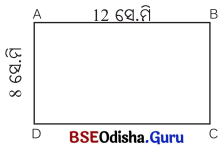
ମନେକର, ABCD ଗୋଟିଏ ଆୟତକ୍ଷେତ୍ର, ଯାହାର ଦୈର୍ଘ୍ୟ ଓ ପ୍ରସ୍ଥ ଯଥାକ୍ରମେ 12 ସେ.ମି. ଓ ୫ ସେ.ମି.। ଏହାର ପରିସୀମା କେତେ?
Class 6 Maths Chapter 6 Question Answer Odia Medium ପରିସୀମା ଓ କ୍ଷେତ୍ରଫଳ Page 129 Q1
Solution:
ଆୟତକ୍ଷେତ୍ରର ପରିସୀମା = ଏହାର ଚାରିବାହୁର ଦୈର୍ଘ୍ୟର ସମଷ୍ଟି
= AB + BC + CD + DA
= AB + BC + AB + BC
= 2 × AB + 2 × BC
= 2 × (AB + BC)
= 2 × (12 + 8) ସେ.ମି.
= 2 × (20 ସେ.ମି.)
= 40 ସେ.ମି.

ବର୍ଗକ୍ଷେତ୍ରର ପରିସୀମା: (Page No. 130)

Question 1.
ପାଖରେ ଦିଆଯାଇଥିବା 1 ମିଟର ପାର୍ଶ୍ଵ ବିଶିଷ୍ଟ ଗୋଟିଏ ବର୍ଗାକୃତି ଫଟୋ ଫ୍ରେମ୍ର ଚାରିପାଖରେ ଲିଲି ରଙ୍ଗୀନ୍ ଫିତା ଲଗାଇବାକୁ ଚାହୁଁଛି। ଏଥିପାଇଁ ଆବଶ୍ୟକୀୟ ହେଉଥ‌ିବା ରଙ୍ଗୀନ୍ ଫିତାର ଲମ୍ବ କେତେହେବ?
Class 6 Maths Chapter 6 Question Answer Odia Medium ପରିସୀମା ଓ କ୍ଷେତ୍ରଫଳ Page 130 Q1
Solution:
ଯେହେତୁ ଲିଲି ବର୍ଗାକୃତି ଫଟୋଫ୍ରେମ୍ବର ଚାରିପାଖରେ ରଙ୍ଗୀନ୍ ଫିତା ଲଗାଇବ, ତାକୁ ଫଟୋ ଫ୍ରେମ୍‌ର ପରିସୀମା ନିର୍ଣ୍ଣୟ କରିବାକୁ ହେବ।
ଆବଶ୍ୟକୀୟ ଫିତାର ଦୈର୍ଘ୍ୟ = ବର୍ଗାକୃତି କ୍ଷେତ୍ରର ପରିସୀମା।
= ବର୍ଗାକୃତି ଚାରି ବାହୁର ଦୈର୍ଘ୍ୟର ସମଷ୍ଟି
= 1 ମିଟର + 1 ମିଟର + 1 ମିଟର + 1 ମିଟର
= 4 ମିଟର।

Class 6 Maths Chapter 6 Question Answer Odia Medium ପରିସୀମା ଓ କ୍ଷେତ୍ରଫଳ

ତ୍ରିଭୁଜର ପରିସୀମା: (Page No. 131)

Question 1.
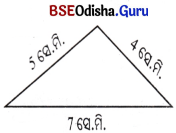
ମନେକର ଗୋଟିଏ ତ୍ରିଭୁଜର ତିନି ବାହୁର ଦୈର୍ଘ୍ୟ ଯଥାକ୍ରମେ 4 ସେ.ମି., 5 ସେ.ମି. ଓ 7 ସେ.ମି.। ଏହାର ପରିସୀମା ନିର୍ଣ୍ଣୟ କର।
Class 6 Maths Chapter 6 Question Answer Odia Medium ପରିସୀମା ଓ କ୍ଷେତ୍ରଫଳ Page 131 Q1
Solution:
ତ୍ରିଭୁଜର ପରିସୀମା = 4 ସେ.ମି. + 5 ସେ.ମି. + 7 ସେ.ମି.
= (4 + 5 + 7) ସେ.ମି.
= 16 ସେ.ମି.
ତ୍ରିଭୁଜର ପରିସୀମା = ଏହାର ତିନି ବାହୁର ଦୈର୍ଘ୍ୟର ସମଷ୍ଟି।

Question 2.
ଉଦାହରଣ–1: ପ୍ରତାପ 3 ମିଟର ଦୈର୍ଘ୍ୟ ଓ 2 ମିଟର ପ୍ରସ୍ଥ ବିଶିଷ୍ଟ ଗୋଟିଏ ଆୟତାକୃତି ଟେବୁଲ୍‌କ୍କଥ୍ର ଚାରିପାଖରେ ଝାଲେରି ଲଗାଇବାକୁ ଚାହୁଁଅଛି। ଦେଖୁବା ଝାଲେରିର ଦୈର୍ଘ୍ୟ କେତେ ହେବ?
Solution:
ଆୟତାକୃତି ଟେବୁଲ କ୍ଲଥର ଦୈର୍ଘ୍ୟ = 3 ମିଟର, ପ୍ରସ୍ଥ = 2 ମିଟର।
ପ୍ରତାପ ଟେବୁଲ୍ କ୍ଲଥର ଚାରିପାଖରେ ଝାଲେରି ଲଗାଇବାକୁ ଚାହେଁ।
ତେଣୁ, ଝାଲେରିର ଆବଶ୍ୟକୀୟ ଲମ୍ବ, ଆୟତାକୃତି ଟେବୁଲ୍ କ୍ଲଥର ପରିସୀମା ହେବ।
ଆୟତାକୃତି ଟେବୁଲ୍ କ୍ଲଥର ପରିସୀମା = 2 × (ଦୈର୍ଘ୍ୟ + ପ୍ରସ୍ଥ)
= 2 × (3 ମି. + 2 ମି.)
= 2 × 5 ମି.
= 10 ମିଟର।
∴ ଆବଶ୍ୟକୀୟ ଝାଲେରିର ଲମ୍ବ = 10 ମିଟର ହେବ।

Question 3.
ଉଦାହରଣ–2: 75 ମିଟର ପାର୍ଶ୍ଵ ବିଶିଷ୍ଟ ଗୋଟିଏ ବର୍ଗାକୃତି ପାର୍କର ଚାରିପାଖରେ ତିନିଥର ବୁଲି ଆସିବା ପାଇଁ ଉଷାକୁ କେତେ ଦୂରତା ଅତିକ୍ରମ କରିବାକୁ ପଡ଼ିବ?
Solution:
ବର୍ଗାକୃତି ପାର୍କର ବାହୁର ଦୈର୍ଘ୍ୟ = 75 ମିଟର
ବର୍ଗାକୃତି ପାର୍କର ପରିସୀମା = 4 × ଗୋଟିଏ ପାର୍ଶ୍ଵର ଦୈର୍ଘ୍ୟ
= 4 × 75 ମିଟର
= 300 ମିଟର।
ଥରେ ଘୂରି ଆସିବା ପାଇଁ ଉଷାକୁ ଯିବାକୁ ପଡ଼ିବ = 300 ମିଟର।
ଉଷା ତିନିଥର ବୁଲି ଆସିବା ପାଇଁ = 300 ମିଟର × 3 = 900 ମିଟର ଦୂରତା ଅତିକ୍ରମ କରିବ।

ଆସ ବୁଝିବା: (Page No. 132)

Question 1.
କେତେ ହେବ କୁହ:
(କ) ଆୟତକ୍ଷେତ୍ରର ପରିସୀମା = 14 ସେ.ମି., ପ୍ରସ୍ଥ = 2 ସେ.ମି., ଦୈର୍ଘ୍ୟ = ?
(ଖ) ବର୍ଗକ୍ଷେତ୍ରର ପରିସୀମା = 20 ସେ.ମି., ପ୍ରତ୍ୟେକ ବାହୁର ଦୈର୍ଘ୍ୟ = ?
(ଗ) ଆୟତକ୍ଷେତ୍ରର ପରିସୀମା = 10 ମି., ଦୈର୍ଘ୍ୟ = 3 ମି., ପ୍ରସ୍ଥ = ?
Solution:
(କ) ଆୟତକ୍ଷେତ୍ରର ପରିସୀମା = 2 × (ଦୈର୍ଘ୍ୟ + ପ୍ରସ୍ଥ)।
⇒ 2 × (ଦୈର୍ଘ୍ୟ + ପ୍ରସ୍ଥ) = 14 ସେ.ମି.
⇒ 2 × (ଦୈର୍ଘ୍ୟ + 2 ସେ.ମି.) = 14 ସେ.ମି.
⇒ 2 × ଦୈର୍ଘ୍ୟ + 4 ସେ.ମି. = 14 ସେ.ମି.
⇒ 2 × ଦୈର୍ଘ୍ୟ = 14 ସେ.ମି. – 4 ସେ.ମି. = 10 ସେ.ମି.
⇒ ଦୈର୍ଘ୍ୟ = \(\frac {10}{2}\) ସେ.ମି. = 5 ସେ.ମି.
∴ ଦୈର୍ଘ୍ୟ = 5 ସେ.ମି.

(ଖ) ବର୍ଗକ୍ଷେତ୍ରର ପରିସୀମା = 4 × ବାହୁର ଦୈର୍ଘ୍ୟ
⇒ 4 × ବାହୁର ଦୈର୍ଘ୍ୟ = 20 ସେ. ମି.।
⇒ ବାହୁର ଦୈର୍ଘ୍ୟ = \(\frac {20}{4}\) ସେ.ମି. = 5 ସେ.ମି.।
∴ ବର୍ଗକ୍ଷେତ୍ରର ପ୍ରତ୍ୟେକ ବାହୁର ଦୈର୍ଘ୍ୟ = 5 ସେ.ମି.।

(ଗ) ଆୟତକ୍ଷେତ୍ରର ପରିସୀମା = 10 ମି. ଦୈର୍ଘ୍ୟ = 3 ମି., ପ୍ରସ୍ଥ = ?
ଆୟତକ୍ଷେତ୍ରର ପରିସୀମା = 2 × (ଦୈର୍ଘ୍ୟ + ପ୍ରସ୍ଥ)
⇒ 2 × (ଦୈର୍ଘ୍ୟ + ପ୍ରସ୍ଥ) = 10 ମି.
⇒ 2 × (3 ମି. + ପ୍ରସ୍ଥ) = 10 ମି.
⇒ 6 ମି. + 2 ପ୍ରସ୍ଥ = 10 ମି.
⇒ 2 ପ୍ରସ୍ଥ = 10 ମି. – 6 ସେ.ମି. = 4 ମି.
⇒ ପ୍ରସ୍ଥ = \(\frac {4}{2}\) ମି. = 2 ମି.।
∴ ପ୍ରସ୍ଥ = 2 ମି.।

Class 6 Maths Chapter 6 Question Answer Odia Medium ପରିସୀମା ଓ କ୍ଷେତ୍ରଫଳ

Question 2.
ଖଣ୍ଡିଏ ତାରକୁ ବ୍ୟବହାର କରି 5 ସେ.ମି. ଦୈର୍ଘ୍ୟ ଓ 3 ସେ.ମି. ପ୍ରସ୍ଥ ବିଶିଷ୍ଟ ଗୋଟିଏ ଆୟତାକୃତି କ୍ଷେତ୍ର ତିଆରି କରାଗଲା। ଯଦି ଉକ୍ତ ତାରଖଣ୍ଡକୁ ସିଧା କରି ପୁଣି ବଙ୍କାଇ ଗୋଟିଏ ବର୍ଗାକୃତି କ୍ଷେତ୍ର ତିଆରି କରାଯାଏ, ତେବେ ବର୍ଗକ୍ଷେତ୍ରର ପ୍ରତ୍ୟେକ ବାହୁର ଦୈର୍ଘ୍ୟ କେତେ ହେବ?
Solution:
ଆୟତକ୍ଷେତ୍ରର ପରିସୀମା = 2 × (ଦୈର୍ଘ୍ୟ ଶ୍ଚ ପ୍ରସ୍ଥ)।
= 2 × (5 ସେ.ମି. + 3 ସେ.ମି.)
= 2 × 8 ସେ.ମି.
= 16 ସେ.ମି.।
∴ ତାରର ଦୈର୍ଘ୍ୟ = 16 ସେ.ମି.।
ଯଦି ଉକ୍ତ ତାରଖଣ୍ଡକୁ ସିଧାକରି ପୁଣି ବଙ୍କାକରି ବର୍ଗକ୍ଷେତ୍ର ତିଆରି କରାଯାଏ,
ବର୍ଗକ୍ଷେତ୍ରର ପରିସୀମା = 16 ସେ.ମି. = 4 × (ପ୍ରତ୍ୟେକ ବାହୁର ଦୈର୍ଘ୍ୟ)
ପ୍ରତ୍ୟେକ ବାହୁର ଦୈର୍ଘ୍ୟ = \(\frac {16}{4}\) = 4 ସେ.ମି.।
∴ ବର୍ଗକ୍ଷେତ୍ରର ପ୍ରତ୍ୟେକ ବାହୁର ଦୈର୍ଘ୍ୟ 4 ସେ.ମି.।

Question 3.
ଗୋଟିଏ ତ୍ରିଭୁଜର ପରିସୀମା 55 ସେ.ମି.। ଏହାର ପ୍ରଥମ ଦୁଇ ବାହୁର ଦୈର୍ଘ୍ୟ ଯଥାକ୍ରମେ 20 ସେ.ମି. ଓ 14 ସେ.ମି. ହେଲେ, ତୃତୀୟ ବାହୁର ଦୈର୍ଘ୍ୟ ନିର୍ଣ୍ଣୟ କର।
Solution:
ତ୍ରିଭୁଜର ପରିସୀମା = ଏହାର ତିନି ବାହୁର ଦୈର୍ଘ୍ୟର ସମଷ୍ଟି।
⇒ (ପ୍ରଥମ ବାହୁ + ଦ୍ଵିତୀୟ ବାହୁ + ତୃତୀୟ ବାହୁ) = 55 ସେ.ମି.।
⇒ (20 ସେ.ମି. + 14 ସେ.ମି. + ତୃତୀୟ ବାହୁ) = 55 ସେ.ମି.।
⇒ ତୃତୀୟ ବାହୁ + 34 ସେ.ମି. = 55 ସେ.ମି.।
⇒ ତୃତୀୟ ବାହୁ = 55 ସେ.ମି. – 34 ସେ.ମି. = 21 ସେ.ମି.।
∴ ତୃତୀୟ ବାହୁର ଦୈର୍ଘ୍ୟ = 21 ସେ.ମି.।

Question 4.
ଗୋଟିଏ ଆୟତାକୃତି ଉଦ୍ୟାନର ଦୈର୍ଘ୍ୟ 150 ମିଟର ଓ ପ୍ରସ୍ଥ 120 ମିଟର ଅଟେ। ପ୍ରତି ମିଟରକୁ 40 ଟଙ୍କା ହାରରେ ଉଦ୍ୟାନର ଚାରିପଟେ ବାଡ଼ ନିର୍ମାଣ କଲେ କେତେ ଟଙ୍କା ଖର୍ଚ୍ଚ ହେବ?
Solution:
ଗୋଟିଏ ଆୟତାକୃତି ଉଦ୍ୟାନର ଦୈର୍ଘ୍ୟ = 150 ମିଟର ଓ ପ୍ରସ୍ଥ = 120 ମିଟର।
ଆୟତାକୃତି କ୍ଷେତ୍ରର ପରିସୀମା = 2 × (ଦୈର୍ଘ୍ୟ + ପ୍ରସ୍ଥ)
= 2 × (150 ମିଟର + 120 ମିଟର)
= 2 × (150 + 120) ମିଟର
= 2 × 270 ମିଟର
= 540 ମିଟର।
ଚାରିପଟେ ବାଡ଼ ଦେବା ପାଇଁ 1 ମିଟରକୁ ଖର୍ଚ୍ଚ = 40 ଟଙ୍କା।
540 ମିଟରକୁ ଖର୍ଚ୍ଚ = 40 × 540 = 21600 ଟଙ୍କା।
∴ ଉଦ୍ୟାନର ଚାରିପଟେ ବାଡ଼ ନିର୍ମାଣ କଲେ 21600 ଟଙ୍କା ଖର୍ଚ୍ଚ ହେବ।

Question 5.
ଗୋଟିଏ ସୂତାଖଣ୍ଡର ଲମ୍ବ 36 ସେ.ମି.। ଯଦି ଏହାକୁ ବ୍ୟବହାର କରି ନିମ୍ନଲିଖ୍ତ ଆକୃତିର କ୍ଷେତ୍ର ତିଆରି କରାଯାଏ, ତେବେ କ୍ଷେତ୍ରର ବାହୁର ଦୈର୍ଘ୍ୟ କେତେ ହେବ,
(କ) ବର୍ଗକ୍ଷେତ୍ର
(ଖ) ସମବାହୁ ତ୍ରିଭୁଜ
(ଗ) ସୁଷମ ଷଡ଼ଭୁଜ
Solution:
ଗୋଟିଏ ସୂତାଖଣ୍ଡର ଲମ୍ବ 36 ସେ.ମି.। ଏହାକୁ ବ୍ୟବହାର କରି ବିଭିନ୍ନ ଆକୃତିର କ୍ଷେତ୍ର ତିଆରି କରାଗଲା।
ସେହି କ୍ଷେତ୍ରର ପରିସୀମା = 36 ସେ.ମି.।
(କ) ବର୍ଗକ୍ଷେତ୍ରର ପରିସୀମା = 4 × ଗୋଟିଏ ବାହୁର ଦୈର୍ଘ୍ୟ।
⇒ 4 × ବାହୁର ଦୈର୍ଘ୍ୟ = 36 ସେ.ମି.।
∴ ଗୋଟିଏ ବାହୁର ଦୈର୍ଘ୍ୟ = \(\frac {36}{9}\) = 9 ସେ.ମି.।

(ଖ) ସମବାହୁ ତ୍ରିଭୁଜର ପରିସୀମା = ତିନି ବାହୁର ସମଷ୍ଟି।
ତିନି ବାହୁର ସମଷ୍ଟି = 36 ସେ.ମି.
∴ ଗୋଟିଏ ବାହୁର ଦୈର୍ଘ୍ୟ = \(\frac {36}{3}\) = 12 ସେ.ମି.।

(ଗ) ସୁଷମ ଷଡ଼ଭୁଜ କ୍ଷେତ୍ରର ପରିସୀମା = ଛଅ ବାହୁର ସମଷ୍ଟି।
ଛଅ ବାହୁର ସମଷ୍ଟି = 36 ସେ.ମି.
∴ ଗୋଟିଏ ବାହୁର ଦୈର୍ଘ୍ୟ = \(\frac {36}{6}\) = 6 ସେ.ମି.।

Question 6.
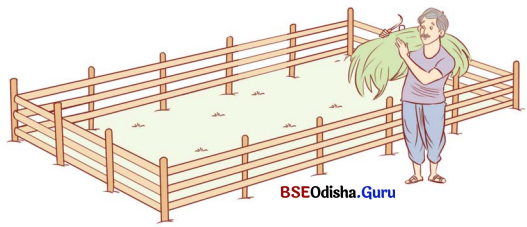
ଜଣେ ଚାଷୀଙ୍କର ଗୋଟିଏ ଆୟତାକୃତି କ୍ଷେତ୍ର ଅଛି, ଯାହାର ଦୈର୍ଘ୍ୟ 230 ମିଟର ଓ ପ୍ରସ୍ଥ 160 ମିଟର। ତଳ ଚିତ୍ରରେ ଦେଖାଯାଇଥ‌ିବା ଭଳି ସେ ଏହାକୁ ତିନି ଘେରା ଦଉଡ଼ି ବାନ୍ଧି ବାଡ଼ ଦେବାକୁ ଚାହିଁଲେ। କେତେ ମିଟର ଦଉଡ଼ି ଆବଶ୍ୟକ?
Class 6 Maths Chapter 6 Question Answer Odia Medium ପରିସୀମା ଓ କ୍ଷେତ୍ରଫଳ Page 132 Q6
Solution:
ଚାଷୀଙ୍କ ଆୟତାକୃତି କ୍ଷେତ୍ରର ଦୈର୍ଘ୍ୟ = 230 ମିଟର ଓ ପ୍ରସ୍ଥ = 160 ମିଟର।
ଆୟତାକୃତି କ୍ଷେତ୍ରର ପରିସୀମା = 2 × (ଦୈର୍ଘ୍ୟ + ପ୍ରସ୍ଥ)
= 2 × (230 ମିଟର + 160 ମିଟର)
= 2 × 390 ମିଟର
= 780 ମିଟର।
ଏକ ଘେରା ଦଉଡି଼ ବାନ୍ଧି ବାଡ଼ ଦେଲେ = 780 ମିଟର।
ତିନି ଘେରା ଦଉଡି଼ ବାନ୍ଧି ବାଡ଼ ଦେଲେ = 3 × 780 ମିଟର 2340 ମିଟର।
∴ ତିନି ଘେରା ଦଉଡ଼ି ବାନ୍ଧି ବାଡ଼ ଦେଲେ 2340 ମିଟର ଦଉଡ଼ି ଆବଶ୍ୟକ।

ଆସ ବୁଝିବା: (Page No. 133)

Question 1.
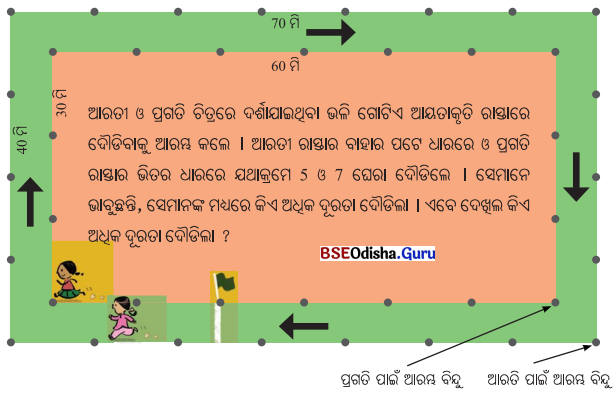
ଆରତୀ 5 ଘେରା ଏହିପରି ଦଉଡ଼ିଲେ କେତେ ଦୂରତା ଅତିକ୍ରମ କରିବ?
Solution:
ଆରତୀ ଦୌଡ଼ୁଥ‌ିବା ରାସ୍ତାର ଦୈର୍ଘ୍ୟ 70 ମିଟର ଓ ପ୍ରସ୍ଥ 40 ମିଟର।
ଆରତୀ ଏହି ରାସ୍ତାରେ ସମ୍ପୂର୍ଣ୍ଣ ଦଉଡ଼ିଲେ = 2 × (70 + 40) ମିଟର = 220 ମିଟର ଅତିକ୍ରମ କରିବ।
ଆରତୀ ଏହି ରାସ୍ତାରେ 5 ଥର ଦଉଡ଼ିଲେ = 5 × 220 ମିଟର = 1100 ମିଟର ଅତିକ୍ରମ କରିବ।

Question 2.
ପ୍ରଗତି 7 ଘେରା ଦଉଡ଼ିଲେ କେତେ ଦୂରତା ଅତିକ୍ରମ କରିବ ନିର୍ଣ୍ଣୟ କର। କିଏ ଅଧିକ ଦୂରତା ଦଉଡ଼ିଲା?
Solution:
ପ୍ରଗତି ଦୌଡ଼ୁଥ‌ିବା ରାସ୍ତାର ଦୈର୍ଘ୍ୟ 60 ମିଟର ଓ ପ୍ରସ୍ଥ 30 ମିଟର।
ପ୍ରଗତି ଏହି ରାସ୍ତାରେ ସମ୍ପୂର୍ଣ୍ଣ ଦଉଡ଼ିଲେ = 2 × (60 + 30) ମିଟର = 180 ମିଟର ଅତିକ୍ରମ କରିବ।
ପ୍ରଗତି ଏହି ରାସ୍ତାରେ 7 ଥର ଦଉଡ଼ିଲେ = 5 × 180 ମିଟର = 900 ମିଟର ଅତିକ୍ରମ କରିବ।
∴ ଆରତୀ ଅଧିକ ଦୂରତା ଦଉଡ଼ିଲା।

Class 6 Maths Chapter 6 Question Answer Odia Medium ପରିସୀମା ଓ କ୍ଷେତ୍ରଫଳ

Question 3.
ଚିନ୍ତାକର ଓ ସୂଚନା ଅନୁଯାୟୀ ପ୍ରତ୍ୟେକ ଅବସ୍ଥିତିକୁ ଚିହ୍ନିତ କର।
(କ) ଆରତୀ 250 ମିଟର ଦଉଡ଼ିବା ପରେ ଯେଉଁଠାରେ ପହଞ୍ଚିବ, ସେହି ସ୍ଥାନକୁ ‘A’ ନାମ ଦିଅ।
(ଖ) ଆରତୀ 500 ମିଟର ଦଉଡ଼ିବା ପରେ ଯେଉଁଠାରେ ପହଞ୍ଚିବ, ସେହି ସ୍ଥାନକୁ ‘B’ ନାମ ଦିଅ।
(ଗ) ଆରତୀ 1000 ମିଟର ଦୌଡ଼ିଲା। ସେ ତା’ର ଦୌଡ଼ିବା ପଥରେ କେତେ ପୂର୍ବ ଘେରା ଦଉଡ଼ିଲା?
(ଘ) ପ୍ରଗତି 250 ମିଟର ଦଉଡ଼ିବା ପରେ ଯେଉଁଠି ପହଞ୍ଚିବ, ସେହି ସ୍ଥାନକୁ ‘X’ ନାମ ଦିଅ।
(ଙ) ପ୍ରଗତି 500 ମିଟର ଦଉଡ଼ିବା ପରେ, ଯେଉଁ ସ୍ଥାନରେ ପହଞ୍ଚିବ, ସେହି ସ୍ଥାନକୁ ‘Y’ ଦିଅ।
(ଚ) ପ୍ରଗତି 1000 ମିଟର ଦଉଡ଼ିଲା। ସେ ତାର ଦଉଡ଼ିବା ପଥରେ କେତେ ପୂର୍ଣ ଘେରା ଦଉଡ଼ିଲା?
1000 ମିଟର ଦଉଡ଼ିବା ପରେ ଯେଉଁଠାରେ ପହଞ୍ଚିବ, ସେହି ସ୍ଥାନକୁ ‘Z’ ନାମ ଦିଅ।
Class 6 Maths Chapter 6 Question Answer Odia Medium ପରିସୀମା ଓ କ୍ଷେତ୍ରଫଳ Page 133 Q3
Solution:
(କ) ଉପରିସ୍ଥ ଚିତ୍ରରେ ସ୍ଥାନିତ କରାଯାଇଛି।
(ଖ) ଉପରିସ୍ଥ ଚିତ୍ରରେ ସ୍ଥାନିତ କରାଯାଇଛି।
(ଗ) ଆରତୀ ଥରକରେ ଦୌଡ଼ିଲା = 220 ମିଟର।
1000 ମିଟର ଦୌଡ଼ିଲା = 1000 ÷ 220 = 4.545 = 4 ପୂର୍ଣ୍ଣ ଘେରା।
(ଘ) ଉପରିସ୍ଥ ଚିତ୍ରରେ ସ୍ଥାନିତ କରାଯାଇଛି।
(ଙ) ଉପରିସ୍ଥ ଚିତ୍ରରେ ସ୍ଥାନିତ କରାଯାଇଛି।
(ଚ) ପ୍ରଗତୀ ଥରକରେ ଦୌଡ଼ିଲା = 180 ମିଟର।
1000 ମିଟର ଦୌଡ଼ିଲା = 1000 ÷ 180 = 5.555 = 5 ପୂର୍ଣ୍ଣ ଘେରା।
‘Z’ ସ୍ଥାନିତ ଉପରିସ୍ଥ ଚିତ୍ରରେ ସ୍ଥାନିତ କରାଯାଇଛି।

Page No. 134

Question 1.
ଯଦି ଉଭୟ ଧାବକ 350 ମିଟର ଦୌଡ଼ିବାକୁ ହୁଏ, ତେବେ ଆମକୁ ଦୁଇଟି ଧାରରେ ଦୁଇ ଧାବକଙ୍କ ଆରମ୍ଭ ସ୍ଥାନ କେଉଁଠାରେ ରହିବ, ତାହା ସ୍ଥିର କରିବାକୁ ହେବ। ମନେରଖ ଉଭୟ ଧାବକ 350 ମିଟର ଲମ୍ବ ଅତିକ୍ରମ କରିଛି। ଉଭୟଙ୍କର ଶେଷ ସାଧାରଣ ରେଖା ସ୍ପଷ୍ଟ କରାଯାଇଛି। ଆମକୁ ଉଭୟଙ୍କର ଦୌଡ଼ ଆରମ୍ଭ କରିବା ସ୍ଥାନକୁ ନିର୍ଣ୍ଣୟ କରିବାକୁ ହେବ। ଯଦି ଦୌଡ଼ପଥର ଭିତର ଧାରରେ ଦୌଡୁଥ‌ିବା ଧାବକର ଆରମ୍ଭ ବିନ୍ଦୁକୁ ‘A’ରେ ସୂଚାଇ ଦିଆଯିବ ଓ ବାହାର ଧାରରେ ଦୌଡୁଥ‌ିବା ଧାବକର ଆରମ୍ଭ ବିନ୍ଦୁକୁ ‘B’ ରେ ସୂଚାଇ ଦିଆଯିବ। ତେବେ A ଓ B ବିନ୍ଦୁକୁ ଚିତ୍ରରେ ସୂଚାଅ।
Solution:
ବାହାର ଧାରରେ ଧାବକକୁ 350 ମିଟର ଦୌଡ଼ିବାକୁ ହେବ।
ଆରମ୍ଭ ଅବସ୍ଥାନ B ପାଇଁ: ଯେହେତୁ ପରିସୀମା 600 ମିଟର, ଧାବକକୁ ସାଧାରଣ ଶେଷ ରେଖା 250 ମିଟର (600 – 350 = 250 ମିଟର) ପୂର୍ବରୁ ଆରମ୍ଭ ଅବସ୍ଥାନ ହେବ।
ବର୍ଗୀକୃତି ଦୌଡ଼ ପଥର ଭିତର ଧାର ପରିସୀମା = 4 × 100 = 400 ମିଟର।
ଭିତର ଧାରରେ ଧାବକକୁ 350 ମିଟର ଦୌଡ଼ିବାକୁ ହେବ।
ଆରମ୍ଭ ଅବସ୍ଥାନ A ପାଇଁ: ଯେହେତୁ ପରିସୀମା 400 ମିଟର ଧାବକକୁ ସାଧାରଣ ଶେଷରେଖାର 50 ମିଟର ପୂର୍ବରୁ ଆରମ୍ଭ କରିବ ବାହାର ଧାରର ପରିସୀମା = 4 × 150 = 600 ମିଟର।

Question 2.
ଆକଳନ କରି ତନଖୁ କର: ଖଣ୍ଡିଏ ଆୟତାକୃତି ଅଦରକାରୀ କାଗଜ ପୃଷ୍ଠା ନିଅ କିମ୍ବା ଖବର କାଗଜର ଗୋଟିଏ ପୃଷ୍ଠା ନିଅ। କାଗଜଖଣ୍ଡକୁ ବିଭିନ୍ନ ପ୍ରକାର ଆକୃତି ଆଧାରରେ ଖଣ୍ଡଖଣ୍ଡ କରି କାଟ। ପ୍ରତ୍ୟେକ ଆକୃତିର ବାହ୍ୟ ସୀମାର ଦୈର୍ଘ୍ୟକୁ ଆକଳନ କର ଓ ପରେ ସ୍କେଲ୍ ବା ମାପଫିତା ବ୍ୟବହାର କରି ପରିସୀମା ସ୍ଥିର କର। ତୁମର ଆକଳନ ଓ ପ୍ରକୃତ ମାପକୁ ତୁଳନା କର।
Solution:
ଛାତ୍ରଛାତ୍ରୀମାନେ ନିଜେ ଅଭ୍ୟାସ କରିବେ।

Question 3.
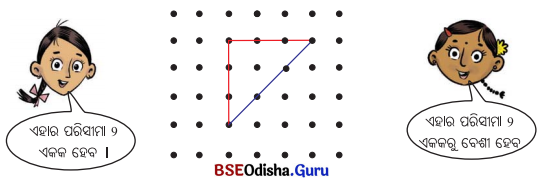
ଆରତୀ କହୁଛି, ତଳ ତ୍ରିଭୁଜ ଆକୃତିର ପରିସୀମା 9 ଏକକ ହେବ। ପ୍ରଗତି କହୁଛି, ଏହା 9 ଏକକ ନୁହେଁ, ବରଂ ଏହାର ପରିସୀମା 9 ଏକକରୁ ବେଶୀ ହେବ। ତୁମେ କ’ଣ ଭାବୁଛ?
Class 6 Maths Chapter 6 Question Answer Odia Medium ପରିସୀମା ଓ କ୍ଷେତ୍ରଫଳ Page 134 Q3
Solution:
ତ୍ରିଭୁଜର ପରିସୀମା 9 ଏକକରୁ ବେଶୀ ହେବ। ପ୍ରଗତି କଥା ଠିକ୍।
କାରଣ ତ୍ରିଭୁଜର ପ୍ରତ୍ୟେକ ବାହୁ 4 ଏକକ, ଏହାର ପରିସୀମା = 4 × 3 = 12 ଏକକ

Page No. 135

Question 1.
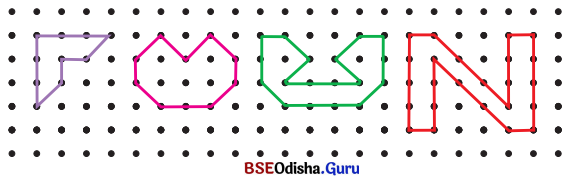
ତଳେ ଦିଆଯାଇଥୁବା ଚିତ୍ରମାନଙ୍କର ପରିସୀମା ସିଧା ଏକକ ଓ ତେରେଛା ଏକକ ଆଧାରରେ ଲେଖ।
Class 6 Maths Chapter 6 Question Answer Odia Medium ପରିସୀମା ଓ କ୍ଷେତ୍ରଫଳ Page 135 Q1
Solution:
ଚିତ୍ର (କ)ର ପରିସୀମା = 8 ସିଧା ଏକକ + 2 ତେରେଛା ଏକକ = 10 ଏକକରୁ ଅଧିକ।
ଚିତ୍ର (ଖ)ର ପରିସୀମା = 4 ସିଧା ଏକକ + 6 ତେରେଛା ଏକକ = 10 ଏକକରୁ ଅଧିକ।
ଚିତ୍ର (ଗ)ର ପରିସୀମା = 12 ସିଧା ଏକକ + 6 ତେରେଛା ଏକକ = 18 ଏକକରୁ ଅଧିକ।
ଚିତ୍ର (ଘ)ର ପରିସୀମା = 18 ସିଧା ଏକକ + 6 ତେରେଛା ଏକକ = 24 ଏକକରୁ ଅଧିକ।

Page No. 136

Question 1.
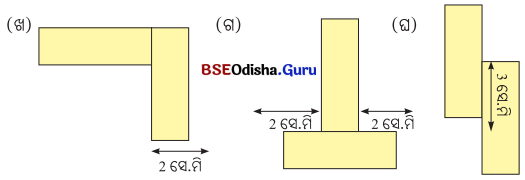
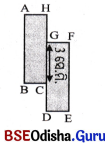
ନିମ୍ନରେ କାଗଜର ଦୁଇଖଣ୍ଡକୁ ଆଉ କିଛି ଉପାୟରେ ଯୋଡ଼ାଯାଇଅଛି, ପ୍ରତ୍ୟେକ କ୍ଷେତ୍ରର ପରିସୀମା ନିଶ୍ଚର୍ୟ କର।
Class 6 Maths Chapter 6 Question Answer Odia Medium ପରିସୀମା ଓ କ୍ଷେତ୍ରଫଳ Page 136 Q1
Solution:
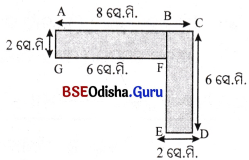
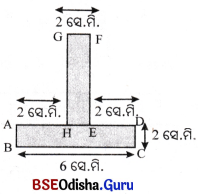
(ଖ) ପାର୍ଶ୍ଵସ୍ଥ କ୍ଷେତ୍ରର ପରିସୀମା = AB + BC + CD + DE + EF + FG + GA
= 6 + 2 + 6 + 2 + 4 + 6 + 2
= 28 ସେ.ମି.।
Class 6 Maths Chapter 6 Question Answer Odia Medium ପରିସୀମା ଓ କ୍ଷେତ୍ରଫଳ Page 136 Q1.1
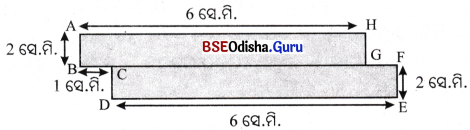
(ଗ) ପାର୍ଶ୍ଵସ୍ଥ କ୍ଷେତ୍ରର ପରିସୀମା = AB + BC + CD + DE + EF + FG + GH + HA
= 2 + 6 + 2 + 2 + 6 + 2 + 6 + 2
= 28 ସେ.ମି.।
Class 6 Maths Chapter 6 Question Answer Odia Medium ପରିସୀମା ଓ କ୍ଷେତ୍ରଫଳ Page 136 Q1.2
(ଘ) ପାର୍ଶ୍ୱସ୍ଥ କ୍ଷେତ୍ରର ପରିସୀମା = AB + BC + CD + DE + EF + FG + GH + HA
= 6 + 2 + 3 + 2 + 6 + 2 + 3 + 2
= 28 ସେ.ମି.।
Class 6 Maths Chapter 6 Question Answer Odia Medium ପରିସୀମା ଓ କ୍ଷେତ୍ରଫଳ Page 136 Q1.3

Class 6 Maths Chapter 6 Question Answer Odia Medium ପରିସୀମା ଓ କ୍ଷେତ୍ରଫଳ

Question 2.
କାଗଜ ଦୁଇଖଣ୍ଡକୁ ଏପରି ଯୋଡ଼, ଯେପରି ତାହାର ପରିସୀମା 22 ସେ.ମି. ହେବ।
Solution:
Class 6 Maths Chapter 6 Question Answer Odia Medium ପରିସୀମା ଓ କ୍ଷେତ୍ରଫଳ Page 136 Q2
∴ ଉପରିସ୍ଥ କ୍ଷେତ୍ରର ପରିସୀମା = AB + BC + CD + DE + EF + FG + GH + HA
= 2 + 1 + 2 + 6 + 2 + 1 + 2 + 6
= 22 ସେ.ମି.

6.2 କ୍ଷେତ୍ରଫଳ (Area)

Page No. 137

Question 1.
ଉଦାହରଣ 1: ଗୋଟିଏ ଚଟାଣର ଦୈର୍ଘ୍ୟ 5 ମିଟର ଓ ପ୍ରସ୍ଥ 4 ମିଟର। 3 ମିଟର ବାହୁ ବିଶିଷ୍ଟ ଗୋଟିଏ ବର୍ଗାକୃତି ଗାଲିଚା ଏହା ଉପରେ ବିଛାଇ ଦିଆଗଲା। ଗାଲିଚା ବିଛାଯାଇ ନଥୁବା କ୍ଷେତ୍ରର କ୍ଷେତ୍ରଫଳ ନିର୍ଣ୍ଣୟ କର।
Solution:
ଚଟାଣର ଦୈର୍ଘ୍ୟ = 5 ମିଟର, ଚଟାଣର ପ୍ରସ୍ଥ = 4 ମିଟର।
ଚଟାଣର କ୍ଷେତ୍ରଫଳ = ଦୈର୍ଘ୍ୟ × ପ୍ରସ୍ଥ
= (5 × 4) ବର୍ଗ ମିଟର
= 20 ବର୍ଗମିଟର।
ବର୍ଗୀକୃତି ଗାଲିଚାର ବାହୁ = 3 ମିଟର।
ଗାଲିଚାର କ୍ଷେତ୍ରଫଳ = ବାହୁ × ବାହୁ
= (3 × 3) ବର୍ଗ ମିଟର
= 9 ବର୍ଗମିଟର।
ତେଣୁ, ଗାଲିଚା ବିଛା ଯାଇଥିବା ଚଟାଣର କ୍ଷେତ୍ରଫଳ 9 ବର୍ଗମିଟର।
ଏଣୁ, ଗାଲିଚାଦ୍ଵାରା ବିଛା ହୋଇନଥିବା ଚଟାଣର କ୍ଷେତ୍ରଫଳ = ଚଟାଣର କ୍ଷେତ୍ରଫଳ – ଗାଲିଚା ବିଛା ହୋଇଥୁବା କ୍ଷେତ୍ରର କ୍ଷେତ୍ରଫଳ
= (20 – 9) ବର୍ଗମିଟର
= 11 ବର୍ଗମିଟର।

Question 2.
ଉଦାହରଣ–2: 12 ମିଟର ଦୈର୍ଘ୍ୟ ଓ 10 ମିଟର ପ୍ରସ୍ଥ ବିଶିଷ୍ଟ ଗୋଟିଏ ଜମିର ଚାରିକୋଣରେ 4 ମିଟର ବାହୁ ବିଶିଷ୍ଟ ଚାରୋଟି ବର୍ଗାକାର ଫୁଲ ପଟାଳି କରାଯାଇଅଛି। ଜମିର ଅବଶିଷ୍ଟ ଅଂଶର କ୍ଷେତ୍ରଫଳ ନିର୍ଣ୍ଣୟ କର।
Solution:
ଜମିର ଲମ୍ବ (l) = 12 ମିଟର, ଜମିର ପ୍ରସ୍ଥ (b) = 10 ମିଟର।
ଜମିର କ୍ଷେତ୍ର ଳ l × b = (12 × 10) ବର୍ଗମିଟର = 120 ବର୍ଗମିଟର।
ଫୁଲ ପଟାଳିର ପ୍ରତ୍ୟେକ ବାହୁର ଦୈର୍ଘ୍ୟ (s) = 4 ମିଟର।
ଗୋଟିଏ ଫୁଲ ପଟାଳିର କ୍ଷେତ୍ରଫଳ = s × s = (4 × 4) ବର୍ଗମିଟର = 16 ବର୍ଗମିଟର।
ତେଣୁ ଚାରୋଟି ଫୁଲ ପଟାଳିର କ୍ଷେତ୍ରଫଳ = 16 ବର୍ଗମିଟର × 4 = 64 ବର୍ଗମିଟର।
ଅତଏବ, ଜମିର ଅବଶିଷ୍ଟ ଅଂଶର କ୍ଷେତ୍ରଫଳ = ସମ୍ପୂର୍ଣ୍ଣ ଜମିର କ୍ଷେତ୍ରଫଳ – ଚାରୋଟି ଫୁଲ ପଟାଳିର କ୍ଷେତ୍ରଫଳ
= (120 – 64) ବର୍ଗମିଟର
= 56 ବର୍ଗମିଟର।

ଆସ ବୁଝିବା: (Page No. 138)

Question 1.
25 ମିଟର ଦୈର୍ଘ୍ୟ ବିଶିଷ୍ଟ ଏକ ଆୟତାକୃତି ଉଦ୍ୟାନର କ୍ଷେତ୍ରଫଳ 300 ବର୍ଗମିଟର। ଏହି ଉଦ୍ୟାନର ପ୍ରସ୍ଥ କେତେ?
Solution:
ଆୟତାକୃତି ଉଦ୍ୟାନର ଦୈର୍ଘ୍ୟ = l = 25 ମିଟର।
କ୍ଷେତ୍ରଫଳ = 300 ବର୍ଗମିଟର। ପ୍ରସ୍ଥ = b = ?
ଆୟତାକୃତି ଉଦ୍ୟାନର କ୍ଷେତ୍ରଫଳ ଦୈର୍ଘ୍ୟ × ପ୍ରସ୍ଥ।
⇒ 300 = l × b
⇒ 25 × b = 300 ବର୍ଗମିଟର
⇒ b = \(\frac {300}{25}\) = 12 ମିଟର।
∴ ଉଦ୍ୟାନର ପ୍ରସ୍ଥ 12 ମିଟର।

Question 2.
500 ମିଟର ଦୈର୍ଘ୍ୟ ଓ 200 ମିଟର ପ୍ରସ୍ଥ ବିଶିଷ୍ଟ ଗୋଟିଏ ଆୟତାକୃତି ଜମିରେ ଟାଇଲ୍ ବିଛାଇବା ପାଇଁ ପ୍ରତି ବର୍ଗମିଟରକୁ 5 ଟଙ୍କା ହାରରେ କେତେ ଖର୍ଚ୍ଚ ହେବ?
Solution:
ଆୟତାକୃତି ଜମିର ଦୈର୍ଘ୍ୟ = 500 ମିଟର, ପ୍ରସ୍ଥ = 200 ମିଟର
ଆୟତାକୃତି ଜମିର କ୍ଷେତ୍ରଫଳ = ଦୈର୍ଘ୍ୟ × ପ୍ରସ୍ଥ
= 500 × 200
= 1,00,000 ବର୍ଗମିଟର।
1 ବର୍ଗମିଟରକୁ ଖର୍ଚ୍ଚ = 5 ଟଙ୍କା।
1,00,000 ବର୍ଗମିଟରକୁ ଖର୍ଚ୍ଚ = 5 × 1,00,000 ଟଙ୍କା = 5,00,000 ଟଙ୍କା ଖର୍ଚ୍ଚ ହେବ।

Question 3.
ଗୋଟିଏ ଆୟତାକୃତି ନଡ଼ିଆ ବଗିଚାର ଲମ୍ବ 100 ମିଟର ଓ ଚଉଡ଼ା 50 ମିଟର। ଯଦି ଗୋଟିଏ ନଡ଼ିଆ ଗଛ ଲଗାଇବା ପାଇଁ 25 ବର୍ଗମିଟରର ଜାଗା ଆବଶ୍ୟକ ହୁଏ, ତେବେ ବଗିଚାରେ ସର୍ବାଧୁକ କେତେ ନଡ଼ିଆଗଛ ଲାଗିପାରିବ?
Solution:
ଆୟତାକୃତି ନଡ଼ିଆ ବଗିଚାର ଦୈର୍ଘ୍ୟ = 100 ମିଟର,
ପ୍ରସ୍ଥ = 50 ମିଟର।
ଆୟତାକୃତି ନଡ଼ିଆ ବଗିଚାର କ୍ଷେତ୍ରଫଳ = ଦୈର୍ଘ୍ୟ × ପ୍ରସ୍ଥ।
= 100 ମିଟର × 50 ମିଟର
= 5000 ବର୍ଗମିଟର।
25 ବର୍ଗମିଟରରେ ଲାଗେ 1 ଟି ନଡ଼ିଆଗଛ।
5000 ବର୍ଗମିଟରରେ ଲାଗିବ = \(\frac {5000}{25}\) = 200 ନଡ଼ିଆଗଛ।
∴ ବଗିଚାରେ 200 ନଡ଼ିଆଗଛ ଲାଗିପାରିବ।

Question 4.
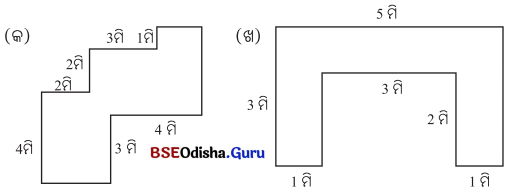
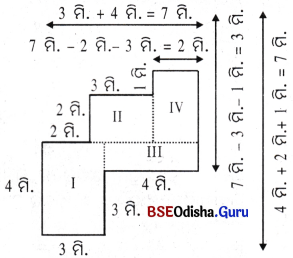
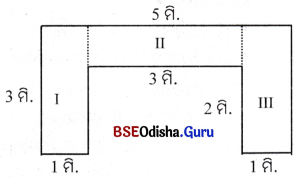
ତଳେ ଦିଆଯାଇଥିବା ଆକୃତିଗୁଡ଼ିକୁ ଆୟତାକୃତି କ୍ଷେତ୍ରରେ ବିଭକ୍ତ କରି କ୍ଷେତ୍ରଫଳ ନିର୍ଣ୍ଣୟ କର। (ସମସ୍ତ ମାପ ମିଟର ଏକକରେ ଦିଆଯାଇଅଛି।)
Class 6 Maths Chapter 6 Question Answer Odia Medium ପରିସୀମା ଓ କ୍ଷେତ୍ରଫଳ Page 138 Q4
Solution:
(କ) I କ୍ଷେତ୍ରର କ୍ଷେତ୍ରଫଳ = ଦୈର୍ଘ୍ୟ × ପ୍ରସ୍ଥ = 4 ମି. × 3 ମି, = 12 ବର୍ଗମିଟର।
II କ୍ଷେତ୍ରର କ୍ଷେତ୍ରଫଳ = ଦୈର୍ଘ୍ୟ × ପ୍ରସ୍ଥ = 3 ମି. × 2 ମି. = 6 ବର୍ଗମିଟର।
III କ୍ଷେତ୍ରର କ୍ଷେତ୍ରଫଳ = ଦୈର୍ଘ୍ୟ × ପ୍ରସ୍ଥ = 4 ମି. × 1 ମି. = 4 ବର୍ଗମିଟର।
IV କ୍ଷେତ୍ରର କ୍ଷେତ୍ରଫଳ = ଦୈର୍ଘ୍ୟ × ପ୍ରସ୍ଥ = 3 ମି. × 2 ମି. = 6 ବର୍ଗମିଟର।
∴ ସମୁଦାୟ କ୍ଷେତ୍ରର କ୍ଷେତ୍ରଫଳ = 12 ବର୍ଗମିଟର + 6 ବର୍ଗମିଟର + 4 ବର୍ଗମିଟର + 6 ବର୍ଗମିଟର = 28 ବର୍ଗମିଟର।
Class 6 Maths Chapter 6 Question Answer Odia Medium ପରିସୀମା ଓ କ୍ଷେତ୍ରଫଳ Page 138 Q4.1

(ଖ) I କ୍ଷେତ୍ରର କ୍ଷେତ୍ରଫଳ = ଦୈର୍ଘ୍ୟ × ପ୍ରସ୍ଥ = 3 ମି. × 1 ମି. = 3 ବର୍ଗମିଟର।
II କ୍ଷେତ୍ରର କ୍ଷେତ୍ରଫଳ = ଦୈର୍ଘ୍ୟ × ପ୍ରସ୍ଥ = 3 ମି. × 1 ମି. = 3 ବର୍ଗମିଟର।
III କ୍ଷେତ୍ରର କ୍ଷେତ୍ରଫଳ = ଦୈର୍ଘ୍ୟ × ପ୍ରସ୍ଥ = 3 ମି. × 1 ମି. = 3 ବର୍ଗମିଟର।
∴ ସମୁଦାୟ କ୍ଷେତ୍ରର କ୍ଷେତ୍ରଫଳ = 3 ବର୍ଗମିଟର + 3 ବର୍ଗମିଟର + 3 ବର୍ଗମିଟର = 9 ବର୍ଗମିଟର।
Class 6 Maths Chapter 6 Question Answer Odia Medium ପରିସୀମା ଓ କ୍ଷେତ୍ରଫଳ Page 138 Q4.2

ଆସ ବୁଝିବା: (Page No. 139)

ପାଠ୍ୟ ପୁସ୍ତକର ଶେଷରେ ଥିବା ଟ୍ୟାନ୍‌ଗ୍ରାମ୍‌କୁ ଖଣ୍ଡ ଖଣ୍ଡ କରି କାଟ।
Class 6 Maths Chapter 6 Question Answer Odia Medium ପରିସୀମା ଓ କ୍ଷେତ୍ରଫଳ Page 139 Q1

Question 1.
ଏହି ଟ୍ୟାଗ୍ରାମ୍‌ର କେତେଖଣ୍ଡ କ୍ଷେତ୍ରର କ୍ଷେତ୍ରଫଳ ସହ ସମାନ ବାହାର କର?
Solution:
ଦୁଇଟି ସମାନ କ୍ଷେତ୍ରଫଳ ବିଶିଷ୍ଟ ଟ୍ୟାଗ୍ରାମ୍ ଅଛି।

Question 2.
ଆକୃତି C ତୁଳନାରେ ଆକୃତି D କେତେ ବଡ଼ ? ଆକୃତି C, D ଏବଂ E ମଧ୍ୟରେ କ’ଣ ସମ୍ପର୍କ ଅଛି?
Solution:
ଆକୃତି D, ଆକୃତି C ଠାରୁ ଦୁଇଗୁଣ ବଡ଼। ଏହି ଚିତ୍ରରୁ ଜଣାପଡୁଛି ଯେ, ଆକୃତି C ଓ ଆକୃତି E ର କ୍ଷେତ୍ରଫଳ ଆକୃତି Dର କ୍ଷେତ୍ରଫଳ ସହ ସମାନ।

Question 3.
ଆକୃତି D ଓ F ମଧ୍ୟରେ କେଉଁ ଖଣ୍ଡର କ୍ଷେତ୍ରଫଳ ଅଧୁକ? ତୁମ ଉତ୍ତରର କାରଣ ଉପସ୍ଥାପନ କର।
Solution:
ଯେହେତୁ ମଧ୍ୟମ ତ୍ରିଭୁଜ ଓ ବର୍ଗକ୍ଷେତ୍ର ଦୁଇଟି କ୍ଷୁଦ୍ର ଟ୍ୟାଗ୍ରାମ୍ ତ୍ରିଭୁଜରେ ଗଠିତ। ସେମାନଙ୍କ କ୍ଷେତ୍ରଫଳ କ୍ଷୁଦ୍ର ତ୍ରିଭୁଜର 2x। ତେଣୁ ଉଭୟର କ୍ଷେତ୍ରଫଳ ସମାନ ହେବ।

Class 6 Maths Chapter 6 Question Answer Odia Medium ପରିସୀମା ଓ କ୍ଷେତ୍ରଫଳ

Question 4.
ଆକୃତି F ଓ B ମଧ୍ୟରେ କେଉଁ ଖଣ୍ଡର କ୍ଷେତ୍ରଫଳ ଅଧିକ? ତୁମ ଉତ୍ତରର ଯଥାର୍ଥତା ପ୍ରତିପାଦନ କର।
Solution:
ଯେହେତୁ ମଧ୍ୟମ ତ୍ରିଭୁଜ ଓ ରମ୍ବସ୍ ଦୁଇଟି କ୍ଷୁଦ୍ର ଟ୍ୟାଗ୍ରାମ୍ ତ୍ରିଭୁଜରେ ଗଠିତ। ସେମାନଙ୍କ କ୍ଷେତ୍ରଫଳ କ୍ଷୁଦ୍ର ତ୍ରିଭୁଜର 2x। ତେଣୁ ଉଭୟର କ୍ଷେତ୍ରଫଳ ସମାନ।

Question 5.
ଆକୃତି G ତୁଳନାରେ ଆକୃତି A ର କ୍ଷେତ୍ରଫଳ କେତେ? ଏହା ଦୁଇଗୁଣ ବଡ଼ କି? ଚାରିଗୁଣ ବଡ଼ କି?
ସୂଚନା: ଟ୍ୟାନ୍‌ଙ୍ଗ୍ରାମ୍ ଖଣ୍ଡଗୁଡ଼ିକରେ, ଆକୃତିଗୁଡ଼ିକୁ ଗୋଟିକ ଉପରେ ଆଉ ଗୋଟିଏକୁ ରଖୁଲେ ଆମେ ଜାଣିପାରିବା ଆକୃତି A ଓ ଆକୃତି B ର କ୍ଷେତ୍ରଫଳ ସମାନ। ଆକୃତି C ଓ ଆକୃତି E କ୍ଷେତ୍ରଫଳ ସମାନ, ତୁମେ ଏହା ମଧ୍ୟ ଜାଣିପାରିବ। ଆକୃତି C ଓ ଆକୃତି E ଦ୍ଵାରା ଆକୃତି D କୁ ସମ୍ପୂର୍ଣ୍ଣ ଭାବେ ଯୋଡ଼ାଇ ଦିଆଯାଇପାରିବ, ଅର୍ଥାତ୍ ଆକୃତି D ର କ୍ଷେତ୍ରଫଳ ଆକୃତି C କିମ୍ବା E ର କ୍ଷେତ୍ରଫଳ ଦୁଇଗୁଣ ଇତ୍ୟାଦି।
Solution:
ଆକୃତି A ର କ୍ଷେତ୍ରଫଳ ଆକୃତି G କ୍ଷେତ୍ରଫଳର ଦୁଇଗୁଣ।

Question 6.
ତୁମେ ଏବେ କହିପାରିବ କି, ଆକୃତି C ର କ୍ଷେତ୍ରଫଳ ଆଧାରରେ ସମସ୍ତ ସାତଖଣ୍ଡକୁ ନେଇ ଗଠିତ ବଡ଼କ୍ଷେତ୍ରର କ୍ଷେତ୍ରଫଳ କେତେ?
Solution:
ମନେକର C ର କ୍ଷେତ୍ରଫଳ = x
D ର କ୍ଷେତ୍ରଫଳ = C ର କ୍ଷେତ୍ରଫଳର ଦୁଇଗୁଣ = 2x
E ର କ୍ଷେତ୍ରଫଳ = C ର କ୍ଷେତ୍ରଫଳ = x
F ର କ୍ଷେତ୍ରଫଳ = C ର କ୍ଷେତ୍ରଫଳର ଦୁଇଗୁଣ = 2x
G ର କ୍ଷେତ୍ରଫଳ = C ର କ୍ଷେତ୍ରଫଳର ଦୁଇଗୁଣ = 2x
A ର କ୍ଷେତ୍ରଫଳ = F ର କ୍ଷେତ୍ରଫଳର ଦୁଇଗୁଣ = 2 × 2x = 4x
B ର କ୍ଷେତ୍ରଫଳ = A ର କ୍ଷେତ୍ରଫଳ = 4x
∴ ବଡ଼ ଆକୃତିର ମୋଟ କ୍ଷେତ୍ରଫଳ = (A + B + C + D + E + F + G) ଆକୃତିର କ୍ଷେତ୍ରଫଳ
= 4x + 4x + x + 2x + x + 2x + 2x
= 16x
= 16C
ଅର୍ଥାତ୍ ବଡ଼ ଆକୃତି ବିଶିଷ୍ଟ ବର୍ଗକ୍ଷେତ୍ରର କ୍ଷେତ୍ରଫଳର ଆକୃତି = C କ୍ଷେତ୍ରଫଳର 16 ଗୁଣ।

Question 7.
ଏହି ସାତଖଣ୍ଡକୁ ସଜାଡ଼ି ଗୋଟିଏ ଆୟତକ୍ଷେତ୍ର ଗଠନ କର। ଆକୃତି C ର କ୍ଷେତ୍ର ଳ ଆଧାରରେ ଏହି ଆୟତକ୍ଷେତ୍ରର କ୍ଷେତ୍ର ଳ କେତେ ହେବ? ତୁମ ଉତ୍ତରର ଯଥାର୍ଥତା ସ୍ତୁତିପାଦନ କର।
Solution:
ସମସ୍ତ 7 ଖଣ୍ଡ ବିଶିଷ୍ଟ ଟ୍ୟାଗ୍ରାମ୍ ଆୟତଚିତ୍ର ହେଉଛି ଗୋଟିଏ ଟ୍ୟାନ୍‌ଗ୍ରାମ୍ ବର୍ଗ ଯାହାର 5 ଖଣ୍ଡ ଦୁଇଟି ବଡ଼ ତ୍ରିଭୁଜରେ ଗଠିତ ବିସ୍ତାରିତ। ସମସ୍ତ ସାତଟି ଟ୍ୟାଗ୍ରାମ୍ ଗୋଟିଏ ଗୋଟିଏ ଆୟତଚିତ୍ର ଗଠନ କରନ୍ତି। ଆକୃତି C ର କ୍ଷେତ୍ରଫଳ ଆଧାରରେ ଏହି ଆୟତଚିତ୍ରର କ୍ଷେତ୍ରଫଳ କ୍ଷୁଦ୍ର ତ୍ରିଭୁଜର 16 ଗୁଣ ହେବ।

Question 8.
ଏହି ସାତଖଣ୍ଡକୁ ନେଇ ଗଠିତ ବର୍ଗକ୍ଷେତ୍ର ଓ ଆୟତକ୍ଷେତ୍ରର ପରିସୀମା ସମାନ ହେବା ନା ଭିନ୍ନ ହେବ ? କିପରି ଉତ୍ତର ପାଇଲେ ତାହା ନିର୍ଣ୍ଣୟ କର।
Solution:
ଏହି ସାତଖଣ୍ଡକୁ ନେଇ ଗଠିତ ବର୍ଗକ୍ଷେତ୍ର ଓ ଆୟତକ୍ଷେତ୍ରର ପରିସୀମା ସମାନ ହେଇ।

Page No. 140

Question 1.
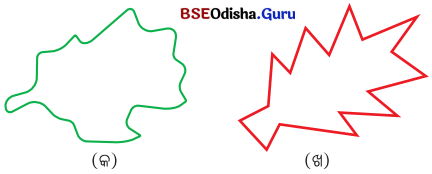
ପାର୍ଶ୍ଵରେ ଦିଆଯାଇଥବା (ଚିତ୍ର ଦୁଇଟିକୁ) ଲକ୍ଷ୍ୟ କର। ଏବେ ଅନୁମାନ କରି କୁହ, କାହାର କ୍ଷେତ୍ରଫଳ ଅଧିକ?
Class 6 Maths Chapter 6 Question Answer Odia Medium ପରିସୀମା ଓ କ୍ଷେତ୍ରଫଳ Page 140 Q1
Solution:
ନିଜେ ଅଭ୍ୟାସ କର।

Question 2.
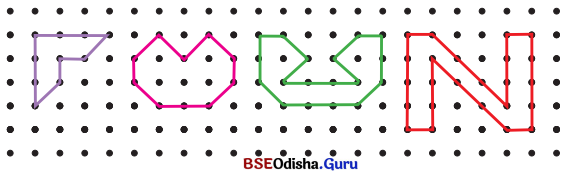
ନିମ୍ନଲିଖତ କ୍ଷେତ୍ରଗୁଡ଼ିକର କ୍ଷେତ୍ରଫଳ ନିର୍ଣ୍ଣୟ କର।
Class 6 Maths Chapter 6 Question Answer Odia Medium ପରିସୀମା ଓ କ୍ଷେତ୍ରଫଳ Page 140 Q2
Solution:
ପ୍ରଥମ କ୍ଷେତ୍ର:
Class 6 Maths Chapter 6 Question Answer Odia Medium ପରିସୀମା ଓ କ୍ଷେତ୍ରଫଳ Page 140 Q2.1
∴ ପ୍ରଥମ କ୍ଷେତ୍ରର କ୍ଷେତ୍ରଫଳ = 3 + 1 = 4 ବର୍ଗ ଏକକ।
ଦ୍ଵିତୀୟ କ୍ଷେତ୍ର:
Class 6 Maths Chapter 6 Question Answer Odia Medium ପରିସୀମା ଓ କ୍ଷେତ୍ରଫଳ Page 140 Q2.2
∴ ଦ୍ଵିତୀୟ କ୍ଷେତ୍ରର କ୍ଷେତ୍ରଫଳ = 6 + 3 = 9 ବର୍ଗ ଏକକ।
ତୃତୀୟ କ୍ଷେତ୍ର:
Class 6 Maths Chapter 6 Question Answer Odia Medium ପରିସୀମା ଓ କ୍ଷେତ୍ରଫଳ Page 140 Q2.3
∴ ତୃତୀୟ କ୍ଷେତ୍ରର କ୍ଷେତ୍ରଫଳ = 7 + 3 = 10 ବର୍ଗ ଏକକ।
ଚତୁର୍ଥ କ୍ଷେତ୍ର:
Class 6 Maths Chapter 6 Question Answer Odia Medium ପରିସୀମା ଓ କ୍ଷେତ୍ରଫଳ Page 140 Q2.4
∴ ଚତୁର୍ଥ କ୍ଷେତ୍ରର କ୍ଷେତ୍ରଫଳ = 8 + 3 = 11 ବର୍ଗ ଏକକ।

Page No. 141

Question 1.
ଗୋଟିଏ ଉପରେ ଆଉ ଗୋଟିଏକୁ ନମଡ଼ାଇ ଏବଂ ବିନା ଫାଙ୍କରେ ଥିବା ସ୍ଥାନକୁ ବିଭିନ୍ନ ଆକୃତି (ତ୍ରିଭୁଜ ଓ ଆତୟଚିତ୍ର)ଦ୍ଵାରା ପୂରଣ କର ଓ କ୍ଷେତ୍ରଫଳ ନିରୂପଣ କରିବା ପାଇଁ ଅନ୍ୟ ଆକୃତି ଅପେକ୍ଷା ବର୍ଗାକୃତି ବ୍ୟବହାର କରିବାର ଉପକାରିତା ଜାଣ। କ୍ଷେତ୍ରଫଳ ନିରୂପଣ କରିବା ପାଇଁ ବର୍ଗକ୍ଷେତ୍ର ଆକୃତି ଯେ ସର୍ବୋତ୍ତମ ଆକୃତି, ତା’ର କାରଣଗୁଡ଼ିକର ତାଲିକା କର।
1. ତୁମ ଶ୍ରେଣୀଗୃହ ଚଟାଣର କ୍ଷେତ୍ରଫଳ (ବର୍ଗ ଏକକରେ) ନିର୍ଣ୍ଣୟ କର।
2. ତୁମ ବିଦ୍ୟାଳୟ ଖେଳ ପଡ଼ିଆର କ୍ଷେତ୍ରଫଳ (ବର୍ଗ ଏକକରେ) ନିର୍ଣ୍ଣୟ କର।
Solution:
ଛାତ୍ରଛାତ୍ରୀମାନେ ନିଜେ କରିବେ।

Class 6 Maths Chapter 6 Question Answer Odia Medium ପରିସୀମା ଓ କ୍ଷେତ୍ରଫଳ

Question 2.
ଆସ ଅନୁସନ୍ଧାନ କରିବା
ଗୋଟିଏ ବର୍ଗାକୃତି ଗ୍ରୀଡ଼ କାଗଜରେ (1 ବର୍ଗକ୍ଷେତ୍ର = 1 ବର୍ଗ ଏକକ), ଦୈର୍ଘ୍ୟ ଓ ପ୍ରସ୍ଥ ପୂର୍ଣ୍ଣସଂଖ୍ୟା ବିଶିଷ୍ଟ ମାପ ଏକକ ନେଇ ଯେତେ ସମ୍ଭବ ଆୟତକ୍ଷେତ୍ର ପ୍ରସ୍ତୁତ କର, ଯେପରି ଆୟତକ୍ଷେତ୍ରର କ୍ଷେତ୍ରଫଳ 24 ବର୍ଗ ଏକକ ହେବ।
(କ) କେଉଁ ଆୟତକ୍ଷେତ୍ରର ପରିସୀମା ସବୁଠାରୁ ଅଧ‌ିକ?
(ଖ) କେଉଁ ଆୟତକ୍ଷେତ୍ରର ପରିସୀମା ସବୁଠାର କମ୍?
(ଗ) ଯଦି ତୁମେ 32 ବର୍ଗ ସେ.ମି. କ୍ଷେତ୍ରଫଳ ବିଶିଷ୍ଟ ଗୋଟିଏ ଆୟତକ୍ଷେତ୍ର ନେବ ତେବେ ତୁମର ଉତ୍ତର କ’ଣ ହେବ? ସମାନ କ୍ଷେତ୍ରଫଳ ଥାଇ ଯଦି ଏକାଧ୍ଵକ ଆୟତକ୍ଷେତ୍ର ଅଙ୍କାଯିବ ତେବେ ସର୍ବାଧ‌ିକ କିମ୍ବା ସର୍ବନିମ୍ନ ପରିସୀମା କେତେ ହେବ, ତୁମେ ଅନୁମାନ କରି କହିପାରିବ କି?
Solution:
ଛାତ୍ରଛାତ୍ରୀମାନେ ନିଜେ କରିବେ।

6.3 ତ୍ରିଭୁଜର କ୍ଷେତ୍ରଫଳ (Area of a Triangle)

Page No. 142

Question 1.
ଗୋଟିଏ ତ୍ରିଭୁଜକୁ ଅନ୍ୟ ଗୋଟିଏ ତ୍ରିଭୁଜ ଉପରେ ରଖ୍ ତ୍ରିଭୁଜ ଦୁଇଟିକୁ ମିଳାଇବାକୁ ଚେଷ୍ଟାକର। ଏବେ ତ୍ରିଭୁଜ ଦୁଇଟି ପରସ୍ପର ସଂପୂର୍ଣ୍ଣ ମିଶିଗଲା କି? ସେମାନଙ୍କର କ୍ଷେତ୍ରଫଳ ସମାନ ଅଛି କି?
Solution:
ଛାତ୍ରଛାତ୍ରୀମାନେ ନିଜେ କରିବେ।

Question 2.
ତୁମେ ଏହି କାର୍ଯ୍ୟରୁ କିଛି ସିଦ୍ଧାନ୍ତରେ ଉପନୀତ ହୋଇପାରିବ କି? ନିଜର ସିଦ୍ଧାନ୍ତକୁ ଏଠାରେ ଲେଖ।
Solution:
ଛାତ୍ରଛାତ୍ରୀମାନେ ନିଜେ କରିବେ।

Page No. 143

ସାରଣୀ କାଗଜ ସାହାଯ୍ୟରେ ଯେକୌଣସି ଆବଦ୍ଧ ଚିତ୍ରର କ୍ଷେତ୍ରଫଳ ନିର୍ଣ୍ଣୟ କର।
Class 6 Maths Chapter 6 Question Answer Odia Medium ପରିସୀମା ଓ କ୍ଷେତ୍ରଫଳ Page 143 Q1

Question 1.
ନୀଳରଙ୍ଗର BAD ତ୍ରିଭୁଜର କ୍ଷେତ୍ରଫଳ ନିର୍ଣ୍ଣୟ କର।
Solution:
Class 6 Maths Chapter 6 Question Answer Odia Medium ପରିସୀମା ଓ କ୍ଷେତ୍ରଫଳ Page 143 Q1.1
∴ BAD ତ୍ରିଭୁଜର କ୍ଷେତ୍ରଫଳ = 6 + 1 + 3 = 10 ବର୍ଗ ଏକକ।

Question 2.
ନାଲି ରଙ୍ଗର ABE ତ୍ରିଭୁଜର କ୍ଷେତ୍ରଫଳ ନିର୍ଣ୍ଣୟ କର।
Solution:
Class 6 Maths Chapter 6 Question Answer Odia Medium ପରିସୀମା ଓ କ୍ଷେତ୍ରଫଳ Page 143 Q2
∴ ABE ତ୍ରିଭୁଜର କ୍ଷେତ୍ରଫଳ = 5 + 1 + 4 = 10 ବର୍ଗ ଏକକ।

Question 3.
ABCD ଆୟତକ୍ଷେତ୍ରର କ୍ଷେତ୍ରଫଳ = __________?
Solution:
Class 6 Maths Chapter 6 Question Answer Odia Medium ପରିସୀମା ଓ କ୍ଷେତ୍ରଫଳ Page 143 Q3
∴ ABCD ଆୟତକ୍ଷେତ୍ରର କ୍ଷେତ୍ରଫଳ = 20 ବର୍ଗ ଏକକ।

ଆସ ବୁଝିବା: (Page No. 144)

Question 1.
ଆୟତକ୍ଷେତ୍ର ଓ ତ୍ରିଭୁଜରେ ବିଭକ୍ତ କରି ତଳେ ଦିଆଯାଇଥବା କ୍ଷେତ୍ରଗୁଡ଼ିକର କ୍ଷେତ୍ରଫଳ ନିର୍ଣ୍ଣୟ କର।
Class 6 Maths Chapter 6 Question Answer Odia Medium ପରିସୀମା ଓ କ୍ଷେତ୍ରଫଳ Page 144 Q1
Solution:
(a)
Class 6 Maths Chapter 6 Question Answer Odia Medium ପରିସୀମା ଓ କ୍ଷେତ୍ରଫଳ Page 144 Q1.1
∴ କ୍ଷେତ୍ରଟିର କ୍ଷେତ୍ରଫଳ = 20 + 4 = 24 ବର୍ଗ ଏକକ।
(b)
Class 6 Maths Chapter 6 Question Answer Odia Medium ପରିସୀମା ଓ କ୍ଷେତ୍ରଫଳ Page 144 Q1.2
∴ କ୍ଷେତ୍ରଟିର କ୍ଷେତ୍ରଫଳ = 25 + 4 = 29 ବର୍ଗ ଏକକ।
(c)
Class 6 Maths Chapter 6 Question Answer Odia Medium ପରିସୀମା ଓ କ୍ଷେତ୍ରଫଳ Page 144 Q1.3
∴ କ୍ଷେତ୍ରଟିର କ୍ଷେତ୍ରଫଳ = 36 + 1 + 8 = 45 ବର୍ଗ ଏକକ।
(d)
Class 6 Maths Chapter 6 Question Answer Odia Medium ପରିସୀମା ଓ କ୍ଷେତ୍ରଫଳ Page 144 Q1.4
∴ କ୍ଷେତ୍ରଟିର କ୍ଷେତ୍ରଫଳ = 13 + 3 = 16 ବର୍ଗ ଏକକ।
(e)
Class 6 Maths Chapter 6 Question Answer Odia Medium ପରିସୀମା ଓ କ୍ଷେତ୍ରଫଳ Page 144 Q1.5
∴ କ୍ଷେତ୍ରଟିର କ୍ଷେତ୍ରଫଳ = 5 + 2 + 4 = 11 ବର୍ଗ ଏକକ।

Page No. 145

9ଟି ବର୍ଗ ଏକକ ବ୍ୟବହାର କରି, ନିମ୍ନଲିଖତ ପ୍ରଶ୍ନଗୁଡ଼ିକୁ ସମାଧାନ କର।

Question 1.
କେଉଁ ପରିସ୍ଥିତିରେ ସବୁଠାରୁ କମ୍ ପରିସୀମା ମିଳିବା ସମ୍ଭବ?
Solution:
ପରିସୀମା = 3 + 3 + 3 + 3 = 12 ଏକକ।

Class 6 Maths Chapter 6 Question Answer Odia Medium ପରିସୀମା ଓ କ୍ଷେତ୍ରଫଳ

Question 2.
କେଉଁ ପରିସ୍ଥିତିରେ ସବୁଠାରୁ ଅଧିକ ପରିସୀମା ମିଳିବା ସମ୍ଭବ?
Solution:
Class 6 Maths Chapter 6 Question Answer Odia Medium ପରିସୀମା ଓ କ୍ଷେତ୍ରଫଳ Page 145 Q2
ପରିସୀମା = 1 + 9 + 1 + 9 = 20 ଏକକ

Question 3.
18 ଏକକ ପରିସୀମା ବିଶିଷ୍ଟ ଗୋଟିଏ ଚିତ୍ର ପ୍ରସ୍ତୁତ କର।
Solution:
ପରିସୀମା = 6 + 3 + 1 + 1 + 1 + 1 + 1 + 1 + 3 = 18 ଏକକ

Question 4.
ତୁମେ ଉପରୋକ୍ତ ତିନୋଟି ପରିସୀମା ପାଇଁ ଅନ୍ୟ କୌଣସି ଆକୃତିର ଚିତ୍ର କରିପାରିବ କି, ବା ଏକ ନିର୍ଦ୍ଦିଷ୍ଟ ପରିସୀମାକୁ ନେଇ କେବଳ ଗୋଟିଏ ଆକୃତିର ଚିତ୍ର ସମ୍ଭବ? ଏହାର କାରଣ କ’ଣ?
Solution:
ନିଜେ ଅଭ୍ୟାସ କର।

Page No. 146

Question 1.
ଏହି ନୂଆ ବର୍ଗକ୍ଷେତ୍ରଟିକୁ ବିଭିନ୍ନ ସ୍ଥାନରେ ରଖୁଲେ, ପରିସୀମାରେ କି ପରିବର୍ତ୍ତନ ହେଉଛି, ଚିନ୍ତା କର। ତୁମେ ବର୍ଗକ୍ଷେତ୍ରଟିକୁ ଏପରି ସ୍ଥାନରେ ରଖୁପାରିବ କି, ଯେପରି ମୂଳ କ୍ଷେତ୍ରର ପରିସୀମାଠାରୁ:
(କ) ଅଧୁକ ରହିବ?
(ଖ) କମ୍ ରହିବ?
(ଗ) ସମାନ ରହିବ?
Solution:
(କ) ହଁ, ଯଦି ନୂତନ ବର୍ଗକୁ ମୂଳ ଚିତ୍ରର ଏପରି ଏକ ପାର୍ଶ୍ବରେ ଯୋଡ଼ାଯାଏ, ଯେଉଁଠାରେ ଏହା କେବଳ ଗୋଟିଏ ପାର୍ଶ୍ଵକୁ ସ୍ପର୍ଶ କରେ।
(ଖ) ହଁ, ଯଦି ନୂତନ ବର୍ଗକୁ ମୂଳ ଚିତ୍ରର ଏପରି କୋଣରେ ଯୋଡ଼ାଯାଏ, ଯେଉଁଠାରେ ଏହା ଦୁଇଟି ପାର୍ଶ୍ଵକୁ ସ୍ପର୍ଶ କରେ।
(ଗ) ହଁ, ଯଦି ନୂଆ ବର୍ଗକୁ ମୂଳ ଚିତ୍ରର କୌଣସି ଏକ ପାର୍ଶ୍ବରେ ଯୋଡ଼ାଯାଏ, ତେବେ ପରିସୀମା ଅପରିବର୍ତ୍ତିତ ରହିବ।

Question 2.
ତଳେ ପ୍ରକାଶର ଘରର ନକ୍‌ ଦିଆଯାଇଅଛି। ଏହା ଗୋଟିଏ ଆୟତାକୃତି ଜମି। ନକ୍‌ସାକୁ ଦେଖ। ତୁମେ କ’ଣ ଲକ୍ଷ୍ୟ କରୁଛ?
Class 6 Maths Chapter 6 Question Answer Odia Medium ପରିସୀମା ଓ କ୍ଷେତ୍ରଫଳ Page 146 Q2
ତଳେ କେତେକ ମାପ ଦିଆଯାଇଅଛି।
(କ) ଦିଆଯାଇ ନଥୁବା ମାପଗୁଡ଼ିକୁ ନିର୍ଣ୍ଣୟ କର। (ପ୍ରଶ୍ନ ସହିତ ଉତ୍ତର)
(ଖ) ଘରର କ୍ଷେତ୍ରଫଳ ନିର୍ଣ୍ଣୟ କର।
Solution:
(କ)
Class 6 Maths Chapter 6 Question Answer Odia Medium ପରିସୀମା ଓ କ୍ଷେତ୍ରଫଳ Page 146 Q2.1
(ଖ) ଘରର କ୍ଷେତ୍ରଫଳ = 30 ଫୁଟ × 35 ଫୁଟ = 1050 ବର୍ଗ ଫୁଟ।

Page No. 147

Question 1.
ତଳେ ବିଶ୍ଵଜିତର ଘରର ନକ୍‌ ଦିଆଯାଇଅଛି। ଏଥୁରେ ଦିଆଯାଇଥିବା ମାପ ଓ କ୍ଷେତ୍ରଫଳ ନିର୍ଣ୍ଣୟ କର।
Class 6 Maths Chapter 6 Question Answer Odia Medium ପରିସୀମା ଓ କ୍ଷେତ୍ରଫଳ Page 147 Q1
ଏଠାରେ କିଛି ମାପ ଦିଆଯାଇଅଛି।
(କ) ଦିଆଯାଇନଥୁବା ମାପଗୁଡ଼ିକୁ ନିର୍ଣ୍ଣୟ କର। (ପ୍ରଶ୍ନ ସହିତ ଉତ୍ତର)
(ଖ) ଘରର କ୍ଷେତ୍ରଫଳ ନିର୍ଣ୍ଣୟ କର।
Solution:
(କ)
Class 6 Maths Chapter 6 Question Answer Odia Medium ପରିସୀମା ଓ କ୍ଷେତ୍ରଫଳ Page 147 Q1.1
(ଖ) ଘରର କ୍ଷେତ୍ରଫଳ = ଦୈର୍ଘ୍ୟ × ପ୍ରସ୍ଥ
= 42 ଫୁଟ × 25 ଫୁଟ
= 1050 ବର୍ଗଫୁଟ।

Question 2.
ବିଶ୍ୱଜିତ୍ ଘରର ବିଭିନ୍ନ କୋଠରିର ମାପର ପରିମାଣ କେତେ? ପ୍ରକାଶ ଓ ବିଶ୍ୱଜିତ୍‌ଙ୍କର ଘରର ପରିସୀମା ଓ କ୍ଷେତ୍ରଫଳକୁ ତୁଳନା କର।
Solution:
ବିଶ୍ୱଜିତ୍ ଘରର ପରିସୀମା = 2 × (ଦୈର୍ଘ୍ୟ + ପ୍ରସ୍ଥ)
= 2 × (42 + 25) ଫୁଟ
= 2 × 67 ଫୁଟ
= 134 ଫୁଟ।
ପ୍ରକାଶ ଘରର ପରିସୀମା = 2 × (ଦୈର୍ଘ୍ୟ + ପ୍ରସ୍ଥ)
= 2 × (35 + 30) ଫୁଟ।
= 2 × 65 ଫୁଟ।
= 130 ଫୁଟ।
∴ ବିଶ୍ୱଜିତ୍ ଘରର ପରିସୀମା ପ୍ରକାଶ ଘରର ପରିସୀମାଠାରୁ ଅଧିକ।

କ୍ଷେତ୍ରଫଳ ଧନ୍ଦା: (Page No. 148)

Question 1.
ପ୍ରତ୍ୟେକ ଚିତ୍ରରେ, ଦିଆଯାଇନଥୁବା ବାହୁର ଦୈର୍ଘ୍ୟ କିମ୍ବା କ୍ଷେତ୍ରଫଳର ପରିମାଣ ନିର୍ଣ୍ଣୟ କର।
Class 6 Maths Chapter 6 Question Answer Odia Medium ପରିସୀମା ଓ କ୍ଷେତ୍ରଫଳ Page 148 Q1
Solution:
(କ) ଉପର ବାମ ଆୟତକ୍ଷେତ୍ରର କ୍ଷେତ୍ରଫଳ = 13 ବର୍ଗ ସେ. ମି.।
ଉପର ଡାହାଣ ଆୟତକ୍ଷେତ୍ରର କ୍ଷେତ୍ରଫଳ = 26 ବର୍ଗ ସେ.ମି.।
ଯାହା ବାମ ଆୟତକ୍ଷେତ୍ରର କ୍ଷେତ୍ରଫଳ 13 ର ଦୁଇଗୁଣ = 13 × 2 = 26 ବର୍ଗ ସେ. ମି.।
ତଳର ବାମ ଆୟତକ୍ଷେତ୍ରର କ୍ଷେତ୍ରଫଳ = 15 ବର୍ଗ ସେ.ମି.।
ତଳର ଡାହାଣ ଆୟତକ୍ଷେତ୍ରର କ୍ଷେତ୍ରଫଳ = 15 × 2 = 30 ବର୍ଗ ସେ.ମି.।

(ଖ) c କ୍ଷେତ୍ରର କ୍ଷେତ୍ରଫଳ ଆମକୁ ନିର୍ଣ୍ଣୟ କରିବାକୁ ହେଲେ କ୍ଷେତ୍ରର ଅନ୍ୟ ବାହୁଟି ନିର୍ଣ୍ଣୟ କରିବାକୁ ହେବ।
a କ୍ଷେତ୍ରର କ୍ଷେତ୍ରଫଳ = 10 ବର୍ଗ ସେ.ମି.।
ଦୈର୍ଘ୍ୟ × ପ୍ରସ୍ଥ = 10 ବର୍ଗ ସେ.ମି.
⇒ ଦୈର୍ଘ୍ୟ × 2 ସେ.ମି. = 10 ବର୍ଗ ସେ.ମି.।
∴ ଦୈର୍ଘ୍ୟ = 10 ÷ 2 = 5 ସେ.ମି.।
ସେହିପରି b କ୍ଷେତ୍ରର କ୍ଷେତ୍ରଫଳ = 10 ବର୍ଗ ସେ.ମି.।
ଦୈର୍ଘ୍ୟ × ପ୍ରସ୍ଥ = 10 ବର୍ଗ ସେ.ମି.
⇒ ଦୈର୍ଘ୍ୟ × 2 ସେ.ମି. = 10 ବର୍ଗ ସେ.ମି.।
∴ ଦୈର୍ଘ୍ୟ = 10 ÷ 2 = 5 ସେ.ମି.।
ଆମେ b କ୍ଷେତ୍ରର ଦୈର୍ଘ୍ୟ = 5 ସେ.ମି.।
ବର୍ତ୍ତମାନ c କ୍ଷେତ୍ରର ଅନ୍ୟ ବାହୁଟି = 5 ସେ.ମି. – 2 ସେ.ମି. = 3 ସେ.ମି.।
c କ୍ଷେତ୍ରର ପ୍ରତ୍ୟେକ ବାହୁର ପରିମାଣ = 3 ସେ.ମି.।
କ୍ଷେତ୍ରଫଳ = 3 ସେ.ମି. × 3 ସେ.ମି. = 9 ସେ.ମି.।

(ଗ) DEFG ଆୟତକ୍ଷେତ୍ରର କ୍ଷେତ୍ରଫଳ = 42 ବର୍ଗ ସେ.ମି.।
DE × EF = 42 ବର୍ଗ ସେ.ମି.
⇒ DE × 6 ସେ.ମି. = 42 ବର୍ଗ ସେ.ମି.।
DE ବାହୁର ଦୈର୍ଘ୍ୟ = 42 ÷ 6 = 7 ସେ.ମି.।
∴ DE = AB = 7 ସେ.ମି.।
DC ବାହୁର ଦୈର୍ଘ୍ୟ = DE + CE = 7 + 5 = 12 ସେ.ମି.।
ABCD ଆୟତକ୍ଷେତ୍ରର କ୍ଷେତ୍ରଫଳ = 60 ବର୍ଗ ସେ. ମି.।
DC × AD = 60 ବର୍ଗ ସେ.ମି.।
12 × AD = 60 ବର୍ଗ ସେ.ମି. ହେଲେ,
AD = 60 ÷ 12 = 5 ସେ.ମି.।
∴ AD ବାହୁର ଦୈର୍ଘ୍ୟ = 5 ସେ.ମି.।
ତେଣୁ BC ବାହୁର ଦୈର୍ଘ୍ୟ = 5 ସେ.ମି.।
DEFG ଆୟତକ୍ଷେତ୍ରର କ୍ଷେତ୍ରଫଳ = 42 ବର୍ଗ ସେ.ମି.।
GD × DE = 42 ବର୍ଗ ସେ.ମି.
⇒ GD × 7 ସେ.ମି. = 42 ବର୍ଗ ସେ.ମି.।
GD ବାହୁର ଦୈର୍ଘ୍ୟ = 42 ÷ 7 = 6 ସେ.ମି.।
∴ GJ ବାହୁର ଦୈର୍ଘ୍ୟ = 7 ସେ.ମି. – 3 ସେ.ମି. = 4 ସେ.ମି.।
GH ବାହୁର ଦୈର୍ଘ୍ୟ = AHର ଦୈର୍ଘ୍ୟ – (AD ର ଦୈର୍ଘ୍ୟ + GD ର ଦୈର୍ଘ୍ୟ)
= 15 ସେ.ମି. – (5 + 6) ସେ.ମି.
= 4 ସେ.ମି.।
∴ ବର୍ତ୍ତମାନ GHIJ ବର୍ଗକ୍ଷେତ୍ରର କ୍ଷେତ୍ରଫଳ = ବାହୁ × ବାହୁ
= 4 × 4
= 16 ବର୍ଗ ସେ.ମି.।

(ଘ) ଛାତ୍ରଛାତ୍ରୀମାନେ ନିଜେ କରିବେ।

ଆସ ବୁଝିବା: (Page No. 149)

Question 1.
ଗୋଟିଏ ଆୟତକ୍ଷେତ୍ରର କ୍ଷେତ୍ରଫଳ, ଦୁଇଟି ଛୋଟ ଆୟତକ୍ଷେତ୍ରର କ୍ଷେତ୍ରଫଳର ସମଷ୍ଟି ସହ ସମାନ। ପ୍ରଥମ ଛୋଟ ଆୟତକ୍ଷେତ୍ରର ଦୈର୍ଘ୍ୟ ଓ ପ୍ରସ୍ଥ ଯଥାକ୍ରମେ 10 ମିଟର ଓ 5 ମିଟର ଏବଂ ଦ୍ଵିତୀୟ ଆୟତକ୍ଷେତ୍ରର ଦୈର୍ଘ୍ୟ ଓ ପ୍ରସ୍ଥ ଯଥାକ୍ରମେ 7 ମିଟର ଓ 2 ମିଟର ହେଲେ, ଉକ୍ତ ଆୟତକ୍ଷେତ୍ରର ଦୈର୍ଘ୍ୟ ଓ ପ୍ରସ୍ଥର ମାପ କେତେ ହେବ?
Solution:
ପ୍ରଥମ ଆୟତକ୍ଷେତ୍ରର ଦୈର୍ଘ୍ୟ = 10 ମିଟର, ପ୍ରସ୍ଥ = 5 ମିଟର।
ଆୟତକ୍ଷେତ୍ରର କ୍ଷେତ୍ରଫଳ = ଦୈର୍ଘ୍ୟ × ପ୍ରସ୍ଥ।
∴ କ୍ଷେତ୍ରଫଳ = 10 ମିଟର × 5 ମିଟର = 50 ବର୍ଗ ମିଟର।
ଦ୍ଵିତୀୟ ଆୟତକ୍ଷେତ୍ରର ଦୈର୍ଘ୍ୟ = 7 ମିଟର, ପ୍ରସ୍ଥ = 2 ମିଟର।
∴ କ୍ଷେତ୍ରଫଳ 7 ମିଟର × 2 ମିଟର = 14 ବର୍ଗ ମିଟର।
ଦୁଇଟି ଆୟତକ୍ଷେତ୍ରର କ୍ଷେତ୍ରଫଳର ସମଷ୍ଟି = 50 ବର୍ଗମିଟର + 14 ବର୍ଗମିଟର = 64 ବର୍ଗ ମିଟର।
∴ ଆୟତକ୍ଷେତ୍ରର କ୍ଷେତ୍ରଫଳ = 64 ବର୍ଗ ମିଟର।
ମନେକର ଆୟତକ୍ଷେତ୍ରର ଦୈର୍ଘ୍ୟ = x, ପ୍ରସ୍ଥ = y
∴ କ୍ଷେତ୍ରଫଳ = x × y = 64 ବର୍ଗ ମିଟର
⇒ xy = 64 ବର୍ଗମିଟର।
ଯଦି ଆୟତକ୍ଷେତ୍ରର ଦୈର୍ଘ୍ୟକୁ 1 ନିଆଯିବ, ପ୍ରସ୍ଥ = \(\frac {64}{1}\) = 64 ମିଟର।
ଯଦି ଆୟତକ୍ଷେତ୍ରର ଦୈର୍ଘ୍ୟକୁ 2 ନିଆଯିବ, ପ୍ରସ୍ଥ = \(\frac {64}{2}\) = 32 ମିଟର।
∴ ଆୟତକ୍ଷେତ୍ରର କ୍ଷେତ୍ରଫଳ (1 × 64), (2 × 32)।

Class 6 Maths Chapter 6 Question Answer Odia Medium ପରିସୀମା ଓ କ୍ଷେତ୍ରଫଳ

Question 2.
50 ମିଟର ଦୈର୍ଘ୍ୟ ବିଶିଷ୍ଟ ଗୋଟିଏ ଆୟତାକୃତି ବଗିଚାର କ୍ଷେତ୍ରଫଳ 1000 ବର୍ଗ ମିଟର ହେଲେ, ବଗିଚାର ପ୍ରସ୍ଥ ନିର୍ଣ୍ଣୟ କର।
Solution:
ଆୟତାକୃତି ବଗିଚାର ଦୈର୍ଘ୍ୟ = 50 ମିଟର।
କ୍ଷେତ୍ରଫଳ = 1000 ବର୍ଗ ମିଟର।
ପ୍ରସ୍ଥ = \(\frac {କ୍ଷେତ୍ରଫଳ}{ଦୈର୍ଘ୍ୟ}\)
= \(\frac {1000}{50}\)
= 20 ମିଟର।
∴ ବଗିଚାର ପ୍ରସ୍ଥ 20 ମିଟର।

Question 3.
ଗୋଟିଏ ଘରର ଚଟାଣର ଦୈର୍ଘ୍ୟ 5 ମିଟର ଓ ପ୍ରସ୍ଥ 4 ମିଟର ଅଟେ। ଏହି ଚଟାଣରେ 3 ମିଟର ବାହୁ ବିଶିଷ୍ଟ ଗୋଟିଏ ବର୍ଗାକୃତି ଗାଲିଚା ବିଛାଗଲା। ଗାଲିଚା ବିଛାଯାଇ ନଥୁବା କ୍ଷେତ୍ରର କ୍ଷେତ୍ରଫଳ ନିଶ୍ଚୟ କର।
Solution:
Class 6 Maths Chapter 6 Question Answer Odia Medium ପରିସୀମା ଓ କ୍ଷେତ୍ରଫଳ Page 149 Q3
ଘରର ଚଟାଣର ଦୈର୍ଘ୍ୟ = 5 ମିଟର, ପ୍ରସ୍ଥ = 4 ମିଟର।
ଚଟାଣର କ୍ଷେତ୍ରଫଳ = 5 ମିଟର × 4 ମିଟର = 20 ବର୍ଗ ମିଟର।
ଚଟାଣରେ 3 ମିଟର ବାହୁ ବିଶିଷ୍ଟ ଗୋଟିଏ ବର୍ଗକୃତି ଗାଲିଚା ବିଛାଗଲା।
ଗାଲିଚା ବିଛାଯାଇଥିବା କ୍ଷେତ୍ରର କ୍ଷେତ୍ରଫଳ = 3 ମିଟର × 3 ମିଟର = 9 ବର୍ଗ ମିଟର।
ଗାଲିଚା ବିଛାଯାଇ ନଥୁବା କ୍ଷେତ୍ରର କ୍ଷେତ୍ରଫଳ = 20 ବର୍ଗମିଟର – 9 ବର୍ଗମିଟର = 11 ବର୍ଗ ମିଟର।
∴ ଗାଲିଚା ବିଛାଯାଇ ନଥୁବା କ୍ଷେତ୍ରର କ୍ଷେତ୍ରଫଳ 11 ବର୍ଗମିଟର।

Question 4.
ଗୋଟିଏ ବଗିଚାର ଦୈର୍ଘ୍ୟ 15 ମିଟର ଓ ପ୍ରସ୍ଥ 12 ମିଟର ଅଟେ। ଏହାର ଚାରିକୋଣରେ 2 ମିଟର ଦୈର୍ଘ୍ୟ ଓ 1 ମିଟର ପ୍ରସ୍ଥ ବିଶିଷ୍ଟ ଚାରୋଟି ଫୁଲ ପଟାଳି ପ୍ରସ୍ତୁତ କରାଗଲା। ଅବଶିଷ୍ଟ ସ୍ଥାନରେ ଘାସ ବିଛାଗଲା। ତେବେ ଘାସ ବିଛାଯାଇଥିବା ଅଂଶର କ୍ଷେତ୍ରଫଳ କେତେ?
Solution:
ବଗିଚାର ଦୈର୍ଘ୍ୟ = 15 ମିଟର,
ପ୍ରସ୍ଥ = 12 ମିଟର।
ବଗିଚାର କ୍ଷେତ୍ରଫଳ = 15 ମିଟର × 12 ମିଟର = 180 ବର୍ଗମିଟର।
ଗୋଟିଏ ଫୁଲ ପଟାଳିର ଦୈର୍ଘ୍ୟ = 2 ମିଟର, ପ୍ରସ୍ଥ = 1 ମିଟର।
ଗୋଟିଏ ଫୁଲ ପଟାଳିର କ୍ଷେତ୍ରଫଳ = 2 ମିଟର × 1 ମିଟର = 2 ବର୍ଗମିଟର।
ଚାରୋଟି ଫୁଲ ପଟାଳିର କ୍ଷେତ୍ରଫଳ = 2 ବର୍ଗମିଟର × 4 = 8 ବର୍ଗମିଟର।
ବଗିଚାର କ୍ଷେତ୍ରଫଳ = 180 ବର୍ଗମିଟର।
ଫୁଲ ପଟାଳିର କ୍ଷେତ୍ରଫଳ = 8 ବର୍ଗମିଟର।
ଘାସ ବିଛାଯାଇଥବା ଅଂଶର କ୍ଷେତ୍ରଫଳ = 180 ବର୍ଗମିଟର – 8 ବର୍ଗମିଟର = 172 ବର୍ଗମିଟର।
∴ ଘାସ ବିଛାଯାଇଥିବା ଅଂଶର କ୍ଷେତ୍ରଫଳ 172 ବର୍ଗମିଟର।

Question 5.
ଆକୃତି A ର କ୍ଷେତ୍ରଫଳ 18 ବର୍ଗ ଏକକ ଓ ଆକୃତି B ର କ୍ଷେତ୍ରଫଳ 20 ବର୍ଗ ଏକକ। ଆକୃତିର A ର ପରିସୀମା, B ର ପରିସୀମାଠାରୁ ଅଧିକ। ଏହି ସର୍ଭ ଆଧାରରେ ଦୁଇଟି ଭିନ୍ନ ଆକୃତିର ଚିତ୍ର ଅଙ୍କନ କର।
Solution:
ଆକୃତି A ର କ୍ଷେତ୍ରଫଳ = 18 ବର୍ଗ ଏକକ।
ସମ୍ଭାବ୍ୟ ଦୈର୍ଘ୍ୟ ଓ ପ୍ରସ୍ଥ ହେବ = 18 × 1, 2 × 9, 6 × 3 ଇତ୍ୟାଦି।
ଆକୃତି B ର କ୍ଷେତ୍ରଫଳ = 20 ବର୍ଗ ଏକକ।
ସମ୍ଭାବ୍ୟ ଦୈର୍ଘ୍ୟ ଓ ପ୍ରସ୍ଥ ହେବ = 20 × 1, 4 × 5, 10 × 2 ଇତ୍ୟାଦି।
ଦତ୍ତ ଅଛି ଆକୃତି A ର ପରିସୀମା, B ର ପରିସୀମାଠାରୁ ଅଧିକ।
ଏହି ସର୍ଭକୁ ଆଧାର କରି ଚିତ୍ର ଅଙ୍କନ କଲେ ନିମ୍ନୋକ୍ତ ପ୍ରକାର ହେବ।
Class 6 Maths Chapter 6 Question Answer Odia Medium ପରିସୀମା ଓ କ୍ଷେତ୍ରଫଳ Page 149 Q5
∴ ଆକୃତି A ପରିସୀମା = 2(9 + 2) ଏକକ = 2 × 11 ଏକକ = 22 ଏକକ।
∴ ଆକୃତି B ପରିସୀମା = 2 (5 + 4) ଏକକ = 2 × 9 ଏକକ = 18 ଏକକ।

Question 6.
ତୁମ ବହିର ଗୋଟିଏ ପୃଷ୍ଠାର ଉପର ଏବଂ ତଳଧାରଠାରୁ 1 ସେ.ମି. ଏବଂ ବାମ ଓ ଡାହାଣ ପାର୍ଶ୍ଵରେ ଧାରଠାରୁ 1.5 ସେ.ମି. ଦୂରରେ ଗୋଟିଏ ଆୟତାକୃତି ଧଡ଼ି ଅଙ୍କନ କର। ଏହି ଆୟତାକୃତି ଧନ୍ଦିର ପରିସୀମା କେତେ ହେବ?
Solution:
ଆୟତାକୃତି ଧଡ଼ିର ଦୈର୍ଘ୍ୟ = 1.5 ସେ.ମି., ପ୍ରସ୍ଥ = 1 ସେ.ମି.।
ଆୟତାକୃତି ଧଡ଼ିର ପରିସୀମା = 2 × (ଦୈର୍ଘ୍ୟ + ପ୍ରସ୍ଥ)
= 2 × (1.5 ସେ.ମି. + 1 ସେ.ମି.)
= 2 × 2.5 ସେ.ମି.
= 5 ସେ.ମି.।
∴ ଆୟତାକୃତି ଧଡ଼ିର ପରିସୀମା 5 ସେ.ମି. ହେବ।

Question 7.
12 ଏକକ ଓ 8 ଏକକ ବିଶିଷ୍ଟ ଗୋଟିଏ ଆୟତକ୍ଷେତ୍ର ଅଙ୍କନ କର। ଏହା ଭିତରେ ଆଉ ଗୋଟିଏ ଆୟତକ୍ଷେତ୍ର ଅଙ୍କନ କର, ଯେପରି ଏହାର କ୍ଷେତ୍ରଫଳ, ମୂଳ ଆୟତକ୍ଷେତ୍ର କ୍ଷେତ୍ରଫଳର ଅଧା ହେବ?
Solution:
ଦତ୍ତ ଆୟତକ୍ଷେତ୍ରର ଦୈର୍ଘ୍ୟ = 12 ଏକକ, ପ୍ରସ୍ଥ = 8 ଏକକ।
ଆୟତକ୍ଷେତ୍ରର କ୍ଷେତ୍ରଫଳ = 12 ଏକକ × 8 ଏକକ = 96 ବର୍ଗ ଏକକ।
Class 6 Maths Chapter 6 Question Answer Odia Medium ପରିସୀମା ଓ କ୍ଷେତ୍ରଫଳ Page 149 Q7
ଭିତରେ ଥ‌ିବା ଆୟତକ୍ଷେତ୍ର ମୂଳ ଆୟତକ୍ଷେତ୍ରର ଅଧା ହେଲେ,
ଭିତରେ ଥିବା ଆୟତକ୍ଷେତ୍ରର କ୍ଷେତ୍ରଫଳ = \(\frac {96}{2}\) = 48 ବର୍ଗ ଏକକ।
ସମ୍ଭାବ୍ୟ ଦୈର୍ଘ୍ୟ ଓ ପ୍ରସ୍ଥଗୁଡ଼ିକ ହେବ = (12 × 4), (16 × 3), (8 × 6), (1 × 48)
∴ ସମ୍ଭାବ୍ୟ ମୂଳ ଆୟତକ୍ଷେତ୍ରର କ୍ଷେତ୍ରଫଳ (12 × 8) ବର୍ଗ ଏକକ ଭିତରେ ନୂତନ ଆୟତକ୍ଷେତ୍ର (8 × 6) ବର୍ଗ ଏକକ ହେବ।

Class 6 Maths Chapter 6 Question Answer Odia Medium ପରିସୀମା ଓ କ୍ଷେତ୍ରଫଳ

Question 8.
ଖଣ୍ଡିଏ ବର୍ଗାକୃତି କାଗଜକୁ, ଦୁଇ ସମାନ ଭାଗରେ ଭାଙ୍ଗକରି କାଟିଲେ, ଆମେ ଦୁଇଟି ଆୟତାକୃତି କାଗଜଖଣ୍ଡ ପାଇବା। ବର୍ଗାକୃତି,କାଗଜର ଆକାର ନିର୍ବିଶେଷରେ, ନିମ୍ନୋକ୍ତ ମଧ୍ୟରୁ ଗୋଟିଏ ଉକ୍ତି ସର୍ବଦା ସତ୍ୟ। ଏଠାରେ କେଉଁ ଉକ୍ତିଟି ସତ୍ୟ।
(କ) ପ୍ରତ୍ୟେକ ଆୟତକ୍ଷେତ୍ରର କ୍ଷେତ୍ରଫଳ, ବର୍ଗକ୍ଷେତ୍ରର କ୍ଷେତ୍ରଫଳଠାରୁ ବେଶୀ।
(ଖ) ଦୁଇଟି ଆୟତକ୍ଷେତ୍ରର ପରିସୀମାର ଯୋଗଫଳଠାରୁ ବର୍ଗକ୍ଷେତ୍ରର ପରିସୀମା ବେଶୀ।
(ଗ) ଦୁଇଟି ଆୟତକ୍ଷେତ୍ରର ପରିସୀମାର ଯୋଗଫଳ, ସବୁବେଳେ ବର୍ଗକ୍ଷେତ୍ରର ପରିସୀମାର 1\(\frac {1}{2}\) ଗୁଣ ହେବ।
(ଘ) ବର୍ଗକ୍ଷେତ୍ରର କ୍ଷେତ୍ରଫଳ ସର୍ବଦା ଦୁଇଟି ଆୟତକ୍ଷେତ୍ରର କ୍ଷେତ୍ରଫଳ ସମଷ୍ଟିର 3 ଗୁଣ ହେବ।
Solution:
ପ୍ରତ୍ୟେକ ବାହୁ = 1 ଏକକ।
ବର୍ଗକ୍ଷେତ୍ରର କ୍ଷେତ୍ରଫଳ = 1 × 1 = 1 ବର୍ଗ ଏକକ।
ବର୍ଗକ୍ଷେତ୍ରର ପରିସୀମା = 1 + 1 + 1 + 1 = 4 ଏକକ ।
∴ କ୍ଷେତ୍ରଟିକୁ ଦୁଇଭାଙ୍ଗ କଲେ ଆମେ ଦୁଇଟି ଆୟତକ୍ଷେତ୍ର ପାଇବା।
R1 ଆୟତକ୍ଷେତ୍ରର ପରିସୀମା = 1 + \(\frac {1}{2}\) + 1 + \(\frac {1}{2}\) = 3 ଏକକ।
R1 ଆୟତକ୍ଷେତ୍ରର କ୍ଷେତ୍ରଫଳ = 1 × \(\frac {1}{2}\) = \(\frac {1}{2}\) ଏକକ।
R2 ଆୟତକ୍ଷେତ୍ରର ପରିସୀମା = 1 + \(\frac {1}{2}\) + 1 + \(\frac {1}{2}\) = 3 ଏକକ।
R2 ଆୟତକ୍ଷେତ୍ରର କ୍ଷେତ୍ରଫଳ = 1 × \(\frac {1}{2}\) = \(\frac {1}{2}\) ଏକକ।
Class 6 Maths Chapter 6 Question Answer Odia Medium ପରିସୀମା ଓ କ୍ଷେତ୍ରଫଳ Page 149 Q8

(କ) R1 ଆୟତକ୍ଷେତ୍ରର କ୍ଷେତ୍ରଫଳ = R2 ଆୟତକ୍ଷେତ୍ରର କ୍ଷେତ୍ରଫଳ = \(\frac {1}{2}\) < 1
∴ ଉକ୍ତିଟି ସତ୍ୟ ନୁହେଁ।

(ଖ) ବର୍ଗକ୍ଷେତ୍ରର ପରିସୀମା = 4 ଏକକ।
R1 ଆୟତକ୍ଷେତ୍ରର ପରିସୀମା + R2 ଆୟତକ୍ଷେତ୍ରର ପରିସୀମା = 3 + 3 = 6 ଏକକ,
ଯାହା ବର୍ଗକ୍ଷେତ୍ରର ପରିସୀମାଠାରୁ ବେଶୀ।
∴ ଉକ୍ତିଟି ସତ୍ୟ ନୁହେଁ।
Class 6 Maths Chapter 6 Question Answer Odia Medium ପରିସୀମା ଓ କ୍ଷେତ୍ରଫଳ Page 149 Q8.1

(ଗ) ଦୁଇଟି ଆୟତକ୍ଷେତ୍ରର ପରିସୀମାର ଯୋଗ ଳ, ସବୁବେଳେ ବର୍ଗକ୍ଷେତ୍ରର ପରିସୀମାର 1\(\frac {1}{2}\) ଗୁଣ ହେବ।
R1 ଆୟତକ୍ଷେତ୍ରର ପରିସୀମା + R2 ଆୟତକ୍ଷେତ୍ରର ପରିସୀମା = 3 + 3 = 6 ଏକକ।
ଯାହା ବର୍ଗକ୍ଷେତ୍ରର ପରିସୀମାଠାରୁ ବେଶୀ।
ବର୍ଗକ୍ଷେତ୍ରର ପରିସୀମା = 4 ଏକକ।
ବର୍ଗକ୍ଷେତ୍ରର ପରିସୀମାର 1\(\frac {1}{2}\) ଗୁଣ = 4 × 1\(\frac {1}{2}\) ଏକକ
= 4 × \(\frac {3}{2}\) ଏକକ
= 6 ଏକକ।
∴ ଉକ୍ତିଟି ସତ୍ୟ।

(ଘ) ବର୍ଗକ୍ଷେତ୍ରର କ୍ଷେତ୍ରଫଳ ସର୍ବଦା ଦୁଇଟି ଆୟତକ୍ଷେତ୍ରର କ୍ଷେତ୍ରଫଳ ସମଷ୍ଟିର 3 ଗୁଣ ହେବ।
ବର୍ଗକ୍ଷେତ୍ରର କ୍ଷେତ୍ରଫଳ = 1 × 1 = 1 ବର୍ଗ ଏକକ।
ଦୁଇଟି ଆୟତକ୍ଷେତ୍ରର କ୍ଷେତ୍ରଫଳ = \(\frac {1}{2}\) ଏକକ + \(\frac {1}{2}\) ଏକକ = 1 ବର୍ଗ ଏକକ। ବର୍ଗକ୍ଷେତ୍ରର କ୍ଷେତ୍ରଫଳ = ଦୁଇଟି ଆୟତକ୍ଷେତ୍ରର କ୍ଷେତ୍ରଫଳ।
∴ ଉକ୍ତିଟି ସତ୍ୟ ନୁହେଁ।

Class 6 Maths Chapter 6 MCQ Odia Medium

ବସ୍ତୁନିଷ୍ଠ ପ୍ରଶ୍ନୋତ୍ତର

Question 1.
କେବଳ ଉତ୍ତର ଲେଖ।
(କ) ଗୋଟିଏ ଆୟତକ୍ଷେତ୍ରର ସୀମା ନିରୂପକ ରେଖାଖଣ୍ଡମାନଙ୍କର ଦୈର୍ଘ୍ୟର ସମଷ୍ଟିକୁ କ’ଣ କୁହାଯାଏ?
(ଖ) କୌଣସି ଆବଦ୍ଧ ଚିତ୍ର ଦ୍ଵାରା ଆବଦ୍ଧ କ୍ଷେତ୍ରର ପରିମାଣକୁ ସେହି କ୍ଷେତ୍ରର କ’ଣ କୁହାଯାଏ?
(ଗ) ଗୋଟିଏ ଆୟତକ୍ଷେତ୍ରର ଦୈର୍ଘ୍ୟ ସେ.ମି. ଏକକ ଓ ପ୍ରସ୍ଥ ସେ.ମି. ଏକକ ଥିଲେ, ଏହାର କ୍ଷେତ୍ରଫଳ କେଉଁ ଏକକରେ ପ୍ରକାଶ କରାଯାଏ।
Solution:
(କ) ପରିସୀମା
(ଖ) କ୍ଷେତ୍ରଫଳ
(ଗ) ବର୍ଗସେ.ମି.

ସଂକ୍ଷିପ୍ତ ଉତ୍ତରମୂଳକ ପ୍ରଶ୍ନୋତ୍ତର

Question 1.
ତୁମ ଦୈନନ୍ଦିନ ଜୀବନର କେଉଁ ପରିସ୍ଥିତିରେ କ୍ଷେତ୍ରଫଳ ମାପିବାର ଆବଶ୍ୟକତା ପଡ଼ିଥାଏ?
Solution:

  • ଗୋଟିଏ ଚାଷଜମିରେ ଚାଷ କରାଯାଉଥିବା ସ୍ଥାନର ପରିମାଣ ନିର୍ଣ୍ଣୟ କରିବା।
  • ଗୋଟିଏ କୋଠରିର ଚଟାଣରେ ମାର୍ବଲ ବିଛାଇବା।
  • ଝରକା କବାଟରେ କାଚ ଲଗାଇବା ପାଇଁ କ୍ଷେତ୍ରଫଳ ମାପର ଆବଶ୍ୟକତା ପଡ଼ିଥାଏ।

Question 2.
ଗୋଟିଏ ଆୟତାକୃତି ଜମିର ଦୈର୍ଘ୍ୟ 7 ସେ.ମି. ପ୍ରସ୍ଥ 4 ସେ.ମି. ହେଲେ ଏହାର ପରିସୀମା କେତେ?
Solution:
ଆୟତାକାର କ୍ଷେତ୍ରର ପରିସୀମା = 2(ଦୈର୍ଘ୍ୟ + ପ୍ରସ୍ଥ)
= 2(7 ମି. + 4 ମି.)
= 2 × 11 ମି.
= 22 ମି.

Question 3.
ଗୋଟିଏ ସମବାହୁ ଆକାର ବଗିଚାର ପ୍ରତ୍ୟେକ ପାର୍ଶ୍ଵର ଦୈର୍ଘ୍ୟ 10 ମି. ହେଲେ ଏହାର ତିନିପଟେ ବାଡ଼ଦେବା ପାଇଁ ମିଟରକୁ 5 ଟଙ୍କ ହିସାବରେ କେତେ ଖର୍ଚ୍ଚ ହେବ?
Solution:
ସମବାହୁ ଆକାର ବଗିଚାର ପ୍ରତ୍ୟେକ ପାର୍ଶ୍ଵ ସମାନ।
ପ୍ରଶ୍ନରେ ଦତ୍ତ ଅଛି ସମାନ ବାହୁର ଦୈର୍ଘ୍ୟ 10 ମି.
∴ ସମବାହୁ ଆକାର ବଗିଚାର ପରିସୀମା = 3 × ସମାନ ବାହୁର ଦୈର୍ଘ୍ୟ
= 3 × 10 ମି.
= 30 ମି.
ବାଡ଼ଦେବାପାଇଁ 1 ମି.କୁ ଖର୍ଚ୍ଚକୁ 5 ଟଙ୍କା
30 ମି.କୁ ଖର୍ଚ୍ଚହେବ = 5 ଟଙ୍କା × 30 = 150 ଟଙ୍କା।

Question 4.
ବର୍ଗାକାର କ୍ଷେତ୍ରର ସମାନବାହୁର ଦୈର୍ଘ୍ୟ 12 ମି. ହେଲେ ପରିସୀମା କେତେ?
Solution:
ବର୍ଗକାର କ୍ଷେତ୍ରର ବାହୁର ଦୈର୍ଘ୍ୟ 12 ମି.
ପରିସୀମା = 4 × ସମାନ ବାହୁର ଦୈର୍ଘ୍ୟ
= 4 × 12 ମି.
= 48 ମି.

Class 6 Maths Chapter 6 Question Answer Odia Medium ପରିସୀମା ଓ କ୍ଷେତ୍ରଫଳ

Question 5.
ଗୋଟିଏ ବର୍ଗାକାର କ୍ଷେତ୍ରର ପରିସୀମା 32 ମି. ଦତ୍ତ ଅଛି। ଏହାର ସମାନ ବାହୁର ଦୈର୍ଘ୍ୟ କେତେ?
Solution:
ବର୍ଗାକାର କ୍ଷେତ୍ରର ପରିସୀମା 32 ମି. ଦଉଅଛି
ଏହାର ସମାନବାହୁର ଦୈର୍ଘ୍ୟ = \(\frac {ପରିସୀମା}{4}\)
= \(\frac {32}{4}\) ମି
= 8 ମି.।

Question 6.
ଗୋଟିଏ ଆୟତାକାର ପଡ଼ିଆର ଦୈର୍ଘ୍ୟ 8 ମି. ଓ ପ୍ରସ୍ଥ 6 ମି. ହେଲେ, ଏହାର କ୍ଷେତ୍ରଫଳ କେତେ?
Solution:
ଆୟତାକାର ପଡ଼ିଆର ଦୈର୍ଘ୍ୟ 8 ମି. ଓ ପ୍ରସ୍ଥ 6 ମି. ଦଉଅଛି
∴ ଏହାର କ୍ଷେତ୍ରଫଳ = ଦୈର୍ଘ୍ୟ × ପ୍ରସ୍ଥ
= 8 ମି, × 6 ମି,
= 48 ବର୍ଗ ମି.

Beyond Earth Class 6 Notes Science Chapter 12

Combining textbook study with BSE Odisha Class 6 Science Notes and Class 6 Science Curiosity Chapter 12 Beyond Earth Notes can make exam preparation more effective.

Beyond Earth Notes Class 6

Class 6 Science Curiosity Chapter 12 Notes

Stars and Constellations

At night, many stars are visible; some look bright, others dim, and they shine with their own light.

Groups of stars appear to form patterns that resemble familiar objects, animals or characters from stories. In earlier times, these groups of stars forming patterns were called constellations.

Long ago, different cultures named these patterns based on their own stories, and these patterns were useful for navigation before compasses and modern technology.

At present, constellations are defined as regions of the sky that include these groups of stars, but the word “constellation” is still commonly used for the star patterns themselves.

Beyond Earth Class 6 Notes Science Chapter 12

Different cultures marked constellation boundaries in different ways, so in the early twentieth century the International Astronomical Union (IAU) defined an internationally agreed set of constellation boundaries.
Beyond Earth Class 6 Notes Science Chapter 12 1
The IAU officially listed 88 constellations, dividing the entire sky into 88 regions, and these regions of the sky are now defined as constellations.

The constellation Orion is often represented as a hunter; three bright stars in the middle form the hunter’s belt.

Nearby constellations include Canis Major (imagined as a dog) and Taurus (imagined as a bull). Sirius, the brightest star in the night sky, lies in Canis Major.

In Indian astronomy, the term nakshatra is used for certain stars or star groups, such as Ardra (Betelgeuse in Orion), Krittika (the Pleiades star group in Taurus) and Rohini (Aldebaran in Taurus). Two well-known star patterns are the Big Dipper and the Little Dipper. The Big Dipper lies in the constellation Ursa Major, and the Little Dipper lies in Ursa Minor.

The Pole Star (Polaris) is part of the Little Dipper, appears almost stationary in the northern sky, and is useful for finding the North direction in the northern hemisphere.

In India, the Big Dipper is called Saptarishi, and the Pole Star is called Dhruva tara.

Note: The lines used to show a constellation are not seen in the sky; they are imaginary lines drawn only for easy identification.

Beyond Earth Class 6 Notes Science Chapter 12

Night Sky Watching

We cannot see the same stars and constellations all the time. Their visibility depends on our location on Earth, the season, sky conditions (light pollution, cloudy sky) and the time of night.

  • Some stars are visible only during certain months or from particular places on Earth.
  • Dhruv Tara (Pole Star) is visible only in the Northern Hemisphere because it lies almost in line with Earth’s axis towards the north; it cannot be seen from the Southern Hemisphere, o The visibility of constellations changes with seasons.
  • Orion is a constellation that is prominent in winter months.
  • Some stars rise and set during the night, similar to how the Sun rises and sets during the day.
  • To identify a star or constellation, it is important to know its pattern and the part of the sky and time when it will be visible.
  • Images of constellations and sky-mapping apps on phones and computers (such as Sky Map and Stellarium) are helpful in learning where and when to look.
    Beyond Earth Class 6 Notes Science Chapter 12 2

Using Patterns to Locate Stars
The Big Dipper can be seen in the northern sky on suitable nights in summer; drawing an imaginary straight line from the two stars at the end of its “cup” about five times their separation leads to the Pole Star.

Our Solar System

The Solar System is made up of the Sun, the eight planets, their moons, and many smaller objects including asteroids and comets. The Sun is the largest and heaviest object in the Solar System and produces almost all the energy in it.

Beyond Earth Class 6 Notes Science Chapter 12

The Sun

  • The Sun is a star and is the closest star to the Earth. It is an extremely hot, glowing sphere of gases that emits a huge amount of energy in the form of heat and light.
  • The Sun’s heat keeps the Earth warm enough for life and drives climate, seasons, weather, winds and the water cycle. Plants use sunlight to make food and oxygen, supporting animals and humans, so the Sun is essential for life on Earth.
  • The average distance between the Earth and the Sun is about 150 million kilometres; this distance is taken as 1 astronomical unit (1 au) and is used to measure distances within the Solar System.
    Beyond Earth Class 6 Notes Science Chapter 12 4
  • The Sun’s diameter is about 100 times that of the Earth, but it appears small in the sky because it is very far away.
  • The Sun appears much larger and brighter than other stars because it is so much closer to us; many stars that look like tiny points may actually be larger than the Sun.
  • During daytime, the bright sunlight makes it impossible to see other stars with the naked eye.
  • The star nearest to us after the Sun is Proxima Centauri, which is at a distance of about 269000 au.

Beyond Earth Class 6 Notes Science Chapter 12

Planets

  • A planet is a large, nearly spherical object that revolves around the Sun along a path called its orbit.
  • The eight planets, in order of increasing distance from the Sun, are Mercury, Venus, Earth, Mars, Jupiter, Saturn, Uranus and Neptune.
    Beyond Earth Class 6 Notes Science Chapter 12 3
  • The four inner planets—Mercury, Venus, Earth and Mars—are smaller and have solid, rocky surfaces.
  • The four outer planets—Jupiter, Saturn, Uranus and Neptune—are much larger than the Earth and are mostly made of gases; they are called giant gaseous planets. These giant planets have broad, flat ring-like structures around them, made of dust particles and rocky material.
  • The Earth takes nearly one year to complete one revolution around the Sun. While revolving around the Sun, the Earth also rotates about its own axis once in about 24 hours, giving rise-to day and night; other planets also rotate about their own axes.
  • A large portion of the Earth’s surface is covered with water, so from space it appears blue and is called the Blue Planet.
  • Venus shines very brightly at dawn and dusk and is commonly called the Morning Star or Evening Star, although it is a planet, not a star.
  • Mars appears reddish because its soil is red in colour, so it is known as the Red Planet.
  • Planets receive most of their energy from the Sun, so in general, planets farther from the Sun are colder.
  • The atmosphere of a planet can trap heat and greatly affect its temperature; for example, Venus is hotter than Mercury even though it is farther from the Sun. because its atmosphere traps more heat.
  • Beyond Neptune, there are smaller bodies that also revolve around the Sun; one of these is Pluto, which is smaller than Earth’s Moon. It was once considered a planet but was reclassified as a dwarf planet in 2006 after the International Astronomical Union (IAU) redefined the criteria for planets.
  • Among the planets, Venus is easiest to identify in the night sky because it is very bright; after the Moon, it is the brightest object in the night sky. Mercury, Mars, Jupiter and Saturn can also be seen with the naked eye but appear as shining dots. Neptune is the only planet in our solar system not visible to the naked eye.
  • Planets generally shine with a steadier light, while stars appear to twinkle a lot, which helps to distinguish planets from stars.
  • Many celestial objects can be seen more clearly and brightly using binoculars or a telescope, and telescopes also allow us to see many dim objects that cannot be seen with the naked eye.

Beyond Earth Class 6 Notes Science Chapter 12

Natural Satellites

  • Objects that move around planets are commonly called satellites; they are smaller than the planets. In general, any object that moves around a much larger object can also be called a satellite; for example, the Earth can be considered a satellite of the Sun.
  • Moons are natural satellites of planets; the Earth has one moon (The Moon), Mars has two moons (Phobos and Deimos), and Jupiter, Saturn, Uranus and Neptune each have many moons.
    Beyond Earth Class 6 Notes Science Chapter 12 5

The Moon

  • The Moon is the Earth’s natural satellite and is our nearest neighbour in space. It takes about 27.3 days to complete one revolution around the Earth.
  • The Moon’s diameter is about one-quarter that of the Earth.
  • The Moon is about 3,84,000 km away from the Earth.
  • The Moon’s surface is covered with circular, bowl-shaped depressions called craters, formed mainly by impacts of asteroids or rocks from space. There is almost no atmosphere, water or life on the Moon, so these surface features remain unchanged for very long periods.
    Beyond Earth Class 6 Notes Science Chapter 12 6

Beyond Earth Class 6 Notes Science Chapter 12

Asteroids

  • The Sun and the planets are nearly spherical, but the Solar System also contains many smaller, rocky objects that are irregular in shape, called asteroids.
  • Many asteroids revolve around the Sun in orbits that lie mainly between Mars and Jupiter; this region is called the asteroid belt.
  • Asteroids vary in size from about 10 metres to about 500 kilometres across. Occasionally, some asteroids pass very close to the Earth.
    Beyond Earth Class 6 Notes Science Chapter 12 7

Comets

  • Comets are icy, rocky objects that usually come from the outer regions of the Solar System and sometimes pass through the inner Solar System.
  • Comets are made up of dust, gases, rocks and ice. As a comet approaches the Sun, the frozen material in it starts to evaporate and forms a glowing tail that always points away from the Sun.
  • Comets look bright when close to the Sun but become dimmer as they move away and mav no longer be visible to the naked eye.
  • Many comets revolve around the Sun in long, stretched orbits and approach the Sun periodically; some may escape the Solar System, break up, or fall into the Sun or a planet.
  • A famous comet is Halley’s Comet, which appears roughly every 76 years; its last appearance was in 1986.
    Beyond Earth Class 6 Notes Science Chapter 12 8

Galaxy

  • A galaxy is a huge group of stars, planets, clouds of gas, and dust that move
  • Our galaxy is called the Milky Way.

Beyond Earth Class 6 Notes Science Chapter 12

The Milky Way Galaxy

  • The Milky Way is a spiral galaxy that contains our Solar System along with billions of stars, gas, and dust.
  • It appears in the night sky as a faint, continuous band of light stretching across the sky and can be seen only on a clear, moonless night from a dark place away from city lights.
  • Our Solar System and all the stars visible in the sky are part of the Milky Way Galaxy.
    Beyond Earth Class 6 Notes Science Chapter 12 9

The Universe

  • The universe is an extremely vast and seemingly endless space.
  • There are trillions of galaxies in the universe, and the Milky Way is just one of them. .

Exoplanets

  • Exoplanets are planets that revolve around stars other than the Sun in our galaxy.
  • Thousands of exoplanets have been discovered with the help of powerful telescopes.
  • Scientists are still searching for signs of life beyond our Solar System, but no confirmed evidence has been found so far.
  • The search for life beyond Earth is mainly focused on these exoplanets.

Beyond Earth Class 6 Notes Science Chapter 12

Universe:
There are many galaxies in the outer space beyond the Milky Way galaxy which together constitutes the whole universe.

Galaxy:
A galaxy is a group of stars, planets, clouds of gas, and dust that move together through space.

Milky Way Galaxy (Akasha Ganga)

  • This is our home galaxy.
  • Our solar system, along with all the stars and constellations we see in the night sky, is part of the Milky Way Galaxy.

Constellations

  • In earlier times, a group of stars forming patterns was called a constellation.
  • Nowadays, the sky is divided into 88 regions called constellations, which include groups of stars that appear to form patterns.
  • Some important constellations are, Orion, Taurus, Canis Major, Ursa Major, Ursa Minor.
  • The Pole Star which is a star in the Ursa Minor constellation appears stationary in the north direction, and helps in locating the north direction in the northern hemisphere.
  • Sirius is the brightest star in the night sky and is part of the constellation Canis Major.

Beyond Earth Class 6 Notes Science Chapter 12

Solar System: The Sun, planets, their moons, and many smaller objects including asteroids and comet, together form the solar system.

Sun

  • It is the nearest star to the Earth.
  • It emits huge amounts of heat and light.
  • The Sun is the main source of energy on the Earth.
  • It is about 100 times bigger than the Earth in diameter.
  • The Sun is nearly 150,000,000 km’ (150 million km) away from the Earth.

Planets

  • Planets are large, nearly spherical objects that revolve around the Sun.
  • Planets do not have light of their own.
  • They shine because of the reflection of sunlight from their surfaces.
  • Planets get most of their energy from the Sun.
  • Inner Planets
    • Mercury (Budha)
    • Venus (Shukra)Earth (Prithvi)
    • Mars (Mangala)
  • They are closer to the Sun and smaller in size.
  • They have solid surfaces with rocks on them.

Beyond Earth Class 6 Notes Science Chapter 12

Outer Planets

  • Jupiter (Brihaspati or Guru)
  • Saturn (Shani)
  • Uranus (Aran)
  • Neptune (Varun)
  • They are much bigger than Earth, and are mostly made of gases.
  • They have large flat ring-like structures around them which are made of dust particles and rocky materials.
  • They are colder than inner planets due to their distance from the Sun.

Natural Satellites

  • Objects that orbit around planets.
  • They are smaller in size than planets
  • Moons are natural satellites of planets.
  • The Earth has one moon.
  • Mars has two moons.
  • Jupiter, Saturn, Uranus and Neptune have a large number of moons.

Earth’s Natural Satellite

  • The Moon is Earth’s natural satellite.
  • It revolves around the Earth in nearly 27 days.
  • Its diameter is about one-fourth that of the Earth.
  • It is about 3,84,000 km away from the Earth.
  • Rocky and irregular objects in space.
  • Asteroid belt lies between Mars and | upiter.

Beyond Earth Class 6 Notes Science Chapter 12

Asteroids

  • Rocky and irregular objects in space.
  • Asteroid belt lies between Mars and Jupiter.

Comets

  • Comets are small bodies made of ice, dust, gas. and rocks.
  • They come from the outer regions of the solar system.
  • As they move near the Sun, heat causes them to form a glowing head and a long tail.

Nature’s Treasures Class 6 Notes Science Chapter 11

Combining textbook study with BSE Odisha Class 6 Science Notes and Class 6 Science Curiosity Chapter 11 Nature’s Treasures Notes can make exam preparation more effective.

Nature’s Treasures Notes Class 6

Class 6 Science Curiosity Chapter 11 Notes

Air

A layer of air envelops the Earth, called the atmosphere, which is essential for our survival and extends up many kilometres.

Composition of Air

  • Air is a mixture of gases surrounding the Earth.
  • It is composed of 78% nitrogen. 21% oxygen, and 1% other gases (argon, carbon dioxide, water vapour, and other gases).
    Nature’s Treasures Class 6 Notes Science Chapter 11 1

Key Gases and their Importance

  • Nitrogen: The most abundant gas in the atmosphere. It is essential for plant growth.
  • Oxygen: Necessary for breathing and survival of living beings. It also supports burning.
  • Carbon dioxide: Used by plants to make food and helps regulate the Earth’s temperature by trapping heat coming from the Sun.
  • Water vapour: Contributes to humidity, drives the water cycle, and helps keep the atmosphere warm.

Nature’s Treasures Class 6 Notes Science Chapter 11

Harnessing Wind Energy

  • Wind is moving air. When wind blows, it rotates the large blades of a windmill, which helps generate energy. This energy can be used for various purposes, including producing electricity. Many windmills are set up together in large open areas called wind farms.
  • Some famous wind farms in India are Muppandal Wind Farm (Tamil Nadu), Jaisalmer Wind Farm (Rajasthan), and Brahmanvel Wind Farm (Maharashtra).
  • Wind energy is a clean and renewable source of power that does not pollute the environment. India is the fourth-largest country in the world in wind power capacity.
    Nature’s Treasures Class 6 Notes Science Chapter 11 2

Water

  • Water is indispensable for life and is required to perform daily activities. It is important for plant growth, agriculture, industries, and regulating the Earth’s temperature and climate.
  • The Earth is called the “Blue Planet” because about two-thirds of its surface is covered with water.
  • Most of the Earth’s water is saline or salty (present in oceans and seas) and cannot be used for domestic, farming and industrial purposes.
  • For all these, freshwater is required, which is found in ponds, rivers, kikes, underground sources (groundwater – part of rainwater that seeps into the ground through the soil and collects between the rocks), and in (lie form ol ice.

Nature’s Treasures Class 6 Notes Science Chapter 11

Water Pollution

  • Water pollution is a serious problem that makes water unsafe for use. It is caused by plastic waste, household waste, and other litter thrown into water bodies.
  • Chemicals from industries and agricultural waste (like fertilisers) also pollute water when released without proper treatment.
  • Since freshwater is limited (less than 1%), pollution worsens water shortages. Therefore, we must prevent water pollution and use water wisely.

Water Conservation

  • Rainwater harvesting is an effective method to conserve water. It involves collecting rainwater from rooftops of houses and other buildings and storing it for future use.
  • Rainwater harvesting is a traditional practice in India, especially important in dry regions like Rajasthan and Gujarat. Stepwells, known as Bawadis in Rajasthan or Vavs in Gujarat, are built for storing rainwater and help in recharging groundwater.
    Nature’s Treasures Class 6 Notes Science Chapter 11 3

Solar Energy

  • The Sun is the ultimate source of energy for life and daily activities on Earth. Plants use sunlight to make their food (photosynthesis), which supports all living beings.
  • Sunlight keeps us warm, especially during cold weather. It also gives us light, enabling us to see and carry out daily activities, like drying of clothes.

Nature’s Treasures Class 6 Notes Science Chapter 11

Harnessing Solar Energy

  • Solar energy is obtained from the Sun’s rays and can be used to generated heat and electricity through solar panels, n It is a clean, renewable source of energy.
  • The Indian government encourages the use of solar energy by providing subsidies for installing solar panels.
    Nature’s Treasures Class 6 Notes Science Chapter 11 4

Forests

  • A forest is a dense area with a wide variety of plants and animals. Forests are called the Earth’s “green lungs” for the vast amount of oxygen released by the plants.
  • They also regulate the climate, prevent soil erosion, and provide food and shelter to many animals, birds, and insects, as well as timber and medicines for humans.

Deforestation
Clearing of land by cutting trees is called deforestation, which leads to loss of natural resources, soil erosion, landslides (due to loss of tree roots), and other harmful effects, on the environment.

Nature’s Treasures Class 6 Notes Science Chapter 11

Conservation of Forests

  • Plant more trees (afforestation) and educate people about the importance of forests.
  • Prevent overgrazing by cattle.
  • Control forest fires using anti-fire measures.
  • Recycle paper to reduce the cutting of trees, n Promote alternate energy sources; reduce firewood use.

The Chipko Movement, started in the 1970s in Uttarakhand, was led by local women who hugged trees to prevent them from being cut down. It was a protest against commercial logging and deforestation. Leaders like Chandi Prasad Bhatt, Sunderlal Bahuguna, and Gaura Devi played key roles in the movement.

Van Mahotsav (the festival of trees) is celebrated during the first week of July to encourage tree planting and forest conservation. The festival aims to increase green cover by actively involving local communities and government agencies in creating a greener, cleaner India.

Soil

  • Soil forms the topmost layer of the Earth’s surface and consists of organic and inorganic materials.
  • Soil supports plant growth by allowing roots to grow, access air, and absorb water and nutrients. It is also home to organisms (like earthworms) and microbes that enrich soil fertility.
  • It is replenished by the decay of organic matter and by nutrient recycling.
  • It forms from the slow disintegration (breaking apart or weathering) of rocks over thousands of years by the Sun, wind, water, and living organisms.

Nature’s Treasures Class 6 Notes Science Chapter 11

Rocks and Minerals

Rocks

  • Humans have been using rocks to make tools like arrowheads and axes since prehistoric times (Stone Age).
  • Rocks are used in the construction of houses, buildings, monuments (like the Taj Mahal made from white marble), roads, dams, and table tops.
  • Examples include slate (roofing), laterite (brick-making), granite (for kitchen countertops), and sandstone.
    Nature’s Treasures Class 6 Notes Science Chapter 11 5

Minerals

  • Rocks are made of minerals (solid, naturally occurring substances with specific chemical compositions and structures), which can consist of a single or a combination of elements, n a Several important metals come from minerals, including aluminium, gold, copper, iron, quartz, and calcite (limestone).
  • Minerals are essential in everyday products, playing a key role in manufacturing airplanes, jewellery, electronics, automobiles, and cosmetics.

Conservation and Responsible Use

  • Rocks and minerals take millions of years to form, so they must be conserved and used responsibly.
  • Mining can harm the environment, cause deforestation, soil erosion, groundwater contamination, and habitat destruction, thus making sustainable mining practices crucial.Mineral resources are unevenly distributed, so their extraction and transportation must be done carefully.

Nature’s Treasures Class 6 Notes Science Chapter 11

Fossil Fuels

Fossil fuels (petrol, diesel, natural gas now used in the form of CNG) are natural resources formed from the remains of ancient plants and microorganisms over millions of years. These fuels were formed under extreme heat and pressure deep inside the Earth and are the major sources of energy used worldwide.

Coal and Petroleum

  • Coal is widely used in production of cement, steel, and electricity generation, a Petrol, diesel, and kerosene are derived from petroleum.
    CNG (Compressed Natural Gas)
  • Natural gas is formed through the same process as petroleum and is found near petroleum reserves.
  • It produces fewer harmful emissions and less smoke compared to other fossil fuels.
  • Used for transportation, cooking, and electricity generation.

Natural Resources: Renewable and Non-renewable

The materials that we use to meet our daily needs are known as resources. Resources provided by nature are called natural resources. They are broadly classified into two categories:

Basis of Difference Renewable Resources Non-renewable Resources
Meaning Natural resources that can regenerate or replenish themselves over time. Natural resources that exist in limited quantities and cannot be replenished within a human lifetime.,
Availability Available continuously and can be used repeatedly Available in fixed amounts and are depleted with use
Formation Time Replenished naturally in a short period Formed over millions of years
Rate of

Replenishment

Replaced by nature at the same or faster rate than consumption Cannot be replaced at the same rate as they are consumed
Examples Water, sunlight, air, and forests Coal, petroleum, natural gas, rocks, minerals, and soil
Risk of Depletion Less risk if used responsibly High risk of exhaustion once used

Resources made by human beings to meet their needs are called human-made resources (like bulbs, cars, etc.).

Nature’s Treasures Class 6 Notes Science Chapter 11

Nature’s Treasures
Resources are nature’s treasures that we need for our survival and for making our lives more comfortable.

Natural Resources: Resources provided by nature

Renewable Resources: Resources that get renewed, replenished or restored within a reasonable period of time
Air

  • Mixture of gases
  • Contains 78% nitrogen, 21% oxygen, and 1% argon, carbon dioxide and other gases.
  • Present around us in a thin layer called the atmosphere.
  • Windmills harness wind (moving air) energy to generate electricity.

Water

  • Covers about two-thirds of the Earth’s surface
  • Most of the water found in large water bodies is saline and thus unsuitable for daily use; very small fraction of water is usable, which is called freshwater.
  • Water Pollution: Contamination of water by harmful substances, making it unfit for use.
  • Rainwater harvesting is a wise method for conserving water.

Nature’s Treasures Class 6 Notes Science Chapter 11

Energy from the sun

  • The Sun is the ultimate source of energy for all living beings on Earth.
  • Plants get energy from the Sun and produce food, which are then eaten by animals.
  • Solar energy can be used to generate electricity using solar panels.

Forests

  • A dense area where we find a large variety of plants and animals.
  • Forest cover is decreasing due to human activities like large-scale cutting of trees (deforestation).
  • Van Mahotsav is a tree-planting festival celebrated in India which aims to promote awareness about the importance of forests and encourages planting and conservation of trees.

Human-made Resources
Resources created by human beings to meet their needs are called human-made resources. Humans use natural resources to make many useful things like light bulbs, furniture, machines, bicycles, etc.

Non-renewable Resources: Resources which are found in limited quantities, and once used, get exhausted

Soil, Rocks, and Minerals

  • Soil is formed by the disintegration (weathering) of rocks and is a precious treasure that supports biodiversity.
  • Rocks are made up of minerals apd takes thousands to millions of years to form.
  • Important metals, like gold, copper, and iron are extracted from minerals.
  • Mining is the process of extracting minerals.

Nature’s Treasures Class 6 Notes Science Chapter 11

Fossil Fuels

  • Formed from the remains of microorganisms and plants.
  • Petrol, diesel, and kerosene are obtained from petroleum.
  • Coal is used for the production of electricity.
  • Natural gas is used in the form of Compressed Natural Gas (CNG) for cooking and in vehicles as fuel.
  • When fossil fuels are burned, smoke and carbon dioxide are produced which cause air pollution.

Sustainable use of natural resources means using them judiciously so that they are available for future generations.

Living Creatures: Exploring their Characteristics Class 6 Notes Science Chapter 10

Combining textbook study with BSE Odisha Class 6 Science Notes and Class 6 Science Curiosity Chapter 10 Living Creatures: Exploring their Characteristics Notes can make exam preparation more effective.

Living Creatures: Exploring their Characteristics Notes Class 6

Class 6 Science Curiosity Chapter 10 Notes

Features of Living Beings

An organism that can grow, move, require food, respond to stimuli, respire (breath), reproduce, and remove waste from its body is considered living.

Growth

  • Growth is characterised by an increase in size, which is measurable and observable in terms of weight and height, e.g., the growth of a baby into an adult, a kitten into a fully grown cat, a seedling into a tree, etc.
  • Living beings require food (nutrition) for their growth and development.

Living Creatures: Exploring their Characteristics Class 6 Notes Science Chapter 10

Nutrition

  • Nutrition is the process by which a living organism prepares (like plants) or consumes (like animals) food to keep itself alive.

Movement

  • Movement is an act of moving, i.e., changing position or place by a living thing as a whole or by certain parts of it.
  • Animals can move from one place to another based on their needs; however, plants also show some movements:
  • Opening of flowers
  • Drosera, an insectivorous plant, is another example, identified by the presence of saucer-shaped leaves with sticky hair-like projections of unequal length. Whenever an insect comes and sits on the leaves, hairs move inward and trap the insect with their sticky ends.
    Living Creatures Exploring their Characteristics Class 6 Notes Science Chapter 10 1

Living Creatures: Exploring their Characteristics Class 6 Notes Science Chapter 10

Respiration

  • Respiration is the process of breaking down food to release energy, which is used to carry out various processes of the body. It includes breathing, which is a process of inhaling and exhaling air.
  • Exchange of gases in plants takes place by means of tiny pores called stomata, which are primarily present on the surface of leaves.

Excretion

  • Excretion is the process by which waste materials are removed from the body.
  • In case of animals, excess water and salts are removed from the body in the form of sweat and urine. Whereas, in case of plants like grasses and roses, the excess water and minerals are removed in the form of small droplets on their leaves.
    Living Creatures Exploring their Characteristics Class 6 Notes Science Chapter 10 2

Response to Stimulus

Stimulus (plural – stimuli) is any change in the external or internal environment that brings about any response in an organism. Some common examples include:

  • Withdrawal of the foot when we step on a sharp object, such as a thorn.
  • Withdrawal of hands upon touching a hot object.
  • Folding or closing of leaves in a Mimosa plant (also called touch-me-not, chhui-mui, or lajjalu) when someone touches them.
  • The leaves of Indian gooseberry (amla) fold up and come together after sunset, thus earning the name sleeping leaves. Here, the absence of sunlight acts as a stimulus.
    Living Creatures Exploring their Characteristics Class 6 Notes Science Chapter 10 3
    Living Creatures Exploring their Characteristics Class 6 Notes Science Chapter 10 4

Living Creatures: Exploring their Characteristics Class 6 Notes Science Chapter 10

Reproduction

  • Reproduction is the process by which organisms produce individuals of their own kind. It ensures the continuity of life on Earth.
  • Animals and plants reproduce in different ways; some animals lay eggs (e.g., frog, fish), some give birth to young ones (e.g., cats, humans), and plants reproduce through seeds that germinate under favourable conditions.

Death
When a living being is not able to exhibit the above mentioned characteristics even after the availability of all the resources (like air, water, food, etc.), it is said to be dead. The absence of any of these features indicates that a particular thing is non-living. However, seeds are an exception, as they can grow into new plants under favourable conditions, through germination.

Germination

Germination is the process through which a new plant emerges from a seed.

Conditions Required for Seed Germination

  1. Water
    • Enables a seed to carry out all the essential functions necessary for its growth and germination.
    • It also softens the outer covering of the seed, called seed coat, and helps the embryo to develop into a plant.
  2. Air and Soil
    • Seeds utilise the air present between the soil particles for respiration.
    • Soil particles retain moisture, and the spaces between the soil particles allow roots to grow easily.
  3. Light and/or dark conditions
    • Most of the seeds do not require sunlight for germination.
    • However, there are some exceptions; Coleus and Petunia are seeds that require sunlight to germinate, and Calendula and Zinnia are seeds that require complete darkness to germinate.
      Living Creatures Exploring their Characteristics Class 6 Notes Science Chapter 10 5

Living Creatures: Exploring their Characteristics Class 6 Notes Science Chapter 10

Growth and Movement in Plants

  • Once a seedling is formed, sunlight is very much essential for its growth and development. It is also essential for preparing food.
  • Sunlight affects the direction of growth of shoots and roots:
    • Shoots of a plant always grow towards the source of light.
    • Roots always grow downwards into the soil away from the light source.

Jagadish Chandra Bose (1858-1937)
Indian scientist who invented the crescograph to study plant responses to stimuli like light, heat, electricity, and gravity, showing that plants can sense and respond to their environment.
Living Creatures Exploring their Characteristics Class 6 Notes Science Chapter 10 6

Living Creatures: Exploring their Characteristics Class 6 Notes Science Chapter 10

Life Cycles of Organisms

Life cycle refers to the different stages in the life of an organism.

Life Cycle of Plants

  • Sowing of Seeds: Life begins when seeds are sown in the soil.
  • Germination: Seeds sprout under suitable conditions, i.e., adequate water, air, and soil.
  • Appearance of Leaves: Small leaves grow and prepare food.
  • Appearance of Flowers: Buds form and develop into flowers, upon maturity.
  • Appearance of Fruits: Flowers change into fruits.
  • Seed Formation: Fruits contain seeds, which give rise to a new generation.
  • Death: A plant stops growing in spite of the availability of conditions.
    Living Creatures Exploring their Characteristics Class 6 Notes Science Chapter 10 7

Living Creatures: Exploring their Characteristics Class 6 Notes Science Chapter 10

Life Cycle of Animals

(i) Life Cycle of a Mosquito: Mosquitoes (usually female mosquitoes) are bloodsucking insects that transmit various diseases like malaria, dengue, and chikungunya.

  • Stage I (Egg): The female mosquito lays eggs in stagnant water bodies.
  • Stage II (Larva): Eggs hatch into worm-like larvae.
  • Stage III (Pupa): Larvae grow into pupae. Life cycle of a mosquito
  • Stage IV (Adult mosquito): Pupae tranform into adult mosquitoes; they emerge from water rest briefly on the water surface and then fly away. An adult mosquito may survive for about 10-15 days.
    Living Creatures Exploring their Characteristics Class 6 Notes Science Chapter 10 8
  • A silk moth’s life cycle, like that of a mosquito, also has four stages: egg, larva, pupa, and adult. Eggs hatch and form larvae which produce thread-like material around it and wrap it around themselves to form a cocoon before becoming pupae. The fibres which they form are used to make silk fabric. In India, the Khadi and Village Industries Commission (KVIC) has established several centres all over the country for silk production.

(ii) Life Cycle of a Frog
Frogs are common amphibians usually found near water bodies.
Living Creatures Exploring their Characteristics Class 6 Notes Science Chapter 10 9

  • Stage I (Spawn): Female frogs lay eggs in a cluster of jelly-like substance called spawn, usually found floating near the pond’s edge or attached to plants growing around. Eggs develop into embryos.
  • Stage II (Tadpole): Embryos become tadpoles with tails for swimming. Later, they develop hind legs and start transforming into froglets.
  • Stage III (Froglet): Eroglets have a tail and hind legs initially, then later lose the tail and develop forelegs, gradually resembling adult frogs. They still live in water but spend more time on land.
  • Stage IV (Adult frog): Froglets mature into adult frogs with stronger legs, capable of living both on land and in water.

Living Creatures: Exploring their Characteristics Class 6 Notes Science Chapter 10

Characteristics of Living Beings

Growth: It is characterised by an increase in the size (can include weight and height) of the body of an organism.
Examples: Transformation of a baby into an adult, kitten into cat, etc.

Movement: It is an act of moving, i.e., changing position or place by a living thing as a whole or by certain parts of it.
Examples: Opening of flowers, flying of birds, etc.

Nutrition: The process by which an organism prepares or consumes food to keep itself alive.
Example: Plants prepare their own food, while animals depend on plants and other animals for their nutritional requirements.

Respiration: The process of breakdown of food to release energy which is used to perform different functions of the body. It also includes breathing (process of inhaling and exhaling air).
Example: Respiration in plants through stomata

Excretion: The process by which waste materials are removed from the body.
Examples: Water droplets in grass, urine and sweat in humans, etc.

Response to Stimuli All living organisms respond differently to the changes in their surrounding environment (stimuli).
Examples: Withdrawal of hands upon touching a hot object, drooping of leaves in Mimosa (Touch- me-not) when touched, etc.

Reproduction: The process of producing young ones of own kind to maintain the continuity of life.
Examples: Dogs give birth to puppies, germination of seeds to produce seedlings, etc.

Plants
Living Creatures Exploring their Characteristics Class 6 Notes Science Chapter 10 10

Living Creatures: Exploring their Characteristics Class 6 Notes Science Chapter 10

Essential conditions for seed germination:

  • Water
  • Air
  • Soil

Direction of growth and movement in plants:

  • Roots grow downwards (away from the light source)
  • Shoots grow upwards (towards the light source)

Life Cycles

Animals

Mosquito: Stages in the life cycle of a mosquito include:
Living Creatures Exploring their Characteristics Class 6 Notes Science Chapter 10 11
Female mosquitoes are bloodsucking insects and transimit diseases like malaria. dengue. and chikungunya.

Living Creatures: Exploring their Characteristics Class 6 Notes Science Chapter 10

Frog

Stages in the life cycle of a frog include:
Living Creatures Exploring their Characteristics Class 6 Notes Science Chapter 10 12

Methods of Separation in Everyday Life Class 6 Notes Science Chapter 9

Combining textbook study with BSE Odisha Class 6 Science Notes and Class 6 Science Curiosity Chapter 9 Methods of Separation in Everyday Life Notes can make exam preparation more effective.

Methods of Separation in Everyday Life Notes Class 6

Class 6 Science Curiosity Chapter 9 Notes

  • A mixture is formed when two or more substances are mixed in such a way that they retain their individual properties.
  • For example, air (a mixture of gases), seawater (a mixture of salt, water and other substances dissolved in water), and soil (a mixture of sand, broken rocks, microorganisms, etc.).
  • Since the individual components of a mixture are only physically mixed, they do not form any new substance.
    Methods of Separation in Everyday Life Class 6 Notes Science Chapter 9 1

Hence, the mixtures can be separated into their individual components via physical methods.

Methods of Separation in Everyday Life Class 6 Notes Science Chapter 9

Methods of Separating Mixtures

  • Methods of separating involve sorting and removing different components of a mixture.
  • The method used for separating the components of a given mixture depends on the physical properties, such as shape, size, weight, and magnetic nature of its individual components.

Handpicking

  • The method of handpicking is used to separate the components of a solid- solid mixture having differences in size, colour, and shape.
  • In this method, the components to be separated are picked up by hand.
  • For example, small stones from wheat grains, rice, or lentils.
  • This method of separation is effective when the components of a mixture to be separated are large enough in size to be seen clearly.
  • They should also be present in small amounts within the mixture.
    Methods of Separation in Everyday Life Class 6 Notes Science Chapter 9 2

Threshing

  • The method of threshing is used to separate grains from the harvested stalks.
  • In this method, the harvested stalks are beaten on a large wooden log, resulting in the separation of grains from the stalks.
    Methods of Separation in Everyday Life Class 6 Notes Science Chapter 9 3

Methods of Separation in Everyday Life Class 6 Notes Science Chapter 9

Winnowing

  • The method of winnowing is used to separate components of a mixture that have differences in their weights.
  • By this process, lighter components, e.g., husk, are separated from the heavier ones, e.g. grains, using moving air or wind.
  • In this method of separation, the solid-solid mixture is dropped from a height, where the heavier components drop down forming a heap on the ground, while the lighter components are carried away by the blowing air.
    Methods of Separation in Everyday Life Class 6 Notes Science Chapter 9 4

Sieving

  • The method of sieving is used to separate the components of a solid-solid mixture based on differences in their sizes.
  • It is done using a sieve, which is a utensil with a steel or plastic mesh inside a frame.
  • In this method, a sieve with holes of a certain size allows smaller particles to pass through, while larger particles remain on the sieve, n
  • For example, wheat bran or small stones can be separated from fine wheat flour by sieving.
  • Here, the small holes in the sieve allow fine wheat flour to pass through, and larger stones or wheat bran are left behind on the sieve.
    Methods of Separation in Everyday Life Class 6 Notes Science Chapter 9 5

Evaporation

  • The method of evaporation is used to obtain soluble solids from their solutions.
  • In this method, liquid turns into vapour and the soluble solids present in the mixture are left behind.
  • This method is used to obtain salt from seawater.
    Methods of Separation in Everyday Life Class 6 Notes Science Chapter 9 6

To obtain both the soluble solid and liquid from a solid-liquid mixture, distillation process is used. In this process, liquid is evaporated from the mixture kept in a container, and the evaporated liquid can then be condensed back in a separate container, while the soluble solid remains at the bottom of the first container.

Methods of Separation in Everyday Life Class 6 Notes Science Chapter 9

Sedimentation and Decantation

  • Sedimentation-decantation method can be used to separate:
    • a mixture of an insoluble solid (heavier than liquid) and a liquid.
    • a mixture of two immiscible liquids.
  • In this method, the heavier components of a mixture settle at the bottom, when left undisturbed for some time, which is called sedimentation.
  • Whereas, the process of separating the liquid from the insoluble solids by carefully pouring out the top layer without disturbing the lower layer is called decantation.
  • For example, the separation of water from rice and pulses while washing.
  • When a mixture containing two immiscible liquids is allowed to stand for some time, the heavier component forms the bottom layer, while the lighter component forms the top layer. The lighter component that forms the top layer can then be separated by decantation.
    Methods of Separation in Everyday Life Class 6 Notes Science Chapter 9 7

Filtration

  • The method of filtration is used to separate insoluble solids (lighter or heavier than the liquid) from their mixtures.
  • In this method, filter paper with small, fine holes is used, n When the mixture is passed through a filter paper, liquid can pass through it to form a filtrate, while insoluble solids, such as chalk powder or mud particles, remain on the filter paper as residue.
    Methods of Separation in Everyday Life Class 6 Notes Science Chapter 9 8

Methods of Separation in Everyday Life Class 6 Notes Science Chapter 9

Churning

  • The method of churning is used for obtaining butter from curd. In this process, butter, being lighter, floats at the top, while the buttermilk is left behind.
  • Nowadays, a blender is used to prepare butter milk. It can churn curd to separate the buttermilk.
    Methods of Separation in Everyday Life Class 6 Notes Science Chapter 9 9

Magnetic Separation

  • In this method of separation, a magnetic substance is separated from a non¬magnetic substance. This is done using a magnet.
  • For example, the separation of iron filings from a mixture containing iron filings and sand.
  • When a magnet is brought closer to the mixture, the iron filings, being magnetic, are attracted to the magnet, and the sand, being non-magnetic, remains unaffected.
    Methods of Separation in Everyday Life Class 6 Notes Science Chapter 9 10

Methods of Separation in Everyday Life Class 6 Notes Science Chapter 9

Pure Substances
These are made up of only one type of particles.
Examples: Sugar, water, etc.

Impure Substances Or Mixtures
These are made up of two or more types of particles mixed together.
Examples: Air, seawater, etc.

Seperation

Separation of Solid-Solid Mixtures

  • Handpicking: Components to be separated are picked up by hand.
  • Threshing: Separation of grains from stalks by beating them on hard surfaces.
  • Winnowing: Separation of heavier and lighter components of a mixture by wind or by blowing air.
  • Seiving: Separation of solid components of a solid- solid mixture which differ in their sizes using a sieve.
  • Magnetic Separation : Separation of magnetic materials from non-magnetic materials by using a magnet.

Separation of Solid-Liquid Mixtures
Separation of Insoluble Solids from Liquids

  • Sedimentation: Settling down of heavier insoluble solid particles (sediments) of a solid-liquid mixture at the bottom of a container.
  • Decantation: Separation of liquid from the insoluble solid by pouring off the liquid while leaving the sediments behind.
  • Filtration: Separation of insoluble solid components from a liquid by using a filter.

Separation of Soluble Solids from Liquids

  • Evaporation: Separation of soluble solid from a solid-liquid mixture by converting liquid into its vapour.
  • Distillation: Separation of the liquid from the solution by evaporation followed by condensation of the vapour.
  • Churning: Separation of butter from curd using a churner.

Class 6 Maths Chapter 5 Question Answer Odia Medium ମୌଳିକ ସଂଖ୍ୟା

Students can use Class 6 Math Solution Odia Medium and Class 6 Maths Chapter 5 Question Answer Odia Medium ମୌଳିକ ସଂଖ୍ୟା to check their answers after solving exercises.

6th Class Maths Chapter 5 Question Answer Odia Medium

Class 6 Maths Chapter 5 Odia Medium

5.1 ସାଧାରଣ ଗୁଣିତକ ଏବଂ ସାଧାରଣ ଗୁଣନୀୟକ (Common Multiples and Common Factors)

ଇଡ୍‌ଲି-ବରା ଖେଳ: (Page No. 107)

Question 1.
କେଉଁ ସଂଖ୍ୟାଗୁଡ଼ିକ ପାଇଁ ପିଲାମାନେ ସଂଖ୍ୟା ବଦଳରେ ‘ବରା’ କହିବେ?
Solution:
ଏହି ସଂଖ୍ୟାଗୁଡ଼ିକ ହୋଇପାରିବ 5, 10, 20………

Question 2.
କେଉଁ ପ୍ରଥମ ସଂଖ୍ୟା ପାଇଁ ପିଲାମାନେ ‘ଇଡ୍‌ଲି–ବରା’ କହିବେ?
Solution:
ଏହା ହେଉଛି 15, ଯାହାକି ଉଭୟ 3 ଓ 5ର ଗୁଣିତକ ଅଟେ।

Class 6 Maths Chapter 5 Question Answer Odia Medium ମୌଳିକ ସଂଖ୍ୟା

Question 3.
ଏହିପରି ଉଭୟ 3 ଓ 5ର ଗୁଣିତକ ହେଉଥ‌ିବା ଅନ୍ୟ ସଂଖ୍ୟାଗୁଡ଼ିକୁ କୁହ।
ଏହି ସଂଖ୍ୟାଗୁଡ଼ିକୁ ______________ କୁହାଯାଏ।
Solution:
3 ଓ 5ର ଗୁଣିତକ = 15, 30, 45, 60,………..
ଏହି ସଂଖ୍ୟାଗୁଡ଼ିକୁ 3 ଓ 5ର ସାଧାରଣ ଗୁଣିତକ କୁହାଯାଏ।

ଆସ ବୁଝିବା: (Page No. 108)

Question 1.
10ମ ଥର ପାଇଁ ‘ଇଡ୍‌ଲି–ବରା’ କେଉଁ ସଂଖ୍ୟାରେ କୁହାଯିବ?
Solution:
ଇଡ୍‌ଲି-ବରାର 10ମ ସ୍ଥାନ ନିର୍ଣ୍ଣୟ କରିବା ପାଇଁ ଆମେ 3 ଓ 5ରେ ଗୁଣିତକଗୁଡ଼ିକୁ ନିର୍ଣ୍ଣୟ କରିବା। ଇଡ଼ଲି-ବରା ସଂଖ୍ୟାଗୁଡ଼ିକୁ 15ରେ ଗୁଣିତକ କୁହାଯାଏ।
ଏହି ସଂଖ୍ୟା ଅନୁକ୍ରମିକଟି ହେଲା- = 15, 30, 45, 60, 75, 90, 105, 120, 135, 150…..
∴ 10ମ ଥର ପାଇଁ ଇଡ୍‌ଲି-ବରା 150 ସଂଖ୍ୟାରେ କୁହାଯିବ।

Question 2.
ଯଦି ଖେଳଟିକୁ 1 ଠାରୁ 100 ପର୍ଯ୍ୟନ୍ତ ସଂଖ୍ୟା ପାଇଁ ଖେଳାଯିବ, ତେବେ–
(କ) ପିଲାମାନେ କେତେଥର ‘ଇଡ଼ଲି’ କହିବେ (ଇଡ଼ଲି-ବରା କହିଥ‌ିବା ଥରକୁ ମିଶାଇ)
(ଖ) ପିଲାମାନେ କେତେଥର ‘ବରା’ କହିବେ (ଇଡ଼ଲି-ବରା କହିଥିବା ଥରକୁ ମିଶାଇ)
(ଗ) ପିଲାମାନେ କେତେଥର ‘ଇଡ୍‌ଲି-ବରା’ କହିବେ?
Solution:
(କ) 3 ର ଗୁଣିତକଗୁଡ଼ିକ ଇଡ଼ଲି କହିବେ।
1 ଠାରୁ 100 ସଂଖ୍ୟା ପର୍ଯ୍ୟନ୍ତ 3 ଗୁଣିତକ ଗୁଡ଼ିକ ହେଲେ – 3, 6, 9, 12, 15, 18, …96, 99
ଏଠାରେ 33ଟି ସଂଖ୍ୟା ପାଇବା।
∴ ତେଣୁ ପିଲାମାନେ 33 ଥର ଇଡ଼ଲି କହିବେ।

(ଖ) 5ର ଗୁଣିତକଗୁଡ଼ିକ ବରା କହିବେ।
1 ଠାରୁ 100 ସଂଖ୍ୟା ପର୍ଯ୍ୟନ୍ତ 5 ଗୁଣିତକ ଗୁଡ଼ିକ ହେଲେ – 5, 10, 15, 20, …95, 100
ଏଠାରେ 20ଟି ସଂଖ୍ୟା ପାଇବା।
∴ ତେଣୁ ପିଲାମାନେ 20 ଥର ବରା କହିବେ।

(ଗ) ଉଭୟ 3 ଓ 5ର ଗୁଣିତକଗୁଡ଼ିକ ଇଡ଼ଲି-ବରା କହିବେ, ଯାହା 15 ର ଗୁଣିତକ ହେବ।
1 ଠାରୁ 100 ପର୍ଯ୍ୟନ୍ତ 15ରେ ଗୁଣିତକଗୁଡ଼ିକ ହେଲେ – 15, 30, 45, 60, 75, 90
ଏଠାରେ 6 ଟି ସଂଖ୍ୟା ପାଇବା।
∴ ତେଣୁ ପିଲାମାନେ 6 ଥର ଇଡ଼ଲି-ବରା କହିବେ।

Question 3.
ଯଦି ଏହି ଖେଳଟିକୁ 900 ପର୍ଯ୍ୟନ୍ତ ଖେଳାଗଲା, ତେବେ କ’ଣ ହେବ? ତୁମେ କହିଥୁବା ଉତ୍ତରଗୁଡ଼ିକ କିପରି ପରିବର୍ତ୍ତନ ହେବ?
Solution:
1 ଠାରୁ 900 ସଂଖ୍ୟା ପର୍ଯ୍ୟନ୍ତ 3ର ଗୁଣିତକ 300ଟି ଅଛି, 5ରେ ଗୁଣିତକ 180ଟି ଅଛି ଏବଂ 15ରେ ଗୁଣିତକ 60ଟି ଅଛି।
(କ) ପିଲାମାନେ 300 ଥର ଇଡ଼ଲି କହିବେ।
(ଖ) ପିଲାମାନେ 180 ଥର ବରା କହିବେ।
(ଗ) ପିଲାମାନେ 60 ଥର ଇଡ଼୍ଲି-ବରା କହିବେ।

Class 6 Maths Chapter 5 Question Answer Odia Medium ମୌଳିକ ସଂଖ୍ୟା

Question 4.
ନିମ୍ନରେ ଦିଆଯାଇଥୁବା ଚିତ୍ରଟି ‘ଇଡ୍‌ଲି–ବରା’ ଖେଳ ସହ କୌଣସି ପ୍ରକାରର ସମ୍ପର୍କିତ କି?
(ସୂଚନା : 30) ପର୍ଯ୍ୟନ୍ତ ଖେଳାଯାଇଥିବା ଖେଳଟିକୁ ଚିତ୍ରରେ ଦର୍ଶାଯାଇଛି। ଯଦି ଖେଳଟିକୁ 60 ପର୍ଯ୍ୟନ୍ତ ଖେଳାଯାଏ, ତେବେ ସଂଖ୍ୟାକୁ ନେଇ ଏହିଭଳି ଏକ ଚିତ୍ର ଅଙ୍କନ କର।)
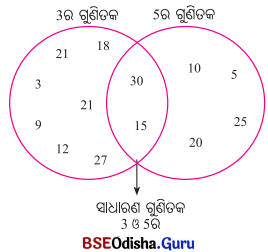
Class 6 Maths Chapter 5 Question Answer Odia Medium ମୌଳିକ ସଂଖ୍ୟା Page 108 Q4
Solution:
Class 6 Maths Chapter 5 Question Answer Odia Medium ମୌଳିକ ସଂଖ୍ୟା Page 108 Q4.1

Question 5.
ଆସ ବର୍ତ୍ତମାନ ଭିନ୍ନଭିନ୍ନ ସଂଖ୍ୟା ଯୋଡ଼ି ନେଇ ଇଡ଼ଲି-ବରା ଖେଳଟିକୁ ଖେଳିବା:
(କ) 2 ଓ 5
(ଖ) 3 ଓ 7
(ଗ) 4 ଓ 6
Solution:
(କ) 2 ଓ 5
(ଖ) 3 ଓ 7
(ଗ) 4 ଓ 6
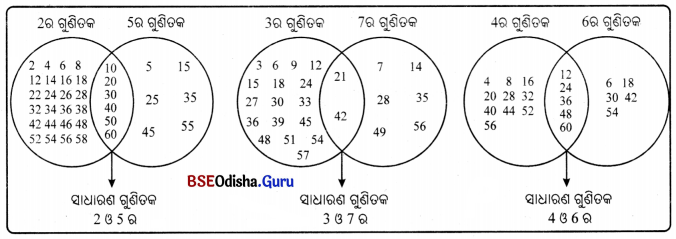
Class 6 Maths Chapter 5 Question Answer Odia Medium ମୌଳିକ ସଂଖ୍ୟା Page 108 Q5

Page No. 109

Question 1.
ନିମ୍ନ ସଂଖ୍ୟାମାନଙ୍କ ମଧ୍ୟରୁ କେଉଁଟି ଅନ୍ୟ ଏକ ସଂଖ୍ୟା ହୋଇପାରିବ? (2, 3, 5, 8, 10)
Solution:
2

Question 2.
24ରେ ଡେଇଁ ଡେଇଁ ପହଞ୍ଚିବା ପାଇଁ ରାମ କେଉଁ କେଉଁ ସଂଖ୍ୟା ବ୍ୟବଧାନରେ ଡେଇଁବା ସ୍ଥିର କରିବ?
Solution:
ଯଦି ସେ 4 ବ୍ୟବଧାନରେ ଡେଇଁବା ସ୍ଥିର କରିବ ତେବେ ସେ ଡେଇଁ ଡେଇଁ ଯିବାକୁ ଥିବା ସଂଖ୍ୟାଗୁଡ଼ିକ ହେଉଛି-
4 → 8 → 12 → 16 → 20 → 24 → 28 ………
ଅର୍ଥାତ୍ 4 ବ୍ୟବଧାନରେ ଡେଇଁ ଡେଇଁ ଗଲେ, ସେ 24 ଉପରକୁ ଡେଇଁ ପାରିବ।
ସେହିପରି, 24 ରେ ଡେଇଁ ଡେଇଁ ପହଞ୍ଚିବା ପାଇଁ ଅନ୍ୟ ସଫଳ ଡେଇଁବା ବ୍ୟବଧାନଗୁଡ଼ିକ ହେଲା – 2, 3, 6, 8 ଓ 12
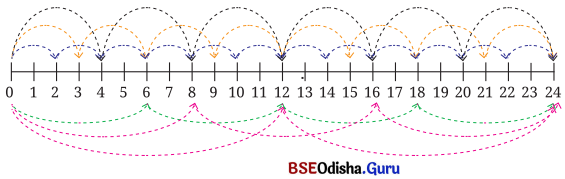
Class 6 Maths Chapter 5 Question Answer Odia Medium ମୌଳିକ ସଂଖ୍ୟା Page 109 Q2

Question 3.
ଡେଇଁବା ବ୍ୟବଧାନ 1 ଓ 24 ହେଲେ, କ’ଣ ହେବ?
Solution:
ହଁ, ସେ ଏହି ସଂଖ୍ୟା ବ୍ୟବଧାନରେ ଡେଇଁଲେ ମଧ୍ୟ 24 ଉପରକୁ ଡେଇଁ ପାରିବ।
ସଂଖ୍ୟା 1, 2, 3, 4, 6, 8, 12 ଓ 24 ସମସ୍ତଙ୍କଦ୍ୱାରା 24 ସମ୍ପୂର୍ଣ୍ଣ ରୂପେ ବିଭାଜ୍ୟ।
ମନେରଖ, ଏହି ସଂଖ୍ୟାଗୁଡ଼ିକୁ 24 ର ଗୁଣନୀୟକ ବା ବିଭାଜକ କୁହାଯାଏ।

Page No. 110

Question 1.
ରହିମ୍ 14 ଓ 36 ଉପରେ ମୁଦ୍ରା ରଖୁଲେ ଏବଂ ରାମ ଡେଇଁବା ବ୍ୟବଧାନ 7 କୁ ବାଛିଲେ, ରାମ ଉଭୟ ମୁଦ୍ରା ଥିବା ସଂଖ୍ୟା ଉପରକୁ ଡେଇଁ ଡେଇଁ ଯାଇପାରିବ କି?
Solution:
‘0’ ଠାରୁ ଆରମ୍ଭ କରି ସେ 7 ବ୍ୟବଧାନରେ ଡେଇଁଗଲେ, ଆମେ ପାଉଥିବା ସଂଖ୍ୟାଗୁଡ଼ିକ ହେଉଛି 7 → 14 → 21 → 28 → 35 → 42 …..।
ଆମେ ଦେଖୁବା ଯେ, ସେ 14 ଉପରକୁ ଡେଇଁ ପାରିବେ କିନ୍ତୁ 36 ଉପରକୁ ଡେଇଁପାରିବେ ନାହିଁ। ତେଣୁ ସେ ମୁଦ୍ରା ପାଇବ ନାହିଁ।

Question 2.
ସେ କେଉଁ ଡେଇଁବା ବ୍ୟବଧାନକୁ ବାଛିବ?
Solution:
14 ର ଗୁଣନୀୟକ ଗୁଡ଼ିକ – 1, 2, 7, 14
ତେଣୁ ଏହି ବ୍ୟବଧାନରେ ଡେଇଁଲେ, 14 ଉପରକୁ ଡେଇଁପାରିବ।
36 ର ଗୁଣନୀୟକ ଗୁଡ଼ିକ – 1, 2, 3, 4, 6, 9, 12, 18 ଏବଂ 36
ତେଣୁ ଏହି ବ୍ୟବଧାନରେ ଡେଇଁଲେ, ସେ 36 ଉପରକୁ ଡେଇଁ ପାରିବ।

Question 3.
କେଉଁ ଡେଇଁବା ବ୍ୟବଧାନ ସାହାଯ୍ୟରେ ଡେଇଁଲେ ଆମେ ଉଭୟ 15 ଓ 30 ପାଖରେ ପହଞ୍ଚତ୍ପାରିବା? ଏଥ‌ିପାଇଁ ଅନେକଗୁଡ଼ିଏ ଡେଇଁବା ବ୍ୟବଧାନ ସମ୍ଭବ? ସେ ସମସ୍ତ ବ୍ୟବଧାନ ଖୋଜିବାକୁ ଚେଷ୍ଟାକର।
Solution:
15ର ଗୁଣନୀୟକ = 1, 3, 5, 15
30ର ଗୁଣନୀୟକ = 1, 2, 3, 5, 6, 10, 15, 30
ଏବେ 15 ଓ 30ର ସାଧାରଣଗୁଣନୀୟକ ହେଲେ – 1, 3, 5, 15
ତେଣୁ 1, 3, 5 ଓ 15 ବ୍ୟବଧାନରେ ଡେଇଁଲେ, ଉଭୟ 15 ଓ 30 ପାଖରେ ପହଞ୍ଚିପାରିବା।

Page No. 110

ତଳେ ଦିଆଯାଇଥିବା ସାରଣୀକୁ ଦେଖ। ଏଥୁରୁ ତୁମେ କ’ଣ ଲକ୍ଷ୍ୟ କରୁଛ?
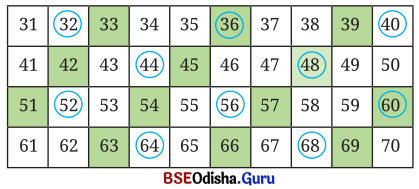
Class 6 Maths Chapter 5 Question Answer Odia Medium ମୌଳିକ ସଂଖ୍ୟା Page 110 Q1

Question 1.
ଉପରୋକ୍ତ ସାରଣୀରୁ ଚିତ୍ରିତ କୋଠରୀରେ ଥିବା ସଂଖ୍ୟାଗୁଡ଼ିକ ମଧ୍ୟରେ କିଛି ସାଧାରଣ। ସମାନତା ଅଛି କି?
Solution:
ଚିତ୍ରିତ କୋଠରିରେ ଥ‌ିବା ସଂଖ୍ୟାଗୁଡ଼ିକ ହେଉଛି – 33, 36, 39, 42, 45, 48, 51, 54, 57, 60, 63, 66, 69
ଏହି ସଂଖ୍ୟାଗୁଡ଼ିକ 3ର ଗୁଣିତକ।

Question 2.
ଗୋଲ ଚିହ୍ନିତ ସଂଖ୍ୟାଗୁଡ଼ିକ ମଧ୍ୟରେ କିଛି ସାଧାରଣ / ସମାନତା ଅଛି କି?
Solution:
ଗୋଲ ଚିହ୍ନିତ ସଂଖ୍ୟାଗୁଡ଼ିକ ହେଉଛି – 32, 36, 40, 44, 48, 52, 56, 60, 64, 68
ଏହି ସଂଖ୍ୟାଗୁଡ଼ିକ 3ର ଗୁଣିତକ।

Class 6 Maths Chapter 5 Question Answer Odia Medium ମୌଳିକ ସଂଖ୍ୟା

Question 3.
କେଉଁ ସଂଖ୍ୟାଗୁଡ଼ିକ ଉଭୟ ଗୋଲ ଚିହ୍ନିତ ଓ ଚିତ୍ର ତଳେ କୋଠରୀ ଅଛି? ଏହି ସଂଖ୍ୟାଗୁଡ଼ିକୁ କ’ଣ କହିବା?
Solution:
ଗୋଲ ଚିତ୍ରିତ ସଂଖ୍ୟାଗୁଡ଼ିକ ହେଉଛି – 36, 48, 60
ଏହି ସଂଖ୍ୟାଗୁଡ଼ିକ 3 ଓ 4ର ସାଧାରଣ ଗୁଣିତକ।

ଆସ ବୁଝିବା: (Page No. 110-111)

Question 1.
310 ଓ 410 ମଧ୍ୟରେ ଥ‌ିବା 40 ର ସମସ୍ତ ଗୁଣିତକଗୁଡ଼ିକୁ ନିର୍ଣ୍ଣୟ କର।
Solution:
40 ର ଗୁଣିତକଗୁଡ଼ିକ = 40, 80, 120, 160, 200, 240, 280, 320, 360, 400, 440…….
∴ 310 ଓ 410 ମଧ୍ୟରେ ଥିବା 40 ର ଗୁଣିତକ ଗୁଡ଼ିକ 320, 360 ଓ 400.

Question 2.
ମୁଁ କିଏ, କୁହ?
(କ) ମୁଁ 40 ଠାରୁ ଗୋଟିଏ ସାନ ସଂଖ୍ୟା ଅଟେ। ମୋର ଗୋଟିଏ ଗୁଣନୀୟକ 7 ଏବଂ ମୋର ଅଙ୍କମାନଙ୍କର ସମଷ୍ଟି ୫ ଅଟେ।
(ଖ) ମୁଁ 100 ଠାରୁ ଗୋଟିଏ ସାନ ସଂଖ୍ୟା ଅଟେ। 3 ଓ 5 ମୋର ଦୁଇଟି ଗୁଣନୀୟକ ଅଟନ୍ତି। ମୋର ଗୋଟିଏ ଅଙ୍କ ଅନ୍ୟ ଅଙ୍କଠାରୁ। ଅଧିକ।
Solution:
(କ) 7 ସଂଖ୍ୟାର ସାଧାରଣ ଗୁଣନୀୟକ ଗୁଡ଼ିକ 40 ଠାରୁ ସାନ,
ସେହି ସଂଖ୍ୟାଗୁଡ଼ିକ ହେଉଛି 7, 14, 21, 28 ଓ 35
ଗୋଟିଏ ସଂଖ୍ୟା ଯାହାର ଅଙ୍କମାନଙ୍କର ସମଷ୍ଟି 8, ସେହି ସଂଖ୍ୟାଟି = 35 = 3 + 5 = 8
∴ ମୁଁ 35.

(ଖ) 3 ଓ 5 ର ସାଧାରଣ ଗୁଣନୀୟକ ଯେଉଁଗୁଡ଼ିକ 100 ରୁ ସାନ,
ସେହି ସଂଖ୍ୟାଗୁଡ଼ିକ ଗୁଡ଼ିକ = 15, 30, 45, 60, 75, 90
ମୋର ଗୋଟିଏ ଅଙ୍କ ଅନ୍ୟ ଅଙ୍କଠାରୁ 1 ଅଧିକ ହେଲେ ସଂଖ୍ୟାଟି 45
∴ ମୁଁ 45.

Question 3.
ଯେଉଁ ସଂଖ୍ୟାର ସମସ୍ତ ଗୁଣନୀୟକମାନଙ୍କର ସମଷ୍ଟି, ସଂଖ୍ୟାର ଦୁଇଗୁଣ ସହ ସମାନ, ସେହି ସଂଖ୍ୟାକୁ ‘ପରିପୂର୍ଣ୍ଣ ସଂଖ୍ୟା’ କୁହାଯାଏ । ଉଦାହରଣ- 28, ଏକ ପରିପୂର୍ଣ୍ଣ ସଂଖ୍ୟା ଅଟେ। ଏହାର ଗୁଣନୀୟକଗୁଡ଼ିକ ହେଉଛି 1, 2, 4, 7, 14 ଓ 28। ଏହି ଗୁଣନୀୟକଗୁଡ଼ିକର ସମଷ୍ଟି ହେଲା – 1 + 2 + 4 + 7 + 14 + 28 = 56 ଯାହା 28 ର 2 ଗୁଣ ସହ ସମାନ। 1 ଓ 10 ମଧ୍ୟରେ ଗୋଟିଏ ପରିପୂର୍ଣ ସଂଖ୍ୟା ନିର୍ଣ୍ଣୟ କର।
Solution:
ମନେକର 1 ଓ 10 ମଧ୍ଯରେ ଗୋଟିଏ ସଂଖ୍ୟା 6
6 ର ଗୁଣନୀୟକ ଗୁଡ଼ିକ = 1, 2, 3, 6
ସେମାନଙ୍କର ସମଷ୍ଟି = 1 + 2 + 3 + 6 = 12
∴ 12 ସଂଖ୍ୟାଟି 6 ର ଦୁଇଗୁଣ ଅର୍ଥାତ୍ 6 ଗୋଟିଏ ପରିପୂର୍ଣ୍ଣ ସଂଖ୍ୟା।

Question 4.
ନିମ୍ନ ସଂଖ୍ୟାଗୁଡ଼ିକର ସାଧାରଣ ଗୁଣନୀୟକ ନିର୍ଣ୍ଣୟ କର।
(କ) 20 ଓ 28
(ଖ) 35 ଓ 50
(ଗ) 4, 8 ଓ 12
(ଘ) 5, 15 ଓ 25
Solution:
(କ) 20 ର ଗୁଣନୀୟକ ଗୁଡ଼ିକ = 1, 2, 4, 5, 10, 20
28 ର ଗୁଣନୀୟକ ଗୁଡ଼ିକ = 1, 2, 4, 7, 14, 28
∴ 20 ଓ 28 ର ସାଧାରଣ ଗୁଣନୀୟକ ଗୁଡ଼ିକ = 1, 2, 4

(ଖ) 35 ର ଗୁଣନୀୟକ ଗୁଡ଼ିକ = 1, 5, 7, 35
50 ର ଗୁଣନୀୟକ ଗୁଡ଼ିକ = 1, 2, 5, 10, 25, 50
∴ 35 ଓ 50 ର ସାଧାରଣ ଗୁଣନୀୟକ ଗୁଡ଼ିକ = 1, 5

(ଗ) 4 ର ଗୁଣନୀୟକ ଗୁଡ଼ିକ = 1, 2, 4
8 ର ଗୁଣନୀୟକ ଗୁଡ଼ିକ = 1, 2, 4, 8
12 ର ଗୁଣନୀୟକ ଗୁଡ଼ିକ = 1, 2, 3, 4, 6, 12
∴ 4, 8 ଓ 12 ର ସାଧାରଣ ଗୁଣନୀୟକ ଗୁଡ଼ିକ = 1, 2, 4

(ଘ) 5 ର ଗୁଣନୀୟକ ଗୁଡ଼ିକ = 1, 5
15 ର ଗୁଣନୀୟକ ଗୁଡ଼ିକ = 1, 3, 5, 15
25 ର ଗୁଣନୀୟକ ଗୁଡ଼ିକ = 1, 5, 25
∴ 5, 15 ଓ 25 ର ସାଧାରଣ ଗୁଣନୀୟକ ଗୁଡ଼ିକ = 1, 5

Question 5.
ଏପରି 3ଟି ସଂଖ୍ୟା ନିର୍ଣ୍ଣୟ କର, ଯେଉଁଗୁଡ଼ିକ 25 ର ଗୁଣିତକ ଅଟନ୍ତି କିନ୍ତୁ 50 ର ଗୁଣିତକ ନୁହଁନ୍ତି।
Solution:
25 ର ଗୁଣିତକ ଗୁଡ଼ିକ = 25, 50, 75, 100, 125, 150, 175, ….
50 ର ଗୁଣିତକ ଗୁଡ଼ିକ = 50, 100, 150, 200, 250, 300, ….
∴ ଯେଉଁ ସଂଖ୍ୟାଗୁଡ଼ିକ 25 ର ଗୁଣିତକ ଅଟନ୍ତି କିନ୍ତୁ 50 ର ଗୁଣିତକ ନୁହଁନ୍ତି,
ସେହି ସଂଖ୍ୟାଗୁଡ଼ିକ = 25, 75, 125, 175

Question 6.
ଅଂଶୁ ଏବଂ ତା’ର ସାଙ୍ଗମାନେ 10 ରୁ କମ୍ ଦୁଇଟି ସଂଖ୍ୟା ନେଇ ଇଡ଼ଲି–ବରା ଖେଳଟିକୁ ଖେଳୁଛନ୍ତି। 50 ପରେ ସେମାନଙ୍କ ମଧ୍ୟରୁ ଜଣେ ପ୍ରଥମ ଥର ପାଇଁ ଇଡ଼ଲି-ବରା କହିଲା। ତେବେ କୁହ, ଇଡ଼ଲି ଓ ବରା ପାଇଁ କେଉଁ ଦୁଇଟି ସଂଖ୍ୟା ନିଆଯାଇପାରେ?
Solution:
ସଂଖ୍ୟା ଦୁଇଟି ହେଲେ 6 ଓ 9।
ଇଡ୍‌ଲି ଓ ବରା ପାଇଁ ନିଆଯାଇଥିବା ସଂଖ୍ୟାଟି 54 ଯାହାକି ଉଭୟ 6 ଓ 9ର ସାଧାରଣ ଗୁଣିତକ।

Question 7.
‘ମୁଦ୍ରା ଖୋଜିବା / ପାଇବା ଖେଳ’ ଟିରେ ରହିମ୍ 28 ଓ 70 ସଂଖ୍ୟା ଉପରେ ଦୁଇଟି ମୁଦ୍ରା ରଖୁଲା। କେଉଁ ସଂଖ୍ୟା ବ୍ୟବଧାନରେ ଡେଇଁଲେ, ଉଭୟ ସଂଖ୍ୟାରେ ପହଞ୍ଚିପାରିବ?
Solution:
28 ର ଗୁଣନୀୟକ ଗୁଡ଼ିକ = 1, 2, 4, 7, 14, 28
70 ର ଗୁଣନୀୟକ ଗୁଡ଼ିକ = 1, 2, 5, 7, 10, 14, 35, 70
∴ 28 ଓ 70 ର ସାଧାରଣ ଗୁଣନୀୟକ ଗୁଡ଼ିକ = 1, 2, 7 ଓ 14
ତେଣୁ 1, 2, 7 ଓ 14 ସଂଖ୍ୟା ବ୍ୟବଧାନରେ ଡେଇଁଲେ, 28 ଓ 70 ସଂଖ୍ୟାରେ ପହଞ୍ଚି ପାରିବ।

Class 6 Maths Chapter 5 Question Answer Odia Medium ମୌଳିକ ସଂଖ୍ୟା

Question 8.
ତଳେ ଦିଆଯାଇଥିବା ଚିତ୍ରରେ, ଗୁନା ସାଧାରଣ ଗୁଣିତକଗୁଡ଼ିକ ବ୍ୟତୀତ ଅନ୍ୟ ସମସ୍ତ ସଂଖ୍ୟାକୁ ଲିଭାଇ ଦେଇଛି। ଏହି ସଂଖ୍ୟାଗୁଡ଼ିକୁ ଖୋଜି ବାହାର କର ଏବଂ ଲିଭାଇ ଦିଆଯାଇଥିବା ସଂଖ୍ୟାଗୁଡ଼ିକୁ ଖାଲି ସ୍ଥାନରେ ପୂରଣ କର।
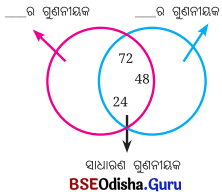
Class 6 Maths Chapter 5 Question Answer Odia Medium ମୌଳିକ ସଂଖ୍ୟା Page 111 Q8
Solution:
Class 6 Maths Chapter 5 Question Answer Odia Medium ମୌଳିକ ସଂଖ୍ୟା Page 111 Q8.1

Question 9.
7 ବ୍ୟତୀତ, 1 ଠାରୁ 10 ପର୍ଯ୍ୟନ୍ତ ଅନ୍ୟ ସମସ୍ତ ସଂଖ୍ୟାର ଏକ କ୍ଷୁଦ୍ରତମ ସାଧାରଣ ଗୁଣିତକ ନିର୍ଣ୍ଣୟ କର।
Solution:
7 ବ୍ୟତୀତ, 1 ଠାରୁ 10 ପର୍ଯ୍ୟନ୍ତ ସମସ୍ତ ସଂଖ୍ୟାର କ୍ଷୁଦ୍ରତମ ସାଧାରଣ ଗୁଣିତକ ହେଉଛି
1 = 1
5 = 5
10 = 2 × 5
2 = 2
6 = 2 × 3
3 = 3
8 = 2 × 2 × 2
4 = 2 × 2
9 = 3 × 3
କ୍ଷୁଦ୍ରତମ ସାଧାରଣ ଗୁଣିତକ = 2 × 2 × 2 × 3 × 3 × 5 = 360
∴ 7 ବ୍ୟତୀତ, 1 ଠାରୁ 10 ପର୍ଯ୍ୟନ୍ତ ଅନ୍ୟ ସମସ୍ତ ସଂଖ୍ୟାର ଏକ କ୍ଷୁଦ୍ରତମ ସାଧାରଣ ଗୁଣିତକ 360।

Question 10.
ଏକ କ୍ଷୁଦ୍ରତମ ସଂଖ୍ୟା ନିର୍ଣ୍ଣୟ କର, ଯାହା 1 ଠାରୁ 10 ପର୍ଯ୍ୟନ୍ତ ସମସ୍ତ ସଂଖ୍ୟାରୁ, ଏକ ସାଧାରଣ ଗୁଣିତକ ହେବ।
Solution:
1 ଠାରୁ 10 ପର୍ଯ୍ୟନ୍ତ ସମସ୍ତ ସଂଖ୍ୟାର କ୍ଷୁଦ୍ରତମ ସାଧାରଣ ଗୁଣିତକ ହେଉଛି
1 = 1
5 = 5
9 = 3 × 3
2 = 2
6 = 2 × 3
10 = 2 × 5
3 = 3
7 = 7
4 = 2 × 2
8 = 2 × 2 × 2
କ୍ଷୁଦ୍ରତମ ସାଧାରଣ ଗୁଣିତକ = 2 × 2 × 2 × 3 × 3 × 5 × 7 = 2520
∴ 1 ଠାରୁ 10 ପର୍ଯ୍ୟନ୍ତ ଅନ୍ୟ ସମସ୍ତ ସଂଖ୍ୟାର ଏକ କ୍ଷୁଦ୍ରତମ ସାଧାରଣ ଗୁଣିତକ ହେଉଛି 2520।

5.2 ମୌଳିକ ସଂଖ୍ୟା (Prime Number)

Page No. 112

Question 1.
କେତେ ପ୍ରକାର ସଜେଇବା ସମ୍ଭବ? ବିଭିନ୍ନ ପ୍ରକାର ଉପାୟଗୁଡ଼ିକ ଚିନ୍ତାକର ଏବଂ କୁହ କିପରି?
Solution:
1. ଗୁନା, 12ଟି ଆମ୍ବକୁ ଆୟତ୍‌ଚିତ୍ର ଆକାରରେ ସଜାଇ ପାରିବ।
2. ଅଂଶୁ, 7ଟି ଆମ୍ବକୁ ଆୟତଚିତ୍ର ଆକାରରେ ସଜାଇପାରିବ।

Page No. 113

Question 1.
21 ରୁ 30 ମଧ୍ଯରେ କେତୋଟି ମୌଳିକ ସଂଖ୍ୟା ଓ କେତୋଟି ଯୌଗିକ ସଂଖ୍ୟା ଅଛି?
Solution:
21 ରୁ 30 ମଧ୍ୟରେ ଥ‌ିବା ମୌଳିକ ସଂଖ୍ୟା = 23, 29 = 2ଟି।
21 ରୁ 30 ମଧ୍ୟରେ ଥ‌ିବା ଯୌଗିକ ସଂଖ୍ୟା = 21, 22, 24, 25, 26, 27, 28, 30 = 8ଟି।

Question 2.
1 ରୁ 100 ମଧ୍ୟରେ ଥିବା ସମସ୍ତ ମୌଳିକ ସଂଖ୍ୟାକୁ ଆମେ ତାଲିକା କରିପାରିବା କି?
Solution:
1 ରୁ 100 ମଧ୍ୟରେ ଥ‌ିବା ସମସ୍ତ ମୌଳିକ ସଂଖ୍ୟା-
Class 6 Maths Chapter 5 Question Answer Odia Medium ମୌଳିକ ସଂଖ୍ୟା Page 113 Q2
1 ରୁ 100 ମଧ୍ୟରେ ଥିବା ସମସ୍ତ ଯୌଗିକ ସଂଖ୍ୟା-
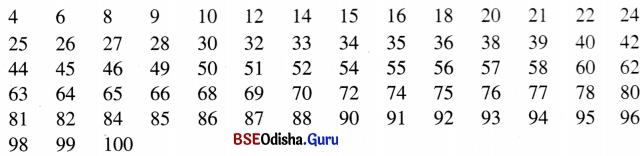
Class 6 Maths Chapter 5 Question Answer Odia Medium ମୌଳିକ ସଂଖ୍ୟା Page 113 Q2.1

ଆସ ବୁଝିବା: (Page No. 114)

Question 1.
ଆମେ ଦେଖୁବା ଯେ 2 ଗୋଟିଏ ମୌଳିକ ସଂଖ୍ୟା ଏବଂ ଏକ ଯୁଗ୍ମ ସଂଖ୍ୟା ମଧ୍ୟ। ଏହିଭଳି ଅନ୍ୟ ଯୁଗ୍ମ ମୌଳିକ ସଂଖ୍ୟା ଅଛି କି?
Solution:
ନାହିଁ। 2 ଏକମାତ୍ର ମୌଳିକ ଓ ଯୁଗ୍ମ ସଂଖ୍ୟା।

Question 2.
100 ମଧ୍ୟରେ ଥିବା ମୌଳିକ ସଂଖ୍ୟାଗୁଡ଼ିକ ଦେଖ। ଦୁଇଟି କ୍ରମାଗତ ମୌଳିକ ସଂଖ୍ୟା ମଧ୍ୟରେ ଥ‌ିବା କ୍ଷୁଦ୍ରତମ ପାର୍ଥକ୍ୟ କେତେ? ବୃହତ୍ତମ ପାର୍ଥକ୍ୟ କେତେ?
Solution:
100 ମଧ୍ୟରେ ଥିବା ମୌଳିକ ସଂଖ୍ୟାଗୁଡ଼ିକ ହେଉଛି – 2, 3, 5, 7, 11, 13, 17, 19, 23, 29, 31, 37, 41, 43, 47, 53, 59, 61, 67, 71, 73, 79, 83, 89, 97
ଦୁଇଟି କ୍ରମାଗତ ମୌଳିକ ସଂଖ୍ୟା ମଧ୍ୟରେ ଥ‌ିବା ପାର୍ଥକ୍ୟ
3 – 2 = 1
5 – 3 = 2
7 – 5 = 2
11 – 7 = 4
13 – 11 = 2
17 – 13 = 4
19 – 17 = 2
23 – 19 = 4
29 – 23 = 6
31 – 29 = 2
37 – 31 = 6
41 – 37 = 4
43 – 41 = 2
47 – 43 = 4
53 – 47 = 6
59 – 53 = 6
61 – 59 = 2
67 – 61 = 6
71 – 67 = 4
73 – 71 = 2
79 – 73 = 6
83 – 79 = 4
89 – 83 = 6
97 – 89 = 8
100 ମଧ୍ୟରେ ଥିବା ଦୁଇଟି କ୍ରମାଗତ ମୌଳିକ ସଂଖ୍ୟା ମଧ୍ୟରେ ଥିବା କ୍ଷୁଦ୍ରତମ ପାର୍ଥକ୍ୟ = 1
(2 ଓ 3 ମୌଳିକ ସଂଖ୍ୟା ମଧ୍ୟରେ)
100 ମଧ୍ୟରେ ଥ‌ିବା ଦୁଇଟି କ୍ରମାଗତ ମୌଳିକ ସଂଖ୍ୟା ମଧ୍ୟରେ ଥିବା ବୃହତ୍ତମ ପାର୍ଥକ୍ୟ = 8
(89 ଓ 97 ମୌଳିକ ସଂଖ୍ୟା ମଧ୍ୟରେ)

Class 6 Maths Chapter 5 Question Answer Odia Medium ମୌଳିକ ସଂଖ୍ୟା

Question 3.
ଉପରୋକ୍ତ ସାରଣୀର ପ୍ରତ୍ୟେକ ଧାଡ଼ିରେ ସମାନ ସଂଖ୍ୟକ ମୌଳିକ ସଂଖ୍ୟା ରହୁଛି କି? କେଉଁ ଦଶ ଭାଗରେ ସର୍ବନିମ୍ନ ସଂଖ୍ୟକ ମୌଳିକ ଅଛି?
Solution:
ସାରଣୀର ପ୍ରତ୍ୟେକ ଧାଡ଼ିରେ ସମାନ ସଂଖ୍ୟକ ମୌଳିକ ରହୁନାହାନ୍ତି।
ସାରଣୀର 91-100 ଧାଡ଼ିରେ ସର୍ବନିମ୍ନ ଗୋଟିଏ ମୌଳିକ ରହୁଛି = 97
ସାରଣୀର 1-10 ଓଁ 11-19 ଧାଡ଼ିରେ ସର୍ବାଧକ 4ଟି ମୌଳିକ ଅଛି = 2, 3, 5, 7 ଓ 11, 13, 17, 19

Question 4.
ନିମ୍ନଲିଖତ ସଂଖ୍ୟାମାନଙ୍କ ମଧ୍ୟରୁ କେଉଁଟି ମୌଳିକ ସଂଖ୍ୟା: 23, 51, 37, 26?
Solution:
23 ଓ 37 କେବଳ 1 ଓ ନିଜ ଦ୍ଵାରା ବିଭାଜ୍ୟ। ତେଣୁ ଏହି ଦୁଇଟି ସଂଖ୍ୟା ମୌଳିକ ସଂଖ୍ୟା।

Question 5.
20 ଠାରୁ ସାନ 3 ଯୋଡ଼ା ମୌଳିକ ସଂଖ୍ୟା ନିର୍ଣ୍ଣୟ କର ଯାହାର ସମଷ୍ଟି 5 ର ଏକକ ଗୁଣିତକ ଅଟେ।
Solution:
20 ଠାରୁ ସାନ 3 ଯୋଡ଼ା ମୌଳିକ ସଂଖ୍ୟା, ଯାହାର ସମଷ୍ଟି 5 ର ଏକ ଗୁଣିତକ ଅଟେ। ସେହି ଯୋଡ଼ା ମୌଳିକ ସଂଖ୍ୟାଗୁଡ଼ିକ ହେଉଛି (2, 3), (2, 13), (7, 13)।

Question 6.
13 ଓ 31 ହେଉଛି ଦୁଇଟି ମୌଳିକ ସଂଖ୍ୟା ଯେଉଁଥରେ ସମାନ ଅଙ୍କ 1 ଓ 3 ଅଛି। 100 ମଧ୍ୟରେ, ଏହିପରି ମୌଳିକ ସଂଖ୍ୟାର ଯୋଡ଼ିଗୁଡ଼ିକ ନିର୍ଣ୍ଣୟ କର।
Solution:
100 ମଧ୍ୟରେ 13 ଓ 31 ହେଉଛି ଦୁଇଟି ମୌଳିକ ସଂଖ୍ୟା ଯେଉଁଥ‌ିରେ ସମାନ ଅଙ୍କ 1 ଓ 3 ଅଛି।
ସେହିଭଳି ଅନ୍ୟ ମୌଳିକ ସଂଖ୍ୟାଗୁଡ଼ିକ ହେଉଛି: (13, 31), (17, 71), (37, 73) ଓ (79, 97)।

Question 7.
1 ଓ 100 ମଧ୍ୟରେ 7ଟି କ୍ରମାଗତ ଯୌଗିକ ସଂଖ୍ୟା ନିର୍ଣ୍ଣୟ କର।
Solution:
1 ଓ 100 ମଧ୍ୟରେ 7ଟି କ୍ରମାଗତ ଯୌଗିକ ସଂଖ୍ୟା = 90, 91, 92, 93, 94, 95, 96

Question 8.
ଯେଉଁ ମୌଳିକ ସଂଖ୍ୟା ଯୋଡ଼ି ମଧ୍ଯରେ ପାର୍ଥକ୍ୟ 2 ଥାଏ, ସେମାନଙ୍କୁ ଯମଜ ମୌଳିକ କୁହାଯାଏ। ଉଦାହରଣ: 3 ଓ 5, 17 ଓ 19 ଯମଜ ମୌଳିକ ଅଟନ୍ତି। 1 ଠାରୁ 100 ମଧ୍ୟରେ ଅନ୍ୟ ଯମଜ ମୌଳିକଗୁଡ଼ିକ ଲେଖ।
Solution:
1 ଠାରୁ 100 ମଧ୍ୟରେ ଯମଜ ମୌଳିକଗୁଡ଼ିକ = (3, 5), (5, 7), (11, 13), (17, 19), (29, 31), (41, 43), (59, 61), (71, 73)

Question 9.
ଦିଆଯାଇଥବା ଉତ୍ତିଗୁଡ଼ିକ ଠିକ୍ କିମ୍ବା ଭୁଲ ଚିହ୍ନଟ କର ଏବଂ କାରଣ ଲେଖ।
(କ) ଏପରି କୌଣସି ମୌଳିକ ସଂଖ୍ୟା ନାହିଁ, ଯାହାର ଏକକ ସ୍ଥାନର ଅଙ୍କ 4 ଅଟେ।
(ଖ) ମୌଳିକ ସଂଖ୍ୟାମାନଙ୍କର ଗୁଣଫଳ ମଧ୍ୟ ଏକ ମୌଳିକ ସଂଖ୍ୟା ହୋଇପାରିବ।
(ଗ) ମୌଳିକ ସଂଖ୍ୟାମାନଙ୍କର କୌଣସି ଗୁଣନୀୟକ ନାହିଁ।
(ଘ) ସମସ୍ତ ଯୁଗ୍ମ ସଂଖ୍ୟା ଯୌଗିକ ସଂଖ୍ୟା ଅଟନ୍ତି।
(ଙ) 2 ଏକ ମୌଳିକ ସଂଖ୍ୟା ଏବଂ ତା’ ପରବର୍ତୀ ସଂଖ୍ୟା 3 ମଧ୍ଯ ଏକ ମୌଳିକ ସଂଖ୍ୟା। 2 ଭିନ୍ନ ଅନ୍ୟ ପ୍ରତ୍ୟେକ ମୌଳିକ ସଂଖ୍ୟାର ପରବର୍ତ୍ତୀ ସଂଖ୍ୟାଟି ଯୌଗିକ ସଂଖ୍ୟା ଅଟେ।
Solution:
(କ) ଠିକ୍। ଆମେ ଜାଣିଛେ ଯେ ଯେଉଁ ସଂଖ୍ୟାର ଏକକ ଘରେ 0, 2, 4, 6, 8 ଥ‌ିବ ସେହି ସଂଖ୍ୟାଟି 2 ଦ୍ଵାରା ବିଭାଜ୍ୟ।
ତେଣୁ କୌଣସି ମୌଳିକ ସଂଖ୍ୟାର ଏକକ ସ୍ଥାନର ଅଙ୍କ 4 ହେବ ନାହିଁ।

(ଖ) ଭୁଲ୍ । ମନେକର ଦୁଇଟି ମୌଳିକ ସଂଖ୍ୟା 2 ଓ 3।
ଗୁଣଫଳ = 2 × 3 = 6, ଗୋଟିଏ ଯୌଗିକ ସଂଖ୍ୟା।
ତେଣୁ ମୌଳିକ ସଂଖ୍ୟାମାନଙ୍କର ଗୁଣଫଳ ମୌଳିକ ସଂଖ୍ୟା ହେବ ନାହିଁ।

(ଗ) ଭୁଲ୍। ପ୍ରତ୍ୟେକ ସଂଖ୍ୟାର ଦୁଇଟି ଗୁଣନୀୟକ ଅଛି। 1 ଓ ସେହି ସଂଖ୍ୟାଟି ନିଜେ।
ତେଣୁ ମୌଳିକ ସଂଖ୍ୟାମାନଙ୍କର ଦୁଇଟି ଗୁଣନୀୟକ ଅଛି।

(ଘ) ଭୁଲ୍। ମନେକର ଯୁଗ୍ମ ସଂଖ୍ୟାଟି 2।
2 ସଂଖ୍ୟାଟି ଯୌଗିକ ସଂଖ୍ୟା ନୁହେଁ, ମୌଳିକ ସଂଖ୍ୟା।

(ଙ) ଠିକ୍। ମନେକର 5 ଗୋଟିଏ ମୌଳିକ ସଂଖ୍ୟା। ପରବର୍ତୀ ଯୌଗିକ ସଂଖ୍ୟା = 6
ତେଣୁ 2 ଭିନ୍ନ ଅନ୍ୟ ପ୍ରତ୍ୟେକ ମୌଳିକ ସଂଖ୍ୟାର ପରବର୍ତ୍ତୀ ସଂଖ୍ୟାଟି ଯୌଗିକ ସଂଖ୍ୟା ଅଟେ।

Question 10.
ନିମ୍ନଲିଖ ସଂଖ୍ୟାଗୁଡ଼ିକ ମଧ୍ୟରୁ କେଉଁଟି ତିନୋଟି ଭିନ୍ନ ମୌଳିକ ସଂଖ୍ୟାର ଗୁଣଫଳ ଅଟେ। 45, 60, 91, 105, 330?
Solution:
45 = 3 × 3 × 5 (2 ଟି ଭିନ୍ନ ମୌଳିକ ସଂଖ୍ୟା)
60 = 2 × 2 × 3 × 5 (3 ଟି ଭିନ୍ନ ମୌଳିକ ସଂଖ୍ୟା)
91 = 7 × 13 (2 ଟି ଭିନ୍ନ ମୌଳିକ ସଂଖ୍ୟା)
105 = 3 × 5 × 7 (3 ଟି ଭିନ୍ନ ମୌଳିକ ସଂଖ୍ୟା)
330 = 2 × 3 × 5 × 11 (4 ଟି ଭିନ୍ନ ମୌଳିକ ସଂଖ୍ୟା)
∴ 105 ସଂଖ୍ୟାଟି ଠିକ୍ ତିନୋଟି ଭିନ୍ନ ମୌଳିକ ସଂଖ୍ୟା (3 × 5 × 7)ର ଗୁଣଫଳ ଅଟେ।

Question 11.
2, 4 ଏବଂ 5 ପ୍ରତ୍ୟେକକୁ ଥରେ ଲେଖାଏଁ ବ୍ୟବହାର କରି କେତୋଟି ତିନି ଅଙ୍କ ବିଶିଷ୍ଟ ମୌଳିକ ସଂଖ୍ୟା ଗଠନ କରିପାରିବ?
Solution:
ଆମେ ଜାଣିଛେ ଯେଉଁ ସଂଖ୍ୟାର ଏକକ ଘରେ 2 କିମ୍ବା 4 ଥିବ ସେହି ସଂଖ୍ୟାଟି 2 ଦ୍ଵାରା ବିଭାଜ୍ୟ। ଯେଉଁ ସଂଖ୍ୟାର ଏକକ ଘରେ 5 ଧ୍ରୁବ, ସେହି ସଂଖ୍ୟାଟି 5 ଦ୍ଵାରା ବିଭାଜ୍ୟ ହେବ।
∴ ତେଣୁ 2, 4 ଓ 5 କୁ ଥରେ ଲେଖାଏଁ ବ୍ୟବହାର କଲେ ତିନି ଅଙ୍କ ବିଶିଷ୍ଟ ଗୋଟିଏ ବି ମୌଳିକ ସଂଖ୍ୟା ଗଠନ ହୋଇପାରିବ ନାହିଁ।

Class 6 Maths Chapter 5 Question Answer Odia Medium ମୌଳିକ ସଂଖ୍ୟା

Question 12.
ଲକ୍ଷ୍ୟକର, 3 ଏକ ମୌଳିକ ସଂଖ୍ୟା ଏବଂ 2 × 3 + 1 = 7 ମଧ୍ଯ ଏକ ମୌଳିକ ସଂଖ୍ୟା, ଏପରି ଅନ୍ୟ କିଛି ମୌଳିକ ସଂଖ୍ୟା ଅଛି କି, ଯାହାର 2 ଗୁଣରେ 1 ଯୋଗକଲେ, ଅନ୍ୟ ଏକ ମୌଳିକ ସଂଖ୍ୟା ମିଳିବ? ଏପରି ଅତିକମ୍‌ରେ 5ଟିର ଉଦାହରଣ ଦିଅ।
Solution:
କିଛି ମୌଳିକ ସଂଖ୍ୟା ଅଛି, ଯାହାର 2 ଗୁଣରେ 1 ଯୋଗକଲେ, ଅନ୍ୟ ଏକ ମୌଳିକ ସଂଖ୍ୟା ମିଳିବ:

  • 2 (2 × 2 + 1 = 5)
  • 3 (2 × 3 + 1 = 7)
  • 5 (2 × 5 + 1 = 11)
  • 11 (2 × 11 + 1 = 23)
  • 23 (2 × 23 + 1 = 47)

5.3 ପରସ୍ପର ମୌଳିକ ସଂଖ୍ୟା (Co-Prime Numbers for Safe keeping Treasures)

Page No. 115

Question 1.
ନିମ୍ନ ଯୋଡ଼ିଟିକୁ ସୁରକ୍ଷିତ କି ନୁହେଁ, ପରୀକ୍ଷା କର।
(କ) 15 ଓ 39
(ଖ) 4 ଓ 15
(ଗ) 18 ଓ 29
(ଘ) 20 ଓ 55
Solution:
(କ) 15 ର ଗୁଣନୀୟକ = 1 × 3 × 5
39 ର ଗୁଣନୀୟକ = 1 × 3 × 13
1 ବ୍ୟତୀତ ଦୁଇଟି ସଂଖ୍ୟା ଯୋଡ଼ିରେ 3 ସାଧାରଣ ଗୁଣନୀୟକ ଅଛି।
∴ ତେଣୁ 15 ଓ 39 ସଂଖ୍ୟା ଯୋଡ଼ି ସୁରକ୍ଷିତ ନୁହେଁ।

(ଖ) 4 ର ଗୁଣନୀୟକ = 1 × 2 × 2
5 ର ଗୁଣନୀୟକ = 1 × 3 × 5
1 ବ୍ୟତୀତ ଦୁଇଟି ସଂଖ୍ୟା ଯୋଡ଼ିରେ କୌଣସି ସାଧାରଣ ଗୁଣନୀୟକ ନାହିଁ।
∴ ତେଣୁ 15 ଓ 39 ସଂଖ୍ୟା ଯୋଡ଼ି ସୁରକ୍ଷିତ।

(ଗ) 18 ର ଗୁଣନୀୟକ = 1 × 2 × 3 × 3
29 ର ଗୁଣନୀୟକ = 1
1 ବ୍ୟତୀତ ଦୁଇଟି ସଂଖ୍ୟା ଯୋଡ଼ିରେ କୌଣସି ସାଧାରଣ ଗୁଣନୀୟକ ନାହିଁ।
∴ ତେଣୁ 15 ଓ 39 ସଂଖ୍ୟା ଯୋଡ଼ି ସୁରକ୍ଷିତ।

(ଘ) 20 ର ଗୁଣନୀୟକ = 1 × 2 × 2 × 5
55 ର ଗୁଣନୀୟକ = 5 × 11
1 ବ୍ୟତୀତ ଦୁଇଟି ସଂଖ୍ୟା ଯୋଡ଼ିରେ 5 ସାଧାରଣ ଗୁଣନୀୟକ ଅଛି।
∴ ତେଣୁ 20 ଓ 55 ସଂଖ୍ୟା ଯୋଡ଼ି ସୁରକ୍ଷିତ ନୁହେଁ।

Page No. 116

Question 1.
ନିମ୍ନରେ ଦିଆଯାଇଥବା କେଉଁ ସଂଖ୍ୟାଯୋଡ଼ିଗୁଡ଼ିକ ପରସ୍ପର ମୌଳିକ?
(କ) 18 ଓ 35
(ଖ) 15 ଓ 37
(ଗ) 30 ଓ 415
(ଘ) 17 ଓ 69
(ଙ) 81 ଓ 18
Solution:
(କ) 18 ର ଗୁଣନୀୟକ = 1 × 2 × 3 × 3
35 ର ଗୁଣନୀୟକ = 1 × 5 × 7
ଏହି ଦୁଇ ସଂଖ୍ୟା ମଧ୍ୟରେ 1 ବ୍ୟତୀତ କୌଣସି ସାଧାରଣ ଗୁଣନୀୟକ ନାହିଁ।
ତେଣୁ 18 ଓ 35 ସଂଖ୍ୟା ଯୋଡ଼ିଟି ପରସ୍ପର ମୌଳିକ।

(ଖ) 15 ର ଗୁଣନୀୟକ = 1 × 3 × 5
37 ର ଗୁଣନୀୟକ = 1 × 37
ଏହି ଦୁଇ ସଂଖ୍ୟା ମଧ୍ୟରେ 1 ବ୍ୟତୀତ କୌଣସି ସାଧାରଣ ଗୁଣନୀୟକ ନାହିଁ।
ତେଣୁ 15 ଓ 37 ସଂଖ୍ୟା ଯୋଡ଼ିଟି ପରସ୍ପର ମୌଳିକ।

(ଗ) 30 ର ଗୁଣନୀୟକ = 1 × 2 × 3 × 5
415 ର ଗୁଣନୀୟକ = 1 × 5 × 83
ଏହି ଦୁଇ ସଂଖ୍ୟା ମଧ୍ୟରେ 1 ବ୍ୟତୀତ 5 ସାଧାରଣ ଗୁଣନୀୟକ।
ତେଣୁ 18 ଓ 35 ସଂଖ୍ୟା ଯୋଡ଼ିଟି ପରସ୍ପର ମୌଳିକ ନୁହେଁ।

(ଘ) 17 ର ଗୁଣନୀୟକ = 1 × 17
69 ର ଗୁଣନୀୟକ = 1 × 3 × 23
ଏହି ଦୁଇ ସଂଖ୍ୟା ମଧ୍ୟରେ 1 ବ୍ୟତୀତ କୌଣସି ସାଧାରଣ ଗୁଣନୀୟକ ନାହିଁ।
ତେଣୁ 17 ଓ 69 ସଂଖ୍ୟା ଯୋଡ଼ିଟି ପରସ୍ପର ମୌଳିକ।

(ଙ) 81 ର ଗୁଣନୀୟକ = 1 × 3 × 3 × 3 × 3
18 ର ଗୁଣନୀୟକ = 1 × 2 × 3 × 3
ଏହି ଦୁଇ ସଂଖ୍ୟା ମଧ୍ୟରେ 1 ବ୍ୟତୀତ 3 ସାଧାରଣ ଗୁଣନୀୟକ।
ତେଣୁ 81 ଓ 18 ସଂଖ୍ୟା ଯୋଡ଼ିଟି ପରସ୍ପର ମୌଳିକ ନୁହେଁ।

Page No. 116

Question 1.
କେତେକ ଚିତ୍ରରେ, ସୂତା ପ୍ରତ୍ୟେକ ଖୁଣ୍ଟରେ ବନ୍ଧା ହୋଇଛି। କେତେକ ଚିତ୍ରରେ ଏହା ହୋଇନାହିଁ। ଏହା ପରସ୍ପର ମୌଳିକ ହେଉଥ‌ିବା ସଂଖ୍ୟାଯୋଡ଼ି (ଖୁଣ୍ଟର ସଂଖ୍ୟା ଓ ସୂତା ବାନ୍ଧିବା ବ୍ୟବଧାନ) ସହ ସମ୍ପର୍କତ କି?
Solution:
ହଁ।

Page No. 117

Question 1.
ନିମ୍ନରେ ଦିଆଯାଇଥିବା ତଥ୍ୟକୁ ନେଇ ପରସ୍ପର ମୌଳିକ ସଂଖ୍ୟାଚିତ୍ର ଅଙ୍କନ କର।
(a) 15 ଟି ଖୁଣ୍ଟ, ସୂତା ବାନ୍ଧିବା ବ୍ୟବଧାନ 10
(b) 10 ଟି ଖୁଣ୍ଟ, ସୂତା ବାନ୍ଧିବା ବ୍ୟବଧାନ 7
(c) 14 ଟି ଖୁଣ୍ଟ, ସୂତା ବାନ୍ଧିବା ବ୍ୟବଧାନ 6
(d) 8 ଟି ଖୁଣ୍ଟ, ସୂତା ବାନ୍ଧିବା ବ୍ୟବଧାନ 3
Solution:
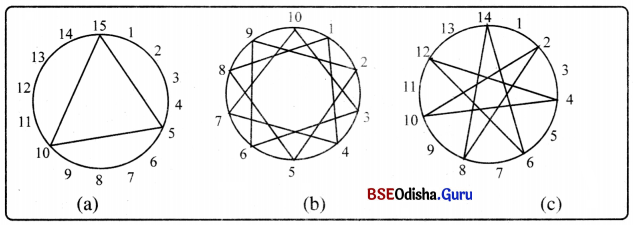
Class 6 Maths Chapter 5 Question Answer Odia Medium ମୌଳିକ ସଂଖ୍ୟା Page 117 Q1
ଏହିପରି ପିଲାମାନେ ପ୍ରଶ୍ନ (d) ର ସଂଖ୍ୟାଚିତ୍ର ଅଙ୍କନ କର।

5.4 ମୌଳିକ ଉତ୍ପାଦକୀକରଣ (Prime Factorisation)

Page No. 117

Question 1.
ଦୁଇଟି ସଂଖ୍ୟା ପରସ୍ପର ମୌଳିକ କି ନୁହେଁ, ନିର୍ଣ୍ଣୟ କରିବା।
56 ଏବଂ 63 ପରସ୍ପର ମୌଳିକ କି?
Solution:
56 = 14 × 4 ଏବଂ 63 = 21 × 3 ଲେଖିପାରିବା। ତେଣୁ 14 ଓ 4, 56 ର ଗୁଣନୀୟକ ଏବଂ 21 ଓ 3, 63 ର ଗୁଣନୀୟକ ଅଟନ୍ତି।
ଯେହେତୁ, ସେମାନଙ୍କ ମଧ୍ୟରେ କୌଣସି ସାଧାରଣ ଗୁଣନୀୟକ ନାହିଁ, ତେଣୁ 56 ଓ 63 ପରସ୍ପର ମୌଳିକ ଅଟନ୍ତି।
56 = 7 × 8 ଏବଂ 63 = 9 × 7 ମଧ୍ୟ ଲେଖୁ ପାରିବା।
ଏଥୁରୁ ଦେଖାଯାଉଛି, ଉଭୟ 56 ଓ 63ର ଏକ ସାଧାରଣ ଗୁଣନୀୟକ 7। ତେଣୁ ସେମାନେ ପରସ୍ପର ମୌଳିକ ନୁହଁନ୍ତି।
ଉଭୟ ସଂଖ୍ୟାର 7 ଏକ ସାଧାରଣ ଗୁଣନୀୟକ।
56 = 14 × 4, ଏହିପରି ଲେଖୁଲେ ଏହା ଆମକୁ ସୂଚାଉଛି ଯେ ଉଭୟ 14 ଓ 4, 56ରେ ଗୁଣନୀୟକ। କିନ୍ତୁ ଏହା
56 ର ସମସ୍ତ ଗୁଣନୀୟକକୁ ସୂଚାଉ ନାହିଁ।
ସେହିପରି 63 = 9 × 7 ସୂଚାଉଛି ଯେ ଉଭୟ 9 ଓ 7, 63 ର ଗୁଣନୀୟକ।
କିନ୍ତୁ ଏହା 63 ର ସମସ୍ତ ଗୁଣନୀୟକକୁ ସୂଚାଉ ନାହିଁ।

Class 6 Maths Chapter 5 Question Answer Odia Medium ମୌଳିକ ସଂଖ୍ୟା

Question 2.
ଉଦାହରଣ: 80 ଓ 63
Solution:
80 ଓ 63 କୁ ବିଭିନ୍ନ ଉପାୟରେ ଉତ୍ପାଦକୀକରଣ କରିପାରିବା।
80 = 40 × 2 = 20 × 4 = 10 × 8 = 16 × 5 = ???
63 = 9 × 7 = 3 × 21 = ???
??? ଲେଖୁବାର ଅର୍ଥ ଉଭୟ ସଂଖ୍ୟାକୁ ଆହୁରି ଅନେକ ଉପାୟରେ ଉତ୍ପାଦୀକରଣ କରାଯାଇପାରିବ।
କିନ୍ତୁ ଯଦି ଆମେ ଦିଆଯାଇଥବା ଯେକୌଣସି ଉତ୍ପାଦକୀକରଣକୁ ନେବା।
ଉଦାହରଣ ସ୍ଵରୂପ: 80 = 16 × 5 ଏବଂ 63 = 9 × 7, ତେବେ ଆମେ କୌଣସି ସାଧାରଣ ଗୁଣନୀୟକ ପାଇବା ନାହିଁ। ଏଥୁରୁ ଆମେ ସିଦ୍ଧାନ୍ତ ନେଇପାରିବା କି, 80 ଏବଂ 63 ପରସ୍ପର ମୌଳିକ ଅଟନ୍ତି।
ଉପରେ ମଧ୍ୟ ସମାନ ଭୁଲ କରାଯାଇଛି । ଯେହେତୁ 80 ଓ 63ର ଗୁଣନୀୟକ ନିର୍ଣ୍ଣୟ ପାଇଁ ଅନ୍ୟ ଉପାୟ ଥାଇପାରେ। ତେଣୁ ଆମେ ସିଦ୍ଧାନ୍ତ ନେଇପାରିବା ନାହିଁ।

ଆସ ବୁଝିବା: (Page No. 120)

Question 1.
ନିମ୍ନ ସଂଖ୍ୟାଗୁଡ଼ିକର ମୌଳିକ ଉତ୍ପାଦକୀକରଣ ନିର୍ଣ୍ଣୟ କର।
64, 104, 105, 243, 320, 141, 1728, 729, 1024, 1331, 1000
Solution:
ମୌଳିକ ଉତ୍ପାଦକୀକରଣ:
64 = 2 × 2 × 2 × 2 × 2 × 2
104 = 2 × 2 × 2 × 13
105 = 3 × 5 × 7
243 = 3 × 3 × 3 × 3 × 3
320 = 2 × 2 × 2 × 2 × 2 × 2 × 5
141 = 3 × 47
1728 = 2 × 2 × 2 × 2 × 2 × 2 × 3 × 3 × 3
729 = 3 × 3 × 3 × 3 × 3 × 3
1024 = 2 × 2 × 2 × 2 × 2 × 2 × 2 × 2 × 2 × 2
1331 = 11 × 11 × 11
1000 = 2 × 2 × 2 × 5 × 5 × 5

Question 2.
ଗୋଟିଏ ସଂଖ୍ୟାର ମୌଳିକ ଉତ୍ପାଦକୀକରଣରେ ଗୋଟିଏ 2, ଦୁଇଟି 3 ଏବଂ ଗୋଟିଏ 11 ଅଛି। ସଂଖ୍ୟାଟି ନିର୍ଣ୍ଣୟ କର।
Solution:
ଗୋଟିଏ ସଂଖ୍ୟାର ମୌଳିକ ଉତ୍ପାଦକୀକରଣରେ ଗୋଟିଏ 2 ଦୁଇଟି 3 ଏବଂ ଗୋଟିଏ 11 ଅଛି।
ସେହି ସଂଖ୍ୟାଗୁଡ଼ିକୁ ଗୁଣନ କଲେ = 2 × 3 × 3 × 11 = 198
∴ ସଂଖ୍ୟାଟି = 198

Question 3.
30 ରୁ କମ୍ 3 ଟି ମୌଳିକ ସଂଖ୍ୟା ନିର୍ଣ୍ଣୟ କର, ଯାହାର ଗୁଣଫଳ 1955 ହେବ।
Solution:
1955 ସଂଖ୍ୟାକୁ ମୌଳିକ ଉତ୍ପାଦକୀକରଣ କଲେ, 1955 = 5 × 17 × 23
ସମସ୍ତ ଉତ୍ପାଦକୀଗୁଡ଼ିକ ମୌଳିକ ସଂଖ୍ୟା ଓ 30 ରୁ ସାନ।
∴ 5, 17 ଓ 23, 30 ରୁ କମ୍ 3ଟି ମୌଳିକ ସଂଖ୍ୟା, ଯାହାର ଗୁଣଫ ଳ 1955 ହେବ।

Question 4.
ଗୁଣନ ନକରି ନିମ୍ନ ସଂଖ୍ୟାଗୁଡ଼ିକର ମୌଳିକ ଉତ୍ପାଦକୀକରଣ କର।
(a) 56 × 25
(b) 108 × 75
(c) 1000 × 81
Solution:
(a) 56 × 25
56 ର ମୌଳିକ ଉତ୍ପାଦକୀକରଣ = 2 × 2 × 2 × 7
25 ର ମୌଳିକ ଉତ୍ପାଦକୀକରଣ = 5 × 5
56 × 25 ର ମୌଳିକ ଉତ୍ପାଦକୀକରଣ = 2 × 2 × 2 × 7 × 5 × 5

(b) 108 × 75
108 ର ମୌଳିକ ଉତ୍ପାଦକୀକରଣ = 2 × 2 × 3 × 3 × 3
75 ର ମୌଳିକ ଉତ୍ପାଦକୀକରଣ = 3 × 5 × 5
108 × 75 ର ମୌଳିକ ଉତ୍ପାଦକୀକରଣ = 2 × 2 × 3 × 3 × 3 × 3 × 5 × 5

(c) 1000 × 81
1000 ର ମୌଳିକ ଉତ୍ପାଦକୀକରଣ = 2 × 2 × 2 × 5 × 5 × 5
81 ର ମୌଳିକ ଉତ୍ପାଦକୀକରଣ = 3 × 3 × 3 × 3
1000 × 81 ର ମୌଳିକ ଉତ୍ପାଦକୀକରଣ = 2 × 2 × 2 × 5 × 5 × 5 × 3 × 3 × 3 × 3

Question 5.
କ୍ଷୁଦ୍ରତମ ସଂଖ୍ୟାଟି ନିର୍ଣ୍ଣୟ କର, ଯାହାର ମୌଳିକ ଉତ୍ପାଦକୀକରଣରେ:
(a) 3 ଟି ଭିନ୍ନ ମୌଳିକ ସଂଖ୍ୟା ରହିବ।
(b) 4 ଟି ଭିନ୍ନ ମୌଳିକ ସଂଖ୍ୟା ରହିବ।
Solution:
(a) ସବୁଠାରୁ କ୍ଷୁଦ୍ରତମ ତିନୋଟି ମୌଳିକ ସଂଖ୍ୟା = 2, 3 ଓ 5
ତିନୋଟି ସଂଖ୍ୟାକୁ ଗୁଣନ କଲେ = 2 × 3 × 5 = 30
∴ ସଂଖ୍ୟାଟି = 30, ଏଠାରେ 3ଟି ଭିନ୍ନ ମୌଳିକ ସଂଖ୍ୟା 2, 3 ଓ 5

(b) ସବୁଠାରୁ କ୍ଷୁଦ୍ରତମ ଚାରୋଟି ମୌଳିକ ସଂଖ୍ୟା = 2, 3, 5 ଓ 7
ଚାରୋଟି ସଂଖ୍ୟାକୁ ଗୁଣନ କଲେ = 2 × 3 × 5 × 7 = 210
∴ ସଂଖ୍ୟାଟି = 210, ଏଠାରେ 2, 3, 5 ଓ 7, ଚରୋଟି ମୌଳିକ ସଂଖ୍ୟା।

Page No. 120

Question 1.
ଆମେ ସିଦ୍ଧାନ୍ତରେ ଉପନୀତ ହୋଇପାରିବା କି, ସେମାନେ ପରସ୍ପର ମୌଳିକ?
Solution:
ମନେକର, ସେମାନଙ୍କ ମଧ୍ୟରେ ଗୋଟିଏ ସାଧାରଣ ଯୌଗିକ ଗୁଣନୀୟକ ଅଛି। ଏହି ସାଧାରଣ ଯୌଗିକ ଗୁଣନୀୟକର ମୌଳିକ ଗୁଣନୀୟକଗୁଡ଼ିକ 80 ଓ 63 ର ମୌଳିକ ଉତ୍ପାଦକୀକରଣରେ ଦେଖାଯିବ କି? ତେଣୁ ଆମେ କହିପାରିବା ଯଦି ସଂଖ୍ୟା ଦୁଇଟି ମଧ୍ୟରେ କୌଣସି ସାଧାରଣ ମୌଳିକ ଗୁଣନୀୟକ ନାହିଁ, ତେବେ ସଂଖ୍ୟାଦ୍ଵୟ ପରସ୍ପର ମୌଳିକ ଅଟନ୍ତି।

Page No. 121

Question 1.
ମୌଳିକ ଉତ୍ପାଦକୀକରଣର ବ୍ୟବହାର କରି ଗୋଟିଏ ସଂଖ୍ୟା ଅନ୍ୟ ସଂଖ୍ୟାଦ୍ଵାରା ବିଭାଜ୍ୟ କି ନୁହେଁ, ପରୀକ୍ଷା କର:
Solution:
ଯଦି ଗୋଟିଏ ସଂଖ୍ୟା ଅନ୍ୟ ସଂଖ୍ୟାଦ୍ଵାରା ବିଭାଜ୍ୟ, ତେବେ ଦ୍ୱିତୀୟ ସଂଖ୍ୟାର ମୌଳିକ ଉତ୍ପାଦକୀକରଣରେ ଆସୁଥ‌ିବା ସଂଖ୍ୟାଗୁଡ଼ିକ ପ୍ରଥମ ସଂଖ୍ୟାର ମୌଳିକ ଉତ୍ପାଦକୀକରଣରେ ମଧ୍ୟ ରହିବ।

Question 2.
ଉଦାହରଣ–1: 168, 12 ଦ୍ଵାରା ବିଭାଜ୍ୟ କି?
Solution:
168 ଓ 12 ର ମୌଳିକ ଉତ୍ପାଦକୀକରଣ କଲେ, 168 = 2 × 2 × 2 × 3 × 7 ଏବଂ 12 = 2 × 2 × 3 ତେଣୁ 168 = 2 × 2 × 3 × 2 × 7 = 12 × 14
∴ 168, 12 ଦ୍ଵାରା ବିଭାଜ୍ୟ।

Question 3.
ଉଦାହରଣ–2: 75, 21 ଦ୍ଵାରା ବିଭାଜ୍ୟ କି?
Solution:
75 ଓ 21 ର ମୌଳିକ ଉତ୍ପାଦକୀକରଣ କଲେ, 75 = 3 × 5 × 5 ଏବଂ 21 = 3 × 7
ଯଦି 75, 21 ର ଏକ ଗୁଣିତକ ହୁଏ, ତେବେ 21 ର ସମସ୍ତ ମୌଳିକ ଗୁଣନୀୟକ 75 ର ମୌଳିକ ଗୁଣନୀୟକ ହେବ।
ଏଠାରେ 7, 21 ର ଗୋଟିଏ ମୌଳିକ ଗୁଣନୀୟକ କିନ୍ତୁ 75 ର ମୌଳିକ ଗୁଣନୀୟକ ନୁହେଁ, ତେଣୁ 75, 21 ଦ୍ଵାରା ବିଭାଜ୍ୟ ନୁହେଁ।

Class 6 Maths Chapter 5 Question Answer Odia Medium ମୌଳିକ ସଂଖ୍ୟା

Question 3.
ଉଦାହରଣ–3: 42, 12 ଦ୍ଵାରା ବିଭାଜ୍ୟ କି?
Solution:
42 ଓ 12 ର ମୌଳିକ ଉତ୍ପାଦକୀକରଣ କଲେ, 42 = 2 × 3 × 7 ଏବଂ 12 = 2 × 2 × 3
ଯଦି 42, 12 ଦ୍ଵାରା ବିଭାଜ୍ୟ ହୁଏ, ତେବେ 12 ର ସମସ୍ତ ମୌଳିକ ଗୁଣନୀୟକ ମଧ୍ୟ 42 ର ମୌଳିକ ଗୁଣନୀୟକ ହେବ। କିନ୍ତୁ 12 ର ମୌଳିକ ଉତ୍ପାଦକୀକରଣରେ ଥ‌ିବା
ସମସ୍ତ ଗୁଣନୀୟକ, 42 ର ମୌଳିକ ଉତ୍ପାଦକୀକରଣର ଅନ୍ତର୍ଭୁକ୍ତ ହେଉନାହିଁ, ଅର୍ଥାତ୍ 12ର ମୌଳିକ ଉତ୍ପାଦକୀକରଣରେ ଦୁଇଥର 2 ଆସୁଥୁବା ବେଳେ 42 ର ମୌଳିକ ଉତ୍ପାଦକୀକରଣରେ 2 ଥରେ ଅଛି।
ତେଣୁ 42, 12 ଦ୍ଵାରା ବିଭାଜ୍ୟ ନୁହେଁ।

ଆସ ବୁଝିବା: (Page No. 122)

Question 1.
ନିମ୍ନ ସଂଖ୍ୟାଯୋଡ଼ିଗୁଡ଼ିକ ପରସ୍ପର ମୌଳିକ କି? ପ୍ରଥମେ ଅନୁମାନ କର ଏବଂ ତା’ପରେ ମୌଳିକ ଉତ୍ପାଦକୀକରଣର ପ୍ରୟୋଗ କରି ତୁମ ଉତ୍ତରକୁ ଯାଞ୍ଚ କର।
(କ) 30 ଓ 45
(ଖ) 57 ଓ 85
(ଗ) 121 ଓ 1331
(ଘ) 343 ଓ 216
Solution:
(କ) ଉଭୟ ସଂଖ୍ୟାର ମୌଳିକ ଉତ୍ପାଦକୀକରଣ କଲେ,
30 = 2 × 3 × 5 ଏବଂ 45 = 3 × 3 × 5
ଉଭୟ 30 ଓ 45 ର ସାଧାରଣ ମୌଳିକ ଗୁଣନୀୟକ ହେଉଛି 3 ଓ 5।
∴ 30 ଓ 45 ପରସ୍ପର ମୌଳିକ ନୁହଁନ୍ତି ।

(ଖ) 57 ଓ 85 ସଂଖ୍ୟାଦ୍ଵୟର ମୌଳିକ ଉତ୍ପାଦକୀକରଣ କଲେ,
57 = 3 × 19 ଏଳ୍କ 85 = 5 × 17
ଉଭୟ 40 ଓ 231 କୁ ଭାଗ କରୁଥିବା ଭଳି କୌଣସି ସାଧାରଣ ମୌଳିକ ସଂଖ୍ୟା ନାହିଁ।
∴ 40 ଓ 231 ସଂଖ୍ୟାଦ୍ଵୟ ପରସ୍ପର ମୌଳିକ ଅଟନ୍ତି।

(ଗ) 121 ଓ 1331 ସଂଖ୍ୟାଦ୍ଵୟର ମୌଳିକ ଉତ୍ପାଦକୀକରଣ କଲେ,
121 = 11 × 11 ଏବଂ 1331 = 11 × 11 × 11
ଉଭୟ 121 ଓ 1331 ର ସାଧାରଣ ମୌଳିକ ଗୁଣନୀୟକ ହେଉଛି 11।
∴ 121 ଓ 1331 ପରସ୍ପର ମୌଳିକ ନୁହଁନ୍ତି।

(ଘ) 343 ଓ 216 ସଂଖ୍ୟାଦ୍ଵୟର ମୌଳିକ ଉତ୍ପାଦକୀକରଣ ହେଉଛି–
343 = 7 × 7 × 7 ଏବଂ 216 = 2 × 2 × 2 × 3 × 3 × 3
ଉଭୟ 343 ଓ 216 କୁ ଭାଗ କରୁଥିବା ଭଳି କୌଣସି ସାଧାରଣ ମୌଳିକ ସଂଖ୍ୟା ନାହିଁ।
∴ 343 ଓ 216 ସଂଖ୍ୟାଦ୍ଵୟ ପରସ୍ପର ମୌଳିକ ଅଟନ୍ତି।

Question 2.
ନିମ୍ନରେ ଦିଆଯାଇଥିବା ସଂଖ୍ୟାଯୋଡ଼ି ମଧ୍ୟରୁ ପ୍ରଥମ ସଂଖ୍ୟାଟି ଦ୍ଵିତୀୟ ସଂଖ୍ୟାଦ୍ଵାରା ବିଭାଜ୍ୟ କି ମୌଳିକ ଉତ୍ପାଦକୀକରଣ ବ୍ୟବହାର କରି ନିର୍ଣ୍ଣୟ କର।
(କ) 225 ଓ 27
(ଖ) 6 ଓ 24
(ଗ) 343 ଓ 17
(ଘ) 999 ଓ 99
Solution:
(କ) 225 ଓ 27 ସଂଖ୍ୟାଦ୍ଵୟର ମୌଳିକ ଉତ୍ପାଦକୀକରଣ କଲେ,
225 = 3 × 3 × 5 × 5 ଏବଂ 27 = 3 × 3 × 3
225, 27 ଦ୍ଵାରା ବିଭାଜ୍ୟ ହେବାକୁ ହେଲେ, 27 ର ସମସ୍ତ ମୌଳିକ ଗୁଣନୀୟକ ମଧ୍ୟ 225 ର ମୌଳିକ ଗୁଣନୀୟକ ହେବ।
କିନ୍ତୁ 27 ର ମୌଳିକ ଉତ୍ପାଦକୀକରଣରେ ଥିବା ସମସ୍ତ ଗୁଣନୀୟକ, 225 ର ମୌଳିକ ଉତ୍ପାଦକୀକରଣର ଅନ୍ତର୍ଭୁକ୍ତ ହେଉନାହିଁ।
∴ 225, 27 ଦ୍ଵାରା ବିଭାଜ୍ୟ ନୁହେଁ।

(ଖ) 96 ଓ 24 ସଂଖ୍ୟାଦ୍ଵୟର ମୌଳିକ ଉତ୍ପାଦକୀକରଣ କଲେ,
96 = 2 × 2 × 2 × 2 × 2 × 3 ଏବଂ 24 = 2 × 2 × 2 × 3
ଯେହେତୁ ଆମେ, ଯେକୌଣସି କ୍ରମରେ ଗୁଣନ କରିପାରିବା,
ତେଣୁ 96 = 2 × 2 × 2 × 3 × 2 × 2 = 24 × 4
∴ 96, 24 ଦ୍ଵାରା ବିଭାଜ୍ୟ।

(ଗ) 343 ଓ 17 ସଂଖ୍ୟାଦ୍ଵୟର ମୌଳିକ ଉତ୍ପାଦକୀକରଣ କଲେ,
343 = 7 × 7 × 7 ଏବଂ 17 = 1 × 17
343, 17 ଦ୍ଵାରା ବିଭାଜ୍ୟ ହେବାକୁ ହେଲେ, 17 ର ସମସ୍ତ ମୌଳିକ ଗୁଣନୀୟକ ମଧ୍ୟ 343 ର ମୌଳିକ ଗୁଣନୀୟକ ହେବ।
କିନ୍ତୁ 17 ର ମୌଳିକ ଉତ୍ପାଦକୀକରଣରେ ଥିବା ସମସ୍ତ ଗୁଣନୀୟକ, 343 ର ମୌଳିକ ଉତ୍ପାଦକୀକରଣର ଅନ୍ତର୍ଭୁକ୍ତ ହେଉନାହିଁ।
∴ 343, 17 ଦ୍ଵାରା ବିଭାଜ୍ୟ ନୁହେଁ।

(ଘ) 999 ଓ 99 ସଂଖ୍ୟାଦ୍ଵୟର ମୌଳିକ ଉତ୍ପାଦକୀକରଣ କଲେ,
999 = 3 × 3 × 3 × 37 ଏବଂ 99 = 3 × 3 × 11
999, 99 ଦ୍ଵାରା ବିଭାଜ୍ୟ ହେବାକୁ ହେଲେ, 99 ର ସମସ୍ତ ମୌଳିକ ଗୁଣନୀୟକ ମଧ୍ୟ 999 ର ମୌଳିକ ଗୁଣନୀୟକ ହେବ।
କିନ୍ତୁ 99 ର ମୌଳିକ ଉତ୍ପାଦକୀକରଣରେ ଥିବା ସମସ୍ତ ଗୁଣନୀୟକ, 999 ର ମୌଳିକ ଉତ୍ପାଦକୀକରଣର ଅନ୍ତର୍ଭୁକ୍ତ ହେଉନାହିଁ।
∴ 999, 99 ଦ୍ଵାରା ବିଭାଜ୍ୟ ନୁହେଁ।

Question 3.
ପ୍ରଥମ ସଂଖ୍ୟାର ମୌଳିକ ଉତ୍ପାଦକୀକରଣରେ 2 × 3 × 7 ଅଛି ଏବଂ ଦ୍ଵିତୀୟ ସଂଖ୍ୟାର ମୌଳିକ ଉତ୍ପାଦକୀକରଣରେ 3 × 7 × 11 ଅଛି। ସେମାନେ ପରସ୍ପର ମୌଳିକ କି? ଗୋଟିଏ ସଂଖ୍ୟା ଅନ୍ୟ ସଂଖ୍ୟାଦ୍ଵାରା ବିଭାଜ୍ୟ କି?
Solution:
ପ୍ରଥମ ସଂଖ୍ୟାର ମୌଳିକ ଉତ୍ପାଦକୀକରଣରେ 2 × 3 × 7 ଅଛି।
ଦ୍ଵିତୀୟ ସଂଖ୍ୟାର ମୌଳିକ ଉତ୍ପାଦକୀକରଣରେ 3 × 7 × 11 ଅଛି।
ଦୁଇଟି ସଂଖ୍ୟା ମଧ୍ୟରେ ଉଭୟ 3 ଓ 7 ସାଧାରଣ ମୌଳିକ ଗୁଣନୀୟକ।
ତେଣୁ ସଂଖ୍ୟାଦୁଇଟି ପରସ୍ପର ମୌଳିକ ନୁହଁନ୍ତି।
ପ୍ରଥମ ସଂଖ୍ୟା, ଦ୍ଵିତୀୟ ସଂଖ୍ୟାଦ୍ଵାରା ବିଭାଜ୍ୟ ହେବାକୁ ହେଲେ, ଦ୍ଵିତୀୟ ସଂଖ୍ୟାର ସମସ୍ତ ମୌଳିକ ଗୁଣନୀୟକ ମଧ୍ୟ ପ୍ରଥମ ସଂଖ୍ୟାର ର ମୌଳିକ ଗୁଣନୀୟକ ହେବ।
କିନ୍ତୁ ଦ୍ଵିତୀୟ ସଂଖ୍ୟାର ମୌଳିକ ଉତ୍ପାଦକୀକରଣରେ ଥ‌ିବା ସମସ୍ତ ଗୁଣନୀୟକ, ପ୍ରଥମ ସଂଖ୍ୟାର ମୌଳିକ ଉତ୍ପାଦକୀକରଣର ଅନ୍ତର୍ଭୁକ୍ତ ହେଉନାହିଁ। ତେଣୁ ସଂଖ୍ୟାଦୁଇଟି ବିଭାଜ୍ୟ ନୁହେଁ।

Question 4.
ଗୁନା କହୁଛି, ‘‘ଯେକୌଣସି ଦୁଇଟି ମୌଳିକ ସଂଖ୍ୟା ପରସ୍ପର ମୌଳିକ ଅଟନ୍ତି।” ସେ ଠିକ୍ କହୁଛି କି?
Solution:
ହଁ, ଗୁନା ଠିକ୍ କହୁଛି।

5.5 ବିଭାଜ୍ୟତା ପରୀକ୍ଷଣ (Divisibility Tests)

Page No. 124

Question 1.
399 ଓ 411 ମଧ୍ୟରେ ଥିବା 2 ର ସମସ୍ତ ଗୁଣିତକଗୁଡ଼ିକ ଲେଖ।
Solution:
399 ଓ 411 ମଧ୍ୟରେ ଥିବା 2 ର ସମସ୍ତ ଗୁଣିତକଗୁଡ଼ିକ ହେଉଛି– 400, 402, 404, 406, 408 ଓ 410।

Question 2.
330 ଓ 340 ମଧ୍ୟରେ 4 ଦ୍ଵାରା ବିଭାଜ୍ୟ ହେଉଥିବା ସଂଖ୍ୟାଗୁଡ଼ିକୁ ନିର୍ଣ୍ଣୟ କର। ଆହୁରି ମଧ୍ୟ 1730 ଓ 1740 ଏବଂ 2030 ଓ 2040 ମଧ୍ୟରେ 4 ଦ୍ଵାରା ବିଭାଜ୍ୟ ହେଉଥିବା ସଂଖ୍ୟାଗୁଡ଼ିକୁ ଲେଖ।
Solution:
330 ଓ 340 ମଧ୍ୟରେ 4 ଦ୍ଵାରା ବିଭାଜ୍ୟ ହେଉଥ‌ିବା ସଂଖ୍ୟାଗୁଡ଼ିକ ହେଉଛି – 332, 336 ଓ 340।
1730 ଓ 1740 ମଧ୍ଯରେ 4 ଦ୍ଵାରା ବିଭାଜ୍ୟ ହେଉଥ‌ିବା ସଂଖ୍ୟାଗୁଡ଼ିକ ହେଉଛି – 1732, 1736 ଓ 1740।
2030 ଓ 2040 ମଧ୍ୟରେ 4 ଦ୍ଵାରା ବିଭାଜ୍ୟ ହେଉଥ‌ିବା ସଂଖ୍ୟାଗୁଡ଼ିକ ହେଉଛି – 2032, 2036 ଓ 2040।

Class 6 Maths Chapter 5 Question Answer Odia Medium ମୌଳିକ ସଂଖ୍ୟା

Question 3.
8536, 4 ଦ୍ଵାରା ବିଭାଜ୍ୟ କି?
Solution:
8536 ସଂଖ୍ୟାର ଶେଷ ଦୁଇଟି ଅଙ୍କ = 36
ଯେହେତୁ 36, 4 ଦ୍ଵାରା ବିଭାଜ୍ୟ 8536 ସଂଖ୍ୟାଟି 4 ଦ୍ଵାରା ବିଭାଜ୍ୟ।

Page No. 125

Question 1.
120 ଓ 140 ମଧ୍ୟରେ 8 ଦ୍ଵାରା ବିଭାଜ୍ୟ ହେଉଥ‌ିବା ସଂଖ୍ୟାଗୁଡ଼ିକୁ ଲେଖ। ଆହୁରି ମଧ୍ୟ 1120 ଓ 1140 ଏବଂ 3120 ଓ 3140 ମଧ୍ଯରେ 8 ଦ୍ଵାରା ବିଭାଜ୍ୟ ହେଉଥ‌ିବା ସଂଖ୍ୟାଗୁଡ଼ିକୁ ଲେଖ। ତୁମେ ଏଥୁରୁ କ’ଣ ଲକ୍ଷ୍ୟ କରୁଛ?
Solution:
120 ଓ 140 ମଧ୍ଯରେ 8 ଦ୍ଵାରା ବିଭାଜ୍ୟ ହେଉଥ‌ିବା ସଂଖ୍ୟା = 120, 128 ଓ 136
1120 ଓ 1140 ମଧ୍ୟରେ 8 ଦ୍ଵାରା ବିଭାଜ୍ୟ ହେଉଥିବା ସଂଖ୍ୟା = 1120, 1128 ଓ 1136
3120 ଓ 3140 ମଧ୍ୟରେ 8 ଦ୍ଵାରା ବିଭାଜ୍ୟ ହେଉଥିବା ସଂଖ୍ୟା = 3120, 3128 ଓ 3136
ଆମେ ଲକ୍ଷ୍ୟ କରୁ ଯେ, ପ୍ରତ୍ୟେକ ସଂଖ୍ୟାର ଶେଷ ଦୁଇଟି ଅଙ୍କ ସମାନ।

Question 2.
8560 ର ସ୍ତୋଷ ଦୁଇଟି ଅଙ୍କକୁ ପରିବର୍ତ୍ତନ କର, ଯେପରି ନୂତନ ସଂଖ୍ୟାଟି 8ର ଏକ ଗୁଣିତକ ହେବ।
Solution:
8560 ର ଶେଷ ଦୁଇଟି ଅଙ୍କକୁ ପରିବର୍ତ୍ତନ କଲେ ସଂଖ୍ୟାଟି 8564 ହେବ, ଯାହା 8 ଦ୍ଵାରା ବିଭାଜ୍ୟ।

ଆସ ବୁଝିବା: (Page No. 125-126)

Question 1.
2024 ବର୍ଷଟି ଏକ ଅଧ୍ବବର୍ଷ ଅଟେ (ଯେହେତୁ ଏହାର ଫେବୃଆରୀ ମାସ 29 ଦିନିଆ ଅଟେ) 100 ଦ୍ଵାରା ବିଭାଜ୍ୟ ହେଉଥ‌ିବା କିନ୍ତୁ 400) ଦ୍ଵାରା ବିଭାଜ୍ୟ ହେଉନଥ‌ିବା ବର୍ଷଗୁଡ଼ିକ ବ୍ୟତୀତ 4ର ଗୁଣିତକ ହେଉଥବା ବର୍ଷଗୁଡ଼ିକରେ ଅଧ୍ବବର୍ଷ ପଡ଼ିବ।
(କ) ତୁମ ଜନ୍ମ ବର୍ଷଠାରୁ ଆଜି ପର୍ଯ୍ୟନ୍ତ, କେଉଁ ବର୍ଷଗୁଡ଼ିକ ଅଧବର୍ଷ ଅଟେ?
(ଖ) 2024 ଠାରୁ 2099 ପର୍ଯ୍ୟନ୍ତ କେତୋଟି ଅଧୂବର୍ଷ ପଡ଼ିବ?
Solution:
(କ) 2010 ରୁ 2025 ମଧ୍ଯରେ 4ଟି ଅଧୁବର୍ଷ ପଡ଼ିବ; ଯଥା- 2012, 2016, 2020 ଓ 2024।
(ଖ) 2024 ଠାରୁ 2099 ଭିତରେ 19ଟି ଅଧୂବର୍ଷ ପଡ଼ିବ। ସେଗୁଡ଼ିକ ହେଲା- 2024, 2028, 2032, 2036, 2040, 2044, 2048, 2052, 2056, 2060, 2064, 2068, 2072, 2076, 2080, 2084, 2088, 2092, 2096

Question 2.
4 ଅଙ୍କ ବିଶିଷ୍ଟ ବୃହତ୍ତମ ଓ କ୍ଷୁଦ୍ରତମ ସଂଖ୍ୟା ଲେଖ, ଯେଉଁଗୁଡ଼ିକ 4 ଦ୍ଵାରା ବିଭାଜ୍ୟ ହେଉଥ‌ିବ ଏବଂ ପାଲିଣ୍ଡ୍ରୋମ୍ ହୋଇଥୁବ?
Solution:
4 ଅଙ୍କ ବିଶିଷ୍ଟ ବୃହତ୍ତମ ସଂଖ୍ୟା, ଯେଉଁଗୁଡ଼ିକ 4 ଦ୍ଵାରା ବିଭାଜ୍ୟ ହେଉଥ‌ିବ ଏବଂ ପାଲିଣ୍ଡ୍ରୋମ୍ ହୋଇଥୁବ = 8888
4 ଅଙ୍କ ବିଶିଷ୍ଟ କ୍ଷୁଦ୍ରତମ ସଂଖ୍ୟା, ଯେଉଁଗୁଡ଼ିକ 4 ଦ୍ଵାରା ବିଭାଜ୍ୟ ହେଉଥ‌ିବ ଏବଂ ପାଲିଣ୍ଡ୍ରୋମ୍ ହୋଇଥବ = 2112

Question 3.
ନିମ୍ନ ଉତ୍ତିଗୁଡ଼ିକ ମଧ୍ୟରୁ କେଉଁ ଉକ୍ତିଗୁଡ଼ିକ ସତ୍ୟ / ବେଳେବେଳେ ସତ୍ୟ / ସତ୍ୟ ନୁହେଁ ଲେଖ। ଉଦାହରଣ ଦେଇ ତୁମ ଯୁକ୍ତିର ସତ୍ୟତା ପ୍ରତିପାଦନ କର।
(କ) ଦୁଇଟି ଯୁଗ୍ମ ସଂଖ୍ୟାର ଯୋଗଫଳ, 4 ର ଏକ ଗୁଣିତକ ଅଟେ।
(ଖ) ଦୁଇଟି ଅଯୁଗ୍ମ ସଂଖ୍ୟାର ଯୋଗଫଳ, 4 ର ଏକ ଗୁଣିତକ ଅଟେ।
Solution:
(କ) ଦୁଇଟି ଯୁଗ୍ମ ସଂଖ୍ୟାର ଯୋଗଫଳ, 4 ର ଏକ ଗୁଣିତକ ଅଟେ, ଏହା ବେଳେବେଳେ ସତ୍ୟ।
ଉଦାହରଣ: 6 + 4 = 10, 4 ର ଏକ ଗୁଣିତକ ନୁହେଁ। କିନ୍ତୁ 2 + 2 = 4, 4 ର ଏକ ଗୁଣିତକ।

(ଖ) ଦୁଇଟି ଅଯୁଗ୍ମ ସଂଖ୍ୟାର ଯୋଗଫଳ, 4 ର ଏକ ଗୁଣିତକ ଅଟେ, ଏହା ବେଳେବେଳେ ସତ୍ୟ।
ଉଦାହରଣ: 9 + 5 = 14, 4 ର ଏକ ଗୁଣିତକ ନୁହେଁ। କିନ୍ତୁ 7 + 5 = 12, 4 ର ଏକ ଗୁଣିତକ।

Question 4.
ନିମ୍ନଲିଖତ ପ୍ରତ୍ୟେକ ସଂଖ୍ୟାଗୁଡ଼ିକୁ (କ) 10 (ଖ) 5 (ଗ) 2 ଦ୍ଵାରା ଭାଗକଲେ, ଭାଗଶେଷ କେତେ ହେବ, ସ୍ଥିର କର।
78, 99, 173, 572, 980, 1111, 2345
Solution:
(କ) 78 ÷ 10 = ଭାଗଫଳ 7 ଓ ଭାଗଶେଷ 8
99 ÷ 10 = ଭାଗଫଳ 9 ଓ ଭାଗଶେଷ 9
173 ÷ 10 = ଭାଗଫଳ 17 ଓ ଭାଗଶେଷ 3
572 ÷ 10 = ଭାଗଫଳ 57 ଓ ଭାଗଶେଷ 2
980 ÷ 10 = ଭାଗଫଳ 98 ଓ ଭାଗଶେଷ 0
1111 ÷ 10 = ଭାଗଫଳ 111 ଓ ଭାଗଶେଷ 1
2345 ÷ 10 = ଭାଗଫଳ 234 ଓ ଭାଗଶେଷ 5

(ଖ) 78 ÷ 5 = ଭାଗଫଳ 15 ଓ ଭାଗଶେଷ 3
99 ÷ 5 = ଭାଗଫଳ 19 ଓ ଭାଗଶେଷ 4
173 ÷ 5 = ଭାଗଫଳ 34 ଓ ଭାଗଶେଷ 3
572 ÷ 5 = ଭାଗଫଳ 114 ଓ ଭାଗଶେଷ 2
980 ÷ 5 = ଭାଗଫଳ 196 ଓ ଭାଗଶେଷ 0
1111 ÷ 5 = ଭାଗଫଳ 222 ଓ ଭାଗଶେଷ 1
2345 ÷ 5 = ଭାଗଫଳ 469 ଓ ଭାଗଶେଷ 0

(ଗ) 78 ÷ 2 = ଭାଗଫଳ 39 ଓ ଭାଗଶେଷ 0
99 ÷ 2 = ଭାଗଫଳ 49 ଓ ଭାଗଶେଷ 1
173 ÷ 2 = ଭାଗଫଳ 86 ଓ ଭାଗଶେଷ 1
572 ÷ 2 = ଭାଗଫଳ 236 ଓ ଭାଗଶେଷ 0
980 ÷ 2 = ଭାଗଫଳ 490 ଓ ଭାଗଶେଷ 0
1111 ÷ 2 = ଭାଗଫଳ 555 ଓ ଭାଗଶେଷ 1
2345 ÷ 2 = ଭାଗଫଳ 1172 ଓ ଭାଗଶେଷ 1

Question 5.
14560 ସଂଖ୍ୟାଟି 2, 4, 5, 8 ଏବଂ 10 ସମସ୍ତଙ୍କଦ୍ୱାରା ବିଭାଜ୍ୟ କି ନୁହେଁ? ଗୁନା ଏହି ସଂଖ୍ୟାମାନଙ୍କ ମଧ୍ୟରୁ କେବଳ ଦୁଇଟି ସଂଖ୍ୟାକୁ ବ୍ୟବହାର କରି 14560ର ବିଭାଜ୍ୟତା ପରୀକ୍ଷା କଲା ଏବଂ 14560 ସଂଖ୍ୟାଟି ସମସ୍ତ ସଂଖ୍ୟାମାନଙ୍କଦ୍ୱାରା ବିଭାଜ୍ୟ ହେବ ବୋଲି କହିଲା। ଏହି ଦୁଇଟି ସଂଖ୍ୟା କ’ଣ ହୋଇଥବ?
Solution:
ଯଦି ଗୋଟିଏ ସଂଖ୍ୟା 8 ଦ୍ଵାରା ବିଭାଜ୍ୟ, ସେହି ସଂଖ୍ୟାଟି 4 ଦ୍ଵାରା ମଧ୍ୟ ବିଭାଜ୍ୟ ହେବ।
ଯଦି ଗୋଟିଏ ସଂଖ୍ୟା 10 ଦ୍ଵାରା ବିଭାଜ୍ୟ, ସେହି ସଂଖ୍ୟାଟି 2 ଓ 5 ଦ୍ଵାରା ବିଭାଜ୍ୟ ହେବ।
ଆମେ ପରୀକ୍ଷା କରି ଜାଣିଲୁ ଯେ, ଯେଉଁ ସଂଖ୍ୟାଟି 8 ଓ 10 ଦ୍ଵାରା ବିଭାଜ୍ୟ ସେହି ସଂଖ୍ୟାଟି (2, 4, 5) ଦ୍ଵାରା ବିଭାଜ୍ୟ ହେବ।
∴ ଗୁନା କହିଲେ ଏହି ଦୁଇଟି ସଂଖ୍ୟା (8, 5) ହୋଇଥୁବ।

Question 6.
ନିମ୍ନ ସଂଖ୍ୟାଗୁଡ଼ିକ ମଧ୍ୟରୁ କେଉଁଗୁଡ଼ିକ 2, 4, 5, 8 ଓ 10 ସମସ୍ତଙ୍କ ଦ୍ଵାରା ବିଭାଜ୍ୟ?
572, 2352, 5600, 6000, 77622160
Solution:
5600, 6000, 77622160

Class 6 Maths Chapter 5 Question Answer Odia Medium ମୌଳିକ ସଂଖ୍ୟା

Question 7.
ଏକକ ଅଙ୍କରେ ‘0’ ନଥାଇ, ଏପରି ଦୁଇଟି ସଂଖ୍ୟା ଲେଖ, ଯେଉଁମାନଙ୍କର ଗୁଣଫଳ 10000 ହେବ।
Solution:
10000 ର ଗୁଣନୀୟକ ଗୁଡ଼ିକ ନିର୍ଣ୍ଣୟ କରିବାକୁ ହେବ।
10000 = 10 × 10 × 10 × 10 = 2 × 5 × 2 × 5 × 2 × 5 × 2 × 5
ତେଣୁ 2 × 2 × 2 × 2 = 16 ଓ 5 × 5 × 5 × 5 = 625
∴ 16 ଓ 625 ଦୁଇଟି ସଂଖ୍ୟା, ଯାହାର ଗୁଣଫଳ 10000।

5.6 ସଂଖ୍ୟା ସହିତ କୌତୁକ / ମଜା

Page No. 127

Question 1.
ନିମ୍ନରେ 4ଟି କୋଠରି ଅଛି। ପ୍ରତ୍ୟେକ କୋଠରିରେ 4 ଟି ସଂଖ୍ୟା ଅଛି। ପ୍ରତ୍ୟେକ କୋଠରିର ସଂଖ୍ୟାକୁ ଦେଖୁ ପ୍ରତ୍ୟେକ ସଂଖ୍ୟା କିପରି ଅନ୍ୟ କୋଠରିର ସଂଖ୍ୟାଠାରୁ ସ୍ଵତନ୍ତ୍ର କୁହ। ତୁମର ସହପାଠୀଙ୍କ ସହ ଆଲୋଚନା କର ଏବଂ ତୁମ ପରି ସମାନ କାରଣ କହିଥିବା ସହପାଠୀଙ୍କୁ ଖୋଜ। ତୁମ ସହ ଏକମତ ନହୋଇ କେହି ଭିନ୍ନ କାରଣ ଦେଇଛନ୍ତି କି?

Class 6 Maths Chapter 5 Question Answer Odia Medium ମୌଳିକ ସଂଖ୍ୟା Page 127 Q1
Solution:
ଉଦାହରଣଦ୍ଵାରା ନିଜେ ଅଭ୍ୟାସ କର।

Page No. 127-128

Question 1.
ନିୟମ: ଦିଆଯାଇଥିବା ଗ୍ରୀଡ଼କୁ କେବଳ ମୌଳିକ ସଂଖ୍ୟାଦ୍ଵାରା ପୂରଣ କର ଯେପରି ପ୍ରତ୍ୟେକ ଧାଡ଼ିର ସଂଖ୍ୟାଗୁଡ଼ିକର ଗୁଣଫଳ, ଧାଡ଼ିର ଡାହାଣ ପାର୍ଶ୍ଵରେ ଥିବା ସଂଖ୍ୟା ସହ ସମାନ ହେବ ଏବଂ ପ୍ରତ୍ୟେକ ସ୍ତମ୍ଭରେ ଥିବା ସଂଖ୍ୟାଗୁଡ଼ିକର ଗୁଣଫଳ, ସ୍ତମ୍ଭର ତଳେ ଥିବା ସଂଖ୍ୟା ସହ ସମାନ ହେବ।
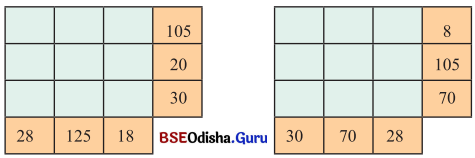
Class 6 Maths Chapter 5 Question Answer Odia Medium ମୌଳିକ ସଂଖ୍ୟା Page 128 Q1
Class 6 Maths Chapter 5 Question Answer Odia Medium ମୌଳିକ ସଂଖ୍ୟା Page 128 Q1.1
Solution:
Class 6 Maths Chapter 5 Question Answer Odia Medium ମୌଳିକ ସଂଖ୍ୟା Page 128 Q1.2
Class 6 Maths Chapter 5 Question Answer Odia Medium ମୌଳିକ ସଂଖ୍ୟା Page 128 Q1.3

A Journey through States of Water Class 6 Notes Science Chapter 8

Combining textbook study with BSE Odisha Class 6 Science Notes and Class 6 Science Curiosity Chapter 8 A Journey through States of Water Notes can make exam preparation more effective.

A Journey through States of Water Notes Class 6

Class 6 Science Curiosity Chapter 8 Notes

Water is one of the most important substances on Earth. It is a clear, colourless liquid that forms rain and makes up rivers, lakes and oceans. It is used by humans every day for drinking, cooking, cleaning, bathing, farming, and many other purposes.

States of Water

Water exists mainly in three different states as shown in the following flowchart:
A Journey through States of Water Class 6 Notes Science Chapter 8 1

A Journey through States of Water Class 6 Notes Science Chapter 8

Interconversion Between States

There are primarily four different processes that involve the interconversion between different states of water.
A Journey through States of Water Class 6 Notes Science Chapter 8 2
These processes are discussed as follows:

Melting
The process by which a substance changes its state from solid to liquid is called melting, the conversion of solid ice to liquid water occurs by this process. Heat needs to be supplied for the melting of ice into water. Melting becomes faster with an increase in temperature.

Freezing
The process by which a substance changes its state from liquid to solid is called freezing.

  • The conversion of liquid water to solid ice occurs by this process.
  • The process of freezing occurs due to cooling or a decrease in temperature.

Evaporation

The process by which a liquid converts into its vapour form is called evaporation.

  • The conversion of liquid water to water vapour occurs by this process.
  • Evaporation can occur at all temperatures, even at room temperature.
  • Some common real-life examples of evaporation are:
    • Water sprinkled on a hot pan turns into steam
    • Drying of wet clothes
    • Drying of freshly mopped floor
    • Drying of sweat from the body
    • Disappearance of water puddles from the ground
  • NOTE: Water vapour is actually invisible but the presence of tiny water droplets in the steam makes it visible.

A Journey through States of Water Class 6 Notes Science Chapter 8

Condensation

The process by which a vapour (gas) converts into its liquid form is called condensation, a The conversion of water vapour to liquid water occurs by this process, a Some common real-life examples of condensation are:

  • Appearance of water droplets on the outer surface of a glass tumbler containing ice-cold water
  • Formation of dew drops on plants, grass, and leaves in the early morning
  • Appearance of water droplets on inner side of a lid used to close a container containing hot water
  • Appearance of mist on a cool mirror surface after a hot water bath

Factors Affecting Evaporation

Evaporation does not take place at the same rate in all conditions. The rate of evaporation is dependent on the factors that are discussed as follows:

Exposed Surface Area

  • The larger the exposed surface area, the greater the rate of evaporation.
  • More water can escape into the air as vapour when water to be evaporated has a comparatively larger exposed surface area.
  • For example, water spread on a plate evaporates faster than water in a bottle cap.
    A Journey through States of Water Class 6 Notes Science Chapter 8 3
    A Journey through States of Water Class 6 Notes Science Chapter 8 4

A Journey through States of Water Class 6 Notes Science Chapter 8

Temperature

  • The higher the temperature, the greater the rate of evaporation.
  • For example, the same amount of water kept in sunlight evaporates faster than water kept in a shaded region.

Wind Speed

  • An increase in the wind speed or the movement of air causes an increase in the rate of evaporation.
  • Moving air carries away water vapour from the surface, which speeds up the evaporation.
  • For example, wet clothes dry faster on a windy day compared to a non-windy day.

Humidity

  • Humidity is the amount of water vapour present in the air.
  • The rate of evaporation decreases with an increase in the humidity.
  • When the air already has a lot of water vapour, there is less space for extra water vapour to enter the air, hence evaporation slows down.
  • For example, wet clothes dry very slowly on a cloudy day dtte to high humidity in the air.

Cooling Effect of Evaporation

Evaporation causes a cooling effect. During evaporation, water absorbs heat from its surroundings, which causes cooling effect.
Examples of Cooling Effect:

  • Earthen Pot (Matka): Earthen pots have tiny pores. Water seeps through these pores and evaporates from the surface, resulting in a cooling effect. Consequently, the water stored in earthen pots (matka or surahi) feels cool.
  • Sweating: Evaporation of sweat from the body produces a cooling sensation.
  • Rubbing sanitiser on hands: The hands feel cool as the sanitiser evaporates quickly, taking heat from the hands.
  • Cooling rooftops during summers: Sprinkling water on rooftops during summer helps cool them due to evaporation.
  • Pot-in-Pot Cooler: Water evaporates from wet sand that is present in between two pots, creating a cooling effect inside.

A Journey through States of Water Class 6 Notes Science Chapter 8

Formation of Clouds and Rain — Water Cycle

The water cycle is the continuous circulation of water between Earth’s surface and the atmosphere.
The steps involved in the water cycle are as follows:

  • Evaporation: Water from oceans, rivers, and lakes evaporates into the atmosphere as water vapour.
  • Rising of Water Vapour: Water vapour is lighter than air, so it rises up in the atmosphere.
  • Cooling and Condensation: As air rises higher, it becomes cooler. Water vapour condenses around dust particles to form tiny water droplets.
  • Cloud Formation: Many tiny water droplets floating together join to form clouds.
  • Precipitation: Droplets join together to form bigger drops. When they become heavy enough, they fall to the ground as rain. Under special conditions, water may fall as snow or hail.
  • Return to Earth: Water returns to oceans, rivers, lakes, and groundwater, and the cycle continues.
    A Journey through States of Water Class 6 Notes Science Chapter 8 5

Importance of Water Conservation :
Although Earth appears to have plenty of water, only a small amount of it is fit for use by humans, animals, and plants. Increasing population and pollution are causing water shortages in many areas.
Therefore, it is our responsibility to:

  • Use water wisely
  • Avoid wastage of water
  • Keep water sources clean and free from pollution
  • Water is essential for life, and protecting it is essential for our future.

Different States of Water

Ice (Solid)
Fixed shape and fixed volume
Does not spread or flow like liquid
A Journey through States of Water Class 6 Notes Science Chapter 8 6

A Journey through States of Water Class 6 Notes Science Chapter 8
Water (Liquid)
Fixed volume but no fixed shape
Flows freely, keeping a constant volume
A Journey through States of Water Class 6 Notes Science Chapter 8 7
Water Vapour (Gas)
‘— No fixed shape or fixed ‘oliime
Moves rapidly

Water Cycle
A Journey through States of Water Class 6 Notes Science Chapter 8 8

Inter-Conversion of States of Water

  • Evaporation: Conversion of water into water vapour
  • Condensation: Conversion of water vapour into liquid water on cooling
  • Melting: Conversion of solid (ice) into liquid (water)
  • Freezing: Conversion of liquid (water) into solid (ice) on cooling
    A Journey through States of Water Class 6 Notes Science Chapter 8 9

A Journey through States of Water Class 6 Notes Science Chapter 8

Factors Affecting Rate of Evaporation :

  • Exposed Surface Area: Increase in the exposed surface area caused an increase in the rate of evaporation.
  • Temperature: Increase in the temperature causes an increase in the rate of evaporation.
  • Wind Speed: Increase in the wind speed causes an increase in the rate of evaporation.
  • Humidity: Increase in the humidity causes a decrease in the rate of evaporation.

Temperature and its Measurement Class 6 Notes Science Chapter 7

Combining textbook study with BSE Odisha Class 6 Science Notes and Class 6 Science Curiosity Chapter 7 Temperature and its Measurement Notes can make exam preparation more effective.

Temperature and its Measurement Notes Class 6

Class 6 Science Curiosity Chapter 7 Notes

The Sense of Temperature: Hot or cold

o Some bodies feel hotter or colder than others when touched, but touch gives only a rough idea.
o Our sense of touch is not always reliable because the same object can feel warm of cool depending on what the hand touched earlier. Therefore, fever or hotness cannot be judged correctly only by touching.

Temperature

Temperature of a body is a measure of its hotness or coldness. A hotter body has a higher temperature than a colder body, and the temperature difference tells how much hotter one body is compared to another.

An instrument used to measure temperature is called a thermometer.

Temperature and its Measurement Class 6 Notes Science Chapter 7

Temperature Scales and Units

  • There are three main temperature scales:
    (a) Celsius Scale: Temperature is measured in degree Celsius (°C).
    (b) Fahrenheit Scale: Temperature is measured in degree Fahrenheit (°F).
    (c) Kelvin Scale: Temperature is measured in kelvin (K). The zero in this scale, i.e., 0 K is known as the absolute zero. It is the lowest possible temperature.
  • The SI unit of temperature is kelvin, it is mostly used in scientific studies.
Conversion of Units
From → To Formula
Celsius → Fahrenheit °F = (°C x 9/5) + 32
Fahrenheit → Celsius °C = (°F – 32) × 5/9
Celsius → Kelvin K = °C + 273.15

Rules for Writing Names and Symbols Correctly

  • The names of the temperature scales (Celsius, Fahrenheit, Kelvin) start with capital letters.
  • In the full unit names “degree Celsius” and “degree Fahrenheit”, the word “degree” begins with a small letter, while “Celsius” and “Fahrenheit” begin with capital letters; the unit name “kelvin” starts with a small letter.
  • The symbols °C, °F and K are written as capital letters; the degree sign (°) is not written with K.
  • A space is left between the number and the unit symbol (for example, 37.0 °C), and no full stop is written after the symbol unless it ends the sentence.
  • While writing the full unit name, the plural “degrees” is used for temperatures more than one degree.

Temperature and its Measurement Class 6 Notes Science Chapter 7

Types of Thermometers

Clinical Thermometer
It is used to measure human body temperature. It usually has a range of 35 °C to 42 °C. There are three main types of clinical thermometers:
(a) Digital clinical thermometer: It displays temperature on a digital display I – screen, and run on batteries. It uses electronic heat sensors to measure the temperature. It is a contact type thermometer, i.e., temperature is measured when the thermometer is placed in contact with a person’s body.
Temperature and its Measurement Class 6 Notes Science Chapter 7 1
Precautions while using a digital clinical thermometer

  • The tip of the thermometer should be washed with soap and water before and after use.
  • Care should be taken to keep the digital display away from water while cleaning.
  • The thermometer should not be held by its tip.

(b) Mercury thermometer: It consists of a narrow glass tube connected to a bulb filled with mercury. Mercury thermometers are not recommended because mercury is toxic and harmful if released, posing health and environmental risks, and digital thermometers are a safer alternative. It is a contact type thermometer.
Temperature and its Measurement Class 6 Notes Science Chapter 7 2

(c) Infrared thermometer: It is a non-contact type thermometer. It can measure temperature without touching a person’s body and thus reduce the risk of spreading disease. Infrared thermometers were widely used during COVID-19 pandemic.
Temperature and its Measurement Class 6 Notes Science Chapter 7 3

NOTE: Normal human body temperature is about 37.0 °C, but it may vary slightly among individuals as it is an average value. It is influenced by factors such as age, time of the day, and activity level. The temperature of human beings does not normally go below 35 °C or above 42 °C.

Temperature and its Measurement Class 6 Notes Science Chapter 7

Laboratory Thermometer

  • A laboratory thermometer is used to measure the temperature of substances other than the human body, such as water and other liquids.
  • It consists of a sealed, narrow glass tube with a bulb containing a liquid, and a liquid column that rises or falls with temperature change.
  • The liquid used in a laboratory thermometer is usually red coloured alcohol or mercury.
  • A typical laboratory thermometer may have a range from -10 °C to 110 °C.
  • To find the smallest value (least count) that a thermometer can measure, the temperature difference between two big marks on its scale is divided by the number of small divisions between them.
    Temperature and its Measurement Class 6 Notes Science Chapter 7 4

Precautions while using a Laboratory Thermometer

  • It should be kept upright not tilted. Ensure the bulb is fully immersed and does not touch the container. Take the reading while bulb is still in touch with the substance.
  • Read the thermometer by keeping your eye directly in line with the level of the liquid column.

NOTE: The temperature of melting ice is 0 °C, and the temperature of boiling water is 100 °C. Laboratory During melting and boiling, the temperature remains constant even if heating continues, thermometer.

Temperature and its Measurement Class 6 Notes Science Chapter 7

Air Temperature

  • Air temperature gives a measure of how hot or cold the air of an area is at a specific time. It is measured using a room thermometer.
  • Air temperature varies from day to day as it is influenced by several factors.
  • It is a crucial weather parameter that affects weather conditions, climate patterns and the environment. It is monitored at weather stations all over the world.
  • The data collected by the weather stations plays a vital role in making weather forecasts (predictions) that prepare us for the changing weather conditions.
    Temperature and its Measurement Class 6 Notes Science Chapter 7 5

Temperature

  • Temperature is a measure of hotness or coldness of a body.
  • The SI unit of temperature is kelvin.

Scales of Temperature

Fahrenheit Scale

  • Unit: degree Fahrenheit, denoted by °F.
  • Freezing point of water: 32 °F
  • Boiling point of water: 212 °F

Celsius Scale

  • Unit: degree Celsius, denoted by °C.
  • Freezing point of water: 0 °C
  • Boiling point of water: 100 °C

Temperature and its Measurement Class 6 Notes Science Chapter 7

Kelvin Scale

  • Unit: kelvin, denoted by K.
  • Freezing point of water: 273.15 K
  • Boiling point of water: 373.15 K

Temperature and its Measurement Class 6 Notes Science Chapter 7 6

Air Temperature

  • It measures how hot or cold the surrounding air is.
  • Weather reports show the day’s maximum and minimum air temperature.
  • Room thermometers in schools, clinics, and hospitals give an approximate temperature of the surrounding air.

Thermometer

Thermometer is a device that measures temperature.

Clinical Thermometer

  • It is used to measure body temperature.
  • Range: 35 °C to 42 °C.

Mercury Thermometer

  • It has a long, uniform glass tube (capillary) connected to a mercury-filled bulb.
  • As mercury is toxic, digital thermometers are now safer alternatives.

Temperature and its Measurement Class 6 Notes Science Chapter 7

Digital Thermometer

  • It runs on batteries and uses electronic heat sensors to measure temperature.
  • Displays temperature in °C or °F on a digital screen.
  • It is easier to read than mercury thermometers.

Infrared Thermometer

  • It measures body temperature without touching the skin.
  • These are also called non-contact thermometers.

Laboratory Thermometer

  • It is used in science labs and industries to measure temperatures other than our body temperature.
  • Range:-10 °C to 110°C (Generally).
  • The liquid used in the laboratory thermometer is generally alcohol (coloured red to make it easily seen) or mercury.
  • The liquid column rises or falls with change in temperature.
  • It does not keep the reading. The temperature drops as soon as you remove it from the liquid.