Working with Fractions Class 7 Solutions Maths Ganita Prakash Chapter 8

Students can refer to BSE Odisha Class 7 Math Solution and Ganita Prakash Chapter 8 Working with Fractions Class 7 Question Answer to understand textbook questions step by step.

Class 7 Maths Chapter 8 Working with Fractions Solutions

Ganita Prakash Class 7 Chapter 8 Solutions

Class 7 Maths Ganita Prakash Chapter 8 Solutions Working with Fractions

Question 1.
A team of workers can make 1 km of a water canal in 8 days. So, in one day, the team can make _______ km of the water canal. If they work 5 days a week, they can make _______ km of the water canal in a week.
Solution:
Water canal made by team of workers in 8 days = 1 km
So, water canal made by team of workers in 1 dav = \(\frac{1}{8}\) km
The length of the water canal made by the team of workers in 5 days = 5 × \(\frac{1}{8}\) km = \(\frac{5}{8}\) km
Hence, the team can make \(\frac{5}{8}\) km of the water canal in one week.

Question 2.
Safia saw the Moon setting on Monday at 10 pm. Her mother, who is a scientist, told her that every day the Moon sets \(\frac{5}{6}\) hour later than the previous day. How many hours after 10 pm will the moon set on Thursday?
Solution:
There are 3 days from Monday to Thursday. Since the Moon sets \(\frac{5}{6}\) hours later than previous day, the number of hours the Moon will set later on Thursday than Monday = 3 × \(\frac{5}{6}\) hours = \(\frac{15}{6}\) hours = \(\frac{5}{2}\) hours.
We know that 1 hour = 60 minutes
⇒ \(\frac{5}{2}\) hours = \(\frac{5}{2}\) × 60 minutes = \(\frac{300}{2}\) minutes = 150 minutes
Now, 150 minutes = 120 minutes + 30 minutes = 2 hours 30 minutes
Hence, on Thursday the Moon will set 2 hours 30 minutes after 10 pm.

Working with Fractions Class 7 Solutions Maths Ganita Prakash Chapter 8

Question 3.
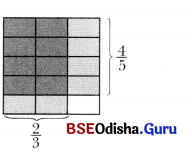
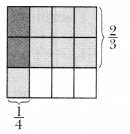
Find the following products. Use a unit square as a whole for representing the fractions and carrying out the operations.
(i) \(\frac{2}{3}\) × \(\frac{4}{5}\)
(ii) \(\frac{1}{4}\) × \(\frac{2}{3}\)
Solution:
(i) Each row represents \(\frac{1}{5}\) and each column represents \(\frac{1}{3}\). The whole is divided into 5 rows and 3 columns creating 5 x 3 = 15 equal parts and 2 × 4 = 8 of the parts is double-shaded, that is \(\frac{8}{15}\) of the whole is double-shaded.
Therefore, \(\frac{2}{3}\) × \(\frac{4}{5}\) = \(\frac{8}{15}\)
Working with Fractions Class 7 Solutions Maths Ganita Prakash Chapter 8 1

(ii) Each row represents \(\frac{1}{3}\) and each column represents \(\frac{1}{4}\). The whole is divided into 3 rows and 4 columns, creating 3×4=12 equal parts and 2 of the parts are double-shaded, that is \(\frac{2}{12}\) of the whole is double-shaded.
Therefore, \(\frac{1}{4}\) × \(\frac{2}{3}\) = \(\frac{2}{12}\) = \(\frac{1}{6}\)
Working with Fractions Class 7 Solutions Maths Ganita Prakash Chapter 8 2

Question 4.
A water tank is filled from a tap. If the tap is open for 1 hour, \(\frac{7}{10}\) of the tank gets filled. How much of the tank is filled if the tap is open for
(i) \(\frac{1}{3}\) hours
(ii) \(\frac{7}{10}\) hours
Solution:
In 1 hour, part of the tank gets filled = \(\frac{7}{10}\)
(i) In \(\frac{1}{3}\) hours, part oLthe tank gels filled = \(\frac{1}{3}\) × \(\frac{7}{10}\) = \(\frac{1 \times 7}{3 \times 10}\) = \(\frac{7}{30}\)
Therefore, in \(\frac{1}{3}\) hours, \(\frac{7}{30}\) of the tank gets filled.

(ii) In \(\frac{7}{10}\) hours, part of the tank gets filled = \(\frac{7}{10}\) × \(\frac{7}{10}\) = \(\frac{7 \times 7}{10 \times 10}\) = \(\frac{49}{100}\)
Therefore, in \(\frac{7}{10}\) hours, \(\frac{49}{100}\) of the tank gets filled.

Working with Fractions Class 7 Solutions Maths Ganita Prakash Chapter 8

Question 5.
Tsewang plants four saplings in a row in his garden. The distance between two saplings is \(\frac{3}{4}\) m. Find the distance between the first and last sapling.
Solution:

Working with Fractions Class 7 Solutions Maths Ganita Prakash Chapter 8 3
The distance between the first and the last sapling = \(\frac{3}{4}\) + \(\frac{3}{4}\) + \(\frac{3}{4}\) = 3 × \(\frac{3}{4}\) = \(\frac{9}{4}\) m

Question 6.
Which is heavier: \(\frac{12}{15}\) of 500 grams or \(\frac{3}{20}\) of 4 kg?
Solution:
We have \(\frac{12}{15}\) of 500 g = \(\frac{12}{15}\) × 500 g = \(\frac{12 \times 500}{15}\) = 400 g
And \(\frac{3}{20}\) × 4000 g = \(\frac{3 \times 4000}{20}\) g = 600 g [∵ 1 kg = 1000 g]
∵ 600 g is heavier than 400 g.
∵ \(\frac{3}{20}\) of 4 kg is heavier than \(\frac{12}{15}\) of 500 grams.

Working with Fractions Class 7 Solutions Maths Ganita Prakash Chapter 8

Question 7.
(i) 3 ÷ \(\frac{7}{9}\)
(ii) \(\frac{14}{6}\) \(\frac{7}{3}\)
(iii) \(\frac{1}{6}\) ÷ \(\frac{11}{12}\)
(iv) 3\(\frac{2}{3}\) ÷ 1\(\frac{3}{8}\)
Solution:
(i) 3 ÷ \(\frac{7}{9}\) = 3 × \(\frac{9}{7}\) = \(\frac{9}{7}\) = \(\frac{3 \times 9}{7}\)
= 3\(\frac{6}{7}\)

(ii) \(\frac{14}{6}\) \(\frac{7}{3}\) = \(\frac{14}{6}\) × \(\frac{3}{7}\) = \(\frac{14 \times 3}{6 \times 7}\)
= \(\frac{42}{42}\) = 1

(iii) \(\frac{1}{6}\) ÷ \(\frac{11}{12}\) = \(\frac{1}{6}\) × \(\frac{12}{11}\) = \(\frac{1 \times 12}{6 \times 11}\)
= \(\frac{2}{11}\)

(iv) 3\(\frac{2}{3}\) ÷ 1\(\frac{3}{8}\) = \(\frac{11}{3}\) ÷ \(\frac{11}{8}\) = \(\frac{11}{3}\) × \(\frac{11}{8}\)
= \(\frac{11 \times 8}{3 \times 11}\)
= \(\frac{8}{3}\) = 2\(\frac{2}{3}\)

Question 8.
Patiganita a book written by Sridharacharya in the 9th century CE, mentions this problem: “Friend, after thinking, what sum will be obtained by adding together 1÷ \(\frac{1}{6}\), 1 ÷ \(\frac{1}{10}\), 1 ÷ \(\frac{1}{13}\), 1 ÷ \(\frac{1}{9}\) and 1 ÷ \(\frac{1}{2}\). What should the friend say?
Solution:
1÷ \(\frac{1}{6}\) = 1 × 6 = 6, 1 ÷ \(\frac{1}{10}\) = 1 × 10 = 10, 1 ÷ \(\frac{1}{13}\) = 1 × 13 = 13, 1 ÷ \(\frac{1}{9}\) = 1 × 9 = 9 and 1 ÷ \(\frac{1}{2}\) = 1 × 2 = 2
Therefore, the sum obtained by adding together
1÷ \(\frac{1}{6}\), 1 ÷ \(\frac{1}{10}\), 1 ÷ \(\frac{1}{13}\), 1 ÷ \(\frac{1}{9}\) and 1 ÷ \(\frac{1}{2}\)
= 6 + 10 + 13 + 9 + 2 = 40
Thus, the friend should say the ‘sum’ is 40.

Working with Fractions Class 7 Solutions Maths Ganita Prakash Chapter 8

Question 9.
Amritpal decides on a destination for his vacation. If he takes a train, it will take him 5\(\frac{1}{6}\) hours to get there. If he takes a plane, it will take him \(\frac{1}{2}\) hour. How many hours does the plane save?
Solution:
The difference between the two durations = 5\(\frac{1}{6}\) – \(\frac{1}{2}\) = \(\frac{31}{6}\) – \(\frac{1}{2}\) [∵ 5\(\frac{1}{6}\) = \(\frac{31}{6}\)]
= \(\frac{31}{6}\) – \(\frac{3}{6}\) = \(\frac{31-3}{6}\) = \(\frac{28}{6}\)
= \(\frac{14}{3}\) = 4\(\frac{2}{3}\) hours
Hence, the plane saves 4\(\frac{2}{3}\) hours.

Question 10.
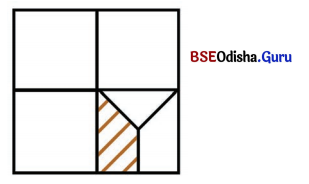
What fraction of the whole square is shaded?
Working with Fractions Class 7 Solutions Maths Ganita Prakash Chapter 8 4
Solution:
In the given figure, the big square is divided into 4 identical squares. So, one small square occupies \(\frac{1}{4}\) of the area of the big square. Now, consider the smaller square.
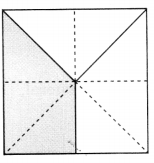
The small square in the figure is divided into 8 identical triangles in which 3 are shaded.
Working with Fractions Class 7 Solutions Maths Ganita Prakash Chapter 8 5
So, the shaded part is \(\frac{3}{8}\) of the small square.
But the small square is \(\frac{3}{8}\) of the big square.
∴ The shaded part is \(\frac{1}{4}\) × \(\frac{3}{8}\) = \(\frac{3}{32}\) of the big square.
Hence, \(\frac{3}{32}\) of the whole square is shaded.

Working with Fractions Class 7 Solutions Maths Ganita Prakash Chapter 8

Question 11.
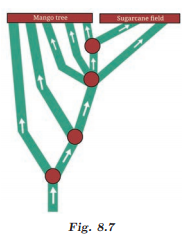
A colony of ants set out in search of food. As they search, they keep splitting equally at each point (as shown in the Fig. 8.7) and reach two food sources, one near a mango tree and another near a sugarcane field. What fraction of the original group reached each food source?
Working with Fractions Class 7 Solutions Maths Ganita Prakash Chapter 8 6
Solution:
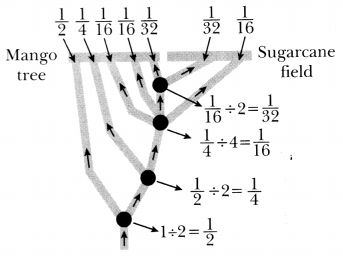
At first point ants split in two ways. So, fraction of ants at each way is 1 ÷ \(\frac{1}{2}\) = \(\frac{1}{2}\).
At the second point. ants split in two ways.
So the fraction of ants at each war \(\frac{1}{2}\) ÷ 2 = \(\frac{1}{2}\) × \(\frac{1}{2}\) = \(\frac{1}{4}\)
Working with Fractions Class 7 Solutions Maths Ganita Prakash Chapter 8 7
At the third point, ants split in four ways.
So, fraction of ants at each way
= \(\frac{1}{4}\) ÷ 4 = \(\frac{1}{4}\) × \(\frac{1}{4}\) = \(\frac{1}{16}\)
At the fourth point, ants split in 2 wars.
So fraction of ants at each way
= \(\frac{1}{16}\) ÷ 2 = \(\frac{1}{16}\) × \(\frac{1}{2}\) = \(\frac{1}{32}\)
Hence, fraction of ants at mango tree = \(\frac{1}{2}\) + \(\frac{1}{4}\) + \(\frac{1}{16}\) + \(\frac{1}{16}\) + \(\frac{1}{32}\)
= \(\frac{16}{32}\) + \(\frac{8}{32}\) + \(\frac{2}{32}\) + \(\frac{2}{32}\) + \(\frac{1}{32}\) = \(\frac{16+8+2+2+1}{32}\)
= \(\frac{29}{32}\)
Fraction of ants near sugarcane field = \(\frac{1}{32}\) + \(\frac{1}{16}\) = \(\frac{1}{32}\) + \(\frac{2}{32}\)
= \(\frac{1+2}{32}\) = \(\frac{3}{32}\)

Working with Fractions Class 7 Solutions Maths Ganita Prakash Chapter 8

Question 12.
What is (1 – \(\frac{1}{2}\))?
(1 – \(\frac{1}{2}\)) × (1 – \(\frac{1}{3}\) ?
(1 – \(\frac{1}{2}\)) × (1 – \(\frac{1}{3}\)) × (1 – \(\frac{1}{4}\)) × (1 – \(\frac{1}{5}\)) ?
(1 – \(\frac{1}{2}\)) × (1 – \(\frac{1}{3}\)) × (1 – \(\frac{1}{4}\)) × (1 – \(\frac{1}{5}\)) × (1 – \(\frac{1}{6}\)) × (1 – \(\frac{1}{7}\)) × (1 – \(\frac{1}{8}\)) × (1 – \(\frac{1}{9}\)) × (1 – \(\frac{1}{10}\)) ?
Make a general statement and explain.
Solution:
1 – \(\frac{1}{2}\) = \(\frac{1}{2}\)
(1 – \(\frac{1}{2}\)) × (1 – \(\frac{1}{3}\) = \(\frac{1}{2}\) × \(\frac{2}{3}\) = \(\frac{1}{3}\);
(1 – \(\frac{1}{2}\)) × (1 – \(\frac{1}{3}\)) × (1 – \(\frac{1}{4}\)) × (1 – \(\frac{1}{5}\)) = \(\frac{1}{2}\) × \(\frac{2}{3}\) × \(\frac{3}{4}\) × \(\frac{4}{5}\) = \(\frac{1}{5}\);
(1 – \(\frac{1}{2}\)) × (1 – \(\frac{1}{3}\)) × (1 – \(\frac{1}{4}\)) × (1 – \(\frac{1}{5}\)) × (1 – \(\frac{1}{6}\)) × (1 – \(\frac{1}{7}\)) × (1 – \(\frac{1}{8}\)) × (1 – \(\frac{1}{9}\)) × (1 – \(\frac{1}{10}\))
= \(\frac{1}{2}\) × \(\frac{2}{3}\) × \(\frac{3}{4}\) × \(\frac{4}{5}\) × \(\frac{5}{6}\) × \(\frac{6}{7}\) × \(\frac{7}{8}\) × \(\frac{8}{9}\) × \(\frac{9}{10}\) = \(\frac{1}{10}\)
Here, we observe that in this pattern, denominator of each term cancels the numerator of the next term, and found that the final product has the numerator of the first term and the denominator of the last term.
In general, (1 – \(\frac{1}{2}\)) × (1 – \(\frac{1}{3}\)) × (1 – \(\frac{1}{4}\)) × ………… × (1 – \(\frac{1}{n}\)) = \(\frac{1}{n}\)

InText Questions

Question 1.
In each of the figures given below, find the fraction of the big square that the shaded region occupies.
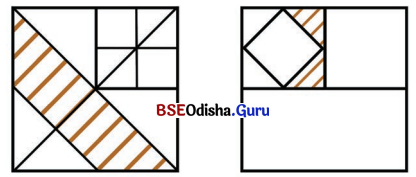
Working with Fractions Class 7 Solutions Maths Ganita Prakash Chapter 8 8
Solution:
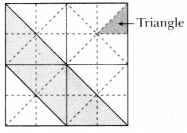
(i) In the figure. the smaller square in the up- right corner is divided into 4 smaller squares and each square within it is further divided into 2 triangles.
Working with Fractions Class 7 Solutions Maths Ganita Prakash Chapter 8 9
∴ Total number of triangles in whole square
= (4 × 2) × 4 = 32
Out of these 32 triangles. 12 triangular regions are shaded.
∴ Fraction of shaded region = \(\frac{12}{32}\) = \(\frac{3}{8}\)
Thus, the shaded region occupies \(\frac{3}{8}\) of the area of the whole square.

Working with Fractions Class 7 Solutions Maths Ganita Prakash Chapter 8

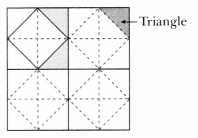
(ii) In the figure, the smaller square is divided into 4 triangles and a square, which can be divided into 4 triangles having the same area. Therefore, total triangle in 1 smaller square is 8.
Working with Fractions Class 7 Solutions Maths Ganita Prakash Chapter 8 10
∴ Total number of triangles in whole square = 8 × 4 = 32
Out of these 32 triangles, 2 triangular regions are shaded.
∴ Fraction of shaded region = \(\frac{2}{32}\) = \(\frac{1}{16}\)
Thus, the shaded region occupies \(\frac{1}{16}\) of the area of the whole square.

Working with Fractions Class 7 Extra Questions

Working with Fractions Class 7 Very Short Question Answer

Question 1.
A library has 2400 books, and \(\frac{5}{8}\) of them are placed on the ground floor. The rest are kept on the first floor. How many books are on the first floor?
Solution:
Given, total number of books in library = 2400
Number of books on ground floor
= \(\frac{5}{8}\) of total books = \(\frac{5}{8}\) × 2400 = 5 × 300 = 1500
Hence, number of books on the first floor
= 2400 – 1500 = 900.

Working with Fractions Class 7 Solutions Maths Ganita Prakash Chapter 8

Question 2.
A water tank can hold 1250 litres of water. If 2\(\frac{1}{5}\) of such tanks are filled, how much water is used in total?
Solution:
Given, capacity of one tank = 1250 litres
And, 2\(\frac{1}{5}\) of such tanks are filled.
∴ Total water used = 2\(\frac{1}{5}\) × capacitv of one tank
= \(\frac{11}{5}\) × capacity of one tank
= \(\frac{11}{5}\) × 125o = 11 × 250
= 2750 litres

Question 3.
Divide:
(i) 25 by \(\frac{1}{3}\)
(ii) 48 by 3\(\frac{3}{4}\)
Solution:
(i) 25 ÷ \(\frac{1}{3}\) = 25 × \(\frac{3}{1}\)
= \(\frac{25 \times 3}{1}\) = 75

(ii) 48 ÷ 3\(\frac{3}{4}\) = 48 ÷ \(\frac{15}{4}\)
= 48 × \(\frac{4}{15}\) [∵ 3\(\frac{3}{4}\) = \(\frac{15}{4}\)]
= \(\frac{16 \times 4}{5}\) = \(\frac{64}{5}\) = 12\(\frac{4}{5}\)

Question 4.
Solve the following:
(i) \(\frac{3}{4}\) ÷ \(\frac{2}{5}\)
(ii) 2\(\frac{1}{2}\) ÷ \(\frac{5}{8}\)
Solution:
(i) \(\frac{3}{4}\) ÷ \(\frac{2}{5}\) = \(\frac{3}{4}\) ÷ \(\frac{5}{2}\)
= \(\frac{3 \times 5}{4 \times 2}\) = \(\frac{15}{8}\)

(ii) 2\(\frac{1}{2}\) ÷ \(\frac{5}{8}\) = \(\frac{5}{2}\) ÷ \(\frac{5}{8}\)
= \(\frac{5}{2} \times \frac{8}{5}\) = \(\frac{5 \times 8}{2 \times 5}\) = 4

Working with Fractions Class 7 Solutions Maths Ganita Prakash Chapter 8

Question 5.
Solve:
(i) \(\frac{5}{6}\) ÷ 3
(ii) 1\(\frac{2}{3}\) ÷ 4
Solution:
(i) \(\frac{5}{6}\) ÷ 3 = \(\frac{5}{6}\) × \(\frac{1}{3}\) = \(\frac{5 \times 1}{6 \times 3}\) = \(\frac{5}{18}\)

(ii) 1\(\frac{2}{3}\) ÷ 4 = \(\frac{5}{3}\) ÷ 4 = \(\frac{5}{3}\) × \(\frac{1}{4}\) = \(\frac{5 \times 1}{3 \times 4}\) = \(\frac{5}{12}\) [∵ 1\(\frac{2}{3}\) = \(\frac{5}{3}\)]

Question 6.
During a community health program, each participant was provided \(\frac{2}{5}\) litres of clean water per day. If 40 litres were distributed on a particular day, calculate the number of participants who received the water.
Solution:
Quantity of water for I participant = \(\frac{2}{5}\) litres
Total quantity oÍ waler = 40 litres
Now, number of participants
= \(\frac{\text { Total quantity of water }}{\text { Quantity of water for } 1 \text { participant }}\)
= 40 ÷ \(\frac{2}{5}\) = 40 × \(\frac{5}{2}\) = 100

Working with Fractions Class 7 Solutions Maths Ganita Prakash Chapter 8

Question 7.
What number should be multiplied by 5\(\frac{3}{4}\) to get 3\(\frac{3}{5}\)?
Solution:
Let the required number be x. Then,
x × 5\(\frac{3}{4}\) = 3\(\frac{3}{5}\)
⇒ x = \(\frac{3 \frac{3}{5}}{5 \frac{3}{4}}\)
⇒ x = \(\frac{\frac{18}{5}}{\frac{23}{4}}\) = \(\frac{15}{5}\) × \(\frac{4}{23}\) = \(\frac{18 \times 4}{5 \times 23}\)
= \(\frac{72}{115}\)

Question 8.
Each guest is served 1\(\frac{3}{5}\) litres of juice. If 40 litres of juice is available, how many guests can be served?
Solution:
Given, juice served to each guest.
= 1\(\frac{3}{5}\) litres = \(\frac{8}{5}\)litres
Total quantity of juice available = 40 litres
Now, number of guests that can be served
= \(\frac{\text { Total quantity of juice available }}{\text { Juice served to each guest }}\)
= \(\frac{40}{\frac{8}{5}}\) = 40 × \(\frac{5}{8}\) = 5 × 5 = 25

Working with Fractions Class 7 Short Question Answer

Question 1.
Multiply the following fractions and express as mixed fraction:
(i) 1\(\frac{3}{4}\) × 2\(\frac{2}{5}\)
(ii) 4\(\frac{1}{3}\) × \(\frac{3}{7}\)
(iii) 5\(\frac{2}{9}\) × 1\(\frac{1}{6}\)
(iv) 3\(\frac{4}{5}\) × 2\(\frac{3}{8}\)
Solution:
(i) 1\(\frac{3}{4}\) × 2\(\frac{2}{5}\) = \(\frac{7}{4}\) × \(\frac{12}{5}\)
= \(\frac{7 \times 3}{1 \times 5}\) = \(\frac{21}{5}\)
= 4\(\frac{1}{5}\)

(ii) 4\(\frac{1}{3}\) × \(\frac{3}{7}\) = \(\frac{13}{3}\) × \(\frac{3}{7}\)
= \(\frac{13 \times 1}{1 \times 7}\) = \(\frac{13}{7}\)
= 1\(\frac{6}{7}\)

(iii) 5\(\frac{2}{9}\) × 1\(\frac{1}{6}\) = \(\frac{47}{9}\) × \(\frac{7}{6}\)
= \(\frac{47 \times 7}{9 \times 6}\) = \(\frac{329}{54}\)
= 6\(\frac{5}{54}\)

(iv) 3\(\frac{4}{5}\) × 2\(\frac{3}{8}\) = \(\frac{19}{5}\) × \(\frac{19}{8}\)
= \(\frac{19 \times 19}{5 \times 8}\) = \(\frac{361}{40}\)
= 9\(\frac{1}{4}\)

Working with Fractions Class 7 Solutions Maths Ganita Prakash Chapter 8

Question 2.
Meena invited \(\frac{2}{7}\) of her students to a weekend workshop. If \(\frac{3}{5}\) of the invited students were girls, how many boys were present at the workshop if her class has 105 students?
Solution:
Given, total students in the class = 105
∴ Nunber of students invited
= \(\frac{2}{7}\) × Total students =
= \(\frac{2}{7}\) × 105 = 2 × 15 = 30
Now, girls among invited students
= \(\frac{3}{5}\) of the invited students
= \(\frac{3}{5}\) × 30 = 3 × 6 = 18
Hence, number of boys present at the workshop
= 30 – 18 = 12.

Question 3.
A library donated \(\frac{3}{8}\) of its books to a village school. If \(\frac{2}{3}\) of the donated books were story books, how many non-story books were donated to the school if the library originally had 1280 books?
Solution:
Given, total number of books in library = 1280
Number of books donated = \(\frac{3}{8}\) of total books
= \(\frac{3}{8}\) × 1280 = 3 × 160 = 480
Story books among donated books = \(\frac{2}{3}\) × of donated books = \(\frac{2}{3}\) × 480 = 2 × 160 = 320
Hence, number of non-story books among donated books = 480 – 320 = 160

Question 4.
The area of a rectangular field is 63\(\frac{3}{5}\) m2. If its length is 7\(\frac{1}{2}\)m, find its breadth?
Solution:
Given area of rectangular field = 63\(\frac{3}{5}\) = \(\frac{318}{5}\) m2
length of rectangular field = 7\(\frac{1}{2}\) = \(\frac{15}{2}\) m
We know.
Area of rectangle length × Breadth
⇒ Breadth = \(\frac{\text { Area of rectangle }}{\text { Length }}\) = \(\frac{318}{5}\) ÷ \(\frac{15}{2}\)
= \(\frac{318}{5}\) × \(\frac{2}{15}\) = \(\frac{106 \times 2}{5 \times 5}\)
= \(\frac{212}{25}\) = 8\(\frac{12}{25}\) m

Working with Fractions Class 7 Solutions Maths Ganita Prakash Chapter 8

Question 5.
Determine the number by which 5\(\frac{4}{7}\) must be multiplied to obtain 4\(\frac{3}{5}\).
Solution:
We have. 5\(\frac{4}{7}\) = \(\frac{39}{7}\) and 4\(\frac{3}{5}\) = \(\frac{23}{5}\)
Let the number to be found b x. Then,
\(\frac{39}{7}\) × x = \(\frac{23}{5}\)
Multiplying by the reciprocal of \(\frac{39}{7}\) on both sides, we get
\(\frac{7}{39}\) × \(\frac{39}{7}\) × x = \(\frac{7}{39}\) × \(\frac{23}{5}\) [∵ Reciprocal of \(\frac{39}{7}\) is \(\frac{7}{39}\)]
⇒ x = \(\frac{7 \times 23}{39 \times 5}\) = \(\frac{161}{195}\)

Question 6.
A bookstore sells journals at ₹ 6\(\frac{1}{2}\) per copy. If the shop’s revenue from journal sales totalled ₹ 975, how many dozens of journals were sold?
Solution:
Given, total revenue from journal sales = ₹ 975
Price of 1 journal = ₹ 6\(\frac{1}{2}\) = ₹ \(\frac{13}{2}\)
Now, number of journals sold
= \(\frac{\text { Total revenue from journal sales }}{\text { Price of } 1 \text { journal }}\)
⇒ Number of journals sold = \(\frac{975}{\frac{13}{2}}\) = 975 × \(\frac{2}{13}\)
= \(\frac{75 \times 2}{1}\) = 150
Now, the number of journals sold (in dozens)
= \(\frac{150}{12}\) = \(\frac{25}{2}\) = 12\(\frac{1}{2}\) [∵ 1 dozen = 12]
Thus, 12\(\frac{1}{2}\) dozens of journals were sold.

Working with Fractions Class 7 Solutions Maths Ganita Prakash Chapter 8

Question 7.
Divide:
(i) 36 by \(\frac{3}{8}\)
(ii) 54 by 2\(\frac{2}{5}\)
(iii) 42 by \(\frac{7}{6}\)
Solution:
(i) 36 ÷ \(\frac{3}{8}\) = 36 × \(\frac{8}{3}\) = 12 × 8 = 96

(ii) 54 ÷ 2\(\frac{2}{5}\)
= 54 ÷ \(\frac{12}{5}\) = 54 × \(\frac{5}{12}\)
= \(\frac{9 \times 5}{2}\) = \(\frac{45}{2}\) = 22\(\frac{1}{2}\) [∵ 2\(\frac{2}{5}\) = \(\frac{12}{5}\)]

(iii) 42 ÷ \(\frac{2}{5}\) = 42 × \(\frac{6}{7}\)
= 6 × 6 = 36

Question 8.
How many square tiles with a side length of \(\frac{1}{2}\) m are required to cover an area of 12\(\frac{1}{4}\) m2?
Solution:
Given, the side length of a square tile is \(\frac{1}{2}\) m.
Therefore, area of one tile = Side × Side
= \(\frac{1}{2}\) × \(\frac{1}{2}\) = \(\frac{1}{4}\) m2
Area to be covered by the tiles = 12\(\frac{1}{4}\) m2 = \(\frac{49}{4}\) m2
Now, number of required tiles = Total area that need to be covered ÷ Area of one tile
= \(\frac{49}{4}\) ÷ \(\frac{1}{4}\) = \(\frac{49}{4}\) × \(\frac{4}{1}\) = 49
Thus, the number of required tiles is 49.

Working with Fractions Class 7 Solutions Maths Ganita Prakash Chapter 8

Question 9.
A fruit seller earns ₹ 4\(\frac{1}{2}\) per apple. He earns ₹864. How many dozens of apples did he sell?
Solution:
Given, total earnings = ₹864
Amount earned per apple = ₹4\(\frac{1}{2}\) = ₹\(\frac{9}{2}\)
Now, number of apples sold = \(=\frac{\text { Total earnings }}{\text { Amount earned per apple}}\)
= \(\frac{864}{\frac{9}{2}}\) = 864 × \(\frac{2}{9}\) = 96 × 2 = 192
So, number of apples sold (in dozens)
= \(\frac{192}{12}\) = 16 [∵ 1 dozen = 12]

Working with Fractions Class 7 Long Question Answer

Question 1.
Fill in the boxes using <, > or = without actually finding the product:
(i) \(\frac{3}{8}\) × \(\frac{2}{7}\) ☐ \(\frac{2}{7}\)
(ii) \(\frac{5}{9}\) × \(\frac{4}{11}\) ☐ \(\frac{5}{9}\)
(iii) 4\(\frac{1}{2}\) × 3\(\frac{3}{4}\) ☐ 4\(\frac{1}{2}\)
(iv) \(\frac{6}{13}\) × \(\frac{15}{4}\) ☐ \(\frac{15}{4}\)
Solution:
(i) We know, the product of two proper fractions is less than each of them.
Here, \(\frac{3}{8}\) and \(\frac{2}{7}\) are proper tractions.
∴ \(\frac{3}{8}\) × \(\frac{2}{7}\) < \(\frac{2}{7}\)

(ii) We know, the product of two proper fractions is less than each of them.
Here. \(\frac{5}{9}\) and \(\frac{4}{11}\) are proper fractions.
∴ \(\frac{5}{9}\) × \(\frac{4}{11}\) < \(\frac{5}{9}\)

(iii) We know, the product of two improper fractions is greater than both the fractions or equal to either of them.
Here, 4\(\frac{1}{2}\) and 3\(\frac{3}{4}\) are mixed tractions and mixed tractions can he converted into improper fractions.
∴ 4\(\frac{1}{2}\) × 3\(\frac{3}{4}\) > 4\(\frac{1}{2}\)

(iv) We know, the product of a proper fraction and an improper fraction (greater than 1) lies between both the fractions.
Here. \(\frac{6}{13}\) is a proper traction and \(\frac{15}{4}\) is an improper traction (greater than 1).
∴ \(\frac{6}{13}\) × \(\frac{15}{4}\) < \(\frac{15}{4}\)

Working with Fractions Class 7 Solutions Maths Ganita Prakash Chapter 8

Question 2.
Solve the following and write the result in simplest form:
(i) 8 × \(\frac{5}{6}\)
(ii) 4 × \(\frac{2}{5}\)
(iii) 7 × \(\frac{3}{8}\)
(iv) 5 × \(\frac{4}{3}\)
(v) \(\frac{11}{4}\) × 3
(vi) 10 × \(\frac{1}{5}\)
Solution:
(i) 8 × \(\frac{5}{6}\) = \(\frac{48 \times 5}{6}\) = \(\frac{4 \times 5}{3}\)
= \(\frac{20}{3}\)

(ii) 4 × \(\frac{2}{5}\) = \(\frac{4 \times 2}{5}\)
= \(\frac{8}{5}\)

(iii) 7 × \(\frac{3}{8}\) = \(\frac{7 \times 3}{8}\)
= \(\frac{21}{8}\)

(iv) 5 × \(\frac{4}{3}\) = \(\frac{5 \times 4}{3}\)
= \(\frac{20}{3}\)

(v) \(\frac{11}{4}\) × 3 = \(\frac{11 \times 3}{4}\)
= \(\frac{33}{4}\)

(vi) 10 × \(\frac{1}{5}\) = 2 × 1 = 2

Working with Fractions Class 7 Solutions Maths Ganita Prakash Chapter 8

Question 3.
Solve the following and express as a mixed fraction:
(i) 3\(\frac{5}{8}\) × 2\(\frac{1}{4}\)
(ii) 7\(\frac{2}{3}\) × 4\(\frac{3}{5}\)
(iii) 5\(\frac{3}{10}\) × 3\(\frac{4}{7}\)
(iv) \(\frac{4}{9}\) × 6\(\frac{2}{5}\)
(v) \(\frac{7}{10}\) × 9\(\frac{1}{6}\)
(vi) \(\frac{3}{8}\) × 8\(\frac{5}{9}\)
Solution:
(i) 3\(\frac{5}{8}\) × 2\(\frac{1}{4}\) = \(\frac{29}{8}\) × \(\frac{9}{4}\) = \(\frac{29 \times 9}{8 \times 4}\)
= \(\frac{261}{32}\) = 8\(\frac{5}{32}\)

(ii) 7\(\frac{2}{3}\) × 4\(\frac{3}{5}\) = \(\frac{23}{3}\) × \(\frac{23}{5}\) = \(\frac{23 \times 23}{3 \times 5}\)
= \(\frac{529}{15}\) = 35\(\frac{4}{15}\)

(iii) 5\(\frac{3}{10}\) × 3\(\frac{4}{7}\) = \(\frac{53}{10}\) × \(\frac{25}{7}\)
= \(\frac{265}{14}\) = 18\(\frac{13}{14}\)

(iv) \(\frac{4}{9}\) × 6\(\frac{2}{5}\) = \(\frac{4}{9}\) × \(\frac{32}{5}\) = \(\frac{4 \times 32}{9 \times 5}\)
= \(\frac{128}{45}\) = 2\(\frac{38}{45}\)

(v) \(\frac{7}{10}\) × 9\(\frac{1}{6}\) = \(\frac{7}{10}\) × \(\frac{55}{6}\)
= \(\frac{77}{12}\) = 6\(\frac{5}{12}\)

(vi) \(\frac{3}{8}\) × 8\(\frac{5}{9}\) = \(\frac{3}{8}\) × \(\frac{77}{9}\) = \(\frac{1 \times 77}{8 \times 3}\)
= \(\frac{77}{24}\) = 3\(\frac{5}{24}\)

Working with Fractions Class 7 Solutions Maths Ganita Prakash Chapter 8

Question 4.
A car travels 5\(\frac{1}{4}\) km north, then \(\frac{1}{2}\) km west and 4\(\frac{3}{8}\) km north. Find total distance travelled (in km)?
What fraction of the journey was travelled in the north direction?
Solution:
Given: Distance travelled in north direction
d1 = 5\(\frac{1}{4}\) km = \(\frac{21}{4}\) km
Distance travelled in west direction, d2 = \(\frac{1}{2}\) km
Distance travelled in north direction again.
d3 = 4\(\frac{3}{8}\)km = \(\frac{35}{8}\) km
∴ Total distance travelled = d1 + d2 + d3
= \(\frac{21}{4}\) + \(\frac{1}{2}\) + \(\frac{35}{8}\) = \(\frac{42}{8}\) + \(\frac{4}{8}\) + \(\frac{35}{8}\)
= \(\frac{42+4+35}{8}\) = \(\frac{81}{8}\) = 10\(\frac{1}{8}\) km
Total distance travelled in north direction
= d1 + d3 = \(\frac{21}{4}\) + \(\frac{35}{8}\) = \(\frac{42+35}{8}\) = \(\frac{77}{8}\) km
∴ Fraction of the journey travelled in the north direction
= \(\frac{d_1+d_3}{d_1+d_2+d_3}\) = \(\frac{\frac{77}{8}}{\frac{81}{8}}\)
= \(\frac{77}{8}\) × \(\frac{8}{81}\) = \(\frac{77}{81}\)
Arithmetic Expressions Class 7 Solutions Maths Ganita Prakash Chapter 2

Students can refer to BSE Odisha Class 7 Math Solution and Ganita Prakash Chapter 2 Arithmetic Expressions Class 7 Question Answer to understand textbook questions step by step.

Class 7 Maths Chapter 2 Arithmetic Expressions Solutions

Ganita Prakash Class 7 Chapter 2 Solutions

Class 7 Maths Ganita Prakash Chapter 2 Solutions Arithmetic Expressions

Question 1.
Fill in the blanks to make the expressions equal on both sides of the ‘=’ sign:
(i) 13 + 4 = _____ + 6
(ii) 22 + = 6 × 5
(iii) 8 × = 64 4 2
(iv) 34 – _____ = 25
Solution:
(i) 13 + 4 = 11 + 6 [∵ 13 + 4 = 17 and 11 + 6 = 17]
(ii) 22 + 8 = 6 × 5 [∵ 6 × 5 = 30 and 22 + 8 = 30]
(iii) 8 × 4 = 64 ÷ 2 [∵ 64 ÷ 2 = 32 and 8 × 4 = 32]
(iv) 34 – 9 = 25

Question 2.
Arrange the following expressions in ascending (increasing) order of their values.
(i) 67 – 19
(ii) 67 – 20
(iii) 35 × 25
(iv) 5 × 11
(v) 120 ÷ 3
Solution:
(i) 67 – 19 = 48
(ii) 67 – 20 = 47
(iii) 35 + 25 = 60
(iv) 5 × 11 = 55
(v) 120 ÷ 3 = 40
Clearly, 40 < 47 < 48 < 55 < 60
∴ 120 ÷ 3 < 67 – 20 < 67 – 19 < 5 × 11 < 35 4 25
Hence, (v) < (ii) < (i) < (iv) < (iii).

Arithmetic Expressions Class 7 Solutions Maths Ganita Prakash Chapter 2

Question 3.
For each of the following situations, write the expression describing the situation, identify its terms and find the value of the expression.
(i) Queen Alia gave 100 gold coins to Princess Elsa and 100 gold coins to Princess Anna last year. Princess Elsa used the coins to start a business and doubled her coins. Princess Anna bought jewellery and has only half of the coins left. Write an expression describing how many gold coins Princess Elsa and Princess Anna together have.
(ii) A metro train ticket between two stations is ₹40 for an adult and ₹20 for a child. What is the total cost of tickets:
(a) for four adults and three children?
(b) for two groups having three adults each?
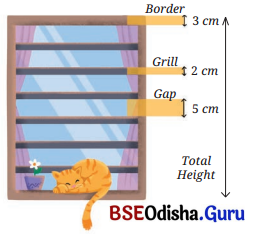
(iii) Find the total height of the window by writing an expression describing the relationship among the measurements shown in the picture.
Arithmetic Expressions Class 7 Solutions Maths Ganita Prakash Chapter 2-1
Solution:
(i) Number of gold coins Princess Elsa got = 100
Number of gold coins Princess Anna got = 100
Princess Elsa used the coins to start the business and double her coins.
So, the number of coins Princess Elsa has = 2 × 100
Princess Anna bought jewellery and has only half of the coins left.
So, the total number of coins Princess Anna has = \(\frac{100}{2}\)
Therefore, the total number of gold coins Princess Elsa and Princess Anna have together
= 2 × 100 + \(\frac{100}{2}\) = 200 + 50 = 250
Thus, the expression describing the above situation is, 2 × 100 + \(\frac{100}{2}\).
Terms: 2 × 100, \(\frac{100}{2}\)
(ii) (a) Fare of metro train ticket for an adult = ₹40
So, the fare of metro train ticket for four adults (in ₹) = 4 × 40
Fare of metro train ticket for a child = ₹20
So, the fare of metro train ticket for three children (in ₹) = 3 × 20
Therefore, the expression describing the total cost of tickets (in ₹) for four adults and three children is 4 × 40 + 3 × 20.
Total fare = 4 × ₹40 + 3 × ₹20 = ₹ 160 + ₹60 = ₹220
Terms: 4 × 40, 3 × 20

(b) Fare of metro train ticket for an adult = ₹40
So, the fare of metro train ticket for a group of three adults (in ₹) = 3 × 40
Therefore, the expression describing the total cost of tickets (in ₹) for the two groups having three adults each is 2 × (3 × 40).
Total fare = 2 × (3 × ₹ 40) = 2 × ₹120 = ₹240
Terms: 2 × (3 × 40)

(iii) By observing the given picture, the total height of the window
= Number of gaps × 5 cm + Number of grills × 2 cm + Number of borders × 3 cm
Here, total number of gaps = 7; Total number of grills = 6; Total number of borders = 2
∴ Total height of window (in cm) = 7 × 5 + 6 × 2 + 2 × 3 = 35 + 12 + 6 = 47 + 6 = 53
Terms: 7 × 5, 6 × 2, 2 ×3

Question 4.
Remove the brackets and write the expression having the same value.
(i) 14 + (12 + 10)
(ii) 14 – (12 + 10)
(iii) 14 + (12 – 10)
(iv) 14 – (12 – 10)
(v) -14 + 12 – 10
(vi) 14 – (-12 – 10)
Solution:
(i) 14 + (12 + 10) = 14 + 12 + 10 = 14 + 22 = 36
(ii) 14 – (12 + 10) = 14 – 12 – 10 = 14 – 22 = -8
(iii) 14 + (12 – 10) = 14 + 12 – 10 = 14 + 2 = 16
(iv) 14 – (12 – 10) = 14 – 12 + 10 = 14 – 2 = 12
(v) – 14 + 12 – 10 = – 14 + 2 = – 12
(vi) 14 – (-12 – 10) = 14 + 12 + 10 = 14 + 22 = 36
Here, expressions given in (i) and (vi) have same value.

Arithmetic Expressions Class 7 Solutions Maths Ganita Prakash Chapter 2

Question 5.
Find the values of the following expressions. For each pair, first try to guess whether they have the same value. When are the two expressions equal?
(i) (6 + 10) – 2 and 6 + (10 – 2)
(ii) 16 – (8 – 3) and (16 – 8) – 3
(iii) 27 – (18 + 4) and 27 + (-18 – 4)
Solution:
(i) (6 + 10) – 2 = 16 – 2 = 14 and 6 + (10 – 2) = 6 + 8 = 14
Clearly, (6 + 10) – 2 = 6 + (10 – 2)
Hence, both the expressions have the same value.

(ii) 16 – (8 – 3) = 16 – 5 = 11 and (16 – 8) – 3 = 8 – 3 = 5
Clearly, 16 – (8 – 3) ≠ (16 – 8) – 3
Hence, both the expressions do not have the same value.

(iii) 27 – (18 + 4) = 27 – 22 = 5 and 27 + (-18 – 4) = 27 + (- 22) = 27 – 22 = 5
Clearly, 27 – (18 + 4) = 27 + (-18 – 4)
Hence, both the expressions have the same value.

Question 6.
Add brackets at appropriate places in the expressions such that they lead to the values indicated.
(i) 34 – 9 + 12 = 13
(ii) 56 – 14 – 8 = 34
(iii) – 22 – 12 + 10 + 22 = – 22
Solution:
(i) 34 – (9 + 12) = 34 – 21 = 13
(ii) (56 – 14) – 8 = 42 – 8 = 34
(iii) – 22 – (12 + 10) + 22 = – 22 – 22 + 22 = – 22

Arithmetic Expressions Class 7 Solutions Maths Ganita Prakash Chapter 2

Question 7.
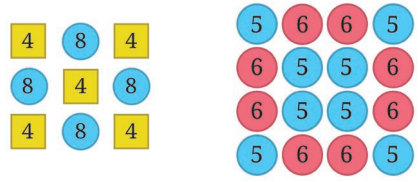
Find out the sum of the numbers given in each picture below in at least two different ways. Describe how you solved it through expressions.
Arithmetic Expressions Class 7 Solutions Maths Ganita Prakash Chapter 2-2
Solution:
For I : 5 × 4 + 4 × 8 = 20 + 32 = 52 or 4 × (4 + 8) + 4 = 4 × 12 + 4 = 52
For II : 8 × (5 + 6) = 8 × 11 = 88 or 8 × 5 + 8 × 6 = 40 + 48 = 88

Question 8.
Read the situations given below. Write appropriate expressions for each of them and find their values.
(i) The district market in Begur operates on all seven days of a week. Rahim supplies 9 kg of mangoes each day from his orchard and Shyam supplies 11 kg of mangoes each day from his orchard to this market. Find the amount of mangoes supplied by them in a week to the local district market.
(ii) Binu earns ₹20,000 per month. She spends ₹5,000 on rent, ₹5,000 on food and ₹2,000 on other expenses every month. What is the amount Binu will save by the end of a year?
(iii) During the daytime a snail climbs 3 cm up a post, and during the night while asleep, accidentally slips down by 2 cm. The post is 10 cm high, and a delicious treat is on its top. In how many days will the snail get the treat?
Solution:
(i) Amount of mangoes supplied by Rahim each day = 9 kg
Amount of mangoes supplied by Shyam each day = 11 kg
Total supplies of mangoes in the market on each day = (9 + 11) kg
∴ Total supplies of mangoes in the market in a week (7 days) = 7 × (9 + 11) = 7 × 20 = 140 kg

(ii) Binu’s per month earning = ₹20,000
Binu’s total monthly expenditures
= ₹5,000 on rent + ₹5,000 on food + ₹ 2,000 on other expenses
= ₹(5,000 + 5,000 + 2,000)
Therefore, Binu’s monthly savings = ₹20,000 – ₹(5,000 + 5,000 + 2,000) = ₹20,000 – ₹12,000 = ₹8,000
Thus, Binu’s total yearly savings = 12 × 8000 = ₹96000
Hence, Binu will save ₹96000 by the end of the year.

(iii) Since the snail climbs 3 cm up the post in daytime and slips down by 2 cm at night.
The distance climbed by the snail in a day = 3 – 2 = 1 cm
∴ The distance climbed in 7 days = 7 cm
The height of the post is 10 cm.
The distance climbed on the 8th day before slipping = 7 + 3=10 cm
So, the snail will take 8 days to reach the top of the post and get the delicious treat.

Arithmetic Expressions Class 7 Solutions Maths Ganita Prakash Chapter 2

Question 9.
Find different ways of evaluating the following expressions:
(i) 1 – 2 + 3 – 4 + 5 – 6 + 7 – 8 + 9 – 10
(ii) 1 – 1 + 1 – 1 + 1 – 1 + 1 – 1 + 1 – 1
Solution:
(i) 1 – 2 + 3 – 4 + 5 – 6 + 7 – 8 + 9 – 10 = (1 + 3 + 5 + 7 + 9) + (-2 – 4 – 6 – 8 – 10) = 25 + (- 30) = – 5
OR
1 – 2 + 3 – 4 + 5 – 6 + 7 – 8 + 9 – 10 = (1 – 2) + (3 – 4) + (5 – 6) + (7 – 8) + (9 – 10)
= (-1) + (-1) + (-1) + (-1) + (-1) = -5

(ii) 1 – 1 + 1 – 1 + 1 – 1 + 1 – 1 + 1 – 1 = (1 – 1) + (1 – 1) + (1 – 1) + (1 – 1) + (1 – 1)
= 0 + 0 + 0 + 0 + 0 = 0
OR
1 – 1 + 1 – 1 + 1 – 1 + 1 – 1 + 1 – 1= (1 + 1 + 1 + 1 + 1) + (- 1 – 1 – 1 – 1 – 1)
= 5 + (- 5) = 0

Question 10.
Identify which of the following expressions are equal to the given expression without computation. You may rewrite the expressions using terms or removing brackets. There can be more than one expression which is equal to the given expression.
(i) 83 – 37 – 12
(a) 84 – 38 – 12
(b) 84 – (37 + 12)
(c) 83 – 38 – 13
(d) -37 + 83 – 12
(ii) 93 + 37 × 44 + 76
(a) 37 + 93 × 44 + 76
(b) 93 + 37 x× 76 + 44
(c) (93 + 37) × (44 + 76)
(d) 37 × 44 + 93 + 76
Solution:
(i) 83 – 37 – 12 = 83 – 37 – 12 + (1 – 1) = (83 + 1) – 37 – 1 – 12 = 84 – 38 – 12
Also, 83 – 37 – 12 = – 37 + 83 – 12
Hence, (a) and (d) are equal to the given expression 83 – 37 – 12.

(ii) 93 + 37 × 44 + 76
Rearranging the terms, we get 37 × 44 + 93 + 76, which is equal to the given expression in option (d). Hence, (d) is equal to the given expression 93 + 37 × 44 + 76.

Arithmetic Expressions Class 7 Solutions Maths Ganita Prakash Chapter 2

InText Questions

Question 1.
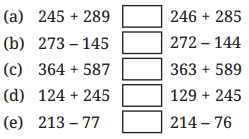
Use ‘>’ or ‘<’ or ‘=’ in each of the following expressions to compare them. Can you do it without complicated calculations? Explain your thinking in each case.
Arithmetic Expressions Class 7 Solutions Maths Ganita Prakash Chapter 2-3
Solution:
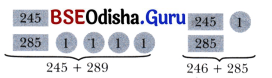
(i) Arithmetic Expressions Class 7 Solutions Maths Ganita Prakash Chapter 2-4
∴ 245 + 289 > 246 + 285

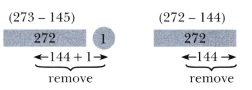
(ii) Arithmetic Expressions Class 7 Solutions Maths Ganita Prakash Chapter 2-5
∴ 273 – 145 = 272 – 144

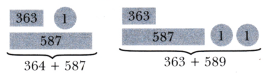
(iii) Arithmetic Expressions Class 7 Solutions Maths Ganita Prakash Chapter 2-6
∴ 364 + 587 < 363 + 589

(iv) Arithmetic Expressions Class 7 Solutions Maths Ganita Prakash Chapter 2-7
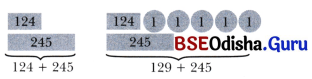
∴ 142 + 245 < 129 + 245

(v) Arithmetic Expressions Class 7 Solutions Maths Ganita Prakash Chapter 2-8
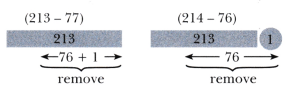
∴ 213 – 77 < 214 – 76

Question 2.
Can you explain why subtracting a number is the same as adding its inverse, using the Token Model of integers that we saw in the Class 6 textbook of mathematics?
Solution:
In the token model:
Subtracting a positive number (e.g. subtracting 3) means removing 3 positive tokens.
Adding a negative number (e.g. adding- 3) meaning adding 3 negative tokens. These 3 negative tokens cancel out 3 existing positive tokens (by forming zero pairs), which is equivalent to removing 3 positive tokens.
Since both actions result in removing the same number of positive tokens, the final value is the same.

Arithmetic Expressions Class 7 Solutions Maths Ganita Prakash Chapter 2

Question 3.
Does adding the terms of an expression in any order give the same value? Take some expressions and check. Consider expressions with more than 3 terms also.
Solution:
Yes
(-2) + (-3) + (-4) + (-5)
= (-2) + (-3) + (-4) + (-5)
= (- 5) + (-4) + (-5)
= (-9) + (-5) = -14

(-2) + (-3) + (-4) + (-5)
= (-2) + (-3) + (-4) + (-5)
= (-2) + (-7) + (-5)
= (-2) + (-12) = -14

(-2) + (-3) + (-4) + (-5)
= (-2) + (-3) + (-4) + (-5)
= (-2) + (-3) + (-9)
= (-5) + (- 9) = -14
Note: Students can do on their own by taking different numbers.

Question 4.
5 × 4 + 3 ≠ 5 × (4 + 3). Can you explain why?
Is 5 × (4 + 3) = 5 × (3 + 4) = (3 + 4) × 5?
Solution:
Expression 5 × 4 + 3 means 3 more than 5 × 4, which is equal to 23, but 5 × (4 + 3) means 5 times the sum of 3 and 4 which is equal to 35.
Hence, 5 × 4 + 3 + 5 ×(4 + 3)
Now, 5 × (4 + 3), 5 × (3 + 4), and (3 + 4) × 5 have the same meaning, which is 5 times the sum of 3 and 4 and give the same value.
Hence, 5 × (4 + 3) = 5 × (3 + 4) = (3 + 4) × 5

Arithmetic Expressions Class 7 Solutions Maths Ganita Prakash Chapter 2

Question 5.
Use distributive property to find the following products:
(i) 95 × 8
(ii) 104 × 15
(iii) 49 × 50
Is this quicker than the multiplication procedure you use generally?
Solution:
(i) 95 × 8
= (100 – 5) × 8
= (100 × 8) – (5 × 8)
= 800 – 40 = 760

(ii) 104 × 15
= (100 + 4) × 15
= (100 × 15) + (4 × 15)
= 1500 + 60 = 1560

(iii) 49 × 50
= (50 – 1) × 50
= (50 × 50) – (50 × 1)
= 2500 – 50 = 2450
Yes, this procedure is quicker than the general multiplication procedure.

Arithmetic Expressions Class 7 Extra Questions

Arithmetic Expressions Class 7 Very Short Question Answer

Question 1.
Riya buys 5 notebooks per day for 4 days and 7 notebooks per day for the remaining 3 days of a week. Form an expression to represent the total number of notebooks she buys in that week.
Solution:
For 4 days: Riya buys 5 notebooks per day
For 3 days: Riya buys 7 notebooks per day
Thus, expression for total number of notebooks
= 4 × 5 + 3 × 7

Arithmetic Expressions Class 7 Solutions Maths Ganita Prakash Chapter 2

Question 2.
Compare which is greater: 79 – 96 or 117 – 130.
Solution:
The value of 79 – 96 is – 17.
The value of 117 – 130 is – 13.
Clearly, – 17 < -13
Hence, 117 – 130 is greater than 79 – 96.

Question 3.
Anaya is preparing for a temple festival. She decorates 5 pillars, placing 7 marigold garlands on each. However, 2 garlands fall and cannot be used. Find the total number of garlands finally used.
Solution:
Total garlands before any fall = 5 × 7 = 35
Garlands that cannot be used = 2
Now, total garlands finally used = 35 – 2 = 33

Arithmetic Expressions Class 7 Solutions Maths Ganita Prakash Chapter 2

Question 4.
Priya buys 2 packs of biscuits for ₹15 each and a juice for ₹20. What is the total cost that Priya needs to pay?
Solution:
Given, Priya buys 2 packs of biscuits for ₹15 each and a juice for ₹20.
Cost of biscuits = 2 × ₹15
Cost of juice = ₹ 20
Now, total cost = 2 × ₹ 15 + ₹20 = ₹30 + ₹20
= ₹50

Question 5.
Add brackets at appropriate places in the expressions such that they lead to the values indicated.
(i) 25 – 7 + 12 = 6
(ii) 42 – 15 – 7-9 = 29
(iii) – 32 – 18 + 14 + 32 = – 32
(iv) 35 – 18 – 5 + 10 = 32
Solution:
(i) 25 – (7 + 12) = 6
(ii) 42 – 15 – (7 – 9) = 29
(iii) – 32 – (18 + 14) + 32 = – 32
(iv) 35 – (18 – 5) + 10 = 32

Arithmetic Expressions Class 7 Solutions Maths Ganita Prakash Chapter 2

Arithmetic Expressions Class 7 Short Question Answer

Question 1.
Ankit is planning a birthday party. He buys:

  • 5 party hats, each costing ₹ 60
  • 2 big balloons, each costing ₹90
  • If the total cost exceeds ₹400, he receives a discount of ₹50.

Write the expression that shows the amount (in ₹) Ankit has to pay.
Solution:
Given, cost of five party hats = 5 × ₹ 60
Cost of two big balloons = 2 × ₹90
Discount = ₹50 [If total cost > ₹400]
Now, total cost (in ₹) = 5 × 60 + 2 × 90 = 300 + 180 = 480
As 480 > 400, Ankit gets a discount of ₹50.
So, the expression that shows the amount (in ₹) Ankit has to pay (after applying the discount) is
5 × 60 + 2 × 90 – 50.

Question 2.
Simplify:
(i) (-40) × (-1) + 28 ÷ 7
(ii) 7 – [13 – 2{4 × (- 4)}]
(iii) 81 × [59 – {7 × 8 + (13 – 2 × 5)}]
Solution:
(i) (-40) × (- 1) + 28 ÷ 7
= (40 × 1) + 28 ÷ 7
= 40 + 4 = 44 [∵ (-) × (-) = ( + )]

(ii) 7 – [13 – 2{4 × (- 4)}]
= 7 – [13 – 2 × {-16}] [∵ (+) × (-) = (-)]
= 7 – [13 + 32] = 7 – 45 = -38

(iii) 81 × [59 – {7 × 8 + (13 – 2 × 5)}]
= 81 × [59 – {7 × 8 + (13 – 10)}]
= 81 × [59 – {56 + 3}]
= 81 × [59 – 59] = 81 × 0 = 0

Arithmetic Expressions Class 7 Solutions Maths Ganita Prakash Chapter 2

Question 3.
Find the following products using the distributive property.
(i) 107 × 12
(ii) 98 × 14
Solution:
(i) Let’s break 107 as 100 + 7.
Now, 107 × 12 = (100 + 7) × 12
= 100 × 12 + 7 × 12 [Using distributive property]
= 1200 + 84 = 1284
Hence, 107 × 12 = 1284

(ii) Let’s break 98 as 100 – 2.
Now, 98 × 14 = (100 – 2) × 14
= 100 × 14 – 2 × 14
= 1400 – 28 = 1372
Hence, 98 × 14 = 1372

Question 4.
Simplify: 659 – [219 – (750 — 255 ÷ 5 × 9)]
Solution:
We know, on removing the brackets preceded by a minus sign, the signs of all the terms inside the brackets change.
Thus, 659 – [219 – (750 – 255 ÷ 5 × 9)]
= 659 – 219 + (750 – 255 ÷ 5 × 9)
= 659 – 219 + (750 – 51 × 9) [As 255 ÷ 5 = 51]
= 659 – 219 + (750 – 459) [As 51 × 9 = 459]
= 1409-678
[As 659 + 750 = 1409 and – 219 – 459 = – 678]
= 731
Hence, 659 – [219 – (750 – 255 ÷ 5 × 9)] = 731

Arithmetic Expressions Class 7 Solutions Maths Ganita Prakash Chapter 2

Question 5.
Simplify:
63 – (- 3){- 2 – 8 – 3} ÷ {5 + (- 2)(- 1)}
Solution:
63 – (-3){-2 – 8 – 3} ÷ {5 + (-2)(-1)}
= 63 – (- 3){-2 – 5} ÷ {5 + (- 2)(- 1)}
[Removal of bar]
= 63 + 3{-2 – 5} ÷ {5 + 2}
[As – (-3) = 3 and (-2) (-1) = 2]
= 63 + 3{-7} ÷ 7
= 63 – 21 ÷ 7[As 3(-7) = -21]
= 63 – 3 = 60[As 21 ÷ 7 = 3]

Question 6.
Ravi took part in a painting competition and got scores 34, 37 and 31 from three judges. Later, it was found that second judge had mistakenly given 37 instead of the correct score 35. What are Ravi’s initial and updated total scores?
Solution:
Given, Ravi got scores 34, 37 and 31 from three judges.
So, the initial total score = 34 + 37 + 31 = 102
Later, the second judge’s score was corrected from 37 to 35, which is 2 less than the initial score.
Since only the second score changed, the updated total score = 102 – 2 = 100
Hence, Ravi’s updated total score is 100.

Arithmetic Expressions Class 7 Solutions Maths Ganita Prakash Chapter 2

Question 7.
Remove the brackets and write the expression having the same value.
(i) 18 + (12 + 6)
(ii) 18 + (12 – 6)
(iii) 18 – (12 + 6)
(iv) 18 – (12 – 6)
(v) 18 – (-12 – 6)
(vi) 18 – (-12 + 6)
Solution:
On removing the brackets preceded by a plus sign, the signs of all the terms inside the brackets remain same.
(i) 18 + (12 + 6) = 18 + 12 + 6
(ii) 18 + (12 – 6) = 18 + 12 – 6
On removing the brackets preceded by a minus sign, the signs of all the terms inside the brackets change.
(iii) 18 – (12 + 6) = 18 – 12 – 6
(iv) 18 – (12 – 6) = 18 – 12 + 6
(v) 18 – (-12 – 6) = 18 + 12 + 6
(vi) 18 – (-12 + 6) = 18 + 12 – 6

Question 8.
Leela is organizing candles for a festival. She places 36 candles in one box and 27 in another. She gives away 8 candles from the second box to her neighbour.
Write an expression for the number of candles Leela is left with.
Solution:
Candles in the first box = 36
Candles in the second box = 27
Candles given to neighbour = 8
Now, the number of candles left with Leela
= Candles in the first box + Candles in the second box – Candles given to neighbour
= 36 + 27 – 8, which is the required expression.

Arithmetic Expressions Class 7 Solutions Maths Ganita Prakash Chapter 2

Question 9.
In three sections of a school library, 64, 93 and 81 books were recorded respectively.
Later, the librarian found that there were mistakes in two sections:

  • The first section actually had 84 books, not 64.
  • The second section actually had 73 books, not 93.

What is the difference between total number of books initially and after correcting the record?
Solution:
The error in the number of books in the first section was + 20 (i.e., 84 – 64 = +20).
The error in the second section was -20
(i.e., 73 – 93 = – 20).
Since these two errors cancel each other out, the overall total remains unchanged.
Therefore, there is no difference in the total number of books.

Arithmetic Expressions Class 7 Long Question Answer

Question 1.
Find the following products using the distributive property.
(i) 125 × 16
(ii) 87 × 13
(iii) 106 × 104
(iv) 107 × 91
Solution:
(i) Let’s break 125 as 100 + 25.
Now, 125 × 16 = (100 + 25) × 16
= 100 × 16 + 25 × 16 = 1600 + 400 = 2000
Hence, 125 × 16 = 2000

(ii) Let’s break 87 as 100 -13.
Now, 87 × 13 = (100 – 13) × 13
= 100 × 13 – 13 × 13 = 1300 – 169 = 1131
Hence, 87 × 13 = 1131

(iii) Let’s break 106 as 100 + 6.
Now, 106 × 104 = (100 + 6) × 104
= 100 × 104 + 6 × 104 = 10400 + 6 × (100 + 4)
[As 104 = 100 + 4]
= 10400 + 6 × 100 + 6 × 4
= 10400 + 600 + 24 = 11024
Hence, 106 × 104 = 11024

(iv) Let’s break 107 as 100 + 7.
Now, 107 × 91 = (100 + 7) × 91
= 100 × 91 + 7 × 91 = 9100 + 7 × (100 – 9)
[As 91 = 100 – 9]
= 9100 + 7 × 100 – 7 × 9
= 9100 + 700 – 63
= 9800 – 63 = 9737
Hence, 107 × 91 = 9737.

Arithmetic Expressions Class 7 Solutions Maths Ganita Prakash Chapter 2

Question 2.
Simplify:
(i) 121 ÷ [17 – {15 – 3(7 – 4)}]
(ii) 32 ÷ [32 + {32 – (32 + 32 – 32 )}]
(iii) 15 – (-3) × [{4- 7 – 3} + 3 × {5 + (-3) × (-6)}]
Solution:
(i) 121 ÷ [17 – {15 – 3(7 – 4)}]
= 121 ÷ [17 – {15 – 3 × 3}]
= 121 ÷ [17 – {15 – 9}]
= 121 ÷ [17 – 6]
= 121 ÷ 11 = 11

(ii) 32 ÷ [32 + {32 – (32 + 32 – 32 )}]
= 32 ÷ [32 + {32 – (32 + 0)}]
= 32 ÷ [32 + {32 – 32}]
= 32 ÷ [32 + 0] = 32 + 32 = 1

(iii) 15 – (-3) × [{4 – 7 – 3 } ÷ 3 × {5 + (-3) × (-6)}]
= 15 + 3 × [{4 – 4} ÷ 3 × {5 + 18}]
= 15 + 3 × [0 ÷ 3 × 23]
= 15 + 3 × [0 × 23] [As 0 ÷ 3 = 0]
= 15 + 3 × 0 = 15

Arithmetic Expressions Class 7 Case Based Questions

Question 1.
At Surya Vidya Mandir, the annual Art Festival is being celebrated. Ishan is participating in the event and earning performance points based on his art scenes.
Here’s how the points are awarded:

  • In the 1st scene, he puts in a solid effort and earns 22 points.
  • In the 2nd scene, he gets more confident and scores 8 more points than in the 1st scene.
  • In the 3rd scene, he is slightly exhausted and earns half the points he got in the 2nd scene.

Based on the above information, answer the following questions:
(i) Write arithmetic expressions to represent the number of points earned in the 2nd and 3rd scenes respectively.
(ii) What is the total number of points earned in all three scenes?
(iii) If each point is worth ₹50, how much money can Ishan claim?
Solution:
Points earned in 1st scene = 22
Points earned in 2nd scene
= 8 more points than in the 1st scene
= 22 + 8 = 30
Points earned in 3rd scene
= \(\frac{1}{2}\) × (Points earned in 2nd scene)
= \(\frac{1}{2}\) × 30 = 15
(i) Arithmetic expression to represent the number of points earned in 2nd scene = 22 + 8
Arithmetic expression to represent the number of points earned in 3rd scene = \(\frac{1}{2}\) × 30

(ii) Total number of points earned in all three scenes = 22 + 30 + 15 = 67

(iii) Given, 1 point = ₹50
Total money that Ishan can claim
= ₹50 × 67 = ₹3,350

Arithmetic Expressions Class 7 Solutions Maths Ganita Prakash Chapter 2

Question 2.
Ria buys 5 packs of pencils for her art class.
Each pack has 6 coloured pencils and 4 graphite pencils. But she loses 3 coloured pencils on the way.
Based on the above information, answer the following questions
Arithmetic Expressions Class 7 Solutions Maths Ganita Prakash Chapter 2-9
(i) How many coloured pencils does Ria have?
(ii) How many graphite pencils does she have?
(iii) What is the total number of pencils Ria finally has?
Solution:
(i) In 1 pack, there are 6 coloured pencils.
So, number of coloured pencils in 5 packs
= 5 × 6 = 30
Given, Ria lost 3 coloured pencils on the way.
Now, number of remaining coloured pencils
= 30 – 3 = 27

(ii) In 1 pack, there are 4 graphite pencils.
So, number of graphite pencils in 5 packs
= 4 × 5 = 20

(iii) Total number of pencils with Ria
= Number of coloured pencils + Number of graphite pencils
= 27 + 20 = 47

Large Numbers Around Us Class 7 Solutions Maths Ganita Prakash Chapter 1

Students can refer to BSE Odisha Class 7 Math Solution and Ganita Prakash Chapter 1 Large Numbers Around Us Class 7 Question Answer to understand textbook questions step by step.

Class 7 Maths Chapter 1 Large Numbers Around Us Solutions

Ganita Prakash Class 7 Chapter 1 Solutions

Class 7 Maths Ganita Prakash Chapter 1 Solutions Large Numbers Around Us

Question 1.
Read the following numbers in Indian place value notation and write their number names in both the Indian and American systems:
(i) 4050678
(ii) 48121620
(iii) 20022002
(iv) 246813579
Solution:
(i) 4050678
Indian System: 40,50,678
Number name: Forty lakh fifty thousand six hundred seventy eight American system: 4,050,678
Number name: Four million fifty thousand six hundred seventy eight

(ii) 48121620
Indian System: 4,81,21,620
Number name: Four crore eighty one lakh twenty one thousand six hundred twenty American System: 48,121,620
Number name: Forty eight million one hundred twenty one thousand six hundred twenty

(iii) 20022002
Indian System: 2,00,22,002
Number name: Two crore twenty two thousand two American System: 20,022,002
Number name: Twenty million twenty two thousand two

(iv) 246813579
Indian System: 24,68,13,579
Number name: Twenty four crore sixty eight lakh thirteen thousand five hundred seventy nine American System: 246,813,579
Number name: Two hundred forty six million eight hundred thirteen thousand five hundred seventy nine

Question 2.
Write the following numbers in Indian place value notation:
(i) One crore one lakh one thousand ten
(ii) One billion one million one thousand one
(iii) Ten crore twenty lakh thirty thousand forty
(iv) Nine billion eighty million seven hundred thousand six hundred
Solution:
(i) 1,01,01,010
(ii) 1,001,001,001
In Indian place value notation: 1,00,10,01,001
(iii) 10,20,30,040
(iv) 9,080,700,600
In Indian place value notation: 9,08,07,00,600

Large Numbers Around Us Class 7 Solutions Maths Ganita Prakash Chapter 1

Question 3.
Compare and write ‘<‘ ‘>’ or ‘ = ’:
(i) 30 thousand _________ 3 lakh
(ii) 500 lakh _______ 5 million
(iii) 800 thousand ______ 8 million
(iv) 640 crore _______ 60 billion
Solution:
(i) As 30,000 < 3,00,000
⇒ 30 thousand < 3 lakh (ii) Since 1 million = 10 lakh, 5 million = 50 lakh Clearly, 500 lakh > 50 lakh ⇒ 500 lakh > 5 million

(iii) 800 thousand = 800 × 1000 = 800,000
8 million = 8,000,000
As 800,000 < 8,000,000
⇒ 800 thousand < 8 million

(iv) Since 1 billion = 100 crore, 60 billion = 60 × 100 crores = 6,000 crores
Clearly, 640 crore < 6,000 crore
⇒ 640 crore < 60 billion

Question 4.
Find quick ways to calculate these products:
(i) 2 × 1768 × 50
(ii) 72 × 125
(iii) 125 × 40 × 8 × 25
Solution:
(i) 2 × 1768 × 50 = 2 × 1768 × \(\frac{100}{2}\) = 1768 × 100 = 1,76,800
(ii) 72 × 125 = 72 × \(\frac{1000}{8}\) = 9 × 1000 = 9,000
(iii) 125 × 40 × 8 × 25 = \(\frac{1000}{8}\) × 40 × 8 × \(\frac{100}{4}\) = 1000 × 5 × 2 × 100 = 10,00,000

Large Numbers Around Us Class 7 Solutions Maths Ganita Prakash Chapter 1

Question 5.
Using all digits from 0-9 exactly once (the first cannot be 0) to create a 10-digit number, write the —
(i) Largest multiple of 5
(ii) Smallest even number
Solution:
(i) Arranging digits in descending order, we get 9, 8, 7, 6, 5, 4, 3, 2, 1, 0.
All multiple of 5 can end only in 5 or 0.
Hence, the largest multiple of 5 is 9876543210.

(ii) Arranging digits in ascending order, we get 0, 1, 2, 3, 4, 5, 6, 7, 8, 9.
Since the number cannot start with 0, the smallest number = 1023456789
We know that an even number has either 2, 4, 6 or 8 at its ones place.
Thus, swapping the last two digits, we get the smallest even number = 1023456798

Question 6.
The number 10,30,285 in words is “Ten lakh thirty thousand two hundred eighty five”, which has 41 letters. Give a 7-digit number which has the maximum number of letters.
Solution:
We use 7 (seven) and 8 (eight) to make such a number since both numbers contain five letters when written in words.

One such 7-digit number is 77,77,777 (Seventy seven lakh seventy seven thousand seven hundred seventy seven).

This has 60 letters, making it one of the 7-digit numbers having maximum number of letters.

Large Numbers Around Us Class 7 Solutions Maths Ganita Prakash Chapter 1

Question 7.
Write a 9-digit number where exchanging any two digits results in a bigger number. How many such numbers exist?
Solution:
To ensure that on exchanging any two digits increases the value of a 9-digit number, the digits must increase from left to right. So, the arrangement would be: 123456789.
There is only 1 number that satisfies the given condition.

Question 8.
Strike out 10 digits from the number 12345123451234512345 so that the remaining number is as large as possible.
Solution:
Given, 12345123451234512345
We have 20 digits and need to remove 10 digits, leaving us with 10 digits.
To maximise the resulting number we want the leftmost digit to be as large as possible. Looking at the original number 12345123451234512345, the first few digits are small. We can strike out the initial T234’ to get the larger digit in the first position, i.e. 5.

Now, our numbers starts with 5 as we have struck out 4 digits so far and we need to strike out 6 more.

The remaining number is 5123451234512345. We want the next digit to be as large as possible. So, we strike out ‘1234’ following the 5, leaving us with 551234512345.
We have now struck out 4 + 4 = 8 digits.
We need to strike out 2 metre digits from 551234512345.
To keep the number as large as possible we should strike out ‘ I ’ and ‘2’.

Therefore, by striking out the digits 1234, then 1234, then 1 and 2, the number is 5534512345, which is the largest possible number.

Large Numbers Around Us Class 7 Solutions Maths Ganita Prakash Chapter 1

Question 9.
The words ‘zero’ and ‘one’ share letters ‘e’ and ‘o’. The words ‘one’ and ‘two’ share a letter ‘o’, and the words ‘two’ and ‘three’ also share a letter ‘t’. How far do you have to count to find two consecutive numbers which do not share an English letter in common?
Solution:
The problem involves finding two consecutive numbers whose English names share no common letters.
Here, words zero and one share e and o. Words one (1) and two (2) share o.
Words two (2) and three (3) share t. Words three (3) and four (4) share r.
Words four (4) and five (5) share/. Words five (5) and six (6) share i.
Words six (6) and seven (7) share s. Words seven (7) and eight (8) share e.
Words eight (8) and nine (9) share i and e.
Words nine (9) and ten (10) share n and e.
.
.
.
.
Words nineteen (19) and twenty (20) share t, e, n and so on.
It shows that all consecutive numbers have atleast one common letter. Hence, their is no such pair of consecutive numbers that do not share an English letter in common.

Question 10.
A calculator has only ‘+ 10,000’ and ‘+ 100’ buttons. Write an expression describing the number of button clicks to be made for the following numbers:
(i) 20,800
(ii) 92,100
(iii) 1,20,500
(iv) 65,30,000
(v) 70,25,700
Solution:
(i) 20,800 = (2 × 10,000) + (8 × 100)
Number of clicks = 2 + 8 = 10 clicks

(ii) 92,100 = (9 × 10,000) + (21 × 100)
Number of clicks = 9 + 21 =30 clicks

(iii) 1,20,500 = (12 × 10,000) + (5 × 100)
Number of clicks = 12 + 5 = 17 clicks

(iv) 65,30,000 = (653 × 10,000) + (0 × 100)
Number of clicks = 653 + 0 = 653 clicks

(v) 70,25,700 = (702 × 10,000) + (57 × 100)
Number of clicks = 702 + 57 = 759 clicks

Large Numbers Around Us Class 7 Solutions Maths Ganita Prakash Chapter 1

Question 11.
You are given two sets of number cards numbered from 1-9. Place a number card in each box below to get the (i) largest possible sum (ii) smallest possible difference of the two resulting numbers.
Large Numbers Around Us Class 7 Solutions Maths Ganita Prakash Chapter 1-1
Solution:
(i) Since each card numbered 1 – 9 is to be placed in the boxes such that no box is empty, the cards cannot be repeated.
To get the largest possible sum, both the 7-digit and 5-digit numbers need to be the largest.
Largest 7-digit number = 98,76,543; Largest 5-digit number = 98,765
Largest possible sum = 98,76,543 + 98,765 = 99,75,308

(ii) To get the smallest possible difference, the 7-digit number needs to be the smallest, and the 5-digit number needs to be the largest.
Smallest 7-digit number = 12,34,567
Largest 5-digit number = 98,765
Smallest possible difference = 12,34,567 – 98,765 = 11,35,802

Question 12.
A bar-tailed godwit holds the record for the longest recorded non-stop flight. It travelled 13,560 km from Alaska to Australia without stopping. Its journey started on 13 October 2022 and continued for about 11 days. Find out the approximate distance it covered every day. Find out the approximate distance it covered every hour.
Solution:
Given, total distance = 13,560 km and duration = 11 days
Distance covered everyday = 13,560 ÷ 11 = 1,232.72 km
Thus, the godwit covers approximately 1,233 km per day.
We know that one day has 24 hours.
Thus, distance covered every hour = 1,233 ÷ 24 = 51.375 km
Hence, the godwit covers approximately 51 km per

InText Questions

Question 1.
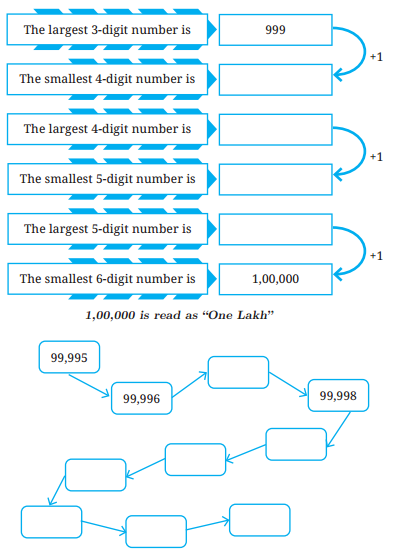
Observe the pattern and fill in the boxes given below.
Large Numbers Around Us Class 7 Solutions Maths Ganita Prakash Chapter 1-2
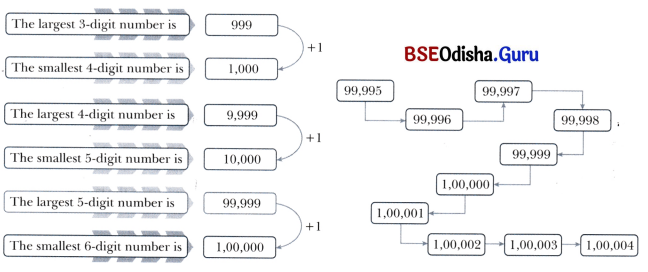
Solution:
Large Numbers Around Us Class 7 Solutions Maths Ganita Prakash Chapter 1-3

Large Numbers Around Us Class 7 Solutions Maths Ganita Prakash Chapter 1

Question 2.
What if a person ate 3 varieties of rice every day, will he be able to taste all the lakh varieties in a 100 year lifetime? Find out.
Solution:
With 3 varieties of rice every day, he can taste 365 × 3 = 1095 varieties in a year.
To taste 1 lakh varieties, he would need 1,0,000 ÷ 1095 ≈ 91 years.
Hence, he would be able to eat all 1 lakh varieties of rice in 100 years.

Question 3.
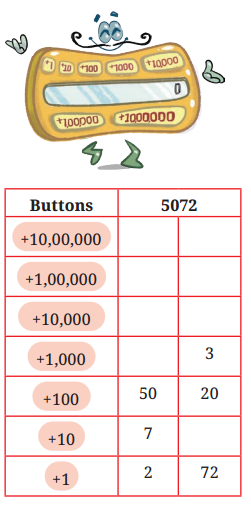
Two of the many different ways to get 5072 are shown below:
Large Numbers Around Us Class 7 Solutions Maths Ganita Prakash Chapter 1-4
These two ways can be expressed as:
(a) (50 × 100) + (7 × 10) + (2 × 1) = 5072
(b) (3 × 1000) + (20 × 100) + (72 × 1) = 5072
Find a different way to get 5072 and write an expression for the same.
Solution:

Buttons 5072
+ 10,00,000
+ 1,00,000
+ 10,000
+ 1,000 5
+ 100 0
+ 10 7
+ 1 2

Expression: (5 × 1000) + (0 × 100) + (7 × 10) + (2 × 1) = 5000 + 70 + 2 = 50724.

Large Numbers Around Us Class 7 Solutions Maths Ganita Prakash Chapter 1

Question 4.
The estimated population of Chintamani in the year 2024 is 1,06,000. How much more than one lakh is 1,06,000?
Solution:
Given, the estimated population of Chintamani in the year 2024 is 1,06,000.
∴ Required difference = 1,06,000 – 1,00,000
= 6,000
Thus, the population of Chintamani in 2024 is 6,000 more than one lakh.

Question 5.
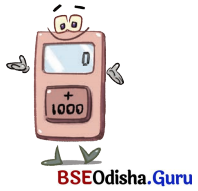
The Thoughtful Thousands only has a + 1000 button. How many times should it be pressed to show:
Large Numbers Around Us Class 7 Solutions Maths Ganita Prakash Chapter 1-5
(i) Three thousand? 3 times
(ii) 10,000? ______
(iii) Fifty-three thousand? _________
(iv) 90,000? __________
(v) One Lakh? ________
(vi) ________? 153 times
(vii) How many thousands are required to make one lakh?
Solution:
(i) \(\frac{3000}{1000}\) = 3 ⇒ 3 times
(ii) \(\frac{10000}{1000}\) = 10 ⇒ 10 times
(iii) \(\frac{53000}{1000}\) = 53 ⇒ 53 times
(iv) \(\frac{90000}{1000}\) = 90 ⇒ 90 times
(v) \(\frac{100000}{1000}\) = 100 ⇒ 100 times
(vi) 153 × 1000 = 1,53,000
(vii) 100000 ÷ 1000 = 100. Thus, 100 thousands make 1 lakh.

Large Numbers Around Us Class 7 Solutions Maths Ganita Prakash Chapter 1

Question 6.
How many zeros does a hundred thousand have?
Solution:
100 thousand = 100 × 1000 = 1,00,000
Clearly it has 5 zeros.

Question 7.
With large numbers it is useful to know the nearest thousand, lakh or crore. For example, the nearest neighbours of the number 6,72,85,183 are shown in the table below.

Nearest thousand 6,72,85,000
Nearest ten thousand 6,72,90,000
Nearest lakh 6,73,00,000
Nearest ten lakh 6,70,00,000
Nearest crore 7,00,00,000

Write the five nearest neighbours for these numbers:
(i) 3,87,69,957
(ii) 29,05,32,481
Solution:

Nearest Neighbours For 3,87,69,957 For 29,05,32,481
Nearest thousands 3,87,70,000 29,05,32,000
Nearest ten thousands 3,87,70,000 29,05,30,000
Nearest lakhs 3,88,00,000 29,05,00,000
Nearest ten lakhs 3,90,00,000 29,10,00,000
Nearest crores 4,00,00,000 29,00,00,000

Large Numbers Around Us Class 7 Solutions Maths Ganita Prakash Chapter 1

Question 8.
Using the meaning of multiplication and division, can you explain why multiplying by 5 is the same as dividing by 2 and multiplying by 10?
Solution:
We know that 5 × 2= 10 (multiplication fact) gives
two division facts: 10 ÷ 2 = 5 and 10 ÷ 5 = 2.
So, we can use \(\frac{10}{2}\) in place of 5 . Either we multiply a number by 5 or by \(\frac{10}{2}\), we will get the same answer.

Question 9.
Can multiplying a 3-digit number with another 3-digit number give a 4-digit number?
Solution:
The product of smallest 3-digit numbers
= 100 × 100 = 10,000 (5-digit number)
And, the product of largest 3-digit numbers
= 999 × 999 = 9,98,001 (6-digit number)
So, the product of two 3-digit numbers will have either 5 or 6 digits.
Hence, a 4-digit number cannot be obtained by multiplying two 3-digit numbers.

Large Numbers Around Us Class 7 Solutions Maths Ganita Prakash Chapter 1

Question 10.
Can multiplying a 4-digit number with a 2-digit number give a 5-digit number?
Solution:
The product of smallest 4-digit number and smallest 2-digit number
= 1000 × 10 = 10,000 (5-digit number)
And, the product of largest 4-digit number and largest 2-digit number
= 9999 × 99 = 9,89,901 (6-digit number)
So, the product of 4-digit number and 2-digit number will have either 5 or 6 digits.
Hence, multiplying a 4-digit number with a 2-digit number can give a 5-digit number.

Question 11.
Roxie wondered, “If I could travel 100 kilometers every day, could I reach the Moon in 10 years?” (The distance between the Earth and the Moon is 3,84,400 km.)
(i) How far would she have travelled in a year?
(ii) How far would she have travelled in 10 years?
Solution:
(i) Distance travelled by Roxie in a day = 100 km
Thus, distance travelled by Roxie in a year = 365 × 100 = 36500 km (As 1 year = 365 days)
(ii) Distance travelled by Roxie in 10 years =100 × 365 x 10 = 36500 × 10 = 365000 km
Since 365000 < 384400, Roxie cannot reach the moon in 10 years.

Large Numbers Around Us Class 7 Extra Questions

Large Numbers Around Us Class 7 Very Short Question Answer

Question 1.
How many thousands are there in 1 million?
Solution:
Place value chart in International Number System is given below:

Periods Millions Thousands Ones
Place Name HM TM M HTh TTh Th H T o
1 million 1 0 0 0 0 0 0
1 thousand 1 0 0 0

1 million is three places to the left of 1 thousand.
Thus, 1 million = 1,000 thousand
Hence, 1,000 thousands are there in one million.

Large Numbers Around Us Class 7 Solutions Maths Ganita Prakash Chapter 1

Question 2.
How many hundreds are there in 10 lakhs?
Solution:
Place value chart in Indian Number System is given below:

Periods Crores Lakhs Thousands Ones
Place

Name

TC C TL L TTh Th H T o
10 lakh 1 0 0 0 0 0 0
1 hundred 1 0 0

10 lakh is four places to the left of 1 hundred.
Thus, 10 lakh = 10,000 hundred
Hence. 10,000 hundreds are there in 10 lakhs.

Question 3.
The annual wheat production in a region is 673400000 kilograms. Place the commas according to the International Number System format.
Solution:
In the International Number System, commas are placed in a 3-3-3-3… pattern, starting from the right. This helps to separate the digits into hundreds, thousands, millions, billions, and so on.
Number: 673,400,000
Number Name: Six hundred seventy three million four hundred thousand

Large Numbers Around Us Class 7 Solutions Maths Ganita Prakash Chapter 1

Question 4.
Without multiplying, predict the number of digits in the product 113 × 98.
Solution:
Rounding 113 to nearest tens we get 110 and rounding 98 to nearest tens, we get 100.
Thus, estimated product = 110 × 100 = 11000, which is a 5-digit number.
Hence, the actual product will have 5 digits.
Verification: 113 × 98 = 11,074, which is a 5-digit number

Question 5.
Compare and write ‘>’, ‘<‘ or ‘=’’:
(i) 80 thousand ______ 8 lakh
(ii) 200 lakh ______ 2 million
Solution:
(i) 80 thousand = 80 × 1,000 = 80,000 and 8 lakh = 8 × 1,00,000 = 8,00,000
As 80,000 < 8,00,000
Thus, 80 thousand < 8 lakh

(ii) We know, 1 million = 10 lakh
So, 2 million = 20 lakh < 200 lakh Thus, 200 lakh > 2 million

Large Numbers Around Us Class 7 Solutions Maths Ganita Prakash Chapter 1

Question 6.
How many ten thousands are there in the smallest 6-digit number?
Solution:
The smallest 6-digit number is 1,00,000 i.e. 1 lakh.

Place Name TL L TTh Th H T o
1 Lakh 1 0 0 0 0 0
10 thousand 1 0 0 0 0

1 lakh is one place to the left often thousands.
Thus, 1 lakh =10 ten thousands

Question 7.
How many thousands are there in 1 lakh?
Solution:

Place Name L TTh Th H T b
1 Lakh 1 0 0 0 0 0
1 thousand 1 0 0 0

1 lakh is 2 places to the left of thousand.
Hence, 1 lakh = 100 thousands.

Large Numbers Around Us Class 7 Short Question Answer

Question 1.
Write the number names of the following numerals in the Indian and International Numbers Systems.
(i) 437065
(ii) 42181602
(iii) 636547150
(iv) 4050607080
Solution:

Sr. No. Indian System International System
(0 4,37,065: Four lakh thirty seven thousand sixty five 437,065: Four hundred thirty seven thousand sixty five
(ii) 4,21,81,602: Four crore twenty one lakh eighty one thousand six hundred two 42,181,602: Forty two million one hundred eighty one thousand six hundred two
(iii) 63,65,47,150: Sixty three crore sixty five lakh forty seven thousand one hundred fifty 636,547,150: Six hundred thirty six million five hundred forty seven thousand one hundred fifty
(iv) 4,05,06,07,080: Four arab five crore six lakh seven thousand eighty 4,050,607,080: Four billion fifty million six hundred seven thousand eighty

Large Numbers Around Us Class 7 Solutions Maths Ganita Prakash Chapter 1

Question 2.
Find the place value of underlined digits in International Number System.
(i) 3241767
(ii) 98443810
Solution:
(i)

Place Name M HTh TTh Th H T O
3,241,767 3 2 4 I 7 6 7

From the table, the digit 1 is at thousands place.
Thus, the place value of 1 is 1 × 1,000 = 1,000.

(ii)

Place Name TM M HTh TTh Th H T O
98,443,810 9 8 4 4 3 8 1 0

From the table, the digit 8 is at thousands place.
Thus, the place value of 8 is 8 × 1,000 = 1,000.
= 8,000,000.

Question 3.
Calculate the following products:
(i) 4 × 1522 × 50
(ii) 48 × 125
(iii) 125 × 20 × 16 × 25
Solution:
(i) 4 × 1522 × 50 = 4 × 1522 × \(\frac{100}{2}\)
= 2 × 1522 × 100 = 3044 × 100 = 304400

(ii) 48 × 125 = 48 × \(\frac{1000}{8}\) = 6 × 1000 = 6000

(iii) 125 × 20 × 16 × 25 = \(\frac{1000}{8}\) × 20 ×16 × \(\frac{100}{4}\)
= 1000 × 5 × 2 × 100 = 1000 × 10 × 100 = 1000000

Large Numbers Around Us Class 7 Solutions Maths Ganita Prakash Chapter 1

Question 4.
A city’s population grew from 5,67,000 to 7.42.0 in five years. Estimate the increase using appropriate rounding.
Solution:
Given, in five years the population of a city grew from 5,67,000 to 7,42,000.
Rounding off both the numbers to nearest ten thousands, we get 5,70,000 and 7,40,000 respectively.
Thus, estimated increase in population
= 7,40,000 – 5,70,000 = 1,70,000

Question 5.
A stadium had 4,73,000 visitors in 2022 and 5.85.0 in 2023. Estimate the increase in visitors by rounding to the nearest ten thousands.
Solution:
Number of visitors in 2022 = 4,73,000
Number of visitors in 2023 = 5,85,000
Rounding both the numbers to nearest ten thousands, we get
4.73.0 → 4,70,000 and 5,85,000 → 5,90,000
Thus, estimated increase in visitors
= 5,90,000 – 4,70,000 = 1,20,000.

Large Numbers Around Us Class 7 Long Question Answer

Question 1.
Round off the following to the given nearest place.
(i) 7,065; hundreds
(ii) 55,777; thousands
(iii) 46,439; ten thousands
(iv) 30,89,732; lakhs
(v) 34,75,68,328; ten crores
Solution:
(i) In 7,065, the digit at the hundreds place is 0.
As the digit at the tens place, 6 > 5, we increase 0 by 1 and we replace the remaining digits to the right of the hundreds place by 0.
Thus, on rounding off 7065 to the nearest hundreds, we get 7100.

(ii) In 55,777, the digit at the thousands place is 5.
As the digit at the hundreds place, 7 > 5, we increase 5 by 1 and we replace the remaining digits to the right of the thousands place by 0.
Thus, on rounding off 55,777 to the nearest thousands, we get 56,000.

(iii) In 46,439, the digit at the ten thousands place is 4.
As the digit at the thousands place, 6 > 5, we increase 4 by 1 and we replace the remaining digits to the right of the ten thousands place by 0.
Thus, on rounding off 46,439 to the nearest ten thousands, we get 50,000.

(iv) In 30,89,732, the digit at the lakhs place is 0.
As the digit at the ten thousands place, 8 > 5, we increase 0 by 1 and we replace the remaining digits to the right of the lakhs place by 0.
Thus, on rounding off 30,89,732 to the nearest lakhs, we get 31,00,000.

(v) In 34,75,68,328, the digit at the ten crores place is 3.
As the digit at the crore place, 4 < 5, 3 remains unchanged and we replace the remaining digits to the right of the ten crores place by 0.
Thus, on rounding off 34,75,68,328 to the nearest ten crores, we get 30,00,00,000.

Large Numbers Around Us Class 7 Solutions Maths Ganita Prakash Chapter 1

Question 2.
A clothing store earned ₹6,58,900 in January and ₹ 7,21,600 in February. Estimate the total revenue by rounding each figure to the nearest lakhs. Is your estimated total greater or smaller than the exact total?
Solution:
Revenue earned by clothing store in January = ₹6,58,900
Revenue earned by clothing store in February = ₹ 7,21,600
Rounding the numbers to nearest lakhs, we get
6,58,900 → 7,00,000
[∵ At ten thousands place, 5 = 5]
7,21,600 → 7,00,000
[∵ At ten thousands place, 2 < 5]
Now, estimated total revenue over the two months = ₹ 7,00,000 + ₹ 7,00,000 = ₹ 14,00,000
Actual total revenue = ₹6,58,900 + ₹7,21,600
= ₹ 13,80,500
Thus, the estimated total revenue for the given two months is greater than the actual revenue.

Large Numbers Around Us Class 7 Solutions Maths Ganita Prakash Chapter 1

Question 3.
Say True or False.
(i) 6,78,456 is rounded off as 6,80,000 to the nearest ten thousands.
(ii) 52,25,067 is rounded off as 52,00,000 to the nearest thousands.
(iii) 2,31,48,765 is rounded off as 2,40,00,000 to the nearest ten lakhs.
Solution:
We know that, while rounding the number nearest to given place,
If the digit on the right of the given place is 5 or greater than 5, we increase the digit at that place by 1.
If the digit on the right of the given place is less than 5, we keep the digit at that place same.

(i) True
In 6,78,456, the digit at the ten thousands place is 7.
The digit to the right of 7, i.e. the digit at the thousands place is 8 and 8 > 5.
Thus, 6,78,456 is rounded off as 6,80,000 to the nearest ten thousands.

(ii) False
In 52,25,067, the digit at the thousands place is 5.
The digit to the right of 5, i.e. the digit at the hundreds place is 0 and 0 < 5.
So, 5 remains unchanged.
Thus, 52,25,067 is rounded off as 52,25,000 to the nearest thousands.

(iii) False
In 2,31,48,765, the digit at the ten lakhs place is 3.
The digit to the right of 3, i.e. the digit at the lakhs place is 1 and 1 < 5. So, 3 remains unchanged.
Thus, 2,31,48,765 is rounded off as 2,30,00,000 to the nearest ten lakhs.

Large Numbers Around Us Class 7 Case Based Questions

Question 1.
The population details of a town were published in a report.

Population of children 12,35,678
Population of adults 34,78,915
Population of senior citizens 5,60,328

The report is also translated for international agencies.
Based on the above information, answer the
following questions:
(i) Create the report for the international agencies using the International Number System.
(ii) What is the face value and place value of digit 3 in the population of children?
(iii) Write the number name for the population of senior citizens in the International Number System.
Solution:
i) The report in International Number System will be:

Population of children 1,235,678
Population of adults 3,478,915
Population of senior citizens 560,328

(ii) Given, the population of children = 12,35,678, which is represented in Indian Number System.

Place Name 12,35,678
C
TL 1
L 2
TTh 3
Th 5
H 6
T 7
O 8

The face value of 3 is 3.
Clearly, digit 3 is at the ten-thousands place.
∴ The place value of 3 is 3 × 10,000 = 30,000.

(iii) In International Number System, population of senior citizens = 560,328
Number name: Five hundred sixty thousand three hundred twenty eight

Question 2.
The principal of Sunrise Public School is preparing a budget for renovating the school. She has received the cost from various departments:
Painting classrooms: ₹4,83,760
Replacing furniture: ₹3,27,450
Electrical work: ₹ 1,65,890
Bathroom renovations: ₹2,49,300
To present a simplified version in a meeting, she rounds off all values to the nearest lakhs.
Based on the above information, answer the following questions:
(i) What is the rounded cost of each item to the nearest lakhs?
(ii) What is the total estimated cost using the rounded values?
(iii) How much is the difference between the estimated and the total actual cost?
Solution:
(i) Rounding off all the costs to the nearest lakhs, we get

Items Actual Cost Estimated Cost (to nearest lakh)
Painting classrooms ₹4,83,760 ₹5,00,000
Replacing furniture ₹3,27,450 ₹ 3,00,000
Electrical work ₹ 1,65,890 ₹ 2,00,000
Bathroom renovations ₹2,49,300 ₹2,00,000

(ii) The total estimated cost is the sum of the estimated cost of each item.
Thus, total estimated cost = ₹5,00,000 + ₹ 3,00,000 + ₹ 2,00,000 + ₹ 2,00,000
= ₹ 12,00,000

(iii) The total estimated cost = ₹ 12,00,000
Now, total actual cost
= ₹4,83,760 + ₹3,27,450 + ₹ 1,65,890 + ₹2,49,300
= ₹ 12,26,400
Thus, difference between total actual cost and total estimated cost
= ₹ 12,26,400 – 12,00,000 = ₹26,400

BSE Odisha 7th Class Science Solutions Chapter 17 ଆବର୍ଜନାର ପରିଚାଳନା

Odisha State Board BSE Odisha 7th Class Science Solutions Chapter 17 ଆବର୍ଜନାର ପରିଚାଳନା Textbook Exercise Questions and Answers.

BSE Odisha Class 7 Science Solutions Chapter 17 ଆବର୍ଜନାର ପରିଚାଳନା

Question 1.
ଶୂନ୍ୟସ୍ଥାନ ପୂରଣ କର ।
(କ) ଜଳରେ ଦୂଷିତ ପଦାର୍ଥ ମିଶିଥିଲେ ତା’କୁ ________ ଜଳ କୁହାଯାଏ ।
(ଖ) ଦୂଷିତ ଜଳକୁ ବିଶୁଦ୍ଧ କରିବାପାଇଁ ________ ଓ ________ ରାସାୟନିକ ପଦାର୍ଥ ବ୍ୟବହାର କରାଯାଏ ।
(ଗ) ହଇଜା ________ ଓ ________ ଜଳ ବାହିତ ରୋଗ କୁହାଯାଏ ।
(ଙ) ନଳାଗୁଡ଼ିକ ________ ଓ ________ ପାଇଁ ଜାମ୍ ହୋଇଯାଏ ।
(ଚ) ଘରୁ ବାହାରୁଥ‌ିବା ଦୂଷିତ ଜଳକୁ ________ କୁହାଯାଏ ।
(ଛ) ଦୂଷିତ ଜଳର ଉପଚାର ________ ରେ କରାଯାଏ ।
Solution:
(କ) ଅପଚୟିତ
(ଖ) ଚୂନ, ବ୍ଲିଚିଂପାଉଡର
(ଗ) କାମଳ, ଟାଇଫଏଡ୍
(ଙ) ପଲିଥ୍, ତୁଳା
(ଚ) ସୁଏଜ୍ ବା ନାଳ ନର୍ଦ୍ଦମା ଆବର୍ଜନା
(ଛ) ଦୂଷିତଜଳ ଉପଚାର ପ୍ଲାଣ୍ଟ

BSE Odisha 7th Class Science Solutions Chapter 17 ଆବର୍ଜନାର ପରିଚାଳନା

Question 2.
କାରଣ ଲେଖ :
(କ) ନଳାରେ ରନ୍ଧାତେଲ କିମ୍ବା ପୋଡ଼ା ମୋବିଲ୍ ଆଦି ପକାଇବା ଉଚିତ୍ ନୁହେଁ ।
Solution:

  • ରନ୍ଧା ତେଲ କିମ୍ବା ପୋଡ଼ା ମୋବିଲ୍ ମାଟିର ଜଳ ଶୋଷଣରେ ବାଧା ସୃଷ୍ଟିକରେ ।
  • ଏହା ମାଟିର ଉପର ସ୍ତରରେ ଲାଗି ରହି ଜଳକୁ ଶୋଷଣ କରିବାକୁ ନଦେବାରୁ ଜଳ ଜମିରହେ ଓ ଉପକାରୀ ଅଣୁଜୀବ ମରିଯାନ୍ତି । ଏଣୁ ନଳାରେ ରନ୍ଧାତେଲ କିମ୍ବା ପୋଡ଼ା ମୋବିଲ ପକାଇବା ଉଚିତ ନୁହେଁ ।

(ଖ) କଠିନ ଆବର୍ଜନା ଯଥା ତୁଳା, କଣ୍ଢେଇ, ପ୍ଲାଷ୍ଟିକ, ଜରି ଇତ୍ୟାଦି ନଳାରେ ନ ପକାଇ ଡଷ୍ଟବିନ୍‌ରେ ପକାଇବା ଉଚିତ ।
Solution:
ତୁଳା, କଣ୍ଢେଇ, ପ୍ଲାଷ୍ଟିକ, ଜରି ଇତ୍ୟାଦି ନଳାରେ ପକାଇଲେ ନଳା ବନ୍ଦ ବା ଜାମ୍ ହୋଇଯାଏ । ଫଳରେ ଜଳ ନିଷ୍କାସନରେ ବାଧା ସୃଷ୍ଟି ହୁଏ । ଏଣୁ ଏଗୁଡ଼ିକୁ ନଳାରେ ନ ପକାଇ ଡଷ୍ଟବିନ୍‌ରେ ପକାଇବା ଉଚିତ ।

(ଗ) ଦୂଷିତ ଜଳ ପ୍ରବାହିତ ସ୍ଥାନରେ ଇଉକାଲିପଟାସ୍ ଗଛ ଲଗାଇବା ଆବଶ୍ୟକ ।
Solution:
ଇଉକାଲିପଟାସ୍ ଗଛ ଅତି ଶୀଘ୍ର ଦୂଷିତ ଜଳ ଶୋଷଣ କରିପାରେ ଏବଂ ଉଦ୍ବେଦନ ପ୍ରକ୍ରିୟାରେ ପରିଷ୍କାର ବାଷ୍ପ ବାୟୁମଣ୍ଡଳକୁ ଛାଡ଼ିଥାଏ । ଫଳରେ ପାଣି ଜମି ରହେ ନାହିଁ ଓ ପରିବେଶକୁ ପ୍ରଦୂଷିତ ହେବାରୁ ରକ୍ଷା କରେ ।

(ପ) ଦୂଷିତ ଜଳରେ ଉପଚାର ସମୟରେ ପ୍ରଥମେ ବାରସ୍କ୍ରିନ୍ ଦେଲ ଦିଆଯାଏ ।
Solution:
ଦୂଷିତ ଜଳରେ ଉପଚାର ସମୟରେ ଏହାକୁ ପ୍ରଥମେ ବାରସ୍କ୍ରିନ୍ ମଧ୍ୟଦେଇ ପ୍ରବାହିତ ହେବାକୁ ଦିଆଯାଏ । କାରଣ ଏହାଦ୍ଵାରା ସେଥ‌ିରେ ଥ‌ିବା କାଠି, କୁଟା, ପ୍ଲାଷ୍ଟିକ, ଜରି, ତୁଳା ଚିରାକନା ଇତ୍ୟାଦି କଠିନ ଭାସମାନ ଆବର୍ଜଣା ଛାଣି ହୋଇଯାଏ ।

(ଙ) ଖୋଲା ପଡ଼ିଆରେ ଝାଡ଼ା ପରିସ୍ରା କରିବା ମହାମାରୀର କାରଣ ।

  • ଖୋଲା ପଡ଼ିଆରେ ମଳତ୍ୟାଗ କଲେ ତାହା ବର୍ଷା ପାଣିରେ ଧୋଇହୋଇ ନଦୀ, ପୋଖରୀ ଓ କେନାଲ ପାଣିରେ ମିଶେ ।
  • ସେଥ‌ିରେ ନାନା ପ୍ରକାର ରୋଗଜୀବାଣୁ, କୃମି, କୃମିର ଅଣ୍ଡା, ନାନା ବିଷାକ୍ତ ପଦାର୍ଥ ଜଳକୁ ଦୂଷିତ କରେ ।
  • ଏହି ଦୂଷିତ ଜଳକୁ ପିଇଲେ ଏବଂ ସେଥ‌ିରେ ଗାଧୋଇଲେ ଆମେ ହଇଜା, ଆମ୍ବିକଜ୍ଵର, କାମଳ ଓ ଚର୍ମରୋଗରେ ଆକ୍ରାନ୍ତ ହୋଇଥାଉ । ଏହି ଦୂଷିତ ଜଳର ଉପଯୁକ୍ତ ନିଷ୍କାସନ ଓ ବିଶୋଧନ ନହେଲେ ଚାରିଆଡ଼େ ମହାମାରୀ

(କ) ପରିଷ୍କାର ପରିଚ୍ଛନ୍ନତା ଓ ରୋଗ ମଧ୍ୟରେ ସମ୍ପର୍କ କ’ଣ ?
Solution:

  • ଅସ୍ୱାସ୍ଥ୍ୟକର ପରିବେଶରେ ବସବାସ କରିବା ଓ ଦୂଷିତ ଜଳ ବ୍ୟବହାର କରିବା ସମସ୍ତ ରୋଗର ପ୍ରଧାନ କାରଣ ର୍ଥଟେ ।
  • ଏଣେତେଣେ ମଳତ୍ୟାଗ କଲେ ଯାହାଦ୍ୱାରା ବାୟୁ ଉପର ଓ ତଳ ମାଟିର ଜଳ ଦୂଷିତ ହୋଇଥାଏ । ଫଳରେ ଆମକୁ ହଇଜା, ଆମାଶୟ ଆଦି ଜଳବାହିତ ରୋଗ ସହଜରେ ବ୍ୟାପିଥାଏ ।
  • ଖାଲି ପାଦରେ ଝାଡ଼ାଗଲେ ମଳରେ ଥିବା କୃମି, ପାଦର ଚର୍ମଦେଇ ଶରୀର ଭିତରକୁ ପ୍ରବେଶ କରେ । ଏଣୁ ଚପଲ ପିନ୍ଧି ମଳତ୍ୟାଗ କରିବାକୁ ଯିବା ଆବଶ୍ୟକ । ମଳ ତ୍ୟାଗକରି ସାବୁନରେ ହାତ ଧୋଇବା ଓ ନିୟମିତ ଜଳ ପାନ କଲେ ରୋଗରୁ ରକ୍ଷା ମିଳେ ।

(ଖ) ଜଣେ ନାଗରିକ ହିସାବରେ ପରିମଳ ବ୍ୟବସ୍ଥା ପାଇଁ ତୁମର କର୍ତ୍ତବ୍ୟ କ’ଣ ?
Solution:

  • ଜଣେ ସଚେତନ ଓ ଉତ୍ତମ ନାଗରିକ ହିସାବରେ ପରିମଳ ବ୍ୟବସ୍ଥା ପାଇଁ ପୌର ପରିଷଦର କର୍ମକର୍ତ୍ତାଙ୍କୁ ଖବର ଦେଇ ନଳା, ରାସ୍ତା ଓ ସମ୍ପୂର୍ଣ୍ଣ ପରିବେଶକୁ ପରିଷ୍କାର ଓ ବିଶୋଧନ କରିବାପାଇଁ ଉପଯୁକ୍ତ ପଦକ୍ଷେପ ନେବା ଆବଶ୍ୟକ । କରାଇବା ଆବଶ୍ୟକ ।
  • ଗ୍ରାମ ପଞ୍ଚାୟତରେ ସରପଞ୍ଚଙ୍କୁ ଅନୁରୋଧ କରି ଖୋଲା ନଳାଗୁଡ଼ିକୁ ଘୋଡ଼ଣୀ ଦେଇ ବନ୍ଦ ମଶା, ମାଛି ଏବଂ ଅନ୍ୟାନ୍ୟ ଜୀବାଣୁମାନେ ସେଠାରେ ବଂଶବିସ୍ତାର କରନ୍ତି ।

(ଗ) ଦୂଷିତ ଜଳର ପୁନଃ ବ୍ୟବହାର ପାଇଁ ତୁମେ ଦିଦ୍ୟାଳୟରେ କ’ଣ କରିପାରିବ ?
Solution:
ଦୂଷିତ ଜଳର ପୁନଃ ବ୍ୟବହାର ପାଇଁ ବିଦ୍ୟାଳୟରେ ବ୍ୟବହୃତ ଜଳକୁ ନାଳି କାଟି ବଗିଚାରେ ଥ‌ିବା ଫଳ ଫୁଲ ଗଛ ମୂଳକୁ ଛାଡ଼ି ଦେଇପାରିବୁ କିମ୍ବା ଅନ୍ୟ ଆଡ଼କୁ ନଛାଡ଼ି ସୋକ୍‌ପିଟ୍‌ରେ ନିର୍ଦ୍ଦିଷ୍ଟ ଜାଗାକୁ ଛାଡ଼ିପାରିବୁ ନଚେତ୍ ଅଧିକ ଜଳକୁ ମୁଖ୍ୟ ନାଳ ସହ ସଂଯୋଗ କରି ଛାଡ଼ି ପାରିବୁ ।

(ଘ) ବିଦ୍ୟାଳୟ ପରିବେଶରେ ଶ୍ରେଣୀ କୋଠରିରୁ ବାହାରୁଥ‌ିବା ଆବର୍ଜନାର ନିଷ୍କାସନ ପାଇଁ କ’ଣ କରିବ ?
Solution:

  • ବିଦ୍ୟାଳୟ ପରିବେଶରେ ଶ୍ରେଣୀ କୋଠରିରୁ ବାହାରୁଥିବା କଠିନ ଆବର୍ଜନାର ନିଷ୍କାସନ ପାଇଁ ଦୁଇ ପ୍ରକାର ଡଷ୍ଟବିନ୍ ପ୍ରତି ଶ୍ରେଣୀରେ ରହିବା ଆବଶ୍ୟକ ।
  • ଗୋଟିଏ ସବୁଲ ରଲର ଯେଉଁଥିରେ ଲେବ ନିମ୍ନାକାରଣ ଯୋଗ୍ୟ ଆଦଲ୍ୟା ଆତ୍ ମାଟିରେ ମିଶିଯାଉଥିବା ଆବର୍ଜନା ରଖାଯିବ ଓ ଅନ୍ୟଟିରେ ଜୈବ-ନିମ୍ନକରଣ ଅଯୋଗ୍ୟ ଆବର୍ଜନା ରଖାଯିବ ।
  • ଏହି ସବୁଜରଙ୍ଗର ଆବର୍ଜନାକୁ ବଡ଼ ବଡ଼ ଗାତ ମଧ୍ଯରେ ପକାଇ ପଚନ ପଦ୍ଧତିରେ ଏହାକୁ କମ୍ପୋଷ୍ଟରେ ପରିଣତ କରାଯାଇପାରିବ ଏବଂ ଏହି ସାରକୁ ଫଲ ଫୁଲ ଗଛ୍ଠିରେ ଦେବତାର ବ୍ୟବହୃତ ହୋଇପାରିବ |
  • ଲାଲ ରଙ୍ଗର ଆବର୍ଜନାକୁ ଅର୍ଥାତ୍ କାଚ, ପ୍ଲାଷ୍ଟିକ, ପଲିଥ୍, ଟିଣ ଓ ଲୁହା ଆଦିକୁ ବିଭିନ୍ନ କଳକାରଖାନାକୁ ପଠାଳ ପୁନଚକୃଣ ପଦତିଦ୍ୱାରା ନୂତନ ଜିନିଷ ପୃସ୍ତୁତ କରାଯାଲପାରିବ |

(ଙ) ତୁମେ ବିଦ୍ୟାଳୟର ଶୌଚାଳୟ/ପାଇଖାନାର ସଦୁପଯୋଗ ପାଇଁ କ’ଣ ସବୁ କରିବ ?
Solution:

  • ବିଦ୍ୟାଳୟର ପାଇଖାନାର ସଦୁପଯୋଗ ପାଇଁ ଆମେ ପୃତି ବିଦ୍ୟାଳୟରେ ପୁଅ ଟିଥମାନକ ପାଳ ଥିଲଗା ପାଇଖାନା ଓ ପରିସ୍ରାଗାର ରଖୁବା ।
  • ଚପଲ ପିନ୍ଧି ପାଇଖାନାକୁ ଯିବାକୁ ପିଲାଙ୍କୁ ଶିଖାଇବା ।
  • ମଳତ୍ୟାଗ କରି ସାବୁନ୍‌ରେ ହାତଧୋଇବା ଅଭ୍ୟାସ କରାଇବା । ମଳତ୍ୟାଗ ପୂର୍ବରୁ ଓ ପରେ ପାଇଖାନାରେ ପାଣି ଢାଳିବାକୁ କହିବା ।
  • ନିୟମିତ ବ୍ୟବଧାନରେ ପାଇଖାନାକୁ ପରିଷ୍କାର କରିବା ଉଚିତ ।
  • ପାଇଖାନାରେ ବାଲ୍ଟି, ମଗ୍ , ସାବୁନ ଓ ପାଣି ରଖୁବା ନିହାତି ଆବଶ୍ୟକ । ପରିବେଶକୁ ସୁସ୍ଥ ଓ ପରିଷ୍କାର ରଖୁବା ଆମ ସମସ୍ତଙ୍କର କର୍ତ୍ତବ୍ୟ ।

BSE Odisha 7th Class Science Solutions Chapter 17 ଆବର୍ଜନାର ପରିଚାଳନା

Question 3.
ସଂକ୍ଷିପ୍ତ ଟିପ୍‌ପଣୀ ଲେଖ :
(i) ଦୂଷିତ ଜଳ :
Solution:
(a) ତରଳ ଆବର୍ଜନାର କାରକ ଗୁଡ଼ିକ ଜଳସହିତ ମିଶି ଏହାକୁ ଦୂଷିତ କରିଥାଏ ।
(b) ବିଭିନ୍ନ କାରଣରୁ ଜଳ ପ୍ରଦୂଷିତ ହୋଇଥାଏ; ଯଥା – ଶିଳ୍ପଜନିତ, କୃଷି ସମ୍ପର୍କିତ ଓ ଗୃହକାର୍ଯ୍ୟ ଜନିତ ଆଦି । ଏହି ଆବର୍ଜନା ମିଶା ଦୂଷିତ ଜଳକୁ ଅପଚୟିତ ଜଳ କୁହାଯାଏ ।
(c) ଅପଚୟିତ ଜଳରେ କେତେକ ଦୂଷିତ ପଦାର୍ଥ ଦ୍ରବୀଭୂତ ହୋଇଥାଏ ଓ କେତେକ ଭାସୁଥାଏ । ସେଥ୍ରେ କିଛି ହାନିକାରକ ଜୈବିକ ଓ ଅଜୈବିକ ପଦାର୍ଥ ରହିଥାଏ । ରୋଗ ସୃଷ୍ଟି କରୁଥିବା କେତେକ ବୀଜାଣୁ ଏବଂ ଅନ୍ୟାନ୍ୟ
(d) ଦୂଷିତ ଜଳ ପାନକଲେ ଏବଂ ସେଥ‌ିରେ ଗାଧୋଇଲେ ଆମେ ହଇଜା, ଆମାଶୟ, କାମଳ, ଟାଇଫଏଡ୍, କାଛୁକୁଣ୍ଡିଆ ଓ ଯାଦୁ ଆଦି ଜଳବାହିତ ରୋଗରେ ଆକ୍ରାନ୍ତ ହୋଇଥାଉ ।

(ii) ଜୈବିକ ଗ୍ୟାସ :
Solution:
(a) ମନୁଷ୍ୟ ଓ ଗାଈଗୋରୁଙ୍କ ମଳରୁ ବାହାରୁଥିବା ଗ୍ୟାସ୍‌ ଜୈବିକ ଗ୍ୟାସ୍ କୁହାଯାଏ ।
(b) ବାୟୋଗ୍ୟାସ୍ ପ୍ଲାଣ୍ଟରେ ବୀଜାଣୁମାନଙ୍କ ଦ୍ବାରା ମଳ ଅପଘଟିତ ହୋଇ ସେଥୁରୁ ଗ୍ୟାସ୍ ବାହାରେ । ଏହି ଗ୍ୟାସ୍ ରନ୍ଧନ କାର୍ଯ୍ୟରେ ବ୍ୟବହୃତ ହୁଏ ।
(c) ଏହି ଗ୍ୟାସ ପ୍ଲାଣ୍ଟରୁ ଗ୍ୟାସ୍‌ ସରିଲା ପରେ ଯାହା ଅବଶିଷ୍ଟ ରହିଥାଏ, ତାହା ଶସ୍ୟକ୍ଷେତ୍ର ପାଇଁ ଉତ୍ତମ ସାର ରୂପେ ବ୍ୟବହାର କରାଯାଏ ।
(d) ଏ ଦ୍ବିବିଧ ଲାଭ ପାଇଁ ଏବେ ଚୀନ ଓ ଭାରତର ଗାଁମାନଙ୍କରେ ଏହିପରି ଜୈବିକ ଗ୍ୟାସ୍ ପ୍ଲାଣ୍ଟ୍ ହଜାର ହଜାର ସଂଖ୍ୟାରେ ସ୍ଥାପନ କରିବା ପାଇଁ ଚେଷ୍ଟା ଚାଲିଛି ।

(iii) କଲାଭ ଉପଚାର :
Solution:
(a) ଜୈବିକ, ଭୌତିକ ଓ ରାସାୟନିକ ପ୍ରକ୍ରିୟାରେ ଦୂଷିତ ଜଳକୁ ବିଭିନ୍ନ ଉପଚାର କରାଯାଇ ସେଥ‌ିରେ ଥ‌ିବା ଅଦରକାରୀ ଭୌତିକ, ରାସାୟନିକ ଓ ଜୈବିକ ପଦାର୍ଥଗୁଡ଼ିକର ପରିବର୍ତ୍ତନ କରାଯାଇଥାଏ ।
(b) ପ୍ରଥମେ ଦୂଷିତ ଜଳ ବାର୍‌ସ୍କ୍ରିନ୍ ମଧ୍ୟଦେଇ ପ୍ରବାହିତ ହେବା ସମୟରେ ଏଥ‌ିରେ ଥ‌ିବା କାଠି, କୁଟା, ଜରି, ତୁଳା ଆଦି ଭାସମାନ ପଦାର୍ଥ ଛାଣି ହୋଇଯାଏ ।
(c) ଏହାପରେ ଜଳ ଆଉ ଏକ ଟ୍ୟାକୁ ଯାଏ, ଯେଉଁଠାରେ ଜଳରେ ଥିବା ବାଲି, ଗୋଡ଼ି ସବୁ ତଳେ ବସିଯାଏ । ଏହାପରେ ଜଳ ଗୋଟେ ବଡ଼ ଟାଙ୍କିରେ ରହେ ।
(d) ଏଠାରେ ବାଲି ଓ ଗୋଡ଼ି ତଳକୁ ରହିଯାଏ ଓ ଗୋଟେ କୋରଣା ଦ୍ଵାରା ବାହାରିଯାଏ । ଏଠାରେ ଚିକ୍କଣ ଅଠାଳିଆ ପଙ୍କୁଆ ପଦାର୍ଥକୁ ପଙ୍କ (Sludge) କୁହାଯାଏ ।
(e) ଜଳରେ ଭାସୁଥିବା କଠିନ ପଦାର୍ଥ, ଗାଡ଼ିରୁ ବାହାରି ଥ‌ିବା ତେଲ ଆଦିକୁ ଅଲଗା କରି ସ୍କିମର (Skimmer) ବାହାର କରିଦିଏ । ତେଲ ମିଶା କାଦୁଅକୁ ଅନ୍ୟ ଗୋଟିଏ ଟାଙ୍କିକୁ ନିଆଯାଏ । ସେଠାରେ ଥିବା ବିଜାଣୁମାନଙ୍କ ଦ୍ୱାରା ଏହା ଅପଘଟିତ କରାଯାଏ ।
(f) ଏଠାରେ ବାୟୁ ପ୍ରବେଶ କରାଯାଇ ବୀଜାଣୁଗୁଡ଼ିକୁ ବଢ଼ିବାରେ ସାହାଯ୍ୟ କରାଯାଏ । ଏମାନେ ଜଳରେ ରହିଥ‌ିବା ମଳ, ପଚାଫଳ, ସାବୁନ ଓ ଅନ୍ୟାନ୍ୟ ଅଦରକାରୀ ଜୈବିକ ପଦାର୍ଥଗୁଡ଼ିକୁ ଅପଘଟନ କରିଦିଅନ୍ତି ।
(g) କିଛି ସମୟ ପରେ ଜଳରେ ଭାସୁଥ‌ିବା ଅଣୁଜୀବଗୁଡ଼ିକ ତଳେ ବସି ଯାଆନ୍ତି । ଏହାପରେ ଉପରୁ ଜଳକୁ ବାହାର କରିଦିଆଯାଏ । ତଳେ ବସିଥିବା ମାଟି କାଦୁଅକୁ ସାର ରୂପେ ବ୍ୟବହାର କରାଯାଏ ଓ ପରିଷ୍କାର ଜଳକୁ କ୍ଲୋରିନ୍ କିମ୍ବା ଓଜୋନ୍‌ ଦ୍ବାରା ବ୍ୟବହାର ଯୋଗ୍ୟ କରାଯାଏ ।

(iv) ଖୋଲାନାଳର ଅପକାରିତା :
Solution:

  • ବର୍ଷାଦିନେ ଖୋଲାଥିବା ନଳାରେ ଅର୍ଧ ପାଣି ପଶିବା ଦ୍ବାରା ନଳାର ଆବର୍ଜନା ସବୁ ରାସ୍ତା ଉପରେ ଜମା ହୋଇ ଏକ ଅସ୍ବାସ୍ଥ୍ୟକର ପରିବେଶ ସୃଷ୍ଟି କରେ ।
  • ରାସ୍ତାରେ ଚାଲିବା କଷ୍ଟକର ହୋଇପଡ଼େ । କାରଣ ମଶା, ମାଛି ଏବଂ ଅନ୍ୟାନ୍ୟ ଜୀବାଣୁ ଏଠାରେ ବଂଶବିସ୍ତାର

Question 4.
ଅପଚୟିତ ଜଳରେ ଥ‌ିବା ବିଭିନ୍ନ ଉପାଦାନରୁ ଦୁଇଟି ଲେଖାଏଁ ଉଦାହରଣ ଲେଖ ।
BSE Odisha 7th Class Science Solutions Chapter 17 Img 1

Question 5.
ପଲିଥନ୍ ଓ ପ୍ଲାଷ୍ଟିକ ନିର୍ମିତ ପଦାର୍ଥର ବ୍ୟବହାର ପରେ ଏଣେତେଣେ ନ ଫିଙ୍ଗି ପୋଡ଼ିବା ଦ୍ବାରା ପରିବେଶର କ’ଣ କ୍ଷତି ହୁଏ ?
Solution:

  • ପଲିଥନ୍ ଓ ପ୍ଲାଷ୍ଟିକ ନିର୍ମିତ ପଦାର୍ଥଗୁଡ଼ିକୁ ଏଣେତେଣେ ଫିଙ୍ଗିଲେ ଏହା ଅଣୁ ଜୀବମାନଙ୍କ ଦ୍ବାରା ଅପଘଟିତ ହୋଇନଥାଏ କିମ୍ବା ମାଟିରେ ମିଶିନଥାଏ ।
  • ଏଗୁଡ଼ିକ ପୋଡ଼ିଲେ ସେଥ‌ିରୁ ବିଷାକ୍ତ ବାଷ୍ପ ଓ ଧୂଆଁ ନିର୍ଗତ ହୋଇ ବାୟୁମଣ୍ଡଳକୁ ଦୂଷିତ କରେ ।

Question 6.
ଆଜିକାଲି ଦେଖାଯାଉଥ‌ିବା ‘‘ରାସ୍ତାରୋକା’’ବେଳେ ରାସ୍ତା ମଝିରେ ଟାଏର୍ ଜଳାଯାଉଛି । ଏହାଦ୍ୱାରା ବାୟୁମଣ୍ଡଳ ଉପରେ କି ପ୍ରଭାବ ପଡ଼େ ?
Solution:
‘ରାସ୍ତାରୋକା’ ବେଳେ ରାସ୍ତା ମଝିରେ ଟାଏର୍ ଜଳାଇଲେ ବହୁ ପରିମାଣର ଅଙ୍ଗାରକାମ୍ଳ ଗ୍ୟାସ ବାୟୁ ମଣ୍ଡଳରେ ମିଶେ ଓ ଦୂର୍ଗନ୍ଧ ବାହାରି ପରିବେଶ ପ୍ରଦୂଷିତ ହୋଇଥାଏ ।

BSE Odisha 7th Class Science Solutions Chapter 17 ଆବର୍ଜନାର ପରିଚାଳନା

Question 7.
ପୁରୁଣା ଓ ବ୍ୟବହାର ହୋଇସାରିଥିବା ଟାଏର୍‌ଗୁଡ଼ିକୁ ସାଧାରଣତଃ ଆମେ ଅବ୍ୟବହୃତ ଜାଗାରେ ଫୋପାଡ଼ି ଦେଇଥାଉ । ଏଥୁଗୁଁ ଯେଉଁ ସ୍ଵାସ୍ଥ୍ୟଗତ ସମସ୍ୟା ସୃଷ୍ଟି ହୁଏ ଲେଖ ।
Solution:

  • ଟାଏରମ୍ମତିକ୍ ସାଧାରଣଙ କେବ-ନିମ୍ନାକରଣ ଅବଲାନା | ଏଣ୍ଡ ଅଶ୍ମଜୀବମାନଜ ଦାରା ଅପଣଟିତହୁଏ ନାହିଁ କି ମାଟିରେ ମିଶେ ନାହିଁ । ଏଣୁ ସହର ଓ ଗ୍ରାମାଞ୍ଚଳର ଆବର୍ଜନା ଦୂରୀକରଣ ଏକ ଗୁରୁତ୍ଵପୂର୍ଣ୍ଣ ସମସ୍ୟା ।

Question 8.
ଅଣୁଜୀବମାନେ ଶୁଖୁଲା ପତ୍ର ସହିତ ପ୍ରତିକ୍ରିୟା କରି କ’ଣ ସୃଷ୍ଟି କରନ୍ତି ?
(କ) ବାଲି (ଖ) ଛତୁ (ଗ) ହ୍ୟୁମସ୍ (ଘ) କାଠ
Solution:
ହ୍ୟୁମସ୍

Question 9.
କଟକ ଓ ଭୁବନେଶ୍ଵର ଭଳି ବଡ଼ ବଡ଼ ସହରରୁ ନିର୍ଗତ ବହୁ ପରିମାଣରେ ବାହିତ ମଳକୁ ସଦୁପଯୋଗ କରିବା ପାଇଁ ଦୁଇଟି ଉପାୟ ଲେଖ ।
Solution:

  • କଟକର CDAରୁ ବାହିତ ମଳର ସଦୁପଯୋଗ କରାଯାଇ ସେଥୁରୁ କେବଳ ସାର ସଂଗ୍ରହ କରାଯାଉଛି, ମାତ୍ର ଗୋଟିଏ ବାୟୋଗ୍ୟାସ ପ୍ଲାଣ୍ଟ କରାଗଲେ ଏଡ୍ ସହ ଜାଲେଣି ଗ୍ୟାସ ଓ ବିଦ୍ୟୁତ୍ ଶକ୍ତି ମିଳିପାରିବ ।
  • ଭୁବନେଶ୍ୱରରେ ବାହିତ ମଳକୁ ନେଇ ଗୋଟିଏ City Sewage Disposal Plant ଅର୍ଥାତ୍ ସହରର ଦୂଷିତ ଜଳ ଉପଚାର ପ୍ଳାଣ୍ଟ କରାଯାଇପାରିବ । ଫଳରେ ସେଥୁରୁ ସାର, ବିଦ୍ୟୁତ୍, ଜାଳେଣୀ ଗ୍ୟାସ୍ ଓ ପାନୀୟ ଜଳ ପରିମାଣରେ ମିଳିପାରିବ ।

ବିପଯୁବସ୍ତୁ ସପୂଜାପ ପୂଚନା ଓ ବିଶେଷଣ :

→ ଉପକ୍ରମ :

  • ମନୁଷ୍ୟର ଅଦରକାରୀ ବା ପରିତ୍ୟକ୍ତ ବସ୍ତୁ ସମୂହକୁ ତ୍ୟଜ୍ୟ ବସ୍ତୁ ବା ଆବର୍ଜନା କୁହାଯାଏ ।
  • ଆବର୍ଜନାଗୁଡ଼ିକର ଅବସ୍ଥାକୁ ନେଇ ଏହା କଠିନ, ତରଳ ଓ ଗ୍ୟାସୀୟ ହୋଇଥାଏ ।
  • ସହରର ବିଭିନ୍ନ ସ୍ଥାନରେ ଗୃହ ଆବର୍ଜନା ସବୁ ଜମା କରାଯାଏ । ପନିପରିବା ଚୋପା, ଫଳ, ମଞ୍ଜି, ରନ୍ଧନଶାଳାର ଆବର୍ଜନା, ଗଛ ପତ୍ର ଓ ଘାସ, ଭଙ୍ଗାରୁଜା ଟିଣ, ଅଦରକାରୀ କାଚ ବୋତଲ, ପ୍ଲାଷ୍ଟିକ ଓ ପଲିଥୁନ୍ ଆଦି କଠିନ ଆବର୍ଜନା ଅଟନ୍ତି ।
  • ଆଉ ଏକ ପ୍ରକାରର ଆବର୍ଜନା ହେଲା ନାଳ ଓ ନର୍ଦ୍ଦମା ପାଣି | ଶିଳ୍ପାଞ୍ଚଳଗୁଡ଼ିକରୁ ନିର୍ଗତ ତରଳ ତ୍ୟଜ୍ୟ ସବୁ
  • ଗାଡ଼ି ମଟର, କଳକାରଖାନା ଆଦିରୁ ଉତ୍ପନ୍ନ ଆବର୍ଜନା, ଗ୍ୟାସୀୟ ଆବର୍ଜନା ଅଟେ । ଜାଳେଣିରୁ ମଧ୍ଯ ଗ୍ୟାସୀୟ ଆବର୍ଜନା ବାୟୁମଣ୍ଡଳରେ ମିଶିଥାଏ ।
  • ତରଳ ଓ ଗ୍ୟାସୀୟ ଆବର୍ଜନା ଗୁଡ଼ିକ ରାସାୟନିକ ଆବର୍ଜନା ହୋଇଥିବାରୁ ଅତ୍ୟନ୍ତ ବିଷାକ୍ତ ଓ କ୍ଷତିକାରକ ।
  • ନାଳ, ନର୍ଦ୍ଦମାର ତରଳ ଆବର୍ଜନାରେ ପ୍ରଧାନ ଅଂଶ ହେଉଛି ଜଳ ଏବଂ ଏଥିରେ ଖଦା ଅଂଶ ଅତି କମ୍ । ଜଳକୁ ଖଦାରୁ ପୃଥକ କରି କ୍ଲୋରିନ ଦ୍ଵାରା ବିଶୋଧନ କରି ନଦୀ, ନାଳ, ସମୁଦ୍ର ବା ଅନ୍ୟାନ୍ୟ ଜଳଧାର ମାନଙ୍କରେ ଛାଡ଼ିଦିଆ ଯାଇପାରେ ।

→ ବିଶୁଦ୍ଧ ଜଳ :

  • ଆପେ କେବଳ ବିଶ୍ଵଦ୍ଧ କାଳକୁ ବୃ ପାନାମ୍ ଉପେ ବ୍ୟବହାର କରିଥାଇ |
  • ଦୂଷିତ ଜଳକୁ ପାନୀୟ ରୂପେ ବ୍ୟବହାର କରି ଲୋକମାନେ ଜଳ ବାହିତ ରୋଗ ଯଥା – କଲେରା, ଟାଇଫଏଡ଼ ଓ କାମଳ ଆଦି ରୋଗଦ୍ୱାରା ଆକ୍ରାନ୍ତ ହୋଇଥାଆନ୍ତି ।
    • ବିଶୁଦ୍ଧ ଜଳର ଆବଶ୍ୟକତାକୁ ଅନୁଭବ କରାଇ ଜନସଚେତନତା ଜାଗ୍ରତ କରିବା ପାଇଁ 2005 ମସିହାରୁ ମାର୍ଚ୍ଚ 22 ତାରିଖକୁ ଆମେ ‘ବିଶ୍ଵ ଜଳ ବିବସ’’ ରୂପେ ପାଳନ କରି ଆସୁଛୁ ।
  • ଜାତିସଂଘର ଘୋଷଣା ଅନୁଯାୟୀ ଦଶନ୍ଧି 2005 – 2015 କୁ ଆନ୍ତର୍ଜାତିକ ସ୍ତରରେ ‘‘ଜୀବନ ପାଇଁ ଜଳ’’ ଉପରେ କାର୍ଯ୍ୟାନୁଷ୍ଠାନ ଗ୍ରହଣ କରି ସମସ୍ତଙ୍କୁ ବିଶୁଦ୍ଧପାନୀୟ ଜଳ ଯୋଗାଇବାର ଏହି ପ୍ରକଳ୍ପର ଉଦ୍ଦେଶ୍ୟ ।
  • ତରଳ ଆବର୍ଜନାର ବିଭିନ୍ନ କାରକଗୁଡ଼ିକ ଜଳ ସହିତ ମିଶି ଜଳକୁ ଦୂଷିତ କରିଥାଏ । ବିଭିନ୍ନ କାରଣରୁ ଜଳ ପ୍ରଦୂଷିତ ହୋଇଥାଏ; ଯଥା – ଶିଳ୍ପଜନିତ, କୃଷି ସମ୍ପର୍କିତ, ଗୃହକାର୍ଯ୍ୟ ଜନିତ ଆଦି ।
  • ଅପଚଯିତ କାଳର ସମ୍ୟକୟକୃପେ ସେଥିରେ ମିଶିଥିବା ସମୟ ଆନକାନାର ଉପଚାର କୁହାଯାଏ ।

→ ଆବର୍ଜନା ମିଶ୍ରିତ ଜଳ :

  • ଆବର୍ଜନା ମିଶ୍ରିତ ଜଳକୁ ଅପଚୟିତ ଜଳ କୁହାଯାଏ । ପାଇଖାନା ଓ ଗାଧୁଆ ଘରୁ ବାହାରୁଥିବା ମଇଳା ଜଳ, ନାଳରୁ ବାହାରୁଥ‌ିବା ଜଳ, ବର୍ଷାଦ୍ବାରା ଧୋଇହୋଇ ଯାଉଥିବା ଜଳ ଆଦି ଅପଚୟିତ ଜଳ ।
  • ଅପଚୟିତ ଜଳରେ କେତେକ ଦୂଷିତ ପଦାର୍ଥ ଭାସମାନ ଅବସ୍ଥାରେ ରହିଥାଏ ଓ ଆଉ କେତେକ ଦ୍ରବୀଭୂତ ଅବସ୍ଥାରେ ରହିଥାଏ । ସେଥ‌ିରେ କେତେକ ହାନିକାରକ ଜୈବ ଓ ଅଜୈବ ପଦାର୍ଥ ଏବଂ ରୋଗ ସୃଷ୍ଟିକାରୀ ଜୀବାଣୁ ଓ ଅଣୁଜୀବ ରହିଥାନ୍ତି ।
  • ଜଳ ନିଷ୍କାସନର ସୁବ୍ୟବସ୍ଥା କରିବା ଉଚିତ ଓ ବର୍ଷା ଜଳକୁ ନଷ୍ଟ ହେବାକୁ ନଦେଇ ତା’କୁ ସଂଚୟ କରିବା ଉଚିତ୍ ।
  • ଅପଚୟିତ ଜଳରେ ଥିବା କେତେକ ପଦାର୍ଥର ଉଦାହରଣ ତଳେ ଦିଆଯାଇଛି ।

ଜୈବିକ ପଦାର୍ଥ – ମନୁଷ୍ୟର ମଳ, ପଶୁପକ୍ଷୀଙ୍କ ମଇଳା, ଅପରିଷ୍କାର ତୈଳ ଜାତୀୟ ପଦାର୍ଥ, ପଲିଥନ୍,
ଅଜୈବିକ ପଦାର୍ଥ – ମାଟି, ଗୋଡ଼ି, ପାଉଁଶ, ଭଙ୍ଗାକାଚ ଇତ୍ୟାଦି ।
ପୋଷକ – ନାଇଟ୍ରୋଜେନ୍, ଫସ୍‌ଫରସ୍, ପୋଟାସିୟମ୍ ଇତ୍ୟାଦି ଧାତୁର ଯୌଗିକରୁ ପ୍ରସ୍ତୁତ ସାର ।
ବୀଜାଣୁ – ହଇଜା ଓ ଆନ୍ତ୍ରିକ ଜ୍ଵର ସୃଷ୍ଟି କରୁଥିବା ବୀଜାଣୁ ।

→ ଦୂଷିତ ଜଳର ଉପଚାର :

  • ଜଣେ ସଚେତନ ଓ ଉତ୍ତମ ନାଗରିକ ହିସାବରେ, ତୁମେ ପୌରପରିଷଦର କର୍ମକର୍ତ୍ତା ତଥା ଗ୍ରାମ ସରପଞ୍ଚଙ୍କ ସହାୟତାରେ ପରିବେଶକୁ ପରିଷ୍କାର ଓ ବିଶୋଧନ କରିବାରେ ପଦକ୍ଷେପମାନ ନେବା ଆବଶ୍ୟକ ।
  • ନାଳ ନର୍ଦ୍ଦମା ପାଖରେ ଇଉକାଲିପଟାସ୍ ଗଛ ଲଗାଇଲେ ତାହା ଅପରିଷ୍କାର ଜଳ ଅଧ୍ବକ ଶୋଷଣ କରି ପରିଷ୍କାର ବାଷ୍ପ ବାୟୁମଣ୍ଡଳକୁ ଛାଡ଼ିଥାଏ ।

→ ଆବର୍ଜନା ନିଷ୍କାସନର ଉତ୍ତମ ମାର୍ଗ :

  • ଅଳ୍ପ ଆବର୍ଜନା ସୃଷ୍ଟି କରିବା ଓ ଦ୍ୱିତୀୟରେ ଆବର୍ଜନାର ଉପଯୁକ୍ତ ବିନିଯୋଗକରି ସେଥୁରୁ ଉତ୍ପନ୍ନ ଉପାଦାନଗୁଡ଼ିକୁ କାମରେ ଲଗାଇବା ।
  • ଅଦରକାରୀ ତୈଳଜାତୀୟ ପଦାର୍ଥ ମାଟିର ଜଳ ଶୋଷଣରେ ବାଧା ସୃଷ୍ଟି କରେ ଓ ମୋବିଲ, ପୋକମରା ଔଷଧ, ବିଭିନ୍ନ ରଙ୍ଗ, ଆଦି ନାଳରେ ପକାଇଲେ ଏହା ଉପକାରୀ ଅଣୁଜୀବଙ୍କୁ ମାରି ଅଶେଷ କ୍ଷତିସାଧନ କରିଥାଏ ।
  • ପଲିଥନ୍, ଛିଣ୍ଡାକନା, ତୁଳା, ଭଙ୍ଗା କଣ୍ଢେଇ ଆଦି ନାଳରେ ପକାଇଲେ ନାଳ ବନ୍ଦ ହୋଇ ଜଳ ନିଷ୍କାନରେ ବାଧାଦିଏ ।
  • ସହଜରେ ମାଟିରେ ମିଶିଯାଉଥ‌ିବା ଜୈବ ନିମ୍ବୀକରଣ ଯୋଗ୍ୟ ଆବର୍ଜନା ପାଇଁ ସବୁଜ ରଙ୍ଗର ଓ ଜୈବ – ନିମ୍ନକରଣ ଅଯୋଗ୍ୟ ଆବର୍ଜନା ପାଇଁ ଲାଲରଙ୍ଗର ଡଷ୍ଟବିନ୍ ଘରେ ଓ ବିଦ୍ୟାଳୟରେ ବ୍ୟବହାର କରିବା ଉଚିତ ।

→ ପରିମଳ ବ୍ୟବସ୍ଥାର :

  • ପରିମଳ ବ୍ୟବସ୍ଥାର ଉନ୍ନତି ପାଇଁ ସମସ୍ତେ ସ୍ବଚ୍ଛ ପାଇଖାନା ବ୍ୟବହାର କରିବା ଉଚିତ ।
  • ଖୋଲାଜାଗାରେ ମଳତ୍ୟାଗ କରିବା ଉଚିତ ନୁହେଁ, ଯଦି ମଳତ୍ୟାଗ ହୁଏ, ତେବେ ଏହାକୁ ବାଲି କିମ୍ବା ମାଟି ଦ୍ଵାରା ଘୋଡ଼ାଇ ଦେବା ଉଚିତ ।
  • ଆଜିକାଲି ଜଳମୁଦ ପାଇଖାନାରୁ ନିଷ୍କାସିତ ଜଳକୁ ପାଇପ୍ ସାହାଯ୍ୟରେ ବାୟୋଗ୍ୟାସ ପ୍ଲାଣ୍ଟ ସହ ସଂଯୋଗ କରି ସେଥ‌ିରୁ ବିଦ୍ୟୁତ୍ ଶକ୍ତି ଓ ତାପଶକ୍ତି ଉତ୍ପନ୍ନ କରାଯାଉଛି ।

→ ଯେଉଁଠାରେ ଭୂତଳ ନିଷ୍କାସନର ସୁବିଧା ନାହିଁ :

  • ପର୍ବପର୍ବାଣି, ମେଳା ଓ ମହୋତ୍ସବ ପାଳନ ବେଳେ, ହାଟ ବଜାର, ରେଳଷ୍ଟେସନ୍ , ଡାକ୍ତରଖାନା ଓ ବିମାନ ବନ୍ଦରରେ ଅନେକ ଲୋକ ପ୍ରତିଦିନ ଯାତାୟତ କରନ୍ତି । ଏଣୁ ଏଠାରେ ସୃଷ୍ଟି ହେଉଥ‌ିବା ଆବର୍ଜନାର ଉପଯୁକ୍ତ ନିଷ୍କାସନ ଓ ବିଶୋଧନ ଏକାନ୍ତ ଆବଶ୍ୟକ, ନଚେତ୍ ମହାମାରୀ ରୋଗ ବ୍ୟାପିବାର ସମ୍ଭାବନ ଅଛି ।
  • ପରିମଳ ବ୍ୟବସ୍ଥା ପ୍ରତି ନିଜେ ସଚେତନ ରହିବା ସହ ଅନ୍ୟମାନଙ୍କୁ ସଚେତନ କରିବା ଆମର କର୍ତ୍ତବ୍ୟ । କାରଣ ଆମ ପରିବେଶକୁ ସୁସ୍ଥ ଓ ପରିଷ୍କାର ରଖୁବା ଆମ ସମସ୍ତଙ୍କର କର୍ତ୍ତବ୍ୟ । ମିଳିତ ଉଦ୍ୟମରେ ପରିବେଶ ପ୍ରଦୂଷଣ ମୁକ୍ତ ହୋଇ ପାରିବ ।

→ ପରିଷ୍କାର ପରିଚ୍ଛନତା ଓ ରୋଗ :

  • ଅସ୍ବାସ୍ଥ୍ୟକର ପରିବେଶରେ ବାସ କରିବା ଓ ଦୂଷିତ ଜଳ ପାନ କରିବା ସମସ୍ତ ରୋଗର ପ୍ରଧାନ କାରଣ ।
  • ଏଣେତେଣେ ମଳତ୍ୟାଗ କରିବା ଫଳରେ ବାୟୁ, ମାଟି ଉପର ଓ ମାଟି ତଳ ଜଳ ଦୂଷିତ ହୋଇଥାଏ ।
  • ଖୋଲା ପଡ଼ିଆରେ ଝାଡ଼ା ନ ଯାଇ ବରପାଲି ବା ସେପ୍‌ଟିକ୍ ଟ୍ୟାକ୍ ବ୍ୟବହାର କରିବା ଆବଶ୍ୟକ ।
  • ଖାଲି ପାଦରେ ଝାଡ଼ାଗଲେ ମଳରେ ଥିବା କୃମି ପାଦର ଚର୍ମଦେଇ ଶରୀର ଭିତରକୁ ପ୍ରବେଶ କରନ୍ତି ।
    • ଦୂଷିତ ଜଳ ପାନ କଲେ ଏବଂ ସେଥ‌ିରେ ଗାଧୋଇଲେ ହଇଜା, କାମଳ,
    • ଟାଇଫଏଡ଼, କାଛୁକୁଣ୍ଡିଆ ଓ ଯାଦୁ ଆଦି ରୋଗ ହୋଇଥାଏ ।

→ ବ୍ୟବହୃତ ଜଳର ନିଷ୍କାସନ ଓ ପୁନଃ ବ୍ୟବହାର :

  • ବ୍ୟବହୃତ ଜଳକୁ ଗୋଟିଏ ଜାଗାରେ ଜମିବାକୁ ନ ଦେଇ ଏହାକୁ ସୋପିଟ ମଧ୍ୟକୁ ବା ବଗିଚାର ଗଛ ମୂଳକୁ ଛାଡ଼ିଦେବା ଉଚିତ ।
  • ସହରାଞ୍ଚଳରେ ବ୍ୟବହୃତ ଜଳକୁ ଏଣେତେଣେ ନ ଛାଡ଼ି ମୁଖ୍ୟନାଳକୁ ଛାଡ଼ିବା ଉଚିତ ।
  • କୂଅ ଓ ନଳକୂଅ ପାଖରେ ସିମେଣ୍ଟ ଚଟାଣ କରି ଉଚ୍ଚା କଲେ ବ୍ୟବହୃତ ପାଣି ଏହା ମଧ୍ୟକୁ ନଯାଇ ଜଳକୁ ଦୂଷିତ କରି ନ ଥାଏ ।
  • ନାଳ ନର୍ଦ୍ଦମାର ଆବର୍ଜନାକୁ ସଂଗ୍ରହ କରି ବିଭିନ୍ନ ପ୍ରଣାଳୀରେ ସେଥୁରୁ ଜଳ ଓ ଖଦା ଅଂଶକୁ ପୃଥକ କରି ଓ ଜଳକୁ ବିଶୋଧନ କରି ଚାଷପାଇଁ ଏହି ଜଳକୁ ବିନିଯୋଗ କରାଇପାରିବ । ଏପରିକି ମାଛ ଚାଷ ପାଇଁ ମଧ୍ୟ ଲାଭଜନକ ଭାବରେ ଏହାର ବ୍ୟବହାର କରାଯାଇପାରିବ ।

→ ଅପଚୟିତ ଜଳର ପୁନଃ ଚକ୍ରଣ ଏବଂ ପୁନଃ ବିନିଯୋଗ :

  • ପ୍ରତ୍ୟେକ ଆବର୍ଜନାର ପୁନଃଚକ୍ରଣ କରି ବ୍ୟବହାର ଯୋଗ୍ୟ କରାଯାଇ ପାରିବ । କଠିନ ଆବର୍ଜନାକୁ ସହଜରେ ପୁନଃଚକ୍ରଣ କରି ବ୍ୟବହାର କରାଯାଏ; ଯଥା –ଭଙ୍ଗା ଟିଣ, କାଚ, ପ୍ଲାଷ୍ଟିକ ଆଦି ଆବର୍ଜନାକୁ ଆବଶ୍ୟକୀୟ କାରଖାନାକୁ ପଠାଯାଇ ଏହାକୁ ତରଳାଇ ସେଥୁରୁ ନୂତନ ଜିନିଷ ପ୍ରସ୍ତୁତ କରାଯାଇଥାଏ ।
  • ଅପଚୟିତ ଜଳକୁ ସିଧାସଳଖ ନଦୀ ବା ସମୁଦ୍ରକୁ ଛାଡ଼ିବା ଫଳରେ ଅଶୋଧ ଜଳ ଓ ଏଥ‌ିରେ ଥିବା ମାରାତ୍ମକ ପଦାର୍ଥମାନ ଜଳଜ ଜୀବମାନଙ୍କର ଅଶେଷ କ୍ଷତି ଘଟାଇଥାଏ ।
  • ଆଜିକାଲି ଅପଚୟିତ ଜଳକୁ ବିଭିନ୍ନ ପ୍ରକ୍ରିୟାଦ୍ୱାରା ପୁନଃ ବ୍ୟବହାର ଉପଯୋଗୀ କରାଯାଇ ପାରୁଛି । ଉଦାହରଣ ସ୍ଵରୂପ, ଭୁବନେଶ୍ୱର ବିଡ଼ିଏ ନିକୋ ପାର୍କକୁ ବିଭିନ୍ନ ନଳାରେ ଆସୁଥ‌ିବା ଆବର୍ଜନା ପୂର୍ଣ୍ଣ ନର୍ଦ୍ଦମା ଜଳକୁ ପରିଷ୍କାର କରି ଏକ କୃତ୍ରିମ ହ୍ରଦ କରାଯାଇଛି । ଏହି ହ୍ରଦରେ ନୌକା ବିହାର ଓ ଅନ୍ୟାନ୍ୟ ଜଳକ୍ରୀଡ଼ା କରାଯାଇ ପାରୁଛି ।
  • ଭୌତିକ, ରାସାୟନିକ ଓ ଜୈବିକ ପ୍ରକ୍ରିୟାରେ ଦୂଷିତ ଜଳର ଉପଚାର କରାଯାଇ ଏହାକୁ ପରିଷ୍କାର ଓ ବ୍ୟବହାର
  • ଏଥୁରୁ ଶେଷରେ ସାର ମିଳିବା ସହ ଜାଳେଣି ଗ୍ୟାସ୍ ମଧ୍ୟ ମିଳେ ଏବଂ ପରିଷ୍କାର ବିଶୋଧ ଜଳକୁ ପାନୀୟ ଜଳରୂପେ ବ୍ୟବହାର କରାଯାଏ ।

→ ଆସ, ଜାଣିବା :

  • ଘରୁ, କଳକାରଖାନାରୁ, ଚାଷଜମିରୁ ନିର୍ଗତ ଓ ମନୁଷ୍ୟର ବିଭିନ୍ନ ବ୍ୟବହାରରୁ ନିର୍ଗତ ବା ନିଷ୍କାସିତ ଜଳକୁ ଆମେ ପାରୁଛି ।
  • ଅପଚୟିତ ଏକ ପ୍ରକାର ତରଳ ଦୂଷିତ ପଦାର୍ଥ ଯାହା, ମାଟି ଜଳ ଏବଂ ଜମିକୁ ପ୍ରଦୂଷିତ କରିଥାଏ ।
  • ଦୂଷିତ ଜଳକୁ ବିଭିନ୍ନ ପ୍ରକାର ପ୍ରକ୍ରିୟାରେ ଉପଚାର କରାଯାଏ ।
  • ଯେଉଁଠାରେ ଭୂତଳ ନିଷ୍କାସନର ସୁବିଧା ନାହିଁ ସେଠାରେ କମ୍ ଖର୍ଚ୍ଚରେ ସୁଲଭ ପରିମଳ ବ୍ୟବସ୍ଥା କରାଯାଇଥାଏ ।
  • ଦୂଷିତ ଜଳର ଉପଚାର ଫଳରେ ପଟୁମାଟି ଓ ଜୈବିକ ଗ୍ୟାସ୍ ଉପଲବ୍ଧ ହୋଇଥାଏ ।
  • ଖୋଲା ନାଳରେ ମାଛି, ମଶା ଏବଂ ବିଭିନ୍ନ ଅଣୁଜୀବ ସୃଷ୍ଟି ହୋଇଥାଆନ୍ତି । ସେଗୁଡ଼ିକ ବିଭିନ୍ନ ରୋଗର କାରଣ ।
  • ଖୋଲା ପଡ଼ିଆରେ ଝାଡ଼ା ନଯାଇ, ପକ୍କା ପାଇଖାନା ବା ବରପାଲି ପାଇଖାନା ବ୍ୟବହାର କରିବା ଆବଶ୍ୟକ ।

BSE Odisha 7th Class English Solutions Test-1

Odisha State Board BSE Odisha 7th Class English Solutions Test-1 Textbook Exercise Questions and Answers.

BSE Odisha Class 7 English Solutions Test-1

BSE Odisha 7th Class English Test-1 Text Book Questions and Answers

The figures in the right hand margin indicates the marks for each question.
1. Write the following Odia names of the persons in English. [10]
(Teacher will give names of ten persons in Odia)

BSE Odisha 7th Class English Solutions Test-1 Q1
ମହାତ୍ମା ଗାନ୍ଧୀ – Mahatma Gandhi
ମଧୁସୂଦନ ଦାସ – Madhusudan Das
ବିଜୁ ପଟ୍ଟନାୟକ – Biju Pattnaik
ବିନାପାନି ମହନ୍ତ – Binapani Mohantv
ଗୋପାବନ୍ଧୁ ଦାଶ – Gopabandhu Dash
ଗୋପୀନାଥ ମହନ୍ତ – Gopinath Mohantv
ଫାକିରମୋହନ ସେନାପତି – Fakirmohan Senapati
ରାଧନାଥ ରୋଭ – Radhanath Rov
ରାଜେନ୍ଦ୍ର ପ୍ରସାଦ – Rajendra Prasad
ଚିତ୍ତରଂଜନ ଦାସ – Chittaranjan Das

2. Write the following names of places in English. [10]
(Teacher will give names of ten places in Odia)

BSE Odisha 7th Class English Solutions Test-1 Q2
Answer:
ଭୁବନେଶ୍ୱର – Bhubaneswar
ଦିଲ୍ଲୀ – Delhi
ଆହ୍ଲାବାଦ – Allahabad
ବାଲାସୋର – Balasore
ଆନନ୍ଦପୁର – Anandpur
ବରିପଡା – Baripada
ଗୌହାଟୀ – Gauhati
ଚେନ୍ନାଇ – Chennai
ଫିରୋଜାବାଦ – Ferozabad
ଚମ୍ପୁଆ – Champua

BSE Odisha 7th Class English Solutions Test-1

3. Your teacher will give dictation of ten English words. Write them in the space given below. [10]

BSE Odisha 7th Class English Solutions Test-1 Q3
Answer:
rooster
monkey
money
protect
desert
teacher
wealth
singer
bottle
driver

4. Given below are some words. Your teacher will read aloud ten of them. Tick those which s/he reads aloud.
city, country, tree, crown, rooster, close, monkey, jackal, animal, camel, thirsty, climb, zoo, trumpet [10]
Answer:
(Student tick the words which their teacher reads aloud.)

5. Your teacher will read aloud a paragraph (The Jackal and the Rooster). You listen to him/her and fill in the gaps
There was a very ___________ and ___________ rooster. It looked like a __________ with a beautiful red __________. It also felt like a __________ in the morning. It sat on a ___________ place and ____________ non-stop cock-koo-doodle-doo. He knew his _____________ was much better than the songs of ____________. [15]
Answer:
There was a very big and handsome rooster. It looked like a king with a beautiful read crown. It also felt like a king. It gets up very early in the morning. It sat on a high place and sang non-stop cock-koo-doodle-doo. He knew his song was much better than the songs of other roosters of his locality.

BSE Odisha 7th Class English Solutions Test-1

6. Match the pairs of words which sound alike at the end part. Write the serial numbers in boxes. [15]

BSE Odisha 7th Class English Solutions Test-1

Answer:

A B
1. Pool Farm (10)
2. Trees Keeper (8)
3. Sun Sky (4)
4. High Away (9)
5. You Zoo (6)
6.Too Turn (3)
7. Learn Breeze (2)
8. Soldier Run (7)
9. Day True (5)
10. Arm Cool (2)

7. Read the poem and answer the questions that follow. [10]
(କବିତାଟି ପଢ଼ ଏବଂ ପରବର୍ତ୍ତୀ ପ୍ରଶ୍ନଗୁଡିକର ଉତ୍ତର ଦିଅ ।)

A fox was moving on one day,
And just above his head,
He saw a vine with lovely grapes,
Rich ripe and purple-red.

Question (i).
What is the poem about?
(କବିତାଟି କେଉଁ ବିଷୟରେ ?)
Answer:
The poem is about a fox and vine with lovely grapes.

Question (ii).
What was the fox doing one day?
(ଦିନେ କୋକିଶିଆଳ କ’ଣ କରୁଥିଲା ?)
Answer:
The fox was moving here and there one day.

BSE Odisha 7th Class English Solutions Test-1

Question (iii).
What did he see above his head?
(ତା’ ମୁଣ୍ଡ ଉପରେ ସେ କ’ଣ ଦେଖୁଲା ?)
Answer:
He saw a vine with lovely grapes above his head.

Question (iv).
What were the grapes like? (ଅଙ୍ଗୁରଗୁଡ଼ିକ କିପରି ଥିଲା ?)
Answer:
The grapes were rich, ripe and purple red.

Question (v).
‘He’ in the third line is used for___________.
(ତୃତୀୟ ଧାଡ଼ି ‘He’ (ସେ) _________________ ପାଇଁ ବ୍ୟବହାର ହୋଇଛି ।)
Answer:
In the third line ‘He’ is used for the fox.

8. Read the following paragraph and write the answers to the questions that follow in complete sentences.
Once there lived a jackal in a forest. One day, he did not get any food. He was very hungry. In the evening, the hungry jackal came into a village. He moved here and there in the village. He was looking for food. By chance he fell into a washer-man’s tub which was full of blue water. He became blue and other jackals could not know him. [20]

Question (i).
What is the paragraph about?
(ଅନୁଚ୍ଛେଦଟି କେଉଁ ବିଷୟରେ ?)
Answer:
The paragraph is about a hungry jackal.

Question (ii).
Where did the jackal live?
(ବିଲୁଆଟି କେଉଁଠାରେ ରହୁଥିଲା ?)
Answer:
The jackal lived in a forest.

Question (iii).
Why did he become very hungry one day?
(ଦିନେ ବିଲୁଆ କାହିଁକି ଅଧିକ ଭୋକିଲା ଥିଲା ?)
Answer:
One day the jackal did not get any food anywhere, so he became hungry

Question (iv).
When did the jackal come into the village?
(ବିଲୁଆଟି କେତେବେଳେ ଗାଁ ଭିତରକୁ ଆସିଲା ?)
Answer:
The jackal came into the village in the evening.

Question (v).
What was he searching for in the village?
(ଗାଁରେ ସେ କ’ଣ ଖୋଜୁଥୁଲା ?)
Answer:
He was searching for food in the village.

BSE Odisha 7th Class English Solutions Test-1

Question (vi).
Where did he move in the village?
(ସେ ଗାଁର କେଉଁ ଜାଗାରେ ବୁଲୁଥିଲା ?)
Answer:
He moved here and there in the village.

Question (vii).
What did he fall into?
(କେଉଁଠାରେ ସେ ପଡ଼ିଗଲା ?)
Answer:
He fell into a washer-man’s tub which was full of blue water.

Question (viii).
What happened to him when he fell into the tub?
(ଟବ୍‌ରେ ପଡ଼ିଗଲା ପରେ ତା’ର କ’ଣ ହେଲା ?)
Answer:
When he fell into the tub, he became blue.

Question (ix).
Why couldn’t the other jackals know him?
(ଅନ୍ୟ ବିଲୁଆମାନେ ତାହାକୁ କାହିଁକି ଜାଣିପାରିଲେ ନାହିଁ ?)
Answer:
Other jackals could not know him because he was looking blue quite different from them.

Question (x).
Who is ‘He’ in the last line?
(ଶେଷ ଧାଡିରେ ‘He’ କିଏ ?)
Answer:
In the last lines ‘He’ refers to the jackal.

BSE Odisha 7th Class Sanskrit Solutions Chapter 6 ପୂରଣବାଚକଶବ୍ଦାଃ

Odisha State Board BSE Odisha 7th Class Sanskrit Solutions Chapter 6 ପୂରଣବାଚକଶବ୍ଦାଃ Textbook Exercise Questions and Answers.

BSE Odisha Class 7 Sanskrit Solutions Chapter 6 ପୂରଣବାଚକଶବ୍ଦାଃ

४. शून्यस्थानं पूरयतु
(ଶୂନ୍ୟସ୍ଥାନଂ ପୂରୟତୁ) ଶୂନ୍ୟସ୍ଥାନ ପୂରଣ କର :

(क) ______ बालकः ।
BSE Odisha 7th Class Sanskrit Solutions Chapter 6 ପୂରଣବାଚକଶବ୍ଦାଃ 1
(କ) _______ବାଳକଃ ।
BSE Odisha 7th Class Sanskrit Solutions Chapter 6 ପୂରଣବାଚକଶବ୍ଦାଃ 2
उत्तर :
(क) चतुर्थः बालकः ।
(କ) ଚତୁର୍ଥୀ ବାଳକଃ ।

(ख) ________ शुकः ।
BSE Odisha 7th Class Sanskrit Solutions Chapter 6 ପୂରଣବାଚକଶବ୍ଦାଃ 3
(ଖ) _______ ଶୁକଃ ।
BSE Odisha 7th Class Sanskrit Solutions Chapter 6 ପୂରଣବାଚକଶବ୍ଦାଃ 4
उत्तर :
(ख) नवमः शुकः ।
(ଖ) ନବମଃ ଶୁକଃ ।

(ग) ________ बालिका: ।
BSE Odisha 7th Class Sanskrit Solutions Chapter 6 ପୂରଣବାଚକଶବ୍ଦାଃ 5
(ଗ) _____ ବାଳିକା ।
BSE Odisha 7th Class Sanskrit Solutions Chapter 6 ପୂରଣବାଚକଶବ୍ଦାଃ 6
उत्तर :
(ग) सप्तमी बालिका ।
(ଗ) ସପ୍ତମୀ ବାଳିକା ।

(घ) _______ माला ।
BSE Odisha 7th Class Sanskrit Solutions Chapter 6 ପୂରଣବାଚକଶବ୍ଦାଃ 7
(ଘ) _________ ମାଳା
BSE Odisha 7th Class Sanskrit Solutions Chapter 6 ପୂରଣବାଚକଶବ୍ଦାଃ 8
उत्तर :
(घ) तृतीया माला ।
(ଘ) ତୃତୀୟା ମାଳା।

२. किं समीचीनम् (✓) किम् असमीचीनम् (✗)
କିଂ ସମୀଚୀନମ୍ (✓) ଅସମୀଚୀନମ୍ (✗) କେଉଁଟି ଠିକ୍ କେଉଁଟି ଭୁଲ୍

यथा
(क) प्रथमा फलम् [ ]
(ख) पञ्चमी बालिका [ ]
(ग) पञ्चमः बालिका [ ]
(घ) द्वितीयं पुष्पम् [ ]
(ङ) द्वितीय: पुष्पम् [ ]
(च) चतुर्थः मार्जार: [ ]
(छ) तृतीया लता [ ]
(ज) चतुर्थं मार्जारः [ ]
(झ) तृतीयः लता [ ]
(ज) प्रथमं फलम् [ ]
उत्तर :
(क) प्रथमा फलम् [✗]
(ख) पञ्चमी बालिका [✓]
(ग) पञ्चमः बालिका [✗]
(घ) द्वितीयं पुष्पम् [✓]
(ङ) द्वितीय: पुष्पम् [✗]
(च) चतुर्थः मार्जार: [✓]
(छ) तृतीया लता [✓]
(ज) चतुर्थं मार्जारः [✗]
(झ) तृतीयः लता [✗]
(ज) प्रथमं फलम् [✓]

३. स्तम्भं योजयतु
(ସ୍ତମଂ ଯୋଜୟତୁ) ସ୍ତମ୍ଭ ମିଳନ କର:

पश्रम: यानम्
सप्तमी बालक:
दशमम् भाषा
द्वितीया स्थानम्
तृतीयम् कक्षा

उत्तर :
BSE Odisha 7th Class Sanskrit Solutions Chapter 6 ପୂରଣବାଚକଶବ୍ଦାଃ 9

अतिरिक्त प्रश्नोत्तरम्
(ଅତିରିକ୍ତ ପ୍ରଶ୍ନୋତ୍ତରମ୍)

१. मातृभाषया अनुवादं कुरुत ।

(क) रवि : प्रथमः सोमः द्वितीयः ।
उत्तर :
ରବିବାର ପ୍ରଥମ ସୋମବାର ଦ୍ଵିତୀୟ।

(ख) स एव छात्रोत्तमः ।
उत्तर :
ସେ ହିଁ ଉତ୍ତମ ଛାତ୍ର ।

(ग) एवं क्रमेण सप्ताहः वारक्रमः ।
उत्तर :
ଏହିପରି ସପ୍ତାହର ବାରକ୍ରମ।

(घ) छात्र सुखी परिश्रमी ।
उत्तर :
ଛାତ୍ର ସୁଖୀ ପରିଶ୍ରମୀ।

BSE Odisha 7th Class Sanskrit Solutions Chapter 6 ପୂରଣବାଚକଶବ୍ଦାଃ

(ङ) विभक्तिगणनं जानाति क्रमशः ।
उत्तर :
କ୍ରମେ ବିଭକ୍ତି ଗଣନା ଜାଣେ ।

२. एकपदेन उत्तरं लिखत ।

(क) प्रथमं श्रवणं द्वितीयं किम् ?
उत्तर :
ମନନମ୍

(ख) द्वितीयं मननं तृतीयं किम् ?
उत्तर :
ସ୍ମରଣମ୍

(ग) तृतीयं स्मरणं चतुर्थं किम् ?
उत्तर :
ଭାଷଣମ୍

(घ) पंचमं पठनं षष्ठं किम् ?
उत्तर :
ଲେଖନମ୍

(ङ) षष्ठं लेखनं सप्तमं किम् ?
उत्तर :
ଗାୟନମ୍

३. शून्यस्थानं पूरयत ।

(क) नवमं ______ दशमं कीर्त्तनम् ।
उत्तर :
ନର୍ଭନମ୍

(ख) भाषाप्रशिक्षणं सामान्यं _____।
उत्तर :
ସୋପାନମ୍

(ग) प्रथमं ______ द्वितीयं मननम् ।
उत्तर :
ଶ୍ରବଣମ୍

BSE Odisha 7th Class Sanskrit Solutions Chapter 6 ପୂରଣବାଚକଶବ୍ଦାଃ

(घ) अष्टमं ______
उत्तर :
ବୋଧନମ୍

ङ ______ सामान्यं सोपानम्।
उत्तर :
ଭାଷା ପ୍ରଶିକ୍ଷଣମ୍

४. विक्षिप्तवर्णाना मेलनेन शुद्धपदं रचयत ।

(क) ष्ट अम्न।
उत्तर :
ଅଷ୍ଟମମ୍

(ख) प्रमः थ।
उत्तर :
ପ୍ରଥମଃ

(ग) पासो म्म ।
उत्तर :
ସୋପାନମ୍

(घ) या द्विती।
उत्तर :
ଦ୍ଵିତୀୟା

BSE Odisha 7th Class Sanskrit Solutions Chapter 6 ପୂରଣବାଚକଶବ୍ଦାଃ

(ङ) मी प
उत्तर :
ପଞ୍ଚମୀ

५. स्तम्भमेलनं’ कुरूत ।

BSE Odisha 7th Class Sanskrit Solutions Chapter 6 ପୂରଣବାଚକଶବ୍ଦାଃ 10
उत्तर :
BSE Odisha 7th Class Sanskrit Solutions Chapter 6 ପୂରଣବାଚକଶବ୍ଦାଃ 11

६. मातृभाषया अर्थं लिखत ।

(क) मननम्
उत्तर :
ମନନକରିବା

(ख) सोपानम्
उत्तर :
ପାହାଚ

(ग) वोधनम्
उत्तर :
ବୋଧନ

(घ) माला
उत्तर :
ମାଳ

BSE Odisha 7th Class Sanskrit Solutions Chapter 6 ପୂରଣବାଚକଶବ୍ଦାଃ

(ङ) शुकः
उत्तर :
ଶୁଆ

७. उत्तर चयनं कुरूत ।

(क) भौमवार:
(a) सोमवार :
(b) मंगलवार
(c) बुधवार
(d) गुरुवारः
उत्तर :
(b) मंगलवार

(ख) कः षष्ठवार ?
(a) वुधवार :
(b ) भौमवार
(c) शुक्रवार :
(d) रविवार :
उत्तर :
(c) शुक्रवार :

(ग) कः विभक्तिगणना जानाति ?
(a) परिश्रमी
(b) दृष्ट:
(c) सुखी
(d) सुखी परिश्रमी
उत्तर :
(d) ସୁଖୀ ପରିଶ୍ରମୀ

BSE Odisha 7th Class Sanskrit Solutions Chapter 6 ପୂରଣବାଚକଶବ୍ଦାଃ

(घ) प्रथमं किम् ?
(a) पठनम्
(b) श्रवणम्
(c) लेखनम्
(d) मननम्
उत्तर :
(b) श्रवणम्

(ङ) भाषा प्रशिक्षणश्च नवमं स्थानं किम् ?
(a) कीर्त्तनम्
(b) नर्त्तनम्
(c) गायनम्
(d ) श्रवणम्-
उत्तर :
(b) नर्त्तनम्

८. संशोधन कुरूत ।

(क) तृतीय स्थानम् ।
उत्तर :
ତୃତୀୟଂ ସ୍ଥାନମ୍ ।

(ख) चतुर्थं मार्जारः ।
उत्तर :
ଚତୁର୍ଥୀ ମାର୍ଜାରଃ ।

(ग) तृतीय : लता ।
उत्तर :
ତୃତୀୟା ଲତା।

(घ) सप्तमी वालकः ।
उत्तर :
ସପ୍ତମଃ ବାଳକଃ ।

BSE Odisha 7th Class Sanskrit Solutions Chapter 6 ପୂରଣବାଚକଶବ୍ଦାଃ

(ङ) प्रथमा फलम् ।
उत्तर :
ପ୍ରଥମଂ ଫଳମ୍ ।

पूरणवाचकशब्दाः
ପୂରଣବାଚକଶବ୍ଦ (ପୂରଣବାଚକ ଶବ୍ଦ)

१. प्रथमः बालक:
BSE Odisha 7th Class Sanskrit Solutions Chapter 6 ପୂରଣବାଚକଶବ୍ଦାଃ 12

ପ୍ରଥମଃ ବାଳକଃ ( ପ୍ରଥମ ବାଳକ)
BSE Odisha 7th Class Sanskrit Solutions Chapter 6 ପୂରଣବାଚକଶବ୍ଦାଃ 13

द्वितीय: बालक:
BSE Odisha 7th Class Sanskrit Solutions Chapter 6 ପୂରଣବାଚକଶବ୍ଦାଃ 14

ଦ୍ଵିତୀୟ ବାଳକଃ (ଦ୍ଵିତୀୟ ବାଳକ)
BSE Odisha 7th Class Sanskrit Solutions Chapter 6 ପୂରଣବାଚକଶବ୍ଦାଃ 15

तृतीय: बालक:
BSE Odisha 7th Class Sanskrit Solutions Chapter 6 ପୂରଣବାଚକଶବ୍ଦାଃ 16

ତୃତୀୟ ବାଳକ (ତୃତୀୟ ବାଳକ)
BSE Odisha 7th Class Sanskrit Solutions Chapter 6 ପୂରଣବାଚକଶବ୍ଦାଃ 17

चतुर्थः बालक:
BSE Odisha 7th Class Sanskrit Solutions Chapter 6 ପୂରଣବାଚକଶବ୍ଦାଃ 18

ଚତୁର୍ଥୀ ବାଳକଃ (ଚତୁର୍ଥ ବାଳକ)
BSE Odisha 7th Class Sanskrit Solutions Chapter 6 ପୂରଣବାଚକଶବ୍ଦାଃ 20

पश्च्रम: बालक:
BSE Odisha 7th Class Sanskrit Solutions Chapter 6 ପୂରଣବାଚକଶବ୍ଦାଃ 21

ପଞ୍ଚମଃ ବାଳକଃ (ପଞ୍ଚମ ବାଳକ)
BSE Odisha 7th Class Sanskrit Solutions Chapter 6 ପୂରଣବାଚକଶବ୍ଦାଃ 22

षष्ठः बालक:
BSE Odisha 7th Class Sanskrit Solutions Chapter 6 ପୂରଣବାଚକଶବ୍ଦାଃ 23

ଷଷ୍ଠୀ ବାଳକଃ (ଷଷ୍ଠୀ ବାଳକ)
BSE Odisha 7th Class Sanskrit Solutions Chapter 6 ପୂରଣବାଚକଶବ୍ଦାଃ 24

सप्तमः बालक:
BSE Odisha 7th Class Sanskrit Solutions Chapter 6 ପୂରଣବାଚକଶବ୍ଦାଃ 25

ସପ୍ତମଃ ବାଳକଃ (ସପ୍ତମ ବାଳକ)
BSE Odisha 7th Class Sanskrit Solutions Chapter 6 ପୂରଣବାଚକଶବ୍ଦାଃ 26

अष्टम: बालक :
BSE Odisha 7th Class Sanskrit Solutions Chapter 6 ପୂରଣବାଚକଶବ୍ଦାଃ 27

ଅଷ୍ଟମୀ ବାଳକଃ (ଅଷ୍ଟମ ବାଳକ)
BSE Odisha 7th Class Sanskrit Solutions Chapter 6 ପୂରଣବାଚକଶବ୍ଦାଃ 28

नवम: बालक:
BSE Odisha 7th Class Sanskrit Solutions Chapter 6 ପୂରଣବାଚକଶବ୍ଦାଃ 29

ନବମଃ ବାଳକଃ (ନବମ ବାଳକ)
BSE Odisha 7th Class Sanskrit Solutions Chapter 6 ପୂରଣବାଚକଶବ୍ଦାଃ 30

दशम: बालक:
BSE Odisha 7th Class Sanskrit Solutions Chapter 6 ପୂରଣବାଚକଶବ୍ଦାଃ 31

ଦଶମଃ ବାଳକଃ (ଦଶମ ବାଳକ)
BSE Odisha 7th Class Sanskrit Solutions Chapter 6 ପୂରଣବାଚକଶବ୍ଦାଃ 32

BSE Odisha 7th Class Sanskrit Solutions Chapter 6 ପୂରଣବାଚକଶବ୍ଦାଃ 33

प्रथमा बालिका
BSE Odisha 7th Class Sanskrit Solutions Chapter 6 ପୂରଣବାଚକଶବ୍ଦାଃ 34

ପ୍ରଥମା ବାଳିକା (ପ୍ରଥମ ଝିଅ)
BSE Odisha 7th Class Sanskrit Solutions Chapter 6 ପୂରଣବାଚକଶବ୍ଦାଃ 35

द्वितीया बालिका
BSE Odisha 7th Class Sanskrit Solutions Chapter 6 ପୂରଣବାଚକଶବ୍ଦାଃ 36

ଦ୍ଵିତୀୟା ବାଳିକା (ଦ୍ଵିତୀୟ ଝିଅ)
BSE Odisha 7th Class Sanskrit Solutions Chapter 6 ପୂରଣବାଚକଶବ୍ଦାଃ 37

तृतीया बालिका
BSE Odisha 7th Class Sanskrit Solutions Chapter 6 ପୂରଣବାଚକଶବ୍ଦାଃ 38

ତୃତୀୟା ବାଳିକା (ତୃତୀୟ ଝିଅ)
BSE Odisha 7th Class Sanskrit Solutions Chapter 6 ପୂରଣବାଚକଶବ୍ଦାଃ 39

चतुर्थी बालिका
BSE Odisha 7th Class Sanskrit Solutions Chapter 6 ପୂରଣବାଚକଶବ୍ଦାଃ 40

ଚତୁର୍ଥୀ ବାଳିକା (ଚତୁର୍ଥ ଝିଅ)
BSE Odisha 7th Class Sanskrit Solutions Chapter 6 ପୂରଣବାଚକଶବ୍ଦାଃ 41

पश्चमी बालिका
BSE Odisha 7th Class Sanskrit Solutions Chapter 6 ପୂରଣବାଚକଶବ୍ଦାଃ 42

ପଞ୍ଚମୀ ବାଳିକା (ପଞ୍ଚମ ଝିଅ)
BSE Odisha 7th Class Sanskrit Solutions Chapter 6 ପୂରଣବାଚକଶବ୍ଦାଃ 43

षष्ठी बालिका
BSE Odisha 7th Class Sanskrit Solutions Chapter 6 ପୂରଣବାଚକଶବ୍ଦାଃ 44

ଷଷ୍ଠୀ ବାଳିକା (ଷଷ୍ଠ ଝିଅ)
BSE Odisha 7th Class Sanskrit Solutions Chapter 6 ପୂରଣବାଚକଶବ୍ଦାଃ 45

सप्तमी बालिका
BSE Odisha 7th Class Sanskrit Solutions Chapter 6 ପୂରଣବାଚକଶବ୍ଦାଃ 46

ସପ୍ତମୀ ବାଳିକା (ସପ୍ତମ ଝିଅ)
BSE Odisha 7th Class Sanskrit Solutions Chapter 6 ପୂରଣବାଚକଶବ୍ଦାଃ 47

अष्टमी बालिका
BSE Odisha 7th Class Sanskrit Solutions Chapter 6 ପୂରଣବାଚକଶବ୍ଦାଃ 48

ଅଷ୍ଟମୀ ବାଳିକା (ଅଷ୍ଟମ ଝିଅ)
BSE Odisha 7th Class Sanskrit Solutions Chapter 6 ପୂରଣବାଚକଶବ୍ଦାଃ 49

नवमी बालिका
BSE Odisha 7th Class Sanskrit Solutions Chapter 6 ପୂରଣବାଚକଶବ୍ଦାଃ 50

ନବମୀ ବାଳିକା (ନବମ ଝିଅ)
BSE Odisha 7th Class Sanskrit Solutions Chapter 6 ପୂରଣବାଚକଶବ୍ଦାଃ 51

दशमी बालिका
BSE Odisha 7th Class Sanskrit Solutions Chapter 6 ପୂରଣବାଚକଶବ୍ଦାଃ 52

ଦଶମୀ ବାଳିକା (ଦଶମ ଝିଅ)
BSE Odisha 7th Class Sanskrit Solutions Chapter 6 ପୂରଣବାଚକଶବ୍ଦାଃ 53

BSE Odisha 7th Class Sanskrit Solutions Chapter 6 ପୂରଣବାଚକଶବ୍ଦାଃ 54

प्रथमं फलम्
BSE Odisha 7th Class Sanskrit Solutions Chapter 6 ପୂରଣବାଚକଶବ୍ଦାଃ 55

ପ୍ରଥମ ଫଳମ୍ (ପ୍ରଥମ ଫଳ)
BSE Odisha 7th Class Sanskrit Solutions Chapter 6 ପୂରଣବାଚକଶବ୍ଦାଃ 56

द्वितीयं फलम्
BSE Odisha 7th Class Sanskrit Solutions Chapter 6 ପୂରଣବାଚକଶବ୍ଦାଃ 57

ଦ୍ଵିତୀୟଂ ଫଳମ୍ (ଦ୍ଵିତୀୟ ଫଳ)
BSE Odisha 7th Class Sanskrit Solutions Chapter 6 ପୂରଣବାଚକଶବ୍ଦାଃ 58

तृतीयं फलम्
BSE Odisha 7th Class Sanskrit Solutions Chapter 6 ପୂରଣବାଚକଶବ୍ଦାଃ 59

ତୃତୀୟଂ ଫଳମ୍ (ତୃତୀୟ ଫଳ)
BSE Odisha 7th Class Sanskrit Solutions Chapter 6 ପୂରଣବାଚକଶବ୍ଦାଃ 60

चतुर्थं फलम्
BSE Odisha 7th Class Sanskrit Solutions Chapter 6 ପୂରଣବାଚକଶବ୍ଦାଃ 61

ଚତୁର୍ବିଂ ଫଳମ୍ (ଚତୁର୍ଥ ଫଳ)
BSE Odisha 7th Class Sanskrit Solutions Chapter 6 ପୂରଣବାଚକଶବ୍ଦାଃ 62

पश्च्रमं फलम्
BSE Odisha 7th Class Sanskrit Solutions Chapter 6 ପୂରଣବାଚକଶବ୍ଦାଃ 63

ପଞ୍ଚମ ଫଳମ୍ (ପଞ୍ଚମ ଫଳ)
BSE Odisha 7th Class Sanskrit Solutions Chapter 6 ପୂରଣବାଚକଶବ୍ଦାଃ 64

षष्ठं फलम्
BSE Odisha 7th Class Sanskrit Solutions Chapter 6 ପୂରଣବାଚକଶବ୍ଦାଃ 65

ଷବଂ ଫଳମ୍ (ଷଷ୍ଠ ଫଳ)
BSE Odisha 7th Class Sanskrit Solutions Chapter 6 ପୂରଣବାଚକଶବ୍ଦାଃ 66

सप्तमं फलम्
BSE Odisha 7th Class Sanskrit Solutions Chapter 6 ପୂରଣବାଚକଶବ୍ଦାଃ 67

ସପ୍ତମଂ ଫଳମ୍ (ସପ୍ତମ ଫଳ)
BSE Odisha 7th Class Sanskrit Solutions Chapter 6 ପୂରଣବାଚକଶବ୍ଦାଃ 68

अष्टमं फलम्
BSE Odisha 7th Class Sanskrit Solutions Chapter 6 ପୂରଣବାଚକଶବ୍ଦାଃ 70

ଅଷ୍ଟମ ଫଳମ୍ (ଅଷ୍ଟମ ଫଳ)
BSE Odisha 7th Class Sanskrit Solutions Chapter 6 ପୂରଣବାଚକଶବ୍ଦାଃ 71

नवमं फलम्
BSE Odisha 7th Class Sanskrit Solutions Chapter 6 ପୂରଣବାଚକଶବ୍ଦାଃ 72

ନବମଂ ଫଳମ୍ (ନବମ ଫଳ)
BSE Odisha 7th Class Sanskrit Solutions Chapter 6 ପୂରଣବାଚକଶବ୍ଦାଃ 73

दशमं फलम्
BSE Odisha 7th Class Sanskrit Solutions Chapter 6 ପୂରଣବାଚକଶବ୍ଦାଃ 74

ଦଶମାଂ ଫଳମ୍ (ଚତୁର୍ଥ ଫଳ)
BSE Odisha 7th Class Sanskrit Solutions Chapter 6 ପୂରଣବାଚକଶବ୍ଦାଃ 75

प्रथमं श्रवणं द्वितीयं मननम्
तृतीयं स्मरणं चतुर्थं भाषणम् ।
पश्चमं पठनं षष्ठं च लेखनम्
सप्तमं गायनम् अष्टमं बोधनम् ।
नवमं नर्त्तनं दशमं कीर्त्तनम्
भाषाप्रशिक्षणं सामान्यं सोपानम् ।

BSE Odisha 7th Class Sanskrit Solutions Chapter 6 ପୂରଣବାଚକଶବ୍ଦାଃ

ପ୍ରଥମଂ ଶ୍ରବଣଂ ଦ୍ଵିତୀୟଂ ମନନମ୍
ତୃତୀୟଂ ସ୍ମରଣଂ ଚତୁର୍ଥୀ ଭାଷଣମ୍ ।
ପଞ୍ଚମାଂ ପଠନଂ ଷଶଂ ଚ ଲେଖନମ୍
ସପ୍ତମଂ ଗାୟନମ୍ ଅଷ୍ଟମଂ ବୋଧନମ୍ ।
ନବମଂ ନର୍ତ୍ତନଂ ଦଶମ କୀର୍ତ୍ତନମ୍
ଭାଷାପ୍ରଶିକ୍ଷଣଂ ସାମାନ୍ୟ ସୋପାନମ୍ ।

BSE Odisha 7th Class Sanskrit Solutions Chapter 14 ପଞ୍ଚମୀବିଭକ୍ତିପ୍ରୟୋଗଃ

Odisha State Board BSE Odisha 7th Class Sanskrit Solutions Chapter 14 ପଞ୍ଚମୀବିଭକ୍ତିପ୍ରୟୋଗଃ Textbook Exercise Questions and Answers.

BSE Odisha Class 7 Sanskrit Solutions Chapter 14 ପଞ୍ଚମୀବିଭକ୍ତିପ୍ରୟୋଗଃ

१. पठतु (ପଞ୍ଚମୀବିଭକ୍ତିରୂପାଣି ଲିଖତୁ) ପଞ୍ଚମୀ ବିଭକ୍ତି ରୂପ ଲେଖ :

BSE Odisha 7th Class Sanskrit Solutions Chapter 14 ପଞ୍ଚମୀବିଭକ୍ତିପ୍ରୟୋଗଃ 1
ଉତ୍ତରମ୍:
BSE Odisha 7th Class Sanskrit Solutions Chapter 14 ପଞ୍ଚମୀବିଭକ୍ତିପ୍ରୟୋଗଃ 3
BSE Odisha 7th Class Sanskrit Solutions Chapter 14 ପଞ୍ଚମୀବିଭକ୍ତିପ୍ରୟୋଗଃ 4
BSE Odisha 7th Class Sanskrit Solutions Chapter 14 ପଞ୍ଚମୀବିଭକ୍ତିପ୍ରୟୋଗଃ 2

BSE Odisha 7th Class Sanskrit Solutions Chapter 14 ପଞ୍ଚମୀବିଭକ୍ତିପ୍ରୟୋଗଃ

२. कोष्ठकस्थानां शब्दानां साहाय्येन वाक्यानि लिखतु-
(କୋଷ୍ଠକସ୍ମାନାଂ ଶବ୍ଦାନାଂ ସାହାଯ୍ୟନ ବାକ୍ୟାନି ଲିଖନ୍ତୁ।) କୋଠରି ମଧ୍ୟରେ ଥ‌ିବା ଶବ୍ଦଗୁଡ଼ିକ ସାହାଯ୍ୟରେ ବାକ୍ୟ ରଚନା କର ।

BSE Odisha 7th Class Sanskrit Solutions Chapter 14 ପଞ୍ଚମୀବିଭକ୍ତିପ୍ରୟୋଗଃ 5
ଉତ୍ତରମ୍:
(क) अश्च: ग्रामात् आगच्छति ।
ଅଶ୍ଵ ଗ୍ରାମାତ୍ ଆଗଛତି। (ଘୋଡ଼ା ଗ୍ରାମରୁ ଆସୁଛି) ।

(ख) कङ्फणं हस्तात् पतति।
କଙ୍କଣଂ ହସ୍ତାତ୍ ପତତି। (କଙ୍କଣ ହାତରୁ ପଡ଼ୁଛି)

(ग) हारः कण्ठात् पतति ।
ହାରଃ କଣ୍ଠାତ୍ ପତତି । (ହାର କଣ୍ଠରୁ ପଡୁଛି।)

(घ) वृष्टिः आकाशात् पतति।
ବୃଷ୍ଟି ଆକାଶାତ୍ ପତତି । (ବୃଷ୍ଟି ଆକାଶରୁ ପଡ଼ୁଛି ।)

(ङ) नदी गिरे: प्रवहति।
ନଦୀ ଗିରେ ପ୍ରବହତି। (ନଈ ପାହାଡ଼ରୁ ପ୍ରବାହିତ ହେଉଛି ।)

(च) जलं द्रोण्याः पतति ।
ଦ୍ରୋଣ୍ୟା ପତତି। (ପାଣି ବାଲ୍ମିରୁ ପଡୁଛି।)

(छ) प्रकाशः भानो : आगच्छति ।
ପ୍ରକାଶଃ ଭାନୋ ଆଗଚ୍ଛତି । (ସୂର୍ଯ୍ୟଙ୍କଠାରୁ ଆଲୋକ ଆସେ)

(ज) तैलं वाहनात् पतति  ।
ତୈଳଂ ବାହନାତ୍ ପତତି। (ଗାଡ଼ିରୁ ତେଲ ବାହାରୁଛି ।)

BSE Odisha 7th Class Sanskrit Solutions Chapter 14 ପଞ୍ଚମୀବିଭକ୍ତିପ୍ରୟୋଗଃ

(झ) फलं वृक्षात् पतति ।
ଫଳ ବୃକ୍ଷାତ୍ ପତତି। (ଗଛରୁ ଫଳ ଝଡୁଛି।)

३. चित्रं पश्यतु, बालक: कस्मात् किं स्वीकरोति इति लिखतु ।
ଚିତ୍ର ପଶ୍ୟତୁ ବାଳକଃ କସ୍ମାତ୍ କିଂ ସ୍ୱୀକରୋତି ଇତି ଲିଖନ୍ତୁ । ଚିତ୍ର ଦେଖ୍ ପିଲାଟି କାହାଠାରୁ କ’ଣ ନେଉଛି ଲେଖନ୍ତୁ ।)

BSE Odisha 7th Class Sanskrit Solutions Chapter 14 ପଞ୍ଚମୀବିଭକ୍ତିପ୍ରୟୋଗଃ 6

यथा – बालक: मित्रात् वाहनं स्वीकरोति ।

(क) ब़ालक: मित्रांतु वाहनं स्वीकरोति ।
ବାଳକ ମିତ୍ରାତ୍ ବାହନଂ ସ୍ଵୀକରୋତି।
(ପିଲାଟି ବନ୍ଧୁଙ୍କଠାରୁ ଗାଡ଼ି ନେଉଛି।)

(ख) बालक: पाचकात् भोजनं स्वीकरोति।
ବାଳକଃ ପାଚକାତ୍ର ଭୋଜନଂ ସ୍ଵୀକରୋତି।
(ପିଲାଟି ପାଚକଠାରୁ ଖାଦ୍ୟ ଗ୍ରହଣ କରୁଛି।)

(ग) बालकः पितुः वस्त्रं स्वीकरोति।
ବାଳକଃ ପିତୁଃ ବରଂ ସ୍ଵୀକରୋତି।
(ପିଲାଟି ବାପାଙ୍କଠାରୁ ଲୁଗା ଗ୍ରହଣ କରୁଛି ।)

(घ) बालक: धेनो: क्षीरं स्वीकरोति।
ବାଳକ ଧେନଃ କ୍ଷୀରଂ ସ୍ଵୀକରୋତି।
(ବାଳକଟି ଗାଈଠାରୁ କ୍ଷୀର ନେଉଛି।)

(ङ) बालक: नद्या: जलं स्वीकरोति ।
ବାଳକଃ ନଦ୍ୟା ଜଳଂ ସ୍ଵୀକରୋତି।
(ପିଲାଟି ନଈରୁ ପାଣି ନେଉଛି।)

(च) बालक: वैद्याया: ओषधं स्वीकरोति।
ବାଳକଃ ବୈଦ୍ୟାୟା ଔଷଧୀ ସ୍ଵୀକରୋତି।
(ପିଲାଟି ଡାକ୍ତରଙ୍କଠାରୁ ଔଷଧ ନେଉଛି।)

(छ) बालकः क्षेत्रात् शस्यं स्वीकरोति ।
ବାଳକ କ୍ଷେତ୍ରାତ୍ର ଶସ୍ୟ ସ୍ଵୀକରୋତି।
(ପିଲାଟି ବିଲରୁ ଶସ୍ୟ ନେଉଛି।)

BSE Odisha 7th Class Sanskrit Solutions Chapter 14 ପଞ୍ଚମୀବିଭକ୍ତିପ୍ରୟୋଗଃ

(ज) बालक: गुरो: पुस्तकं स्वीकरोति।
ବାଳକଃ ଗୁରୋ ପୁସ୍ତକଂ ସ୍ଵୀକରୋତି।
(ପିଲାଟି ଶିକ୍ଷକଙ୍କଠାରୁ ବହି ନେଉଛି।)

४. शून्यस्थाने उचितं पदं लिखतु ।
(ଶୂନ୍ୟସ୍ଥାନେ ଉଚିତଂ ପଦଂ ଲିଖନ୍ତୁ।) (ଶୂନ୍ୟସ୍ଥାନରେ ଠିକ୍ ପଦଟି ଲେଖନ୍ତୁ।)

…………… जना: भारतम् आगच्छन्ति ।
पक्षिण: …………… सरोवरम् आगच्छन्ति ।
…………… प्रकाशः आगच्छति ।
महान् वृक्ष: …………… उद्भवति ।
(बीजात्, लताभ्यः सवितु …………… विदेशात्, दूरात्)
ଉତ୍ତରମ୍:
विदेशात् जना: भारतम् आगच्छन्ति ।
ବିଦେଶାତ୍ ଜନାଃ ଭାରତମ୍ ଆଗଛନ୍ତି।

पक्षिण: दूरात् सरोवरम् आगच्छन्ति
ପକ୍ଷିତଃ ଦୂରାତ୍ର ସରୋବରମ୍ ଆଗଛନ୍ତି।

लताभ्य: पर्णानि पतन्ति ।
ଲତାଭ୍ୟ ପର୍ଣାନି ପତନ୍ତି ।

सवितु: प्रकाशः आगच्छति ।
ସବିତଃ ପ୍ରକାଶଃ ଆଗଛନ୍ତି ।

BSE Odisha 7th Class Sanskrit Solutions Chapter 14 ପଞ୍ଚମୀବିଭକ୍ତିପ୍ରୟୋଗଃ

महान् वृक्ष: वीजातु उद्भवति ।
ମହାନ୍ ବୃକ୍ଷୀ ବୀଜାତ୍ର ଉଦ୍ଭବତି।

अतिरिक्त प्रश्नोत्तरम्
(ଅତିରିକ୍ତ ପ୍ରଶ୍ନୋତ୍ତରମ୍)

१. मातृभाषया अनुवादं कुरुत।
(क) बालः बाहनात् अवतरति।
उत्तर :
ପିଲାଟି ଗାଡିରୁ ଓହ୍ଲାଉଛି ।

(ख) अभिनेता विदेशात् आगच्छति।
उत्तर :
ଅଭିନେତା ବିଦେଶରୁ ଆସୁଛି।

(ग) वृक्षात् फलानि पतन्ति।
उत्तर :
ଋଛରୁ ଫଳ ପଡୁଛି।

(घ) पर्वतेभ्य: नद्य: प्रवहन्ति।
उत्तर :
ପର୍ବତମାନଙ୍କରୁ ନଈଗୁଡ଼ିକ ବହୁଛନ୍ତି ।

(ङ) शब्द: वाहनात् भवति।
उत्तर :
ଗାଡିରୁ ଶବ୍ଦ ହେଉଛି।

BSE Odisha 7th Class Sanskrit Solutions Chapter 14 ପଞ୍ଚମୀବିଭକ୍ତିପ୍ରୟୋଗଃ

(च) नलिक्राया: जलं निपतति।
उत्तर :
ନଳରୁ ପାଣି ପଡୁଛି ।

(छ) फलेभ्य: बीजानि प्राप्नुम:।
उत्तर :
ନଳରୁ ପାଣି ପଡୁଛି ।

२. एकपदेन उत्तरं लिखत।

(क) क़: वनात् आगच्छति ?
उत्तर :
ବାନରଃ

(ख) पुत्राः जनकेभ्यः किं प्राप्नुवन्ति ?
उत्तर :
ସ୍ନେହ

(ग) जनकः कया अवतरति ?
उत्तर :
ନୌକାୟଃ

(घ) महिला कस्या: जलम् आनयति ?
उत्तर :
ନମଃ

BSE Odisha 7th Class Sanskrit Solutions Chapter 14 ପଞ୍ଚମୀବିଭକ୍ତିପ୍ରୟୋଗଃ

(ङ) काआकाशात् पतति ?
उत्तर :
ବୃଷ୍ଟି

(च) कार्यालये काभ्य: शब्द: भवति ?
उत्तर :
ଦୂରବାଣୀଭ୍ୟ

(छ) तरोः किं पतति ?
उत्तर :
ପୁଙ୍ଖ

३. शून्यस्थानं पूरयत।

(क) मुद्रिका …………. पतति।
उत्तर :
ଅଙ୍ଗୁଲ୍ୟା

(ख) नेत्राभ्याम् …………. पतन्ति।
उत्तर :
ଅଶୁଣି

(ग) …………. फलानि पतन्ति।
उत्तर :
ବୃକ୍ଷାତ୍

(घ) तैलं कुप्या: …………. |
उत्तर :
ସ୍ରବତି

(ङ) सा हस्ताभ्यां …………. निष्कासयति।
उत्तर :
କଙ୍କଣାନି

BSE Odisha 7th Class Sanskrit Solutions Chapter 14 ପଞ୍ଚମୀବିଭକ୍ତିପ୍ରୟୋଗଃ

(च) फलेभ्य: …………….. प्राप्नुमः ।
उत्तर :
ବୀଜାନି

४.विक्षिप्तवर्णानां मेलनेन शुद्धपदं रचयत।

(क) म् ति म भ्या
उत्तर :
ମତିଭ୍ଯାମ୍

(ख) क:च पा
उत्तर :
ପାଚକ

(ग) ह ति व प्र
उत्तर :
ପ୍ରବହତି

(घ) ते:सं स्कृ
उत्तर :
ସଂସ୍କୃତଃ

(ङ) का त् शा आ
उत्तर :
ଆକାଶାତ୍

५.स्तम्भमेलनं कुरूत।
‘क’ स्मम्भ: — ‘ख’ स्तम्भ:
घट:– मते:
मति:– मधुन:
मधु — वनात्
लेखनी — घटात्
वनम् — लेखन्या:
उत्तर :
‘କ’ ସ୍ତମ୍ଭ — ‘ଖ’ ସ୍ତମ୍ଭ
ଘଟ — ଘଟାତ୍
ମତିଃ — ମତଃ
ମଧୁ — ମଧୁନଃ
ଲେଖନୀ — ଲେଖନ୍ଯା
ବନମ୍ — ବନାତ୍

BSE Odisha 7th Class Sanskrit Solutions Chapter 14 ପଞ୍ଚମୀବିଭକ୍ତିପ୍ରୟୋଗଃ

६. मातृभाषया अर्थं प्रकाशयत।
(क) वाहनात्
उत्तर :
ବାହନରୁ

(ख) वनात्
उत्तर :
ବଣରୁ

(ग) भानुः
उत्तर :
ସୂର୍ଯ୍ୟ

(घ) अवतरति
उत्तर :
ଓହ୍ଲାଉଛି

(ङ) प्रवहति
उत्तर :
ପ୍ରବାହିତ ହେଉଛି

७. रेखाड्कितपदानां भ्रमसंशोधनं कुरुत।
(क) फलं वृक्षांत् पतन्ति।
उत्तर :
ଫଳ ବୃକ୍ଷାତ୍ ପତତି।

(ख) द्रोणीया: जलं पतति।
उत्तर :
ଦ୍ରୋଣ୍ୟା ଜଳ ପତତି ।

(ग) वानरः वनस्य आगच्छति।
उत्तर :
ବାନରଃ ବନାତ୍ ଆଗଚ୍ଛତି ।

BSE Odisha 7th Class Sanskrit Solutions Chapter 14 ପଞ୍ଚମୀବିଭକ୍ତିପ୍ରୟୋଗଃ

(घ) तैल: कुप्या: स्रवति।
उत्तर :
ତୈଳଂ କୁପ୍ୟା ସୁବତି ।

(ङ) वृक्षा: बीजात् उद्भवति।
उत्तर :
ବୃକ୍ଷ ବୀଜାତ୍ ଉଦ୍‌ଭବତି ।

८. उत्तर चयनं कुरूत।
(क) वृष्टिः कस्मात् पतति ?
(a) आकाशात्
(b) भूमे:
(c) वायो:
(d) जलात्
उत्तर :
(a) ଆକାଶାତ୍

(ख) बालः कस्मात् अवतरति ?
(a) द्विचक्रिकाया:
(b) यानात्
(c) वाहनात्
(d) गृहात्
उत्तर :
(c) ବାହନାତ୍

(ग) वेेभ्य: नद्य: प्रवहन्ति ?
(a) जलेभ्य:
(b) वृक्षेभ्य:
(c) गृहेभ्य:
(d) पर्वतेभ्य:
उत्तर :
(d) ପର୍ବତେଭ୍ୟ

(घ) तरो: किं पतति ?
(a) फलं
(b) पुष्पं
(c) जलं
(d) दलं
उत्तर :
(b) ପୁଙ୍ଖ

BSE Odisha 7th Class Sanskrit Solutions Chapter 14 ପଞ୍ଚମୀବିଭକ୍ତିପ୍ରୟୋଗଃ

(ङ) वाहनात् किं भवति ?
(a) यानं
(b) शब्द:
(c) अब्द:
(d) तैलं
उत्तर :
(b) ଶବ୍ଦ

पश्यतु वदतु
(ପଶ୍ୟତୁ, ଉଚ୍ଚୈଃ ପଠତୁ) :

BSE Odisha 7th Class Sanskrit Solutions Chapter 14 ପଞ୍ଚମୀବିଭକ୍ତିପ୍ରୟୋଗଃ 7

→ वृक्षात् फलानि पतन्ति ।
(ବୃକ୍ଷାତ୍ ଫଳାନି ପତନ୍ତି।)
ଗଛରୁ ଫଳ ପଡୁଛି।

BSE Odisha 7th Class Sanskrit Solutions Chapter 14 ପଞ୍ଚମୀବିଭକ୍ତିପ୍ରୟୋଗଃ 8
→ बालः वाहनानात् अवतरति ।
(ବାଳ ବାହାନାତ୍ ଅବତରତି।)
ପିଲାଟି ଗାଡ଼ିରୁ ଓହ୍ଲାଉଛି।
BSE Odisha 7th Class Sanskrit Solutions Chapter 14 ପଞ୍ଚମୀବିଭକ୍ତିପ୍ରୟୋଗଃ 9
→ नलिकायाः जलं निपतति ।
(ନଳିକାୟା ଜଳଂ ନିପତତି।)
ନଳରୁ ପାଣି ପଡୁଛି ।
BSE Odisha 7th Class Sanskrit Solutions Chapter 14 ପଞ୍ଚମୀବିଭକ୍ତିପ୍ରୟୋଗଃ 10
→ महिला: नद्या: जलम् आनयति ।
(ମହିଳା ନଦ୍ୟା ଜଳମ୍ ଆନୟତି)
ନାରୀଟି ନଈରୁ ପାଣି ଆଣୁଛି।

उच्चै : पठतु जानातु च
(ଉଚ୍ଚୈଃ ପଠତୁ ଜାନାଡ଼ୁ ଚ) ବଡ଼ପାଟିରେ ପଢ଼ନ୍ତୁ ଏବଂ ଜାଣନ୍ତୁ :

→ अभिनेता विदेशात् आगच्छति ।
(ଅଭିନେତା ବିଦେଶାତ୍ମ ଆଗଚ୍ଛତି।)
ଅଭିନେତା ବିଦେଶରୁ ଆସୁଛି ।

BSE Odisha 7th Class Sanskrit Solutions Chapter 14 ପଞ୍ଚମୀବିଭକ୍ତିପ୍ରୟୋଗଃ

→ वृष्टिः आकाशात् पतति ।
(ବୃଷ୍ଟି ଆକାଶାତ୍ ପତତି।)
ବୃଷ୍ଟି ଆକାଶରୁ ପଡ଼ୁଛି ।

→ वानरः वनात् आगच्छति ।
(ବାନରଃ ବନାତ୍ ଆଗଚ୍ଛତି ।)
ମାଙ୍କଡ଼ ବଣରୁ ଆସୁଛି ।

→ शब्द:वाहनात् भवति ।
(ଶବ୍ଦ ବାହନାତ୍ ଭବତି।)
ଗାଡ଼ିରୁ ଶବ୍ଦ ହେଉଛି ।

→ जनक:नौकाया:अवतरति ।
(ଜନମଃ ନୌକାୟଃ ଅବତରତି।)
ବାପା ଡଙ୍ଗାରୁ ଓହ୍ଲାଉଛନ୍ତି ।

→ पुष्पं तरो: पतति ।
(ପୁଙ୍ଖ ତରୋ ପତତି।)
ଗଛରୁ ଫୁଲ ଝଡ଼ୁଛି ।

→ तैलं कुप्या: स्रवति ।
(ତୈଳଂ କୁପ୍ୟା ସୁବତି।)
ବୋତଲରୁ ତେଲ ବୋହୁଛି ।

→ मुद्रिका अङुगुल्या: पतति ।
(ମୁଦ୍ରିକା ଅଙ୍ଗୁଲ୍ୟା ପତତି।)
ଅଙ୍ଗୁଳିରୁ ମୁଦି ପଡ଼ିଯାଉଛି ।

→ पर्वतेभ्य: नद्य:प्रवहन्ति ।
(ପର୍ବତେଭ୍ୟ ନମଃ ପ୍ରବହନ୍ତି ।)
(ନଈଗୁଡ଼ିକ ପର୍ବତମାନଙ୍କରୁ ବହୁଛନ୍ତି।)

अवधेयम् :

BSE Odisha 7th Class Sanskrit Solutions Chapter 14 ପଞ୍ଚମୀବିଭକ୍ତିପ୍ରୟୋଗଃ 11
BSE Odisha 7th Class Sanskrit Solutions Chapter 14 ପଞ୍ଚମୀବିଭକ୍ତିପ୍ରୟୋଗଃ 12

BSE Odisha 7th Class Sanskrit Solutions Chapter 15 ଷଷ୍ଠୀବିଭକ୍ତି ପ୍ରୟୋଗଃ

Odisha State Board BSE Odisha 7th Class Sanskrit Solutions Chapter 15 ଷଷ୍ଠୀବିଭକ୍ତି ପ୍ରୟୋଗଃ Textbook Exercise Questions and Answers.

BSE Odisha Class 7 Sanskrit Solutions Chapter 15 ଷଷ୍ଠୀବିଭକ୍ତି ପ୍ରୟୋଗଃ

१. वन्धनीमध्यस्थस्य शब्दस्य यथार्थरूपं शून्यस्थाने पूरयतु
(ବନ୍ଧନୀମଧ୍ଯସ୍ପୃସ୍ୟ ଶବ୍ଦସ୍ୟ ଯଥାର୍ଥରୂପଂ ଶୂନ୍ୟସ୍ଥାନେ ପୂରୟତ୍ବ।) ବନ୍ଧନୀ ମଧ୍ଯରେ ଥ‌ିବା ଶବ୍ଦର ଯଥାର୍ଥ ରୂପ କରି ଶୂନ୍ୟସ୍ଥାନ ପୂରଣ କର ।

  • ___ राजधानी भुवनेश्वरम् । (ओड़िशा)
  • ___ राजधानी श्रीनगरम् । (काश्मीरम्)
  • ___ राजधानी गान्धिनगरम् । (गुजरात्)
  • ___ मुखं प्रशान्तं भवति । (मुनिः)
  • ___ वाक्यानि स्मरामि । (गुरुः)
  • ___ चपलतां पश्यामि । (कपिः)
  • ___ध्वनिः मंधुरः। (वीणा)
  • ___ गतिः वक्रा। (नदी)
  • बालक: ___ प्रिय:। (पिता)
  • मूल्यम् अधिकम् । (वस्तु)

ଉତ୍ତରମ୍:
ओड़िशायाः राजधानी भुवनेश्वरम् ।
ଓଡ଼ିଶାୟା ରାଜଧାନୀ ଭୁବନେଶ୍ଵରମ୍ ।
(ଓଡ଼ିଶାର ରାଜଧାନୀ ଭୁବନେଶ୍ଵର।)

BSE Odisha 7th Class Sanskrit Solutions Chapter 15 ଷଷ୍ଠୀବିଭକ୍ତି ପ୍ରୟୋଗଃ

काश्मीस्स्य राजधानी श्रीनगरम्।
କାଶ୍ମୀରସ୍ୟ ରାଜଧାନୀ ଶ୍ରୀନଗରମ୍।
କାଶ୍ମୀରର ରାଜଧାନୀ ଶ୍ରୀନଗର।

गुजरातस्य राजधानी गान्धिनगरम्।
ଗୁଜରାତସ୍ୟ ରାଜଧାନୀ ଗାନ୍ଧିନଗରମ୍।
(ଗୁଜରାତର ରାଜଧାନୀ ଗାନ୍ଧିନଗର ।)

मुनेः मुखं प्रशान्तं भवति ।
ମୁନେ ମୁଖ୍ୟ ପ୍ରଶାନ୍ତ ଭବତି ।
(ମୁନିଙ୍କ ମୁଖ ପ୍ରଶାନ୍ତ ଅଟେ।)

गुरो: वाक्यानि स्मरामि ।
ଗୁରୋ ବାକ୍ୟାନି ସ୍ମରାମି |
(ଗୁରୁଙ୍କ ବାକ୍ୟ ମନେରଖୁଛି।)

कपे: चपलतां पश्यामि ।
କପେ ଚପଳତାଂ ପଶ୍ୟାମି ।
(ମାଙ୍କଡ଼ର ଚପଳତା ଦେଖୁଛି ।)

वीणाया: ध्वनिः मधुरः।
ବୀଣାୟା ଧ୍ଵନିଃ ମଧୁରଃ ।
(ବୀଣାର ଧ୍ବନି ମଧୁର।)

नद्या: गति: वक्रा ।
ନଦ୍ୟା ଗତିଃ ବକ୍ରା।
(ନଈର ଗତି ବଙ୍କା ।)

BSE Odisha 7th Class Sanskrit Solutions Chapter 15 ଷଷ୍ଠୀବିଭକ୍ତି ପ୍ରୟୋଗଃ

बालक: पितु: प्रिय:।
ବାଳକଃ ପିତୁଃ ପ୍ରିୟଃ ।
(ବାଳକ ପିତାଙ୍କର ପ୍ରିୟ ।)

वस्तुनः मूल्यम् अधिकम् ।
ବସ୍ତୁନଃ ମୂଲ୍ୟମ ଅଧ୍ଵକମ୍ ।
(ଜିନିଷର ଦର ଅଧ୍ବକ ।)

उदाहरणानु सारं वावन्यानि रचयतु
(ଉଦାହରଣାନୁସାରଂ ବାକ୍ୟାନି ରଚୟତୁ।)

हिमालय ← गिरि:→ कपिलास:
कुमारसम्भवम् ← ग्रन्थ:→ हर्षचरितम्
सुधर्मा ← पत्रिका → चन्दमामा
ऋषिकुल्या ← नदी → महानदी
जगन्नाथ:← देव:→लिङ्गराज:
ଉତ୍ତରମ୍:
(क) गिरे:नाम हिमालय:।
ଗିରଃ ନାମ ହିମାଳୟ ।
(ପର୍ବତର ନାମ ହିମାଳୟ ।)

(ख) गिरे: नंम कपिलासः।
ଗିରଃ ନାମ କପିଳାମଃ ।
( ପର୍ବତର ନାମ କପିଳାସ।)

(ग) ग्रन्थस्य नाम कुमारसम्भवम् ।
ଗ୍ରନ୍ଥସ୍ୟ ନାମ କୁମାରସମ୍ଭବମ୍ ।
(ଗ୍ରନ୍ଥର ନାମ କୁମାରସମ୍ଭବମ୍ ।)

(घ) ग्रन्थस्य नाम हर्षचरित्रम् ।
ଗ୍ରନ୍ଥସ୍ୟ ନାମ ହର୍ଷଚରିତ୍ରମ୍ ।
(ଗ୍ରନ୍ଥର ନାମ ହର୍ଷଚରିତ୍ର।)

BSE Odisha 7th Class Sanskrit Solutions Chapter 15 ଷଷ୍ଠୀବିଭକ୍ତି ପ୍ରୟୋଗଃ

(ङ) पत्रिकाया: नाम सुधर्मा।
ପତ୍ରିକାୟା ନାମ ସୁଧର୍ମା।
(ପତ୍ରିକାର ନାମ ସୁଧର୍ମା ।)

(च) पत्रिकाया: नाम चन्दामामा।
ପତ୍ରିକାୟଃ ନାମ ଚନ୍ଦାମାମା।
(ପତ୍ରିକାର ନାମ ଚନ୍ଦାମାମା।)

(छ) नद्या: नाम महानदी।
ନଦ୍ୟା ନାମ ମହାନଦୀ ।
(ନଦୀର ନାମ ମହାନଦୀ।)

(ज) नद्या: नाम ऋषिकूल्या।
ନଦ୍ୟା ନାମ ଋଷିକୂଲ୍ୟା ।)
(ନଦୀର ନାମ ଋଷିକୂଲ୍ୟା ।)

(झ) देवस्य नाम जगन्नाथः।
ଦେବସ୍ୟ ନାମ ଜଗନ୍ନାଥ ।
(ଦେବତାଙ୍କ ନାମ ଜଗନ୍ନାଥ।)

BSE Odisha 7th Class Sanskrit Solutions Chapter 15 ଷଷ୍ଠୀବିଭକ୍ତି ପ୍ରୟୋଗଃ

(ज) देवस्य नाम लिङ्नराज:।
ଦେବସ୍ୟ ନାମ ଲିଙ୍ଗରାଜଃ ।
(ଦେବତାଙ୍କ ନାମ ଲିଙ୍ଗରାଜଃ ।

३. उदाहरणं पश्यतु शुन्यस्थानं पूरयतु ।
(ଉଦାହରଣଂ ପଶ୍ୟତୁ ଶୂନ୍ୟସ୍ଥାନଂ ପୂରୟତୁ।)

ଉଦାହରଣ ଦେଖ ଶୂନ୍ୟସ୍ଥାନ ପୂରଣ କର ।
उदाहरणम् – देशयो : मध्ये युद्धं भवति । (देशौ)
स: …………. आशीर्वादं प्राप्नोति । (गुरू)

  • …………. संयोजनेन अक्षलि: भवति । (हस्तौ)
  • अद्य (कवी) …………. सम्मानकार्यक्रम: अस्ति ।
  • (वाहने) …………. घट्टनेन दुर्घटना भवति ।
  • (भातरौ) …………. कलहेन पिता खित्र: भवति ।
  • मम (भगिन्यौ) …………. निवास: ग्रामे अस्ति ।

ଉତ୍ତରମ୍:
(क) देशयो: मध्ये युद्धं भवति ।
ଦେଶ ମଧ୍ୟ ଯୁଦ୍ଧ ଭବତି ।
(ଦୁଇଦେଶ ମଧ୍ୟରେ ଯୁଦ୍ଧ ହେଉଛି।)

(ख) स:गुरो: आशीर्वादं प्राप्नोति ।
ଡଃ ଗୁରୋ ଆଶୀର୍ବାଦଂ ପ୍ରାୟୋତି ।
(ସେ ଗୁରୁଙ୍କ ଆଶୀର୍ବାଦ ପାଉଛି।)

BSE Odisha 7th Class Sanskrit Solutions Chapter 15 ଷଷ୍ଠୀବିଭକ୍ତି ପ୍ରୟୋଗଃ

(ग) हस्तयो: संयोजनेन अज्जलिः भवति ।
ହସ୍ତୟୋ ସଂଯୋଜନେନ ଅଞ୍ଜଳି ଭବତି ।
(ଦୁଇହାତର ମିଳନରେ ଅଞ୍ଜଳି ହୁଏ।)

(घ) अद्य कव्यो: सम्मानकार्यक्रम:अस्ति ।
ଅଦ୍ୟ କବୟୋ ସମ୍ମାନକାର୍ଯ୍ୟକ୍ରମ ଅସ୍ତି ।
(ଆଜି ଦୁଇଜଣ କବିଙ୍କର ସମ୍ମାନ କାର୍ଯ୍ୟକ୍ରମ ରହିଛି ।)

(ङ) वाहनयो: घट्टनेन दुर्घटना भवति।
ଘଟନେନ ଦୁର୍ଘଟନା ଭବତି ।
( ଦୁଇଟି ଗାଡ଼ିର ଧକ୍କାରେ ଦୁର୍ଘଟଣା ହୁଏ।)

(च) भ्रात्रो: कलहेन पिता खिन्न:भवति ।
ଭ୍ରାତ୍ରୀ କଳହେନ ପିତା ଖୁନଃ ଭବତି।
(ଦୁଇଭାଇଙ୍କ କଳିରେ ବାପା ଦୁଃଖତ ଅଟନ୍ତି ।)

(छ) मम भगिन्यो: निवास:ग्रामे अस्ति ।
ମମ ଭଗିନ୍ୟା ନିବାସ ଗ୍ରାମେ ଅସ୍ତି।
(ମୋ ଦୁଇଭଉଣୀ ଗ୍ରାମରେ ରହୁଛନ୍ତି।)

BSE Odisha 7th Class Sanskrit Solutions Chapter 15 ଷଷ୍ଠୀବିଭକ୍ତି ପ୍ରୟୋଗଃ

४. उदाहरणं पश्यतु शब्दस्य यथार्थरूपेण शून्यस्थानं

यथा-भारतीयाः-संस्कृति प्राचीना-
भारतीयानां संस्कृति :प्राचीना ।

  • वयम्-भाषा-संस्कृतम्
    ……… ……….. ………
  • भाषा – उपादानं संस्कृतम्
    ……… ……….. ………
  • नेतार: – जीवनं – परोपकायाय
    ……… ……….. ………
  • नद्य: – जलं – परोपकारार्थम्
    ……… ……….. ………

ଉତ୍ତରମ୍:
यथा-भारतीयाः-संस्कृति-प्राचीना
ଭାରତୀୟ – ସଂସ୍କୃତି ପ୍ରାଚୀନା।

भारतीयानां संस्कृति:प्राचीना ।
ଭାରତୀୟାନାଂ ସଂସ୍କୃତିଃ ପ୍ରାଚୀନା ।

वयम्-भाषां-संस्कृतम्
ବୟଂ ଭାଷା – ସଂସ୍କୃତମ୍
उत्तर :
वयं-भाषा-संस्कृतम्
ଅସ୍ଵାକଂ ଭାଷା ସଂସ୍କୃତମ୍ ।
(ଆମ ଭାଷା ସଂସ୍କୃତ)

BSE Odisha 7th Class Sanskrit Solutions Chapter 15 ଷଷ୍ଠୀବିଭକ୍ତି ପ୍ରୟୋଗଃ

नेतार:-जीवनं-परोपकायाय
ନେତାରଃ – ଜୀବନଂ – ପରୋପକାରାୟ
उत्तर :
नेतृणां जीवनं परोपकायाय
ନେତୃ ମାଂ ଜୀବନଂ ପରୋପକାରାୟ।
(ନେତାମାନଙ୍କର ଜୀବନ ପରର ଉପକାର ପାଇଁ)

भाषा-उपादान-संस्कृतम्
ଭାଷା – ଉପାଦାନଂ – ସଂସ୍କୃତମ୍
उत्तर :
भाषयाः उपादानं सस्कृतम्।
ଭାଷୟ ଉପାଦାନଂ ସଂସ୍କୃତମ୍ ।
(ଭାଷାର ଉପାଦାନ ସଂସ୍କୃତ ।)

नद्य:-जलं-परोपकारार्थम्
ଜଳଂ –ନମଃ – ପରୋପକାରାର୍ଥମ୍
उत्तर :
नदीनां जलं परोपकारार्थम्।
ନଦୀନାଂ ଜଳଂ ପରୋପକାରାର୍ଥମ୍।
( ନଈମାନଙ୍କ ପାଣି ପର ଉପକାର ପାଇଁ।)

५. बन्धनीमध्यस्थस्य शब्दस्य यथार्थरूपेण रिक्तस्थानं
(ବନ୍ଧନୀମଧ୍ଯସ୍ପୃସ୍ୟ ଶବ୍ଦସ୍ୟ ଯଥାର୍ଥରୂପେଣ ରିକ୍ତସ୍ନାନଂ ପୂରୟତୁ)

यथा – मयूरा: मेघानां गर्जनम् इच्छन्ति । (मेघा:)

  • बृहस्पति: …………. गुरुः अस्ति । (देवाः)
  • कवि: …………. रचनां करोति । (काव्यानि)
  • वयं …………. वचनं पालयामः।
  • पिता …………. गणनां करोति ।
  • सभायां …………. ध्वनिः अधिक: अस्ति । (वाद्यानि)
  • अहं …………. सेवां करोमि । (अतिथ्य:)
  • गोपालक: …………. पालनं करोति । (धेनव:)
  • सज्जना: …………. स्मरणं कुर्वन्ति । (सुभाषितानि)

ଉତ୍ତରମ୍:
यथा – मयूरा: मेघानां गर्जनम् इच्छन्ति ।
ମୟୂରା ମେଘାନାଂ ଗର୍ଜନମ୍ ଇଛନ୍ତି।

(क) बृहस्पति: देवानां गुरुः अस्ति।
ବୃହସ୍ପତିଃ ଦେବାନାଂ ଗୁରୁ ଅସ୍ତି ।
କବି କାବ୍ୟାନାଂ ରଚନାଂ କରୋତି।

BSE Odisha 7th Class Sanskrit Solutions Chapter 15 ଷଷ୍ଠୀବିଭକ୍ତି ପ୍ରୟୋଗଃ

(ख) कवि: काव्यानां रचनां करोति।
ବୟଂ ଗୁରୁମାଂ ବଚନଂ ପାଳୟାମଃ ।

(ग) वयं गुरूणां वचनं पालयामः।
ପିତା ବସ୍ତୁନାଂ ଗଣନାଂ କରୋତି ।

(घ) पिता वस्तूनां गणनां करोति।
ପିତା ବସ୍ତୁନାଂ ଗଣନାଂ କରୋତି ।

(ङ) सभायां वाद्यानां ध्वनिः अधिकः अस्ति ।
ସଭାୟାଂ ବାଦ୍ୟାନାଂ ଧ୍ଵନିଂ ଅଧ୍ଵତଃ ଅସ୍ତି

(च) अहं अतिथीनां सेवां करोमि ।
ଅହଂ ଅତିଥୀନାଂ ସେବାଂ କରୋମି।

(छ) गोपालक: धेनूनां पालनं करोति ।
ଗୋପାଳକ ଧେନୁନାଂ ପାଳନଂ କରୋତି।

(ज) सज्जना: सुभाषितानां स्मरणं कुर्वन्ति ।
ସଜନାଃ ସୁଭାଷିତାନାଂ ସ୍ମରଣଂ କୁର୍ବନ୍ତି।

६. उचितपदै: रिक्तस्थानं पूरयतु ।
(ଉଚତି ପଦଃ ରିକ୍ତସ୍ନାନଂ ପୂରୟତୁ।)

यथा – वयं प्रतिदिनं महापुरूषाणां जीवनचरितं पठाम:।

  • गोपालक: …………. पालनं करोति ।
  • तेषां …………. कविताः रमणीयाः सन्ति ।
  • …………. आज्ञा पालनीया।
  •  विवेकानन्दस्य …………. पठनेन शान्ति: भवति।
  • ………… जलं कलुषितं भवति ।
    (उपदेशानां नदीनां, महापुरुषाणां, कविनां, धेनूनां, गुरूणां)

ଉତ୍ତରମ୍:
(क) वयं प्रतिदिनं महापुरूषाणां जीवनचरितं पठामः।
ବୟଂ ପ୍ରତିଦିନଂ ମହାପୁରୁଷାନାଂ ଜୀବନଚରିତଂ ପଠାମଃ ।

(ख) गोपालक: धेनूनां पालनं करोति।
ଗୋପାଳକଃ ଧେନୁନାଂ ପାଳନଂ କରୋତି।

BSE Odisha 7th Class Sanskrit Solutions Chapter 15 ଷଷ୍ଠୀବିଭକ୍ତି ପ୍ରୟୋଗଃ

(ग) तेषां कवीनां कविताः रमणीयाः सन्ति ।
ତେଷା କବୀନାଂ କବିତା ରମଣୀୟା ସନ୍ତି ।

(घ) गुरूणां आज्ञा पालनीया।
ଗୁରୁଣା ଆଜ୍ଞା ପାଳନୀୟା।

(ङ) विवेकानन्दस्य उपदेशानां पठनेन शान्ति: भवति।
ବିବେକାନନ୍ଦସ୍ୟ ଉପଦେଶାନାଂ ପଠନେନ ଶାନ୍ତଃ ଭବତି ।

(च) नदीनां जलं कलुषितं भवति ।
ନଦୀନାଂ ଜଳଂ କଳୁଷିତଂ ଭବତି।

अतिरिक्त प्रश्नोत्तरम्
(ଅତିରିକ୍ତ ପ୍ରଶ୍ନୋତ୍ତରମ୍)

१. मातृभाषया अनुवादं कुरुत।
(क) रामायणस्य कर्त्ता बाल्मीकि:।
उत्तर :
ରାମାୟଣର କର୍ତ୍ତା ବାଲ୍ମୀକି ।

(ख) विवेकानन्द: रामकृष्णस्य शिष्य:।
उत्तर :
ବିବେକାନନ୍ଦ ରାମକୃଷ୍ଣଙ୍କ ଶିଷ୍ୟ ।

(ग) पुस्तकस्य नाम कलिका।
उत्तर :
ପୁସ୍ତକର ନାମ କଳିକା ।

(घ) वेदस्य नाम यजुः।
उत्तर :
ବେଦର ନାମ ଯଜୁ।

BSE Odisha 7th Class Sanskrit Solutions Chapter 15 ଷଷ୍ଠୀବିଭକ୍ତି ପ୍ରୟୋଗଃ

(ङ) नद्या: नाम गङ्न।
उत्तर :
ନଦୀର ନାମ ଗଙ୍ଗା ।

(च) गृहस्य नाम श्रीकुटीरम्।
उत्तर :
ଘରର ନାମ ଶ୍ରୀକୁଟୀର।

(छ) श्रीकृष्ण: अर्जुनस्य मित्रम्।
उत्तर :
ଶ୍ରୀକୃଷ୍ଣ ଅର୍ଜୁନଙ୍କ ବନ୍ଧୁ।

२. एकपदेन उत्तरं लिखत।
(क) ओडिशाया: राजधानी किम् ?
उत्तर :
ଭୁବନେଶ୍ବରମ୍

(ख) देशस्य नाम किम् ?
उत्तर :
ଭାରତମ୍

(ग) कस्य कर्त्ता बाल्मीकि: ?
उत्तर :
ରାମାୟଣସ୍ୟ

(घ) कस्याः लेखक: बाणभट्टः ?
उत्तर :
କାଦମ୍ବର୍ଯ୍ୟା

(ङ) रामकृष्णस्य शिष्य: क: ?
उत्तर :
ବିବେକାନନ୍ଦ

(च) गणेशः कस्य पुत्र: ?
उत्तर :
ଶିବସ୍ଯ

BSE Odisha 7th Class Sanskrit Solutions Chapter 15 ଷଷ୍ଠୀବିଭକ୍ତି ପ୍ରୟୋଗଃ

(छ) उत्कलप्रशङ्क कस्याः नाम ?
उत्तर :
ପତ୍ରିକାୟଃ

३. शून्यस्थानं पूरयत।
(क) …………. नाम कलिका।
उत्तर : ପୁସ୍ତକସ୍ଯ

(ख) बेदस्य नाम …………. |
उत्तर :
ଯନୁଃ

(ग) अर्जुनस्य …………. श्रीकृष्णः।
उत्तर :
ମିତ୍ର

(घ) देशस्य नाम …………. |
उत्तर :
ଭାରତମ୍

(ङ) कादम्बर्या: लेखक: …………. ।
उत्तर :
ବାଣଭରଃ

(च) …………. नाम गङ्ग़।।
उत्तर :
ନଦ୍ଯା

४. विक्षिप्तवर्णानां मेलनेन शुद्धपदं रचयत।
(क) न का वे न्द: वि
उत्तर :
ବିବେକାନନ୍ଦ

BSE Odisha 7th Class Sanskrit Solutions Chapter 15 ଷଷ୍ଠୀବିଭକ୍ତି ପ୍ରୟୋଗଃ

(ख) त्रिया: का प
उत्तर :
ପତ୍ରିକାୟଃ

(ग) गु णा रू म्
उत्तर :
ଗୁରୂଣାମ୍

(घ) धा रा ज नी
उत्तर :
ରାଜଧାନୀ

(ङ) ग त्रा ज थः
उत्तर :
ଜଗନ୍ନାଥ

५. स्तम्भमेलनं कुरूत।

‘क’ स्मम्भ: — ‘ख’ स्तम्भ:
शिवस्य — भरत:
वसुदेवस्य — श्रीराम:
दशरथस्य — अर्जुनः
पण्डो: — श्रीकृष्ण:
शकुन्तलाया: — गणेश:
उत्तर :
‘କ’ ସ୍ତମ୍ଭ — ‘ଖ’ ସ୍ତମ୍ଭ
ଶିବସ୍ଯ — ଗଣେଶଃ
ବସୁଦେବସ୍ଯ — ଶ୍ରୀକୃଷ୍ଣ
ଦଶରଥସ୍ଯ — ଶ୍ରୀରାମ
ପଣ୍ଡା — ଅର୍ଜୁନଃ
ଶକୁନ୍ତଳାୟା — ଭରତଃ

BSE Odisha 7th Class Sanskrit Solutions Chapter 15 ଷଷ୍ଠୀବିଭକ୍ତି ପ୍ରୟୋଗଃ

६. मातृभाषया अर्थं प्रकाशयत।
(क) धेनुः
उत्तर :
ଗାଈ

(ख) नगरस्य
उत्तर :
ନଗରର

(ग) वेदानाम्
उत्तर :
ବେଦଗୁଡ଼ିକର

(घ) वीणाया:
उत्तर :
ବୀଣାର

(ङ) पत्रिकाया:
उत्तर :
ପତ୍ରିକାର

BSE Odisha 7th Class Sanskrit Solutions Chapter 15 ଷଷ୍ଠୀବିଭକ୍ତି ପ୍ରୟୋଗଃ

७. रेखाङ्कितपदानां भ्रमसंशोधनं कुरुत।
(क) कपयाः चपलतां पश्यामि।
उत्तर :
କପେ ଚପଳ ତାଂ ପଶ୍ୟାମି ।

(ख) अस्माकं भाषा संस्कृतः।
उत्तर :
ଅସ୍ମାକଂ ଭାଷା ସଂସ୍କୃତମ୍ ।

(ग) देशय: मध्ये युद्धं भवति।
उत्तर :
ଦେଶ ମଧ୍ୟ ଯୁଦ୍ଧ ଭବତି।

(घ) नदीनां जलं कलुषितं भवन्ति।
उत्तर :
ନଦୀନାଂ ଜଳଂ କଳୁଷିତଂ ଭବତି ।

(ङ) कवि: काव्याना: रचनां करोति।
उत्तर :
କବି କାବ୍ୟାନାଂ ରଚନା କରୋତି।

८. उत्तर चयनं कुरूत।
(क) काश्मीरस्य राजधानी किम् ?
(a) श्रीनगरम्
(b) भुवनेश्वरम्
(c) गान्धिनगरम्
(d) इटानगरम्
उत्तर :
(a) ଶ୍ରୀନଗରମ୍

(ख) वीणायाः ध्वनिः कीदृशः ?
(a) मधुरा
(b) मधुरम्
(c) मधुरः
(d) मधुराणि
उत्तर :
(c) ମଧୁରଃ

BSE Odisha 7th Class Sanskrit Solutions Chapter 15 ଷଷ୍ଠୀବିଭକ୍ତି ପ୍ରୟୋଗଃ

(ग) कस्या: नाम चन्दमामा ?
(a) पुस्तकस्य
(b) पत्रिकाया:
(c) मम
(d) तस्या:
उत्तर :
(b) ପତ୍ରିକାୟଃ

(घ) वयं केषां वचनं पालयाम: ?
(a) गुरूणाम्
(b) गुरुणाम्
(c) गुरुषु
(d) गुरो:
उत्तर :
(a) ଗୁରୁଣାମ୍

(ङ) कस्या: गति: वक्रा ?
(a) नदी
(b) नदीम्
(c) नदिना
(d) नद्या:
उत्तर :
(d) ନମଃ

पश्यतु, उच्चै: पठतु (ପଶ୍ୟତୁ, ଉଚ୍ଚୈଃ ପଠତୁ) ଦେଖନ୍ତୁ ବଡ଼ପାଟିରେ ପଢ଼ନ୍ତୁ :

BSE Odisha 7th Class Sanskrit Solutions Chapter 15 ଷଷ୍ଠୀବିଭକ୍ତିପ୍ରୟୋଗଃ 4
→ देशस्य नाम भारतम् ।
(ଦେଶସ୍ୟ ନାମ ଭାରତମ୍ ।)
ଦେଶର ନାମ ଭାରତ।

BSE Odisha 7th Class Sanskrit Solutions Chapter 15 ଷଷ୍ଠୀବିଭକ୍ତି ପ୍ରୟୋଗଃ

→ शिवस्य पुत्र: गणेशः।
(ଶିବସ୍ୟ ପୁନଃ ଗଣେଶଃ ।)
ଗଣେଶ ଶିବଙ୍କ ପୁଅ।

→ पत्रिकाया: नाम उत्कलप्रसङ्मः।
(ପତ୍ରିକାୟଃ ନାମ ଉତ୍କଳପ୍ରସଙ୍ଗ ।)
ପତ୍ରିକାର ନାମ ଉତ୍କଳ ପ୍ରସଙ୍ଗ।

→ नद्या: नामं गड्ग़।
(ନଦ୍ୟା ନାମ ଗଙ୍ଗା ।)
ନଈର ନାମ ଗଙ୍ଗା ।

→ कादम्बर्या:लेखक:वाणभट्टः।
(କାଦମ୍ବର୍ଯ୍ୟା ଲେଖକଃ ବାଣଭଟ୍ଟ ।)
କାଦମ୍ବରୀର ଲେଖକ ବାଣଭଟ୍ଟ ।

→ पुस्तकस्य नाम कलिका।
(ପୁସ୍ତକସ୍ୟ ନାମ କଳିକା ।)
ବହିର ନାମ କଳିକା ।

→ रामायणस्य कर्त्ता बाल्मीकिः।
(ରାମାୟଣସ୍ୟ କର୍ତ୍ତା ବାଲ୍ମୀକି ।)
ରାମାୟଣର କର୍ତ୍ତା ବାଲ୍ମୀକି ।

→ गृहस्य नाम श्रीकुटीरम् ।
(ଗୃହସ୍ୟ ନାମ ଶ୍ରୀକୁଟୀରମ୍ ।)
ଘରର ନାମ ଶ୍ରୀକୁଟୀର।

→ अर्जुनस्य मित्रं श्रीकृष्णः।
(ଅର୍ଜୁନସ୍ୟ ମିତ୍ର ଶ୍ରୀକୃଷ୍ଣ ।)
ଅର୍ଜୁନଙ୍କ ବନ୍ଧୁ ଶ୍ରୀକୃଷ୍ଣ।

BSE Odisha 7th Class Sanskrit Solutions Chapter 15 ଷଷ୍ଠୀବିଭକ୍ତି ପ୍ରୟୋଗଃ

→ वेदस्य नाम यजुः।
(ବେଦସ୍ୟ ନାମ ଯଜଃ ।)
ବେଦର ନାମ ଯଜୁ।

उच्चै : पठतु
(ଉଚ୍ଚୈଃ ପଠତୁ) ବଡ଼ ପାଟିରେ ପଢ଼ନ୍ତୁ

BSE Odisha 7th Class Sanskrit Solutions Chapter 15 ଷଷ୍ଠୀବିଭକ୍ତିପ୍ରୟୋଗଃ 5
BSE Odisha 7th Class Sanskrit Solutions Chapter 15 ଷଷ୍ଠୀବିଭକ୍ତିପ୍ରୟୋଗଃ 7
BSE Odisha 7th Class Sanskrit Solutions Chapter 15 ଷଷ୍ଠୀବିଭକ୍ତିପ୍ରୟୋଗଃ 6

BSE Odisha 7th Class Sanskrit Solutions Chapter 16 ସପ୍ତମୀବିଭକ୍ତିପ୍ରୟୋଗଃ

Odisha State Board BSE Odisha 7th Class Sanskrit Solutions Chapter 16 ସପ୍ତମୀବିଭକ୍ତିପ୍ରୟୋଗଃ Textbook Exercise Questions and Answers.

BSE Odisha Class 7 Sanskrit Solutions Chapter 16 ସପ୍ତମୀବିଭକ୍ତିପ୍ରୟୋଗଃ

उच्चैः पठतु (ଉଚ୍ଚୈଃ ପଠତୁ) ବଡ଼ ପାଟିରେ ପଢ଼ନ୍ତୁ :
BSE Odisha 7th Class Sanskrit Solutions Chapter 16 ସପ୍ତମୀବିଭକ୍ତିପ୍ରୟୋଗଃ 1
१. वन्धनीमध्यस्थस्य शब्दस्य यथार्थरूपं शून्यस्थाने पूरयतु
(ବନ୍ଧନୀମଧ୍ଯସ୍ପୃସ୍ୟ ଶବ୍ଦସ୍ୟ ଯଥାର୍ଥ ରୂପଂ ଶୂନ୍ୟସ୍ଥାନେ ପୂରୟତୁ।) ବନ୍ଧନୀ ମଧ୍ଯରେ ଥିବା ଯଥାର୍ଥ ରୂପ ନେଇ ଶୂନ୍ୟସ୍ଥାନ ପୂରଣ କର ।

BSE Odisha 7th Class Sanskrit Solutions Chapter 16 ସପ୍ତମୀବିଭକ୍ତିପ୍ରୟୋଗଃ

यथा – सन्यासी कुटीरे कटं प्रसारयति । (कुटीरः)

  • सर्प: ………… दशति । (पादौ)
  • धान्यं ………… शुष्यति । (छदि:)
  • कथा: ………… सन्ति। (पुराणानि)
  • सौन्दर्यं ………… अस्ति। (मूर्त्ति:)
  • जगन्नाथमन्दिरं’ ………… अस्ति। (पुरी)
  • सैनिका: ………… गच्छन्ति। (पर्वता:)
  • पक्षिण: ………… उपविशन्ति। (शाखा:)
  • सिंहा: ………… वसन्ति। (गुहाः)
  • छात्रा: ………… नृत्यन्ति। (पङ्न्तिः)
  • गृहिणी ………… धान्यं कुट्टयति। (उलूखलम्)
  • विमानानि ………… सक्चरति। (गगनम्)
  • शिशु: ………… मुद्रे स्थापयति। (मुष्टिः)
  • जना ………… तिलकं धरन्ति। (ललाट:)
  • रस: ………… भवति । (इक्षु:)

ଉତ୍ତରମ୍

यथा- सन्यासी कुटीरे कटं प्रसारयति ।
ସନ୍ୟାସୀ କୁଟୀରେ କରଂ ପ୍ରସାରୟତି ।

(क) सर्प: पादौ दशति ।
ସପଃ ପାଦୟୋ ଦଶତି ।

(ख) धान्यं छदौ शुष्यति ।
ଧାନ୍ୟ ଛଦୌ ଶୁଷ୍ଯତି ।

(ग) कथाः पुराणेषु सन्ति।
କଥା ପୁରାଣେଷୁ ସନ୍ତି |

(घ) सौन्दर्य मूत्तौ अस्ति।
ସୌନ୍ଦର୍ଯ୍ୟ ମୂଭୌ ଅସ୍ତ ।

(ङ) जगन्नाथमन्दिरं पूर्याम् अस्ति।
ଜଗନ୍ନାଥମନ୍ଦିରଂ ପୂର୍ଜ୍ୟମ୍ ଅଛି।

(च) सैनिकाः पर्वतेषु गच्छन्ति।
ସୈନିକା ପର୍ବତେଷୁ ଗଛନ୍ତି ।

BSE Odisha 7th Class Sanskrit Solutions Chapter 16 ସପ୍ତମୀବିଭକ୍ତିପ୍ରୟୋଗଃ

(छ) पक्षिण: शाखासु उपविशन्ति।
ପକ୍ଷିଣ ଶାଖାସୁ ଉପବିଶନ୍ତି ।

(ज) सिंहाः गुहासु वसन्ति।
ସିଂହା ଗୁହାସୁ ବସନ୍ତି ।

(झ) छात्रा: पङ्क्तिषु नृत्यन्ति।
ଛାତ୍ରା ପଚ୍ଛିଶୁ ନୃତ୍ୟନ୍ତି।

(অ) गृहिणी उलूखले धान्यं कुट्टयति।
ଗୃହିଣୀ ଉଲ୍ଲେଖଳେ ଧାନ୍ୟ କୁଟ୍ଟୟତି ।

(ट) विमानानि गगने सश्चरन्ति।
ବିମାନାନି ଗଗନେ ସଞ୍ଚରନ୍ତି ।

(ठ) शिशुः मुष्टौ मुद्रे स्थापयति।
ଶିଶୁ ମୁଷ୍ଟି ମୁଦ୍ରେ ସ୍ଥାପୟତି।

(ढ) जना: ललाटे तिलकं धरन्ति।
ଜନଃ ଲଲାଟେ ତିଳକଂ ଧରନ୍ତି।

(ण) रस: इक्षै भवति ।
ରସ ଇକ୍ଷୌ ଭବତି ।

२. कोष्ठक-साहाय्येन उदाहरणानुसारं वाक्यानि लिखतु ।
(ବନ୍ଧନୀମଧ୍ଯସ୍ପୃସ୍ୟ ଶବ୍ଦସ୍ୟ ଯଥାର୍ଥ ରୂପଂ ଶୂନ୍ୟସ୍ଥାନେ ପୂରୟତୁ।) ବନ୍ଧନୀ ମଧ୍ଯରେ ଥ‌ିବା ଶବ୍ଦର ଯଥାର୍ଥ ରୂପ ନେଇ ଶୂନ୍ୟସ୍ଥାନ ପୂରଣ କର ।
उदाहरणम् :
प्रकाशः दीपे भवति ।
………………………………………………
………………………………………………
………………………………………………
………………………………………………

BSE Odisha 7th Class Sanskrit Solutions Chapter 16 ସପ୍ତମୀବିଭକ୍ତିପ୍ରୟୋଗଃ
………………………………………………
………………………………………………
………………………………………………
BSE Odisha 7th Class Sanskrit Solutions Chapter 16 ସପ୍ତମୀବିଭକ୍ତିପ୍ରୟୋଗଃ 2
(क) प्रकाशः दीपे भवति ।
ପ୍ରକାଶଃ ଦୀପେ ଭବତି।

(ख) कोलाहल:मेलायां भवति ।
କୋଳାହଳ ମେଳାୟାଂ ଭବତି

(ग) श्य्या पर्यङ्के भवति।
ଶଯ୍ୟା ପର୍ଯଙ୍କ ଭବତି ।

(घ) व्याधिः शरीरे भवति।
ବ୍ୟାଧ୍ୱ ଶରୀରେ ଭବତି ।

(ङ) पक्षी नीडे उपविशति।
ପକ୍ଷୀ ନୀଡ଼େ ଉପବିଶତି ।

(च) वानरः वृक्षे उपविशति।
ବାନରଃ ବୃକ୍ଷେ ଉପବିଶତି ।

(छ) मनुष्य:वीथौ गच्छति ।
ମନୁଷ୍ୟ ବୀର୍ଥେ ଗଛନ୍ତି ।

(ज) विमानं आकाशे गच्छति।
ବିମାନଂ ଆକାଶେ ଗଛନ୍ତି ।

BSE Odisha 7th Class Sanskrit Solutions Chapter 16 ସପ୍ତମୀବିଭକ୍ତିପ୍ରୟୋଗଃ

(झ) भ्रमरः पुष्पे उपविशति ।
ଭ୍ରମରଃ ପୁଷ୍ପ ଉପବିଶତି।

३. चित्रं पश्यतु वाक्यानि लिखतु ।
(ଚିତ୍ର ପଶ୍ୟତୁ ବାକ୍ୟାନି ଲିଖନ୍ତୁ।)
BSE Odisha 7th Class Sanskrit Solutions Chapter 16 ସପ୍ତମୀବିଭକ୍ତିପ୍ରୟୋଗଃ 3
उदाहरणम् :
सर्प: विलेषु सश्चरति ।
१. ………………………………………………
२. ………………………………………………
३.  ………………………………………………
४. ………………………………………………
………………………………………………
………………………………………………
………………………………………………

१. सर्प: विलेषु सश्चरति।
ସର୍ପ ବିଳେଷୁ ସଞ୍ଚରତି।

२. सर्प: लतायां संचरति।
ସର୍ପ ଲତାୟାଂ ସଞ୍ଚରତି ।

३. सर्पः तरुषु संचरति।
ସର୍ପ ତରୁଷୁ ସଞ୍ଚରତି।

४. सर्प: वल्मीकेषु संचरति ।
ସର୍ପ ବଲ୍ଲୀକେଷୁ ସଞ୍ଚରତି।

५. सर्प: गुहासु संचरति।
ସର୍ପ ଗୁହାସୁ ସଞ୍ଚରତି।

BSE Odisha 7th Class Sanskrit Solutions Chapter 16 ସପ୍ତମୀବିଭକ୍ତିପ୍ରୟୋଗଃ

६. सर्प: गुल्मेषु संचरति।
ସର୍ପ ଗୁଳ୍ମଷୁ ସଞ୍ଚରତି।

७. सर्प: कन्दरायां संचरति।
ସର୍ପ କନ୍ଦରାୟାଂ ସଞ୍ଚରତି ।

८. सर्प: गिरिषु संचरति।
ସର୍ପ ଗିରିଶୁ ସଞ୍ଚରତି।

४. कोष्ठक-साहाय्येन वाक्यानि रचयुत
(କୋଷ୍ଠକ-ସାହାଯ୍ୟନ ବାକ୍ୟାନି ରଚୟତୁ।)
BSE Odisha 7th Class Sanskrit Solutions Chapter 16 ସପ୍ତମୀବିଭକ୍ତିପ୍ରୟୋଗଃ 4
उदाहरणम् :
कन्दुके सूतयो : स्त:।
………………………………………….
………………………………………….
………………………………………….
उदाहरणम् :
जना: वाटिकयो : सन्ति ।
………………………………………….
………………………………………….
………………………………………….
उत्तर :
(क) कन्दुके स्यूतयो :स्तः।
କନ୍ଦୁକେ ସୂତୟୋ ୟଃ |

(ख) कङ़्मेणे हस्तयो :स्तः।
କଙ୍କଣେ ହସ୍ତୟୋ ସ୍ତ୍ରୀ ।

(ग) कर्णाभरणे कर्णयो :स्तः।
କଣ୍ଟାଭରଣେ କଣ୍ଠୀୟୋ ୟଃ ।

(घ) नूपुरे पादयो :सन्ति ।
ନୂପୁରେ ପାଦୟୋ ୟଃ |

BSE Odisha 7th Class Sanskrit Solutions Chapter 16 ସପ୍ତମୀବିଭକ୍ତିପ୍ରୟୋଗଃ

(ङ) जना:वाटिकयो:सन्ति ।
ଜନଃ ବାଟିକୟୋ ସନ୍ତି ।

(च) आभूषणानि पेटिकयो:सन्ति ।
ଆଭୂଷଣାନି ପେଟିକ ସନ୍ତି ।

(छ) कागदानि सश्चिकयो :सन्ति ।
କାଗଦାନି ସଞ୍ଚୟୋ ସନ୍ତି।

(ज) चित्राणि शाटिकयो :सन्ति ।
ଚିତ୍ରାଣି ଶାଟିକୟୋ ସନ୍ତି ।

५. उदाहरणानुसारम् एतै : पदै: वाक्यानि रचयतु
(ଉଦାହରଣାନୁସାରମ୍ ଏତୌ ପଦଃ ବାକ୍ୟାନି ରଚୟତୁ।) :

BSE Odisha 7th Class Sanskrit Solutions Chapter 16 ସପ୍ତମୀବିଭକ୍ତିପ୍ରୟୋଗଃ 5

१. जना: आपणेषु उपविशन्ति ।
ଜନଃ ଆପଣେଷୁ ଉପବିଶନ୍ତି ।

२. जना: मार्गेषु भ्रमन्ति ।
ଜନଃ ମାର୍ଗେଷୁ ଭ୍ରମନ୍ତି।

३. जना: कार्यालयेषु उपविशन्ति ।
ଜନଃ କାର୍ଯ୍ୟାଳୟେଷୁ ଭ୍ରମନ୍ତି।

४. जना: उद्यानेषु भ्रमन्ति ।
ଜନଃ ଉଦ୍ୟାନେଷୁ ଭ୍ରମନ୍ତି।

५. जना: यानेषु उपविशन्ति ।
ଜନଃ ଯନେଷୁ ଉପବିଶନ୍ତି ।

६. जना: पर्यटनस्थलेषु भ्रमन्ति ।
ଜନଃ ପର୍ଯ୍ୟଟନସ୍ଥଳେଷୁ ଭ୍ରମନ୍ତି |

७. जना: गृहेषु उपविशन्ति ।
ଜନଃ ଗୃହେତୁ ଉପବିଶନ୍ତି ।

८. जना: महानगरेषु भ्रमन्ति ।
ଜନଃ ମହାନଗରେଷୁ ଭ୍ରମନ୍ତି।

९. जना: सभासु उपविशन्ति ।
ଜନଃ ସଭାସୁ ଉପବିଶନ୍ତି ।

१०. जना: वीथिषु भ्रमन्ति ।
ଜନଃ ବୀଥ୍ଷୁ ଭ୍ରମନ୍ତି।

BSE Odisha 7th Class Sanskrit Solutions Chapter 16 ସପ୍ତମୀବିଭକ୍ତିପ୍ରୟୋଗଃ

११. जना: गोष्ठीषु उपविशन्ति ।
ଜନଃ ଗୋଷ୍ଠୀଷୁ ଉପବିଶନ୍ତି ।

१२. जना: प्रदर्शनीषु भ्रमन्ति ।
ଜନଃ ପ୍ରଦର୍ଶନୀଷୁ ଭ୍ରମନ୍ତି।

अतिरिक्त प्रश्नोत्तरम्
(ଅତିରିକ୍ତ ପ୍ରଶ୍ନୋତ୍ତରମ୍)

१. मातृभाषया अनुवादं कुरुत।

(क) बालक:पलङ्के निद्राति।
उत्तर :
ପିଲାଟି ପଲଙ୍କରେ ଶୋଇଛି।

(ख) जलं कुप्याम् अस्ति।
उत्तर :
ପାଣି ବୋତଲରେ ଅଛି।

(ग) जननी पाकशालायां पचति।
उत्तर :
ମାଆ ରୋଷଶାଳାରେ ରାନ୍ଧୁଛନ୍ତି ।

(घ) मीना:जले सन्तरन्ति।
उत्तर :
ମାଛମାନେ ଜଳରେ ପହଁରନ୍ତି।

(ङ) वेदना कर्णयो :अस्ति।
उत्तर :
ଦୁଇ କାନରେ ଯନ୍ତ୍ରଣା ଅଛି ।

(च) श्लोकाः ग्रेन्थेषु सन्ति।
उत्तर :
ଗ୍ରନ୍ଥମାନଙ୍କରେ ଶ୍ଳୋକ ଅଛି ।

(छ) जानयो :चक्राणि सन्ति।
उत्तर :
ଗାଡ଼ି ଦୁଇଟିରେ ଚକ ରହିଛି।

BSE Odisha 7th Class Sanskrit Solutions Chapter 16 ସପ୍ତମୀବିଭକ୍ତିପ୍ରୟୋଗଃ

२. एकपदेन उत्तरं लिखत।
(क) जना:केषु भ्रमन्ति ?
उत्तर :
ମାର୍ଗେଷୁ

(ख) धनं कुत्र अस्ति ?
उत्तर :
କୋଷ

(ग) नद्यां का चलति ?
उत्तर :
ନୌକା

(घ) सिंहा: कुत्र गर्जन्ति ?
उत्तर :
ପର୍ବତେ

(ङ) पुस्तकेषु कानि सन्ति ?
उत्तर :
ଚିତ୍ରାଣି

(च) के वीथिषु सश्चरन्ति ?
उत्तर :
ଜନାଃ

(छ) दण्ड: कयो : अस्ति ?
उत्तर :
ସ୍ତମ୍ଭୟୋ

३. शून्यस्थानं पूरयत।
(क) शिशु: …………. अस्ति।
उत्तर :
ଦୋଳାୟାମ୍

(ख) पशव: …………. विहरन्ति।
उत्तर :
ବନେ

(ग) …………. पेटिकायो : सन्ति।
उत्तर :
ଭୂଷଣାନି

(घ) वार्त्ता: …………. सान्ति।
उत्तर :
ପତ୍ରିକାସୁ

BSE Odisha 7th Class Sanskrit Solutions Chapter 16 ସପ୍ତମୀବିଭକ୍ତିପ୍ରୟୋଗଃ

(ङ) अश्रूणि …………. सन्ति।
उत्तर :
ନେତ୍ରୟୋ

(च) पुष्पाणि लतयो: …………. |
उत्तर :
ବିକସନ୍ତି

४. विक्षिप्तवर्णानां मेलनेन शुद्धपदं रचयत।
(क) च षु के ष
उत्तर :
ଚଷକେଷୁ

(ख) म ला क नि
उत्तर :
କମଳାନି

(ग) पा रा ज्य ल:
उत्तर :
ରାଜ୍ୟପାଳୀ

(घ) स यो गा नं
उत्तर :

(ङ) क: च वा
उत्तर :

५. स्तम्भमेलनं कुरूत।

‘क’ स्मम्भ: — ‘ख’ स्तम्भ:
पादे — कर्त्तुषु
नीति: — गृहेषु
वटु: — पादेषु
गृहे — नीतिषु
कर्त्ता — वटुषु
उत्तर :
‘କ’ ସ୍ତମ୍ଭ — ‘ଖ’ ସ୍ତମ୍ଭ
ପାଦେ — ପାଦେଷୁ
ନୀତିଃ — ନୀତିଷୁ
ବଟୁ — ବଟୁଷୁ
ଗୃହେ — ଗୃହେଷୁ
କର୍ତ୍ତା — କର୍ତ୍ତୃଷୁ

६. मातृभाषया अर्थं प्रकाशयत ।
(क) कण्डोलयो: ଝୁଡି ଦୁଇଟିରେ
(ख) वीधिषु ରାସ୍ତାରେ
(ग) वेदना ଯନ୍ତ୍ରଣା
(घ) कटे ମଶିଣାରେ
(ङ) हस्तयो: ହାତ ଦୁଇଟିରେ

BSE Odisha 7th Class Sanskrit Solutions Chapter 16 ସପ୍ତମୀବିଭକ୍ତିପ୍ରୟୋଗଃ

७. रेखाङ्कितपदानां भ्रमसंशोधनं कुरुत ।

(क) सिंहा: गुहासु वसति।
ସିଂହା ଗୁହାସୁ ବସନ୍ତି

(ख) छात्र: विद्यालये पठन्ति।
ଛାତ୍ରା ବିଦ୍ୟାଳୟ ପଠନ୍ତି ।

(ग) जना: मार्गेसु भ्रमन्ति।
ଜନାଃ ମାର୍ଗେଷୁ ଭ୍ରମନ୍ତି।

(घ) क्षीरः चषकेषु अस्ति।
କ୍ଷୀରଂ ଚଷକେଷୁ ଅଛି ।

(ङ) बालकाः सोपानेशु क्रीडन्ति।
ବାଳକା ସୋପା ନେଷୁ କ୍ରୀଡ଼ନ୍ତି।

८. उत्तर चयनं कुरूत।
(क) कमलामि केषु विकसन्ति ?
(a) नदीषु
(b) जलेषु
(c) सागरेषु
(d) सरोवरेषु
उत्तर :
(d) ସରୋବରେଷୁ

(ख) पक्षिणः कुत्र तिष्ठन्ति ?
(a) शाखायाम्
(b) शाखायु:
(c) शाखासु
(d) शाखाभ्यै
उत्तर :
(a) ଶାଖାସୁ

BSE Odisha 7th Class Sanskrit Solutions Chapter 16 ସପ୍ତମୀବିଭକ୍ତିପ୍ରୟୋଗଃ

(ग) ध्वनिमुद्रिकयो: कानि सान्ति ?
(a) भीतानि
(b) प्रीतानि
(c) गीतानि
(d) मित्राणि
उत्तर :
(c) ଗୀତାଳି

(घ) का: वाटिकायां भ्रमन्ति ?
(a) बालिका
(b) बालिका:
(c) बालिके
(d) बालिकाया:
उत्तर :
(b) ବାଳିକା

(ङ) जले के सन्तरन्ति ?
(a) कच्छपा:
(b) मकरा:
(c) वानरा:
(d) मीना:
उत्तर :
(d) ମୀନା:

पश्यतु, उच्चै: पठतु च (ପଶ୍ୟତୁ, ଉଚ୍ଚୈଃ ପଠତୁ ଚ)
ଦେଖନ୍ତୁ ବଡ଼ପାଟିରେ ପଢ଼ନ୍ତୁ :

BSE Odisha 7th Class Sanskrit Solutions Chapter 16 ସପ୍ତମୀବିଭକ୍ତିପ୍ରୟୋଗଃ 6

नर्तकी मश्रे नृत्यति ।
(ନର୍ତକୀ ମଞ୍ଚେ ନୃତ୍ୟତି।)
ନର୍ତକୀ ମଞ୍ଚରେ ନାଚୁଛି।

युवक: कटे योगासनं करोति ।
(ଯୁବକଃ କଟେ ଯୋଗାସନଂ କରୋତି।)
ଯୁବକଟି ମଶିଣାରେ ଯୋଗାସନ କରୁଛି ।

धनं कोषे अस्ति ।
(ଧନଂ କୋଷେ ଅଛି।)
ଟଙ୍କା ପକେଟରେ ଅଛି ।

छात्रा: विद्यालये पठन्ति ।
(ଛାତ୍ରୀ ବିଦ୍ୟାଳୟ ପଠନ୍ତି।)
ଛାତ୍ରମାନେ ସ୍କୁଲରେ ପଢୁଛନ୍ତି ।

BSE Odisha 7th Class Sanskrit Solutions Chapter 16 ସପ୍ତମୀବିଭକ୍ତିପ୍ରୟୋଗଃ

बालिका: वाटिकायां भ्रमन्ति ।
(ବାଳିକା ବାଟିକାୟାଂ ଭ୍ରମନ୍ତି।)
ଝିଅଟି ବଗିରରେ ବୁଲୁଛନ୍ତି ।

भगिनी स्थालिकायां भोजनम् आनयति ।
(ଭଗିନୀ ସ୍ଲାଳିକାୟାଂ ଭୋଜନମ୍ ଆନୟତି।)
ଭଉଣୀ ଥାଳିରେ ଖାଦ୍ୟ ଆଣୁଛି ।

BSE Odisha 7th Class Sanskrit Solutions Chapter 16 ସପ୍ତମୀବିଭକ୍ତିପ୍ରୟୋଗଃ 7

शिशु : दोलायाम् अस्ति ।
(ଶିଶୁ ଦୋଳାୟାମ୍ ଅସ୍ଥି ।)
ଶିଶୁଟି ଦୋଳିରେ ଅଛି।

जननी पाकशालायां पचति ।
(ଜନନୀ ପାକଶାଳାୟଃ ପଚତି।)
ମାଆ ରୋଷଶାଳରେ ରୋଷେଇ କରୁଛି।

वाचक: सभायां बदति ।
(ବାଚକ ସଭାୟାଂ ବଦତି।)
ପ୍ରବଚକ ସଭାରେ କହୁଛନ୍ତି ।

BSE Odisha 7th Class Sanskrit Solutions Chapter 16 ସପ୍ତମୀବିଭକ୍ତିପ୍ରୟୋଗଃ 8
नौका नद्यां चलति ।
(ନୌକା ନଦ୍ୟା ଚଳତି।)
ନଈରେ ଡଙ୍ଗା ଗଲେ ।

राज्यपाल: राजधान्यां तिष्ठति ।
(ରାଜ୍ୟପାଳ ରାଜଧାନ୍ୟ ତିଷ୍ଠତି।)
ରାଜ୍ୟପାଳ ରାଜଧାନୀରେ ରୁହନ୍ତି।

BSE Odisha 7th Class Sanskrit Solutions Chapter 16 ସପ୍ତମୀବିଭକ୍ତିପ୍ରୟୋଗଃ

जलं कुप्याम् अस्ति ।
(ଜଳଂ କୁପ୍ୟାମ୍ ଅଛି।)
ପାଣି ବୋତଲରେ ଅଛି ।

BSE Odisha 7th Class Sanskrit Solutions Chapter 16 ସପ୍ତମୀବିଭକ୍ତିପ୍ରୟୋଗଃ 10

मीना: जले सन्तरन्ति
(ମୀନାଃ ଜଳେ ସନ୍ତରନ୍ତି।)
ମାଛମାନେ ପାଣିରେ ପହଁରନ୍ତି।

पशव: वने विहरन्ति ।
(ପଶତଃ ବନେ ବିହରନ୍ତି।)
‘ପଶୁମାନେ ବଣରେ ବିହାର କରନ୍ତି।

सिंह़ाः पर्वते गर्जन्ति ।
(ସିଂହାଃ ପର୍ବତେ ଗର୍ଜନ୍ତି।)
ସିଂହମାନେ ପର୍ବତରେ ଗର୍ଜନ କରନ୍ତି।

BSE Odisha 7th Class Sanskrit Solutions Chapter 16 ସପ୍ତମୀବିଭକ୍ତିପ୍ରୟୋଗଃ 11

फलानि कण्डोलयो: सन्ति ।
(ଫଳାନି କଣ୍ଡୋଳୟୋ ସନ୍ତି ।)
ଦୁଇଟି ଝୁଡ଼ିରେ ଫଳଗୁଡ଼ିକ ଅଛି।

BSE Odisha 7th Class Sanskrit Solutions Chapter 16 ସପ୍ତମୀବିଭକ୍ତିପ୍ରୟୋଗଃ

वेदना कर्णयो : अस्ति ।
(ବେଦନା କୟୋ ଅସ୍ଥି ।)
ଦୁଇକାନରେ ଯନ୍ତ୍ରଣା ଅଛି।

BSE Odisha 7th Class Sanskrit Solutions Chapter 16 ସପ୍ତମୀବିଭକ୍ତିପ୍ରୟୋଗଃ 12

पुस्तकानि निधिानिकयो : सन्ति ।
(ପୁସ୍ତକାନି ନିଧାନିକୟୋ ସନ୍ତି ।)
ବହିଗୁଡ଼ିକ ଦୁଇ ଥାକରେ ରହିଛି।

भूषणानि पेटिकयो : सन्ति ।
(ଭୂଷଣାନି ପେଟିକ ସନ୍ତୋ ।)
ଅଳଙ୍କାରଗୁଡ଼ିକ ବାକ୍ସଦୁଇଟିରେ ରହିଛି।

पुष्पाणि हस्तयो : सन्ति ।
(ପୁଷ୍ପାଣି ହସ୍ତୟୋ ସନ୍ତୋ ।)
ଦୁଇହାତରେ ଫୁଲଗୁଡ଼ିଏ ଅଛି।

दण्ड: स्तम्भयो : अस्ति ।
(ଦଣ୍ଡ ସ୍ତମ୍ଭୟୋ ଅସ୍ଥି ।)
ବାଡ଼ି ଦୁଇଖୁଣ୍ଟ ଉପରେ ଅଛି।

पुष्पाणि लतयो : विकसन्ति ।
(ପୁଷ୍ପାଣି ଲତ ବିକସନ୍ତି ।)
ଫୁଲଗୁଡ଼ିକ ଦୁଇଲତାରେ  ଫୁଟିଛି।

गीतानि ध्वनिमुद्रिकयो : सन्ति ।
(ଗୀତାନି ଧ୍ଵନିମୁଦ୍ରିକୟୋ ସନ୍ତୋ।)
ଦୁଇଟି କ୍ୟାସେଟରେ ସବୁଗୀତ ଅଛି।
BSE Odisha 7th Class Sanskrit Solutions Chapter 16 ସପ୍ତମୀବିଭକ୍ତିପ୍ରୟୋଗଃ 13

जलं द्रोणयो : निपतिति ।
(ଜଳଂ ଦ୍ରୋଣେ ନିପତତି।)
ଦୁଇ ବାଲ୍ଟିରେ ପାଣି ପଡୁଛି ।

तैलं दर्व्यो : अस्ति ।
(ତୈଳ ଦ୍ରବ୍ୟ ଅସ୍ଥି ।)
ଦୁଇଟି ଡଙ୍କିରେ ତେଲ ଅଛି।

मसी पुनः पूरणयो : अस्ति ।
(ମସୀ ପୁନଃ ପୂରଣ୍ୟା ଅସ୍ତି।)
ରିଫଲ୍ ଦୁଇଟିରେ କାଳି ଅଛି ।

BSE Odisha 7th Class Sanskrit Solutions Chapter 16 ସପ୍ତମୀବିଭକ୍ତିପ୍ରୟୋଗଃ

मीना: नद्यो : सन्ति ।
(ମୀନାଃ ନଦ୍ୟୋ ସନ୍ତୋ।)
ନଈ ଦୁଇଟିରେ ମାଛ ଅଛନ୍ତି ।

BSE Odisha 7th Class Sanskrit Solutions Chapter 16 ସପ୍ତମୀବିଭକ୍ତିପ୍ରୟୋଗଃ 14

यानयो : चक्राणि सन्ति ।
(ଯାନ ଚକ୍ରାଣି ସନ୍ତ।)
ଗାଡ଼ିଦୁଇଟିରେ ଚକ ରହିଛି ।

अश्रूणि नेत्र्यो : सन्ति ।
(ଆଶୁଣି ନେତ୍ର ସନ୍ତ।)
ଦୁଇଆଖରେ ଲୋତକ ଅଛି ।

अलङ्कारा: कर्णयो : भान्ति ।
(ଅଳଙ୍କାରଃ କର୍ଷ ଭାନ୍ତି।)
କାନଦୁଇଟିରେ ଅଳଙ୍କାର ଶୋଭାପାଉଛି।

बालका: आसनयो : उपविशन्ति ।
(ବାଳକା ଆସନୟୋ ଉପବିଶକ୍ତି।)
ପିଲାମାନେ ଦୁଇଟି ଆସନରେ ବସିଛନ୍ତି।

BSE Odisha 7th Class Sanskrit Solutions Chapter 16 ସପ୍ତମୀବିଭକ୍ତିପ୍ରୟୋଗଃ 15

जना: मार्गेषु भ्रमन्ति ।
(ଜନା ମାର୍ଗେଷୁ ଭ୍ରମନ୍ତି।)
ଲୋକମାନେ ରାସ୍ତାରେ ବୁଲୁଛନ୍ତି ।

फलानि वृक्षेषु सन्ति ।
(ଫଳାନି ବୃକ୍ଷେଷୁ ସନ୍ତି ।)
ଗଛମାନଙ୍କରେ ଫଳ ଅଛି।

क्षीरं चषकेषु अस्ति ।
(କ୍ଷୀରଂ ଚଷକେଷୁ ଅସ୍ତି।)
ଗ୍ଲାସ୍‌ରେ କ୍ଷୀର ଅଛି ।

BSE Odisha 7th Class Sanskrit Solutions Chapter 16 ସପ୍ତମୀବିଭକ୍ତିପ୍ରୟୋଗଃ

श्लोकाः ग्रन्थेषु सन्ति ।
(ଶ୍ଳୋକା ଗ୍ରନ୍ମେଷୁ ସଜ୍ଜି ।)
ଗ୍ରନ୍ଥମାନଙ୍କରେ ଶ୍ଳୋକ ଅଛି ।

BSE Odisha 7th Class Sanskrit Solutions Chapter 16 ସପ୍ତମୀବିଭକ୍ତିପ୍ରୟୋଗଃ 16

वार्त्ता : पत्रिकासु सन्ति ।
(ବାର୍ତ୍ତା ପତ୍ରିକାସୁ ସନ୍ତ।)
ପତ୍ରିକାମାନଙ୍କରେ ଖବର ଅଛି ।

कागदानि सन्त्रिकासु सन्ति ।
(କାଗଦାନି ସଞ୍ଚକାସୁ ସଜ୍ଜି ।)
ଫାଇଲମାନଙ୍କରେ କାଗଜ ଅଛି।

पक्षिण:शाखासु तिष्ठन्ति ।
(ପକ୍ଷିତଃ ଶାଖାସୁ ତିଷ୍ଠନ୍ତି।)
ପକ୍ଷୀମାନେ ଡାଳମାନଙ୍କରେ ବସିଛନ୍ତି।

सिंहा:गुहासु वसन्ति ।
(ସିଂହା ଗ୍ରହାସୁ ବସନ୍ତି।)
ସିଂହମାନେ ଗୁମ୍ଫାମାନଙ୍କରେ ବାସକରନ୍ତି।

BSE Odisha 7th Class Sanskrit Solutions Chapter 16 ସପ୍ତମୀବିଭକ୍ତିପ୍ରୟୋଗଃ 17

चित्राणि पुस्तकेषु सन्ति ।
(ଚିତ୍ରାଣି ପୁସ୍ତକେଖୁ ସନ୍ତି ।)
ବହିମାନଙ୍କରେ ଛବି ଅଛି।

BSE Odisha 7th Class Sanskrit Solutions Chapter 16 ସପ୍ତମୀବିଭକ୍ତିପ୍ରୟୋଗଃ 18

जलं कूपीषु अस्ति।
(ଜଳଂ କୃପୀଷୁ ଅସ୍ତି।)
ବୋତଲମାନଙ୍କରେ ପାଣି ଅଛି।

कर्मकारा:यन्त्रागारेषु कार्य कुर्वन्ति ।
(କର୍ମକାରଃ ଯନ୍ତ୍ରାଗାରେଷୁ କାର୍ଯ୍ୟ କୁର୍ବନ୍ତି।)
କର୍ମରରୀମାନେ ଯନ୍ତ୍ରାଗାରରେ କାର୍ଯ୍ୟ କରୁଛନ୍ତି।

BSE Odisha 7th Class Sanskrit Solutions Chapter 16 ସପ୍ତମୀବିଭକ୍ତିପ୍ରୟୋଗଃ

बालका:सोपानेषु क्रीड़न्ति ।
(ବାଳକା ସୋପାନେଷୁ କ୍ରୀଡ଼ନ୍ତି।)
ବାଳକମାନେ ପାହାଚମାନଙ୍କରେ ଖେଳୁଛନ୍ତି।

कमलानि सरोवरेषु विकसन्ति ।
(କମଳାନି ସରୋବରେଷୁ ବିକସନ୍ତି ।)
ପୋଖରୀମାନଙ୍କରେ ପଦ୍ମ ଫୁଟିଛି ।

जना:वीथिषु सक्षरान्ति ।
(ଜନଃ ବୀଥୁଷୁ ସଞ୍ଚରନ୍ତି।)
ଲୋକମାନେ ରାସ୍ତାରେ ବୁଲୁଛନ୍ତି ।

टिप्पणी (ଟିପ୍ପଣୀ) :

  • कण्डोलयो :  (କଣ୍ଡଳ) – ଝୁଡ଼ି ଦୁଇଟିରେ
  • कण्डोल (କଣ୍ଡୋଳୀ) – ଝୁଡ଼ି
  • दर्व्यो : (ଦର୍ଯ୍ୟା) – ପଳା ଦୁଇଟିରେ
  • दर्वी (ଦର୍ବୀ) – ଡଙ୍କା, ତେଲ ମପାଯାଉଥିବା ପାତ୍ର
  • मसी (ମସୀ) – କାଳି । ସ୍ୟାହି
  • पुनः पूरणयो : (ପୁନଃ ପୂରଣ୍ୟା) – ରିଫଲ୍ ଦୁଇଟିରେ
  • पुनः पूरणी (ପୁନଃ ପୂରଣୀ) – ରିଫଲ
  • कटे (କଟେ) – ସପରେ । ମସିଣାରେ
  • पयङ्के (ପର୍ଯ୍ୟଙ୍କେ) – ପଲଙ୍କରେ
  • निधानिकयो : (ନିଧାନିକୟୋ) – ଥାକ ଦୁଇଟିରେ
  • ध्वनिमुद्रिकयो :(ଧ୍ୱନିମୁଦ୍ରିକୟୋ) – କ୍ୟାସେଟ୍ଦୁଇଟିରେ

BSE Odisha 7th Class Sanskrit Solutions Chapter 17 ଆତ୍ମ-ନ-ବା ପ୍ରୟୋଗଃ

Odisha State Board BSE Odisha 7th Class Sanskrit Solutions Chapter 17 ଆତ୍ମ-ନ-ବା ପ୍ରୟୋଗଃ Textbook Exercise Questions and Answers.

BSE Odisha Class 7 Sanskrit Solutions Chapter 17 ଆତ୍ମ-ନ-ବା ପ୍ରୟୋଗଃ

१. कोष्ठकस्थं चिह्नं पश्यतु, उचितवाक्यानि लिखतु।
(କୋଷ୍ଠକରଂ ଚିହ୍ନ ପଶ୍ୟତୁ, ଉଚିତବାକ୍ୟାନି ଲିଖନ୍ତୁ।)
BSE Odisha 7th Class Sanskrit Solutions Chapter 17 ଆତ୍ମ-ନ-ବା ପ୍ରୟୋଗଃ 1
उदाहरण –
१. गोपबन्धु: देशभक्त: वा ? आम् स: देशभक्त:। स: सत्र्यासी न ।
BSE Odisha 7th Class Sanskrit Solutions Chapter 17 ଆତ୍ମ-ନ-ବା ପ୍ରୟୋଗଃ 2
ଉତ୍ତରମ୍

१. गोपबन्धुः देशभक्त: वा ? आम् स: देशभक्तः। स: सन्य्यासी न ।
ଗୋପବନ୍ଧୁ ଦେଶଭକ୍ତ ବା ? ଆମ୍, ଡଃ ଦେଶଭକ୍ତ । ଡଃ ସନ୍ନ୍ୟାସୀ ନ ।

२. श्रीधर: छात्र: वा ? आम् स: छात्र:। स: वैद्य: न ।
ଶ୍ରୀଧରଃ ଛାତ୍ରୀ ବା ? ଆମ୍ ସ ଛାତ୍ରୀ। ଡଃ ବୈଦ୍ୟ ନ ।

BSE Odisha 7th Class Sanskrit Solutions Chapter 17 ଆତ୍ମ-ନ-ବା ପ୍ରୟୋଗଃ

३. प्रतिमा समाजसेविका वा ? न, सा समाजसेविका न । सा शिक्षिका ।
ପ୍ରତିମା ସମାଜସେବିକା ବା ? ନ, ସା ସମାଜସେବିକା ନ। ସା ଶିକ୍ଷିକା।

४. सुरेश: चित्रकार: वा ? आम्, स: चित्रकार:। स: कर्मकार: न।
ସୁରେଶଃ ଚିତ୍ରକାରଃ ବା ? ଆମ୍, ଡଃ ଚିତ୍ରକାରଃ । ଡଃ କର୍ମକାରଃ ନ ।

५. नरेन्द्र: शिक्षक: वा ? न, स: शिक्षक: न। स: सेवक:।
ନରେନ୍ଦ୍ର ଶିକ୍ଷକ ବା ? ନ, ଡଃ ଶିକ୍ଷକ ନ । ୟଃ ସେବକଃ ।

६. अबदुलकालाम वैज्ञानिक: वा ? आम्, स: वैज्ञानिक:। स: सैनिक: न।
ଅବଦୁଲକାଲାମ ବୈଜ୍ଞାନିକ ବା ? ଆମ୍, ଡଃ ବୈଜ୍ଞାନିକ । ଡଃ ସୈନିକଃ ନ ।

अतिरिक्त प्रश्नोत्तरम्
(ଅତିରିକ୍ତ ପ୍ରଶ୍ନୋତ୍ତରମ୍)

१.मातृभाषया अनुवादं कुरुत।
(क) स:गज:वा ?
उत्तर :
ସେ ହାତୀ କି ?

(ख) आम्,एतानि पुष्पाणि।
उत्तर :
ହଁ, ଏଗୁଡ଼ିକ ଫୁଲ ।

BSE Odisha 7th Class Sanskrit Solutions Chapter 17 ଆତ୍ମ-ନ-ବା ପ୍ରୟୋଗଃ

(ग) ते वृक्षा:वा ?
उत्तर :
ସେଗୁଡ଼ିକ ଗଛ କି ?

(घ) एतत्मुष्पं वा ?
उत्तर :
ଏହା ଫୁଲ କି ?

(ङ) न,तत् विमानम्।
उत्तर :
ନା, ତାହା ଉଡାଜାହାଜ ।

(च) आम्,छात्र:पठति।
उत्तर :
ହଁ, ଛାତ୍ର ପଢୁଛି ।

BSE Odisha 7th Class Sanskrit Solutions Chapter 17 ଆତ୍ମ-ନ-ବା ପ୍ରୟୋଗଃ

(छ) बालिका नृत्यति।
उत्तर :
ବାଳିକା ନାଚୁଛି ।

२. विक्षिप्तवर्णानां मेलनेन शुद्धपदं रचयत।

(क) मा न वि म्
उत्तर :
ବିମାନମ୍

(ख) ज:ग
उत्तर :
ଗଜଃ

(ग) नि ता ए
उत्तर :
ଏତାନି

BSE Odisha 7th Class Sanskrit Solutions Chapter 17 ଆତ୍ମ-ନ-ବା ପ୍ରୟୋଗଃ

(घ) र्म का क र:
उत्तर :
କର୍ମକାରଃ

(ङ) क ला नि म
उत्तर :
କମଳାନି

३. स्तम्भमेलनं कुरूत।

‘क’ स्मम्भः — ‘ख’ स्तम्भ:
एष: — पुष्पाणि
स: — विमानम्
एषा — बालक:
तत् — गज:
एतानि — धेनु:
उत्तर :
BSE Odisha 7th Class Sanskrit Solutions Chapter 17 ଆତ୍ମ-ନ-ବା ପ୍ରୟୋଗଃ 3

४. मातृभाषया अर्थं प्रकाशयत।
(क) गज:
उत्तर :
ହାତୀ

BSE Odisha 7th Class Sanskrit Solutions Chapter 17 ଆତ୍ମ-ନ-ବା ପ୍ରୟୋଗଃ

(ख) कैरवम्
उत्तर :
କଇଁ

(ग) कमलानि
उत्तर :
ପଦ୍ମଗୁଡ଼ିକ

(घ) नृत्यति
उत्तर :
ନାଚୁଛି

(ङ) पठति
उत्तर :
ପଢୁଛି

आम्-न-वा प्रयोग:
ଆମ୍ବ-ନ-ବା ପ୍ରୟୋଗ (ବ୍ୟବହାର)

BSE Odisha 7th Class Sanskrit Solutions Chapter 17 ଆତ୍ମ-ନ-ବା ପ୍ରୟୋଗଃ 4
एषः बालक: वा ?
(ଏଷ ବାଳକଃ ବା ?)
ଇଏ ବାଳକ କି ?
आम्, एष: बालक:।
(ଆମ୍, ଏଷୀ ବାଳକଃ ।)
ହଁ ଇଏ ବାଳକ।

BSE Odisha 7th Class Sanskrit Solutions Chapter 17 ଆତ୍ମ-ନ-ବା ପ୍ରୟୋଗଃ 5
स: गज: वा ?
(ସ୍ୱ ଗଜଃ ବା ?)
ସେ ହାତୀ କି ?
आम्, स: गज:।
(ଆମ୍, ଡଃ ଗଜଃ । )
ହଁ ସେ ହାତୀ।
BSE Odisha 7th Class Sanskrit Solutions Chapter 17 ଆତ୍ମ-ନ-ବା ପ୍ରୟୋଗଃ 6
एषा अजा वा ?
(ଏଷା ଅଜା ବା ?)
ଇଏ ମାଈଛେଳି କି ?
न एषा धेनु : ।
(ନ, ଏଷା ଧେନୁଃ ।)
ନା, ଏଇ ଗାଈ ।
BSE Odisha 7th Class Sanskrit Solutions Chapter 17 ଆତ୍ମ-ନ-ବା ପ୍ରୟୋଗଃ 7

तत् लोकयानं वा ?
ତାହା ବସ୍ କି ?
न, तत् विमानम् ।
(ନ, ତତ୍ ବିମାନମ୍ ।)
ନା, ତାହା ଉଡ଼ାଜାହଜ।
BSE Odisha 7th Class Sanskrit Solutions Chapter 17 ଆତ୍ମ-ନ-ବା ପ୍ରୟୋଗଃ 8

एतत् पुष्पं वा ?
(ଏତତ୍ ପୁଷ୍ପ ବା ?)
ଏହା ଫୁଲ କି ?
न, एतत् पत्रम् ।
(ନ, ଏତତ୍ ପତ୍ରମ୍ ।)
ନା, ଏହା ପତ୍ର।
BSE Odisha 7th Class Sanskrit Solutions Chapter 17 ଆତ୍ମ-ନ-ବା ପ୍ରୟୋଗଃ 9

एते गजा: वा ?
(ଏତେ ଗଜାଃ ବା ? )
ଏଗୁଡ଼ିକ ଛେଳି କି ?
न, एते अश्वा: ।
(ନ, ଏତେ ଅଶ୍ଵ।)
ନା, ଏଗୁଡ଼ିକ ଘୋଡ଼ା।
BSE Odisha 7th Class Sanskrit Solutions Chapter 17 ଆତ୍ମ-ନ-ବା ପ୍ରୟୋଗଃ 10.

ते वृक्षाः वा ?
(ତେ ବୃକ୍ଷା ବା ?)
ସେଗୁଡ଼ିକ ଗଛ କି ?
आम्, ते वृक्षा:।
(ଆମ୍, ତେ ବୃକ୍ଷା ।)
ହଁ, ସେଗୁଡ଼ିକ ଗଛ।
BSE Odisha 7th Class Sanskrit Solutions Chapter 17 ଆତ୍ମ-ନ-ବା ପ୍ରୟୋଗଃ 11

एता: माला: वा?
(ଏତା ମାଳା ବା ?)
ଏଗୁଡ଼ିକ ମାଳ କି ?

BSE Odisha 7th Class Sanskrit Solutions Chapter 17 ଆତ୍ମ-ନ-ବା ପ୍ରୟୋଗଃ
आम्, एता: माला:।
(ଆମ୍, ତେ ବୃକ୍ଷା ।)
ହଁ, ସେଗୁଡ଼ିକ ଗଛ।

BSE Odisha 7th Class Sanskrit Solutions Chapter 17 ଆତ୍ମ-ନ-ବା ପ୍ରୟୋଗଃ 12

ता: गदा: वा ?
(ତାଃ ଗଦା ବା ?)
ସେଗୁଡ଼ାକ ଗଦା କି ?
आम्, ता गदाः।
(ଆମ୍, ତାଃ ଗଦା ।)
ହଁ, ସେଗୁଡ଼ିକ ଗଦା।

BSE Odisha 7th Class Sanskrit Solutions Chapter 17 ଆତ୍ମ-ନ-ବା ପ୍ରୟୋଗଃ 13

एतानि पुष्पाणि वा ?
(ଏତାନି ପୁଷ୍ପାଣି ବା ?)
ଏଗୁଡ଼ିକ ଫୁଲ କି ?
आम्, एतानि पुष्पाणि ।
(ଆମ୍ବ, ଏତାନି ପୁଷ୍ପାଣି।)
ହଁ, ଏଗୁଡ଼ିକ ଫୁଲ। ।

BSE Odisha 7th Class Sanskrit Solutions Chapter 17 ଆତ୍ମ-ନ-ବା ପ୍ରୟୋଗଃ 14

तानि कैरवाणि वा ?
(ବାଳକ ନ୍ୟତ୍ୟତି ବା ?)
ବାଳକଟି ନାଚୁଛି କି ?
न, तानि कमलानि ।
(ତାନି କୈରବାଣି ବା ?)
ସେଗୁଡ଼ିକ କଇଁଫୁଲ କି ?

BSE Odisha 7th Class Sanskrit Solutions Chapter 17 ଆତ୍ମ-ନ-ବା ପ୍ରୟୋଗଃ 15

बालक: नृत्यति वा ?
(ନ, ବାଳକଃ ନ ନୃତ୍ୟତି।)
ନା, ବାଳକ ନାଚୁ ନାହିଁ।
न, बालक: न नृत्यति ।
(ନ, ତାନି କମଳାନି।)
ନା,ସେଗୁଡ଼ିକ ପଦ୍ମଫୁଲ।

BSE Odisha 7th Class Sanskrit Solutions Chapter 17 ଆତ୍ମ-ନ-ବା ପ୍ରୟୋଗଃ 16

बालिंका नृत्यति ।
(ବାଳିକା ନୃତ୍ୟତି।)
ବାଳିକା ନାଚୁଛି।
BSE Odisha 7th Class Sanskrit Solutions Chapter 17 ଆତ୍ମ-ନ-ବା ପ୍ରୟୋଗଃ
छात्र: पठति वा ?
(ଛାତ୍ରୀ ପଠତି ବା ?)
ଛାତ୍ରଟି ପଢ଼ୁଛି କି ?
आम्, छात्र: पठति ।
(ଆମ୍, ଛାତ୍ରୀ ପଠତି।)
ହଁ, ଛାତ୍ର ପଢୁଛି।


BSE Odisha 7th Class Sanskrit Solutions Chapter 18 ଲଙ୍ଲକାର ପ୍ରୟୋଗଃ

Odisha State Board BSE Odisha 7th Class Sanskrit Solutions Chapter 18 ଲଙ୍ଲକାର ପ୍ରୟୋଗଃ Textbook Exercise Questions and Answers.

BSE Odisha Class 7 Sanskrit Solutions Chapter 18 ଲଙ୍ଲକାର ପ୍ରୟୋଗଃ

१. उत्तराणि लिखतु
(ଉତ୍ତରାଣି ଲିଖତୁ) ଉତ୍ତର ଲେଖନ୍ତୁ:

(क) जम्बुवृक्षे कः अवसत् ?
ଜମ୍ବୁବୃକ୍ଷେ ଡଃ ଅବସତ୍ ?
(ଜାମୁ ଗଛରେ କିଏ ବାସ କରୁଥିଲା।)
उत्तर :
जम्बुवृक्षे वानरः अवसत्।
ଜମ୍ବୁବୃକ୍ଷେ ବାନରଃ ଅବସତ୍।

(ख) वानरः जम्बुफलानि कस्य कृते अददात् ?
ବାନରଃ ଜମ୍ବୁଫଳାନି କସ୍ୟ କୃତେ ଅଦଦାତ୍ ?
(ମାଙ୍କଡ଼ ଜାମୁକୋଳି କାହାକୁ ଦେଲା ?)
उत्तर :
वानरः जम्बुफलानि मकरस्य कृते अददात्।
ବାନରଃ ଜମ୍ବୁ ଫଳାନି ମକରସ୍ୟ କୃତେ ଅଦଦାତ୍।

BSE Odisha 7th Class Sanskrit Solutions Chapter 18 ଲଙ୍ଲକାର ପ୍ରୟୋଗଃ

(ग) कानि फलानि मधुराणि ?
କାନି ଫଳାନି ମଧୁରାଣି ?
(କେଉଁ ଫଳସବୁ ମଧୁର ?)
उत्तर :
जम्बुफलानि मधुराणि।
ଜମ୍ବୁ ଫଳାନି ମଧୁରାଣି।

(घ) वानर:किम् आरोहत् ?
ବାନରଃ କିମ୍ ଆରୋହତ୍ ?
(ମାଙ୍କଡ଼ କ’ଣ ଚଢ଼ିଲା ?)
उत्तर :
वानर:मकरस्य पृष्ठम् आरोहत्।
ବାନରଃ ମକରସ୍ୟ ପୃଷ୍ଠମ୍ ଆରୋହତ୍।

(ङ) क:निराशः अभवत् ?
କଃ ନିରାଶଃ ଅଭବତ୍ ?
କିଏ ହତାଶ ହେଲା ?
उत्तर :
मकर:निराश:अभवत्।
ମକରଃ ନିରାଶଃ ଅଭବତ୍ ।

२. शून्यस्थानानि पूरयतु (ଶୂନ୍ୟସ୍ଥାନାନି ପୂରୟତୁ)
ଶୂନ୍ୟସ୍ଥାନ ପୂରଣ କର :
(क) एक: ……………. अवसत्।
(अहम्,वानरः,त्वम्)

BSE Odisha 7th Class Sanskrit Solutions Chapter 18 ଲଙ୍ଲକାର ପ୍ରୟୋଗଃ

(ख) मधुराणि ………… खादति ।
(फलं, फले, फलानि)

(ग) ………… ! सत्यं वदामि ।
(मित्रः, मित्रे, मित्र)

(घ) स: वानरं प्रति …………
(अकथय :, अकथयत्, अकथयम्)

(ङ) वानर: ………… अभवत् ।
(चकितः, चकितौ, चकिताः)
उत्तर :
(क) वानरः ବାନରଃ
(ख) फलानि ଫଳାନି
(ग) मित्र ମିତ୍ର
(घ) अकथयत् ଅକଥୟତ୍
(ङ) चकितः ଚକିତଃ

३. रेखाङ्कितपदानां संशोधनं करोतु।
(ରେଖାଙ୍କିତପଦାନାଂ ସଂଶୋଧନଂ କରୋତୁ।)
(क) अहं तत्र त्वं नयामि ।
(ख) अपरस्या दिवसे मकरः पुनः आगच्छत्।
(ग) एकस्मिन् नद्याः तीरे जम्बुवृक्षः आसीत्।
(घ) स: प्रक्वफलानि भक्षणम् अकरोत् ।
(ङं) मम भार्या तव हृदयम् इच्छामि ।
उत्तर :
(क) त्वां ନାଂ
(ख) अपरस्मिन् ଅପରସ୍କ୍ରିନ୍
(ग) एकस्या: ଏକସ୍ଯ
(घ) पक्वफलानां ପକ୍ବଫଳାନାଂ
(ङ) इच्छति ଇଚ୍ଛତି

BSE Odisha 7th Class Sanskrit Solutions Chapter 18 ଲଙ୍ଲକାର ପ୍ରୟୋଗଃ

४. चित्रं पश्यतु नाम लिखतु
(ଚିତ୍ର ପଶ୍ୟତୁ ନାମ ଲିଖନ୍ତୁ ।)

BSE Odisha 7th Class Sanskrit Solutions Chapter 19 ବିଦ୍ୟାଳୟଃ 4

उत्तर :
(क) वानरः ବାନରଃ
(ख) वृक्ष: ବୃକ୍ଷ :
(ग) मकरः ମକରଃ
(घ) गज:  ଗଜଃ

अतिरिक्त प्रश्नोत्तरम्
(ଅତିରିକ୍ତ ପ୍ରଶ୍ନୋତ୍ତରମ୍)

१. मातृभाषया अनुवादं कुरुत।

(क) वृक्षस्य शाखायाम् एक: वानरः अवसत्।
ଗଛ ଡାଳରେ ଗୋଟିଏ ମାଙ୍କଡ ବାସ କରୁଥିଲା ।

(ख) स: मकरः कानिचन फलानि अखादत्।
ସେ କୁମ୍ଭୀର କେତେକ ଫଳ ଖାଇଲା ।

BSE Odisha 7th Class Sanskrit Solutions Chapter 18 ଲଙ୍ଲକାର ପ୍ରୟୋଗଃ

(ग) अहं तस्य वानरस्य हृदयम् इच्छामि।
ମୁଁ ସେହି ମାଙ୍କଡର ହୃଦୟ ଇଚ୍ଛା କରୁଛି ।

(घ) आगच्छ मम पृष्ठदेशे उपविश।
ଆସ ମୋ ପିଠିରେ ବସ ।

(ङ) मित्र ! सत्यं वदामि।
ବନ୍ଧୁ ! ସତ କହୁଛି ।

(च) हृदयं वृक्षस्य कोटरे अस्ति।
ହୃଦୟ ଗଛ କୋରଡରେ ଅଛି ।

(छ) मूर्ख: मकरः निराशः अभवत्।
ମୂର୍ଖ କୁମ୍ଭୀର ନିରାଶ ହେଲା ।

२. विक्षिप्तवर्णानां मेलनेन शुद्धपदं रचयत।

(क) या शा खा म्
उत्तर :
ଶାଖାୟାମ୍

(ख) णा स्व प्रा न्
उत्तर :
ସପ୍ରାଣାନ୍

(ग) तः किच
उत्तर :
ଚକିତଃ

(घ) या आ मि न
उत्तर :
ଆନୟାମି

BSE Odisha 7th Class Sanskrit Solutions Chapter 18 ଲଙ୍ଲକାର ପ୍ରୟୋଗଃ

(ङ) से व दि
उत्तर :
ଦିବସେ

३. स्तम्भमेलनं कुरूत।

‘क’ समम्भ: — ‘ख’ स्तम्भ:
एक: — हृदयम्
नद्या: — शाखायाम्
वृक्षस्य — चकित:
तव — मकर:
वानर: — तीरे
उत्तर :
‘କ’ ସ୍ତମ୍ଭ — ‘ଖ’ ସ୍ତମ୍ଭ
ଏକଃ — ମକରଃ
ନମଃ — ତୀରେ
ବୃକ୍ଷସ୍ଯ — ଶାଖାୟାମ୍
ତବ — ହୃଦୟମ୍
ବାନରଃ — ଚକିତଃ

४. मातृभाषया अर्थं प्रकाशयत।

(क) अधुना
उत्तर :
ବଧିମାନ

(ख) अवसत्
उत्तर :
ବାସ କରୁଥିଲା

(ग) अरक्षत्
उत्तर :
ରକ୍ଷା କଲା

BSE Odisha 7th Class Sanskrit Solutions Chapter 18 ଲଙ୍ଲକାର ପ୍ରୟୋଗଃ

(घ) मकरः
उत्तर :
କୁମ୍ଭୀର

(ङ) झटिति
उत्तर :
ଶୀଘ୍ର

८. उत्तर चयनं कुरूत।

(क) नद्याः तीरे क: वृक्ष: आसीत् ?
(a) जम्बु वृक्ष:
(b) आम्र वृक्ष:
(c) पनस वृक्ष:
(d) कदली वृक्ष:
उत्तर :
(a) ଜମ୍ବୁବୃକ୍ଷ

(ख) क: पक्वफलानां भक्षणम् अकरोत् ?
(a) मकर:
(b) शृगाल:
(c) वानर:
(d) कच्छपः
उत्तर :
(c) ବାନରଃ

BSE Odisha 7th Class Sanskrit Solutions Chapter 18 ଲଙ୍ଲକାର ପ୍ରୟୋଗଃ

(ग) क: पुन: वृक्षमूलम् आगच्छत् ?
(a) शृगाल:
(b) वानरः
(c) मूषिक:
(d) मकर:
उत्तर :
(d) ମକରଃ

(घ) हृदयं कस्य कोटरे अस्ति इति वानरः अवदत् ?
(a) नद्या:
(b) वृक्षस्य
(c) जलस्य
(d) लताया:
उत्तर :
(b) ବୃକ୍ଷସ୍ଯ

(ङ) वानरः केन स्वप्राणान् अरक्षत् ?
(a) कौशलेन
(b) सूत्रेण
(c) बलेन
(d) अस्रेण
उत्तर :
(a) କୌଶଳେନ

चतुरः वानरः
(ଚତୁରଃ ବାନରଃ) ଚତୁର ମାଙ୍କଡ଼

एकस्या: नद्या: तीरे एक: जम्बुवृक्ष: आसीत्। वृक्षस्य शाखायाम् एक: वानर: अवसत् । सः पक्वफलानां भक्षणम् अकरोत् ।
ଏକସ୍ୟା ନଦ୍ୟା ତୀରେ ଏକଃ ଜମ୍ବୁବୃକ୍ଷୀ ଆସୀତ୍ । ବୃକ୍ଷସ୍ୟ ଶାଖାୟାମ୍ ଏକଃବାନରଃ ଅବସତ୍ । ଡଃ ପକ୍ବଫଳାନାଂ ଭକ୍ଷଣମ୍ ଅକରୋତ୍।
BSE Odisha 7th Class Sanskrit Solutions Chapter 19 ବିଦ୍ୟାଳୟଃ 5

ଶବ୍ଦାର୍ଥୀ :

  • ତୀରେ – କୂଳେ କୂଳରେ।
  • ଜମ୍ବୁବୃକ୍ଷ – ଜାମୁକୋଳି ଗଛ।
  • ଆସୀତ୍ – ଥିଲା।
  • ଶାଖାୟାମ୍ – ଡାଳରେ।
  • ବାନରଃ – ମାଙ୍କଡ଼ ।
  • ଅବସତ୍ – ବାସ କରୁଥିଲା ।
  • ପଦ୍ମଫଳାନାଂ – ପାଚିଲା ଫଳ।
  • ଅକରୋତ୍ – କରୁଥିଲା।

ଅର୍ଥ :
ଗୋଟିଏ ନଈ କୂଳରେ ଏକ ଜାମୁଗଛ ଥିଲା। ଗଛ ଡାଳରେ ଗୋଟିଏ ମାଙ୍କଡ଼ ବାସକରୁଥିଲା। ସେ ପାଚିଲାଫଳ ଖାଉଥିଲା।

एकदा एक: मकरः वृक्षमूलम् आगच्छत्। वानर: मकरस्य कृते पक्वानि फलानि अददात् । सः मकरः कानिचन फलानि अखादत् । कानिचन भार्याया: कृते गृहम् अनयत्। तस्य भार्या मकरं प्रति अकथयत् – “अहो जम्बुफलानि मधुराणि । य: प्रतिदिनं मधुराणि फलानि खादति तस्य हृदयम् अवश्यं मधुरम् । भो पतिदेव ! अहं तस्य वानरस्य हृदयम् इच्छामि।’’

BSE Odisha 7th Class Sanskrit Solutions Chapter 18 ଲଙ୍ଲକାର ପ୍ରୟୋଗଃ

ଶବ୍ଦାର୍ଥୀ :

  • ଏକଦା – ଥରେ।
  • ମକରଃ – କୁମ୍ଭୀର।
  • ଆଗଚ୍ଛତ୍ – ଆସିଲା।
  • ମକରସ୍ୟ କୃତେ – କୁମ୍ଭୀର ପାଇଁ।
  • ପକ୍ବାନି ଫଳାନି – ପାଚିଲା ଫଳ ।
  • ଅଦଦାତ୍ – ଦେଉଥିଲେ।
  • କାନିଚନ – କେତେକ ।
  • ଭାର୍ଯ୍ୟାୟା-କୃତେ – ସ୍ତ୍ରୀ ପାଇଁ ।
  • ଅନୟତ୍ – ନେଇଥିଲା।
  • ପ୍ରତି – ଆଡ଼କୁ।
  • ଅହୋ ! – ଆହେ ।
  • ପ୍ରତିଦିନଂ – ନିତିଦିନ ।
  • ଅବଶ୍ୟମ୍ – ନିଶ୍ଚୟ ।

ଅର୍ଥ :
ଥରେ ଗୋଟିଏ କୁମ୍ଭୀର ଗଛମୂଳକୁ ଆସିଲା। ମାଙ୍କଡ଼ କୁମ୍ଭୀର ପାଚିଲା ଫଳ ଦେଲା। ସେ କୁମ୍ଭୀର କେତେକ ଫଳ ଖାଇଲା। କେତେକ ଫଳ ସ୍ତ୍ରୀ ପାଇଁ ଘରକୁ ନେଲା। ତା’ର ସ୍ତ୍ରୀ କୁମ୍ଭୀରକୁ କହିଲା – ‘ ଆହେ ଜାମୁକୋଳି କେତେ ମିଠା। ଯିଏ ପ୍ରତିଦିନ ମିଠା ଫଳ ଖାଏ ତା’ର ହୃଦୟ ନିଶ୍ଚୟ ମଧୁର । ହେ ସ୍ଵାମୀ ! ମୁଁ ସେହି ମାଙ୍କଡ଼ର ହୃଦୟ ଇଚ୍ଛାକରୁଛି।

अपरस्मिन् दिवेसे मकरः पुनः वृक्षमूलम् आगच्छत्। स: वानरं प्रति अकथयत् – “मित्र ! मम भार्या तव निमन्त्रणम् अकरोत्। आगच्छ मम पृष्ठदेशे उपविश। अहं तत्र त्वां नयामि ।

ଶବ୍ଦାର୍ଥୀ :

  • ପୁନଃ – ପୁଣି।
  • ବାନରଂ – ମାଙ୍କଡ଼କୁ।
  • ତବ – ତୁମର।
  • ପୃଷ୍ଠଦେଶେ – ପିଠିରେ।
  • ଉପବିଶ – ବସ ।
  • ତତ୍ର – ସେଠାକୁ
  • ବଂ – ତୁମକୁ।

ଅର୍ଥ :
ଅନ୍ୟ ଏକ ଦିନ କୁମ୍ଭୀର ପୁନଶ୍ଚ ଗଛମୂଳକୁ ଆସିଲା। ସେ ମାଙ୍କଡ଼କୁ କହିଲା – ‘ ବନ୍ଧୁ ! ମୋ ଭାର୍ଯ୍ୟା ତୁମକୁ ନିମନ୍ତ୍ରଣ କରିଛି । ଆସ ମୋର ପିଠିରେ ବସ । ମୁଁ ତୁମକୁ ସେଠାକୁ ନେଇଯିବି।

BSE Odisha 7th Class Sanskrit Solutions Chapter 18 ଲଙ୍ଲକାର ପ୍ରୟୋଗଃ

वानरः मकरपृष्ठम् आरोहत्। नदीमध्ये मकर: अवदत् – “मित्र ! सत्यं वदामि । मम भार्या तव हृदयम् इच्छति ।”
ବାନରଃ ମକରପୃଷ୍ଠମ୍ ଆରୋହିତ୍। ନଦୀମଧେ ମକରଃ ଓଁ ଅବଦତ୍ – ‘ ମିତ୍ର ! ସତ୍ୟ ବଦାମି। ମମ ଭାର୍ଯ୍ୟା ତବ ହୃଦୟମ୍ ଇଚ୍ଛତି।’’
BSE Odisha 7th Class Sanskrit Solutions Chapter 19 ବିଦ୍ୟାଳୟଃ 6

ଶବ୍ଦାର୍ଥୀ :

  • ଆରୋହତ୍ – ଚଢ଼ିଲା।
  • ଅବଦତ୍ – କହିଲା।
  • ବଦାମି – କହୁଛି ।
  • ଇଚ୍ଛତି – ଚାହୁଁଛି।

ଅର୍ଥ :
ମାଙ୍କଡ଼ କୁମ୍ଭୀର ପିଠିରେ ଚଢ଼ିଲା। ନଈ ମଝିରେ କୁମ୍ଭୀର କହିଲା – ‘ ବନ୍ଧୁ ! ସତ କହୁଛି । ମୋ ସ୍ତ୍ରୀ ତୁମ ହୃଦୟ ଚାହୁଁଛି।

वानर: चकित: अभवत्, इष्टम् अस्मरत्। विचारम् अकरोत् । पुनः अकथयत् – ‘‘मम प्रिय मित्र ! पूर्वं कथं न अवदत् ? हृदयं वृक्षस्य कोटरे अस्ति। अधुना तत्र मां नय । तत् आनयामि । अत्र पुनः आगच्छाव:।’

ବାନରଃ ଚକିତଃ ଅଭବତ୍, ଇଷ୍ଟମ୍ ଅସ୍ମରତ୍। ବିଚାରମ୍ ଅକରୋତ୍ । ପୁନଃ ଅକଥୟତ୍ – ‘ମମ ପ୍ରିୟ ମିତ୍ର ! ପୂର୍ବ କରଂ
ନ ଅବଦତ୍ ? ହୃଦୟଂ ବୃକ୍ଷସ୍ୟ କୋଟରେ ଅସ୍ତି। ଅଧୁନା ତତ୍ର ମାଂ ନୟ। ତତ୍ ଆନୟାମି। ଅତ୍ର ପୁନଃ ଆଗଚ୍ଛାମଃ।

ଶବ୍ଦାର୍ଥୀ :

  • ଚକିତଃ ଅଭବତ୍ – ଚମକି ପଡ଼ିଲା।
  • ଇଷ୍ଟମ୍ – କୁଳଦେବତାଙ୍କୁ।
  • ଅକଥୟତ୍ – କହିଲା ।
  • କର୍ଡିଂ – କାହିଁକି ।
  • କୋଟରେ – କୋରଡ଼ରେ।
  • ଅଧୁନା – ବର୍ତ୍ତମାନ।
  • ନୟ – ନିଅ।
  • ତତ୍ – ତାହା।
  • ଆଗଚ୍ଛାବ – ଆସିବା।

BSE Odisha 7th Class Sanskrit Solutions Chapter 18 ଲଙ୍ଲକାର ପ୍ରୟୋଗଃ

ଅର୍ଥ :
ମାଙ୍କଡ଼ ଚମକି ପଡ଼ିଲା, କୁଳଦେବତାଙ୍କୁ ସ୍ମରଣ କଲା। ବିଚାର କଲା। ପୁଣି କହିଲା – ‘‘ମୋର ପ୍ରିୟ ସାଙ୍ଗ ! ପୂର୍ବରୁ କାହିଁକି କହିଲୁ ନାହିଁ । ହୃଦୟ ଗଛ କୋରଡ଼ରେ ଅଛି। ବର୍ତ୍ତମାନ ମୁଁ ସେଠାକୁ ମୋତେ ନେଇଚାଲ । ତାହା ଆଣିବି । ଏଠାକୁ ପୁଣି ଆସିବା।
ततः मकरः वानरं वृक्षमूलम् अनयत् । झटिति वानरः वृक्षस्य उपरि आगच्छत् । मूर्ख : मकरः निराशः अभवत्। वानरः कौशलेन स्वप्राणान् अरक्षत् ।
ତତଃ ମକରଃ ବାନରଂ ବୃକ୍ଷମୂଳମ୍ ଅନୟତ୍। ଝଟିତି ବାନରଃ ବୃକ୍ଷସ୍ୟ ଉପରି ଆଗଚ୍ଛତ୍ । ମୂର୍ଖ ମକରଃ ନିରାଶଃ ଅଭବତ୍। ବାନରଃ କୌଶଳେନ ସ୍ଵପ୍ରାଣାନ୍ ଅରକ୍ଷତ୍ ।
BSE Odisha 7th Class Sanskrit Solutions Chapter 19 ବିଦ୍ୟାଳୟଃ 7

ଶବ୍ଦାର୍ଥୀ :

  • ତତଃ – ତାପରେ।
  • ଅନୟତ୍ – ନେଲା।
  • ଝଟିତି – ଶୀଘ୍ର ।
  • ଉପରି – ଉପରକୁ।
  • ନିରାଶଃ – ହତାଶଃ – ହତାଶ।
  • ସ୍ଵପ୍ରାଣାନ୍ – ନିଜ ଜୀବନକୁ।
  • ଅରକ୍ଷତ – ରକ୍ଷାକଲା।

ଅର୍ଥ :
ତା’ପରେ କୁମ୍ଭୀର ମାଙ୍କଡ଼କୁ ଗଛମୂଳକୁ ଆଣିଲା। ମାଙ୍କଡ଼ ଝିଅଟି ଗଛ ଉପରକୁ ଋଲିଗଲା। ମୂର୍ଖ କୁମ୍ଭୀର ହତାଶ ହେଲା । ମାଙ୍କଡ଼ କୌଶଳରେ ନିଜ ଜୀବନ ରକ୍ଷାକଲା।

शब्दार्थ (ଶବ୍ଦାର୍ଥ) :

BSE Odisha 7th Class Sanskrit Solutions Chapter 19 ବିଦ୍ୟାଳୟଃ 8
BSE Odisha 7th Class Sanskrit Solutions Chapter 19 ବିଦ୍ୟାଳୟଃ 9