A Peek Beyond the Point Class 7 Notes Maths Chapter 3

Easy-to-read Ganita Prakash Class 7 Notes and Chapter 3 A Peek Beyond the Point Class 7 Notes save valuable study time during exam season.

Class 7 Maths Chapter 3 A Peek Beyond the Point Notes

Class 7 A Peek Beyond the Point Notes

Decimals are another way to show parts of a whole. Instead of writing fractions like \(\frac{1}{2}\) or \(\frac{3}{4}\), we use a point or period (V) as a separator called a decimal point.
For example, 0.5 means the same as \(\frac{1}{2}\) and 0.75 means the same as \(\frac{3}{4}\).

In a decimal number:
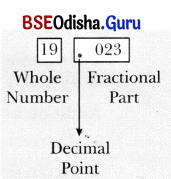
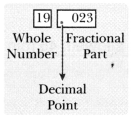
A Peek Beyond the Point Class 7 Notes Maths Chapter 3-1
The number before the decimal point is the whole number part,
The number after the decimal point is the fractional part.
For example, in decimal number 19.023, we have

  1. Whole number part = 19
  2. Fractional part = 0.023

Adding zeros after the last non-zero digit in the fractional part of a decimal number does not change its value. For example, 0.3, 0.30 and 0.300 are all equal as they represent the same quantity, i.e. 3 tenths.

When reading decimal numbers, say each digit after the decimal point separately. For example, 8.05 is read as “eight point zero five”.

Decimal numbers which have the same number of digits after the decimal point are called Like Decimals. For example, 1.23, 22.63 and 100.56 are ‘Like Decimals as they all have 2 digits after the decimal point.

A Peek Beyond the Point Class 7 Notes Maths Chapter 3

Decimal numbers which have different number of digits after the decimal point are called Unlike Decimals. For example, 6.3 and 6.25 are ‘Unlike Decimals’ as number of digits after the decimal point in the given two numbers are f and 2, respectively.

Unlike decimals can be converted to like decimals by adding zeros to the extreme right of the fractional part after the last non-zero digit. For example, ‘Unlike Decimals’ 6.3 and 6.25 are converted to ‘Like Decimals’ as 6.30 and 6.25.

Some most frequently used conversions (from decimals to fraction) are as follows:

1 \(\frac{1}{2}\) \(\frac{1}{3}\) \(\frac{1}{4}\) \(\frac{1}{5}\) \(\frac{1}{8}\) \(\frac{2}{3}\) \(\frac{3}{4}\)
1 0.5 0.333 0.25 0.20 0.125 0.67 0.75
A Peek Beyond the Point Class 7 Notes Maths Chapter 3-2 A Peek Beyond the Point Class 7 Notes Maths Chapter 3-3 A Peek Beyond the Point Class 7 Notes Maths Chapter 3-4 A Peek Beyond the Point Class 7 Notes Maths Chapter 3-5 A Peek Beyond the Point Class 7 Notes Maths Chapter 3-6 A Peek Beyond the Point Class 7 Notes Maths Chapter 3-7 A Peek Beyond the Point Class 7 Notes Maths Chapter 3-8 A Peek Beyond the Point Class 7 Notes Maths Chapter 3-9

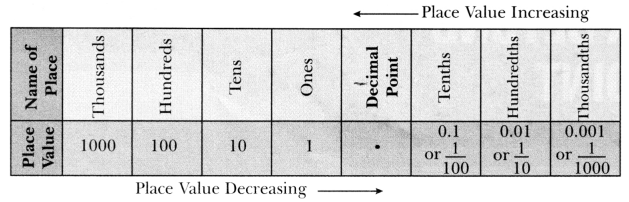
The decimal point separates the whole number part and fractional part. With the help of a decimal place value chart, we can easily understand the value of digits in both parts of a decimal number.
A Peek Beyond the Point Class 7 Notes Maths Chapter 3-10

Just like fractions, we can also represent decimal numbers on the number line.

Consider the decimal number 1.8. It is equal to 1 unit and 8 tenths. This means that the unit between 1 and 2 is divided into 10 equal parts and 8 such parts are taken. Hence, 1.8 lies between 1 and 2.
A Peek Beyond the Point Class 7 Notes Maths Chapter 3-11

Comparing two decimal numbers:
The decimal number with the greater whole number part is greater. For example: 6. 12 > 4.3

A Peek Beyond the Point Class 7 Notes Maths Chapter 3

If whole number parts mere same, compare digit by digit, from left to right, until a difference is found. For example: 2.593 > 2528

Addition and subtraction of decimals:
Convert the given decimal numbers into like decimals.

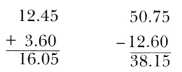
Arrange the decimal numbers vertically with all the digits in the correct places according to the place value of the digits. This will result in the decimal point of the decimal numbers falling in one vertical line. Then add or subtract, as the case may be.
A Peek Beyond the Point Class 7 Notes Maths Chapter 3-12

The sum of two decimal numbers will always be greater than the sum of their whole number parts. but less than 2 more than that sum, For example, the sum of 15.245 and 18.847 is greater than 33 and less than 35.

The difference of two decimal numbers will always lie between one iess than and one more than the difference of their whole number parts. For example, the difference of 25.89 and 13.42 is greater than 11 and less than 13.

A Peek Beyond the Point Class 7 Notes Maths Chapter 3

When we change a measurement from one unit to another, we call it unit converstion.
The common units are as follows:
Length: km, m, cm, mm
Weight: kg, g, mg
Capacity: kl, l, ml
A Peek Beyond the Point Class 7 Notes Maths Chapter 3-13

Decimal Numbers
In a decimal number, the number before the decimal point is the whole number part.
A Peek Beyond the Point Class 7 Notes Maths Chapter 3-14
The number after the decimal point is the fractional part.
Decimal fractions: Fractions with denominators 10, 100, 1000, etc.
Tenths: One part out of 10 is known as tenths.
Hundredths: One part out of 100 is known as hundredths.

Decimal numbers which have the same number of digits after the decimal point are called Like Decimals.

Decimal numbers which have different number of digits after the decimal point are called Unlike Decimals.

Adding zeros after the last non-zero digit in the fractional part of a decimal number does not change its value.

When reading decimal numbers, say each digit after the decimal point separately. For example, 8.05 is read as “eight point zero five”.

A Peek Beyond the Point Class 7 Notes Maths Chapter 3

A decimal place value chart shows the value of digits in both whole and fractional parts of a number.

A decimal number with a greater whole number part is larger, and if the whole number parts are equal, compare digits from left to right until a difference is found.

Addition and Subtraction of decimals

  1. Convert the given decimal numbers into like decimals.
  2. Arrange the decimal numbers vertically with all the digits in the correct places according to the place value of the digits. This will result in the decimal points of the decimal numbers falling in one vertical line. Then add or subtract, as the case may be.

Note:
The sum of two decimal numbers w ill always be greater than the sum of their whole number parts, but less than 2 more than that sum.

The difference of two decimal numbers will always lie between one less than and one more than the difference of their whole number parts.

Conversion of Units
When we change a measurement from one unit to another, we call it unit conversion.

The common units are as follow’s: Length: km, m, cm, mm Weight: kg, g, mg Capacity: kl, l, ml

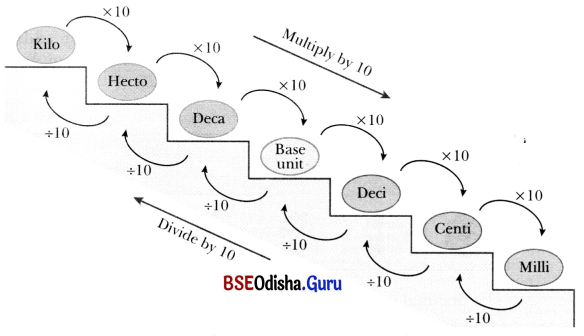
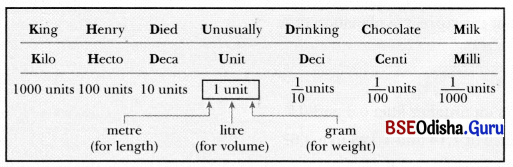
Memory Aid:
A Peek Beyond the Point Class 7 Notes Maths Chapter 3-15
For example, 10 mm = 1 cm, 100 cm = 1 m, 1000 g = 1 kg, 1000 ml = 1l

A Peek Beyond the Point Class 7 Notes Maths Chapter 3

Remember:
Larger unit → Smaller unit: Multiply by 10 for each step
Smaller unit → Larger unit: Divide by 10 for each step

Arithmetic Expressions Class 7 Notes Maths Chapter 2

Easy-to-read Ganita Prakash Class 7 Notes and Chapter 2 Arithmetic Expressions Class 7 Notes save valuable study time during exam season.

Class 7 Maths Chapter 2 Arithmetic Expressions Notes

Class 7 Arithmetic Expressions Notes

Arithmetic Expression: An arithmetic expression is a combination of numbers and basic operations. For example,
6 + 4
15 – 7
3 × 8
24 ÷ 6

We use ‘equal to’ sign (‘ = ’) to show that the expression and its value are the same.
Arithmetic Expressions Class 7 Notes Maths Chapter 2-1
An arithmetic expression may have multiple operations.
For example, 8 + 36 = 12 – 7 × 4. Here, all four basic operations are used.

Two expressions may have the same value. If they have the same value, then they are considered equal to each other.

If two expressions or numbers are not equal, then one of them is greater or smaller than the other. .

  1. To show‘greater than’we use the symbol ‘>’
  2. To show‘less (smaller) than’we use the symbol ‘<’.

This type of representation is called an ‘inequality’.
To compare two expressions, we do not compare their length, number of operators or individual numbers in the expression. To compare the expressions, we must compare their values.

Arithmetic Expressions Class 7 Notes Maths Chapter 2

BODMAS is a rule that tells us about the correct order to solve different operations in an Arithmetic Expression. If we do not follow this order, we will get a wrong answer.

What does BODMAS stand for?

Letter

Meaning

Example

B Brackets (3 + 2) × 5 = 5 × 5 = 25
O Order (Powers: Squares, Cubes, etc.) 32 + 2 = 3 × 3 + 2 = 9 + 2 = 11
D Division 20 + 5 = 4
M Multiplication 4 × 3 = 12
A Addition 6 + 2 = 8
S Subtraction 9 – 3 = 6

Remember, always solve expressions in this order:
Brackets → Order → Division → Multiplication → Addition → Subtraction

The most commonly used brackets are Round brackets or parentheses ()
Curly brackets or braces {}
Square brackets []
Bar or vinculum –
A bar is used to signify that certain terms should be considered together, similar to parentheses.
For example, 8 ÷ 2 + 2 = 8 ÷ 4 = 2

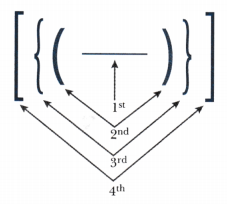
If there are multiple types of brackets in an expression, the order in which the brackets are solved is:
Arithmetic Expressions Class 7 Notes Maths Chapter 2-2

Quick Rules: Multiplication of Signs
(+) × (+) = (+)
(-) × (-) = (+)
(+) × (-) = (-)
(-) × (+) = (-)

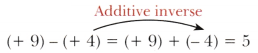
Subtracting a number is the same as adding its additive inverse.
So, 25 – 13 is the same as 25 + -13

The commutative property of addition means that you can swap the terms when adding, and the
result will still be the same.
Term 1 + Term 2 + Term 3 + Term 1
Example: 5 + 7 = 7 + 5

Arithmetic Expressions Class 7 Notes Maths Chapter 2

According to the associative property of addition, the sum of three or more terms remains the same regardless of how the terms are grouped.
Arithmetic Expressions Class 7 Notes Maths Chapter 2-3
Example: (5 + 3) + 9 = 5 + (3 + 9)

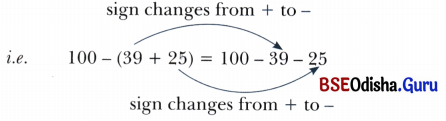
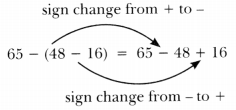
If there is a plus sign before a bracket, remove the bracket without changing the signs of the terms inside it.

If there is a minus sign before a bracket, remove the bracket by changing the sign of each term inside the bracket.
Arithmetic Expressions Class 7 Notes Maths Chapter 2-4

The distributive property of multiplication over addition states that ‘multiplying a number by a sum in brackets is the same as multiplying the number by each term inside the brackets and then adding the results’.
a × (b + c) = a × b + a × c
Distributive property of multiplication over subtraction: a × (b – c) = a × b – a × c

Arithmetic Expressions
An arithmetic expression is a combination of numbers and basic operations.
For example, 3 + 8, 5 × 13

An arithmetic expression may have multiple operations.
For example, 3 – 5 × 7 + 8

Arithmetic Expressions Class 7 Notes Maths Chapter 2

Terms are the parts of an expression separated by a ‘ + ’ sign.
For example, in 10 + 4, the terms are 10 and 4.

Comparison of Expressions
An inequality is a mathematical expression that compares two expressions using symbols > (greater than) or < (smaller than). For example, 5 > 3, 7 < 9 To compare two arithmetic expressions, we compare their values. For example, 5 × 3 = 15, 5 + 7 = 12 ⇒ 5 × 3 > 5 + 7
If a > b and c > d then a + c > b + d. For example, 7 > 2 and 8 > 6 then 7 + 8 > 2 + 6
If a > b and c > d then a – d > b – c. For example, 7 > 2 and 8 > 6 then 7 – 6 > 2 – 8

BODMAS
BODMAS is a rule that shows the correct order to solve operations in a mathematical expression.
Brackets → Order → Division → Multiplication → Addition → Subtraction

If there is a minus sign before a bracket, remove the bracket by changing the sien of each term inside the bracket.
Arithmetic Expressions Class 7 Notes Maths Chapter 2-5

Multiplication of Signs:
(+) × (+) = (+)
(-) × (-) = (+)
(+) × (-) = (-)
(-) × (+) = (-)

Properties of Addition

  1. Commutative property of addition: a + b = b + a (Swapping the terms does not change the sum)
  2. Associative property of addition: a + (b + c) = (a + b) + c (Grouping numbers differently does not affect their sum)
  3. Distributive property of multiplication over addition: a × (b + c) = a × b + a × c
  4. Distributive property of multiplication over subtraction: a × (b – c) = a × b – a × c

Arithmetic Expressions Class 7 Notes Maths Chapter 2

Important Points

  1. When 0 is divided by any non-zero integer, the result is always 0.
  2. When the integer is divided by 0, the result is always undefined.
  3. Any integer when multiplied or divided by 1 gives itself and when multiplied or divided by – 1 gives its additive inverse.
  4. Sometimes we use expressions like ‘thrice of’, ‘one fourth of’. In these expressions, ‘of’ means ‘multiplication with’.
  5. For Example: \(\frac{1}{3}\) of 15 = \(\frac{1}{3}\) × 15.

Class 6 Science Chapter 2 Question Answer Odia Medium ଜୀବଜଗତର ବିବିଧତା

Go through 6th Class Science Book Odia Medium Question Answer and Class 6 Science Chapter 2 Question Answer Odia Medium ଜୀବଜଗତର ବିବିଧତା to understand textbook questions more clearly.

6th Class Science Chapter 2 Question Answer Odia Medium

Class 6 Science Chapter 2 Odia Medium

ଆସ ଆମ ଶିକ୍ଷଣର ଅଭିବୃଦ୍ଧି କରିବା

Question 1.
ଏଠାରେ ଦୁଇ ପ୍ରକାରର ମଞ୍ଜି ରହିଛି । ସେମାନଙ୍କ ଉଭିଦର ମୂଳ ଏବଂ ପତ୍ରର ଶିରା ବିନ୍ୟାସ ମଧ୍ୟରେ ତୁମେ କ’ଣ ପାର୍ଥକ୍ୟ ଦେଖୁଛ ?
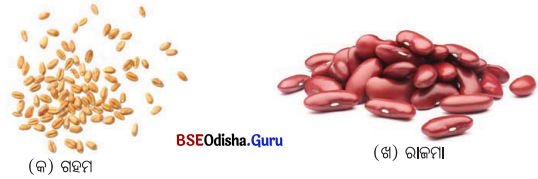
Class 6 Science Chapter 2 Question Answer Odia Medium ଜୀବଜଗତର ବିବିଧତା 1
Answer:

କ୍ର.ସଂ ବୈଶିଷ୍ଟ୍ୟ ଗହମ ମଞ୍ଜି ରାଜମା ମଞ୍ଜି
୧. ବୈଶିଷ୍ଟ୍ୟ ଗୁଚ୍ଛମୂଳ ଗହମ ମଳ
9. ମୂଳର ବୈଶିଷ୍ଟ୍ୟ ଘନ ଓ ଏହାର ଚାରିପଟେ ପତଳା ଚେରର ଉପସ୍ଥିତି ପ୍ରଧାନ ମୂଳ ମଧ୍ୟଭାଗରେ ଗୋଟିଏ ପ୍ରଧାନ ଓ ଏଠାରୁ ଶାଖାମୂଳ ସୃଷ୍ଟି
୩. ଶି ରାବିନ୍ଯାସ ସମାନ୍ତରାଳ ଜାଲକ
୪. ଶିରା ବିନ୍ୟାସର ବୈଶିଷ୍ଟ୍ୟ ଶିରାଗୁଡ଼ିକ ପତ୍ରର ଲମ୍ବ ଦିଗରେ ସମାନ୍ତରାଳ ଭାବେ ରହିଥାନ୍ତି ମଧ୍ୟଭାଗରେ ଥିବା ମୁଖ୍ୟ ଶିରାର ଦୁଇପଟେ ଜାଲ ଭଳି ଶାଖାଶିରାଗୁଡ଼ିକ ରହିଥାନ୍ତି
୫. ଚିତ୍ର Class 6 Science Chapter 2 Question Answer Odia Medium ଜୀବଜଗତର ବିବିଧତା 2 Class 6 Science Chapter 2 Question Answer Odia Medium ଜୀବଜଗତର ବିବିଧତା 3

Class 6 Science Chapter 2 Question Answer Odia Medium ଜୀବଜଗତର ବିବିଧତା

Question 2.
କିଛି ପ୍ରାଣୀମାନଙ୍କ ନାମ ନିମ୍ନରେ ଦିଆଯାଇଛି । ସେମାନଙ୍କୁ ସେମାନଙ୍କର ବାସସ୍ଥାନ ଆଧାରରେ ବର୍ଗୀକରଣ କର । ‘କ’ ଚିହ୍ନିତ ଅଞ୍ଚଳରେ ଜଳଚର ପ୍ରାଣୀ ଏବଂ ‘ଖ’ ଚିହ୍ନିତ ଅଞ୍ଚଳରେ ସ୍ଥଳଚର ପ୍ରାଣୀଙ୍କ ନାମ ଲେଖ । ‘ଗ’ ଭାଗରେ ଉଭୟଚର ପ୍ରାଣୀଙ୍କ ନାମ ଲେଖ । ଘୋଡ଼ା, ଡଲ୍‌ଫିନ୍, ବେଙ୍ଗ, ମେଣ୍ଢା, କୁମ୍ଭୀର, ଗୁଣ୍ଡୁଚି ମୂଷା, ତିମି, ଜିଆ, କଇଁଛ, ପାରା
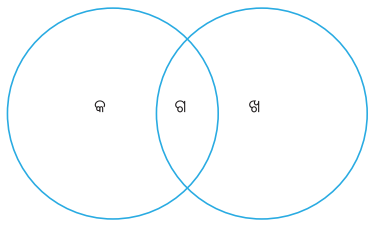
Class 6 Science Chapter 2 Question Answer Odia Medium ଜୀବଜଗତର ବିବିଧତା 4
Answer:
କ୍ର – ଡଲଫିନ୍, ତିମି
ଖ – ଘୋଡ଼ା, ମେଣ୍ଢା, ଗୁଣ୍ଡୁଚିମୂଷା, ଜିଆ, ପାରା
ଗ – ବେଙ୍ଗ, କୁମ୍ଭୀର, କଇଁଛ

Question 3.
ମୁନୁର ମା’ ଏକ ବଗିଚା କରିଛନ୍ତି । ଦିନେ ସେ ମୂଳା ଏକ ପ୍ରକାର ମୂଳ । ଗୋଟିଏ ମୂଳାକୁ ଲକ୍ଷ୍ୟ ମାଟିରୁ ମୂଳା ଖୋଳୁଥିଲେ । ସେ ମୁନୁକୁ କହିଥିଲେ ଯେ, କର ଏବଂ ଏହା କେଉଁ ପ୍ରକାରର ମୂଳ ତାହା ଲେଖ । ମୂଳା ଗଛର ପତ୍ରରେ ତୁମେ କେଉଁ ପ୍ରକାର ଶିରା ବିନ୍ୟାସ ଦେଖୁଲ ?
Answer:

  1. ମୂଳାରେ ଥିବା ମୂଳ ପ୍ରଧାନ ମୂଳ ଅଟେ । ଏ ପ୍ରକାର ମୂଳ ମୋଟାହୋଇ ମାଟିର ଗଭୀରତମ ଭାଗକୁ ଯାଇଥାଏ । ସାଧାରଣତଃ ଲମ୍ବା ଓ କୋନ୍ ଆକୃତିର ହୋଇଥାଏ । ଏହା ଉଭିଦର ଖାଦ୍ୟ ସଂରକ୍ଷଣ କରିବାରେ ସହାୟକ ହୋଇଥାଏ ।
  2. ଏହାର ପତ୍ରରେ ଜାଲକ ଶିରା ବିନ୍ୟାସ ଦେଖିବାକୁ ମିଳିଥାଏ ।

Class 6 Science Chapter 2 Question Answer Odia Medium ଜୀବଜଗତର ବିବିଧତା

Question 4.
ସମତଳ ଅଞ୍ଚଳରେ ମିଳୁଥିବା ଗୋଟିଏ ଛେଳି ଓ ଏକ ପର୍ବତ ଅଞ୍ଚଳରେ ରହୁଥ‌ିବା ଛେଳିର ଚିତ୍ର ଦେଖ । ସେମାନଙ୍କ ମଧ୍ୟରେ ସମାନତା ଏବଂ ପାର୍ଥକ୍ୟ ଦର୍ଶାଅ । ଏହି ପାର୍ଥକ୍ୟର କାରଣ କ’ଣ ?
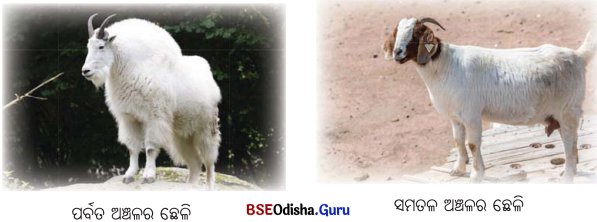
Class 6 Science Chapter 2 Question Answer Odia Medium ଜୀବଜଗତର ବିବିଧତା 5
Answer:
ସମାନତା :
(i) ଉଭୟ ଅଞ୍ଚଳରେ ଦେଖାଯାଉଥ‌ିବା ଛେଳି ଏକା ପରିବାରର ଅନ୍ତର୍ଭୁକ୍ତ ଅଟନ୍ତି ।
(ii) ଉଭୟ ଖାଦ୍ୟଗ୍ରହଣ ଦୃଷ୍ଟିରୁ ତୃଣଭୋଜୀ ଅଟନ୍ତି । ସେମାନେ ଡାଳ, ପତ୍ର ଓ ମୂଳ ଖାଇଥା’ନ୍ତି ।
ପାର୍ଥକ୍ୟ :
ସମତଳ ଅଞ୍ଚଳର ଛେଳି
(i) ଉଷ୍ମ ଜଳବାୟୁରେ ଖାପଖୁଆଇ ଚଳିବା ନିମନ୍ତେ ଶରୀରରେ ଛୋଟ ଓ ପତଳା ଲୋମ ଥାଏ ।
(ii) ସମତଳ ଓ ଖୋଲା ଅଞ୍ଚଳ ସହ ଖାପଖୁଆଇବା ପାଇଁ ଶରୀର ଗଠନ ପତଳା ହୋଇଥାଏ ।
(iii) ସମତଳ ତୃଣଭୂମିରେ ଚାଲିବା ପାଇଁ ଖୁରା ସୁଗଠିତ ହୋଇଥାଏ ।

ପର୍ବତ ଅଞ୍ଚଳର ଛେଳି
(i) ପାର୍ବତ୍ୟ ଅଞ୍ଚଳର ଥଣ୍ଡା ପରିବେଶରୁ ସୁରକ୍ଷା ପାଇଁ ଶରୀରରେ ଲମ୍ବା ଓ ଘନ ଲୋମ ଥାଏ ।
(ii) ପଥୁରିଆ ଉପତ୍ୟକାରେ ସହଜରେ ଚଢ଼ିପାରିବା ପାଇଁ ଶରୀର ପୃଥୁଳ ଓ ମାଂସପେଶୀ ବହୁଳ ହୋଇଥାଏ ।
(iii) ପଥୁରିଆ ପୃଷ୍ଠକୁ ଦୃଢ଼ ଭାବରେ ଧରିବା ପାଇଁ ସ୍ୱତନ୍ତ୍ର ଧରଣର ଆବଡ଼ାଖାବଡ଼ା ଖୁରା ଥାଏ ।

Question 4.
ଏହି ଅଧ୍ୟାୟରେ ଆଲୋଚନା କରାଯାଇଥିବା ବୈଶିଷ୍ଟ୍ୟ ନିମ୍ନଲିଖତ ପ୍ରାଣୀମାନଙ୍କୁ ଦୁଇଟି ପର୍ବତ ଅଞ୍ଚଳର ଛେଳି ଶ୍ରେଣୀରେ ବିଭକ୍ତ କର – ଗାଈ, ଅସରପା, ପାରା, ବାଦୁଡ଼ି, କଇଁଛ, ତିମି, ମାଛ, ଝିଣ୍ଟିକା, ଝିଟିପିଟି ।
Answer:
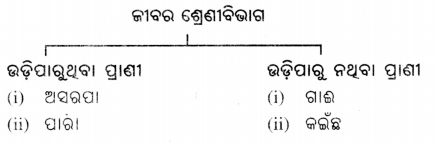
Class 6 Science Chapter 2 Question Answer Odia Medium ଜୀବଜଗତର ବିବିଧତା 6
ଉଡ଼ିପାରୁଥିବା ପ୍ରାଣୀ
(iii) ବାଦୁଡ଼ି
(iv) ଝିଣ୍ଟିକା

ଉଡ଼ିପାରୁ ନଥ‌ିବା ପ୍ରାଣୀ
(iii) ତିମି
(iv) ମାଛ
(v) ଝିଟିପିଟି

Class 6 Science Chapter 2 Question Answer Odia Medium ଜୀବଜଗତର ବିବିଧତା

Question 6.
ଜନସଂଖ୍ୟା ବଢି ଚାଲିଛି ଓ ଲୋକମାନେ ଅଧ‌ିକ ଆରାମଦାୟକ ଜୀବନ ଯାପନ କରିବାକୁ ଚାହୁଁଛନ୍ତି ଫଳରେ ବିଭିନ୍ନ ଆବଶ୍ୟକତା ପୂରଣ ପାଇଁ ଜଙ୍ଗଲ କଟାଯାଉଛି । ଏହା ଆମ ପରିବେଶକୁ କିପରି ପ୍ରଭାବିତ କରିପାରେ ? ଆମେ ଏହି ସମସ୍ୟାର କିପରି ମୁକାବିଲା କରିପାରିବା ବୋଲି ତୁମେ ଭାବୁଛ ?
Answer:
ଜଙ୍ଗଲ ନଷ୍ଟର ପରିବେଶ ଉପରେ ପ୍ରଭାବ :

  1. ଜୈବ ବିବିଧତା ହ୍ରାସ ପାଉଅଛି ।
  2. ଜଳବାୟୁରେ ପରିବର୍ତ୍ତନ ଦେଖାଦେଉଛି ।
  3. ମୃତ୍ତିକା ପ୍ରଦୂଷଣ ବା କ୍ଷୟ ବୃଦ୍ଧି ପାଉଛି ।
  4. ଜଳଚକ୍ର ପ୍ରଭାବିତ ହେଉଅଛି ।
  5. ବାୟୁ ପ୍ରଦୂଷଣ ଫଳରେ ବାୟୁର ଗୁଣବତ୍ତା ହ୍ରାସ ପାଉଛି ।

ସମସ୍ୟାର ସମାଧାନ ପାଇଁ ଗ୍ରହଣୀୟ ପଦକ୍ଷେପ :

  1. ସଂରକ୍ଷିତ ଜଙ୍ଗଲ ସୃଷ୍ଟି କରିବାକୁ ପଡ଼ିବ ।
  2. ଅଧ‌ିକ ମାତ୍ରାରେ ଅଭୟାରଣ୍ୟ, ଜାତୀୟ ଉଦ୍ୟାନ ଓ ପାର୍କ ସ୍ଥାପନ କରାଯାଇପାରିବ ।
  3. ଜଙ୍ଗଲ ସଂରକ୍ଷଣ ପାଇଁ ସ୍ଥାନୀୟ ଲୋକଙ୍କୁ ସଚେତନ କରାଯାଇପାରିବ ।
  4. ଜଙ୍ଗଲ କ୍ଷୟର ପ୍ରତିରୋଧ ପାଇଁ ବିଭିନ୍ନ ଆଇନ ଓ ନିୟମ ପ୍ରଣୟନ କରାଯାଇପାରିବ ।
  5. ଜାଳେଣି କାଠ ପରିବର୍ତ୍ତେ ସୌର ରନ୍ଧକ ବ୍ୟବହାର କରାଯାଇ ପାରିବ ।

Question 7.
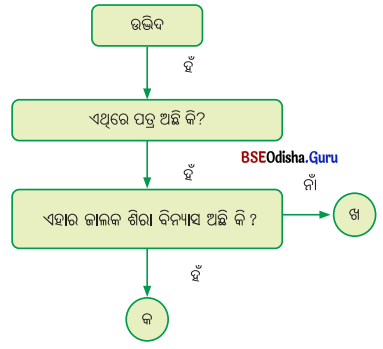
ଫ୍ଲୋଚାର୍ଟକୁ ବିଶ୍ଳେଷଣ କର । ‘କ’ ଓ ‘ଖ’ ସ୍ଥାନରେ ଉଭିଦର ନାମ ଲେଖ ।
Class 6 Science Chapter 2 Question Answer Odia Medium ଜୀବଜଗତର ବିବିଧତା 7
Answer:
କ – ପତ୍ରରେ ଜାଲକ ଶିରା ବିନ୍ୟାସ ଦେଖାଯାଏ ।
ଦ୍ଵିବୀଜପତ୍ରୀ ଅଟନ୍ତି । ଉଦାହରଣ – ମଟର, ତେନ୍ତୁଳି, ଆମ୍ବ, ମନ୍ଦାର, ସୋରିଷ ଇତ୍ୟାଦି ।
ଖ – ପତ୍ରରେ ସମାନ୍ତରାଳ ଶିରା ବିନ୍ୟାସ ଦେଖାଯାଏ ।
ଏକ ବୀଜପତ୍ରୀ ଅଟନ୍ତି । ଉଦାହରଣ – ଧାନ, ମକା, ଗହମ, ଘାସ ଇତ୍ୟାଦି ।

Class 6 Science Chapter 2 Question Answer Odia Medium ଜୀବଜଗତର ବିବିଧତା

Question 8.
ରାଜୁ ତା’ ବନ୍ଧୁ ସଞ୍ଜୟ ସହ ଯୁକ୍ତିତର୍କ କରିଥିଲା ଯେ, ‘ମନ୍ଦାର ହେଉଛି ଏକ ବୁନ୍ଦା’’ । ସଞ୍ଜୟ ସ୍ପଷ୍ଟୀକରଣ ପାଇଁ କ’ଣ ପ୍ରଶ୍ନ ପଚାରିଥ‌ିବ ?
Answer:

  • ମନ୍ଦାର ଗଛର ଉଚ୍ଚତା କେତେ ?
  • ଏହାର କାଣ୍ଡର ରଂଗ
  • ଏହାର କାଣ୍ଡ ଓ ଶାଖା ମାଟିଠାରୁ କେତେ ଉଚ୍ଚରେ ଅଛି ?
  • କାଣ୍ଡଗୁଡ଼ିକ ଶକ୍ତ ଅଥବା କିପରି ଅଟେ ?

Question 9.
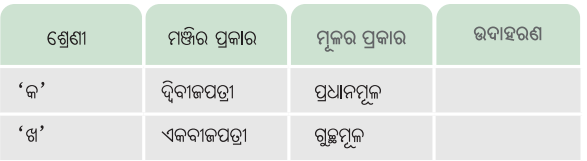
ସାରଣୀରେ ଥିବା ସୂଚନା ଆଧାରରେ, ପ୍ରତ୍ୟେକ ଶ୍ରେଣୀ ପାଇଁ ଏହି ଉଭିଦଗୁଡ଼ିକର ଉଦାହରଣ ଲେଖ ।
Class 6 Science Chapter 2 Question Answer Odia Medium ଜୀବଜଗତର ବିବିଧତା 8
(କ) ଶ୍ରେଣୀ ‘କ’ର ଉଭିଦଗୁଡ଼ିକର ଆଉ କ’ଣ ସମାନତା ରହିଛି ?
(ଖ) ଶ୍ରେଣୀ ‘ଖ’ର ଉଭିଦଗୁଡ଼ିକର ଆଉ କ’ଣ ସମାନତା ରହିଛି ?
Answer:
କ – ବୁଟ, ମୁଗ, ତେନ୍ତୁଳି, ଚିନାବାଦାମ ଇତ୍ୟାଦି ।
ଖ – ଧାନ, ଗହମ, ମକା ଇତ୍ୟାଦି ।
ଶ୍ରେଣୀ ‘କ’ ର ସମାନତା : ଦ୍ଵିବୀଜପତ୍ରୀ ଓ ପତ୍ରରେ ଜାଲକ ଶିରାବିନ୍ୟାସ ରହିଥାଏ ।
ଶ୍ରେଣୀ ‘ଖ’ ର ସମାନତା : ଏକବୀଜପତ୍ରୀ ଓ ପତ୍ରରେ ସମାନ୍ତରାଳ ଶିରାବିନ୍ୟାସ ରହିଥାଏ ।

Class 6 Science Chapter 2 Question Answer Odia Medium ଜୀବଜଗତର ବିବିଧତା

Question 10.
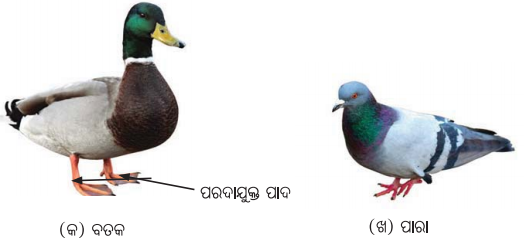
ଦିଆଯାଇଥବା ଚିତ୍ରରେ ବତକର ନାମକରଣ କରାଯାଇଥିବା ଅଂଶକୁ ନିରୀକ୍ଷଣ କର । ଅନ୍ୟ ପକ୍ଷୀଙ୍କ ତୁଳନାରେ ବ୍ରତକର ପାଦରେ କ’ଣ ପାର୍ଥକ୍ୟ ଦେଖ‌ିବାକୁ ମିଳେ ? ବତକ ଏହି ଅଂଶ ବ୍ୟବହାର କରି କେଉଁ କାର୍ଯ୍ୟ କରିବାକୁ ସକ୍ଷମ ହୁଏ ?
Class 6 Science Chapter 2 Question Answer Odia Medium ଜୀବଜଗତର ବିବିଧତା 9
Answer:

  • ବ୍ରତକର ପାଦ ପରଦାଯୁକ୍ତ ହୋଇଥାଏ କିନ୍ତୁ ପାରାର ପାଦରେ ଏହି ପରଦା ନଥାଏ । ବତକ ଏକ ଜଳଚର ଜୀବ ହୋଇଥ‌ିବାରୁ ଏହି ପାଦ ତାହାକୁ ପାଣିରେ ପହଁରିବା କାର୍ଯ୍ୟ କରିଥାଏ ।
  • ବତକର ଏହି ପରଦାଯୁକ୍ତ ପାଦ ବତକକୁ କାଦୁଆ ଓ ସନ୍ତସନ୍ତିଆ ଅଞ୍ଚଳରେ ଚାଲିବାରେ ଦୃଢ଼ତା ଯୋଗାଇଥାଏ । ଏହା ମଧ୍ୟ ତାହାକୁ ପାଣିରେ ବୁଡ଼ିବାକୁ ପ୍ରତିରୋଧ କରେ । ଏହି ପାଦ ବ୍ରତକକୁ ପାଣିରେ ସଠିକ ଭାବେ ପହଁରିବା ସହ ଥଣ୍ଡା ପାଣିରେ ପାଦରେ ଥ‌ିବା ରକ୍ତକୁ ଜମାଟ ବାନ୍ଧିବାକୁ ଦେଇ ନଥାଏ ।
  • ଏହାର ପାଦରେ ଶତକଡ଼ା 60 ଭାଗ ହାଡ଼ ଓ 40 ଭାଗ ମାଂସ ରହିଥାଏ ।

ଅଧ୍ବକ ଶିଖ୍ ବା

Question 1.
ଭାରତର ଜୈବ ବିବିଧତାର ସୁରକ୍ଷା ଦିଗରେ କାମ କରୁଥିବା ଜଣେ ଭାରତୀୟ ବୈଜ୍ଞାନିକ କିମ୍ବା ବନ୍ୟପ୍ରାଣୀ ଜୀବବିଜ୍ଞାନୀଙ୍କ ବିଷୟରେ ପଢ଼ ଓ ଭାରତର ଜୈବ ବିବିଧତାର ସୁରକ୍ଷା
Answer:
ଭାରତର ଜୈବ ବିବିଧତାର ସୁରକ୍ଷା ଦିଗରେ ଅନେକ ଭାରତୀୟ ବୈଜ୍ଞାନିକ କାର୍ଯ୍ୟ କରିଛନ୍ତି । ସେମାନେ
ହେଲେ :

  1. ଡକ୍ଟର ସଲିମ୍ ଅଲ୍ଲୀ : ‘ଭାରତର ପକ୍ଷୀ ମାନବ’ ଭାବରେ ବିବେଚିତ ସଲୀମ୍ ଅଲ୍ଲୀ, ଭାରତର ତଥା ଏସିଆ ମହାଦେଶର ପକ୍ଷୀମାନଙ୍କ ଉପରେ ବ୍ୟାପକ ଅନୁଧ୍ୟାନ ଓ ଗବେଷଣା କରିଛନ୍ତି ଏବଂ ପକ୍ଷୀ ସଂରକ୍ଷଣ ପାଇଁ ସକ୍ରିୟ ପଦକ୍ଷେପ ଗ୍ରହଣ କରିଛନ୍ତି । ରାଜସ୍ଥାନର ଭରତପୁର କେଓଲାଦେଓ ଜାତୀୟ ଉଦ୍ୟାନ ଏବଂ କର୍ଣ୍ଣାଟକର ମାଣ୍ଡାସ୍ଥିତ ରଙ୍ଗନାଥୁରୁ ପକ୍ଷୀ ଅଭୟାରଣ୍ୟ ତାଙ୍କ ସଂରକ୍ଷଣ ଅଞ୍ଚଳର ଉଦାହରଣ ।
  2. ଡକ୍ଟର ଅସୀର ଜବାହାର ଥୋମାସ୍ : ଏହି ବନ୍ୟପ୍ରାଣୀ ଜୀବବିଜ୍ଞାନୀ ତଥା ଭାରତୀୟ ବନ୍ୟପ୍ରାଣୀ ପ୍ରତିଷ୍ଠାନର ଅଧ୍ୟାପକ, ବ୍ୟାଘ୍ର ସଂରକ୍ଷଣ ପ୍ରକଳ୍ପରେ ଗୁରୁତ୍ଵପୂର୍ଣ୍ଣ ଭୂମିକା ଗ୍ରହଣ କରିଛନ୍ତି । ସେ ଏସୀୟ ହାତୀ ଓ ଏସୀୟ ସିଂହ ଭଳି ପ୍ରଜାତି ଉପରେ ମଧ୍ୟ କାର୍ଯ୍ୟ କରିଛନ୍ତି ।
  3. ଡକ୍ଟର କମଲଜିତ୍ ବାୱା : ଏହି ଜୀବବିଜ୍ଞାନୀ ଉଷ୍ମ କଟିବନ୍ଧୀୟ ଭାରତର ସମୃଦ୍ଧ ଜୈବ ବିବିଧତାକୁ ସୁରକ୍ଷା ଦେବାପାଇଁ ଅନେକ କାର୍ଯ୍ୟ କରିଯାଇଛନ୍ତି ।
  4. ଡକ୍ଟର ଅନିଲ କୁମାର : ଏହି ଉଦ୍ଭଦବିଜ୍ଞାନୀ ଜୈବ ବିବିଧତା ସଂରକ୍ଷଣ, ଏହାର ସ୍ଥାୟୀ ବ୍ୟବହାର ଏବଂ ଜୈବିକ ସମ୍ପଦରୁ ଲାଭର ସମାନ ବଣ୍ଟନରେ ଦଶନ୍ଧିର ଅଭିଜ୍ଞତା ସମ୍ପର୍କୀୟ ଅନେକ ତଥ୍ୟ ପ୍ରଦାନ କରିଛନ୍ତି ।
  5. ଡକ୍ଟର ଉଲ୍ଲାସ କରନ୍ଥ : ଜୈବ ବିବିଧତା ସଂରକ୍ଷଣ ବିଜ୍ଞାନର ଜଣେ ଅଗ୍ରଣୀ ବୈଜ୍ଞାନିକ ଭାବରେ ବନ୍ୟପ୍ରାଣୀ ଜୀବ ବିଜ୍ଞାନ ଏବଂ ସଂରକ୍ଷଣରେ ଏକ ପ୍ରୋଗ୍ରାମ ବିକଶିତ କରିଯାଇଛନ୍ତି ।

Class 6 Science Chapter 2 Question Answer Odia Medium ଜୀବଜଗତର ବିବିଧତା

ଜୈବ ବିବିଧତା ସଂରକ୍ଷଣର ଜନକ :
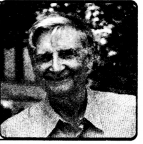
ଇ.ଓ ୱିଲସନ୍ 2007 ମସିହାରେ ବିବର୍ତ୍ତନବାଦୀ ଜୀବବିଜ୍ଞାନ ଏବଂ ଜୈବ ବିବିଧତା ସଂରକ୍ଷଣରେ ତାଙ୍କ ଜୀବନର କାର୍ଯ୍ୟପାଇଁ TED ପୁରସ୍କାର ପାଇଥିଲେ । ତାଙ୍କ ଭାଷଣରେ ସେ କହିଥିଲେ, ‘ମୁଁ ଇଚ୍ଛା ପ୍ରକାଶ କରେ ଯେ ଆମେ ପୃଥ‌ିବୀର ଜୈବ ବିବିଧତା ସଂରକ୍ଷଣକୁ ପ୍ରେରଣା ଦେବା ପାଇଁ ଆବଶ୍ୟକ ପ୍ରମୁଖ ଉପକରଣଗୁଡ଼ିକ ସୃଷ୍ଟି କରିବାରେ ସାହାଯ୍ୟ କରିବା ପାଇଁ ଏକାଠି କାର୍ଯ୍ୟ କରିବା ।’’
Class 6 Science Chapter 2 Question Answer Odia Medium ଜୀବଜଗତର ବିବିଧତା 10

Question 2.
ଭାରତରେ ଜୈବ ବିବିଧତା ପାଇଁ ଦିବ୍ୟା ମୁଦଗ୍ଧା, ଉଷା ଲଢ଼ୁଙ୍ଗା, ଗଜଲା ସାହାବୁଦ୍ଦିନ, ନନ୍ଦିନୀ ଭେଲହୋ, ବିଦ୍ୟା ଆଥେୟା, ଉମା ରାମକ୍ରିଷ୍ଣନ ଏବଂ ଦିବ୍ୟା ବର୍ଣ୍ଣାଡ଼ଙ୍କ ଅବଦାନ ବିଷୟରେ ଅନୁସନ୍ଧାନ କର । ସେମାନଙ୍କ ମଧ୍ୟରୁ କୌଣସି ତିନି ଜଣଙ୍କଦ୍ଵାରା କରାଯାଇଥିବା କାର୍ଯ୍ୟର ଏକ ବିବରଣୀ ପ୍ରସ୍ତୁତ କର ।
Answer:
(i) ଦିବ୍ୟା ମୁଦଗା (Divya Mudappa) : ଏହି ମହିଳା ଭାରତର ପ୍ରକୃତି ସଂରକ୍ଷଣ ଫାଉଣ୍ଡେସନ୍‌ର ଜଣେ ବନ୍ୟପ୍ରାଣୀ ଏବଂ ସଂରକ୍ଷଣ ବୈଜ୍ଞାନିକ ଅଟନ୍ତି । ସେ ପଶ୍ଚିମଘାଟ ପର୍ବତମାଳାର ପୁନରୁଦ୍ଧାର ପ୍ରକଳ୍ପରେ କାର୍ଯ୍ୟ କରିଛନ୍ତି । ଏଠାରେ ସେ ଏବଂ ତାଙ୍କର ଦଳ ବୃକ୍ଷରୋପଣ ଏବଂ ସମ୍ପଭିରେ ବର୍ଷାଜଳ ସଂରକ୍ଷଣ ଓ ଏହାର ପୁନରୁଦ୍ଧାର ସମ୍ପର୍କିତ ଗବେଷଣାତ୍ମକ ତଥ୍ୟ ପ୍ରଦାନ କରିଛନ୍ତି ।
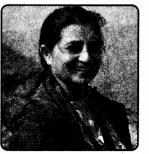
Class 6 Science Chapter 2 Question Answer Odia Medium ଜୀବଜଗତର ବିବିଧତା 11
(ii) ଉଷା ଲଢ଼ୁଙ୍ଗା (Usha Lachungpa) : ସେ ଭାରତର ଜଣେ ପ୍ରସିଦ୍ଧ ପରିବେଶବିତ୍ ଅଟନ୍ତି । ବିଶେଷକରି ହିମାଳୟ ଅଞ୍ଚଳରେ ଜୈବ ବିବିଧତା ସଂରକ୍ଷଣ ପାଇଁ ତାଙ୍କର ପ୍ରୟାସ ଜଣାଶୁଣା ଅଟେ । ସାମଗ୍ରିକ ଭାବରେ ଜୈବ ବିବିଧତା ସଂରକ୍ଷଣକୁ ପ୍ରୋତ୍ସାହିତ କରିବାରେ ସେ ଏକ ଗୁରୁତ୍ଵପୂର୍ଣ ଭୂମିକା ଗ୍ରହଣ କରିଛନ୍ତି । ସେ ମଧ୍ୟ ପରିବେଶ ସଂରକ୍ଷଣ ଶିକ୍ଷାଗତ କାର୍ଯ୍ୟକ୍ରମରେ ସାମିଲ ଅଛନ୍ତି ।
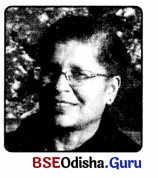
Class 6 Science Chapter 2 Question Answer Odia Medium ଜୀବଜଗତର ବିବିଧତା 12
(iii) ଗଜଲା ସାହାବୁଦ୍ଦିନ୍ (Ghazala Shahabuddin) : ଏହି ମହିଳା ଭାରତ ଏବଂ ଏସିଆରେ ଜୈବ ବିବିଧତା ଏବଂ ବନୀକରଣ ପ୍ରସଙ୍ଗରେ କାର୍ଯ୍ୟ କରିଥିବା ଜଣେ ପରିବେଶବିତ୍ ଅଟନ୍ତି । ତାଙ୍କର ଗବେଷ6ଗୁଡ଼ିକ ଜଙ୍ଗଲର ଜୈବ ବିବିଧତା, ସାମାଜିକ ପରିସଂସ୍ଥାନ ଏବଂ ଜଙ୍ଗଲ ନୀତିର ପ୍ରଭାବ ସହିତ ଜଡ଼ିତ ଅଟେ ।
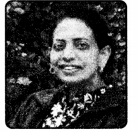
Class 6 Science Chapter 2 Question Answer Odia Medium ଜୀବଜଗତର ବିବିଧତା 13
(iv) ନନ୍ଦିନୀ ଭେଲହୋ (Nandini Velho) : ଏହି ମହିଳା ଉତ୍ତର-ପୂର୍ବ ଭାରତର ଗୁରୁତ୍ବପୂର୍ଣ୍ଣ ଅଭୟାରଣ୍ୟଗୁଡ଼ିକର ବ୍ୟାଘ୍ର ସଂରକ୍ଷଣ ଯୋଜନା ସମୀକ୍ଷା କରିଛନ୍ତି ଏବଂ ଲେଖୁବାରେ ସାହାଯ୍ୟ କରିଛନ୍ତି । ସେ ଏକ ମନୋରମ ପ୍ରକୃତି ବ୍ୟାଖ୍ୟା କେନ୍ଦ୍ର ଡିଜାଇନ୍ ସୃଷ୍ଟି କରିବାରେ ସାହଯ୍ୟ କରିଛନ୍ତି ।

Class 6 Science Chapter 2 Question Answer Odia Medium ଜୀବଜଗତର ବିବିଧତା

(v) ବିଦ୍ୟା ଆଥ୍ରୋୟା (Vidya Athreya) : ଏହି ମହିଳା ଜଣେ ପରିବେଶବିତ୍ ଯିଏ 2003 ମସିହାରୁ ମାନବ ଚିତାବାଘ ସଂଘର୍ଷ ପ୍ରସଙ୍ଗରେ କାର୍ଯ୍ୟ କରୁଛନ୍ତି । ସେ ଭାରତରେ ମାନବ ବ୍ୟବହାର ଭୂମିରେ ଚିତାବାଘର ପରିବେଶ ଉପରେ ଗବେଷଣା କରିଛନ୍ତି । ସେ ମଧ୍ୟ ଚିତାବାଘ ସମ୍ବନ୍ଧରେ ଜଣେ ବିଶ୍ଵ ବିଶେଷଜ୍ଞ ଅଟନ୍ତି ।

Class 6 Science Chapter 2 Question Answer Odia Medium ଜୀବଜଗତର ବିବିଧତା 14
(vi) ଉମା ରାମକ୍ରିଷ୍ଣନ୍ (Uma Ramakrishnan) : ଏହି ମହିଳା ଜଣେ ଭାରତୀୟ ଆଣବିକ ପରିବେଶ ବିଜ୍ଞାନୀ ଏବଂ ବାଙ୍ଗାଲୋର ନ୍ୟାସନାଲ ସେଣ୍ଟର ଫର ବାଇଓଲୋଜିକାଲ ସାଇନ୍ସରେ ଜଣେ ପ୍ରଫେସର ଅଟନ୍ତି । ତାଙ୍କର ଗବେଷଣା ଭାରତୀୟ ଉପମହାଦେଶରେ ସ୍ତନ୍ୟପାୟୀ ପ୍ରାଣୀଙ୍କ ଜନସଂଖ୍ୟା ଏବଂ ବିବର୍ତ୍ତନର ଇତିହାସ ସହିତ ବାଘମାନଙ୍କୁ ସୁରକ୍ଷା ପ୍ରଦାନ ସମ୍ପର୍କିତ କାର୍ଯ୍ୟ ସହ ଜଡ଼ିତ ।

(vii) ଦିବ୍ୟା କର୍ଣ୍ଣାଡ଼ (Divya Karnad ) : ଏହି ମହିଳା ଆନ୍ତର୍ଜାତିକ ପୁରସ୍କାର ବିଜେତା ଅଟନ୍ତି । ସେ ସାମୁଦ୍ରିକ ସଂରକ୍ଷଣବାଦୀ ଏବଂ ଜଣେ ବୈଜ୍ଞାନିକ ଅଟନ୍ତି । ସାମୁଦ୍ରିକ ଖାଦ୍ୟ ଏବଂ ସାମୁଦ୍ରିକ ମତ୍ସ୍ୟ ସମ୍ବନ୍ଧରେ ସେ 463 ପୃଷ୍ଠାର ସନ୍ଦର୍ଭ ପ୍ରସ୍ତୁତ କରିଛନ୍ତି । ତାଙ୍କର ଋଷିକୂଲ୍ୟା ନଦୀରେ କୃତ୍ରିମ ଆଲୋକ ଯୋଗୁଁ ଅଲିଭ୍ ରିଡ଼ଲେ ଛୁଆମାନଙ୍କର ପ୍ରଭାବ ସମ୍ବନ୍ଧୀୟ କାର୍ଯ୍ୟ ଉଲ୍ଲେଖନୀୟ ।

Question 3.
ତୁମ ଶିକ୍ଷକ କିମ୍ବା ମାଳୀଙ୍କ ସାହାଯ୍ୟରେ ତୁମ ବିଦ୍ୟାଳୟରେ ଥ‌ିବା ଉଭିଦଗୁଡ଼ିକୁ ନାମକରଣ କର । ସେଗୁଡ଼ିକୁ ତୁମ ଖାତାରେ ତାଲିକାଭୁକ୍ତ କର ।
Answer:
ବଗିଚାରେ ଦେଖାଯାଉଥିବା ଉଦ୍ଭଦ : ଟଗର, ମନ୍ଦାର, କନିଅର, ମଲ୍ଲୀ, ଅପରାଜିତା, ଗେଣ୍ଡୁ, ଗୋଲାପ, ସୂର୍ଯ୍ୟମୂଖୀ, ଆମ୍ବ, ପଣସ, ଲିଲି, ନିମ୍ବ, କାମିନି, ଡାଲିଆ, ଚମ୍ପା, ସଦାବିହାରୀ, ପଲାସ, କୃଷ୍ଣଚୂଡ଼ା, ହରଗୌରା ।

Question 4.
ତୁମ ଶିକ୍ଷକଙ୍କ ସହାୟତାରେ, ଏକ କ୍ଷେତ୍ର ପରିଭ୍ରମଣ କିମ୍ବା ଏକ ପ୍ରକୃତି ଭ୍ରମଣ ଯୋଜନା କର । ତୁମ ପର୍ଯ୍ୟବେକ୍ଷଣକୁ ଲିପିବଦ୍ଧ କର । ଏହି ସମୟରେ ନିଆଯାଇଥିବା ପ୍ରତ୍ୟକ ଶିକ୍ଷାର୍ଥୀଙ୍କ ପର୍ଯ୍ୟବେକ୍ଷଣ ଓ ଟିପ୍‌ପଣୀକୁ ଏକାଠି କରି ଶ୍ରେଣୀର ଏକ ଜୈବ ବିବିଧତା ପଞ୍ଜିକା ପ୍ରସ୍ତୁତ କର ।
Answer:
ଜୈବ ବିବିଧତା ପଞ୍ଜିକା (ନମୁନା) :
କ୍ଷେତ୍ର ଭ୍ରମଣ ସ୍ଥାନ – ନନ୍ଦନକାନନ
ସମୟ –
ଅଂଶଗ୍ରହଣକାରୀ ଛାତ୍ରଛାତ୍ରୀଙ୍କ ନାମ –
ଶିକ୍ଷକ/ଶିକ୍ଷୟତ୍ରୀଙ୍କ ନାମ –
ଅନୁଧ୍ୟାନ ସମୟ –
ପ୍ରାଣୀମାନଙ୍କ ବିବରଣୀ –
ତାରିଖ –
ଉଭିଦମାନଙ୍କ ବିବରଣୀ –
ସ୍ପାପ୍ ବୁକ୍ ପ୍ରସ୍ତୁତି (ପତ୍ର, ଫୁଲ, ଫଟୋଚିତ୍ର ସଂଗ୍ରହ) –

Class 6 Science Chapter 2 Question Answer Odia Medium ଜୀବଜଗତର ବିବିଧତା

Question 5.
ଆମର ଜୈବ ବିବିଧତାର ସୁରକ୍ଷା ପାଇଁ ଭାରତରେ ଆରମ୍ଭ ହୋଇଥିବା ‘ପ୍ରୋଜେକ୍ଟ ଟାଇଗର’ ଏବଂ ଅନ୍ୟାନ୍ୟ ଅନୁରୂପ ପ୍ରକଳ୍ପ ବିଷୟରେ ତୁମେ ତଥ୍ୟ ସଂଗ୍ରହ କରି ଶ୍ରେଣୀରେ ଉପସ୍ଥାପନ କର ।
Answer:
‘ପ୍ରୋଜେକ୍ଟ ଟାଇଗର’ (Project Tiger) : ଏହି କାର୍ଯ୍ୟକ୍ରମ ହେଉଛି ଭାରତରେ ଥିବା ବିପଦଗ୍ରସ୍ତ ବାଘଙ୍କୁ ସୁରକ୍ଷା ଦେବାପାଇଁ ଆରମ୍ଭ ହୋଇଥିବା ଏକ ବନ୍ୟପ୍ରାଣୀ ସଂରକ୍ଷଣ ଆନ୍ଦୋଳନ । ଏହି ପ୍ରକଳ୍ପକୁ 1973 ମସିହାଠାରୁ ଭାରତ ସରକାରଙ୍କ ପରିବେଶ, ଜଙ୍ଗଲ ଏବଂ ଜଳବାୟୁ ପରିବର୍ତ୍ତନ ମନ୍ତ୍ରଣାଳୟଦ୍ଵାରା ଆରମ୍ଭ କରାଯାଇଅଛି । ମାର୍ଚ୍ଚ 2025 ସୁଦ୍ଧା, ଭାରତରେ 58 ଟି ସଂରକ୍ଷିତ ଅଞ୍ଚଳକୁ ବ୍ୟାଘ୍ର ସଂରକ୍ଷଣ ଅଞ୍ଚଳ ଭାବେ ଚିହ୍ନଟ କରାଯାଇଛି ।

Question 6.
ତୁମ ଶ୍ରେଣୀର ଛଅ ଜଣ ଲେଖାଏଁ ଛାତ୍ରଙ୍କୁ ନେଇ ଦଳ ଗଠନ କର । ତୁମେ କିପରି ତୁମ ଆଖପାଖରେ ଥବା ଜୈବ ବିବିଧତାକୁ ସୁରକ୍ଷିତ ରଖପାରିବ ସେ ବିଷୟରେ ଶ୍ରେଶୀରେ ଆଲୋଚନା ଆରମ୍ଭ କରି । ଏକ ଦଳଭିତ୍ତିକ ବିବରଣୀ ପ୍ରସ୍ତୁତ କର ଯେଉଁଥୁରେ ପ୍ରତ୍ୟେକ ଦଳର ସଦସ୍ୟଙ୍କଦ୍ଵାରା ନିଆଯାଇଥିବା ପରାମର୍ଶ ଥବ ।
Answer:
ମୁଖ୍ୟ ପ୍ରସଙ୍ଗ : ଜୈବ ବିବିଧତାର ସୁରକ୍ଷା
ତୁମ ପ୍ରସଙ୍ଗ : ଜଙ୍ଗଲର ସୁରକ୍ଷା ହିଁ ମଣିଷ ଜାତିର ସୁରକ୍ଷା
ବିଷୟ : ଜଙ୍ଗଲ ବଞ୍ଚିଲେ ମଣିଷ ସମାଜ ସୁସ୍ଥ ଜୀବନ ବିତାଇ ପାରିବ ।
ଉଦ୍ଦେଶ୍ୟ : ଆମ ଦେଶ ଭାରତ ପ୍ରାକୃତିକ ସମ୍ପଦରେ ସମୃଦ୍ଧ ଅଟେ । ଏହି ଦେଶର ପରିବେଶ ଅର୍ଥନୀତି ଓ ବନ୍ୟ ସମ୍ପଦ ସାମାଜିକ ଜୀବନରେ ମହତ୍ତ୍ଵପୂର୍ଣ୍ଣ ଭୂମିକା ବହନ କରୁଅଛି । ବନ ଓ ଜୀବନର ପାରସ୍ପରିକ ପରିପୂରକ ତତ୍ତ୍ଵକୁ ହୃଦୟଙ୍ଗମ କରି ଅନେକ ବନୀକରଣକୁ ଜୀବନ ବଞ୍ଚିବାର ମୁଖ୍ୟ ଆଧାରରେ ପରିଣତ କରିଛନ୍ତି । ଜଙ୍ଗଲ ସମ୍ପଦର ସୁରକ୍ଷା ଓ ଜଙ୍ଗଲର ଅତୁଳନୀୟ ଅବଦାନ ସମ୍ପର୍କରେ ସଚେତନତା ସୃଷ୍ଟି କରିବା ପାଇଁ ଏହି ପ୍ରୟାସ କରାଯାଇଛି ।

Class 6 Science Chapter 2 Question Answer Odia Medium ଜୀବଜଗତର ବିବିଧତା

1ମ ଦଳର ବିବରଣୀ : (6 ଜଣ ଛାତ୍ରଛାତ୍ରୀଙ୍କ ନାମ)
ଭାରତୀୟ ସଂସ୍କୃତିରେ ଜୈବ ବିବିଧତା :

  • ଆମ ଭାରତୀୟ ସଂସ୍କୃତି ଓ ଐତିହ୍ୟ ମହାନ୍ ଅଟେ । ଭାରତୀୟ ସଂସ୍କୃତିରେ ପ୍ରକୃତି ପୂଜାର ସ୍ଵତନ୍ତ୍ର ସ୍ଥାନ ରହିଛି । ବୃକ୍ଷକୁ ଦେବତାଭାବେ ମନେକରି ଏବେବି ପୁରପଲ୍ଲୀରେ ଗ୍ରୀଷ୍ମ ଋତୁରେ ଭାରତୀୟ ନାରୀମାନେ ବୃକ୍ଷମୂଳରେ ପାଣି ଅର୍ପଣକରି ପୂଜା କରୁଛନ୍ତି । ମହାନ୍ ତୀର୍ଥସ୍ଥାନ ପୁରୀ ଜଗନ୍ନାଥ ମନ୍ଦିର ବେଢ଼ାରେ କଳ୍ପବଟ କେଉଁ ଅତୀତ କାଳରୁ ପୂଜା ପାଇ ଆସୁଅଛି ।
  • ପୃଥ‌ିବୀ ପୃଷ୍ଠରେ ପ୍ରଥମ ବୃକ୍ଷ ଓ ପରେ ଜୀବର ସୃଷ୍ଟି ହୋଇଛି । ପ୍ରଥମେ ଆଦିମ, ପରେ ଦ୍ରାବିଡ଼ ଓ ତତ୍‌ପରେ ଆର୍ଯ୍ୟମାନେ ସେମାନଙ୍କ ଜୀବନଯାତ୍ରା ଘନ ଜଙ୍ଗଲରୁ ହିଁ ଆରମ୍ଭ କରିଛନ୍ତି । ସବୁଜିମାରେ ପରିପୂର୍ଣ୍ଣ ବନ ପ୍ରକୃତିର ଏକ ପୂଜନୀୟ ଓ ଅଭିନ୍ନ ଅଙ୍ଗ ଅଟେ । ଏହାକୁ ଆଧ୍ୟାତ୍ମିକ ଶାନ୍ତି ଓ ଶକ୍ତି ତଥା ଜ୍ଞାନପ୍ରାପ୍ତିର ମହାନ୍ ସ୍ତମ୍ଭଭାବେ ଗ୍ରହଣ କରାଯାଇଛି ।
  • ଆମର ପବିତ୍ର ଗ୍ରନ୍ଥ ରାମାୟଣ ଓ ମହାଭାରତରେ ଜଙ୍ଗଲର ‘ଗୁରୁ ଆଶ୍ରମ’’କୁ ଶିକ୍ଷାର ମନ୍ଦିରରୂପେ ବର୍ଣ୍ଣନା କରାଯାଇଛି । ଜଗତ୍ଵଜନନୀ ମା’ ଦୁର୍ଗା, ଧନଦାତ୍ରୀ ଲକ୍ଷ୍ମୀ, ଜ୍ଞାନଦାତ୍ରୀ ସରସ୍ଵତୀ, ଭଗବାନ ଶିବ, କୃଷ୍ଣ, ଗଣେଶ, କାର୍ଭିକ ଆଦି ଅନେକ ଦେବଦେବୀଙ୍କ ପ୍ରିୟ ବାହନମାନେ ହେଉଛନ୍ତି ପଶୁ, ପକ୍ଷୀ ବା ସରୀସୃପ ।
  • ଜଙ୍ଗଲୀ ଜୀବନଜନ୍ତୁଙ୍କ ସହିତ ଦେବଦେବୀଙ୍କ ସମ୍ପର୍କ କେଉଁ ଆଦିମକାଳରୁ ରହି ଆସିଅଛି । ଅତୀତରେ ରାଜା, ମହାରାଜାମାନେ ମଧ୍ଯ ଜଙ୍ଗଲ, ପଶୁ ଓ ପକ୍ଷୀର ଆଦର କରୁଥିଲେ ଏବଂ ସେମାନଙ୍କ ଯନ୍ତ୍ର ମଧ୍ୟ ନେଉଥିଲେ । ମଣିଷ ଅତୀତରେ ଜଙ୍ଗଲକୁ ନିଜର କର୍ମସ୍ଥଳ ଭାବେ ଗ୍ରହଣ କରୁଥିଲେ ଓ ଏହାର ସୁରକ୍ଷା ପାଇଁ ଆତ୍ମବଳି ମଧ୍ୟ ଦେଉଥିଲେ ।

2ୟ ଦଳର ବିବରଣୀ : (6 ଜଣ ଛାତ୍ରଛାତ୍ରୀଙ୍କ ନାମ)
ଜାତୀୟ ବନବାହିନୀ ଦିବସପାଳନର ମହତ୍ତ୍ବ

  • ‘ଜଙ୍ଗଲ ନାହିଁ ତ ଜୀବନ ନାହିଁ?’ । ଜଙ୍ଗଲର ସୁରକ୍ଷା ଓ ଜଙ୍ଗଲ ସମ୍ପଦର ବୃଦ୍ଧି ପାଇଁ ଭାରତରେ ଘଟିଥିବା ଏକ ଘଟଣା ଆମମାନଙ୍କ ମନରେ ବିସ୍ମୟ ସୃଷ୍ଟିକରେ । 1730 ମସିହା ସେପ୍ଟେମ୍ବର 11 ତାରିଖରେ – ମାରୱାଡ଼ର ତତ୍କାଳୀନ ମହାରାଜା ଅଭୟ ସିଂହ ଏକ ନୂଆ ପ୍ରସାଦ ନିର୍ମାଣ ପାଇଁ ନିକଟବର୍ତ୍ତୀ ଜଙ୍ଗଲରୁ ଗଛ କାଟି ଆଣିବା ପାଇଁ ସୈନ୍ୟମାନଙ୍କୁ ଆଦେଶ ଦେଇଥିଲେ ।
  • ମାତ୍ର ସେଠାକାର ବାସିନ୍ଦା, ବୃକ୍ଷପ୍ରେମୀ ଅମୃତା ଦେବୀ ଗଛଗୁଡ଼ିକୁ ଆଦରରେ ଆଲିଙ୍ଗନ କରି ଗଛ କାଟିବାକୁ ବାରଣ କରିଥିଲେ । ସେଥ‌ିରେ ତାଙ୍କର 3 ଜଣ ଝିଅ ମଧ୍ୟ ଗଛକଟାକୁ ବିରୋଧ କରିଥିଲେ । ରାଜାଙ୍କର ନିଷ୍ଠର ସୈନିକମାନେ ଅମୃତା ଓ ତାଙ୍କର 3 ଟି ଝିଅଙ୍କୁ ହତ୍ୟା କଲେ
  • ଏହି ଘଟଣାରେ ବିଷୋଇ ସମ୍ପ୍ରଦାୟର ଗ୍ରାମବାସୀମାନେ ସୈନିକମାନଙ୍କ ସହିତ ଯୁଦ୍ଧ ଘୋଷଣା କରି 363 ଜଣ ପ୍ରାଣ ହରାଇଥିଲେ । ବିଷୋଇ ସମାଜର ଗୁରୁ ମହାରାଜା ଜମ୍ବାନୀ ଗଛ କାଟିବା ଓ ପଶୁହତ୍ୟାକୁ ବାରଣ କରିଛନ୍ତି । ଏହି ମହାନ୍ ପରିବେଶଧର୍ମୀ ସହିଦଙ୍କୁ ସ୍ମରଣ କରି ସେମାନଙ୍କ ସମ୍ମାନାର୍ଥେ 2013 ମସିହାରୁ ସେପ୍ଟେମ୍ବର 1 ତାରିଖକୁ ‘‘ଜାତୀୟ ବନବାହିନୀ ଦିବସ’’ ଭାବେ ସେମାନେ ପାଳନ କରାଯାଉଛି ।

Class 6 Science Chapter 2 Question Answer Odia Medium ଜୀବଜଗତର ବିବିଧତା

3ୟ ଦଳର ବିବରଣୀ : (6 ଜଣ ଛାତ୍ରଛାତ୍ରୀଙ୍କ ନାମ)
ଚିପ୍‌ ଆନ୍ଦୋଳନ

  • ଜଙ୍ଗଲର ସୁରକ୍ଷା ଓ ଜଙ୍ଗଲ ସମ୍ପଦର ବୃଦ୍ଧି ପାଇଁ ଭାରତର କେତୋଟି ପ୍ରମୁଖ ସଂସ୍ଥା ତତ୍ପର ଅଛନ୍ତି ଓ ନିଃସ୍ୱାର୍ଥ ଭାବରେ ଅହରହ କାର୍ଯ୍ୟ ଜାରିରଖୁଛନ୍ତି । 1973 ମସିହାରେ ଗଡ଼ୱାଲ ଓ ଚମୋଲିଠାରେ ହଜାର ହଜାର ସଂଖ୍ୟାରେ ମହିଳା ବୃକ୍ଷମାନଙ୍କୁ ଆଲିଙ୍ଗନ କରି ସେଥ‌ିରେ ପବିତ୍ର ସୂତା ବାନ୍ଧି ନିଜର ମମତା ପ୍ରଦର୍ଶନ କରିଥିଲେ ।
  • ଏହି ଅଭୁଲା ଐତିହାସିକ ଆନ୍ଦୋଳନର କର୍ଣ୍ଣଧାର ଥିଲେ ପ୍ରଖ୍ୟାତ ପରିବେଶବିତ୍ ସୁନ୍ଦରଲାଲ ବହୁଗୁଣା । ଏମାନଙ୍କ ଦାବି ଥିଲା ଯେ, ଜଙ୍ଗଲ ଯାହାର ଅଧିକାର ସେହି ସମ୍ପଦର ଉପକାରିତା ସ୍ଥାନୀୟ ଅଧ୍ୟାବାସୀ ପାଇବା ଉଚିତ ଅଟେ ।
  • ଏହି ପରିବେଶ ଅନୁକୂଳ ଚିପ୍‌ ଆନ୍ଦୋଳନରେ ଗୌରଦେବୀ, ସ୍ଵଦେଶ ଦେବୀ ପ୍ରମୂଖ ବଡ଼ ବଡ଼ ନେତୃତ୍ଵ ସାମିଲ ହୋଇଥିଲେ । 1978 ମସିହାରେ ଗ୍ରାମବାସୀଙ୍କ ସପକ୍ଷରେ ସରକାର ନିଷ୍ପତ୍ତି ନେବାକୁ ବାଧ୍ୟ ହୋଇଥିଲେ । ଏହା ଦେଶର ସର୍ବପ୍ରଥମ ପରିବେଶ ଜନଜାଗରଣ ଆନ୍ଦୋଳନ ଅଟେ ।

ଚତୁର୍ଥ ଦଳର ବିବରଣୀ : (6 ଜଣ ଛାତ୍ରଛାତ୍ରୀଙ୍କ ନାମ)
ସାଇଲେଣ୍ଟ ଭ୍ୟାଲି ବଞ୍ଚାଅ ଓ କାଞ୍ଚୀ ଗାଚିବୋୱାଲି ଆନ୍ଦୋଳନ

  • 1970 ଦଶକରେ କେରଳର ବିଦ୍ୟୁତ୍ ବୋର୍ଡ଼ ନୀରବ ଉପତ୍ୟକାରେ ଜଳବିଦ୍ୟୁତ୍ ପ୍ରକଳ୍ପ ଯୋଜନା ପ୍ରସ୍ତୁତ କରିଥିଲେ । ଏହା ୫ ବର୍ଗ କିଲୋମିଟର ସବୁଜ ଜଙ୍ଗଲ ଉପରେ ବିପଦ ସୃଷ୍ଟି କଲା । ତେଣୁ ଏହି ବିରାଟ ଓ ବିରଳ ଜଙ୍ଗଲର ସୁରକ୍ଷା ପାଇଁ କେରଳ ଶାସ୍ତ୍ର ସାହିତ୍ୟ ପରିଷଦ ସଂସ୍ଥା ଓ ସାମାଜିକ କର୍ମୀ ସୁଗାଥା କୁମାରୀ ଅଭିଯାନ ଆରମ୍ଭ କରିଥିଲେ ।
  • ଏହି ଅଭିଯାନକୁ ବିରାଟ ଜନତାଙ୍କର ସମର୍ଥନ ମିଳିଥିଲା । ଏହା ସରକାରଙ୍କ ଉପରେ ଚାପ ସୃଷ୍ଟିକଲା ଓ 1981 ମସିହାରେ ତତ୍କାଳୀନ ପ୍ରଧାନମନ୍ତ୍ରୀ ଇନ୍ଦିରା ଗାନ୍ଧୀ ନୀରବ ଉପତ୍ୟକାକୁ ସଂରକ୍ଷିତ ରଖୁବାର ଘୋଷଣା କରିଥିଲେ ଓ ଜଳବିଦ୍ୟୁତ୍ ପ୍ରକଳ୍ପର କାର୍ଯ୍ୟ ସ୍ଥଗିତ ରଖୁବାକୁ ବାଧ୍ୟ ହୋଇଥିଲେ ।
  • ବିବିଧ ବିରଳ ପ୍ରଜାତିର ବୃକ୍ଷ ଓ ପଶୁପକ୍ଷୀ ନିର୍ଭୟ ଆଶ୍ରୟସ୍ଥଳ ହାଇଦ୍ରାବାଦଠାରେ କାଞ୍ଚା ଗାଚିବୋୱାଲି ଜଙ୍ଗଲ ସଫାକରି ତେଲେଙ୍ଗାନା ସରକାର I.G ପାର୍କ ପ୍ରତିଷ୍ଠାର ଯୋଜନାକୁ ସ୍ଥାନୀୟ ବାସିନ୍ଦା ବିରୋଧ କରିଥିଲେ । ଏହି ଜଙ୍ଗଲ ହାଇଦ୍ରାବାଦର ପୁସ୍‌ଫୁସ୍ ବୋଲି କୁହାଯାଏ । ସୁପ୍ରିମ କୋର୍ଟ ଏହାକୁ ଅନ୍ୟତ୍ର ସ୍ଥାନାନ୍ତରଣ ପାଇଁ ସଂପ୍ରତି ରାୟ ପ୍ରଦାନ କରିଅଛନ୍ତି ।

ପଞ୍ଚମ ଦଳର ବିବରଣୀ : (6 ଜଣ ଛାତ୍ରଛାତ୍ରୀଙ୍କ ନାମ)
ଆପିକୋ ଓ ଜଙ୍ଗଲ ବଞ୍ଚାଅ ଆନ୍ଦୋଳନ

  • `ବିଶିଷ୍ଟ ପରିବେଶବିତ୍ ପାଣ୍ଡୁରଙ୍ଗ ହେଗଡ଼େଙ୍କ ବଳିଷ୍ଠ ନେତୃତ୍ୱରେ 1983 ମସିହାରେ କର୍ଣ୍ଣାଟକର ଉତ୍ତର କନ୍ନଡ଼ ଜିଲ୍ଲାରେ ଜଙ୍ଗଲ ସୁରକ୍ଷା ଓ ସଚେତନତା ସୃଷ୍ଟି କରିବା ପାଇଁ ଆଞ୍ଚଳିକ ଅଧ୍ବବାସୀ ଗଛ ସହିତ ଲାଖ୍ ହୋଇ ଜଙ୍ଗଲରେ ପଦ ସଞ୍ଚାଳନ କରିବା ସହିତ ସ୍ଲାଇଡ଼ ସୋ, ଲୋକନୃତ୍ୟ, ପଥପ୍ରାନ୍ତ ନାଟକ ଆଦି ପ୍ରଦର୍ଶନ କରିଥିଲେ । ଏହି ଆନ୍ଦୋଳନ ସଫଳ ହୋଇଥିଲା ।
  • 1982 ମସିହାରେ ଝାଡ଼ଖଣ୍ଡର ସିଂହଭୂମି ଜିଲ୍ଲାରେ ଆଦିବାସୀମାନେ ନିଜ ଜଙ୍ଗଲର ସୁରକ୍ଷା ପାଇଁ ଏକ ବଡ଼ ଆନ୍ଦୋଳନ କରିଥିଲେ । ଜଙ୍ଗଲର ଘଞ୍ଚ ପ୍ରାକୃତିକ ଜଙ୍ଗଲରୁ ମୂଲ୍ୟବାନ ଶାଳ ବୃକ୍ଷକୁ କାଟିବା ଏହାର ଯୋଜନା ଥିଲା । ଏହାଦ୍ଵାରା ଆଦିବାସୀମାନଙ୍କ ବାସସ୍ଥାନ ପ୍ରତି ବିପଦ ସୃଷ୍ଟି ହେଲା । ଓଡ଼ିଶା ଏବଂ ଝାଡ଼ଖଣ୍ଡ ଅଞ୍ଚଳରେ 1978 – 83 ପର୍ଯ୍ୟନ୍ତ ଏହି ଆନ୍ଦୋଳନ ବେଳେ 18 ଜଣଙ୍କର ମୃତ୍ୟୁ ସହ ଶତାଧ୍ୱ ଆହତ ହୋଇଥିଲେ । ଶେଷରେ 1985 ମସିହାରେ ସରକାର ଜଙ୍ଗଲ ଅଧିକାର ଆଇନ ପାସ୍ କରିଥିଲେ ।

Class 6 Science Chapter 2 Question Answer Odia Medium ଜୀବଜଗତର ବିବିଧତା

ଶିକ୍ଷକଙ୍କଦ୍ଵାରା ଉପସଂହାର :

  • ଜଳବାୟୁ ନିୟନ୍ତ୍ରଣ, ଜଳଚକ୍ର ନିର୍ଦ୍ଧାରଣ, ବୃଷ୍ଟିପାତର ସୂତ୍ରପାତ, ମୃତ୍ତିକାର ଉର୍ବରତା ବୃଦ୍ଧି, ଭୂସ୍ଖଳନ, ମେଘଫଟା ବର୍ଷା, ପ୍ରବଳ ବାତ୍ୟା ଓ ବନ୍ୟାପରି ପ୍ରାକୃତିକ ବିପର୍ଯ୍ୟୟକୁ ରୋକିବାରେ ଜଙ୍ଗଲର ଭୂମିକା ଗୁରୁତ୍ଵପୂର୍ଣ୍ଣ ।
  • ଜଙ୍ଗଲ ବିବିଧ ପ୍ରଜାତିର ଗଛ ଏବଂ ପଶୁପକ୍ଷୀ, କୀଟ ଓ ପତଙ୍ଗଙ୍କ ପାଇଁ ଉପଯୁକ୍ତ ବାସସ୍ଥାନ ହେବା ସହିତ ଜୈବ ବିବିଧତା ସଂରକ୍ଷଣରେ ପ୍ରମୁଖ ଭୂମିକା ନିର୍ବାହ କରୁଅଛି ।
  • ବୈଜ୍ଞାନିକ ତଥ୍ୟ ଅନୁଯାୟୀ ଗୋଟିଏ ବୃକ୍ଷ ତାର ଜୀବନକାଳ ମଧ୍ୟରେ ଜଳଧାରଣର ଶକ୍ତି, ଫଳ, ମୂଳ, ଛାୟା ଓ ଅମ୍ଳଜାନ ପ୍ରଦାନକୁ ଆକଳନ କଲେ ଏହାର ମୂଲ୍ୟ ପ୍ରାୟ 2 କୋଟି ଟଙ୍କା ହେବ ।
  • ଭାରତୀୟ ସଂସ୍କୃତିରେ ଜଙ୍ଗଲକୁ ମାତୃତମ ସ୍ଥାନ ପ୍ରଦାନ କରାଯାଇଛି । ଏହା ସହ ଜଡ଼ିତ ଆଦିବାସୀ ପାରମ୍ପରିକ ପ୍ରଥା ଏବଂ ପରିବେଶ ଜ୍ଞାନ ମଣିଷ ସମାଜକୁ ପ୍ରକୃତି ସହ ସନ୍ତୁଳନ ରକ୍ଷା କରି ଆତ୍ମନିର୍ଭରଶୀଳ ଜୀବନ ନିର୍ବାହ କରିବାରେ ସହାୟକ ହେବ ।

Question 7.
ବିଭିନ୍ନ ଉଦ୍ଭିଦ ଓ ପ୍ରାଣୀମାନଙ୍କ ବିଷୟରେ ଜାଣିବା ପାଇଁ ତୁମ ପରିବାର କିମ୍ବା ପାଖ ପଡ଼ୋଶୀର ବୟସ୍କମାନଙ୍କ ସହ କଥାବାର୍ତ୍ତା କର । ଯେଉଁ ପ୍ରାଣୀ ଓ ଉଭିଦ ପୂର୍ବରୁ ଦେଖାଯାଇଥିଲେ କିନ୍ତୁ ବର୍ତ୍ତମାନ ଦେଖାଯାଉନାହାନ୍ତି, ସେହି ପ୍ରାଣୀ ଓ ଉଭିଦଗୁଡ଼ିକର ଫଟୋ ସଂଗ୍ରହ କର ଏବଂ ସ୍ଟ୍ରାପ୍ ବୁକ୍‌ରେ ଅଠାଦେଇ ଲଗାଅ । ତୁମ ଶିକ୍ଷକଙ୍କ ସହିତ ଆଲୋଚନା କରି ସେମାନଙ୍କ ବିଷୟରେ ଅଧ‌ିକ ତଥ୍ୟ ସଂଗ୍ରହ କର ।
Answer:
ଯେଉଁ ପ୍ରାଣୀ ଓ ଉଦ୍ଭିଦମାନେ ପୂର୍ବରୁ ଦେଖାଯାଉଥିଲେ କିନ୍ତୁ ବର୍ତ୍ତମାନ ଦେଖାଯାଉ ନାହାନ୍ତି ସେମାନଙ୍କୁ ମୁଖ୍ୟତଃ ନିମ୍ନଲିଖତ ରୂପେ ଶ୍ରେଣୀବିଭାଗ କରାଯାଏ ।
(i) ବିଲୁପ୍ତ ଜାତି (Extinct species)
(ii) ଲୁପ୍ତପ୍ରାୟ ଜାତି (Endangered species)
(iii) ଅସୁରକ୍ଷିତ ଜାତି (Vulnerable species)
(iv) ଦୁର୍ଲଭ ଜାତି (Rare species)
(v) କମ୍ ଜଣାଥୁବା ଜାତି (Insufficiently known species)
ବିଲୁପ୍ତ ଜାତି :
ଏହି ଜୀବମାନେ ଅନ୍ୟୁନ 50 ବର୍ଷ ହେଲା ଅଦୃଶ୍ୟ ହୋଇଯାଇଛନ୍ତି ଓ ଏମାନେ ପୃଥ‌ିବୀ ପୃଷ୍ଠରୁ ଅପସରି
ଗଲେଣି ବୋଲି ବିଚାର କରାଯାଏ । ଉଦାହରଣ – ଡୋଡୋ ପକ୍ଷୀ, ମାମଥ୍ ଇତ୍ୟାଦି ।

Class 6 Science Chapter 2 Question Answer Odia Medium ଜୀବଜଗତର ବିବିଧତା

ଲୁପ୍ତପ୍ରାୟ ଜାତି :
ଏହି ଜୀବମାନଙ୍କର ସଂଖ୍ୟା ଅତିମାତ୍ରାରେ କମିଗଲାଣି ଓ ନିକଟ ଭବିଷ୍ୟତରେ ଏମାନେ ବିଲୁପ୍ତ ହେବାର ଆଶଙ୍କା ସୃଷ୍ଟି ହୋଇଛି ।
ଉଦାହରଣ – ବୃହତ୍‌ୟ ପାଣ୍ଡା, ପାତାଳ ଗରୁଡ଼ ଗଛ ଇତ୍ୟାଦି ।

ଅସୁରକ୍ଷିତ ଜାତି :
ଏହି ଜୀବଙ୍କର ଶିକାର ଓ ବ୍ୟବହାର ଅତି ମାତ୍ରାରେ ହେଉଥ‌ିବାରୁ ଏବଂ ସଂରକ୍ଷଣ ବ୍ୟବସ୍ଥା ନ ଥିବାରୁ ଏମାନେ ଅସୁରକ୍ଷିତ ଅଟନ୍ତି ।
ଉଦାହରଣ – ଔଷଧୀୟ ଗୁଳ୍ମ, ଏସୀୟ ହସ୍ତୀ, ପାଙ୍ଗୋଲିନ୍ ଇତ୍ୟାଦି ।

ଦୁର୍ଲଭ ଜାତି :
ଏହି ଜାତିର ଖୁବ୍ କମ୍ ସଂଖ୍ୟକ ଜୀବ ପୃଥ‌ିବୀ ପୃଷ୍ଠରେ କେତେକ ନିର୍ଦ୍ଦିଷ୍ଟ ଅଞ୍ଚଳରେ କେବଳ ଦେଖାଯାଉଛନ୍ତି । ଉଦାହରଣ – ଆସାମର ଜାତୀୟ ଉଦ୍ୟାନରେ ଦେଖାଯାଉଥ‌ିବା ସୁବର୍ଣ୍ଣ ମର୍କଟ ।

କମ୍ ଜଣାଥୁବା ଜାତି :
ଏହି ଜାତିର ଜୀବମାନେ ମାନବ ସମାଜଠାରୁ ବହୁତ ଦୂରରେ ଥ‌ିବାର ଆଶଙ୍କା କରାଯାଏ ।
ଉଦାହରଣ – ଗଭୀର ସମୁଦ୍ର ଓ ଅଜ୍ଞାତ ଦ୍ଵୀପରେ ଥ‌ିବା ଉଭିଦ ସମ୍ପଦ ।

‘‘ରେଡ୍ ଡାଟା ବୁକ୍’’ :
ଏହି ଗ୍ରନ୍ଥରେ ବିଲୁପ୍ତ, ଲୁପ୍ତପ୍ରାୟ, ଅସୁରକ୍ଷିତ ଓ ଦୁର୍ଲଭ ଜୀବମାନଙ୍କ ବିଷୟରେ ବର୍ଣ୍ଣନା କରାଯାଇଛି । IUCN ଦ୍ଵାରା ଏହି ପୁସ୍ତକ ପ୍ରଣୟନ କରାଯାଇଛି ।

‘‘ରେଡ଼ ଡାଟା ବ୍ଲକ୍‌’’ର ପୃଷ୍ଠାଗୁଡ଼ିକର ବୈଶିଷ୍ଟ୍ୟ :
ଏହି ଗ୍ରନ୍ଥରେ ଗୋଲାପି ଓ ସବୁଜ ରଙ୍ଗର ପୃଷ୍ଠା ରହିଅଛି । ଗୋଲାପି ପୃଷ୍ଠାରେ ଲୁପ୍ତପ୍ରାୟ ଜାତି ଓ ସବୁଜ ପୃଷ୍ଠାରେ ଅତୀତରେ ଲୁପ୍ତପ୍ରାୟ ଜାତିଙ୍କ ବିଷୟରେ ଲେଖାଯାଇଛି ।

ବିପନ୍ନ ବନ୍ୟପ୍ରାଣୀ ସଂରକ୍ଷଣ ପାଇଁ ଅନୁସୃତ କୌଶଳ :
ବନ୍ୟପ୍ରାଣୀଙ୍କୁ ସୁରକ୍ଷା ଦେବାପାଇଁ 2 ପ୍ରକାର କୌଶଳ ଗ୍ରହଣ କରାଯାଉଛି ।
ଯଥା – (i) ବାହ୍ୟସ୍ଥାନେ ସଂରକ୍ଷଣ ଓ (ii) ସ୍ଵସ୍ଥାନେ ସଂରକ୍ଷଣ
ବାହ୍ୟସ୍ଥାନେ ସଂରକ୍ଷଣ :
ଏହି କେନ୍ଦ୍ରଗୁଡ଼ିକରେ ଲୁପ୍ତପ୍ରାୟ ଜାତିର ଜୀବମାନଙ୍କ ସମ୍ବନ୍ଧରେ ଗବେଷଣା କରାଯାଉଛି ।
ଉଦାହରଣ : (i) ଚିଡ଼ିଆଖାନା ଓ (ii) ଉଦ୍ଭଦ ଉଦ୍ୟାନ

Class 6 Science Chapter 2 Question Answer Odia Medium ଜୀବଜଗତର ବିବିଧତା

ସ୍ଵସ୍ଥାନେ ସଂରକ୍ଷଣ :
Answer:
ଏହି ସ୍ଥାନମାନଙ୍କରେ ଜୀବମାନଙ୍କୁ ସେମାନଙ୍କ ନିଜସ୍ଵ ପ୍ରାକୃତିକ ପରିବେଶରେ ବୃଦ୍ଧି ସହ ସୁରକ୍ଷା ପ୍ରଦାନ କରାଯାଉଛି । ଉଦାହରଣ : (i) ଜାତୀୟ ଉଦ୍ୟାନ ଓ (ii) ଅଭୟାରଣ୍ୟ ।

ଶୂନ୍ୟସ୍ଥାନ ପୂରଣ କର ।

[ଶକ୍ତ ଓ ସରୁ, ଶକ୍ତ, ଶକ୍ତ ଓ ମୋଟା, ଘନ ଓ କଠିନ, କୋମଳ ଓ ସରୁ]
(a) ଘାସର କାଣ୍ଡ __________ ହୋଇଥାଏ ।
Answer:
କୋମଳ ଓ ସରୁ

(b) ତୁଳସୀର କାଣ୍ଡ ________ ହୋଇଥାଏ ।
Answer:
ଶକ୍ତ ଓ ସରୁ

(c) ମନ୍ଦାର ଗଛର କାଣ୍ଡ _______ ହୋଇଥାଏ ।
Answer:
ଶକ୍ତ

(d) ନିମ୍ବ ଗଛର କାଣ୍ଡ ________ ହୋଇଥାଏ ।
Answer:
ଶକ୍ତ ଓ ମୋଟା

(e) ଆମ୍ବ ଗଛର କାଣ୍ଡ _________ ହୋଇଥାଏ ।
Answer:
ଘନ ଓ କଠିନ

Class 6 Science Chapter 2 Question Answer Odia Medium ଜୀବଜଗତର ବିବିଧତା

ଶୂନ୍ୟସ୍ଥାନ ପୂରଣ କର ।

[ବାଇଗଣୀ, ବଉଳ, ଛୋଟ ଓ ସୁଗନ୍ଧବିହୀନ, ଲାଲ ଓ ଧଳା, ଧଳା ଓ ହଳଦିଆ]

(a) ଘାସ ଗଛର ଫୁଲଗୁଡ଼ିକ ________ ଅଟନ୍ତି ।
Answer:
ଛୋଟ ଓ ସୁଗନ୍ଧବିହୀନ

(b) ତୁଳସୀ ଗଛର ଫୁଲଗୁଡ଼ିକ ________ ର ଙ୍ଗ ର ହୋଇଥାଏ ।
Answer:
ବାଇଗଣୀ

(c) ମନ୍ଦାର ଗଛର ଫୁଲ ଗୁଡ଼ିକର ରଙ୍ଗ ______ ଅଟେ ।
Answer:
ଲାଲ ଓ ଧଳା

(d) ନିମ୍ବ ଗଛର ଫୁଲଗୁଡ଼ିକର ରଙ୍ଗ _______ ଅଟେ ।
Answer:
ଧଳା ଓ ହଳଦିଆ

(e) ଆମ୍ଭ ଗଛର ଫୁଲଗୁଡ଼ିକୁ _______ କୁହାଯାଏ ।
Answer:
ବଉଳ

Class 6 Science Chapter 2 Question Answer Odia Medium ଜୀବଜଗତର ବିବିଧତା

ଶୂନ୍ୟସ୍ଥାନ ପୂରଣ କର ।

[ମାଟି ଓ ଗାତ ଭିତରେ, ନଦୀ/ସମୁଦ୍ର, ଗଛ, ଜଳ, ଗୁହାଳ]

(a) କାଉର ବାସସ୍ଥାନ _______ ଅଟେ ।
Answer:
ଗଛ

(b) ପିମ୍ପୁଡ଼ିର ବାସସ୍ଥାନ _______ ଅଟେ ।
Answer:
ମାଟି ଓ ଗାତ ଭିତରେ

(c) ଗାଈର ବାସସ୍ଥାନ _______ ଅଟେ ।
Answer:
ଗୁହାଳ

(d) ମାଛର ବାସସ୍ଥାନ _______ ଅଟେ ।
Answer:
ଜଳ

(e) କଇଁଛର ବାସସ୍ଥାନ _______ ଅଟେ ।
Answer:
ନଦୀ/ସମୁଦ୍ର

Class 6 Science Chapter 2 Question Answer Odia Medium ଜୀବଜଗତର ବିବିଧତା

ଉକ୍ତିଟି ଭୁଲ୍ ଥିଲେ (✗) ଓ (✓) ଠିକ୍ ଥିଲେ ଚିହ୍ନ ଦିଅ । (ପ୍ରଶ୍ନ ସହିତ ଉତ୍ତର)

(a) ଗୁଳ୍ମ ଜାତୀୟ ଉଦ୍ଭଦଗୁଡ଼ିକ ଛୋଟ, କୋମଳ ଓ ସବୁଜ କାଣ୍ଡ ବିଶିଷ୍ଟ ଅଟନ୍ତି ।
Answer:
(✓)

(b) ଆମ୍ବ ଏକ ବୁଦା ଜାତୀୟ ଗଛ ଅଟେ ।
Answer:
(✗)

(c) ପଣସ ଗଛର କାଣ୍ଡ ଶକ୍ତ ଓ ମୋଟା ।
Answer:
(✓)

(d) ଉଚ୍ଚତାକୁ ଶ୍ରେଣୀ ବିଭାଗର ଆଧାର ଭାବେ ବାଛିପାରିବା ।
Answer:
(✓)

(e) ଉଦ୍ଭଦ ଓ ପ୍ରାଣୀମାନେ ପରସ୍ପର ଉପରେ ନିର୍ଭରଶୀଳ ।
Answer:
(✓)

ଉକ୍ତିଟି ଭୁଲ୍ ଥିଲେ (✗) ଓ ଠିକ୍ ଥିଲେ (✓) ଚିହ୍ନ ଦିଅ । (ପ୍ରଶ୍ନ ସହିତ ଉତ୍ତର)

(a) ବୁଦାର କାଣ୍ଡଗୁଡ଼ିକ ମାଟିର ବହୁତ ନିକଟରୁ ବାହାରିଥା’ନ୍ତି ।
Answer:
(✓)

(b) ଗୋଲାପ ଏକ ଗଛ ଜତୀୟ ଉଦ୍ଭିଦ ।
Answer:
(✗)

Class 6 Science Chapter 2 Question Answer Odia Medium ଜୀବଜଗତର ବିବିଧତା

(c) ଗୋଲାପ ଗଛର କାଣ୍ଡ କୋମଳ ଓ ପତଳା ।
Answer:
(✗)

(d) ଗଛରେ ଫୁଲ ଫୁଟେ ବା ଫୁଟେ ନାହିଁ ଏହାକୁ ଶ୍ରେ ଣୀ ବି ଭାଗ ର ଆଧାର ଭାବେ ବାଛିପାରିବା ।
Answer:
(✓)

(e) ଜୈବ ବିବିଧତାରେ ପ୍ରତ୍ୟେକ ସଦସ୍ୟଙ୍କ ଭିନ୍ନ ଭିନ୍ନ ଭୂମିକା ରହିଥାଏ ।
Answer:
(✓)

ଉକ୍ତିଟି ଭୁଲ ଥିଲେ (✗) ଓ ଠିକ୍ ଥିଲେ (✓) ଚିହ୍ନ ଦିଅ । (ପ୍ରଶ୍ନ ସହିତ ଉତ୍ତର)

(a) ବୃକ୍ଷର ଶାଖାଗୁଡ଼ିକ ଉଚ୍ଚ ଓ ମାଟିଠାରୁ ଦୂରରୁ ବାହାରିଥା’ନ୍ତି ।
Answer:
(✓)

(b) ଟମାଟୋ ଏକ ବୁଦା ଜାତୀୟ ଉଦ୍ଭିଦ ଅଟେ ।
Answer:
(✗)

(c) ଆମ୍ବ ଗଛର କାଣ୍ଡ କୋମଳ ଓ ପତଳା ।
Answer:
(✓)

(d) ଉଚ୍ଚତା ଓ କାଣ୍ଡର ଆଧାରରେ ଉଭିଦର ଶ୍ରେଣୀବିଭାଗ ସମ୍ଭବ ।
Answer:
(✓)

Class 6 Science Chapter 2 Question Answer Odia Medium ଜୀବଜଗତର ବିବିଧତା

(e) ଏକ ନିର୍ଦ୍ଦିଷ୍ଟ ସ୍ଥାନର ଜୀବମାନଙ୍କ ବିବିଧତା ଜୈବ ବିବିଧତା ଅଟେ ।
Answer:
(✓)

‘କ’ ସ୍ତମ୍ଭ, ‘ଖ’ ସ୍ତମ୍ଭ ଓ ‘ଗ’ ସ୍ତମ୍ଭ ମଧ୍ଯରେ ସମ୍ପର୍କ ସ୍ଥାପନ କର । (ପ୍ରଶ୍ନ ସହିତ ଉତ୍ତର)

Question 1.

‘କ’ ସ୍ତମ୍ଭ ‘ଖ’ ସ୍ତମ୍ଭ ‘ଗ’ ସ୍ତମ୍ଭ
(a) ବୃକ୍ଷ ସବୁଜ କାଣ୍ଡ ଟଗର
(b) ବୁଦା ଶକ୍ତ କାଣ୍ଡ ଆମ୍ବ
(c) ଗୁଳ୍ମ ବାଦାମୀ କାଣ୍ଡ ଟମାଟୋ
(d) ବୃକ୍ଷ ମଧ୍ୟମ ଉଚ୍ଚ ପଣସ
(e) ବୁଦା ଲ ମ୍ବା ଗୋଲାପ

Answer:

‘କ’ ସ୍ତମ୍ଭ  ‘ଖ’ ସ୍ତମ୍ଭ  ‘ଗ’ ସ୍ତମ୍ଭ
(a) ବୃକ୍ଷ ଶକ୍ତ କାଣ୍ଡ ଆମ୍ବ
(b) ବୁଦା ବାଦାମୀ କାଣ୍ଡ ଗୋଲାପ
(c) ଗୁଳ୍ମ ସବୁଜ କାଣ୍ ଟମାଟୋ
(d) ବୃକ୍ଷ ଲ ମ୍ବା ପଣସ
(e) ବୁଦା ମଧ୍ୟମ ଉଚ୍ଚ ଟଗର

Class 6 Science Chapter 2 Question Answer Odia Medium ଜୀବଜଗତର ବିବିଧତା

Question 2.

‘କ’ ସ୍ତମ୍ଭ ‘ଖ’ ସ୍ତମ୍ଭ ‘ଗ’ ସ୍ତମ୍ଭ
(a) ଘାସ ଜାଳକ ଶି ରାବିନ୍ଯାସ ଗୁଚ୍ଛ ମୂଳ
(b) ଧାନ ସମାନ୍ତରାଳ ଶି ରାବିନ୍ଯାସ ପ୍ରଧାନ ମୂଳ
(c) ଆମ୍ବ ସମାନ୍ତରାଳ ଶି ରାବିନ୍ଯାସ ଗୁଚ୍ଛ ମୂଳ
(d) ପଣସ ଜାଲ କ ଶି ରାବିନ୍ଯାସ ପ୍ରଧାନ ମୂଳ
(e) ଡ।ଳ ସମାନ୍ତରାଳ ଶି ରାବିନ୍ଯାସ ଗୁଚ୍ଛ ମୂଳ

Answer:

‘କ’ ସ୍ତମ୍ଭ ‘ଖ’ ସ୍ତମ୍ଭ ‘ଗ’ ସ୍ତମ୍ଭ
(a) ଘାସ ସମାନ୍ତରାଳ ଶି ରାବିନ୍ଯାସ ଗୁଚ୍ଛ ମୂଳ
(b) ଧାନ ସମାନ୍ତରାଳ ଶି ରାବିନ୍ଯାସ ଗୁଚ୍ଛ ମୂଳ
(c) ଆମ୍ବ ଜାଳକ ଶି ରାବିନ୍ଯାସ ପ୍ରଧାନ ମୂଳ
(d) ପଣସ ଜାଲ କ ଶି ରାବିନ୍ଯାସ ପ୍ରଧାନ ମୂଳ
(e) ଡ।ଳ ସମାନ୍ତରାଳ ଶି ରାବିନ୍ଯାସ ଗୁଚ୍ଛ ମୂଳ

Question 3.

‘କ’ ସ୍ତମ୍ଭ ‘ଖ’ ସ୍ତମ୍ଭ ‘ଗ’ ସ୍ତମ୍ଭ
(a) ଦ୍ବିବୀଜପତ୍ରୀ ଚାଲେ ଓ ଉଡ଼େ ଜାଲକ ଶି ରାବିନ୍ଯାସ
(b) ଏକବୀଜପତ୍ରୀ ଚାଲେ ଓ ଡିଏଁ ସମାନ୍ତରାଳ ଶି ରାବିନ୍ଯାସ
(c) ପିମ୍ପୁଡ଼ି ଚଣା ଡେଣା ବା ପକ୍ଷ
(d) ଛେଳି ମକା ଗୋଡ଼ ଓ ପର
(e) ପାରା ଉଡ଼େ ଗୋଡ଼ ଓ ଖୁରା

Answer:

‘କ’ ସ୍ତମ୍ଭ ‘ଖ’ ସ୍ତମ୍ଭ ‘ଗ’ ସ୍ତମ୍ଭ
(a) ଦ୍ବିବୀଜପତ୍ରୀ ଚଣା ଜାଲକ ଶି ରାବିନ୍ଯାସ
(b) ଏକବୀଜପତ୍ରୀ ମକା ସମାନ୍ତରାଳ ଶି ରାବିନ୍ଯାସ
(c) ପିମ୍ପୁଡ଼ି ଚାଲେ ଓ ଉଡ଼େ ଗୋଡ଼ ଓ ପର
(d) ଛେଳି ଚାଲେ ଓ ଡିଏଁ ଗୋଡ଼ ଓ ଖୁରା
(e) ପାରା ଉଡ଼େ ଡେଣା ବା ପକ୍ଷ

Class 6 Science Chapter 2 Question Answer Odia Medium ଜୀବଜଗତର ବିବିଧତା

ଶୂନ୍ୟସ୍ଥାନ ପୂରଣ କର ।

(a) ସେଭ୍ ସାଇଲେଣ୍ଟ ଭ୍ୟାଲି : ଜାନକୀ ଅମ୍ମାଲ :: ବାର୍ଡ଼ ମ୍ୟାନ୍ ଅଫ୍ ଇଣ୍ଡିଆ : _______
Answer:
ସଲିମ୍ ଅଲ୍ଲୀ

(b) ଜାନକୀ ଅମ୍ମାଲ : ଉଭିଦ ବିଜ୍ଞାନୀ :: ସଲିମ୍ ଅଲ୍ଲୀ : _______
Answer:
ପକ୍ଷୀ ବିବିଧତା ଅନୁଧ୍ୟାନ

(c) ଛେଳି : ଗୋଡ଼ :: ମାଛ : ________
Answer:
ପକ୍ଷ

(d) ଓଟ : ମରୁଭୂମି :: ଦେବଦାରୁ : ________
ପାହାଡ଼ିଆ ଅଞ୍ଚଳ

(e) ମାଛ : ସମୁଦ୍ର :: ସିଂହ : _______
Answer:
ଜଙ୍ଗଲ

Class 6 Science Chapter 2 Question Answer Odia Medium ଜୀବଜଗତର ବିବିଧତା

ସଂକ୍ଷିପ୍ତ ପ୍ରଶ୍ନୋତ୍ତର

Question 1.
କାହାକୁ କୁହନ୍ତି ଲେଖ । (ପ୍ରଶ୍ନ ସହ ଉତ୍ତର)
(a) ପ୍ରକୃତି ଭ୍ରମଣ (Nature camp) :
ଯେଉଁ ପ୍ରାକୃତିକ ପରିବେଶରେ ଜୀବମାନଙ୍କର ସୌନ୍ଦର୍ଯ୍ୟ ଓ ଭିନ୍ନତା ସମ୍ବନ୍ଧରେ ଜ୍ଞାନ ଆହରଣ ଉଦ୍ଦେଶ୍ୟରେ ଭ୍ରମଣ କରାଯାଇଥାଏ, ତାହାକୁ ପ୍ରକୃତି ଭ୍ରମଣ କୁହାଯାଏ ।

(b) ଜଳଚର (Aquatic) :
ଯେଉଁ ଜୀବମାନଙ୍କର ରହୁଥ‌ିବା ସ୍ଥାନ ଜଳ ଅଟେ, ସେମାନଙ୍କୁ ଜଳଚର ଜୀବ କୁହାଯାଏ । ପ୍ରାଣୀ – ମାଛ ଓ ଉଭିଦ – ଶୈବାଳ ଏହାର ଉଦାହରଣ ।

(c) ସ୍ଥଳଚର (Terrestrial) :
ଯେଉଁ ଜୀବମାନଙ୍କର ରହୁଥ‌ିବା ସ୍ଥାନ ସ୍ଥଳଭାଗ ଅଟେ, ସେମାନଙ୍କୁ ସ୍ଥଳଚର ଜୀବ କୁହାଯାଏ । ପ୍ରାଣୀ – ମଣିଷ, ଉଭିଦ – ଆମ୍ବ ଏହାର ଉଦାହରଣ ଅଟେ ।

(d) ଉଭୟଚର (Amphibians) :
ଯେଉଁ ଜୀବମାନେ ଉଭୟ ଜଳ ଓ ସ୍ଥଳ ଭାଗରେ ଜୀବନଧାରଣ କରିଥା’ନ୍ତି, ସେମାନଙ୍କୁ ଉଭୟଚର କୁହାଯାଏ । ପ୍ରାଣୀ – ବେଙ୍ଗ ଓ ଉଦ୍ଭଦ ବ୍ରାଇଓଫାଇଟା ଶ୍ରେଣୀର ଉଭିଦ ।

(e) ଜୈବ ବିବିଧତା (Biodiversity) :
ଏକ ନିର୍ଦ୍ଦିଷ୍ଟ ସ୍ଥାନରେ ଦେଖାଯାଉଥ‌ିବା ଉଭିଦ ଓ ପ୍ରାଣୀଙ୍କ ବିବିଧତାକୁ ସେହି ଅଞ୍ଚଳର ଜୈବ ବିବିଧତା କୁହାଯାଏ, ଏହି ଅଞ୍ଚଳର ପ୍ରତ୍ୟେକ ସଦସ୍ୟଙ୍କର ଭିନ୍ନ ଭିନ୍ନ ଭୂମିକା ରହିଥାଏ ।

(f) ବୃକ୍ଷ ବା ଗଛ (Tree) :
ଯେଉଁ ଉଭିଦଗୁଡ଼ିକର ଶାଖାଗୁଡ଼ିକ ସାଧାରଣତଃ ଉଚ୍ଚ ଓ ମାଟିଠାରୁ ଦୂରରେ ରହିଥା’ନ୍ତି, ସେମାନଙ୍କୁ ବୃକ୍ଷ ବା ଗଛ କୁହାଯାଏ । ଉଦାହରଣ ଆମ୍ବ, ପଣସ ଇତ୍ୟାଦି ।

(g) ବୁଦା (Shrub) :
ଯେଉଁ ଶ୍ରେଣୀର ଉଭିଦଗୁଡ଼ିକ ବୃକ୍ଷଭଳି ଲମ୍ବା ହୋଇ ନଥା’ନ୍ତି ଓ ଏଗୁଡ଼ିକର ଅନେକ ବାଦାମୀ କାଣ୍ଡ ମାଟିର ବହୁତ ନିକଟରୁ ବାହାରିଥା’ନ୍ତି, ସେମାନଙ୍କୁ ବୁଦା କୁହାଯାଏ । ଉଦାହରଣ – ଗୋଲାପ, ଟଗର ଇତ୍ୟାଦି ।

(h) ଗୁଳ୍ମ (Herb) :
ଯେଉଁ ଶ୍ରେଣୀର ଉଭିଦଗୁଡ଼ିକ ସାଧାରଣତଃ ଛୋଟ, କୋମଳ ଓ ସବୁଜ କାଣ୍ଡବିଶିଷ୍ଟ ହୋଇଥା’ନ୍ତି, ଏଗୁଡ଼ିକୁ ଗୁଳ୍ମ କୁହାଯାଏ । ଉଦାହରଣ – ଟମାଟୋ ଗଛ ।

(i) ଲତା (Climbers) :
ଦୁର୍ବଳ କାଣ୍ଡ ଥିବା କେତେକ ଉଭିଦ ଚଢ଼ିବା ଏବଂ ମାଡ଼ିବା ପାଇଁ ଆଶ୍ରୟ ଆବଶ୍ୟକ କରନ୍ତି, ସେମାନଙ୍କୁ ଲତା କୁହାଯାଏ । ଏମାନେ ଅନ୍ୟ ଉପରେ ଆଶ୍ରୟ ନେଇ ବା ଭୂମି ଉପରେ ମାଡ଼ିଥା’ନ୍ତି । ଉଦାହରଣ ପୋଇ ।

(j) ଆଶ୍ରିତ ଲତା (Creepers) :
ଆଶ୍ରୟ ନେଇ ବଢ଼ୁଥ‌ିବା ଲତାମାନଙ୍କୁ ଆଶ୍ରିତ ଲତା କୁହାଯାଏ । ଉଦ। ହ ର ଣ ଆଶ୍ରୟରେ ମାଟିରେ ମାଡୁଥୁବା ଲତା କୁହାଯାଏ ।

(k) ଶିରା (Vain) ଓ ପ୍ରଶିରା (Veinlets) :
ଗଛର ପତ୍ରରେ ସରୁସରୁ ହୋଇଥାଏ । ଏଗୁଡ଼ିକୁ ଶିରା କଖାରୁ । ବିନ ଲତାକୁ ବିନା ଆଶ୍ରିତ ରେଖାମାନ ଦୃଶ୍ୟମାନ ଓ ଶିରାରୁ ବାହାରିଥିବା କୁହାଯାଏ । ଏଗୁଡ଼ିକ ସରୁ ଶିରାମାନଙ୍କୁ ପ୍ରଶିରା ପତ୍ରର୍ ଉଭୟ ପାର୍ଶ୍ଵରେ ଦୃଶ୍ୟମାନ ହୋଇଥାଏ ।

Class 6 Science Chapter 2 Question Answer Odia Medium ଜୀବଜଗତର ବିବିଧତା

(I) ଶିରା ବିନ୍ୟାସ (Venation) :
ପତ୍ରର ମଧ୍ଯ ରେଖାର ଉଭୟ ପାର୍ଶ୍ଵରେ ଶିରା ଓ ପ୍ରଶିରାମାନେ ଯେଉଁ ଢାଞ୍ଚା ପ୍ରଦର୍ଶନ କରିଥା’ନ୍ତି, ତାହାକୁ ଶିରା ବିନ୍ୟାସ କୁହାଯାଏ । ଏହା ମଧ୍ୟ ଦେଇ ଜଳ ଓ ପୋଷକର ପରିବହନ ହୋଇଥାଏ ।

(m) ଜାଲକ ଶିରା ବିନ୍ୟାସ (Reticulate venation) : କେତେକ ପତ୍ରରେ ଏକ ମୋଟା ଶିରାର ଉଭୟ ପାର୍ଶ୍ଵରେ ଜାଲପରି ଶିରା ଥ‌ିବାର ଦେଖାଯାଇଥାଏ । ଏହାକୁ ଜାଲକ ଶିରାବିନ୍ୟାସ କୁହାଯାଏ । ଉଦାହରଣ
ମନ୍ଦାର ।

(n) ସମାନ୍ତରାଳ ଶିରା ବିନ୍ୟାସ (Parallel venation) : କେତେକ ପତ୍ରରେ ଏକ ମୋଟା ଶିରାର ଉଭୟ ପାର୍ଶ୍ଵରେ ସମାନ୍ତରାଳ ଭାବରେ ଶିରାମାନ ରହିଥ‌ିବାର ଦେଖାଯାଏ । ଏହାକୁ ସମାନ୍ତରାଳ ଶିରାବିନ୍ୟାସ କୁହାଯାଏ । ଏକବୀଜପତ୍ରୀ ଉଭିଦରେ ଏ ପ୍ରକାର ଶିରାବିନ୍ୟାସ ଦେଖାଯାଏ । ଉଦାହରଣ ଧାନ ।

(o) ପ୍ରଧାନ ମୂଳ (Tap root) : କେତେକ ଉଭିଦରେ ଗୋଟିଏ ମୁଖ୍ୟ ମୂଳ ଓ ଏଥ‌ିରୁ ଉତ୍ପନ୍ନ ହୋଇଥିବା ଛୋଟ ପାର୍ଶ୍ଵ ମୂଳମାନ ରହିଥାଏ । ଏହି ମୁଖ୍ୟ ମୂଳକୁ ପ୍ରଧାନ ମୂଳ କୁହାଯାଏ । ଦ୍ଵିବୀଜପତ୍ରୀ ଉଭିଦମାନଙ୍କରେ ପ୍ରଧାନମୂଳ ଦେଖାଯାଏ, ଉଦାହରଣ – ସୋରିଷ ।

(p) ଗୁଚ୍ଛ ମୂଳ (Fibrous root) :
କେତେକ ଉଦ୍ଭଦରେ ଗଛର ଚେର କାଣ୍ଡର ତଳ ଭାଗରୁ ବାହାରିଥାଏ ଓ ସମାନ ଆକାରର ସରୁ ସରୁ ମୂଳର ଏକ ଗୁଚ୍ଛ ଭାବରେ ରହିଥାଏ । ଏକ ବୀଜପତ୍ରୀ ଉଭିଦ ମାନଙ୍କରେ ଗୁଚ୍ଛ ମୂ ଳ ଦେଖାଯାଏ, ଉଦାହରଣ ଧାନ ।

(g) ବୀଜପତ୍ର (Cotyledon) :
ମଞ୍ଜିରେ ପୋଷକ ପଦାର୍ଥ ସଞ୍ଚିତ ହୋଇ ରହିଥାଏ । ଏହା ପ୍ରାଥମିକ ଉଦ୍ଭଦକୁ ଖାଦ୍ୟ ଯୋଗାଇଥାଏ । ଏହାକୁ ବୀଜପତ୍ର କୁହାଯାଏ । ଉଭିଦ ବଡ଼ ହୋଇଗଲେ ଏହି ବୀଜପତ୍ରର ଆବଶ୍ୟକ ନଥାଏ ।

(r) ଏକବୀଜପତ୍ରୀ (Monocotyledon) :
ଯେଉଁ ଗଛର ମଞ୍ଜିରେ ଗୋଟିଏ ବୀଜପତ୍ର ରହିଥାଏ, ତାହାକୁ ଏକବୀଜପତ୍ରୀ ଉଭିଦ କୁହାଯାଏ । ଏହି ଉଭିଦ– ମାନଙ୍କରେ ସମାନ୍ତରାଳ ଶିରାବିନ୍ୟାସ ଓ ଗୁଚ୍ଛମୂଳ ଦେଖାଯାଏ । ଉଦାହରଣ ମକା, ଧାନ ଇତ୍ୟାଦି ।

Class 6 Science Chapter 2 Question Answer Odia Medium ଜୀବଜଗତର ବିବିଧତା

(s) ଦ୍ଵିବୀଜପତ୍ରୀ (Dicotyledon) :
ଯେଉଁ ଗଛର ମଞ୍ଜିରେ ଦୁଇଟି ବୀଜପତ୍ର ରହିଥାଏ, ତାହାକୁ ଦ୍ଵିବୀଜପତ୍ରୀ ଉଭିଦ କୁହାଯାଏ । ଏହି ଉଭିଦମାନଙ୍କରେ ଜାଳକ ଶିରାବିନ୍ୟାସ ଓ ପ୍ରଧାନ ମୂଳ ଦେଖାଯାଏ । ଉଦାହରଣ – ସୋରିଷ, ତେନ୍ତୁଳି ଇତ୍ୟାଦି ।

(t) ଉପଯୋଜନ (Adaptation) :
ଏକ ନିର୍ଦ୍ଦିଷ୍ଟ ଅଞ୍ଚଳରେ ବଢୁଥ‌ିବ। ଉଭିଦ ଓ ପ୍ରାଣୀମାନଙ୍କର ବିଶେଷ ବୈଶିଷ୍ଟ୍ୟ ରହିଥାଏ ଯାହା ସେମାନଙ୍କୁ ସେଠାରେ ବଞ୍ଚିବା ପାଇଁ ସହାୟକ ହୁଏ । ଏକ ନିର୍ଦ୍ଦିଷ୍ଟ ଅଞ୍ଚଳରେ ଜୀବମାନଙ୍କୁ ବଞ୍ଚିବାରେ ସକ୍ଷମ କରୁଥିବା ବୈଶିଷ୍ଟ୍ୟକୁ ଉପଯୋଜନ କୁହାଯାଏ ।

(u) ପରିସ୍ଥାନ (Ecosystem) :
ଯେଉଁ ସ୍ଥାନରେ ଉଭିଦ ଓ ପ୍ରାଣୀମାନେ ବାସ କରନ୍ତି, ତାହାକୁ ସେମାନଙ୍କର ପରିସ୍ଥାନ କୁହାଯାଏ । ଉଦାହରଣ – ଜଙ୍ଗଲ ପରିସ୍ଥାନ, ଲବଣାକ୍ତ ଜଳ ପରିସ୍ଥାନ, ମଧୁର ଜଳ ପରିସ୍ଥାନ ଇତ୍ୟାଦି ।

Question 2.
ପାର୍ଥକ୍ୟ ଦର୍ଶାଅ ।
(କ) ବୃକ୍ଷ, ବୁଦା ଓ ଗୁଳ୍ମ
Answer:

ବୃକ୍ଷ ନଦୀ ଗୁଳ୍ମ
ଡେଙ୍ଗା, କାଣ୍ଡ ଶକ୍ତ, ମୋଟା ବାଦାମୀ ଓ କଠିନ ଡାଳ ବିଶିଷ୍ଟ । ବୃକ୍ଷ ଭଳି ଲମ୍ବା ନୁହଁନ୍ତି । କାଣ୍ଡ ବାଦାମୀ ହୋଇଥାଏ । ଗଛଗୁଡ଼ିକ ଛୋଟ, କୋମଳ ଓ ସବୁଜ କାଣ୍ଡ ବିଶିଷ୍ଟ ।
ଶାଖାଗୁଡ଼ିକ ସାଧାରଣତଃ ଉଚ୍ଚ ଓ ମାଟିଠାରୁ ଦୁରରୁ ବାହାରିଥା’ନ୍ତି । ଉଦାହରଣ – ଆମ୍ବ ଗଛ । ଶାଖାଗୁଡ଼ିକ ମାଟିର ବହୁତ ନିକଟରୁ ବାହାରିଥା’ନ୍ତି । ଉଦାହରଣ – ଗୋଲାପ ଗଛ । ଶାଖାଗୁଡ଼ିକ ମାଟିର ବହୁତ ନିକଟରୁ ବାହାରିଥା’ନ୍ତି । ଉଦାହରଣ – ଟମାଟୋ ଗଛ ।

Class 6 Science Chapter 2 Question Answer Odia Medium ଜୀବଜଗତର ବିବିଧତା

(ଖ) ଜଳଜ, ସ୍ଥଳଜ ଓ ଉଭୟଚର
Answer:

ଜଳ ଜ ସ୍ଥଳଜ ଉଭୟଚର
  • ଜଳରେ ବସବାସ କରୁଥିବା ଜୀବମାନଙ୍କୁ ଜଳଜ କୁହାଯାଏ ।
  • ଉଦାହରଣ – ପୋଖରୀ, ହ୍ରଦ, ବାସ ଓ ସମୁଦ୍ରରେ ବୁଦା କରୁଥିବା ଜୀବ ଓ ଉଦ୍ଭିଦ
  • ସ୍ଥଳଭାଗରେ ବସବାସ କରୁଥିବା ଜୀବମାନଙ୍କୁ ସ୍ଥଳଜ କୁହାଯାଏ ।
  • ଉଦାହରଣ –ଜଙ୍ଗଲ, ମରୁଭୂମି, ସ୍ଥଳଭାଗ ଉଭୟରେ ବାସ କରୁଥିବା ଜୀବ ଓ ଉଦ୍ଭିଦ
  • ଉଭୟ ଜଳ ଓ ସ୍ଥଳଭାଗରେ ବସବାସ କରୁଥିବା ଜୀବମାନଙ୍କୁ ଉଭୟଚର କୁହାଯାଏ ।
  • ଉଦାହରଣ – ଜଳଭାଗ ଓ ତୃଣଭୂମି, ପର୍ବତ୍ରରେ ବାସ କରୁଥିବା ଜୀବ ଓ ଉଦ୍ଭିଦ

(ଗ) ଜାଲକ ଶିରାବିନ୍ୟାସ ଓ ସମାନ୍ତରାଳ ଜାଲକ ଶିରାବିନ୍ୟାସ
Answer:

ଜାଲକ ଶିରାବିନ୍ୟାସ ସମାନ୍ତରାଳ ଶିରାବିନ୍ୟାସ
  • ପତ୍ରର ମୋଟା ମଧ୍ୟମ ଶିରାର ଉଭୟ ପାର୍ଶ୍ଵରେ ଜାଲପରି ଶିରା ଅବସ୍ଥାନ କରିଥାଏ ।
  • ଉଦାହରଣ – ମନ୍ଦାର ପତ୍ର ।
  • ପତ୍ରର ଶିରାଗୁଡ଼ିକ ସମାନ୍ତରାଳ ଭାବରେ ଅବସ୍ଥାନ କରିଥା’ନ୍ତି ।
  • ଉଦାହରଣ – କଦଳୀ ପତ୍ର ।

Class 6 Science Chapter 2 Question Answer Odia Medium ଜୀବଜଗତର ବିବିଧତା

(ଘ) ପ୍ରଧାନ ମୂଳ ଓ ଗୁଚ୍ଛ ମୂଳ
Answer:

ପ୍ରଧାନ ମୂଳ ଗୁଚ୍ଛ ମୂଳ
ଗୋଟିଏ ମୁଖ୍ୟ ମୂଳ ଓ ଏଥିରୁ ଉତ୍ପନ୍ନ ହେଉଥ‌ିବା ଛୋଟ ପାର୍ଶ୍ଵମୂଳ ରହିଥାଏ ।

ଉଦାହରଣ – ମନ୍ଦାର ।

ଚେର କାଣ୍ଡର ତଳଭାଗରୁ ବାହାରିଥାଏ ଓ ସମାନ ଆକାରରେ ସରୁ ସରୁ ମୂଳର ଏକ ଗୁଚ୍ଛ ଭାବରେ ଦେଖାଯାଏ ।

ଉଦାହରଣ – ଘାସ ।

(ଙ) ଏକବୀଜପତ୍ରୀ ଉଭିଦ ଓ ଦ୍ଵିବୀଜପତ୍ରୀ ଉଭିଦ
Answer:

ଏକବୀଜପତ୍ରୀ ଉଭିଦ ଦ୍ଵିବୀଜପତ୍ରୀ ଉଭିଦ
  • ମଞ୍ଜିରେ ଗୋଟିଏ ବୀଜପତ୍ର ଥାଏ ।
  • ପତ୍ରରେ ସମାନ୍ତରାଳ ଶିରାବିନ୍ୟାସ ଦେଖାଯାଏ ।
  • ଗୁଚ୍ଛମୂଳ ରହିଥାଏ ।
    ଉଦାହରଣ – ଧାନ
  • ମଞ୍ଜିରେ ଦୁଇଟି ବୀଜପତ୍ର ରହିଥାଏ ।
  • ପତ୍ରରେ ଜାଲକ ଶିରାବିନ୍ୟାସ ଦେଖାଯାଏ ।
  • ପ୍ରଧାନ ମୂଳ ରହିଥାଏ ।
    ଉଦାହରଣ – ଚଣା

(ଚ) ଜୈବ ବିବିଧତା ଓ ଉପଯୋଜନ
Answer:

ଜୈବ ବିବିଧତା ଉପଯୋଜନ
ଏକ ନିର୍ଦ୍ଦିଷ୍ଟ ସ୍ଥାନରେ ଦେଖାଯାଉଥ‌ିବା ଜୀବମାନଙ୍କ ବିବିଧତା ହିଁ ଜୈବ ବିବିଧତା ଅଟେ । ଏକ ନିର୍ଦ୍ଦିଷ୍ଟ ଅଞ୍ଚଳରେ ଜୀବମାନଙ୍କର ବଞ୍ଚିବାରେ ସକ୍ଷମ କରୁଥିବା ବିଶେଷ ବୈଶିଷ୍ଟ୍ୟ ହିଁ ଉପଯୋଜନ ଅଟେ ।

(ଛ) ଆଶ୍ରିତ ଲତା ଓ ବିନା ଆଶ୍ରିତ ଲତା
Answer:

ଆଶ୍ରିତ ଲତା ବିନା ଆଶ୍ରିତ ଲତା
ଯେଉଁ ଦୁର୍ବଳ କାଣ୍ଡଥ‌ିବା ଉଦ୍ଭଦ ଅନ୍ୟର ଆଶ୍ରୟନେଇ ଉପରକୁ ବଢ଼ିଥାଏ, ତାହାକୁ ଆଶ୍ରିତ ଲତା କୁହାଯାଏ ।
ଉଦାହରଣ – ମନିପ୍ଲାଣ୍ଟ, ଅଙ୍ଗୁରୁ
ଯେଉଁ ଦୁର୍ବଳ କାଣ୍ଡଥବା ଉଭିଦ ଅନ୍ୟର ଆଶ୍ରୟ ନେଇ ବିନା ଆଶ୍ରୟରେ ମାଟିରେ ମାଡ଼ିଥାଏ, ତାହାକୁ ବିନା ଆଶ୍ରିତ ଲତା କୁହାଯାଏ ।
ଉଦାହରଣ – କଖାରୁ

Class 6 Science Chapter 2 Question Answer Odia Medium ଜୀବଜଗତର ବିବିଧତା

Question 3.
ପ୍ରକୃତିର ବିବିଧତାର ଚାରୋଟି ଉଦାହରଣ ଲେଖ ।
Answer:
(a) ପ୍ରତ୍ୟେକ ପକ୍ଷୀଙ୍କର ସ୍ଵତନ୍ତ୍ର ରାବ ରହିଥାଏ ।
(b) ପ୍ରତ୍ୟେକ ଉଭିଦର ଫୁଲ, ଫଳ ଓ ପତ୍ରରେ ପାର୍ଥକ୍ୟ
(c) ପ୍ରତ୍ୟେକ ମଣିଷର ମୁଖମଣ୍ଡଳରେ ବିବିଧତା ରହିଥାଏ ।
(d) ମାଟିର ରଙ୍ଗ ଓ ଗଠନ, ବର୍ଷାର ପରିମାଣରେ ମଧ୍ୟ ପାର୍ଥକ୍ୟ

Question 4.
ଉଦ୍ଭଦରେ ଦେଖାଯାଉଥ‌ିବା ୩ଟି ବୈଶିଷ୍ଟ୍ୟ ସମ୍ବନ୍ଧରେ ଲେଖ ।
Answer:
(a) ଉଚ୍ଚତା – ଡେଙ୍ଗା ବା ଗେଡ଼ା, କାଣ୍ଡ ଶକ୍ତ ବା କୋମଳ ।
(b) ପତ୍ରର ଆକୃତି, ଡାଳ ବା କାଣ୍ଡରେ ପତ୍ରର ସଜ୍ଜୀକରଣ
(c) ଫୁଲର ରଙ୍ଗ, ଆକୃତି ଏବଂ ସୁଗନ୍ଧରେ ଭିନ୍ନତା ।

Question 5.
ଉଦ୍ଭିଦ ଓ ପ୍ରାଣୀମାନେ ପରସ୍ପର ଉପରେ ନିର୍ଭରଶୀଳ, ଚାରୋଟି ଉଦାହରଣ ଦିଅ ।
Answer:
(a) ଉଦ୍ଭିଦ ପ୍ରାଣୀମାନଙ୍କୁ ଖାଦ୍ୟ ପ୍ରଦାନ କରିଥାଏ ।
(b) ଉଦ୍ଭଦର ବଂଶବିସ୍ତାର (ପରାଗସଙ୍ଗମ) ରେ ପ୍ରାଣୀମାନେ ସାହାଯ୍ୟ କରନ୍ତି ।
(c) ପ୍ରାଣୀମାନଙ୍କର ଆଶ୍ରୟସ୍ଥଳ ନିର୍ମାଣରେ ଉଭିଦ ସମ୍ପଦର ଅବଦାନ ଅତୁଳନୀୟ ।
(d) ପ୍ରାଣୀମାନଙ୍କର ଚିକିତ୍ସା ଉଭିଦ ବିନା ଅସମ୍ଭବ ।

Question 6.
ଉଦ୍ଭଦ ଶ୍ରେଣୀବିଭାଗ କଲାବେଳେ କାହାକୁ ଆଧାର ବା ମାନଦଣ୍ଡ ଭାବରେ ଗ୍ରହଣ କରାଯାଇଥାଏ ?
Answer:
(a) ଉଭିଦରେ ଫୁଲ ଫୁଟେ ବା ଫୁଟେ ନାହିଁ ।
(b) କାଣ୍ଡ ଶକ୍ତ ବା କୋମଳ ଅଟେ ।
(c) ବାସସ୍ଥାନ, ବୀଜପତ୍ର ସଂଖ୍ୟା, ଶିରାବିନ୍ୟାସ, ସଜ୍ଜା, ମୂଳର ଆକାର ।

Class 6 Science Chapter 2 Question Answer Odia Medium ଜୀବଜଗତର ବିବିଧତା

Question 7.
ପ୍ରକୃତିକୁ ବଞ୍ଚାଇବା ଓ ସୁରକ୍ଷା ଦେବା ପାଇଁ ଓଡ଼ିଶାରେ ହୋଇଥିବା କେତେକ ଆନ୍ଦୋଳନର ଉଦାହରଣ ଦିଅ ।
Answer:
(a) ବେଦାନ୍ତ ଏବଂ ପୋସ୍କୋ ଭଳି ପ୍ରତିଷ୍ଠାନଦ୍ୱାରା ସୁନ୍ଦରଗଡ଼ର କୁଲଡ଼ା ଖୋଲା ଖଣି ଭଳି ଅଞ୍ଚଳରେ ଶିଳ୍ପ ପ୍ରଦୂଷଣ ବିରୁଦ୍ଧରେ ଆନ୍ଦୋଳନ ।
(b) ଗନ୍ଧମାର୍ଦ୍ଦନ ପାହାଡ଼ ଅଞ୍ଚଳର ଜୈବ ବିବିଧତା ସୁରକ୍ଷା ପାଇଁ ଆନ୍ଦୋଳନ ।
(c) ନିୟମଗିରି ପାହାଡ଼କୁ ବେଦାନ୍ତର ଖଣି କାର୍ଯ୍ୟରୁ ରକ୍ଷାକରିବା ପାଇଁ ଆନ୍ଦୋଳନ ।
(d) କୋଇଲା ଖଣି ବିରୋଧରେ ‘କର ବା ମର’’ ଆନ୍ଦୋଳନ ।
(e) ଭୁବନେଶ୍ଵରରେ ପରିବେଶ ବଞ୍ଚାଅ ଆନ୍ଦୋଳନ
(f) ଜଳ ଉତ୍ସ ଓ ଜୀବିକା ପାଇଁ କାଶୀପୁର ଆନ୍ଦୋଳନ ।
(g) କୁଚେଇପଦର (ରାୟଗଡ଼ା) ଆଦିବାସୀ ଆନ୍ଦୋଳନ ।

The Other Side of Zero Class 6 Notes Maths Chapter 10

Easy-to-read Ganita Prakash Class 6 Notes and Chapter 10 The Other Side of Zero Class 6 Notes save valuable study time during exam season.

Class 6 Maths Chapter 10 The Other Side of Zero Notes

Class 6 The Other Side of Zero Notes

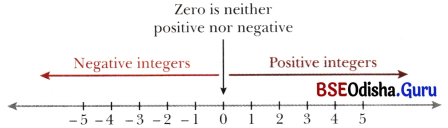
Positive numbers {+ 1, + 2, + 3, …} and negative numbers {…, – 3, – 2, – 1}, along with zero, are called integers.

If a number is written without a sign, it is generally understood to he a positive number.

Zero is neither a positive nor a negative number. We do not put a ‘+ ’ or ‘-‘ sign before it.

Every number has another number associated to it which when added to the number gives zero. This is called the additive inverse of the number.

For positive integers, a number with greater numerical value is greater.

For negative integers a number with greater numerical value is smaller.

A positive integer is always greater than a negative integer (e.g., 2 > – 3 and 2 > – 1).

+ and – sign placed side by side without any number in between, gives a – sign.
For example, + (- 6) = – 6 or – (+ 6) = – 6

The Other Side of Zero Class 6 Notes Maths Chapter 10

Addition and Subtraction of Integers

Addition of Integers Subtraction of integers
1. The sum of two positives is positive. e.g. 5 + 3 = 8 1. If a smaller positive is subtracted from a larger positive, the result is positive, e.g. 5-4 = 1
2. The sum of two negatives is negative. To add two negatives, add the numbers (without the signs), and then place a minus sign to obtain the result. e.g. (- 3) + (- 4) = – 7 2. If a larger positive is subtracted from a smaller positive, the result is negative. e.g. 4 – 5 = – 1
3. To add a positive number and a negative number, subtract the smaller number (without the sign) from the greater number (without the sign), and place the sign of the greater number to obtain the result, e.g. – 6 + 2 = – 4, 5 + (- 8) = – 3 and -2 + 6 = 4 3. Subtracting a negative number is the same as adding the corresponding positive number. e.g. 3 – (- 6) = 3 + 6
4. The sum of a number and its additive inverse is zero. e.g. 3 + (- 3) = 0 4. Subtracting a number from itself gives zero. e.g. 5 – 5 = 0 and – 5 – (- 5) = 0
5. The sum of any number and zero is the same number.
e.g. – 4 + 0 = – 4 and 4 + 0 = 4
Note: The number that is being subtracted can be replaced by its additive inverse and then added.
For example, The Other Side of Zero Class 6 Notes Maths Chapter 10-1
5. Subtracting zero from a number gives the same number e.g. – 3 – 0 = – 3 and 3-0 = 3. Subtracting a number from zero gives the number’s additive inverse e.g. 0 – (- 3) = 3.
Note: The number that is being added can be replaced by its additive inverse and then subtracted.
The Other Side of Zero Class 6 Notes Maths Chapter 10-2


Addition and Subtraction of Integers using Tokens

Addition with Tokens Subtraction with Tokens
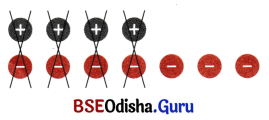
Combine tokens of the same color and cancel out equal numbers of opposite colored tokens (zero pairs).
For example, (+ 4) + (- 7) = – 3
The Other Side of Zero Class 6 Notes Maths Chapter 10-3
Subtract by taking away tokens of the required type.
Use zero pairs when there are not enough tokens to remove.
For example,
(a)  (- 6) – (- 5) = – 1
The Other Side of Zero Class 6 Notes Maths Chapter 10-4
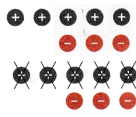
(b) (+ 2) – (+ 5) = – 3
From 2 positive tokens, we need to take out 5 positive tokens, which is not possible. So, we need to add 3 w w w w w zero pairs. After removing 5 positive tokens, we are left with 3 negative tokens.
The Other Side of Zero Class 6 Notes Maths Chapter 10-5

NOTE: A zero pair is one positive and one negative token that cancel each other to make zero, so the overall value remains unchanged during addition or subtraction.

Geographical Cross Sections

  1. Height above the sea level is represented by a positive number.
  2. Height below the sea level or depth is represented by a negative number.
  3. Temperature above 0°C is taken as positive and temperature below 0°C is taken as negative.
  4. In direction, if north is considered as positive, then south will be negative and vice versa.

In Vedic math, Rekhank means ‘a digit with a bar on its top’. In other words it is a negative number.

  1. For example: A bar on 7 is written as (7) and means – 7.
  2. This line (now the minus sign -) was used to show debt or loss, the opposite of gain.

The great Indian mathematician Brahmagupta was the first in the world to define:

  1. Positive numbers as Dhana (धन) — meaning wealth/gain;
  2. Negative numbers as Rina (ऋण) or Rekhank (रेखांक ) — meaning debt/loss

In profit and loss, if profit is taken as positive, then loss will be negative and vice versa.

Integers and their Applications
Positive numbers { + 1, +2, +3, …} and negative numbers {- 1, – 2, – 3, …} along with zero, are called integers.

The Other Side of Zero Class 6 Notes Maths Chapter 10

The integer – 6 is read as ‘negative 6’ or ‘minus 6’ while 4- 6 is read as ‘positive 6’ or simply ‘six’.
The Other Side of Zero Class 6 Notes Maths Chapter 10-6

Every given number has another number associated to it which when added to the given number gives zero. This is called the additive inverse of the number. For example, the additive inverse of +7 is – 7 because +7 + (- 7) = 0.

The absolute value of a number is its distance from zero on the number line. It is always non-negative. For example, |-4| = 4 and |3| = 3.
The Other Side of Zero Class 6 Notes Maths Chapter 10-7

Temperature above 0°C is taken as positive and temperature below 0°C is taken as negative.

In height, if the sea level is considered as the zero level, height above the sea level is taken as positive height and the depth or height below the sea level is taken as negative height.

The Other Side of Zero Class 6 Notes Maths Chapter 10

Comparison of Integers
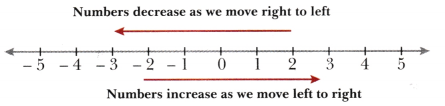
Integers are compared by their position on the number line. Numbers to the right are greater than those to the left.
For example, – 5 < -2 < 0 < +3 < +7.

For positive integers, a number with greater numerical value is greater while for negative integers a number with greater numerical value is smaller.
For example, – 8 < – 4 and + 6 < + 9.
The Other Side of Zero Class 6 Notes Maths Chapter 10-8

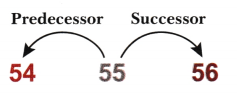
The predecessor of a number is the number that comes directly before it, while the successor is the number that comes directly after it.
The Other Side of Zero Class 6 Notes Maths Chapter 10-9

Class 6 Science Chapter 1 Question Answer Odia Medium ବିଜ୍ଞାନର ଚମତ୍କାର ଦୁନିଆ

Go through 6th Class Science Book Odia Medium Question Answer and Class 6 Science Chapter 1 Question Answer Odia Medium ବିଜ୍ଞାନର ଚମତ୍କାର ଦୁନିଆ to understand textbook questions more clearly.

6th Class Science Chapter 1 Question Answer Odia Medium

Class 6 Science Chapter 1 Odia Medium

ଶୂନ୍ୟସ୍ଥାନ ପୂରଣ କର ।

[ଦୃଷ୍ଟିକୋଣ, ବିଜ୍ଞାନ, ଖାଦ୍ୟ, ଆବିଷ୍କାର, ପୃଥ‌ିବୀ]
(a) ବିଶ୍ଵର ରହସ୍ୟକୁ ଉନ୍ମୋଚନ କରିବା ପାଇଁ ଚିନ୍ତା କରିବାର ଏକ ମାଧ୍ୟମ ହେଉଛି _______ ।
Answer:
ବିଜ୍ଞାନ

(b) ଆମେ ପାଉଥିବା ନୂତନ _______ ବିଜ୍ଞାନରେ ଯୋଡ଼ି ହୋଇଥାଏ ।
Answer:
ଆବିଷ୍କାର

(c) ନୂଆ ଆବିଷ୍କାର ଅନେକ ସମୟରେ ଆମର _______ କୁ ବଦଳାଇ ଦେଇଥାଏ ।
Answer:
ଦୃଷ୍ଟିକୋଣ

(d) _______ ହେଉଛି ଏକମାତ୍ର ଗ୍ରହ, ଯେଉଁଠାରେ ଜୀବସତ୍ତା ସମ୍ଭବ ।
Answer:
ପୃଥ‌ିବୀ

Class 6 Science Chapter 1 Question Answer Odia Medium ବିଜ୍ଞାନର ଚମତ୍କାର ଦୁନିଆ

(e) ଆମର ବୃଦ୍ଧି ପାଇଁ ________ ଆବଶ୍ୟକ ।
Answer:
ଖାଦ୍ୟ

ଶୂନ୍ୟସ୍ଥାନ ପୂରଣ କର ।
[ବୈଜ୍ଞାନିକ ପଦ୍ଧତି, ବରଫ, ଜଳ, ବାଷ୍ପ, ପର୍ଯ୍ୟବେକ୍ଷଣ]

(a) ଆମେ ବଞ୍ଚିବା ପାଇଁ ଖାଦ୍ୟ ସହିତ _______ ଆବଶ୍ୟକ କରୁ ।
Answer:
ଜଳ

(b) ପାଣି ଥଣ୍ଡା ହେଲେ ______ ରେ ପରିଣତ ହୁଏ ।
Answer:
ବରଫ

(c) ପାଣି ଗରମ ହୋଇ ଫୁଟିଲେ _______ ରେ ପରିଣତ ହୁଏ ।
Answer:
ବାଷ୍ପ

(d) ବୈ ଜ୍ଞାନି କ ମାନେ କୌଣସି ସମସ୍ୟାର ସମାଧାନ ପାଇଁ ______ ଅନୁସରଣ କରନ୍ତି ।
Answer:
ବୈଜ୍ଞାନିକ ପଦ୍ଧତି

(e) ଅନୁମାନକୁ _______ ମାଧ୍ୟମରେ ପରୀକ୍ଷା କରାଯାଏ ।
Answer:
ପର୍ଯ୍ୟବେକ୍ଷଣ

ଶୂନ୍ୟସ୍ଥାନ ପୂରଣ କର ।

[ବୈଜ୍ଞାନିକ ପଦ୍ଧତି, ବିଶ୍ଳେଷଣ, ଅନୁସନ୍ଧି ସ୍କୁ, ଆବିଷ୍କାର, ଦଳଗତ]

(a) ପର୍ଯ୍ୟବେକ୍ଷଣ ଫଳାଫଳକୁ ________ ମାଧ୍ୟମରେ ପରୀକ୍ଷା କରାଯାଏ ।
Answer:
ବିଶ୍ଳେଷଣ

Class 6 Science Chapter 1 Question Answer Odia Medium ବିଜ୍ଞାନର ଚମତ୍କାର ଦୁନିଆ

(b) ପ୍ରତ୍ୟେକ ଘଟଣା ସମ୍ବନ୍ଧରେ ଜାଣିବାକୁ ଚେଷ୍ଟା କରିବା ହିଁ _______ ର ଏକ ଉଦାହରଣ ଅଟେ ।
Answer:
ବୈଜ୍ଞାନିକ ପଦ୍ଧତି

(c) ବିଜ୍ଞାନକୁ ଭଲଭାବରେ ଶିଖୁବା ପାଇଁ. ______ ହେବା ଗୁରୁତ୍ଵପୂର୍ଣ୍ଣ ।
Answer:
ଅନୁସନ୍ଧିତ୍ସୁ

(d) ସମଗ୍ର ବିଶ୍ଵର ବୈଜ୍ଞାନିକମାନେ ପ୍ରାୟତଃ _____ ଭାବରେ ଏକତ୍ର କାର୍ଯ୍ୟ କରିଥାନ୍ତି ।
Answer:
ଦଳଗତ

(e) ସର୍ବଦା ଏକାଠି ହୋଇ _______ କରିବା ଅଧ୍ବକ ମଜାଦାର ହୋଇଥାଏ ।
Answer:
ଆବିଷ୍କାର

ଉକ୍ତିଟି ଭୁଲ ଥିଲେ (✗) ଓ ଠିକ୍ ଥିଲେ (✓) ଚିହ୍ନ ଦିଅ । (ପ୍ରଶ୍ନ ସହ ଉତ୍ତର)

(a) ବିଜ୍ଞାନ ହେଉଛି ଏକ ବିଶାଳ ଏବଂ ଅସରନ୍ତି ଗୋଲକ ଧନ୍ଦା ।
Answer:
(✓)

(b) ଆମ ଆବିଷ୍କାରର କୌଣସି ଅନ୍ତ ନାହିଁ ।
Answer:
(✓)

(c) ପୃଥ‌ିବୀରେ ବିଭିନ୍ନ ପ୍ରକାରର ଚମତ୍କାର ଜୀବ ଅଛନ୍ତି ।
Answer:
(✓)

Class 6 Science Chapter 1 Question Answer Odia Medium ବିଜ୍ଞାନର ଚମତ୍କାର ଦୁନିଆ

(d) ଆମର ବୃଦ୍ଧି ପାଇଁ ଖାଦ୍ୟ ଆବଶ୍ୟକ ।
Answer:
(✓)

(e) ଜଳ ଏକ ଅମୂଲ୍ୟ ସମ୍ପଦ ନୁହେଁ ।
Answer:
(✗)

ଉକ୍ତିଟି ଭୁଲ ଥିଲେ (✗) ଓ ଠିକ୍ ଥିଲେ (✓) ଚିହ୍ନ ଦିଅ । (ପ୍ରଶ୍ନ ସହ ଉତ୍ତର)

(a) ପାଣି ଥଣ୍ଡା ହେଲେ ବରଫରେ ପରି ଣତ ହୁଏ ।
Answer:
(✓)

(b) ପାଣି ଗରମ ହୋଇ ଫୁଟିଲେ ବାଷ୍ପରେ ପରିଣତ ହୁଏ ।
Answer:
(✓)

(c) ବିଜ୍ଞାନ ହେଉଛି ଏକ ପର୍ଯ୍ୟାୟକ୍ରମିକ ପ୍ରକ୍ରିୟାକୁ ଅନୁସରଣ କରିବା ।
Answer:
(✓)

(d) ପର୍ଯ୍ୟବେକ୍ଷଣଦ୍ଵାରା ମନରେ କୌତୂହଳ ସୃଷ୍ଟି ହୁଏ ।
Answer:
(✓)

(e) କ୍ଷୀର ଗରମ କରିବା ପାଇଁ ପ୍ରେସର କୁକର ବ୍ୟବହାର କରାଯାଏ ।
Answer:
(✗)

Class 6 Science Chapter 1 Question Answer Odia Medium ବିଜ୍ଞାନର ଚମତ୍କାର ଦୁନିଆ

ଉକ୍ତିଟି ଭୁଲ ଥିଲେ (✗) ଓ ଠିକ୍ ଥିଲେ (✓) ଚିହ୍ନ ଦିଅ । (ପ୍ରଶ୍ନ ସହ ଉତ୍ତର)

(a) ବିଜ୍ଞାନ ସମ୍ବନ୍ଧୀୟ କାର୍ଯ୍ୟ ସର୍ବଦା ବ୍ୟକ୍ତିଗତ ଭାବେ କରାଯାଏ ।
Answer:
(✗)

(b) ସମଗ୍ର ବିଶ୍ଵର ବୈଜ୍ଞାନିକମାନେ ପ୍ରାୟତଃ ଦଳଗତ ଭାବେ ଏକତ୍ର କାର୍ଯ୍ୟ କରନ୍ତି ।
Answer:
(✓)

(c) ବିଜ୍ଞାନ ହେଉଛି ମଜାଦାର ଅନୁସନ୍ଧାନ ର ଗନ୍ତାଘର ।
Answer:
(✓)

(d) ଜଣେ ଜ୍ଞାନୀ ବ୍ୟକ୍ତି ହେବାକୁ ହେଲେ ସର୍ବଦା କାହିଁକି ପ୍ରଶ୍ନ ପଚାରିବା ଜରୁରୀ ଅଟେ ।
Answer:
(✓)

(e) ବିଜ୍ଞାନ ପଢ଼ିବାଦ୍ଵାରା ଆମର ଦକ୍ଷତା ବିକଶିତ ହୋଇଥାଏ ।
Answer:
(✓)

Class 6 Science Chapter 1 Question Answer Odia Medium ବିଜ୍ଞାନର ଚମତ୍କାର ଦୁନିଆ

‘କ’ ସ୍ତମ୍ଭ ଓ ‘ଖ’ ସ୍ତମ୍ଭ ମଧ୍ଯରେ ସମ୍ପର୍କ ସ୍ଥାପନ କର ।

Question 1.

‘କ’ ସ୍ତମ୍ଭ ‘ଖ’ ସ୍ତମ୍ଭ
(a) ନୂତନ ଜିନିଷ ଆବିଷ୍କାର ମଜାଦାର ଅନୁସନ୍ଧାନର ଗନ୍ତାଘର
(b) ଅନୁସନ୍ଧିତ୍ସୁ ହେବା କାହିଁକି ପ୍ରଶ୍ନ ଅଧ୍ବକ କରିବା
(c) ବିଜ୍ଞାନ ସମ୍ବନ୍ଧୀୟ ବୈଜ୍ଞାନିକ ପଦ୍ଧତି ଅନୁସରଣ
(d) ବିଜ୍ଞାନ କାହିଁକି ଓ କିପରି ପ୍ରଶ୍ନ କରିବା
(e) ଜ୍ଞାନୀ ବ୍ୟକ୍ତି ଦଳଗତ ଭାବରେ

Answer:

‘କ’ ସ୍ତମ୍ଭ ‘ଖ’ ସ୍ତମ୍ଭ
(a) ନୂତନ ଜିନିଷ ଆବିଷ୍କାର ବୈଜ୍ଞାନିକ ପଦ୍ଧତି ଅନୁସରଣ
(b) ଅନୁସନ୍ଧିତ୍ସୁ ହେବା କାହିଁକି ଓ କିପରି ପ୍ରଶ୍ନ କରିବା
(c) ବିଜ୍ଞାନ ସମ୍ବନ୍ଧୀୟ ଦଳଗତ ଭାବରେ
(d) ବିଜ୍ଞାନ ମଜାଦାର ଅନୁସନ୍ଧାନର ଗନ୍ତାଘର
(e) ଜ୍ଞାନୀ ବ୍ୟକ୍ତି କାହିଁକି ପ୍ରଶ୍ନ ଅଧ୍ବକ କରିବା

Question 2.

‘କ’ ସ୍ତମ୍ଭ ‘ଖ’ ସ୍ତମ୍ଭ
(a) ବିଜ୍ଞାନ ବରଫ
(b) ପର୍ଯ୍ୟବେକ୍ଷଣ ବିଶାଳ ଏବଂ ଅସରନ୍ତି ଗୋଳକ ଧନ୍ଦା
(c) ଜଳ ମଞ୍ଜି ଗଛରେ ପରିଣତ ହେବା
(d) ପାଣି ଥଣ୍ଡା ହେବା ଅମୂଲ୍ୟ ସମ୍ପଦ
(e) ପାଣି ଗରମ ହେବା ବାଷ୍ପ

Answer:

‘କ’ ସ୍ତମ୍ଭ ‘ଖ’ ସ୍ତମ୍ଭ
(a) ବିଜ୍ଞାନ ବିଶାଳ ଏବଂ ଅସରନ୍ତି ଗୋଳକ ଧନ୍ଦା
(b) ପର୍ଯ୍ୟବେକ୍ଷଣ ମଞ୍ଜି ଗଛରେ ପରିଣତ ହେବା
(c) ଜଳ ଅମୂଲ୍ୟ ସମ୍ପଦ
(d) ପାଣି ଥଣ୍ଡା ହେବା ବରଫ
(e) ପାଣି ଗରମ ହେବା ବାଷ୍ପ

Class 6 Science Chapter 1 Question Answer Odia Medium ବିଜ୍ଞାନର ଚମତ୍କାର ଦୁନିଆ

Question 3.

‘କ’ ସ୍ତମ୍ଭ ‘ଖ’ ସ୍ତମ୍ଭ
(a) ପତ୍ର କୌତୂହଳ
(b) ମୋଟର ଗାଡ଼ି ଗଠନ
(c) ଚିନାବାଦାମ ମଞ୍ଜିରୁ ଚୋପା ପୃଥକ ଗତି
(d) କଲମ କାର୍ଯ୍ୟ ନ କରିବା ପ୍ରଣାଳୀ
(e) ପର୍ଯ୍ୟବେକ୍ଷଣ ବୈଜ୍ଞାନିକ ପଦ୍ଧତି

Answer:

‘କ’ ସ୍ତମ୍ଭ ‘ଖ’ ସ୍ତମ୍ଭ
(a) ପତ୍ର ଗଠନ
(b) ମୋଟର ଗାଡ଼ି ଗତି
(c) ଚିନାବାଦାମ ମଞ୍ଜିରୁ ଚୋପା ପୃଥକ ପ୍ରଣାଳୀ
(d) କଲମ କାର୍ଯ୍ୟ ନ କରିବା ବୈଜ୍ଞାନିକ ପଦ୍ଧତି
(e) ପର୍ଯ୍ୟବେକ୍ଷଣ କୌତୂହଳ

ପ୍ରଥମ ଯୋଡ଼ିର ସମ୍ପର୍କକୁ ଦେଖୁ ଦ୍ଵିତୀୟ ଯୋଡ଼ିରେ ଶୂନ୍ୟସ୍ଥାନ ପୂରଣ କର ।

(a) ମଞ୍ଜି : ଗଛ ହେବା :: ସଁବାଳୁଆ : __________
Answer:
ପ୍ରଜାପତିରେ ପରିଣତ ହେବା

(b) ପାଣି ଥଣ୍ଡା ହେବା : ବରଫ :: ପାଣି ଗରମ ହେବା : ______
Answer:
ବାଷ୍ପ

(c) ପର୍ଯ୍ୟବେକ୍ଷଣ : କୌତୂହଳ :: ଫଳାଫଳ : ________
Answer:
ବିଶ୍ଳେଷଣ

(d) ସମୁଦ୍ର : ଗଭୀରତା :: ମହାକାଶ : _______
Answer:
ବିଶାଳତା

Class 6 Science Chapter 1 Question Answer Odia Medium ବିଜ୍ଞାନର ଚମତ୍କାର ଦୁନିଆ

(e) ଉଦ୍ଭଦ : ଖାଦ୍ୟପ୍ରସ୍ତୁତ କରି ପାରନ୍ତି :: ପ୍ରାଣୀ : _______
Answer:
ଖାଦ୍ୟ ପ୍ରସ୍ତୁତ କରିପାରନ୍ତି ନାହିଁ

ସଂକ୍ଷିପ୍ତ ପ୍ରଶ୍ନୋତ୍ତର

Question 1.
କେଉଁ ପ୍ରକାର କାର୍ଯ୍ୟ କରିବାର ମାଧ୍ୟମ ବିଜ୍ଞାନ ଅଟେ ?
Answer:

  • ଆମେ ରହୁଥ‌ିବା ଦୁନିଆକୁ ବୁଝିବା
  • ବିଶ୍ଵର ରହସ୍ୟକୁ ଉନ୍ମୋଚନ କରିବା
  • ପର୍ଯ୍ୟବେକ୍ଷଣ କରିବା
  • ପରୀକ୍ଷା ନିରୀକ୍ଷା କରିବା

Question 2.
କେଉଁ କାରଣରୁ ଆମେ ଜିଜ୍ଞାସୁ ହେବା ଆବଶ୍ୟକ ଅଟେ ?
Answer:

  • ବିଭିନ୍ନ ପ୍ରକାର ପ୍ରଶ୍ନ ପଚାରି, ଦୁନିଆକୁ ଅନୁସନ୍ଧାନ କରିବା ।
  • ବିଭିନ୍ନ ଘଟଣା ଘଟିବାର ପ୍ରକ୍ରିୟା ବିଷୟରେ ବୁଝିବାକୁ ଚେଷ୍ଟା କରିବା ।

Question 3.
କେଉଁ ଘଟଣାକୁ ଅଧ୍ୟୟନ କଲେ ନୂଆ ଓ ରୋମାଞ୍ଚକର ତଥ୍ୟ ଆବିଷ୍କୃତ ହୋଇଥାଏ ?
Answer:

  • ଛୋଟ ଛୋଟ ବାଲିଦାନାରୁ ବିଶାଳ ପର୍ବତ କିପରି ସୃଷ୍ଟି ହୁଏ ।
  • ଘାସରୁ ବିଶାଳ ଜଙ୍ଗଲ କିପରି ସୃଷ୍ଟି ହୁଏ ।

Class 6 Science Chapter 1 Question Answer Odia Medium ବିଜ୍ଞାନର ଚମତ୍କାର ଦୁନିଆ

Question 4.
କେଉଁ ପ୍ରକାର ଭାବନା ଆମକୁ ଆଶ୍ଚର୍ଯ୍ୟ କରିଥାଏ ?
Answer:

  • ରାତିରେ ଆକାଶରେ ତାରାଗୁଡ଼ିକ କାହିଁକି ଚକ୍ରମକ୍ କରନ୍ତି ?
  • ଫୁଲ କେତେବେଳେ ଫୁଟିବ ବୋଲି କିପରି ଜାଣି ଥାଏ ।

Question 5.
‘‘ବିଜ୍ଞାନ ହେଉଛି ଏକ ବିଶାଳ ଏବଂ ଅସରନ୍ତି ଗୋଲକ ଧନ୍ଦା’’ କାହିଁକି ?
Answer:

  1. ଆମେ କରୁଥିବା ପ୍ରତ୍ୟେକ ନୂତନ ଆବିଷ୍କାର ଏଥ‌ିରେ ଯୋଡ଼ି ହୁଏ ।
  2. ଆମ ଆବିଷ୍କାରର କୌଣସି ଅନ୍ତ ନାହିଁ ।
  3. ନୂତନ ଆବିଷ୍କାର ଆମର ଦୃଷ୍ଟିକୋଣକୁ ବଦଳାଇ ଦେଇଥାଏ ।

Question 6.
ଆମେ ଅଧିକରୁ ଅଧିକ ନୂଆ କଥା ଜାଣିଲେ କ’ଣ ହେବ ?
Answer:

  1. ଅନେକ କୌତୂହଳପୂର୍ଣ୍ଣ ତଥ୍ୟ ପାଇବା ।
  2. କିଛି ଚିନ୍ତନମୂଳକ ପରୀକ୍ଷଣ କରିପାରିବା ।
  3. ଆମେ ଅନୁଭବ କରିପାରିବା ଯେ ଏହିସବୁ ଧାରଣା ପରସ୍ପର ସହ ଜଡ଼ିତ ।

Class 6 Science Chapter 1 Question Answer Odia Medium ବିଜ୍ଞାନର ଚମତ୍କାର ଦୁନିଆ

Question 7.
କେଉଁ କାରଣରୁ ଆମ ପୃଥ‌ିବୀକୁ ସୁରକ୍ଷିତ ରଖୁବା ଉଚିତ ଅଟେ ?
Answer:

  • ଏହା ହେଉଛି ଏକମାତ୍ର ଗ୍ରହ ଯେଉଁଠାରେ ଜୀବସଭା ସମ୍ଭବ ।
  • ଏହି ଗ୍ରହରେ ଚମତ୍କାର ଜୀବ ତଥା ପ୍ରାଣୀ ଓ ଉଭିଦ ଅଛନ୍ତି ।

Question 8.
ଯେ କୌଣସି ୨ଟି ପର୍ଯ୍ୟବେକ୍ଷଣର ଉଦାହରଣ ଦର୍ଶାଅ ।
Answer:

  • ମଞ୍ଜି ଗଛରେ ପରିଣତ ହେବା ।
  • ଏକ ସଂବାଳୁଆ ସୁନ୍ଦର ପ୍ରଜାପତିରେ ପରିଣତ ହେବା ।

Question 9.
ଆମର ବୃଦ୍ଧି ପାଇଁ କ’ଣ ନିହାତି ଆବଶ୍ୟକ ଅଟେ ?
Answer:

  • ଆମର ବୃଦ୍ଧି ପାଇଁ ଖାଦ୍ୟ ଆବଶ୍ୟକ ।
  • ଆମେ ବଞ୍ଚିବା ପାଇଁ ଖାଦ୍ୟ ସହିତ ଜଳ ମଧ୍ୟ ଆବଶ୍ୟକ ଅଟେ ।

Question 10.
କେଉଁ କାର୍ଯ୍ୟଗୁଡ଼ିକ ଅନୁସନ୍ଧିସ୍ମ ଭାବନାକୁ ଜାଗ୍ରତ କରାଇଥାଏ ?
Answer:

  • ବିଭିନ୍ନ ପ୍ରକାର ପତ୍ରର ଗଠନ ।
  • ଜିନିଷଗୁଡ଼ିକ କିପରି ଗତି କରନ୍ତି ।

  • ଚିନାବାଦାମ ମଞ୍ଜିରୁ ଚୋପାକୁ କିପରି ଅଲଗା କରାଯାଏ ।
Class 6 Science Chapter 1 Question Answer Odia Medium ବିଜ୍ଞାନର ଚମତ୍କାର ଦୁନିଆ

Question 11.
ତୁମ କଲମ ଚାଲିବା ବନ୍ଦ ହୋଇଗଲେ ତୁମେ କ’ଣ କରିବ ?
Answer:

  • ଆମେ ଅନୁମାନ କରିବୁ ଯେ, ବୋଧହୁଏ କାଳି ଶେଷ ହୋଇଯାଇଛି ।
  • ବୋଧହୁଏ କାଳି ଶୁଖୁ ଯାଇଥବ ବା କଲମର ମୁନ ଖସି ପଡ଼ିଥ‌ିବ ।
Question 12.
ଜାଣିବାକୁ ଚେଷ୍ଟା କରିବା ହିଁ ବୈଜ୍ଞାନିକ ପଦ୍ଧତିର ଉଦାହରଣ କିପରି ?
‍Answer:

  • ଆମ କଲମଟି କାହିଁକି ଲେଖୁ ଲେଖୁ ବନ୍ଦ ହୋଇଗଲା ।
  • ବସ୍ତୁଟିର ଉପରୁ ତଳକୁ କାହିଁକି ଖସିପଡ଼ିଲା ।
  • ଚାଲୁଥିବା ଘଣ୍ଟାଟି କାହିଁକି ବନ୍ଦ ହୋଇଗଲା ।
  • ଜଳୁଥିବ। ଗ୍ୟାସ୍ ଚୁଲ। କାହିଁକି ବନ୍ଦ ହୋଇଗଲା ।

Question 13.
ବିଜ୍ଞାନ ଆମକୁ ପ୍ରଶ୍ନଗୁଡ଼ିକର ଉତ୍ତର ଖୋଜିବାରେ କିପରି ସାହାଯ୍ୟ କରେ ?
Answer:

  1. କୌଣସି ସମସ୍ୟାର ସମାଧାନ ହେଉଛି ଏକ ପର୍ଯ୍ୟାୟକ୍ରମିକ ପ୍ରକ୍ରିୟା ।
  2. ପ୍ରଥମେ ପର୍ଯ୍ୟବେକ୍ଷଣ କରାଯାଇ କେତେକ ପ୍ରଶ୍ନ ପ୍ରସ୍ତୁତ କରାଯାଏ ।
  3. ଦ୍ଵିତୀୟରେ ପ୍ରଶ୍ନଗୁଡ଼ିକରେ ସମ୍ଭାବ୍ୟ ଉତ୍ତର ଅନୁମାନ କରାଯାଏ ।
  4. ତୃତୀୟରେ ଅନୁମାନକୁ ଅଧିକ ପର୍ଯ୍ୟବେକ୍ଷଣ ମାଧ୍ୟମରେ ପରୀକ୍ଷା କରାଯାଏ ।
  5. ଶେଷରେ ଫଳାଫଳକୁ ବିଶ୍ଳେଷଣ କରାଯାଇ ସିଦ୍ଧାନ୍ତରେ ଉପନୀତ ହେବାକୁ ପଡ଼େ ।

Class 6 Science Chapter 1 Question Answer Odia Medium ବିଜ୍ଞାନର ଚମତ୍କାର ଦୁନିଆ

Question 14.
ବୈଜ୍ଞାନିକ ପଦ୍ଧତି ଅନୁସରଣର 3 ଟି ଉଦାହରଣ ପ୍ରଦାନ କର ।
Answer:

  • ରୋଷେଇ କରୁଥିବା ବ୍ୟକ୍ତି ଭାବୁଥିବେ ଯେ, ପ୍ରେସର କୁକରରୁ ଡାଲି କାହିଁକି ବାହାରିଲା ?
  • ସାଇକେଲ୍ ମରାମତି କରୁଥ‌ିବା ବ୍ୟକ୍ତି ଭାବୁଥ‌ିବେ ଯେ, ଟ୍ୟୁବ୍‌ର କେଉଁ ସ୍ଥାନରେ ଛିଦ୍ର ହେଲା ?
  • ଇଲେକ୍‌ଟ୍ରିସିଆନ ଜାଣିବାକୁ ଚେଷ୍ଟା କରୁଥିବେ ଯେ, ବଲ୍‌ବ କାହିଁକି ଜଳୁନାହିଁ ?

Question 15.
ଦୈନନ୍ଦିନ ଜୀବନର କେତେକ ପରିସ୍ଥିତି ବର୍ଣ୍ଣନା କର ଯେଉଁଠି ତୁମେ ଅନୁଭବ କରିଥୁବ ଯେ, କେହି ଜଣେ ବୈଜ୍ଞାନିକ ପଦ୍ଧତି ଅନୁସରଣ କରୁଛନ୍ତି ?
Answer:
ଉଦାହରଣ – I : ବଗିଚାରେ ଥିବା ଗଛଗୁଡ଼ିକ କାହିଁକି ବାରମ୍ବାର କୀଟଦ୍ଵାରା ଆକ୍ରାନ୍ତ ହେଉଅଛି ?
ଉଦାହରଣ – II : କେଉଁ କାରଣରୁ ଗୃହର ଇଲେକ୍‌ଟ୍ରିକ୍ ବିଲ୍ ଅଧ୍ଵ କ ପରି ମାଣରେ ଆସୁଅଛି ?
ଉଦାହରଣ – III : ଘର ଭିତରକୁ ମୁଷା, ଅସରପା ଓ ଝିଟିପିଟି ଇତ୍ୟାଦି ଜୀବ କାହିଁକି ଆସୁଛନ୍ତି ?
ଉଦାହରଣ – IV : ପାନୀୟ ଜଳର ସ୍ଵାଦରେ କାହିଁକି ପରିବର୍ତ୍ତନ ହେଉଅଛି ?
ଉଦାହର ଣ – V : ଜ୍ଵର ହେଲେ ତାପମାତ୍ରାରେ ପରିବର୍ତ୍ତନ କାହିଁକି ହେଉଅଛି ?

Question 16.
କେଉଁ କାରଣରୁ ବିଜ୍ଞାନ ମଜାଦାର ଅନୁସନ୍ଧାନର ଗନ୍ତାଘର ଅଟେ ?
Answer:

  • ବୈଜ୍ଞାନିକ ଯାତ୍ରାକୁ ଉପଭୋଗ କରିହେବ ।
  • ଅନୁସନ୍ଧାନଗୁଡ଼ିକୁ ଜାରି ରଖୁହେବ ।
  • ବିଶ୍ଵର ଆଶ୍ଚର୍ଯ୍ୟଜନକ ରହସ୍ୟ ସମ୍ବନ୍ଧରେ ଚିନ୍ତା କରିହେବ ।
  • ପ୍ରଶ୍ନ ପଚାରିବା ଜାରି ରଖୁହେବ ।
  • ଦଳଗତ ଭାବେ ଏକତ୍ର କାର୍ଯ୍ୟ କରିହେବ
  • ଚତୁଃପାର୍ଶ୍ଵ କୁ ତନ୍ନ ତନ୍ନ କରି ଅନୁଧ୍ୟାନ କରିହେବ ।
  • ନୂତନ ତଥ୍ୟ ଆବିଷ୍କୃତ ହୋଇପାରିବ ।

ଦୀର୍ଘ ପ୍ରଶ୍ନୋତ୍ତର

Question 1.
ପାଠ୍ୟପୁସ୍ତକର ନାମ ଜିଜ୍ଞାସା ହେବାର ଯଥାର୍ଥତା କ’ଣ ?
Answer:
(a) ଜୀବନଧାରଣର ମାନବୃଦ୍ଧି ପାଇଁ ବିଜ୍ଞାନ ଏକାନ୍ତ ଅପରିହାର୍ଯ୍ୟ । ଶିକ୍ଷାର୍ଥୀମାନଙ୍କ ଜ୍ଞାନକୁ କେବଳ ପାଠ୍ୟପୁସ୍ତକ ମଧ୍ୟରେ ସୀମିତ ନ ରଖ୍ ସେମାନଙ୍କୁ ବାହ୍ୟଜଗତ ସହ ସଂଯୁକ୍ତ କରିବା ଏହି ପାଠ୍ୟକ୍ରମର ଉଦ୍ଦେଶ୍ୟ ଅଟେ ।

(b) ଶିକ୍ଷାର୍ଥୀମାନଙ୍କ ମଧ୍ୟରେ ବିଭିନ୍ନ ବିଷୟକୁ ନେଇ କୌତୂହଳ ତଥା ବୈ ଜ୍ଞାନି କ ଚିନ୍ତାଧାରାର ଉଦ୍ରେକ କରିବାରେ ଏହି ପାଠ୍ୟପୁସ୍ତକ ସହାୟକ ହୋଇପାରିବ ।

(c) ଏହି ପାଠ୍ୟକ୍ରମ ବିଭିନ୍ନ ପ୍ରକାର କାର୍ଯ୍ୟକଳାପ ମାଧ୍ୟମରେ ବିଦ୍ୟାର୍ଥୀମାନଙ୍କର ବୈଜ୍ଞାନିକ ମନୋବୃତ୍ତି ଓ ସୃଜନ ଶୀଳତା ବୃଦ୍ଧି କରି ସେମାନଙ୍କ ମନରେ ସୃଷ୍ଟି ହେଉଥ‌ିବ । ସନ୍ଦେହମୋଚନ କରାଯାଇପାରିବ ।

(d) ବିଦ୍ୟାର୍ଥୀମାନେ ସମସ୍ୟା ସମାଧାନ ନିମନ୍ତେ ଉଦ୍ଦିଷ୍ଟ ସୋପାନ ସମ୍ବନ୍ଧରେ ଅବଗତ ହେବେ ଏବଂ ପ୍ରତ୍ୟେକ ଘଟଣା ସହିତ ଜଡ଼ିତ ବିଜ୍ଞାନ ସମ୍ମତ କାରଣଗୁଡ଼ିକୁ ଚିନ୍ତନ ମାଧ୍ୟମରେ ଅନୁ ସନ୍ଧା। ନ କ ରି ବ।ରେ ସ ଫ ଳ ହୋଇପାରିବେ ।

(e) ବିଜ୍ଞାନ ମଜାଦାର ଅନୁସନ୍ଧାନର ଗନ୍ତାଘର ହୋଇଥିବାରୁ ଅଧିକରୁ ଅଧ‌ିକ କାହିଁକି ଓ କିପରି ପ୍ରଶ୍ନ ପଚାରିବାଦ୍ଵାରା ବିଦ୍ୟାର୍ଥୀମାନଙ୍କର ଚିନ୍ତା ପ୍ରରୋଚିତ ପ୍ରଶ୍ନ ପଚାରିବା ଏବଂ ଶିକ୍ଷକମାନଙ୍କୁ ମାର୍ଗ ଦ ର୍ଶ ନ ଦେବାରେ ସ ହ। ୟ କ ହୋଇପାରିବ ।

Class 6 Science Chapter 1 Question Answer Odia Medium ବିଜ୍ଞାନର ଚମତ୍କାର ଦୁନିଆ

Question 2.
ଜିଜ୍ଞାସା ଅନୁମୋଦିତ ସମସ୍ୟାର ସମାଧାନ ପାଇଁ କେଉଁ କେଉଁ ସୋପାନଗୁଡ଼ିକୁ ଅବଲମ୍ବନ କରିବାକୁ ପଡ଼ିଥାଏ ?
Answer:
(a) ଉପକ୍ର ମ : ସମସ୍ୟା ସମ୍ବନ୍ଧରେ ଅବଗତ ହେବା ।
(b) ଉଦ୍ଦେଶ୍ୟ : ସମାସ୍ୟାର ସମାଧାନ ହେଲେ କେଉଁ ଉଦ୍ଦେଶ୍ୟ ସାଧ୍ୟ ହେବ ।
(c) ହାଇପୋଥେସିସ୍ : କାହିଁକି ଏହି ସମସ୍ୟାଟି ବଛାଗଲା ।
(d) ପ୍ରାସଙ୍ଗିକତା । : ଏହି ସମସ୍ୟା କାହିଁ କି ଗୁରୁତ୍ଵପୂର୍ଣ୍ଣ ।
(e) ସମୀକ୍ଷା : ସମସ୍ୟା ସମାଧାନରେ ଅନ୍ୟମାନଙ୍କ ସହାୟତା ।
(f) ତଥ୍ୟ ସଂଗ୍ରହ ପଦ୍ଧତି : ପ୍ରତ୍ୟକ୍ଷ ବା ପରୋକ୍ଷ ବା ପର୍ଯ୍ୟବେକ୍ଷଣ ।
(g) ତଥ୍ୟ ବିଶ୍ଳେଷଣ : ସାକ୍ଷାତକାର ବା ସର୍ବେକ୍ଷଣ ତଥ୍ୟର ତର୍ଜମା ।
(h) ଉପସଂହାର : ଆମେ କେଉଁ ସିଦ୍ଧାନ୍ତରେ ଉପନୀତ ହେଲୁ ।

The Ever-Evolving World of Science Class 7 Question Answer Science Chapter 1

Go through BSE Odisha Class 7 Science Solutions and Class 7 Science Chapter 1 The Ever-Evolving World of Science Question Answer to understand textbook questions more clearly.

Class 7 Science Curiosity Chapter 1 Question Answer

Science Curiosity Class 7 Chapter 1 Question Answer

The Ever-Evolving World of Science Class 7 Questions and Answers

Very Short Answer Type Questions

Question 1.
Ramesh was wearing a white shirt with a turmeric stain. Explain the scientific inquiry that may result in this situation.
Answer:
This situation may push us to ask why some substances leave permanent stains while others do not. It also encourages us to explore the properties of materials and how different types of substances interact with each other.

Question 2.
On a hot summer day, Anamika noticed that water disappeared from a bucket left outside. Later, she observed that clouds formed and it rained. Mention the primary natural source of energy that is responsible for driving this water cycle. Explain its importance.
Answer:
The primary source of energy for the water cycle is the heat generated by the Sun. It is important because it drives continuous movement of water through evaporation, condensation, and precipitation, helping maintain life and environmental balance on the Earth.

The Ever-Evolving World of Science Class 7 Question Answer Science Chapter 1

Question 3.
Mention one responsibility that comes with scientific progress. Mention its importance.
Answer:
Making informed and ethical choices is an unavoidable responsibility that comes with scientific progress. This is important because science can greatly impact society and the environment. Using knowledge responsibly ensures that discoveries are used for the well-being of people and do not harm nature or future generations.

Question 4.
Answer the following questions.
(i) In this chapter, it has been emphasised that science is a process, not just a subject. Explain.
(ii) While eating a fruit salad, Ratika observed that most of the fruits tasted sour. What kind of scientific thinking is developed in this situation?
Answer:
(i) Science is described as a process because it encourages questions, curiosity and logical thinking. Instead of rote learning, it promotes learning through observations and experimentation.
(ii) Based on the taste of a substance, one might think about the type of substance and its properties, i.e., they can be acidic, basic, or neutral.
Note: Never taste unknown substances, as they can be dangerous.

Short Answer Type Questions

Question 1.
‘Scientific observations help us understand everyday phenomenon’. Justify this statement by giving two examples from your everyday life.
Answer:
Scientific observations help us understand how and why things happen around us. By carefully observing changes, we can identify their patterns and causes. Some of the examples that can be observed in our everyday life include:

  • Glowing of an electric bulb
  • Ripening of fruits [Any other]

The Ever-Evolving World of Science Class 7 Question Answer Science Chapter 1

Question 2.
Why is the understanding of various types of changes taking place around us important in science?
Answer:
Understanding the types of changes taking place around us helps us know how substances behave under different conditions, which is useful in various daily-life applications. Changes like melting of ice, boiling of water, and folding of paper can be reversed, whereas changes like cooking food, cutting a piece of paper, and breaking glass cannot be reversed. This knowledge is essential and can be used in areas like cooking, manufacturing, and chemical processing, where choosing the right kind of change is important.

Long Answer Type Questions

Question 1.
“Science is not only about learning facts – it is also about how we think and solve problems.” Explain this statement with two examples from your daily life.
Answer:
Science is more than just remembering facts. It involves thinking logically, asking questions, observing carefully, and solving problems based on evidences. It shapes the way we understand and interact with the world around us.
For example:

  • When someone wonders why lemon juice tastes sour, they are using observation and curiosity. Through experimentation, they may discover that lemon contains acid, showing how science helps explain the properties of substances.
  • When we feel a metal spoon become hot after placing it in tea, we learn through experience that metals conduct heat. This leads to a deeper understanding of heat transfer and properties of materials.

Symmetry Class 6 Notes Maths Chapter 9

Easy-to-read Ganita Prakash Class 6 Notes and Chapter 9 Symmetry Class 6 Notes save valuable study time during exam season.

Class 6 Maths Chapter 9 Symmetry Notes

Class 6 Symmetry Notes

Symmetry
Symmetry means a shape or an object looks identical after being transformed by a specific operation, such as being divided by a line or rotated.

A figure has reflection symmetry if it can be folded (or divided) along a line and both halves match exactly.

A figure has rotational symmetry if it looks the same after being turned around a centre by a certain angle.

Reflection Symmetry
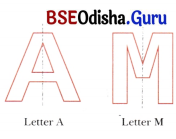
An object or a shape displays reflection symmetry, if on drawing a (vertical, horizontal or inclined) line through the middle of the object or the shape, the portions on either side of the line are identical.

Reflection symmetry is also called mirror symmetry or mirror-image symmetry because one half of the shape looks exactly like the other half when reflected across a line, just like an image seen in a mirror.

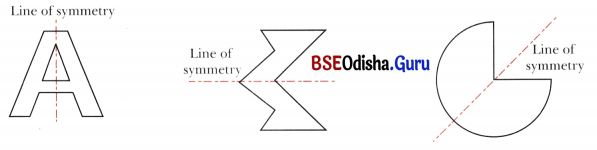
A line that divides a figure into two equal parts, such that both parts completely overlap when folded along that line, is called a line of symmetry. The two identical parts are called mirror halves.

Symmetry Class 6 Notes Maths Chapter 9

A line of symmetry may be vertical, horizontal, or even slanting (inclined).
Symmetry Class 6 Notes Maths Chapter 9-1

Lines of Symmetry of some Geometric Figures

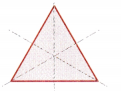
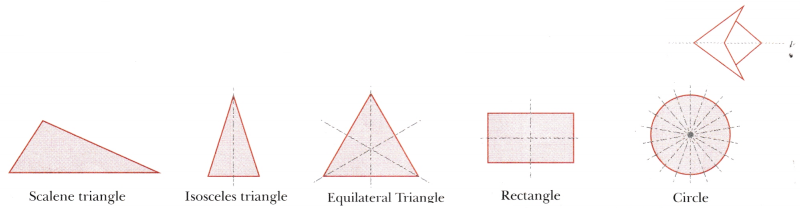
Equilateral triangle Symmetry Class 6 Notes Maths Chapter 9-2 3 lines of symmetry
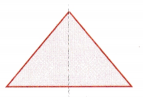
Isosceles triangle Symmetry Class 6 Notes Maths Chapter 9-3 1 line of symmetry
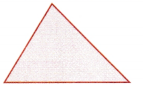
Scalene triangle Symmetry Class 6 Notes Maths Chapter 9-4 0 line of symmetry
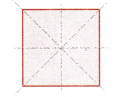
Square Symmetry Class 6 Notes Maths Chapter 9-5 4 lines of symmetry
Rectangle Symmetry Class 6 Notes Maths Chapter 9-6 2 lines of symmetry (Does not have its diagonals as lines of symmetry)
Kite Symmetry Class 6 Notes Maths Chapter 9-7 1 line of symmetry
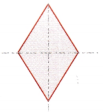
Rhombus Symmetry Class 6 Notes Maths Chapter 9-8 2 lines of symmetry
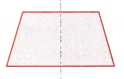
Isosceles Trapezium Symmetry Class 6 Notes Maths Chapter 9-9 1 line of symmetry
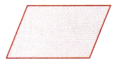
Parallelogram Symmetry Class 6 Notes Maths Chapter 9-10 No line of symmetry
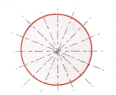
Circle Symmetry Class 6 Notes Maths Chapter 9-11 Infinite lines of symmetry

Rotational Symmetry
Rotational symmetry occurs when a figure appears unchanged after being rotated around a fixed point (the centre of rotation) by specific angles.

The fixed point around which the rotation of figure occurs is called the centre of rotation.

An angle of rotational symmetry or angle of symmetry is the angle at which a figure looks the same after rotation.

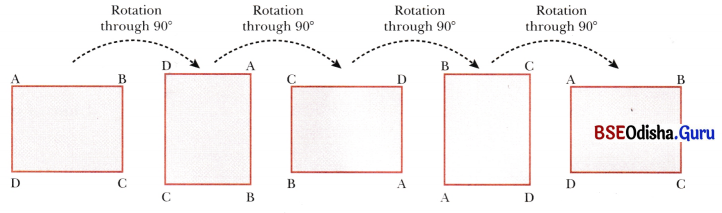
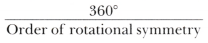
The number of times a figure fits into itself in one full turn is called the order of rotational symmetry.

Order of rotational symmetry = Symmetry Class 6 Notes Maths Chapter 9-12

A square has rotational symmetry at 90°, 180°, 270° and 360°. The order of rotational symmetry is 4 (number of times it matches its original shape in one full rotation).
Symmetry Class 6 Notes Maths Chapter 9-13

Symmetry Class 6 Notes Maths Chapter 9

A rectangle has rotational symmetry at 180° and 360°. The order of rotational symmetry is 2 (number of times it matches its original shape in one full rotation).
Symmetry Class 6 Notes Maths Chapter 9-14

A figure that only looks the same after 360° rotation has no rotational symmetry (order = 1).
If the smallest angle of symmetry is a natural number (in degrees), it is a factor of 360.
The angles of symmetry are always multiples of the smallest angle of symmetry.

Figures with radial arms can be designed to have a specific number of angles of symmetry by ensuring equal spacing between arms:

  1. For 4 arms: angles are 90°, 180°, 270° and 360°.
  2. For 3 arms: angles are 120°, 240° and 360°.
  3. For 2 arms: angles are 180° and 360°.
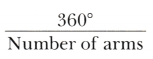
    Angle between two consecutive arms = Symmetry Class 6 Notes Maths Chapter 9-15

A circle has infinite angles of rotational symmetry, i.e. any angle of rotation maps it onto itself.

Line of Symmetry
A line that cuts plane figure into two parts that exactly overlap when folded along that line is called a line of symmetry or axis of symmetry of the figure.
Symmetry Class 6 Notes Maths Chapter 9-16
Note: A plane figure through which no axis of symmetry can be drawn is said to be asymmetric.

Reflection Symmetry
Symmetry Class 6 Notes Maths Chapter 9-17
An object or a shape displays reflection symmetry, if on drawing a line (vertical, horizontal or inclined) through the middle of the object or the shape, the portions on either side of the line are identical.

Reflection symmetry is also called mirror symmetry or mirror-image symmetry because one half of the shape looks exactly like the other half when reflected across a line, just like an image seen in a mirror.

Rotational Symmetry
The process of turning an object around a fixed point is called rotation. The fixed point is called the centre of rotation.

Objects or figures which can be rotated about a point by less than a complete turn to obtain the exact same shape are said to have rotational symmetry.

The angle through which the figure must be rotated to get the original figure is called the angle of rotation or the angle of symmetry.

Symmetry Class 6 Notes Maths Chapter 9

The number of times a figure fits into itself in one full turn is called the order of rotational symmetry.
(a) Order of ratational symmetry = Symmetry Class 6 Notes Maths Chapter 9-18
(b) Smallest angle of ratational symmetry = Symmetry Class 6 Notes Maths Chapter 9-19

For example, a rectangle has angle of rotational symmetry at 180° and 360°. The order of rotational symmetry is 2 (number of times it matches its original shape in one full rotation).
Symmetry Class 6 Notes Maths Chapter 9-20

Playing with Constructions Class 6 Notes Maths Chapter 8

Easy-to-read Ganita Prakash Class 6 Notes and Chapter 8 Playing with Constructions Class 6 Notes save valuable study time during exam season.

Class 6 Maths Chapter 8 Playing with Constructions Notes

Class 6 Playing with Constructions Notes

Circle
A circle is a set of all points in a plane that are at a constant distance from a fixed point. The fixed point is known as the centre of the circle, and the constant distance is known as the radius of the circle.
Here, O is the centre and OA = OB = r is the radius.
Playing with Constructions Class 6 Notes Maths Chapter 8-1

A line segment passing through the centre of a circle, and having its end points on the circle, is known as a diameter of the circle.
Here, PQ (diameter) = PO + OQ = r + r = 2r
Therefore the diameter of a circle with a radius ‘r’ is 2r.
Playing with Constructions Class 6 Notes Maths Chapter 8-2

A compass is a tool used to draw circles or arcs. It has two legs — one leg has a sharp point that is placed on the centre of the circle, and the other leg holds a pencil that is used to draw the circle or the arc.

Construction of Circle
Playing with Constructions Class 6 Notes Maths Chapter 8-3
Step 1: Adjust the compass to the required radius using a ruler.
Step 2: Place the pointed leg firmly on the paper to mark the circle’s centre
Step 3: Rotate the compass to draw the circle without lifting the pencil.

Construction of Squares and Rectangles
Construction of a square of side length 5 cm:
Playing with Constructions Class 6 Notes Maths Chapter 8-4
Step 1: Draw a line segment PQ = 5 cm.
Step 2: Draw a perpendicular to PQ through P.
Step 3: Using a ruler, mark S on the perpendicular such that PS = 5 cm.
Step 4: Draw a perpendicular to PQ through Q and mark R on the perpendicular such that QR = 5 cm.
Step 5: Join R and S to get square PQRS of side length 5 cm.

Playing with Constructions Class 6 Notes Maths Chapter 8

Construction of a rectangle of side lengths 6 cm and 4 cm:
Playing with Constructions Class 6 Notes Maths Chapter 8-5
Step 1: Draw a line segment PQ = 6 cm.
Step 2: Draw a perpendicular to PQ through P.
Step 3: Using a ruler, mark S on the perpendicular such that PS = 4 cm.
Step 4: Draw a perpendicular to PQ through Q and mark R on the perpendicular such that QR = 4 cm.
Step 5: Join R and S to get rectangle PQRS of side lengths 6 cm and 4 cm.

Construction of a Rectangle in which one of the Diagonals Divides the Opposite Angles into Two Smaller Angles
Playing with Constructions Class 6 Notes Maths Chapter 8-6

Let’s construct a rectangle in which one of the diagonals divides the opposite angles into 50° and 40°. Steps of construction are as follows:
Step 1: Draw AB of any length.
Step 2: Draw a perpendicular to AB through B.
Step 3: Draw a ray making an angle 50° with AB through A. You will get point C as point of intersection of the ray drawn in this step and perpendicular drawn in step 2.
Step 4: Draw a perpendicular to AB through A.
Step 5: Draw a perpendicular to BC through C. (Because all the angles of a rectangle are equal to 90°). Join CD to get the required rectangle ABCD.

Construction of a Rectangle in which a Side and a Diagonal are Given
Playing with Constructions Class 6 Notes Maths Chapter 8-7
Let’s construct a rectangle where one of its sides is 4 cm and the length of a diagonal is 5 cm.
Steps of construction are as follows:
Step 1: Draw a line segment AB = 4 cm.
Step 2: Draw a perpendicular to AB through B.
Step 3: TakeT as centre and mark an arc of radius 5 cm on perpendicular to AB through B. The arc and perpendicular intersect at point C.
Step 4: Draw perpendiculars to AB and BC passing through A and C respectively. Then, the point where these perpendiculars intersect is the point D. ABCD is the required rectangle.

Playing with Constructions Class 6 Notes Maths Chapter 8

Points Equidistant from Two Given Points
Playing with Constructions Class 6 Notes Maths Chapter 8-8
Suppose A and B are two given points. Our task is to find points that are 5 cm away from both A and B. Steps of construction are as follows:
Step 1: Take A as centre and mark two arcs of radius 5 cm such that one arc is above AB and another is A below AB.
Step 2: Take B as centre and mark two arcs of radius 5 cm such that one arc is above AB and another is below AB.
Let P and Q, be the points of intersection of arcs above and below /IB respectively. Then, AP = BP = 5 cm and AQ = BQ = 5 cm.

If you join the points P and Q with a straight line, then that line is called the perpendicular bisector of the line segment AB.
Playing with Constructions Class 6 Notes Maths Chapter 8-9

The perpendicular bisector cuts the line segment AB in two equal parts such that AM = BM.

All the points on line PQ are equidistant from points A and B. Therefore, there are infinite number of points which are equidistant from points A and B.

Construction of Circle
Steps:
Adjust the compass to the required radius using a ruler.
Playing with Constructions Class 6 Notes Maths Chapter 8-10
Place the pointed leg firmly on the paper to mark the circle’s centre.
Rotate the compass to draw the circle without lifting the pencil.
Playing with Constructions Class 6 Notes Maths Chapter 8-11

Playing with Constructions Class 6 Notes Maths Chapter 8

Construction of Squares and Rectangles
In a rectangle:
Playing with Constructions Class 6 Notes Maths Chapter 8-12
Opposite sides are parallel and equal.
All angles are 90°.
Diagonals are equal and bisect each other.

Construction of a rectangle of side lengths 7 cm and 5 cm:
Draw a line segment PQ = 7 cm.
Draw a perpendicular to PQ through P.
Playing with Constructions Class 6 Notes Maths Chapter 8-13
Using a ruler, mark S on the perpendicular such that PS = 5 cm.
Draw a perpendicular to PQ through (land mark R on the perpendicular such that QR = 5 cm.
Join R and S to get rectangle PQRS of side lengths 7 cm and 5 cm.
Playing with Constructions Class 6 Notes Maths Chapter 8-14

In a square:
Playing with Constructions Class 6 Notes Maths Chapter 8-15
All four sides are equal.
Opposite sides are parallel,
All angles are 90°.
Diagonals are equal and bisect each p other at 90°.

Construction of a square of side length 6 cm:
Draw a line segment PQ = 6 cm.
Draw a perpendicular to PQ through P.
Playing with Constructions Class 6 Notes Maths Chapter 8-16
Using a ruler, mark S on the perpendicular such that PS = 6 cm.
Draw a perpendicular to PQ through Q and mark R on the perpendicular such that QR = 6 cm.
Join R and S to get square PQRS of side length 6 Cm.

Playing with Constructions Class 6 Notes Maths Chapter 8

Instruments for Construction
Ruler
For drawing and measuring straight lines.
It has two long straight edges. One edge is graduated into centimetres and millimetres and the other is usually graduated into inches.
Playing with Constructions Class 6 Notes Maths Chapter 8-17

Protractor
Semi circular tool used to construct and measure angles.
Playing with Constructions Class 6 Notes Maths Chapter 8-18

Compass
For drawing circles and arcs.
It has two legs, one with a sharp needle and the other with a screw arrangement to hold a pencil. The two legs are hinged together which gives a provision to increase or decrease the distance between them.
Playing with Constructions Class 6 Notes Maths Chapter 8-19

Divider
It has two legs with sharp needle at their end.
It is used to compare the lengths.
Playing with Constructions Class 6 Notes Maths Chapter 8-20

Construction of a Rectangle with Diagonals dividing the opposite angles
Construction of a rectangle in which one of the diagonals divides the opposite angles in 30° and 60°:
Draw PQ of any length.
Draw a perpendicular to PQ through Q.
Draw a ray making an angle 30° with PQ through P. Mark R as point of intersection of ray and perpendicular.
Draw perpendiculars to PQ and QR passing through P and R respectively. Mark .S as point of intersection of both the perpendiculars.
Join R and S to get rectangle PQRS in which one of the diagonals divides the opposite angles in 30° and 60°.
Playing with Constructions Class 6 Notes Maths Chapter 8-21

Playing with Constructions Class 6 Notes Maths Chapter 8

Construction of a Rectangle in which a Side and a Diagonal are given
Construction of a rectangle in which one of the sides is 8 cm and length of diagonal is 10 cm:
Draw a line segment PQ = 8 cm.
Draw a perpendicular to PQ through Q.
Take P as centre and mark an arc of radius 10 cm on perpendicular to PQ through £). The arc and perpendicular intersect at point R.
Playing with Constructions Class 6 Notes Maths Chapter 8-22
Draw perpendiculars to PQ and QR passing through P and R respectively. Then, the point where these perpendiculars intersect is the point S.
PQRS is the required rectangle.
Playing with Constructions Class 6 Notes Maths Chapter 8-23

Fractions Class 6 Notes Maths Chapter 7

Easy-to-read Ganita Prakash Class 6 Notes and Chapter 7 Fractions Class 6 Notes save valuable study time during exam season.

Class 6 Maths Chapter 7 Fractions Notes

Class 6 Fractions Notes

A fraction is a number representing a part of a whole. The whole has to be divided into equal parts.
Fractions Class 6 Notes Maths Chapter 7-1

A fraction lias two parts:
Fractions Class 6 Notes Maths Chapter 7-2

Numerator (top number): Tells how many parts we have
Denominator (bottom number): Tells how many equal parts the whole is divided into.

Fractions Class 6 Notes Maths Chapter 7-3 Fractions Class 6 Notes Maths Chapter 7-4
Fraction that is shaded \(\frac{1}{8}\) \(\frac{3}{4}\)
Meaning 1 part out of 8 equal parts 3 part out of 4 equal parts
Numerator (N) 1 3
Denominator (D) 8 4

Any whole number can be written as a fraction by placing it over 1 i.e., 5 can be written as \(\frac{5}{1}\).

Proper fractions: A fraction whose numerator is less than the denominator is called a proper fraction. For example, \(\frac{1}{3}, \frac{3}{7}, \frac{2}{5}\) etc. are proper fractions.

Note: The values of these fractions are always less than 1. So, proper fractions lie to the left of 1 on the number line.

Fractions Class 6 Notes Maths Chapter 7

Unit fractions: A fraction which has 1 as the numerator is called a unit fraction.
For example, \(\frac{1}{1}, \frac{1}{2}, \frac{1}{6}, \frac{1}{9}\) etc.

Improper fractions: A fraction with the numerator either equal to or greater than the denominator is called an improper fraction. For example, \(\frac{3}{2}, \frac{7}{4}, \frac{10}{3}, \frac{5}{5}\) etc. are improper fractions.

Note: The values of these fractions are always equal to or more than 1. Therefore, improper fractions lie on the right of 1, including 1, on the number line.

Mixed fractions: A mixed fraction is a combination of a whole number and a proper fraction. Mixed fractions are used when a quantity is more than a whole, but not a complete next whole number.

Like and Unlike fractions
Two or more fractions with the same denominators are called like fractions.
For example, \(\frac{7}{20}, \frac{13}{20}, \frac{11}{20}\) are like tractions.

Fractions with different denominators are called unlike fractions.
For example, \(\frac{7}{9}, \frac{13}{15}, \frac{11}{13}\) are unlike tractions.

When numerators of two fractions are the same, the fraction with smaller denominator is greater than the fraction with larger denominator. For example, \(\frac{9}{4}\) is greater than \(\frac{9}{5}\).

When denominators of two fractions are the same, the fraction with smaller numerator is smaller than the fraction with larger numerator. For example, \(\frac{5}{8}\) is smaller than \(\frac{7}{8}\).

The reciprocal of a fraction \(\frac{a}{b}\) is obtained by interchanging its numerator and denominator, resulting in \(\frac{b}{a}\).

Fractions Class 6 Notes Maths Chapter 7

Simplest form: A fraction is said to be in its simplest form (or lowest terms) when the numerator and the denominator have no common factor other than 1.
For example, \(\frac{3}{5}\) is the simplest form of \(\frac{18}{30}\).

Equivalent fractions: Fractions having the same value are called equivalent fractions.
For example, \(\frac{1}{2}, \frac{2}{4}, \frac{3}{6}\) are equivalent lractions because \(\frac{1}{2}=\frac{2}{4}=\frac{3}{6}\).

Conversion of Fractions
Mixed fraction into improper fraction:
Improper fraction = \(\frac{\text { Whole number } \text { × } \text { Denominator }+ \text { Numerator }}{\text { Denominator }}\)
For example, \(2 \frac{3}{5}=\frac{(\text { Whole number } \times \mathrm{D})+\mathrm{N}}{\mathrm{D}}=\frac{(2 \times 5)+3}{5}=\frac{10+3}{5}=\frac{13}{5}\)

Improper fraction into mixed fraction:
Mixed fraction = Quotient (Q) \(\frac{\text { Remainder (R) }}{\text { Denominator (D) }} \text {. For example, } \frac{29}{6}=4+\frac{5}{6}=4 \frac{5}{6}\)
Fractions Class 6 Notes Maths Chapter 7-5

Comparison of Fractions
To compare unlike fractions, follow these steps:
Step 1: Obtain LCM of the denominators of the fractions.
Step 2: Convert each fraction to its equivalent fraction with the denominator equal to the LCM obtained in step 1.
Step 3: Compare the numerators of the obtained fractions having equal denominators.
Step 4: Fraction with the smaller numerator is smaller than the other fractions.
For example, to compare \(\frac{2}{3}, \frac{3}{4} \text { and } \frac{5}{6}\), we take the LCM of 3, 4, and 6, which is 12,
and convert the fractions:
\(\frac{2}{3}=\frac{8}{12}, \frac{3}{4}=\frac{9}{12}, \frac{5}{6}=\frac{10}{12}, \text { so } \frac{8}{12}<\frac{9}{12}<\frac{10}{12} \Rightarrow \frac{2}{3}<\frac{3}{4}<\frac{5}{6}\)

Addition of Like Fractions
To add two or more like fractions, follow the steps given below:
Step 1: Obtain the fractions and common denominator.
Step 2: Add the numerators of all fractions.
Step 3 : Write the fraction as Fractions Class 6 Notes Maths Chapter 7-6

Fractions Class 6 Notes Maths Chapter 7

Subtraction of Like Fractions
To subtract two like fractions, follow the steps given below:
Step 1: Obtain the fractions and common denominator
Step 2: Subtract the numerator of the fraction which is to be subtracted from the numerator of the other fraction (from which it is to be subtracted).
Step 3 : Write the fraction as Fractions Class 6 Notes Maths Chapter 7-7

Addition of Unlike Fractions (Brahmagupta’s Method)
Step 1: Obtain the fractions and their denominators.
Step 2: Find the LCM of the denominators.
Step 3: Convert each fraction to its equivalent fraction with denominator equal to the LCM obtained in step 2.
Step 4: Add the numerators of all equivalent fractions obtained in step 3.
Step 5 : Write the fraction as Fractions Class 6 Notes Maths Chapter 7-8
For example, \(\frac{4}{5}+\frac{2}{3}=\frac{12}{15}+\frac{10}{15}=\frac{12+10}{15}=\frac{22}{15}\)

Subtraction of Unlike Fractions (Brahmagupta’s Method)
Step 1: Obtain the fractions and their denominators.
Step 2: Find the LCM of the denominators.
Step 3: Convert each fraction to its equivalent fraction with denominator equal to the LCM obtained in step 2.
Step 4: Subtract the numerator of fraction which is to be subtracted from the numerator of the other fraction (of equivalent fractions obtained in step 3).
Step 5: Write the fraction as Fractions Class 6 Notes Maths Chapter 7-9
For Example, \(\frac{7}{3}-\frac{2}{5}=\frac{35}{15}-\frac{6}{15}=\frac{35-6}{15}=\frac{29}{15}\)

Types of Fractions

  1. A fraction is a number representing a part of a whole. The whole has to be divided into equal parts.
  2. A fraction whose numerator is less than the denominator is called a proper fraction.
  3. A fraction which has 1 as the numerator is called a unit fraction.
  4. A fraction with the numerator either equal to or greater than the denominator is called an improper fraction.
  5. A mixed fraction is a combination of a whole number and a proper fraction.
  6. Two or more fractions with the same denominators are called like fractions.
  7. Fractions with different denominators are called unlike fractions.
  8. Fractions having the same value are called equivalent fractions.

Fractions Class 6 Notes Maths Chapter 7

Conversion of Fractions
Mixed fraction into improper fraction:
Improper traction = \(\frac{\text { Whole number × Denominator }+ \text { Numerator }}{\text { Denominator }}\)

Improper fraction into mixed fraction:
Mixed Fraction = Quotient (Q) \(\frac{\text { Remainder (R) }}{\text { Denominator (D) }}\)

Comparison of Fractions
To compare unlike fractions, follow these steps:
Step 1: Obtain LCM of the denominators of the fractions.
Step 2: Convert each fraction to its equivalent fraction with the denominator equal to the LCM obtained in step 1.
Step 3: Compare the numerators of the obtained fractions having equal denominators.
Step 4: Fraction with the smaller numerator is smaller than the other fractions.

Addition and Subtraction of Fractions
Addition of Unlike Fractions
Step 1: Obtain the fractions and their denominators.
Step 2: Find the LCM of the denominators.
Step 3: Convert each fraction to its equivalent fraction with denominator equal to the LCM obtained in step 2.
Step 4: Add the numerators of all equivalent fractions obtained in step 3.
Step 5: Write the fraction as Fractions Class 6 Notes Maths Chapter 7-8

Fractions Class 6 Notes Maths Chapter 7

Subtraction of Unlike Fractions
Step 1: Obtain the fractions and their denominators.
Step 2: Find the LCM of the denominators.
Step 3: Convert each fraction to its equivalent fraction with denominator equal to the LCM obtained in step 2.
Step 4: Subtract the numerator of fraction which is to be subtracted from the numerator of the other fraction (of equivalent fractions obtained in step 3).
Step 5: Write the fraction as Fractions Class 6 Notes Maths Chapter 7-9

Perimeter and Area Class 6 Notes Maths Chapter 6

Easy-to-read Ganita Prakash Class 6 Notes and Chapter 6 Perimeter and Area Class 6 Notes save valuable study time during exam season.

Class 6 Maths Chapter 6 Perimeter and Area Notes

Class 6 Perimeter and Area Notes

The perimeter of a closed figure is the length of the boundary of the figure.
If a closed figure is made up entirely of line segments then its perimeter is the sum of the lengths of all the sides.

Perimeter of Rectangle and Square
Perimeter and Area Class 6 Notes Maths Chapter 6-1
Generally, the longer side of a rectangle is called length while the shorter side is called the breadth.
Perimeter of a rectangle = 2 (Length + Breadth) = 2(l + b)

A square is a special rectangle where all the four sides are equal.
Perimeter of a square = 4 × Side length = 4s

Perimeter of Triangle
Perimeter and Area Class 6 Notes Maths Chapter 6-2
Perimeter of a triangle = Sum of lengths of its three sides.
Perimeter of triangle ABC = a + b + c
A triangle having all three sides equal, is called an equilateral trians
Perimeter of an equilateral trian = 3 × Side length = 3s

Perimeter of Regular Polygon: If all the sides and all the interior angles of a polygon are equal, then it is called a regular polygon.

No. of Sides

Regular Polygon

Length of Side

Perimeter

3 Equilateral Triangle a 3a
4 Square a 4a
5 Regular Pentagon a 5a
6 Regular Hexagon a 6a
7

.

.

.

Regular Heptagon

.

.

.

a

.

.

.

7a

.

.

.

n n-sided Regular Polygon a n × a

Perimeter and Area Class 6 Notes Maths Chapter 6

Area is the measure or amount of flat surface enclosed by a closed figure. It is measured in square units such as square centimetres (cm2), square metres (m2), square feet (ft2), etc.

Area of a rectangle

= (Length × Breadth)

= (l × b)
Perimeter and Area Class 6 Notes Maths Chapter 6-3

Area of a Square

= Side × Side

= s × s = s2
Perimeter and Area Class 6 Notes Maths Chapter 6-4

Area of a triangle ABC

= \(\frac{1}{2}\) × Base × Height

= \(\frac{1}{2}\) × AB × BC = \(\frac{1}{2}\) × b × h

Perimeter and Area Class 6 Notes Maths Chapter 6-5

The perimeter is a length, so its unit is not in square units (those are used for area). We measure it in simple length units like metres (m), centimetres (cm), or kilometres (km).

Area = length × breadth, so the units also get multiplied. Thus, we measure area in units like square centimetres (cm2), square metres (m2), or square kilometres (km2).

Two closed figures can have same area with different perimeters, or same perimeter with different areas.

  1. If the perimeters of two figures are the same, then equate the perimeters to find the unknown.
  2. If the areas of two figures are the same, then equate the areas to find the unknown.

For a given area of rectangular shapes, the square has the smallest perimeter.
With a fixed perimeter of rectangular shapes, the square encloses the largest area.
Perimeter and Area Class 6 Notes Maths Chapter 6-6

We can find the area of a shape by breaking it into smaller units like squares or into simple shapes like rectangles and triangles whose areas we already know.

For example, to find the area of below figure, we will break it into shapes with known areas, such as rectangles or squares.
Perimeter and Area Class 6 Notes Maths Chapter 6-7

A house plan is a drawing that shows the layout of rooms and spaces in a home. It uses measurements to represent the size and shape of each room, helping us understand how space is used. House plans are useful for designing, building, and calculating areas of different parts.

Perimeter and Area Class 6 Notes Maths Chapter 6

Perimeter
The perimeter of a closed figure is the length of the boundary of the figure. The word perimeter is derived from the Greek words peri (around) and metron (measure).

If a closed figure is made up entirely of line segments then its perimeter is the sum of the lengths of all the sides.

Perimeter of Rectangle & Square
Perimeter and Area Class 6 Notes Maths Chapter 6-8
Perimeter of a rectangle = 2(Length + Breadth)
= 2(l + b)

Perimeter and Area Class 6 Notes Maths Chapter 6-9
Perimeter of a square
= 4 × Side length = 4s

Perimeter of Triangle
Perimeter and Area Class 6 Notes Maths Chapter 6-10
Perimeter of triangle ABC = a + b + c

Perimeter and Area Class 6 Notes Maths Chapter 6-11
Perimeter of an equilateral triangle = 3 × Side length
= 3s

Area
The amount of surface of the plane covered by a closed figure is called its area.

Area of Rectangle
Area of a rectangle
= (Length × Breadth)
= (l × b)
Perimeter and Area Class 6 Notes Maths Chapter 6-12

Perimeter and Area Class 6 Notes Maths Chapter 6

Area of Square
Area of a square
= Side × Side
= s × s = s2
Perimeter and Area Class 6 Notes Maths Chapter 6-13

Area of Triangle
Area of a triangle
= \(\frac{1}{2}\) × Base × Height
= \(\frac{1}{2}\) × AB × BC
= \(\frac{1}{2}\) × b × h
Perimeter and Area Class 6 Notes Maths Chapter 6-14

The perimeter is a length, so its unit is not in square units (those are used for area). We measure it in simple length units like metres (m), centimetres (cm), or kilometres (km).

Area = length × breadth, so the units also get multiplied. Thus, we measure area in units like square centimetres (cm2), square metres (m2), or square kilometres (km2).

Prime Time Class 6 Notes Maths Chapter 5

Easy-to-read Ganita Prakash Class 6 Notes and Chapter 5 Prime Time Class 6 Notes save valuable study time during exam season.

Class 6 Maths Chapter 5 Prime Time Notes

Class 6 Prime Time Notes

Multiples and Factors
A multiple of a number is the result of multiplying that number by counting numbers i.e. {1, 2, 3, …}. For example, the multiples of 3 are 3, 6, 9, 12, … .

A common multiple is a number that can be divided exactly (without remainder) by two or more different numbers. For example, the common multiples of 3 and 5 are 15, 30, 45, 60, … .

Factors of a number are numbers that divide the given number exactly i.e. if a number is divisible by another, the second number is called a factor of the first.
For example, 8 is divisible by 2, then 2 is a factor of 8.
Factors of a number are also called its divisors.

Factors are finite (countable) whereas every number has infinitely many multiples (uncountable).
1 is a factor of all the numbers.
Common factors are numbers that divide two or more numbers exactly.

Prime Time Class 6 Notes Maths Chapter 5

A number for which the sum of all its factors is equal to twice the number is called a perfect number. For example, the factors of 28 are 1, 2, 4, 7, 14, 28.

Now, 1+ 2 + 4 + 7 + 14 + 28 = 56 (which is double of 28). Hence, 28 is an example of a perfect number.

Prime Numbers and Composite Numbers
A prime number is a counting number greater than 1 that has exactly two distinct factors: 1 and itself. It cannot be divided evenly by any other number. For example, 2 is a prime number because its only factors are 1 and 2.

2 is the only even number which is a prime number.
The numbers that have more than two factors are called composite numbers. For example, 4, 6, 8, 9, 10, 12, … are composite numbers.
1 is neither prime nor composite because it has only one factor.

Twin primes are pairs of primes having a difference of 2. For example, 3 and 5, 5 and 7, 11 and 13 etc.

Prime triplets are a group of three prime numbers such that the difference between the largest and the smallest prime number is less than or equal to 6.

Sieve of Eratosthenes – A Method of Listing Prime Numbers
Prime Time Class 6 Notes Maths Chapter 5-1
To find all the prime numbers from 1 to 100, follow the steps given below:
Step 1: Write down all the numbers from 1 to 100.
Step 2: Cross out 1 as it is neither prime nor composite.
Step 3: Circle number 2, the smallest and first prime number. Then, cross out all multiples of 2 (like 4, 6, 8, etc.)
Step 4: Circle 3, recognising it as a prime. Cross out all its multiples (such as 6, 9, 12, etc.).
Step 5: Continue this pattern. Stop when all the numbers in the list are either circled or crossed out.

All the circled numbers are prime numbers.
All the crossed-out numbers, other than 1, are composite numbers.

Prime Time Class 6 Notes Maths Chapter 5

How to check whether a number is prime or not?
Let n be a prime number.
Step 1: Find \(\sqrt{n}\) (approximate value).
Step 2: Divide the prime number n by all prime numbers (say m) smaller than \(\sqrt{n}\).
Step 3: If there exists no prime number (m) smaller than \(\sqrt{n}\) to divide n, then n is a prime number.

Co-prime Numbers
Two numbers are called co-prime if their only common factor is 1. For example, 8 and 15 are co-prime numbers.

Two consecutive counting numbers are always co-prime numbers. For example, 9 and 10 are co-prime numbers.

Two prime numbers are always co-prime numbers. For example, 5 and 7 are co-prime numbers.

Two composite numbers may or may not be co-prime numbers. For example, 10 and 12 are not co-prime numbers as 2 is their common factor. But 10 and 21 are co-prime numbers as there is no common factor other than 1.

As prime numbers have exactly two factors 1 and itself , squares of prime numbers will have exactly three factors. For example, factors of 3 are 1 and 3, so, factors of 32 = 9 are 1, 3 and 9.

Prime Factorisation
When a number is written as the product of prime numbers only, it is called prime factorisation of the number. The individual factors are called prime factors.
Prime Time Class 6 Notes Maths Chapter 5-2

The prime factorisation of a composite number is unique, meaning it always consists of the same set of prime factors, regardless of the order in which they occur.

If there is no common prime factor of numbers a and b, then a and b are co-prime numbers.

Prime Time Class 6 Notes Maths Chapter 5

For two numbers a and b, if prime factorisation of b is included in the prime factorisation of a, then a is divisible by b i.e. all the prime factors of b are prime factors of a.

Divisibility Tests
A number is divisible by 2, if its units digit is 0, 2, 4, 6 or 8.
A number is divisible by 3, if the sum of its digits is divisible by 3.
A number is divisible by 4, if number formed by last two digits of given number is divisible by 4.
A number is divisible by 5, if its units digit is either 0 or 5.
A number is divisible by 6, if it is divisible by both 2 and 3.

A number is divisible by 7, if the difference between twice the unit digit of the given number and the remaining part of the given number is 0 or a multiple of 7.

A number is divisible by 8, if number formed by last three digits of given number is divisible by 8.

A number is divisible by 9, if the sum of its digits is divisible by 9.

A number is divisible by 10, if its units digit is 0.

A number is divisible by 11, if the difference between the sum of its digits in odd places and the sum of its digits in even places (starting from units place) is either 0 or a multiple of 11.

If a number is divisible by another number, then it is also divisible by each of the factors of that number. For example, every number divisible by 9 is divisible by 3.

If a number is divisible by two prime numbers, then it is also divisible by their product. For example, every number divisible by 2 and 3 is divisible by 6.

If two numbers a and b are divisible by a number c, then a + b is also divisible by c.
For example, 48 and 72 are divisible by 4, their sum 48 + 72 = 120 is also divisible by 4.

If two numbers a and b are divisible by a number c, then a – b is also divisible by c.
For example, 78 and 42 are divisible by 6, their difference 78 – 42 = 36 is also divisible by 6.

Prime Time Class 6 Notes Maths Chapter 5

Multiples and Factors
A multiple of a number is the result of multiplying that number by counting numbers. For example, the multiples of 3 are 3, 6, 9, 12, …

A common multiple is a number that can be divided exactly by two or more different numbers.
For example, the common multiples of 3 and 5 are 15, 30, 45, 60, …

A factor of a number is an exact divisor of that number.
For example, 24 ÷ 6 = 4. So, 6 is a factor of 24 or 24 is a multiple of 6.
Prime Time Class 6 Notes Maths Chapter 5-3

Prime Factorisation
Prime factorisation is the way of expressing a composite number as a product of its prime factors.
For example, 40 = 2 × 2 × 2 × 5

The prime factorisation of a composite number is unique, regardless of the order in which they occur.
For example, 12 = 2 × 2 × 3 or 2 × 3 × 2 or 3 × 2 × 2

Divisibility Tests

Divisibility by Condition
2 The digit at the ones place is either 0, 2, 4, 6, or 8.
3 Sum of digits of given number is divisible by 3.
4 Number formed by last two digits of given number is divisible by 4.
5 Units digit of the given number is either 0 or 5.
6 The given number is divisible by both 2 and 3.
7 The difference between twice the unit digit of the given number and the remaining part of the given number is either 0 or a multiple of 7.
8 Number formed by last three digits of given number is divisible by 8.
9 Sum of digits of given number is divisible by 9.
10 Units digit of given number is 0.
11 The difference between the sum of digits of given number in odd places and the sum of its digits in even places starting from units place is either 0 or a multiple of 11.

Prime Time Class 6 Notes Maths Chapter 5

Types of Number
A number is called a perfect number if the sum of all its factors is equal to twice the number.

Numbers with only two factors, 1 and the number itself are called prime numbers.
Numbers with more than two factors are called composite numbers.

  1. 2 is the smallest and the only even prime number.
  2. 1 is neither prime nor composite.

Two numbers are said to be co-prime if they have only 1 as their common factor.
Twin primes are pairs of prime numbers that differ exactly by 2.

Prime triplets are a group of three prime numbers such that the difference between the largest and the smallest prime number is less than or equal to 6.