Lines and Angles Class 6 Notes Maths Chapter 2

Easy-to-read Ganita Prakash Class 6 Notes and Chapter 2 Lines and Angles Class 6 Notes save valuable study time during exam season.

Class 6 Maths Chapter 2 Lines and Angles Notes

Class 6 Lines and Angles Notes

A point has no length, no width, and no height.
Three or more points that lie on the same straight line are known as collinear points.

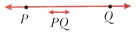
Line Segment, Ray and Line

Line segment Ray Line
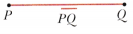
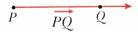
A line segment has two endpoints. A ray has only one endpoint. A line has no endpoint.
A line segment has definite length. A ray has indefinite length. A line has indefinite length.
A line segment can be drawn on a sheet of paper.
Lines and Angles Class 6 Notes Maths Chapter 2-1
A ray cannot be drawn on a sheet of paper as it has indefinite length, but it can be represented by a diagram.

Lines and Angles Class 6 Notes Maths Chapter 2-2

A line cannot be drawn on a sheet of paper as it has indefinite length, but it can be represented by a diagram.

Lines and Angles Class 6 Notes Maths Chapter 2-3

Line segment PQ and line segment QP are the same. Ray PQ and ray QP are different rays. Line PQ and line QP are the same.

Special Lines

Parallel lines Intersecting lines Concurrent lines
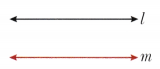
Lines lying on the same plane that do not intersect, no matter how far they are extended.

Lines and Angles Class 6 Notes Maths Chapter 2-4

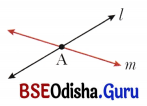
Lines that meet or cross each other at a single point.


The point where they meet isĀ  called the point of intersection.

Lines and Angles Class 6 Notes Maths Chapter 2-5

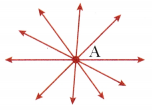
Three or more lines that pass through one common point.

This common point is called the point of concurrency.

Lines and Angles Class 6 Notes Maths Chapter 2-6

A plane is a smooth, flat surface that extends endlessly in all directions.
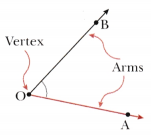
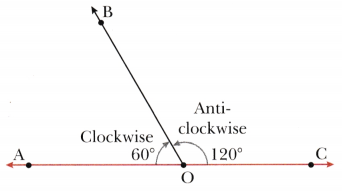
An angle is formed when two rays start from the same initial point called the vertex.

Lines and Angles Class 6 Notes Maths Chapter 2

To represent an angle, write the letter of one arm, followed by the letter of the vertex (always in the middle), and then the letter of the other arm.
Lines and Angles Class 6 Notes Maths Chapter 2-7
For example, in the adjacent figure, the angle is written as ∠AOB or ∠BOA.
Interior of an angle: The space between the arms (when extended indefinitely).
Exterior of an angle: The space outside the arms.
The size of an angle depends on the amount of rotation, not on the length of its arms.
Angles are measured in degrees (°).

To find out whether two angles are equal, greater or smaller, we compare them using the following methods:

  1. By observation (without superimposition)
  2. By tracing/superimposition

Types of Angles

Name Definition Diagram
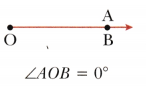
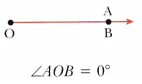
Zero Angle Ā The initial and final positions of a rotating ray coincide without making any turn.

The measure of such an angle is 0°

Lines and Angles Class 6 Notes Maths Chapter 2-8
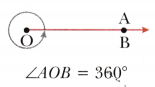
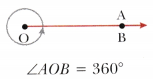
Complete Angle The initial and final positions of a rotating ray coincide after making a full turn.

The measure of such an angle is the angle made in a full turn, i.e. 360°.

Lines and Angles Class 6 Notes Maths Chapter 2-9
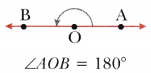
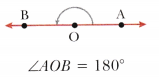
Straight Angle The initial and final positions of a rotating ray are opposite to each other (on the same line) after making half of a full turn.

The measure of such an angle is equal to half of a complete angle, i.e. \(\frac{1}{2}\) Ɨ 360° = i80°.

Lines and Angles Class 6 Notes Maths Chapter 2-10
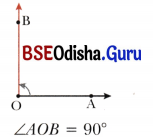
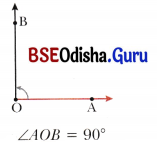
Right Angle Ā The initial and final positions of a rotating ray are perpendicular to each other after making one-fourth of a full turn.

The measure of such an angle is equal to one-fourth of a complete angle, i.e. \(\frac{1}{4}\) Ɨ 360° = 90°.

Lines and Angles Class 6 Notes Maths Chapter 2-11
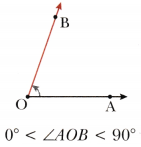
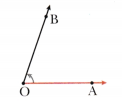
Acute Angle The final position of a rotating ray lies between the initial position and one-fourth of a full turn (i.e less than 90°). Lines and Angles Class 6 Notes Maths Chapter 2-12
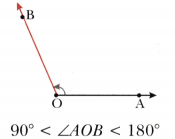
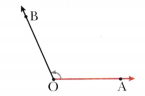
Obtuse Angle The final position of a rotating ray lies between a right angle and a straight angle (i.e. more than 90° but less than 180°). Lines and Angles Class 6 Notes Maths Chapter 2-13
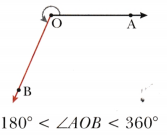
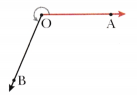
Reflex Angle The final position of a rotating ray lies between a straight angle and a complete angle (i.e. more than 180° but less than 360°). Lines and Angles Class 6 Notes Maths Chapter 2-14

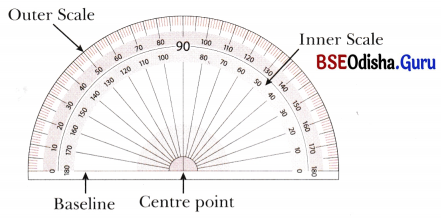
A protractor is a semi-circular tool used to measure angles from 0° to 180°.
Lines and Angles Class 6 Notes Maths Chapter 2-15

Lines and Angles Class 6 Notes Maths Chapter 2

It has two scales:

  1. Inner scale: It starts at 0° on the right and increases to 180° as you move anti-clockwise.
  2. Outer scale: It starts at 0° on the left and increases to 180° as you move clockwise.

To measure an angle, place the centre point of the base line on the vertex, aligning one arm with the base line.

Use the outer scale if the angle opens clockwise and the inner scale if the angle opens anti-clockwise.
Lines and Angles Class 6 Notes Maths Chapter 2-16

Angles Formed by a Clock

  1. A clock is shaped like a circle, so one full turn around it is 360 degrees.
  2. As the clock is divided into 12 hours, the angle between any two adjacent hour marks = \(\frac{360^{\circ}}{12}\) = 30°

Line segment, Ray and Line

Line segment Ray Line
Number of endpoints 2 1 0
Length Definite Indefinite Indefinite
Representation Lines and Angles Class 6 Notes Maths Chapter 2-17 Lines and Angles Class 6 Notes Maths Chapter 2-18 Lines and Angles Class 6 Notes Maths Chapter 2-19

Note: Rays \(\overrightarrow{P Q} \text { and } \overrightarrow{Q P}\) are different because they start from different points and extend in opposite directions.

Comparison of Angles
By observation:

  1. Angles can be compared visually when the difference in their openings is clearly noticeable.
  2. This method is suitable only when the difference in size is significant.

Lines and Angles Class 6 Notes Maths Chapter 2

By tracing/superimposition:

  1. Any two angles can be compared by placing them one over the other, i.e. by superimposition.
  2. While superimposing, the vertices and one arm of the angles must overlap.

Types of Angles

Angles with fixed values

Zero Angle: The measure of such an angle is 0°. Right Angle: The measure of such an angle is equal to 90°. Straight Angle: The measure of such an angle is equal to 180°. Complete Angle: The measure of such an angle is equal to 360°.
Lines and Angles Class 6 Notes Maths Chapter 2-20 Lines and Angles Class 6 Notes Maths Chapter 2-21 Lines and Angles Class 6 Notes Maths Chapter 2-22 Lines and Angles Class 6 Notes Maths Chapter 2-23


Angles with multiple values

Acute Angle: Between 0° and 90° Obtuse Angle: Between 90° and 180° Reflex Angle: Between 180° and 360°
Lines and Angles Class 6 Notes Maths Chapter 2-24

0° < ∠AOB < 90°

Lines and Angles Class 6 Notes Maths Chapter 2-25

90° < ∠AOB < 180°

Lines and Angles Class 6 Notes Maths Chapter 2-26

180° < ∠AOB < 360°

Patterns in Mathematics Class 6 Notes Maths Chapter 1

Easy-to-read Ganita Prakash Class 6 Notes and Chapter 1 Patterns in Mathematics Class 6 Notes save valuable study time during exam season.

Class 6 Maths Chapter 1 Patterns in Mathematics Notes

Class 6 Patterns in Mathematics Notes

A pattern means a repeated arrangement of numbers, shapes, colours, or even ideas. Patterns help us predict what comes next and understand how things are connected.

Patterns in Numbers

  1. If the numbers in a list are related to each other by a clear rule, the arrangement is called a number pattern or a number sequence.
  2. Some number sequences are finite (having a fixed number of terms), while others are infinite (going on forever).
    For example, 2, 4, 6, 8, 10 is a finite sequence having 5 terms, while 1, 2, 3, 4, …, is an infinite sequence.

Some important number sequences

Name of Sequence Sequence Pattern / Rule
All Is 1, 1, 1, 1, 1, 1, … Every number is 1
Counting Numbers 1,2, 3, 4, 5, 6, 7, 8, … Add 1 each time
Even Numbers 2,4,6, 8, 10, 12, 14, 16, 18, … Add 2 each time, starting from 2
Odd Numbers 1,3, 5, 7, 9, 11, 13, 15, 17, 19, … Add 2 each time, starting from 1
Square Numbers 1,4, 9, 16, 25, 36, 49, … Multiply a number by itself (w Ɨ n)
Cube Numbers 1, 8, 27, 64, 125, 216, … Multiply a number by itself twice (n Ɨ n Ɨ n)
Powers of 2 1,2, 4, 8, 16, 32,64, 128,256,… Multiply previous number by 2 each time
Powers of 3 1,3, 9, 27, 81,243, 729, … Multiply previous number by 3 each time
Virahanka Numbers 1, 2, 3, 5, 8, 13, 21, … Sum of the previous two numbers

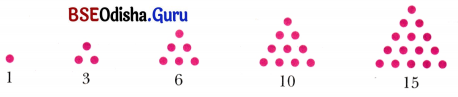
Triangular numbers: 1, 3, 6, 10, 15, 21, 28, …
The nth triangular number is the sum of the first n natural numbers.
Pattern Rule: nth number = \(\frac{n(n+1)}{2}\); n = 1, 2, 3, …
i.e. 1st number = 1; 2nd number = \(\frac{2(2+1)}{2}=\frac{2 \times 3}{2}\) = 3;
3rd number = \(\frac{3(3+1)}{2}=\frac{3 \times 4}{2}\) = 6; 4th number = \(\frac{4(4+1)}{2}=\frac{4 \times 5}{2}\) = 10 and so on.
Triangular numbers can be arranged as dots forming an equilateral triangle.
Patterns in Mathematics Class 6 Notes Maths Chapter 1-1

Patterns in Mathematics Class 6 Notes Maths Chapter 1

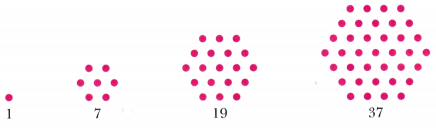
Hexagonal numbers: 1, 7, 19, 37, 61, …
The nth hexagonal number (except the first number) is obtained by adding the preceding number with 6 Ɨ (n – 1).
Pattern Rule: 1st term = 1, nth number (term) = Preceding term + 6 Ɨ (n- 1); n = 2, 3, 4, …
i.e. 1st term = 1; 2nd term = 1 + 6 Ɨ (2 – 1) = 7
3rd term = 7 + 6 Ɨ (3 – 1) = 19; 4th term = 19 + 6 Ɨ (4 – 1) = 37 and so on.
Hexagonal numbers can be arranged as dots forming a regular hexagon.
Patterns in Mathematics Class 6 Notes Maths Chapter 1-2

Relations among Number Sequences
The sum of the first n odd numbers is equal to n2.

Addition of Odd Numbers Result Square Number
1 1 l2
1 + 3 4 22
1+ 3 + 5 9 32
1 + 3 + 5 + 7 16 42
1 + 3 + 5 + 7 + 9 25 52
1 + 3 + 5 + 7 + 9 +11 36 62

Adding numbers up from 1 to a number, and then back down again to 1, also gives square numbers.

Addition of Counting Numbers Up and Down Result Square Number
1 1 l2
1+2+1 4 22
1+2+3+2+1 9 32
1+2+3+4+3+2+1 16 42
1+2+3+4+5+4+3+2+1 25 52
1+2+3+4+5+6+5+4+3+2+1 36 62

Patterns in Shapes
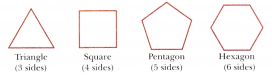
Regular Polygons Sequence
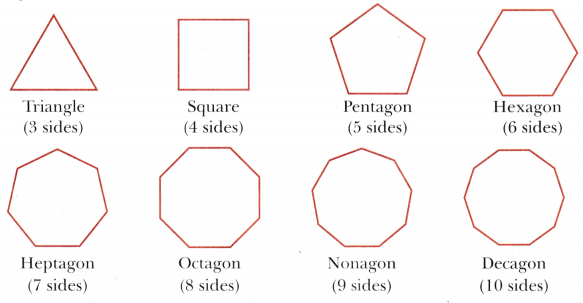
A regular polygon is a flat (two dimensional) shape with equal sides and equal angles.

Regular Polygon Number of Sides Measure of Each Angle
Triangle (Equilateral) 3 60°
Quadrilateral (Square) 4 90°
Pentagon (Regular) 5 108°
Hexagon (Regular) 6 120°
Heptagon (Regular) 7 128.57°
Octagon (Regular) 8 135°
Nonagon (Regular) 9 140°
Decagon (Regular) 10 144°                 .

Triangle → Square → Pentagon → Hexagon → Heptagon → Octagon → Nonagon → Decagon → ….
Patterns in Mathematics Class 6 Notes Maths Chapter 1-3

Patterns in Mathematics Class 6 Notes Maths Chapter 1

Complete Graphs Sequence
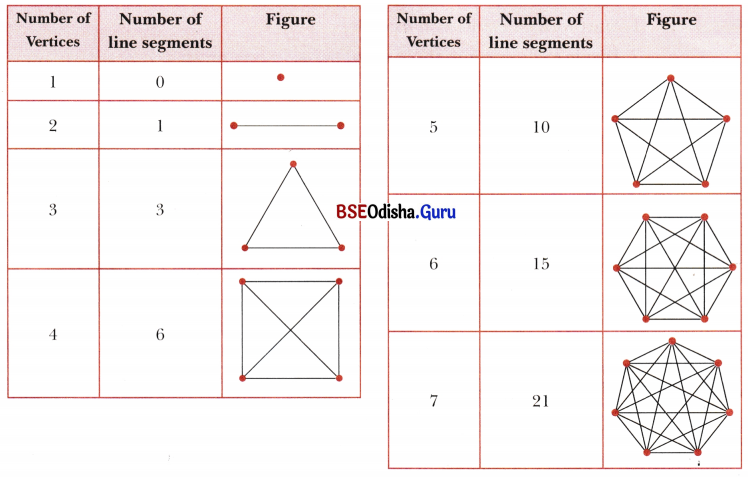
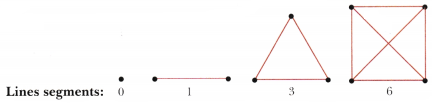
In complete graph, every pair of distinct vertices is connected by a unique line segment.
The number of unique line segments in a sequence of complete graphs with n vertices is calculated as \(\frac{n(n-1)}{2}\), where n = 1,2, 3, ….
Patterns in Mathematics Class 6 Notes Maths Chapter 1-4
We represent a complete graph with the symbol Kn, where n is the number of vertices.
Note: This sequence follows the pattern of Triangular Numbers starting with 1, 3, 6, 10, … .

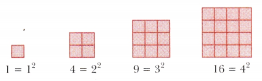
Stacked Squares Sequence
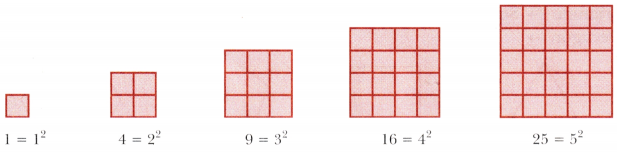
In the stacked squares sequence, we arrange small squares to form larger squares.
It follows the pattern of square numbers: 1,4, 9, 16, 25, …
Patterns in Mathematics Class 6 Notes Maths Chapter 1-5

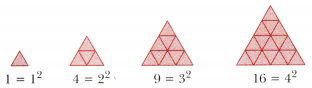
Stacked Triangles Sequence
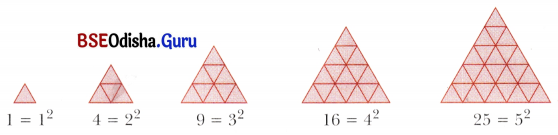
In the stacked triangles sequence, we stack small triangles to form larger triangles.
This sequence also follows the square numbers pattern: 1,4, 9, 16, 25, …
Patterns in Mathematics Class 6 Notes Maths Chapter 1-6

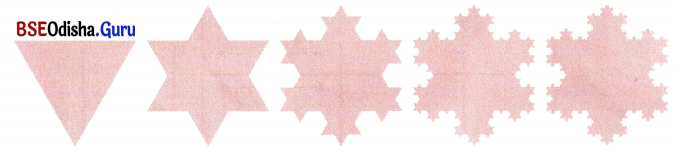
Koch Snowflake Sequence
The Koch Snowflake is a special pattern where we start with an equilateral triangle and
build a snowflake shape Patterns in Mathematics Class 6 Notes Maths Chapter 1-7 by repeating a simple rule.
Steps to Form a Koch Snowflake:

  1. Start with an equilateral triangle.
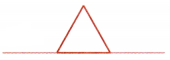
  2. Divide each side into three equal parts. Patterns in Mathematics Class 6 Notes Maths Chapter 1-8
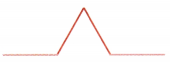
  3. Replace the middle part with a new outward-facing equilateral triangle. Patterns in Mathematics Class 6 Notes Maths Chapter 1-9
  4. Remove the original middle line segment.
  5. Repeat the process on every straight line segment (side). Patterns in Mathematics Class 6 Notes Maths Chapter 1-10

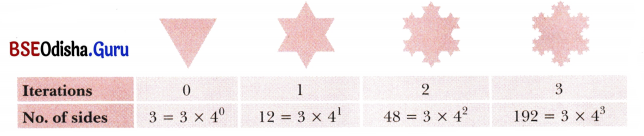
Number of line segments = 3 Ɨ 4n, where n is the number of iterations.
Patterns in Mathematics Class 6 Notes Maths Chapter 1-11

Iterations 0 1 2 3 4
No. of sides 3 Ɨ 4° = 3 3 Ɨ 41 = 12 3 Ɨ 42 = 48 3 Ɨ 43Ā = 192 3Ɨ 44 = 768


Relation of Shapes to Number Sequences

  • The regular polygons sequence is related to counting numbers sequence starting from 3, i.e. 3, 4, 5, 6, 7 and so on.
  • Complete graphs sequence is related to triangular number sequence, i.e. 1,3, 6, 10, 15 … .
  • The stacked squares sequence is related to square numbers sequence i.e. 1, 4, 9, 16, 25 … .
  • Stacked triangles sequence is related to square numbers sequence i.e. 1,4, 9, 16, 25 … .
  • Koch Snowflakes sequence is related to a numbers sequence and the number sequence is
    given as 3, 12, 48, 192 … .

Patterns in Mathematics Class 6 Notes Maths Chapter 1

Regular Polygon
A Regular Polygon is a flat (two dimensional) shape with equal sides and equal angles.
Add 1 side each time to get the next polygon.
Triangle → Square → Pentagon → Hexagon….
Patterns in Mathematics Class 6 Notes Maths Chapter 1-12

Stacked Triangles
In the stacked triangles sequence, we stack small triangles to form larger triangles.
This sequence follows the square numbers pattern: 1, 4, 9, 16, 25, …
Patterns in Mathematics Class 6 Notes Maths Chapter 1-13

Stacked Squares
In the stacked squares sequence, we arrange small squares to form larger squares.
It follows the pattern of square numbers: 1,4, 9, 16, 25, …
Patterns in Mathematics Class 6 Notes Maths Chapter 1-14

Complete Graphs
In complete graphs, every pair of distinct vertices is connected by a unique line segment.
The number of unique line segments in a sequence of complete graph with n vertices is calculated as \(\frac{n(n-1)}{2}\), where = 1, 2, 3,……….
Patterns in Mathematics Class 6 Notes Maths Chapter 1-15

Koch Snowflake
The Koch Snowflake is a special pattern where we start with an equilateral triangle and build a snowflake shape by replacing each line segment by a speed bump Patterns in Mathematics Class 6 Notes Maths Chapter 1-7.
Number of line segments = 3 x 4″, where n is the number of iterations.
In the Koch Snowflake, the number of line segments increases by 4 times at every step: 3. 12, 48, 192, …
Patterns in Mathematics Class 6 Notes Maths Chapter 1-16

Patterns in Mathematics Class 6 Notes Maths Chapter 1

Important points

  1. Adding up odd numbers gives square numbers.
  2. Adding the counting numbers up and then down gives square numbers.
  3. Adding pairs of consecutive triangular numbers gives square numbers.
  4. Multiplying triangular numbers by 6 and adding 1 gives hexagonal numbers.
  5. Adding up hexagonal numbers gives cube numbers.
  6. The number of sides in the shape sequence of regular polygons is given by the counting numbers starting with 3.
  7. In a complete graph, the number of unique line segments sequence is related to triangular number pattern: 1, 3, 6, 10, 15,……

Ganita Prakash Class 6 Notes

Class 6 Maths Ganita Prakash Notes

Class 6 Ganita Prakash Notes

Also Read Ganita Prakash Class 6 Solutions

The Other Side of Zero Class 6 MCQ Maths Chapter 10

Regular revision with Class 6 Maths MCQ with Answers and Ganita Prakash Class 6 Maths Chapter 10 The Other Side of Zero MCQ improves accuracy in objective exams.

MCQ on The Other Side of Zero Class 6

The Other Side of Zero MCQ Class 6

Class 6 Maths The Other Side of Zero MCQ

Question 1.
The additive inverse of – 4 is:
(a) 2
(b) 4
(c) -4
(d) -2
Solution:
(b) 4
We know that every number has another number associated to it which when added to the number gives zero.
∓ The additive inverse of – 4 is 4 as -4 + 4 = 0.

Question 2.
Number of integers lying between – 1 and 1 is:
(a) 3
(b) 2
(c) 1
(d) 0
Solution:
(c) 1
The integers between – 1 and 1 are the integers that come after – 1 and before 1.
So, 0 is the only integer between – 1 and 1.
Hence, there is only one integer between – 1 and 1.

Question 3.
– 22 + 33 + 21 – 38 – 16 + 19 =
(a) -3
(b) – 7
(c) 0.3
(d) 7
Solution:
(a) -3
-22 + 33 + 21 – 38 – 16 + 19
= (-22 – 38 – 16) + (+33 + 21 + 19) [Grouping positive and negative integers]
= (-76) + (+ 73) = – 3

The Other Side of Zero Class 6 MCQ Maths Chapter 10

Question 4.
The sum of two integers is 36. If one of them is – 24, then the other integer is:
(a) – 12
(b) 60
(c) 12
(d) -60
Solution:
(b) 60
It is given that the sum of two integers is 36 and one of them is – 24.
Since the sum is 36, the other integer is obtained bv subtracting – 24 from 36.
∓ Required integer = 36 – ( – 24)
= (+ 36) + (+ 24)
[The number that is being subtracted can be replaced by its additive inverse and then added.]
= 60

Question 5.
If a lift goes from floor – 2 to floor + 3, how many floors did it move?
(a) 2
(b) 3
(c) 4
(d) 5
Solution:
(d) 5
We know, target position – starting position = movement
Here, target position = + 3;
Starting position = – 2
∓ Movement = +3 – (-2) = + 3 + (+2)
= 5 floors

Question 6.
Choose the greatest integer among all the given integers:
(a) -10
(b) -5
(c) 0
(d) -1
Solution:
(c) 0
Given integers are – 10, – 5, 0 and – 1.
We know that zero is greater than every negative integer. Also, a number that is more to the left of zero on the number line has a smaller value.
∓ The given integers can be arranged in ascending order as: – 10, – 5, – 1, 0 Thus, 0 is the greatest integer among the given integers.

The Other Side of Zero Class 6 MCQ Maths Chapter 10

Question 7.
Which of the following integers is 4 less than – 3?
(a) 2
(b) -2
(c) 7
(d) -7
Solution:
(d) -7
To find the integer which is 4 less than – 3, we start at – 3 on the number line and move 4 steps backward. We reach – 7. Hence, the required integer is – 7.
The Other Side of Zero Class 6 MCQ Maths Chapter 10-5

Question 8.
Which of the following statements is true?
(a) -3 > 2
(b) -1 > 0
(c) 0 > -5
(d) -6 > -2
Solution:
(c) 0 > -5
A number is smaller than all the numbers to its right on the number line and larger than all the numbers to its left.
-3 is to the left of 2, so -3 < 2. Therefore, option (a) is incorrect.
-1 is to the left of 0, so -1 < 0. Therefore, option (b) is incorrect. 0 is to the right of -5, so 0 > -5. Therefore, option (c) is correct.
-6 is to the left of -2, so -6 < -2. Therefore, option (d) is incorrect.

Question 9.
3 + (-3) + 3 + (-3) + 3 + (-3) + … upto 189 terms, is equal to:
(a) 567
(b) -567
(c) 3
(d) -3
Solution:
(c) 3
We know that the sum of an integer with its additive inverse is zero.
The additive inverse of – 3 is 3.
∓ 3 + (-3) = 0
Here, the total number of terms is 189 i.e. odd. So, we have
3 + [(-3) + 3] + [(-3) + 3] +[(-3) + 3] + … = 3 + 0 + 0 + 0 + … = 3

The Other Side of Zero Class 6 MCQ Maths Chapter 10

Question 10.
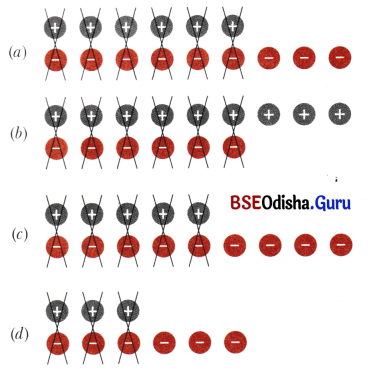
Which of the following subtractions is correctly represented by the given arrangement of tokens?
The Other Side of Zero Class 6 MCQ Maths Chapter 10-1
(a) (-8) + (-5)
(b) (+8) – (+5)
(c) (-8) – (-5)
(d) (+8) – (-5)
Solution:
(b) (+8) – (+5)
Clearly, 5 positive tokens are taken away from 8 positive tokens.
So, the given arrangement of tokens represents (+ 8) – (+ 5).

Question 11.
How many minimum zero-pairs must be introduced to model -5 – (+ 2) using tokens?
(a) 1
(b) 2
(c) 3
(d) 4
Solution:
(b) 2
The Other Side of Zero Class 6 MCQ Maths Chapter 10-6
Since there are no positive tokens initially, two zero-pairs must be added in order to remove two positives.
-5 – (+2) = -7
Thus, two zero-pairs are needed.

Question 12.
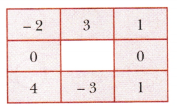
The border sum of the given grid is:
The Other Side of Zero Class 6 MCQ Maths Chapter 10-2
(a) -3
(b) 2
(c) 3
(d) – 2
Solution:
(b) 2
Sum of numbers in the top row
= (-2) + 3 + 1 – 2
Sum of numbers in the bottom row
= 4 + (-3) + 1 = 2
Sum of numbers in the left column
= (-2) + 0 + 4 = 2
Sum of numbers in the right column
= 1 + 0 + 1 = 2
So, the border sum of the given grid is 2.

The Other Side of Zero Class 6 MCQ Maths Chapter 10

Question 13.
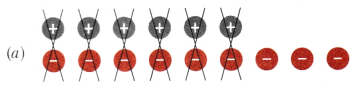
(+ 6) + (- 9) = -3 is correctly represented by:
The Other Side of Zero Class 6 MCQ Maths Chapter 10-3
Solution:
The Other Side of Zero Class 6 MCQ Maths Chapter 10-7
(+6) + (-9) = – 3
There must be 6 positive tokens and 9 negative tokens. So, we can remove six zero pairs and then we are left with 3 negative tokens.

Question 14.
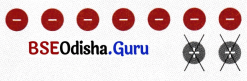
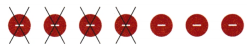
Which of the following subtractions is correctly represented by the given arrangement of tokens?
The Other Side of Zero Class 6 MCQ Maths Chapter 10-4
(a) (+7) – (-4)
(b) (+7) – (+4)
(c) (-7) + (-4)
(d) (-7) – (-4)
Solution:
(d) (-7) – (-4)
Clearly, 4 negative tokens are taken away from 7 negative tokens.
So, the given arrangement of tokens represents (-7) – (-4).

Question 15.
Which of the following statements are correct?
(i) The additive inverse of — 5 is 5.
(ii) – 5 < 0 < 5
(iii) The successor and predecessor of – 5 are – 6 and – 4 respectively.
(iv) The absolute value of – 5 is 5.
Choose the correct option from the following:
(a) (i), (iii) and (iv)
(b) (i), (ii) and (iv)
(c ) (i), (ii) and (iii)
(d) (ii), (iii) and (iv)
Solution:
(b) (i), (ii) and (iv)
(i) We know that two numbers are said to be
additive inverse of each other if their sum is zero.
Therefore, the additive inverse of -5 is 5 as (-5) + 5 = 0.
Thus, statement (1) is correct.

(ii) Since 0 is greater than every negative integer and less than every positive integer.
-5 < 0 < 5.
Thus, statement (ii) is correct.

(iii) If we move 1 to the right of a number, we get the successor of that number and if we move 1 to the left of a number, we get the predecessor of that number.
The successor and predecessor of – 5 are
– 4 and – 6 respectively.
Thus, statement (iii) is incorrect.

(iv) The absolute value of a negative integer is the same as the integer but without the negative sign.
The absolute value of – 5 is 5.
Thus, statement (iv) is correct.

The Other Side of Zero Class 6 MCQ Maths Chapter 10

Question 16.
Which of the following are correct?
(i) -3 < -2 < -1
(ii) -2 < -5 < 1
(iii) -5 < 8 < 10
(iv) -2 < 0 < 1
Choose the correct option from the following:
(a) (i), (iii) and (iv)
(b) (i), (ii) and (iii)
(c) (i), (ii) and (iv)
(d) (ii), (iii) and (iv)
Solution:
(a) (i), (iii) and (iv)
(i) A number farther to the left of zero on the number line has a smaller value.
∓ -3 < -2 < -1
(i) is correct.

(ii) Every positive integer is greater than every negative integer and a number farther to the left of zero on the number line has a smaller value.
∓ -5 < -2 < 1
(ii) is incorrect.

(iii) A number located farther to the right of zero on the number line is greater in value.
∓ 5 < 8 < 10
(iii) is correct.

(iv) On the number line, the numbers right to 0 are greater than 0, and the numbers left to 0 are less than 0.
-2 < 0 < 1 (iv) is correct.

Question 17.
Which of the following statements are correct?
(i) The number that is being subtracted can be replaced bv its additive inverse and then added.
(ii) The absolute value of -7 is equal to the absolute value of 7.
(iii) The absolute value of -2 is less than -1.
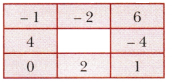
(iv) The border sum of the given grid is 3.
The Other Side of Zero Class 6 MCQ Maths Chapter 10-9
Choose the correct option from the following:
(a) (i) and (iii) only
(b) (ii), (iii) and (iv)
(c) (i), (ii) and (iv)
(d) (iii) and (iv) only
Solution:
(c) (i), (ii) and (iv)
(i) The number that is being subtracted can be replaced by its additive inverse and then added.
For example, 3 – (-5) = 3 + (+ 5) = 8 (i) is correct.
(ii) The absolute value of a positive integer is the integer itself.
∓ Absolute value of 7 = 7
The absolute value of a negative integer is the same as the integer but without the negative sign.
∓ Absolute value of -7 = 7
(ii) is correct.

(iii) Absolute value of -2 = 2 and 2 > -1.
(iii) is incorrect.

(iv) Sum of numbers in the top row = (-1) + (- 2) + 6 = 3
Sum of numbers in the bottom row = 0 + 2 + 1 = 3
Sum of numbers in the left column = -1 + 4 + 0 = 3
Sum of numbers in the right column = 6 + (- 4) + 1 = 3
∓ The border sum of grid is 3.
(iv) is correct.

The Other Side of Zero Class 6 Assertion and Reason Questions

The following questions are Assertion and Reason based questions. Two statements are given, one labelled as Assertion (A) and the other is labelled as Reason (R). Select the correct answer to these questions from the codes (a), (b), (c) and (d) as given below.
(a) Both A and R are true and R is the correct explanation of A.
(b) Both A and R are true but R is not the correct explanation of A.
(c) A is true but R is false.
(d) A is false but R is true.

Question 1.
(A): Zero is a positive integer.
(R): Zero lies between – 1 and + 1.
Solution:
(d) A is false but R is true.
We know that zero is neither positive integer nor negative integer.
And, zero lies between – 1 and + 1 on the number line.
Thus, Assertion (A) is false, but Reason (R) is true.

The Other Side of Zero Class 6 MCQ Maths Chapter 10

Question 2.
(A): The additive inverse of- 5 is + 5.
(R): The additive inverse of a number is the same number with the opposite sign.
Solution:
(a) Both A and R are true and R is the correct explanation of A.
We know that the additive inverse of a number is the same number with the opposite sign.
So, the additive inverse of – 5 is + 5.
Thus, both Assertion (A) and Reason (R) are true, and Reason (R) is the correct explanation of Assertion (A).

Question 3.
(A): – 5 is greater than – 2.
(R): A number is smaller than every number that is to its right on the number line.
Solution:
(d) A is false but R is true.
A number is smaller than any number positioned to its right on the number line.
Since – 2 is to the right of- 5, – 5 is smaller than -2.
Thus, Assertion (A) is false, but Reason (R) is true.

Question 4.
(A): On the number line, – 5 is at a greater distance from zero than – 8.
(R): Farther a number from zero on left, smaller is the value.
Solution:
(d) A is false but R is true.
We know that the farther ,a number is to the left of zero on the number line, the smaller its value.
Since – 8 is to the left of – 5, – 8 is at a greater distance from 0 than – 5.
Thus, Assertion (A) is false, but Reason (R) is true.

The Other Side of Zero Class 6 MCQ Maths Chapter 10

The Other Side of Zero Class 6 Fill in the Blanks

Question 1.
The number that is neither positive nor negative is _________ .
Solution: zero
The number that is neither positive nor negative is zero.

Question 2.
On a number line, integers to the left of zero are called _______ integers.
Solution: negative
On a number line, integers to the left of zero are called negative integers.

Question 3.
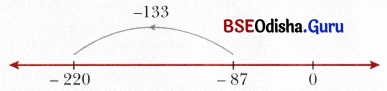
Use unmarked number lines to evaluate these expressions -87 + (-133) = ________ .
Solution: -220
We start at -87 and move 133 steps backward on the number line.
The Other Side of Zero Class 6 MCQ Maths Chapter 10-8
Therefore, -87 + (-133) = -220

Question 4.
The additive inverse of zero is ________ .
Solution: zero
We know that the additive inverse of a number is the number which, when added to the original number, gives zero. Here, 0 + 0 = 0
Therefore, the additive inverse of zero is zero.

The Other Side of Zero Class 6 MCQ Maths Chapter 10

Question 5.
Integers to the right side of zero are _______ than those to the left side on number line.
Solution: greater
A number is smaller than all the numbers to its right on the number line and larger than all the numbers to its left.
Therefore, integers to the right side of zero are greater than those to the left side on number line.

Question 6.
The number of integers lying between – 3 and 2 is _______ .
Solution: four
The integers that come between – 3 and 2 on the number line are – 2, – 1, 0 and 1.
So, the number of integers lying between – 3 and 2 is four.

Symmetry Class 6 MCQ Maths Chapter 9

Regular revision with Class 6 Maths MCQ with Answers and Ganita Prakash Class 6 Maths Chapter 9 Symmetry MCQ improves accuracy in objective exams.

MCQ on Symmetry Class 6

Symmetry MCQ Class 6

Class 6 Maths Symmetry MCQ

Question 1.
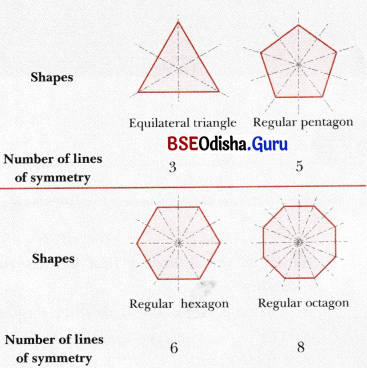
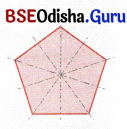
Which regular polygon has 5 lines of symmetry?
(a) Hexagon
(b) Pentagon
(c) Equilateral Triangle
(d) Octagon
Solution:
(b) Pentagon
Symmetry Class 6 MCQ Maths Chapter 9-1

Question 2.
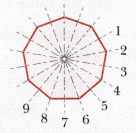
What is the number of lines of symmetry in a regular nonagon?
(a) 6
(b) 8
(c) 9
(d) 12
Solution:
(c) 9
A regular nonagon has nine lines of symmetry.
Symmetry Class 6 MCQ Maths Chapter 9-2

Question 3.
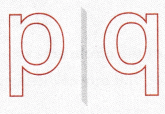
What is the mirror image of the letter ā€˜p’ across a vertical mirror?
(a) p
(b) d
(c) b
(d) q
Solution:
(d) q
The mirror image of the letter p’ across a vertical mirror is ‘q’.
Symmetry Class 6 MCQ Maths Chapter 9-3

Symmetry Class 6 MCQ Maths Chapter 9

Question 4.
Which method can generate a symmetric figure?
(a) Drawing random curves
(b) Folding a square paper and cutting a shape
(c) Rotating a shape randomly
(d) Moving a shape sideways
Solution:
(b) Folding a square paper and cutting a shape
We know that if we fold a square paper and cut a shape on one side, the other half appears when you open it. Both halves match.
Symmetry Class 6 MCQ Maths Chapter 9-4

Question 5.
A line of symmetry divides a figure into:
(a) Two identical but flipped figures
(b) Two unequal parts
(c) One half only
(c) Two unrelated shapes
Solution:
(a) Two identical but flipped figures
We know that a line that cuts a plane figure into two parts that exactly overlap when folded along that line is called a line of symmetry or axis of symmetry of the figure.
Symmetry Class 6 MCQ Maths Chapter 9-5
Thus, a line of symmetry divides a figure into two identical but flipped figures.

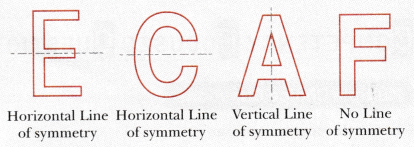
Question 6.
Which of the following letters has a vertical line of symmetry?
(a) E
(b) C
(c) A
(d) F
Solution:
(c) A
From the given letters, only letter ā€˜A’ has a vertical line of symmetry.
Symmetry Class 6 MCQ Maths Chapter 9-6

Symmetry Class 6 MCQ Maths Chapter 9

Question 7.
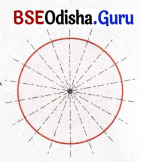
Which shape has an infinite number of lines of symmetry?
(a) Square
(b) Regular Pentagon
(c) Regular Octagon
(d) Circle
Solution:
(d) Circle
Symmetry Class 6 MCQ Maths Chapter 9-7
We know that a square has four lines of symmetry.
A regular pentagon has five , lines of symmetry.
A regular octagon has eight lines of symmetry.
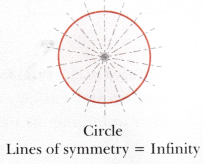
A circle has infinite lines of symmetry.

Question 8.
Which of the following is true for a figure drawn using a mirror?
(a) Asymmetrical
(b) Uneven
(c) Symmetrical
(d) Curved
Solution:
(c) Symmetrical
We know that the mirror creates the same shape on the other side, so the whole shape looks balanced and symmetrical.

Question 9.
Which of the following best defines rotational symmetry?
(a) The object looks the same when flipped over.
(b) The object looks the same when rotated about a fixed point.
(c) The object has two identical halves.
(d) The object looks the same from any side.
Solution:
(b) The object looks the same when rotated about a fixed point.
Imagine rotating a defined shape around a fixed point without flipping it. If it looks exactly the same in some positions during the rotation, it has rotational symmetry.

Symmetry Class 6 MCQ Maths Chapter 9

Question 10.
Which of the following shapes does NOT have rotational symmetry?
(a) Equilateral Triangle
(b) Rectangle
(c) Semi-circle
(d) Square
Solution:
(c) Semi-circle
Rotational symmetry occurs if a shape looks exactly the same when we turn (rotate) it at an angle less than 360° around a fixed point (usually the centre).

A semicircle does not look the same as its original shape when rotated by any angle less than 360°; it only matches after completing a full 360° turn.

Question 11.
What is the angle of symmetry for a figure with rotational symmetry of order 4?
(a) 30°
(b) 45°
(c) 60°
(d) 90°
Solution:
(d) 90°
A complete rotation makes 360°.
As the order of symmetry of the figure is 4, it looks the same four times.
Thus, the angle of rotational symmetry for the figure = \(\frac{360^{\circ}}{4}\) = 90°

Question 12.
The centre of the circle acts as:
(a) The point that moves during rotation
(b) A vertex
(c) The centre of rotation
(d) None of these
Solution:
(c) The centre of rotation
The centre of a circle is the centre of rotation because it is the only point within the figure that remains perfectly still when the circle rotates.

Symmetry Class 6 MCQ Maths Chapter 9

Question 13.
What is the angle of rotation that maps a circle onto itself?
(a) Only 360°
(b) Only 180°
(c) Any angle
(d) Only 90°
Solution:
(c) Any angle
No matter how little or how much we rotate a circle, it always looks exactly the same. Whether we rotate it by 1°, 20°, 123° or even 0.5°, it still appears to be the same circle.

Question 14.
If a figure coincides with itself 6 times during a full rotation, its smallest angle of symmetry is:
(a) 30°
(b) 45°
(c) 60°
(d) 90°
Solution:
(c) 60°
Given, a figure coincides with itself 6 times during a full rotation.
Therefore, smallest angle of symmetry for the figure = \(\frac{360^{\circ}}{4}\) = 60°
So, each time the figure is rotated by 60°, it appears the same.

Question 15.
Every diameter of a circle is:
(a) A line not passing through centre
(b) A line of symmetry
(c) A line outside the circle
(d) A line touching the circle at one point
Solution:
(b) A line of symmetry
We know that the diameter of a circle passes through the centre of the circle and divides the circle into two equal halves.

A line of symmetry divides a shape into two mirror-image parts. If we fold the shape along that line, both halves match exactly.

Symmetry Class 6 MCQ Maths Chapter 9

Question 16.
Which of these shapes have both reflection symmetry and rotational symmetry?
(i) Square
(ii) Equilateral triangle
(iii) Circle
(iv) Rectangle
Choose the correct option from the following:
(a) Only (i) and (iv)
(b) Only (i) and (iii)
(c) Only (i), (ii) and (iii)
(d) (i), (ii), (iii) and (iv)
Solution:
(d) (i), (ii), (iii) and (iv)
We know that reflection symmetry occurs when a figure can be divided into two identical halves by a line, where one half is the mirror image of the other.

Rotational symmetry means a figure looks the same after being rotated about a fixed point (centre of rotation) through certain angles.

Square has 4 lines of symmetry and rotational symmetry at 90°, 180°, 270° and 360°.
Equilateral triangle has 3 lines of symmetry and rotational symmetry at 120°, 240° and 360°.
Circle has infinite lines of symmetry and rotational symmetry at every angle.
Rectangle has 2 lines of symmetry and rotational symmetry at 180° and 360°.
Thus, (i), (ii), (iii) and (iv) have both reflection symmetry and rotational symmetry.

Question 17.
A shape has rotational symmetry of order 4. Which statements must be true?
(i) It overlaps with itself at every 90° rotation.
(ii) It has 4 angles of symmetry including 360°.
(iv) It looks exactly the same after a 180° rotation.
Choose the correct option from the following:
(a) Only (i) and (ii)
(b) Only (ii) and (iii)
(c) (i), (ii) and (iv)
(d) (ii), (iii) and (iv)
Solution:
(c) (i), (ii) and (iv)
We know that the number of times a figure fits into itself in one full turn is called the order of rotational symmetry.
Smallest angle of rotational symmetry
= \(\frac{360^{\circ}}{Order of ratational symmetry}\)
Given, a shape has rotational symmetry of order 4.
∓ Smallest angle of rotational symmetry
= \(\frac{360^{\circ}}{4}\) = 90°
Hence, the given shape has rotational symmetry at 90°, 180°, 270° and 360°.
Since the swastika symbol (*****) has rotational symmetry but not reflection symmetry, it is not necessarily true that the given shape must have four lines of symmetry.
Thus, statements (i), (ii) and (iv) are true.

Question 18.
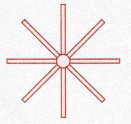
A shape has 8 radial arms. What must be true if it has rotational symmetry?
(i) The angle between adjacent arms is 45°.
(ii) It looks the same after every 45° rotation.
(iii) It has 8 angles of symmetry.
(iv) It has no reflection symmetry.
Choose the correct option from the following:
(a) (i), (ii) and (iii)
(b) (i), (ii) and (iv)
(c) (iii) and (iv) only
(d) (ii), (iii) and (iv)
Solution:
(a) (i), (ii) and (iii)
Given, a shape has 8 radial arms.
Symmetry Class 6 MCQ Maths Chapter 9-8
We know,
Angle between the adjacent radial arms.
= \(\frac{360^{\circ}}{\text { Number of radial arms }}=\frac{360^{\circ}}{8}=45^{\circ}\)
We observe that the figure with 8 radial arms fits exactly onto itself when it is rotated by 45°, 90°, 135°, 180°, 225°, 270°, 315° and 360°. So, it has eight angles of rotational symmetry and hence the order of rotational symmetry is 8.
We can see that the figure has reflection symmetry.
Thus, statements (i), (ii) and (iii) are true.

Symmetry Class 6 MCQ Maths Chapter 9

Symmetry Class 6 Assertion and Reason Questions

The following questions are Assertion and Reason based questions. Two statements are given, one labelled as Assertion (A) and the other is labelled as Reason (R). Select the correct answer to these questions from the codes (a), (b), (c) and (d) as given below.
(a) Both A and R are true and R is the correct explanation of A.
(b) Both A and R are true but R is not the correct explanation of A.
(c) A is true but R is false.
(d) A is false but R is true.

Question 1.
(A): A circle has an infinite number of lines of
(R): Any diameter of a circle divides it into two identical halves.
Solution:
(a) Both A and R are true and R is the correct explanation of A.
We know that a diameter of a circle passes through its centre and connects two points on its boundary. Every diameter divides the circle into two symmetrical parts, called semicircles.
Symmetry Class 6 MCQ Maths Chapter 9-9
A line of symmetry divides a figure into two mirror-image halves.

In the case of a circle, any line that passes through its centre divides it into two equal halves. Since there are infinitely many such lines (diameters), a circle indeed has an infinite number of lines of symmetry.

Thus, both Assertion (A) and Reason (R) are true, and Reason (R) is the correct explanation of Assertion (A).

Question 2.
(A): A regular pentagon has five lines of symmetry.
(R): Each line of symmetry passes through a vertex and the midpoint of the opposite side.
Solution:
(a) Both A and R are true and R is the correct explanation of A.
We know that a regular pentagon (all sides and angles equal) has 5 lines of symmetry, one corresponding to each vertex and each line of symmetry passes through a vertex and the midpoint of the opposite side, dividing the regular pentagon into two equal halves.
Symmetry Class 6 MCQ Maths Chapter 9-10

Thus, both Assertion (A) and Reason (R) are true, and Reason (R) is the correct explanation of Assertion (A).

Symmetry Class 6 MCQ Maths Chapter 9

Question 3.
(A): The English letter ā€˜S’ has no line of symmetry.
(R): The symmetry of a figure depends on its rotational characteristics only.
Solution:
(c) A is true but R is false.
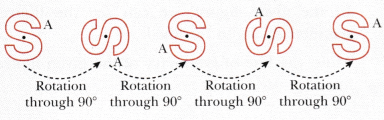
The capital letter ā€˜S’ has no line of symmetry. It does, however, have rotational symmetry of order 2 (i.e., it looks the same after a 180° rotation), but no reflection symmetry.
Symmetry Class 6 MCQ Maths Chapter 9-11
Reflection symmetry and rotational symmetry are different concepts.
A figure can have reflection symmetry, rotational symmetry, both or neither.

For example, an equilateral triangle has both; the letter ā€˜S’ has rotational but not reflection symmetry.
Thus, .Assertion (A) is true, but Reason (R) is false.

Question 4.
(A): All regular polygons have both reflection and rotational symmetry.
(R): Regular polygons have equal angles and equal sides, which ensures symmetry in both aspects.
Solution:
(a) Both A and R are true and R is the correct explanation of A.
We know that a regular polygon has all sides and angles equal, which ensures symmetry in both aspects.
Equal angles and sides allow for multiple lines of symmetry.

Uniformity ensures the shape can rotate and still match its original form, giving rotational symmetry.
A regular polygon always has reflection symmetry (as many lines of symmetry as sides) and rotational symmetry (order equal to the number of sides).

Thus, both Assertion (A) and Reason (R) are true, and Reason (R) is the correct explanation of Assertion (A).

Question 5.
(A): A figure with rotational symmetry of order 1 has no rotational symmetry.
(R): A figure must match its original position more than once in a full turn to have rotational symmetry.
Solution:
(a) Both A and R are true and R is the correct explanation of A.
We know that rotational symmetry is the property of a shape looking the same after rotating it less than 360°. If a shape looks the same only once in a full turn (at the starting position), it has rotational symmetry of order 1. But in practice, this means it has no real rotational symmetry. For a shape to have rotational symmetry, it should match its original look more than once during one full rotation.

Thus, both Assertion (A) and Reason (R) are true, and Reason (R) is the correct explanation of Assertion (A).

Symmetry Class 6 MCQ Maths Chapter 9

Symmetry Class 6 Fill in the Blanks

Question 1.
A _______ line of symmetry divides the figure in the vertical direction.
Solution: vertical
A vertical line of symmetry divides the figure in the vertical direction.

Question 2.
A square has _______ lines of symmetry.
Solution: four
A square has four lines of symmetry.

Question 3.
In an isosceles triangle, there is only _______ line of symmetry.
Solution: one
In an isosceles triangle, there is only one line of symmetry.

Symmetry Class 6 MCQ Maths Chapter 9

Question 4.
A figure is said to have ________ symmetry if itlooks the same after a certain amount of rotation around a fixed point.
Solution: rotational
A figure is said to have rotational symmetry if it looks the same after a certain amount of rotation (less than 360°) around a fixed point. This amount of rotation is called angle of rotational symmetry.

Question 5.
The number of times a figure matches itself in one full rotation is called its _______ of rotational symmetry.
Solution: order
The number of times a figure matches itself in one full rotation is called its order of rotational symmetry.

Question 6.
The smallest angle of rotation for a figure with a rotational symmetry of order 5 is _________ .
Solution: 72°
If a figure has rotational symmetry of order 5, it means it matches itself every \(\frac{360^{\circ}}{5}\) = 72°.
Thus, the smallest angle of rotation for a figure with a rotational symmetry of order 5 is 72°.

Symmetry Class 6 MCQ Maths Chapter 9

Question 7.
All the ______ of a circle are its lines of symmetry.
Solution: diameters
All the diameters of a circle are its lines of symmetry.

Question 8.
A square has rotational symmetry of order _________ .
Solution: 4
A square fits onto itself 4 times during a 360° turn (at every 90°), so the order is 4.
Thus, a square has rotational symmetry of order 4.

Playing with Constructions Class 6 MCQ Maths Chapter 8

Regular revision with Class 6 Maths MCQ with Answers and Ganita Prakash Class 6 Maths Chapter 8 Playing with Constructions MCQ improves accuracy in objective exams.

MCQ on Playing with Constructions Class 6

Playing with Constructions MCQ Class 6

Class 6 Maths Playing with Constructions MCQ

Question 1.
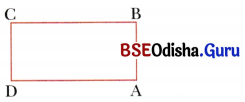
Which of the following is a valid name for the given rectangle?
Playing with Constructions Class 6 MCQ Maths Chapter 8-1
(a) ABDC
(b) DABC
(c) DCAB
(d) ACBD
Solution:
(b) DABC
DABC is the valid name for the given rectangle as it lists the vertices in a sequence around the shape.

Question 2.
Which of the following can be the side lengths of a rectangle that can be divided into 3 identical squares?
(a) 3 cm and 9 cm
(b) 3 cm and 6 cm
(c) 4 cm and 9 cm
(d) 4 cm and 8 cm
Solution:
(a) 3 cm and 9 cm
A rectangle that can be divided into 3 identical squares must have one side equal to one-third of the other. So, a rectangle with side lengths 3 cm and 9 cm can be divided into 3 identical squares.

Question 3.
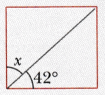
In a rectangle, one of its diagonals divides the opposite angles in 42° and x. Value of x is:
(a) 52°
(b) 58°
(c) 42°
(d) 48°
Solution:
(d) 48°
Each angle of a rectangle is 90°.
Playing with Constructions Class 6 MCQ Maths Chapter 8-3
∓ x + 42° = 90°
⇒ x = 90° – 42°
⇒ x = 48°

Playing with Constructions Class 6 MCQ Maths Chapter 8

Question 4.
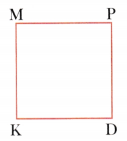
Which of the following is not a valid name for the given square?
Playing with Constructions Class 6 MCQ Maths Chapter 8-2
(a) PDKM
(b) KDPM
(c) MDKP
(d) DKMP
Solution:
(c) MDKP
MDKP is not a valid name as it does not list the vertices of the given square in a sequence around the shape.

Question 5.
What is the measure of each angle in a square?
(a) 30°
(b) 45°
(c) 60°
(d) 90°
Solution:
(d) 90°
In a square, all four angles are equal to 90°.

Question 6.
If you had to draw a circle with a 4 cm radius, which instrument would you pick?
(a) Protractor
(b) Set square
(c) Compass
(d) None of these
Solution:
(c) Compass
A compass is used to draw circles and arcs.

Playing with Constructions Class 6 MCQ Maths Chapter 8

Question 7.
Which of the following are properties of a square?
(i) All sides are equal.
(ii) All angles are 90°.
(iii) Diagonals are of different lengths.
(iv) Diagonals are of same length.
Choose the correct option from the following:
(a) (i), (ii) and (iv)
(b) (ii), (iii) and (iv)
(c) (i), (ii) and (iii)
(d) (i), (iii) and (iv)
Solution:
(a) (i), (ii) and (iv)
All sides of a square are of equal length.
Each interior angle of a square is a right angle, i.e. 90°.
The diagonals of a square are equal in length. Hence, statements (i), (ii) and (iv) are true.

Question 8.
Which of the following statements about diagonals of
(i) In a rectangle, the diagonals are equal.
(ii) In a square, the diagonals are equal.
(iii) In rectangles, the diagonals always bisect the angles equally.
(iv) In both rectangles and squares, diagonals pass through the centre.
Choose the correct option from the following:
(a) (i), (ii), and (iv)
(b) (ii), (iii) and (iv)
(c) (i), (iii), and (iv)
(d) (i) and (ii) only
Solution:
(a) (i), (ii), and (iv)
The diagonals of a rectangle are always equal in length.
In a square, diagonals are equal.
Diagonals in a rectangle do not bisect the angles equally unless it’s a square, so statement (iii) is incorrect.
In both squares and rectangles, diagonals pass through the centre.
Therefore, statements (i), (ii) and (iv) are correct.

Playing with Constructions Class 6 Fill in the Blanks

Question 1.
All the points on a circle are at the same distance from its ________ .
Solution: centre
All the points on a circle are at the same distance from its centre.

Playing with Constructions Class 6 MCQ Maths Chapter 8

Question 2.
In a rectangle, _____ sides are equal in length.
Solution: opposite
In a rectangle, opposite sides are equal in length.

Question 3.
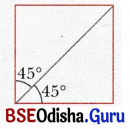
The diagonal of a square divides each opposite angle into two equal angles of _______ each.
Solution:
Playing with Constructions Class 6 MCQ Maths Chapter 8-4
The diagonal of a square divides each opposite angle into two equal angles of 45° each.

Fractions Class 6 MCQ Maths Chapter 7

Regular revision with Class 6 Maths MCQ with Answers and Ganita Prakash Class 6 Maths Chapter 7 Fractions MCQ improves accuracy in objective exams.

MCQ on Fractions Class 6

Fractions MCQ Class 6

Class 6 Maths Fractions MCQ

Question 1.
If a watermelon is shared among 4 children equally, then the share of each child is:
(a) 4
(b) \(\frac{1}{2}\)
(c) \(\frac{1}{4}\)
(d) \(\frac{1}{8}\)
Solution:
(c) \(\frac{1}{4}\)
One watermelon is shared among 4 children equally.
So, share of each child
= \(\frac{\text { Number of watermelon }}{\text { Number of children }}=\frac{1}{4}\)

Question 2.
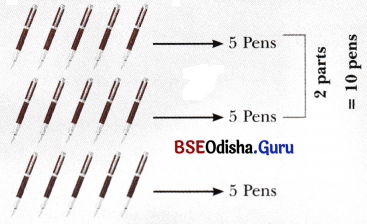
\(\frac{2}{3}\) of a collection of 15 pens is equal to:
(a) 5 pens
(b) 8 pens
(c) 10 pens
(d) 12 pens
Solution:
(c) 10 pens
In order to find \(\frac{2}{3}\) of a collection of 15 pens, we divide the collection of 15 pens in 3 equal parts and take 2 such parts.
Fractions Class 6 MCQ Maths Chapter 7-1

Question 3.
The fraction of vowels in the English alphabet is:
(a) \(\frac{21}{26}\)
(b) \(\frac{5}{26}\)
(c) \(\frac{26}{5}\)
(d) \(\frac{26}{21}\)
Solution:
(b) \(\frac{5}{26}\)
Total number of English alphabets = 26
Number of vowels = 5
So, the required fraction
= \(\frac{\text { Number of vowels }}{\text { Total number of alphabets }}=\frac{5}{26}\)

Fractions Class 6 MCQ Maths Chapter 7

Question 4.
Fraction representing 15 minutes of an hour is:
(a) \(\frac{1}{4}\)
(b) \(\frac{1}{6}\)
(c) \(\frac{1}{3}\)
(d) \(\frac{1}{2}\)
Solution:
(a) \(\frac{1}{4}\)
We know, there are 60 minutes in 1 hour.
So, fraction representing 15 minutes of an hour = \(\frac{15}{60}\) = \(\frac{1}{4}\)

Question 5.
What fraction of the natural numbers from 2 to 30 are multiples of 2 and 3?
(a) \(\frac{3}{19}\)
(b) \(\frac{5}{29}\)
(c) \(\frac{4}{19}\)
(d) \(\frac{4}{29}\)
Solution:
(b) \(\frac{5}{29}\)
Number of natural numbers from 2 to 30 = 30 – 2 + 1 = 29
Multiples of 2 and 3 from 2 to 30 are 6, 12, 18, 24 and 30.
Number of multiples of 2 and 3 from 2 to 30 = 5
∓ Required fraction = \(\frac{5}{29}\)

Question 6.
Which of the following fractions is a proper fraction?
(a) \(\frac{3}{4}\)
(b) \(\frac{3}{2}\)
(c) \(\frac{4}{3}\)
(d) \(\frac{5}{2}\)
Solution:
(a) \(\frac{3}{4}\)
We know, a fraction whose numerator is less than the denominator is called proper fraction.
So, \(\frac{3}{4}\) is a proper fraction.

Fractions Class 6 MCQ Maths Chapter 7

Question 7.
Which of the following fractions is not an improper fraction?
(a) 4
(b) \(\frac{5}{5}\)
(c) \(\frac{4}{5}\)
(d) \(\frac{5}{4}\)
Solution:
(c) \(\frac{4}{5}\)
We know, fractions with the numerator either equal to or greater than the denominator are called improper fractions.
So, \(\frac{4}{5}\) is not an improper fraction.

Question 8.
If \(\frac{5}{13}=\frac{x}{65}\) then x =
(a) 26
(b) 39
(c) 15
(d) 25
Solution:
(d) 25
Given, \(\frac{5}{13}=\frac{x}{65}\)
As they are equivalent fractions and 13 Ɨ 5 = 65, so we multiply the numerator by 5 as well.
Thus, \(\frac{5 \times 5}{13 \times 5}=\frac{x}{65}\)
⇒ \(\frac{25}{65}=\frac{x}{65}\) ⇒ x = 25

Question 9.
Which of the following fractions corresponds to the mixed fraction \(7 \frac{2}{15}\)?
(a) \(\frac{107}{15}\)
(b) \(\frac{29}{15}\)
(c) \(\frac{103}{15}\)
(d) \(\frac{44}{15}\)
Solution:
(a) \(\frac{107}{15}\)
\(7 \frac{2}{15}=7+\frac{2}{15}=\frac{7 \times 15+2}{15}\)
= \(\frac{105+2}{15}=\frac{107}{15}\)

Fractions Class 6 MCQ Maths Chapter 7

Question 10.
The equivalent fraction of \(\frac{7}{12}\) is:
(a) \(\frac{14}{26}\)
(b) \(\frac{21}{36}\)
(c) \(\frac{26}{48}\)
(d) \(\frac{34}{60}\)
Solution:
(b) \(\frac{21}{36}\)
We can write.
\(\frac{7}{12}=\frac{7 \times 2}{12 \times 2}=\frac{7 \times 3}{12 \times 3}=\frac{7 \times 4}{12 \times 4}=\frac{7 \times 5}{12 \times 5}\)
⇒ \(\frac{7}{12}=\frac{14}{24}=\frac{21}{36}=\frac{28}{48}=\frac{35}{60}\)

Question 11.
If \(\frac{21}{27}\) is equivalent to \(\frac{7}{x}\), then x is:
(a) 3
(b) 9
(c) 6
(d) 5
Solution:
(b) 9
Given, \(\frac{21}{27}=\frac{7}{x}\)
⇒ \(\frac{21 \div 3}{27 \div 3}=\frac{7}{x}\) ⇒ \(\frac{7}{9}=\frac{7}{x}\)
⇒ x = 9

Question 12.
Mixed fraction corresponding to fraction \(\frac{39}{4}\) is:
(a) \(9\frac{1}{4}\)
(b) \(10\frac{3}{4}\)
(c) \(9\frac{3}{4}\)
(d) \(10\frac{1}{4}\)
Solution:
(c) \(9\frac{3}{4}\)
\(\frac{39}{4}=9+\frac{3}{4}=9 \frac{3}{4}\)
Fractions Class 6 MCQ Maths Chapter 7-2

Fractions Class 6 MCQ Maths Chapter 7

Question 13.
\(\frac{1}{4 \frac{1}{2}}+\frac{1}{2 \frac{1}{4}}\) =
(a) \(\frac{2}{3}\)
(b) \(\frac{1}{2}\)
(c) \(\frac{3}{2}\)
(d) \(\frac{1}{3}\)
Solution:
(a) \(\frac{2}{3}\)
We have, \(\frac{1}{4 \frac{1}{2}}+\frac{1}{2 \frac{1}{4}}=\frac{1}{4+\frac{1}{2}}+\frac{1}{2+\frac{1}{4}}\)
= \(\frac{1}{\frac{4 \times 2+1}{2}}+\frac{1}{\frac{2 \times 4+1}{4}}\)
= \(\frac{1}{\frac{8+1}{2}}+\frac{1}{\frac{8+1}{4}}=\frac{1}{\frac{9}{2}}+\frac{1}{\frac{9}{4}}\)
= \(\frac{2}{9}+\frac{4}{9}=\frac{2+4}{9}=\frac{6}{9}=\frac{2}{3}\)

Question 14.
If \(\frac{1}{3}+\frac{1}{2}+\frac{1}{x}\) = 3, then x =
(a) \(\frac{5}{13}\)
(b) \(\frac{4}{9}\)
(c) \(\frac{6}{13}\)
(d) \(\frac{5}{7}\)
Solution:
(c) \(\frac{6}{13}\)
We have, \(\frac{1}{3}+\frac{1}{2}+\frac{1}{x}=3\)
⇒ \(\frac{1}{x}=3-\frac{1}{3}-\frac{1}{2}\)
⇒ \(\frac{1}{x}=\frac{3 \times 6}{6}-\frac{1 \times 2}{3 \times 2}-\frac{1 \times 3}{2 \times 3}\)
⇒ \(\frac{1}{x}=\frac{18}{6}-\frac{2}{6}-\frac{3}{6} \Rightarrow \frac{1}{x}=\frac{18-2-3}{6}\)
⇒ \(\frac{1}{x}=\frac{13}{6}\) ⇒ 13 Ɨ x = 1 Ɨ 6
⇒ x = \(\frac{1 \times 6}{13}=\frac{6}{13}\)

Question 15.
Which of the following fractions can be written as mixed fraction?
(i) \(\frac{5}{4}\)
(ii) \(\frac{8}{3}\)
(iii) \(\frac{3}{4}\)
(iv) \(\frac{5}{8}\)
Choose the correct option from the following:
(a) Only (i)
(b) (ii) and (iii)
(c) (i) and (iv)
(d) (i) and (ii)
Solution:
(d) (i) and (ii)
We know that only those fractions, which are greater than 1, can be converted into mixed fractions. Here, \(\frac{5}{4}\) and \(\frac{8}{3}\) are greater than 1 as numerator is greater than denominator in each case.

Fractions Class 6 MCQ Maths Chapter 7

Question 16.
Consider the following fractions:
(i) \(\frac{7}{2}\)
(ii) \(\frac{8}{3}\)
(iii) \(\frac{13}{4}\)
(iv) \(\frac{17}{6}\)
Which of the following fractions are greater than 3?
(a) (i) and (iii)
(b) (i) and (iv)
(c) (ii) and (iii)
(d) (ii) and (iv)
Solution:
(a) (i) and (iii)
\(\frac{7}{2}=3 \frac{1}{2}\) (which is greater than 3)
\(\frac{8}{3}=2 \frac{2}{3}\) (which is smaller than 3)
\(\frac{13}{4}=3 \frac{1}{4}\) (which is greater than 3)
\(\frac{17}{6}=2 \frac{5}{6}\) (which is smaller than 3)

Fractions Class 6 Fill in the Blanks

Question 1.
Five apples together weigh 1 kg. If they are of the same size, each apple will weigh ______ kg.
Solution: \(\frac{1}{5}\)
Given, weight of five apples = 1 kg
∓ Weight of one apple = \(\frac{1}{5}\) kg

Question 2.
\(\frac{2}{5}\) is _____ than \(\frac{4}{5}\).
Solution: smaller
\(\frac{2}{5}\) means 2 parts out of 5 and \(\frac{4}{5}\) means 4 parts
out of 5.
∓ \(\frac{2}{5}\) is smaller than \(\frac{4}{5}\).

Fractions Class 6 MCQ Maths Chapter 7

Question 3.
Seven friends ordered 4 glasses of orange juice and shared it equally among themselves. Each one drank ________ glass of orange juice.
Solution: \(\frac{4}{7}\)
Given, 7 friends ordered 4 glasses of orange juice and shared it equally.
∓ Each one drank \(\frac{4}{7}\) glasses of orange juice.

Question 4.
The number of whole units in \(\frac{9}{2}\) is ________ .
Solution: 4
We can write, \(\frac{9}{2}\) = 4 + \(\frac{1}{2}\)
∓ The number of whole units in \(\frac{9}{2}\) is 4.

Question 5.
4 glasses of juice shared equally among 3 friends is the same as _______ glasses of juice shared equally among 9 friends.
Solution: 12
Let x be the required number of glasses of juice.
So, \(\frac{4}{3}=\frac{x}{9}\) ⇒ \(\frac{4 \times 3}{3 \times 3}=\frac{x}{9}\)
⇒ \(\frac{12}{9}=\frac{x}{9}\) ⇒ x = 12
So, 4 glasses of juice shared equally among 3 friends is the same as 12 glasses of juice shared equally among 9 friends.

Fractions Class 6 MCQ Maths Chapter 7

Question 6.
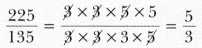
The simplest form of \(\frac{225}{135}\) is _________ .
Solution: \(\frac{5}{3}\)
We have, Fractions Class 6 MCQ Maths Chapter 7-4
∓ The simplest form of \(\frac{225}{135}\) is \(\frac{5}{3}\).

Question 7.
In all the fractions that are less than 1 unit, the _______ is smaller than the _________ .
Solution: numerator, denominator
In all the fractions that are less than 1 unit, the numerator is smaller than the denominator.

Question 8.
In all the fractions that are more than 1 unit, the numerator is _______ than the denominator.
Solution: greater
In all the fractions that are more than 1 unit, the numerator is greater than the denominator.

Fractions Class 6 MCQ Maths Chapter 7

Question 9.
150 rupees distributed equally among _________ students is the same as 750 rupees distributed equally among 25 students.
Solution: 5
Let x be the required number of students.
So, \(\frac{150}{x}=\frac{750}{25}\) ⇒ x = 150 Ɨ \(\frac{25}{750}\)
⇒ x = 150 Ɨ \(\frac{1}{30}\) ⇒ x = 5
So, 150 rupees distributed equally among 5 students is the same as 750 rupees distributed equally among 25 students.

Question 10.
Use >, =, < to fill the boxes:
Fractions Class 6 MCQ Maths Chapter 7-3
Solution: <
(i) When the denominator is same, the Fraction with greater numerator is larger.
∓ \(\frac{19}{6}<\frac{23}{6}\)
(ii) The least common multiple of 9 and 8 is 72.
We can write \(\frac{4}{9}=\frac{4 \times 8}{9 \times 8}=\frac{32}{72}\)
and \(\frac{13}{8}=\frac{13 \times 9}{8 \times 9}=\frac{117}{72}\)
We know, 32 < 117
⇒ \(\frac{32}{72}<\frac{117}{72}\) ⇒ \(\frac{4}{9}<\frac{13}{8}\)

Perimeter and Area Class 6 MCQ Maths Chapter 6

Regular revision with Class 6 Maths MCQ with Answers and Ganita Prakash Class 6 Maths Chapter 6 Perimeter and Area MCQ improves accuracy in objective exams.

MCQ on Perimeter and Area Class 6

Perimeter and Area MCQ Class 6

Class 6 Maths Perimeter and Area MCQ

Question 1.
The perimeter of a closed plane figure is:
(a) The total space occupied by the figure
(b) The sum of all angles
(c) The distance covered along its boundary
(d) The distance from the centre to the boundary
Solution:
(c) The distance covered along its boundary
We know that the perimeter of any closed plane figure is the distance covered along its boundary when you go around it once.

Question 2.
The perimeter of a rectangle with length l and breadth b is:
(a) l + b
(b) 2l + 2b
(c) l Ɨ b
(d) 2 Ɨ l Ɨ b
Solution:
(b) 2l + 2b
Given, the length and breadth of a rectangle are l and b, respectively.
Now, perimeter of a rectangle = 2 Ɨ (length + breadth)
= 2 Ɨ (l + b) = 2l + 2b

Question 3.
If the length and breadth of a rectangle are 12 cm and 8 cm respectively, its perimeter is:
(a) 20 cm
(b) 40 cm
(c) 96 cm
(d) 80 cm
Solution:
(b) 40 cm
Given, the length and breadth of a rectangle are 12 cm and 8 cm, respectively.
Now, perimeter of a rectangle = 2 Ɨ (12 cm + 8 cm) = 2 Ɨ 20 cm = 40 cm

Perimeter and Area Class 6 MCQ Maths Chapter 6

Question 4.
If the sides of a triangle are 3 cm, 5 cm and 7 cm, its perimeter is:
(a) 15 cm
(b) 16 cm
(c) 17 cm
(d) 18 cm
Solution:
(a) 15 cm
Given, the sides of a triangle are 3 cm, 5 cm and 7 cm.
Now, perimeter of a triangle = sum of the lengths of its three sides
= 3 cm + 5 cm + 7 cm = 15 cm

Question 5.
The perimeter of a regular polygon is given by:
(a) Number of sides Ɨ length of one side
(b) Sum of two sides
(c) Side length Ɨ side length
(d) Half the sum of all sides
Solution:
(a) Number of sides Ɨ length of one side
We know that the perimeter of a regular polygon is number of sides Ɨ length of one side.

Question 6.
The perimeter of a polygon is equal to:
(a) The sum of the areas of all sides
(b) The sum of the lengths of all sides
(c) The product of the lengths of all sides
(d) Twice the length of one side
Solution:
(b) The sum of the lengths of all sides
We know that a polygon is a closed plane figure made up of line segments and the perimeter of a polygon is the sum of the lengths of its all sides, i.e., the total distance along its outer boundary.

Perimeter and Area Class 6 MCQ Maths Chapter 6

Question 7.
Which of the following figures has a perimeter?
(a) Open curve
(b) Line segment
(c) Polygon
(d) Ray
Solution:
(c) Polygon
We know that the perimeter of any closed plane figure is the distance covered along its boundary when we go around it once.
An open curve is not dosed, so it doesn’t have a perimeter.
A line segment is just a straight line between two points, not a closed figure.
A ray extends infinitely in one direction, so it doesn’t have a perimeter.
A polygon is a closed figure and it has a perimeter.

Question 8.
The perimeter of a square with side a is:
(a) 2a
(b) 3a
(c) 4a
(d) 5a
Solution:
(c) 4a
Given, the length of a side of a square is a. Now, perimeter of a square
= 4 Ɨ length of a side = 4 Ɨ a = 4a

Question 9.
In a triangle, the perimeter depends on:
(a) Only two sides
(b) Two angles and one side
(c) All three sides
(d) None of these
Solution:
(c) All three sides
We know that the perimeter of a triangle is the sum of the lengths of its three sides.
Therefore, the perimeter of a triangle depends on all three sides.

Perimeter and Area Class 6 MCQ Maths Chapter 6

Question 10.
The perimeter of a regular pentagon with side 6 cm is:
(a) 24 cm
(b) 30 cm
(c) 36 cm
(d) 42 cm
Solution:
(b) 30 cm
Given, length of the side of a pentagon is 6 cm.
We know that the number of sides in a pentagon is 5.
And perimeter of a regular polygon = Number of sides Ɨ length of one side
Now, perimeter of a regular pentagon = 5 Ɨ Length of the side = 5 Ɨ 6 cm = 30 cm

Question 11.
What is the formula for the area of a rectangle?
(a) 2 Ɨ (length + breadth)
(b) length Ɨ breadth
(c) length + breadth
(d) 4 Ɨ side
Solution:
(b) length Ɨ breadth
We know, area of a rectangle = Length Ɨ Breadth

Question 12.
A square has a side of 11 m. What is its area?
(a) 51 sq. m
(b) 44 sq. m
(c) 100 sq. m
(d) 121 sq. m
Solution:
(d) 121 sq. m
Given, a square has a side of 11 m.
So, area of the square = Side Ɨ Side
= 11 m Ɨ 11 m
= 121 sq. m

Perimeter and Area Class 6 MCQ Maths Chapter 6

Question 13.
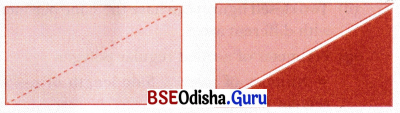
The triangle formed by cutting a rectangle along one diagonal has:
(a) Same area as the rectangle
(b) Half the area of the rectangle
(c) Double the area of the rectangle
(d) No relation
Solution:
(b) Half the area of the rectangle
We know that if a rectangle is cut along one of its diagonals, then the area of each resulting triangle is half the area of the rectangle.
Perimeter and Area Class 6 MCQ Maths Chapter 6-1

Question 14.
A triangle has a base of 8 cm and height of 6 cm. What is its area?
(a) 48 sq. cm
(b) 32 sq. cm
(c) 16 sq.cm
(d) 24 sq. cm
Solution:
(d) 24 sq. cm
Given, base of the triangle = 8 cm; and height of the triangle = 6 cm
So, area of the triangle = \(\frac{1}{2}\) Ɨ Base Ɨ Height
= \(\frac{1}{2}\) Ɨ 8 cm Ɨ 6 cm
= 4 cm Ɨ 6 cm = 24 sq. cm

Question 15.
A floor is 6 m long and 5 m wide. What is its area?
(a) 11 sq. m
(b) 30 sq. m
(c) 60 sq. m
(d) 25 sq. m
Solution:
(b) 30 sq. m
Given, length of the floor = 6 m
And, breadth of the floor = 5 m
So, area of floor = Length Ɨ Breadth
= 6 m Ɨ 5 m = 30 sq. m

Perimeter and Area Class 6 MCQ Maths Chapter 6

Question 16.
The area of a rectangle is 48 sq. m, and the length is 8 m. What is the breadth?
(a) 6 m
(b) 4 m
(c) 8 m
(d) 12 m
Solution:
(a) 6 m
Given, length of the rectangle = 8 m
And, area of the rectangle = 48 sq. m
We know, area of the rectangle
= Length Ɨ Breadth
⇒ 48 sq. m = 8 m Ɨ Breadth
⇒ Breadth = \(\frac{48 \mathrm{sq} \cdot \mathrm{~m}}{8 \mathrm{~m}}\) = 6m

Question 17.
The area of a triangle is equal to:
(a) base Ɨ height
(b) \(\frac {1}{2}\) Ɨ base Ɨ height
(c) base + height
(d) base Ć· height
Solution:
(b) \(\frac {1}{2}\) Ɨ base Ɨ height
We know, area of a triangle = \(\frac{1}{2}\) Ɨ base Ɨ height
Perimeter and Area Class 6 MCQ Maths Chapter 6-2

Question 18.
A triangle with base 10 cm and height 5 cm has an area of:
(a) 25 sq. cm
(b) 15 sq. cm
(c) 50 sq. cm
(d) 40 sq. cm
Solution:
(a) 25 sq. cm
Given, base of the triangle =10 cm
And, height of the triangle = 5 cm
So, area of the triangle = \(\frac{1}{2}\) Ɨ Base Ɨ Height
= \(\frac{1}{2}\) Ɨ 10 cm Ɨ 5 cm
= 5 cm Ɨ 5 cm = 25 sq. cm

Perimeter and Area Class 6 MCQ Maths Chapter 6

Question 19.
Which of the following is correct?
(i) The perimeter of a closed figure is the distance around its boundary.
(ii) The perimeter of a rectangle is twice the sum of its length and breadth.
(iii) The perimeter of a square is quadruple the length of its side.
(iv) The perimeter of an equilateral triangle is twice the length of one side.
Choose the correct option from the following:
(a) (i), (ii) and (iii)
(b) (ii), (iii) and (iv)
(c) (i), (ii) and (iv)
(d) (i), (iii) and (iv)
Solution:
(a) (i), (ii) and (iii)
(i) We know that the perimeter of any closed plane figure is the distance covered along its boundary when you go around it once.
∓ Statement (i) is correct.
(ii) Perimeter of rectangle = 2(length + breadth) i.e., the perimeter of a rectangle is twice the sum of its length and breadth.
∓ Statement (ii) is correct.
(iii) Perimeter of square = 4 Ɨ side i.e., the perimeter of a square is quadruple (four times) the length of its side.
∓ Statement (iii) is correct.
(iv) Perimeter of equilateral triangle = 3 Ɨ side of equilateral triangle i.e., the perimeter of an equilateral triangle is thrice the length of one side.
∓ Statement (iv) is incorrect.

Question 20.
Which of the following is correct?
(i) Two closed figures can have the same area with different perimeters.
(ii) Two closed figures can have the same perimeter with different areas.
(iii) Perimeter of n-sided regular polygon
= Number of sides Ɨ Side length of n-sided regular polygon
(iv) Area of triangle = \(\frac{1}{2}\) Ɨ Base v Height
Choose the correct option from the following:
(a) (i), (ii) and (iii) only
(b) (ii), (iii) and (iv) only
(c) (i), (ii) and (iv) only
(d) (i), (ii) (iii) and (iv)
Solution:
(d) (i), (ii) (iii) and (iv)
(i) Two closed figures can have the same area with different perimeters, or the same perimeter with different areas.
(ii) For a given area of rectangular shapes, a square has the smallest perimeter and for a given perimeter of rectangular shapes, the square covers the most space
∓ Statements (i) and (ii) are correct.
(iii) If s is side length of an n-sided regular polygon, then:
Perimeter of n-sided regular polygon
= n Ɨ s
= Number of sides Ɨ Side length of n-sided regular polygon
∓ Statement (iii) is correct.
(iv) Area of a triangle with base b and height h is given by
Area of triangle = \(\frac{1}{2}\) Ɨ base Ɨ height
= \(\frac{1}{2}\) Ɨ b Ɨ h
∓ Statement (iv) is correct.

Question 21.
Which of the following is correct?
(i) If the area of a square is 144 cm2, then the perimeter of the square is 12 cm.
(ii) The perimeter of a regular hexagon having a side of 6 cm is 36 cm.
(iii) A triangle with base 12 cm and height 7 cm has an area of 84 cm2.
(iv) The perimeter of a rectangle with area 72 cm2 and length 9 cm is 34 cm.
Choose the correct option from the following:
(a) (ii) and (iii)
(b) (iii) and (iv)
(c) (ii) and (iv)
(d) (i) and (ii)
Solution:
(c) (ii) and (iv)
(i) We know that area of square = side Ɨ side
Given, area of a square =144 cm2 =12 cm Ɨ 12 cm
Side of square = 12 cm
Perimeter of square = 4 Ɨ side = 4 Ɨ 12 = 48 cm
(i) is incorrect.

(ii) If s is side length of an n-sided regular polygon, then:
Perimeter of n-sided regular polygon
= n Ɨ s
= Number of sides Ɨ Side length of n-sided regular polygon
Side of regular hexagon = 6 cm
∓ Perimeter of a regular hexagon = 6 Ɨ 6 = 36 cm
(ii) is correct.

(iii) Area of triangle = \(\frac{1}{2}\) Ɨ base Ɨ height
= \(\frac{1}{2}\) Ɨ 12 Ɨ 7 = 42 cm2
(iii) is incorrect.

(iv) Area of rectangle = length Ɨ breadth
⇒ 72 cm2 = 9 cm Ɨ breadth
⇒ Breadth = \(\frac{72}{9}\) = 8 cm
Perimeter of rectangle = 2(length + breadth)
= 2(9 + 8) = 2 Ɨ 17 = 34 cm
(iv) is correct.

Perimeter and Area Class 6 MCQ Maths Chapter 6

Question 22.
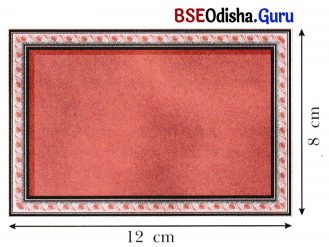
A rectangular frame with length 12 cm and breadth 8 cm is shown below. Which of the following is correct?
Perimeter and Area Class 6 MCQ Maths Chapter 6-3
(i) The perimeter of the rectangular frame is 40 cm.
(ii) The area of the rectangular frame is 96 cm2.
(iii) If the breadth of the rectangular frame is doubled, the new perimeter of the rectangular frame will be 64 cm.
(iv) If the length of the rectangular frame is doubled, the new area of the frame will be 384 cm2.
Choose the correct option from the following:
(a) (ii) and (iii)
(b) (iii) and (iv)
(c) (i) and (iv)
(d) (i) and (ii)
Solution:
(d) (i) and (ii)
We have, length of rectangular frame = 12 cm breadth of rectangular frame = 8 cm
(i) Perimeter of rectangular frame
= 2(length + breadth)
= 2(12 + 8) = 2 Ɨ 20 = 40 cm
(i) is correct.

(ii) Area of rectangular frame = length Ɨ breadth
= 12 Ɨ 8 = 96 cm2
(ii) is correct.

(iii) New breadth of rectangular frame = 2 Ɨ 8 = 16 cm
New perimeter of rectangular frame = 2(length + new breadth)
= 2(12 +16) = 2 Ɨ 28 = 56 cm
(iii) is incorrect.

(iv) New length of rectangular frame = 2 Ɨ 12 = 24 cm
New area of rectangular frame = new length Ɨ breadth
= 24 Ɨ 8 = 192 cm2
(iv) is incorrect.

Perimeter and Area Class 6 Assertion and Reason Questions

The following questions are Assertion and Reason based questions. Two statements are given, one labelled as Assertion (A) and the other is labelled as Reason (R). Select the correct answer to these questions from the codes (a), (b), (c) and (d) as given below.
(a) Both A and R are true and R is the correct explanation of A.
(b) Both A and R are true but R is not the correct explanation of A.
(c) A is true but R is false.
(d) A is false but R is true.

Question 1.
(A): The perimeter of a closed figure is the distance around its boundary.
(R): The perimeter is calculated by multiplying the length by the breadth.
Solution:
(c) A is true but R is false.
We know that the perimeter of any closed plane figure is the distance covered along its boundary when you go around it once.
Thus, Assertion (A) is true, but Reason (R) is false.

Perimeter and Area Class 6 MCQ Maths Chapter 6

Question 2.
(A): The perimeter of a rectangle is twice the sum of its length and breadth.
(R): Opposite sides of a rectangle are always equal.
Solution:
(a) Both A and R are true and R is the correct explanation of A.
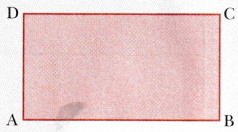
Let ABCD be a rectangle.
Perimeter and Area Class 6 MCQ Maths Chapter 6-4
Now, perimeter of the rectangle
= Sum of the lengths of its four sides
= AB + BC + CD + DA
= 2 Ɨ AB + 2 Ɨ BC [∓ Opposite sides of a rectangle are always equal. So, AB = CD and AD = BC]
= 2 Ɨ (AB + BC)
= 2 Ɨ (Length + Breadth)
Thus, both Assertion (A) and Reason (R) are true, and Reason (R) is the correct explanation of Assertion (A).

Question 3.
(A): The perimeter of a regular polygon is the product of the number of sides and the length of one side.
(R): In a regular polygon, all sides are equal.
Solution:
(a) Both A and R are true and R is the correct explanation of A.
We know that in a regular polygon, all sides are equal.
So, perimeter of a regular polygon = Number of sides Ɨ Length of one side i.e. the perimeter of a regular polygon is the product of the number of sides and the length of one side.

Thus, both Assertion (A) and Reason (R) are true, and Reason (R) is the correct explanation of Assertion (A).

Question 4.
(A): The perimeter of an equilateral triangle is twice the length of one side.
(R): An equilateral triangle has all sides equal.
Solution:
(d) A is false but R is true.
We know that the perimeter of a triangle is the sum of the lengths of its three sides.
In an equilateral triangle, all sides are of equal length.
Thus, Assertion (A) is false, but Reason (R) is true.

Perimeter and Area Class 6 MCQ Maths Chapter 6

Question 5.
(A): The perimeter of a rectangle is given by 2 Ɨ (length + breadth).
(R): A rectangle has four unequal sides.
Solution:
(c) A is true but R is false.
Let ABCD be a rectangle.
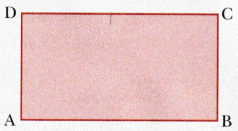
Perimeter and Area Class 6 MCQ Maths Chapter 6-5
Now,
perimeter of the rectangle = Sum of the lengths of its four sides
= AB + BC + CD + DA
= 2 Ɨ AB + 2 Ɨ BC [∓ Opposite sides of a rectangle are always equal. So, AB = CD and AD = BC]
= 2 Ɨ (AB + BC) = 2 Ɨ (Length + Breadth)
Thus, Assertion (A) is true, but Reason (R) is false.

Question 6.
(A): The perimeter of a square having a side of 5 cm is 10 cm.
(R): Perimeter of a square = 4 Ɨ side.
Solution:
(d) A is false but R is true.
We know, perimeter of a square = 4 Ɨ side
Given, the length of side of a square is 5 cm.
Now, perimeter of the square = 4 Ɨ side = 4 Ɨ 5 cm = 20 cm
Thus, Assertion (A) is false,’but Reason (R) is true.

Question 7.
(A): The area of a rectangle having length 5 cm & breadth 2.5 cm is 12.5 sq. cm.
(R): The area of a rectangle is calculated as length Ɨ breadth.
Solution:
(a) Both A and R are true and R is the correct explanation of A.
Given, length of the rectangle = 5 cm; and, breadth of the rectangle = 2.5 cm
Now, area of the rectangle = Length Ɨ Breadth
= 5 cm Ɨ 2.5 cm = 12.5 sq. cm
Thus, both Assertion (A) and Reasqn (R) are true, and Reason (R) is the correct explanation
of Assertion (A).

Perimeter and Area Class 6 MCQ Maths Chapter 6

Question 8.
(A): The area of a square of side 4.5 cm is 20.25 sq. cm.
(R): The area of a square = side Ɨ side
Solution:
(a) Both A and R are true and R is the correct explanation of A.
Given, the side of a square is 4.5 cm.
Now, area of the square = Side Ɨ Side
= 4.5 cm Ɨ 4.5 cm = 20.25 sq. cm
Thus, both Assertion (A) and Reason (R) are true, and Reason (R) is the correct explanation of Assertion (A).

Question 9.
(A): If four square flower beds of side 3.5 m each are placed on a 10 m Ɨ 12 m held, the remaining area is 71 sq. m.
(R): The total area of the field is 120 sq. m and the area of the four flower beds is 49 sq. m.
Solution:
(a) Both A and R are true and R is the correct explanation of A.
Given, the side of a square flower bed is 3.5 m.
Now, area of one square flower bed = Side Ɨ Side
= 3.5 m Ɨ 3.5 m = 12.25 sq. m
So, total area of four flower beds = 4 Ɨ Area of one flower bed
= 4 Ɨ 12.25 sq. m = 49 sq. m
Also, length of the field = 10 m
Aid, breadth of the field = 12 m
So, area of the field = Length Ɨ Breadth
= 10 m Ɨ 12 m = 120 sq. m

If all the four square flower beds are placed in the field,

Remaining area = Area of the field – Total area of four flower beds
= 120 sq. m – 49 sq. m = 71 sq. m
Thus, both Assertion (A) and Reason (R) are true, and Reason (R) is the correct explanation of Assertion (A).

Perimeter and Area Class 6 Fill in the Blanks

Question 1.
A regular polygon has all sides and _______ equal.
Solution: angles
We know that the closed figures that have all sides and all angles equal are called regular polygons.
Therefore, a regular polygon has all sides and angles equal.

Perimeter and Area Class 6 MCQ Maths Chapter 6

Question 2.
The unit of measurement of perimeter is same as that of _____ of sides.
Solution: length
The unit of measurement of perimeter is same as that of length of sides.

Question 3.
The perimeter of closed plane figure is the length of its _____ .
Solution: boundary
We know that the perimeter of closed plane figure is the length of its boundary.

Question 4.
The ________ of a regular polygon is calculated by multiplying the number of its sides by the length of one side.
Solution: perimeter
We know, perimeter of a regular polygon = Number of sides Ɨ length of one side
So, the perimeter of a regular polygon is calculated by multiplying the number of its sides by the length of one side.

Perimeter and Area Class 6 MCQ Maths Chapter 6

Question 5.
The amount of region enclosed by a closed figure is called its __________.
Solution: area
We know, the amount of region enclosed by a closed figure is called its area.

Question 6.
The area of a square is always equal to the _______ of its side length.
Solution: square
We know, the area of a square is always equal to the square of its side length.

Question 7.
For the given area of rectangular shapes, _______ has smallest perimeter.
Solution: square
For the given area of rectangular shapes, square has smallest perimeter.

Perimeter and Area Class 6 MCQ Maths Chapter 6

Question 8.
For the given perimeter of rectangular shapes, square has the largest _______ .
Solution: area
For the given perimeter of rectangular shapes, square has the largest area.

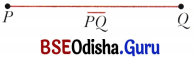
Prime Time Class 6 MCQ Maths Chapter 5

Regular revision with Class 6 Maths MCQ with Answers and Ganita Prakash Class 6 Maths Chapter 5 Prime Time MCQ improves accuracy in objective exams.

MCQ on Prime Time Class 6

Prime Time MCQ Class 6

Class 6 Maths Prime Time MCQ

Question 1.
Which of the following is a factor of 36?
(a) 5
(b) 14
(c) 9
(d) 15
Solution:
(c) 9
We can write 36 = 1 Ɨ 36 = 2 Ɨ 18 = 3 Ɨ 12 = 4 Ɨ 9 = 6 Ɨ 6
Hence, the factors of 36 are 1, 2, 3, 4, 6, 9, 12, 18 and 36.

Question 2.
Which of the following is a multiple of 15?
(a) 125
(b) 135
(c) 145
(d) 155
Solution:
(b) 135
We can write 135 = 15 Ɨ 9.
Hence, 135 is a multiple of 15.

Question 3.
Which of the following is a perfect number?
(a) 4
(b) 5
(c) 6
(d) 8
Solution:
(c) 6
We know that a number for which the sum of all its factors is equal to twice of itself, is called a perfect number.
Factors of 6 are 1, 2, 3 and 6.
Sum of factors of 6 = 1 + 2 + 3 + 6= 12, which is double of number 6.
Hence, 6 is a perfect number.

Prime Time Class 6 MCQ Maths Chapter 5

Question 4.
Which of the following is not a multiple of 24?
(a) 72
(b) 120
(c) 168
(d) 206
Solution:
(d) 206
Clearly, 72 = 24 Ɨ 3, 120 = 24 Ɨ 5 and 168 = 24 Ɨ 7
Hence, 72, 120 and 168 are multiples of 24. But 206 is not a multiple of 24.

Question 5.
Which of the following is not a common multiple of 2 and 5?
(a) 30
(b) 40
(c) 45
(d) 50
Solution:
(c) 45
Clearly, 30 = 2 Ɨ 15 = 5 Ɨ 6, 40 = 2 Ɨ 20 = 5 Ɨ 8 and 50 = 2 Ɨ 25 = 5 Ɨ 10
∓ 30, 40 and 50 are common multiples of 2 and 5.
Since 45 = 5 Ɨ 9, 45 is a multiple of 5 but not of 2.
Thus, 45 is not a common multiple of 2 and 5.

Question 6.
Which of the following is a composite number?
(a) 47
(b) 67
(c) 57
(d) 89
Solution:
(c) 57
Factors of 47 are 1 and 47.
Factors of 67 are 1 and 67.
Factors of 57 are 1, 3, 19 and 57.
Factors of 89 are 1 and 89.
Since 57 has more than two factors, 57 is a composite number.

Prime Time Class 6 MCQ Maths Chapter 5

Question 7.
Which of the following numbers is the product of exactly three distinct prime numbers?
(a) 135
(b) 145
(c) 155
(d) 165
Solution:
(d) 165
Every number can be expressed as a product of primes.
135 = 3 Ɨ 3 Ɨ 3 Ɨ 5 (only two prime numbers 3 and 5)
145 = 5 Ɨ 29 (only two prime numbers 5 and 29)
155 = 5 Ɨ 31 (only two prime numbers 5 and 31)
165 = 3 Ɨ 5 Ɨ 11 (three distinct prime numbers 3, 5 and 11)

Question 8.
The difference between the prime numbers between 80 and 90 is:
(a) 6
(b) 7
(c) 8
(d) 9
Solution:
(a) 6
The prime numbers between 80 and 90 are 83 and 89.
Hence, the required difference = 89 – 83 = 6

Question 9.
Which of the following are co-prime?
(a) 8 and 14
(b) 12 and 15
(c) 14 and 15
(d) 18 and 21
Solution:
(c) 14 and 15
Factors of 14 are 1, 2, 7 and 14.
Factors of 15 are 1, 3, 5 and 15.
Since 1 is the only common factor of 14 and 15, they are co-prime.

Prime Time Class 6 MCQ Maths Chapter 5

Question 10.
Which of the following are twin primes?
(a) 3 and 7
(b) 11 and 13
(c) 13 and 19
(d) 17 and 23
Solution:
(b) 11 and 13
Twin primes are pairs of primes having a difference of 2.
13 – 11 = 2
Hence, 11 and 13 are twin primes.

Question 11.
The smallest number having four different prime factors is:
(a) 210
(b) 215
(c) 230
(d) 240
Solution:
(a) 210
The smallest number, having four different prime factors, will be obtained as the product of the first four prime numbers.
The first four smallest prime numbers are 2, 3, 5 and 7.
Thus, the required number = 2 Ɨ 3 Ɨ 5 Ɨ 7 = 210

Question 12.
The prime factorisation of 44100 is:
(a) 2 Ɨ 2 Ɨ 2 Ɨ 3 Ɨ 3 Ɨ 5 Ɨ 5 Ɨ 7
(b) 2 Ɨ 2 Ɨ 3 Ɨ 3 Ɨ 5 Ɨ 5 Ɨ 7 Ɨ 7
(c) 2 Ɨ 3 Ɨ 5 Ɨ 5 Ɨ 5 Ɨ 7 Ɨ 7
(d) 2 Ɨ 3 Ɨ 3 Ɨ 5 Ɨ 7 Ɨ 7 Ɨ 7
Solution:
(b) 2 Ɨ 2 Ɨ 3 Ɨ 3 Ɨ 5 Ɨ 5 Ɨ 7 Ɨ 7
The prime factorisation of 44100 is
44100 = 2 Ɨ 2 Ɨ 3 Ɨ 3 Ɨ 5 Ɨ 5 Ɨ 7 Ɨ 7
Prime Time Class 6 MCQ Maths Chapter 5-1

Prime Time Class 6 MCQ Maths Chapter 5

Question 13.
In prime factorisation of 2250, number 5 appears:
(a) 1 time
(b) 2 times
(c) 3 times
(d) 4 times
Solution:
(c) 3 times
The prime factorisation of 2250 is 2250 = 2 Ɨ 3 Ɨ 3 Ɨ 5 Ɨ 5 Ɨ 5.
Prime Time Class 6 MCQ Maths Chapter 5-2
Here, 2 appears once, 3 appears 2 times and 5 appears 3 times.

Question 14.
Which one of the following numbers is divisible by 8?
(a) 7634452
(b) 4078376
(c) 7232854
(d) 5736500
Solution:
(b) 4078376
For a number to be divisible by 8, the number formed by its last three digits should be divisible by 8.
The number formed by the last three digits of 4078376 is 376.
Since 376 = 8 x 47, it is divisible by 8.
Thus, 4078376 is divisible by 8.

Question 15.
Which one of the following numbers is divisible by all of 2, 4, 5, 8 and 10?
(a) 72460
(b) 73360
(c) 78945
(d) 76390
Solution:
(b) 73360
We know that if a number is divisible by 5 and
8, then it is also divisible by 2, 4 and 10.
All four numbers end with either ā€˜0’ or ā€˜5’, therefore they are divisible by 5.
The number formed by the last three digits of 73360 is 360.
Since 360 = 8 Ɨ 45, it is divisible by 8.
Thus, 73360 is divisible by 8.
So, 73360 is divisible by all of 2, 4, 5, 8 and 10.

Prime Time Class 6 MCQ Maths Chapter 5

Question 16.
Which digit should replace * so that the number 80405*6 is divisible by 4?
(a) 2
(b) 0
(c) 5
(d) 8
Solution:
(c) 5
For a number to be divisible by 4, the number formed by its last two digits should be divisible by 4.
Digits 1, 3, 5, 7 or 9 can replace * because 16, 36, 76 and 96 are divisible by 4.
Thus, 8040516, 8040536, 8040556, 8040576 and 8040596 are divisible by 4.

Question 17.
Which one of the following numbers is divisible by 10?
(a) 101010
(b) 232323
(c) 656565
(d) 727272
Solution:
(a) 101010
Since 101010 ends with digit 0, it is divisible by 10.

Question 18.
Which of the following statements are true?
(i) A number which is divisible by 10 will always be divisible by 2 also.
(ii) Every multiple of 5 ends with 5 only.
(iii) A factor of a number is always equal to or smaller than the number.
(iv) A composite number has more than 2 factors.
Choose the correct option from the following:
(a) (i) and (iii) only
(b) (ii) and (iii) only
(c) (i), (iii) and (iv)
(d) (iii) and (iv) only
Solution:
(c) (ii) and (iv)
We know that a number is divisible by 10 if it ends with 0.
And, if a number ends with 0, it is also even and hence divisible by 2.
So, any number that is divisible by 10 is divisible by 2.
Alternative explanation:
10 = 2 Ɨ 5, which means if a number is divisible by 10, it must also be divisible by both 2 and 5, since they are the factors of 10. Thus, statemen (i) is true.
We know that a number is divisible by 5 or a multiple of 5 if it ends with either 0 or 5.
Thus, statement (ii) is false.
We know that a factor divides a number exactly, without leaving any remainder. So, it cannot be greater than the number itself. The largest factor a number can have is the number itself. Thus, statement (iii) is true.
We know that a number is said to be composite if it has more than 2 factors.

Prime Time Class 6 MCQ Maths Chapter 5

Question 19.
Which of the following is/are not the correct prime factorisation?
(i) 144 = 2 Ɨ 2 Ɨ 2 Ɨ 3 Ɨ 3
(ii) 225 = 3 Ɨ 3 Ɨ 5 Ɨ 5
(iii) 100 = 2 Ɨ 5 Ɨ 10
(iv) 160 = 2 Ɨ 2 Ɨ 2 Ɨ 2 Ɨ 2 Ɨ 5
Choose the correct option from the following:
(a) (i) and (iii)
(b) (ii) and (iii)
(c) (ii) and (iv)
(d) (iii) and (iv)
Solution:
(a) (i) and (iii)
Prime facionsation of 1 44 = 2 Ɨ 2 Ɨ 2 Ɨ 2 Ɨ 3 Ɨ 3
Prime factorisation of 225 = 3 Ɨ 3 Ɨ 5 Ɨ 5
Prime factorisation of 100 = 2 Ɨ 2 Ɨ 5 Ɨ 5
Prime factorisation of 160 = 2 Ɨ 2 Ɨ 2 Ɨ 2 Ɨ 2 Ɨ 5
Prime Time Class 6 MCQ Maths Chapter 5-3
Thus, in the given prime factorisations, prime factorisation of 144 and 100 are incorrect.

Question 20.
Which of the following numbets can be expressed as the product of 4 distinct primes?
(i) 462
(ii) 315
(iii) 1155
(iv) 1925
Choose the correct option from the following:
(a) (i) and (ii)
(b) (i) and (iii)
(c) (ii) and (iv)
(d) (iii) and (iv)
Solution:
(b) (i) and (iii)
Prime factorisation of 462 = 2 Ɨ 3 Ɨ 7 Ɨ 11 (Product of 4 distinct primes)
Prime factorisation of 315 = 3 Ɨ 3 Ɨ 5 Ɨ 7 (Product of only 3 distinct primes)
Prime factorisation of 1155 = 3 Ɨ 5 Ɨ 7 Ɨ 11 (Product of 4 distinct primes)
Prime factorisation of 1925 = 5 Ɨ 5 Ɨ 7 Ɨ 11 (Product of only 3 distinct primes)
Prime Time Class 6 MCQ Maths Chapter 5-4
Thus, the prime factorisation of 462 and 1155 have four distinct primes.

Prime Time Class 6 Assertion and Reason Questions

The following questions are Assertion and Reason based questions. Two statements are given, one labelled as Assertion (A) and the other is labelled as Reason (R). Select the correct answer to these questions from the codes (a), (b), (c) and (d) as given below.
(a) Both A and R are true and R is the correct explanation of A.
(b) Both A and R are true but R is not the correct explanation of A.
(c) A is true but R is false.
(d) A is false but R is true.

Question 1.
(A): The common factors of two numbers can never be greater than the smaller number.
(R): If a number is divisible by another, the second number is called a factor of the first.
Solution:
(a) (a) Both A and R are true and R is the correct explanation of A.
When a number is divisible by another, the second number is called a factor of the first number. Since second number can never be greater than the first number, the factors of a number are always smaller than or equal to the number. Therefore, the common factors of two numbers can never be greater than the smaller number.
Hence, both Assertion (A) and Reason (R) are true, and Reason (R) is the correct explanation of Assertion (A).

Prime Time Class 6 MCQ Maths Chapter 5

Question 2.
(A): 8 is one of the factors of 36.
(R): Every factor of a number N is always smaller than or equal to N.
Solution:
(d) A is false but R is true.
We can write 36 = 1 Ɨ 36 = 2 Ɨ 18 = 3 Ɨ 12 = 4 Ɨ 9 = 6 Ɨ 6.
∓ 1,2, 3,4,6, 9,12, 18 and 36 are factors of 36.
Thus, 8 is not a factor of 36.
Every factor of a number is always smaller than or equal to the number.
Hence, Assertion (A) is false, but Reason (R) is true.

Question 3.
(A): 4 is one of the factors of 44.
(R): Every factor of a number N is always smaller than N.
Solution:
(c) A is true but R is false.
We can write 44 = 1 Ɨ 44 = 2 Ɨ 22 = 4 Ɨ 11.
∓ 1,2, 4, 11, 22 and 44 are factors of 44.
Thus, 4 is one of the factors of 44.
44 also is a factor of 44, but 44 is not smaller than 44.
Every factor of a number is either smaller than or equal to the number.
Hence, Assertion (A) is true, but Reason (R) is false.

Question 4.
(A): 148725 is divisible by 5.
(R): If a number ends with either digit ā€˜O’ or ā€˜5’, then the number is divisible by 5.
Solution:
(a) Both A and R are true and R is the correct explanation of A.
We know, if a number ends with either digit ā€˜0’ or ā€˜5’, then the number is divisible by 5.
Thus, 148725 is divisible by 5.
Hence, both Assertion (A) and Reason (R) are true, and Reason (R) is the correct explanation of Assertion (A).

Prime Time Class 6 MCQ Maths Chapter 5

Question 5.
(A): 425783 is divisible by 2.
(R): If a number ends with either digit ā€˜0’ or ā€˜5’, then the number is divisible by 5.
Solution:
(d) A is false but R is true.
We know, if a number ends with digit 0, 2, 4, 6 or 8, then the number is divisible by 2.
But 425783 ends with the digit 3, therefore it is not divisible by 2.
And, if a number ends with either digit ā€˜0’ or ā€˜5’, then the number is divisible by 5.
Hence, Assertion (A) is false, but Reason (R) is true.

Prime Time Class 6 Fill in the Blanks

Question 1.
21 is a multiple of _________ and _______ .
Solution: 3, 7
We can write 21 = 3 Ɨ 7.
21 is a multiple of 3 and 7.

Question 2.
The smallest number that is a multiple of all the numbers from 1 to 10 is ______.
Solution: 2520
We know that, 8 is a multiple of 1, 2, 4 and 8.
9 is a multiple of 1, 3 and 9.
8 Ɨ 9 is a multiple of 6.
5 Ɨ 8 Ɨ 9 is a multiple of 5 and 10. [As 5 x 8 = 40 is a multiple of 5 and 10.]
5 Ɨ 7 Ɨ 8 Ɨ 9 is a multiple of 7.
∓ The required smallest number is 5 Ɨ 7 Ɨ 8 Ɨ 9 = 2520.
Hence, the smallest number that is a multiple of all the numbers from 1 to 10 is 2520.

Prime Time Class 6 MCQ Maths Chapter 5

Question 3.
The smallest 2-digit composite number is ________.
Solution: 10
The smallest 2-digit composite number is 10.

Question 4.
The number 1 is _______ a prime _______ a composite number.
Solution: neither, nor
The number 1 is neither a prime nor a composite number.

Question 5.
The largest 2-digit prime number is _________.
Solution: 97
The largest 2-digit prime number is 97.

Question 6.
The total number of even prime numbers is ________.
Solution: 1
2 is the only even prime number.
Thus, the total number of even prime numbers is 1.

Prime Time Class 6 MCQ Maths Chapter 5

Question 7.
The smallest number whose prime factorisation has three different prime numbers is _________.
Solution: 30 (2 Ɨ 3 Ɨ 5)
A smallest number, having three different prime factors, will be obtained as the product of the first three prime numbers. The first three smallest prime numbers are 2, 3 and 5.
Thus, the smallest number whose prime factorisation has three different prime numbers is 30 (2 Ɨ 3 Ɨ 5).

Question 8.
The prime factorisation of the smallest 4-digit number is ________.
Solution: 2 Ɨ 2 Ɨ 2 Ɨ 5 Ɨ 5 Ɨ 5
The smallest 4-digit number is 1000.
Prime factorisation of 1000 is 1000 = 10 Ɨ 10 Ɨ 10
= (2 Ɨ 5) Ɨ (2 Ɨ 5) Ɨ (2 Ɨ 5)
= 2 Ɨ 2 Ɨ 2 Ɨ 5 Ɨ 5 Ɨ 5
Hence, the prime factorisation of the smallest 4-digit number is 2 Ɨ 2 Ɨ 2 Ɨ 5 Ɨ 5 Ɨ 5.

Question 9.
The largest prime number in prime factorisation of the largest 4-digit number is _______.
Solution: 101
The largest 4-digit number is 9999.
Prime factorisation of 9999 is 9999 = 9 Ɨ 1111
= (3 Ɨ 3) Ɨ 11 Ɨ 101 = 3 Ɨ 3 Ɨ 11 Ɨ 101
Thus, the largest prime number in prime factorisation of the largest 4-digit number is 101.

Prime Time Class 6 MCQ Maths Chapter 5

Question 10.
The largest 4-digit palindromic number divisible by 4 is __________ .
Solution: 8888
The largest 4-digit palindromic number divisible by 4 is 8888.

Question 11.
The largest 6-digit number divisible by 8 is ________.
Solution: 999992
The largest 6-digit number divisible by 8 is 999992.

Question 12.
Smallest digit to replace * so that the number 2317*4 is divisible by 11 is ________.
Solution: 0
Given, 2317*4 is divisible by 11.
Sum of its digits in odd places = 4 + 7 + 3= 14
Sum of its digits in even places = * + 1 + 2 = * + 3
Difference between the two sums = 14 – (* + 3) = 11 -*
So, smallest digit to replace * is 0.

Data Handling and Presentation Class 6 MCQ Maths Chapter 4

Regular revision with Class 6 Maths MCQ with Answers and Ganita Prakash Class 6 Maths Chapter 4 Data Handling and Presentation MCQ improves accuracy in objective exams.

MCQ on Data Handling and Presentation Class 6

Data Handling and Presentation MCQ Class 6

Class 6 Maths Data Handling and Presentation MCQ

Question 1.
The marks (out of 10) obtained by 28 students in a Mathematics test are listed as below:
8, 1, 2, 6, 5, 5, 5, 0, 1, 9, 7, 8, 0, 5, 8, 3, 0, 8, 10, 10, 3, 4, 8, 7, 8, 9, 2, 0
The number of students who obtained marks more than or equal to 5 is:
(a) 3
(b) 15
(c) 16
(d) 17
Solution:
(d) 17
The given marks can be arranged in ascending order as follows:
0, 0, 0, 0, 1,1,2, 2, 3, 3, 4, 5, 5, 5, 5, 6, 7, 7, 8, 8, 8, 8, 8, 8, 9, 9, 10, 10
Hence, the number of students who obtained marks more than or equal to 5 is 17.

Question 2.
The table below shows the marks obtained by 5 students in Science exam.

Name of Student Attendance Marks Assignment Marks Theory (Marks) Total marks
Abhijeet 5 10 45 60
Rajeev 4 8 58 70
Simran 5 6 38 49
Karuna 5 9 57 71
Jatin 4 10 65 79

Which student scored the highest marks in theory?
(a) Karima
(b) Jatin
(c) Abhijeet
(d) Simran
Solution:
(b) Jatin
From the table, we can see that the theory
column contains the highest marks of 65, which corresponds to Jatin. Hence, Jatin scored the highest marks in theory.

Data Handling and Presentation Class 6 MCQ Maths Chapter 4

Question 3.
A dice is rolled 20 times. Following tally table shows which number comes up how many times.
Data Handling and Presentation Class 6 MCQ Maths Chapter 4-1
Which of the number appeared maximum number of times?
(a) 1
(b) 2
(c) 3
(d) 6
Solution:
(a) 1
1 appears 7 times, which is maximum.

Question 4.
The following bar graph shows number of toys produced by a company during certain week:
Data Handling and Presentation Class 6 MCQ Maths Chapter 4-2
The minimum number of toys produced on:
(a) Tuesday
(b) Monday
(c) Friday
(d) Saturday
Solution:
(d) Saturday
The bar graph shows that the minimum number of toys were produced on Saturday, with a total of 40.

Question 5.
The pictograph shows the number of bouquets sold by a flower shop in the past 4 days.
Data Handling and Presentation Class 6 MCQ Maths Chapter 4-3
Data Handling and Presentation Class 6 MCQ Maths Chapter 4-4
What is the difference between the maximum number of bouquets sold and the least number of bouquets sold?
(a) 5
(b) 21
(c) 15
(d) 33
Solution:
(b) 21
Maximum number of bouquets sold on thursday = 10 Ɨ 3 = 30
Least number of bouquets sold on Wednesday = 3 Ɨ 3 = 9
The difference between the maximum and least number of bouquets sold = 30 – 9 = 21

Data Handling and Presentation Class 6 MCQ Maths Chapter 4

Question 6.
The following bar graph shows the number of sections in a class from class VI to class X:
Data Handling and Presentation Class 6 MCQ Maths Chapter 4-5
The pair of classes in which the number of sections is same, is:
(a) VIII and X
(b) VIII and IX
(c) VII and IX
(d) IX and X
Solution:
(b) VIII and IX
The given bar graph shows that the number of sections is same in classes VIII and IX, equal to 4.

Question 7.
From the bar graph given in previous question, the total number of sections from class VI to class X, is:
(a) 19
(b) 20
(c) 22
(d) 25
Solution:
(c) 22
From the given bar graph,
Number of sections in class VI = 6
Number of sections in class VII = 5
Number of sections in class VIII = 4
Number of sections in class IX = 4
Number of sections in class X = 3
So, total number of sections from classes VI to X = 6 + 5 + 4 + 4 + 3 = 22

Question 8.
What are the advantages of using a bar graph over a pictograph?
(i) Bar graphs are more accurate for large values.
(ii) Bar graphs can be made fancy with pictures.
(iii) It is easier to compare different categories with bar graphs.
(iv) It can be more challenging to prepare a pictograph than a bar graph when the frequencies are not exact multiples of the scale
Choose the correct option from the following:
(a) Only (i) and (iv)
(b) Only (i) and (ii)
(c) (i), (ii) and (iii)
(d) (i), (iii) and (iv)
Solution:
(d) (i), (iii) and (iv)
Pictographs are a nice visual and suggestive way to represent data. They represent data through pictures of objects. It can be more challenging to prepare a pictograph when the amount of data is large or when the frequencies are not exact multiples of the scale or key. It is also easier to compare different categories of data with bar graphs.

Data Handling and Presentation Class 6 MCQ Maths Chapter 4

Question 9.
A class has these shoe sizes (already in order):
3, 3, 3, 4, 4, 4, 4, 4, 4, 4, 4, 5, 5, 5, 5, 5, 5, 5, 5, 5, 5, 6, 6, 6, 6, 7
(i) The shoe size range is 4.
(ii) There are 10 students with size 4.
(iii) Shoe size 4 is worn by more students than size 3.
(iv) Size 6 is the most common.
Choose the correct option from the following:
(a) Only (i) and (iv)
(b) Only (i) and (iii)
(c) (i), (ii) and (iii)
(d) (i), (iii) and (iv)
Solution:
(b) Only (i) and (iii)
We have, size range = largest size – smallest size
= 7 – 3 = 4.
From the given list of shoe size, there are 8 students who wore shoes of size 4 while, and there are 3 students who wore shoes of size 3. Therefore, shoe size 4 is worn by more students than size 3.

Also, there are 10 students who wore shoes of size 5, while there are only 4 students who wore shoes of size 6. So, size 5 is the most common.

Question 10.
In which of the following situations data needs to be collected?
(i) Finding out the favourite fruit of 10 people.

(ii) Finding out the capital city of a state.
(iii) Counting the number of pets that the students own.
(iv) Finding out the total runs scored by Sachin Tendulkar in test cricket. ,
Choose the correct option from the following:
(a) Only (i) and (iii)
(b) Only (ii) and (iv)
(c) (i), (ii) and (iii)
(d) (i), (iii) and (iv)
Solution:
(a) Only (i) and (iii)
We would need to ask each of the 10 people about their favourite fruit. So, this is an example of data collection.
The capital city of a particular state is a known fact, so there is no need to collect data.
We would need to ask each student about the number of pets they have, so this is an example of data collection.
Again, the total runs scored by Sachin Tendulkar in test cricket is a known fact, so there is no need to collect data.

Data Handling and Presentation Class 6 Assertion and Reason Questions

The following questions are Assertion and Reason based questions. Two statements are given, one labelled as Assertion (A) and the other is labelled as Reason (R). Select the correct answer to these questions from the codes (a), (b), (c) and (d) as given below.
(a) Both A and R are true and R is the correct explanation of A.
(b) Both A and R are true but R is not the correct explanation of A.
(c) A is true but R is false.
(d) A is false but R is true.

Question 1.
(A): In a bar graph, all bars must be of equal width.
(R): Equal width ensures that the comparison is based only on the height of the bars.
Solution:
(a) Both A and R are true and R is the correct explanation of A.
Uniform width of bars is essential to not confuse width with quantity. Only height (or length) of the bar should represent value (frequency). Having equal widths supports accurate comparison.
Thus, both Assertion (A) and Reason (R) are true, and Reason (R) is the correct explanation of Assertion (A).

Data Handling and Presentation Class 6 MCQ Maths Chapter 4

Question 2.
(A): Bar graph with vertical bars is better to represent height of mountains.
(R): Vertical bars help us visually interpret increasing values as ā€˜growing upward’, like heights.
Solution:
(a) Both A and R are true and R is the correct explanation of A.
Heights naturally grow upwards. The vertical bars give an intuitive and realistic feel when comparing heights (like of mountains or buildings). The reason explains the assertion.
Thus, both Assertion (A) and Reason (R) are true, and Reason (R) is the correct explanation of Assertion (A).

Data Handling and Presentation Class 6 Fill in the Blanks

Question 1.
Organising the data by arranging it in ________ or ______ order is called an array.
Solution: ascending, descending
Organising the data by arranging it in ascending or descending order is called an array.

Data Handling and Presentation Class 6 MCQ Maths Chapter 4

Question 2.
Data obtained in the _____ form is called raw data.
Solution: original
Data obtained in the original form is called raw data.

Number Play Class 6 MCQ Maths Chapter 3

Regular revision with Class 6 Maths MCQ with Answers and Ganita Prakash Class 6 Maths Chapter 3 Number Play MCQ improves accuracy in objective exams.

MCQ on Number Play Class 6

Number Play MCQ Class 6

Class 6 Maths Number Play MCQ

Question 1.
How many supercells are there in the table below?

4532 1234 3165 3995
6721 8751 4987 1087
5421 3456 6134 5601
2136 4500 2180 3579

(a) 4
(b) 6
(c) 7
(d) 9
Solution:
(a) 4
We know, a cell is a supercell if the number in it is greater than the numbers in its neighbouring cells that are immediately to the left, right, top and bottom.

4532

1234

3165

3995

6721

8751

4987

1087

5421

3456

6134

5601

2136

4500

2180

3579

Thus, cell containing 3995 is a supercell as 3995 is greater than the numbers in its neighbouring cells i.e. 3165 and 1087.

Cell containing 8751 is a supercell as 8751 is greater than the numbers in its neighbouring cells i.e. 1234, 6721, 3456 and 4987.

Cell containing 6134 is a supercell as 6134 is greater than the numbers in its neighbouring cells i.e. 4987, 3456, 2180 and 5601.

Cell containing 4500 is a supercell as 4500 is greater than the numbers in its neighbouring cells i.e. 3456, 2136 and 2180. So, there are 4 supercells.

Question 2.
If there are 7 cells in a row, then the maximum number of supercells possible is:
(a) 3
(b) 4
(c) 5
(d) 6
Solution:
(b) 4
Given, number of cells in a row, n = 7 (Odd number)
So, maximum number of supercells = \(\frac{n+1}{2}\)
= \(\frac{7+1}{2}=\frac{8}{2}\) = 4

Question 3.
Which of the following numbers should be filled in the empty cell such that there are 4 supercells in the table given below?

162

393

297

236

453

193

503

384

(a) 256
(b) 128
(c) 7
(d) 9
Solution:
(b) 128
In a grid, a cell is a supercell if the number in it is greater than the numbers in the neighbouring cells that are immediately to the left, right, top and bottom.
If 256 is filled in the empty cell, then there would be 3 supercells only.

162

393

297

236

256

453

193

503

384

If 128 is filled in the empty cell, then there would be 4 supercells.

162

393

297

236

128

453

193

503

384

If 421 is filled in the empty cell, then there would be 2 supercells only.

162

393

297

236

421

453

193

503

384

If 625 is filled in the empty cell, then there would be 1 supercell only.

162

393

297

236

625

453

193

503

384

Number Play Class 6 MCQ Maths Chapter 3

Question 4.
Identify the numbers marked on the number line below.
Number Play Class 6 MCQ Maths Chapter 3-1
What is the value of (x + y)?
(a) 10475
(b) 10480
(c) 10485
(d) 10490
Solution:
(d) 10490
There are 3 sub-divisions between 5240 and 5255.
Therefore, each sub-division represents
\(\frac{5255-5240}{3}=\frac{15}{3}\) = 5 numbers.
Thus, the labelled number line is shown below.
Number Play Class 6 MCQ Maths Chapter 3-2
So, x = 5230 and y = 5260
Now, x + y = 5230 + 5260 = 10490

Question 5.
What is the highest sum of digits of a number between 35 and 45?
(a) 12
(b) 11
(c) 13
(d) 9
Solution:
(a) 12
Numbers between 35 and 45 are: 36, 37, 38, 39, 40, 41, 42, 43 and 44.

Numbers

Sum of digits

36

3 + 6 = 9

37

3 + 7 = 10

38

3 + 8 =11

39

3 + 9 = 12 (Highest)

40

4 + 0 = 4

41

4 + 1 = 5

42

4 + 2 = 6

43

4 + 3 = 7

44

4 + 4 = 8

Question 6.
In the number line pattern, if you are moving from 105 to 125 and then from 125 to 145, what will be the number after moving from 145 with the same pattern?
(a) 160
(b) 165
(c) 170
(d) 175
Solution:
(b) 165
First movement: From 105 to 125
Second movement: From 125 to 145
Next movement: From 145 to 145 + 20 = 165
So, the required number is 165.
Number Play Class 6 MCQ Maths Chapter 3-3

Number Play Class 6 MCQ Maths Chapter 3

Question 7.
Among the numbers 1 – 100, how many times will the digit ā€˜5’ occur?
(a) 19
(b) 20
(c) 21
(d) 22
Solution:
(b) 20
Numbers that contain digit ā€˜5’ are:
5, 15, 25, 35, 45, 50, 51, 52, 53, 54, 55(it has two 5s), 56, 57, 58, 59, 65, 75, 85 and 95
Thus, digit ā€˜5’ occurs 20 times.

Question 8.
Which of the following is a palindromic number?
(a) 1212
(b) 1331
(c) 4141
(d) 1009
Solution:
(b) 1331
We know, palindromic numbers read the same from left to right and right to left.
Thus, 1331 is a palindromic number.

Question 9.
What is the smallest sum of digits of a number from 116 to 125?
(a) 2
(b) 3
(c) 6
(d) 7
Solution:
(b) 3
Numbers from 116 to 125 are: 116, 117, 118, 119, 120, 121, 122, 123, 124 and 125.

Numbers

Sum of digits

116

1 + 1 + 6 = 8

117

1 + 1 + 7 = 9

118

1 + 1 + 8 = 10

119

1 + 1+ 9 =11

120

1 + 2 + 0 = 3 (smallest)

121

1 + 2 + 1 = 4

122

1 + 2 + 2 = 5

123

1 + 2 + 3 = 6

124

1 + 2 + 4 = 7

125

1 + 2 + 5 = 8

Number Play Class 6 MCQ Maths Chapter 3

Question 10.
What is the sum of the smallest and largest 2-digit numbers with unique digits?
(a) 108
(b) 110
(c) 100
(d) 121
Solution:
(a) 108
Smallest 2-digit number with unique digits = 10
Largest 2-digit number with unique digits = 98
Required sum = 10 + 98 = 108

Question 11.
If you subtract the smallest 2-digit even number from smallest 3-digit odd number, what is the result?
(a) 91
(b) 81
(c) 101
(d) 110
Solution:
(a) 91
Smallest 2-digit even number = 10
Smallest 3-digit odd number = 101
Now, 101 – 10 = 91

Question 12.
A 24-hour digital clock is showing 14:41 now. How many minutes until the clock shows the next palindromic time?
(a) 60 minutes
(b) 70 minutes
(c) 80 minutes
(d) 90 minutes
Solution:
(b) 70 minutes
Time now = 14:41 and next palindrome time = 15:51
Thus, 15:51 – 14:41 = 1 hr 10 mins
=70 minutes
Hence, the clock shows the next palindromic time after 70 minutes.

Number Play Class 6 MCQ Maths Chapter 3

Question 13.
The 5th term in the Collatz sequence starting with 21 is:
(a) 8
(b) 16
(c) 10
(d) 17
Solution:
(a) 8
The rule followed by a Collatz sequence is: Start with any number; if the number is even, take half of it; if the number is odd, multiply it by 3 and add 1; repeat till 1 is obtained.
First term: 21
Second term: 3 Ɨ 21 + 1 = 64
[As 21 is an odd number.]
Third term: \(\frac{64}{2}\) = 32 [As 64 is an even number.]
Fourth term: \(\frac{32}{2}\) = 16
[As 32 is an even number.]
Fifth term: \(\frac{16}{2}\) = 8 [As 16 is an even number.]
Hence, the required term is 8.

Question 14.
The sum of 3rd and 5th terms in the Collatz sequence starting with 100 is:
(a) 28
(b) 63
(c) 34
(d) 41
Solution:
(b) 63
First term: 100
Second term: \(\frac{100}{2}\) = 50
[As 100 is an even number.]
Third term: \(\frac{50}{2}\) = 25
[As 50 is an even number.]
Fourth term: 3 Ɨ 25 + 1 = 76
[As 25 is an odd number.]
Fifth term: y = \(\frac{76}{2}\) [As 76 is an even number.]
Hence, the sum of 3rd and 5th terms = 25 + 38
= 63

Question 15.
Which of the following numbers are numbers in the collatz sequence starting with 18?
(i) 19
(ii) 52
(iii) 17
(iv) 35
Choose the correct option from the following:
(a) (i) and (ii)
(b) (ii) and (iii)
(c) (iii) and (iv)
(d) (i) and (iv)
Solution:
(b) (ii) and (iii)
Rule: If the number is even, divide by 2.
If the number is odd, multiply by 3 and add 1.
18 → 9 → 28 → 14 → 7 → 22 → 11 → 34 → 17 → 52 → 26 → 13 → 40 → 20 → 10 → 5 → 16 → 8 → 4 → 2 → 1
From the given numbers, 17 and 52 are present in the Collatz sequence starting with 18.

Number Play Class 6 MCQ Maths Chapter 3

Question 16.
Which of the following numbers are Supercells in the given grid?

109

62

573

432

101

673

809

84

572

961

274

340

209

173

114

200

381

524

468

93

(i) 673
(ii) 468
(iii) 809
(iv) 109
Choose the correct option from the following:
(a) (i) and (ii)
(b) (ii) and (iii)
(c) (iii) and (iv)
(d) (i) and (iv)
Solution:
(c) (iii) and (iv)
809 and 961 are greater than 673 in its neighbourh ood.
So, 673 is not a supercell.
524 is greater than 468 in its neighbourhood. So, 468 is not a supercell

There is no number greater than 809 in its neighbourhood, i.e. 573, 673, 84 and 274.
So, 809 is a supercell.
There is no number greater than 109 in its neighbourhood, i.e. 62 and 101.
So, 109 is a supercell.

Question 17.
Which of the following numbers are palindrome and have digit sum equal to 14?
(i) 545
(ii) 2552
(iii) 3434
(iv) 1771
Choose the correct option from the following:
(a) (i) and (ii)
(b) (ii) and (iii)
(c) (iii) and (iv)
(d) (i) and (iv)
Solution:
(a) (i) and (ii)
545, 2552 and 1771 are palindromes but digit sum of 1771 is not 14.
1 + 7 + 7 + 1 = 16
3434 is not a palindrome as we get 4343 on reversing the digits, which is not same as 3434.

Number Play Class 6 Assertion and Reason Questions

The following questions are Assertion and Reason based questions. Two statements are given, one labelled as Assertion (A) and the other is labelled as Reason (R). Select the correct answer to these questions from the codes (a), (b), (c) and (d) as given below.
(a) Both A and R are true and R is the correct explanation of A.
(b) Both A and R are true but R is not the correct explanation of A.
(c) A is true but R is false.
(d) A is false but R is true.

Question 1.
(A): The coloured cell is die supercell in the given table.

15000

15500

16000

16500

(R): In a row, a cell is a supercell if the number in it is greater than the numbers in the neighbouring cells that are immediately to the left and right.
Solution:
(d) A is false but R is true.
We know, a cell is a supercell if the number in it is greater than the numbers in its neighbouring cells that are immediately to the left and right. Here, 16000 is greater than 15500 but smaller than 16500.
Thus, Assertion (A) is lalse, but Reason (R) is true.

Number Play Class 6 MCQ Maths Chapter 3

Question 2.
(A): If 120 is the largest number in a grid, then cell containing 120 is a supercell.
(R): The cell having the largest number in a grid is always a supercell.
Solution:
(a) Both A and R are true and R is the correct explanation of A.
If a number is the largest number in a grid, then it will be greater than all the numbers in its neighbouring cells.
Thus, the cell having the largest number in a grid is always a supercell.
Thus, both Assertion (A) and Reason (R) are true, and Reason (R) is the correct explanation of Assertion (A).

Question 3.
(A): The cell containing 4500 is a supercell in the given table.

5100

4900

4600

4700

4500

5000

3900

4800

5300

(R): 4500 is smaller than 4900, 4700, 4800 and 5000.
Solution:
(d) A is false but R is true.
We know, a cell is a supercell if the number in it is greater than the numbers in the neighbouring cells that are immediately to the left, right, top and bottom.

As 4500 is smaller than 4900, 4700, 4800 and 5000, the cell containing 4500 is not a supercell. Thus, Assertion (A) is false, but Reason (R) is true.

Number Play Class 6 Fill in the Blanks

Question 1.
Two adjacent cells _______ be supercells.
Solution: cannot
Two adjacent cells cannot be supercells.

Number Play Class 6 MCQ Maths Chapter 3

Question 2.
The cell having the ____ number in a grid is always a supercell.
Solution: largest
The cell having the largest number in a grid is always a supercell.

Question 3.
On the number line, a smaller number is always to the ______of a larger number.
Solution: left
On the number line, a smaller number is always to the left of a larger number.

Question 4.
The digits of number 7203 adds up to _______ .
Solution: 12
Sum of digits of 7203 is 7 + 2 + 0 + 3 = 12.

Number Play Class 6 MCQ Maths Chapter 3

Question 5.
The total number of 4-digit numbers is __________ .
Solution: 9000
Smallest 4-digit number = 1000
Largest 4-digit number = 9999
The total number of 4-digit numbers = 9999 – 1000 + 1 = 9000

Question 6.
The largest palindromic number between 700 and 800 is _______ .
Solution: 797
The largest palindromic number between 700 and 800 is 797.

Question 7.
The next number in the Collatz sequence after 24 is __________ .
Solution: 12
Since 24 is an even number, the next number is \(\frac{24}{2}\) = 12.