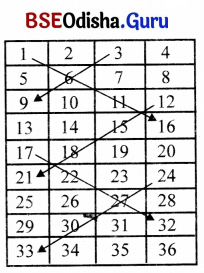
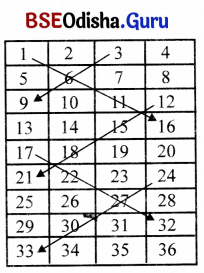
A Tale of Three Intersecting Lines Class 7 MCQ Maths Chapter 7

Regular revision with Class 7 Maths MCQ with Answers and Ganita Prakash Class 7 Maths Chapter 7 A Tale of Three Intersecting Lines MCQ improves accuracy in objective exams.

MCQ on A Tale of Three Intersecting Lines Class 7

A Tale of Three Intersecting Lines MCQ Class 7

Class 7 Maths A Tale of Three Intersecting Lines MCQ

Question 1.
A triangle with two sides equal is called:
(a) Scalene triangle
(b) Equilateral triangle
(c) Isosceles triangle
(d) None of these
Solution:
(c) Isosceles triangle
We know that an isosceles triangle has exactly two equal sides and two equal angles opposite to equal sides.
Thus, a triangle with two equal sides is called isosceles triangle.

Question 2.
An equilateral triangle has angles measuring:
(a) 60°, 60°, 60°
(b) 90°, 45°, 45°
(c) 100°, 40°, 40°
(d) 120°, 30°, 30°
Solution:
(a) 60°, 60°, 60°
We know that all angles are equal in an equilateral triangle and each angle is 60°.

Question 3.
The symbol used to represent a triangle is:
(a) ∆
(b) ∠
(c) ||
(d) ⊥
Solution:
(a) ∆
The triangle is commonly denoted using the symbol ∆ as in ∆ABC. The other symbols given in the options represent angle (∠), two parallel lines (||) and two perpendicular lines (⊥).

A Tale of Three Intersecting Lines Class 7 MCQ Maths Chapter 7

Question 4.
Consider AB < BC < CA. Which of the following is sufficient to say ∆ABC exists?
(a) BC + CA > AB
(b) AB + CA > BC
(c) AB + BC > CA
(d) None of these
Solution:
(c) AB + BC > CA
Given, AB < BC < CA If sum of two smaller sides is greater than the third side (longest), then triangle inequality is automatically satisfied four all other combination of sides. Thus AB + BC > CA is sufficient to say ∆ABC exists.

Question 5.
A triangle with sides XY = 6.6 cm, YZ = 6 cm and XZ = 6.6 cm, is:
(a) Isosceles
(b) Scalene
(c) Equilateral
(d) None of these
Solution:
(a) Isosceles
Given, XY = 6.6 cm, YZ = 6 cm and XZ = 6.6 cm
Here, two sides have equal length.
We know that if any two sides of a triangle are equal in length, then it is called an isosceles triangle.
Thus, triangle XYZ is an isosceles triangle.

Question 6.
In a ∆ABC,which of the given condition holds?
(a) AB – BC > CA
(b) AB + BC < CA
(c) AB – BC < CA
(d) AB + CA < BC
Solution:
(c) AB – BC < CA
We know that the sum of any two sides of a triangle is greater than the third sides and the difference between the lengths of any two sides of a triangle is always smaller than the length of the third side. Therefore, AB – BC < CA.

A Tale of Three Intersecting Lines Class 7 MCQ Maths Chapter 7

Question 7.
Which of the following is true for an obtuse angled triangle?
(a) One angle = 90°
(b) All angles > 90°
(c) 90° < One angle < 180°
(d) Two angles > 90°
Solution:
(c) 90° < One angle < 180°
We know that if an angle of a triangle is greater than 90° (between 90° and 180°), then it is called an obtuse angled triangle.

Question 8.
If AB = 7 cm, ∠T = 50° and ∠B = 60°, then ∠C =
(a) 60°
(b) 70°
(c) 80°
(d) 100°
Solution:
(b) 70°
Given, AB = 7 cm, ∠A = 50° and ∠B = 60°
We know that the sum of all angles of a triangle is 180°.
∴ ∠A + ∠B + ∠C = 180°
⇒ 50° + 60° + ∠C = 180°
⇒ 110° + ∠C = 180°
⇒ ∠C = 180°- 110° = 70°

Question 9.
If AB = 5 cm, AC = 6 cm and ∠A = 90°, what type of triangle will be constructed?
(a) Acute angled triangle
(b) Right-angled triangle
(c) Obtuse angled triangle
(d) Equilateral triangle
Solution:
(b) Right-angled triangle
Given, AB = 5 cm, AC = 6 cm and ∠A = 90°
As ∠A = 90°, the triangle is a right-angled triangle.

A Tale of Three Intersecting Lines Class 7 MCQ Maths Chapter 7

Question 10.
How many altitudes (maximum) can a triangle have?
(a) 1
(b) 2
(c) 3
(d) Depend on type of triangle
Solution:
(c) 3
We know that every triangle has three altitudes, each drawn from a vertex to its opposite side.

Question 11.
Which of the following sets of data is sufficient to construct a triangle?
(i) Two sides and the included angle
(ii) Three angles
(iii) Two angles and the included side
(iv) Three sides
Choose the correct option from the following:
(a) Only (i) and (Hi)
(b) Only (i) and (iv)
(c) Only (i), (ii) and (iii)
(d) (i), (ii), (iii) and (iv)
Solution:
(d) (i), (ii), (iii) and (iv)
Triangles can be constructed if we are given three sides, three angles, two sides with the included angle, or two angles with the included side.
Therefore, all the data sets are sufficient.

Question 12.
Which of the following statements about altitudes of a triangle are correct?
(i) An altitude alwavs lies inside the triangle.
(ii) An altitude can lie outside the triangle.
(iii) Every triangle has three altitudes.
(iv) All three altitudes are equal in length.
Choose the correct option from the following:
(a) Only (i) and (ii)
(b) Only (i) and (iii)
(c) Only (ii) and (iii)
(d) (i), (ii), (iii) and (iv)
Solution:
(c) Only (ii) and (iii)
We know that every triangle has three altitudes, each drawn from a vertex to its opposite side (or its extension).
In right-angled triangles, two altitudes lie along sides of the triangle.
In obtuse-angled triangles, 2 altitudes lie outside the triangle.
In a scalene triangle, all three altitudes are of different lengths.
Thus, statements (ii) and (iii) are true.

A Tale of Three Intersecting Lines Class 7 MCQ Maths Chapter 7

A Tale of Three Intersecting Lines Class 7 Assertion and Reason Questions

The following questions are Assertion and Reason based questions. Two statements are given, one labelled as Assertion (A) and the other is labelled as Reason (R). Select the correct answer to these questions from the codes (a), (b), (c) and (d) as given below.
(a) Both A and R are true and R is the correct explanation of A.
(b) Both A and R are true but R is not the correct explanation of A.
(c) A is true but R is false.
(d) A is false but R is true.

Question 1.
(A): In ∆ABC, if ∠A = 60° and ∠B = 80°, then ∠C = 40°.
(R): In a triangle, the sum of all the angles is 180°.
Solution:
(a) Both A and R are true and R is the correct explanation of A.
Given, in ∆ABC, ∠d = 60° and ∠B = 80°
We know that the sum of all the angles of a triangle is 180°.
∴ ∠A + ∠B + ∠C = 180°
⇒ 60° + 80° + ∠C = 180°
⇒ 140° + ∠C = 180°
⇒ ∠C = 180°- 140° = 40°
Thus, both Assertion (A) and Reason (R) are true, and Reason (R) is the correct explanation of Assertion (A).

Question 2.
(A): If two angles in a triangle are equal, the third angle must be 90°.
(R): In an isosceles triangle, the two angles are equal
Solution:
(d) A is false but R is true.
We know that if two angles of a triangle areequal, then the triangle is called an isosceles triangle.
Let ∠d and ∠B be the equal angles in ∆ABC. We know that the sum of all angles of a triangle is 180°.
∴ ∠A + ∠B + ∠C = 180°
⇒ ∠A + ∠A + ∠C = 180° [∵ ∠d = ∠B]
⇒ 2∠A + ∠C = 180°
⇒ ∠C = 180° – 2∠d
As we can see that the value of ∠C will be 90° only when ∠d is 45°.
Thus, Assertion (A) is false, but Reason (R) is true.

Question 3.
(A): If one of the interior angles of a triangle is 90°, the adjacent exterior angle is also 90°.
(R): A straight angle measures 180°.
Solution:
(a) Both A and R are true and R is the correct explanation of A.
Given, one of the interior angles of a triangle is 90°.
We know that an interior angle and its adjacent exterior angle form a straight angle.
∴ Interior angle + Adjacent exterior angle = 180°
⇒ 90° + Adjacent exterior angle = 180°
⇒ Adjacent exterior angle = 180° – 90° = 90°
Thus, both Assertion (A) and Reason (R) are true, and Reason (R) is the correct explanation of Assertion (A).

A Tale of Three Intersecting Lines Class 7 MCQ Maths Chapter 7

Question 4.
(A): All angles of an acute-angled triangle are less than 90°.
(R): The sum of all angles of a triangle is 180°. equal.
Solution:
(b) Both A and R are true but R is not the correct explanation of A.
We know that if all three angles of a triangle are acute angles (between 0° and 90°), then it is called an acute angled triangle and the sum of all angles of a triangle is 180°.
Thus, both Assertion (A) and Reason (R) are true, but. Reason (R) is not the correct explanation of Assertion (A).

A Tale of Three Intersecting Lines Class 7 Fill in the Blanks

Question 1.
A triangle is a closed figure made up of three ________ line segments.
Solution: non-parallel
We know that a triangle is a closed figure made up of three non-parallel line segments.

Question 2.
Each angle in an equilateral triangle measures _________ degrees.
Solution: 60
We know that each angle in an equilateral triangle measures 60 degrees.

A Tale of Three Intersecting Lines Class 7 MCQ Maths Chapter 7

Question 3.
A triangle having all three sides of different lengths is called a _______ triangle.
Solution: scalene
We know that a triangle with all three sides of different lengths is called a scalene triangle.

Question 4.
An altitude of a triangle is a _________ from vertex to the opposite side.
Solution: perpendicular line segment
We know that in a triangle, an altitude is a line drawn from a corner (vertex) straight down to the opposite side, making a right angle (90°) with that side.
Thus, an altitude of a triangle is a perpendicular line segment from vertex to the opposite side.

Question 5.
The sum of the three angles in a triangle is __________ .
Solution: 180°
The sum of the three angles in a triangle is 180°.

A Tale of Three Intersecting Lines Class 7 MCQ Maths Chapter 7

Question 6.
In ∆ABC, if ∠A = 45° and ∠B = 65°, then the exterior angle at vertex C is _______ .
Solution: 110°
Given, ∠d = 45° and ∠B = 65°
We know that if a side of a triangle is produced or extended, then the exterior angle formed is equal to the sum of two interior opposite angles. ,
∴ Exterior angle at vertex C = Sum of interior angle at A and interior angle at B
= ∠A + ∠B = 45° + 65° = 110°
Thus, in triangle ABC, if ∠A = 45° and ∠B = 65°, then the exterior angle at vertex C is 110°.

Number Play Class 6 Solutions Maths Ganita Prakash Chapter 3

Students can refer to BSE Odisha Class 6 Math Solution and Ganita Prakash Chapter 3 Number Play Class 6 Question Answer to understand textbook questions step by step.

Class 6 Maths Chapter 3 Number Play Solutions

Ganita Prakash Class 6 Chapter 3 Solutions

Class 6 Maths Ganita Prakash Chapter 3 Solutions Number Play

Question 1.
Fill the table below with only 4-digit numbers such that the supercells are exactly the coloured cells.
Number Play Class 6 Solutions Maths Ganita Prakash Chapter 3 1
Solution:

5346 8643 1166 1258 1056 2012 8000 9635 9905

Question 2.
Fill the table below such that we get as many supercells as possible. Use numbers between 100 and 1000 without repetitions.
Number Play Class 6 Solutions Maths Ganita Prakash Chapter 3 2
Solution:

999 102 909 110 918 210 928 350 958

Number Play Class 6 Solutions Maths Ganita Prakash Chapter 3

Question 3.
Can you fill a supercell table without repeating numbers such that there are no supercells? Why or why not?
Solution:
No, we cannot fill a supercell table without repeating numbers such that there are no supercells because at least one number will always be larger than its adjacent cell unless repetition is allowed.
For example,

3 6 9 12 15 18 21 20 or 22

Here, if the last number is greater than 21, it is a supercell and if less than 21, then 21 itself is a supercell number.

Question 4.
Will the cell having the largest number in a table always be a supercell? Can the cell having the smallest number in a table be a supercell? Why or why not?
Solution:
Yes, the cell having the largest number in a table will always be a supercell, because largest number will always be greater than its neighbouring numbers.
But, the cell having smallest number in a table can never be a supercell, because it will always be smaller than its neighbouring numbers.

Number Play Class 6 Solutions Maths Ganita Prakash Chapter 3

Question 5.
Fill a table such that the cell having the second largest number is not a supercell but the second smallest number is a supercell. Is it possible?
Solution:
Yes, it is possible.

245 147 368 313 696 758 532 590 485

In this table, the second largest number is 696, it is not a supercell number and second smallest number is 245, which is a supercell number.

Question 6.
What is the sum of the smallest and largest 5-digit palindrome? What is their difference?
Solution:
Smallest 5-digit palindrome = 10001
Largest 5-digit palindrome = 99999
Sum = 10001 + 99999 = 110000
Difference = 99999 – 10001 = 89998

Question 7.
Write an example for each of the below scenarios whenever possible.
Number Play Class 6 Solutions Maths Ganita Prakash Chapter 3 3
Could you find examples for all the cases? If not, think and discuss what could be the reason. Make other such questions and challenge your classmates.
Solution:
(i) 45000 + 50000 = 95000 > 90250
(ii) 99999 + 900 = 100899
(iii) 4-digit 4- 4-digit to give a 6-digit sum. Since, the maximum sum for two 4-digit numbers (9999 + 9999) is 19998. Thus, it is not possible to get a 6 -digit number by adding two 4-digit numbers.
(iv) 50000 + 61000 = 111000
(v) The minimum sum of two 5-digit numbers (10000 + 10000) is 20000, which is greater than 18500. Therefore, it is not possible to get a sum of 18500 with two 5-digit numbers.
(vi) 70000 – 15000 = 55000 < 56503
(vii) 10000 – 999 = 9001
(viii) 12000 – 8000 = 4000
(ix) 20000 – 19500 = 500
(x) The difference between the largest 5-digit number and smallest 5-digit number (99999 – 10000) is 89999 which is less than 91500.
Therefore, it not possible to get the difference of 91500 between two 5-digit numbers.

Number Play Class 6 Solutions Maths Ganita Prakash Chapter 3

Question 8.
There is only one supercell (number greater than all its neighbours) in this grid. If you exchange two digits of one of the numbers, there will be 4 supercells.
Number Play Class 6 Solutions Maths Ganita Prakash Chapter 3 4
Figure out which digits to swap.
Solution:
Swap the digits 6 and 1 in the number 62,871. The number becomes 12,876 which will be the smallest among all the numbers.

16,200 39,344 29,765
23,609 12,876 45,306
19,381 50,319 38,408

Now, there are four supercells.

Question 9.
We are the group of 5-digit numbers between 35000 and 75000 such that all of our digits are odd. Who is the largest number in our group? Who is the smallest number in our group? Who among us is the closest to 50,000?
Solution:
The possible odd digits are: 1, 3, 5, 7 and 9.
Largest odd number is 73,999. (between 35000 and 75000)
Smallest odd number is 35,111. (between 35000 and 75000)
Closest odd number to 50,000 is 51,111.

Number Play Class 6 Solutions Maths Ganita Prakash Chapter 3

Question 10.
Recall the sequence of powers of 2 from chapter 1. Why is the Collatz conjecture correct for all the starting numbers in this sequence?
Solution:
Powers of 2 → 2, 4, 8, 16,
For 2 (even) → 2 divide by 2 = 1
For 4 (even) → 4 divide by 2 = 2 (even) → 2 divide by 2 = 1
For 8 (even) → 8 divide by 2 = 4 (even) → 4 divide by 2 = 2 (even) → 2 divide by 2 = 1
Thus, for starting numbers that are powers of 2, the Collatz conjecture holds true because the sequence of operations simply involves a series of divisions by 2, which eventually leads to 1.

InText Questions

[Instruction for Q1 to Q7]
Some Children in a park are standing in a line. Each one says a number.

  • A child says ‘1’ if there is only one taller child standing next to them.
  • A child says ‘2’ if both the children standing next to them are taller.
  • A child says ‘O’, if neither of the children standing next to them are taller.

That is each person says the number of taller neighbours they have.

Question 1.
Can the children rearrange themselves so that the children standing at the ends say ‘2’?
Solution:
No, the children cannot line up in a way that the ones at the ends say ‘2′ because a child only says ‘2’ when both of their neighbours are taller and children at the ends have only one neighbour, not two.

Question 2.
Can we arrange the children in a line so that all would say only 0s?
Solution:
No, it’s not possible to arrange the children in a line so that they all say only ‘0’, because a child says ‘0’ only when neither of their neighbours is taller. This would only happen if all the children are the same height.

Number Play Class 6 Solutions Maths Ganita Prakash Chapter 3

Question 3.
Can two children standing next to each other say the same number?
Solution:
Yes, two children standing next to each other can say the same number i.e. 1 because there can be one taller and one smaller child standing next to them.

Question 4.
There are 5 children in a group, all of different heights. Can they stand such that four of them say 1 and the last one says ‘0’? Why or why not?
Solution:
Yes, because a child can say ‘0’ only if neither of the children standing next to them are taller. Arranging them in increasing or decreasing order of heights will eventually put tallest child at one of the end. So it is obvious that last child will say ‘0’.

Question 5.
For this group of 5 children, is the sequence 1, 1, 1, 1, 1 possible?
Solution:
No, the sequence 1, 1, 1, 1, 1 is not possible because there are 5 children and first four will say 1 only if they are arranged in increasing order of height. So, the last child will be tallest and will say 0 (not 1).

Question 6.
Is the sequence 0, 1,2, 1,0 possible? Why or why not?
Solution:
Yes, the sequence 0, 1, 2, 1, 0 is possible. It represents a situation where the middle child is the smallest (has two taller neighbours). The two children at the end are taller than the second last child from both the ends.

Number Play Class 6 Solutions Maths Ganita Prakash Chapter 3

Question 7.
How would you rearrange the five children so that the maximum number of children say ‘2’?
Solution:
We can rearrange the five children so that the maximum number of children say ‘2’ as 0, 2, 0, 2, 0.
Thus, maximum number of children who can say ‘2’ is 2 . ,

Question 8.
Complete Table 2 with 5-digit numbers whose digits are ‘1’, ‘0’, ‘6’, ‘3’, and ‘9’ in some order. Only a coloured cell should have a number greater than all its neighbours.
Number Play Class 6 Solutions Maths Ganita Prakash Chapter 3 5
Once you have filled the table above, put commas appropriately after the thousands digit.
The biggest number in the table is _______.
The smallest even number in the table is ______.
The smallest number greater than 50,000 in the table is _______.
Solution:

96,310 96,301 36,109 36,190′
93,610. 13,609 60,319 19,306
93,106 10,639 60,193 30,196
10,369 10,963 10,396 31,906

The biggest number in the table is 96,310.
The smallest even number in the table is 10,396.
The smallest number greater than 50,000 in the table is 60,193.

Number Play Class 6 Solutions Maths Ganita Prakash Chapter 3

Question 9.
Among the numbers 1-100, how many times will the digit 7’ occur? Among the numbers 1-1000, how many times will the digit ‘7’ occur?
Solution:
Among the numbers 1-100, we can divide the range into two parts: When ‘7’ appears in the ones place and when ‘7’ appears in the tens place.

In the ones place: The numbers that have ‘7’ in the ones place are: 7, 17, 27, 37, 47, 57, 67, 77, 87, and 97. So, there are 10 numbers where ‘7’ appears in the ones place.

In the tens place: The numbers 70 to 79 contain the digit ‘7’ in the tens place. So, there are 10 numbers where ‘7’ appears in the tens place.

Total occurrences of ‘7’ between 1 and 100:
Ones place: 10 times and Tens place: 10 times
Total = 10 + 10 = 20
So, digit ‘7’ appears 20 times among the numbers 1-100.

Among the numbers 1-1000, we can divide the range into three parts:
hundreds place, tens place and ones place
In the hundreds place: The numbers 700 to 799 contain the digit ‘7’ in the hundreds place. There are 100 numbers front 700 to 799.

In the tens place: We already know that in each set of 100 numbers (i.e. 0-99, 100-199, …, 900-999),
‘7’ will appear in the tens place 10 times (just like in the 1-100 range). Since we have 10 sets of 100 numbers, ‘7’ will appear in the tens place, 10 × 10 = 100 times.

In the ones place: Similarly, for each set of 100 numbers (i.e. 0-99, 100-199, …. 900-999), 7’ will appear in the ones place 10 times (like in the 1-100 range). So, across 10 sets of 100 numbers, 7’ will appear in the ones place 10 × 10 = 100 times.

Total occurrences of 7’ between 1 and 1000:
Hundreds place: 100 times, Tens place: 100 times, Ones place: 100 times
Total = 100 + 100 + 100 = 300
So, digit ‘7’ appears 300 times among the numbers 1-1000.

Number Play Class 6 Solutions Maths Ganita Prakash Chapter 3

Question 10.
Write all possible 3-digit palindromes using 1, 2, 3.
Solution:
All the possible 3-digit palindromes using the digits ‘1’, ‘2’, and ‘3’ are: 111, 121, 131, 212, 222, 232, 313, 323 and 333.
There are 9 possible palindromes using the digits ‘1’, ‘2’, and ‘3’.

Question 11.
Puzzle time:
Number Play Class 6 Solutions Maths Ganita Prakash Chapter 3 6
I am a 5-digit palindrome.
I am an odd number.
My ‘t’ digit is double of my ‘M’ digit.
My ‘h’ digit is double of my ‘t’ digit.
Who am I? _______
Solution:
Since palindrome is an odd number, u digit would be 1, 3, 5, 7 or 9 and tth digit would be same as u digit.
Since double of 5, 7 and 9 is not a digit, u digit would be either 1 or 3.
Double of 1 is 2 and double of 3 is 6. So, t digit would be either 2 or 6.
Since double of 6 is not a digit, u digit is 1 and t digit is 2.
Then, h digit would be 4.
So, the required 5-digit odd palindrome number is 12421.
In words: Twelve thousand four hundred twenty one

Number Play Class 6 Solutions Maths Ganita Prakash Chapter 3

Number Play Class 6 Extra Questions

Number Play Class 6 Very Short Question Answer

Question 1.
What is the largest 4-digit number with non-zero digits such that its digits add up to 14?
Solution:
The largest 4-digit number must have largest digit ‘9’ at thousands place and the remaining digits in descending order such that the sum of all digits is 14.
Hence, the required number is 9311.

Question 2.
Write all 2-digit palindromic numbers.
Solution:
The 2-digit palindromic numbers are: I 1, 22, 33, 44, 55, 66, 77, 88 and 99.

Question 3.
Write all possible 3-digit palindromes using the digits 7, 8, 9.
Solution:
Using digits 7, 8 and 9, we get the following palindromes:
777, 787, 797, 878, 888, 898, 979, 989, 999

Number Play Class 6 Solutions Maths Ganita Prakash Chapter 3

Question 4.
Write two 4-digit numbers such that their difference is a 2-digit number.
Solution:
Let us take 5500 and 5460 as two 4-digit numbers.
Clearly, 5500 – 5460 = 40 which is a 2-digit number.

Question 5.
Write two 5-digit numbers whose sum is 32500.
Solution:
Let us take 12500 and 20000 as two 5-digit numbers.
Clearly, 12500 + 20000 = 32500

Question 6.
Write two 4-digit numbers whose difference is 4680.
Solution:
Let us take 7500 and 2820 as two 4-digit numbers.
Clearly, 7500 – 2820 = 4680

Question 7.
Write the smallest and largest 4-digit palindromes. Find their sum and difference.
Solution:
Smallest 4-digit palindrome = 1001 and largest 4-digit palindrome = 9999
Required sum = 1001 + 9999 = 11000
Required difference = 9999 – 1001 = 8998

Number Play Class 6 Solutions Maths Ganita Prakash Chapter 3

Question 8.
Write the second smallest and second largest 5-digit palindromes. Find their sum.
Solution:
Second smallest 5-digit palindrome = 10101
Second largest 5-digit palindrome = 99899
Required sum = 10101 + 99899 = 110000

Question 9.
Write a 6-digit number and a 4-digit number such that their difference is a 5-digit number.
Solution:
Let us take 103200 as a 6-digit number and 8200 as a 4-digit number.
Clearly, 103200 – 8200 = 95000 which is a 5-digit number.

Question 10.
Write a 6-digit number and a 5-digit number such that their difference is a 5-digit number.
Solution:
Let us take 120500 as a 6-digit number and 40500 as a 5-digit number.
Clearly, 120500 – 40500 = 80000, which is a 5-digit number.

Question 11.
Rearrange the digits of 48900125 to get the largest 8-digit number?
Solution:
In order to get the largest 8-digit number using the digits of 48900125, digits should be in descending order on moving from left to right.
Therefore, the required largest number is 98542100.

Number Play Class 6 Solutions Maths Ganita Prakash Chapter 3

Question 12.
What is the smallest number whose digit sum is 16?
Solution:
There is no single digit number to give digit sum equal to 16.
The 2-digit numbers whose digits add up to 16 are: 79, 88 and 97.
We see that 79 is the smallest number among these numbers.
Therefore, 79 is the smallest number whose digit sum is 16.

Question 13.
Rearrange the digits of 4500731 to get the smallest 7-digit number?
Solution:
In order to get the smallest 7-digit number using the digits of 4500731, the first digit from left to right should be the smallest digit except 0. So, in this case, it is 1. Then, on moving from left to right further, digits should be in ascending order.
Therefore, the required smallest number is 1003457.

Question 14.
What is the largest 4-digit number whose digits add up to 15?
Solution:
The largest 4-digit number should have the largest digit at thousands place. Since 9 is the largest digit, it takes thousands place. Then, 6 takes the hundreds place because 9 + 6 = 15. As the sum is exhausted by thousands and hundreds place digits, rest places will take digit ‘0’.
Therefore, the required largest 4-digit number is 9600.

Number Play Class 6 Short Question Answer

Question 1.
Fill the given table such that the cell having the 2nd largest number is not a supercell but the cell having 2nd smallest number is a supercell. Use numbers between 10 and 100.
Number Play Class 6 Solutions Maths Ganita Prakash Chapter 3 7
Solution:
To make sure the cell with the second largest number is not a supercell, it has to be next to the cell with the largest number. This is because the cell with the largest number is always a supercell, and two supercells cannot be next to each other.

Number Play Class 6 Solutions Maths Ganita Prakash Chapter 3

To make the cell with the second smallest number a supercell, it should be one of the extreme end cells and the smallest number should be in the adjacent cell.

53 88 72 64 22 32

Here, 72 is the second largest number and 32 is the second smallest number
Activity: Think of another numbers by yourself.

Question 2.
Mark the supercells in the table below.

6828 670 9435 2180
3780 3708 7308 9225
8000 5583 52 5001

Solution:
6828 is a supercell because it is larger than its neighbours 670 and 3780.
9435 is a supercell because it is larger than its neighbours 670, 2180 and 7308.
9225 is a supercell because ii is larger than its neighbours 2180, 7308 and 5001.
8000 is a supercell because it is larger than its neighbours 3780 and 5583.

6828 670 9435 2180
3780 3708 7308 9225
8000 5583 52 5001

Number Play Class 6 Solutions Maths Ganita Prakash Chapter 3

Question 3.
Fill in the table using only 3-digit numbers, making sure that the supercells line up exactly with the coloured cells.
Number Play Class 6 Solutions Maths Ganita Prakash Chapter 3 8
Solution
Since 2nd cell is a supercell, it must contain a number greater than 576. Let it he 832.

Since 3rd and 5th cells are not supercells and 4th cell is a supercell, the numbers in 3rd and 5th cells should be smaller than the number in 4th cell i.e., 188. Let them he 112 and 176 respectively.

576 832 112 188 176 912

The last cell is a supercell, and its neighbouring cell contains 912. So, the number in the last cell should be greater than 912. Let it be 950.

Since 7th cell is not a supercell, it must contain number smaller than 912. Let it be 492.

Also, 6th cell is not a supercell, it must contain a number smaller than the number present in 7th cell, i.e. 492. Let it be 350.

Now, the complete table is as follows:

576 832 112 188 176 350 492 912 950

Activity: Think of another numbers by yourself.

Number Play Class 6 Solutions Maths Ganita Prakash Chapter 3

Question 4.
Fill in the table using only 3-digit numbers, making sure that the supercells line up exactly with the coloured cells.
Number Play Class 6 Solutions Maths Ganita Prakash Chapter 3 9
Solution:
Since 2nd cell is a supercell, it must contain a number greater than 576. Let it be 832. Then, number in 1st cell should be less than 432. Let it be 100.

100 432 120 312 731 512

Since 4th cell is not supercell, it may Contain any 3-digit number less than 312. Let it be 230.

Also. 7th cell is not supercell and second last cell is a supercell. it must contain number smaller than 731 and 512. I et it be 219.

The second last cell is a supercell, and it contains 512. So, the number in the last cell should be smaller than 512. Let it he 194.

Now, the complete table is as follows:

100 432 120 230 312 731 219 512 494

Question 5.
Calculate the digit sums of 2-digit numbers whose digits are consecutive. Do you observe a pattern?
Solution:
2-digit numbers having consecutive digits are: 12, 23, 34, 45, 56, 67, 78 and 89 .
The sums of digits of these 8 numbers arc:
1 + 2 = 3
2 + 3 = 5
3 + 4 = 7
4 + 5 = 9
5 + 6 = 11
6 + 7 = 13
7 + 8 = 15
8 + 9 = 17
We find that each sum is 2 more than the preceding sum.

Number Play Class 6 Solutions Maths Ganita Prakash Chapter 3

Question 6.
What is the largest 5-digit number with non-zero digits whose digits add up to 17?
Solution:
Non-zero digits are 1, 2, 3, 4, 5, 6, 7, 8, 9.
The largest 5-digit number must have largest digit ‘9’ at ten thousands place (tth) and the remaining digits in descending order such that the sum of all digits is 17.

tth th h t u

Question 7.
Calculate the digit sums of 4-digit numbers whose digits are consecutive. Do you observe any pattern?
Solution:
The 4-digit numbers having consecutive digits are 1234,2345, 3456, 4567, 5678 and 6789.
The sum of digits of these 6 numbers are 10, 14, 18, 22, 26 and 30 respectively.
We find that each sum is 4 more than the preceding sum.

Question 8.
What is the smallest 5-digit number whose digits add up to 18?
Solution:
In order to write smallest 5-digit number, ten thousands place must be occupied by digit ‘1’. Then, sum of the rest of the digits should be 18 – 1 = 17.

The smallest 5-digit number should have the largest digit at units place. Since 9 is the largest digit, it takes units place. Then, 8 takes the tens place because 9 + 8 = 17. As the sum is exhausted by ten thousands, tens and units place digits, rest places will take digit ‘0’.

Therefore, the required smallest 5-digit number is 10089.

Number Play Class 6 Solutions Maths Ganita Prakash Chapter 3

Question 9.
Convert the following times from 12-hour format to 24-hour format.
(i) 02:00 PM
(ii) 10:00 AM
(iii) 07:30 PM
(iv) 12:20 AM
(v) 12:15 PM
Solution:

12-hour Format 24-hour Format
(i) 02:00 PM 14:00 hours
(ii) 10:00 AM 10:00 hours
(iii) 07:30 PM 19:30 hours
(iv) 12:20 AM 00:20 hours
(v) 12:15 PM 12:15 hours

Question 10.
What can be the previous number in the Collatz sequence to 40?
Solution:
Let x be the required number.
If x is an even number, then
\(\frac{x}{2}\) = 40 ⇒ x = 2 × 40 ⇒ x = 80
If x is an odd number, then
3x + 1 = 40 ⇒ 3x = 40 – 1
⇒ 3x = 39 ⇒ x = \(\frac{39}{3}\) = 13
Thus, either 80 or 13 can be the number preceding 40 in a Collatz sequence.

Number Play Class 6 Solutions Maths Ganita Prakash Chapter 3

Question 11.
Observe the following numbers written in a pattern. Find their sum.
Number Play Class 6 Solutions Maths Ganita Prakash Chapter 3 10
Solution:
We find that there are 3 rows each consisting of 5 boxes written with 30 and 2 rows each consisting of 6 boxes written with 70.
∴ Total sum = 3(5 × 30) + 2(6 × 70)
= 3 × 150 + 2 × 420
= 450 + 840 = 1290

Question 12.
Apply Kaprekar’s routine on the number 3562 to get Kaprekar constant.
Solution:
The number is 3562.
Round 1: A = Largest number using digits of the number 3562 = 6532
B = Smallest number using digits of the number 3562 = 2356
C = A – B = 6532 – 2356 = 4176

Round 2: A = Largest number using digits of the number 4176 = 7641
B = Smallest number using digits of the number 4176 = 1467
C = A – B = 7641 – 1467 = 6174

Number Play Class 6 Solutions Maths Ganita Prakash Chapter 3

Question 13.
Apply Kaprekar’s routine on the number 8825 to get Kaprekar constant.
Solution:
The number is 8825.
Round 1:
A = Largest number using digits of the number 8825 = 8852
B = Smallest number using digits of the number 8825 = 2588
C = A – B = 8852 – 2588 = 6264

Round 2:
A = Largest number using digits of the number 6264 = 6642
R = Smallest number using digits of the number 6264 = 2466
C = A – B = 6642 – 2466 = 4176

Round 3:
A = Largest number using digits of the number 4176 = 7641
B = Smallest number using digits of the number 4176 = 1467
C = A – B = 7641 – 1467 = 6174

Question 14.
Convert the following times from 24-hour format to 12-hour format.
(i) 18:00 hours
(ii) 06:00 hours
(iii) 12:30 hours
(iv) 00:45 hours
(v) 23:15 hours
Solution:

24-hour Format 12-hour Format
(i) 18:00 hours 06:00 PM
(ii) 06:00 hours 06:00 AM
(iii) 12:30 hours 12:30 PM
(iv) 00:45 hours 12:45 AM
(v) 23:15 hours 11:15 PM

Number Play Class 6 Solutions Maths Ganita Prakash Chapter 3

Question 15.
Count all the suns in the following pattern.
Number Play Class 6 Solutions Maths Ganita Prakash Chapter 3 11
Solution:
There are 26 boxes with 1 sun each and 26 boxes with 4 suns each.
∴ Total number of suns = (26 × 1) + (26 × 4)
= 26 + 104 = 130

Question 16.
Find the sum of the numbers in the number pattern shown in the figure.
Number Play Class 6 Solutions Maths Ganita Prakash Chapter 3 12
Solution:
We note that the number 75 occurs 20 times around the outer edge, the number 40 appears 12 times along the second layer, the number 50 is present 4 times on the edge of the inner layer, and the number 1500 is located at the centre.
∴ Required sum
= (20 × 75) + (12 × 40) + (4 × 50) + 1500
= 1500 + 480 + 200 + 1500 = 3680

Number Play Class 6 Solutions Maths Ganita Prakash Chapter 3

Question 17.
Consider the numbers in the following boxes:
Number Play Class 6 Solutions Maths Ganita Prakash Chapter 3 13
Using operations addition/subtraction on these numbers, we can get
13100 = 32000 – 20000 + 700 + 200 + 200
Similarly, obtain the following numbers by using the numbers in the boxes.
(i) 25800
(ii) 28000
(iii) 7500
(iv) 14400
(v) 53000
Solution:
(i) 25800 = 20000 + 6000 – 200
(ii) 28000 = 32000 – 3500 – 700 + 200
(iii) 7500 = 3500 + 3500 + 700 – 200
(iv) 14400 = 20000 – 6000 + 200 + 200
(v) 53000 = 32000 + 20000 – 6000 + 3500 + 3500

Question 18.
Consider the numbers in the following boxes:
Number Play Class 6 Solutions Maths Ganita Prakash Chapter 3 14
Using operations addition/subtraction on these numbers, we can get
23300 = 16000 + 16000 – 9000 + 300
Similarly, obtain the following numbers by using the numbers in the boxes.
(i) 60200
(ii) 2500
(iii) 7700
(iv) 64600
(v) 17300
Solution:
(i) 60200 = 45000 4 16000-800
(ii) 2500 = 9000 + 9000 – 16000 + 800 – 300
(iii) 7700 = 9000 – 800 – 800 + 300
(iv) 64600 = 45000 + 9000 + 9000 + 800 + 800
(v) 17300 = 16000 + 800 + 800 – 300

Number Play Class 6 Solutions Maths Ganita Prakash Chapter 3

Number Play Class 6 Long Question Answer

Question 1.
Colour or mark the supercells in the given table:

6235 970 8145 4780 4708 7084 9000 160

Solution:
Clearly, 6235 is greater than the number 970 in the neighbouring cell.
Hence, the cell containing 6235 is the supercell.
970 is smaller than 6235 and 8145, so the cell containing 970 is not a supercell.
As 8145 is greater than the numbers 970 and 4780 in the neighbouring cells, the cell containing 8145 is a supercell.
As 4780 is smaller than 8145, the cell containing 4780 is not a supercell.
As 4708 is smaller than 4780 and 7084, the cell containing 4708 is not a supercell.
As 7084 is smaller than 9000, the cell containing 7084 is not a supercell.
As 9000 is greater than the numbers 7084 and 160 in the neighbouring cells, the cell containing 9000 is a supercell.
As 160 is smaller than 9000, the cell containing 160 is not a supercell.

6235 970 8145 4780 4708 7084 9000 160

Question 2.
Mark supercells in the following grid:

3462 2198 6757 5678
1001 5982 4723 2345
2723 5600 7210 2316
3298 1465 3467 4621

Solution:
The cell containing 3462 is a supercell as the numbers 2198 and 1001 in neighbouring cells are smaller than 3462.
The cell containing 6757 is a supercell as the numbers 2198, 4723 and 5678 in neighbouring cells are smaller than 6757.
The cell containing 5982 is a supercell as the numbers 2198, 4723, 5600 and 1001 in neighbouring cells are smaller than 5982.
The cell containing 7210 is a supercell as the numbers 4723, 2316, 3467 and 5600 in neighbouring cells are smaller than 7210.
The cell containing 3298 is a supercell as the numbers 2723 and 1465 in neighbouring cells are smaller than 3298.
The cell containing 4621 is a supercell as the numbers 2316 and 3467 in neighbouring cells are smaller than 4621.

3462 2198 6757 5678
1001 5982 4723 2345
2723 5600 7210 2316
3298 1465 3467 4621

Number Play Class 6 Solutions Maths Ganita Prakash Chapter 3

Question 3.
Identify the numbers marked on the number lines below, and label the remaining positions.
Number Play Class 6 Solutions Maths Ganita Prakash Chapter 3 15
Put a circle around the smallest number and a box around the largest number in each of the sequences above.
Solution:
(i) There are 3 sub-divisions between 729 and 732.
Therefore, each sub-division represents \(\frac{732-729}{3}\) = \(\frac{3}{3}\) = 1 number.
Number Play Class 6 Solutions Maths Ganita Prakash Chapter 3 16

(ii) There are 7 sub-divisions between 6236 and 6250.
Therefore, each sub-division represents \(\frac{6250-6250}{7}\) = \(\frac{14}{7}\) = 2 numbers.
Number Play Class 6 Solutions Maths Ganita Prakash Chapter 3 17

(iii) There are 6 sub-divisions between 12100 and 12160.
Therefore, each sub-division represents \(\frac{12100-12160}{6}\) = \(\frac{60}{6}\) = 10 numbers.
Number Play Class 6 Solutions Maths Ganita Prakash Chapter 3 18
(iv) There is 1 sub-division between 53312 and 54312.
Therefore, each sub-division represents \(\frac{53312-54312}{1}\) = 1000 numbers
Number Play Class 6 Solutions Maths Ganita Prakash Chapter 3 19

Question 4.
Among the numbers 100 – 1000, how many times will the digit ‘3’ occur?
Solution:
There are 901 numbers from 100 to 1000.

When digit ‘3’ is at hundreds place:
Numbers with ‘3’ in the hundreds place look like: 300 – 399
So, total count of digit ‘3’ at hundreds place = 100

When digit ‘3’ is at tens place:
To count how often ‘3’ appears in the tens place, fix the hundreds and units digit, and loop through all possibilities:
There are:

  • 9 choices for hundreds digit (1 to 9)
  • 1 choice for tens digit (3)
  • 10 choices for units digit (0 to 9)

So, total count of digit ‘3’ at tens place = 9 × 1 × 10 = 90

When digit ‘3’ is at units place:
To count how often ‘3’ appears in the units place, fix the hundreds and tens digit, and loop through all possibilities:
There are:

  • 9 choices for hundreds digit (1 to 9)
  • 10 choices for tens digit (0 to 9)
  • 1 choice for units digit (3)

So, total count of digit ‘3’ at units place = 9 × 1 × 10 = 90
Total count of digit ‘3’ = 100 + 90 + 90 = 280
Thus, digit ‘3’ occurs 280 times.

Number Play Class 6 Solutions Maths Ganita Prakash Chapter 3

Question 5.
How big a number can you form having the digit sum 16? Can you make an even bigger number?
Solution:
2-digit numbers having the digit sums 16 are: 79, 88 and 97.
3-digit numbers having the digit sums 16 are: 169, 178, 187, 196, 259, 268, 277, 286, 295, 349, 358, 367, 376, 385, 394, 439, 448, 457, 466, 475, 484, 493, 529, 538, 547, 556, 565, 574, 583, 592, 619, 628, 637, 646, 655, 664, 673, 682, 691, 709, 718, 727, 736, 745, 754, 763, 772, 781, 790, 808, 817, 826, 835, 844, 853, 862, 871, 880, 907, 916, 925, 934, 943, 952, 961 and 970.
To form a 4-digit number having the digit sum 16, put one 0 in any of the above 3-digit numbers anywhere after first digit from left or two 0 in any of the above 2-digit numbers anywhere after first digit from left.

Similarly, we can form w-digit numbers by putting an appropriate number of 0 in any of the above numbers.

Thus, there will be infinitely many numbers with digit sum 16.

Yes, we can make even much bigger numbers.

Question 6.
Solve the puzzle:
My father’s salary is a 6-digit palindrome.
It is an even number.
Its tens digit is double of units digit and hundreds digit is double of tens digit.
What is my father’s salary?
Solution:
Units digit of an even number is 0 or 2 or 4 or 6 or 8. Since it is a palindrome, 0 cannot be the units digit. It is given that tens digit is double of units digit. So, 6 and 8 cannot be the units digit as 6 × 2 = 12 and 8 × 2 = 16 but 12 and 16 are not digits. If 4 is the units digit, then 8 would be the tens digit. But it is given that hundreds digit is double of tens digit, then hundreds digit would be 16, which is not possible.

So, units digit must be 2 only. Then, tens digit would be 4 and hundreds digit would be 8.

2 4 8 8 4 2

Thus, the palindromic number is 248842.
Hence, father’s salary is 248842.

Number Play Class 6 Solutions Maths Ganita Prakash Chapter 3

Question 7.
List all 3-digit palindromic numbers and highlight those whose digit sum is greater than 15.
Solution:
3-digit palindromic numbers are given in the below table:

101 111 121 131 141 151 161 171 181 191
202 212 222 232 242 252 262 272 282 292
303 313 323 333 343 353 363 373 383 393
404 414 424 434 444 454 464 474 484 494
505 515 525 535 545 555 565 575 585 595
606 616 626 636 646 656 666 676 686 696
707 717 727 737 747 757 767 777 787 797
808 818 828 838 848 858 868 878 888 898
909 919 929 939 949 959 969 979 989 999

Highlighted (bold) palindromes have their digit sum greater than 15.

Question 8.
Write a 5-digit number, a 4-digit number and a 3-digit number such that their sum is 24680.
Solution:
Let us take 20000 as a 5-digit number. Then,
20000 + Sum of a 4-digit number and a 3-digit number = 24680
⇒ Sum of a 4-digit number and a 3-digit number
= 24680 – 20000 = 4680
Let us take 4500 as a 4-digit number. Then,
4500 + a 3-digit number = 4680
⇒ 3-digit number = 4680 – 4500 = 180
Hence, 20000 is a 5-digit number, 4500 is a 4-digit number and 180 is a 3-digit number such that their sum is 24680.
There can also be other numbers like
19000 + 5100 + 580 = 24680,
17500 + 7000 4 180 = 24680 etc.
Think of another numbers by yourself.

Number Play Class 6 Solutions Maths Ganita Prakash Chapter 3

Question 9.
State whether the following statements are True/ False.
(i) The sum of two 5-digit numbers is always a 5-digit number.
(ii) The sum of a 5-digit number and a 3-digit number is always a 5-digit number.
(iii) 4’be sum of a 5-digit number and a 3-digit number is always a 6-digit number.
(iv) The difference of two 4-digit numbers is always a 4-digit number.
(ii) The difference between a 5-digit number and a 3-digit number is always a 4-digit number.
Solution:
(i) False; 26000 + 42000 = 68000 → a 5-digit number
76000 + 84000 = 160000 + not → a 5-digit number
Thus, the sum of two 5-digit numbers may or may not be a 5-digit number.

(ii) False; 10000 + 100 = 10100 → a 5-digit number
99900 + 900 = 100800 → not a 5-digit number
Thus, the sum of a 5-digit number and a 3-digit number may or may not be a 5-digit number.

(iii) False; 10000 + 100 = 10100 → not a 6-digit number
99900 + 900 = 100800 → a 6-digit number
Thus, the sum of a 5-digit number and a 3-digit number may or may not be a 6-digit number.

(iv) False; 8040 – 6080 = 1960 → a 4-digit number
1980 – 1200 = 780 → not a 4-digit number
Thus, the difference of two 4-digit numbers may or may not be a 4-digit number.

(v) False; 10250 – 750 = 9500 → a 4-digit number
15500 – 900 = 14600 → not a 4-digit number
Thus, the difference between a 5-digit number and a 3-digit number may or may not be a 4-digit number.

Number Play Class 6 Solutions Maths Ganita Prakash Chapter 3

Question 10.
Apply Kaprekar’s routine on a 3-digit number. What number will start repeating?
Solution:
Let the number be 729.
Round 1:
A = Largest number using digits of the number 729 = 972
B = Smallest number using digits of the number 729 = 279
C = A – B = 972 – 279 = 693

Round 2:
A = Largest number using digits of the number 693 = 963
B = Smallest number using digits of the number 693 = 369
C = A – B = 963 – 369 = 594

Round 3:
A = Largest number using digits of the number 594 = 954
B = Smallest number using digits of the number 594 = 459
C = A – B = 954 – 459 = 495

Round 4:
A = Largest number using digits of the number 495 = 954
B = Smallest number using digits of the number 495 = 459
C = A – B = 954 – 459 = 495
Clearly, 495 repeats after 3 iterations.

Number Play Class 6 Solutions Maths Ganita Prakash Chapter 3

Question 11.
How many rounds does the number 7443 take to reach the Kaprekar constant.
Solution:
The number is 7443.
Round 1:
A = Largest number using digits of the number 7443 = 7443
B = Smallest number using digits of the number 7443 = 3447
C = A – B = 7443 – 3447 = 3996

Round 2:
A = Largest number using digits of the number 3996 = 9963
B = Smallest number using digits of the number 3996 = 3699
C = A – B = 9963 – 3699 = 6264

Round 3:
A = Largest number using digits of the number 6264 = 6642
B = Smallest number using digits of the number 6264 = 2466
C = A – B = 6642 – 2466 = 4176

Round 4:
A = Largest number using digits of the number 4176 = 7641
B = Smallest number using digits of the number 4176 = 1467
C = A – B = 7641 – 1467 = 6174, which is the Kaprekar constant
Thus, we reach at the Kaprekar constant in four rounds.

Question 12.
Make the Collatz sequence by starting with number 24.
Solution:
The rule followed by a Collatz sequence is: Start with any number; if the number is even, take half of it; if the number is odd, multiply it by 3 and add 1; repeat till 1 is obtained.
First term: 24
Second term: \(\frac{24}{2}\) = 12 [As 24 is an even number.]
Third term: \(\frac{12}{2}\) = 6 [As 12 is an even number.] 0
Fourth term: \(\frac{6}{2}\) = 3 [As 6 is an even number.]
Fifth term: 3 × 3 + 1 = 10 [As 3 is an odd number.]
Sixth term: \(\frac{10}{2}\) = 5 [As 10 is an even number.]
Seventh term: 3 × 5 + 1 = 16 [As 5 is an odd number.]
Eighth term: \(\frac{16}{2}\) = 8 [As 16 is an even number.]
Ninth term: \(\frac{8}{2}\) = 4 [As 8 is an even number.]
Tenth term: \(\frac{4}{2}\) = 2 [As 4 is an even number.]
Eleventh term: \(\frac{2}{2}\) = 1 [As 2 is an even number.]
Hence, the Collatz sequence starting with 24 is:
24, 12, 6, 3, 10, 5, 16, 8, 4, 2, 1

Number Play Class 6 Solutions Maths Ganita Prakash Chapter 3

Question 13.
Make the Collatz sequence by starting with number 17.
Solution:
The rule followed by a Collatz sequence is: Start with any number; if the number is even, take half of it; if the number is odd, multiply it by 3 and add 1; repeat till I is obtained.
1st term : 17
2nd term : 3 × 17 + 1 = 52 [As 17 is an odd number]
3rd term : \(\frac{52}{2}\) = 26 [As 52 is an even number]
4th term : \(\frac{26}{2}\) = 13 [As 26 is an even number]
5th term : 3 × 13 + 1 = 40 [As 13 is an odd number]
6th term : \(\frac{40}{2}\) = 20 [As 40 is an even number]
7th term : \(\frac{20}{2}\) = 10 [As 20 is an even number]
8th term : \(\frac{10}{2}\) = 5 [As 10 is an even number]
9th term : 3 × 5 + 1 = 16 [As 5 is an odd number]
10th term : \(\frac{16}{2}\) = 8 [As 16 is an even number]
11th term : \(\frac{8}{2}\) = 4 [As 8 is an even number]
12th term : \(\frac{4}{2}\) = 2 [As 4 is an even number]
13th term : \(\frac{2}{2}\) = 1 [As 2 is an even number]
Hence, the Collatz sequency starting with 17 is: 17, 52, 26, 13, 40, 20, 10, 5, 16, 8, 4, 2, 1.

Number Play Class 6 Solutions Maths Ganita Prakash Chapter 3

Question 14.
Find the Collatz sequence by starting with number 11.
Solution:
The rule followed by a Collatz sequence is: Start with any number; if the number is even, take half of it; if the number is odd, multiply it by 3 and add 1; repeat till 1 is obtained.
1st term : 11
2nd term : 3 × 11 + 1 = 34 [As 11 is an odd number]
3rd term : \(\frac{34}{2}\) = 17 [As 34 is an even number]
4th term : 3 × 17 + 1 = 52 [As 1 7 is an odd number]
5th term : \(\frac{52}{2}\) = 26 [As 52 is an even number]
6th term : \(\frac{26}{2}\) = 13 [As 26 is an even number]
7th term : 3 × 13 + 1 = 40 [As 13 is an odd number]
8th term : \(\frac{40}{2}\) = 20 [As 40 is an even number]
9th term : \(\frac{20}{2}\) = 10 [As 20 is an even number]
10th term : \(\frac{10}{2}\) = 5 [As 10 is an even number]
11th term : 3 × 5 + 1 = 16 [As 5 is an odd number]
12th term : \(\frac{16}{2}\) = 8 [As 16 is an even number]
13th term : \(\frac{8}{2}\) = 4 [As 8 is an even number]
14th term : \(\frac{4}{2}\) = 2 [As 4 is an even number]
15th term : \(\frac{2}{2}\) = 1 [As 2 is an even number]

Question 15.
Make a quick estimate. Take about 30 seconds. Then compare your answer with your friends.
(i) Number of tiles on your classroom floor:
(a) More than 200
(b) Less than 200
(Hint: Count how many tiles there are*in one row and one column.)

(ii) Time taken to write your full name:
(a) More than 10 seconds
(b) Less than 10 seconds

(iii) Estimate the number of books in your school library.
(a) More than 2000
(b) Less than 2000

(iv) Weight of a fully packed school bag:
(a) More than 4 kg
(b) Less than 4 kg

(v) Estimate the number of leaves on a big tree near your school.
(a) Around 1000
(b) Around 10,000
(c) More than 50,000
Solution:
(i) Estimate the number of tiles in one row and one column. Multiply the two to get the total. If it is 20 rows and 15 columns, then 20 × 15 = 300 tiles.
(ii) Say your name aloud and imagine writing each letter. Most students take 5-12 seconds depending on length.
(iii) Think of how many shelves there are and how many books per shelf. For example, 50 shelves × 50 books = 2500 books.
(iv) Lift your bag and guess based on how heavy it feels. Most packed school bags weigh around 3-5 kg.
(v) A large tree has thousands of branches and leaves. It’s very hard to count, but an estimate can be made.

Number Play Class 6 Solutions Maths Ganita Prakash Chapter 3

Number Play Class 6 Case Based Questions

Question 1.
During a school trip, Class 6 students noticed a unique design featuring a 9-box row on a wall. Inspired, they decided to fill the boxes with numbers between 300 and 700, using each number only once.
They were excited to experiment with different number arrangements and see what interesting patterns might emerge.
Number Play Class 6 Solutions Maths Ganita Prakash Chapter 3 20
Based on the above information, answer the following:
(ii) Fill the table such that we get maximum number of supercells.
(ii) How many supercells are there in the table.
Solution:
(i) If there are n cells in a row, then maximum number of supercells = \(\left\{\begin{array}{c}
\frac{n}{2}, \text { if } n \text { is even } \\
\frac{n+1}{2}, \text { if } n \text { is odd }
\end{array}\right.\)
Since total number of cells is 9, maximum 9 +1
number of supercell = \(\frac{9+1}{2}\) = 5
We know that two adjacent cells can never be supercells. So, the maximum number of supercells would be obtained when every alternate cell is a supercell.

In order to get the maximum number of supercells, always consider the 1st cell to be the supercell.
One such table with numbers between 300 and 700 is as follows:

699 301 698 302 697 303 696 304 695

(ii) Clearly, there are 5 supercells.

Number Play Class 6 Solutions Maths Ganita Prakash Chapter 3

Question 2.
One day, Raghu bought a packet of pencils and found a lottery scratch coupon tucked inside. Curious, he scratched it off and revealed six two-digit numbers. The first number was 34, and to his surprise, the rest of the numbers followed the mysterious pattern of the Collatz sequence.
Number Play Class 6 Solutions Maths Ganita Prakash Chapter 3 21
Based on the above information, answer the following questions:
(i) What number is written in second box?
(ii) What number is written in last box?
(iii) How many boxes are supercells?
Solution:
(i) As the numbers on the lottery ticket follow the Collatz sequence, and the first number is 34, which is even, the number in second box = \(\frac{34}{2}\) = 17

(ii) In the given Collatz sequence
First term = 34
Second term = \(\frac{34}{2}\) = 17 [As 34 is an even number]
Third term = 3 × 17 + 1 = 52 [As 17 is an odd number]
Fourth term = \(\frac{52}{2}\) = 26 [As 52 is an even number]
Fifth term = \(\frac{26}{2}\) = 13 [As 26 is an even number]
Sixth term = 3 × 13 + 1 = 40 [As 13 is an odd number]
Thus, the number in the last i.e. sixth box is 40.
The list of numbers obtained on the lottery ticket is given below.

Number Play Class 6 Solutions Maths Ganita Prakash Chapter 3

(iii) The list of numbers obtained on the lottery ticket is given below.

34 17 52 26 13 40

Clearly, 3 boxes are supercells.

Number Play Class 7 MCQ Maths Chapter 6

Regular revision with Class 7 Maths MCQ with Answers and Ganita Prakash Class 7 Maths Chapter 6 Number Play MCQ improves accuracy in objective exams.

MCQ on Number Play Class 7

Number Play MCQ Class 7

Class 7 Maths Number Play MCQ

Question 1.
Which of the following expressions has odd parity?
(a) 2 + 6
(b) 8 – 4
(c) 7 + 3
(d) 4 + 5
Solution:
(d) 4 + 5
The word parity is used to denote the property
of being even or odd.
Here, 2 + 6 = 8 (Even)
8 – 4 = 4 (Even)
7 + 3 = 10 (Even)
4 + 5 = 9 (Odd)

Question 2.
Which of the following statements is not true?
(a) The parity of the sum of any count of even numbers is even.
(b) The parity of the sum of even count of odd numbers is even.
(c) The parity of the sum of odd count of odd numbers is odd.
(d) If the parity of n is odd, then the parity of n2 is even.
Solution:
(d) If the parity of n is odd, then the parity of n2 is even.
If n is an odd number, then n1 is also an odd number.
For example, 5 is an odd number, and 52 = 25 is also an odd number.
∴ If the parity of n is odd, then the parity of n2 is also odd.
Statement (d) is not true.

Question 3.
Which of the following expressions has odd parity at n = 4?
(a) n2
(b) 2n + 1
(c) 3n
(d) n – 2
Solution:
(b) 2n + 1
At n = 4, n2 = 42 = 16 (Even)
At n = 4, 2n + 1 = 2 × 4 + 1 = 9 (Odd)
At n = 4, 3n = 3 × 4 = 12 (Even)
At n = 4, n – 2 = 4 – 2 = 2 (Even)

Number Play Class 7 MCQ Maths Chapter 6

Question 4.
Which of the following has an even parity?
(a) 3 + 8
(b) 7 – 2
(c) 52
(d) 5 + 7
Solution:
(d) 5 + 7
The word parity is used to denote the property of being even or odd.
Here, 3 + 8 = 11 (Odd)
7 – 2 = 5 (Odd)
52 = 25 (Odd)
5 + 7 = 12 (Even)

Question 5.
Which of the following has an odd parity?
(a) 8 × 88
(b) 7 × 72
(c) 92
(d) 82
Solution:
(c) 92
We know that the parity of the product is odd
if both numbers are odd and the parity of the product of two numbers is even if at least one of them is even.
∴ The parity of both 8 × 88 and 7 × 72 is even.
Also, the parity of n2 is the same as the parity of n.
∴ The parity of 92 is odd and the parity of 82 is even.

Question 6.
At what value of n, the expression 3n + 8 has an odd parity?
(a) 9
(b) 8
(c) 4
(d) 0
Solution:
(a) 9
Given expression, 3n + 8
At n = 9, 3 n + 8 = 3 × 9 + 8 = 27 + 8 = 35 (Odd)
At n = 8, 3 n + 8 = 3 × 8 + 8 = 24 + 8 = 32 (Even)
At w = 4, 3n + 8 = 3 × 4 + 8 = 12 + 8 = 20 (Even)
At n = 0, 3n + 8 = 3 × 0 + 8 = 0 + 8 = 8 (Even)
So, the expression has odd parity when n = 9.

Number Play Class 7 MCQ Maths Chapter 6

Question 7.
Which of the following months has days with odd parity?
(a) April
(b) June
(c) August
(d) November
Solution:
(c) August
Months that have an even number of days show even parity, while those with an odd number of days show odd parity.

April, June, and November each have 30 days, showing even parity, while August, with 31 days, shows odd parity.

Question 8.
If each number in a 3 × 3 magic square is increased by 1, the magic sum will increase by:
(a) 2
(b) 4
(c) 3
(d) 5
Solution:
(c) 3
We know that in a 3 × 3 magic square (using 1 – 9) if we increase each number by n the magic sum increases by 3n.
∴ If each number of a magic square is increased by 1, the magic sum will increase by 3.

Question 9.
What will be the magic sum of a magic square if the central number is 15?
(a) 45
(b) 40
(c) 30
(d) 35
Solution:
(a) 45
Here, central number = 15 = 3 × 5
We know that in a 3 × 3 magic square (using 1-9) if we multiply each number by n the new magic sum becomes 15 × n.
Here, new magic sum =15 × 3 = 45

Number Play Class 7 MCQ Maths Chapter 6

Question 10.
In how many different ways, number 6 can be written as a sum of Is and 2s?
(a) 12
(b) 13
(c) 14
(d) 15
Solution:
(b) 13
We know that the number of different ways in which number 6 can be written as the sum of Is and 2s is the 6th element of the Virahanka sequence.
Virahanka sequence is: 1, 2, 3, 5, 8, 13, …
Thus, 6 can be written as sum of Is and 2s in 13 different ways.

Question 11.
Two consecutive numbers in the Virahanka sequence are 144 and 233. The next number in the sequence is:
(a) 297
(b) 377
(c) 89
(d) 367
Solution:
(b) 377
We know that in Virahanka sequence, a number is the sum of previous two numbers.
∴ Required number = 144 + 233 = 377

Question 12.
If each number of a 3 × 3 magic square (with numbers 1 – 9) is multiplied by 4, the magic sum will increase by:
(a) 8
(b) 60
(c) 45
(d) 30
Solution:
(c) 45
We know that the magic sum of a 3 × 3 magic square filled using numbers 1-9 is 15.
If each number of a magic square is multiplied by 4, the new magic sum will be 15 × 4 = 60.
∴ The magic sum will increase by:
60 – 15 = 45.

Number Play Class 7 MCQ Maths Chapter 6

Question 13.
What will be the magic sum of a 3 × 3 magic square if the central number is 0?
(a) 3
(b) 2
(c) 1
(d) 0
Solution:
(d) 0
Generalised form of 3 × 3 magic square is:

m + 1 m – 4 m +3
m + 2 m m – 2
m – 3 m + 4 m – 1

Given, m = 0. The magic square with central number 0 is obtained as:

1 -4 3
2 0 -2
-3 4 -1

Here, magic sum = 1 – 4 + 3 = 0

Question 14.
How many rhythms are there with 7 beats consisting of short syllables and long syllables?
(a) 13
(b) 21
(c) 34
(d) 55
Solution:
(b) 21
The number of rhythms with 7 beats consisting of short syllables and long syllables is the 7th element of the Virahanka sequence.
Now, Virahanka sequence is: 1, 2, 3, 5, 8, 13, 21,…
As, the 7th element is 21, there are 21 rythms with 7 beats.

Question 15.
The number of different magic squares which can be formed with numbers 1-9, including reflection and rotation, are:
(a) 3
(b) 4
(c) 7
(d) 8
Solution:
(d) 8
Total 8 magic squares can be formed with numbers 1-9, including reflection and rotation.

Number Play Class 7 MCQ Maths Chapter 6

Question 16.
The expression n2 – 1 has even parity when:
(i) n = 2
(ii) n = 3
(iii) n = 4
(iv) n = 5
Choose the correct option from the following:
(a) (i) and (ii)
(b) (ii) and (in)
(c) (iii) and (iv)
(d) (ii) and (iv)
Solution:
(d) (ii) and (iv)
Given expression: n2 – 1
When n = 2, n2 – 1 = 22 – 1 = 4 – 1 = 3 (odd)
When n = 3, n2 – 1 = 32 – 1 = 9 – 1 = 8 (even)
When n = 4, n2 – 1 = 42 – 1 = 16 – 1 = 15 (odd)
When n = 5, n2 – 1 = 52 – 1 = 25 – 1 = 24 (even
Thus, the expression n2 – 1 has even parity when n is 3 and 5.

Question 17.
Which of the following 3 × 3 grid is a magic square:
(i)

8

1

6

3

5

7

4

9

2

(ii)

8

1

2

3

5

7

6

9

4

(iii)

6

1

8

7

5

3

2

9

4

(iv)

8

9

6

5

3

7

4

1

2

Choose the correct option from the following:
(a) (i) and (iii)
(b) (ii) and (iv)
(c) (i) and (iv)
(d) (ii) and (iii)
Solution:
(a) (i) and (iii)
We know that a 3 × 3 square grid of numbers is called a magic square if each row, each column and each diagonal, add up to the same number. This number is called the magic sum.

In grid (i), the sum of each row, each column and each diagonal is 15.
Thus, it is a magic square.
In grid (ii), the sum of first row (i.e. 8+1+2 = 11) is different from the sum of second row (i.e. 3 + 5 + 7 = 15).
Thus, it is not a magic square.

The grid (iii) is the vertical reflection of the grid (i).
Thus, it is also a magic square as sum of each row, each column and each diagonal is 15.

In grid (iv), the sum of first row (i.e. 8 + 9 + 6 = 23) is different from the sum of second row (i.e. 5 + 3 + 7 = 15).
Thus, it is not a magic square.

Number Play Class 7 Assertion and Reason Questions

The following questions are Assertion and Reason based questions. Two statements are given, one labelled as Assertion (A) and the other is labelled as Reason (R). Select the correct answer to these questions from the codes (a), (b), (c) and (d) as given below.
(a) Both A and R are true and R is the correct explanation of A.
(b) Both A and R are true but R is not the correct explanation of A.
(c) A is true but R is false.
(d) A is false but R is true.

Question 1.
(A): The parity of 100 × 101 is even.
(R): The parity of the product of two numbers is even when at least one of the numbers is even.
Solution:
(a) Both A and R are true and R is the correct explanation of A.
We know that the parity of the product of two numbers is even when both numbers are even, or when one is even and the other is odd.
Thus, the parity of 100 × 101 is even as 100 is even.
Therefore, both Assertion (A) and Reason (R) are true, and Reason (R) is the correct explanation of Assertion (A).

Question 2.
(A): The expression 2n + 7 always has an odd parity.
(R): The parity of the sum of an even number and an odd number is odd.
Solution:
(a) Both A and R are true and R is the correct explanation of A.
We know that 2n is an even number.
Also, even number + odd number = odd number
∴ The expression 2n + 7 always has odd parity.
Thus, both Assertion (A) and Reason (R) are true, and Reason (R) is the correct explanation of Assertion (A).

Number Play Class 7 MCQ Maths Chapter 6

Question 3.
(A): In a 3 × 3 magic square with numbers 1-9, the first row is [8 5 2],
(R): The magic sum of a 3 × 3 magic square is 15.
Solution:
(d) A is false but R is true.
We know that the magic sum of a 3 × 3 magic square is 15.
Since the number occurring at the centre of a magic square filled using 1-9 must he 5. Hence, the first row cannot be [8 5 2].
∴ Assertion (A) is false, but Reason (R) is true.

Question 4.
(A): The next 3 numbers in the Virahanka sequence: 1, 2, 3, 5, 8, 13,… are 21, 34 and 45.
(R): In Virahanka sequence, a number is the sum of previous two numbers.
Solution:
(d) A is false but R is true.
We know that in Virahanka sequence, a number is the sum of previous two numbers.
∴ The next 3 numbers in the Virahanka sequence: 1, 2, 3, 5, 8, 13, … are 8 + 13 = 21, 21 + 13 = 34 and 34 + 21 = 55.
∴ Assertion (A) is false, but Reason (R) is true.

Number Play Class 7 Fill in the Blanks

Question 1.
The parity of the sum of 99 even numbers is _______.
Solution: even
We know that the parity of sum of any count of even numbers is even.
Therefore, the parity of the sum of 99 even numbers is even.

Number Play Class 7 MCQ Maths Chapter 6

Question 2.
The parity of the expression n2 + n is always ________.
Solution: even
We know that the parity of n is the same as the parity of n.
Also, even number + even number = even number and odd number + odd number = even number.
Therefore, no matter if n is even or odd, the parity of the expression n2 + n is always even.

Question 3.
The parity of the sum of numbers from 1 to 20 is ______ .
Solution: even
From 1 to 20, there are 10 even numbers and 10 odd numbers.
We know that the parity of the sum of any count of even numbers is even. So, the sum of 10 even numbers is even.

Also, the parity of the sum of even count of odd numbers is even. So, the sum of 10 odd numbers is even.

Since even number + even number = even number, the parity of the sum of numbers from 1 to 20 is even.

Question 4.
If n is odd, then the parity of n × n × n is __________ .
Solution: odd
We know that,
odd number × odd number = odd number.
∴ If n is odd, then the parity of n ×n × n is odd.

Number Play Class 7 MCQ Maths Chapter 6

Question 5.
The sum of first 6 numbers in a Virahanka sequence is ______.
Solution: 32
Virahanka sequence is: 1, 2, 3, 5, 8, 13, …
Sum of first 6 numbers = 1 + 2 + 3 + 5 + 8 +13 = 32
Thus, the sum of first 6 numbers in a Virahanka sequence is 32.

Question 6.
The magic sum of a 4 × 4 magic square using numbers 1-16 is _______.
Solution: 34
The sum of numbers from 1 to 16 = 1 + 2 + 3 + …. + 14 + 15 + 16 = 136

We know that in a magic square, each row, each column and each diagonal add up to the same number called the magic sum.
∴ Magic sum = \(\frac{136}{4}\) = 34 [As there are 4 rows and 4 columns in a 4 × 4 magic square]
Thus, the magic sum of a 4 × 4 magic square using numbers 1-16 is 34.

Question 7.
The parity of 6th element in Virahanka sequence is _______ .
Solution: odd
Virahanka sequence is: 1, 2, 3, 5, 8, 13, …
The 6th element of Virahanka sequence is 13, which is an odd number.
∴ The parity of 6th element in Virahanka sequence is odd.

Number Play Class 7 MCQ Maths Chapter 6

Question 8.
The magic sum of a 4 × 4 magic square using numbers 1-16 is 34. The total of row sum is _______ .
Solution: 136
Given, the magic sum of a 4 × 4 magic square using numbers 1-16 is 34.
Since there are 4 rows, the total of row sum is 4 × 34 = 136.

Parallel and Intersecting Lines Class 7 MCQ Maths Chapter 5

Regular revision with Class 7 Maths MCQ with Answers and Ganita Prakash Class 7 Maths Chapter 5 Parallel and Intersecting Lines MCQ improves accuracy in objective exams.

MCQ on Parallel and Intersecting Lines Class 7

Parallel and Intersecting Lines MCQ Class 7

Class 7 Maths Parallel and Intersecting Lines MCQ

Question 1.
How many angles are formed when two lines intersect?
(a) 2
(b) 3
(c) 4
(d) 6
Solution:
(c) 4
When two lines intersect, they form four angles at the point of intersection.
Parallel and Intersecting Lines Class 7 MCQ Maths Chapter 5-4

Question 2.
The sum of a linear pair of angles formed by intersecting lines is:
(a) 360°
(b) 180°
(c) 90°
(d) 45°
Solution:
(b) 180°
A linear pair of angles is formed when two angles are adjacent and their non-common arms form a straight line. This means the two angles lie on a straight line.
So, their sum is always 180°.
Parallel and Intersecting Lines Class 7 MCQ Maths Chapter 5-5
∠AOC + ∠BOC = 180°
So, they form linear pairs.

Question 3.
Which of the following is true about perpendicular lines?
(a) They form acute angles.
(b) They form obtuse angles.
(c) They do not intersect.
(d) They form four right angles.
Solution:
(d) They form four right angles.
When two lines are perpendicular, they form four right angles at the point of intersection .

Parallel and Intersecting Lines Class 7 MCQ Maths Chapter 5

Question 4.
If the complement of an angle is 42°, then the angle is:
(a) 28°
(b) 48°
(c) 138°
(d) 148°
Solution:
(b) 48°
We know that complement of angle x° is (90° – x°).
∴ Complement of 42° = 90° – 42° = 48°
Thus, the angle is 48°.

Question 5.
If the supplement of an angle is 42°, then the angle is:
(a) 28°
(b) 48°
(c) 138°
(d) 148°
Solution:
(c) 138°
We know that supplement ot’x0 is (180° – x°).
∴ Supplement of 42° = 180° – 42° = 138°.

Question 6.
When a transversal cuts two lines, how many angles are formed in total?
(a) 4
(b) 6
(c) 8
(d) 10
Solution:
(c) 8
When a transversal cuts across two lines (whether parallel or not), it intersects each line and forms 4 angles with first line and 4 angles with second line.
So, total of 8 angles are formed when a transversal cuts two lines.

Parallel and Intersecting Lines Class 7 MCQ Maths Chapter 5

Question 7.
In the given figure, the parallel lines l and m are intersected by a transversal t. The value of ∠a is:
Parallel and Intersecting Lines Class 7 MCQ Maths Chapter 5-1
(a) 50°
(b) 80°
(c) 120°
(d) 130°
Solution:
(d) 130°
In the given figure, ∠a and 130° are alternate exterior angles.
We know that alternate exterior angles formed by a transversal intersecting a pair of parallel lines are always equal to each other.
So, ∠a = 130°

Question 8.
In the given figure, which pair of angles forms alternate interior angles?
Parallel and Intersecting Lines Class 7 MCQ Maths Chapter 5-2
(a) ∠1 and ∠5
(b) ∠2 and ∠6
(c) ∠4 and ∠5
(d) ∠3 and ∠5
Solution:
(d) ∠3 and ∠5
We know that alternate interior angles lie between the two lines and on opposite sides of the transversal.
From the figure, as ∠3 and ∠5 are on opposite sides of the transversal t and between the two lines l and m, they form a pair of alternate interior angles.

Question 9.
Which of the following is always true when a transversal intersects two lines?
(a) All angles are right angles.
(b) All vertically opposite angles are equal.
(c) All angles are different.
(d) All corresponding angles are equal.
Solution:
(b) All vertically opposite angles are equal.
Parallel and Intersecting Lines Class 7 MCQ Maths Chapter 5-6
When a transversal intersects two lines (whether parallel or not), vertically opposite angles are always equal at each point of intersection. This is a basic geometric property and does not depend on whether the lines are parallel or not.

Parallel and Intersecting Lines Class 7 MCQ Maths Chapter 5

Question 10.
Two parallel lines are cut by a transversal. If ∠x = 65° and it corresponds to ∠y, what is the measure of ∠y?
(a) 115°
(b) 65°
(c) 125°
(d) cannot be determined
Solution:
(b) 65°
We know that when two parallel lines are cut by a transversal, the corresponding angles are always equal.
∴ ∠y = ∠x = 65°

Question 11.
In the figure, if two lines l and m are parallel and ∠c = 110°, what is the measure of its alternate angle?
Parallel and Intersecting Lines Class 7 MCQ Maths Chapter 5-3
(a) 110°
(b) 70°
(c) 90°
(d) 100°
Solution:
(a) 110°
We know that when two parallel lines l and m are cut by a transversal t, the alternate interior angles are always equal. Here, ∠f is the alternate interior angle of ∠c.
Therefore, ∠f – ∠c = 110°.

Question 12.
Which of the following are true for adjacent angles?
(i) They share a common vertex.
(ii) They lie on different planes.
(iii) They have a common arm.
(iv) Their non-common arms lie on the same side of the common arm.
Choose the correct option from the following:
(a) (i) and (ii)
(b) (ii) and (iv)
(c) (i) and (iii)
(d) (ii) and (iii)
Solution:
(c) (i) and (iii)
We know that two angles in a plane are said to be adjacent angles if:
Parallel and Intersecting Lines Class 7 MCQ Maths Chapter 5-7
(1) they have a common vertex,
(2) they have a common arm, and
(3) their other arms lie on the opposite side of the common arm.
Thus, (i) and (iii) are true.

Parallel and Intersecting Lines Class 7 MCQ Maths Chapter 5

Question 13.
Which of the following statements about supplementary angles are correct?
(i) Two angles are supplementary if their measures add up to 180°.
(ii) Two obtuse angles can be supplementary.
(iii) A pair of right angles is always supplementary.
(iv) Supplementary angles must always be adjacent.
(v) If one angle is 65°, its supplement is 115°.
Choose the correct option from the following:
(a) Only (i) and (iii)
(b) (i), (ii) and (iv)
(c) (i), (ii) and (v)
(d) (i), (iii) and (v)
Solution:
(d) (i), (iii) and (v)
We know that if the sum of the measures of two angles is 180°, then the angles are called supplementary angles.

Two obtuse angles cannot be supplementary angles as the sum of these angles will be more than 180°.

A pair of right angles, i.e. two right angles are always supplementary angles as the sum of these angles is 180° and supplementary angles may or may not be adjacent.

As 65° + 115° = 180°, 65° and 115° are supplement of each other.
Thus, (i), (iii) and (v) are correct.

Parallel and Intersecting Lines Class 7 Assertion and Reason Questions

The following questions are Assertion and Reason based questions. Two statements are given, one labelled as Assertion (A) and the other is labelled as Reason (R). Select the correct answer to these questions from the codes (a), (b), (c) and (d) as given below.
(a) Both A and R are true and R is the correct explanation of A.
(b) Both A and R are true but R is not the correct explanation of A.
(c) A is true but R is false.
(d) A is false but R is true.

Question 1.
(A): Two right angles can be complementary.
(R): Complementary angles are those angles whose sum is 90°.
Solution:
(d) A is false but R is true.
We know that if the sum of the measures of two angles is 90°, then the angles are called complementary angles.
A right angle measures exactly 90°, so sum of two right angles = 90° + 90° = 180°.
Thus, two right angles cannot be complementary.
Thus, Assertion (A) is false, but Reason (R) is true.

Question 2.
(A): Two obtuse angles can never be supplementary.
(R): Supplementary angles are those angles whose sum is 180°.
Solution:
(a) Both A and R are true and R is the correct explanation of A.
We know that if the sum of the measures of two angles is 180°, then the angles are called supplementary angles.

An obtuse angle is more than 90°. So, two obtuse angles will always have a sum greater than 180°, and hence they cannot be supplementary.

Thus, both Assertion (A) and Reason (R) are true, and Reason (R) is the correct explanation of Assertion (A).

Parallel and Intersecting Lines Class 7 MCQ Maths Chapter 5

Question 3.
(A): Linear pair of angles are always supplementary.
(R): Linear pair angles are adjacent and lie on a straight line.
Solution:
(a) Both A and R are true and R is the correct explanation of A.
We know that linear pair of angles are adjacent angles formed on a straight line.
Since a straight line forms 180° angle, the two adjacent angles always add up to 180°.
Hence, they are supplementary.
Thus, both Assertion (A) and Reason (R) are true, and Reason (R) is the correct explanation of Assertion (A).

Question 4.
(A): Parallel lines never intersect even if extended infinitely.
(R): Parallel lines are always equidistant from each other.
Solution:
(a) Both A and R are true and R is the correct explanation of A.
We know that parallel lines stay the same distance apart and lie on the same plane.
So, they never intersect, no matter how far extended.
Thus, both Assertion (A) and Reason (R) are true, and Reason (R) is the correct explanation of Assertion (A).

Parallel and Intersecting Lines Class 7 Fill in the Blanks

Question 1.
When two lines on a plane do not meet even when extended infinitely, they are called __________ lines.
Solution: parallel
When two lines on a plane do not meet even when extended infinitely, they are called parallel lines.

Parallel and Intersecting Lines Class 7 MCQ Maths Chapter 5

Question 2.
When two lines intersect and all four angles formed are equal, each angle measures ________ degrees.
Solution: 90
We know that when two lines intersect, they form four angles.
Parallel and Intersecting Lines Class 7 MCQ Maths Chapter 5-8
Given, all four angles formed are equal.
Let the four angles formed be ∠a, ∠b, ∠c and ∠d. Then,
∠a + ∠b + ∠c + ∠d = 360°
⇒ ∠a + ∠a + ∠a + ∠a = 360°
[∵ ∠a = ∠b = ∠c = ∠d]
⇒ 4∠a = 360° => ∠a = 90°
Thus, when two lines intersect and all four angles formed are equal, each angle measures 90 degrees.

Question 3.
Vertically opposite angles are always ________ .
Solution: equal
Vertically opposite angles are always equal.

Question 4.
________ lines always stay the same distance apart from each other.
Solution: Parallel
Parallel lines always stay the same distance apart from each other.

Lines and Angles Class 6 Solutions Maths Ganita Prakash Chapter 2

Students can refer to BSE Odisha Class 6 Math Solution and Ganita Prakash Chapter 2 Lines and Angles Class 6 Question Answer to understand textbook questions step by step.

Class 6 Maths Chapter 2 Lines and Angles Solutions

Ganita Prakash Class 6 Chapter 2 Solutions

Class 6 Maths Ganita Prakash Chapter 2 Solutions Lines and Angles

Question 1.
Can you find the angles in the given pictures? Draw the rays forming any one of the angles and name the vertex of the angle.
Lines and Angles Class 6 Solutions Maths Ganita Prakash Chapter 2 1
Solution:
Yes,
Lines and Angles Class 6 Solutions Maths Ganita Prakash Chapter 2 2

Lines and Angles Class 6 Solutions Maths Ganita Prakash Chapter 2

Question 2.
Mark any four points on your paper so that no three of them are on one line. Label them A, B, C and D. Draw all possible lines going through pairs of these points. How many lines do you get? Name them. How many angles can you name using A, B, C and D? Write them all down and mark each of them with a curve.
Solution:
A, B, C and D are four points.
Lines and Angles Class 6 Solutions Maths Ganita Prakash Chapter 2 3
The six possible lines are \(\overleftrightarrow{A B}\), \(\overleftrightarrow{B C}\), \(\overleftrightarrow{C D}\), \(\overleftrightarrow{A D}\), \(\overleftrightarrow{A C}\) and \(\overleftrightarrow{B D}\).
And, 12 possible angles arc ∠BAC, ∠CAD, ∠BAD, ∠ADB, ∠BDC, ∠ADC, ∠DCA. ∠ACB, ∠DCB, ∠ABD, ∠DBC, and ∠ABC.

Lines and Angles Class 6 Solutions Maths Ganita Prakash Chapter 2

Question 3.
Find out the number of acute angles in each of the figures below.
Lines and Angles Class 6 Solutions Maths Ganita Prakash Chapter 2 4
What will be the next figure and how many acute angles will it have? Do you notice any pattern in the numbers?
Solution:
First figure: There are three acute angles in the first figure.
Second figure: There are 12 acute angles in second figure (each of the 4 smaller triangles has 3 acute angles).
Third figure: There are 21 acute angles in the third figure (each of the 7 smaller triangles has 3 acute angles).
Lines and Angles Class 6 Solutions Maths Ganita Prakash Chapter 2 5
The next figure is given alongside. And, it has 30 acute angles.
The number of acute angles: 3, 12, 21, 30, …
Pattern: number of acute angles increase by 9 in each step.

Lines and Angles Class 6 Solutions Maths Ganita Prakash Chapter 2

Question 4.
Angles in a clock
(a) The hands of a clock make different angles at different times. At 1 o’clock, the angle between the hands is 30°. Why?
(b) What will be the angle at 2 o’clock? And at 4 o’clock? 6 o’clock?
(c) Explore other angles made by the hands of a clock.
Lines and Angles Class 6 Solutions Maths Ganita Prakash Chapter 2 6
Solution:
(a) The clock is divided into 12 hours, so each hour mark is 30° apart, (\(\frac{360^{\circ}}{12}\) = 30°)
Therefore, at 1 o’clock the hour hand is at 1 and the minute hand is at 12, forming a 30° angle.

(b) At 2 o’clock, it is 60° (i.e. 30° × 2 = 60°),
At 4 o’clock, it is 120° (i.e. 30° × 4 = 120°)
At 6 o’clock, it is 180° (i.e. 30° × 6 = 180°)

(c) The angle increases by 30° for each hour. Other angle includes 90° at 3 o’clock, 150° at 5 o’clock and so on. ‘ Thus, on multiplying the hour by 30°, we can find the angle at any hour.

Question 5.
Vidya is enjoying her time on the swing. She notices that the greater the angle with which she starts the swinging, the greater is the speed she achieves on her swing. But where is the angle? Are you able to see any angle?
Lines and Angles Class 6 Solutions Maths Ganita Prakash Chapter 2 7
Solution:
Yes, the angle is visible, and it is formed between the rope and the tree branch.
Lines and Angles Class 6 Solutions Maths Ganita Prakash Chapter 2 8

Lines and Angles Class 6 Solutions Maths Ganita Prakash Chapter 2

Question 6.
Observe the images below where there is an insect and its rotated version. Can angles be used to describe the amount of rotation?
Lines and Angles Class 6 Solutions Maths Ganita Prakash Chapter 2 9
How? What will be the arms of the angle and the vertex?
Solution:
Yes, angles can he used to show the amount of rotation.
Lines and Angles Class 6 Solutions Maths Ganita Prakash Chapter 2 10
One arm of the angle is the horizontal line that the insects are on, and the other arm is the line that meets it at a corner point. The point where the two lines meet is the vertex of the angle.

Question 7.
In this figure, ∠TER = 80°. What is the measure of ∠BET? What is the measure of ∠SET?
Lines and Angles Class 6 Solutions Maths Ganita Prakash Chapter 2 11
Solution:
Given, ∠TER = 80° and ∠SER = 90°
Now, ∠SET = ∠SER – ∠TER = 90° – 80° = 10°; ∠BET = ∠BES + ∠SET = 90° + 10° = 100°

Lines and Angles Class 6 Solutions Maths Ganita Prakash Chapter 2

Question 8.
Draw the letter ‘M’ such that the angles on the sides are 40° each and the angle in the middle is 80°.
Solution:
Lines and Angles Class 6 Solutions Maths Ganita Prakash Chapter 2 12
Note: In NCERT, the middle angle is given as 60°, which is not possible with side angles as 40°.

Question 9.
Draw the letter Y such that the three angles formed are 150°, 60° and 150°.
Solution:
Lines and Angles Class 6 Solutions Maths Ganita Prakash Chapter 2 13

Question 10.
The Ashoka Chakra has 24 spokes. What is the degree measure of the angle between two spokes next to each other? What is the largest acute angle formed between two spokes?
Lines and Angles Class 6 Solutions Maths Ganita Prakash Chapter 2 14
Solution:
The angle between two spokes is 15° (i.e. \(\frac{360^{\circ}}{24}\)) because the Ashoka Chakra is a circle and dividing 360° by the number of spokes 24 gives the angle between two adjacent spokes.
Now, each pair of spokes can form different angles depending on how many spokes apart they are:
1 spoke apart → 15°;
2 spokes apart → 30°;
3 spokes apart → 45° ;
4 spokes apart → 60°;
5 spokes apart → 75°;
6 spokes apart → 90° → Not acute
7 spokes apart → 105° → Not acute (but obtuse)
So, the largest acute angle formed between two spokes = 75°.

Lines and Angles Class 6 Solutions Maths Ganita Prakash Chapter 2

InText Questions

Question 1.
In given figure, we have ∠AOB = ∠BOC = ∠COD = ∠DOE = ∠EOF = ∠FOG = ∠GOH = ∠HOI = ______. Why?
Lines and Angles Class 6 Solutions Maths Ganita Prakash Chapter 2 15
Solution:
In the figure, it is shown that a straight angle is divided into 8 equal angles:
∠AOB, ∠BOC, ∠COD, ∠DOE, ∠EOF, ∠FOG, ∠GOH, and ∠HOI.
A straight angle around a point measures 180°.
Since all 8 angles are equal, we divide 180° equally among them:
∠AOB = ∠BOC = … = ∠HOI = \(\frac{180^{\circ}}{8}\) = 22.5°

Lines and Angles Class 6 Extra Questions

Lines and Angles Class 6 Very Short Question Answer

Question 1.
In the figure, 8 points are given. Join the points A to E, E to F, F to B, B to G, G to C, C to H, H to D and D to C. How many line segments are formed?
Lines and Angles Class 6 Solutions Maths Ganita Prakash Chapter 2 17
Solution:
While joining the points A to E, E to F, F to B, B to G, G to C, C to H, H to D and D to C, we get the figure given alongside.
Lines and Angles Class 6 Solutions Maths Ganita Prakash Chapter 2 18
From the figure, the line segments are \(\overline{A E}, \overline{E F}, \overline{F B}, \overline{B G}, \overline{G C}, \overline{C H}, \overline{H D}\) and \(\overline{D C}\).
So, 8 line segments are formed.

Lines and Angles Class 6 Solutions Maths Ganita Prakash Chapter 2

Question 2.
In the given figure, write concurrent lines and their points of concurrence.
Lines and Angles Class 6 Solutions Maths Ganita Prakash Chapter 2 19
Solution:
We know that three or more lines that pass through the same point are called concurrent lines.

Concurrent Lines Point of Concurrence
line n, line q, line r A
line l, line p, line q B
line l, line m, line r D

Question 3.
Complete the statements given in Column I using the appropriate statements from Column II.

Column I Column II
(i) Three or more points are collinear (a) part of line having two endpoints.
(ii) Through a point (b) can be either parallel or intersecting.
(iii) Line segment is a (c) more than one line can pass.
(iv) Through two points (d) if they lie on the same line.
(v) Two lines in a plane (e) only one line can pass.

Solution:
We know that,
Three or more points are collinear if they lie on the same line.
Through a point more than one line can pass.
Line segment is a part of line having two endpoints. Through two points only one line can pass.
Two lines in a plane can be either parallel or intersecting.
∴ (i) – (d), (ii) – (c), (iii) – (a), (iv) – (e), (v) – (b)

Lines and Angles Class 6 Solutions Maths Ganita Prakash Chapter 2

Question 4.
Match the expressions in Column I with their correct descriptions from Column II.

Column I Column II
(i) \(\overrightarrow{P Q}\) (a) Line PQ
(ii) \(\overrightarrow{Q P}\) (b) Line segment PQ
(iii) \(\overleftrightarrow{P Q}\) (c) A ray with starting point P
(iv) \(\overline{P Q}\) (d) A ray with starting point Q

Solution:
Here,
(i) \(\overrightarrow{P Q}\) represents a ray with starting point P.
(ii) \(\overrightarrow{Q P}\) represents a ray with starting point Q.
(iii) \(\overleftrightarrow{P Q}\) represents a line PQ.
(iv) \(\overline{P Q}\) represents a line segment PQ.
∴ (i) – (c), (ii) – (d), (iii) – (a), (iv) – (b)

Lines and Angles Class 6 Solutions Maths Ganita Prakash Chapter 2

Question 5.
Write the name of the angles in the given figure.
Lines and Angles Class 6 Solutions Maths Ganita Prakash Chapter 2 20
Solution:
In the given figure, the possible angles are as follows:

Vertex Arms Name of angle
O \(\overrightarrow{O P}\) and \(\overrightarrow{O Q}\) ∠POQ or ∠QOP
O \(\overrightarrow{O P}\) and \(\overrightarrow{O R}\) ∠POR or ∠ROP
O \(\overrightarrow{O Q}\) and \(\overrightarrow{O R}\) ∠ROQ or ∠QOR

Question 6.
How many acute angles are present in the given figure? Also, name them.
Lines and Angles Class 6 Solutions Maths Ganita Prakash Chapter 2 21
Solution:
We know that acute angles measure less than 90°.
In the given figure,
Acute angles: ∠ABC, ∠BCD, ∠DEF, ∠EFG and ∠GHI
So, 5 acute angles are present in the given figure.

Question 7.
In the figure, find ∠AOC.
Lines and Angles Class 6 Solutions Maths Ganita Prakash Chapter 2 22
Solution:
Given, ∠AOB = 51° and ∠BOC = 46°
Now, ∠AOC = ∠AOB + ∠BOC = 51° + 46° = 97°

Lines and Angles Class 6 Solutions Maths Ganita Prakash Chapter 2

Question 8.
In the figure, find the missing angle.
Lines and Angles Class 6 Solutions Maths Ganita Prakash Chapter 2 23
Solution:
From figure, ∠ACB is a straight angle.
∴ ∠ACB = 180°
⇒ ∠ACD + ∠BCD = 180° ,
⇒ 123° + ∠BCD = 180°
⇒ ∠BCD = 180°- 123° = 57°

Question 9.
Find the measure of the angle POQ given below using a protractor.
Lines and Angles Class 6 Solutions Maths Ganita Prakash Chapter 2 24
Solution:
Using protractor, we get ∠POQ = 137°.

Lines and Angles Class 6 Solutions Maths Ganita Prakash Chapter 2

Question 10.
Find the degree measures of ∠POR, ∠QOR and ∠QOS in the below figure.
Lines and Angles Class 6 Solutions Maths Ganita Prakash Chapter 2 25
Solution:
Using protractor, we get
∠POR = 98°, ∠QOR = 50°, ∠QOS = 76°

Question 11.
In the figure, find the missing angle.
Lines and Angles Class 6 Solutions Maths Ganita Prakash Chapter 2 26
Solution:
From the figure, ∠POQ is a straight angle.
∴ ∠POQ = 180°
⇒ ∠QOR + ∠ROS + ∠SOP = 180°
⇒ 26° + ∠ROS + 32° = 180°
⇒ ∠ROS + 58° = 180°
⇒ ∠ROS = 180°-58° = 122°

Lines and Angles Class 6 Solutions Maths Ganita Prakash Chapter 2

Question 12.
In the figure given below, find the value of x°.
Lines and Angles Class 6 Solutions Maths Ganita Prakash Chapter 2 27
Solution:
We know that the complete angle at a point measures 360°
∴ ∠AOB + ∠BOC + ∠COD + ∠AOD = 360°
⇒ 98° + 23° + 76° + x° = 360°
⇒ 197° + x° = 360°
⇒ x° = 360°- 197° = 163°

Lines and Angles Class 6 Short Question Answer

Question 1.
What is the maximum and minimum number of points of intersection of four lines in a plane?
Lines and Angles Class 6 Solutions Maths Ganita Prakash Chapter 2 28
Solution:
When four lines intersect each other in such a way that each pair of lines meet at a different point, we get the maximum number of intersecting points.

Let the four lines be p, q, r and s. Then, the lines can intersect as shown in the figure to give the maximum number of points of intersection.

So, the maximum number of points of intersection of four lines in a plane is six.

Formula to confirm the answer:
Maximum number of points of intersection of n lines = \(\frac{n(n-1)}{2}\)
If all four lines are parallel, then they will not intersect at any point.
So, the minimum number of points of intersection of four lines in a plane is zero.

Question 2.
Lines l, m and n are concurrent. Also, lines p, m and n are concurrent. State whether lines p, l, m and n are concurrent or not.
Solution:
Three or more lines that pass through one common point is called concurrent lines. We are told that:

Lines l, m, and n are concurrent. So, they all meet at a point, let’s call it point A. Also, lines p, m, and n are concurrent. That means these lines also meet at point A. Now, let’s look at all the lines:
Line l goes through point A.
Line p goes through point A.
Line m goes through point A.
Line n goes through point A.
So, all four lines (l, m, n, and p) go through the same point A.
That means they are all concurrent.

Lines and Angles Class 6 Solutions Maths Ganita Prakash Chapter 2

Question 3.
Name all the line segments in each of the following figures.
Lines and Angles Class 6 Solutions Maths Ganita Prakash Chapter 2 29
Solution:
All the line segments in figure (i) are \(\overline{A B}\), \(\overline{A C}\) and \(\overline{A D}\).
All the line segments in figure (ii) are \(\overline{P Q}\), \(\overline{P T}\), \(\overline{P S}\), \(\overline{P R}\), \(\overline{Q T}\), \(\overline{S R}\) and \(\overline{S T}\).
All the line segments in figure (iii) are \(\overline{L M}\), \(\overline{M N}\), \(\overline{N O}\), \(\overline{O P}\), \(\overline{P Q}\) and \(\overline{Q L}\).

Lines and Angles Class 6 Solutions Maths Ganita Prakash Chapter 2

Question 4.
There are four non-collinear points as shown in the figure. Draw lines through these points taking two at a time. Name the lines. How many such different lines can be drawn?
Lines and Angles Class 6 Solutions Maths Ganita Prakash Chapter 2 30
Solution:
The lines through the given points taking two at a time are \(\overleftrightarrow{P Q}, \overleftrightarrow{P R}, \overleftrightarrow{P S}, \overleftrightarrow{Q R}, \overleftrightarrow{Q S}\) and \(\overleftrightarrow{R S}\)
Lines and Angles Class 6 Solutions Maths Ganita Prakash Chapter 2 31
So, 6 different lines can be drawn from the given four non-collinear points.

Question 5.
In the given figure, name
Lines and Angles Class 6 Solutions Maths Ganita Prakash Chapter 2 32
(i) lines containing the point P.
(ii) lines passing through the point Q.
(iii) line on which H lies.
(iv) three pairs of intersecting lines.
Solution:
(i) Lines containing the Point P are \(\overleftrightarrow{P Q}\), \(\overleftrightarrow{A X}\) and \(\overleftrightarrow{P G}\).
(ii) Lines through the point Q are \(\overleftrightarrow{A Y}\) and \(\overleftrightarrow{P Q}\).
(iii) Line on which lines is \(\overleftrightarrow{X Y}\).
(iv) Three pairs of intersecting hues are \(\overleftrightarrow{P Q}\) and \(\overleftrightarrow{P G}\); \(\overleftrightarrow{A X}\) and \(\overleftrightarrow{X Y}\); \(\overleftrightarrow{A Y}\) and \(\overleftrightarrow{X Y}\).

Lines and Angles Class 6 Solutions Maths Ganita Prakash Chapter 2

Question 6.
Identify and name the line segments and rays in each of the following figures.
Lines and Angles Class 6 Solutions Maths Ganita Prakash Chapter 2 33
Solution:
We know that the shortest path from point A to point B (including A and B) is called the line segment AB. It is denoted by either \(\overline{A B}\) or \(\overline{B A}\).
And a ray is a portion of a line that starts at one point (called the starting point or initial point of the ray) and goes on endlessly in a direction.

Figure Number Line Segment Ray
(i) \(\overline{A C}\), \(\overline{D E}\), \(\overline{A B}\) and \(\overline{C D}\) \(\overrightarrow{A B}\) and \(\overrightarrow{D E}\)
(ii) \(\overline{R T}\), \(\overline{R P}\), \(\overline{T Q}\), \(\overline{R S}\) and \(\overline{T S}\) \(\overrightarrow{R P}\), \(\overrightarrow{T Q}\), \(\overrightarrow{R S}\) and \(\overrightarrow{T S}\)
(iii) \(\overline{O N}\), \(\overline{Q L}\), \(\overline{Q P}\), \(\overline{L P}\), \(\overline{M N}\), \(\overline{N O}\) and \(\overline{M O}\) \(\overrightarrow{Q L}\), \(\overrightarrow{N M}\), \(\overrightarrow{N O}\) and \(\overrightarrow{Q P}\)

Lines and Angles Class 6 Solutions Maths Ganita Prakash Chapter 2

Question 7.
In the given figure, name the point(s):
Lines and Angles Class 6 Solutions Maths Ganita Prakash Chapter 2 34
(i) in the interior of ∠POQ.
(ii) in the interior of ∠POR.
(iii) in the exterior of ∠QOR.
(iv) in the exterior of ∠QOS. ..
(v) on ∠POS.
(vi) on ∠ROS.
Solution:
(i) Point A is in the interior of ∠POQ.
(ii) Points A, B, Q and C are in the interior of ∠POR.
(iii) Points A, P, D. E and S are in the exterior of ∠QOR.
(iv) Points A and P arc in the exterior of ∠QOS.
(v) Points P, O, E and S are on ∠POS.
(vi) Points R, O, E and S are on ∠ROS.

Lines and Angles Class 6 Solutions Maths Ganita Prakash Chapter 2

Question 8.
Compare two angles given below using superimposition and find which angle is smaller?
Lines and Angles Class 6 Solutions Maths Ganita Prakash Chapter 2 35
Solution:
Suppose we have a transparent circular paper which can be moved and placed from one figure to another figure.

Let us place the circular paper on the ∠PQR

The circular paper is placed in such a way that its centre is on the vertex of the angle i.e. Q. Mark the points A and B on the edge of circular paper at the points where the arms of the angle PQR pass through the circular paper.

After that put it on the other given angle ∠LMN, such that B lies on the arm MN and check which is smaller.
Lines and Angles Class 6 Solutions Maths Ganita Prakash Chapter 2 36
Hence, ∠LMN is smaller than ∠PQR.

Lines and Angles Class 6 Solutions Maths Ganita Prakash Chapter 2

Question 9.
In the figure, write another name for:
Lines and Angles Class 6 Solutions Maths Ganita Prakash Chapter 2 37
(i) ∠1
(ii) ∠2
(iii) ∠3
(iv) ∠4
(v) ∠5
Solution:
(i) Arms of’ the ∠1 are BA and BC and its vertex is B.
So. another name for ∠1 is ∠ABG or ∠GBA.

(ii) Aims of tIme ∠2 are GB amid GC and its vertex is G.
So, another name for ∠2 is ∠BGC or ∠CGB.

(iii) Arms of the ∠3 are CG and CE and its vertex is C.
So, another name for ∠3 is ∠GCE or ∠ECG.

(iv) Arms of the ∠4 arc ED and EC and its vertex is E.
So. another name for ∠4 is ∠CED or ∠DEC.

(v) Arms of the ∠5 are FE and FG and its vertex is F.
So, another name for ∠5 is ∠EFG or ∠GFE.

Lines and Angles Class 6 Solutions Maths Ganita Prakash Chapter 2

Question 10.
In each case, determine which angle is greater and why?
(i) ∠PQR or ∠XYZ
(ii) ∠XYZ or ∠LMN
(iii) ∠PQR or ∠LMN
Lines and Angles Class 6 Solutions Maths Ganita Prakash Chapter 2 38
Solution:
On comparing by superimposition, we get
Lines and Angles Class 6 Solutions Maths Ganita Prakash Chapter 2 39
(i) ∠PQR is greater than ∠XYZ because the amount of rotation of ∠PQR is greater than the amount of rotation of ∠XYZ.
(ii) ∠XYZ is greater than ∠LMN because the amount of rotation of ∠XYZ is greater than the amount of rotation of ∠LMN.
(iii) ∠PQR is greater than ∠LMN because the amount of rotation of ∠PQR is greater than the amount of rotation of ∠LMN.

Question 11.
How many acute and obtuse angles are present in the given figure? Also, name them.
Lines and Angles Class 6 Solutions Maths Ganita Prakash Chapter 2 40
Solution:
We know that acute angles measure less than 90° and obtuse angles measure more than 90° but less than 180°.
In the given figure,
Acute angles: ∠OLP, ∠MLP, ∠LMQ, ∠NMQ, ∠MNR, ∠ONR, ∠NOS and ∠LOS
Obtuse angles: ∠LPS, ∠LPQ, ∠MQP, ∠MQR, ∠NRQ, ∠NRS, ∠OSR and ∠OSP
So, 8 acute angles and 8 obtuse angles are present in the given figure.

Lines and Angles Class 6 Solutions Maths Ganita Prakash Chapter 2

Question 12.
Classify the following angles (acute, obtuse, right, straight, complete):
(i) 80°
(ii) 90°
(iii) 180°
(iv) 175°
(v) 360°
Solution:
The given angles can be classified as follows:
(i) 80°: Acute angle
(ii) 90°: Right angle
(iii) 180°: Straight angle
(iv) 175°: Obtuse angle
(v) 360°: Complete angle

Question 13.
In the figure, if ∠POQ = 23° and ∠POR = 62°, then find ∠QOR.
Lines and Angles Class 6 Solutions Maths Ganita Prakash Chapter 2 41
Solution:
Given,
∠POQ = 23° and ∠POR = 62°
From the figure, ∠POR = ∠POQ + ∠QOR
⇒ 62° = 23° + ∠QOR
Subtracting 23° from both sides, we get
62° – 23° = 23° + ∠QOR – 23°
⇒ ∠QOR = 39°

Lines and Angles Class 6 Solutions Maths Ganita Prakash Chapter 2

Question 14.
Construct an angle of 115° using a protractor.
Solution:
Lines and Angles Class 6 Solutions Maths Ganita Prakash Chapter 2 42
To draw an angle of 115° using a protractor, we follow the steps laid down below:
Step 1: Draw a ray \(\overrightarrow{O A}\).
Step 2: Place the protractor in such a way that its centre is exactly on the point 0 and the base line lies along \(\overrightarrow{O A}\).
Step 3: Starting from 0° on the right, move and look for the mark 115° mark on the protractor.
Step 4: Mark a point B against this 115° mark.
Step 5: Remove the protractor and draw the ray \(\overrightarrow{O B}\).
Thus, ∠AOB is the required angle whose measure is 115°.

Lines and Angles Class 6 Solutions Maths Ganita Prakash Chapter 2

Question 15.
How many degrees are there in:
(i) \(\frac{1}{2}\) of a straight angle?
(ii) \(\frac{3}{4}\) of a right angle?
Solution:
(i) \(\frac{1}{2}\) of a straight angle = \(\frac{1}{2}\) × 180° = 90°
(ii) \(\frac{3}{4}\) of right angle = \(\frac{3}{4}\) × 90°
= 3 × 22.5° = 67.5°

Question 16.
Measure the following angles with the help of a protractor and write the measure in degrees.
Lines and Angles Class 6 Solutions Maths Ganita Prakash Chapter 2 43
Solution:
(i) Using protractor, we get ∠ABC = 68°.
(ii) Using protractor, we get ∠PQR = 109°.
(iii) Using protractor, we get ∠XYZ = 125°.

Lines and Angles Class 6 Solutions Maths Ganita Prakash Chapter 2

Question 17.
Name the different angles and write their degree measures.
Lines and Angles Class 6 Solutions Maths Ganita Prakash Chapter 2 44
Solution:
All the possible angles are as follows: ;
∠AOB, ∠AOC, ∠AOD, ∠AOE, ∠BOC, ∠BOD, ∠BOE, ∠COD, ∠COE, ∠DOE
Now, ∠AOB = 40°; ∠AOC = 65°; ∠AOD = 125°; ∠AOE = 180°
∠BOC = ∠AOC – ∠AOB = 65° – 40° = 25°
∠BOD = ∠AOD – ∠AOB = 125°- 40° = 85°
∠BOE = ∠AOE – ∠AOB = 180° – 40° = 140°
∠COD = ∠AOD – ∠AOC = 125° – 65° = 60°
∠COE = ∠AOE – ∠AOC = 180° – 65°= 115°
∠DOE = ∠AOE – ∠AOD = 180°- 125°= 55°

Question 18.
Draw a line segment PQ of length 8 cm. Take a point R on PQ such that PR = 5 cm. At point R, draw SR ⊥ PQ.
Lines and Angles Class 6 Solutions Maths Ganita Prakash Chapter 2 45
Solution:
To draw a required perpendicular line using a protractor, we follow the steps laid down below:
Step 1: Draw a line segment PQ of length 8 cm.
Step 2: Mark a point R on the line segment PQ such that PR = 5 cm.
Step 3: Draw SR perpendicular to PQ at R using protractor.
Thus, SR ⊥ PQ at point R.

Lines and Angles Class 6 Solutions Maths Ganita Prakash Chapter 2

Question 19.
State the type (obtuse, reflex, complete) of each of the following angles with their measure.
Lines and Angles Class 6 Solutions Maths Ganita Prakash Chapter 2 46
Solution:
Using protractor, we find
∠HOG = 125° (Obtuse angle)
∠EOE = 133°
⇒ Reflex of ∠EOE = 360°- 133° = 227° (Reflex angle)
∠NON = 360° (Complete angle)

Question 20.
Find the degree measures of ∠XOW, ∠XOY, ∠XOZ and ∠YOZ in the below figure.
Lines and Angles Class 6 Solutions Maths Ganita Prakash Chapter 2 47
Solution:
We need to find the measures of ∠XOW, ∠XOY, ∠XOZ and ∠YOZ.
So, we place the protractor in such-a way that its centre coincide with the vertex 0 of the given angles and the base line lies along \(\overrightarrow{O W}\).
Starting from 0° on the right on inner scale, \(\overrightarrow{O X}\) passes through the 26° mark, \(\overrightarrow{O Y}\) passes through the 65° mark and \(\overrightarrow{O Z}\) passes through the 106° mark.
So, ∠XOW = 26°, ∠WOY = 65° and ∠WOZ = 106°
Now, ∠XOW = 26°
∴ ∠XOY = ∠WOY – ∠WOX = 65° – 26° = 39° [∵ ∠XOW = ∠WOX]
Also, ∠XOZ =∠WOZ – ∠WOX = 106° – 26° = 80°
And, ∠YOZ = ∠WOZ – ∠WOY = 106° – 65° = 41°

Lines and Angles Class 6 Solutions Maths Ganita Prakash Chapter 2

Lines and Angles Class 6 Long Question Answer

Question 1.
In the given figure, name
Lines and Angles Class 6 Solutions Maths Ganita Prakash Chapter 2 48
(i) Five pairs of intersecting lines.
(ii) Four collinear points.
(iii) Three collinear points.
(iv) Three concurrent lines.
Solution:
(i) Five pairs of intersecting lines are \(\overleftrightarrow{A B}\) and \(\overleftrightarrow{I J}\) ; \(\overleftrightarrow{P Q}\) and \(\overleftrightarrow{I J}\) ; \(\overleftrightarrow{X Y}\) and \(\overleftrightarrow{I J}\) ; \(\overleftrightarrow{X Y}\) and \(\overleftrightarrow{L M}\) ; \(\overleftrightarrow{X Y}\) and \(\overleftrightarrow{A B}\).
(ii) Four collinear points are X, G, H and Y.
(iii) Three collinear points are P, K and Q. As X, G, H and Y are collinear points, we can select any three points from X, G, H and Y as well for three collinear points.
(iv) Three concurrent lines are \(\overleftrightarrow{A B}\), \(\overleftrightarrow{L M}\) and \(\overleftrightarrow{P Q}\).

Lines and Angles Class 6 Solutions Maths Ganita Prakash Chapter 2

Question 2.
Consider the line XV in the adjoining figure. Find whether the given statements are true or false.
Lines and Angles Class 6 Solutions Maths Ganita Prakash Chapter 2 49
(i) B is a point on \(\overrightarrow{G Y}\).
(ii) A is a point on \(\overrightarrow{H Y}\).
(iii) G, B and H are points on the line segment GC.
(iv) \(\overrightarrow{H Y}\) is same as \(\overrightarrow{G Y}\).
(v) \(\overrightarrow{B X}\) is different from \(\overrightarrow{B Y}\).
(vi) A, B, C, G, H, X and Y are points on the line XY.
Solution:
(i) True
From the figure, the point B lies between the points G and Y.
Therefore, B is a point on \(\overrightarrow{G Y}\).

(ii) False
From the figure, the point A does not lie between the points H and Y.
Therefore, A is not a point on \(\overrightarrow{H Y}\).

(iii) True
From the figure, the point G is one endpoint of the line segment GC and the points B and H lie between points G and C.
Therefore, G, B and H are points on the line segment GC.

(iv) False
From the figure, the initial points of \(\overrightarrow{H Y}\) and \(\overrightarrow{G Y}\) are different.
Therefore, \(\overrightarrow{H Y}\) is not the same as \(\overrightarrow{G Y}\).

(v) True
From the figure, the initial points of the \(\overrightarrow{B X}\) and \(\overrightarrow{B Y}\) are same but they are moving in different directions.
Therefore, \(\overrightarrow{B X}\) is different from \(\overrightarrow{B Y}\).

(vi) True
From the figure, the points A, B, C, G, H, X and F lie on the line \(\overrightarrow{X Y}\).
Therefore, A, B, C, G, H, X and Y are points on the line \(\overrightarrow{X Y}\).

Lines and Angles Class 6 Solutions Maths Ganita Prakash Chapter 2

Question 3.
Draw rough diagrams of two angles for the condition which is possible.
(i) Vertex in common.
(ii) One arm in common.
(iii) Two arms in common.
(iv) Three points in common.
Solution:
Rough diagrams of two angles for the given condition are as follows:
(i) In the figure, ∠POQ and ∠XOY have vertex O in common.
Lines and Angles Class 6 Solutions Maths Ganita Prakash Chapter 2 50

(ii) In the figure, ∠POO and ∠QOR have arm \(\overrightarrow{O Q}\) in common.
Lines and Angles Class 6 Solutions Maths Ganita Prakash Chapter 2 51

(iii) In the figure, ∠POQ and ∠XOY have two arms in common.
Lines and Angles Class 6 Solutions Maths Ganita Prakash Chapter 2 52

(iv) In the figure, ∠POQ and ∠QOR have three points O, S and Q in common.
Lines and Angles Class 6 Solutions Maths Ganita Prakash Chapter 2 53

Lines and Angles Class 6 Solutions Maths Ganita Prakash Chapter 2

Question 4.
In each of the grids, join A to other grid points in the figure by a straight line to get:
(i) An acute angle
Lines and Angles Class 6 Solutions Maths Ganita Prakash Chapter 2 54
Solution:
(i) We know that an acute angle is greater than 0° and less than 90°.
Lines and Angles Class 6 Solutions Maths Ganita Prakash Chapter 2 55
Here, ∠BAX, ∠BAY, ∠DCX and ∠DCY are acute angles.

(ii) We know that an obtuse angle is greater than 90° and less than 180°.
Lines and Angles Class 6 Solutions Maths Ganita Prakash Chapter 2 56
Here, ∠BAX, ∠BAY, ∠DCX and ∠DCY are obtuse angles.

Lines and Angles Class 6 Solutions Maths Ganita Prakash Chapter 2

(iii) We know that an obtuse angle is greater than 180° and less than 360°.
Lines and Angles Class 6 Solutions Maths Ganita Prakash Chapter 2 57
Here, ∠BAX, ∠BAY, ∠DCX and ∠DCY are reflex angles.

(iv) We know that a right angle is equal to 90°
Lines and Angles Class 6 Solutions Maths Ganita Prakash Chapter 2 58
Here, ∠BAX, ∠BAY, ∠DCX and ∠DCY are right angles.

Question 5.
Find, the degree measures of ∠AOB, ∠BOE, ∠BOD, ∠COE and ∠COD.
Lines and Angles Class 6 Solutions Maths Ganita Prakash Chapter 2 59
Solution:
For ∠AOB, \(\overrightarrow{O A}\) is at 0° mark on the right and \(\overrightarrow{O B}\) passes through the 35° mark from right.
Therefore, ∠AOB = 35°
For ∠BOE, \(\overrightarrow{O E}\) is at 0° mark on the left and \(\overrightarrow{O B}\) passes through the 145° mark from left.
Therefore, ∠BOE = 145°
For ∠COE, \(\overrightarrow{O E}\) is at 0° mark on the left and \(\overrightarrow{O C}\) passes through the 105° mark from left.
Therefore, ∠COE = 105°
For ∠BOD, we have
∠BOD = ∠BOE – ∠DOE …….. (i)
For ∠DOE, \(\overrightarrow{O E}\) is at 0° mark on the left and \(\overrightarrow{O D}\) passes through the 65° mark from left.
Therefore, ∠DOE = 65°
From (i), ∠BOD = 145° – 65° = 80° [∵ ∠BOE = 145° and ∠DOE = 65°]
For ∠COD, we have
∠COD = ∠COE – ∠DOE = 105°- 65° = 40°

Lines and Angles Class 6 Solutions Maths Ganita Prakash Chapter 2

Question 6.
Identify the types of angles represented by shaded portion in each:
Lines and Angles Class 6 Solutions Maths Ganita Prakash Chapter 2 60
Solution:
(i) As the angle is less than quarter of a full turn, it is an acute angle.
(ii) As the angle is greater than quarter of a full turn but less than half of a full turn, it is an obtuse angle.
(iii) As the angle is greater than half of a full turn but less than a full turn, it is a reflex angle.
(iv) As the angle is equal to quarter of a full turn, it is a right angle.
(v) As the angle is equal to half of a full turn, it is a straight angle.
(vi) As the angle is equal to a full turn, it is a complete angle.

Lines and Angles Class 6 Case Based Questions

Question 1.
The Ashoka Chakra, found at the centre of the Indian national flag, is a symbol of righteousness and progress. It consists of 24 equally spaced spokes.
Based on the above information, answer the following questions:
(i) What is the angle between any two consecutive spokes of the Ashoka Chakra?
(ii) What is the largest acute angle that can be formed between any two spokes of the Ashoka Chakra?
(iii) What is the largest obtuse angle that can be formed between any two spokes of the Ashoka Chakra?
(iv) What is the smallest reflex angle that can be formed between any two spokes of the Ashoka Chakra?
Solution:
There are 24 spokes in the Ashoka Chakra.
(i) Since the spokes divide the circle into 24 equal parts, the angle between any two consecutive spokes is calculated by dividing the complete angle of a circle (360°) by 24. Thus, the angle between two consecutive spokes is \(\frac{360^{\circ}}{24}\) = 15°.

(ii) The largest acute angle that can be formed between any two spokes would be the greatest multiple of 15° that is still less than 90°.
The largest multiple of 15° and less than 90° is 75°.
Therefore, the largest acute angle between any two spokes is 75°.

Lines and Angles Class 6 Solutions Maths Ganita Prakash Chapter 2

(iii) The largest obtuse angle that can he formed between two spokes is the greatest multiple of 15°, which is greater than 90° but less than 1.80°.
The multiples of 15° (between 90° and 180°) are 105°, 120°, 135°, 150°, 165°.
Thus, the largest obtuse angle between any two spokes is 165°.

(iv) The smallest reflex angle that can be formed between two spokes is the smallest angle multiple of 15° greater than 180°, which would be 195° (since 180° + 15° = 195°).

Question 2.
Priya drawn a figure in her notebook as shown.
Lines and Angles Class 6 Solutions Maths Ganita Prakash Chapter 2 16
Based on the above information, answer the following questions:
(i) Write the collinear points.
(ii) Write the concurrent lines.
(iii) How many lines are concurrent at point N?
(iv) How many lines have point Q as the point of intersection?
Solution:
(i) Three or more points that lie on the same straight line are known as collinear points.
From the figure, N, P and O are collinear points.
And, M, S, R and Q are collinear points.

(ii) We know that three or more lines in a plane that pass through one point are known as concurrent lines.
From the figure, \(\overleftrightarrow{M N}\), \(\overleftrightarrow{S N}\) and \(\overleftrightarrow{Q N}\) are concurrent lines.

Lines and Angles Class 6 Solutions Maths Ganita Prakash Chapter 2

(iii) From the figure, we can see that three lines \(\overleftrightarrow{M N}\), \(\overleftrightarrow{S N}\) and \(\overleftrightarrow{Q N}\) are concurrent at point N.

(iv) From the figure, we can see that two lines. \(\overleftrightarrow{M Q}\) and \(\overleftrightarrow{N Q}\) intersect at point Q.

Expressions using Letter Numbers Class 7 MCQ Maths Chapter 4

Regular revision with Class 7 Maths MCQ with Answers and Ganita Prakash Class 7 Maths Chapter 4 Expressions using Letter Numbers MCQ improves accuracy in objective exams.

MCQ on Expressions using Letter Numbers Class 7

Expressions using Letter Numbers MCQ Class 7

Class 7 Maths Expressions using Letter Numbers MCQ

Question 1.
The value of the expression 2x – 7, when x = 5, is:
(a) 7
(b) 5
(c) 3
(d) -4
Solution:
(c) 3
Putting x = 5 in the expression 2x – 7, we get
2 × 5 – 7 = 10 – 7 = 3

Question 2.
The value of the expression 4p + 8q – 10, when p = 3 and q = -1, is:
(a) 8
(b) -24
(c) 14
(d) -6
Solution:
(d) -6
Putting p = 3 and q = – 1 in the expression
4p + 8q – 10,
we get 4 × 3 + 8 × (- 1) – 10 = 12 – 8 – 10
= 12 – 18 = – 6

Question 3.
The simplified form of 9x + 2y + 3x – 7y is:
(a) 12x – 5y
(b) 7xy
(c) 11x – 4y
(d) -3xy
Solution:
(a) 12x – 5y
Given, 9x + 2y + 3x – 7y
Here, 9x and 3x are like terms; 2y and -7y are like terms.
So, 9x + 2y + 3x – 7y = 9x + 3x + 2y – 7y
= 12x – 5y

Expressions using Letter Numbers Class 7 MCQ Maths Chapter 4

Question 4.
Shown alongside is a BALANCED hanger using circular and triangular cut-outs. The weight of each circular cut-out is 1 unit and of each triangular cut-out is p units.
Which of the following will help in finding the weight of triangular cut-out?
Expressions using Letter Numbers Class 7 MCQ Maths Chapter 4-1
(a) 6p = 7p
(b) 2p + 4 = 5p + 2
(c) 2(p + 4) = 5(p + 2)
(d) 4p + 2 = 2p + 5
Solution:
(b) 2p + 4 = 5p + 2
Left side: 4 circles and 2 triangles
Right side: 2 circles and 5 triangles
Thus, total weight on left side
= 4 × 1 + 2 × p = (4 + 2p) units
And total weight on right side
= 2 × 1 + 5 × p = (2 + 5p) units
Since the hanger is balanced, both sides must have equal weight.
∴ Weight on left side = Weight on right side
⇒ 4 + 2p = 2 + 5p
⇒ 2p + 4 = 5p + 2

Question 5.
Niharika is printing posters for an event using her home printer. It takes 15 seconds to set up the printer before it starts printing. Once it starts, each poster takes 6 seconds to print. Which of the following expressions shows the total time (in seconds) needed to print4p’ posters, assuming the printer is off initially?
(a) 15 + 6 + p
(b) (15 + 6)p
(c) 15 × 6p
(d) 15 + 6p
Solution:
(d) 15 + 6p
Time taken to set up the printer = 15 seconds (this happens only once).
Time taken to print 1 poster = 6 seconds
Therefore, time taken to print ‘p’ posters = 6p seconds
Thus, total time needed to print ‘p’ posters
= Time taken to set up the printer + Time taken to print ‘p’ posters = (15 + 6p) seconds

Question 6.
The simplified form of 5m – 2n – 7m + 10n + 3 is:
(a) 3
(b) 3m + 3n + 3
(c) 2m + 8n
(d) -2m + 8n + 3
Solution:
(d) -2m + 8n + 3
Given, 5m – 2n – 7m + 10n + 3
Here, 5m and -7m are like terms; -2n and 10n are like terms.
So, 5m – 2n – 7m + 10n + 3
= 5m – 7m – 2n + 10n + 3
= -2m + 8n + 3

Expressions using Letter Numbers Class 7 MCQ Maths Chapter 4

Question 7.
Shown below is a representation of one of the properties of whole numbers.
Expressions using Letter Numbers Class 7 MCQ Maths Chapter 4-2
Which of the following represents the property shown?
(a) a(b + c) = a × b + a × c
(b) a + b = b + a
(c) a × (b × c) = a × (b × c)
(d) a + (b + c) = (a + b) + c
Solution:
(a) a(b + c) = a × b + a × c
From figure, we have
Area on left side = Area on right side
⇒ 16 × 8 = 12 × 8 + 4 × 8
[∵ Area of rectangle = Length × Breadth]
⇒ 8 × 16 = 8 × 12 + 8 × 4
⇒ 8 × (12 + 4) = 8 × 12 + 8 × 4
[∵ 16 = 12 + 4]
Suppose a = 8, b = 12 and c = 4, we get
a(b + c) = a × b + a × c

Question 8.
Amit sells cold drinks and sandwiches at a school canteen. One cold drink costs ₹25 and one sandwich costs ₹40.
If m cold drinks and n sandwiches were sold in a day, which of the following expressions shows the total amount earned (in rupees) that day?
(a) 25m + 40n
(b) (25 + 40) × (m + n)
(c) 40m + 25n
(d) (25 + 40) × m + n
Solution:
(a) 25m + 40n
Cost of 1 cold drink = ₹25
Cost of 1 sandwich = ₹40
Money earned from m cold drinks
= 25 × m = 25m
Money earned from n sandwiches
= 40 × n = 40n
Total earnings = 25m + 40M

Question 9.
The formula of the given number machine is:
Expressions using Letter Numbers Class 7 MCQ Maths Chapter 4-3
(a) 2a + b
(b) a × b + 5
(c) a + 5 × b
(d) None of these
Solution:
(b) a × b + 5
We can see,
4 × 1 + 5 = 445 = 9, 7 × 0 + 5 = 0 + 5 = 5,
3 × 2 + 5 = 6 + 5 = 11, 5 × 3 + 5 = 15 + 5 = 20
Here, the rule followed is “5 more than the product of two numbers”.
Thus, if two numbers are a and b, the formula for the given machine is a × b + 5.

Expressions using Letter Numbers Class 7 MCQ Maths Chapter 4

Question 10.
Consider the following number machine:
Expressions using Letter Numbers Class 7 MCQ Maths Chapter 4-4
What is the missing input?
(a) 8
(b) 10
(c) 12
(d) 15
Solution:
(a) 8
We can see,
4 × 3 + 2 × 2 = 12 + 4 = 16,
5 × 3 + 2 × 2=15 + 4=19,
7 × 3 + 3 × 2 = 21 + 6 = 27,
9 × 3 + 3 × 2 = 27 + 6 = 33
So, the rule for the given machine in algebraic expression is,
Output = a × 3 + b × 2, where a and b are inputs.
When output = 34 and b = 5,
34 = a × 3 + 5 × 2
⇒ 34 = 3a + 10 ⇒ 3a = 34 – 10 = 24
⇒ a = \(\frac{24}{3}\) = 8 3
Thus, the missing input is 8.

Question 11.
The value of expression 6m – 7n is:
(i) 6, when m = 4 and n = 2.
(ii) 9, when m = 5 and n = 3.
(iii) -9, when m = 2 and n = 3.
(iv) 10, when m = 3 and n = 1.
Choose the correct option from the following:
(a) (i) and (ii)
(b) (ii) and (iii) only
(c) (ii), (iii) and (iv)
(d) (i) and (iv)
Solution:
(b) (ii) and (iii) only
When m = 4 and n = 2;
6m – 7n = 6 × 4 – 7 × 2 = 24 – 14 = 10
When m = 5 and n = 3;
6m – 7n = 6 × 5 – 7 × 3 = 30 – 21 = 9
When m = 2 and n = 3;
6m – 7n = 6 × 2 – 7 × 3 = 12 – 21 = – 9
When m = 3 and n = 1;
6m – 7n = 6 × 3 – 7 × 1 = 18 – 7 = 11
So, (ii) and (iii) are correct.

Question 12.
If p is a number, then which of the following statements are correct?
(i) 2 more than 3 times the number is 2p + 3.
(ii) 4 less than 7 times the number is 7p – 4.
(iii) 4 more than 5 times the number is 5p + 4.
(iv) 8 less than 4 times the number is 8p – 4.
Choose the correct option from the following:
(a) (i) and (ii)
(b) (ii) and (iii) only
(c) (ii), (iii) and (iv)
(d) (i) and (iv)
Solution:
(b) (ii) and (iii) only
(i) 2 more than 3 times the number is 2 + 3 × p
= 3p + 2.
(ii) 4 less than 7 times the number is 7 × p – 4
= 7p – 4.
(iii) 4 more than 5 times the number is 4 + 5 × p
= 5p + 4.
(iv) 8 less than 4 times the number is 4 × p – 8
= 4p – 8.
So, (ii) and (iii) are correct.

Expressions using Letter Numbers Class 7 MCQ Maths Chapter 4

Question 13.
The expression 5x – 3y + 4 is equivalent to
(i) 7x – 2y – (2x + y + 2) + 6
(ii) 5x – y + 3 – 2(y + 2x) + 1
(iii) x – y – (2y – 4x) + 4
(iv) 2(2y – x – 2) + 7(1 – y + x) + 1
Choose the correct option from the following:
(a) (i) only
(b) (ii) and (iii) only
(c) (i), (iii) and (iv) only
(d) (i), (ii), (iii) and (iv)
Solution:
(c) (i), (iii) and (iv) only
(i) 7x – 2y – (2x + y + 2) + 6
= 7x – 2y – 2x – y – 2 + 6
= (7x – 2x) + (-2y – y) + 4
= 5x + (-3y) + 4 = 5x – 3y + 4

(ii) 5x – y + 3 – 2(y + 2x) + 1
= 5x – y + 3 – 2y – 4x + 1
= (5x – 4x) + (-y – 2y) + 3 + 1
= x + (-3y) + 4
= x – 3y + 4 ≠ 5x – 3y + 4

(iii) x – y – (2y – 4x) + 4
= x – y – 2y + 4x + 4
= (x + 4x) + (-y – 2y) + 4
= 5x + (-3y) + 4 = 5x – 3y + 4

(iv) 2(2y – x – 2) + 7(1 – y + x) + 1
= 4y – 2x – 4 + 7 – 7y + 7x + 1
= (-2x + 7x) + (4y – 7y) – 4 + 7 + 1
= 5x + (-3y) + 4 = 5x – 3y + 4
So, (i), (iii) and (iv) are correct.

Expressions using Letter Numbers Class 7 Fill in the Blanks

Question 1.
If n is a number, then:
(i) 7 more than the number is _____.
(ii) 3 less than the number is __.
(iii) 5 less than 7 times the number is _________.
(iv) 12 more than 9 times the number is _____.
Solution: n + 7, n – 3, 7n – 5, 9n + 12.
(i) 7 more than the number is n + 7.
(ii) 3 less than the number is n – 3.
(iii) 5 less than 7 times the number is 7n – 5.
(iv) 12 more than 9 times the number is 9n + 12.

Question 2.
If x = – 4, then 5 – x = ____.
Solution: 9
Putting x = – 4 in the expression 5 – x, we get
5 – (-4) = 5 + 4 = 9
∴ If x = – 4, then 5 – x = 9.

Expressions using Letter Numbers Class 7 MCQ Maths Chapter 4

Question 3.
If t = 21, then 3t = _______ .
Solution: 63
Putting t = 21 in the expression 31, we get
3 × 21 = 63
∴ If t = 21, then 3t = 63.

Question 4.
If p = 7 and q = – 3, then 3p + 2q = _______.
Solution: 15
Putting p = 7 and q = – 3 in the expression 3p + 2q, we get
3 × 7 + 2 × (- 3) = 21 – 6 = 15 .
∴ If p = 7 and q = – 3, then 3p + 2q = 15.

Question 5.
If x = 12, then 4x + 5 = ______.
Solution: 53
Putting x = 12 in the expression 4x + 5, we get
4 × 12 + 5 = 48 + 5 = 53
∴ If x = 12, then 4x + 5 = 53.

Question 6.
If m = – 4, then 5(m + 1) = _______.
Solution: -15
Putting m = -4 in the expression 5(m + 1), we get
5(- 4 + 1) = 5 × (- 3) = -15
∴ If = -4, then 5(m + 1) = -15.

Expressions using Letter Numbers Class 7 MCQ Maths Chapter 4

Question 7.
If p = – 10 and q = 5, then 5p + 10q = ______.
Solution: 0
Putting p = -10 and q = 5 in the expression 5p + 10q, we get
5 × (- 10) + 10 × 5 = – 50 + 50 = 0
∴ If p = – 10 and q = 5 then 5p + 10q = 0.

A Peek Beyond the Point Class 7 MCQ Maths Chapter 3

Regular revision with Class 7 Maths MCQ with Answers and Ganita Prakash Class 7 Maths Chapter 3 A Peek Beyond the Point MCQ improves accuracy in objective exams.

MCQ on A Peek Beyond the Point Class 7

A Peek Beyond the Point MCQ Class 7

Class 7 Maths A Peek Beyond the Point MCQ

Question 1.
How many tenths make a unit?
(a) \(\frac{1}{10}\)
(b) 10
(c) 100
(d) 1
Solution:
(b) 10
We know, 1 unit = 10 one-tenths.

Question 2.
The value of \(4 \frac{4}{10}+7 \frac{3}{10}\) is:
(a) \(7 \frac{7}{10}\)
(b) \(11 \frac{7}{10}\)
(c) \(10 \frac{1}{10}\)
(d) \(7 \frac{17}{10}\)
Solution:
(b) \(11 \frac{7}{10}\)
We can write, \(4 \frac{4}{10}=\frac{44}{10} \text { and } 7 \frac{3}{10}=\frac{73}{10}\)
Now, \(4 \frac{4}{10}+7 \frac{3}{10}=\frac{44}{10}+\frac{73}{10}\)
= \(\frac{117}{10}=\frac{110}{10}+\frac{7}{10}=11+\frac{7}{10}=11 \frac{7}{10}\)

Question 3.
How is one-hundredth represented in decimal form?
(a) 0.01
(b) 0.001
(c) 1.0
(d) 0.1
Solution:
(a) 0.01
One-hundredth represents 100 parts of a unit, i.e. \(\frac{1}{100}=\frac{01}{100}\)
Here, number of zeros in denominator is 2.
So, putting decimal point in the numerator 2 places to the left, we get 0.01.
Thus, the decimal representation of one- hundredth is 0.01.

A Peek Beyond the Point Class 7 MCQ Maths Chapter 3

Question 4.
The place value of 5 in the decimal 11.485 is:
(a) Five-tenths
(b) Five-hundredths
(c) Five-thousandths
(d) Five-ones
Solution:
(c) Five-thousandths
The expanded form of 11.485 is:
11.485 = 10 × 1 + 1 × 1 + \(\left(4 \times \frac{1}{10}\right)\) + \(\left(8 \times \frac{1}{100}\right)+\left(5 \times \frac{1}{1000}\right)\)
Thus, the place value of 5 in the decimal 11.485 is five-thousandths, i.e. 0.005.

Question 5.
The decimal form of 729 hundredths is:
(a) 729
(b) 72.9
(c) 7.29
(d) None of these
Solution:
(c) 7.29
The decimal form of 729 hundredths is \(\frac{729}{100}\) = 7.29.

Question 6.
The decimal representation of \(\frac{3}{4}\) is:
(a) 0.75
(b) 0.85
(c) 0.65
(d) 0.95
Solution:
(a) 0.75
We have, \(\frac{3}{4}=\frac{3 \times 25}{4 \times 25}=\frac{75}{100}\) = 0.75

A Peek Beyond the Point Class 7 MCQ Maths Chapter 3

Question 7.
The place value of the digit 7 in the number 3.476 is:
(a) 7 ones
(b) 7 tenths
(c) 7 hundredths
(d) 7 thousandths
Solution:
(c) 7 hundredths
3.476 can he represented in the decimal place value chart as:

Tens Ones . Tenths Hundredths Thousandths
3 . 4 7 6

Hence, the place value of the digit 7 in the number 3.476 is 7 hundredths, i.e. 0.07.

Question 8.
If a number line is divided into 10 equal parts between 3 and 4, then the decimal number at the 7th division is:
(a) 3.07
(b) 3.7
(c) 3.17
(d) 37
Solution:
(b) 3.7
The number line, divided into 10 equal parts between 3 and 4, is given as:
A Peek Beyond the Point Class 7 MCQ Maths Chapter 3-1
Thus, the decimal number at the 7th division is 3.7.

Question 9.
The greatest decimal number among the following is:
(a) 1.2
(b) 1.02
(c) 1.22
(d) 1.21
Solution:
(c) 1.22
The given decimal numbers are: 1.2, 1.02, 1.22, 1.21
Converting them to like decimals, we get 1.20, 1.02, 1.22, 1.21

Now, as the whole number part of all the decimal numbers is the same, i.e. 1, we compare the digits after the decimal point from left to right.

As 1.02 has 0 at the tenths place while other decimals have 2, 1.02 is the smallest.
Now, comparing the hundredths place of 1.20, 1.22, 1.21, we get
1.22 > 1.21 > 1.20 (As 2 >1 > 0)
Thus, 1.22 is the greatest among the given numbers.

A Peek Beyond the Point Class 7 MCQ Maths Chapter 3

Question 10.
Which of the following sequence is decreasing?
(a) 4.5, 4.55, 4.6
(b) 2.3, 2.2, 2.1
(c) 3.1, 3.0, 3.1
(d) 1.01,2.001,3.0001
Solution:
(b) 2.3, 2.2, 2.1
A sequence is decreasing if each term is smaller
than the one before it.
2.3, 2.2, 2.1 → each term decreases by 0.1 i.e. (2.3 > 2.2 > 2.1).
Thus, 2.3, 2.2, 2.1 is the decreasing sequence.

Question 11.
How can we express 0.5 hours in minutes?
(a) 50 minutes
(b) 45 minutes
(c) 25 minutes
(d) 30 minutes
Solution:
(d) 30 minutes
We know, 1 hour = 60 minutes
Thus, 0.5 hours = 0.5 × 60 = \(\frac{5}{10}\) × 60
= 30 minutes

Question 12.
Which of the following pairs of decimal numbers are equivalent?
(i) 0.5 and 0.500
(ii) 0.05 and 0.0500
(iii) 1.06 and 1.060
(iv) 0.06 and 0.600
Choose the correct option from the following:
(a) (i) and (iv)
(b) (ii) and (iii) only
(c) (i), (ii) and (iii)
(d) (i) and (iii) only
Solution:
(c) (i), (ii) and (iii)
We know that adding trailing zeros after the last non-zero digit of a decimal does not change its value. Thus,
(i) 0.5 and 0.500 are equivalent.
(ii) 0.05 and 0.0500 are equivalent.
(iii) 1.06 and 1.060 are equivalent.
(iv) 0.06 and 0.600 are not equivalent as 0.06 represents 6-hundredths, while 0.600 represents 6-tenths.

A Peek Beyond the Point Class 7 MCQ Maths Chapter 3

Question 13.
Which of these are correct comparisons of decimals?
(i) 0.70 = 0.7
(ii) 0.701 > 0.7
(iii) 0.65 < 0.605
(iv) 0.506 < 0.56
Choose the correct option from the following:
(a) (i) and (iii) only
(b) (ii) and (iv) only
(c) (i), (ii) and (iv)
(d) (i), (iii) and (iv)
Solution:
(c) (i), (ii) and (iv)
(i) 0.70 and 0.7 are equal in value, i.e. 7 tenths. Thus, this comparison is correct.
(ii) 0.701 is greater than 0.7 because it has a 1 in the thousandths place, while 0.7 has 0. Thus, this comparison is correct.
(iii) 0.65 is greater than 0.605, since 0.65 = 0.650. So, this comparison is incorrect.
(iv) 0.506 < 0.56, since 0.506 = 506 thousandths, and 0.56 = 560 thousandths. Thus, this comparison is correct.

Question 14.
Which of the following statements are true?
(i) The decimal number with the greater whole number part is greater.
(ii) Milligrams are used for measuring heavier weights like bags of rice, etc. while kilograms are used for very light weights like medicine dosage, etc.
(iii) 3.5 feet means 3 feet and 5 inches.
(iv) 2.4 hours means 2 hours 24 minutes.
Choose the correct option from the following:
(a) (ii) and (iv)
(b) (ii) and (iii)
(c) (i) and (iv)
(d) (i) and (iii)
Solution:
(c) (i) and (iv)
The decimal number with greater whole number part is greater. For example, 7.1 > 6.99 because 7 > 6.
Kilograms are used for heavier things (like bags of rice) while milligrams are used for very tiny weights (like medicine).
Since 1 foot =12 inches, 0.5 feet = 6 inches. So, 3.5 feet = 3 feet 6 inches.
0.4 hours = 0.4 × 60 = 24 minutes. So, 2.4 hours = 2 hours 24 minutes.
Thus, statements (i) and (iv) are true.

A Peek Beyond the Point Class 7 Assertion and Reason Questions

The following questions are Assertion and Reason based questions. Two statements are given, one labelled as Assertion (A) and the other is labelled as Reason (R). Select the correct answer to these questions from the codes (a), (b), (c) and (d) as given below.
(a) Both A and R are true and R is the correct explanation of A.
(b) Both A and R are true but R is not the correct explanation of A.
(c) A is true but R is false.
(d) A is false but R is true.

Question 1.
(A): Fractional part of a number is always less than 1.
(R): Decimal places represent values like
\(\frac{1}{10}, \frac{1}{100}, \frac{1}{1000},\) and so on. These are all parts of a whole.
Solution:
(a) Both A and R are true and R is the correct explanation of A.
Decimal places represent values like \(\frac{1}{10}, \frac{1}{100}, \frac{1}{1000},\)
and so on. These are a parts of a whole, they are less than 1.
That’s why fractional part of a number is always less than 1.
Thus, both Assertion (A) and Reason (R) are true, and Reason (R) is the correct explanation of Assertion (A).

A Peek Beyond the Point Class 7 MCQ Maths Chapter 3

Question 2.
(A): \(3 \frac{6}{100}\) is greater than \(3 \frac{6}{10}\).
(R): \(\frac{6}{100}\) has a larger denominator than \(\frac{6}{10}\).
Solution:
(d) A is false but R is true.
We can write \(3 \frac{6}{100}=\frac{306}{100}\) and \(3 \frac{6}{10}=\frac{36}{10}=\frac{360}{100}\)
Clearly, 360 > 306 ⇒ \(\frac{360}{100}>\frac{306}{100}\)
⇒ \(3 \frac{6}{10}>3 \frac{6}{100}\)
Thus, Assertion (A) is false.
Now, as 100 > 10, \(\frac{6}{100}\) has larger denominator than \(\).
Thus, Reason (R) is true.

Question 3.
(A): If we subtract 47.38 from 89.62, the whole number parts differ by 42, and the actual result is more than 41 and less than 43.
(R): When subtracting two decimal numbers, the result lies between one less than and one more than the difference of their whole number parts.
Solution:
(a) Both A and R are true and R is the correct explanation of A.
Whole number part of 89.62 = 89
Whole number part of 47.38 = 47
Difference of whole number parts
= 89 – 47 = 42
Actual difference: 89.62 – 47.38 = 42.24
Now, (42 – 1) < 42.24 < (42 + 1) i.e.
41 < 42.24 < 43.
Thus, both Assertion (A) and Reason (R) are true, and Reason (R) is the correct explanation of Assertion (A).

A Peek Beyond the Point Class 7 MCQ Maths Chapter 3

Question 4.
(A): 38 paise = ₹0.38
(R): One rupee =100 paise
Solution:
(a) Both A and R are true and R is the correct explanation of A.
We know that 1 rupee = 100 paise.
So, 1 paisa = \(\frac{1}{100}\) rupee
Therefore, 38 paise = ₹ \(\frac{38}{100}\) = ₹0.38
Hence, both Assertion (A) and Reason (R) are true, and Reason (R) is the correct explanation of Assertion (A).

A Peek Beyond the Point Class 7 Fill in the Blanks

Question 1.
The length \(2\frac{7}{10}\) cm is read as _____.
Solution: two and seven- tenths centimetres
The length \(2\frac{7}{10}\) cm is read as two and seven- tenths centimetres.

A Peek Beyond the Point Class 7 MCQ Maths Chapter 3

Question 2.
Kashvi cuts a 1-metre ribbon into 10 equal pieces. The length of one piece is ______ metre.
Solution: \(\frac{1}{10}\) or one-tenth
Given, length of ribbon is 1 metre and number of equal pieces is 10.
∴ Length of each piece = \(\frac{1}{10}\) metre
Thus, the length of one piece is \(\frac{1}{10}\) or one-tenth metre.

Question 3.
Fill in the blanks:
(i) __________ mm = 42.9 cm
(ii) 826 cm = ________ m
(iii) _____ g = 9.5 kg
(iv) 1834 mm = _____ cm
(v) 1749 g = ____ kg
(vi) ₹7 = _____ paise
(vii) ₹ 18.75 = ______ paise
(viii) ₹ _______ = 4250 paise
Solution: 429, 8.26, 9500, 183.4, 1.749, 700, 1875, 42.50
(i) We know that 1 cm = 10 mm.
Therefore, 42.9 cm = 42.9 × 10 mm
= \(\frac{429}{10}\) × 10 mm = 429 mm

(ii) We know that 1 cm = \(\frac{1}{100}\) m
Therefore, 826 cm = \(\frac{826}{100}\) m = 0.86 m

(iii) We know that 1 kg = 1000 g.
Therefore, 9.5 kg = 9.5 × 1000 g 95
= \(\frac{95}{10}\) × 1000 g = 9500 g

(iv) We know that 1 mm = \(\frac{1}{10}\) cm.
Therefore, 1834 mm = \(\frac{1834}{10}\) cm = 183.4 cm

(v) We know that 1 g = \(\frac{1}{1000}\) kg.
Therefore, 1749 g = \(\frac{1749}{100}\) kg = 1.749 kg

(vi) We know that 1 rupee = 100 paise.
Therefore, 7 rupees = 7 × 100 paise
= 700 paise

(vii) We know that 1 rupee =100 paise.
Therefore, ₹ 18.75 = 18.75 × 100 paise
= \(\frac{1875}{100}\) × 100 = 1875 paise

(viii) We know that 1 paise = \(\frac{1}{100}\) rupee
4250 paise = \(\frac{4250}{100}\) rupees = 42.50 rupees

The Amazing World of Solutes, Solvents, and Solutions Class 8 Question Answer Science Chapter 9

Go through BSE Odisha Class 8 Science Solutions Chapter 9 The Amazing World of Solutes, Solvents, and Solutions Question Answer to understand textbook questions more clearly.

Class 8 Science Curiosity Chapter 9 Question Answer

Class 8 Science Ch 9 The Amazing World of Solutes, Solvents, and Solutions Question Answer

Class 8 Science Chapter 9 The Amazing World of Solutes, Solvents, and Solutions Question Answer

Probe and Ponder Questions

Question 1.
What do you think is happening in the picture given below?
The Amazing World of Solutes, Solvents, and Solutions Class 8 Question Answer Science Chapter 9.1
Answer:

  • The picture shows Mahatma Gandhi obtaining salt from the sea during the Salt March, accompained by followers.
  • This illustrates the historical process of extracting salt from seawater through evaporation, where seawater acts as a natural solution with salt as the solute and water as the solvan, highlighting concepts of solubility and traditional salt production.

The Amazing World of Solutes, Solvents, and Solutions Class 8 Question Answer Science Chapter 9

Question 2.
What happens when you add too much sugar to your tea and it stops dissolving? How can you solve this problem?
Answer:

  • When too much sugar is added, the tea becomes a saturated solution and excess sugar settles at the bottom as it can no longer dissolve at that temperature.
  • To solve this, heat the tea to increase the solubility of sugar, allowing more to dissolve, as solubility generally increases with temperature for solids in liquids.

Question 3.
Why do sugar and salt dissolve in water but not in oil? Why is water considered a good solvent?
Answer:
Sugar and salt dissolve in water because water mixes evenly with many with many substances and can break them down into smaller particles forming uniform solution. They do not dissolve in oil because oil cannot mix well with them. Water is considered a good solvent because it can dissolve a large number of substances, so it is often called a universal solvent.

Question 4.
Why are water bottles usually tall and cylindrical in shape instead of spherical?
Answer:

  • Water bottles are tall and cylindrical as they are easy to hold, store and use efficiently.
  • They provide better grip, stability and use less material for the same volume compared to spheres, which would roll and be harder to handle.

The Amazing World of Solutes, Solvents, and Solutions Class 8 Question Answer Science Chapter 9

Question 5.
Share your questions …………
Answer:
Based on the chapter, potential questions could include:

  • How does temperature affect the solubility of gases differently from solids?
  • Why does ice float on water despite being a solid?
  • What role does density play in everyday phenomena like hot air balloons?

InText Questions

Question 1.
We know air is a mixture. Would a mixture of gases also be considered a solution? (Page 135)
Answer:
Yes, just like liquid solution where water act as a solvent, gases can also form solution – with air being a common example. Air is a gaseous solution. Since nitrogen is present in the largest amount in the air, it is considered as the solvent, while oxygen, argon, carbon dioxide, and other gases are considered as solutes.

Question 2.
What will happen if we keep on adding more salt in a given amount of water? (Page 136)
Answer:
A stage comes when the added salt does not dissolve completely and undissolved salt settles at the bottom.

Question 3.
Do gases also dissolve in water ? (Page 139)
Answer:
Yes, many gases, including oxygen dissolve in water. All aquatic life like fishes, even plants utilises these dissolved oxygen to sustain.

Question 4.
How many types of mixture are there? What special name is given to uniform mixture? How would you able to see their components?
Answer:
Now I understand that the mixtures we use can be of two types-uniform and nonuniform. Uniform mixtures are called solutions, and their components are not visible separately. In non-uniform mixtures, the components can be seen either with the naked eye or with a magnifying device.

Question 5.
I observed that in some nonuniform mixtures, such as sawdust in water, the sawdust floats, whereas in the mixture of sand and water, the sand sinks. I wonder why that happens? (Page 139)
Answer:
This happens because sawdust is lighter than water but sand is heavier than water. In other words, density of sawdust is less than water but density of sand is more than water.

The Amazing World of Solutes, Solvents, and Solutions Class 8 Question Answer Science Chapter 9

Question 6.
Why are measuring cylinders always designed narrow and tall instead of wider and short like a beaker? (Page 144)
Answer:
A measuring cylinder is designed to be narrow and tall to improve the accuracy and precision of liquid volume measurements. It also minimizes the distortion of the liquid’s curved surface (the meniscus), making it easier for a person to read the volume consistently at eye level.

Question 7.
I wonder how the level of a coloured liquid is measured? (Page 145)
Answer:
For coloured liquids take reading from the top of the meniscus.

Question 8.
What is the maximum amount of solute which a fixed amount of solvent can dissolve ?
Answer:
It is called the solubility.

The Amazing World of Solutes, Solvents, and Solutions Class 8 Questions and Answers

Keep the Curiosity Alive (Pages 149-151)

Question 1.
State whether the statements given below are True [T] or False [F]. Correct the false statement(s).

(i) Oxygen gas is more soluble in hot water rather than in cold water.
Answer:
False: Oxygen is more soluble in cold water.

(ii) A mixture of sand and water is a solution.
Answer:
False: A Mixture of sand and water is not a solution. Sand does not dissolve in water but settles down.

The Amazing World of Solutes, Solvents, and Solutions Class 8 Question Answer Science Chapter 9

(iii) The amount of space occupied by any object is called its mass.
Answer:
False: The amount of space occupied by any object is called its volume

(iv) An unsaturated solution has more solute dissolved than a saturated solution.
Answer:
False: A saturated solution has more solute dissolved than an unsaturated solution.

(v) The mixture of different gases in the atmosphere is also a solution.
Answer:
True.

Question 2.
Fill in the blanks:

(i) The volume of a solid can be measured by the method of displacement, where the solid is ……… in water and the ………… in water level is measured.
Answer:
placed; rise

(ii) The maximum amount………… dissolved in ………… of……….. at a particular temperature is called solubility at that temperature.
Answer:
solute, solvent

The Amazing World of Solutes, Solvents, and Solutions Class 8 Question Answer Science Chapter 9

(iii) Generally, the density ………… with increase in temperature.
Answer:
decrease

(iv) The solution in which glucose has completely dissolved in water, and no more glucose can dissolve at a given temperature, is called a ………… solution of glucose.
Answer:
saturated

Question 3.
You pour oil into a glass containing some water. The oil floats on top. What does this tell you?
(i) Oil is denser than water.
(ii) Water is denser than oil.
(iii) Oil and water have the same density.
(iv) Oil dissolves in water.
Answer:
(ii) Water is denser than oil.
Oil floats because its density is lower than water’s, causing less dense substances to float on denser ones.

Question 4.
A stone sculpture weighs 225 g and has a volume of 90cm3. Calculate its density and predict whether it will float or sink in water.
Answer:
Density of stone =\(\frac{225}{90}\)=2.5 g/cm3
Since this is greater than water’s density ( 1g/cm3 )the sculpture will sink in water.

Question 5.
Which one of the following is the most appropriate statement, and why are the other statements not appropriate?
(i) A saturated solution can still dissolve more solute at a given temperature.
(ii) An unsaturated solution has dissolved the maximum amount of solute possible at a given temperature.
(iii) No more solute can be dissolved into the saturated solution at that temperature.
(iv) A saturated solution forms only at high temperatures.
Answer:
Statement (iii) is most appropriate.
(i) It is not appropriate as a saturated solution cannot dissolve more solute at a given temperature.
(ii) An unsaturated solution can have more solute dissolved at a given temperature.
(iii) Correct.
(iv) A Saturated solution can be formed at all temperatures.

Question 6.
You have a bottle with a volume of 2 litres. You pour 500 mL of water into it. How much more water can the bottle hold?
Answer:
The bottle of 2 litres capacity can hold 1500 mL more of water besides 500 mL.

Question 7.
An object has a mass of 400 g and a volume of 40cm3. What is its density?
Answer:
Density = \(\frac{\text { mass }}{\text { volume }}\)=\(\frac{400}{40}\)=10 g/cm3

Question 8.
Analyse Figures (a) and (b). Why does the unpeeled orange float, while the peeled one sinks? Explain.
The Amazing World of Solutes, Solvents, and Solutions Class 8 Question Answer Science Chapter 9.2
Answer:
An unpeeled orange displaces more water, and so it floats. Peeled orange displaces less water than its weight, so it sinks.

Question 9.
Object A has a mass of 200 g and a volume of 40 cm3. Object B has a mass of 240 g and a volume of 60 cm3. Which object is denser?
Answer:
Density of object A=\(\frac{200}{40}\)= 5g/cm3
Density of object B= \(\frac{240}{60}\)=4g /cm3
Conclusion: Object A is denser, having more density than B.

The Amazing World of Solutes, Solvents, and Solutions Class 8 Question Answer Science Chapter 9

Question 10.
Reema has a piece of modeling clay that weighs 120 g. She first moulds it into a compact cube that has a volume of 60 cm3. Later, she flattens it into a thin sheet. Predict what will happen to its density.
Answer:
The density of flattened clay will decrease as it displaces more liquid.

Question 11.
A block of iron has a mass of 600 g and a density of 7.9g/cm3. What is its volume?
Answer:
We know density =\(\frac{\text { mass }}{\text { volume }}\)
∴ Volume = \(\frac{\text { mass }}{\text { density }} \)
= \(\frac{600 \mathrm{~g}}{7.9 \mathrm{~g} / \mathrm{cm}^3}\)=75.94 cm}3

Question 12.
You are provided with an experimental setup as shown in Figures (a) and (b). On keeping the test tube (Figure b) in a beaker containing hot water ∼70°C, the water level in the glass tube rises. How does it affect the density?
The Amazing World of Solutes, Solvents, and Solutions Class 8 Question Answer Science Chapter 9.3
Answer:
The density of water in setup (b) will decrease.

Class 8 Science Chapter 9 Question Answer

Activity 1

Let us investigate
Aim: To find the capacity of water to dissolve solutes.

Materials Required: A glass tumbler, salt.
The Amazing World of Solutes, Solvents, and Solutions Class 8 Question Answer Science Chapter 9.5

Procedure:

  • Take a clean glass tumbler and half filled with water.
  • Now add one spoonful of salt into it and stir it untill it dissolves completely (see figure).
  • Continue adding a spoonful of salt into the glass tumbler and stir. Observe how many spoons of salt you can add before it stops dissolving completely.
  • Note down your observations in table given below.

The Amazing World of Solutes, Solvents, and Solutions Class 8 Question Answer Science Chapter 9

Observations:
Table: Dissolution of salt in water
The Amazing World of Solutes, Solvents, and Solutions Class 8 Question Answer Science Chapter 9.4
Answer:

Amount of salt taken (teaspoon) Observation (salt dissolves/salt does not dissolve)
One Salt dissolves
Two Salt dissolves
Three Salt dissolves
Four Salt dissolves with difficulty
Five Salt does not dissolve and settle at the bottom

Inferences:

  • After adding a few more spoons of salt, a stage comes when the added salt does not dissolve completely and the undissolved salt settles at the bottom.
  • This indicates water reaches a limit and cannot dissolve more salt. This is called saturated solution.

Activity 2.

Let us experiment (Demonstration activity)
Aim: To show that solubility of substances increases with increase in temperature.
Materials Required: Baking soda (sodium hydrogen carbonate), a glass beaker.

Procedure:

  • First of all we will take about 50 mL of water in a glass beaker and measure its temperature using a laboratory thermometer, say 20°C.
  • Now, add a spoonful of baking soda (sodium hydrogen carbonate) to the water and stir until it dissolves. Continue adding small amounts of baking soda while stirring, till some solid baking soda is left undissolved at the bottom of the beaker.
  • Heat the mixture to 50°C while stirring.
  • Observe the undissolved baking soda dissolving.
  • Add more baking soda until undissolved solid remains again.
  • Heat further to 70°C while stirring and observe again.

Observations:

  • At 20°C: Limited baking soda dissolves; excess remains undissolved.
  • At 50°C: Previously undissolved baking soda dissolves; more can be added before saturation.
  • At 70°C: Even more baking soda dissolves, showing increased capacity.

Inference: Water at 70°C dissolves more baking soda than at 50°C and much more than at 20°C.

Activity 3.

Let us measure
Aim: To measure the mass of objects.
Materials Required: Digital weighing balance, a watch glass, stone or solid objects.

The Amazing World of Solutes, Solvents, and Solutions Class 8 Question Answer Science Chapter 9.7

Procedure:

  • Switch ON the digital weighing balance.
  • Observe the initial reading on the digital weighing balance display.
  • The balance should show a zero reading initially. If not, then we must bring it to zero by pressing the tare or reset button (Figure (a).
  • Now, put a dry and clean watch glass or butter paper on the pan.
  • Note down the reading on the digital weighing balance.
  • Reset the digital weighing balance reading to zero by pressing the tare or reset button as shown in figure (b).
  • Now, carefully place the solid object, such as stone, on the watch glass [Figure (c)].
  • Note the reading displayed on the balance, which gives the mass of the stone, say 15.400 g.
  • Repeat the experiment with different objects like an apple, orange etc.
  • You can use any other type of balance available in your school.

Observations: Mass of different objects are different.
Inference: A digital weighing balance or a balance give the measurement of mass. e.g., Mass of stone =15.400 g
Mass of an apple =150 g

Activity 4.

Let us observe and calculate
Aim: (i) To measure the maximum volume of liquid using a measuring cylinder.
(ii) To find the smallest value that a measuring cylinder can read.
Materials Required: A measuring cylinder.
Procedure: Take a measuring cylinder of 100 mL.

The Amazing World of Solutes, Solvents, and Solutions Class 8 Question Answer Science Chapter 9.8

Observations:

  • There are 10 smaller divisions between 10 mL and 20 mL or between 40 mL and 50 mL.
  • 10 small divisions =10 mL
    So, one small division = \(\frac{10}{10}\)=1 mL
  • It can measure volume upto 100 mL.

The Amazing World of Solutes, Solvents, and Solutions Class 8 Question Answer Science Chapter 9

Inference:

1. What is the maximum volume it can measure?
Answer: The cylinder is marked as 100 mL; therefore, it can measure volume up to 100 mL.

2. What is the smallest volume it can measure?

3. How much is the volume difference indicated between the two bigger marks (for example, between 10 mL and 20 mL )?
Answer: 10 mL

4. How many smaller divisions are there between the two bigger marks?
Answer: 10 smaller divisions
Fig: Measuring cylinder of 100 m L

5. How much volume does one small division indicate?
Answer: 1mL

Activity 5.

Let us measure 50 mL of water
Aim: To measure 50 mL of water.
Materials Required: A dry measuring cylinder, a droper.

Procedure:

  • Take a clean and dry measuring cylinder on a flat surface and pour water slowly to the mark. [see figure (a)]
  • Use a dropper to add or remove water for exact level.
  • If you observe carefully then you will findthat the water inside the measuring cylinder forms a curved surface. This curved surface is called the meniscus [see figure (b)].
  • Keep eyes at level with the bottom of the meniscus for accurate reading.
  • As soon as it reaches the required level-that is, 50 mL – transfer this water to the required container.
  • For coloured liquids read the top of the meniscus.

Observations: Reading of the bottom of the meniscus is observed 50 mL.
Inference: The volume of water is 50 mL.

Determining Volume of Solid Objects with Regular Shapes

  • For cuboid shapes (e.g., notebook, shoe box, dice), measure length (l), width (w), height (h) with a scale.
  • Formula: Volume = l ×w ×h.

The Amazing World of Solutes, Solvents, and Solutions Class 8 Question Answer Science Chapter 9

Activity 6.

Let us calculate
Aim: To determine volume of solid objects with regular shapes (like cube, cuboid).
Materials Required: For cuboid shapes (e.g., notebook, shoe box), For cube: a dice, scale.

Procedure:

  • Take various objects with a cuboid shapes, such as a notebook, a shoe box, or a dice.
  • Now, measure the length (l), width (w), and height (h) of the objects with the help of a scale. Suppose the length of the notebook is 25 cm, the width is 18 cm, and the height is 2 cm.

Observations:

Note book dice shoe box
length (l)
width or breadth (w)
height
25 cm
18 cm
2 cm
1 cm
1 cm
1 cm
10 cm
5 cm
3 cm

Demonstration:
Volume of cuboid =l × w × h
Volume of cube = a3 or (side)3
∴ Volume of Note book =25 × 18 × 2= 900cm3
Volume of a dice =1cm × 1 cm × 1 cm = 1 cm3
Volume of a shoe box =10 × 5 × 3 = 150 cm3

Inference:

Volume of a cuboid = l times w times h
Volume of cube = side × side × side
Note: The values of volume are obtained in units of mL, which can be written in the equivalent unit cm3 for solids.

Activity 7.

Let us measure
Aim: To determine the volume of objects with irregular shapes.
Materials Required: A measuring cylinder, various objects such as a stone, metal keys etc.

Procedure:

  • Take some objects from your surroundings, like stone, metal keys, and so on.
  • Now, pour water in a measuring cylinder up to any desired volume, say 50 mL [Figure (a)] and record the initial volume taken in table.
  • Now, tie the object, say a stone, with the help of a thread and slowly lower it down into the measuring cylinder.
  • Note down your observation.
  • Now, record the final volume after the level rises, say 55 mL, as shown in [Figure (b)].
  • Subtract the initial volume from the final volume after the object is put into the measuring cylinder. This is the volume of the object.

Observations:

Table: Volume of irregular solids

S.No. Object Initial volume of water in the measuring cylinder (mL) (A) Final volume of water in the measuring cylinder (mL) (B) Volume of water displaced in the measuring cylinder (mL) (B-A) Volume of the object
( cm3)
1.
2.
3.
Stone
Metal key
Any other
50 mL 55 mL 5 mL 5cm3

Inference:
Volume of object = Final volume of water – Initial volume of water
∴ Volume of stone =55 mL-50 mL
= 5mL = 5 cm3

The Amazing World of Solutes, Solvents, and Solutions Class 8 Extra Questions and Answers

Short Answer Type Questions

Question 1.
How do you decide which liquid is the solute and which is the solvent when two liquids mix ?
Answer:
The component present in the smaller amount is the solute and the component in the larger amount is the solvent.

Question 2.
Why does sugar dissolve in water but sand does not form a solution?
Answer:
Sugar particles interact with water and disperse evenly to form a clear solution, while sand does not dissolve and settles at the bottom.

The Amazing World of Solutes, Solvents, and Solutions Class 8 Question Answer Science Chapter 9

Question 3.
What does it mean when a solution becomes saturated ?
Answer:
A saturated solution has dissolved the maximum amount of solute at that temperature, so any extra solute remains undissolved.

Question 4.
How can heating turn a saturated solution into an unsaturated one ?
Answer:
Heating usually increases wi bility for many solids, so the solvent can cassolve more solute and the previously saturated solution becomes unsaturated.

Question 5.
Floating of ice is an important phenomenon. How does it helps animals living in lakes and oceans?
Answer:
This is important for animals living in lakes and oceans because ice floats, it forms a layer on top, keeping the water underneath warm enough for fish and other creatures to survive, even in extremely cold weather.

Question 6.
If mass of an object is 16.400 g and its volume is 5cm3, then calculate the density of object.
Answer:
Mass of object =16.400 g
Volume of object =5 cm3
∴ Density = \(\frac{\text { Mass }}{\text { Volume }}\)= \(\frac{16.4 \mathrm{~g}}{5 \mathrm{~cm}^3}\) 5cm3 =3.28 g/cm3

Question 7.
Why hot air balloons rises in the sky ?
Answer:
As temperature increases the volume of gases filled inside the balloons increases and its density decreases. So, density of gases inside the balloon is less than the cool air around it and hence it rises.

Long Answer Type Questions

Question 1.
Explain with an example how the same substances can form different types of mixtures depending on proportion and how to identify them.
Answer:
(a) Oil and water usually form a non-uniform mixture with separate layers when oil is added in ordinary amounts, so it is not a solution.
(b) However, a very small amount of acetic acid in water forms vinegar, which is a true solution because it is uniform and clear.
(c) To identify them, look for clarity, absence of layers, and particles that do not settle on standing. If the mixture is cloudy or separates, it is not a true solution. If it remains clear and uniform, it is a solution.

Question 2.
Explain how relative density helps predict floating and sinking better than mass alone, using two same-sized objects made of different materials.
Answer:
(a) Mass alone can be misleading because it does not consider volume, but relative density compares a material’s density to water. If a same-sized wooden block and an iron block are placed in water, the wood floats and iron sinks because wood’s density is less than water’s, while iron’s is greater.

(b) Relative density less than 1 means it will float in water; greater than 1 means it will sink. Thus, relative density accurately predicts behavior in a liquid

Case-Study Based Questions

1. Read the following passage carefully and answer the questions that follow : At a picnic, friends make lemonade by stirring sugar into water. After adding too much sugar, they notice some grains settle at the bottom of the glass. They realise no more sugar can dissolve at that temperature, no matter how much they stir.

(a) What does it mean when sugar settles at the bottom and does not dissolve further?
Answer:
It means the solution is saturated; no more sugar can dissolve at that temperature.

(b) What type of solution is formed before and after the sugar settles?
Answer:
Before settling, the solution is unsaturated; after settling, it is saturated.

(c) How can temperature changes affect how much sugar dissolves in water in this scenario?
Answer:
Increasing temperature usually increases solubility; thus, more sugar can dissolve in warmer water, while decreasing temperature may cause sugar to crystallise out.

The Amazing World of Solutes, Solvents, and Solutions Class 8 Question Answer Science Chapter 9

Picture Based Questions

I. Look at the picture and answer the following questions:
The Amazing World of Solutes, Solvents, and Solutions Class 8 Question Answer Science Chapter 9.9
(a) Identify the picture.
(a) Bamboo raft
(b) Wooden raft
(c) Kayaka
(d) None of these
Answer:
(a) Bamboo raft

(b) Why it floats on water ?
Answer:
It floats on water because it is lighter than water.

(c) Why Bamboo was used in it ? Write its uses also?
Answer:
Bamboo was used because it is light, hollow and floats easily on water. People tied bamboo poles together to make rafts and small boats for fishing, trading and crossing water bodies.

The Amazing World of Solutes, Solvents, and Solutions Class 8 MCQ

Multiple Choice Questions (Mcqs)

Question 1.
Which of the following is an example of solution?
(a) Sugar in water
(b) Sand in water
(c) Muddy water
(d) Oil and water
Answer:
(a) Sugar in water

Question 2.
Which of the following is a characteristic of solute ?
(a) It is present in the largest quantity.
(b) It dissolved in the solvent
(c) Both (c) and (d)
(d) It is present in smallest quantity
Answer:
(c) Both (c) and (d)

Question 3.
A solution that contains the maximum amount of solute that can be dissolved at a given temperature is called :
(a) Unsaturated Solution
(b) Saturated Solution
(c) Supersaturated Solution
(d) Dilute Solution
Answer:
(b) Saturated Solution

Question 4.
If a solution has a high concentration of solute, it is considered :
(a) Dilute
(b) Concentrated
(c) Saturated
(d) Unsaturated
Answer:
(b) Concentrated

The Amazing World of Solutes, Solvents, and Solutions Class 8 Question Answer Science Chapter 9

Question 5.
The SI unit of density is: ………….
(a) gram/cm3
(b) kg/m3
(c) cubic metre
(d) g/L
Answer:
(b) kg/m3

Assertion and Reasoning

These questions consist of two statements, each printed as Assertion (A) and Reason (R). While answering these questions, you are required to choose any one of the following four responses.
(a) Assertion (A) and Reason (R) both are correct and reason is correct explanation for assertion.
(b) Assertion (A) and Reason (R) both are correct and reason is not correct explanation for assertion.
(c) Assertion (A) is correct but the Reason (R) is wrong.
(d) Assertion (A) is wrong but the Reason (R) is correct.

1. Assertion (A): Mass is the amount of matter contained in body.
Reason (R): Mass is measured in newton (N) unit.
Answer:
(c) Assertion (A) is correct but the Reason (R) is wrong.

2. Assertion (A): SI unit of density is kg/m
Reason (R): Relative density has no unit.
Answer:
(b) Assertion (A) and Reason (R) both are correct and reason is not correct explanation for assertion.

Fill in the blanks

1. The concentration of a solution is the amount of ………… present per unit volume or per unit mass of the solution/solvent.
Answer:
solute

2. A homogeneous mixture of two or more substances is called ………….
Answer:
solution

3. ………… is the maximum amount of the solute that can be dissolved in a given solution at a given temperature.
Answer:
solubility

The Amazing World of Solutes, Solvents, and Solutions Class 8 Question Answer Science Chapter 9

4. SI unit of density is ………….
Answer:
kg/m3

5. Relative density is the ratio of the density of the substance to the density of ………….
Answer:
water.

True or False

1. The maximum amount of solute that dissolves in a fixed quantity of the solvent is called its solubility.
Answer:
True

2. Relative density do not have any units.
Answer:
True

3. Volume of liquids cannot be measured by a measuring cylinder.
Answer:
False

4. Volume of a solid object with regular shapes are calculated with the help of formulas.
Answer:
True

The Amazing World of Solutes, Solvents, and Solutions Class 8 Question Answer Science Chapter 9

5. The unit of density is cubic metre.
Answer:
True

Arithmetic Expressions Class 7 MCQ Maths Chapter 2

Regular revision with Class 7 Maths MCQ with Answers and Ganita Prakash Class 7 Maths Chapter 2 Arithmetic Expressions MCQ improves accuracy in objective exams.

MCQ on Arithmetic Expressions Class 7

Arithmetic Expressions MCQ Class 7

Class 7 Maths Arithmetic Expressions MCQ

Question 1.
The value of expression 8 + 7 + 6 is:
(a) 21
(b) 19
(c) 20
(d) 17
Solution:
(a) 21
We have, 8 + 7 + 6 = 15 + 6 = 21

Question 2.
Compare and choose the correct option to fill the box: 24 + 16 ☐ 56 – 16.
(a) >
(b) <
(c) =
(d) None of these
Solution:
(c) =
Given, 24 + 16 ☐ 56 – 16
Left hand side (LHS) = 24 + 16 = 40
Right hand side (RHS) = 56 – 16 = 40
Clearly, LHS = RHS So, 24 + 16 = 56 – 16

Question 3.
Compare and choose the correct option to fill the box: 4 × 3 ☐ 78 ÷ 6.
(a) >
(b) <
(c) =
(d) None of these
Solution:
(b) <
Left hand side (LHS): 4 × 3 = 12
Right hand side (RHS): 78 ÷ 6 = 13
Clearly, 12 < 13 ⇒ 4 × 3 < 78 ÷ 6

Arithmetic Expressions Class 7 MCQ Maths Chapter 2

Question 4.
In a sweet shop, Meena packed 12 laddoos in one box and 4 in another. Kunal packed 10 laddoos in one big box and none in the second. Who packed more laddoos?
(a) Meena
(b) Kunal
(c) Both packed the same number
(d) Depends on the sweetness
Solution:
(a) Meena
Laddoos packed by Meena = 12 + 4= 16
Laddoos packed by Kunal = 10 + 0= 10
Thus, Meena packed more laddoos.

Question 5.
The number of terms in the expression 40 – 7 × 3 + 8 ÷ 2 – 4is:
(a) 2
(b) 3
(c) 4
(d) 5
Solution:
(c) 4
We have, 40 – 7 × 3 + 8 ÷ 2 – 4
Arithmetic Expressions Class 7 MCQ Maths Chapter 2-1
So, there are 4 terms in the given expression.

Question 6.
The value of the expression 100 – {25 – (10 × 5)} is:
(a) 125
(b) 115
(c) 120
(d) 130
Solution:
(a) 125
We have, 100 – {25 – (10 × 5)}
We know, on removing the brackets preceded by a minus sign, the signs of all the terms inside the brackets change.
Thus, 100 – {25 – (10 × 5)}
= 100 – 25 + (10 × 5)
= 100 – 25 + 50 = 150 – 25 = 125

Arithmetic Expressions Class 7 MCQ Maths Chapter 2

Question 7.
The value of the expression 240 – [60 – (30 – 8 ÷ 2) + 10] is:
(a) 192
(b) 194
(c) 196
(d) 198
Solution:
(c) 196
240 – [60 – (30 – 8 ÷ 2) + 10]
= 240 – [60 – (30 – 4) + 10]
= 240 – [60 – 26 + 10]
= 240 – 44 = 196

Question 8.
Which of the following is equal to the expression ‘53 – 17 + 4’?
(a) 53 – (17 + 4)
(b) 53 + (17 – 4)
(c) 53 – (17 – 4)
(d) 4 + (17 – 53)
Solution:
(c) 53 – (17 – 4)
We know, on removing the brackets preceded by a minus sign, the signs of all the terms inside the brackets change.
So, 53 – (17 – 4) = 53 – 17 + 4

Question 9.
Which of the following expressions are the arithmetic expressions?
(i) 12 + (2 × 4 – 6)
(ii) 7x + 2y – 3
(iii) 18 ÷ 3 + 7
(iv) 4xy – 11
Choose the correct option from the following:
(a) (i) and (iii) only
(b) (ii) and (iv) only
(c) (i), (ii), (iii) and (iv)
(d) None of these
Solution:
(a) (i) and (iii) only
We know, an arithmetic expression is a
mathematical sentence that contains numbers and operations like addition (+), subtraction (-), multiplication (×) or division (÷).
So, 12 + (2 × 4 – 6) and 18 ÷ 3 + 7 are arithmetic expressions.
And, 7x + 2y – 3 and 4xy – 11 are not arithmetic expressions because x and y are not numbers.

Arithmetic Expressions Class 7 MCQ Maths Chapter 2

Question 10.
Which of the following are correct?
(i) The signs ‘>’, ‘=’ and ‘<’ are used to compare the values of two expressions.
(ii) 276- 19 < 275- 18 (iii) 366 – 20 = 380 – 34 (iv) 490 – 20 > 396 – 30
Choose the correct option from the following:
(a) (i) and (iii) only
(b) (ii) and (iv) only
(c) (i), (ii) and (iii)
(d) (i), (iii) and (iv)
Solution:
(d) (i), (iii) and (iv)
(i) Yes, the signs ‘>’, ‘=’ and ‘<’ are used to compare the values of two expressions.
So, (i) is correct.

(ii) Left-hand side (LHS): 276 – 19 = 257
Right-hand side (RHS): 275 – 18 = 257
Clearly, 276- 19 = 275- 18.
So, (ii) is incorrect.

(iii) Left-hand side (LHS): 366 – 20 = 346
Right-hand side (RHS): 380 – 34 = 346
Clearly, 366 – 20 = 380 – 34.
So, (iii) is correct.

(iv) Left-hand side (LHS): 490 – 20 = 470
Right-hand side (RHS): 396 – 30 = 366
Clearly, 470 > 366
⇒ 490 – 20 > 396 – 30
So, (iv) is correct.

Arithmetic Expressions Class 7 Assertion and Reason Questions

The following questions are Assertion and Reason based questions. Two statements are given, one labelled as Assertion (A) and the other is labelled as Reason (R). Select the correct answer to these questions from the codes (a), (b), (c) and (d) as given below.
(a) Both A and R are true and R is the correct explanation of A.
(b) Both A and R are true but R is not the correct explanation of A.
(c) A is true but R is false.
(d) A is false but R is true.

Question 1.
(A): 110 – 27 > 112 – 27
(R): When the same number is subtracted from two different numbers, the difference is greater for the larger number.
Solution:
(d) A is false but R is true.
We know, when the same number is subtracted
from two different numbers, the difference is greater for the larger number.
Since 112 is larger than 110,
110 – 27 < 112 – 27 Therefore, Assertion (A) is false, but Reason (R) is true.

Question 2.
(A): 568 + 247 > 572 + 248
(R): If a < b and c < d, then a + c < b + d, where a, b, c and d are numbers.
Solution:
(d) A is false but R is true.
If a < b and c < d, then a + c < b + d, where a,
b, c and d are numbers.
Clearly, 568 < 572 and 247 < 248
So, 568 + 247 < 572 + 248
Therefore, Assertion (A) is false, but Reason (R) is true.

Arithmetic Expressions Class 7 MCQ Maths Chapter 2

Question 3.
(A): 5 – 2 ≠ 5 + (-2)
(R): Subtracting a number is the same as adding its additive inverse.
Solution:
(d) A is false but R is true.
We know that subtracting a number is the same
as adding its additive inverse.
∴ 5 – 2 = 5 + (- 2) as – 2 is additive inverse of 2.
Therefore, Assertion (A) is false and Reason (R) is true.

Question 4.
(A) : 16 – (- 7 + 19) = 16 – 7 + 19
(R) : On removing the brackets preceded by a plus “ + ’ sign, the signs of all the terms inside the brackets remain same.
Solution:
(d) A is false but R is true.
We know, on removing the brackets preceded by a ‘+’ sign, the signs of all the terms inside the brackets remains same.
But in expression ‘16 – (-7 + 19)’, brackets are preceded by minus sign.
Therefore, 16 – (- 7 + 19) = 16 + 7 – 19
Therefore, Assertion (A) is false, but Reason (R) is true.

Arithmetic Expressions Class 7 Fill in the Blanks

Question 1.
Fill in the blanks with the correct sign: ‘<’ , ‘>’ or ‘=’:
(i) 111 – 28 _____ 85
(ii) 55 ÷ 11 ____ 5
Solution: <, =
(i) LHS: 111 – 28 = 83
RHS: 85
Clearly, 83 < 85 ⇒ 111 – 28 < 85

(ii) LHS: 55 ÷ 11 = 5
RHS: 5
Clearly, LHS = RHS ⇒ 55 – 11 = 5

Arithmetic Expressions Class 7 MCQ Maths Chapter 2

Question 2.
Fill in the blanks to make the expressions equal on both sides of the ‘ = ’ sign:
(i) 19 + 6 = ____ + 9
(ii) 9 × _____ = 72 ÷ 2
Solution: 16, 4
(i) 19 + 6 = 16 + 9
[∵ 19 + 6 = 25 and 16 + 9 = 25]
(ii) 9 × 4 = 72 ÷ 2
[∵ 72 ÷ 2 = 36 and 9 × 4 = 36]

Question 3.
In the blanks below, fill ‘<’, ‘>’ or ‘=’ after analysing the expressions on the LHS and RHS. Use reasoning and understanding of terms and brackets to figure this out, and not by evaluating the expressions.
(i) (12 – 7) × 36 _____ (7 – 12) × 36
(ii) 20 + 6 × 15 _____ (20 + 6) × 15
Solution: <, <
(i) LHS : (12 – 7) × 36 = Positive number × 36 → Positive number
RHS : (7 – 12) × 36 = Negative number × 36 → Negative number
We know, a positive number is always greater than a negative number.
Thus, LHS > RHS
Hence, (12 – 7) × 36 > (7 – 12) × 36

(ii) RHS : (20 + 6) × 15
Arithmetic Expressions Class 7 MCQ Maths Chapter 2-2
Thus, LHS < RHS
Hence, 20 + 6 × 15 < (20 + 6) × 15

Question 4.
Fill in the blanks with numbers and boxes with operation signs such that the expressions on both sides are equal.
(i) 21 + (___ ☐ ____) = 21 + 12 – 5
(ii) 32 – (3 + 8) = 32 ☐ 3 – _____
(iii) 25 – (11 ☐ 7) = 25 – 11 + 7
(iv) 19 – (17 – 12) = 19 ☐ 17 ☐ 12
Solution: 12 – 5, 8, -, -, +
(i) 21 + ( 12 – 5) = 21 + 12 – 5
(ii) 32 – (3 + 8) = 32 – 3 – 8
(iii) 25 – (11 – 7) = 25 – 11 + 7
(iv) 19 – (17 – 12) = 19 – 17 + 12

Patterns in Mathematics Class 6 Solutions Maths Ganita Prakash Chapter 1

Students can refer to BSE Odisha Class 6 Math Solution and Ganita Prakash Chapter 1 Patterns in Mathematics Class 6 Question Answer to understand textbook questions step by step.

Class 6 Maths Chapter 1 Patterns in Mathematics Solutions

Ganita Prakash Class 6 Chapter 1 Solutions

Class 6 Maths Ganita Prakash Chapter 1 Solutions Patterns in Mathematics

Question 1.
Why are 1, 3, 6, 10, 15, … called triangular numbers? Why are 1, 4, 9, 16, 25, … called square numbers or squares? Why are 1, 8, 27, 64, 125, … called cubes?
Solution:
As the dot representation of sequence 1,3, 6, 10, 15, … forms triangles, it is called triangular numbers sequence. As the dot representation of sequence 1,4, 9, 16, 25, … forms squares, it is called square numbers sequence.

As the dot representation of sequence 1,8, 27, 64, 125, … forms cubes, it is called cube numbers sequence.

Patterns in Mathematics Class 6 Solutions Maths Ganita Prakash Chapter 1

Question 2.
You will have noticed that 36 is both a triangular number and a square number! That is, 36 dots can be arranged perfectly both in a triangle and in a square. Make pictures in your notebook illustrating this!
This shows that the same number can be represented differently and play different roles, depending on the context. Try representing some other numbers pictorially in different ways!
Solution:
Representation of 36 as a triangular number:
Patterns in Mathematics Class 6 Solutions Maths Ganita Prakash Chapter 1 1
Representation of 36 as a square number:
Patterns in Mathematics Class 6 Solutions Maths Ganita Prakash Chapter 1 2

Representation of 10 as even number:
Patterns in Mathematics Class 6 Solutions Maths Ganita Prakash Chapter 1 3
Representation of 10 as triangular number:
Patterns in Mathematics Class 6 Solutions Maths Ganita Prakash Chapter 1 4

Question 3.
Can you think of pictorial way to visualise the sequence of Powers of 2? Powers of 3?
Solution:
Powers of 2 can be visualised as:
Patterns in Mathematics Class 6 Solutions Maths Ganita Prakash Chapter 1 5

Powers of 3 can be visualised as:
Patterns in Mathematics Class 6 Solutions Maths Ganita Prakash Chapter 1 6

Question 4.
Can you find a similar pictorial explanation for why adding counting numbers up and down, i.e., 1, 1+2 + 1,1+2 + 3 + 2 + 1, … , gives square numbers?
Solution:
Yes,
As we can see, the dot representation of the addition of counting numbers up and down forms the dot representation of square numbers.

Patterns in Mathematics Class 6 Solutions Maths Ganita Prakash Chapter 1

Question 5.
Which sequence do you get when you start to add the All 1’s sequence up? What sequence do you get when you add the All l’s sequence up and down?
Solution:
Adding all 1 ’s sequence up
1 = 1
1 + 1 = 2
1 + 1 + 1 = 3
1 + 1 + 1 + 1 = 4 and so on.
Here, we get a sequence of counting numbers i.e. 1, 2, 3, 4, … .

Adding all l’s sequence up and down 1 = I
1 + 1 + 1 = 3
1 + 1 + 1 + 1 + 1 = 5 and so on.
Here, we get a sequence of odd numbers.

Question 6.
What happens when you add up pairs of consecutive triangular numbers? That is, take 1 + 3, 3 + 6, 6 + 10, 10 + 15,… ? Which sequence do you get?
Solution:
Adding up pairs of consecutive triangular numbers, we get
1 + 3 = 4;
3 + 6 = 9;
6 + 10 = 16;
10 + 15 = 25 and so on.
Here, we get a sequence of square numbers.

Patterns in Mathematics Class 6 Solutions Maths Ganita Prakash Chapter 1

Question 7.
What happens when you multiply the triangular numbers by 6 and add 1 ? Which sequence do you get?
Solution:
Triangular numbers are 1, 3, 6, 10, 15, …
On multiplying triangular numbers by 6 and add 1 to it, we get
1 × 6 + 1 = 7;
3 × 6 + 1 = 19;
6 × 6 + 1 = 37;
10 × 6 + 1 = 61;
15 × 6 + 1 = 91 and so on.
Hence, we get a sequence of hexagonal numbers.

InText Questions

Question 1.
Observe the pattern given below:
1 = 1
1 + 3 = 4
1 + 3 + 5 = 9
Why does this happen? Do you think it will happen forever?
Solution:
The sequence of odd numbers is: 1, 3, 5, 7, 9, 11,…
Sum of first 1 odd number = 1 = 12
Sum of first 2 odd numbers = 1 + 3 = 4 = 22
Sum of first 3 odd numbers = 1 + 3 + 5 = 9 = 32
Sum of first 4 odd numbers =1 + 3 + 5 + 7 = 16 = 42
Sum of first 5 odd numbers =1+3 + 5 + 7 + 9 = 25 = 52
Sum of first 6 odd numbers =1 + 3 + S + 7 + 9 + 11 = 36 = 62
Each time we add another odd number, the total becomes a perfect square.
Since the sequence of odd numbers keeps going forever, and the sum of the first n odd numbers is always n2, this pattern will continue forever.

Patterns in Mathematics Class 6 Solutions Maths Ganita Prakash Chapter 1

Question 2.
Pictorially represent and find the sum of the first 10 odd numbers.
Solution:
From figure, it is clear that
1 + 3 + 5 + 7 + 9 + 11 + 13 + 15 + 17 + 19 = 100 = 102
Patterns in Mathematics Class 6 Solutions Maths Ganita Prakash Chapter 1 7

Patterns in Mathematics Class 6 Extra Questions

Patterns in Mathematics Class 6 Very Short Question Answer

Question 1.
Find the next term of the sequence 1, 4, 9, 16,… .
Solution:
Given sequence is 1, 4, 9, 16, …, i.e. 12, 22, 32, 42, …, which is a sequence of squares.
So, next term, i.e. fifth term = 52 = 25

Question 2.
What is the sum of first 10 terms of the sequence of counting numbers?
Solution:
We know, the sequence of counting numbers is 1, 2, 3, 4, ….
Now, sum of first 10 terms of the sequence of counting numbers
= 1 + 2 + 3 + 4 + 5 + 6 + 7 + 8 + 9 + 10 = 55

Patterns in Mathematics Class 6 Solutions Maths Ganita Prakash Chapter 1

Question 3.
Identify the rule in the following number pattern and write the missing entries:
111 × 11 = 1221
121 × 11 = 1331
131 × 11 = 1441
141 × _____ = ______
_____ × 11 = 1661
161 × 11 = ______
Solution:
We observe that the first number on the left side increases by 10 each time: 111, 121, 131, 141, 151, 161,…
The result also increases by 110 each time: 1221, 1331, 1441, 1551, 1661, 1771, …
The first number is multiplied by 11 each time.
Thus, the missing numbers are as follows:
141 × 11 = 1551;
151 × 11 = 1661;
161 × 11 = 1771

Question 4.
Find the next term of the sequence 2 + 1, 2 + 2, 2 + 3, 2 + 4,… .
Solution:
Given sequence is 2 + 1, 2 + 2, 2 + 3, 2 + 4, ….
First term = 2 + 1
Second term = 2 + 2
Third term = 2 + 3
Fourth term = 2 + 4
So, next term, i.e. fifth term = 2 + 5

Question 5.
Find the next term of the sequence 2, 6, 12, 20, …
Solution:
C liven sequence is 2, 6, 12, 20, ….
Here, 2 = 1 × 2
6 = 2 × 3
12 = 3 × 4
20 = 4 × 5
So, next term = 5 × 6 = 30

Patterns in Mathematics Class 6 Solutions Maths Ganita Prakash Chapter 1

Question 6.
Find the next term of the sequence 1, 3, 6, 10, 15,
Solution:
Given sequence is 1, 3, 6, 10, 15
First term = 1
Second term = 3 = 1 + 2 (First term + 2)
Third term = 6 = 3 + 3 (Second term + 3)
Fourth term = 10 = 6 + 4 (Third term + 4)
Fifth term = 15 = 10 + 5 (Fourth term + 5)
So, next term = Fifth term + 6 = 15 + 6 = 21

Question 7.
What is the sum of first 12 terms of the sequence of all 1s?
Solution:
We know, the sequence of all 1 s is 1, 1, 1, 1, ….
Now, sum of first 12 terms of the sequence of all 1s
= 1 + 1 + 1 + 1 + 1 + 1 + 1 + 1 + 1 + 1 + 1 + 1 = 12

Question 8.
What is the sum of first 6 terms of the sequence of odd numbers?
Solution:
The sequence of odd numbers is 1, 3, 5, 7
Now, sum of first 6 terms of the sequence of odd numbers = 1 + 3 + 5 + 7 + 9 + 11 = 36 = 62

Question 9.
Write the first 5 square numbers.
Solution:
We know, the sequence of square numbers is 1, 4, 9, 16, 25, 36, …….
So, the first 5 square numbers are 1, 4, 9, 16 and 25.

Patterns in Mathematics Class 6 Solutions Maths Ganita Prakash Chapter 1

Question 10.
Write the first 4 triangular numbers.
Solution:
We know, the sequence of triangular numbers is 1, 3, 6, 10, 15, 21, 28, … .
So, the first 4 triangular numbers are 1, 3, 6 and 10.

Question 11.
Which sequence do you get on adding the counting numbers up?
Solution:
We know, the sequence of counting numbers is 1. 2, 3, 4, 5, … .
Now, on adding the counting numbers up, we get the following sequence:
1 = 1
1 + 2 = 3
1 + 2 + 3 = 6
1 + 2 + 3 + 4 = 10
1 + 2 + 3 + 4 + 5 = 15
So, the sequence is 1, 3, 6, 10, 15, …, which is the sequence of triangular numbers.

Patterns in Mathematics Class 6 Short Question Answer

Question 1.
Find the next term of the sequence 2, 16, 54, 128,
Solution:
Given sequence is 2, 16, 54, 128, ….
First term = 2 = 2 × 1 = 2 × 13
Second term = 16 = 2 × 8 = 2 × 23
Third term = 54 = 2 × 27 = 2 × 33
Fourth term = 128 = 2 × 64 = 2 × 43
So, next term, i.e. fifth term = 2 × 53 = 2 × 125 = 250

Patterns in Mathematics Class 6 Solutions Maths Ganita Prakash Chapter 1

Question 2.
Can you identify numbers which are both triangular as well as square numbers? Find 2 such numbers.
Solution:
We know, the sequence of triangular numbers is 1, 3, 6, 10, 15, 21, 28, 36, 45, ….
And the sequence of squares is 1,4, 9, 16, 25, 36, 49, 64, 81, ….
So, 1 and 36 are both triangular as well as square numbers.

Question 3.
Observe the pattern shown below and write the next three steps:
1 × 9 + 2 = 11
12 × 9 + 3 = 111
123 × 9 + 4 = 1111
Solution:
We observe that

  • On the left side, the first number starts at 1, then becomes 12, then 123, each time we add the next digit in order.
  • We multiply by 9 each time.
  • Then, we add next number (2, then 3, then 4)
  • On the right side the answer is made of all 1 s and the number of Is is one more than the number of digits in starting number.

So, next three steps will be:
1234 × 9 + 5 = 11111
12345 × 9 + 6 = 111111
123456 × 9 + 7 = 1111111

Question 4.
Identify the pattern in the following number pattern and write the missing terms:
2178 × 4 = 8712
21978 × 4 = 87912
219978 × 4 = _______
_____ × 4 = 8799912
21999978 × 4 = ________
219999978 × ______ = 879999912
Solution:
In the first number, we start with 2178 and keep adding one more 9 before 78 in each step.
Then, we multiply the number by 4. The result is a number starting with 87, followed by the same number of 9s, and ending with 12.
The missing numbers are as follows:
2178 × 4 = 8712
21978 × 4 = 87912
219978 × 4 = 879912
2199978 × 4 = 8799912
21999978 × 4 = 87999912
219999978 × 4 = 879999912

Patterns in Mathematics Class 6 Solutions Maths Ganita Prakash Chapter 1

Question 5.
Pairs of consecutive triangular numbers are added (i.e. 1 + 3, 3 + 6, …). Which sequence will you get on such addition? Write the 6th term of the new obtained sequence.
Solution:
We know, the sequence of triangular numbers is 1, 3, 6, 10, 15, 21, 28, … .
Now, on adding pairs of consecutive triangular numbers we get the following sequence:
1 + 3 = 4
3 + 6 = 9
6 + 10 = 16
10 + 15 = 25
15 + 21 = 36
21 + 28 = 49
So, the sequence is 4, 9, 16, 25, 36, 49, …, which represents the square numbers starting with 4.
Now, 6th term of the new obtained sequence is 49.

Question 6.
Which sequence do you get on adding the odd numbers up?
Solution:
We know, the sequence of odd numbers is 1, 3, 5, 7, 9, … .
Now, on adding the odd numbers up, we get the following sequence:
1 = 1
1 + 3 = 4
1 + 3 + 5 = 9
1 + 3 + 5 + 7 = 16
1 + 3 + 5 + 7 + 9 = 25
So, the sequence is 1,4, 9, 16, 25, …, which is the sequence of square numbers.

Patterns in Mathematics Class 6 Solutions Maths Ganita Prakash Chapter 1

Patterns in Mathematics Class 6 Long Question Answer

Question 1.
What will happen if you multiply the triangular numbers by 6 and add 1? Which sequence do you get?
Solution:
We know, the sequence of triangular numbers is 1, 3, 6, 10, 15, 21, 28, 36, 45, … .
Now, if we multiply the triangular numbers by 6 and add 1, we get the following sequence:
1 × 6 + 1 = 6 + 1 = 7
3 × 6 + 1 = 18 + 1 = 19
6 × 6 + 1 = 36 + 1 = 37
10 × 6 + 1 = 60 + 1 = 61
15 × 6 + 1 = 90 + 1 = 91
So, the required sequence is 7, 19, 37, 61, 91, …, which represents hexagonal numbers starting with 7.

Question 2.
Find the number of line segments connecting any two distinct vertices of the polygon as shown in the figure.
Patterns in Mathematics Class 6 Solutions Maths Ganita Prakash Chapter 1 9
Solution:
We know, in a complete graph, every pair of vertices is connected by a unique line segment. The number of line segments in a complete graph with n vertices is given by \(\frac{n(n-1)}{2}\).
For K7 (Heptagon):
Number of vertices = 7
∴ Number of line segments
= \(\frac{n(n-1)}{2}\) = \(\frac{7(7-1)}{2}\) = 7 × 3 = 21
Patterns in Mathematics Class 6 Solutions Maths Ganita Prakash Chapter 1 10

Question 3.
Find the number of sides of a Koch Snowflake obtained after 5 iterations.
Solution:
To get from one shape to the next shape in the Koch Snowflake sequence, each line segment ‘_______’ is replaced by a speed bump ‘Patterns in Mathematics Class 6 Solutions Maths Ganita Prakash Chapter 1 11
Patterns in Mathematics Class 6 Solutions Maths Ganita Prakash Chapter 1 12

Number of iterations No. of sides
0 3 = 3 × 40
1 12 = 3 × 41
2 48 = 3 × 42
3 192 = 3 × 43
4 768 = 3 × 44

Thus,
After 5 iterations, number of sides = 3 × 45 = 3 × 1024 = 3072.

Patterns in Mathematics Class 6 Solutions Maths Ganita Prakash Chapter 1

Patterns in Mathematicse Class 6 Case Based Questions

Question 1.
Players wear different jersey numbers to help fans and broadcasters identify them, especially in games like cricket and football where they look similar on the field.
Patterns in Mathematics Class 6 Solutions Maths Ganita Prakash Chapter 1 8
One day, Ashish went to the stadium to watch a cricket match. There, he observed the jersey numbers of some cricketers and found them to follow a sequence.
Based on the above information, answer the following questions:
(i) Write the rule for the sequence followed by the given numbers in words.
(ii) What will be the number on Captain’s jersey?
(iii) What will be the number on Vice-captain’s jersey?
Solution:
(i) Numbers on the jersey of players are given as
2 = 12 + 1;
5 = 22 + 1;
10 = 32 + 1;
17 = 42 + 1;
26 = 52 + 1
Rule of the sequence: n2 + 1; n = 1, 2, 3, …
(ii) Since captain is at 6th position, the number on his jersey is 62 + 1 = 36 + 1 = 37.
(iii) Since vice-captain is at 7th position, the number on his jersey is 72 + 1 = 49 + 1 = 50

Patterns in Mathematics Class 6 Solutions Maths Ganita Prakash Chapter 1

Question 2.
In Ms. Rina’s class, each student is given a unique roll number. One day, while arranging the books in the library, she noticed that the roll numbers of the students returning books followed a specific number pattern. She found that the roll numbers were: 1, 2, 3, 5, 8, 13, …
Based on the above information, answer the following questions:
(i) Write the rule for the sequence followed by the given numbers.
(ii) What is the name of the number sequence followed by the given numbers?
(iii) What will be the roll number of the 10th student?
Solution:
The given numbers are 1, 2, 3, 5, 8, 13, …
(i) First number = 1
Second number = 2
Third number = 3 = 1 + 2
(First number + Second Number)
Fourth number = 5 = 2 + 3
(Second number + Third Number)
Fifth number = 8 = 3 + 5
(Third number + Fourth Number)
Sixth number = 13 = 5 + 8
(Fourth number + Fifth Number)
Therefore, the rule for the sequence is,
First number = 1, Second number = 2, any other number = sum of previous two numbers

(ii) The given numbers are known as Virahanka numbers.

(iii) Observing the pattern (from above)
Seventh number = Fifth number + Sixth number
= 8 + 13 = 21
Eighth number = Sixth number + Seventh number
= 13 + 21 = 34
Ninth number = Seventh number + Eighth number
= 21 + 34 = 55
Tenth number = Eighth number + Ninth number
= 34 + 55 = 89
Therefore, the roll number of 10th student is 89.

Proportional Reasoning 1 Class 8 Solutions Maths Ganita Prakash Chapter 7

Students can refer to BSE Odisha Class 8 Math Solution and Ganita Prakash Chapter 7 Proportional Reasoning 1 Class 8 Question Answer to understand textbook questions step by step.

Class 8 Maths Chapter 7 Proportional Reasoning 1 Solutions

Ganita Prakash Class 8 Chapter 7 Solutions

Class 8 Maths Ganita Prakash Chapter 7 Solutions Proportional Reasoning 1

1. PROBLEM SOLVING WITH PROPORTIONAL REASONING
Figure it Out (Page 165 – 167) :

Question 1.
Circle the following statements of proportion that are true.
(i) 4 : 7 :: 12 : 21
(ii) 8 : 3 :: 24 : 6
(iii) 7 : 12 :: 12 : 7
(iv) 21 : 6 :: 35 : 10
(v) 12 : 18 – 28 : 12
(vi) 24 : 8 :: 9 : 3
Answer:
(i) Given statement is 4 : 7 :: 12 : 21.
This is true if \(\frac{4}{7}\) = \(\frac{12}{21}\) or if \(\frac{4}{7}\) = \(\frac{4}{7}\), which is true.
∴ The given statement is true.

(ii) Given statement is 8 : 3 :: 24 : 6.
This is true if \(\frac{8}{3}\) = \(\frac{24}{6}\) or if \(\frac{8}{3}\) = 4, which is false.
∴ The given statement is not true.

(iii) Given statement is 7 : 12 :: 12 : 7.
This is true if \(\frac{7}{12}\) = \(\frac{12}{7}\) which is false.
∴ The given statement is not true.

(iv) Given statement is 21 : 6 :: 35 : 10.
This is true if \(\frac{21}{6}\) = \(\frac{35}{10}\) or if \(\frac{7}{2}\) = \(\frac{7}{2}\), which is true.
∴ The given statement is true.

(v) Given statement is 12 : 18 :: 28 : 12.

This is true if \(\frac{12}{18}\) = \(\frac{28}{12}\) or if \(\frac{2}{3}\) = \(\frac{7}{3}\) or 2 = 7, which is false.
∴ The given statement is not true.

(vi) Given statement is 24 : 8 :: 9 : 3.
This is true if \(\frac{24}{8}\) = \(\frac{9}{3}\) or if 3 = 3, which is true.
∴ The given statement is true.

Question 2.
Give 3 ratios that are proportional to 4 : 9.
__________ : ____________ __________ : ____________ __________ : ____________
Answer:
To find ratios proportional to 4 : 9, we multiply both terms by the same number:
4 × 2 : 9 × 2 = 8 : 18.
4 × 3 : 9 × 3 = 12 : 27.
4 × 5 : 9 × 5 = 20 : 45.
So, three ratios proportional to 4 : 9 are 8 : 18; 12 : 27 and 20 : 45.

Proportional Reasoning 1 Class 8 Solutions Maths Ganita Prakash Chapter 7

Question 3.
Fill in the missing numbers for these ratios that are proportional to 18 : 24.
3 : ________, 12 : ________ ,20 : ________ , 27 : ________
Answer:
(i) Given ratio is 18 : 24.
Let 18 : 24 : : 3 : x
∴ \(\frac{18}{24}\) = \(\frac{x}{3}\) or \(\frac{3}{4}\) = \(\frac{3}{x}\) or x = 4
∴ 24 X or 4 = X or x = 4
∴ Missing number in the ratio : 3 _________ is 4.

(ii) Let 18 : 24 : : 12 : x.
∴ \(\frac{18}{24}\) = \(\frac{12}{x}\) or \(\frac{3}{4}\) = \(\frac{12}{x}\)
or 3x = 48 or x = \(\frac{48}{3}\) = 16
∴ Missing number in the ratio 12 : _________ is 16.

(iii) Let 18 : 24 : : 20 : x.
∴ \(\frac{18}{24}\) = \(\frac{20}{x}\) or \(\frac{3}{4}\) = \(\frac{20}{x}\)
or 3x = 80 or x = \(\frac{80}{3}\)
Missing number in the ratio 20 : ___________ is \(\frac{80}{3}\)

(iv) Let 18 : 24 : : 27 : x.
∴ \(\frac{18}{24}\) = \(\frac{27}{x}\) or \(\frac{3}{4}\) = \(\frac{27}{x}\)
or 3x = 108 or x = \(\frac{108}{3}\) = 36
∴ Missing number in the ratio 27 : ____________ is 36.

Question 4.
Look at the following rectangles. Which rectangles are similar to each other? You can verify this by measuring the width and height using a scale and comparing their ratios.
Proportional Reasoning 1 Class 8 Solutions Maths Ganita Prakash Chapter 7 1
Answer:

Rectangle Width Height Ratio
A 0.5 cm 1.5 cm 0.5 : 1.5 = 1 : 3
B 1.5 cm 1 cm 1.5 : 1 = 3 : 2
C 4.5 cm 2 cm 4.5 : 2 = 9 : 4
D 3.5 cm 1 cm 3.5 : 1 = 7 : 2
E 0.5 cm 1.5 cm 0.5 : 1.5 = 1 : 3

Since rectangles A and E have the same simplified ratio 1 : 3. So, they are similar to each other.

Question 5.
Look at the following rectangle. Can you draw a smaller rectangle and a bigger rectangle with the same width to height ratio in your notebooks? Compare your rectangles with your classmates’ drawings.
Are all of them the same? If they are different from yours, can you think why? Are they wrong?
Proportional Reasoning 1 Class 8 Solutions Maths Ganita Prakash Chapter 7 2
Answer:
For the given rectangle;
Width = 32 mm and height = 18 mm
∴ Ratio is 32 : 18.
We shall draw smaller and bigger rectangles and similar to the given rectangle by considering different ‘factors of change’.
Let the factor of change be \(\frac{1}{2}\).
∴ New width = \(\frac{1}{2}\) × 32 = 16 mm
and New height = \(\frac{1}{2}\) × 18 = 9 mm
A new, similar rectangle is shown in the figure.
Proportional Reasoning 1 Class 8 Solutions Maths Ganita Prakash Chapter 7 3
Let ‘factor of change’ be 2.
∴ New width = 2 × 32 = 64 mm and new height = 2 × 18 = 36 mm
Proportional Reasoning 1 Class 8 Solutions Maths Ganita Prakash Chapter 7 4
A new, similar rectangle is shown in the figure. The rectangles drawn by other classmates are all different, but they are all similar to the given rectangle.

Question 6.
The following figure shows a small portion of a long brick wall with patterns made using coloured bricks. Each wall continues this pattern throughout the wall. What is the ratio of grey bricks to coloured bricks? Try to give the ratios in their simplest form.
Proportional Reasoning 1 Class 8 Solutions Maths Ganita Prakash Chapter 7 5
Answer:
(a) We consider one set of patterns in the given wall.
Proportional Reasoning 1 Class 8 Solutions Maths Ganita Prakash Chapter 7 6
Number of grey bricks in one set of pattern = 2 + 3 + 4 = 9
Number of coloured bricks in one set of pattern = 3 + 2 + 1 = 6
∴ Ratio of grey bricks to coloured bricks = 9 : 6
We have 9 : 6 = 3 : 2
∴ Ratio in the simplest form = 3 : 2

(b) We use one set of patterns on the given wall
Proportional Reasoning 1 Class 8 Solutions Maths Ganita Prakash Chapter 7 7
One set of pattern
Number of grey bricks in one set of pattern
= (\(\frac{1}{2}\) + 1 + 1 + \(\frac{1}{2}\)) + (1 + 1) + (\(\frac{1}{2}\) + 1 + \(\frac{1}{2}\)) + (1 + 1) + (\(\frac{1}{2}\) + 1 + \(\frac{1}{2}\)) + (1 + 1) + (\(\frac{1}{2}\) + 1 + 1 + \(\frac{1}{2}\))
= 3 + 2 + 2 + 2 + 2 + 2 + 3 = 16
Number of coloured bricks in one set of pattern
= 1 + (1 + 1) + (1 + 1) + (1 + 1) + (1 + 1) + (1 + 1) + 1
= 1 + 2 + 2 + 2 + 2 + 2 + 1 = 12
∴ Ratio of grey bricks to coloured bricks = 16 : 12
We have 16 : 12 = 4 : 3
∴ Ratio in the simplest form = 4 : 3.

Question 7.
Let us draw some human figures. Measure your friend’s body-the lengths of their head, torso, arms, and legs. Write the ratios as mentioned below-
Proportional Reasoning 1 Class 8 Solutions Maths Ganita Prakash Chapter 7 8
Answer:
My friend’s body measurements :
(i) Head = 22 cm

(ii) Torso (neck to hip) = 50 cm

(iii) Arms (shoulder to fingertip) = 60 cm

(iv) Legs (hip to foot) = 80 cm

1. Head : Torso = 22 : 50
Simplify by dividing both by 2 → 11 : 25.

2. Torso : Arms = 50 : 60
Simplify by dividing both by 10 → 5 : 6.

3. Torso : Legs = 50 : 80
Simplify by dividing both by 10 → 5 : 8.
So the ratios are:

  • Head : Torso = 11 : 25
  • Torso : Arms = 5 : 6
  • Torso : Legs = 5 : 8

Proportional Reasoning 1 Class 8 Solutions Maths Ganita Prakash Chapter 7

Figure it Out (Page 170 – 171) :

Question 1.
The Earth travels approximately 940 million kilometres around the Sun in a year. How many kilometres will it travel in a week?
Answer:
We know that:
1 million = 10 lakh = 10,00,000
and 1 year = \(\frac{365}{7}\) weeks.
940 million kilometres, i.e., 940 × 10,00,000 kilometres, are travelled by the Earth in 1 year, i.e., in \(\frac{365}{7}\) weeks.
Let the fiarth travel x kilometres in 1 week
∴ The ratios 940 × 10,00,000 : \(\frac{365}{7}\) and x : 1 are
in proportion.
⇒ \(\frac{940 \times 10,00,000}{\frac{365}{7}}\) = \(\frac{x}{1}\)
⇒ x = \(\frac{940 \times 10,00,000 \times 7}{365}\)
⇒ x = \(\frac{188 \times 70,00,000}{73}\)
⇒ x = 1,80,27,397 (nearly)
∴ In 1 week, Earth travels nearly 1,80,27,397 kilometres around the Sun.

Question 2.
A mason is building a house in the shape shown in the diagram. He needs to construct both the outer walls and the inner wall that separates two rooms. To build a wall of 10-feet, he requires approximately 1450 bricks. How many bricks would he need to build the house? Assume all walls are of the same height and thickness.
Proportional Reasoning 1 Class 8 Solutions Maths Ganita Prakash Chapter 7 9
Answer:
Number of bricks required for a 10ft wall =1450
∴ Ratio of length of wall to number of bricks = 10 : 1450
Proportional Reasoning 1 Class 8 Solutions Maths Ganita Prakash Chapter 7 10
Total length of walls = AI + CH + DE + FG + IG + AF + CD
= 12 + (9 + 12) + 9 + 12 + (9 + 15) + (9 + 15) + 6 = 108 ft
Let x bricks be required for a 108 ft long wall.
∴ Ratio of length of wall to number of bricks = 108 : x
These ratios are in proportion.
∴ 10 : 1450 :: 108 : x
⇒ \(\frac{10}{1450}\) = \(\frac{108}{x}\)
⇒ \(\frac{1}{145}\) = \(\frac{108}{x}\)
⇒ x = 145 × 108 = 15,660
∴ Number of required bricks = 15,660.

Figure it Out (Page 175) :

Question 1.
Divide ₹4,500 into two parts in the ratio 2 : 3.
Answer:
Given ratio = 2 : 3
Amount to be divided = ₹ 4,500
∴ First part = \(\frac{2}{2 + 3}\) × 4,500
= \(\frac{2}{5}\) × 4,500 = 2 × 900 = ₹ 1,800
∴ Second part= \(\frac{3}{2 + 3}\) × 4,500 = \(\frac{3}{5}\) × 4,500
= 3 × 900 = ₹ 2,700
∴ Two parts are ₹ 1,800 and ₹ 2,700.
Verification:
1,800 : 2,700 = \(\frac{1,800}{2,700}\)
\(\frac{18}{27}\) = \(\frac{2}{3}\) = 2 : 3 and 1,800 + 2,700 = 4,500.

Question 2.
In a science lab, acid and water are mixed in the ratio of 1 : 5 to make a solution. In a bottle that has 240 mL of the solution, how much acid and water does the solution contain?
Answer:
Ratio of acid and water = 1 : 5
Quantity of solution = 240 mL
∴ Quantity of acid = \(\frac{1}{1 + 5}\) × 240
= \(\frac{1}{6}\) × 240 = 40 mL
∴ Quantity of water = \(\frac{1}{1 + 5}\) × 240
= \(\frac{5}{6}\) × 240 = 200 mL
∴ Quantities of acid and water in the solution are 40 mL and 200 mL.
Verification: 4Q
40 : 200 = \(\frac{40}{200}\)
\(\frac{1}{5}\) = 1 : 5 and 40 + 200 = 240.

Question 3.
Blue and yellow paints are mixed in the ratio of 3 : 5 to produce green paint. To produce 40 mL of green paint, how much of these two colours are needed? To make the paint a lighter shade of green, I added
20 mL of yellow to the mixture. What is the new ratio of blue and yellow in the paint?
Answer:
Ratio of blue and yellow paints = 3 : 5
Quantity of green paint = 40 mL
∴ Quantity of blue paint = \(\frac{3}{3 + 5}\) × 40
= \(\frac{3}{8}\) × 40 = 15 mL
∴ Quantity of yellow paint = \(\frac{5}{3 + 5}\) × 40
= \(\frac{5}{8}\) × 40 = 25 mL
Addition of yellow paint to the mixture = 20 mL
∴ New quantity of blue paint =15 mL
∴ New quantity of yellow paint = 25 mL + 20 mL = 45 mL
∴ New ratio of blue and yellow paints
= 15 : 45 = 1 : 3.

Question 4.
To make soft idlis, you need to mix rice and urad dal in the ratio of 2 : 1. If you need 6 cups of this mixture to make idlis tomorrow morning, how many cups of rice and urad dal will you need?
Answer:
Ratio of rice and urad dal = 2 : 1
Total number of cups of mixture = 6
∴ Number of cups of rice = \(\frac{2}{2 + 1}\) × 6
= \(\frac{2}{3}\) × 6 = 4
∴ Number of cups of urad dal = \(\frac{1}{2 + 1}\) × 6
= \(\frac{1}{3}\) × 6 = 2
∴ 4 cups of rice and 2 cups of urad dal are to be mixed.

Proportional Reasoning 1 Class 8 Solutions Maths Ganita Prakash Chapter 7

Question 5.
I have one bucket of orange paint that I made by mixing red and yellow paints in the ratio of 3 : 5. I added another bucket of yellow paint to this mixture. What is the ratio of red paint to yellow paint in the new mixture?
Answer:
Let the capacity of one bucket be x L.
Ratio of red paint and yellow paint = 3 : 5
∴ Quantity of red paint in the bucket = \(\frac{3}{3 + 5}\) × x = \(\frac{3 x}{8}\)
∴ Quantity of yellow paint in the bucket = \(\frac{5}{3 + 5}\) × x = \(\frac{5 x}{8}\)
One bucket of yellow paint is added to the mixture.
∴ New quantity of red paint in the mixture = \(\frac{3 x}{8}\)
∴ New quantity of yellow paint in the mixture = \(\frac{5 x}{8}\)
+ x = \(\frac{13 x}{8}\)
∴ New ratio of red paint and yellow paint in the mixture = \(\frac{3 x}{8}\) : \(\frac{13 x}{8}\) = 3 : 13

Figure it Out (Page 176 – 177) :

Question 1.
Anagh mixes 600 mL of orange juice with 900 mL of apple juice to make a fruit drink. Write the ratio of orange juice to apple juice in its simplest form.
Answer:
Quantity of orange juice = 600 mL
Quantity of apple juice = 900 mL
∴ Ratio of orange juice to apple juice = 600 : 900
Ratio in the simplest form = 600 : 900 = 2:3

Question 2.
Last year, we hired 3 buses for the school trip. We had a total of 162 students and teachers who went on that trip and all the buses were full. This year we have 204 students. How many buses will we need? Will all the buses be full?
Answer:
Number of buses for 162 students and teachers = 3
Since the buses were full, the capacity of 1 bus = \(\frac{162}{3}\) = 54
∴ Ratio of number of seats to the number of buses is 54 : 1.
We have
54 : 1 = 2(54) : 2(1) = 108 : 2
54 : 1 = 3(54) : 3(1) = 162 : 3
54 : 1 = 4(54): 4(1) = 216 : 4
∴ Capacity of 4 buses = 216
∴ For 204 students, we shall need 4 buses.
Since 216 – 204 = 12, we have 12 vacant seats in the buses.

Question 3.
The area of Delhi is 1,484 sq. km and the area of Mumbai is 550 sq. km. The population of Delhi is approximately 30 million and that of Mumbai is 20 million people. Which city is more crowded? Why do you say so?
Answer:
Area of Delhi = 1,484 sq.km
Population of Delhi = 30 million
Area of Mumbai = 550 sq. km
Population of Mumbai = 20 million
∴ Ratio of area to population for Delhi = 1484 : 30
∴ Ratio of area to population for Mumbai = 550 : 20
Factor of change of area = \(\frac{550}{1484}\) = 0.371 (nearly)
Factor of change of population = \(\frac{20}{30}\) = 0.667 (nearly)
Since 0.667 > 0.371, Mumbai is more crowded than Delhi.
Alternative Method:
Ratio of area to population for Delhi = 1484 : 30
Let the density of Delhi and Mumbai be the same, and there be x people in Mumbai.
∴ The ratios 1,484 : 30 and 550 : x are in proportion.
∴ \(\frac{1,484}{30}\) = \(\frac{550}{x}\)
⇒ 1484x = 30 × 550 = 16,500
⇒ x = \(\frac{16500}{1484}\) = 11.118
There should be 11.118 million people in Mumbai. But the population of Mumbai is 20 million.
∴ Mumbai is more crowded than Delhi.

Question 4.
A crane of height 155 cm has its neck and the rest of its body in the ratio 4 : 6. For your height, if your neck and the rest of the body also had this ratio, how tall would your neck be?
Proportional Reasoning 1 Class 8 Solutions Maths Ganita Prakash Chapter 7 11
Answer:
The ratio of the height of the neck and the height of the rest of the body of a crane is 4 : 6. My height is 65 inches, i.e., 165 cm.
Let the ratio of the height of my neck and the height of the rest of my body also be 4 : 6.
∴ Height of my neck = (\(\frac{4}{4 + 6}\) × 165)cm = 66 cm

Question 5.
Let us try an ancient problem from Lilavati. At that time weights were measured in a unit named palas and niskas was a unit of money. “If 2\(\frac{1}{2}\) palas of saffron costs \(\frac{3}{7}\) niskas, O expert businessman! tell me quickly what quantity of saffron can be bought for 9 niskas?”
Answer:
A proportional relationship between the quantity of saffron and its cost is described. The cost of a known quantity of saffron is provided, and the quantity of saffron that can be purchased for a different amount of money is to be determined.

Step 1: Convert Mixed Numbers to Improper Fractions
= The given quantity of saffron, 2\(\frac{1}{2}\) palas, converted to an improper fraction:
→ 2\(\frac{1}{2}\) = \(\frac{2 \times 2+1}{2}\) = \(\frac{5}{2}\)
= The given cost, \(\frac{3}{7}\) niskas.

Step 2 : Set Up the Proportion
A proportion is established relating the quantity of saffron to its cost. Let x be the unknown quantity of saffron.
Proportional Reasoning 1 Class 8 Solutions Maths Ganita Prakash Chapter 7 12

Proportional Reasoning 1 Class 8 Solutions Maths Ganita Prakash Chapter 7

Question 6.
Harmain is a 1-year-old girl. Her elder brother is 5 years old. What will be Harmain’s age when the ratio of her age to her brother’s age is 1 : 2?
Answer:
The current ages are given as Harmain being 1 year old and her brother being 5 years old.
→ The age difference = 5 – 1 = 4 years.
= The difference will remain constant over time.
= Let x be the number of years that pass untill the desired ratio is achieved.
= After x years, Harmain age will be 1 + x years
= After x years, her brother’s age will be 5 + x years
= Ratio is given as 1 : 2.
Can be expressed as \(\frac{1 + x}{5 + x}\) = \(\frac{1}{2}\)
→ 2(1 + x) = 1(5 + x)
→ 2 + 2x = 5 + x
→ 2x – x = 5 – 2
→ x = 3
= Harmain’s age when the ratio is 1 : 2 is found by adding * to her current age.
→ 1 + 3 = 4 years.
Harmain’s age will be 4 years when the ratio of her age to her brother’s age is 1 : 2

Question 7.
The mass of equal volumes of gold and water are in the ratio 37 : 2. If 1 litre of water is 1 kg in mass, what is the mass of 1 litre of gold?
Answer:
The given ratio of the mass of the gold to the mass of water for equal Volumes is 37 : 2
This Can be expressed as \(\frac{\text { Mass of gold }}{\text { Mass of water }}\) = \(\frac{37}{2}\)
= It is stated that 1 litre of water has a mass of 1kg.
Mass of 1 litre of gold = 1kg × \(\frac{37}{2}\)
= \(\frac{37}{2}\) kg = 18.5 kg
= The mass of 1 litre of gold is 18.5 kg.
= Mass of 1L of water is given as 1kg.
= Ratio to find the mass of 1L of gold
= Ratio of mass of equal volumes of gold to water is 37 : 2
\(\frac{\text { Mass of gold }}{\text { Mass of water }}\) = \(\frac{37}{2}\)
= Mass of Gold = Mass of water × \(\frac{37}{2}\)
= Mass of Gold = \(\frac{37}{2}\)kg = 18.5 kg.
So… Mass of 1 litre of gold is 18.5 kg.

Question 8.
It is good farming practice to apply 10 tonnes of cow manure for 1 acre of land. A farmer is planning to grow tomatoes in a plot of size 200 ft by 500 ft. How much manure should he buy? (Please refer to the section on Unit Conversions earlier in this chapter).
Answer:
Let’s Calculate the area of the plot in square feet.
Area = Length × width
Area = 500ft × 200ft = 100,000ft2
Convert the area from Square feet to acres we knew 1 acre = 43560ft2
Area in acres = \(\frac{100000 f^2}{43560 f^2}\) = 2.2956 acres
Calculate the total amount of manure required.
Manure required = 2.2956 acres × 10 tonnes/acres
= 22.956 tonnes.

Question 9.
A tap takes 15 seconds to fill a mug of water. The volume of the mug is 500 mL. How much time does the same tap take to fill a bucket of water if the bucket has a 10-litre capacity?
Answer:
Time taken by the tap for 500 mL of water = 15 seconds
∴ Ratio of volume to time = 500 : 15
We know 1 litre = 1,000 mL
10 litre = 10 × 1,000 = 10,000 mL
Let the time taken to fill a bucket of 10,000 mL be x seconds.
∴ Ratio of volume to time = 10,000 : x
These ratios are proportional.
∴ 500 : 15 :: 10,000 : x
⇒ \(\frac{500}{15}\) = \(\frac{10,000}{x}\)
⇒ 500x = 1,50,000
⇒ x = 300
∴ Time to fill bucket = 300 seconds \(\frac{300}{60}\) = minutes = 5 minutes.

Question 10.
One acre of land costs ₹15,00,000. What is the cost of 2,400 square feet of the same land?
Answer:
We know that 1 acre = 43,560 square feet.
∴ Cost of 43,560 sq. ft. land = ₹15,00,000
∴ Ratio of area of land to cost = 43,560 : 15,00,000
Let the cost of 2,400 sq. ft. of land be ₹x.
∴ Ratio of area of land to cost = 2,400 : x
These ratios are proportional.
∴ 43,560 : 15,00,000 :: 2,400 : x
⇒ \(\frac{43,560}{15,00,000}\) = \(\frac{2,400}{x}\)
⇒ 43,560x = 2,400 × 15,00,000
⇒ x = \(\frac{2,400 \times 15,00,000}{43,560}\)
⇒ x = 82,664.63
∴ Cost of land = ₹82,664.63.

Question 11.
A tractor can plough the same area of a field 4 times faster than a pair of oxen. A farmer wants to plough his 20-acre field. A pair of oxen takes 6 hours to plough an acre of land. How much time would it take if the farmer used a pair of oxen to plough the field? How much time would it take him if he decides to use a tractor instead?
Answer:
Ratio of efficiency of a tractor to a pair of oxen = 4 : 1
Time taken by a pair of oxen to plough 1 acre of field = 6 hours
∴ Time taken by a tractor to plough 1 acre field = \(\frac{6}{4}\) = 1.5 hours
∴ Time taken by a pair of oxen to plough 20 20- acre field = 20 × 6 = 120 hours
∴ Time taken by a tractor to plough a 20-acre field = 20 × 1.5 = 30 hours

Proportional Reasoning 1 Class 8 Solutions Maths Ganita Prakash Chapter 7

Question 12.
The ₹10 coin is an alloy of copper and nickel called ‘cupro-nickel’. Copper and nickel are mixed in a 3 : 1 ratio to get this alloy. The mass of the coin is 7.74 grams. If the cost of copper is ₹906 per kg and the cost of nickel is ₹1,341 per kg, what is the cost of these metals in a ₹10 coin?
Answer:
Ratio of copper and nickel in ₹10 coin = 3 : 1
Mass of one ₹10 coin = 7.74 grams
∴ Mass of copper in one ₹10 coin = \(\frac{3}{3 + 1}\) × 7.74
\(\frac{3}{4}\) × 7.74 = 5.805 grams
Maas of nickel in one ₹10 coin = \(\frac{1}{3 + 1}\) × 7.74
= \(\frac{1}{4}\) × 7.74 = 1.935 grams
Cost of 1 kg copper = ₹ 906
∴ Cost of 1000 grams of copper = ₹ 906
∴ Cost of 5.805 grams copper = \(\frac{906}{1000}\) × 5.805
= ₹5.26
Cost of 1 kg nickel = ₹1341
∴ Cost of 1000 grams of nickel = ₹1341
∴ Cost of 1.935 grams nickel = \(\frac{1341}{1000}\) × 1.935
= ₹2.59
∴ In one ₹10 coin, the cost of copper and the cost of nickel are respectively ₹5.26 and ₹2.59.

Proportional Reasoning 1 Class 8 Extra Questions

Multiple Choice Questions

Question 1.
The ratio 72 : 96 in its simplest form is:
(a) 2 : 3
(b) 3 : 4
(c) 2 : 5
(d) 1 : 2
Solution:
HCF of 72 and 96 = 24
Now, \(\frac{72}{96}\) = \(\frac{72 \div 24}{95 \div 24}\) = \(\frac{3}{4}\)
(b) 3 : 4

Question 2.
The equivalant ratio, for the ratio 2 : 3 in the simplest form, is :
(a) 24 : 48
(b) 13 : 39
(c) 50 : 75
(d) 36 : 90
Solution:
HCF of 50 and 75 = 25
∴, \(\frac{50}{75}\) = \(\frac{50 \div 25}{75 \div 25}\) = \(\frac{2}{3}\)
∴, equivalant ratio of 2 : 3 is 50 : 75

Question 3.
If 14 : 21 :: 2 : x, then the value of x is :
(a) 1
(b) 2
(c) 14
(d) 3
Solution:
Since, 14 : 21 in the simplest form is 2 : 3.
Hence, x = 3
(d) 3

Question 4.
If 24 : x :: 48 : 72, then the value of x is:
(a) 36
(b) 30
(c) 48
(d) 32
Solution:
For 24 : x : : 48 : 72, we write
\(\frac{24}{x}\) = \(\frac{48}{72}\) ⇒ \(\frac{24}{x}\) = \(\frac{2}{3}\) ⇒ 2x = 2 × 3
⇒ x = \(\frac{24 \times 3}{2}\) ⇒ x = 36
(a) 36

Question 5.
If 15 : 35 = x : y, then x : y is :
(a) 5 : 7
(b) 3 : 7
(c) 1 : 3
(d) 3 : 4
Solution:
Hence, 15 : 35 = \(\frac{15}{35}\) = \(\frac{3}{7}\) = 3 : 7
(b) 3 : 7

Proportional Reasoning 1 Class 8 Solutions Maths Ganita Prakash Chapter 7

Assertion and Reasoning

(a) Assertion (A) and Reason (R) both are true and Reason (R) is the correct explanation for the Assertion (A).
(b) Assertion (A) and Reason (R) both are true but Reason (R) is not the correct explanation for the Assertion (A).
(c) Assertion (A) is true but Reason (R) is false.
(d) Assertion (A) is false but Reason (R) is true.

Question 1.
Assertion (A) : The ratio 60 : 40 can be written as 3 : 2 in simplest form.
Reason (R) : To get the ratio in simplest form we divide both numerator and denominator by the HCF of them.
Solution:
\(\frac{60}{40}\) = \(\frac{60 \div 20}{40 \div 20}\) = \(\frac{3}{2}\) (HCF (60, 40) = 20)
(a) Assertion (A) and Reason (R) both are true and Reason (R) is the correct explanation for the Assertion (A).

Question 2.
Assertion (A) : 15 : 20 : : 12 : 16
Reason (R) : a : b :: c : d ⇔ \(\frac{a}{b}\) = \(\frac{c}{d}\)
Solution:
If \(\frac{x}{y}\) = \(\frac{z}{u}\), then x : y and z : u are in proportion.
Hence, x : y : : z : u
(a) Assertion (A) and Reason (R) both are true and Reason (R) is the correct explanation for the Assertion (A).

Case Based Questions

Question 1.
For the mid-day meal in a school with 600 students, the cook usually makes 75 kg of rice. On a certain day, only 120 students came to school.
Proportional Reasoning 1 Class 8 Solutions Maths Ganita Prakash Chapter 7 13
(i) How much rice in grams is cooked for each student?
(ii) How much rice will be cooked if 120 students came to school?
(iii) What is the factor of change in the first term of 600 : 75 : 120:?
(iv) If on a certain day 180 students came to school, then how much rice will be cooked on that day?
Answer:
(i) Since, 75 kg of rice is cooked for 600 students Hence, for 1 student the amount of rice cooked Proportional Reasoning 1 Class 8 Solutions Maths Ganita Prakash Chapter 7 14

(ii) If 120 students come to school, then the amount of rice to be cooked 15. Proportional Reasoning 1 Class 8 Solutions Maths Ganita Prakash Chapter 7 15

(iii) Factor of change in the first term is : \(\frac{120}{600}\) = \(\frac{1}{5}\)

(iv) If 180 students come to school, then the amount of rice to be cooked on that day = \(\frac{1}{8}\) × 180 kg = 22.5 kg