Connecting the Dots Class 7 Notes Maths Part 2 Chapter 5

Easy-to-read Ganita Prakash Class 7 Notes and Part 2 Chapter 5 Connecting the Dots Class 7 Notes save valuable study time during exam season.

Class 7 Maths Chapter 5 Connecting the Dots Notes

Class 7 Connecting the Dots Notes

Statistical Questions and Statements
A statistical question is a question that can be answered by collecting and analysing data.

A statistical statement is a claim or summary about some phenomenon, expressed in terms of numerical values, proportions, probabilities or predictions.

A non-statistical question does not need data collection as it has usually one, fixed answer.

Asking a statistical question, collecting data, analysing it and making a statistical statement together form the statistical process.

Connecting the Dots Class 7 Notes Maths Part 2 Chapter 5-1

Connecting the Dots Class 7 Notes Maths Part 2 Chapter 5

Visualisation of data with a Dot Plot
A dot plot is a simple way of visualising data using dots, where each dot represents one observation.
In a dot plot:

  1. Spacing between the horizontal and the vertical lines must be equal.
  2. The dots are placed in a line or a row, usually along a number line.
  3. If the same observation occurs more than once, place the dots one above the other.

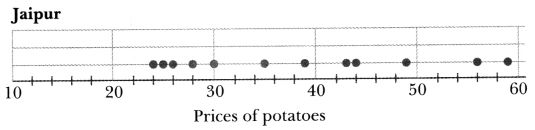
For example, the given data shows how the prices of potatoes change across different months of the year in Jaipur.

Month Jan Feb Mar Apr May Jun Jul Aug Sep Oct Nov Dec
Price in Jaipur (in ₹/ kg) 25 24 43 28 30 35 39 26 49 56 59 44

The dot plot for the given data is drawn as:
Connecting the Dots Class 7 Notes Maths Part 2 Chapter 5-2

Range of the given data is difference between its extremes, i.e. the difference between the highest and the lowest values in the dataset.
Range = Highest Value (Maximum) Lowest Value (Minimum)

Representative Value of the Data
A representative value of a dataset is a single number, often called a measure of central tendency, that summarises the entire dataset.

Average or Arithmetic mean (or simply Mean) is the value we get when we add up all the observations in the group and divide the total by the count of observations in the group.
\(\text { Mean }=\frac{\text { Sum of all values in the data }}{\text { Number of values in the data }}\)

The value of the Arithmetic mean depends on the total of all values and number of values, so more observations do not guarantee a higher mean.

The Median of a data set is the value in the middle, when all observations are arranged in order. It splits the data into two groups of equal size.

Connecting the Dots Class 7 Notes Maths Part 2 Chapter 5

If n is odd, Median = value of the \(\left(\frac{n+1}{2}\right)^{\text {th }}\) observation
If n is even, \(\text { Median }=\frac{\text { value of the }\left(\frac{n}{2}\right)^{\text {th }} \text { observation }+ \text { value of }\left(\frac{n}{2}+1\right)^{\text {th }} \text { observation }}{2}\)

An outlier is a data value which significantly deviates from the rest of the values in the data set.

Effect of Outliers on Mean and Median:
The mean may move up (or down), depending on the presence of an outlier to the right (or left).

The median usually remains near the centre of the main cluster of data and is more stable than the mean (especially in presence of outliers).

Mean is sensitive to outliers, while the median is more stable and often better represents the central tendency of the complete data set.

While working with data, it is important to understand the difference between a zero value and no value. For example, in a cricket match:

A score of 0 means the player played and scored 0 runs. Therefore, it must be counted to find mean or median.

A blank (no score) means the player did not bat in that match. Therefore, that match should not be counted while finding the average.

Visualisation of data with a Double Bar Graph
A clustered bar graph is a type of bar graph in which two or more bars are placed side by side to compare related quantities.

Like the single bar graphs, clustered bar graphs can be of two types: Horizontal and Vertical, depending on the orientation of bars.

Connecting the Dots Class 7 Notes Maths Part 2 Chapter 5

A double bar graph is a special case of a clustered bar graph in which exactly two bars are drawn for each category such as a team, a place, a time period, a type of item etc.

To draw a double bar graph for a given data, follow the steps given below:
Step 1: Draw axes and choose a scale: Draw vertical and horizontal axes, label them, and select a common scale for the vertical axis (or horizontal axis in case of horizontal double bar graph).
Step 2: Draw bars for each data set: For each category, draw bars of equal width side by side, using different colours or patterns.
Step 3: Add title and key: Give the graph a proper title and include a key (legend) to identify each data set.
Step 4: Check and label carefully: Ensure all bars are correctly labelled and spaced evenly.

For example, for the given data:

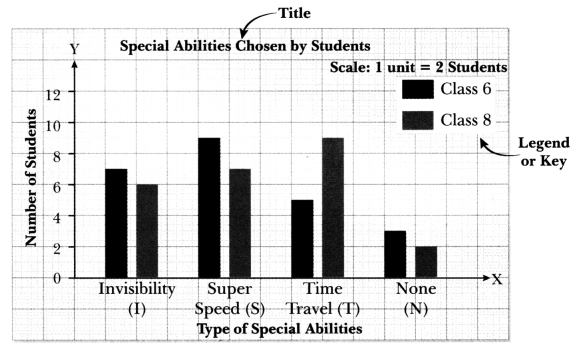
Special Abilities Chosen by Students

Invisibility (I)

Super Speed (S)

Time Travel (T)

None(N)

Class 6

7

9

5

3

Class 8

6

7

9

2

The double graph is drawn as:
Connecting the Dots Class 7 Notes Maths Part 2 Chapter 5-3

Interpretation of Double Bar Graphs
Interpreting a graph means studying it carefully to understand the information shown, comparing values, and drawing meaningful conclusions from the data.

To make sense of the data easily, we can follow a simple two-step process:
Step 1: Observe and identify the given data

  1. To do this, first read the title of the graph to know what is being measured and compared.
  2. Next, observe the x-axis and y-axis to identify the categories shown and the unit of measurement.
  3. Finally, check the scale of the graph so that the values and differences can be interpreted correctly.

Step 2: Analyse the data and make inferences

  1. To do this, analyse the values shown in the graph.
  2. Compare the data for different categories.
  3. Draw conclusions based on your observations.

Connecting the Dots Class 7 Notes Maths Part 2 Chapter 5

A well-drawn graph must be clear and accurate: It should have a proper title, correctly labelled axes, a common scale, equal spacing, and a key so that the data can be understood easily.

Introduction
Statistical questions are questions that involve variability in data and require data collection and analysis to answer.

A data set is an organised collection of related information or numerical values,
Range is the difference between the maximum and minimum values in a data set.

Representative Value
A representative value of a data set is a single number, often called a measure of central tendency, that summarises the entire data set. For example, mean and median.

Arithmetic Mean (Average) Median
\(\text { Mean }=\frac{\text { Sum of all observations }}{\text { Number of observations }}\) Median is the middle value of an ordered data.
Mean can be understood as fair share or equal distribution. If number of observations i.e., n is even,
\(\text { Median }=\left(\frac{n+1}{2}\right)^{\text {th }} \text { value }\)
Mean is widely used in daily life (rainfall, height, income, prices, sports performance) If number of observations i.e., n is even,
\(\text { Median }=\frac{\left(\frac{n}{2}\right)^{\text {th }} \text { value }+\left(\frac{n}{2}+1\right)^{\text {th }} \text { value }}{2}\)

Note:

  1. An outlier is a number that is very different from the others in a set of data — it is much bigger or much smaller than most of the values.
  2. The mean can be easily affected by outliers, but the median usually stays the same and gives a better idea of the middle of the data set.

Connecting the Dots Class 7 Notes Maths Part 2 Chapter 5

Visualisation of Data
Data visualisation helps in understanding data better using tools like dot plots and clustered bar graphs.

Dot Plots

Double Bar Graphs

A dot plot is a simple, visual graph used to represent numerical data by placing dots above a labeled number line. Double bar graphs are used to compare two related quantities by showing a pair of bars for each category using the same scale.
In a dot plot:

  1. Each dot represents one value from the data set.
  2. Spacing between the horizontal and vertical lines must be equal.
  3. The dots are placed in a line or row, usually along a number line.
  4. If the same number appears more than once, we stack the dots on top of each other.
To draw a double bar graph for a given data, follow the steps given below:
Step 1: Draw axes and choose a scale
Step 2: Draw bars for each data set
Step 3: Add title and key
Step 4: Check and label carefully


Interpreting the Graphs
Interpreting a graph means studying it carefully to understand the information shown, comparing values and drawing meaningful conclusions from the data.

To make sense of the data easily, we can follow a simple two-step process:
Step 1: Observe and identify the given data
Step 2: Analyse the data and make inferences

Another Peek Beyond the Point Class 7 Notes Maths Part 2 Chapter 4

Easy-to-read Ganita Prakash Class 7 Notes and Part 2 Chapter 4 Another Peek Beyond the Point Class 7 Notes save valuable study time during exam season.

Class 7 Maths Chapter 4 Another Peek Beyond the Point Notes

Class 7 Another Peek Beyond the Point Notes

Decimals are another way to show parts of a whole. Instead of writing fractions like \(\frac{1}{4}\) or \(\frac{1}{5}\), we use a point or period (‘.’) as a separator called a decimal point.
A decimal number has 3 parts.
Another Peek Beyond the Point Class 7 Notes Maths Part 2 Chapter 4-1

A decimal point indicates where the whole number part ends and the fractional part begins in a decimal number.

Also, decimals such as 0.1 and 0.01 can be expressed in the form of fractions as \(\frac{1}{10}\) and \(\frac{1}{100}\), respectively.

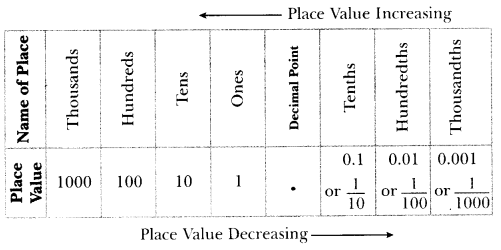
Place Value in a Decimal: Each digit in a number denotes a value depending on where it is placed. This is called the place value.
Another Peek Beyond the Point Class 7 Notes Maths Part 2 Chapter 4-2
Place value chart for decimals is given in the figure.
For example,
137.85 = 1 × 100 + 3 × 10 + 7 × 1 + 8 × \(\frac{1}{10}\) + 5 × \(\frac{1}{100}\)

Converting Fractions to Decimals (When Denominators are 10, 100, 1000, …): A fraction represents the division of the numerator by the denominator.

Another Peek Beyond the Point Class 7 Notes Maths Part 2 Chapter 4

Write the dividend as it is and put a decimal point at the end.
Count the zeroes in the divisor.

Move the decimal point left by the same number of places as the count of zeroes in the divisor. Add zeroes in front if needed.

Multiplication of a Decimal Number with a Whole Number
Repeated Addition Method: Multiplying a decimal by a whole number can be done by adding the decimals as many times as the whole number indicates.
For example, multiplying 6.5 by 7 is same as adding 6.5 seven times,
i. e. 6.5 × 7 = 6.5 + 6.5 + 6.5 + 6.5 + 6.5 + 6.5 + 6.5 = 45.5

Multiplication of Decimal by 10, 100 and 1000: When a decimal number is multiplied by 10, 100, or 1000, the decimal point shifts to the right by as many places as there are zeros in the multiplier.
For example, (i) 24.576 × 100 = 2457.6
(ii) 0.3251 × 1000 = 325.1

If there are not enough digits to shift the decimal point, zeroes are added to the right.
For example, 1.34 × 1000 = 1340.0 = 1340

Multiplication of a Decimal Number with a Decimal Number
Fraction Method (Converting Decimals to Fractions): Multiplication of decimals is same as multiplication of their corresponding fractions.
Step 1: Change decimals to corresponding fractions
Step 2: Multiply Numerator and Denominator, respectively
Step 3: Turn the final fraction back into a decimal

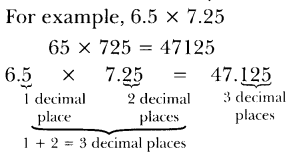
Decimal Shifting Method (Making them Whole Number)
Another Peek Beyond the Point Class 7 Notes Maths Part 2 Chapter 4-3
Step 1: Ignore the decimal points and multiply the numbers as whole numbers.
Step 2: Count the total number of digits after the decimal point in both numbers.
Step 3: From the right of the product, shift the decimal point to the left by the count obtained in step 2.

Another Peek Beyond the Point Class 7 Notes Maths Part 2 Chapter 4

Relation between Product and Numbers
If both numbers are greater than 1 (e.g., 3.4 X 6.5), the product (22.1) is greater than both the numbers.

If both number are between 0 and 1 (e.g., 0.75 x 0.4), the product (0.3) is less than both the numbers.

If one number is between 0 and 1 and one number is greater than 1 (e.g., 0.75 X 5), the product (3.75) is less than the number greater than 1 and greater than the number between 0 and 1.

Division of Decimals by 10, 100, 1000, …: When a number is divided by 10, 100, 1000, and so
on, move the decimal point to the left by as many places as there are zeros in the divisor.

Number ÷10 ÷100 ÷1000
12.02 1.202 0.1202 0.01202

If we run out of digits while moving the decimal point, we add zeros at the start of the number.

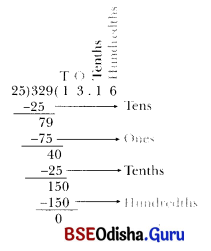
Decimal Division Using Place Value
Another Peek Beyond the Point Class 7 Notes Maths Part 2 Chapter 4-4
Step 1: Divide as you do with counting numbers, starting from the highest place value.
Step 2: If there is a remainder, regroup it into the next smaller place value digit and continue dividing.
Step 3: When you move from the Ones place to the Tenths place in the division, place a decimal point in the quotient.
Step 4: If necessary, add zeros to the right of the decimal point in the dividend and continue the division until the remainder becomes zero or the digits in the quotient begin to repeat.

Another Peek Beyond the Point Class 7 Notes Maths Part 2 Chapter 4

When the divisor is a decimal, we can convert it into a counting number by suitably multiplying it by 10, 100, 1000, and so on. We must also multiply the dividend by the same number.

Once the divisor is converted into a counting number, we proceed with the division by following the same place-value procedure (long division) to find the quotient.

A recurring decimal is a decimal that follows a repeating pattern of digits after the decimal point.
For example, \(\frac{1}{3}\) = 0.333… and \(\frac{12}{99}\) = 0.121212…

Relation between Dividend, Divisor and Quotient
When the divisor is between 0 and 1.
For example, 135 ÷ 0.5 (0 < 0.5 <1) The quotient (270) is greater than the dividend (135). When the divisor is greater than 1. For example, 135 ÷ 2.5 (> 1)
The quotient (54) is smaller than the dividend (135).

When the divisor is exactly 1.
For example, 135 ÷ 1
The quotient (135) is equal to the dividend (135).

Leap Year
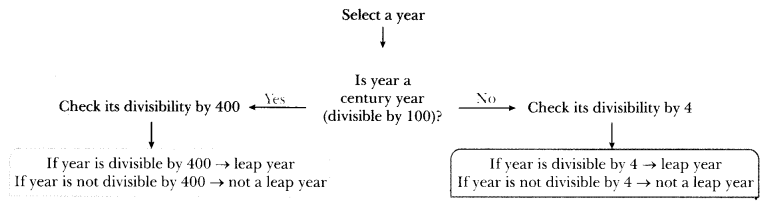
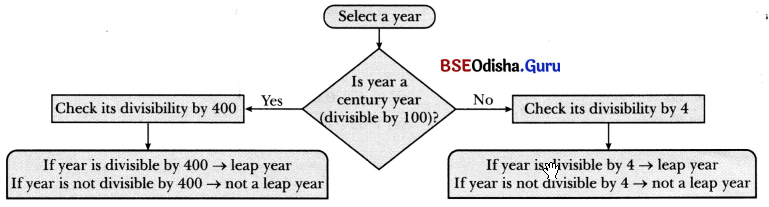
A leap year is a year with 366 days. In the Gregorian calendar, years divisible by 4 are leap years, but century years are leap years only if they are divisible by 400.

Process to determine whether a year is a leap year:
Another Peek Beyond the Point Class 7 Notes Maths Part 2 Chapter 4-5

Another Peek Beyond the Point Class 7 Notes Maths Part 2 Chapter 4

Multiplication of Decimal Numbers
For small whole numbers, multiplication can be viewed as adding the decimal number multiple times.

While multiplying a number by 10, 100, 1000, move the decimal point to the right by as many places as there are zeros in the multiplier.
If you run out of digits while moving the decimal point, add zeros at the end.

Multiplication of decimals is same as multiplication of their corresponding fractions.

Division of Decimal Numbers
When the divisor is a decimal, we can convert it into a counting number by suitably multiplying it by 10, 100, 1000, and so on. We must also multiply the dividend by the same number.

Once the divisor is converted into a counting number, we proceed with the division by following the same place-value procedure (long division) to find the quotient.

A recurring decimal is a decimal that follows a repeating pattern of digits after the decimal point.

Relationship between Dividend, Divisor and Quotient
When the divisor is between 0 and 1 [e.g., 135 ÷ 0.5 (0 < 0.5 <1)], the quotient (270) is greater than the dividend (135). When the divisor is greater than 1 [e.g., 135 ÷ 2.5 (> 1)], the quotient (54) is smaller than the dividend (135).

When the divisor is exactly 1 (e.g., 135 ÷ 1), the quotient (135) is equal to the dividend (135).

Another Peek Beyond the Point Class 7 Notes Maths Part 2 Chapter 4

Relation between Product and Numbers
If both numbers are greater than 1 (e.g., 3.4 × 6.5), the product (22.1) is greater than both the numbers.

If both numbers are between 0 and 1 (e.g., 0.75 × 0. 4), the product (0.3) is less than both the numbers.

If one number is between 0 and 1 and one number is greater than 1 (e.g., 0.75 × 5), the product (3.75) is less than the number greater than 1 and greater I than the number between 0 and 1.

Leap Year
A leap year is a year with 366 days. In the Gregorian calendar, years divisible by 4 are leap years, but century years are leap years only if they are divisible by 400.

Process to determine whether a year is a leap year:
Another Peek Beyond the Point Class 7 Notes Maths Part 2 Chapter 4-6

Finding Common Ground Class 7 Notes Maths Part 2 Chapter 3

Easy-to-read Ganita Prakash Class 7 Notes and Part 2 Chapter 3 Finding Common Ground Class 7 Notes save valuable study time during exam season.

Class 7 Maths Chapter 3 Finding Common Ground Notes

Class 7 Finding Common Ground Notes

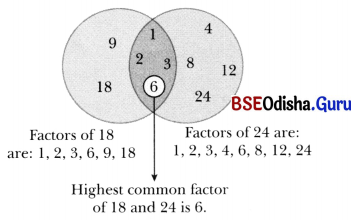
The Highest Common Factor (HCF) of a group of numbers is the greatest number that divides each number in the group completely, without leaving any remainder.
For example: HCF of 12 and 18 is 6.

We use HCF when we need to find the largest possible size that fits perfectly into different measurements, such as the largest tile for a floor.

A prime number is a number greater than 1 that has exactly two factors: 1 and the number itself. For example, 11 has only two factors 1 and 11, so it is a prime number.

Every number has a unique way of being broken down into its prime building blocks or prime factors. We call this process Prime Factorisation.
For example: 6 = 2 × 3; Here 2 and 3 are primes.
50 = 2 × 5 × 5; Here, 2 and 5 are primes.

Finding Common Ground Class 7 Notes Maths Part 2 Chapter 3

Any composite number can be written as a product of prime numbers.

Methods of finding HCF
Prime Factorisation Method
Step 1: Find the prime factorisation of each of the given numbers.
Step 2: Identify the common factors in the prime factorisation of all the given numbers.
Step 3: Multiply the common factors to obtain the HCF.
For example: Consider numbers 36, 42 and 64. Their prime factorisation are:
36 = 2 × 2 × 3 × 3
42 = 2 × 3 × 7
64= 2 × 2 × 2 × 2 × 2 × 2
∴ HCF of 36, 42 and 64 = 2

Common Factor Method
Step 1: Arrange all the given numbers in a row, separated by commas, for which we need to find the HCF.
Step 2: Divide all the numbers by any factor i.e., common to all of the given numbers. ;
Step 3: If there are still any common factors, divide the quotients by them and keep dividing until there is no common factor for all the given numbers.
Step 4: The product of these common factors will give the highest common factor.
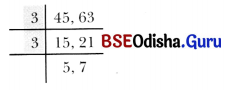
For example: Consider numbers 45 and 63. Using common factor method, we get
HCF of 45 and 63 = 3 × 3 = 9
Finding Common Ground Class 7 Notes Maths Part 2 Chapter 3-1

Repeated Division Method
Step 1: Divide the larger number by the smaller number and find the remainder.
Step 2: Take the remainder as the new divisor and divisor of step 1 as the new dividend, then divide.
Step 3: Repeat until the remainder is 0. The last divisor thus obtained is the HCF.
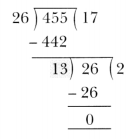
For example: Consider numbers 26 and 455. Using repeated division method, we get
HCF of 26 and 455 = 13
Finding Common Ground Class 7 Notes Maths Part 2 Chapter 3-2

Finding Common Ground Class 7 Notes Maths Part 2 Chapter 3

For numbers that share no common factors other than 1 (called co-primes, like 7 and 15), the F1CF is always 1. Therefore, the HCF of two co-prime numbers is always 1.

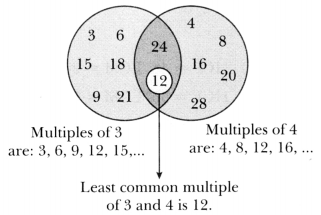
The Least Common Multiple (LCM) is the smallest non-zero number that is a multiple of all the given numbers.

For example, LCM of 15 and 20 is 60, as 60 is the smallest non-zero number that is a multiple of both 15 and 20.

We use LCM to find when events that happen at different intervals will align or meet again, like bells ringing or joggers crossing a start line.

Methods of finding LCM
Prime Factorisation Method
Step 1: Write the prime factorisation of each given number and list all the prime factors involved.
Step 2: For each prime factor, take the greatest number of times it appears in any of the numbers.
If two numbers are multiplied
Step 3: Multiply these factors to obtain the LCM.
For example: Consider numbers 36, 42 and 64. Their prime factorisation are:
36 = 2 × 2 × 3 × 3
42 = 2 × 3 × 7
64 = 2 × 2 × 2 × 2 × 2 × 2
∴ LCM of 36, 42 and 64 = 2 × 2 × 2 × 2 × 2 × 2 × 3 × 3 × 7 = 4032

Finding Common Ground Class 7 Notes Maths Part 2 Chapter 3

Common Division Method
Step 1: Write the given numbers in a row, separated by commas.
Step 2: Divide these numbers by the least prime number which divides at least one of the numbers.
Step 3: Write the quotients below, and bring down the numbers that are not divisible by the prime number.
Step 4: Repeat Steps 2 and 3 with the new row. Continue until all numbers in a row become 1.
Step 5: Find the product of all the divisors used in the process. This gives the LCM.
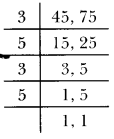
For example: Consider numbers 45 and 75. Using common division method, we get
LCM of 45 and 75 = 3 × 5 × 3 × 5 = 225
Finding Common Ground Class 7 Notes Maths Part 2 Chapter 3-3

Properties of HCF and LCM
The HCF of a set of given numbers is always either smaller than all the numbers or equal to the smallest number.
For example, HCF (18, 24) = 6 → smaller than both the numbers
Also, HCF (8, 16) = 8 → equal to the smallest number

The LCM of a set of given numbers is always either greater than all the numbers or equal to the greatest number.
For example, LCM (6, 8) = 24 → greater than both the numbers
Also, LCM (8, 16) = 16 → equal to the greatest number

The HCF of a set of co-prime numbers is 1 and the LCM of co-prime numbers is the product of the co-primes.
For example, 8 and 15 are co-prime numbers as their common factor is 1.
Here, LCM (8, 15) = 120 = 8 × 15 and HCF (8, 15) = 1

Finding Common Ground Class 7 Notes Maths Part 2 Chapter 3

The HCF of a set of given numbers is a factor of their LCM. In other words, the LCM of given numbers is a multiple of their HCF.
For example, HCF and LCM of 12 and 18 are 6 and 36, respectively. Here, 6 is a factor 36.

If two numbers are multiplied by the same number, then both their HCF and LCM are also multiplied by that number.

If the HCF of two numbers a and b is H and their LCM is L, then for any number k:
HCF (ka, kb) = kH and LCM (ka, kb) = kL

For any two given numbers, if the first number is a factor of the second number, then the first number is their HCF and the second number is their LCM.
For example, consider the numbers 8 and 48. As 8 is a factor of 48,
HCF (8, 48) = 8 and LCM (8, 48) = 48

Relationship Between HCF, LCM and the Product of Two Numbers
The product of LCM and HCF of two numbers is equal to the product of the numbers, i.e.
For any two numbers a and b, LCM (a, b) × HCF (a, b) = a × b

Highest Common Factor (HCF)
The largest positive integer that divides two or more given numbers exactly.
Finding Common Ground Class 7 Notes Maths Part 2 Chapter 3-4

Finding Common Ground Class 7 Notes Maths Part 2 Chapter 3

Least Common Multiple (LCM)
The smallest positive integer that is a multiple of two or more given numbers.
Finding Common Ground Class 7 Notes Maths Part 2 Chapter 3-5

Properties of HCF and LCM
The HCF of given numbers is always either smaller than all the numbers or equal to the smallest number.

The LCM of given numbers is always either greater than all the numbers or equal to the greatest number.

HCF of co-prime numbers is 1 and the LCM of co-prime numbers is the product of the co-primes.

The HCF of a set of given numbers is a factor of their LCM. In other words, the LCM of given numbers is a multiple of their HCF.

If two numbers are multiplied by the same number, then both their HCF and LCM are also multiplied by that number.
HCF(ka, kb) = kH and LCM(ka, kb) = kL, where, H and L are HCF (a, b) and LCM (a, b) respectively.

Given any two numbers, if the first number is a factor of the second number, then the first number is their HCF and the second number is their LCM.

The product of LCM and HCF of two numbers is equal to the product of the numbers, i.e. LCM × HCF = Product of two numbers.

Operations with Integers Class 7 Notes Maths Part 2 Chapter 2

Easy-to-read Ganita Prakash Class 7 Notes and Part 2 Chapter 2 Operations with Integers Class 7 Notes save valuable study time during exam season.

Class 7 Maths Chapter 2 Operations with Integers Notes

Class 7 Operations with Integers Notes

Integers are a set of numbers that include natural numbers, their additive inverses (negative integers) and zero.

Two numbers are said to be additive inverses of each other if their sum is zero.
For example, — 3 is the additive inverse of 3 and 5 is the additive inverse of – 5 as 3 + (— 3) = 0 and (— 5) + 5 = 0.

Addition and Substraction of Integers
Sum of two positive integers is always positive.
Sum of two negative integers is always negative.

When two integers with the same sign are added, their magnitudes are added and the sign of the result remains the same as the given integers.

When two integers with different signs are added, the result is obtained by finding the difference of their magnitudes (greater magnitude – smaller magnitude), and the sign of the answer is the sign of the integer with greater magnitude.

“Subtraction” is same as “adding the opposite” or “adding the additive inverse”.

Operations with Integers Class 7 Notes Maths Part 2 Chapter 2

Multiplication of Integers
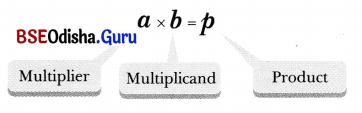
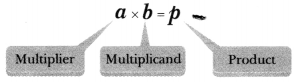
In a × b = p, numbers a, b and p are called multiplier, multiplicand and product respectively.
Operations with Integers Class 7 Notes Maths Part 2 Chapter 2-1

The magnitude of the product does not change Multiplier Multiplicand with the change in the signs of both the multiplier and the multiplicand.

When both numbers (multiplier and multiplicand) are positive, the product is positive. When both numbers (multiplier and multiplicand) are negative, the product is positive.

When one of the multiplier or the multiplicand is positive and the other is negative, their product is negative.

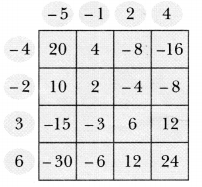
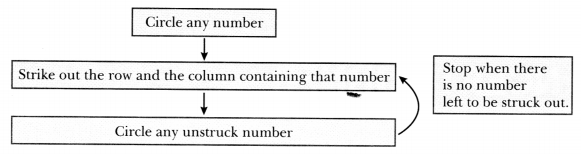
Magic Grid of Integers
Operations with Integers Class 7 Notes Maths Part 2 Chapter 2-2
Each number in the grid is formed by multiplying one row factor and one column factor.

So, each cell contains the product of one row factor and one column factor.
Operations with Integers Class 7 Notes Maths Part 2 Chapter 2-3
When a number is circled, its row and column are crossed out.
This ensures that no row or column is used more than once.
As a result, each row factor and each column factor is included exactly once in final multiplication.

No matter which valid numbers are chosen—provided only one number is selected from each row and each column—the product remains the same.

Operations with Integers Class 7 Notes Maths Part 2 Chapter 2

Division of Integers
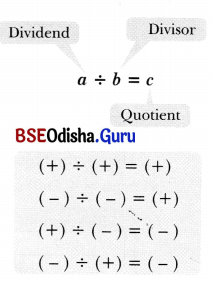
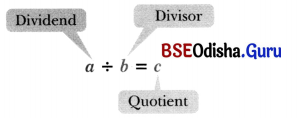
The magnitude of the quotient does not change with the change in the signs of the dividend and the divisor.
Operations with Integers Class 7 Notes Maths Part 2 Chapter 2-4
When a positive integer is divided by another positive integer, a positive result is obtained.
When a negative integer is divided by a positive integer, a negative result is obtained.

When a positive integer is divided by a negative integer, a negative result is obtained.

When a negative integer is divided by another negative integer, a positive result is obtained.

Properties Related to Multiplication and Division of Integers
Commutative Property of Multiplication (Swapping)
For any two integers, a and b, we can say that a × b = b × a

Associative Property of Multiplication (Grouping)
For any three integers, a, b and c, we can say that (a × b) × c = a × (b × c).

Distributive Property of Multiplication Over Addition
For any three integers, a, b and c, we can say that a × (b + c) = a × b + a × c

The sign of a product is positive if the number of negative integers in the product is even.
For example, (- 3) × (- 2) × (- 1) × (- 4) = 24 [Number of negative integers = 4 (even)]

The sign of a product is negative if the number of negative integers in the product is odd.
For example, (- 5) × (- 1) × (- 3) = – 15 [Number of negative integers = 3 (odd)]

Division of two numbers is not commutative. For example, 4 ÷ 2 ≠ 2 ÷ 4

Division of three numbers is not associative. For example, (16 ÷ 4) ÷ 2 ≠ 16 ÷ (4 ÷ 2)

Operations with Integers Class 7 Notes Maths Part 2 Chapter 2

Identify the Pattern
Imagine a “number machine” or “machine”, which performs a defined set of arithmetic operations on the numbers it receives as inputs.

The operations done by the machine are hidden, and our task is to identify the rule by carefully observing the relationship between the input numbers and the output number.
Inputs → Machine → Outputs

Multiplication of Integers
Operations with Integers Class 7 Notes Maths Part 2 Chapter 2-5
The magnitude of the product does not change with the change in the signs of the multiplier and the multiplicand.
For example, 3 × 2 = 6; 3 × (- 2) = – 6; – 3 × 2 = – 6; -3 × (-2) = 6

Quick Rules: Multiplication of integers
(+) × (+) = (+); (-) × (-) = (+)
(+) × (-) = (-); (-) × (+) = (-)

Division of Integers
Operations with Integers Class 7 Notes Maths Part 2 Chapter 2-6
The magnitude of the quotient does not change with the change in the signs of the dividend and the divisor.
For example, 8 ÷ 4 = 2; 8 ÷ (- 4) = – 2;
– 8 ÷ 4 = – 2; – 8 ÷ (- 4) = 2

Quick Rules: Division of integers
(+) ÷ (+) = (+); (-) ÷ (-) = (+)
(+) ÷ (-) = (-); (-) ÷ (+) = (-)

Operations with Integers Class 7 Notes Maths Part 2 Chapter 2

Properties Related to Multiplication and Division
Commutative property of multiplication: a × b = b × a
Associative property of multiplication: (a × b) × c = a × (b × c)
Distributive property of multiplication over addition: a × (b + c) = a × b + a × c

The sign of a product is positive if the number of negative integers in the product is even.
For example, (- 3) × (- 2) × (- 1) × (- 4) = 24 [Number of negative integers = 4 (even)]

The sign of a product is negative if the number of negative integers in the product is odd.
For example, (-5) × (-1) × (-3) = – 15 [Number of negative integers = 3 (odd)]

Division of two numbers is not commutative. For example, 4 ÷ 2 ≠ 2 ÷ 4
Division of three numbers is not associative. For example, (16 ÷ 4) ÷ 2 ≠ 16 ÷ (4 ÷ 2)

Geometric Twins Class 7 Notes Maths Part 2 Chapter 1

Easy-to-read Ganita Prakash Class 7 Notes and Part 2 Chapter 1 Geometric Twins Class 7 Notes save valuable study time during exam season.

Class 7 Maths Chapter 1 Geometric Twins Notes

Class 7 Geometric Twins Notes

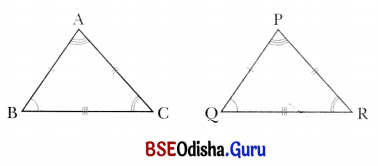
Two figures or objects that have same shape and same size, and can be superimposed on each other by sliding, turning or flipping, are called geometric twins or congruent figures.
Geometric Twins Class 7 Notes Maths Part 2 Chapter 1-1
Two line segments are said to be congruent if they have the same length.

Two angles are said to be congruent if they have the same measure.

Two polygons are congruent if they are of the same size and shape, i.e. if their corresponding angles and sides are equal.

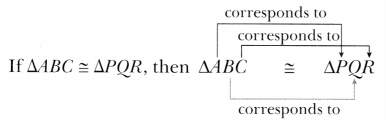
Two triangles are congruent if their corresponding sides are equal in length and their corresponding angles are equal in measure.
Geometric Twins Class 7 Notes Maths Part 2 Chapter 1-2

Criteria for Congruence of Triangles
There are five criteria for congruence of triangles as given below:
Geometric Twins Class 7 Notes Maths Part 2 Chapter 1-3

Geometric Twins Class 7 Notes Maths Part 2 Chapter 1

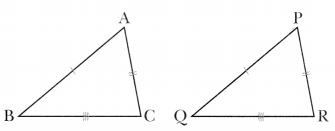
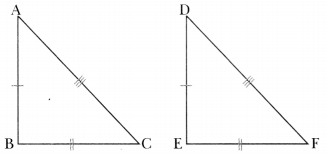
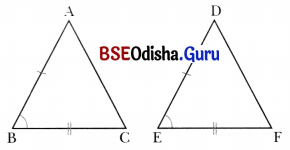
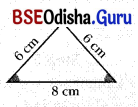
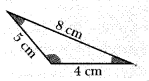
SSS (Side – Side – Side) congruence criterion
If the three sides of one triangle are equal to corresponding three sides of another triangle, then the triangles are congruent.

In general, for any two triangles, ∆ABC and ∆PQR, if B AB = PQ, BC = QR and AC = PR, then according to SSS congruence criterion, ∆ABC ≅ ∆PQR.

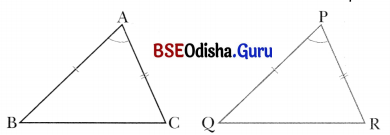
SAS (Side – Angle – Side) congruence criterion
Geometric Twins Class 7 Notes Maths Part 2 Chapter 1-4
If two sides and the included angle of one triangle are equal to the corresponding two sides and the included angle of another triangle, then the triangles are congruent.

In general, for any two triangles ∆ABC and ∆PQR, if AB = PQ, ∠A = ∠P and AC = PR, then according to SAS congruence criterion, ∆ABC ≅ ∆PQR.

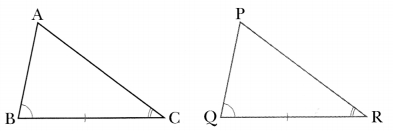
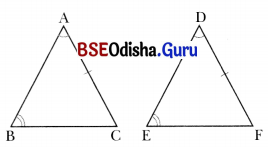
ASA (Angle – Side – Angle) congruence criterion
Geometric Twins Class 7 Notes Maths Part 2 Chapter 1-12
If two angles and the included side of one triangle are equal to the corresponding two angles and included side of another triangley. then the triangles are congruent.

In general, for any two triangles, ∆ABC and ∆PQR, if ∠B = ∠Q BC = QR and ∠C = ∠R, then according to ASA congruence criterion, ∆ABC ≅ ∆PQR.

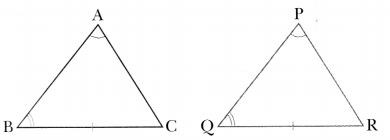
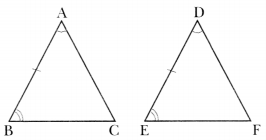
AAS (Angle – Angle – Side) congruence criterion
Geometric Twins Class 7 Notes Maths Part 2 Chapter 1-5
If two angles and the non-included side of one triangle are equal to the corresponding two angles and the non-included side of another triangle, then the triangles are congruent.

Geometric Twins Class 7 Notes Maths Part 2 Chapter 1

In general, for any two triangles, ∆ABC and ∆PQR, if ∠A = ∠P, ∠B = ∠Q and BC = QR. then according to AAS congruence criterion,
∆ABC ≅ ∆PQR.

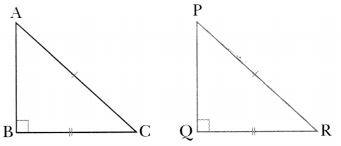
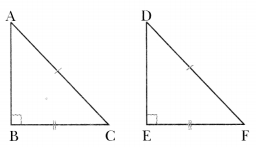
RHS (Right Angle – Hypotenuse – Side) congruence criterion
Geometric Twins Class 7 Notes Maths Part 2 Chapter 1-6
If the hypotenuse and one side of one right-angled triangle are equal to the hypotenuse and corresponding side of another right-angled triangle, then the triangles are congruent.

In general, if ∆ABC and ∆PQR are two right triangles g such that ∠B = ∠Q= 90°, AC = PR and BC = QR, then according to RHS congruence criterion, ∆ABC ≅ ∆PQR.

Angles of Isosceles and Equilateral Triangles
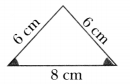
Angles opposite to equal sides of an isosceles triangle are equal. Conversely, sides opposite to equal angles of a triangle are equal.

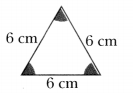
An equilateral triangle has all sides equal and all the angles in an equilateral triangle are equal, i.e. 60°.

Important Points

  1. The sum of all interior angles of a triangle is 180°, and that of a quadrilateral (polygon with 4 sides) is 360°.
  2. Two congruent figures have the same area and same perimeter.
  3. The angle that lies between two given sides of a triangle is called the included angle.
  4. An angle of a triangle that does not lie between the two given sides is called a non-included angle.
  5. The side of a triangle that lies between two given angles is called the included side.
  6. A non-included side of a triangle is the side that does not lie between the two given angles.
  7. AAA (Angle – Angle – Angle) and SSA (Side – Side – Angle) are not congruence criteria.

Geometric Twins Class 7 Notes Maths Part 2 Chapter 1

Concept of congruence

  1. Two figures or objects that have same shape and same size and can be superimposed on each other by sliding, turning or flipping are called congruent figures.
  2. Two line segments are said to be congruent if they have the same length.
  3. Two angles are said to be congruent if they hat e the same measure.
  4. Two squares are said to be congruent, if they have same length of the sides.
  5. Two rectangles are said to be congruent if they have same length and breadth.
  6. Two circles are said to be congruent if they have the same radius.

Congruency of Triangles
SSS Congruence Rule
Geometric Twins Class 7 Notes Maths Part 2 Chapter 1-7
If measure of all three sides of triangle ABC are equal to the measure of three corresponding sides of other triangle DEE then ∆ABC ≅ ∆DEF, by SSS (Side-Side-Side) congruence rule.

Geometric Twins Class 7 Notes Maths Part 2 Chapter 1

SAS Congruence Rule
Geometric Twins Class 7 Notes Maths Part 2 Chapter 1-8
If any two sides and the included angle of triangle ABC are equal to the corresponding two sides and the included angle in the another triangle DEF, then ∆ABC ≅ ∆DEF, bv SAS (Side-Angle-Side) congruence rule.

RHS Congruence Rule
Geometric Twins Class 7 Notes Maths Part 2 Chapter 1-9
In right-angled ∆ABC, if the hypotenuse and any one side of triangle are equal to the hypotenuse and corresponding side of another right angled ∆DEF, then ∆ABC ≅ ∆DEF, by RHS (Right angle-Hypotenuse- Side) congruence rule.

ASA Congruence Rule
Geometric Twins Class 7 Notes Maths Part 2 Chapter 1-10
If any two angles and the included side of triangle ABC are equal to the corresponding two angles and included side of the another triangle DEF, then ∆ABC ≅ ∆DEF, by ASA (Angle-Side-Angle) congruence rule.

Geometric Twins Class 7 Notes Maths Part 2 Chapter 1

AAS Congruence Rule
Geometric Twins Class 7 Notes Maths Part 2 Chapter 1-11
If any two angles and ,non- included side of triangle ABC are equal to the corresponding two angles and non-included side of the another triangle DEF, then ∆ABC ≅ ∆DEF, by AAS (Angle- Angle-Side) congruence rule.

Working with Fractions Class 7 Notes Maths Chapter 8

Easy-to-read Ganita Prakash Class 7 Notes and Chapter 8 Working with Fractions Class 7 Notes save valuable study time during exam season.

Class 7 Maths Chapter 8 Working with Fractions Notes

Class 7 Working with Fractions Notes

Types of Fractions

Type of Fraction What it means Example
Proper Fraction Numerator < Denominator {Numerator less than Denominator} \(\frac{1}{3}, \frac{4}{7}, \frac{2}{5},\) etc.
Improper Fraction Numerator ≥ Denominator {Numerator equal to or greater than Denominator} \(\frac{1}{1}, \frac{3}{2}, \frac{7}{4},\) etc.
Mixed Fraction A whole number + a proper fraction \(1 \frac{1}{4}, 3 \frac{2}{5}, 5 \frac{3}{7},\) etc.
Equivalent Fractions Look different but have the same value \(\frac{1}{2}=\frac{2}{4}=\frac{3}{6}\) etc.

To multiply a whole number by a fraction, we simply multiply the numerator of the fraction by the whole number, keeping the denominator same.
For example, \(3 \times \frac{1}{2}=\frac{3 \times 1}{2}=\frac{3}{2}\)

Note: Fraction \(\frac{a}{b}\) is said to be in its lowest form, if a and b have no common factor other than 1.

Multiplication can be understood as repeated addition. It tells us how many times one number is added to itself.
For example, 3 × 4 = 12 because 4 + 4 + 4 = 12 (3 times).
This idea works with fractions too: \(3 \times \frac{1}{4}=\frac{3}{4}\) because \(\frac{1}{4}+\frac{1}{4}+\frac{1}{4}=\frac{3}{4}\).

Working with Fractions Class 7 Notes Maths Chapter 8

Multiplication is the number that is to be multiplied by another number (called the multiplier).
For example, in \(8 \times \frac{3}{5}=\frac{24}{5},\) 8 is multiplier while \(\frac{3}{5}\) is multiplicand.

Sometimes ‘of’ means ‘multiplication’. For example, \(\frac{3}{4}\) of 20 = \(\frac{3}{4} \times 20\) = 15.

Unit fractions (like \(\frac{3}{n}\)) get smaller as the number in the bottom (denominator) gets bigger.
For example, \(\frac{1}{2}>\frac{1}{5}>\frac{1}{10}\)

Product ot two fractions = \(\frac{\text { Product of their numerators }}{\text { Product of their denominators }} \text {. For example, } \frac{2}{3} \times \frac{5}{11}=\frac{2 \times 5}{3 \times 11}=\frac{10}{33}\)

(i) When two proper fractions are multiplied, their product is less than each of the fractions.
For example, the product of \(\frac{1}{2} \text { and } \frac{3}{4} \text { is } \frac{3}{8} \text { and } \frac{3}{8}\) is less than both \(\frac{1}{2} \text { and } \frac{3}{4}\).

(ii) The product of a proper fraction and an improper fraction is greater than or equal to the proper fraction and less than the improper fraction.
For example, the product of \(\frac{5}{2} \text { and } \frac{1}{4} \text { is } \frac{5}{8} \text { and } \frac{1}{4}<\frac{5}{8}<\frac{5}{2}\).

(iii) When two improper fractions are multiplied, their product is greater than both the fractions or equal to either of them.
For example, the product of \(\frac{5}{2} \text { and } \frac{5}{4} \text { is } \frac{25}{8} \text { and } \frac{25}{8}\) is greater than both and \(\frac{5}{2} \text { and } \frac{5}{4}\).

The reciprocal of a fraction can be obtained by interchanging the numerator and denominator.
So, the reciprocal of a fraction \(\frac{a}{b} \text { is } \frac{b}{a}\).

Working with Fractions Class 7 Notes Maths Chapter 8

Relation between the Area of a Rectangle and Multiplication of Fractions
Working with Fractions Class 7 Notes Maths Chapter 8-1
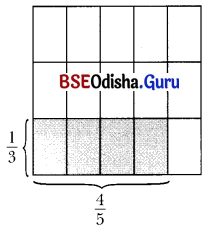
In the given figure, a square of area 1 square unit is divided into 15 equal rectangles. So, the area of each small rectangle = \(\frac{1}{15}\) square units
Number of shaded rectangles = 4
Therefore, total shaded area = \(4 \times \frac{1}{15}=\frac{4}{15}\) square units

Now, let’s verify this mathematically:
Length of shaded region = \(\frac{4}{5}\); Breadth of shaded region = \(\frac{1}{3}\)
Area of shaded region = Length × Breadth = \(\frac{4}{5} \times \frac{1}{3}=\frac{4 \times 1}{5 \times 3}=\frac{4}{15}\)

In general, if we want to find the product of two fractions, we can find the area of the rectangle formed with the two fractions as its sides.

The area of the rectangle remains the same even if the length and the breadth are interchanged,
i. e. the order of multiplication does not matter. Thus,
\(\frac{a}{b} \times \frac{c}{d}=\frac{c}{d} \times \frac{a}{b}\)

Division of Fractions

Division of a Whole Number by a Fraction Rule: \(a \div \frac{b}{c}=a \times \frac{c}{b}\) For Example, \(5 \div \frac{5}{4}=5 \times \frac{4}{5}=4\)
Division of a Fraction by Another Fraction Rule: \(\frac{a}{b} \div \frac{c}{d}=\frac{a}{b} \times \frac{d}{c}\) For Example, \(\frac{3}{7} \div \frac{4}{7}=\frac{3}{7} \times \frac{7}{4}=\frac{3}{4}\)
Division of a Fraction by a Non-zero Whole Number Rule: \(\frac{a}{b} \div c=\frac{a}{b} \times \frac{1}{c}\) For Example, \(\frac{6}{13} \div 6=\frac{6}{13} \times \frac{1}{6}=\frac{1}{13}\)

Working with Fractions Class 7 Notes Maths Chapter 8

Note:

  1. When the divisor is greater than 1, the quotient is smaller than the dividend. For example, 15 ÷ 3 = 5. Here, 5 < 15 as 3 > 1.
  2. When the divisor is equal to 1, the quotient is the same as the dividend. For example, 8 ÷ 1 = 8.
  3. When the divisor is smaller than 1, the quotient is greater than the dividend. For example, 8 ÷ \(\frac{1}{2}\) = 16. Here, 16 > 8 as \(\frac{1}{2}\) < 1.

Important Points to Remember

  1. Smaller divisor → Bigger quotient
  2. Bigger divisor → Smaller quotient
  3. When the whole number 0 is divided by a fraction, we get 0 as the quotient.

Introduction
Proper Fraction: Numerator < Denominator. For example, \(\frac{2}{7}, \frac{5}{8},\) etc. Value of proper fraction is always less than 1. Improper Fraction: Numerator > Denominator.
For example, \(1, \frac{8}{5}, \frac{13}{5},\) etc.
Value of an improper fraction is always greater than or equal to 1.

Mixed Fraction: A whole number + A proper fraction.
For example, \(1 \frac{1}{4}, 3 \frac{1}{2},\) etc.

Equivalent Fractions: Look different but have the same value.
For example, \(\frac{1}{2}=\frac{2}{4}=\frac{3}{6}\)

Working with Fractions Class 7 Notes Maths Chapter 8

Multiplication of Fractions
Product of two fractions = \(\frac{\text { Product of their numerators }}{\text { Product of their denominators }} \text {. For example, } \frac{3}{5} \times \frac{5}{9}=\frac{5 \times 3}{5 \times 9}\)
Based on above formula we can conclude the following result:

Condition Description of Product Example Comparison
Two Proper Fractions The product is less than each of the fractions. \(\frac{1}{3} \times \frac{5}{7}=\frac{5}{21}\) \(\frac{5}{21}<\frac{1}{3} \text { and } \frac{5}{21}<\frac{5}{7}\)
Proper x Improper The product is greater than or equal to the proper fraction but less than the improper fraction. \(\frac{1}{3} \times \frac{7}{3}=\frac{7}{9}\) \(\frac{1}{3}<\frac{7}{9}<\frac{7}{3}\)
Two Improper Fractions The product is greater than both the fractions or equal to either of them. \(\frac{7}{3} \times \frac{8}{5}=\frac{56}{15}\) \(\frac{56}{15}>\frac{7}{3} \text { and } \frac{56}{15}>\frac{8}{5}\)


Division of Fractions
The reciprocal of a fraction can be obtained by interchanging the numerator and denominator.
So, the reciprocal of a fraction \(\frac{a}{b} \text { is } \frac{b}{a}\)

Whole Number ÷ Fraction \(a \div \frac{b}{c}=a \times \frac{c}{b}\)
For Example: \(5 \div \frac{3}{4}=5 \times \frac{4}{3}=\frac{20}{3}\)
Fraction ÷ Fraction \(\frac{a}{b} \div \frac{c}{d}=\frac{a}{b} \times \frac{d}{c}\)
For Example: \(\frac{3}{7} \div \frac{1}{5}=\frac{3}{7} \times \frac{5}{1}=\frac{15}{7}\)
Fraction ÷ Non-zero Whole Number \(\frac{a}{b} \div c=\frac{a}{b} \times \frac{1}{c}\)
For Example: \(\frac{1}{8} \div 3=\frac{1}{8} \times \frac{1}{3}=\frac{1}{24}\)

The World of Metals and Non-metals Class 7 Question Answer Science Chapter 4

Go through BSE Odisha Class 7 Science Solutions and Class 7 Science Chapter 4 The World of Metals and Non-metals Question Answer to understand textbook questions more clearly.

Class 7 Science Curiosity Chapter 4 Question Answer

Science Curiosity Class 7 Chapter 4 Question Answer

The World of Metals and Non-metals Class 7 Questions and Answers

Let Us Enhance Our Learning

Question 1.
Which metal is commonly used to make food packaging materials as it is cheaper, and its thin sheets can be folded easily into any shape?
(a) Aluminium
(b) Copper
(c) Iron
(d) Gold
Answer:
(a) Aluminium is commonly used in food packaging materials as it is malleable, cheaper, and easily available.

The World of Metals and Non-metals Class 7 Question Answer Science Chapter 4

Question 2.
Which of the following metals catches fire when it comes in contact with water?
(a) Copper
(b) Aluminium
(c) Zinc
(d) Sodium
Answer:
(d) Sodium, being highly reactive, catches fire when it comes in contact with water.

Question 3.
State with reason(s) whether the following statements are True [T] or False [F].
(i) Aluminium and copper are examples of nonmetals used for making utensils and statues.
Answer:
False Aluminium and copper are examples of metals.

(ii) Metals form oxides when combined with oxygen, the solution of which turns blue litmus paper to red.
Answer:
False Metals form basic oxides when combined with oxygen, and thus, the solution turns red litmus paper blue.

(iii) Oxygen is a non-metal essential for respiration.
Answer:
True

(iv) Copper vessels are used for boiling water because they are good conductors of electricity.
Answer:
False Copper vessels are used for boiling water because they are good conductors of heat.

The World of Metals and Non-metals Class 7 Question Answer Science Chapter 4

Question 4.
Why are only a few metals suitable for making jewellery?
Answer:
To make jewellery, the material used must be lustrous, malleable, ductile, and resistant to corrosion. Generally, metals are lustrous, malleable, ductile, but not all metals are resistant to corrosion. Metals like gold and silver are the most malleable as well as resistant to corrosion and are therefore suitable for making jewellery.

Question 5.
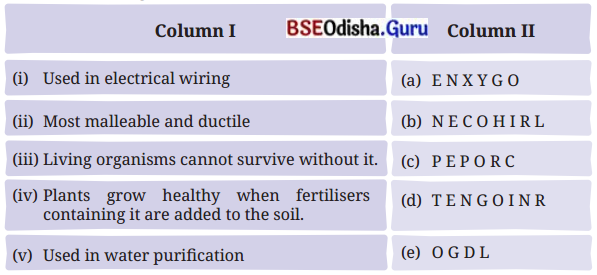
Match the uses of metals and non-metals given in Column I with the jumbled names of metals and non-metals given in Column II.
The World of Metals and Non-metals Class 7 Question Answer Science Chapter 4.1
Answer:

Column I Column II
(i) Used in electrical wiring (C) COPPER
(ii) Most malleable and ductile (E) GOLD
(iii) Living organisms cannot survive without it. (A) OXYGEN
(iv) Plants grow healthy when fertilisers containing it are added to the soil. (D) NITROGEN
(v) Used in water purification (B) CHLORINE

Question 6.
What happens when oxygen reacts with magnesium and sulphur? What are the main differences in the nature of products formed?
Answer:
When oxygen reacts with magnesium (metal), a white ash of magnesium oxide is formed. When oxygen reacts with sulphur, sulphur dioxide gas is released.
Main difference: It is known that metals form basic oxides, while non-metals generally form acidic oxides. Hence, in the present case, the magnesium oxide is basic in nature, while sulphur dioxide is acidic in nature. This can also be confirmed via the litmus test. Magnesium oxide turns moist red litmus paper blue, while sulphur dioxide turns moist blue litmus paper red.

The World of Metals and Non-metals Class 7 Question Answer Science Chapter 4

Question 7.
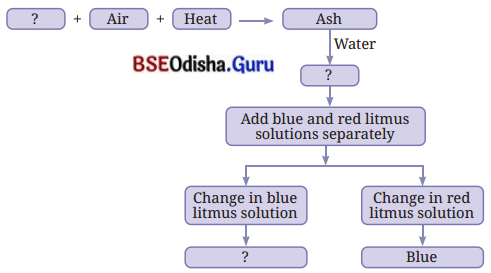
Complete the following flow chart:
The World of Metals and Non-metals Class 7 Question Answer Science Chapter 4.2

Answer:
The answers from top to bottom in sequence are as follows:

  • Magnesium
  • Magnesium hydroxide (or solution of magnesium oxide)
  • No change

Question 8.
You are provided with the following materials. Discuss which material would be your choice to make a pan that is most suitable for boiling water and why?
The World of Metals and Non-metals Class 7 Question Answer Science Chapter 4.3
Answer:
Since metals are good conductors of heat, they are used to make utensils like a pan for boiling water or other cooking purposes. From the given materials, only iron and copper are metals. Here, copper is most suitable for making a pan because it does not react easily with water, and is a better conductor of heat.

Question 9.
You are provided with three iron nails, each dipped in oil, water and vinegar. Which iron nail will not rust, and why?
Answer:
The iron nail dipped in oil will not rust, as oil acts as a barrier that prevents the iron nail from coming in contact with air and water.

Question 10.
How do the different properties of metals and non-metals determine their uses in everyday life?
Answer:
Metals like copper and aluminium can be used to make electrical wires as these are ductile and good conductors of heat and electricity. Aluminium, being malleable, can be used to make foils to wrap food items. Gold and silver, being lustrous, are used to make jewellery.

Iron is strong and hard, and thus, used in construction to make buildings and tools like hammers, knives, and spades. Non-metals are also essential for life. For example, chlorine is used in water purification, nitrogen is used in the preparation of fertilisers, and oxygen is used for breathing.

The World of Metals and Non-metals Class 7 Question Answer Science Chapter 4

Question 11.
One of the methods of protecting iron from getting rusted is to put a thin coating of zinc metal over it. Since sulphur does not react with water, can it be used for this purpose? Justify your answer.
Answer:
No, sulphur cannot be used to coat iron to prevent it from rusting. This is because sulphur reacts with oxygen to form sulphur dioxide gas which can easily leave the surface of iron and hence, cannot form a protective layer like zinc. Zinc forms a protective layer that prevents iron from coming in contact with air and moisture.

Question 12.
An ironsmith heats iron before making tools. Why is heating necessary in this process?
Answer:
It is important to heat the iron to make tools because heating makes the iron soft and easier to shape. Once it cools down, it becomes strong and hard again.

Class 7 Curiosity Chapter 4 Question Answer

InText Questions

Question 1.
Are all metals hard and solid (at room temperature)? Explain. [Page 43]
Answer:
No, some metals like sodium and potassium are so soft that they can be cut with a knife. Mercury is a metal that exists in its liquid state at room temperature.

Question 2.
Where do you find the use of metal wires? [Page 44]
Answer:
Metal wires are used in electrical fittings, fencing, ornaments like necklaces, and variety of stringed musical instruments such as veena, sitar, violin, and guitar.

The World of Metals and Non-metals Class 7 Question Answer Science Chapter 4

Question 3.
Why can wires not be made up of coal or sulphur? [Page 45]
Answer:
Since ductility is mainly possessed by metals, while coal and sulphur are non-metals, they cannot be used to make wires.

Question 4.
How is the sound produced by a metallic object dropped on the floor different from the sound produced when a piece of coal or wood is dropped on the floor? [Page 45]
Answer:
A metallic object dropped on the floor produces a ringing sound, which is one of the characteristic properties of metals like sonority. Coal or wood produces a dull sound when dropped on the floor as they are non-sonorous.
Question 5.
What type of material is used for making the handle of a screwdriver, and why? [Page 47]
Answer:
A material that is a poor conductor of electricity is used to make the handle of a screwdriver to protect the electrician from electric shock.

Question 6.
When magnesium ribbon is burned in air, what can we observe? What effect does the aqueous solution of its product have on blue and red litmus papers? [Page 51]
Answer:
Magnesium ribbon burns in air with a dazzling white flame, and a white powder (magnesium oxide) is produced. The aqueous solution of it has no effect on the blue litmus paper, but it changes the colour of red litmus paper to blue.

The World of Metals and Non-metals Class 7 Question Answer Science Chapter 4

Question 7.
Does sulphur behave in water the same way metals do? [Page 53]
Answer:
No, sulphur behaves differently from metals, as no reaction takes place when sulphur is added to water.

A Tale of Three Intersecting Lines Class 7 Notes Maths Chapter 7

Easy-to-read Ganita Prakash Class 7 Notes and Chapter 7 A Tale of Three Intersecting Lines Class 7 Notes save valuable study time during exam season.

Class 7 Maths Chapter 7 A Tale of Three Intersecting Lines Notes

Class 7 A Tale of Three Intersecting Lines Notes

A triangle is a closed plane figure formed by three non-parallel line segments. The symbol “A” is used to denote a triangle (e.g., ∆ABC).

There are three types of triangles on the basis of the number of equal-length sides.

Equilateral Triangle Isosceles Triangle Scalene Triangle
All three sides are equal in length. Any two sides of a triangle are equal in length. Three sides of a triangle are different in length.
All three angles are equal, each measuring 60°.
A Tale of Three Intersecting Lines Class 7 Notes Maths Chapter 7-1
Angles opposite to equal sides are equal in measure.
A Tale of Three Intersecting Lines Class 7 Notes Maths Chapter 7-2
All three angles are of different measures and never equal.
A Tale of Three Intersecting Lines Class 7 Notes Maths Chapter 7-3

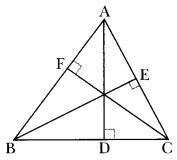
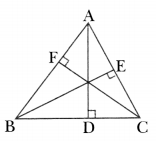
In a triangle, an altitude is a line segment drawn from a vertex perpendicular to its opposite side. In the given figure, AD, BE and CF are the altitudes of the ∆ABC.
A Tale of Three Intersecting Lines Class 7 Notes Maths Chapter 7-4
Each triangle has 3 altitudes.

Triangle Inequality Theorem:
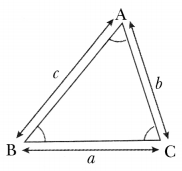
The sum of any two sides of a triangle is greater than the third side.
In the given triangle ABC, we have b + c > a, c + a > b and a + b > c.

Angle Sum Property: The sum of the three interior angles of any triangle is always 180°.
i.e., ∠A + ∠B + ∠C = 180°
A Tale of Three Intersecting Lines Class 7 Notes Maths Chapter 7-5

A Tale of Three Intersecting Lines Class 7 Notes Maths Chapter 7

Exterior Angle Property:
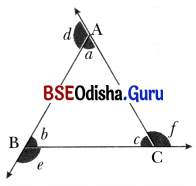
If a side of a triangle is extended, the exterior angle formed is equal to the sum of the two interior opposite angles.
i.e., ∠a + ∠b = ∠f, ∠b + ∠c = ∠d and ∠a + ∠c = ∠e
The sum of exterior angles of a triangle is 360°.
i.e., ∠d + ∠e + ∠f = 360°
A Tale of Three Intersecting Lines Class 7 Notes Maths Chapter 7-6

There are three types of triangles on the basis of measure of their interior angles.

Acute Angled Triangle All three angles are less than 90° A Tale of Three Intersecting Lines Class 7 Notes Maths Chapter 7-7
Right Angled Triangle One angle is 90° and other two are less than 90°. A Tale of Three Intersecting Lines Class 7 Notes Maths Chapter 7-8
Obtuse Angled Triangle One angle is more than 90° and other two are less than 90°. A Tale of Three Intersecting Lines Class 7 Notes Maths Chapter 7-9

To construct a triangle, we need at least three elements. These can be:
Three sides, or
Two sides and the included angle, or
Two angles and the included side

Construction of triangles when three sides are given
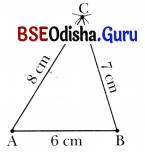
To construct a triangle ABC with sides AB = 6 cm, BC = 7 cm andTC = 8 cm, follow the steps laid down below:
A Tale of Three Intersecting Lines Class 7 Notes Maths Chapter 7-10
Step 1: Draw a line segment AB of 6 cm using a ruler.
Step 2: With B as centre, draw7 an arc with radius 7 cm.
Step 3: With A as centre, draw an arc with radius 8 cm to cut the previous arc at point C.
Step 4: Join C to A and B. Thus, AABC is required triangle.

A Tale of Three Intersecting Lines Class 7 Notes Maths Chapter 7

Construction of triangles when two sides and the included angle are given
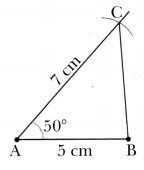
If two sides (say AB = 5 cm and AC = 7 cm) along with the included angle (say ∠A then we follow the steps for constructing triangle as follows:
A Tale of Three Intersecting Lines Class 7 Notes Maths Chapter 7-11
Step 1: Using a ruler, drawn a line segment AB of length 5 cm.
Step 2: Using protractor, draw the given vertex angle, ∠A = 50°.
Step 3: On the new arm created from ∠A, mark a point C such that AC = 7 cm using ruler and compass.
Step 4: Using a ruler, connect points B and C to complete the triangle ABC.

Construction of triangles when two angles and the included side are given
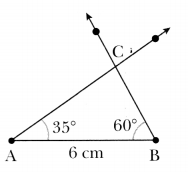
If two angles (say ∠A = 35° and ∠B = 60°) along with the included side (say AB = 6 cm) are given, then the steps for constructing triangle are as follows:
A Tale of Three Intersecting Lines Class 7 Notes Maths Chapter 7-12
Step 1: Using a ruler, draw a line segment.-Id of length 6 cm.
Step 2: Using protractor, draw the given vertex angle, ∠A = 35°, by placing protractor at vertex A.
Step 3: Using protractor, draw the given vertex angle, ∠B = 60°, by accurately placing the protractor at vertex B.
Step 4: If the two new lines (arms of angles) are intersecting, then mark the intersection point as C. If not, then extend the two new lines such that they intersect at a point. Mark that point as C.
Thus, the required triangle, ∆ABC is constructed.

Triangle
A triangle is a dosed plane figuie ioimed by three non-parallel line segments. T he symbol “A” is used to denote a triangle (e.g., ∆ABC).
A Tale of Three Intersecting Lines Class 7 Notes Maths Chapter 7-13
Altitude: In a triangle, an altitude is a line segment drawn from a vertex perpendicular to its opposite side. In the given figure, AD,
BE and CF are the altitudes of the ∆ABC.
NOTE:
Each triangle has 3 altitudes.
Two perpendicular sides in a right angled triangle are its altitudes.

A Tale of Three Intersecting Lines Class 7 Notes Maths Chapter 7

Based on Angles
Acute Angled Triangle
All three angles are less than 90°.
A Tale of Three Intersecting Lines Class 7 Notes Maths Chapter 7-14

Right Angled Triangle
One angle is 90° and other two are less than 90°.
A Tale of Three Intersecting Lines Class 7 Notes Maths Chapter 7-15

Obtuse Angled Triangle
One angle is more than 90° and other two are less than 90°.
A Tale of Three Intersecting Lines Class 7 Notes Maths Chapter 7-16

Based on Sides
Equilateral Triangle
All three sides are equal in length.
All three angles are equal, each measuring 60°.
A Tale of Three Intersecting Lines Class 7 Notes Maths Chapter 7-17

Isosceles Triangle
Any two sides of a triangle are equal in length.
Angles opposite to equal sides are equal in measure.
A Tale of Three Intersecting Lines Class 7 Notes Maths Chapter 7-18

Scalene Triangle
Three sides of a triangle are different in length.
A Tale of Three Intersecting Lines Class 7 Notes Maths Chapter 7-19

Number Play Class 7 Notes Maths Chapter 6

Easy-to-read Ganita Prakash Class 7 Notes and Chapter 6 Number Play Class 7 Notes save valuable study time during exam season.

Class 7 Maths Chapter 6 Number Play Notes

Class 7 Number Play Notes

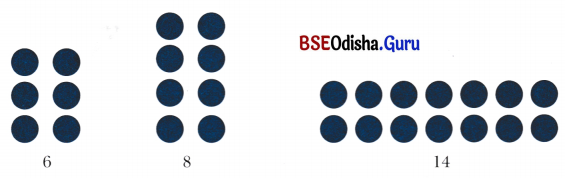
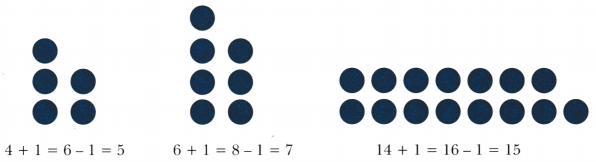
A number that can be arranged in pairs without any leftovers is called an even number.
Number Play Class 7 Notes Maths Chapter 6-1

A number that cannot be arranged in pairs is called an odd number.
Number Play Class 7 Notes Maths Chapter 6-2

Parity denotes the property of a number being classified as even or odd.
For example, 9 has odd parity and 8 has even parity.

The parity of sum or difference of numbers is given as:

  1. Even + Even = Even; Even – Even = Even
  2. Odd + Odd = Even; Odd – Odd = Even
  3. Odd + Even = Odd; Odd – Even = Odd

The parity of product of two numbers is given as:
(i) Even × Even = Even
(ii) Odd × Odd = Odd
(iii) Odd × Even = Even

Number Play Class 7 Notes Maths Chapter 6

Parity of Expressions

  • The parity of 2n is always even, where n = 0, 1, 2, 3, 4, 5,…
  • The parity of 2n – 1 or 2n + 1 is always odd, where n = 1, 2, 3, 4, 5, …
  • The parity of n2 is the same as n., where n = 0, 1, 2, 3, 4, 5, …

A magic square is a numerical arrangement in a square grid in which the sums of all rows, columns, and diagonals are equal, and this constant total is termed as the magic sum.

For a 3 × 3 magic square using digits 1-9:
Magic sum =15
Centre position → always 5
Corner positions → even numbers
Middle-edge positions → odd numbers

6 1 8
7 5 3
2 9 4

We can generate new magic squares from an existing one by applying simple arithmetic operations like addition, subtraction, or multiplication to each number in the square. These transformations will change the magic sum while preserving the magic square structure.

If each entry of a 3 × 3 magic square is increased by n, the magic sum becomes (15 + 3n); if each entry is decreased by n, the magic sum becomes (15 – 3n); and if each entry is multiplied by n, the magic sum becomes (15 × n).

The number pattern 1, 2, 3, 5, 8, 13, 21, 34… is known as the Virahanka-Fibonacci sequence. Each term in the sequence is obtained by adding the two previous terms.

  1. 1 + 2 = 3
  2. 2 + 3 = 5
  3. 3 + 5 = 8, and so on.

Number Play Class 7 Notes Maths Chapter 6

Applications of the Virahanka-Fibonacci Sequence
Poetry and Music: Used in syllable arrangements or rhythms.
Nature: The numbers of petals in daisy flowers follow this pattern.
Honeybees: The ancestry of honeybees also forms Fibonacci sequence.

Cryptarithms: Cryptarithms are mathematical puzzles where letters represent unique digits. The goal is to solve the arithmetic problem by finding the correct digit-letter combination.

In cryptarithms, letters takes values from the digits 0-9.
The important points to remember while solving cryptarithms problems are:

  1. Each letter stands for unique digit.
  2. Same letter always means the same digit.
  3. Different letters mean different digits.

For example:
Number Play Class 7 Notes Maths Chapter 6-3
Here, 2 + C = 6 ⇒ C = 4
Now, B + 6 = EC = E4 [Since C = 4]
⇒ B = 8 and E = 1

Parity
Parity denotes the property of a number being classified as even or odd. For example, 9 has odd parity and 8 has even parity.

Parity of Numbers

  1. Even + Even = Even
  2. Odd + Odd = Even
  3. Odd + Even = Odd
  4. Even × Even = Even
  5. Odd × Odd = Odd
  6. Odd × Even = Even

Parity of Expressions

  1. 2w → Always even, where n = 0, 1,2, 3, 4, 5. …
  2. 2n – 1 or 2n + 1 → Always odd, where n = 1, 2, 3, 4. 5. …
  3. The parity of n2 is the same as n, where n = 0, 1, 2, 3, 4, 5, …

Number Play Class 7 Notes Maths Chapter 6

Magic Square
A magic square is a numerical arrangement in a square grid in which the sums of all rows, columns, and diagonals are equal, and this constant total is termed as the magic sum.
For a 3 × 3 magic square using digits 1-9:
Magic sum = 15
Centre position→ always 5
Corner positions → even numbers
Middle-edge positions → odd numbers

6 1 8
7 5 3
2 9 4

If each entry of a 3 × 3 magic square is increased by n, magic sum becomes (15 + 3n).
If each entry of a 3 × 3 magic square is decreased bv n, magic sum becomes (15 – 3n).
If each entry of a 3 × 3 magic square is multiplied by n, magic sum becomes (15 × n).

Digits in Disguise (Cryptarithms/Alphametics)
In Cryptarithms, letters takes values from the digits 0-9.
The important points to remember while solving Cryptarithms are:

  1. Each letter stands for unique digit.
  2. Same letter always means the same digit.
  3. Different letters mean different digits.
    For example:
    Number Play Class 7 Notes Maths Chapter 6-4

Here, 2 + Q = 8 ⇒ Q = 6
Now, P + 7 = RQ = R6 [Since Q = 6]
⇒ P = 9 and R = 1

Number Play Class 7 Notes Maths Chapter 6

Virahanka-Fibonacci Sequence
The number pattern 1, 2, 3, 5, 8, 13, 2h, 34… is known as the Virahanka-Fibonacci sequence.
Each term in the sequence is obtained by adding the two previous terms.

  1. 1 + 2 = 3
  2. 2 + 3 = 5
  3. 3 + 5 = 8, and so on.

Parallel and Intersecting Lines Class 7 Notes Maths Chapter 5

Easy-to-read Ganita Prakash Class 7 Notes and Chapter 5 Parallel and Intersecting Lines Class 7 Notes save valuable study time during exam season.

Class 7 Maths Chapter 5 Parallel and Intersecting Lines Notes

Class 7 Parallel and Intersecting Lines Notes

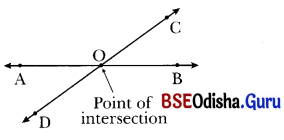
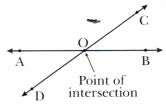
Two lines that cross each other at exactly one point are called intersecting lines. The point at which two lines meet, is called the point of intersection.
Parallel and Intersecting Lines Class 7 Notes Maths Chapter 5-1

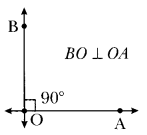
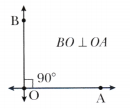
When two lines intersect and form an angle of 90°, they are called perpendicular lines.
Parallel and Intersecting Lines Class 7 Notes Maths Chapter 5-2

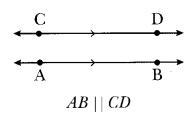
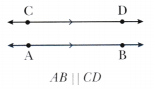
Two lines on the same plane that never meet, no matter how far they are extended at both ends are called parallel lines.
Parallel and Intersecting Lines Class 7 Notes Maths Chapter 5-3

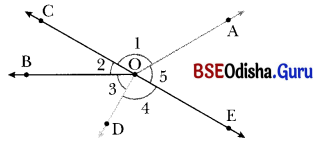
When two or more rays originate from a common initial point, they form different angles around that point. Such angles are collectively known as angles at a point.
Parallel and Intersecting Lines Class 7 Notes Maths Chapter 5-4

Parallel and Intersecting Lines Class 7 Notes Maths Chapter 5

The sum of all angles around a point is always 360° as they form a complete angle.
Thus, ∠1 + ∠2 + ∠3 + ∠4 + ∠5 = 360°

  1. Two angles are said to be complementary if the sum of their measures is 90°.
  2. Two angles are called supplementary if the sum of their measures is 180°.

Two angles in a plane are said to be adjacent angles if:
Parallel and Intersecting Lines Class 7 Notes Maths Chapter 5-5

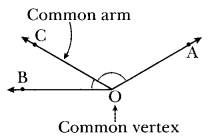
(i) they have a common vertex and a common arm.
(ii) their other arms lie on the opposite side of the common arm.
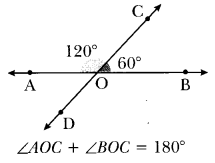
For example, ∠AOC and ∠BOC are adjacent angles.

A linear pair of angles is a pair of adjacent angles whose non-common arms form a straight line.
Parallel and Intersecting Lines Class 7 Notes Maths Chapter 5-6
The sum of the angles in a linear pair is always 180°.

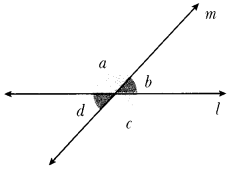
When two lines intersect, the angles opposite to each other are called vertically opposite angles. They are always equal.
Parallel and Intersecting Lines Class 7 Notes Maths Chapter 5-7
In the given figure, ∠a and ∠c, ∠b and ∠d are vertically opposite angles.
Thus, ∠a = ∠c and ∠b = ∠d.

Parallel and Intersecting Lines Class 7 Notes Maths Chapter 5

Transversal is a line that intersects a set of two or more lines at distinct points.
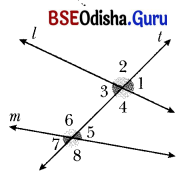
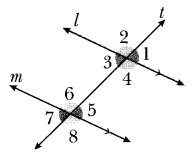
Angles formed by a transversal (t) intersecting a pair of non-parallel lines (l and m):

Interior Angles
Parallel and Intersecting Lines Class 7 Notes Maths Chapter 5-8
When a transversal intersects two lines, the angles that lie between the two lines are called interior angles.
In the given figure, ∠3, ∠4, ∠5 and ∠6 are interior angles.
The pair of interior angles on the same side of the transversal are called
co-interior (consecutive interior) angles.

  1. ∠4 and ∠5 are co-interior (consecutive interior) angles.
  2. ∠3 and ∠6 are co-interior (consecutive interior) angles

Exterior Angles
When a transversal intersects two lines, the angles that lie outside the two lines are called exterior angles.

In the given figure, ∠1, ∠2, ∠7 and ∠8 are exterior angles.

The pair of exterior angles on the same side of the transversal are called co-exterior (consecutive exterior) angles.

  1. ∠l and ∠8 are co-exterior (consecutive exterior) angles.
  2. ∠2 and ∠7 are co-exterior (consecutive exterior) angles

Parallel and Intersecting Lines Class 7 Notes Maths Chapter 5

Corresponding Angles
The pair of angles on one side of the transversal, one of which is an exterior angle while the other is an interior angle, but together do not form a linear pair are known as corresponding angles.

In the figure, when a transversal t cuts across two lines l and m, it creates two sets of four angles — one set at the intersection with line l, and another at the intersection with line m.

In the figure, pairs of corresponding angles are: ∠1 and ∠5; ∠2 and ∠6; ∠3 and ∠7; ∠4 and ∠8.

Although ∠5 and ∠8 lie on the same side of transversal, and ∠5 is an interior angle while ∠8 is an exterior angle but they are not corresponding to each other as together they form linear pair.

Parallel and Intersecting Lines Class 7 Notes Maths Chapter 5

Alternate Angles
When a transversal intersects two lines, the pair of angles that lie on opposite sides of the transversal are called alternate angles.
When a transversal cuts two lines,

  1. the angles that lie inside the two lines and on opposite sides of the transversal are called alternate interior angles.
  2. the angles that lie outside the two lines and on opposite sides of the transversal are called alternate exterior angles.

In the given figure, a transversal t cuts across two lines l and m,

  1. Alternate interior angle: ∠3 and ∠5; ∠4 and ∠6
  2. Alternate exterior angle: ∠1 and ∠7; ∠2 and ∠8

When a transversal (t) intersects a pair of lines (l and m) that are parallel to each other, then:
Parallel and Intersecting Lines Class 7 Notes Maths Chapter 5-9
(i) the alternate angles are equal to each other, i.e. ∠3 = ∠5, ∠4 = ∠Z6, ∠1 = ∠7 and ∠2 = ∠8.
(iii) the sum of co-interior angles and co-exterior angles is 180°,
i. e. ∠4 + ∠5 = 180°; ∠3 + ∠6 = 180° and ∠1 + ∠8 = 180°; ∠2 + ∠7 = 180°.

Conversely, if any of the above three properties holds when two lines are intersected by a transversal, then the two lines must be parallel to each other.

Parallel and Intersecting Lines Class 7 Notes Maths Chapter 5

Important Points to Remember

  1. A plane is a flat two-dimensional surface (e.g., paper, table top, blackboard).
  2. A line has no thickness and extends infinitely in both directions.
  3. Complement of angle x° is (90° – x°). Supplement of angle x° is (180° – x°).
  4. Complementary and supplementary angles may or may not share a common arm, i.e. they may or may not be adjacent angles.

Types of Lines
Intersecting Lines: Two lines that cross each other at exactly one point are called intersecting lines.
Parallel and Intersecting Lines Class 7 Notes Maths Chapter 5-10

Perpendicular Lines: When two lines intersect and form an angle of 90°, they are called perpendicular lines.
Parallel and Intersecting Lines Class 7 Notes Maths Chapter 5-11

Parallel Lines: Two lines on the same plane that never meet, no matter how far they are extended at both ends are called parallel lines.
Parallel and Intersecting Lines Class 7 Notes Maths Chapter 5-12

Parallel and Intersecting Lines Class 7 Notes Maths Chapter 5

Pair of Angles

Adjacent Angles

Linear Pairs

Vertically Opposite Angles

Two angles in a plane are said to be adjacent angles if:

(i) they have a common vertex and a common arm.

(ii) their other arms lie on the opposite side of the common arm.

A linear pair of angles is a pair of adjacent angles whose non-common arms form a straight line.

The sum of the angles in a linear pair is always 180°.

When two lines intersect, the angles opposite to each other are called vertically opposite angles.

They are always equal.

Note: (i) The sum of angles at a point is always 360°.
(ii) Two angles are said to be complementary if the sum of their measures is 90°.
(iii) Two angles are called supplementary if the sum of their measures is 180°.

Electricity: Circuits and Their Components Class 7 Question Answer Science Chapter 3

Go through BSE Odisha Class 7 Science Solutions and Class 7 Science Chapter 3 Electricity: Circuits and Their Components Question Answer to understand textbook questions more clearly.

Class 7 Science Curiosity Chapter 3 Question Answer

Science Curiosity Class 7 Chapter 3 Question Answer

Electricity: Circuits and Their Components Class 7 Questions and Answers

Let Us Enhance Our Learning

Question 1.
Choose the incorrect statement.
Electricity Circuits and Their Components Class 7 Question Answer Science Chapter 3.1
(a) A switch is the source of electric current in a circuit.
(b) A switch helps to complete or break the circuit.
(c) A switch helps us to use electricity as per our requirement.
(d) When the switch is in ‘OFF’ position, there is an air gap between its terminals.
Answer:
(a) A switch does not produce current; it only helps to complete or break the circuit.

 Electricity: Circuits and Their Components Class 7 Question Answer Science Chapter 3

Question 2.
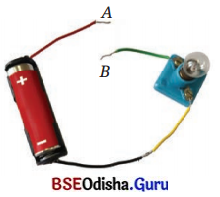
Observe the given figure alongside. With which material connected between the ends A and B, the lamp will not glow?
Answer:
The lamp will not glow when an insulator such as rubber, plastic, cork, paper, wood, or glass is connected between the ends A and B.

Question 3.
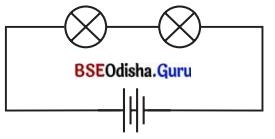
In the given figure, if the filament of one of the lamps is broken, will the other glow? Justify your answer.
Electricity Circuits and Their Components Class 7 Question Answer Science Chapter 3.2
Answer:
No, if the filament of one of the lamps is broken, the other lamp will not glow. This is because both lamps are connected in the same circuit along a single path. When the filament of one lamp is broken, the circuit path gets broken, and the current cannot flow through it.

Question 4.
A student forgot to remove the insulator covering from the connecting wires while making a circuit. If the lamp and the cell are working properly, will the lamp glow?
Answer:
No, the lamp will not glow. The insulating covering on the wires does not allow an electric current to pass through. As a result, the circuit remains incomplete, and the lamp does not glow.

Question 5.
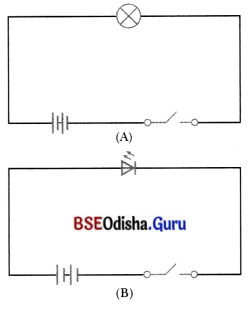
Draw a circuit diagram for a simple torch using symbols for electric components.
Answer:
Electricity Circuits and Their Components Class 7 Question Answer Science Chapter 3.7
A simple torch consists of an electric cell (battery), a switch, and a lamp or an LED connected in a closed circuit. The figure (A) represents the circuit diagram of a torch with a lamp, and figure (B) represents the circuit diagram of a torch with an LED.

 Electricity: Circuits and Their Components Class 7 Question Answer Science Chapter 3

Question 6.
In the given figure:
Electricity Circuits and Their Components Class 7 Question Answer Science Chapter 3.3
(i) If S2 is in ‘ ON ‘ position, S1 is in ‘OFF’ position, which lamps(s) will glow?
(ii) If S2 is in ‘OFF’ position, S1 is in ‘ON’ position, which lamps(s) will glow?
(iii) If S1 and S2 both are in ‘ON’ position, which lamp(s) will glow?
(iv) If S1 and S2 both are in ‘OFF’ position, which lamp(s) will glow?
Ans.
(i) S2 ON, S1 OFF: No lamp will glow.
(ii) S2 OFF, S1-ON : No lamp will glow.
(iii) S1 and S2 – both ON : Both lamps L1 and L2 will glow.
(iv) S1 and S2 – both OFF: No lamp will glow.
The electric current flows only when the circuit is complete. Both switches S1 and S2 must be in ON position to complete the circuit and make the lamps glow.

Question 7.
Vidyut has made the circuit as shown in the figure below. Even after closing the circuit, the lamp does not glow. What can be the possible reasons? List as many possible reasons as you can for this faulty operation. What will you do to find out why the lamp did not glow?
Electricity Circuits and Their Components Class 7 Question Answer Science Chapter 3.4
Answer:
Possible reasons:

  • The cell may be discharged.
  • The circuit is open at some point (for example, a loose or broken connection), so there is no complete path for the current to flow.
  • The lamp is fused (its filament is broken), so current cannot pass through it.
  • The switch is not properly closed (remains open), so the circuit path is incomplete.
  • The ends of the connecting wires are not making metal-to-metal contact because the insulating covering has not been removed, preventing the flow of current.

To find the fault:

  • Replace the cell with a new working one to check whether the old cell is weak or discharged.
  • Check the switch by turning it ON and ensuring it properly closes the circuit gap.
  • Inspect all connections carefully and look for loose or broken joints.
  • Tighten the connections so that the bare wire firmly touches the terminals, and there is no insulation in between.
  • Test the lamp in another working circuit to confirm whether its filament is intact.

 Electricity: Circuits and Their Components Class 7 Question Answer Science Chapter 3

Question 8.
In the figures given below, in which case(s) the lamp will not glow when the switch is closed?
Answer:
Electricity Circuits and Their Components Class 7 Question Answer Science Chapter 3.5
In case (c), the LED will not glow when the switch is closed, because it is connected in the reverse direction (positive terminal of LED is connected to the negative terminal of the cell), and current cannot pass through it.

Question 9.
Suppose the ‘+’ and ‘-‘ symbols cannot be read on a battery. Suggest a method to identify the two terminals of this battery.
Answer:
The terminals of a battery can be identified using an LED:

  • Connect an LED across the two terminals of the battery.
  • If the LED glows, the terminal connected to the longer leg of the LED is positive, and the other terminal is negative.
  • If the LED does not glow, interchange the connections. When the LED glows after interchanging, the battery terminal connected to the longer leg of the LED is the positive.

Question 10.
You are given six cells marked A, B, C, D, E, and F. Some of these are working and some are not. Design an activity to identify which of them are working.
(i) List the items that you require.
(ii) Write the procedure that you will follow.
(iii) With the items, carry out the activity to identify the cells that are working.
Answer:
(i) Items required: An electric lamp (or LED), a cell holder, and connecting wires.
(ii) Procedure:

  • Prepare a testing setup by connecting the terminals of a bulb (lamp) with two wires.
  • Attach the free end of the wires to the two terminals of the cell A and observe whether the lamp glows (If an LED is used instead of a lamp and it does not glow, reverse the connections of the LED and try again).
  • If the lamp glows, the cell is working.
  • If the lamp does not glow, the cell may be weak or dead.
  • Repeat the same process with the remaining cells B, C, D, E, and F, one at a time.

(iii) Observation and conclusion: If the lamp glows upon using a particular cell, it shows that the cell is providing current and is therefore working. If the lamp does not glow, the cell is not supplying current and is therefore not working.

 Electricity: Circuits and Their Components Class 7 Question Answer Science Chapter 3

Question 11.
An LED requires two cells in series to glow. Tanya made the circuit as shown in the figure. Will the lamp glow? If not, draw the wires for correct connections.
Electricity Circuits and Their Components Class 7 Question Answer Science Chapter 3.6
Answer:
No, the LED will not glow.
The correct connection for the LED to glow is as follows:
Electricity Circuits and Their Components Class 7 Question Answer Science Chapter 3.8

Class 7 Curiosity Chapter 3 Question Answer

InText Questions

Question 1.
Why does a torch lamp glow only in one position of the switch? [Page 24]
Answer:
A torch lamp glows only when the circuit is closed. When the switch is ON, the circuit is closed, and electric current flows, so the lamp glows. When the switch is OFF, the circuit is broken, current cannot flow, and the lamp does not glow.

Question 2.
In a torch, we generally use more than one cell. Are those placed in any particular order? [Page 25]
Answer:
Yes. The cells must be placed so that the positive terminal of one cell touches the negative terminal of the next, forming a battery.

Question 3.
Which part of the incandescent lamp glows to produce light? [Page 26]
Answer:
The filament (the thin wire inside the glass bulb) gets hot and glows to produce light.

 Electricity: Circuits and Their Components Class 7 Question Answer Science Chapter 3

Question 4.
Sometimes you may come across a device in which the cells are placed side by side. How are the terminals of these cells connected? [Page 31]
Answer:
Inside such a battery compartment, a thick wire or metal strip connects the positive terminal of one cell to the negative terminal of the next.

Question 5.
Why do we use metal wires for making electric circuits? [Page 34]
Answer:
Metal wires (like copper) are used for making electric circuits because metals are good conductors of electricity. They allow electric current to pass through them easily.

Question 6.
Why are electric wires covered with plastic or rubber? [Page 34]
Answer:
Electric wires are covered with plastic or rubber because these are insulators. They prevent electric current from escaping the metal core and entering the human body. This protects users from electric shocks and makes handling wires, plugs, and switches safe.

 Electricity: Circuits and Their Components Class 7 Question Answer Science Chapter 3

Question 7.
In the circuit symbol of an LED, what does the direction of the triangle represent, and what do the two outward arrows indicate? [Page 34]
Answer:
In the symbol for an LED, the triangle points to the direction in which the current can flow. The two arrows indicate that light is emitted by an LED.